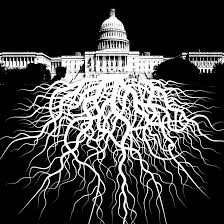
The Empire of Lies Breaks Down: Ugly Truths the Deep State Wants to Keep Hidden

By John W. Whitehead & Nisha Whitehead

Source: The Rutherford Institute

“The world is a dangerous place, not because of those who do evil, but because of those who look on and do nothing.”—Albert Einstein

America is breaking down.

This breakdown—triggered by polarizing circus politics, media-fed mass hysteria, racism, classism, fascism, fear-mongering, political correctness, cultural sanitation, virtue signaling, a sense of hopelessness and powerlessness in the face of growing government corruption and brutality, a growing economic divide that has much of the population struggling to get by, and militarization and militainment (the selling of war and violence as entertainment)—is manifesting itself in madness, mayhem and an utter disregard for the very principles and liberties that have kept us out of the clutches of totalitarianism for so long.

In New York City, for example, a 200-year-old statue of Thomas Jefferson holding the Declaration of Independence will be removed from the City Council’s chambers where it has presided since 1915. Despite Jefferson’s many significant accomplishments, without which we might not have the rights we do today, he will be banished for having been, like many of his day, a slaveowner. Curiously, that same brutal expectation of infallibility has yet to be applied to many other politically correct yet equally imperfect and fallible role models of the day.

In Washington, DC, a tribunal of nine men and women spoke with one voice to affirm that the government and its henchmen can literally get away with murder and not be held accountable for their wrongdoing. The Supreme Court’s latest rulings are yet another painful lesson in compliance, a reminder that in the American police state, “we the people” are at the mercy of law enforcement officers who have almost absolute discretion to decide who is a threat, what constitutes resistance, and how harshly they can deal with the citizens they were appointed to ‘serve and protect.”

All across the country, from California to Connecticut and every point in between, men and women who have worked faithfully and diligently at their jobs for years are being terminated for daring to believe that they have a right to bodily integrity; that they should not be forced, against their conscience or better judgment, to choose between individual liberty and economic survival; and that they—and not the government, or the FDA, or the CDC, or the Corporate State—have dominion over their bodies. Conveniently enough, this COVID-19 pandemic has created yet another double standard in how “we the people” navigate this country: while “we the middling classes” are subjected to vaccine mandates and denied even the right to be skeptical about the origins of the COVID virus, let alone the efficacy of the so-called cure, the government, corporations and pharmaceutical companies have been shielded from liability with blanket immunity laws that ensure we are little more than guinea pigs for their questionable experiments.

And then in Pennsylvania, a man traveling on a commuter train harassed, assaulted and then raped a woman over the course of 40 minutes and more than two dozen train stops while fellow travelers, watching and filming the attack, did nothing. Not a single witness called 911. Not a single bystander intervened to help the woman. Despite the fact that the man was outnumbered and could have been overwhelmed by those on the train, no collective effort was made to ward off the attack. Only when it was too late, when the damage had been done and the train had pulled into its last stop, did police show up to intervene.

There is an allegory here for what is happening to our country and its citizens, who have also been waylaid by a madman (the Deep State), stripped of their safety nets (their rights undermined and eroded), and savaged out in the open by a fiend (the American Police State and its many operatives—the courts, the legislatures and their various armies) that is devoid of humanity while those not in the immediate crosshairs watch safely from a distance without making a move to help.

This is madness, yet there is a method to this madness.

This is how freedom falls and tyranny rises.

Remember, authoritarian regimes begin with incremental steps: overcriminalization, surveillance of innocent citizens, imprisonment for nonviolent—victimless—crimes, etc. Bit by bit, the citizenry finds its freedoms being curtailed and undermined for the sake of national security. And slowly the populace begins to submit.

No one speaks up for those being targeted.

No one resists these minor acts of oppression.

No one recognizes the indoctrination into tyranny for what it is.

Historically this failure to speak truth to power has resulted in whole populations being conditioned to tolerate unspoken cruelty toward their fellow human beings, a bystander syndrome in which people remain silent and disengaged—mere onlookers—in the face of abject horrors and injustice.

Time has insulated us from the violence perpetrated by past regimes in their pursuit of power: the crucifixion and slaughter of innocents by the Romans, the torture of the Inquisition, the atrocities of the Nazis, the butchery of the Fascists, the bloodshed by the Communists, and the cold-blooded war machines run by the military industrial complex.

We can disassociate from such violence. We can convince ourselves that we are somehow different from the victims of government abuse. We can continue to spout empty political rhetoric about how great America is, despite the evidence to the contrary.

We can avoid responsibility for holding the government accountable.

We can zip our lips and bind our hands and shut our eyes.

In other words, we can continue to exist in a state of denial. Yet there is no denying the ugly, hard truths that become more evident with every passing day.

  1. The government is not our friend. Nor does it work for “we the people.”
  2. Our so-called government representatives do not actually represent us, the citizenry. We are now ruled by an oligarchic elite of governmental and corporate interests whose main interest is in perpetuating power and control.
  3. Republicans and Democrats like to act as if there’s a huge difference between them and their policies. However, they are not sworn enemies so much as they are partners in crime, united in a common goal, which is to maintain the status quo.
  4. The lesser of two evils is still evil.
  5. Some years ago, a newspaper headline asked the question: “What’s the difference between a politician and a psychopath?” The answer, then and now, remains the same: None. There is virtually no difference between psychopaths and politicians.
  6. More than terrorism, more than domestic extremism, more than gun violence and organized crime, the U.S. government has become a greater menace to the life, liberty and property of its citizens than any of the so-called dangers from which the government claims to protect us
  7. The government knows exactly which buttons to push in order to manipulate the populace and gain the public’s cooperation and compliance.
  8. If voting made any difference, they wouldn’t let us do it.
  9. America’s shadow government—which is comprised of unelected government bureaucrats, corporations, contractors, paper-pushers, and button-pushers who are actually calling the shots behind the scenes right now and operates beyond the reach of the Constitution with no real accountability to the citizenry—is the real reason why “we the people” have no control over our government.
  10. You no longer have to be poor, black or guilty to be treated like a criminal in America. All that is required is that you belong to the suspect class—that is, the citizenry—of the American police state. As a de facto member of this so-called criminal class, every U.S. citizen is now guilty until proven innocent.
  11. “We the people” are no longer shielded by the rule of law. By gradually whittling away at our freedoms—free speech, assembly, due process, privacy, etc.—the government has, in effect, liberated itself from its contractual agreement to respect our constitutional rights while resetting the calendar back to a time when we had no Bill of Rights to protect us from the long arm of the government.
  12. Private property means nothing if the government can take your home, car or money under the flimsiest of pretexts, whether it be asset forfeiture schemes, eminent domain or overdue property taxes. Likewise, private property means little at a time when SWAT teams and other government agents can invade your home, break down your doors, kill your dog, wound or kill you, damage your furnishings and terrorize your family
  13. We now find ourselves caught in the crosshairs of a showdown between the rights of the individual and the so-called “emergency” state, and “we the people” are losing.
  14. All of those freedoms we cherish—the ones enshrined in the Constitution, the ones that affirm our right to free speech and assembly, due process, privacy, bodily integrity, the right to not have police seize our property without a warrant, or search and detain us without probable cause—amount to nothing when the government and its agents are allowed to disregard those prohibitions on government overreach at will.
  15. If there is an absolute maxim by which the federal government seems to operate, it is that the American taxpayer always gets ripped off.
  16. Our freedoms—especially the Fourth Amendment—continue to be choked out by a prevailing view among government bureaucrats that they have the right to search, seize, strip, scan, spy on, probe, pat down, taser, and arrest any individual at any time and for the slightest provocation.
  17. Forced vaccinations, forced cavity searches, forced colonoscopies, forced blood draws, forced breath-alcohol tests, forced DNA extractions, forced eye scans, forced inclusion in biometric databases: these are just a few ways in which Americans continue to be reminded that we have no control over what happens to our bodies during an encounter with government officials.
  18. Finally, freedom is never free. There is always a price—always a sacrifice—that must be made in order to safeguard one’s freedoms.

We cannot remain silent in the face of the government’s ongoing overreaches, power grabs, and crimes against humanity.

Evil disguised as bureaucracy is still evil. Indeed, this is what Hannah Arendt referred to as the banality of evil.

As I make clear in my book Battlefield America: The War on the American People and in its fictional counterpart The Erik Blair Diaries, such evil happens when bureaucrats (governmental and corporate) unquestioningly carry out orders that are immoral and inhumane; obey immoral instructions unthinkingly; march in lockstep with tyrants; mindlessly perpetuate acts of terror and inhumanity; and justify it all as just “doing one’s job.”

Such evil prevails when good men and women do nothing.

By doing nothing, by remaining silent, by being bystanders to injustice, hate and wrongdoing, good people become as guilty as the perpetrator.

There’s a term for this phenomenon where people stand by, watch and do nothing—even when there is no risk to their safety—while some horrific act takes place (someone is mugged or raped or bullied or left to die): it’s called the bystander effect.

It works the same whether you’re talking about kids watching bullies torment a fellow student on a playground, bystanders watching someone dying on a sidewalk, passengers on a train filming a fellow traveler be raped without intervening to help, or citizens remaining silent in the face of government atrocities.

We need to stop being silent bystanders.

It’s time to stand up for truth—for justice—for freedom—not just for ourselves but for all humanity. Tomorrow may be too late.

The State of Our Nation: Still Divided, Enslaved & Locked Down

By John W. Whitehead & Nisha Whitehead

Source: The Rutherford Institute

A house divided against itself cannot stand. I believe this government cannot endure, permanently, half slave and half free. I do not expect the Union to be dissolved—I do not expect the house to fall—but I do expect it will cease to be divided. It will become all one thing or all the other.”—Abraham Lincoln

History has a funny way of circling back on itself.

The facts, figures, faces and technology may change from era to era, but the dangers remain the same.

This year is no different, whatever the politicians and talking heads may say to the contrary.

Sure, there’s a new guy in charge, but for the most part, we’re still recycling the same news stories that have kept us with one eye warily glued to the news for the past 100-odd years: War. Corruption. Brutality. Economic instability. Partisan politics. Militarism. Disease. Hunger. Greed. Violence. Poverty. Ignorance. Hatred.

The more things change, the more they stay the same.

Brush up on your history, and you’ll find that we’ve been stuck on repeat for some time now.

Take the United States of America in the year 2021, which is not so far different from the United States of America during the Civil Rights era, or the Cold War era, or even the Depression era.

Go far enough afield, and you’ll find aspects of our troubled history mirrored in the totalitarianism of Nazi Germany, in the fascism of Mussolini’s Italy, and further back in the militarism of the Roman Empire.

We’re like TV weatherman Phil Connors in Harold Ramis’ classic 1993 comedy Groundhog Day, forced to live the same day over and over again.

Here in the American police state, however, we continue to wake up, hoping each new day, new president and new year will somehow be different from what has come before.

Unfortunately, no matter how we change the narrative, change the characters, change the plot lines, we seem to keep ending up in the same place that we started: enslaved, divided and repeating the mistakes of the past.

You want to know about the true State of our Nation? Listen up.

The State of the Union: The state of our nation is politically polarized, controlled by forces beyond the purview of the average American, and rapidly moving the nation away from its freedom foundation. Over the past year, due in part to the COVID-19 pandemic, Americans have found themselves repeatedly subjected to egregious civil liberties violations, invasive surveillance, martial law, lockdowns, political correctness, erosions of free speech, strip searches, police shootings of unarmed citizens, government spying, the criminalization of lawful activities, warmongering, etc.

The predators of the police state have wreaked havoc on our freedoms, our communities, and our lives. The government does not listen to the citizenry, refuses to abide by the Constitution, and treats taxpayers as a source of funding and little else. Police officers shoot unarmed citizens and their household pets. Government agents—including local police—remain armed to the teeth and act like soldiers on a battlefield. Bloated government agencies continue to fleece taxpayers. Government technicians spy on our emails and phone calls. And government contractors make a killing by waging endless wars abroad.

Consequently, the state of our nation remains bureaucratic, debt-ridden, violent, militarized, fascist, lawless, invasive, corrupt, untrustworthy, mired in war, and unresponsive to the wishes and needs of the electorate.

The policies of the American police state continue unabated.

The Executive Branch: All of the imperial powers amassed by Donald Trump, Barack Obama and George W. Bush—to kill American citizens without due process, to detain suspects indefinitely, to strip Americans of their citizenship rights, to carry out mass surveillance on Americans without probable cause, to suspend laws during wartime, to disregard laws with which he might disagree, to conduct secret wars and convene secret courts, to sanction torture, to sidestep the legislatures and courts with executive orders and signing statements, to direct the military to operate beyond the reach of the law, to act as a dictator and a tyrant, above the law and beyond any real accountability—were inherited by Joe Biden.

Biden has these powers because every successive occupant of the Oval Office has been allowed to expand the reach and power of the presidency through the use of executive orders, decrees, memorandums, proclamations, national security directives and legislative signing statements that can be activated by any sitting president. Those of us who saw this eventuality coming have been warning for years about the growing danger of the Executive Branch with its presidential toolbox of terror that could be used—and abused—by future presidents. The groundwork, we warned, was being laid for a new kind of government where it won’t matter if you’re innocent or guilty, whether you’re a threat to the nation or even if you’re a citizen. What will matter is what the president—or whoever happens to be occupying the Oval Office at the time—thinks. And if he or she thinks you’re a threat to the nation and should be locked up, then you’ll be locked up with no access to the protections our Constitution provides. In effect, you will disappear.

Our warnings continue to go unheeded.

The Legislative Branch:  Congress may well be the most self-serving, semi-corrupt institution in America. Abuses of office runs the gamut from elected representatives neglecting their constituencies to engaging in self-serving practices, including the misuse of eminent domain, earmarking hundreds of millions of dollars in federal contracting in return for personal gain and campaign contributions, having inappropriate ties to lobbyist groups and incorrectly or incompletely disclosing financial information. Pork barrel spending, hastily passed legislation, partisan bickering, a skewed work ethic, graft and moral turpitude have all contributed to the public’s increasing dissatisfaction with congressional leadership. No wonder only 31 percent of Americans approve of the job Congress is doing.

The Judicial Branch: The Supreme Court was intended to be an institution established to intervene and protect the people against the government and its agents when they overstep their bounds. Yet through their deference to police power, preference for security over freedom, and evisceration of our most basic rights for the sake of order and expediency, the justices of the United States Supreme Court have become the guardians of the American police state in which we now live. As a result, sound judgment and justice have largely taken a back seat to legalism, statism and elitism, while preserving the rights of the people has been deprioritized and made to play second fiddle to both governmental and corporate interests. The courts have empowered the government to wreak havoc on our liberties. Protections for private property continue to be undermined. And Americans can no longer rely on the courts to mete out justice.

Shadow Government: Joe Biden inherited more than a bitterly divided nation teetering on the brink of financial catastrophe when he assumed office. He also inherited a shadow government, one that is fully operational and staffed by unelected officials who are, in essence, running the country. Referred to as the Deep State, this shadow government is comprised of unelected government bureaucrats, corporations, contractors, paper-pushers, and button-pushers who are actually calling the shots behind the scenes right now.

Law Enforcement: By and large the term “law enforcement” encompasses all agents within a militarized police state, including the military, local police, and the various agencies such as the Secret Service, FBI, CIA, NSA, etc. Having been given the green light to probe, poke, pinch, taser, search, seize, strip and generally manhandle anyone they see fit in almost any circumstance, all with the general blessing of the courts, America’s law enforcement officials, no longer mere servants of the people entrusted with keeping the peace but now extensions of the military, are part of an elite ruling class dependent on keeping the masses corralled, under control, and treated like suspects and enemies rather than citizens. As a result, police are becoming even more militarized and weaponized, and police shootings of unarmed individuals continue to increase.

A Suspect Surveillance Society: Every dystopian sci-fi film we’ve ever seen is suddenly converging into this present moment in a dangerous trifecta between science, technology and a government that wants to be all-seeing, all-knowing and all-powerful. By tapping into your phone lines and cell phone communications, the government knows what you say. By uploading all of your emails, opening your mail, and reading your Facebook posts and text messages, the government knows what you write. By monitoring your movements with the use of license plate readers, surveillance cameras and other tracking devices, the government knows where you go. By churning through all of the detritus of your life—what you read, where you go, what you say—the government can predict what you will do. By mapping the synapses in your brain, scientists—and in turn, the government—will soon know what you remember. And by accessing your DNA, the government will soon know everything else about you that they don’t already know: your family chart, your ancestry, what you look like, your health history, your inclination to follow orders or chart your own course, etc. Consequently, in the face of DNA evidence that places us at the scene of a crimebehavior sensing technology that interprets our body temperature and facial tics as suspicious, and government surveillance devices that cross-check our biometricslicense plates and DNA against a growing database of unsolved crimes and potential criminals, we are no longer “innocent until proven guilty.”

Military Empire: America’s endless global wars and burgeoning military empire—funded by taxpayer dollars—have depleted our resources, over-extended our military and increased our similarities to the Roman Empire and its eventual demise. Black budget spending has completely undermined any hope of fiscal transparency, with government contractors padding their pockets at the expense of taxpayers and the nation’s infrastructure—railroads, water pipelines, ports, dams, bridges, airports and roads—taking the hit. The U.S. now operates approximately 800 military bases in foreign countries around the globe at an annual cost of at least $156 billion. The consequences of financing a global military presence are dire. In fact, David Walker, former comptroller general of the U.S., believes there are “striking similarities” between America’s current situation and the factors that contributed to the fall of Rome, including “declining moral values and political civility at home, an over-confident and over-extended military in foreign lands and fiscal irresponsibility by the central government.”

I haven’t even touched on the corporate state, the military industrial complex, SWAT team raids, invasive surveillance technology, zero tolerance policies in the schools, overcriminalization, or privatized prisons, to name just a few. However, what I have touched on should be enough to show that the landscape of our freedoms has already changed dramatically from what it once was and will no doubt continue to deteriorate unless Americans can find a way to wrest back control of their government and reclaim their freedoms.

So how do we go about reclaiming our freedoms and reining in our runaway government?

Essentially, there are four camps of thought among the citizenry when it comes to holding the government accountable. Which camp you fall into says a lot about your view of government—or, at least, your view of whichever administration happens to be in power at the time.

In the first camp are those who trust the government to do the right thing, despite the government’s repeated failures in this department.

In the second camp are those who not only don’t trust the government but think the government is out to get them.

In the third camp are those who see government neither as an angel nor a devil, but merely as an entity that needs to be controlled, or as Thomas Jefferson phrased it, bound “down from mischief with the chains of the Constitution.”

Then there’s the fourth camp, comprised of individuals who pay little to no attention to the workings of government. Easily entertained, easily distracted, easily led, these are the ones who make the government’s job far easier than it should be.

It is easy to be diverted, distracted and amused by the antics of politicians, the pomp and circumstance of awards shows, athletic events, and entertainment news, and the feel-good evangelism that passes for religion today.

What is far more difficult to face up to is the reality of life in America, where unemployment, poverty, inequality, injustice and violence by government agents are increasingly norms.

The powers-that-be want us to remain divided, alienated from each other based on our politics, our bank accounts, our religion, our race and our value systems. Yet as George Orwell observed, “The real division is not between conservatives and revolutionaries but between authoritarians and libertarians.”

The only distinction that matters anymore is where you stand in the American police state.

In other words, you’re either part of the problem or part of the solution.

America is at a crossroads.

History may show that from this point forward, we will have left behind any semblance of constitutional government and entered into a militaristic state where all citizens are suspects and security trumps freedom.

Certainly, we have moved beyond the era of representative government and entered a new age: the age of authoritarianism. Even with its constantly shifting terrain, this topsy-turvy travesty of law and government has become America’s new normal.

As long as we continue to put our politics ahead of our principles—moral, legal and constitutional—“we the people” will lose.

And you know who will keep winning by playing on our prejudices, capitalizing on our fears, deepening our distrust of our fellow citizens, and dividing us into polarized, warring camps incapable of finding consensus on the one true menace that is an immediate threat to all of our freedoms? The government.

As I make clear in my book Battlefield America: The War on the American People and its fictional counterpart The Erik Blair Diaries, when we lose sight of the true purpose of government—to protect our rights—and fail to keep the government in its place as our servant, we allow the government to overstep its bounds and become a tyrant that rules by brute force.

America’s Real Red Scare

The Slow-Motion Collapse of the American Empire

By William J. Astore

Source: TomDispatch.com

Jump into your time machine and let me transport you back to another age.

It’s May 2001 and the Atlantic Monthly has just arrived in the mail.  I’m tantalized by the cover article.  “Russia is finished,” the magazine announces.  The subtitle minces no words: “The unstoppable descent into social catastrophe and strategic irrelevance.”  Could it be that the country I had worried most about as a military officer during all those grim years of the Cold War, the famed “Evil Empire” that had threatened us with annihilation, was truly kaput, even in its Russian rather than Soviet guise?

Sixteen years later, the article’s message seems just a tad premature.  Today’s Russia surely has its problems — from poverty to pollution to prostitution to a rickety petro-economy — but on the geopolitical world stage it is “finished” no longer.  Vladimir Putin’s Russia has recently been enjoying heightened influence, largely at the expense of a divided and disputatious superpower that now itself seems to be on an “unstoppable descent.”

Sixteen years after Russia was declared irrelevant, a catastrophe, finito, it is once again a colossus — at least on the American political scene, if nowhere else.  And that should disturb you far less than this: more than a generation after defeating the Soviet Union in the Cold War, the United States of 2017 seems to be doing its level best to emulate some of the worst aspects of its former foe and once rival superpower.

Yes, the U.S. has a Soviet problem, and I’m not referring to the allegations of the moment in Washington: that the Trump campaign and Russian officials colluded, that money may have flowed into that campaign via Russian oligarchs tied to Putin, that the Russians hacked the U.S. election to aid Donald Trump, that those close to the president-elect dreamed of setting up a secret back channel to Moscow and suggested to the Russian ambassador that it be done through the Russian embassy, or even that Putin has a genuine hold of some sort on Donald Trump.  All of this is, of course, generating attention galore, as well as outrage, in the mainstream media and among the chattering classes, leading some to talk of a new “red scare” in America.  All of it is also being investigated, whether by congressional intelligence committees or by former FBI director — now special counsel — Robert Mueller.

When it comes to what I’m talking about, though, you don’t need a committee or a counsel or a back channel or a leaker from some intelligence agency to ferret it out.  Whatever Trump campaign officials, Russian oligarchs, or Vladimir Putin himself did or didn’t do, America’s Soviet problem is all around us: a creeping (and creepy) version of authoritarianism that anyone who lived through the Cold War years should recognize.  It involves an erosion of democratic values; the ever-expanding powers exercised by a national security state operating as a shadow government and defined by militarism, surveillance, secrecy, prisons, and other structures of dominance and control; ever-widening gaps between the richest few and the impoverished many; and, of course, ever more weapons, along with ever more wars.

That’s a real red scare, America, and it’s right here in the homeland.

In February, if you remember — and given the deluge of news, half news, rumor, and innuendo, who can remember anything these days? — Donald Trump memorably compared the U.S. to Russia.  When Bill O’Reilly called Vladimir Putin “a killer” in an interview with the new president, he responded that there was little difference between us and them, for — as he put it — we had our killers, too, and weren’t exactly innocents abroad when it came to world affairs.  (“There are a lot of killers. You think our country’s so innocent?”)  The president has said a lot of outlandish things in his first months in office, but here he was on to something.

My Secret Briefing on the Soviet Union

When I was a young lieutenant in the Air Force, in 1986 if memory serves, I attended a secret briefing on the Soviet Union. Ronald Reagan was president, and we had no clue that we were living through the waning years of the Cold War.  Back then, believing that I should know my enemy, I was reading a lot about the Soviets in “open sources”; you know, books, magazines, and newspapers.  The “secret” briefing I attended revealed little that was new to me. (Classified information is often overhyped.)  I certainly heard no audacious predictions of a Soviet collapse in five years (though the Soviet Union would indeed implode in 1991).  Like nearly everyone at the time, the briefers assumed the USSR would be our archenemy for decades to come and it went without saying that the Berlin Wall was a permanent fixture in a divided Europe, a forever symbol of ruthless Communist oppression.

Little did we know that, three years later, the Soviet military would stand aside as East Germans tore down that wall.  And who then would have believed that a man might be elected president of the United States a generation later on the promise of building a “big, fat, beautiful wall” on our shared border with Mexico?

I wasn’t allowed to take notes during that briefing, but I remember the impression I was left with: that the USSR was deeply authoritarian, a grim surveillance state with an economy dependent on global weapons sales; that it was intent on nuclear domination; that it was imperialist and expansionist; that it persecuted its critics and dissidents; and that it had serious internal problems carefully suppressed in the cause of world mastery, including rampant alcohol and drug abuse, bad health care and declining longevity (notably for men), a poisoned environment, and an extensive prison system featuring gulags.  All of this was exacerbated by festering sores overseas, especially a costly and stalemated war in Afghanistan and client-states that absorbed its resources (think: Cuba) while offering little in return.

This list of Soviet problems, vintage 1986, should have a familiar ring to it, since it sounds uncannily like a description of what’s wrong with the United States today.

In case you think that’s an over-the-top statement, let’s take that list from the briefing — eight points in all — one item at a time.

1. An authoritarian, surveillance state: The last time the U.S. Congress formally declared war was in 1941.  Since then, American presidents have embarked on foreign wars and interventions ever more often with ever less oversight from Congress.  Power continues to grow and coalesce in the executive branch, strengthening an imperial presidency enhanced by staggering technologies of surveillance, greatly expanded in the aftermath of the 9/11 terrorist attacks.  Indeed, America now has 17 intelligence agencies with a combined yearly budget of $80 billion.  Unsurprisingly, Americans are surveilled more than ever, allegedly for our safety even if such a system breeds meekness and stifles dissent.

2. An economy dependent on global weapons sales: The U.S. continues to dominate the global arms trade in a striking fashion.  It was no mistake that a centerpiece of President Trump’s recent trip was a $110 billion arms deal with Saudi Arabia.  On the same trip, he told the Emir of Qatar that he was in the Middle East to facilitate “the purchase of lots of beautiful military equipment.”  Now more than ever, beautiful weaponry made in the U.S.A. is a significant driver of domestic economic growth as well as of the country’s foreign policy.

3. Bent on nuclear domination: Continuing the policies of President Obama, the Trump administration envisions a massive modernization of America’s nuclear arsenal, to the tune of at least a trillion dollars over the next generation.  Much like an old-guard Soviet premier, Trump has boasted that America will always remain at “the top of the pack” when it comes to nuclear weapons.

4. Imperialist and expansionist: Historians speak of America’s “informal” empire, by which they mean the U.S. is less hands-on than past imperial powers like the Romans and the British.  But there’s nothing informal or hands-off about America’s 800 overseas military bases or the fact that its Special Operations forces are being deployed in 130 or more countries yearly.  When the U.S. military speaks of global reach, global power, and full-spectrum dominance, this is traditional imperialism cloaked in banal catchphrases.  Put differently, Soviet imperialism, which American leaders always professed to fear, never had a reach of this sort.

5. Persecutes critics and dissidents: Whether it’s been the use of the Patriot Act under George W. Bush’s presidency, the persecution of whistleblowers using the World War I-era Espionage Act under the Obama administration, or the vilification of the media by the new Trump administration, the U.S. is far less tolerant of dissent today than it was prior to the Soviet collapse.  As Homeland Security Secretary and retired four-star Marine General John Kelly recently put it, speaking of news stories about the Trump administration based on anonymous intelligence sources, such leaks are “darn close to treason.”  Add to such an atmosphere Trump’s attacks on the media as the “enemy” of the people and on critical news stories as “fake” and you have an environment ripe for the future suppression of dissent.

In the Soviet Union, political opponents were often threatened with jail or worse, and those threats were regularly enforced by men wearing military or secret police uniforms.  In that context, let’s not forget the “Lock her up!” chants led by retired Lt. General Michael Flynn at the Republican National Convention and aimed at Donald Trump’s political opponent of that moment, Hillary Clinton.

6. Internal problems like drug abuse, inadequate health care, and a poisoned environment: Alcoholism is still rife in Russia and environmental damage widespread, but consider the U.S. today.  An opioid crisis is killing more than 30,000 people a year.  Lead poisoning in places like Flint, Michigan, and New Orleans is causing irreparable harm to the young.  The disposal of wastewater from fracking operations is generating earthquakes in Ohio and Oklahoma.  Even as environmental hazards proliferate, the Trump administration is gutting the Environmental Protection Agency.  As health crises grow more serious, the Trump administration, abetted by a Republican-led Congress, is attempting to cut health-care coverage and benefits, as well as the funding that might protect Americans from deadly pathogens.  Disturbingly, as with the Soviet Union in the era of its collapse, life expectancy among white men is declining, mainly due to drug abuse, suicide, and other despair-driven problems.

7. Extensive prison systems: As a percentage of its population, no country imprisons more of its own people than the United States.  While more than two million of their fellow citizens languish in prisons, Americans continue to see their nation as a beacon of freedom, ignoring Guantánamo Bay, Cuba.  In addition, the country now has a president who believes in torture, who has called for the murder of terrorists’ families, and who wants to refill Guantánamo with prisoners.  It also has an attorney general who wants to make prison terms for low-level drug offenders ever more draconian.

8. Stalemated wars: You have to hand it to the Soviets.  They did at least exhibit a learning curve in their disastrous war in Afghanistan and so the Red Army finally left that country in 1989 after a decade of high casualties and frustration (even if its troops returned to a land on the verge of implosion).  U.S. forces, on the other hand, have been in Afghanistan for 16 years, with the Taliban growing ever stronger, yet its military’s response has once again been to call for investing more money and sending in more troops to reverse the “stalemate” there.  Meanwhile, after 14 years, Iraq War 3.0 festers, bringing devastation to places like Mosul, even as its destabilizing results continue to manifest themselves in Syria and indeed throughout the greater Middle East.  Despite or rather because of these disastrous results, U.S. leaders continue to over-deploy U.S. Special Operations forces, contributing to exhaustion and higher suicide rates in the ranks.

In light of these eight points, that lighthearted Beatles tune and relic of the Cold War, “Back in the USSR,” takes on a new, and far harsher, meaning.

What Is to Be Done?

Slowly, seemingly inexorably, the U.S. is becoming more like the former Soviet Union.  Just to begin the list of similarities: too many resources are being devoted to the military and the national security state; too many over-decorated generals are being given too much authority in government; bleeding-ulcer wars continue unstanched in Afghanistan, Iraq, and elsewhere; infrastructure (roads, bridges, pipelines, dams, and so on) continues to crumble; restless “republics” grumble about separating from the union (Calexit!); rampant drug abuse and declining life expectancy are now American facts of life. Meanwhile, the latest U.S. president is, in temperament, authoritarian, even as government “services” take on an increasingly nepotistic flavor at the top.

I’m worried, comrade!  Echoing the cry of the great Lenin, what is to be done?  Given the list of symptoms, here’s one obvious 10-step approach to the de-sovietization of America:

1. Decrease “defense” spending by 10% annually for the next five years.  In the Soviet spirit, think of it as a five-year plan to restore our revolution (as in the American Revolution), which was, after all, directed against imperial policies exercised by a “bigly” king.

2. Cut the number of generals and admirals in the military by half, and get rid of all the meaningless ribbons, badges, and medals they wear.  In other words, don’t just cut down on the high command but on their tendency to look (and increasingly to act) like Soviet generals of old.  And don’t allow them to serve in high governmental positions until they’ve been retired for at least 10 years.

3. Get our military out of Afghanistan, Iraq, and other war-torn countries in the Greater Middle East and Africa.  Reduce that imperial footprint overseas by closing costly military bases.

4. Work to eliminate nuclear weapons globally by, as a first step, cutting the vast U.S. arsenal in half and forgetting about that trillion-dollar “modernization” program.  Eliminate land-based ICBMs first; they are no longer needed for any meaningful deterrent purposes.

5. Take the money saved on “modernizing” nukes and invest it in updating America’s infrastructure.

6. Curtail state surveillance.  Freedom needs privacy to flourish.  As a nation, we need to remember that security is not the bedrock of democracy — the U.S. Constitution is.

7. Work to curb drug abuse by cutting back on criminalization.  Leave the war mentality behind, including the “war on drugs,” and focus instead on providing better treatment programs for addicts.  Set a goal of cutting America’s prison population in half over the next decade.

8. Life expectancy will increase with better health care.  Provide health care coverage for all using a single-payer system.  Every American should have the same coverage as a member of Congress.  People shouldn’t be suffering and dying because they can’t afford to see a doctor or pay for their prescriptions.

9. Nothing is more fundamental to “national security” than clean air and water.  It’s folly to risk poisoning the environment in the name of either economic productivity or building up the military.  If you doubt this, ask citizens of Russia and the former Soviet Republics, who still struggle with the fallout from the poisonous environmental policies of Soviet days.

10. Congress needs to assert its constitutional authority over war and the budget, and begin to act like the “check and balance” it’s supposed to be when it comes to executive power.

There you have it.  These 10 steps should go some way toward solving America’s real Russian problem — the Soviet one.  Won’t you join me, comrade?


William J. Astore, a retired lieutenant colonel (USAF) and history professor, is a TomDispatch regular.  His personal blog is Bracing Views.

Are We Humans Terminally Insane or Just Waking Up?

Brain waves

By Paul Levy

Source: Reality Sandwich

The following article was originally published on Awaken in the Dream


“The world today hangs by a thin thread, and that thread is the psyche of man.”
– C. G. Jung

How does anyone possibly express in words the state of collective madness that humanity has fallen into at this time in our history? As if in a hypnotic trance, our species is enacting a mass ritual suicide on a global scale, rushing as fast as we can towards our own self-destruction. We are destroying the biospheric life-support systems of the planet in so many different ways that it is as if we are determined to make this suicide attempt work—using a variety of methods as a perverse insurance policy, in case a couple of them don’t do the job. What modern-day humanity is confronted with, to quote the author and Trappist monk Thomas Merton, is “a crisis of sanity first of all.”

In trying to find a way to write about this state of affairs, I find myself going “off-planet,” imagining what it would look like if some enlightened aliens, in their travels throughout the universe, came upon our planet. Observing from a distance, they would naturally see all the various living beings who call planet earth home as related members of one larger organism—a single eco-system—who literally depend upon each other for survival. From this vantage point, I imagine, they would be utterly baffled at why human beings—the seemingly most intelligent species ever to appear on planet earth—are acting out their destructive impulses practically without restraint in every corner of the globe. Contemplating the state of humanity, I imagine these awakened beings wondering, “What in the world has gotten into them?”

I imagine these illumined aliens, in agreement with Merton, would quickly conclude that human beings had become afflicted with some sort of psychological illness, a disease of the mind and soul that has caused us to turn on ourselves in self-and-other destruction. Apparently in a “fallen state,” we have lost our way, become disoriented, and, in our confusion, become quite deranged. It is as if our collective madness is so overwhelming—and by now so familiar and so normalized—that most of us, its sufferers, have no idea how to even think about it, let alone how to deal with it. Not knowing what to do, many of us inwardly dissociate—which only exacerbates the collective madness—and in our fragmented and disempowered state go about our lives in a numbed-out, zombie-like trance, making the best of what seems to be a bad situation.

The question naturally arises: how would these enlightened beings conspire with us to help wake us up? We can only imagine. For our part, it seems essential that we ask questions such as: what is the nature of this madness, and how can it be consciously engaged so that humanity can get back on the right track?

Seen as an organism, there is a systemic psycho-spiritual disease that has infected the whole body politic of humanity. At present we are having an acute—and potentially deadly—inflammation of this illness. As with any disease, in order to cure the pathology that ails us we must come up with the right diagnosis. Under the present circumstances, it is a healthy response for us to have an appropriate level of alarm. If we aren’t “alarmed” at what is happening in our world, we are still sleeping.

Economy

It’s difficult to appreciate how our behavior might appear strange—let alone completely insane—to an impartial observer. But engaging in a “benign onlooker” thought experiment—in this case, through the imagined insights of enlightened aliens—affords us some much-needed perspective. Even from this vantage point, though, the collective madness that humanity is acting out is hard to fathom. It is truly as if the inmates are running the asylum.

The first thing these aliens might perceive is a single living organism in crisis. What makes life itself possible is that every cell and organ of a living organism plays a uniquely vital role to the life and health of the greater organism; each part works together as part of an integrated and interdependent whole system. Our planet and its biosphere is a seamlessly interconnected whole system that operates as a macro-organism, and yet its supposedly most intelligent species has set up a global system for managing its rich diversity of natural resources that would kill a living organism in no time if such a system were implemented within the individual bodies of any of its members. If the human body was organ-ized and operated in a similar way to the global economy—where certain parts of the system demand disproportionate and ever-increasing shares of the existing resources—the body would die in no time.

At the heart of this reality is the fact that the way the global economic system has been crafted primarily serves the interests of the very few. Machine-like, “the system” relentlessly, and increasingly, sucks, drains and redistributes wealth from the majority of the populace—who more and more become impoverished and practically enslaved—into the hands of the already unthinkably wealthy. The powers-that-be then use coercive power to not only deny people the means to make even a subsistence living, but even denies them the basic human right to life on massive scales. This system doesn’t just passively allow people to fall below the poverty line, it actively pushes them under, as if poor people are being intentionally “left behind.” The most powerful and successful financial institutions have taken on the form of parasitic enterprises that have attached themselves to governments and people around the world, upon which they shamelessly and ravenously engorge themselves. These illumined aliens, with their clairvoyant vision, would surely find it revealing that the ones who own the wealth are—like vampires—energetically “feeding” off of the ones who barely have enough to eat.

The evidence is overwhelming. The current global economic system has brought us to a point where an incredibly small minority of human beings own a grossly disproportionate percentage of the planet’s resources. According to recent figures, the 62 richest people on the planet have more wealth than the poorest half of the global population combined, and over time this imbalance is increasingly getting worse. This is globalization at work. Much of this rising inequality is a direct result of the fact that globalization is the process by which multinational corporations are taking over sovereign governments—of the 100 largest economies in the world, over half are corporations.

These challenging economic times we live in are simultaneously the times of the greatest profits in all of history for certain select corporate conglomerates. Those at the top of the economic pyramid then use this ever-increasing gap between the rich and the poor to further game the system—itself riddled with corruption—so as to protect their advantage even more. The United States government in particular, instead of being a “government of the people, by the people, for the people,” has instead become a plutocracy—a government “of the rich, by the rich, for the rich.” It should get our attention that such economic stratification into the have and have-nots historically plays a crucial role in the collapse of civilizations.

These aliens would recognize that earth’s current way of “doing business” is unsustainable. Instead of creating value and wealth for the good of all, the way business is done on planet earth is actually destroying the genuine wealth and health of the whole system, with people, communities and the environment considered to be nothing more than collateral damage—all for the benefit of a small minority. If humanity is viewed as a family, there is abuse of power being perpetrated within the family system for the simple reason that those in the positions of power can act with total impunity and, in a case of “moral insanity,” can—and do—literally get away with murder.

These benign aliens would find it revealing that such a large percentage of earth’s resources—including humanity’s intrinsic ingenuity—instead of being used to care for each other and enrich life, are being used to create more potent and deadly weapons of mass destruction. In other words, humanity’s divinely inspired genius is being channeled into ever-more efficient ways of murdering each other! We have become conditioned to accept this astonishing cruelty and destruction as normal. We spend trillions of dollars to sustain a state of endless war against God knows who, while at the same time innumerable of our fellow brothers and sisters are impoverished and dying of starvation every day. These spiritually awake beings would realize that the destruction that humanity is playing out in the world is an unmediated reflection of an imbalance deep within the collective human psyche.

From the meta-perspective of the enlightened aliens, the behind-the-scene financiers who on the surface are benefitting the most from this diabolical set-up are themselves merely puppets in the hands of some darker forces that are informing the whole enterprise. To use writer Matt Taibi’s infamous phrase, a “vampire squid” is running rampant and feasting on the living body of humanity. To quote eminent theologian David Ray Griffin, “It does seem that we are possessed by some demonic power that is leading us, trancelike, into self-destruction.” Similarly, the Bible points out that our fight is not against “flesh and blood” (i.e., human forces), bot rather, against “powers and principalities” (spiritual forces). These forces are not only acting themselves out in our world, but are simultaneously interfacing with and covertly operating through our own minds.

It is as if we have become possessed by a self-created Frankenstein monster that is running amok, wreaking untold havoc all over the planet. This Frankenstein monster has seemingly gained a quasi-life and autonomous will of its own, independent of its creator—us—who it holds in its thrall, as we are unable to escape from the out-of-control hell of our own making. In any case, it certainly seems as if there is a force that is hell-bent on stopping us—both individually and collectively as a species—from reaching our full creative potential.

We are at a severe “crisis” point in our world, which, medically speaking, always tells us that our sickness has reached a dangerous climax. Our species is suffering from what the great doctor of the soul C. G. Jung calls a “sickness of dissociation,” which is a state of fragmentation deep within the collective unconscious that has seemingly spilled outside of our skulls and is playing itself out en masse on the world stage. This primordial rupture, which is a form of trauma on a cosmic scale, has become the in-forming force behind human history itself, conditioning the experience of each individual, as well as our species as a whole. Seen as a whole person, it is as if the undivided wholeness of the universe has split into cosmic multiple sub-personalities who are dissociated from and seemingly separate from each other, desperately in need of recognizing their connection so as to come together and reintegrate. Our sickness of dissociation and the world crisis we are facing as a result can be seen, as Jung points out, as the labor pains of a new birth.

Wetiko

Author and environmental activist Derrick Jensen writes in his foreword to the classic book Columbus and Other Cannibals by Native American scholar Jack Forbes, that it is “the most important book ever written on one of the most important topics ever faced by human beings: why is the dominant culture so excruciatingly, relentlessly, insanely, genocidally, ecocidally, suicidally destructive?” Oftentimes, the most important point in finding a solution to a problem is asking the right question; Jensen’s question feels like the right question, a question literally demanding to be answered.

Forbes’ book beautifully elucidates the Native American idea of “wetiko psychosis,” which can be likened to a mind virus that has infected the human psyche.[1] Jung never tired of pointing out that the greatest danger which threatens humanity comes from the psyche. We are living with the very real possibility that millions—maybe even billions—of us can fall into our unconscious together, reinforcing each others’ madness in such a way that we become unwittingly complicit in our own self-destruction. An inner disease of the soul, wetiko flavors our perceptions by stealth and subterfuge so as to act itself out through us while simultaneously hiding itself from being seen. Being an illness that afflicts the psyche itself, wetiko—a term connoting the spirit of evil—is a psycho-spiritual disease of the soul, a disorder of consciousness existing deep within the collective unconscious of humanity that is playing out writ large on the world stage. Like a cannibal, those taken over by wetiko—also called “cannibal sickness”—consume the life force of others, both human and nonhuman, for private purpose or profit, and do so without giving back anything of real value from their own lives.

The idea of wetiko can be enormously helpful in creating a wider context that can assist us in getting a handle on the mass insanity that is playing out in our world today. Though using individuals as its instruments, wetiko—a “collective psychosis”—can’t replicate itself; it needs the unconscious masses for its genesis and proliferation on the world stage. Wetiko psychosis is highly contagious, spreading through the channel of our shared unconsciousness, rendering us oblivious to our own madness. This fluidly moving, nomadically wandering bug reciprocally reinforces and feeds off and into each of our unconscious blind spots, which is how it nonlocally propagates itself throughout the field. A psychic epidemic, wetiko is at the bottom, at the very root of the seemingly never-ending destruction we are wreaking upon ourselves, each other and the very biosphere we depend upon for our survival as a species.

Every wisdom tradition throughout history has been pointing at wetiko in its own unique way. The Gnostics (“the ones who know”), for example, were pointing at wetiko when they spoke of the “Archons,” who they thought of as “mind parasites” which had infiltrated the human mind. The Nag Hammadi text called The Apocryphon of John II describes these Archons, “They sought to overpower humanity in its psychological and perceptual functions…their triumph is in deception.” Wetiko/the Archons occlude us in such a way that our occlusion becomes self-perpetuating, the result being that we can’t even tell we are occluded. Wetiko bedazzles, bewitches, and bedevils consciousness so that we become blind to the underlying, assumed viewpoint through which we perceive, conjure up and give meaning to our experience of both the world and ourselves. An intrinsic challenge to our investigation of the wetiko virus, therefore, is that it is incarnating in and through the very psyche which itself is the means of our inquiry. In our encounter with wetiko, we find ourselves in a situation where we are confronted—practically face-to-face—with the unconscious.

As Jung has pointed out, when it is a question of mass psychosis, nothing but “new symbolic ideas,” i.e., novel, creative, redemptive, archetypal conceptions, brought up from the depths—which embrace, express and help to re-contextualize the emerging chaos and disorder—can save us from the impending catastrophe. This is to say that in light of our current world crisis, a new creative achievement has become a necessity. The concept of wetiko and all that it stands for is precisely such a “new symbolic idea.” What Plato calls “the eyes of the soul,” ideas have real power, as they are the means by which we see the world and creatively envision and give meaning to our lives.

Being a disease of the soul, we all potentially have wetiko, as it pervades and in-forms the underlying field of consciousness. Any one of us at any moment can fall into our unconscious and unwittingly become an instrument for the evil of wetiko to act itself out through us and incarnate in our world, which is a realization that cultivates humility while simultaneously serving as an inoculation against wetiko’s pernicious effects. If we see someone who seems to be taken over by wetiko and we think that they have the disease and we don’t, we have then fallen under the spell of the virus, as wetiko feeds on the inner, psychological process of shadow projection which underlies and informs our experience of separation, polarization and the paranoid fear—and terror—of “the other.”

Wetiko can be conceived of as a cancer of the psyche that slowly metastasizes, gradually subsuming all of the healthy parts of the psyche into itself to serve its sinister agenda. The personality then becomes one-sided, self-organizing an outer display of coherence around this pathogenic core, which masks the inner dysfunction, making it hard to recognize. In a psychic coup d’état, the wetiko bug can usurp and displace a person, who becomes its puppet and marionette. Like a parasite, the wetiko virus can take over and subvert the will of an animal more evolved than itself, enlisting that creature into serving its nefarious agenda. The psychological fact of being taken over by something “other” than ourselves finds expression in the belief in demons and their ability to possess humans, a belief found among all peoples from time immemorial.

Once the wetiko virus becomes sufficiently entrenched within the psyche, the prime directive coordinating a person’s behavior comes from the disease, as it is now the one in the driver’s seat. As it commandeers and colonizes the psyche—centralizing power and control in the process—wetiko eventually incorporates a seemingly autonomous regime within the greater body politic of the psyche. Once it gains a sufficient sovereignty, wetiko forms something like a totalitarian “shadow government” within the psyche which dictates to the ego. Being an archetypal, transpersonal and daemonic energy, wetiko can not only take over an individual, but also a group of people, a nation or even—potentially—an entire species.

Wetiko is especially unique, in that, though an inner disease of the soul, it is able to inform, give shape to and configure events in the outer world so as to synchronistically express—and reveal—itself. For example, as if the boundary has dissolved between the inner and the outer, the internal landscape of the wetikoized psyche is mirrored in the external world through the totalitarian-like “shadow government”—with its ever-increasing centralization of power and control—that has taken over our seeming democracy. Both within our psyche and in our alleged “democracy,” we are allowed our seeming freedom, but only so long as it doesn’t threaten the sovereignty and dominance of the “ruling” power (interestingly, the word “Archon,” a synonym for wetiko, means “ruler”).

Wetiko covertly works through the projective tendencies of the mind to distract us, keeping our attention directed outside of ourselves, thereby obstructing us from finding and utilizing the immense light of intrinsic awareness within, which would “kill” wetiko, rendering it impotent. The “Buddha” (which means one who has woken up to the dreamlike nature of reality) realized in his enlightenment that the solution to the human predicament could never be found externally, but had to be discovered within the very nature of one’s own mind. If we don’t realize that our current world crisis has its roots within, and is an expression of, the human psyche, we are doomed to unconsciously repeat it, continually re-creating endless destruction in more and more amplified form—as if we are having a recurring dream. Our nightmare will then be fated to continue with ever-alarming intensity until we receive its message.

Wetiko can easily trick and deceive us by materializing itself in, as, and through the medium of the outside world, which we then assume—as if entranced—is distinct from our psyche. Once the ever-increasing sociopolitical insanity plays itself out on the world stage, we have all the proof we need that the conflict is outside of ourselves. It then becomes nearly impossible to convince anyone that the source of the conflict is to be found within the psyche of every individual. The psyche has then become exteriorized, as an internal psychic conflict takes place by way of projection in the outside world in living (and dying) flesh and blood. The sponsor of the whole project(ion), the wetiko bug remains behind-the-scenes, invisible and unnoticed.

Wetiko subversively turns our “genius” for reality-creation against us in such a way that we literally become entranced by our God-given power to create our experience of both our world and ourselves so that it boomerangs against us, undermining our potential for individual and collective evolution. Strangely enough, people under the enchantment of wetiko become compulsively, even fanatically, attached to supporting a social or political agenda that oftentimes is diametrically opposed to serving their own best interests. This self-sabotaging behavior is an outer reflection of the inner state of being under the sway of —and unwittingly serving—the self-destructive wetiko parasite.

An aberration of the psyche, wetiko cannot be ultimately healed by merely bringing about external reforms (although such reforms are welcome and needed); it must be dealt with where it originates—within the human psyche of each individual. Wetiko can’t be “legislated” out of existence via political or social means, but can only be transformed within the individual, who, as Jung reminds us, is the real carrier of life.

To the extent we are unconsciously possessed by the spirit of wetiko, it is as if a psychic tapeworm or parasite has taken over our brain and tricked us, its host, into thinking we are feeding and empowering ourselves while we are actually nourishing the parasite. Wetiko is a virulent, psychic pathogen that insinuates thought-forms and beliefs into our mind which, when unconsciously enacted, feed it, and ultimately, like a fatal addiction, kill its host—us. Beyond informing our addictions, wetiko psychosis is itself the addictive process taking living form so as to take life.

Savaged by the ferocity of their unending hunger, people who are sufficiently infected by the wetiko virus, like the hungry ghosts of Buddhist cosmology, have become possessed by an insatiable craving that can never be filled. Not in possession of their true selves, they try to possess something outside of themselves to both escape from and fill the void within—the result is a futile and never-ending grasping. Attempting to secure a self that by its very nature is illusory and thus can never be secured, their appetites can never be quenched, just as an illusion can never be satisfied.

At the collective level, this perverse inner process is mirrored in the outer world by the consumer society in which we live, a culture that continually fans the flames of never-ending and mostly unnecessary desires, conditioning us to always want more. As if starving, we are in an endless feeding frenzy, trying to fill a bottomless spiritual void. In this regard, wetiko can be likened to a psychic eating disorder.

If the planet were seen as a single organism, and people seen as cells in the greater organism of the planet, it would be as if these cells had become cancerous or parasitic, and had turned on themselves, destroying the very organism of which they are a part. Wetiko can be compared to an autoimmune disease of the psyche that is getting collectively acted out, writ large on the world stage. In autoimmune deficiency syndrome, the immune system of the organism, in its attempt to protect itself against perceived attacks, attacks projected aspects of itself that falsely appear to be “other,” leading, ultimately, to its own self-destruction. Bewitched by its own projections—as if hypnotizing itself—the autoimmune system of the wetikoized psyche has fallen under its own self-created illusion and in its state of confusion and trauma, is tricked into creating the very problem it is trying to resolve. One glaring example of how this internal process is getting acted out in the external world: the way our nation is fighting terrorism is creating ever-more terrorists, as if in fighting a fire we are pouring fuel on it.

Once the wetiko virus takes root in our minds and incorporates itself in the world, it “manages our perception” by framing the terms of our inner and outer dialogue through determining the metaphors which dominate the accepted historical narrative, thus controlling the parameters of our conversation and debate. The consensually agreed-upon thought-forms and beliefs act as an intrinsic, built-in control system, defining the limits of what we imagine our possibilities are, as individuals, nations and a species. If we don’t consciously tap into and use the power of our creative imagination, others, particularly “the state,” will be more than happy to do so in our stead.

Just like vampires, full-blown wetikos have a thirst for the very thing they lack—the mystical essence of life—that is, the “blood” of our soul. Wetiko is a deceptive spirit that apes, mimes and imitates the real thing—called the Antimimon pneuma(literally, “counterfeiting spirit”) in the Apocryphon of John (Apoc. John III, 36:17). Impersonating us, if we identify with wetiko’s false version of ourselves, we have then identified with who we are not while simultaneously disconnecting from—and giving away—who we actually are. We then become a duplicate, a copy of ourselves, losing touch with the original.

Wetiko is an expert at imitation, but it has no creativity on its own. Once it “puts us on,” i.e., fooling us into buying into its version of who we are, it can then piggyback onto and plug into our intrinsic creativity, co-opting our creative imagination to serve its malevolent agenda. When we fall under wetiko’s spell, our life-force and God-given creativity become vampirically drained, as we are bled dry of what really counts.

This situation is a reflection of what happens when wetiko infects an organism (be it a person or species)—certain aspects within its bio-system become starved. In essence, when we are under the thrall of wetiko, the creative spirit within us, the very function which connects us to something beyond ourselves, becomes malnourished and impoverished. We then can’t even imagine things being any other way, let alone being able to actively imagine a way out of our dilemma. This points to the profound importance for each of us to intimately connect with the creative spirit living within us as a way of abolishing wetiko’s death sentence.

Many of the institutions in our world are embodiments of the formless wetiko virus taking on corporeal—and incorporated—form. The counterfeiting spirit of wetiko, a true imposter, imitates something but—in a process known as countermimicry—with the intention of making the copy, the fake version, serve a purpose counter to that of the original thing or idea. For example, the entity of the global economic system itself is a living symbol of wetiko disease “in business.” A “real” economy has to do with the production and distribution of goods and services—generating wealth in the process—while the virtual “bubble economy” that we living in is mainly an exercise in profiting from the manipulation of money—draining real wealth in the process. It is as if wetiko has managed to create a simulation of the real economy, replacing the real thing with a copycat version (what I call the “wetikonomy”) that has inverted its original purpose. This is a reflection in the outer world of the covert operations of wetiko within our minds.

Finding the Name

Our collective psychosis is invisible to us, manifesting itself both in the way we are looking at the world as well as the unspoken ways we have been conditioned—i.e., programmed—to not perceive. Wetiko has the power to induce—both individually and en masse—what writer Philip K. Dick calls a “negative hallucination,” i.e., instead of seeing what is not there, we cannot see what isthere. When we are afflicted with wetiko, we literally are unable to see what is right in front of our face. Wetiko is a form of psychic blindness that not only believes itself to be sighted, but believes it is more sighted than those who are actually clear-sighted. This looking away, this “conspiracy of denial” that is endemic to our culture is simultaneously both the cause and effect of wetiko.

Because wetiko is a psychic blindness, the cure for wetiko starts with seeing it—both seeing how it operates in the world and also tracking how it covertly operates within our own minds. In the medical model we describe the various pathogens that make us sick as cancers, bacilli, parasites, plagues, viruses, etc.. Due to the materialistic culture we live in, we are attached to the idea that for something to have “reality” it must be made of a material substance. The implication of this perspective is that if something is not physical it is not real, which disables our capacity to see wetiko. Though “immaterial,” wetiko is as real as we are.

We have to name something, however, before it can be seen, formally “discovered,” and brought into our shared collective cartography. To quote Jung, “For mankind it was always like a deliverance from a nightmare when the new name was found.” Mythologies and fairy tales the world over have been expressing this from time immemorial—finding the name of the offending demon takes away its power over us. This is why it is important to introduce the word “wetiko”—and the idea it represents—into our planetary dialogue.

Once we become more acquainted with the idea of wetiko and all that it entails, we can “spread the word”—creating a new meme in the process—thus conjuring up a living antigen to the heretofore unrecognized mind virus of wetiko. For nothing is more powerful than an idea whose time has come—wetiko is just such an idea, pregnant with new possibilities. Similar to how a vampire hates the light of day, however, the wetiko virus can’t stand to be illumined, for in seeing how wetiko covertly operates through our own consciousness or lack thereof, we not only take away its seeming autonomy and power over us, we empower ourselves.

Seeing the correlation between the inner and the outer—which is to say, seeing the dreamlike nature of reality—is the doorway through which we develop the requisite vision to see wetiko. In a dream, the inner psyche of the dreamer is expressed through, and is therefore not separate from, the outer forms of the dream. Similar to a dream at night, in the waking dream called life, events in the outer world symbolically—and synchronistically—express the inner psychological situation of the dreamer, which is all of us. We don’t have to try to create or fabricate this correlation between the inner and the outer; rather, we simply have to recognize it, for it is always already the case. Once we realize the dreamlike nature of our situation, we have started to develop the eyes to see wetiko, and hence, dispel its malevolent effects. We have then broken the seeming curse we have fallen under (please see my book Dispelling Wetiko: Breaking the Curse of Evil).

A Catalyst for Human Evolution

People taken over by wetiko—a word Jung never used, but in his writings he referred to the same idea by the phrase “totalitarian psychosis”—are often attracted to positions of power, where, as if compelled by forces beyond themselves, they can’t help but to create scorched earths as outer correlates to the inner ravaged landscape of their souls. Insanely enough, many of the people who are most taken over by wetiko are not in asylums, but are freely running around (and running) the world, oftentimes established in positions of great power to influence world events.

Fueled by the myopic vision that prioritizes the bottom line of corporate-driven profits above anything else, people motivated by the greed of the wetiko virus have little meta-awareness of the long-term and whole-system implications of their rapacious actions. All that the wetiko bug craves is to satisfy its narcissistic desires, experience orgasmic release, and glory in the seeming victory of short-term profits. Hiding behind the deceptive banner of “progress,” the Frankenstein monster of ever-enlarging empire, with its incessant, greed-driven need for endless growth, is like a runaway locomotive gaining speed, approaching the catastrophic event horizon of its inevitable crash. Meanwhile, this “progress” destroys people, families, communities and threatens our entire species, as we potentially trigger a “sixth mass-extinction event.”

At the heart of wetiko is our identification with and subsequent grasping onto an illusory “me,” a seemingly separate, independent self which doesn’t actually exist in the way we think it does. Clinging onto this false sense of self—a “lethal mirage” that becomes a self-perpetuating addictive process with a life of its own—our life-force then gets continually invested into protecting, defending and maintaining an illusion. Identifying with a self-constructed illusion whose originating conditions remain obscure is the stuff of which madness is made.

Reciprocally co-arising with the subjectively convincing and self-validating feeling of a separate “I” is the feeling of “mine,” the sense that this “I” can possess and own things. Modern humanity is, in Walt Whitman’s phrase, “demented with the mania of owning things.” We insanely devote so much of our time and energy—our precious human life—in trying to obtain material goods that we really don’t need and that bring no real benefit to us. Speaking of the white man, Chief Seattle said, “His appetite will devour the earth and leave behind only a desert.” Along similar lines, Sitting Bull said, “the love of possession is a disease with them.” This love of possessing things to fill a void that can never be filled is wetiko disease in a nutshell.

Wetiko is a collectively “dreamed up” phenomena in which we are all ultimately implicated. This means that—at least in theory if not in practice—we have the capacity to dream it differently. In other words, because we’ve created wetiko, we can “un-create” it. We don’t yet know how to do this, however, or we wouldn’t be continuing to create it in a way that is destroying us. Our unconscious process of dreaming up wetiko in all its full-blown destructiveness is the way we are teaching ourselves how to not destroy ourselves, which we evidently haven’t yet learned or we wouldn’t be destroying ourselves. The fact that we wouldn’t have realized how to not destroy ourselves without wetiko’s arrival on the scene is to say that the seeming curse of wetiko actually has a hidden blessing secretly encoded within it.

Wetiko is a quantum phenomenon, in that it contains superposed within it both the deepest darkest evil imaginable, while hidden within it is its own medicine. Encoded within wetiko’s pathology is not only its own cure but a precious gift, as it can—in true quantum style, “potentially”—introduce us to our own agency in calling forth our experience of both the world and ourselves. In other words, the wetiko epidemic is revealing to us our nature as empowered co-dreamers/creators of a universe that is more malleable, plastic and dreamlike than we have previously imagined.

Similar to how the unconscious compensates a one-sidedness in the psyche through the dreams it sends our way, the totalitarian psychosis/wetiko running rampant throughout the world today is the psyche’s way of revealing to us that we are forgetting the crucial role it plays in creating our experience. Marginalizing our own authorship and authority, we then dream up totalitarian forces to limit our freedom and create our experience for us. The “totalitarian psychosis” known as wetiko is, in Jung’s words, “forcing us to pay attention to the psyche and our abysmal unconsciousness of it. Never before has mankind as a whole experienced the numen of the psychological factor on so vast a scale.” Literally demanding that we pay attention to our own psyche, wetiko is thus the greatest catalyst for human evolution that our species has ever encountered.

Wetiko can literally destroy our species through wrenching poverty, endless war and catastrophic environmental destruction. Or, if confronted, named and understood, it can introduce us to the dreamlike nature of reality, which changes everything. Wetiko is a living revelation that only reveals its gifts to us, however, if we recognize what it is a reflection of within ourselves. How it manifests depends upon how we dream it. The choice is truly ours.

It is as if through the instrument of wetiko, a higher intelligence is revealing to us the wholeness of our totality through our darker side. This darkness is revealing light by contrast to itself. As we recognize that the evil we see playing out in the world is a reflection of our own darkness, we notice that, paradoxically, with our increase in consciousness the good and positive features within us come more to light too. As we more and more recognize the correlation between the outer world with what is going on deep within our soul, the enlightened aliens, who have been signaling to us the dreamlike nature of our situation by synchronistically arranging events in the world to reflect back what’s going on deep within us, hide behind the scenes, laughing.

Aristocracy Deceives Public about the Deep State

deep_state_gears_1088x725

By Eric Zuesse

Source: Strategic Culture Foundation

The «deep state» is the aristocracy and its agents. Wikispooks defines it as follows:

The deep state (loosely synonymous with the shadow government or permanent government) is in contrast to the public structures which appear to be directing individual nation states. The deep state is an intensely secretive, informal, fluid network of deep politicians who conspire to amplify their influence over national governments through a variety of deep state milieux. The term «deep state» derives from the Turkish »derin devlet», which emerged after the 1996 Susurluk incident so dramatically unmasked the Turkish deep state.

Their article is so honest that it continues from there, directly to:

Official Narrative

The official narrative of deep states used to be that they simply do not exist. This position was modified in the last few years to the claim that they don’t exist here. In 2013 the New York Times defined the deep state as «a hard-to-perceive level of government or super-control that exists regardless of elections and that may thwart popular movements or radical change. Some have said that Egypt is being manipulated by its deep state». [1] Since the Times (like the rest of the commercially-controlled media) is more or less a under the control of the deep state, such a mention is very interesting.

However, one of the deep state’s many agents, Marc Ambinder, came out with a book in 2013, Deep State: Inside the Government Secrecy Industry, much praised by others of the deep state’s agents, such as Martha Raddatz, Jeremy Scahill, and Peter Bergen; and it pretends that the ‘deep state’ is only within the official government, not above it and controlling it — not what has been called by some «the money power,» and by others «the aristocracy» (or the «oligarchy» as it was termed — though even that, only indirectly — by the only people who have scientifically established that it exists in America and controls this country: to acknowledge publicly that the U.S. is controlled by an «aristocracy» is prohibited in scholarly publications; it’s too ‘radical’ a truth to allow in print; it is samizdat).

On its third page, Ambinder’s piece of propaganda make clear what he means by ‘deep state’:

This book is about government secrets — how they are created, why they get leaked, and what the government is currently hiding. We will delve into the key elements of the American secrecy apparatus, based on research and unprecedented access to lawmakers, intelligence agency heads, White House officials, and program managers. …

That piece of trash failed even to discuss George W. Bush’s lies in which Bush stated during 2002 and 2003 that he possessed conclusive proof that Saddam Hussein was reconstituting his WMD (weapons of mass destruction) program — what America’s aristocratically controlled ‘news’ media attributed instead to ‘failures of intelligence’ by the Bush Administration — which had supposedly caused the Bush regime to invade Iraq in 2003. That was supposedly an enormous ‘failure of intelligence’, but Ambinder’s book ignored it entirely — and yet there are still suckers who buy that and the aristocracy’s other propaganda (and so who misunderstand even such a basic concept as «the deep state» or «the aristocracy»).

One of the biggest indicators that one is reading propaganda from the deep state is that the government’s lies are not being called »lies» (unless the deep state is losing control over the government, which rarely happens). Instead, they are called by such phrases as ‘failures of intelligence’. But what about when the people who control the government misrepresent what their ‘intelligence’ actually shows and doesn’t show? Lying is attributed, in the ‘news’ media, only to the aristocracy’s enemies. After all: the aristocracy’s enemies can be acknowledged to exist, even if the existence of an aristocracy isn’t being acknowledged.

Another mouthpiece of the deep state is (like virtually all magazines) The Nation magazine, which headlined on 17 February 2017, «What Is the Deep State? Even if we assume the concept is valid, surely it’s not useful to think of the competing interests it represents as monolithic.» Their propagandist, Greg Grandin, asked «What is the ‘deep state’?» and he ignored what wikispooks said, and he asserted, instead, «The problem with the phrase ‘deep state’ is that it is used to suggest that dishonorable individuals are subverting the virtuous state for their private ambitions.» Aside from propagandist Grandin’s having merely assumed there ‘the virtuous state’, which might not even exist at all, in this country, or perhaps in any other, he was trying to, as he said, get «beyond the binds of conspiracy theory,» as if any hierarchical social structure, corporate or otherwise, doesn’t necessarily and routinely function by means of conspiracies — some of which are nothing more than entirely acceptable competitive strategies, often entirely legal. He wants to get beyond accepting that reality? Why would anyone wish to read such absurd, anti-factual, writings as that? Why would anyone hire such deceptive writers as that? Perhaps the answer to the latter question (which raises the problem here to being one about the aristocracy, since this is about the ‘news’ media, which in every aristocratically controlled country are controlled by its aristocracy) is that only writers such as that will pump their propaganda, and will hide such realities as are here being discussed (and, via links, documented).

Nothing that’s alleged here is denying that there are divisions within the aristocracy (or «deep state»). Nothing is alleging that the aristocracy are «monolithic.» It’s instead asserting that, to the extent the aristocracy are united around a particular objective, that given objective will likely become instituted, both legally and otherwise, by the government — and that, otherwise, it simply won’t be instituted at all. This is what the only scientific analysis that has ever been done of whether or not the U.S. is controlled by an aristocracy found definitely to be the case in the U.S.

(And, of course, that’s also the reason why this momentous study was ignored by America’s ‘news’ media, except for the first news-report on it, mine at the obscure site Common Dreams, which had 414 reader-comments within just its first four months, and then the UPI’s report on it, which, like mine, was widely distributed to the major ‘news’ media and rejected by them all — UPI’s report was published only by UPI itself, and elicited only two reader-comments there. Then came the New Yorker’s pooh-poohing the study, by alleging «the politicians all know this, and we know it, too. The only debate is about how far this process has gone, and whether we should refer to it as oligarchy or as something else.» Their propagandist ignored the researchers’ having noted, in their paper, that though their findings were extremely inconsistent with America’s being a democracy, the problem was almost certainly being understated in their findings: «The failure of theories of Majoritarian Electoral Democracy is all the more striking because it goes against the likely effects of the limitations of our data,» and, especially, «our ‘affluent’ proxy is admittedly imperfect,» and so, «interest groups and economic elites actually wield more policy influence than our estimates indicate.»

In fact, their «elite» had consisted not of the top 0.1% as compared to the bottom 50%, but instead of the top 10% as compared to the bottom 50%, and all empirical evidence shows that the more narrowly one defines «the aristocracy,» the more lopsidedly dominant is the ‘elite’s relative impact upon public policies. Then, a month after the press-release on their study was issued, the co-authors were so disappointed with the paltry coverage of it that had occurred in America’s ‘news’ media, so that they submitted, to the Washington Post, a reply to their study’s academic critics, «Critics argued with our analysis of U.S. political inequality. Here are 5 ways they’re wrong.» It was promptly published online-only, as obscurely as possible, so that there are also — as of the present date — only two reader-comments to that public exposure. This is typical news-suppression in America: essentially total suppression of samizdat information — not merely suppression of the officially top-secret information, such as propagandists like Ambinder focus upon. It’s deeper than the state: it is the deep state, including far more than just the official government.)

Another matter that America’s press has covered-up is the extreme extent to which the only scientific analysis of whether America is a democracy or instead an aristocracy, had found it to be an aristocracy; so, here in closing will be directly quoted the least-obscurantist statement of this fact, in the study itself:

The picture changes markedly when all three independent variables are included in the multivariate Model 4 and are tested against each other. The estimated impact of average citizens’ preferences drops precipitously, to a non-significant, near-zero level. Clearly the median citizen or «median voter» at the heart of theories of Majoritarian Electoral Democracy does not do well when put up against economic elites and organized interest groups. The chief predictions of pure theories of Majoritarian Electoral Democracy can be decisively rejected. Not only do ordinary citizens not have uniquely substantial power over policy decisions; they have little or no independent influence on policy at all.

By contrast, economic elites are estimated to have a quite substantial, highly significant, independent impact on policy.

They weren’t allowed to say «aristocracy», nor even directly to say «oligarchy», but they were allowed to say this. So: now, you’ve seen it. But the secret is still a secret; what’s samizdat, stays samizdat (so long as the government isn’t overthrown and replaced — and maybe even after the existing regime does become replaced).

Russ Baker on the Media’s Deep State Conversion Moment

index

By Russ Baker

Source: Who.What.Why.

The term “Deep State” has recently become as popular with the media as the term “#resistance.” It certainly wasn’t always that way.

For years, a lonely few have set out to enlighten people on the notion that, when it comes to affairs of state, there is usually more to the story than we are told.

I started WhoWhatWhy because I realized that the publications I worked for had no interest, no understanding of, could not fathom, or were just plain scared to explore the possibility that We, the People, were not in control of our destiny.

You can read most media all day long and you’d never get a sense, except fleetingly, that eight people have as much wealth as half of the world’s population. A handful of people can put their selected candidate in the White House, and the masses remain blissfully unaware as the process unfolds.

A company with vast resources can make sure the so-called free market works a whole lot better for itself than it does for its smaller rivals — even if the other companies offer a better product or service — and corporate media remains silent.

The media typically does not make us wonder why there seem to be wars going on all the time, why Americans are able to live so well compared to most of the world, nor that even today, resource extraction is a very deadly one-way street. They rarely seem to stop and ponder why it is that no matter which of the two political parties is in office, public policy seems to always cater to the 1% and not … the public.

The media does cover politics plenty. But it does not very often cover deep politics — that is, the forces beneath the  surface, the powers behind the daily events, what’s been called the Deep State.

To those unfamiliar with it, this expression sounds creepy, even paranoid, with a hint of conspiracy theory — itself a catchall term designed to discredit any critical analysis that comes perilously close to something that may lead back to the Deep State. How could there be something other than politics or the state — deep politics and a deep state?

Well, ask yourself: Is that giant bank where you have your money actually run by the smiling masses you see in their ads? The ones who say “We’re here for you” but when you call, they all read from the same script and admit they’re powerless? One thing your bank doesn’t do, usually, is advertise the top people, the biggest shareholders, and how much power they wield, and how much money they make.

It takes something like a financial scandal for the CEO to suddenly appear in the limelight, like a mole rubbing its eyes, and you say, “Oh, so that’s the main guy.” You never knew.

The media overall hates these “deep” concepts because they are anathema to people trying to keep their jobs and move up in a hierarchical system owned and influenced by the most powerful, while still wearing the thrilling mantle of “troublemaker.”

Let’s be clear: the Deep State is not six people in hoods muttering incantations. It’s a shifting landscape of those at the top of the heap — not a monolith but a bloody battlefield, with factions breaking both bread and heads.

It includes financiers, industrialists, media titans, generals, spymasters, strategists, and experts in the black arts of mass influence. It even includes a super-verboten topic: how the “overworld” (the legit) do business, albeit usually at arm’s length, with the underworld.

Look at Trump’s track record on this; look at CIA’s well-documented cooperation with the mob and with global drug cartels. Also off-limits to the media: the role of highly profitable illegal activity in making great fortunes (prohibition, drug trade, money laundering) and the cooperation of elements of the state.

***

The deeper meaning and scope of the Deep State is now being misrepresented by those who still hope for handouts from the system — either they’re deliberately obscuring the real nature of the Deep State, or they’re really trying, without much success, to throw some light on a topic to which they’ve come late and have little incentive to dig into too deeply.

One example is the Los Angeles Times, which, despite some great journalism and bravery over the years, has retained a mysteriously close relationship with the CIA and similar entities, serving as their hatchet men against reporters who cut too near the bone of the truth. Look up Gary Webb — or read this “review” of a book on the Deep State by yours truly.  

Recently, one of its longtime Washington hands presumed to explain to the rest of us about the Deep State whose very existence he and his paper denied for so long.

The scariest new catchphrase of the Trump era — and we’re only one month in — is the “deep state,” a term borrowed from countries like Turkey and Egypt, where networks of military officers and intelligence operatives control much of the government.

Um, no. It isn’t just entrenched mid-level bureaucrats, soldiers and spies who make up the Deep State — it is also the extremely wealthy who ultimately manipulate and influence these pawns on the board of power.

The New York Times apparently got the same memo as its West Coast namesake:

A wave of leaks from government officials has hobbled the Trump administration, leading some to draw comparisons to countries like Egypt, Turkey and Pakistan, where shadowy networks within government bureaucracies, often referred to as “deep states,” undermine and coerce elected governments.

The point of all this is that if you limit a description of some poisonous Deep State to those actually employed in “bureaucracies,” you are actually playing into the hands of the most powerful Deep State players: the super-rich who benefit when government itself is discredited to the point that everything can be outsourced — to them. And that’s exactly what we have seen in case after case, with the privatization of intelligence, police work, prisons, schools, and so on. Let’s get rid of those nefarious Deep State education officials and save the day with billionaire Betsy DeVos!

No — the Deep State IS populated by people like Betsy DeVos and her husband and their coterie. They’re the ones who can buy the loyalty of modestly-paid government figures who expect to travel out the revolving door to dip into the abundant coffers of the Koch brothers et al.

To be clear, we probably don’t want to think of the Deep State as synonymous with the plutocracy — it’s not all about money. It is about an ideology of self-interest and a kind of fascist value system, and an ability to build deep links into institutions like the FBI, the Pentagon, the NSA, the CIA, local law enforcement, etc. Of course, elements within the Deep State, as is true throughout the world, can also be forces for good, resisting when things in the surface world “go too far.” That, in part, is what we are seeing in the resistance to Trump from surprising quarters.

It’s also something to keep in mind when we see the Washington Post leading the charge against Trump. The Post is, like Amazon, the property of Jeff Bezos — and the CIA is one of Amazon’s biggest customers (for its cloud computing services.) The CIA is none too happy with Trump — with very good reason, for once (well, there was also that battle with Cheney and the neocons), and so, yes, that too is all the Deep State at work.

And no, don’t look to The Post to fully explain it all. Why? Again, my personal experience — here’s the Post’s contracted-out hit piece on my Deep Politics book.

***

The Deep State has cajoled or intimidated almost the entirety of journalism, mainstream to Left to Right — to ignore its existence, and to defame those who dare investigate it, by lumping them with all manner of crazy under the all-purpose dysphemism “conspiracy theory.” Try googling related terms: conspiracy theorist, conspiracy nut, etc — you will find that the “top” news organizations have routinely beaten up on those who dared break ranks by slapping this deadly moniker on them. It’s the loud cousin of the whispering campaign, the sort that makes it hard to find work and scares off would-be allies.

I’ll note that back in the 1960s, the CIA got really nervous as interest in the assassination of President John F. Kennedy heated up, with reputable, brave people asking a lot of questions about the impossible ridiculous fantasy story the media sold us in the Warren Report. In an internal CIA memo, the agency prescribed all manner of tactics to discredit those who were sticking their noses where they oughtn’t, conferring on them the deadly “Conspiracy Theorist” label.

And, in the 1970s, Carl Bernstein, of Watergate sleuth fame, wrote a piece in Rolling Stone revealing the extent to which the security apparatus had penetrated America’s media itself. Shades of Romania and East Germany.

Even Bill Moyers, whom I greatly admire, and who has been complimentary of WhoWhatWhy’s work — brought on a conservative to explain what Deep State is all about. Given the history and the continuing resistance to the concept at the time that program aired in 2014, probably a smart move.

But the times they are a-changin’. Since Wikileaks’ revelations, since Edward Snowden, since … Trump, the shameless and spineless in journalism have spun on a dime and now the things some of us were attacked for are smack dab in the middle of the “conversation,” albeit with the system stingily withholding credit to those who were there first.

In any case, now that it’s all the vogue, I say to the establishment media: No. You do not get to define this term, you do not get to tell the rest of us if there is a Deep State, the nature of its influence, or whether we should or should not be concerned about it.


Related Videos:

‘Stop Drinking the Kool-Aid, America: Political Fiction in an Age of Televised Lies’

20120527040549-stop-drinking-kool-aid

By John W. Whitehead

Source: A Government of Wolves

“We’ve got to face it. Politics have entered a new stage, the television stage. Instead of long-winded public debates, the people want capsule slogans—‘Time for a change’—‘The mess in Washington’—‘More bang for a buck’—punch lines and glamour.”— A Face in the Crowd (1957)

Politics is entertainment.

It is a heavily scripted, tightly choreographed, star-studded, ratings-driven, mass-marketed, costly exercise in how to sell a product—in this case, a presidential candidate—to dazzled consumers who will choose image over substance almost every time.

This year’s presidential election, much like every other election in recent years, is what historian Daniel Boorstin referred to as a “pseudo-event”: manufactured, contrived, confected and devoid of any intrinsic value save the value of being advertised. It is the end result of a culture that is moving away from substance toward sensationalism in an era of mass media.

As author Noam Chomsky rightly observed, “It is important to bear in mind that political campaigns are designed by the same people who sell toothpaste and cars.” In other words, we’re being sold a carefully crafted product by a monied elite who are masters in the art of making the public believe that they need exactly what is being sold to them, whether it’s the latest high-tech gadget, the hottest toy, or the most charismatic politician.

Tune into a political convention and you will find yourself being sucked into an alternate reality so glossy, star-studded, emotionally charged and entertaining as to make you forget that you live in a police state. The elaborate stage show, the costumes, the actors, the screenplay, the lighting, the music, the drama: all carefully calibrated to appeal to the public’s need for bread and circuses, diversion and entertainment, and pomp and circumstance.

Politics is a reality show, America’s favorite form of entertainment, dominated by money and profit, imagery and spin, hype and personality and guaranteed to ensure that nothing in the way of real truth reaches the populace.

After all, who cares about police shootings, drone killings, SWAT team raids, asset forfeiture schemes, private prisons, school-to-prison pipelines, overcriminalization, censorship or any of the other evils that plague our nation when you can listen to the croonings of Paul Simon, laugh along with Sarah Silverman, and get misty-eyed over the First Lady’s vision of progress in America.

But make no mistake: Americans only think they’re choosing the next president.

In truth, however, they’re engaging in the illusion of participation culminating in the reassurance ritual of voting. It’s just another Blue Pill, a manufactured reality conjured up by the matrix in order to keep the populace compliant and convinced that their vote counts and that they still have some influence over the political process.

Stop drinking the Kool-Aid, America.

The nation is drowning in debt, crippled by a slowing economy, overrun by militarized police, swarming with surveillance, besieged by endless wars and a military industrial complex intent on starting new ones, and riddled with corrupt politicians at every level of government. All the while, we’re arguing over which corporate puppet will be given the honor of stealing our money, invading our privacy, abusing our trust, undermining our freedoms, and shackling us with debt and misery for years to come.

Nothing taking place on Election Day will alleviate the suffering of the American people.

The government as we have come to know it—corrupt, bloated and controlled by big-money corporations, lobbyists and special interest groups—will remain unchanged. And “we the people”—overtaxed, overpoliced, overburdened by big government, underrepresented by those who should speak for us and blissfully ignorant of the prison walls closing in on us—will continue to trudge along a path of misery.

With roughly 22 lobbyists per Congressman, corporate greed will continue to call the shots in the nation’s capital, while our elected representatives will grow richer and the people poorer. And elections will continue to be driven by war chests and corporate benefactors rather than such values as honesty, integrity and public service. Just consider: it’s estimated that more than $5 billion will be spent on the elections this year, yet not a dime of that money will actually help the average American in their day-to-day struggles to just get by.

And the military industrial complex will continue to bleed us dry. Since 2001 Americans have spent $10.5 million every hour for numerous foreign military occupations, including in Iraq and Afghanistan. There’s also the $2.2 million spent every hour on maintaining the United States’ nuclear stockpile, and the $35,000 spent every hour to produce and maintain our collection of Tomahawk missiles. And then there’s the money the government exports to other countries to support their arsenals, at the cost of $1.61 million every hour for the American taxpayers.

Then again, when faced with the grim, seemingly hopeless reality of the American police state, it’s understandable why Americans might opt for escapism. “Humankind cannot bear too much reality,” T. S. Eliot once said. Perhaps that is one reason we are so drawn to the unreality of the American political experience: it is spectacle and fiction and farce all rolled up into one glossy dose of escapism.

Frankly, escapism or not, Americans should be mad as hell.

Many of our politicians live like kings. Chauffeured around in limousines, flying in private jets and eating gourmet meals, all paid for by the American taxpayer, they are far removed from those they represent. Such a luxurious lifestyle makes it difficult to identify with the “little guy”—the roofers, plumbers and blue-collar workers who live from paycheck to paycheck and keep the country running with their hard-earned dollars and the sweat of their brows.

Conveniently, politicians only seem to remember their constituents in the months leading up to an election, and yet “we the people” continue to take the abuse, the neglect, the corruption and the lies. We make excuses for the shoddy treatment, we cover up for them when they cheat on us, and we keep hoping that if we just stick with them long enough, eventually they’ll treat us right.

People get the government they deserve.

No matter who wins the presidential election come November, it’s a sure bet that the losers will be the American people.

As political science professor Gene Sharp notes in starker terms, “Dictators are not in the business of allowing elections that could remove them from their thrones.” As I make clear in my book Battlefield America: The War on the American People, the Establishment—the shadow government and its corporate partners that really run the show, pull the strings and dictate the policies, no matter who occupies the Oval Office—are not going to allow anyone to take office who will unravel their power structures. Those who have attempted to do so in the past have been effectively put out of commission.

So what is the solution to this blatant display of imperial elitism disguising itself as a populist exercise in representative government?

Stop playing the game. Stop supporting the system. Stop defending the insanity. Just stop.

Washington thrives on money, so stop giving them your money. Stop throwing your hard-earned dollars away on politicians and Super PACs who view you as nothing more than a means to an end. There are countless worthy grassroots organizations and nonprofits working in your community to address real needs like injustice, poverty, homelessness, etc. Support them and you’ll see change you really can believe in in your own backyard.

Politicians depend on votes, so stop giving them your vote unless they have a proven track record of listening to their constituents, abiding by their wishes and working hard to earn and keep their trust.

Stop buying into the lie that your vote matters. Your vote doesn’t elect a president. Despite the fact that there are 218 million eligible voters in this country (only half of whom actually vote), it is the electoral college, made up of 538 individuals handpicked by the candidates’ respective parties, that actually selects the next president. The only thing you’re accomplishing by taking part in the “reassurance ritual” of voting is sustaining the illusion that we have a democratic republic. What we have is a dictatorship, or as political scientists Martin Gilens and Benjamin Page more accurately term it, we are suffering from an “economic élite domination.”

A healthy, representative government is hard work. It takes a citizenry that is informed about the issues, educated about how the government operates, and willing to make the sacrifices necessary to stay involved, whether that means forgoing Monday night football in order to attend a city council meeting or risking arrest by picketing in front of a politician’s office.

It takes a citizenry willing to do more than grouse and complain. We must act—and act responsibly—keeping in mind that the duties of citizenship extend beyond the act of voting.

Most of all, it takes a citizenry that cares enough to get mad and get active. As Howard Beale declares in the 1976 film Network:

“I want you to get up right now, sit up, go to your windows, open them and stick your head out and yell, ‘I’m as mad as hell and I’m not going to take this anymore.’ Things have got to change. But first, you’ve gotta get mad!…You’ve got to say, ‘I’m as mad as hell, and I’m not going to take this anymore!’ Then we’ll figure out what to do about the depression and the inflation and the oil crisis. But first get up out of your chairs, open the window, stick your head out, and yell, and say it.”


The Age of Authoritarianism: Government of the Politicians, by the Military, for the Corporations

what-corporate-america-wants

By John W. Whitehead

Source: The Rutherford Institute

“I was astonished, bewildered. This was America, a country where, whatever its faults, people could speak, write, assemble, demonstrate without fear. It was in the Constitution, the Bill of Rights. We were a democracy… But I knew it wasn’t a dream; there was a painful lump on the side of my head… The state and its police were not neutral referees in a society of contending interests. They were on the side of the rich and powerful. Free speech? Try it and the police will be there with their horses, their clubs, their guns, to stop you. From that moment on, I was no longer a liberal, a believer in the self-correcting character of American democracy. I was a radical, believing that something fundamental was wrong in this country—not just the existence of poverty amidst great wealth, not just the horrible treatment of black people, but something rotten at the root. The situation required not just a new president or new laws, but an uprooting of the old order, the introduction of a new kind of society—cooperative, peaceful, egalitarian.” ― Historian Howard Zinn

America is at a crossroads.

History may show that from this point forward, we will have left behind any semblance of constitutional government and entered into a militaristic state where all citizens are suspects and security trumps freedom.

Certainly, this is a time when government officials operate off their own inscrutable, self-serving playbook with little in the way of checks and balances, while American citizens are subjected to all manner of indignities and violations with little hope of defending themselves.

As I make clear in my book Battlefield America: The War on the American People, we have moved beyond the era of representative government and entered a new age—the age of authoritarianism. Even with its constantly shifting terrain, this topsy-turvy travesty of law and government has become America’s new normal.

Don’t believe me?

Let me take you on a brief guided tour, but prepare yourself. The landscape is particularly disheartening to anyone who remembers what America used to be.

The Executive Branch: Whether it’s the Obama administration’s war on whistleblowers, the systematic surveillance of journalists and regular citizens, the continued operation of Guantanamo Bay, or the occupation of Afghanistan, Barack Obama has surpassed his predecessors in terms of his abuse of the Constitution and the rule of law. President Obama, like many of his predecessors, has routinely disregarded the Constitution when it has suited his purposes, operating largely above the law and behind a veil of secrecy, executive orders and specious legal justifications. Rest assured that no matter who wins this next presidential election, very little will change. The policies of the American police state will continue.

The Legislative Branch:  It is not overstating matters to say that Congress may well be the most self-serving, semi-corrupt institution in America. Abuses of office run the gamut from elected representatives neglecting their constituencies to engaging in self-serving practices, including the misuse of eminent domain, earmarking hundreds of millions of dollars in federal contracting in return for personal gain and campaign contributions, having inappropriate ties to lobbyist groups and incorrectly or incompletely disclosing financial information. Pork barrel spending, hastily passed legislation, partisan bickering, a skewed work ethic, graft and moral turpitude have all contributed to the public’s increasing dissatisfaction with congressional leadership. No wonder 86 percent of Americans disapprove of the job Congress is doing.

The Judicial Branch: The Supreme Court was intended to be an institution established to intervene and protect the people against the government and its agents when they overstep their bounds. Yet through their deference to police power, preference for security over freedom, and evisceration of our most basic rights for the sake of order and expediency, the justices of the United States Supreme Court have become the guardians of the American police state in which we now live. As a result, sound judgment and justice have largely taken a back seat to legalism, statism and elitism, while preserving the rights of the people has been deprioritized and made to play second fiddle to both governmental and corporate interests.

Shadow Government: America’s next president will inherit more than a bitterly divided nation teetering on the brink of financial catastrophe when he or she assumes office. He or she will also inherit a shadow government, one that is fully operational and staffed by unelected officials who are, in essence, running the country. Referred to as the Deep State, this shadow government is comprised of unelected government bureaucrats, corporations, contractors, paper-pushers, and button-pushers who are actually calling the shots behind the scenes right now.

Law Enforcement: By and large the term “law enforcement” encompasses all agents within a militarized police state, including the military, local police, and the various agencies such as the Secret Service, FBI, CIA, NSA, etc. Having been given the green light to probe, poke, pinch, taser, search, seize, strip and generally manhandle anyone they see fit in almost any circumstance, all with the general blessing of the courts, America’s law enforcement officials, no longer mere servants of the people entrusted with keeping the peace but now extensions of the military, are part of an elite ruling class dependent on keeping the masses corralled, under control, and treated like suspects and enemies rather than citizens. In the latest move to insulate police from charges of misconduct, Virginia lawmakers are considering legislation to keep police officers’ names secret, ostensibly creating secret police forces.

A Suspect Surveillance Society: Every dystopian sci-fi film we’ve ever seen is suddenly converging into this present moment in a dangerous trifecta between science, technology and a government that wants to be all-seeing, all-knowing and all-powerful. By tapping into your phone lines and cell phone communications, the government knows what you say. By uploading all of your emails, opening your mail, and reading your Facebook posts and text messages, the government knows what you write. By monitoring your movements with the use of license plate readers, surveillance cameras and other tracking devices, the government knows where you go. By churning through all of the detritus of your life—what you read, where you go, what you say—the government can predict what you will do. By mapping the synapses in your brain, scientists—and in turn, the government—will soon know what you remember. And by accessing your DNA, the government will soon know everything else about you that they don’t already know: your family chart, your ancestry, what you look like, your health history, your inclination to follow orders or chart your own course, etc. Consequently, in the face of DNA evidence that places us at the scene of a crime, behavior sensing technology that interprets our body temperature and facial tics as suspicious, and government surveillance devices that cross-check our biometricslicense plates and DNA against a growing database of unsolved crimes and potential criminals, we are no longer “innocent until proven guilty.”

Military Empire: America’s endless global wars and burgeoning military empire—funded by taxpayer dollars—have depleted our resources, over-extended our military and increased our similarities to the Roman Empire and its eventual demise. The U.S. now operates approximately 800 military bases in foreign countries around the globe at an annual cost of at least $156 billion. The consequences of financing a global military presence are dire. In fact, David Walker, former comptroller general of the U.S., believes there are “striking similarities” between America’s current situation and the factors that contributed to the fall of Rome, including “declining moral values and political civility at home, an over-confident and over-extended military in foreign lands and fiscal irresponsibility by the central government.”

I haven’t even touched on the corporate state, the military industrial complex, SWAT team raids, invasive surveillance technology, zero tolerance policies in the schools, overcriminalization, or privatized prisons, to name just a few, but what I have touched on should be enough to show that the landscape of our freedoms has already changed dramatically from what it once was and will no doubt continue to deteriorate unless Americans can find a way to wrest back control of their government and reclaim their freedoms.

That brings me to the final and most important factor in bringing about America’s shift into authoritarianism: “we the people.” We are the government. Thus, if the government has become a tyrannical agency, it is because we have allowed it to happen, either through our inaction or our blind trust.

Essentially, there are four camps of thought among the citizenry when it comes to holding the government accountable. Which camp you fall into says a lot about your view of government—or, at least, your view of whichever administration happens to be in power at the time.

In the first camp are those who trust the government to do the right thing, despite the government’s repeated failures in this department. In the second camp are those who not only don’t trust the government but think the government is out to get them. In the third camp are those who see government neither as an angel nor a devil, but merely as an entity that needs to be controlled, or as Thomas Jefferson phrased it, bound “down from mischief with the chains of the Constitution.”

Then there’s the fourth camp, comprised of individuals who pay little to no attention to the workings of government, so much so that they barely vote, let alone know who’s in office. Easily entertained, easily distracted, easily led, these are the ones who make the government’s job far easier than it should be.

It is easy to be diverted, distracted and amused by the antics of the presidential candidates, the pomp and circumstance of awards shows, athletic events, and entertainment news, and the feel-good evangelism that passes for religion today. What is far more difficult to face up to is the reality of life in America, where unemployment, poverty, inequality, injustice and violence by government agents are increasingly norms.

The powers-that-be want us to remain divided, alienated from each other based on our politics, our bank accounts, our religion, our race and our value systems. Yet as George Orwell observed, “The real division is not between conservatives and revolutionaries but between authoritarians and libertarians.”

The only distinction that matters anymore is where you stand in the American police state. In other words, you’re either part of the problem or part of the solution.