
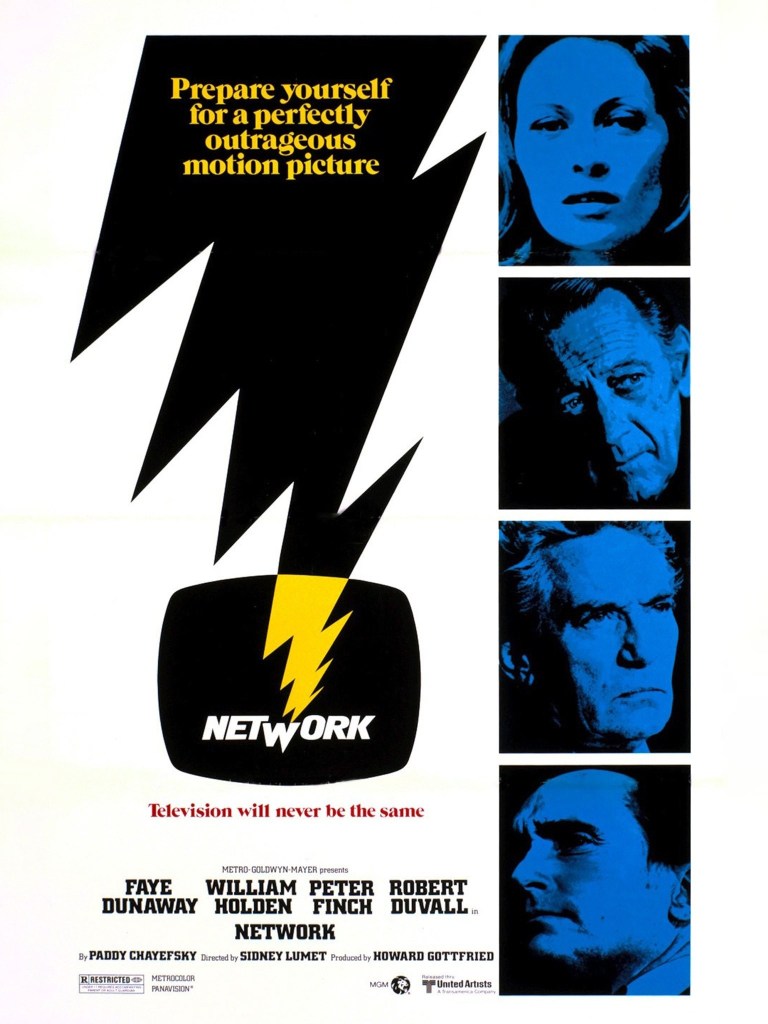
Saturday Matinee: Network

By Roger Ebert

Source: RogerEbert.com

Strange, how Howard Beale, “the mad prophet of the airwaves,” dominates our memories of “Network.” We remember him in his soaking-wet raincoat, hair plastered to his forehead, shouting, “I’m mad as hell and I’m not going to take this anymore.” The phrase has entered into the language.

But Beale (Peter Finch) is the movie’s sideshow. The story centers on Diana Christiansen (Faye Dunaway), the ratings-hungry programming executive who is prepared to do anything for better numbers. The mirror to which she plays is Max Schumacher (William Holden), the middle-age news executive who becomes Diana’s victim and lover, in that order.

The movie has been described as “outrageous satire” (Leonard Maltin) and “messianic farce” (Pauline Kael), and it is both, and more. What is fascinating about Paddy Chayefsky’s Oscar-winning screenplay is how smoothly it shifts its gears. The scenes involving Beale and the revolutionary “liberation army” are cheerfully over the top. The scenes involving Diana and Max are quiet, tense, convincing drama. The action at the network executive level aims for behind-the-scenes realism; we may doubt that a Howard Beale could get on the air, but we have no doubt the idea would be discussed as the movie suggests. And then Chayefsky and the director, Sidney Lumet, edge the backstage network material over into satire, too–but subtly, so that in the final late-night meeting where the executives decide what to do about Howard Beale, we have entered the madhouse without noticing.

The movie caused a sensation in 1976. It was nominated for 10 Oscars, won four (Finch, Dunaway, supporting actress Beatrice Straight, Chayefsky), and stirred up much debate about the decaying values of television. Seen a quarter-century later, it is like prophecy. When Chayefsky created Howard Beale, could he have imagined Jerry Springer, Howard Stern and the World Wrestling Federation?

Parts of the movie have dated–most noticeably Howard Beale’s first news set, a knotty-pine booth that makes it look like he’s broadcasting from a sauna. Other parts, including the network strategy meetings, remain timeless. And the set that Beale graduates to, featuring soothsayers and gossip columnists on revolving pedestals, nicely captures the feeling of some of the news/entertainment shows, where it’s easier to get air time if you’re a “psychic” than if you have useful information to convey.

Most people remember that Howard Beale got fed up, couldn’t take it anymore and had a meltdown on the air. It wasn’t quite like that. Beale is portrayed as an alcoholic doing such a bad job that he’s fired by his boss (Holden). Then they get drunk together and joke about him committing suicide on the air. The next day, in a farewell broadcast, Beale announces that he will indeed kill himself because of falling ratings. He’s yanked from the air but begs for a chance to say farewell, and that’s when he says, the next day, “Well, I’ll tell you what happened: I just ran out of bull- – – -.” His frankness is great for the ratings, Diana convinces her bosses to overturn Max’s decision to fire him, Howard goes back on the air, and he is apparently deep into madness when he utters his famous line.

Lumet and Chayefsky know just when to pull out all the stops. After Beale orders his viewers to “repeat after me,” they cut to exterior shots of people leaning out of their windows and screaming that they’re mad as hell, too. Unlikely, but great drama, and electrifying in theaters at the time. Beale’s ratings skyrocket (he is fourth after “The Six Million Dollar Man,” “All in the Family” and “Phyllis”), and a new set is constructed on which he rants and raves after his announcer literally introduces him as a “mad prophet.”

Counter to this extravagant satire is the affair between Max and Diana. Dunaway gives a seductive performance as the obsessed programming executive; her eyes sparkle and she moistens her lips when she thinks of higher ratings, and in one sequence she kisses Max while telling him how cheaply she can buy some James Bond reruns. Later, in bed, discussing ratings during sex, she climaxes while gasping about the “Mao Tse Tung Hour.”

That’s her idea for a prime-time show based on the exploits of a group obviously inspired by the Symbionese Liberation Army. In a secluded safe house, she negotiates with its armed leader, has a run-in with a Patty Hearst type, and uses an Angela Davis type as her go-between. This material is less convincing, except as an illustration of the lengths to which she will go.

Much more persuasive is Holden’s performance as a newsman who was trained by Edward R. Murrow, and now sees his beloved news division destroyed by Diana. At the same time, Max is fascinated by her, and deliberately begins an affair. For him, it is intoxication with the devil, and maybe love. For her–it is hard to say what it is, because, as he accurately tells her at the end, “There’s nothing left in you I can live with.”

Beatrice Straight’s role as Max’s wife is small but so powerful it won her the Oscar. It is a convincing portrait of a woman who has put up with an impossible man for so long that, although she feels angry and betrayed, she does not feel surprised. The meaning of Max’s decision to cheat is underlined by the art direction; he and his wife live in a tasteful apartment with book-lined walls, and then he moves into Dunaway’s tacky duplex. It is clear that although she cares how she dresses (costumes by Theoni V. Aldredge), she doesn’t care where she lives, because she is not a homebody; her home is in a boardroom, a corner office or a control booth.

The film is filled with vivid supporting roles. Ned Beatty has a sharp-edged cameo as a TV executive (he’s the one who says the famous line, “It’s because you’re on television, dummy”). Robert Duvall plays an executive who, when murder is suggested, insists he wants to “hear everybody’s thoughts on this.” Wesley Addy is the handsome, gray-haired executive in the network’s display window; he looks good at stockholder meetings. (If you look closely, you can spot a young Tim Robbins as a revolutionary assassin.)

One of Chayefsky’s key insights is that the bosses don’t much care what you say on TV, as long as you don’t threaten their profits. Howard Beale calls for outrage, he advises viewers to turn off their sets, his fans chant about how fed up they are–but he only gets in trouble when he reveals plans to sell the network’s parent company to Saudi Arabians. There’s a parallel here with “The Insider,” a 1999 film about CBS News, where “60 Minutes” can do just about anything it wants to, except materially threaten CBS profits.

Sidney Lumet, born 1924, a product of the golden age of live television, is one of the most consistently intelligent and productive directors of his time. His credits are an honor roll of good films, many of them with a conscience, including “12 Angry Men” (1957), “Long Day’s Journey Into Night” (1962), “Fail-Safe” (1964), “Serpico” (1973), “Dog Day Afternoon” (1975), “Prince of the City” (1981), “The Verdict” (1982), “Running on Empty” (1988) and “Q and A” (1990).

Because he works in many different genres and depends on story more than style, he is better known inside the business than out, but few directors are better at finding the right way to tell difficult stories; consider the development of Al Pacino’s famous telephone call in “Dog Day Afternoon.” His book Making Movies (Knopf, 1995) has more common sense in it about how movies are actually made than any other I have read.

In “Network,” which is rarely thought of as a “director’s picture,” it is his unobtrusive skill that allows all those different notes and energy levels to exist within the same film. In other hands, the film might have whirled to pieces. In his, it became a touchstone.

‘Stop Drinking the Kool-Aid, America: Political Fiction in an Age of Televised Lies’

20120527040549-stop-drinking-kool-aid

By John W. Whitehead

Source: A Government of Wolves

“We’ve got to face it. Politics have entered a new stage, the television stage. Instead of long-winded public debates, the people want capsule slogans—‘Time for a change’—‘The mess in Washington’—‘More bang for a buck’—punch lines and glamour.”— A Face in the Crowd (1957)

Politics is entertainment.

It is a heavily scripted, tightly choreographed, star-studded, ratings-driven, mass-marketed, costly exercise in how to sell a product—in this case, a presidential candidate—to dazzled consumers who will choose image over substance almost every time.

This year’s presidential election, much like every other election in recent years, is what historian Daniel Boorstin referred to as a “pseudo-event”: manufactured, contrived, confected and devoid of any intrinsic value save the value of being advertised. It is the end result of a culture that is moving away from substance toward sensationalism in an era of mass media.

As author Noam Chomsky rightly observed, “It is important to bear in mind that political campaigns are designed by the same people who sell toothpaste and cars.” In other words, we’re being sold a carefully crafted product by a monied elite who are masters in the art of making the public believe that they need exactly what is being sold to them, whether it’s the latest high-tech gadget, the hottest toy, or the most charismatic politician.

Tune into a political convention and you will find yourself being sucked into an alternate reality so glossy, star-studded, emotionally charged and entertaining as to make you forget that you live in a police state. The elaborate stage show, the costumes, the actors, the screenplay, the lighting, the music, the drama: all carefully calibrated to appeal to the public’s need for bread and circuses, diversion and entertainment, and pomp and circumstance.

Politics is a reality show, America’s favorite form of entertainment, dominated by money and profit, imagery and spin, hype and personality and guaranteed to ensure that nothing in the way of real truth reaches the populace.

After all, who cares about police shootings, drone killings, SWAT team raids, asset forfeiture schemes, private prisons, school-to-prison pipelines, overcriminalization, censorship or any of the other evils that plague our nation when you can listen to the croonings of Paul Simon, laugh along with Sarah Silverman, and get misty-eyed over the First Lady’s vision of progress in America.

But make no mistake: Americans only think they’re choosing the next president.

In truth, however, they’re engaging in the illusion of participation culminating in the reassurance ritual of voting. It’s just another Blue Pill, a manufactured reality conjured up by the matrix in order to keep the populace compliant and convinced that their vote counts and that they still have some influence over the political process.

Stop drinking the Kool-Aid, America.

The nation is drowning in debt, crippled by a slowing economy, overrun by militarized police, swarming with surveillance, besieged by endless wars and a military industrial complex intent on starting new ones, and riddled with corrupt politicians at every level of government. All the while, we’re arguing over which corporate puppet will be given the honor of stealing our money, invading our privacy, abusing our trust, undermining our freedoms, and shackling us with debt and misery for years to come.

Nothing taking place on Election Day will alleviate the suffering of the American people.

The government as we have come to know it—corrupt, bloated and controlled by big-money corporations, lobbyists and special interest groups—will remain unchanged. And “we the people”—overtaxed, overpoliced, overburdened by big government, underrepresented by those who should speak for us and blissfully ignorant of the prison walls closing in on us—will continue to trudge along a path of misery.

With roughly 22 lobbyists per Congressman, corporate greed will continue to call the shots in the nation’s capital, while our elected representatives will grow richer and the people poorer. And elections will continue to be driven by war chests and corporate benefactors rather than such values as honesty, integrity and public service. Just consider: it’s estimated that more than $5 billion will be spent on the elections this year, yet not a dime of that money will actually help the average American in their day-to-day struggles to just get by.

And the military industrial complex will continue to bleed us dry. Since 2001 Americans have spent $10.5 million every hour for numerous foreign military occupations, including in Iraq and Afghanistan. There’s also the $2.2 million spent every hour on maintaining the United States’ nuclear stockpile, and the $35,000 spent every hour to produce and maintain our collection of Tomahawk missiles. And then there’s the money the government exports to other countries to support their arsenals, at the cost of $1.61 million every hour for the American taxpayers.

Then again, when faced with the grim, seemingly hopeless reality of the American police state, it’s understandable why Americans might opt for escapism. “Humankind cannot bear too much reality,” T. S. Eliot once said. Perhaps that is one reason we are so drawn to the unreality of the American political experience: it is spectacle and fiction and farce all rolled up into one glossy dose of escapism.

Frankly, escapism or not, Americans should be mad as hell.

Many of our politicians live like kings. Chauffeured around in limousines, flying in private jets and eating gourmet meals, all paid for by the American taxpayer, they are far removed from those they represent. Such a luxurious lifestyle makes it difficult to identify with the “little guy”—the roofers, plumbers and blue-collar workers who live from paycheck to paycheck and keep the country running with their hard-earned dollars and the sweat of their brows.

Conveniently, politicians only seem to remember their constituents in the months leading up to an election, and yet “we the people” continue to take the abuse, the neglect, the corruption and the lies. We make excuses for the shoddy treatment, we cover up for them when they cheat on us, and we keep hoping that if we just stick with them long enough, eventually they’ll treat us right.

People get the government they deserve.

No matter who wins the presidential election come November, it’s a sure bet that the losers will be the American people.

As political science professor Gene Sharp notes in starker terms, “Dictators are not in the business of allowing elections that could remove them from their thrones.” As I make clear in my book Battlefield America: The War on the American People, the Establishment—the shadow government and its corporate partners that really run the show, pull the strings and dictate the policies, no matter who occupies the Oval Office—are not going to allow anyone to take office who will unravel their power structures. Those who have attempted to do so in the past have been effectively put out of commission.

So what is the solution to this blatant display of imperial elitism disguising itself as a populist exercise in representative government?

Stop playing the game. Stop supporting the system. Stop defending the insanity. Just stop.

Washington thrives on money, so stop giving them your money. Stop throwing your hard-earned dollars away on politicians and Super PACs who view you as nothing more than a means to an end. There are countless worthy grassroots organizations and nonprofits working in your community to address real needs like injustice, poverty, homelessness, etc. Support them and you’ll see change you really can believe in in your own backyard.

Politicians depend on votes, so stop giving them your vote unless they have a proven track record of listening to their constituents, abiding by their wishes and working hard to earn and keep their trust.

Stop buying into the lie that your vote matters. Your vote doesn’t elect a president. Despite the fact that there are 218 million eligible voters in this country (only half of whom actually vote), it is the electoral college, made up of 538 individuals handpicked by the candidates’ respective parties, that actually selects the next president. The only thing you’re accomplishing by taking part in the “reassurance ritual” of voting is sustaining the illusion that we have a democratic republic. What we have is a dictatorship, or as political scientists Martin Gilens and Benjamin Page more accurately term it, we are suffering from an “economic élite domination.”

A healthy, representative government is hard work. It takes a citizenry that is informed about the issues, educated about how the government operates, and willing to make the sacrifices necessary to stay involved, whether that means forgoing Monday night football in order to attend a city council meeting or risking arrest by picketing in front of a politician’s office.

It takes a citizenry willing to do more than grouse and complain. We must act—and act responsibly—keeping in mind that the duties of citizenship extend beyond the act of voting.

Most of all, it takes a citizenry that cares enough to get mad and get active. As Howard Beale declares in the 1976 film Network:

“I want you to get up right now, sit up, go to your windows, open them and stick your head out and yell, ‘I’m as mad as hell and I’m not going to take this anymore.’ Things have got to change. But first, you’ve gotta get mad!…You’ve got to say, ‘I’m as mad as hell, and I’m not going to take this anymore!’ Then we’ll figure out what to do about the depression and the inflation and the oil crisis. But first get up out of your chairs, open the window, stick your head out, and yell, and say it.”