RIP INF Treaty: Russia’s Victory, America’s Waterloo

By Dmitry Orlov

Source: Club Orlov

On March 1, 2018 the world learned of Russia’s new weapons systems, said to be based on new physical principles. Addressing the Federal Assembly, Putin explained how they came to be: in 2002 the US withdrew from the Anti-Ballistic Missile Treaty. At the time, the Russians declared that they will be forced to respond, and were basically told “Do whatever you want.”

And so they did, developing new weapons that no anti-ballistic missile system can ever hope to stop. The new Russian weapons include one that is already on combat duty (Kinzhal), one that is being readied for mass production (Avangard) and several that are currently being tested (Poseidon, Burevestnik, Peresvet, Sarmat). Their characteristics, briefly, are as follows:

• Kinzhal: a hypersonic air-launched cruise missile that flies at Mach 10 (7700 miles per hour) and can destroy both ground installations and ships.

• Avangard: a maneuverable hypersonic payload delivery system for intercontinental ballistic missiles that flies at better than Mach 20 (15300 miles per hour). It has a 740-mile range and can carry a nuclear charge of up to 300 kilotons.

• Poseidon: an autonomous nuclear-powered torpedo with unlimited range that can travel at a 3000-foot depth maintaining a little over 100 knots.

• Burevestnik: a nuclear-powered cruise missile that flies at around 270 miles per hour and can stay in the air for 24 hours, giving it a 6000-mile range.

• Peresvet: a mobile laser complex that can blind drones and satellites, knocking out space and aerial reconnaissance systems.

• Sarmat: a new heavy intercontinental missile that can fly arbitrary suborbital courses (such as over the South Pole) and strike arbitrary points anywhere on the planet. Because it does not follow a predictable ballistic trajectory it is impossible to intercept.

The initial Western reaction to this announcement was an eerie silence. A few people tried to convince anyone who would listen that this was all bluff and computer animation, and that these weapons systems did not really exist. (The animation was of rather low quality, one might add, probably because Russian military types couldn’t possibly imagine that slick graphics, such as what the Americans waste their money on, would make Russia any safer.) But eventually the new weapons systems were demonstrated to work and US intelligence services confirmed their existence.

Forced to react, the Americans, with the EU in tow, tried to cause public relations scandals over some unrelated matter. Such attempts are repeated with some frequency. For instance, after the putsch in the Ukraine caused Crimea to go back to Russia there was the avalanche of hysterical bad press about Malaysian Airlines flight MH17, which the Americans had shot down over Ukrainian territory with the help of Ukrainian military.

Similarly, after Putin’s announcement of new weapons systems, there was an eruption of equally breathless hysterics over the alleged “Novichok” poisoning of Sergei Skripal and his daughter. A couple of Russian tourists, if you recall, were accused of poisoning Skripal by smearing some toxic gas on the doorknob of his house some time after he left it never to return. Perhaps such antics made some people feel better, but opposing new, breakthrough weapons systems by generating fake news does not an adequate response make.

Say what you will about the Russian response to the US pulling out of the ABM treaty, but it was adequate. It was made necessary by two well-known facts. First, the US is known for dropping nuclear bombs on other countries (Hiroshima, Nagasaki). It did so not in self-defense but just to send a message to the USSR that resistance would be futile (a dumb move if there ever was one). Second, the US is known to have repeatedly planned to destroy the USSR using a nuclear first strike. It was prevented from carrying it out time and again, first by a shortage of nuclear weapons, then by the development of Soviet nuclear weapons, then by the development of Soviet ICBMs.

Ronald Reagan’s “Star Wars” was an attempt to develop a system that would shoot down enough Soviet ICBMs to make a nuclear first strike on the USSR winnable. This work was terminated when Reagan and Gorbachev signed the Anti-Ballistic Missile Treaty in December, 1987. But then when Bush Jr. pulled out of the ABM treaty in 2002 it was off to the races again. Last year Putin declared that Russia has won: the Americans can now rest assured that if they ever attack Russia the result will be their complete, guaranteed annihilation, and the Russians can rest secure in the knowledge that the US will never dare to attack them.

But that was just the prelude. The real victory happened on February 2, 2019. This day will be remembered as the day when the Russian Federation decisively defeated the United States in the battle for Eurasia—from Lisbon to Vladivostok and from Murmansk to Mumbai.

So, what did the Americans want, and what did they get instead? They wanted to renegotiate the INF treaty, revise some of the terms and expand it to include China. Announcing that the US is suspending the INF treaty, Trump said: “I hope we’re able to get everybody in a big, beautiful room and do a new treaty that would be much better…” By “everybody” Trump probably meant the US, China and Russia.

Why the sudden need to include China? Because China has an entire arsenal of intermediate-range weapons with a range of 500-5500 (the ones outlawed by the INF treaty) pointed at American military bases throughout the region—in South Korea, Japan and Guam. The INF treaty made it impossible for the US to develop anything that could be deployed at these bases to point back at China.

Perhaps it was Trump’s attempt to practice his New York real-estate mogul’s “art of the deal” among nuclear superpowers, or perhaps it’s because imperial hubris has rotted the brains of just about everyone in the US establishment, but the plan for renegotiating the INF treaty was about as stupid as can be imagined:

1. Accuse Russia of violating the INF treaty based on no evidence. Ignore Russia’s efforts to demonstrate that the accusation is false.

2. Announce pull-out of the INF treaty.

3. Wait a while, then announce that the INF treaty is important and essential. Condescendingly forgive Russia and offer to sign a new treaty, but demand that it include China.

4. Wait while Russia convinces China that it should do so.

5. Sign the new treaty in Trump’s “big, beautiful room.”

So, how did it actually go? Russia instantly announced that it is also pulling out of the INF treaty. Putin ordered foreign minister Lavrov to abstain from all negotiations with the Americans in this matter. He then ordered defense minister Shoigu to build land-based platforms for Russia’s new air and ship-based missile systems—without increasing the defense budget. Putin added that these new land-based systems will only be deployed in response to the deployment of US-made intermediate-range weapons. Oh, and China announced that it is not interested in any such negotiations. Now Trump can have his “big, beautiful room” all to himself.

Why did this happen? Because of the INF treaty, for a long time Russia has had a giant gaping hole in its arsenal, specifically in the 500-5500 km range. It had air-launched X-101/102s, and eventually developed the Kalibr cruise missile, but it had rather few aircraft and ships—enough for defense, but not enough to guarantee that it could reliably destroy all of NATO. As a matter of Russia’s national security, given the permanently belligerent stance of the US, it was necessary for NATO to know that in case of a military conflict with Russia it will be completely annihilated, and that no air defense system will ever help them avoid that fate.

If you look at a map, you will find that having weapons in the 500-5500 km range fixes this problem rather nicely. Draw a circle with a 5500 km radius around the Russian enclave of Kaliningrad; note that it encompasses every single NATO country, North Africa and Middle East. The INF treaty was not necessarily a good deal for Russia even when it was first signed (remember, Gorbachev, who signed it, was a traitor) but it became a stupendously bad deal as NATO started to expand east. But Russia couldn’t pull out of it without triggering a confrontation, and it needed time to recover and rearm.

Already in 2004 Putin announced that “Russia needs a breakthrough in order to have a new generation of weapons and technology.” At the time, Americans ignored him, thinking that Russia could fall apart at any moment and that they will be able to enjoy Russian oil, gas, nuclear fuel and other strategic commodities for free forever even as the Russians themselves go extinct. They thought that even if Russia tried to resist, it would be enough to bribe some traitors—like Gorbachev or Yeltsin—and all would be well again.

Fast-forward 15 years, and is that what we have? Russia has rebuilt and rearmed. Its export industries provide for a positive trade balance even in absence of oil and gas exports. It is building three major export pipelines at the same time—to Germany, Turkey and China. It is building nuclear generating capacity around the world and owns a lion’s share of the world’s nuclear industry. The US can no longer keep the lights on without Russian nuclear fuel imports. The US has no new weapons systems with which to counter Russia’s rearmament. Yes, it talks about developing some, but all it has at this point are infinite money sinks and lots of PowerPoint presentations. It no longer has the brains to do the work, or the time, or the money.

Part of Putin’s orders upon pulling out of the INF treaty was to build land-based medium-range hypersonic missiles. That’s a new twist: not only will it be impossible to intercept them, but they will reduce NATO’s remaining time to live, should it ever attack Russia, from minutes to seconds. The new Poseidon nuclear-powered torpedo was mentioned too: even if an attack on Russia succeeds, it will be a Pyrrhic one, since subsequent 100-foot nuclear-triggered tsunamis will wipe clean both coasts of the United States for hundreds of miles inland, effectively reducing the entire country to slightly radioactive wasteland.

Not only has the US lost its ability to attack, it has also lost its ability to threaten. Its main means of projecting force around the world is its navy, and Poseidon reduces it to a useless, slow-moving pile of scrap steel. It would take just a handful of Poseidons quietly shadowing each US aircraft carrier group to zero out the strategic value of the US Navy no matter where in the world it is deployed.

Without the shackles of the INF treaty, Russia will be able to fully neutralize the already obsolete and useless NATO and to absorb all of Europe into its security sphere. European politicians are quite malleable and will soon learn to appreciate the fact that good relations with Russia and China are an asset while any dependence on the US, moving forward, is a huge liability. Many of them already understand which way the wind is blowing.

It won’t be a difficult decision for Europe’s leaders to make. On the one pan of the scale there is the prospect of a peaceful and prosperous Greater Eurasia, from Lisbon to Vladivostok and from Murmansk to Mumbai, safe under Russia’s nuclear umbrella and tied together with China’s One Belt One Road.

On the other pan of the scale there is a certain obscure former colony lost in the wilds of North America, imbued with an unshakeable faith in its own exceptionalism even as it grows ever weaker, more internally conflicted and more chaotic, but still dangerous, though mostly to itself, and run by a bloviating buffoon who can’t tell the difference between a nuclear arms treaty and a real estate deal. It needs to be quietly and peacefully relegated to the outskirts of civilization, and then to the margins of history.

Trump should keep his own company in his “big, beautiful room,” and avoid doing anything anything even more tragically stupid, while saner minds quietly negotiate the terms for an honorable capitulation. The only acceptable exit strategy for the US is to quietly and peacefully surrender its positions around the world, withdraw into its own geographic footprint and refrain from meddling in the affairs of Greater Eurasia.

Why We’re Blind to the System Destroying Us

By Jonathan Cook

Source: Information Clearing House

I rarely use this blog to tell readers what they should believe. Rather I try to indicate why it might be wise to distrust, at least without very good evidence, what those in power tell us we should believe.

We have well-known sayings about power: “Knowledge is power”, and “Power tends to corrupt, while absolute power tends to corrupt absolutely.” These aphorisms resonate because they say something true about how we experience the world. People who have power – even very limited power they hold on licence from someone else – tend to abuse it, sometimes subtly and unconsciously, and sometimes overtly and wilfully.

If we are reasonably self-aware, we can sense the tendency in ourselves to exploit to our advantage whatever power we enjoy, whether it is in our dealings with a spouse, our children, a friend, an employee, or just by the general use of our status to get ahead.

This isn’t usually done maliciously or even consciously. By definition, the hardest thing to recognise are our own psychological, emotional and mental blind spots – and the biggest, at least for those born with class, gender or race privileges, is realising that these too are forms of power.

Nonetheless, these are all minor forms of power compared to the power wielded collectively by the structures that dominate our societies: the financial sector, the corporations, the media, the political class, and the security services.

But strangely most of us are much readier to concede the corrupting influence of the relatively small power of individuals than we are the rottenness of vastly more powerful institutions and structures. We blame the school teacher or the politician for abusing his or her power, while showing a reluctance to do the same about either the education or political systems in which they have to operate.

Similarly, we are happier identifying the excessive personal power of a Rupert Murdoch than we are the immense power of the corporate empire behind him and on which his personal wealth and success depend.

And beyond this, we struggle most of all to detect the structural and ideological framework underpinning or cohering all these discrete examples of power.

Narrative control

It is relatively easy to understand that your line manager is abusing his power, because he has so little of it. His power is visible to you because it relates only to you and the small group of people around you.

It is a little harder, but not too difficult, to identify the abusive policies of your firm – the low pay, cuts in overtime, attacks on union representation.

It is more difficult to see the corrupt power of large institutions, aside occasionally from the corruption of senior figures within those institutions, such as a Robert Maxwell or a Richard Nixon.

But it is all but impossible to appreciate the corrupt nature of the entire system. And the reason is right there in those aphorisms: absolute power depends on absolute control over knowledge, which in turn necessitates absolute corruption. If that were not the case, we wouldn’t be dealing with serious power – as should be obvious, if we pause to think about it.

Real power in our societies derives from that which is necessarily hard to see – structures, ideology and narratives – not individuals. Any Murdoch or Trump can be felled, though being loyal acolytes of the power-system they rarely are, should they threaten the necessary maintenance of power by these interconnected institutions, these structures.

The current neoliberal elite who effectively rule the planet have reached as close to absolute power as any elite in human history. And because they have near-absolute power, they have a near-absolute control of the official narratives about our societies and our “enemies”, those who stand in their way to global domination.

No questions about Skripals

One needs only to look at the narrative about the two men, caught on CCTV cameras, who have recently been accused by our political and media class of using a chemical agent to try to murder Sergei Skripal and his daughter Yulia back in March.

I don’t claim to know whether Alexander Petrov and Ruslan Boshirov work for the Russian security services, or whether they were dispatched by Vladimir Putin on a mission to Salisbury to kill the Skripals.

What is clear, however, is that the British intelligence services have been feeding the British corporate media a self-serving, drip-drip narrative from the outset – and that the media have shown precisely no interest at any point in testing any part of this narrative or even questioning it. They have been entirely passive, which means their readers – us – have been entirely passive too.

That there are questions about the narrative to be raised is obvious if you turn away from the compliant corporate media and seek out the views of an independent-minded, one-time insider such as Craig Murray.

A former British ambassador, Murray is asking questions that may prove to be pertinent or not. But at this stage, when all we have to rely on is what the intelligence services are selectively providing, these kinds of doubts should be driving the inquiries of any serious journalist covering the story. But as is so often the case, not only are these questions not being raised or investigated, but anyone like Murray who thinks critically – who assumes that the powerful will seek to promote their interests and avoid accountability – is instantly dismissed as a conspiracy theorist or in Putin’s pocket.

That is no meaningful kind of critique. Many of the questions that have been raised – like why there are so many gaps in the CCTV record of the movements of both the Skripals and the two assumed assassins – could be answered if there was an interest in doing so. The evasion and the smears simply suggest that power intends to remain unaccountable, that it is keeping itself concealed, that the narrative is more important than the truth.

And that is reason enough to move from questioning the narrative to distrusting it.

Ripples on a lake

Journalists typically have a passive relationship to power, in stark contrast to their image as tenacious watchdog. But more fundamental than control over narrative is the ideology that guides these narratives.  Ideology ensures the power-system is invisible not only to us, those who are abused and exploited by it, but also to those who benefit from it.

It is precisely because power resides in structures and ideology, rather than individuals, that it is so hard to see. And the power-structures themselves are made yet more difficult to identify because the narratives created about our societies are designed to conceal those structures and ideology – where real power resides – by focusing instead on individuals.

That is why our newspapers and TV shows are full of stories about personalities – celebrities, royalty, criminals, politicians. They are made visible so that we do not notice the ideological structures we live inside that are supposed to remain invisible.

News and entertainment are the ripples on a lake, not the lake itself. But the ripples could not exist without the lake that forms and shapes them.

Up against the screen

If this sounds like hyperbole, let’s stand back from our particular ideological system – neoliberalism – and consider earlier ideological systems in the hope that they offer some perspective. At the moment, we are like someone standing right up against an IMAX screen, so close that we cannot see that there is a screen or even guess that there is a complete picture. All we see are moving colours and pixels. Maybe we can briefly infer a mouth, the wheel of a vehicle, a gun.

Before neoliberalism there were other systems of rule. There was, for example, feudalism that appropriated a communal resource – land – exclusively for an aristocracy. It exploited the masses by forcing them to toil on the land for a pittance to generate the wealth that supported castles, a clergy, manor houses, art collections and armies. For several centuries the power of this tiny elite went largely unquestioned.

But then a class of entrepreneurs emerged, challenging the landed artistocracy with a new means of industrialised production. They built factories and took advantage of scales of economy that slightly widened the circle of privilege, creating a middle class. That elite, and the middle-class that enjoyed crumbs from their master’s table, lived off the exploitation of children in work houses and the labour of a new urban poor in slum housing.

These eras were systematically corrupt, enabling the elites of those times to extend and entrench their power. Each elite produced justifications to placate the masses who were being exploited, to brainwash them into believing the system existed as part of a natural order or even for their benefit. The aristocracy relied on a divine right of kings, the capitalist class on the guiding hand of the free market and bogus claims of equality of opportunity.

In another hundred years, if we still exist as a species, our system will look no less corrupt – probably more so – than its predecessors.

Neoliberalism, late-stage capitalism, plutocratic rule by corporations – whatever you wish to call it – has allowed a tiny elite to stash away more wealth and accrue more power than any feudal monarch could ever have dreamt of. And because of the global reach of this elite, its corruption is more endemic, more complete, more destructive than any ever known to mankind.

A foreign policy elite can destroy the world several times over with nuclear weapons. A globalised corporate elite is filling the oceans with the debris from our consumption, chopping down the forest-lungs of our planet for palm-oil plantations so we can satisfy our craving for biscuits and cake. And our media and intelligence services are jointly crafting a narrative of bogeymen and James Bond villains – both in Hollywood movies, and in our news programmes – to make us fearful and pliable.

Assumptions of inevitability

Most of us abuse our own small-power thoughtlessly, even self-righteously. We tell ourselves that we gave the kids a “good spanking” because they were naughty, rather than because we established with them early on a power relationship that confusingly taught them that the use of force and coercion came with a parental stamp of approval.

Those in greater power – from minions in the media to executives of major corporations – are no different. They are as incapable of questioning the ideology and the narrative – how inevitable and “right” our neoliberal system is – as the rest of us. But they play a vital part in maintaining and entrenching that system nonetheless.

David Cromwell and David Edwards of Media Lens have provided two analogies – in the context of the media – that help explain how it is possible for individuals and groups to assist and enforce systems of power without having any conscious intention to do so, and without being aware that they are contributing to something harmful. Without, in short, being aware that they are conspiring in the system.

The first:

When a shoal of fish instantly changes direction, it looks for all the world as though the movement was synchronised by some guiding hand. Journalists – all trained and selected for obedience by media all seeking to maximise profits within state-capitalist society – tend to respond to events in the same way.

The second:

Place a square wooden framework on a flat surface and pour into it a stream of ball bearings, marbles, or other round objects. Some of the balls may bounce out, but many will form a layer within the wooden framework; others will then find a place atop this first layer. In this way, the flow of ball bearings steadily builds new layers that inevitably produce a pyramid-style shape. This experiment is used to demonstrate how near-perfect crystalline structures such as snowflakes arise in nature without conscious design.

The system – whether feudalism, capitalism, neoliberalism – emerges out of the real-world circumstances of those seeking power most ruthlessly. In a time when the key resource was land, a class emerged justifying why it should have exclusive rights to control that land and the labour needed to make it productive. When industrial processes developed, a class emerged demanding that it had proprietary rights to those processes and to the labour needed to make them productive.

Our place in the pyramid

In these situations, we need to draw on something like Darwin’s evolutionary “survival of the fittest” principle. Those few who are most hungry for power, those with least empathy, will rise to the top of the pyramid, finding themselves best-placed to exploit the people below. They will rationalise this exploitation as a divine right, or as evidence of their inherently superior skills, or as proof of the efficiency of the market.

And below them, like the layers of ball bearings, will be those who can help them maintain and expand their power: those who have the skills, education and socialisation to increase profits and sell brands.

All of this should be obvious, even non-controversial. It fits what we experience of our small-power lives. Does bigger power operate differently? After all, if those at the top of the power-pyramid were not hungry for power, even psychopathic in its pursuit, if they were caring and humane, worried primarily about the wellbeing of their workforce and the planet, they would be social workers and environmental activists, not CEOs of media empires and arms manufacturers.

And yet, base your political thinking on what should be truisms, articulate a worldview that distrusts those with the most power because they are the most capable of – and committed to – misusing it, and you will be derided. You will be called a conspiracy theorist, dismissed as deluded. You will be accused of wearing a tinfoil hat, of sour grapes, of being anti-American, a social warrior, paranoid, an Israel-hater or anti-semitic, pro-Putin, pro-Assad, a Marxist.

None of this should surprise us either. Because power – not just the people in the system, but the system itself – will use whatever tools it has to protect itself. It is easier to deride critics as unhinged, especially when you control the media, the politicians and the education system, than it is to provide a counter-argument.

In fact, it is vital to prevent any argument or real debate from taking place. Because the moment we think about the arguments, weigh them, use our critical faculties, there is a real danger that the scales will fall from our eyes. There is a real threat that we will move back from the screen, and see the whole picture.

Can we see the complete picture of the Skripal poisoning in Salisbury; or the US election that led to Trump being declared president; or the revolution in Ukraine; or the causes and trajectory of fighting in Syria, and before it Libya and Iraq; or the campaign to discredit Jeremy Corbyn as leader of the Labour party; or the true implications of the banking crisis a decade ago?

Profit, not ethics

Just as a feudal elite was driven not by ethics but by the pursuit of power and wealth through the control of land; just as early capitalists were driven not by ethics but by the pursuit of power and wealth through the control of mechanisation; so neoliberalism is driven not by ethics but the pursuit of power and wealth through the control of the planet.

The only truth we can know is that the western power-elite is determined to finish the task of making its power fully global, expanding it from near-absolute to absolute. It cares nothing for you or your grand-children. It is a cold-calculating system, not a friend or neighbour. It lives for the instant gratification of wealth accumulation, not concern about the planet’s fate tomorrow.

And because of that it is structurally bound to undermine or discredit anyone, any group, any state that stands in the way of achieving its absolute dominion.

If that is not the thought we hold uppermost in our minds as we listen to a politician, read a newspaper, watch a film or TV show, absorb an ad, or engage on social media, then we are sleepwalking into a future the most powerful, the most ruthless, the least caring have designed for us.

Step back, and take a look at the whole screen. And decide whether this is really the future you wish for your grand-children.


Trump’s new cyber strategy seeks global dominion over internet

Source: RT.com

Setting the global standard for online behavior, preserving American dominance, political and economic interests, punishing ‘malicious actors’ like Russia and China: these are the ambitious goals of the new US cyber-strategy.

The White House published the 40-page document on Thursday afternoon, the first comprehensive cyber strategy in 15 years. The strategy’s core assumption is that the US created the internet and that Washington must maintain the dominant role in defining, shaping and policing cyberspace in much the same way as it does the globe.

All strategies are but broad outlines of general measures and overall objectives, and this one is no different. Beyond merely defending US computer networks – that’s just the first part, devoted to protecting the “American People, the Homeland, and the American Way of Life” – it wants to promote US economic prosperity while advancing influence around the world and achieving “peace through strength” as well.

The Trump administration’s approach to cyberspace is “anchored by enduring American values, such as the belief in the power of individual liberty, free expression, free markets, and privacy,” the strategy says right at the start.

It also takes as an article of faith that Russia, China, Iran, and North Korea use “cyber tools to undermine our economy and democracy, steal our intellectual property, and sow discord in our democratic processes.

Having signed on to this central assertion of Russiagate-peddlers, the Trump administration lays out the ways in which it intends to achieve its pie-in-the-(cyber)sky objectives.

‘Securing US democracy’

The Department of Homeland Security, a vast bureaucracy established after 9/11, is supposed to centralize management and oversight of federal computer networks, with the notable exceptions of those belonging to the Pentagon and the intelligence community. Reforms are supposed to make government networks more secure, reliable and efficient, while federal contracting will drive improvements in both products and services. This is the same process that has produced the F-35, a trillion-dollar clunker.

Those obsessed with seeing Russian hackers behind every voting machine might be interested in page nine, where the strategy proposes to “secure our democracy” by… offering training and risk management to state and local governments “when requested.” Admittedly, there isn’t much more the federal government can do to protect election systems, aside from securing the network infrastructure.

A particularly interesting tidbit here is also that law enforcement will “work with private industry to confront challenges presented by technological barriers, such as anonymization and encryption technologies” to obtain “time-sensitive evidence.” This is basically a rehash of former FBI Director James Comey’s perpetual refrain about the need for backdoor access to encrypted products and services.

The most (in)famous example of this was when the FBI took Apple to court over accessing the San Bernardino terrorist suspect’s iPhone, then hiring an Israeli company to crack the device, only to find… nothing of interest.

Privacy and civil rights advocates will be overjoyed to hear that Trump also wants to “update electronic surveillance and computer crime statutes” to make sure law enforcement can gather more evidence of cyber crimes and “impose appropriate consequences upon malicious cyber actors.”

‘Promoting American prosperity’

The second pillar talks a lot about the US government sponsoring innovation and creating jobs, but its key objective is to “promote the free flow of data across borders” (p.15). And if “repressive regimes” use US-made cybersecurity tools to “undermine human rights,” Washington will expose and counter them.

No word on whether that will apply to Google’s work in China, or Twitter, YouTube and Facebook’s throttling of speech that runs counter to their executives’ politics.

‘Preserving peace through strength’

Pillar three is where things get offensive – literally. Its objective is to “identify, counter, disrupt, degrade, and deter behavior in cyberspace that is destabilizing and contrary to national interests” while preserving US “overmatch.”

In addition to authorizing offensive cyber operations against suspected bad actors, the strategy proceeds from the assumption that the world craves US leadership, and envisions Washington promoting a “framework of responsible state behavior in cyberspace” based on international law and “voluntary non-binding norms.”

A coalition of like-minded states, led by the US would “coordinate and support each other’s responses to significant malicious cyber incidents.”

How? Well, through intelligence sharing, but also “buttressing of attribution claims, public statements of support for responsive actions taken, and joint imposition of consequences against malign actors.”

If that sounds a bit like what happened after the UK accused Russia, without evidence, of using a chemical agent to poison ex-spy Sergei Skripal and his daughter in Salisbury, and the US and other allies just took Whitehall’s word for it… that’s because it does.

‘Advancing US influence’

That leads us to the fourth and final pillar, advancing US influence around the globe. Accusing China not only of wanting to create a closed, censored internet by exporting that model elsewhere, the strategy envisions US evangelizing for a “free and open” internet.

Washington “will continue to work with like-minded countries, industry, civil society, and other stakeholders to advance human rights and Internet freedom globally and to counter authoritarian efforts to censor and influence Internet development,” the strategy says.

Does that mean the State Department intends to challenge the new EU copyright rules that would effectively outlaw memes and charge a “link tax”? Somehow that seems highly… unlikely.

The Utility of the RussiaGate Conspiracy

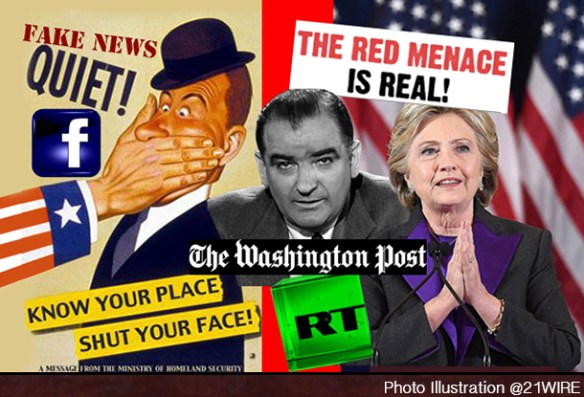
New McCarthyism allows corporate media to tighten grip, Democrats to ignore their own failings

By Alan MacLeod

Source: FAIR

To the shock of many, Donald Trump won the 2016 presidential elections, becoming the 45th president of the United States. Not least shocked were corporate media, and the political establishment more generally; the Princeton Election Consortium confidently predicted an over 99 percent chance of a Clinton victory, while MSNBC’s Rachel Maddow (10/17/16) said it could be a “Goldwater-style landslide.”

Indeed, Hillary Clinton and her team actively attempted to secure a Trump primary victory, assured that he would be the easiest candidate to beat. The Podesta emails show that her team considered even before the primaries that associating Trump with Vladimir Putin and Russia would be a winning strategy and employed the tactic throughout 2016 and beyond.

With Clinton claiming, “Putin would rather have a puppet as president,” Russia was by far the most discussed topic during the presidential debates (FAIR.org, 10/13/16), easily eclipsing healthcare, terrorism, poverty and inequality. Media seized upon the theme, with Paul Krugman (New York Times, 7/22/16) asserting Trump would be a “Siberian candidate,” while ex-CIA Director Michael Hayden (Washington Post, 5/16/16) claimed Trump would be Russia’s “useful fool.”

The day after the election, Jonathan Allen’s book Shattered detailed, Clinton’s team decided that the proliferation of Russian-sponsored “fake news” online was the primary reason for their loss.

Within weeks, the Washington Post (11/24/16) was publicizing the website PropOrNot.com, which purports to help users differentiate sources as fake or genuine, as an invaluable tool in the battle against fake news (FAIR.org, 12/1/16, 12/8/16). The website soberly informs its readers that you see news sources critiquing the “mainstream media,” the EU, NATO, Obama, Clinton, Angela Merkel or other centrists are a telltale sign of Russian propaganda. It also claims that when news sources argue against foreign intervention and war with Russia, that’s evidence that you are reading Kremlin-penned fake news.

PropOrNot claims it has identified over 200 popular websites that “routinely peddle…Russian propaganda.” Included in the list were Wikileaks, Trump-supporting right-wing websites like InfoWars and the Drudge Report, libertarian outlets like the Ron Paul Institute and Antiwar.com, and award-winning anti-Trump (but also Clinton-critical) left-wing sites like TruthDig and Naked Capitalism. Thus it was uniquely news sources that did not lie in the fairway between Clinton Democrats and moderate Republicans that were tarred as propaganda.

PropOrNot calls for an FBI investigation into the news sources listed. Even its creators see the resemblance to a new McCarthyism, as it appears as a frequently asked question on their website. (They say it is not McCarthyism, because “we are not accusing anyone of lawbreaking, treason, or ‘being a member of the Communist Party.’”) However, this new McCarthyism does not stem from the conservative right like before, but from the establishment center.

That the list is so evidently flawed and its creators refuse to reveal their identities or funding did not stop the issue becoming one of the most discussed in mainstream circles. Media talk of fake news sparked organizations like Google, Facebook, Bing and YouTube to change their algorithms, ostensibly to combat it.

However, one major effect of the change has been to hammer progressive outlets that challenge the status quo. The Intercept reported a 19 percent reduction in Google search traffic, AlterNet 63 percent and Democracy Now! 36 percent. Reddit and Twitter deleted thousands of accounts, while in what came to be called the “AdPocalypse,” YouTube began demonetizing videos from independent creators like Majority Report and the Jimmy Dore Show on controversial political topics like environmental protests, war and mass shootings. (In contrast, corporate outlets like CNN did not have their content on those subjects demonetized.) Journalists that questioned aspects of the Russia narrative, like Glenn Greenwald and Aaron Maté, were accused of being agents of the Kremlin (Shadowproof, 7/9/18).

The effect has been to pull away the financial underpinnings of alternative media that question the corporate state and capitalism in general, and to reassert corporate control over communication, something that had been loosened during the election in particular. It also impels liberal journalists to prove their loyalty by employing sufficiently bellicose and anti-Russian rhetoric, lest they also be tarred as Kremlin agents.

When it was reported in February that 13 Russian trolls had been indicted by a US grand jury for sharing and promoting pro-Trump and anti-Clinton memes on Facebook, the response was a general uproar. Multiple senior political figures declared it an “act of war.” Clinton herself described Russian interference as a “cyber 9/11,” while Thomas Friedman said that it was a “Pearl Harbor–scale event.” Morgan Freeman’s viral video, produced by Rob Reiner’s Committee to Investigate Russia, summed up the outrage:  “We have been attacked,” the actor declared; “We are at war with Russia.” Liberals declared Trump’s refusal to react in a sufficiently aggressive manner further proof he was Putin’s puppet.

The McCarthyist wave swept over other politicians that challenged the liberal center. Green Party presidential candidate Jill Stein refused to endorse the Russia narrative, leading mainstream figures like Rachel Maddow to insinuate she was a Kremlin stooge as well. After news broke that Stein’s connection to Russia was being officially investigated, top Clinton staffer Zac Petkanas announced:

Jill Stein is a Russian agent.

Jill Stein is a Russian agent.

Jill Stein is a Russian agent.

Jill Stein is a Russian agent.

Jill Stein is a Russian agent.

Jill Stein is a Russian agent.

Jill Stein is a Russian agent.

Jill Stein is a Russian agent.

“Commentary” that succinctly summed up the political atmosphere.

In contrast, Bernie Sanders has consistently and explicitly endorsed the RussiaGate theory, claiming it is “clear to everyone (except Donald Trump) that Russia was deeply involved in the 2016 election and intends to be involved in 2018.” Despite his stance, Sanders has also been constantly presented as another Russian agent, with the Washington Post (11/12/17) asking its readers, “When Russia interferes with the 2020 election on behalf of Democratic nominee Bernie Sanders, how will liberals respond?” The message is clear: The progressive wave rising across America is and will be a consequence of Russia, not of the failures of the system, nor of the Democrats.

It is not just politicians who have been smeared as Russian agents, witting or unwitting; virtually every major progressive movement challenging the system is increasingly dismissed in the same way. Multiple media outlets, including CNN (6/29/18), Slate (5/11/18), Vox (4/11/18) and the New York Times (2/16/18), have produced articles linking Black Lives Matter to the Kremlin, insinuating the outrage over racist police brutality is another Russian psyop. Others claimed Russia funded the riots in Ferguson and that Russian trolls promoted the Standing Rock environmental protests.

Meanwhile, Democratic insider Neera Tanden retweeted a description of Chelsea Manning as a “Russian stooge,” writing off her campaign for the Senate as “the Kremlin paying the extreme left to swing elections. Remember that.” Thus corporate media are promoting the idea that any challenge to the establishment is likely a Kremlin-funded astroturf effort.

The tactic has spread to Europe as well. After the poisoning of Russian double agent Sergei Skripal, the UK government immediately blamed Russia and imposed sanctions (without publicly presenting evidence). Jeremy Corbyn, the pacifist, leftist leader of the Labour Party, was uncharacteristically bellicose, asserting, “The Russian authorities must be held to account on the basis of the evidence and our response must be both decisive and proportionate.”

The British press was outraged—at Corbyn’s insufficient jingoism. The Sun‘s front page (3/15/18) attacked him as “Putin’s Puppet,” while the Daily Mail (3/15/18) went with “Corbyn the Kremlin Stooge.” As with Sanders, the fact that Corbyn endorsed the official narrative didn’t keep him from being attacked, showing that the conspiratorial mindset seeing Russia behind everything has little to do with evidence-based reality, and is increasingly a tool to demonize the establishment’s political enemies.

The Atlantic Council published a report claiming Greek political parties Syriza and Golden Dawn were not expressions of popular frustration and disillusionment, but “the Kremlin’s Trojan horses,” undermining democracy in its birthplace. Providing scant evidence, the report went on to link virtually every major European political party challenging the center, from right or left, to Putin. From Britian’s UKIP to Spain’s Podemos to Italy’s Five Star Movement, all are charged with being under one man’s control. It is this council that Facebook announced it was partnering with to help promote “trustworthy” news and weed out “untrustworthy” sources (FAIR.org, 5/21/18), as its CEO Mark Zuckerberg met with representatives from some of the largest corporate outlets, like the New York Times, CNN and News Corp, to help develop a system to control what content we see on the website.

The utility of this wave of suspicion is captured in Freeman’s aforementioned video. After asserting that “for 241 years, our democracy has been a shining example to the world of what we can all aspire to”—a tally that would count nearly a century of chattel slavery and almost another hundred years of de jure racial disenfranchisement—the actor explains that “Putin uses social media to spread propaganda and false information, he convinces people in democratic societies to distrust their media, their political process.”

The obvious implication is that the political process and media ought to be trusted, and would be trusted were it not for Putin’s propaganda. It was not the failures of capitalism and the deep inequalities it created that led to widespread popular resentment and movements on both left and right pressing for radical change across Europe and America, but Vladimir Putin himself. In other words, “America is already great.”

For the Democrats, Russiagate allows them to ignore calls for change and not scrutinize why they lost to the most unpopular presidential candidate in history. Since Russia hacked the election, there is no need for introspection, and certainly no need to accommodate the Sanders wing or to engage with progressive challenges from activists on the left, who are Putin’s puppets anyway. The party can continue on the same course, painting over the deep cracks in American society. Similarly, for centrists in Europe, under threat from both left and right, the Russia narrative allows them to sow distrust among the public for any movement challenging the dominant order.

For the state, Russiagate has encouraged liberals to forego their faculties and develop a state-worshiping, conspiratorial mindset in the face of a common, manufactured enemy. Liberal trust in institutions like the FBI has markedly increased since 2016, while liberals also now espouse a neocon foreign policy in Syria, Ukraine and other regions, with many supporting the vast increases in the US military budget and attacking Trump from the right.

For corporate media, too, the disciplining effect of the Russia narrative is highly useful, allowing them to reassert control over the means of communication under the guise of preventing a Russian “fake news” infiltration. News sources that challenge the establishment are censored, defunded or deranked, as corporate sources stoke mistrust of them. Meanwhile, it allows them to portray themselves as arbiters of truth. This strategy has had some success, with Democrats’ trust in media increasing since the election.

None of this is to say that Russia does not strive to influence other countries’ elections, a tactic that the United States has employed even more frequently (NPR, 12/22/16). Yet the extent to which the story has dominated the US media to the detriment of other issues is a remarkable testament to its utility for those in power.

How false flag operations are carried out today

By Philip M. Giraldi

Source: Intrepid Report

False Flag is a concept that goes back centuries. It was considered to be a legitimate ploy by the Greeks and Romans, where a military force would pretend to be friendly to get close to an enemy before dropping the pretense and raising its banners to reveal its own affiliation just before launching an attack. In the sea battles of the eighteenth century among Spain, France and Britain hoisting an enemy flag instead of one’s own to confuse the opponent was considered to be a legitimate ruse de guerre, but it was only “honorable” if one reverted to one’s own flag before engaging in combat.

Today’s false flag operations are generally carried out by intelligence agencies and non-government actors including terrorist groups, but they are only considered successful if the true attribution of an action remains secret. There is nothing honorable about them as their intention is to blame an innocent party for something that it did not do. There has been a lot of such activity lately and it was interesting to learn by way of a leak that the Central Intelligence Agency (CIA) has developed a capability to mimic the Internet fingerprints of other foreign intelligence services. That means that when the media is trumpeting news reports that the Russians or Chinese hacked into U.S. government websites or the sites of major corporations, it could actually have been the CIA carrying out the intrusion and making it look like it originated in Moscow or Beijing. Given that capability, there has been considerable speculation in the alternative media that it was actually the CIA that interfered in the 2016 national elections in the United States.

False flags can be involved in other sorts of activity as well. The past year’s two major alleged chemical attacks carried out against Syrian civilians that resulted in President Donald Trump and associates launching 160 cruise missiles are pretty clearly false flag operations carried out by the rebels and terrorist groups that controlled the affected areas at the time. The most recent reported attack on April 7 might not have occurred at all, according to doctors and other witnesses who were actually in Douma. Because the rebels succeeded in convincing much of the world that the Syrian government had carried out the attacks, one might consider their false flag efforts to have been extremely successful.

The remedy against false flag operations such as the recent one in Syria is, of course, to avoid taking the bait and instead waiting until a thorough and objective inspection of the evidence has taken place. The United States, Britain and France did not do that, preferring instead to respond to hysterical press reports by “doing something.” If the U.N. investigation of the alleged attack turns up nothing, a distinct possibility, it is unlikely that they will apologize for having committed a war crime.

The other major false flag that has recently surfaced is the poisoning of Sergei Skripal and his daughter Yulia in Salisbury, England, on March 4. Russia had no credible motive to carry out the attack and had, in fact, good reasons not to do so. The allegations made by British Prime Minister Theresa May about the claimed nerve agent being “very likely” Russian in origin have been debunked, in part through examination by the U.K.’s own chemical weapons lab. May, under attack even within her own party, needed a good story and a powerful enemy to solidify her own hold on power so false flagging something to Russia probably appeared to be just the ticket as Moscow would hardly be able to deny the “facts” being invented in London. Unfortunately, May proved wrong and the debate ignited over her actions, which included the expulsion of twenty-three Russian diplomats, has done her severe damage. Few now believe that Russia actually carried out the poisoning and there is a growing body of opinion suggesting that it was actually a false flag executed by the British government or even by the CIA.

The lesson that should be learned from Syria and Skripal is that if “an incident” looks like it has no obvious motive behind it, there is a high probability that it is a false flag. A bit of caution in assigning blame is appropriate given that the alternative would be a precipitate and likely disproportionate response that could easily escalate into a shooting war.

Freedom Rider: Syria and Press Propaganda

By Margaret Kimberly

Source: Black Agenda Report

“Trump protects himself with war as Democrats and the rest of the ruling elite support his militarism.”

It is difficult for Americans to find out what is happening in their country and around the world. That is because corporate media outlets have nearly complete control over what they see and hear and because those interests are closely allied with the state. The promise of the internet, the hoped for level playing field for communication and information gathering, is also under corporate control. It is now part of a well coordinated censorship effort and attack against left wing sites such as Black Agenda Report.

The lies which allowed the United States, France and Britain to attack Syria are presented without contradiction. The people with knowledge and expertise who can counter these narratives are disappeared from access to newspapers or television stations. The close relationship between the deep state, the corporate media, and the establishment elite at home and abroad continues without hindrance.

“British prime minister Theresa May refused to allow a parliamentary vote on the Syrian missile strike.”

Donald Trump may be labeled a fascist but he attacked Syria with the help of France and Britain. Apparently every leader of a “free world” country is also a fascist. They certainly behave that way as they trample on the rights of millions of people. Far from being the “civilized” nations that Trump referred to in his televised address, these three countries are among the most criminal that have ever existed. They all grew rich on the slave trade, indigenous genocides, the plantation economies in the Americas, and the theft of resources all over the world. Now they run roughshod over their own people. British prime minister Theresa May refused to allow a parliamentary vote on the Syrian missile strike and showed the hollowness of claims that hers is a democratic nation. The same can be said of her partners in crime.

France impoverished Haiti with nearly 100 years of theft, murdered Algerians in the streets of Paris and keeps its former African colonies financially dependent. Former president Nicolas Sarkozy took millions of dollars from Muammar Gaddafi and then had him murdered, just like a mob boss would do. Now they have connived with the help of press propagandists in all three countries to fool millions of people as they try to continue their gangsterish aggression against Syria.

“Sarkozy took millions of dollars from Muammar Gaddafi and then had him murdered, just like a mob boss would do.”

If even mediocre journalists were allowed to report freely on this issue the crime would be obvious. Consider the timeline of events. On March 4, former Russian double agent Sergei Skripal and his daughter are poisoned with a chemical agent in Britain. The British government immediately blames Russia, which has no motive to harm a former spy they swapped eight years earlier. Saudi crown prince Mohammed bin Salman arrives in London for an official visit on March 7. On March 12 French president Emmanuel Macron states that France will attack Syria if any chemical weapons are used there. The next day the Russian military claims to have evidence that a chemical attack will be carried out against Syrian civilians as a pretext for war. On March 16 France warns French journalists to leave Syria. Mohammed bin Salman arrives in Washington on March 19. On April 8 he goes to Paris for yet another official visit. That same day Saudi funded jihadist groups and the White Helmets, who were created by a British intelligence officer, claim that a chemical weapons attack occurred in the city of Douma. On April 14 the United States, France and Britain join in the missile strike.

“They have connived with the help of press propagandists in all three countries to fool millions of people.”

The aggressors are very transparent. The plot was carried out in the open. But because they have a compliant media behind them they have no reason to worry. No journalist asked why Sergei Skripal and his daughter are in effect held hostage and denied access to Russian officials as a treaty between the two countries demands. No one questions a strangely worded statement allegedly from Yulia Skripal but issued by the London Metropolitan Police in which she said she didn’t want help from her government or contact with her own relatives.

Why shouldn’t Mohammed bin Salman openly plan with presidents and prime ministers? Who will question him? The New York Times and MSNBC and the Washington Post and the BBC and AFP certainly will not. We will probably never know the name of the person or persons who poisoned the Skripals but common sense tells us that the intended murders were ordered by someone with a motive to create a pretext for war.

“The plot was carried out in the open.”

The actual air strike was limited because of back channel negotiations between these countries. The danger may look like Kabuki theater but no one should assume that the peril is over. The criminals in Washington, London and Paris may yet go too far and provoke a major hot war.

All three heads of state have their own concerns. Macron was put into power to kill off his country’s welfare state and any remnants of left politics. May is struggling with Brexit negotiations and cruel austerity measures that have made her so unpopular she actively avoids voters. Trump may be impeached but he protects himself with war as Democrats and the rest of the ruling elite support his militarism.

Regardless of individual rationales these three people pose a threat to the entire planet. They are aided and abetted by corporate media who act as scribes and present war propaganda as fact. The Nuremberg trials after World War II established that planning aggressive war is a crime and so is the propaganda that promotes it. May, Trump and Macron are guilty but so-called journalists are as well. The criminals could not commit their dirty deeds without their help.


Margaret Kimberley’s Freedom Rider column appears weekly in BAR, and is widely reprinted elsewhere. She maintains a frequently updated blog as well at http://freedomrider.blogspot.com . Ms. Kimberley lives in New York City, and can be reached via e-Mail at Margaret.Kimberley(at)BlackAgendaReport.com.

The Skripal Poisonings and the Ongoing Vilification of Putin

By Gary Leupp

Source: CounterPunch

Sergei Skripal and his daughter were poisoned by a nerve agent on March 4 on a park bench in Salisbury, England.

Skripal had been a Russian double agent, a spy who turned over 300 names of Russian spies to British intelligence from 1995 to 2004. He was (not so surprisingly) arrested in Russia in 2004 and sentenced to thirteen years in prison. He was released in a spy-swap in 2010, settled in the UK and became a British citizen.

I see no reason to judge his moral character, although some might reflect that in Kantian general terms what he did was rather bad. (In precisely the same sense that it would be bad for a British citizen to become a double agent for Russia.) Double agents are often punished harshly; this is the way of the world.

Skripal posed no further threat to the Russian state. There is at least one report that he sought to return to Russia recently. It’s hard to comprehend why at this time Moscow would poison him and his young daughter visiting from Russia with a nerve agent (Novichok) created in the USSR from the 1970s but subsequently banned and destroyed under international supervision. Cui bono? Who profits from these poisonings?

In all the outrage, expressed in Britain and elsewhere, about this attack, there is precious little analysis. The Russian foreign minister Sergey Lavrov has said, “This is nonsense. This has nothing to do with us.” The group of military-grade nerve agents called Novichok have been described in academic literature such that many different actors could produce Novichok. The Russians say they have long since destroyed their stocks and suggest the Czech Republic could be the source of the substance used.

But this attack on Skripal and his 33-year-old daughter (by somebody) is highly useful to those who want to vilify Vladimir Putin, just as the use of chemical weapons in Syria last April (by somebody) was useful for those wanting to further vilify Bashar Assad and justify a U.S. missile strike. Have you noticed that we live in an age of constant disinformation, misinformation and “fake news”?

The most annoying thing is, once these unproven causal relations are posited, embraced by cable news directors, such that they become Truth, discussion centers solely on how the U.S. and allies should respond. Why, pundits ask, didn’t Trump raise the issue in his last chat with Putin? Why is Britain’s Labour Party leader Jeremy Corbyn skeptical about the Russia link, suggesting the Novichok could have been possessed by East European mafia? Why isn’t everyone on board the obvious conclusion that Russia did it?

Which would mean: Putin—facing no threat from this traded ex-spy or his innocent daughter—ordered their killing, not because they threatened him, but rather to manifest his deep cruelty and evil to the world and his willingness to invite more and more sanctions against Russia. It doesn’t make much sense.

Putin is ex-KGB. Very rational and calm. He knows all about agents and double agents. I doubt that he is morally judgmental; he understands why people do what Skripal did. He made a deal for the man’s release eight years ago. His only motive to kill him at this point would be to punish Skripal for past sins and warn others not to ever sell secrets. But why would such a rational person incur global outrage by using a banned agent to attempt to murder a British citizen and his Russian daughter, for no compelling reason?

There are international legal processes for investigating charges of use of chemical weapons. Russia has asked Britain to observe them, providing evidence, samples, details. It urges adherence to rules established by the Organization for the Prohibition of Chemical Weapons (OPCW) to establish the facts. But London has merely announced it knows Putin was responsible for the state of these two on that park bench.

So the grand narrative now includes: Russian invasions of Georgia in 2008 and Ukraine in 2014 (somehow becoming in the process “adversaries” of the U.S.); alleged “threats” against the Baltic states; multiple political assassinations; dictatorial control of the Russian polity, economy and media; the accumulation of billions in illicit wealth. To say nothing of his brash exposure of his naked chest to his fandom, his judo, his hunting, his annoyingly high approval ratings.

I don’t know who attacked these two who now struggle for their lives in hospital. But I know that the response means nothing good for Russia, or the world. It is just another short chapter in the new Cold War, and like the old war, basically irrational. What is Putin’s motive? Fareed Zakaria says he’s trying to “undermine democracies” although why anyone would want to do that in principle puzzles me. Putin is not the Heath Ledger’s Joker in the Dark Knight Batman film, just spreading chaos for its own sake.

Putin is not interested in heading a European movement towards isolationist nationalisms but rather in thwarting NATO expansion plans, which any rational Russian leader would want to do. To use the strange Skripal incident as a rationale for further Cold War-type confrontation is more than sad.  Yet in a supposed display of solidarity with Britain, which has kicked out Russian diplomats in response, the U.S. has suddenly expelled 60 Russian diplomats and closed down the Russian consulate in Seattle. Trump, under constant criticism for not criticizing Putin, and not bringing up election meddling or the Skripal affair in his recent phone call, has approved the move without commenting on it.

If Trump planned for better relations with Russia to be a hallmark of his presidency, he has been stymied by his foes’ insistence that he express the traditional knee-jerk hostility. Why, they keep asking, when he criticizes his own cabinet members, does he never say anything bad about Putin? And from there, they proceed to the conclusion that the Russians have stuff on Trump and are blackmailing him…into not being default-mode hostile.

Trump is an ignorant man, uninterested in the world intellectually, unable to invest time in reading, clueless about the historical context of current crises. Part of his candidate persona was opposition to recent U.S. wars (not so much because they’ve killed hundreds of thousands of people, but because they have been expensive and not resulted in the U.S. taking the oil). But he loves men in uniform, surrounds himself with them, relies on them. These are men who grew up during the Cold War and can’t kick it from their minds. Baby-sitting what they surely see (with McMaster) as a “moron,” “idiot,” “dope,” “kindergartner” they see their minimal task the responsibility to remind him that Russia is an adversary.

And so without even ascertaining the facts of the Skripal incident, Washington expels all these diplomats. TV pundits applaud: “absolutely the right thing to do, to defend western values” etc. , the system succeeds in maintaining, even strengthening, Cold War Russophobic mentality. The Skripal incident was a blessing to Trump’s critics, who want him with his child-mind to embrace this mentality. We have to support Theresa May in Britain, they told him. This was the first offensive use of  a nerve agent in Europe since World War II, they told him; very, very serious. A Russian attack on the UK.

Whoever administered that agent triggered a wave of sanctions on Russia, adding to those earlier imposed after the 2014 coup in Ukraine and the Russian response. Russia will respond proportionately. Whoever did this forces Trump to harden a political line against Russia. As his presidency teeters in the winds of scandal, he is prone to more crazy moves like the appointment of John Bolton. Trump’s sole saving grace in his campaign was his advocacy of better ties with Russia. This immediately upon his election became his chief fault. Pundits  demand that he  abandon any hope for cordial relations with Putin’s Russia and properly denounce him for multiple crimes.

Maybe that’s what’s in store. Trump’s unpredictable. He agrees to meet Kim Jong Un then appoints Bolton (advocate of war with North Korea, removed from negotiations with the DPRK  after Pyongyang called him “human scum”) as national security advisor. And why follow up that cordial call to Putin with the expulsion of so many diplomats? What the hell. Doesn’t make sense.

Had Hillary won, I would probably have found some logic and predictability in her evil. With Trump the evil unfolds erratically. He drops a MOAB on Afghanistan (or his generals do, without necessarily consulting). He attacks a Syrian army base in response to an unproven sarin attack. His cabinet members contradict him, espousing the gospel truth that Russia and its allies such as Syria are threats to U.S. national security, whatever that is. One feels that as his personal situation deteriorates, the president will be more prone to lean on his generals, and listen to their advice while also heeding the horrific Bolton. This is a very bad situation.

4/05 Update:
Double miracle as BOTH Skripals are now said to be recovering from deadly nerve agent attack. How?

Spies, Lies and War Propaganda: The Making of Another Conspiracy Theory

By Timothy Alexander Guzman

Source: Silent Crow News

What is insane is how Western governments and the mainstream media (MSM) is that they can tell you that they have the proof that their enemies committed an act of war, or how they interfere in the affairs of other countries but cannot release the evidence due to national security issues or they just outright know in their gut instincts that their enemies did whatever it is that they did, and then they expect us to believe them. While we in the alternative media can show you mountains of evidence including government documents, photos, quotes from world leaders, reports and analysis from respected journalists and researchers from all over the world who represent the facts, yet we are called conspiracy theorists by the same Western governments and the MSM.

Russia is now accused of poisoning another former Russian spy, this time it’s Sergei Skripal (the late Alexander Litvinenko was the last victim) and his daughter Yulia who was living in the Salisbury section of the UK with a military-grade nerve agent produced by..drum roll, please… Russia! How convenient, especially during a time when the U.S. and its allies accuse the Syrian government of launching chemical attacks on civilians, but in reality (which has been proven time and time again) it was the US-backed terrorists or who they call the “rebel forces” who launched the chemical attacks. It’s amazing how Western governments and the MSM constantly link their adversaries to Weapons of Mass Destruction (WMDs). For example, The New York Times published an article on February 27th titled ‘U.N. Links North Korea to Syria’s Chemical Weapons Program’ suggesting that North Korea shipped supplies to Syria to produce chemical weapons due to an investigation by United Nations:

North Korea has been shipping supplies to the Syrian government that could be used in the production of chemical weapons, United Nations experts contend.

The evidence of a North Korean connection comes as the United States and other countries have accused the Syrian government of using chemical weapons on civilians, including recent attacks on civilians in the Damascus suburb of eastern Ghouta using what appears to have been chlorine gas.

The supplies from North Korea include acid-resistant tiles, valves and thermometers, according to a report by United Nations investigators. North Korean missile technicians have also been spotted working at known chemical weapons and missile facilities inside Syria, according to the report, which was written by a panel of experts who looked at North Korea’s compliance with United Nations sanctions

O.K. So now North Korea is shipping supplies to help the Syrian government of Bashar al-Assad to produce chemical weapons? What is interesting about the accusation is that The New York Times reviewed the report, but would not release it themselves. The authors and other members of the UN security council would also not comment on the report:

The possible chemical weapons components were part of at least 40 previously unreported shipments by North Korea to Syria between 2012 and 2017 of prohibited ballistic missile parts and materials that could be used for both military and civilian purposes, according to the report, which has not been publicly released but which was reviewed by The New York Times.

Neither the report’s authors nor members of the United Nations Security Council who have seen it would comment, and neither would the United States’ mission to the international agency. It is unclear when, or even whether, the report will be released

Of course they are not even sure if they would release the report to the public because it would most likely be criticized by the alternative media who would view it as a propaganda plot to demonize Kim Jung-Un. We can call The New York Times article for what it really is, and that is fake news. North Korea would not get involved in a Middle East conflict because it would not be in their interest, politically or economically. It would give the US and South Korean governments more reasons to threaten North Korea with a military strike if something like that was true, but it’s not. Kim Jung -Un does not have a relationship with ISIS and other terrorist groups who have been launching chemical attacks throughout Syria since the start of the conflict, the U.S. and its allies do. So it’s ludicrous accusation.

On March 12th, British Prime Minister Theresa May spoke at the House of Commons about the Skripal incident in Salisbury, UK:

It is now clear that Mr Skripal and his daughter were poisoned with a military-grade nerve agent of a type developed by Russia. This is part of a group of nerve agents known as ‘Novichok’.

Based on the positive identification of this chemical agent by world-leading experts at the Defence Science and Technology Laboratory at Porton Down; our knowledge that Russia has previously produced this agent and would still be capable of doing so; Russia’s record of conducting state-sponsored assassinations; and our assessment that Russia views some defectors as legitimate targets for assassinations; the Government has concluded that it is highly likely that Russia was responsible for the act against Sergei and Yulia Skripal

The case of Sergei Skripal is becoming another farfetched conspiracy theory just like the Alexander Litvinenko case. If you remember Alexander Litvinenko who allegedly drank a cup tea at a business meeting with two other Russians (who were charged with his murder) which contained a fatal dose of Polonium-210. The editorial director of Antiwar.com, Justin Raimondo wrote an article on the assassination of Alexander Litvinenko titled ‘The Craziest Conspiracy Theory of Them All: The British government’s report on the death of Alexander Litvinenko reads like a bad thriller’:

To those of us who grew up during the cold war years, it’s just like old times again: Russian plots to subvert the West and poison our precious bodily fluids are apparently everywhere. Speaking of poisoning plots: the latest Russkie conspiracy – and the most imaginative by far – was the alleged assassination by poisoning of Alexander Litvinenko , a former agent of the Russian intelligence services who fled to the West to become a professional anti-Russian propagandist and conspiracy theorist with a talent for the improbable. According to his fantastic worldview, the many terrorist attacks that have occurred in Russia have all been committed by … Vladimir Putin. Aside from championing the Chechen Islamo-terrorists who actually committed these crimes, Litvinenko’s stock-in-trade was an elaborate conspiracy theory in which he regularly accused Putin of blowing up Russian apartment buildings and murdering schoolchildren and then diverting attention from his own nefarious plots by blaming those lovable Chechens. Not very believable – unless one is predisposed to believe anything, so long as it casts discredit on those satanic Russians.

The conspiracy theory promulgated by the British government – and now memorialized in this official report – surpasses anything the deceased fantasist might have come up with. According to the Brits, Litvinenko was poisoned on British soil whilst imbibing a cup of tea spiked with a massive dose of radioactive polonium-210 – and, since Russia is a prime source of this rare substance, and since the Russians were supposedly out to get Litvinenko, the FSB – successor to the KGB – is named as the “probable” culprit.

Looking at the report, one has to conclude that they don’t make propaganda the way they used to: the certitude of, say, a J. Edgar Hoover or a Robert Welch has given way to the tepid ambiguity of Lord Robert Owen, the author of this report, whose verdict of “probably” merely underscores the paucity of what passes for evidence in this case

Raimondo made his case with a common-sense approach to the conspiracy theory:

To begin with, if the Russians wanted to off Litvinenko, why would they poison him with a substance that left a radioactive trail traceable from Germany to Heathrow airport – and, in the process, contaminating scores of hotel rooms, offices, planes, restaurants, and homes? Why not just put a bullet through his head? It makes no sense.

But then conspiracy theories don’t have to make sense: they just have to take certain assumptions all the way to their implausible conclusions. If one starts with the premise that Putin and the Russians are a Satanic force capable of anything, and incompetent to boot, then it’s all perfectly “logical” – in the Bizarro World, at any rate.

The idea that Litvinenko was a dangerous opponent of the Russian government who had to be killed because he posed a credible threat to the existence of the regime is laughable: practically no one inside Russia knew anything about him, and as for his crackpot “truther” theories about how Putin was behind every terrorist attack ever carried out within Russia’s borders – to assert that they had any credence outside of the Western media echo chamber is a joke. So there was no real motive for the FSB to assassinate him, just as there is none for the FBI to go after David Ray Griffin

To assassinate Litvinenko with a dose of radioactive polonium-210 in his cup of tea is an incredibly ridiculous allegation by both the British and American establishment. Another anti-Putin crusader is the Hudson Institute’s own senior fellow, David Satter who wrote ‘The Russian State of Murder Under Putin’ in 2016 and said:

It is now imperative not only for the West but for the future of Russia that the Litvinenko inquiry set a precedent for the objective international review of the cases of political terrorism in Russia. These include the bloody sieges at Moscow’s Dubrovka theater in 2002 and at a school in Beslan in 2004, the assassinations of journalists and opposition leaders and, above all, the deadly 1999 apartment bombings that helped bring Mr. Putin to power.

In the Litvinenko case, the alleged assassins, Andrei Lugovoi and Dmitry Kovtun, were accused by the British inquiry of slipping polonium-210 into Litvinenko’s tea. A radioactive trail was left all over London. Traces of polonium were found in Mr. Lugovoi’s hotel room, at a sushi restaurant where Litvinenko dined with the two men, and on the seat occupied by Mr. Lugovoi on a British Airlines flight from Moscow to London

Satter’s view concerning Putin’s killing machine apparatus that uses chemical weapons to silence its opposition is pure nonsense. There are many ways to murder an individual if they really wanted to, so why would they use ‘Novichok’ a nerve agent that can be traced back to Russia? Novichok was produced in the former Soviet Union and then in Russia until 1993.

So who would benefit from such an attack? Putin himself? not really, it would somehow benefit the Anglo-American establishment by continuing the demonization of the Russian government. Sergei Skripal, was a former Russian military intelligence colonel who was found guilty of passing state secrets to the U.K. and was sentenced to 13 years in prison back in 2006. If Putin really wanted Skripal dead, he would have had him executed while in custody. The Western powers including the U.S., the U.K., Germany and France want to maintain their “International Order” as Prime Minister May had mentioned in a statement she gave last Monday:

“The UK does not stand alone in confronting Russian aggression. In the last 24 hours I have spoken to President (Donald) Trump, Chancellor (Angela) Merkel and President (Emmanuel) Macron. We have agreed to cooperate closely in responding to this barbaric act and to co-ordinate our efforts to stand up for the rules based international order which Russia seeks to undermine”

So Who Could Have Possibly Poisoned Sergei Skripal and his Daughter?

On March 4th, 2018 Sergei Skripal and his daughter Yulia were found unconscious on a public bench by a shopping centre in Salisbury by a doctor and nurse who happened to be passing by (what are the chances that happening?). It was soon discovered by a medical staff at the Salisbury District Hospital that Sergei Skripal and his daughter were poisoned with a nerve agent. They both remain in critical condition. Three police officers investigating the scene were also hospitalized. The poison discovered on the Skripal family was apparently ‘Novichok.’ According to a New York Times report titled ‘In Poisoning of Sergei Skripal, Russian Ex-Spy, U.K. Sees Cold War Echoes’ basically says Russia is the culprit:

With its echoes of stranger-than-fiction plots from the Cold War and earlier episodes from the Putin era, the case threatens to worsen the already tense relations between the West and a Russian government that has annexed Crimea, destabilized eastern Ukraine and propped up the government of Bashar al-Assad in Syria, all while being accused of disrupting elections and sowing discord within Western democracies.

“This is a form of soft war that Russia is now waging against the West,” said Tom Tugendhat, chairman of the Foreign Affairs Committee in the British Parliament. British officials have accused the Kremlin of only one assassination on British soil in recent years, but the Russian government has been suspected of being behind numerous other mysterious deaths in Britain and elsewhere.

In Mr. Litvinenko’s case, the weapon is believed to have been a poisoned teapot later found to contain polonium 210, a radioactive isotope; his death was slow and agonizing

Russia along with several other nations are not following the globalist’s blueprint because they want their sovereignty respected and therefore it is seen by the West as a threat to its World Order. If the Russian agents did poison Sergei Skripal (which is obviously, a false accusation) with a deadly military-grade nerve agent that can spread throughout the Salisbury community and traced back to Russia, then they must be the most idiotic and most incompetent intelligence agency on planet earth. There is no evidence of the Russian government being involved in Mr. Skripal’s poisoning, in fact, it sounds like a false-flag attack by using Mr. Skripal to blame Russia. Any of the Western intelligence agencies including MI6 or the CIA could have obtained the nerve agent or something close to it in order to poison Skripal. It is also most likely that we would never find out who actually committed the crimes against Skripal and Litvinenko, but according to the West, its Russia. The Alexander Litvinenko story told by the British government and the MSM (in this case, BBC News) is like a bad thriller and so does the Sergei Skripal case. Both cases will most likely make it to the big screen in the future since many of films produced by Hollywood is based on propaganda against America’s enemies including Russia (many Hollywood films, especially since the Cold War usually portray Russia as the enemy) and recently, North Korea made it to the big screen with the 2013 film, ‘Olympus Has Fallen’ about a North Korean terrorist organization who takes over the White House (yes, another really bad thriller). Rest assured, the Sergey Skripal case as well as the murder of Alexander Litvinenko will most likely make its way to the big screen someday.

The UK government along with its Western partners are spreading far-fetched conspiracy theories, but the MSM will cover their lies and deceit and tell you that it is the alternative media who needs to be censored because we are the ones who are spreading conspiracy theories and fake news. The American and the British governments accused Saddam Hussein of having “weapons of mass destruction” which as we all know, was not only a lie, but a lie that destroyed Iraq. Sooner or later, the facts of the Sergei Skripal case will show the world who are the liars and the conspiracy theorists really are, and once again, the Anglo-American establishment and its MSM representatives would lose even more credibility. In my opinion, they lost all of their credibility a very long time ago.