Bust the Trust: Now is the Time to Break Up Amazon

By Andy Laties with additional reporting by Sander Hicks

Source: The New York Megaphone

Standing at the cash register at an Upper West Side independent bookstore I used to run, I once noted the frequent passage of cars painted all over with Amazon’s “And You’re Done” logo. These same-day delivery vehicles were Amazon’s way of pushing back against the resurgence of New York City independent bookselling in progress. Soon, the cars were joined by a Columbus Circle location of the Amazon Books chain. That brick-and-mortar store gave lie to Amazon’s long-standing rhetoric that physical bookstores were doomed.

I have competed with Amazon for twenty years. A couple years ago, we indies were finally winning. 2015 was a great year. More independent stores were opening than closing: Books Are Magic, Greenlight, Word Up, Stories, Archestratus Books & Foods, Astoria Bookshop and Quimby’s. New locations for Book Culture, McNally Jackson, WORD and Books of Wonder were in the works. That trend was mirrored nationally. While our numbers had fallen from 4,000 to 1,500, between 1995 and 2005, now we were pushing 2,000 bookstores again.

Why do indy bookstores matter so much? Well, here’s one way to put it, from the writer Ocean Vuong, “The way I see it, whenever someone walks into a bookstore, they are walking into the future of their cultural and intellectual life. A bookseller collaborates with who you are in order to show you a way forward towards more of yourself, a way you might not have known existed for you–but is still entirely your own. Amazon, with its algorithms, can only show you where you’ve been, can only give you the calcified mirror of your past. In a bookstore, you get a human being who is also a mapmaker of possibility.”


A PEOPLE’S HISTORY OF AMAZON

Amazon itself had started as a New York City project. But retailers don’t collect sales tax on out-of-state shipments. So when hedge fund boy wonder Jeff Bezos rounded up his one million in in start-up capital, he left New York City behind. He launched his company in the lightly-populated Washington State. Bezos planned a national mail-order operation that wouldn’t have to collect sales tax in any other state, especially populous New York and California. Thus, most customers would enjoy a six percent or more cost reduction on each sale.

We indie businesses fought together for twenty years to force Amazon to collect sales tax. And we won. I’m proud of what we fierce indies did to force Amazon to pay sales tax. These taxes fund public services like Medicaid and the local fire department. But Amazon had evolved during the battle, and like that strangling kudzu vine you thought you killed last Fall, it grew back even bigger in the Spring. Instead of dying, Amazon turned into that monster plant from Little Shop of Horrors.

After our victories at the state and national levels, there was no longer any reason for Bezos to base his company in Seattle. That’s one reason Amazon is expanding with a big new HQ2 planned for Crystal City, VA. They recently planned to come back to New York City, but chickened out due to the public criticisms about Amazon’s lucrative tax breaks.

Ten years ago, Amazon used to be an innovative book-seller online. Today, They work for CIA, NSA, they help do facial recognition for ICE. They are bidding to create a “new brain” for the Pentagon, in the little-known “JEDI” program. With Jeff Bezos’s ownership of the Washington Post, they are simultaneously powerful DC lobbyists, defense contractors, spies, and a leading DC media vehicle. Amazon is one juggernaut of unbridled corporate and war-making power.

Amazon developed its Amazon Web Services (AWS), the highly profitable, cloud-hosting division, out of the software and hardware infrastructure that runs its online retail operation. Recent headlines tell the tale of how Amazon monetized AWS. Technology Review reported, “Amazon is the Invisible Backbone Behind ICE’s Immigration Crackdown” And Business Insider let us know that “Amazon is Launching a ‘Secret’ Cloud Service for the CIA.” “‘Alexa, Drop a Bomb’: Amazon Wants in on US Warfare” reveals the plans between Amazon and the Pengaton, for the new JEDI program, as reported by Truthout.

The new Amazon wants to become a leading merchant of death, specializing in robotic drones, while moonlighting as web host for ICE and CIA. Its planned “Washington D.C. footprint” is just across the highway from the Pentagon. The failed effort to come into Queens was offering “twenty-five-thousand jobs.” But who can count how many jobs Amazon has killed, and how many retail stores have closed, due to Amazon artificially lowering prices? (A recent article in Yale Law School journal makes the case that Amazon might be on the road to being a monopoly, since it artificially lowers prices to kill competition.) Amazon promises to add jobs in NYC, but recently committed to making those jobs non-union. Workers at Amazon warehouses complain of onerous conditions at low wages, in which bathroom breaks are rare, and workers sometimes have to urinate into plastic bottles.

Amazon is super convenient. It’s true. But Amazon’s retail customers will feel angst and regret once they learn their dollars pay for robotic drone warfare and racial profiling of immigrants.

Recently, the American Booksellers Association reported that Amazon could be a monopoly. They control 75% of all online retail bookselling, the way that Standard Oil controlled the oil industry, before it was broken up as a monopoly, in 1911.

Let’s resist this new version of the Amazon monopoly. Amazon is an arms dealer and corporate spy. Let’s advocate that the Federal Trade Commission dismember the Amazon octopus. Let’s support a movement that is fired up to do “trust-busting.”

For our safety, it’s time to break up Amazon.


Andrew Laties is the author of Rebel Bookseller: Why Indie Businesses Stand for Everything You Want to Fight For, from Free Speech to Buying Local to Building Communities. He currently co-owns Book and Puppet Company, in Easton, Pennsylvania.

Multi-Billion Dollar Giveaway to Amazon

By Stephen Lendman

Source: StephanLendman.org

Seattle-based Amazon is like corporate predator Walmart, exploiting communities, along with harming local businesses and workers for maximum productivity and profits.

The company’s $100 billion dollar CEO Jeff Bezos didn’t get super-rich by being worker and community friendly – just the opposite, the way all Western corporate giants operate and most others, power, profits, and crushing competition their priorities.

That’s what predatory capitalism is all about – benefitting from harmful practices, polar opposite the way many, maybe most, locally owned and run small enterprises.

A London Guardian investigation revealed “numerous cases of Amazon workers being treated in ways that leave them homeless, unable to work or bereft of income after workplace accidents.”

One worker’s experience is similar to countless others, saying Amazon “cost me my home. They screwed me over and over, and I go days without eating.”

This “case is one of numerous reports from Amazon workers of being improperly treated after an avoidable work injury,” the Guardian explained, adding:

“Amazon’s warehouses were listed on the National Council for Occupational Safety and Health’s ‘dirty dozen’ list of most dangerous places to work in the United States in April 2018.”

“The company made the list due to its pattern of unsafe working conditions and its focus on productivity and efficiency over the safety and livelihood of its employees.”

“Amazon’s emphasis on fulfilling a high demand of orders has resulted in unsafe working conditions for its warehouse employees.”

Numerous workers “succumb to the fatigue and exhaustion of the fulfillment center work environment and quit before getting injured.”

The company lied claiming it prioritizes worker safety, expressing “pr(ide)” in its shameful record, causing enormous harm to countless numbers of workers at its fulfillment centers.

On November 13, Amazon announced two new headquarters locations, besides its current Seattle one.

Additional ones will be in suburban Washington’s Arlington, Virginia’s Crystal City and Queens, NY Long Island City.

An astonishing 238 US cities competed for what the company calls its HQ2. In January, 20 finalists were chosen for its second headquarters –  19 in America, Toronto the only one abroad.

Up for grabs is about 50,000 promised jobs and around a $5 billion investment. Whenever a corporate headquarters is sought,  cities and regions compete by offering companies huge tax breaks and other benefits – at the expense of small local businesses and cuts in public services.

For ordinary people, having major operations like Amazon, Walmart, and other corporate predators in communities is more of a curse than benefit.

Economics Professor Edward Glaeser said the downside of competition for companies like Amazon is it “become(s) a contest for throwing cash at the giant(s).”

The same thing goes on when professional sports teams consider moving to a new city, or the International Federation Association Football (FIFA) World Cup and International Olympic Committee (IOC) select locations for future events.

New stadiums become fields of schemes, not dreams, ordinary people in chosen areas harmed so super-wealthy ones can benefit hugely.

New York City won the bidding for one of two Amazon HQ2 locations by throwing $2.1 in tax incentives at the company – money badly needed for public education, affordable housing, and other vital public services lost to benefit Amazon.

The company’s move to NYC will cost area taxpayers around $61,000 for each of 25,000 promised jobs – double the per capita $32,000 for Virginia residents for the same number of promised jobs, according to Bloomberg, adding:

Amazon’s presence in these cities will likely “exacerbate the already fragile public transportation system and clogged roadways, and raise housing prices.”

Arlington, VA won its bid by offering Amazon $573 million in tax breaks and other benefits.

Locating one of two HQ2 locations there is related to the company’s pursuit of a $10 billion Defense Department cloud-computing contract it’s the front-runner to get.

In summer 2014, it got a $600 million Amazon Web Services cloud-computing contract for the CIA, linking the company and its Washington Post subsidiary to Langley, the broadsheet serving as its mouthpiece.

Bezos has a disturbing history currying favor with national security officials. Winning a major Defense Department contract will assure the company serves its interests along with the US intelligence community’s – at the expense of world peace, stability, and rights of ordinary people everywhere.

City officials betray their residents by throwing enormous amounts of money at deep-pocketed corporate giants to lure them to their areas – well able to defray the cost of expansion and conducting business operations without government handouts.

Yet it’s been the American way for time immemorial – Washington, states and cities financing enterprises from the earliest days of the republic.

The more concentrated business gets, the more power companies have over government – doing their bidding at the expense of ordinary people nationwide.

Amazon’s HQ2 is one of countless other examples of the same dirty business – getting enormous amounts of public money diverted from the general welfare.

Russia’s Seattle Consulate Broken Into: the US Openly Flouts its International Obligations

By Alex Gorka

Source: Strategic Culture Foundation

They did it again. On April 25, US inspectors broke into the Russian consulate in Seattle, which had been shuttered and vacated at the order of the American government, in a response to the Skripal case. The “inspection” was actually a break-in, since the locks had to be forced. The Russian staff had closed the mansion on April 24 but kept the keys, as the house is still the property of the Russian government. Officially, the Russian Federation (RF) still owns the mansion and its flag still flies from the roof, but the US owns the land and consular activities will no longer be authorized on that site.

The forced entry into the consulate was a flagrant violation of international law. True, the US government has the right to declare that the mission has been stripped of its diplomatic immunity. But it takes two to tango, and Russia never agreed to lift that immunity. That declaration has no validity without Russia’s consent.

The Vienna Convention on Diplomatic Relations of 1961 protects embassy and consulate property abroad by bestowing upon it the status of inviolability (Article 22). No unauthorized entry is allowed. Moreover, the host country is responsible for protecting all foreign missions from intrusions, damage, and similar events. Diplomatic sites cannot be searched. No document or property can be seized.

The 1963 Vienna Convention on Consular Relations states that consulates, along with their property, are always to be protected by their host, even during an armed conflict. No entrance without permission is allowed (Article 31).

According to the US-USSR Consular Convention of 1968, the diplomatic properties on each other’s soil are sacrosanct. The consulates enjoy diplomatic immunity. Like it or not, the US has just violated that document by entering the Seattle consulate.

As one can see, all the relevant international conventions state, by and large, the same thing – there is no entrance without permission. This is a hard-and-fast rule, but now all of these conventions have just been breached in broad daylight!

The question arises — what’s the use of signing agreements with someone who flouts them? Today they enter foreign compounds, tomorrow they unilaterally pull out of the Iran deal, and then what? The US can walk away from any major arms-control agreement, just like it abandoned the 1972 ABM Treaty in 2002. Washington signs agreements in order to force others to comply with them, while the US enjoys the freedom to interpret them at will. Nothing is binding upon that “shining city on a hill.”

The relevant domestic law in the US, the 1982 Foreign Missions Act, states that the secretary of state may demand that any foreign mission be stripped of its property if such a move is needed to protect US interests. This can be done provided that one year has passed from the date on which that foreign mission ceased its diplomatic or consular functions. In this case, one year has not passed. What’s more, no clear explanation is offered as to what exactly is meant by “US interests.” And in fact, this act is contradicted by international law. Why should a foreign mission comply with it, if all the conventions listed above are very explicit about property rights and the US is a party to all of them? Anyway, the US law is not relevant in this case, unlike the binding accords America has signed.

It is true that the two nations are engaged in an ongoing “diplomatic war.” That’s a process that’s easy to start and extremely difficult to end. It was not Moscow that started this folly. But even wars have their rules. The US actions are unprecedented and are doing serious damage to the country’s international image. The Seattle consulate’s closure has greatly complicated the lives of many people who have nothing to do with politics.

What about gains? There have been hardly any, especially taking into consideration that the US mission in St. Petersburg, which is going to be closed in response, is much more important for Americans than the consulate office in Seattle was for Russians. The expulsions and closures may go on until the ambassadors are the only ones left, but no one will win. “Tit-for-tat” expulsions are a game with no winners or losers. They are meaningless and doomed to ineffectuality

The ongoing Russian-US “diplomatic war” cannot continue forever. The day will inevitably come when Washington will have to reach some new agreements with Moscow about consulate offices. It’s highly likely that Russia will demand additional guarantees of the safety of its property on American soil. Other nations may follow suit.

Gross violations of international law inflict great damage. The US will not be trusted. It will be viewed as a state that can reject its commitments at any time it chooses. From now on, all nations will know that their embassies and consulates in the US are not protected by the international agreements the American government flouts so easily.


Why It’s Worth Paying More for Legal Pot

By Dominic Holden

Source: The Stranger

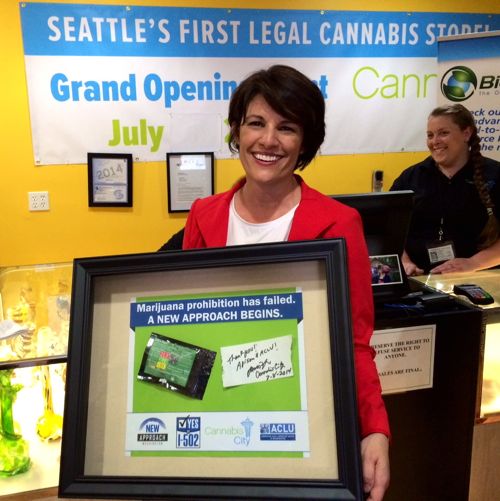
I bought a bag of marijuana today at Cannabis City, Seattle’s first legal retail pot store, just after they opened at noon. (Surprisingly for a pot store, they opened on time.) It was a different experience from every other time I’ve bought pot—and I’ve bought a lot of pot before—not just because there were dozens of TV crews swarming outside. What legalization provides, prohibition never could: explicit certainty about what I purchased, what it contains, what it doesn’t contain, where it came from, where the money goes, and the promise that every time I purchase this product it will be essentially the same.

Here’s the excellent pot, the bag, a receipt, and a very detailed label:

thumb-1404869035-pot_and_receipt

$40 gets you two grams of pot and more information about your stash than you’ve ever had before.

Consumers will decide whether all that certainty is worth the price; the two-gram bag was $40, including $10 in tax, which is generally higher than street prices.

Some people already say it’s not worth it. Standing beyond the media frenzy was John Stuart, 24, who was wearing a pair of pot-leaf-print shorts and a Marilyn Manson t-shirt. His friend had a white pit bull on a rope. Were they waiting to buy pot inside? “No, because I got a medical-marijuana card and it’s way too expensive at Cannabis City,” said Stuart. “You could go to Westlake Park and get it for $10 a gram. That’s a lot cheaper than going to the store.”

But the pot Stuart can buy in a dispensary or in a park will never be like this. The glut of information on that label represents something between government overreach and a pot-lover’s dream come true.

The largest typeface on the label details the precise composition of the drug. This strain is called OG’s Pearl, which contains exactly 21.5 percent THC (the predominant set of psychoactive chemicals in cannabis). The label then lists the CBD, a more narcotic chemical found in marijuana, and the nonpsychoactive CBG. The label goes on: These buds are 80 percent indica-type cannabis (as opposed to the more stimulating sativa, which presumably makes up the other 20 percent). It lists the moisture content (6.25 percent), the day it was harvested (June 2), the day it was tested (June 23), where it was grown (Kitsap County), how it was grown (indoors), and who grew it (Nine Point Growth Industries).

If I like this product, I can buy it again and it will reliably be the same thing. If the product changes—how or where it’s grown, whether there are shifts in chemical composition at the next harvest—it will be right there on the label.

This chunk of vegetation, like all the pot legally sold in Washington, was tracked from the time it was a baby clone to a full-grown plant, then tracked from harvest and into this package. And because it’s so closely tracked, consumers have unprecedented certainty that it’s not tainted with contaminants (other drugs, sketchy fertilizers, tobacco juice, mold, soap, etc.).

It’s also a guaranteed weight—you’re not going to get shorted on your deal—and you know your money is paying for legit, in-state jobs, not funding some murderous interstate cartel.

But if Mr. Stuart buys pot in the park, it’s all but certain he’ll have no idea what he’s really getting (or where his money goes). Even dispensaries will lie through their teeth about what they’re selling—I know because it was once my job to tell that lie.

In my 20s, I worked briefly as an assistant manager in a marijuana dispensary in California. Each morning, growers would deliver massive sacks of weed to the back door, and we’d haul them to an upstairs office for inventory purposes. It turns out, one of my jobs there was to name the strains. People talk a lot about pot strains like they’re of hallowed pedigree, and some of them are legit examples of growers developing a unique variety (classics like White Widow or Blueberry, or newer strains like Jack Herer). But a lot of strain names? They’re totally fabricated. There’s always pothead lore about how one strain is stronger, how it makes you happy, how it’s got a “really mellow vibe,” or it’s “good for sleep.” But most of that is bullcrap. At the dispensary I worked for, part of my job was to fabricate names as a marketing ploy. I’d just make ’em up. I called them Einstein, Alligator, Beethoven, Plato—any name I’d think could sell. And if the name was marketable and we’d run out of that type of pot? We’d find another type of pot and call it the same name. Long story short: Under prohibition, the name’s meaningless. The place you bought it didn’t guarantee its provenance. You never knew what you were getting from one bag to the next.

With the standards we have in Washington, we don’t have punk-ass kids (like me) making up stuff about your weed and you don’t have to guess what you’re smoking. The question is: Do we have enough legal pot to keep this system running?

1404863612-holcomb_and_pot

ALISON HOLCOMB: Beaming for bud.

Alison Holcomb, who sponsored the initiative that legalized marijuana, bought a bag of pot herself today. She acknowledged the shortages of ready-to-use marijuana, as we wrote about over here, and said the first day was not as critical as the state being able to license enough growers to maintain a supply chain: “It is critical that we can sustain stores, instead of seeing them going under due to lack of product to sell to customers.”

But she added that the stores we have are better than what she expected. “When we drafted the initiative [in 2011], we were thinking of the state-run liquor stores,” said Holcomb. But unlike the austere state booze outlets, which were nixed by voters, the Cannabis City showroom has hardwood floors, wooden paneling, and illuminated display cases. “This is warmer and more inviting than what we envisioned,” said Holcomb. (It’s also a helluva lot nicer than buying pot in an alley or at some chatty dealer’s apartment.)

Cannabis City owner James Lathrop was beside himself with self-satisfaction. “I declare this war over,” he told the crowd. (Good for him, but tell that to people in the other 48 states.)

However, Lathrop, Holcomb, and others also provided something with legal pot you’ll never see from a street dealer: a level-headed warning in writing.

Every customer was handed an informational “consumer’s guide” pamphlet with “what you should know” about pot use in a Washington State. It warns about the potency of edibles (which aren’t in stores yet), the law about driving stoned (don’t do it), and the rules about where you can consume it (in private places, but not in hotels that ban smoking).

That pamphlet—free of fear-mongering—represents a tiny but critical revolution in drug education: It’s produced by the Washington State Liquor Control Board, a state agency, but it’s sponsored by and features the logos of the ACLU, the National Organization for the Reform of Marijuana Laws, and the Marijuana Business Association. This pamphlet is evidence of government critics co-opting government.

This is the end of “Just Say No” in our state. That was an era of the government lying about the harms of pot and promising you that one toke led to a lifetime of addiction, while pro-pot forces generally exaggerated the benefits and downplayed the risks. More and more, both sides are settling on the facts and providing all the information—sometimes more than you know what to do with, right on the label—for users make up their own minds. You know you’re buying local.

So if it costs a few bucks more per gram, it’s worth it.

Editor’s note: while I agree with much of the author’s arguments, there is something to be said for supporting blackmarket pot as well. In cases where you and the dealer develop friendship and trust you can get comparable consistency of quality. Though it may not always be the exact same strain, it can be a pleasant surprise to try something new. You may also have an opportunity to experience other illegal substances if you choose (but always do the research first). If/when cannabis becomes as commercialized as foods and tobacco, you may not be able to trust the labels on the package anyway. And why not show loyalty towards those who have provided quality service through the dark days of prohibition at the risk of their freedom and security?

Public Outrage Forces Seattle Officials to Backtrack on DHS Surveillance Grid

index

Last week, Seattle’s alternative weekly paper The Stranger published an exposé on their city’s new wireless mesh network, part of a $2.7 million project purchased by the Department of Homeland Security. The Seattle Police Department refused to answer more than a dozen questions about the network (which was fast-tracked by Seattle City Council with very little process for review and approval) including whether it’s operational, who can access its data, what it might be used for, whether the SPD has used or intends to use it to geo-locate people’s devices via MAC addresses or other identifiers, and how accurately it would be able to track people.

On November 12, Anthony Gucciardi and Mikael Thalen released reports on Infowars and Storyleak featuring leaked documents on the surveillance mesh posted by an anonymous whistleblower earlier this year. Some of the findings are recapped in the video below:

Shortly after the leaks went public (Tuesday evening) Seattle Police Spokesperson Sgt. Sean Whitcomb announced “The wireless mesh network will be deactivated until city council approves a draft policy and until there’s an opportunity for vigorous public debate.” While it’s fortunate they were forced to do this due to public pressure, it contradicted previous statements SPD had made to the local press in the wake of The Stranger article. As reported by RT:

The SPD told The Stranger previously that the system was not being used, but anyone with a smart phone who wandered through the jurisdiction covered by the digital nodes could still notice that their devices were being discovered by the internet-broadcasting boxes, just as a person’s iPhone or Android might attempt to connect to any network within reach. In theory, law enforcement could take the personal information transmitted as the two devices talk to each other and use that intelligence to triangulate the location of a person, even within inches.

When the SPD was approached about the system last week, they insisted that it wasn’t even in operation yet. David Ham of Seattle’s KIRO-7 News asked, however, how come “we could see these network names if it’s not being used?”

Well, they couldn’t give us an explanation,” Ham said at the time.

They now own a piece of equipment that has tracking capabilities so we think that they should be going to city council and presenting a protocol for the whole network that says they won’t be using it for surveillance purposes,” Jamela Debelak of the American Civil Liberties Union told the network.

Now just days later, the SPD has admitted to The Stranger that indeed the mesh network was turned on — it just wasn’t supposed to be.

SPD maintains it has not been actively using the network — it was operational without being operated, having been turned on for DHS grant-mandated testing and then never turned off — so shutting it down won’t hamper any current SPD activities,” The Stranger reported.

Are we supposed to believe the SPD “forgot” to shut the system off or trust that they would leave it operational without anyone operating it in light of the fact that they lied to reporters about the system being on a few days earlier? Both seem unlikely, as does promises that they’ll have enough safeguards in place to prevent misuse of the information they collect.

As RT previously reported, the DHS has been quietly rolling out similar surveillance grids in other cities including Oakland and Las Vegas. At this point, all Americans must remain extra vigilant to stay on top of such Orwellian schemes and do everything within power to shut them down.

UPDATE 11/28: Infowars just released this follow-up report revealing SPD had in fact NOT shut down the surveillance grid after publicly announcing that they would. This is further evidence that government lies and/or is incompetent at doing anything not a high priority for them (like shutting off surveillance grids), as if anyone needed more evidence.

UPDATE 12/9: Seattle police just announced today that the last of the surveillance nodes had finally been shut off last Friday (12/6). According to The Stranger:

Today, an SPD spokesperson said the department had turned off the final nodes in the network on Friday—156 could be disabled remotely, which happened weeks ago (though 19 had to be double-checked in person), but 8 had to be deactivated manually by a technician. Those are now off.

Today, I also received a copy of a letter sent from SPD Chief Jim Pugel to city councilperson Bruce Harrell about the mesh network. The full text is below the jump, but the relevant points are: (a) the department says the technology needs “more vetting with the ACLU and other stakeholders before a public hearing” and (b) Chief Pugel’s assertion that the network does not have the capability to track or record a person’s movements, but that SPD’s draft policies about its use “will cover any non-video technology” anyway.

The department, Pugel says, should be ready for a briefing with the council member earlier next year.

Podcast News Updates

the-5th-horseman

There’s been another string of relevant news podcasts in the past few days so it’s time for another roundup post.

Last week Rob Kall of OpEdnews.cominterviewed Peter Ludlow a professor of linguistics and philosophy, on topics including systemic evil, whistleblowers and hacktivism:

https://itunes.apple.com/us/podcast/rob-kall-bottom-up-radio-show/id359765013

On Friday, Abby Martin of Breaking the Set did an excellent job deconstructing the corporatocracy on Coast to Coast AM with John Wells:

http://www.mediaroots.org/abby-martin-deconstructs-the-corporatocracy-on-coast-to-coast-am/

On Monday Nellie Bailey and Glen Ford of Black Agenda Report covered a wide range of important topics including an update on the corporate plan for Detroit (an American apartheid), the struggle to raise the minimum wage in Seattle, and Dave Swanson’s (of WarIsACrime.org) analysis of the multitude of lies in Obama’s recent UN speech : Listen to Black Agenda Radio on the Progressive Radio Network, with Glen Ford and Nellie Bailey – Week of 9/30/13.

From Traces of Reality there were two great consecutive shows. On 9/30 host Guillermo Jimenez interviewed Kevin Gallagher, director of Free Barrett Brown.  Brown is the journalist who faces a 105 year sentence, the bulk of which is related to charges associated with pasting a link in a chat room. On the 10/1 episode, Guillermo is joined by Vice President of The Future of Freedom Foundation, Sheldon Richman. They cover topics including the “government shutdown”, the national debt, taxation, private property, the “social contract,” and the fallacy of the “consent of the governed.”:

9/30

10/1