Saturday Matinee: Immortal (aka Immortel, ad vitam)

hqdefault“Immortal” (2004) is a French-produced live-action/animated feature directed by Enki Bilal and based on his graphic novel The Carnival of Immortals. It was one of the first major films (along with Casshern and Sky Captain and the World of Tomorrow) to be shot entirely with a digital backdrop, blending live actors with computer generated surroundings.

The film takes place in New York City circa 2095 where genetically altered humans mingle with unaltered men and women and Central Park has been mysteriously encased in an energy field which kills people who attempt to enter. A strange pyramid has appeared over the city in which Egyptian gods decide Horus must end his immortality. Before dying, Horus, while searching for a host body with which to procreate and continue his bloodline, also finds potential demi-god Jill.


Saturday Matinee: La Jetée

“La Jetée” (1962) is a short sci-fi feature directed by filmmaker, poet, novelist, photographer, editor, videographer and digital multimedia artist Chris Marker. Comprised entirely of narration over still photos (except for one crucial scene), La Jetée tells the story of a post-nuclear war time travel experiment and is considered one of the most influential and radical science-fiction films ever made (directly inspiring Terry Gilliam’s “12 Monkeys”).

https://vimeo.com/31209852

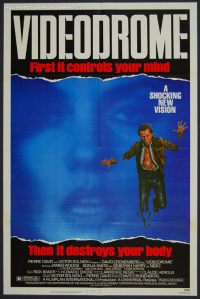
David Cronenberg’s Videodrome Was a Technology Prophecy

videodrome_one_sheet_movie_poster_l

Editor’s note: Since today marks director David Cronenberg’s 73rd birthday, it’s a good time to appreciate one of his greatest and most notorious works. Though my favorite of his remains the distinctly PKD-like eXistenZ, a close runner up is the cult classic Videodrome, which the following analysis reappraises in the context of contemporary social media-fixated culture.

By Nathan Jurgenson

Source: Omni Reboot

David Cronenberg’s vision of technology as the “new flesh” in Videodrome isn’t so shocking anymore.

Videodrome is the best movie ever made about Facebook.

What felt “vaguely futuristic” about it in 1983 is prescient today: technology and media are ever more intimate, personal, embodied, an interpenetration that David Cronenberg’s film graphically explores.
Videodrome offers a long-needed correction to how we collectively view and talk about technology. As the anti-Matrix, Videodrome understood that media is not some separate space, but something which burrows into mind and flesh. The present has a funny habit of catching up with David Cronenberg.
Still, Videodrome is deeply of its time and place. It’s set in Toronto, where Cronenberg was born and studied at the same time as University of Toronto superstar media theorist Marshall McLuhan, who coined the phrase “the medium is the message.” Beyond McLuhan’s reputation, Toronto was also known as a wired city; among other things, it was an early adopter of cable television.
In suit, Videodrome follows a Toronto cable television president, Max Renn (James Woods). He becomes involved with a radio psychiatrist named Nikki Brand (Debbie Harry, of Blondie fame), who reminds us of popular criticisms of television culture: we want to be stimulated until we’re desensitized, becoming (at best) apolitical zombies and (at worst) amoral monsters. Television signal saturates this film. The satellite dishes, screens, playback devices, and general aesthetics of analogue video are on glorious, geeked-out display. Although Videodrome’s operating metaphor is television, this film can be understood as being a fable about media in general. And what seemed possible with television in 1983 seems obvious today with social media.
Over the course of the film, Max comes to know a “media prophet” named Professor Brian O’Blivion—an obvious homage to Marshall McLuhan. O’Blivion builds a “Cathode Ray Mission,” named after the television set component which shoots electrons and creates images. The Cathode Ray Mission gives the destitute a chance to watch television in order to “patch them back into the world’s mixing board,” akin to McLuhan’s notion of media creating a “global village,” premised on the idea that media and technology, together, form the social fabric. O’Blivion goes on to monologue, “The television screen is the retina of the mind’s eye. Therefore, the television screen is part of the physical structure of the brain. Therefore, whatever appears on the television screen appears as raw experience for those who watch it. Therefore, television is reality; and reality is less than television.”
This is Videodrome’s philosophy. It’s the opposite of The Matrix’s reading of Baudrillard’s theories of simulation, and it goes completely against the common understanding of the Web as “virtual,” of the so-called “offline” as “real.” O’blivion would agree when I claim that “it is wrong to say ‘IRL’ to mean offline: Facebook is real life.”
This logic—that the Web is some other place we visit, a “cyber” space, something “virtual” and hence unreal—is what I call “digital dualism” and I think it’s dead wrong. Instead, we need a far more synthetic understanding of technology and society, media and bodies, physicality and information as perpetually enmeshed and co-determining. If The Matrix is the film of digital dualism, Videodrome is its synthetic and augmented opponent.
As P.J. Rey illustrates, fictional Web-spatiality is the favorite digital dualist plot device. Yet more than fiction books and films, what has come to dominate much of our cultural mythology around the Web is the idea that we are trading “real” communication for something simply mechanical: that real friendship, sex, thinking, and whatever else lazy op-ed writers can imagine are being replaced by merely simulated experiences. The non-coincidental byproduct of inventing the notion of a “cyber” space is the simultaneous invention of “the real,” the “IRL,” the offline space that is more human, deep, and true. Where The Matrix’s green lines of code or Neal Stephenson’s 3D Metaverse may have been the sci-fi milieu of the 1990s, the idea of a natural “offline” world is today’s preferred fiction.
Alternatively, what makes Videodrome, and Cronenberg’s oeuvre in general, so useful for understanding social media is their fundamental assumption that there is nothing “natural” about the body. Cronenberg’s trademark flavor of body-horror is highly posthuman: boundaries are pushed and queered, first through medical technologies in Shivers , Rabid , The Brood , and Scanners , then through media technology in Videodrome  and eXistenZ , then, most notoriously, in The Fly, where the human and animal merge. If The Matrix is René Descartes, Videodrome is Donna Haraway.
Cronenberg’s characters are consistent with Haraway’s theory of the cyborg: not the half-robot with the shifty laser eye, but you and me. In the film, the goal is never to remove the videodrome signal that is augmenting the body, but to reprogram it. To direct it. As Haraway famously wrote, “I’d rather be a cyborg than a goddess.” “Natural” was never a real option anyways.
Max Renn is especially good at finding the real in the so-called “virtual” because he is equally good at seeing virtuality in the “real.” From the beginning, he understands that much of everyday life is a massive media event devoid of meaning. The old flesh is tired, used up, and toxic. The world is filled with a suffering assuaged only by glowing television screens. As the film progresses, the real and unreal blur, making each seem hyperbolic: hallucinations become tangible, while the tangible drips with a surrealism that’s gritty, jumpy, dirty, erotic, and violent—closer to Spring Breakers than The Wizard of Oz. As such, Cronenberg’s universe is always a little sticky: an unease which begs the nightmares to come true, so that we at least know what’s real.
Videodrome’s depiction of techno-body synthesis is, to be sure, intense; Cronenberg has the unusual talent of making violent, disgusting, and erotic things seem even more so. The technology is veiny and lubed. It breaths and moans; after watching the film, I want to cut my phone open just to see if it will bleed. Fittingly, the film was originally titled “Network of Blood,” which is precisely how we should understand social media, as a technology not just of wires and circuits, but of bodies and politics. There’s nothing anti-human about technology: the smartphone that you rub and take to bed is a technology of flesh. Information penetrates the body in increasingly more intimate ways.
This synthesis of the physical and the digital is mirrored in the film’s soundtrack, too. In his book on Videodrome’s production, Tim Lucas calls Howard Shore’s score “bio-electronic” because it was written, programmed into a synthesizer, and played back on a computer in a recording studio while live strings played along. Early in the film, the score is mostly those strings, but as time passes the electronic synthesizers creep up in the mix, forming the bio-electronic synthesis.
The most fitting example of techno-human union in Videodrome is the famous scene of Max inserting his head into a breathing, moaning, begging video screen; somewhere between erotic and hilarious, media and humanity coalesce. There isn’t a person and then an avatar, a real world and then an Internet. They’re merged. As theorists like Katherine Hayles have long taught, technology, society, and the self have always been intertwined. Videodrome knows this, and it shows us with that headfirst dive into the screen—to say nothing of media being inserted directly into a vaginal opening in Max’s stomach, or the gun growing into his hand.

Thirty years after its release, Videodrome remains the most powerful fictional representation of technology-self synthesis. This merger wasn’t invented with the Internet, or even television. Humans and technology have always been co-implicated. We often forget this when talking about the Web, selling ourselves instead a naive picture of defined “virtual” spaces which somehow lack the components of “real” reality. This is why The Matrix and “cyberspace” have long outworn their welcome as a frame for understanding the Internet. It should be of no surprise that body horror is as useful for understanding social media as cyberpunk.

Saturday Matinee: Snowpiercer

Snowpiercer_poster

Snowpiercer (2013) is a film adaptation of French graphic novel Le Transperceneige by Jacques Lob and Jean-Marc Rochette directed by Bong Joon-ho (The Host, Mother, Haemoo). The majority of the movie takes place on a perpetually globe-spanning train containing the last surviving members of the human race after a geoengineering scheme creates an apocalyptic ice-age. Though the film has its share of plot holes (which become more apparent with repeat viewings), it remains the best cinematic metaphor for today’s dominant political/economic system. Snowpiercer also features outstanding performances from Chris Evans, Song Kang-ho, Tilda Swinton, Octavia Spencer, John Hurt, and Ed Harris among others.

Watch the full film here.

(Note: annoying pop-up ad windows may need to be closed after clicking the “play” button.)

Philip K. Dick’s Moral Vision

731200982635AM

[Editor’s note: on this 34th anniversary of the death of Philip K. Dick, I’m sharing the 10th and final chapter of Patricia S. Warrick’s bibliographical retrospective “Mind in Motion” (1987). It’s a good reminder of what makes PKD’s work so unique and enduringly relevant.]

This critical study of Dick’s fiction is a work without a concluding chapter – and appropriately so. To summarize his ideas, to categorize his work, to deliver the final word would be to violate Dick’s vision. He saw a universe of infinite possibility, with shapes that constantly transformed themselves – a universe in process. He had not delivered his final word when he died on March 2, 1982, because for him the Word was truly the Living Word, the power that creates and re-creates patterns. Trapped in the stasis of a final statement, the Word would have been defeated by entropy and death.

But if we cannot make a final statement, we can at least note the significance of his opus of fiction for the times in which we live. Great creative personalities often see the essence of an age with a clarity denied to the mass of people. their vision is so vivid that when subsequent events confirm it, humanity, slower at arriving at a realization of its present, hails them as prophetic. I believe that Dick may well be one of those creative personalities whom we hail as visionaries. The claim seems a strange one, considering the literary form in which he worked. Blake, Wordsworth, Yeats – the Romantics with the the elegance of poetic diction make up the visionary company, not writers working in a prose form often regarded as trash. But let us for the moment ignore the form in which he was forced to write and consider instead his vision.

He had a remarkable sense of the cultural transformation taking place in the last half of the twentieth century. He pointed out the cracks in our institutions, our ideologies, and our value systems that would inevitably lead to their collapse. He understood that what had been functional in an industrial age would not work as our culture transformed itself and moved into an Information Age. Such changes often march in with violence. As Dick’s fiction declares again and again, the late twentieth century is a time at war with itself, not with an external enemy. To fight against what one abhors without realizing it lies within is to destroy all. Dick warns us against doing this to ourselves. The cloud of chaos inevitably hangs above the Dickian landscape, a reminder that a like chaos will descend on the real world and envelop us if we continue to make war.

Dick’s fiction calls up our basic cultural assumptions, requires us to reexamine them, and points out the destructive destinations to which they are carrying us. The American Dream may have succeeded as a means of survival in the wilderness of early America; it allowed us to subdue that wilderness and build our holy cities of materialism. But now, the images in Dick’s fiction declare, we live in a new kind of wilderness, a wasteland wilderness, because those cities and the culture that built them are in decay. We need a new American dream to overcome this wasteland. Dick’s ubiquitous wasteland landscape is a moral mirror asking us to journey within and explore the universe of mind and psyche where all the forms that shape the outer world are created. The critical journey of discovery is into the mysterious realm of inner space. Just as Dick’s Fomalhaut Cosmos was a universe created by his imagination, so the universe in which we live is constructed of our ideas about it. To change it we must change our ideas.

Dick’s work makes no new declarations about our time; we knew early in the twentieth century that ours was an Age of Anxiety. But the gift of his powerful mythmaking ability is to give us the stories that help us see both what we are and what we may become as we move into the Space Age. His novel contribution is the bizarre images he creates that so vividly picture our anxieties. Phantasmagoric  shapes, the Dickian protagonist calls them, as he muses about the swirl of awesome possibilities sweeping through his mind. They are disorienting images – without clear boundary, inconsistent, contradictory, fragmented, at war with one another. They force us to reconsider our conventional conception of reality. Dick said that “science fiction is uniquely a kind of semi-reality. It is not a statement that ‘this is,’ but a statement, ‘What if this were.’ The difference is crucial in every respect.” Frightening as are some of the futures Dick imagines for mankind, they are not fixed. We are Leo Buleros, we are “choosers,” Dick tells us in the Three Stigmata of Palmer Eldritch; and The Divine Invasion envisions another future than nuclear destruction that we can choose.

We have noted Dick’s wide acquaintance with the classics. But much as Dick loved classical literature, he did not draw on this source in creating his characters. The Dickian fictional world is a world without Titans or Heroes; instead it is a world cut off from the gods. It is filled with little people lacking in power or wisdom, who daily face the dilemma of trying to survive in the face of the inexplicable destructive forces that constantly try to snuff them out. Yet they are not the conventional antiheroes of modern fiction. Perhaps the oxymoron heroic antihero best describes Dick’s protagonist. finally, the Dickian hero acts. He may writhe and struggle to escape, but in the end he accepts the burden of his existential freedom. Daily, he finally learns, he must once again to push the boulder of moral responsibility up the hill of right action. Freedom thus becomes of highest value in Dick’s code. The individual must be free to make moral choices, even though he may often fail to make the right choice. Dick declares again and again, for the individual to be turned into a machine programmed to carry out the decisions of others is “the greatest evil imaginable; the placing on what was a free man who laughed and cried and made mistakes and wandered off into foolishness and play a restriction that limits him, despite what he may imagine or think, to fulfilling an aim outside his own personal – however puny – destiny.”

Our study of Dick’s writings has traced the journey of his restless mind, watching as it grasped an idea, created a metaphor for it in a fictional pattern of antimonies, discarded it for another idea – always spiraling forward albeit often in a wobbling, erratic course. Yet from the beginning one element remains constant in all the fiction – Dick’s faith in the power of empathy. The idea was not well developed or labeled when it first appeared. We see empathy in two of his early short stories as through a glass darkly. He has not yet given it a name. Instead, his characters act it out, and only later does he recognize what his fiction has said. In “Roog” Dick pictures a dog who guards the garbage can of his owners against the garbage men who come to collect it each week. The dog is driven crazy because he cannot offer protection to his owners against these weekly raids. Years later, Dick commented on the story, explaining that he was describing an actual dog owned by a Berkeley neighbor. “I watched the dog suffer, and I understood a little of what was destroying him, and I wanted to speak for him. That’s the whole of it right there. Snooper couldn’t talk. I could. In fact I could write it down, and someone could publish it and many people could read it. Writing fiction has to do with this: becoming the voice for those without voices. It’s not your own voice, you the author; it is all those other voices which normally go unheard.”

“Beyond Lies the Wub,” Dick’s first published story, also dramatizes the concept of empathy. It tells the story of a pig-like alien captured and eventually eaten be a crew of space adventurers despite the fact that the wub possesses human characteristics. Captain Franco and his men lack the ability to see beneath the wub’s appearance. Twenty years later Dick said of the story”:

The idea I wanted to get down on paper had to do with the definition of “human.” The dramatic way I trapped the idea was to present ourselves, the literal humans, and then an alien life form that exhibits the deeper traits that I associate with humanity: not a biped with an enlarged cortex — a forked radish that thinks, to paraphrase the old saying — but an organism that is human in terms of its soul.

I’m sorry if the word “soul” offends you, but I can think of no other term. Certainly, when I wrote the story “Beyond Lies the Wub” back in my youth in politically active Berkeley, I myself would never have thought of the crucial ingredient in the wub being a soul; I was a fireball radical and atheist, and religion was totally foreign to me. However, even in those days (I was about twenty-two years old) I was casting about in an effort to contrast the truly human from what I was later to call the “android or reflex machine” that looks human but is not — the subject of the speech I gave in Vancouver in 1972 [“The Android and the Human,” included herein] — twenty years after “Beyond Lies the Wub” was published. The germ of the idea behind the speech lies in this, my first published story. It has to do with empathy, or, as it was called in earlier times, caritas or agape.

In this story, empathy (on the part of the wub, who looks like a big pig and has the feelings of a man) becomes an actual weapon for survival. Empathy is defined as the ability to put yourself in someone else’s place. The wub does this even better than we ordinarily suppose could be done: Its spiritual capacity is its literal salvation. The wub was my idea of a higher life form; it was then and it is now. On the other hand, Captain Franco (the name is deliberately based on General Franco of Spain, which is my concession in the story to political considerations) looks on other creatures in terms of sheer utility; they are objects to him, and he pays the ultimate price for this total failure of empathy. So I show empathy possessing a survival value; in terms of interspecies competition, empathy gives you the edge. Not a bad idea for a very early story by a very young person!

Two years after writing “The Wub,” Dick again explored the concept in “The Last of the Masters” (1954) and now he named it and actually called it empathy. In the story a young freedom fighter, Silvia, finally encounters the head of the coercive government and discovers he is a robot. She says in horror, “My God, you have no understanding of us. You run all this, and you’re incapable of empathy. You’re nothing but a mechanical computer.”

By the second period of Dick’s fiction when he writes his great novels of the 1960s, empathy is regularly used as the key element defining the authentic human being. the concept is made concrete most vividly in “The Little Black Box,” published in 1964. Dick then incorporates the black empathy box in Do Androids Dream where those like J.R. Isidore who use it regularly gain the strength to climb up through the difficulties of their daily lives. Beyond that, the power of empathy frees the individual from the prison house of his own consciousness and allows him to slip through the mirror forever reflecting back his own image. Once beyond, he sees the world from an alien consciousness to which he gives the same rights and worth as his own awareness. All life, not just his own, becomes sacred.

At first glance, Dick seems to be a contemporary writer who in many ways espouses an old-fashioned moral view that places him in the long tradition of humanistic writers. From the beginning, his writing insists that each individual has a responsibility to act in a moral way, even though that early fiction makes no reference to God. And of course by the end of his career, the novels focus on the major concepts of the Judeo-Christian tradition. While these concepts are never accepted in their entirety – in fact they are almost always revised – they are never denied or negated.

A closer examination of Dick’s moral code, however, shows us that given the complexities of the contemporary world, the values of traditional Christian humanists are too simple to be workable. He develops a code of valor that is much more demanding. Choice is no longer a choice between good and evil, as the moralist in an earlier age would have declared. Today the problem facing each man is that even when he practices empathy and yearns to make the right moral choice, he often finds himself in a moral dilemma where in order to do right he must also do wrong. Again and again the Dickian hero is faced with this tragic choice: to do the right thing he must violate his own moral nature: for example, Tagomi, Glen Runciter, Joseph Adams, Joe Chip, Rick Deckard. The moral road is not an easy one. The critical metaphor for this arduous journey is the upward climb – Wilbur Mercer on the hill, Joe Chip on the stairs.

In an interview near the end of his life Dick once again reinforced his belief that moral values are the ultimate values: “In a sense what I’m saying is that all life is a moral issue. Which is a very Jewish idea. The Hebrew idea about god is that God is found in morality, not in epistemology. That is where the Almighty exists, in the moral area. It isn’t just what I said once, that in Hebrew monotheism ethics devolve directly god. that’s not it. It’s that God and ethics are so interwoven that where you have one you have the other.”

Dick is an iconoclastic literary figure. His fiction refuses to conform to the characteristics of any particular category. Because he uses many of the techniques of science fiction, he is customarily labeled as a writer in that genre. But the strong, often overwhelming, elements of realism in his fiction – novels Martian Time-Slip and Dr. Bloodmoney, for example – make that label somewhat inaccurate. In many ways he seems to fit into the tradition of Absurdist literature, and he readily admitted the influence in his formative stage of Beckett, Genet, and other Absurdist dramatists. The typical Absurd hero inhabits a grotesque world whose structures violate reason and common sense but are nevertheless true. He is constantly frustrated, muddled, or horrified by the inexplicable events that seem to happen only to him and finally lead him in paranoiac panic to decide that Fate is deliberately playing pranks on him. Not the Fall of Man but his pratfalls are the concern of the Absurdist writer. So, too, are pratfalls often Dick’s concerns. Yet in fuller assessment, we find that Dick does not fit neatly into this category because he refuses to give in to the nihilism of the French Absurdists.

Dick on occasion proclaimed himself a writer in the Romantic tradition who was particularly influenced by German Romanticism. He read Goethe and Schiller when he was young, and the works of Beethoven and other German romantic composers were among his favorites. His intuitive mode of creativity and his emotional excesses characterize him as a romantic, as does his rebellion against all institutions that violate individual freedom. “I’m a Sturm and Drang romantic,” he himself declares in one interview.

When we continue to look for Dick’s literary ancestors, we discover that the ones from which he is rooted most directly are the metaphysical poets. Dick claimed them as among his favorite poets and uses quotations from Vaughan and Marvell and Donne in his fiction. For example, he quotes Donne’s Holy Sonnet XIV, “Batter my Heart, three person’d God,” in its entirety in Timothy Archer. His four chambered metaphors resemble metaphysical conceits with their concentrated images that involve an element of dramatic contrast, or strain, or of intellectual difficulty. Like Donne, he uses a colloquial style. Both writers are obsessed with the idea of death and treat it again and again in their works. So, too, do both writers blend wit and seriousness, intense feelings and vast erudition.

A discussion of literary influences is not a discussion of the essence of Dick’s fiction because his literary voice is unique. He is an eclectic, choosing and using ideas, techniques, and quotations from the literary tradition as he creates in his own distinctive form. He is a synthesizer but never an imitator. the bibliography accompanying Timothy Archer demonstrates the wide range of literature that yielded material to him: the Bible, works of Aeschylus, Plato, Virgil, Dante, Shakespeare, Donne, Vaughan, Goethe, Schiller, Yeats, to name the major writers. In this final novel Dick felt free to reveal his debt to and use of the great literary tradition, a use that he hid under cryptic allusions in most of his science fiction.

Time must be  the judge of Dick’s literary worth. If, as some of us suspect it will, Time does declare him one of the major writers of the twentieth century, he will be hailed as the synthesizer of a new literary form yoking realism and the fantastic. The novels to which I have given major attention in this study (with the possible exception of A Scanner Darkly) all succeed in this new form, for which I have chosen the term quantum-reality fiction. Dick’s fiction gives too little emphasis to science to be called true science fiction. It gives too much emphasis to the real world to be called fantasy. It violates common-sense reality too often to be called realistic fiction. He sees with a new vision as he creates imaginary worlds for his reader – a vision that declares all worlds to be fictions, brought into existence by the consciousness of the creator. Man faces the void and keeps it at bay only by the power of his intelligence to create forms.

The universe where Dick’s characters live when they fall out of commonsense reality is built on concepts that are a part of quantum physics. As physicists describe it, quantum reality is evasive and seems forever to hide beyond direct observation. Quantum physicists do not entirely agree about the nature of quantum reality, except in labeling it as bizarre. A contemporary physicist notes, “if we take the claims [of some outspoken physicists] at face value, the stories physicists tell resemble the tales of mystics and madmen… Not ignorance, but the emergence of unexpected knowledge forces on us all new visions of the way things really are.” Quantum theory holds that all elementary events occur at random, governed only by statistical laws. And Heisenberg’s famous uncertainty principle forbids an accurate knowledge of a quantum particle’s position and momentum. Beyond that, the prevailing quantum theory holds that there is no reality without the act of observation. Dick’s fiction catches the essence of this quantum reality, and he is probably the first writer of fiction to have done so.

In addition to his creation of quantum reality fiction, Dick also deserves recognition for the development of the complex four-chambered metaphor that allows him to picture the dialectical mode of the human mind as it moves in the process of thinking.

Beyond his accomplishments as a writer, Dick merits recognition for his accomplishments as a human. He struggled to live by his code of valor. In the face of great adversity, he survived and created. He was a tortured genius, condemned to live within a brilliant mind that compulsively drove itself to gather up and live out all the anxiety, pain, and torment of our age. Perhaps he needed so to suffer before he could transform our shared experiences into literature. Perhaps he did not choose but worked heroically in the shadow of a mental illness from which he had no escape. He is not the first writer to be so tortured. I recently reread a biography of Virginia Woolf which describes her struggle to write in the face of repeated nervous breakdowns, and I noted how similar Dick’s life was in this respect. He was less fortunate than she; he had no lifetime spouse like Leonard Woolf to shelter him economically and emotionally and to publish his works.

Dick’s life was a quest for meaning, a struggle with the great metaphysical problem of our time – how to reconcile what he knew in his head with what he knew in his heart. He identified himself with his little men, unheroic protagonists who endure in the face of great adversity, going quietly about their work. His work was writing and he, too, went about it quietly, eschewing publicity. Through all the mental and physical illness he never stopped writing for more than a brief time. He never lost faith in the power of literature to create a shared consciousness for the community of men. Looking at our strife-torn world, he said:

The key is this. We must shape a joint dream that differs for and from each of us, but it must harmonize in the sense that it must not exclude and negate from section to section. How this is to be done I can’t of course say; maybe it can’t be done. But… if two people dream the same dream it ceases to be an illusion; the sole prior test that distinguished reality from hallucination was the consensus gentium, that one other or several others saw it, too. This is the idios kosmos, the private dream, contrasted to the shared dream of us all, the koinos kosmos. What is new in our time is that we are begining to see the plastic, trembling quality of the koinos kosmos – which scares us, its insubstantiality – and the more-the-merrier-vapor quality of the hallucination. Like science fiction, a third reality is formed half way between.

In his writing Dick shared with us his private dreams and his nightmares about this new reality in the future toward which we move. He said he was disturbed by those reviewers who found only bitterness and pessimism in his fiction because his mood was one of trust. “Perhaps,” he said, “they are bothered by the fact that what I trust is so very small. They want something vaster. I have news for them; there is nothing vaster.” For Dick all that one could trust was the capacity of the ordinary person to act with courage when courage is required. He explained, “To me the great joy in writing a book is showing some small person, some ordinary person doing something in a moment of great valor, for which he would get nothing and which would be unsung in the real world. the book, then, is the song about his valor.”

Perhaps this book can be regarded at least in part as a song about the valor of Philip K. Dick. For he continued to write over the years, hounded by poverty, often depressed, and ignored by the mainstream literary world where he hoped for recognition. He lived in a sea of emotional disaster, he was often ill, he used drugs, he alienated his friends, he destroyed five marriages… Yet incredibly he wrote well over forty novels and one hundred short stories, and at least eight of those novels, the ones we have examined in detail, seem likely to become classics. He was one of the most courageous of writers, a man who lived by his own code of valor.

Saturday Matinee: Sleep Dealer

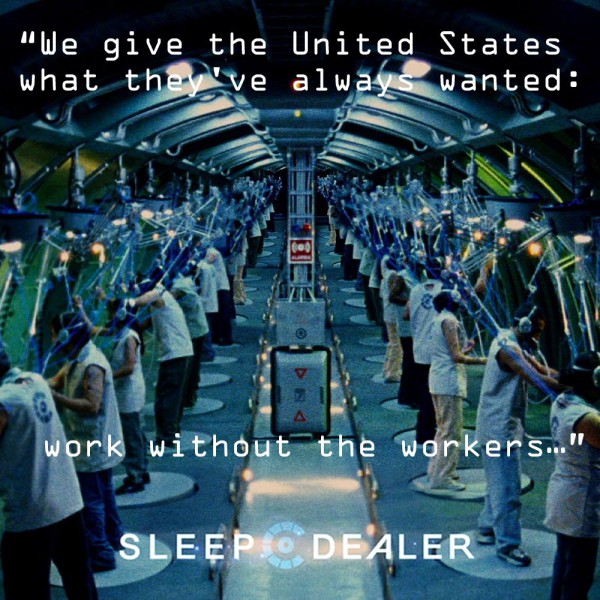
sleep-dealer-work

“Sleep Dealer” (2008) is a dystopian parable directed and co-written by Alex Rivera. Luis Fernando Peña stars as Memo, a hacker who also works as a type of virtual migrant worker. It’s revealed through flashback how his situation was a result of a drone attack on his family and homestead. While trying to find work, Memo meets Luz (Leonor Varela), a fellow hacker who, with additional assistance from a repentant drone pilot in the US, helps him strike a blow against the system.

Note: may not play on some portable devices.

http://www.hulu.com/watch/703496

Weaponized Hyperreality: Social Engineering Through Corporate State Propaganda and Religion

2789bbece2d59ed130d9d0ee1aeea307

By Luther Blissett and J. F. Sebastian of Arkesoul

Perhaps no philosophical concept more aptly describes the current cultural milieu than hyperreality, characterized by wikipedia as “an inability of consciousness to distinguish reality from a simulation of reality, especially in technologically advanced postmodern societies.” The predominance of hyperreality comes at a time when people in power have never had more to conceal, distort and distract the population from while there’s never been more people who have more means and motives to stay distracted. This is evident in many aspects of contemporary life from corporate news narratives shaped by sponsors and “official sources”, increasingly absurd denials of the true state of the economy from (mis)leaders, widespread dependence on pharmaceuticals worsened by direct-to-consumer advertising and a sham drug war, fanatical worship of celebrities, to slavish acquiescence to fads and fashion. But most obvious is the increasing amount of time spent in front of screens whether for work, shopping, social media, education, self-expression, games, web content, or the exponentially growing volume of video entertainment. Though video games and web series are catching up, the primary narrative formats for cultural expression and transmission today are still television and film.

Struggling to retain their cultural/economic status in the face of increased competition while appeasing shareholders of their monolithic multinational corporate owners, large film and television studios are increasingly risk averse. This is glaringly apparent in the output of major studios which are for the most part the media equivalent of comfort food; familiar (formulaic), satisfying (crowd pleasing), full of empty calories (lacking intellectual/emotional complexity or challenging ideas) and generally bland in terms of content and presentation. On television this is commonly displayed through clichéd tropes, characters and situations while films are now more than ever driven by CGI enhanced spectacle. Both rely on repeating what has worked in the past and (for viewers of a certain age) appealing to nostalgia while pandering to current cultural trends.

Of course such strategies overlap, as there’s more than a few television programs that offer Hollywood style spectacle and big budget movies which imitate successful formulas in the form of adaptations, sequels, prequels, reboots, spin-offs, and mockbusters. In fact the majority of Hollywood’s summer blockbuster output is now comprised of such derivative and safe content predominantly in the form of fantasy and science fiction films.

The ideological motives and functions of cinema and other pop culture are manifold, but a major one is control and influence of mass audiences. We now know the US government has been doing it at least since the 1950s. According to a Church Committee investigation detailing Operation Mockingbird in 1976:

“The CIA currently maintains a network of several hundred foreign individuals around the world who provide intelligence for the CIA and at times attempt to influence opinion through the use of covert propaganda. These individuals provide the CIA with direct access to a large number of newspapers and periodicals, scores of press services and news agencies, radio and television stations, commercial book publishers, and other foreign media outlets.”

More recently, in 1991 the Task Force Report on Greater CIA Openness revealed the CIA “now has relationships with reporters from every major wire service, newspaper, news weekly, and television network in the nation,” which enables them to “turn some ‘intelligence failure’ stories into ‘intelligence success’ stories, and has contributed to the accuracy of countless others.” It also revealed that the CIA has “persuaded reporters to postpone, change, hold, or even scrap stories that could have adversely affected national security interests…” (Global Research, Lights, Camera… Covert Action: The Deep Politics of Hollywood)

Government influence of culture factories such as Hollywood through covert infiltration or embedded advisors ensures that the end product reflects the values and behaviors they wish to promote (ie. xenophobia, deference to authority, nationalism, parochialism, narcissism, anti-intellectualism, consumerism, rapaciousness, etc). In some cases, most notably Zero Dark Thirty and United 93,  the goal is to cement an official narrative into the collective consciousness. A more sophisticated method of social engineering via Hollywood is predictive programming; presenting through media societal changes to be implemented by leaders in order to gradually condition the public and reduce resistance to such changes.

Manipulation of public sentiment through mass media also makes sense from a purely corporate perspective. Why wouldn’t media owners gear the ideological content of their products to support the systems they benefit from while screening out more critical messages? Occasional subversive content may get past the gatekeepers if it’s immediately profitable (which it sometimes can be if particularly resonant), can be co-opted in some way that serves the status quo, or if the creative minds behind it are particularly lucky, talented, and/or well connected. Regardless, one could argue uncritical media consumption is a form of pacification through distraction and escapism and all corporate media content are a result of calculating the highest return on investment, which more often than not reflects the culture’s most deeply ingrained values and myths.

This is particularly true for fantasy/sci film films, which have become ubiquitous for a number of reasons including cultural tastes of global demographics, aesthetic trends (eg. hyperreal CG effects for evermore spectacular imagery), impact of changing media technology on the economics of production and distribution, growing awareness of the value of properties belonging to rich fictional universes which can be mined by worldbuilding studio screenwriters, and in many cases, resonance with our increasingly dystopian world. Most fundamental is profitability, especially as sfx technology becomes more advanced and affordable, licensing opportunities increase, and film franchises that come with large and passionate built-in fan bases reduce the need for marketing and practically sell themselves.

Many who grow up immersed in geek culture already have a hyperreal relationship with fantasy and science fiction realms which heightens the nostalgia evoked by the stream of multimedia incarnations and product tie-ins (bolstered by cult-like fan communities). Is it any surprise that fans who’ve extrapolated on the “Jedi” concept from the Star Wars films turned it into a religion? The Jedi cosmology (and similar ones from countless sci-fi/fantasy films) are modeled on mysticism, a philosophical framework which could fill a void for spiritually deprived materialist cultures. For many people, comic book fandom is another safe and entertaining way to explore concepts that might otherwise be too “out there” (perhaps especially among those who share an equally strong interest in materialist science). At the same time, because of the influence of marketing, the greater role of technology in society and changing cultural trends, geek culture has become a larger part of mainstream culture. Combined with celebrity worship, the lure of technology (both on-screen and off), and increasingly omnipotent powers of multinational corporations, modern big budget sci-fi/fantasy films represent a confluence of potent socioreligious crosscurrents.

Recent works such as Christopher Knowles’s Our Gods Wear Spandex and Grant Morrison’s Supergods examine to an extent superheroes as modern mythological archetypes. Bill Moyer’s The Power of Myth explored how Joseph Campbell’s theory of the monomyth (or hero’s journey) influenced and shaped the Star Wars films (which itself has influenced myriad blockbusters since). In The Hero With a Thousand Faces, Campbell identified a story template used in almost all pre-modern cultures across the globe which goes something like this:

A reluctant “chosen one” in an ordinary world receives a call to adventure and warning of a danger that must be confronted. With the training and wisdom of a mentor the hero crosses the threshold into the unknown. Companions acquired along the way assist in overcoming a series of challenges and temptations until reaching the depth of their fears and resultant apotheosis or rebirth. This empowers them to achieve their goal and return triumphant to an admiring family/community/nation etc.

It’s not hard to see the attraction of narratives such as this which tap into primal emotional needs and can be found in a wide range of religious narratives such as the lives of Buddha, Christ, Muhammad and Rama among others. It also serves as a metaphor for spiritual/psychological journeys through life.

In a recent post on his Secret Sun blog, Christopher Knowles states “Myths grow out of times of crisis and upheaval, in one way or another. The current vogue for superheroes is a symptom of the powerlessness felt by a populace under assault by the realities of Globalist social engineering, war-making and economic redundancy.” I would add that myths can also be exploited to function as part of a cultural assault to perpetuate Globalist agendas. Authoritarians are all too eager to depict themselves as monomythic demigod saviors and/or those serving them as self-sacrificing rugged individualist heroes fulfilling their grand destinies.

In the same piece, Knowles concludes: “But myths do die. They aren’t immortal. The next war or wars may in fact sweep away the myths of the 20th Century entirely. The wars may send people reaching back to far older myths as civil wars can rekindle the bonfires of identity, sending people back to the myths of ancestors. This has always emerged in times of close conflict, particularly in conflicts seen as struggles against occupying powers.”

If he’s correct, there may be some hope for our culture to reclaim myths as a means of understanding reality rather than serve as a trapdoor to fabricated hyperreality. The problem is that there is a gap that needs “filling in” between reality and hyperreality. One of the many consequences of postmodernism is the complete blurring of the line between what is real and what is not. A sort of apathy has kicked in within the human psyche given that crushing truths, not easily discernable in the past, are all out there in the raw. Religious and scientific truths once held sacred can be easily discarded. Morality is a rare hobby in a generation both cynical and powerless to discern reality. This is as well due to globalism and technology, which serve as hubs for information retrieval that wasn’t readily available. Humanity has developed thicker skin, while at the same time widened the existential void left by a reality that is less and less objectifiable. Opinion makers are everywhere, information is ubiquitous, and the species is obsessed with being entertained while answers are readily manufactured in the shape of capital fetishes, all the while ideology that purportedly made a call for a “better and different” world, such as Marxism and psychoanalysis, has become both a haunting spectre and an empty promise.

In the past these formulae failed. In the future they seem more and more unlikely. Capitalism has adapted itself to revolutionary ideology. It has generated even more power from it, defusing the motivation for change and twisting the definition of revolution, all the while turning such concepts into brands. The irony. There is call for a “new objectivism”, however. A bet for a system reboot, in which categorical truths can be retrieved and argued from. The analogy is this: keeping what works and dismissing what doesn’t. Sounds like a simple and logical plan. The problem is that those who get to define what works and what doesn’t will be the powerful, uncanny minority. This is their game, and we have cynically accepted it. It is the way it is. Unless we can evolve from reality to hyperreality, and from hyperreality back into reality, as a species that learns, adapts, understands how high the stakes really are, and moves forward as a collective that is conscious and responsible of its flaws, it appears we are doomed. Three scenarios: first, the narrative will continue as is: the majority will continue to be repressed, and will perpetually seek escape by the hand that feeds until lost completely in hyperreality. Technology moves forward, religion condenses into inconvenient myth: we completely “plug in”. Then what? Well, you just have to see Her to see into this future. The second, war extinguishes civilization and winds back the evolutionary clock, think Mad Max, until we reach the first scenario, as if in a loop. The third and most bleak, nuclear war. The species ends.

What we learn from this exercise is that we are at the apex. This is it. The crushing truth of existence is firmly on our shoulders. War is unravelling. An ever-shrinking number of brands dominate the world. And an even smaller number of people call the shots. In between reality and hyperreality there is confusion. There is no longer a basis to discern between the two. We are as it were, lost. We need to fill in this gap. We need to dig deeper than ever before for a reason to dissolve our differences. Somehow the dilemma is set: surrender or die. But the crux of the problem can be overridden if we use the knowledge and tools we have to fight for a better, and more responsible alternative.