Do People Change?

By Edward Curtin

Source: Behind the Curtain

Because there is so much personal anguish, unhappiness, and human mental and physical suffering in the world, many people often wonder how they might personally change to find happiness, contentment, or some elusive something. Or even how to change other people, as if that arrogant illusion could ever work.

This question of significant personal change is usually couched within the context of narrow psychological analyses.  This is very common and is a habit of mind that grows stronger over the years.  People are reduced to their family upbringings and their personal relationships, while the social history they have lived through is dismissed as irrelevant.

The United States is very much a psychological society.  Sociological and historical analyses are considered insignificant to people’s identities.  It’s as if economics, politics, culture, and propaganda are beside the point.

Yes, it is often admitted that circumstances, such as illness, death, divorce, unemployment, etc. affect people, but such circumstances are not considered central to who people are and whom they become.  These matters are rarely seen contextually, nor are connections made.  They are considered inessentials despite the fact that they are always connected to larger social issues – that biography and history are intertwined.

In writing about what he termed the sociological imagination, C. Wright Mills put it clearly when he described it as “the idea that the individual can understand his own experience and gauge his own fate only by locating himself within his period, that he can know his own chances in life only by becoming aware of those of all individuals in his circumstances.  In many ways it is a terrible lesson; in many ways a magnificent one.”

Without learning it, one cannot know who one is or whom one might become if one chose to change and were not just blown by the winds of fate.

We now live in a digital world where the uncanny nature of information pick up sticks is the big game. Uncanny because most people cannot grasp its mysterious power over their minds.

What was true in 1953 when Ray Bradbury penned the following words in Fahrenheit 451, is exponentially truer today:

Cram them full of non-combustible data, chock them so damn full of ‘facts’ that they feel stuffed, but absolutely ‘brilliant’ with information. Then they’ll feel they’re thinking, they’ll get a sense of motion without moving. . . . Don’t give them any slippery stuff like philosophy or sociology to tie things up with. That way lies melancholy.

That it is all noise, all signal – no silence.  That it prevents deep reflection but creates the habit of mental befuddlement that is consonant with the mental derangement of the mainstream media’s 24/7 news reports.

When almost everything you hear is a lie of one sort or another, it becomes barely possible to keep your wits about you.

These bits of bait are scattered all over the mind’s floor, tossed by an unknown player, the unnameable one who comes in the night to play with us.  Their colors flood the mind, dazzle and razzle the eye.  It is screen time in fantasy-land.

This summer’s two hit movies – “Oppenheimer” and “Barbie” – while seemingly opposites, are two sides of this same counterfeit coin.  Spectacles in The Society of the Spectacle as Guy Debord put it:

The spectacle is a social relation between people that is mediated by an accumulation of images that serve to alienate us from a genuinely lived life. The image is thus an historical mutation of the form of commodity fetishism.

“Oppenheimer,” while concentrating on the man J. Robert Oppenheimer who is called “the father of the atomic bomb,” omits the diabolic bombings of Hiroshima and Nagasaki as if there were no innocent victims, while “Barbie” plays the coy game of satirizing the doll that celebrates women as sex objects while advertising its same sex doll status.  It’s just great “fun.”  Colorful salt water taffy for a summer hoot.  “Little Boy” meets sexy sister in the land of dreams where existential crises lead to expanded consciousness.  Yes, Hollywood is the Dream Factory.

There is so much to attend to, multi-colored tidbits begging to be touched carefully, to grab our full consideration as we delicately lift them into the air of our minds.  So many flavors.  Call it mass attention disorder order or paranoia (beside the mind) or digital dementia.  The names don’t matter, for it is a real condition and it is widespread and spreading madly.  Everyone knows it but represses the truth that the country has become a comic book travesty sliding into quicksand while bringing the world down with it.

“Oppenheimer” plays while a mumbling and bumbling U.S. President Biden pushes the world toward nuclear annihilation with Russia over Ukraine.

“Barbie” struts on her stilettos while men receive guidance from the CDC on “chest feeding” and millions of young people are not sure what sex they are.

What’s up?

It’s all noise, all signal – no silence.

The instinct of self-defense has disappeared.  “Not to see many things, not to hear many things, not to permit many things to come close,” this, Nietzsche told us, is the instinct of self-defense.  But we have let all our defenses down because of the Internet, cell phones, and the digital revolution.  We have turned on, tuned in, and dropped into computerized cells whose flickering bars note signal strength but not mental bondage.  Not the long loneliness of distant signals barely heard, but “Cause” what Rodriquez sings for us:

Cause my heart’s become a crooked hotel full of rumours
But it’s I who pays the rent for these fingered-face out-of-tuners
and I make 16 solid half hour friendships every evening

It’s all noise, all signal – no silence.

I recently had the arduous task of reviewing nearly fifty years of a writer’s personal journals.  The thing that stood out to me was the repetitive nature of his comments and analyses of people he knew and the relationships he had.  His political, literary, and historical comments were insightful, and his keen observations into the decades long diminution of the belief in existential freedom captured well the growing domination of today’s deterministic ethos with its biological emphasis and its underlying hopeless nihilism. But it was also very clear that the people he wrote about were little different after forty to fifty years.  Their situations changed but they did not – fundamentally.  They were encased in long-standing carapaces that protected them from change and choices that would force them to metamorphosize or undergo profound metanoias. Most of them saw no connection between their personal lives and world events, nor did they seem to grasp what William James, in writing about habits, said, “if we suffer the wandering of our attention, presently it will wander all the time. Attention and effort are … but two names for the same psychic fact.”

The notebooks, of course, were one man’s observations.  But they seemed to me to capture something about people generally.  In the notes I took, I summarized this by the words “social addiction,” a habit of living and thinking that has resulted in vast numbers of people locked in their cells, confused, totally bamboozled, and in despair.  This condition is now widely recognized, even by the most unreflective people, for it is felt in the gut as a dazed death-in-life, a treading of water waiting for the next disaster, the next bad joke passing for serious attention.  It is impossible to fail to recognize, if not admit, that the United States has become a crazy country, mad and deluded in the worst ways and leading the world to perdition on a fool’s dream of dominance and delusions.

The psychoanalyst Allen Wheelis, an intriguing writer who questioned his own profession, put it well in his 1973 book How People Change:

Often we do not choose, but drift into those modes which eventually define us. Circumstances push and we yield. We did not choose to be what we have become, but gradually, imperceptibly, became what we are by drifting into the doing of those things we now characteristically do. Freedom is not an objective attribute of life; alternatives without awareness yield no leeway… Nothing guarantees freedom. It may never be achieved, or having been achieved, may be lost. Alternatives go unnoticed; foreseeable consequences are not foreseen; we may not know what we have been, what we are, or what we are becoming. We are the bearers of consciousness but of not very much, may proceed through a whole life without awareness of that which would have meant the most, the freedom which has to be noticed to be real. Freedom is the awareness of alternatives and of the ability to choose. It is contingent upon consciousness, and so may be gained or lost, extended or diminished.

He correctly warned that insight does not necessarily lead to change.  It may help initiate it, but in the end the belief in freedom and the power of the will is necessary.  This has become harder in a society that has embraced biological determinism as a result of decades of propaganda.  Freedom has become a slogan only.  We have generally become determined to be determined.

To realize that one has choices is necessary and that not to decide is to decide.  Decisions (from Latin de = off and caedere = to cut) are hard, for they involve deaths, the elimination of alternatives, the facing of one own’s death(s) with courage and hope.  The loss of illusions.  This too has become more difficult in a country that has jettisoned so much of the deep human spirituality that still animates many people around the world whom the U.S. government considers enemies.

Such decisions also involve the intellectual honesty to seek out alternative voices to one’s fixed opinions on a host of public issues that affect everyone’s lives.

To recognize that who we are and who we become intersect with world events, war, politics, the foreign policies of one’s country, economics, culture, etc.; that they cannot be divorced from the people we say we are.  That none of us are islands but part of the main, but when that main becomes corporate dominated mainstream news pumped into our eyes and ears day and night from little machines, we are in big trouble.

To not turn away from what the former CIA analyst Ray McGovern calls this propaganda machine – the Military-Industrial-Congressional-Intelligence-Media-Academic-Think Tank Complex (MICIMATT) – is a choice by default and one of bad faith in which one hides the truth from oneself while knowing one is doing so.

To not seek truth outside this complex is to deny one’s freedom and to determine not to change even when it is apodictic that things are falling apart and all innocence is being drowned in a sea of lies.

It’s all noise, all signal – no silence.

Change begins with desire, at the personal and public level.  It takes courage to face the ways we have all been wrong, missed opportunities, shrunk back, lied, refused to consider alternatives.  Everyone senses that the U.S. is proceeding down a perilous road now.  Everything is out of joint, the country heading for hell.

I recently read an article by Timothy Denevi about the late writer Joan Didion who, together with her husband John Gregory Dunne, was at the Royal Hawaiian Hotel in Honolulu in June 1968 when Senator Robert F. Kennedy, who was assassinated in Los Angeles a few days previously, had died.  The thing that struck me in the article was what Didion described as the sickening indifference of so many vacationers to the news about RFK’s death and funeral.  Because television reception was sketchy in Hawaii, Didion and Dunne, not Kennedy supporters, were only able to watch a three-hour ABC taped special on June 8 that covered the assassination, funeral, and train ride of the body to Arlington Cemetery as millions of regular people kept vigil along the tracks.  A television had been set up on a large veranda where guests could watch this taped show.  But few vacationers were interested; the opposite, actually.  It angered them that this terrible national tragedy was intruding into their vacations.  They walked away.  It seemed to Didion and Dunne that something deep and dark was symbolized by their selfish indifference.  As a result, Didion suffered an attack of vertigo and nausea and was prescribed antidepressants after psychiatric evaluation.  She felt the 1960s “snapping” as she too snapped.

I think those feelings of vertigo and nausea are felt by many people today.  Rightly so.  The U.S.A. is snapping.  It is no longer possible to remain a normal person in dark times like these, no matter how powerfully that urge tempts us.  Things have gone too far on so many fronts from the Covid scam with all its attendant deaths and injuries to the U.S. war against Russia with its increasing nuclear risks, to name only two of scores of disasters.  One could say Didion was a bit late, that the snapping began in Dallas, Texas on November 22, 1963 when President Kennedy was assassinated by the CIA.  As Billie Joel sings, “J.F.K. blown away, what more do I have to say?”  And why was he assassinated?  Because he changed dramatically in the last year of his life to embrace the role of peacemaker despite knowing that by doing so he was accepting the real risk that he would be killed.  He was courage and will personified, an exceptional example of radical change for the sake of the world.

So I come back to my ostensible subject: Do people change?

The short answer is: Rarely.  Many play at it while playing dumb.

Yet is does happen, but only by some mixture of miracle and freedom, in an instant or with the passing of time where meaning and mystery can only exist.  Where we exist.  “If there is a plurality of times, or if time is cyclic,” the English writer John Berger muses, “then prophecy and destiny can coexist with freedom of choice.”  Time always tells.

The last entry in the writer’s notebooks that I reviewed was this:

I read that Kris Kristofferson, whose music I love, has said that he would like the first three lines of Leonard Cohen’s “Bird on a Wire” on his tombstone:

Like a bird on the wire
Like a drunk in a midnight choir
I have tried in my way to be free

It seemed apposite.
Technocensorship: The Government’s War on So-Called Dangerous Ideas

By John & Nisha Whitehead

Source: The Rutherford Institute

“There is more than one way to burn a book. And the world is full of people running about with lit matches.”—Ray Bradbury

What we are witnessing is the modern-day equivalent of book burning which involves doing away with dangerous ideas—legitimate or not—and the people who espouse them. Seventy years after Ray Bradbury’s novel Fahrenheit 451 depicted a fictional world in which books are burned in order to suppress dissenting ideas, while televised entertainment is used to anesthetize the populace and render them easily pacified, distracted and controlled, we find ourselves navigating an eerily similar reality.

Welcome to the age of technocensorship.

On paper—under the First Amendment, at least—we are technically free to speak.

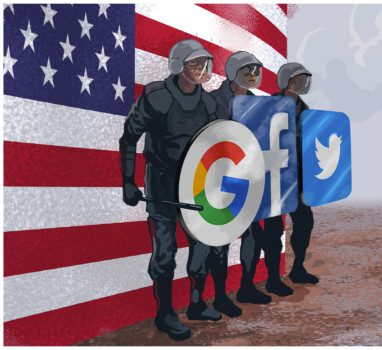
In reality, however, we are now only as free to speak as a government official—or corporate entities such as Facebook, Google or YouTube—may allow.

Case in point: internal documents released by the House Judiciary Select Subcommittee on Weaponization of the Federal Government confirmed what we have long suspected: that the government has been working in tandem with social media companies to censor speech.

By “censor,” we’re referring to concerted efforts by the government to muzzle, silence and altogether eradicate any speech that runs afoul of the government’s own approved narrative.

This is political correctness taken to its most chilling and oppressive extreme.

The revelations that Facebook worked in concert with the Biden administration to censor content related to COVID-19, including humorous jokes, credible information and so-called disinformation, followed on the heels of a ruling by a federal court in Louisiana that prohibits executive branch officials from communicating with social media companies about controversial content in their online forums.

Likening the government’s heavy-handed attempts to pressure social media companies to suppress content critical of COVID vaccines or the election to “an almost dystopian scenario,” Judge Terry Doughty warned that “the United States Government seems to have assumed a role similar to an Orwellian ‘Ministry of Truth.’

This is the very definition of technofascism.

Clothed in tyrannical self-righteousness, technofascism is powered by technological behemoths (both corporate and governmental) working in tandem to achieve a common goal.

The government is not protecting us from “dangerous” disinformation campaigns. It is laying the groundwork to insulate us from “dangerous” ideas that might cause us to think for ourselves and, in so doing, challenge the power elite’s stranglehold over our lives.

Thus far, the tech giants have been able to sidestep the First Amendment by virtue of their non-governmental status, but it’s a dubious distinction at best when they are marching in lockstep with the government’s dictates.

As Philip Hamburger and Jenin Younes write for The Wall Street Journal: “The First Amendment prohibits the government from ‘abridging the freedom of speech.’ Supreme Court doctrine makes clear that government can’t constitutionally evade the amendment by working through private companies.”

Nothing good can come from allowing the government to sidestep the Constitution.

The steady, pervasive censorship creep that is being inflicted on us by corporate tech giants with the blessing of the powers-that-be threatens to bring about a restructuring of reality straight out of Orwell’s 1984, where the Ministry of Truth polices speech and ensures that facts conform to whatever version of reality the government propagandists embrace.

Orwell intended 1984 as a warning. Instead, it is being used as a dystopian instruction manual for socially engineering a populace that is compliant, conformist and obedient to Big Brother.

This is the slippery slope that leads to the end of free speech as we once knew it.

In a world increasingly automated and filtered through the lens of artificial intelligence, we are finding ourselves at the mercy of inflexible algorithms that dictate the boundaries of our liberties.

Once artificial intelligence becomes a fully integrated part of the government bureaucracy, there will be little recourse: we will all be subject to the intransigent judgments of techno-rulers.

This is how it starts.

First, the censors went after so-called extremists spouting so-called “hate speech.”

Then they went after so-called extremists spouting so-called “disinformation” about stolen elections, the Holocaust, and Hunter Biden.

By the time so-called extremists found themselves in the crosshairs for spouting so-called “misinformation” about the COVID-19 pandemic and vaccines, the censors had developed a system and strategy for silencing the nonconformists.

Eventually, depending on how the government and its corporate allies define what constitutes “extremism, “we the people” might all be considered guilty of some thought crime or other.

Whatever we tolerate now—whatever we turn a blind eye to—whatever we rationalize when it is inflicted on others, whether in the name of securing racial justice or defending democracy or combatting fascism, will eventually come back to imprison us, one and all.

Watch and learn.

We should all be alarmed when any individual or group—prominent or not—is censored, silenced and made to disappear from Facebook, Twitter, YouTube and Instagram for voicing ideas that are deemed politically incorrect, hateful, dangerous or conspiratorial.

Given what we know about the government’s tendency to define its own reality and attach its own labels to behavior and speech that challenges its authority, this should be cause for alarm across the entire political spectrum.

Here’s the point: you don’t have to like or agree with anyone who has been muzzled or made to disappear online because of their views, but to ignore the long-term ramifications of such censorship is dangerously naïve, because whatever powers you allow the government and its corporate operatives to claim now will eventually be used against you by tyrants of your own making.

As Glenn Greenwald writes for The Intercept:

The glaring fallacy that always lies at the heart of pro-censorship sentiments is the gullible, delusional belief that censorship powers will be deployed only to suppress views one dislikes, but never one’s own views… Facebook is not some benevolent, kind, compassionate parent or a subversive, radical actor who is going to police our discourse in order to protect the weak and marginalized or serve as a noble check on mischief by the powerful. They are almost always going to do exactly the opposite: protect the powerful from those who seek to undermine elite institutions and reject their orthodoxies. Tech giants, like all corporations, are required by law to have one overriding objective: maximizing shareholder value. They are always going to use their power to appease those they perceive wield the greatest political and economic power.

Be warned: it’s a slippery slope from censoring so-called illegitimate ideas to silencing truth.

Eventually, as George Orwell predicted, telling the truth will become a revolutionary act.

If the government can control speech, it can control thought and, in turn, it can control the minds of the citizenry.

It’s happening already.

With every passing day, we’re being moved further down the road towards a totalitarian society characterized by government censorship, violence, corruption, hypocrisy and intolerance, all packaged for our supposed benefit in the Orwellian doublespeak of national security, tolerance and so-called “government speech.”

Little by little, Americans are being conditioned to accept routine incursions on their freedoms.

This is how oppression becomes systemic, what is referred to as creeping normality, or a death by a thousand cuts.

It’s a concept invoked by Pulitzer Prize-winning scientist Jared Diamond to describe how major changes, if implemented slowly in small stages over time, can be accepted as normal without the shock and resistance that might greet a sudden upheaval.

Diamond’s concerns related to Easter Island’s now-vanished civilization and the societal decline and environmental degradation that contributed to it, but it’s a powerful analogy for the steady erosion of our freedoms and decline of our country right under our noses.

As Diamond explains, “In just a few centuries, the people of Easter Island wiped out their forest, drove their plants and animals to extinction, and saw their complex society spiral into chaos and cannibalism… Why didn’t they look around, realize what they were doing, and stop before it was too late? What were they thinking when they cut down the last palm tree?”

His answer: “I suspect that the disaster happened not with a bang but with a whimper.”

Much like America’s own colonists, Easter Island’s early colonists discovered a new world—“a pristine paradise”—teeming with life. Yet almost 2000 years after its first settlers arrived, Easter Island was reduced to a barren graveyard by a populace so focused on their immediate needs that they failed to preserve paradise for future generations.

The same could be said of the America today: it, too, is being reduced to a barren graveyard by a populace so focused on their immediate needs that they are failing to preserve freedom for future generations.

In Easter Island’s case, as Diamond speculates:

The forest…vanished slowly, over decades. Perhaps war interrupted the moving teams; perhaps by the time the carvers had finished their work, the last rope snapped. In the meantime, any islander who tried to warn about the dangers of progressive deforestation would have been overridden by vested interests of carvers, bureaucrats, and chiefs, whose jobs depended on continued deforestation… The changes in forest cover from year to year would have been hard to detect… Only older people, recollecting their childhoods decades earlier, could have recognized a difference. Gradually trees became fewer, smaller, and less important. By the time the last fruit-bearing adult palm tree was cut, palms had long since ceased to be of economic significance. That left only smaller and smaller palm saplings to clear each year, along with other bushes and treelets. No one would have noticed the felling of the last small palm.

Sound painfully familiar yet?

We’ve already torn down the rich forest of liberties established by our founders. It has vanished slowly, over the decades. The erosion of our freedoms has happened so incrementally, no one seems to have noticed. Only the older generations, remembering what true freedom was like, recognize the difference. Gradually, the freedoms enjoyed by the citizenry have become fewer, smaller and less important. By the time the last freedom falls, no one will know the difference.

This is how tyranny rises and freedom falls: with a thousand cuts, each one justified or ignored or shrugged over as inconsequential enough by itself to bother, but they add up.

Each cut, each attempt to undermine our freedoms, each loss of some critical right—to think freely, to assemble, to speak without fear of being shamed or censored, to raise our children as we see fit, to worship or not worship as our conscience dictates, to eat what we want and love who we want, to live as we want—they add up to an immeasurable failure on the part of each and every one of us to stop the descent down that slippery slope.

As I make clear in my book Battlefield America: The War on the American People and in its fictional counterpart The Erik Blair Diaries, we are on that downward slope now.

The Omnipresent Surveillance State: Orwell’s 1984 Is No Longer Fiction

By John W. Whitehead

Source: The Rutherford Institute

“You had to live—did live, from habit that became instinct—in the assumption that every sound you made was overheard, and, except in darkness, every movement scrutinized.”—George Orwell, 1984

Tread cautiously: the fiction of George Orwell has become an operation manual for the omnipresent, modern-day surveillance state.

It’s been 70 years since Orwell—dying, beset by fever and bloody coughing fits, and driven to warn against the rise of a society in which rampant abuse of power and mass manipulation are the norm—depicted the ominous rise of ubiquitous technology, fascism and totalitarianism in 1984.

Who could have predicted that 70 years after Orwell typed the final words to his dystopian novel, “He loved Big Brother,” we would fail to heed his warning and come to love Big Brother.

“To the future or to the past, to a time when thought is free, when men are different from one another and do not live alone— to a time when truth exists and what is done cannot be undone: From the age of uniformity, from the age of solitude, from the age of Big Brother, from the age of doublethink — greetings!”—George Orwell

1984 portrays a global society of total control in which people are not allowed to have thoughts that in any way disagree with the corporate state. There is no personal freedom, and advanced technology has become the driving force behind a surveillance-driven society. Snitches and cameras are everywhere. People are subject to the Thought Police, who deal with anyone guilty of thought crimes. The government, or “Party,” is headed by Big Brother who appears on posters everywhere with the words: “Big Brother is watching you.”

We have arrived, way ahead of schedule, into the dystopian future dreamed up by not only Orwell but also such fiction writers as Aldous Huxley, Margaret Atwood and Philip K. Dick.

“If liberty means anything at all, it means the right to tell people what they do not want to hear.”―George Orwell

Much like Orwell’s Big Brother in 1984, the government and its corporate spies now watch our every move. Much like Huxley’s A Brave New World, we are churning out a society of watchers who “have their liberties taken away from them, but … rather enjoy it, because they [are] distracted from any desire to rebel by propaganda or brainwashing.” Much like Atwood’s The Handmaid’s Tale, the populace is now taught to “know their place and their duties, to understand that they have no real rights but will be protected up to a point if they conform, and to think so poorly of themselves that they will accept their assigned fate and not rebel or run away.”

And in keeping with Philip K. Dick’s darkly prophetic vision of a dystopian police state—which became the basis for Steven Spielberg’s futuristic thriller Minority Report—we are now trapped in a world in which the government is all-seeing, all-knowing and all-powerful, and if you dare to step out of line, dark-clad police SWAT teams and pre-crime units will crack a few skulls to bring the populace under control.

What once seemed futuristic no longer occupies the realm of science fiction.

Incredibly, as the various nascent technologies employed and shared by the government and corporations alike—facial recognition, iris scanners, massive databases, behavior prediction software, and so on—are incorporated into a complex, interwoven cyber network aimed at tracking our movements, predicting our thoughts and controlling our behavior, the dystopian visions of past writers is fast becoming our reality.

Our world is characterized by widespread surveillance, behavior prediction technologies, data mining, fusion centers, driverless cars, voice-controlled homes, facial recognition systems, cybugs and drones, and predictive policing (pre-crime) aimed at capturing would-be criminals before they can do any damage.

Surveillance cameras are everywhere. Government agents listen in on our telephone calls and read our emails. Political correctness—a philosophy that discourages diversity—has become a guiding principle of modern society.

“People sleep peaceably in their beds at night only because rough men stand ready to do violence on their behalf.”―George Orwell

The courts have shredded the Fourth Amendment’s protections against unreasonable searches and seizures. In fact, SWAT teams battering down doors without search warrants and FBI agents acting as a secret police that investigate dissenting citizens are common occurrences in contemporary America. And bodily privacy and integrity have been utterly eviscerated by a prevailing view that Americans have no rights over what happens to their bodies during an encounter with government officials, who are allowed to search, seize, strip, scan, spy on, probe, pat down, taser, and arrest any individual at any time and for the slightest provocation.

“The creatures outside looked from pig to man, and from man to pig, and from pig to man again; but already it was impossible to say which was which.”―George Orwell, Animal Farm

We are increasingly ruled by multi-corporations wedded to the police state.

What many fail to realize is that the government is not operating alone. It cannot. The government requires an accomplice. Thus, the increasingly complex security needs of the massive federal government, especially in the areas of defense, surveillance and data management, have been met within the corporate sector, which has shown itself to be a powerful ally that both depends on and feeds the growth of governmental overreach.

In fact, Big Tech wedded to Big Government has become Big Brother, and we are now ruled by the Corporate Elite whose tentacles have spread worldwide. For example, USA Today reports that five years after the 9/11 terrorist attacks, the homeland security business was booming to such an extent that it eclipsed mature enterprises like movie-making and the music industry in annual revenue. This security spending to private corporations such as Google, Amazon, Microsoft and others is forecast to exceed $1 trillion in the near future.

The government now has at its disposal technological arsenals so sophisticated and invasive as to render any constitutional protections null and void. Spearheaded by the NSA, which has shown itself to care little to nothing for constitutional limits or privacy, the “security/industrial complex”—a marriage of government, military and corporate interests aimed at keeping Americans under constant surveillance—has come to dominate the government and our lives. At three times the size of the CIA, constituting one third of the intelligence budget and with its own global spy network to boot, the NSA has a long history of spying on Americans, whether or not it has always had the authorization to do so.

Money, power, control. There is no shortage of motives fueling the convergence of mega-corporations and government. But who is paying the price? The American people, of course.

Orwell understood what many Americans, caught up in their partisan flag-waving, are still struggling to come to terms with: that there is no such thing as a government organized for the good of the people. Even the best intentions among those in government inevitably give way to the desire to maintain power and control over the citizenry at all costs. As Orwell explains:

The Party seeks power entirely for its own sake. We are not interested in the good of others; we are interested solely in power, pure power. What pure power means you will understand presently. We are different from the oligarchies of the past in that we know what we are doing. All the others, even those who resembled ourselves, were cowards and hypocrites. The German Nazis and the Russian Communists came very close to us in their methods, but they never had the courage to recognize their own motives. They pretended, perhaps they even believed, that they had seized power unwillingly and for a limited time, and that just around the corner there lay a paradise where human beings would be free and equal. We are not like that. We know what no one ever seizes power with the intention of relinquishing it. Power is not a means; it is an end. One does not establish a dictatorship in order to safeguard a revolution; one makes the revolution in order to establish the dictatorship. The object of persecution is persecution. The object of torture is torture. The object of power is power. Now you begin to understand me.

“The further a society drifts from truth the more it will hate those who speak it.” ― George Orwell

How do you change the way people think? You start by changing the words they use.

In totalitarian regimes—a.k.a. police states—where conformity and compliance are enforced at the end of a loaded gun, the government dictates what words can and cannot be used. In countries where the police state hides behind a benevolent mask and disguises itself as tolerance, the citizens censor themselves, policing their words and thoughts to conform to the dictates of the mass mind.

Dystopian literature shows what happens when the populace is transformed into mindless automatons. In Ray Bradbury’s Fahrenheit 451, reading is banned and books are burned in order to suppress dissenting ideas, while televised entertainment is used to anesthetize the populace and render them easily pacified, distracted and controlled.

In Huxley’s Brave New World, serious literature, scientific thinking and experimentation are banned as subversive, while critical thinking is discouraged through the use of conditioning, social taboos and inferior education. Likewise, expressions of individuality, independence and morality are viewed as vulgar and abnormal.

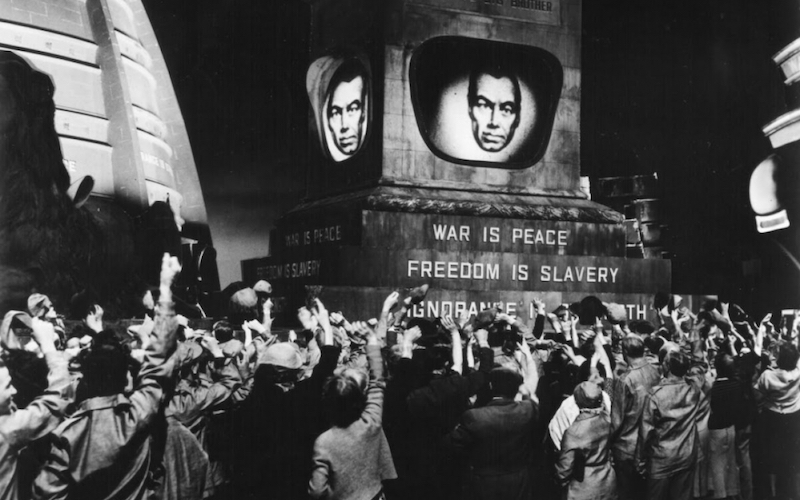
And in Orwell’s 1984, Big Brother does away with all undesirable and unnecessary words and meanings, even going so far as to routinely rewrite history and punish “thoughtcrimes.” In this dystopian vision of the future, the Thought Police serve as the eyes and ears of Big Brother, while the Ministry of Peace deals with war and defense, the Ministry of Plenty deals with economic affairs (rationing and starvation), the Ministry of Love deals with law and order (torture and brainwashing), and the Ministry of Truth deals with news, entertainment, education and art (propaganda). The mottos of Oceania: WAR IS PEACE, FREEDOM IS SLAVERY, and IGNORANCE IS STRENGTH.

All three—Bradbury, Huxley and Orwell—had an uncanny knack for realizing the future, yet it is Orwell who best understood the power of language to manipulate the masses. Orwell’s Big Brother relied on Newspeak to eliminate undesirable words, strip such words as remained of unorthodox meanings and make independent, non-government-approved thought altogether unnecessary. To give a single example, as psychologist Erich Fromm illustrates in his afterword to 1984:

The word free still existed in Newspeak, but it could only be used in such statements as “This dog is free from lice” or “This field is free from weeds.” It could not be used in its old sense of “politically free” or “intellectually free,” since political and intellectual freedom no longer existed as concepts….

Where we stand now is at the juncture of OldSpeak (where words have meanings, and ideas can be dangerous) and Newspeak (where only that which is “safe” and “accepted” by the majority is permitted). The power elite has made their intentions clear: they will pursue and prosecute any and all words, thoughts and expressions that challenge their authority.

This is the final link in the police state chain.

“Until they became conscious they will never rebel, and until after they have rebelled they cannot become conscious.”—George Orwell

Americans have been conditioned to accept routine incursions on their privacy rights. In fact, the addiction to screen devices—especially cell phones—has created a hive effect where the populace not only watched but is controlled by AI bots. However, at one time, the idea of a total surveillance state tracking one’s every move would have been abhorrent to most Americans. That all changed with the 9/11 attacks. As professor Jeffrey Rosen observes, “Before Sept. 11, the idea that Americans would voluntarily agree to live their lives under the gaze of a network of biometric surveillance cameras, peering at them in government buildings, shopping malls, subways and stadiums, would have seemed unthinkable, a dystopian fantasy of a society that had surrendered privacy and anonymity.”

Having been reduced to a cowering citizenry—mute in the face of elected officials who refuse to represent us, helpless in the face of police brutality, powerless in the face of militarized tactics and technology that treat us like enemy combatants on a battlefield, and naked in the face of government surveillance that sees and hears all—we have nowhere left to go.

We have, so to speak, gone from being a nation where privacy is king to one where nothing is safe from the prying eyes of government. In search of so-called terrorists and extremists hiding amongst us—the proverbial “needle in a haystack,” as one official termed it—the Corporate State has taken to monitoring all aspects of our lives, from cell phone calls and emails to Internet activity and credit card transactions. Much of this data is being fed through fusion centersacross the country, which work with the Department of Homeland Security to make threat assessments on every citizen, including school children. These are state and regional intelligence centers that collect data on you.

“Big Brother is Watching You.”―George Orwell

Wherever you go and whatever you do, you are now being watched, especially if you leave behind an electronic footprint. When you use your cell phone, you leave a record of when the call was placed, who you called, how long it lasted and even where you were at the time. When you use your ATM card, you leave a record of where and when you used the card. There is even a video camera at most locations equipped with facial recognition software. When you use a cell phone or drive a car enabled with GPS, you can be tracked by satellite. Such information is shared with government agents, including local police. And all of this once-private information about your consumer habits, your whereabouts and your activities is now being fed to the U.S. government.

The government has nearly inexhaustible resources when it comes to tracking our movements, from electronic wiretapping devices, traffic cameras and biometrics to radio-frequency identification cards, satellites and Internet surveillance.

Speech recognition technology now makes it possible for the government to carry out massive eavesdropping by way of sophisticated computer systems. Phone calls can be monitored, the audio converted to text files and stored in computer databases indefinitely. And if any “threatening” words are detected—no matter how inane or silly—the record can be flagged and assigned to a government agent for further investigation. Federal and state governments, again working with private corporations, monitor your Internet content. Users are profiled and tracked in order to identify, target and even prosecute them.

In such a climate, everyone is a suspect. And you’re guilty until you can prove yourself innocent. To underscore this shift in how the government now views its citizens, the FBI uses its wide-ranging authority to investigate individuals or groups, regardless of whether they are suspected of criminal activity.

“Nothing was your own except the few cubic centimetres inside your skull.” ― George Orwell

Here’s what a lot of people fail to understand, however: it’s not just what you say or do that is being monitored, but how you think that is being tracked and targeted. We’ve already seen this play out on the state and federal level with hate crime legislation that cracks down on so-called “hateful” thoughts and expression, encourages self-censoring and reduces free debate on various subject matter.

Say hello to the new Thought Police.

Total Internet surveillance by the Corporate State, as omnipresent as God, is used by the government to predict and, more importantly, control the populace, and it’s not as far-fetched as you might think. For example, the NSA is now designing an artificial intelligence system that is designed to anticipate your every move. In a nutshell, the NSA will feed vast amounts of the information it collects to a computer system known as Aquaint (the acronym stands for Advanced QUestion Answering for INTelligence), which the computer can then use to detect patterns and predict behavior.

No information is sacred or spared.

Everything from cell phone recordings and logs, to emails, to text messages, to personal information posted on social networking sites, to credit card statements, to library circulation records, to credit card histories, etc., is collected by the NSA and shared freely with its agents in crime: the CIA, FBI and DHS. One NSA researcher actually quit the Aquaint program, “citing concerns over the dangers in placing such a powerful weapon in the hands of a top-secret agency with little accountability.”

Thus, what we are witnessing, in the so-called name of security and efficiency, is the creation of a new class system comprised of the watched (average Americans such as you and me) and the watchers (government bureaucrats, technicians and private corporations).

Clearly, the age of privacy in America is at an end.

“If you want a picture of the future, imagine a boot stamping on a human face—for ever.”—Orwell

So where does that leave us?

We now find ourselves in the unenviable position of being monitored, managed and controlled by our technology, which answers not to us but to our government and corporate rulers. This is the fact-is-stranger-than-fiction lesson that is being pounded into us on a daily basis.

It won’t be long before we find ourselves looking back on the past with longing, back to an age where we could speak to whom we wanted, buy what we wanted, think what we wanted without those thoughts, words and activities being tracked, processed and stored by corporate giants such as Google, sold to government agencies such as the NSA and CIA, and used against us by militarized police with their army of futuristic technologies.

To be an individual today, to not conform, to have even a shred of privacy, and to live beyond the reach of the government’s roaming eyes and technological spies, one must not only be a rebel but rebel.

Even when you rebel and take your stand, there is rarely a happy ending awaiting you. You are rendered an outlaw.

So how do you survive in the American surveillance state?

We’re running out of options.

As I make clear in my book Battlefield America: The War on the American People, we’ll soon have to choose between self-indulgence (the bread-and-circus distractions offered up by the news media, politicians, sports conglomerates, entertainment industry, etc.) and self-preservation in the form of renewed vigilance about threats to our freedoms and active engagement in self-governance.

Yet as Aldous Huxley acknowledged in Brave New World Revisited: “Only the vigilant can maintain their liberties, and only those who are constantly and intelligently on the spot can hope to govern themselves effectively by democratic procedures. A society, most of whose members spend a great part of their time, not on the spot, not here and now and in their calculable future, but somewhere else, in the irrelevant other worlds of sport and soap opera, of mythology and metaphysical fantasy, will find it hard to resist the encroachments of those would manipulate and control it.”

Whose Dystopia Is It Anyway?

Reason writers debate which fictional dystopia best predicted our current moment.

By Mike Riggs, Katherine Mangu-Ward, Todd Krainin, Nick Gillespie, Jesse Walker, Robby Soave, Eric Boehm, Christian Britschgi, Peter Suderman & Brian Doherty

Source: Reason

With social media platforms seemingly unable to distinguish Russian trolls from red-blooded Americans, the last two years have felt like a Deckardian purgatory. The frequency with which intellectual elites accuse their detractors of laboring on behalf of an always-approaching-never-arriving foreign power, meanwhile, smacks of Orwell. And if the proliferation of opioids in the American heartland doesn’t sound like “delicious soma,” what does? (Marijuana? Alcohol? Twitter?)

“We live in Philip K. Dick’s future, not George Orwell’s or Aldous Huxley’s,” George Washington University’s Henry Farrell recently argued in the Boston Review. Despite being a poor prognosticator of what future technologies would look like and do, Dick, Farrell writes, “captured with genius the ontological unease of a world in which the human and the abhuman, the real and the fake, blur together.”

But the universe of possibilities is much larger than just Orwell, Huxley, or Dick. Below, Reason‘s editorial staffers make the case for nearly a dozen other Nostradamii of the right now, ranging from Edgar Allan Poe to Monty Python’s Terry Gilliam. As for why we’re debating dystopias, and not utopias: Because there is no bad in a utopia, and because no dystopia could persist for long without at least a little good, it’s safe to assume that if you’re living in an imperfect world—and you very much are—it’s a dystopian one.

Dick wasn’t wrong, but Edgar Allan Poe got there first, writes Nick Gillespie:

At the core of Philip K. Dick’s work is a profound anxiety about whether we are autonomous individuals or being programmed by someone or something else. In Do Androids Dream of Electric Sheep?, are the characters human or Nexus-6 androids? In The Three Stigmata of Palmer Eldritch and A Scanner Darkly, you’re never quite sure what’s real and what’s the product of too much “Chew-Z” and “Substance D,” hallucinogenic, mind-bending drugs that erode the already-thin line between reality and insanity.

Which is to say that Dick’s alternately funny and terrifying galaxy is a subset of the universe created by Edgar Allan Poe a century earlier. Poe’s protagonists—not really the right word for them, but close enough—are constantly struggling with basic questions of what is real and what is the product of their own demented minds.

This dilemma is front and center in Poe’s only novel, The Narrative of Arthur Gordon Pym (1838), which tells the story of a stowaway who ships out on the Grampus and endures mutiny, shipwreck, cannibalism, and worse. It becomes harder and harder for Pym to trust his senses about the most basic facts, such as what side of a piece of paper has writing on it. The conclusion—not really the right word for the book’s end, but close enough—dumps Pym’s epistemological problem into the reader’s lap in violent and hysterical fashion. A friend told me he threw the book across the room in disbelief when he read its final page, which anticipates the frustration so many of us feel while following the news these days. Just when you think reality can’t get any stranger or less believable, it does exactly that, in both Poe’s fictional world and our real one.

2018’s turn toward hamfisted authoritarianism echoes Terry Gilliam’s Brazil, says Christian Britschgi:

No-knock raids by masked, militarized, police officers. A ludicrously inefficient bureaucracy. Crackdowns on unlicensed repairmen. If all this sounds eerily familiar, you may have seen it coming in 1985’s Brazil.

Set in a repressive near-future Britain, the film tells the story of lowly civil servant Samuel Lowry, who wants nothing more than to hide in the comically inefficient bureaucratic machine that employs him, all while doing his level best to quietly resist both a narcissistic culture demanding he rise higher, and a brutish security apparatus looking to punish anyone who steps out of line.

Directed by Monty Python alum Terry Gilliam, Brazil is surreal, ridiculous, and often just plain silly. Yet there is something chilling about the film’s depiction of the state as a bumbling, byzantine bureaucracy that can’t help but convert every aspect of life into an endless series of permission slips, reinforced by a system of surveillance, disappearance, and torture.

Evil and inefficiency are intimately intertwined in Brazil—with the whole plot set in motion by a literal bug in the system that sends jackbooted thugs to raid the wrong house and arrest the wrong man. While the regime in Brazil lacks a central, dictatorial figure at the top of the pyramid, there is definitely something distinctly current about the world it depicts, with every application of force complemented by an equal element of farce. Trump’s first crack at imposing a travel ban, for instance, proved incredibly draconian and cruel precisely because of how rushed, sloppy, and incoherent the actual policy was.

Fortunately, our own world does manage to be far less authoritarian than the one depicted in Brazil and has mercifully better functioning technology as well. The parallels can still give one pause, however, when you consider what direction we might be headed in.

The current moment definitely tilts toward Ray Bradbury’s Fahrenheit 451, says Eric Boehm:

We are not living in a world where government agents raid homes to set books ablaze, but “there is more than one way to burn a book, and the world is full of people running about with lit matches,” as Ray Bradbury warned in a coda appended to post-1979 editions of his 1953 classic.

Specifically, Bradbury was warning about the dangers of authoritarian political correctness. In that coda, he relates anecdotes about an undergrad at Vassar College asking if he’d consider revising The Martian Chronicles to include more female characters, and a publishing house asking him to remove references to the Christian god in a short story they sought to reprint.

More generally, though, Bradbury was commenting on the common misunderstanding of Fahrenheit 451 as a story about an authoritarian government burning books. It is that, of course, but it’s really about how cultural decay allows authoritarianism to flourish. It was only after people had decided for themselves that books were dangerous that the government stepped in to enforce the consensus, Guy Montag’s boss tells him in one of the novel’s best scenes. “Technology, mass exploitation, and minority pressure carried the trick,” Captain Beatty explains. “Politics? One column, two sentences, a headline! Whirl man’s mind around so fast…that the centrifuge flings off all unnecessary, time-wasting thought!”

In place of literature and high culture, Bradbury’s dystopia has an eerily accurate portrayal of reality television. Montag’s wife is obsessed with the “parlor family” who inhabit the wall-sized television screens in the living room, and clearly has a closer attachment to them than to her husband. The ubiquity of those screens—and how the government exploits them—is on full display near the end of the story, when Montag is on the lam for revolting against orders to burn books, and messages are flashed across every parlor screen in the city telling people to look for the dangerous runaway fireman.

We might not live in Montag’s specific version of Bradbury’s dystopia, but we exist somewhere on the timeline that leads there—which is exactly what Bradbury, and Captain Beatty, are trying to tell us.

Wrong book! We’re really living in Neal Stephenson’s Snow Crash, says Katherine Mangu-Ward:

It’s 1992. Computers are running Windows 3.1. Mobile phones are rare and must be carried in a suitcase. A few nerds in Illinois are getting pretty close to inventing the first web browser, but they’re not quite there yet.

This is the year Neal Stephenson publishes Snow Crash, a novel whose action centers around a global fiber optic network, which can be accessed wirelessly via tiny computers and wearables. On this network, users are identifiable by their avatars, a Sanskrit word that Stephenson’s novel popularized; those avatars may or may not be reliable indications of what they are like in real life. Many of the characters work as freelancers, coding, delivering goods, or collecting information piecemeal. They are compensated in frictionless micropayments, some of which take place in encrypted online digital currency. Intellectual property is the most valuable kind of property, but knowledge is stored in vast digital libraries that function as fully searchable encyclopedias and compendia. Plus there’s this really cool digital map where you can zoom in and see anywhere on the planet.

Basically what I’m saying here is that every other entry in the feature is baloney. We are living in the world Neal Stephenson hallucinated after spending too much time in the library in the early 1990s. End of story.

Is it a dystopia? Sure, if you want to get technical about it: Our antihero, Hiro Protagonist (!), is beset by all manner of typical Blade Runner–esque future deprivations, including sub-optimal housing, sinister corporate villains, and a runaway virus that threatens to destroy all of humanity.

But in addition to the this-guy-must-have-a-secret-time-machine prescience of the tech, the book offers a gritty/pretty vision of anarcho-capitalism that’s supremely compelling—when they’re in meatspace, characters pop in and out of interestingly diverse autonomous quasi-state entities, and the remnants of the U.S. government is just one of the governance options.

Stephenson’s semi-stateless cyberpunk vision is no utopia, that’s for darn sure. But the ways in which it anticipated our technological world is astonishing, and I wouldn’t mind if our political reality inched a little closer to Snow Crash‘s imagined future as well.

Katherine is off by three years. 1989’s Back to the Future: Part II is actually the key to understanding 2018, says Robby Soave:

Back to the Future: Part II has always been the least-appreciated entry in the series: It’s the most confusing and kid-unfriendly, lacking both the originality of the first film and the emotional beats of the third. But almost 30 years after its release, the middle installment of Robert Zemeckis’s timeless time-travel epic is newly relevant: not for accurately depicting the future, but for warning us what life would be like with a buffoonish, bullying billionaire in charge.

2015, the furthest point in the future visited by Marty McFly and “Doc” Emmett Brown has come and gone, and we still don’t have flying cars, hover boards, or jackets that dry themselves. But we do have a president who seems ripped from the film’s alternate, hellish version of Hill Valley in 1985, where the loathsome Biff Tannen has become a powerful mogul after traveling into the past and using his knowledge of the future to rig a series of events in his favor.

The similarities between Trump and alternate-reality Biff are so numerous that Back to the Future writer Bob Gale has retroactively (and spuriously) claimed the 45th president as inspiration for the character. Biff buys Hill Valley’s courthouse and turns it into a casino hotel. Biff is a crony capitalist who weaponizes patriotism for personal enrichment (“I just want to say one thing: God bless America”). Biff is a paunchy playboy with two supermodel ex-wives, a bad temper, and even worse hair. There’s no escaping Biff: He’s a media figure, a businessman, a civic leader, and even a member of the family.

“Biff is corrupt, and powerful, and married to your mother!” Doc Brown laments to Marty. Millions of Americans no doubt feel the same way about a man who similarly possesses the uncanny ability to commandeer our attention and insert himself into every facet of modern life. Sometimes it’s hard to avoid the feeling that we’re simply living through the wrong timeline—thanks, McFly.

We may not have hoverboards, but America is teeming with the legal “Orb” from Woody Allen’s Sleeper, observes Todd Krainin:

The world never recovered after Albert Shanker, president of the United Federation of Teachers, acquired a nuclear warhead. Two hundred years later, in the year 2173, the territory once known as the United States is ruled by The Leader, the avuncular figurehead of a police state that brainwashes, surveils, and pacifies every citizen.

Every citizen except for our hero, Miles Monroe. Cryogenically frozen in the late 20th century, Monroe is thawed out in the 22nd. As the only person alive with no biometric record, Monroe is essentially an undocumented immigrant from the past, making him the ideal secret weapon for an underground revolutionary movement.

“What kind of government you guys got here?” asks a bewildered Monroe, after learning the state will restructure his brain. “This is worse than California!”

Monroe’s quest to take down the worse-than-Sacramento government takes him through a world that’s amazingly prescient for a film that aims for slapstick comedy. He gets high on the orb (space age marijuana), crunches on a 15-foot long stalk of techno-celery produced on an artificial farm (GMOs), impersonates a domestic assistant (Alexa), and joins a crunchy underground (#Resist), in order to defeat The Leader (guess who).

Sleeper‘s most memorable invention is the Orgasmatron, a computerized safe space that provides instant climaxes for a frigid and frightened populace. It’s basically the internet porn and sex robot for today’s intimacy-averse millennials.

In the highpoint of the film, Monroe attempts to clone The Leader from his nose. This in a film released 23 years before real doctors cloned Dolly the sheep from the cell of a mammary gland.

By the film’s end, Monroe is faced with the prospect of replacing The Leader with a revolutionary band of eco-Marxists. But some things never change.

“Political solutions don’t work,” he prophesies. “It doesn’t matter who’s up there. They’re all terrible.”

For a journalism outlet, we’ve been embarrassingly slow to recognize that Orson Scott Card’s Ender’s Game explains the media world we live in, argues Peter Suderman:

In a 2004 feature for Time, Lev Grossman explored of a new form of web-based journalism that was then radically reshaping both the political and media landscapes: blogs. Grossman profiled several bloggers, most of whom were young and relatively unknown, with little experience in or connection to mainstream journalism. Yet “blogs showcase some of the smartest, sharpest writing being published,” Grossman wrote. In particular, bloggers were influencing some pretty big national conversations about U.S. military actions and politics.

From the vantage of 2018, all this might seem like old news: The mainstream media has adopted and amplified many blogging practices. But even in 2004, the idea of user-produced, semi-anonymous journalism, posted directly to the net with no editorial filter, had been in circulation for years as a sci-fi conceit—perhaps most prominently in Orson Scott Card’s 1985 novel, Ender’s Game.

In the book, a child genius named Ender Wiggin is sent to an orbiting military academy to prepare for a military invasion. While he’s away, his adolescent siblings—themselves unusually gifted—hatch a plan to manipulate world politics by posting psuedononymous political arguments on “the nets.” These essays are read by citizens and politicians alike, and both siblings develop powerful followings. Eventually, they help prevent the world from exploding into planetary war, and pave the way for mankind’s colonial expansion into space.

Card’s narrative was too compact, its assumptions about the influence of online writing too simplistic. But it previewed the ways in which the internet would expand the reach and influence of little-known writers—especially political pundits—who lack conventional journalistic training or credentials. Today’s internet-based media landscape is neither a utopia nor a dystopia, but a lively, raucous, fascinating, and occasionally frustrating extrapolation of what Scott Card imagined before any of it existed in the real world.

This year is definitely one of Heinlein’s “crazy years,” says Brian Doherty:

Robert Heinlein was one of the first science fiction writers to create a fictional structure that seemed to privilege prediction, with his “Future History” sequence, collected in the volume The Past Through Tomorrow.

Prediction was not Heinlein’s purpose—storytelling was. But his “Future History” chart started off with the “Crazy Years”: “Considerable technical advance during this period, accompanied by a gradual deterioration of mores, orientation, and social institutions, terminating in mass psychoses in the sixth decade, and the interregnum.” Heinlein made this prediction in 1941, so the “sixth decade” meant the 1950s.

Did he really predict the Trump era? Heinlein fans have seen in wild ideological excesses on both left and right a clear sign that we are, collectively, losing our minds. Instapundit‘s Glenn Reynolds thinks we are certainly in Heinlein’s Crazy Years, noting it’s become a cliché among Heinlein fans to notice. He sees as evidence totemic but useless responses to policy crisis, and a social networking age that allows for tighter epistemic bubbles for information consumers and producers. Factually, the internet makes it stunningly easier for anyone to have opinions about politics and policy far better informed by accurate facts and trends than in any previous era. That so many might choose not to do so shows why predictions of “crazy years” can seem so eternally prescient: People can just be crazy (colloquially).

A lot of the “crazy” news these days that might lead to the never-witty declaration that it’s “not The Onion” come from unusual personal qualities of our president; some come from excesses of the desire to control others’ thought and expression. But if “crazy” means dangerous, then recent trends in crime domestically and wealth and health worldwide indicate we are mucking along well enough.

Indeed, as per the title of Heinlein’s anthology, the past is tomorrow and probably always will be. That times of technologic advance will be followed by “gradual deterioration” (read: changes) in mores, orientation, and social institutions is the kind of golden prediction of the dystopia we eternally are moving in (and always moving through) with which it’s hard to lose.

Loing before the 2016 Flyover Takeover, Walker Percy predicted a frayed nation would disassemble itself, writes Mike Riggs:

It’s the 1980s, and liberals have taken “In God We Trust” off the penny, while “knotheads”—conservatives—have mired the U.S. in a 15-year war with Ecuador. Liberals love “dirty movies from Sweden,” knotheads gravitate toward “clean” films, like The Sound of Music, Flubber, and Ice Capades of 1981. America’s big cities, meanwhile, are shells of themselves. “Wolves have been seen in downtown Cleveland, like Rome during the black plague.” Political polarization has even led to a change in international relations: “Some southern states have established diplomatic ties with Rhodesia. Minnesota and Oregon have their own consulates in Sweden.”

Our guide through the social hellscape of Love in the Ruins is Thomas More, a descendant of Sir Thomas More (author of 1516’s Utopia) and a lecherous Catholic psychiatrist with an albumin allergy who nevertheless chugs egg-white gin fizzes like water. A stand-in for Percy, More is a keen social taxonomist and a neutral party in the culture war. He notes that liberals tend to favor science and secularism; conservatives, business and God. But “though the two make much of their differences, I do not notice a great deal of difference between the two.” In the bustling Louisiana town of Paradise, wealthy knotheads and wealthy leftists live side by side, in nice houses, with new cars parked in their driveways, just as they currently do in Manhattan, Georgetown, and Palm Beach. One group may go to church on Sundays, the other bird watching, but they are more like each other than they are the “dropouts from, castoffs of, and rebels against our society” who live in the swamp on the edge of town.

Yet even the wealthy must bear the brunt of social frisson. A local golf course magnate alternates between depression and indignation as the poor of Paradise challenge his decision to automate the jobs at his country club.

Love in the Ruins is the most radical timeline extending from the King assassination, Kent State, and the Tate Murders, three historical moments that helped undo the World War II–era fantasy—ever more childish in hindsight—of America as a cohesive unit. We were not one then, and are not now. Percy saw 2018 coming from a four-decade mile.

You are all wrong, says Jesse Walker:

Identity has never been as fluid, fungible, and multiple as it is today. That guy you’re arguing with on Twitter might actually be a crowd of people. That crowd of people you’re arguing with might actually be just one guy. Trolls try on a persona for an hour, then discard it for something new. Bots adopt a persona and stick with it, but without an actual mind in command. Your identity might be stolen altogether, leaving you to learn that an entity that looks like you has been spending money, sending messages, or otherwise borrowing your life. You might even wake one day to discover that someone has inserted your head onto someone else’s body, all so a stranger can live out a fantasy.

You can decide for yourself how much of that is a utopia and how much is a dystopia. All I know is that at some point we started living in Being John Malkovich.

Saturday Matinee: There Will Come Soft Rains

“If Mankind Perished Utterly”: Nazim Tulyahodzhaev’s ‘There Will Come Soft Rains’, 1984

Source: We Are the Mutants

Object NameThere Will Come Soft Rains
Maker and Year: Nazim Tulyahodzhaev (Director), UzbekFilm, 1984
Object Type: Film
Description: (Steve Toyoshima)

There Will Come Soft Rains (Будет ласковый дождь) is an animated film produced in the former Soviet Union, based on the Ray Bradbury short story of the same name. Though obscure in the rest of the world during the Cold War, it has gained a cult following in recent years. A VHS-quality copy of the film has been uploaded to YouTube, and appears to be the only version available at this time.

Originally printed in 1950, Bradbury’s story follows the last day of an automated house in the wake of a nuclear apocalypse. The title is from a poem by Sarah Teasdale, written after she witnessed the horrors of the First World War. It described a world that nature reclaims after humanity has ceased to be. Bradbury adopts this poem’s tone and features it in his story.

Written just a few years after the bombings of Hiroshima and Nagasaki, and a few months before the start of the Korean War, There Will Come Soft Rains and the UzbekFilm adaptation reflect the fears of their respective eras. During the years between the original story and the 1984 version, the Cold War had broadened, touching off violence around the world as the two superpowers supported smaller proxy conflicts. In 1983, Soviet jets shot down a Korean airliner that they believed was on an espionage mission, provoking condemnation from the United States. The militant stance of new American President Ronald Reagan, his announcement of a US Strategic Defense Initiative (SDI, nicknamed “Star Wars” by the media), and plans to install missiles in Europe set nuclear tensions at an all-time high. In fact, much of the world felt that a nuclear war was inevitable. The invasion of Grenada and NATO war games exercises that simulated pre-nuclear attack communications put Soviet leadership at high alert for a first strike by their Western foes; the Kremlin wanted to avoid making the same mistake that Stalin had in 1941—ignoring Hitler’s aggression until it was nearly too late.

It was in this tense political environment that UzbekFilm‘s There Will Come Soft Rains was released. A studio in current day Uzbekistan that was originally founded in the 1920s, UzbekFilm expanded from art cinema to producing children’s fantasy films and animated features in the 1980s. There is a marionette show-like sense of playfulness and movement to the cartoons they produced, with a heavy emphasis on colors and textures. There Will Come Soft Rains was directed by Nazim Tulyahodzhaev, a prolific director and actor who had graduated from the Moscow State Institute of the Theatrical Arts in the 1970s and is still working today.

Tulyahodzhaev adapted Bradbury’s story for the 1980s, creating the character of the robot caretaker of the house, which didn’t exist in Bradbury’s original story. (The unsettling design of Robot was based on Lou Cameron’s Classics Illustrated cover for H.G. Wells’ War of the Worlds.) Where the automated house in the original story gradually fell apart after its owners were vaporized while playing outside, it’s the paranoia of Robot that leads to the destruction of the home in Tulyahodzhaev’s version.

When the film opens, it’s December 31st, 2026, in Allendale, California. It’s not entirely clear how long ago the nuclear war happened, or how long the McClellan family lived in a post-apocalyptic world. The McClellan home has been fortified for a nuclear war, with radiation suits hiding behind sliding cabinet doors for daily use by the family. Everything in the home is automated. The preparation of food, movement through the house, even religion is administered by the omnipresent Robot. During the time of prayer, a small crucifix slides out of a small door on the wall of the elder Mrs. McClellan’s room as a somber organ tune plays.

The McClellans themselves can no longer benefit from any of these conveniences, as we find out they were vaporized sometime before the events of the film. Somehow, the nuclear attack was able to breach the windows of the bunker, and the family has been reduced to ash. In a horrifying scene, Robot attempts to wake his charges by swiveling their beds upwards, spilling the remains of the family to the floor. Likely this is meant to invoke the neutron bomb, an atomic weapon designed to maximize radiation damage to humans caught within the radius and minimize damage to nearby structures. Its development became a focal point of the anti-nuke movement in the United States, with President Jimmy Carter only finding out about the program in the newspaper. Though Carter shelved the project, Reagan would become its champion. As he said in the late 1970s:

Very simply, it is the dreamed of death ray weapon of science fiction. It kills enemy soldiers but doesn’t blow up the surrounding countryside or destroy villages, towns and cities…..Here is a deterrent weapon available to us at much lower cost than trying to match the enemy gun for gun, tank for tank, plane for plane.

The fate of the McClellans is a visceral reminder of what it would mean to use such a weapon. Though they have been destroyed, their possessions are intact, with even small toys in the children’s room still walking around on battery power.

In the end, it is the intrusion of a curious bird through one of the broken windows of the home that sends Robot into a frenzy. The robotic arm sprouts sharp steel talons and attempts to smash the bird, which it sees as an intruder and danger to the family. The furniture, Mrs. McClellan’s wheelchair, and the crucifix are demolished during the rampage. Blinded after colliding with a wall, the final target of Robot is its own power source. It destroys itself and the house in a final blow.

The machine created to protect humans was engineered too well, a fear that has only become closer to reality in our modern age of militarized robotic drones. Though intended for peaceful purposes, Robot loses control after its owners are gone and only bits are left behind. The film closes with the poignant moment of the bird, unharmed, trying to fly into a peaceful scene on a video screen while one of Mrs. McClellan’s songs plays on the phonograph. Over the ending, Sarah Teasdale’s haunting poem is read.

This somber short and several more, including the light-hearted Contact (directed by Vladimir Tarasov), represent a wealth of animated films from the former Soviet Union that show the world through a lens that many of us who grew up in the West haven’t yet seen, but whose universal appeal carries the message past the boundaries of culture and language.

You Want a Picture of the Future? Imagine a Boot Stamping on Your Face

By John W. Whitehead

Source: The Rutherford Institute

“The Internet is watching us now. If they want to. They can see what sites you visit. In the future, television will be watching us, and customizing itself to what it knows about us. The thrilling thing is, that will make us feel we’re part of the medium. The scary thing is, we’ll lose our right to privacy. An ad will appear in the air around us, talking directly to us.”—Director Steven Spielberg, Minority Report

We have arrived, way ahead of schedule, into the dystopian future dreamed up by such science fiction writers as George Orwell, Aldous Huxley, Margaret Atwood and Philip K. Dick.

Much like Orwell’s Big Brother in 1984, the government and its corporate spies now watch our every move.

Much like Huxley’s A Brave New World, we are churning out a society of watchers who “have their liberties taken away from them, but … rather enjoy it, because they [are] distracted from any desire to rebel by propaganda or brainwashing.”

Much like Atwood’s The Handmaid’s Tale, the populace is now taught to “know their place and their duties, to understand that they have no real rights but will be protected up to a point if they conform, and to think so poorly of themselves that they will accept their assigned fate and not rebel or run away.”

And in keeping with Philip K. Dick’s darkly prophetic vision of a dystopian police state—which became the basis for Steven Spielberg’s futuristic thriller Minority Report which was released 15 years ago—we are now trapped into a world in which the government is all-seeing, all-knowing and all-powerful, and if you dare to step out of line, dark-clad police SWAT teams and pre-crime units will crack a few skulls to bring the populace under control.

Minority Report is set in the year 2054, but it could just as well have taken place in 2017.

Seemingly taking its cue from science fiction, technology has moved so fast in the short time since Minority Report premiered in 2002 that what once seemed futuristic no longer occupies the realm of science fiction.

Incredibly, as the various nascent technologies employed and shared by the government and corporations alike—facial recognition, iris scanners, massive databases, behavior prediction software, and so on—are incorporated into a complex, interwoven cyber network aimed at tracking our movements, predicting our thoughts and controlling our behavior, Spielberg’s unnerving vision of the future is fast becoming our reality.

Both worlds—our present-day reality and Spielberg’s celluloid vision of the future—are characterized by widespread surveillance, behavior prediction technologies, data mining, fusion centers, driverless cars, voice-controlled homes, facial recognition systems, cybugs and drones, and predictive policing (pre-crime) aimed at capturing would-be criminals before they can do any damage.

Surveillance cameras are everywhere. Government agents listen in on our telephone calls and read our emails. Political correctness—a philosophy that discourages diversity—has become a guiding principle of modern society.

The courts have shredded the Fourth Amendment’s protections against unreasonable searches and seizures. In fact, SWAT teams battering down doors without search warrants and FBI agents acting as a secret police that investigate dissenting citizens are common occurrences in contemporary America.

We are increasingly ruled by multi-corporations wedded to the police state. Much of the population is either hooked on illegal drugs or ones prescribed by doctors. And bodily privacy and integrity has been utterly eviscerated by a prevailing view that Americans have no rights over what happens to their bodies during an encounter with government officials, who are allowed to search, seize, strip, scan, spy on, probe, pat down, taser, and arrest any individual at any time and for the slightest provocation.

All of this has come about with little more than a whimper from a clueless American populace largely comprised of nonreaders and television and internet zombies. But we have been warned about such an ominous future in novels and movies for years.

The following 15 films may be the best representation of what we now face as a society.

Fahrenheit 451 (1966). Adapted from Ray Bradbury’s novel and directed by Francois Truffaut, this film depicts a futuristic society in which books are banned, and firemen ironically are called on to burn contraband books—451 Fahrenheit being the temperature at which books burn. Montag is a fireman who develops a conscience and begins to question his book burning. This film is an adept metaphor for our obsessively politically correct society where virtually everyone now pre-censors speech. Here, a brainwashed people addicted to television and drugs do little to resist governmental oppressors.

2001: A Space Odyssey (1968). The plot of Stanley Kubrick’s masterpiece, as based on an Arthur C. Clarke short story, revolves around a space voyage to Jupiter. The astronauts soon learn, however, that the fully automated ship is orchestrated by a computer system—known as HAL 9000—which has become an autonomous thinking being that will even murder to retain control. The idea is that at some point in human evolution, technology in the form of artificial intelligence will become autonomous and that human beings will become mere appendages of technology. In fact, at present, we are seeing this development with massive databases generated and controlled by the government that are administered by such secretive agencies as the National Security Agency and sweep all websites and other information devices collecting information on average citizens. We are being watched from cradle to grave.

Planet of the Apes (1968). Based on Pierre Boulle’s novel, astronauts crash on a planet where apes are the masters and humans are treated as brutes and slaves. While fleeing from gorillas on horseback, astronaut Taylor is shot in the throat, captured and housed in a cage. From there, Taylor begins a journey wherein the truth revealed is that the planet was once controlled by technologically advanced humans who destroyed civilization. Taylor’s trek to the ominous Forbidden Zone reveals the startling fact that he was on planet earth all along. Descending into a fit of rage at what he sees in the final scene, Taylor screams: “We finally really did it. You maniacs! You blew it up! Damn you.” The lesson is obvious here, but will we listen? The script, although rewritten, was initially drafted by Rod Serling and retains Serling’s Twilight Zone-ish ending.

THX 1138 (1970). George Lucas’ directorial debut, this is a somber view of a dehumanized society totally controlled by a police state. The people are force-fed drugs to keep them passive, and they no longer have names but only letter/number combinations such as THX 1138. Any citizen who steps out of line is quickly brought into compliance by robotic police equipped with “pain prods”—electro-shock batons. Sound like tasers?

A Clockwork Orange (1971). Director Stanley Kubrick presents a future ruled by sadistic punk gangs and a chaotic government that cracks down on its citizens sporadically. Alex is a violent punk who finds himself in the grinding, crushing wheels of injustice. This film may accurately portray the future of western society that grinds to a halt as oil supplies diminish, environmental crises increase, chaos rules, and the only thing left is brute force.

Soylent Green (1973). Set in a futuristic overpopulated New York City, the people depend on synthetic foods manufactured by the Soylent Corporation. A policeman investigating a murder discovers the grisly truth about what soylent green is really made of. The theme is chaos where the world is ruled by ruthless corporations whose only goal is greed and profit. Sound familiar?

Blade Runner (1982). In a 21st century Los Angeles, a world-weary cop tracks down a handful of renegade “replicants” (synthetically produced human slaves). Life is now dominated by mega-corporations, and people sleepwalk along rain-drenched streets. This is a world where human life is cheap, and where anyone can be exterminated at will by the police (or blade runners). Based upon a Philip K. Dick novel, this exquisite Ridley Scott film questions what it means to be human in an inhuman world.

Nineteen Eighty-Four (1984). The best adaptation of Orwell’s dark tale, this film visualizes the total loss of freedom in a world dominated by technology and its misuse, and the crushing inhumanity of an omniscient state. The government controls the masses by controlling their thoughts, altering history and changing the meaning of words. Winston Smith is a doubter who turns to self-expression through his diary and then begins questioning the ways and methods of Big Brother before being re-educated in a most brutal fashion.

Brazil (1985). Sharing a similar vision of the near future as 1984 and Franz Kafka’s novel The Trial, this is arguably director Terry Gilliam’s best work, one replete with a merging of the fantastic and stark reality. Here, a mother-dominated, hapless clerk takes refuge in flights of fantasy to escape the ordinary drabness of life. Caught within the chaotic tentacles of a police state, the longing for more innocent, free times lies behind the vicious surface of this film.

They Live (1988). John Carpenter’s bizarre sci-fi social satire action film assumes the future has already arrived. John Nada is a homeless person who stumbles across a resistance movement and finds a pair of sunglasses that enables him to see the real world around him. What he discovers is a world controlled by ominous beings who bombard the citizens with subliminal messages such as “obey” and “conform.” Carpenter manages to make an effective political point about the underclass—that is, everyone except those in power. The point: we, the prisoners of our devices, are too busy sucking up the entertainment trivia beamed into our brains and attacking each other up to start an effective resistance movement.

The Matrix (1999). The story centers on a computer programmer Thomas A. Anderson, secretly a hacker known by the alias “Neo,” who begins a relentless quest to learn the meaning of “The Matrix”—cryptic references that appear on his computer. Neo’s search leads him to Morpheus who reveals the truth that the present reality is not what it seems and that Anderson is actually living in the future—2199. Humanity is at war against technology which has taken the form of intelligent beings, and Neo is actually living in The Matrix, an illusionary world that appears to be set in the present in order to keep the humans docile and under control. Neo soon joins Morpheus and his cohorts in a rebellion against the machines that use SWAT team tactics to keep things under control.

Minority Report (2002). Based on a short story by Philip K. Dick and directed by Steven Spielberg, the setting is 2054 where PreCrime, a specialized police unit, apprehends criminals before they can commit the crime. Captain Anderton is the chief of the Washington, DC, PreCrime force which uses future visions generated by “pre-cogs” (mutated humans with precognitive abilities) to stop murders. Soon Anderton becomes the focus of an investigation when the precogs predict he will commit a murder. But the system can be manipulated. This film raises the issue of the danger of technology operating autonomously—which will happen eventually if it has not already occurred. To a hammer, all the world looks like a nail. In the same way, to a police state computer, we all look like suspects. In fact, before long, we all may be mere extensions or appendages of the police state—all suspects in a world commandeered by machines.

V for Vendetta (2006). This film depicts a society ruled by a corrupt and totalitarian government where everything is run by an abusive secret police. A vigilante named V dons a mask and leads a rebellion against the state. The subtext here is that authoritarian regimes through repression create their own enemies—that is, terrorists—forcing government agents and terrorists into a recurring cycle of violence. And who is caught in the middle? The citizens, of course. This film has a cult following among various underground political groups such as Anonymous, whose members wear the same Guy Fawkes mask as that worn by V.

Children of Men (2006). This film portrays a futuristic world without hope since humankind has lost its ability to procreate. Civilization has descended into chaos and is held together by a military state and a government that attempts to keep its totalitarian stronghold on the population. Most governments have collapsed, leaving Great Britain as one of the few remaining intact societies. As a result, millions of refugees seek asylum only to be rounded up and detained by the police. Suicide is a viable option as a suicide kit called Quietus is promoted on billboards and on television and newspapers. But hope for a new day comes when a woman becomes inexplicably pregnant.

Land of the Blind (2006). This dark political satire is based on several historical incidents in which tyrannical rulers were overthrown by new leaders who proved just as evil as their predecessors. Maximilian II is a demented fascist ruler of a troubled land named Everycountry who has two main interests: tormenting his underlings and running his country’s movie industry. Citizens who are perceived as questioning the state are sent to “re-education camps” where the state’s concept of reality is drummed into their heads. Joe, a prison guard, is emotionally moved by the prisoner and renowned author Thorne and eventually joins a coup to remove the sadistic Maximilian, replacing him with Thorne. But soon Joe finds himself the target of the new government.

All of these films—and the writers who inspired them—understood what many Americans, caught up in their partisan, flag-waving, zombified states, are still struggling to come to terms with: that there is no such thing as a government organized for the good of the people. Even the best intentions among those in government inevitably give way to the desire to maintain power and control at all costs.

Eventually, as I point out in my book Battlefield America: The War on the American People, even the sleepwalking masses (who remain convinced that all of the bad things happening in the police state—the police shootings, the police beatings, the raids, the roadside strip searches—are happening to other people) will have to wake up.

Sooner or later, the things happening to other people will start happening to us and our loved ones.

When that painful reality sinks in, it will hit with the force of a SWAT team crashing through your door, a taser being aimed at your stomach, and a gun pointed at your head. And there will be no channel to change, no reality to alter, and no manufactured farce to hide behind.

As George Orwell warned, “If you want a picture of the future, imagine a boot stamping on a human face forever.”