Billionaires Want Poor Children’s Brains to Work Better

By Gerald Coles

Source: CounterPunch

Why are many poor children not learning and succeeding in school? For billionaire Bill Gates, who funded the start-up of the failed Common Core Curriculum Standards, and has been bankrolling the failing charter schools movement, and Facebook’s Mark Zuckerberg, it’s time to look for another answer, this one at the neurological level. Poor children’s malfunctioning brains, particularly their brains’ “executive functioning”–that is, the brain’s working memory, cognitive flexibility, and inhibitory control–must be the reason why their academic performance isn’t better.

Proposing to fund research on the issue, the billionaires reason that not only can executive malfunctioning cause substantial classroom learning problems and school failure, it also can adversely affect socio-economic status, physical health, drug problems, and criminal convictions in adulthood. Consequently, if teachers of poor students know how to improve executive function, their students will do well academically and reap future “real-world benefits.” For Gates, who is always looking for “the next big thing,” this can be it in education.

Most people looking at this reasoning would likely think, “If executive functioning is poorer in poor children, why not eliminate the apparent cause of the deficiency, i.e., poverty?” Not so for the billionaires. For them, the “adverse life situations” of poor students are the can’t-be-changed-givens. Neither can instructional conditions that cost more money provide an answer. For example, considerable research on small class size teaching has demonstrated its substantially positive academic benefits, especially for poor children, from grammar school through high school and college. Gates claims to know about this instructional reform, but money-minded as he is, he insists these findings amount to nothing more than a “belief” whose worst impact has been to drive “school budget increases for more than 50 years.”

Cash–rather, the lack of it–that’s the issue: “You can’t fund reforms without money and there is no more money,” he insists. Of course, nowhere in Gates’ rebuke of excessive school spending does he mention corporate tax dodging of state income taxes, which robs schools of billions of dollars. Microsoft, for example, in which Gates continues to play a prominent role as “founder and technology advisor” on the company’s Board of Directors would provide almost $29.6 billion in taxes that could fund schools were its billions stashed offshore repatriated.

In a detailed example of Microsoft’s calculated tax scheming and dodging that would provide material for a good classroom geography lesson, Seattle Times reporter, Matt Day, outlined one of the transcontinental routes taken by a dollar spent for a Microsoft product in Seattle. Immediately after the purchase, the dollar takes a short trip to Microsoft’s company headquarters in nearby Redmond, Washington, after which it moves to a Microsoft sales subsidiary in Nevada. Following a brief rest, the dollar breathlessly zigzags from one offshore tax haven to another, finally arriving in sunny Bermuda where it joins $108 billion of Microsoft’s other dollars. Zuckerberg’s Facebook has similarly kept its earnings away from U.S. school budgets.

By blaming poor children’s school learning failure on their brains, the billionaires are continuing a long pseudoscientific charade extending back to 19th century “craniology,” which used head shape-and-size to explain the intellectual inferiority of “lesser” groups, such as southern Europeans and blacks. When craniology finally was debunked in the early 20thcentury, psychologists devised the IQ test, which sustained the mental classification business. Purportedly a more scientific instrument, it was heavily used not only to continue craniology’s identification of intellectually inferior ethnic and racial groups, but also to “explain” the educational underachievement of black and poor-white students.

After decades of use, IQ tests were substantially debunked from the 1960s onward, but new, more neurologically complex, so-called brain-based explanations emerged for differing educational outcomes. These explanations conceived of the overall brain as normal, but contended that brain glitches impeded school learning and success. Thus entered “learning disabilities,” “dyslexia,”and “attention deficit hyperactivity disorder (ADHD)” as major neuropsychological concepts to (1) explain school failure, particularly for poor children, although the labels also extended to many middle-class students; and (2) serve as “scientific” justification for scripted, narrow, pedagogy in which teachers seemingly reigned in the classroom, but in fact, were themselves controlled by the prefabricated curricula.

In the forefront of this pedagogy was the No Child Left Behind legislation (NCLB), with its lock-step instruction, created under George W. Bush and continued by Barack Obama. Supposedly “scientifically-based,” federal funds supported research on “brain-based” teaching that would be in tune with the mental make-up of poor children, thereby serving to substitute for policy that would address poverty’s influence on educational outcomes. My review of the initial evidence supposedly justifying the launching of this diversionary pedagogy revealed it had no empirical support. However, for the students this instruction targeted, a decade had to pass before national test results confirmed its failure.

The history of “scientific brain-based” pedagogy for poor children has invariably been a dodge from addressing obvious social-class influences. In its newest iteration– improve poor children’s  executive functioning–billionaires Gates and Zuckerberg will gladly put some cash into promoting a new neurological fix for poor children, thereby helping (and hoping) to divert the thinking of education policy-makers, teachers and parents. Never mind that over three years ago, a review of research on executive functioning and academic achievement failed to find “compelling evidence that a causal association between the two exists.” What’s critical for these billionaires and the class they represent is that the nation continues to concoct policy that does not deplete the wealth of the rich and helps explain away continued poverty. Just because research on improving executive functioning in poor children has not been found to be a solution for their educational underachievement, doesn’t mean it can’t be!

Now that’s slick executive functioning!


Gerald Coles is an educational psychologist who has written extensively on the psychology, policy and politics of education. He is the author of Miseducating for the Global Economy: How Corporate Power Damages Education and Subverts Students’ Futures (Monthly Review Press).

Uncle Sam, the Human Rights Hypocrite

By Paul Street

Source: TruthDig

This year marks the 70th anniversary of the Universal Declaration of Human Rights. Signed by the United States and adopted by the United Nations General Assembly on Dec. 10, 1948, the document was a great and shining step forward in the articulation of how human beings might organize their social and political systems in accord with democratic and civilized ideals.

The U.S. has long wielded the Universal Declaration (UD) as a weapon to brandish selectively against officially designated enemies. But seven decades after its signing (and trumpeting) the document, American society stands in rarely noted gross violation of the declaration’s key principles.

Take the UD’s first’s article: “All human beings are born free and equal in dignity and rights. They are endowed with reason and conscience and should act towards one another in a spirit of brotherhood.”

The United States falls far short here. Someone born into one of the 57 percent of U.S. households with less than $1,000 in savings will not enjoy remotely the same amount of “dignity and rights” as those enjoyed by someone born into the top 1 percent of households, which together possess as much wealth as the bottom 90 percent of U.S. citizens. Access to basic means of comfort, dignity and freedom—like quality housing, quality education, strong legal representation, leisure, travel, health care, quality food and recreation—is filtered by the militantly disparate distribution of wealth and income in the U.S., the most savagely unequal nation among all Western “capitalist democracies.” Like the polarized and nasty political culture to which it is merged, the nation’s extreme socioeconomic imbalance is inconsistent with calls for conscience and brotherhood.

Article 2 of the UD proclaims, among other things, that everyone is entitled to human rights and freedoms without distinctions of “race, color” and “national or social origin.” Here again, the U.S. stands in stark contravention.

Median white wealth is 12 times higher than median black wealth in the U.S.—a reflection of persistent anti-black discrimination and segregation built into the nation’s social structures and institutions. Reflecting stark racial disparities in arrest, prosecution, legal representation and sentencing, black and Latinos make up 56 percent of the nation’s 2.2 million incarcerated people though they comprise roughly 32 percent of the U.S. population. One in three adult black males is saddled with the crippling lifelong mark of a felony record—a critical barrier to opportunity and full citizenship (even the right to vote in many U.S. states) on numerous levels. Thanks to the racially disparate waging of the so-called war on drugs, one of every 10 U.S. black men in their 30s is in jail or prison on any given day. African-Americans and whites use drugs at similar rates, but the imprisonment rate of African-Americans for drug charges is almost six times that of whites.

Millions of undocumented immigrant workers and residents are unwilling to fight for their “universal human rights” in the U.S. because they reasonably fear arrest and deportation.

The UD’s fourth article declares, “No one shall be held in slavery or servitude.” Hundreds of thousands of U.S. prisoners—the modern-day and very disproportionately nonwhite human chattel that provides the essential raw material for the self-declared “Land of Freedom’s” curiously gigantic prison-industrial complex—perform labor tasks for tiny levels of compensation and often for no payment at all. The Global Slavery Index estimates that 57,000 people are victims of human trafficking, the modern form of slavery, with illegal smuggling and trading of people, for forced labor or sexual exploitation, in the United States.

Hundreds of millions of nominally free Americans are de facto slaves and servants to employers (upon whom a shocking number of Americans absurdly depend for health coverage), financial institutions, insurance corporations, retail corporations, credit agencies, property associations, government tax collectors, gambling agencies (including state lottery systems), health care providers, lawyers and drug dealers.

The UD’s fifth article says, “No one shall be subjected to torture or to cruel, inhuman or degrading treatment or punishment.” Torture and such treatment is endemic across the United States’ vast prison system, the largest in world history. One particularly widespread and egregious form of cruel and inhuman treatment inside that system is solitary confinement—a punishment well known to cause grave damage to its victims’ mental and physical health. The American Civil Liberties Union reports that:

Over the last two decades, the use of solitary confinement in U.S. correctional facilities has surged … 44 states and the federal government have supermax units, where prisoners are held in extreme isolation, often for years or even decades. On any given day in this country, it’s estimated that over 80,000 prisoners are held in isolated confinement. This massive increase in the use of solitary has happened despite criticism from legal and medical professionals, who have deemed the practice unconstitutional and inhumane.

Other forms of torture and cruel and inhumane treatment that are common in the nation’s vast archipelago of racially disparate mass incarceration include widespread beatings, rape, ignoring cries for help, overcrowding, underfunding, forcing inmates to fight, dehydration, starvation, denial of medical care, executions (including botched executions) and forced scalding showers.

Article 7 of the UD proclaims, “All are equal before the law and are entitled without any discrimination to equal protection of the law.”

This principle, too, is brazenly violated in the purported homeland and headquarters of global freedom and democracy. Many Americans are familiar with the old working-class aphorism that “money talks and bullshit walks”—meaning that the wealthy few hire high-priced lawyers to enhance their chances and power in the courts while everyday people do far less well with fewer resources to pay for legal representation. It’s no joke. As the Georgia gubernatorial candidate and former Georgia House Minority Leader Stacey Abrams noted last February, people with money “artfully navigate the criminal justice system and maybe even avoid it altogether,” but those who are poor are overwhelmed.

Wall Street chieftains who threw millions of Americans out of work and destroyed billions of dollars in lost savings through their reckless and often criminal practices have escaped prosecution while the nation’s jails and prisons are loaded with disproportionately black, Latino and poor people serving long terms for comparative small-time drug offenses. Hundreds of thousands of Americans rot in jail prior to conviction for the simple reason that they lack the financial resources to “make bail.” Abrams reports, “The majority of Georgians incarcerated in local jails have never been convicted of crime. They are simply too poor to pay their bail.”

The UD’s ninth and 10th articles say that “[n]o one shall be subjected to arbitrary arrest, detention or exile” and “Everyone is entitled in full equality to a fair and public hearing by an independent and impartial tribunal, in the determination of his rights and obligations and of any criminal charge against him.”

The 11th article says, “Everyone charged with a penal offence has the right to be presumed innocent until proved guilty according to law in a public trial at which he has had all the guarantees necessary for his defence.”

The “land of freedom” contravenes these core civil-libertarian principles without the slightest hint of embarrassment. The U.S. National Defense Authorization Act (NDAA) authorizes the indefinite military detention, without charge or trial, of any person labeled a “belligerent”—including an American citizen. The legislation overrides habeas corpus, the critical legal procedure that prevents the government from detaining you indefinitely without showing just cause.

In addition, the federal government has used the post 9/11 Authorization to Use Military Force (AUMF) law to justify the direct killing (without a trial or verdict) of anyone proclaimed an “enemy combatant” in the global war on terrorism. The AUMF is unbound by geographic or time limitations. U.S. citizens are not exempted, nor is U.S. territory.

Meanwhile, The Washington Post reported last January, “For the third year in a row, [U.S. local and state] police nationwide shot and killed nearly 1,000 people. …” Police killings, disproportionately inflicted against poor people and people of color, amount to executions, without trial or verdict.

The presumption of innocence does not prevent hundreds of thousands of American from experiencing the torture of incarceration simply because they cannot pay bail while awaiting trial.

The UD’s 12th article proclaims, “No one shall be subjected to arbitrary interference with his privacy, family, home or correspondence.” So what? Americans are subject to a vast private and public surveillance apparatus that has essentially abolished privacy in the name of “national security.” As the ACLU reports:

Numerous government agencies—including the National Security Agency, the Federal Bureau of Investigation, the Department of Homeland Security, and state and local law enforcement agencies—intrude upon the private communications of innocent citizens, amass vast databases of who we call and when, and catalog “suspicious activities” based on the vaguest standards. … Innocuous data is fed into bloated watchlists, with severe consequences—innocent individuals have found themselves unable to board planes, barred from certain types of jobs, shut out of their bank accounts, and repeatedly questioned by authorities. Once information is in the government’s hands, it can be shared widely and retained for years, and the rules about access and use can be changed entirely in secret without the public ever knowing.

Article 15 of the UD says, “Everyone has the right to a nationality” and “No one shall be deprived of the right to change his nationality.” Millions of “illegal” immigrants in flight from impoverished and repressive regimes supported by the United States are stateless people, too afraid of deportation to declare their foreign citizenship or to fight for decent conditions inside the U.S. They are not free to change their nationality by becoming U.S. citizens.

The UD’s 19th article declares, “Everyone has the right to freedom of opinion and expression; this right includes freedom to hold opinions without interference.” That’s nice. Millions of U.S. citizen-subjects know very well that they cannot write or say (or sing or post or march on behalf of) what they believe without putting their livelihoods at risk by offending or otherwise concerning their employers and other authorities. And in the United States, where health insurance is strongly and absurdly tied to place of employment, putting one’s job at risk also endangers a person’s and his or her family’s access to health care.

Freedom of expression is strictly qualified, to say the least, in the hidden and despotic abode of the capitalist workplace, where most working-age Americans spend most of their waking hours under managerial supervision.

Even tenured academics can be fired for expressing their opinions. The University of Illinois at Urbana-Champaign fired tenured professor Steven Salaita over his personal tweets criticizing Israel’s mass-murderous 2014 assault on Gaza. The prolific radical Native American author Ward Churchill was stripped of his tenured professorship on trumped-up grounds because of political comments he made on the 9/11 terror attacks.

Article 20 of the UD says, “Everyone has the right to freedom of peaceful assembly and association.”

These rights are strictly qualified in the U.S., where public assembly is controlled by onerous permitting processes and fees and peaceful protest gatherings commonly face militarized police forces that make random arrests, infiltrate marches and meetings, target organizers, give protesters petty charges (and deadly criminal records) and rough-up protesters. Numerous Republican-controlled states have passed bills that increase penalties for public protest in the wake of the many protests that accompanied Donald Trump’s election and inauguration.

Workers are fired for trying to organize unions in the U.S., where once union-friendly labor laws have been eviscerated.

The UD’s 21st article proclaims that “Everyone has the right to take part in the government of his country, directly or through freely chosen representatives. The will of the people shall be the basis of the authority of government; this shall be expressed in periodic and genuine elections which shall be by universal and equal suffrage and shall be held by secret vote or by equivalent free voting procedures.”

The reality of U.S. politics and policy stands in brazen defiance of this universal human right. As the distinguished liberal political scientists Benjamin Page (Northwestern) and Marin Gilens (Princeton) showed in their expertly researched book, “Democracy in America?” last year:

[T]he best evidence indicates that the wishes of ordinary Americans actually have little or no impact on the making of federal government policy. Wealthy individuals and organized interest groups—especially business corporations—have had much more political clout. When they are taken into account, it becomes apparent that the general public has been virtually powerless. … The will of majorities is often thwarted by the affluent and the well-organized, who block popular policy proposals and enact special favors for themselves. … Majorities of Americans favor … programs to help provide jobs, increase wages, help the unemployed, provide universal medical insurance, ensure decent retirement pensions, and pay for such programs with progressive taxes. Most Americans also want to cut “corporate welfare.” Yet the wealthy, business groups, and structural gridlock have mostly blocked such new policies [and programs].

“Elections alone,” Page and Gilens note, “do not guarantee democracy.” Majority U.S. opinion is regularly trumped by a deadly complex of forces in the nation’s politics, including:

    • The campaign finance, candidate-selection, lobbying and policy agenda-setting power of wealthy individuals, corporations and interest groups
    • The special primary election influence of full-time party activists
    • The disproportionately affluent, white and older composition of the active (voting) electorate
    • The manipulation and restriction of voter turnout
    • The widespread dissemination of distracting, confusing, misleading and just plain false information
    • Absurdly and explicitly unrepresentative political institutions like the Electoral College, the unelected Supreme Court, the over-representation of the predominantly white rural population in the U.S. Senate and the one-party rule in the House of “Representatives”
    • The fragmentation of authority in government
    • Corporate ownership of the reigning media, which frames current events in accord with the wishes and world view of the nation’s real owners—its “unelected dictatorship or money”
    • Americans get to vote but mammon reigns nonetheless in the United States, where, Page and Gilens find, “government policy … reflects the wishes of those with money, not the wishes of the millions of ordinary citizens who turn out every two years to choose among the preapproved, money-vetted candidates for federal office.

You wouldn’t know a thing about these and other brazen violations of the UD (you can find supplemental text on U.S. “homeland” violations of UD articles 22, 23, 24, 25, 27 and 28 on my website) by reading the U.S. State Department’s recently released annual “Country Reports on Human Rights Abuses.” Beyond two disturbing novelties—the deletion of most prior reporting on women’s rights and reproductive rights and the redaction of the term “Occupied Territories” from the report’s description of Israel and its, well, occupied territories—the Trump-era rendering of the annual State Department document (this year’s is the first put together entirely by the Trump State Department) runs in four familiar grooves. Consistent with previous versions, it fails to acknowledge the United States’ longstanding political, economic and military backing of governments whose human rights abuses it mentions—as if Washington had nothing to do with them.

We learn, for example, that Saudi Arabia kills civilians in Yemen and carries out “unlawful killings, including execution for other than the most serious offenses and without requisite due process; torture; arbitrary arrest and detention, including of lawyers” in its own territory. The report says nothing about how Washington considers the Saudi regime one of its most prized allies. Or that it equips the absolutist Saudi state (whose crown prince was recently hosted by Donald Trump, who boasted during the royal’s visit of U.S. arms sales to Saudi Arabia) with tens of billions worth of lethal military equipment. Nor does it say anything about the United States’ own direct egregious abrogation of human rights through things like its horrific torture camp at Guantanamo Bay and its ongoing arch-criminal drone war program of “targeted assassination” (execution without trial) Noam Chomsky has called “the most extensive global terrorism campaign the world has yet seen.”

The world has every reason to respond to the State Department’s report with another old maxim: “Don’t piss on my boots and tell me it’s raining.”

The Country Reports document continues the United States’ longstanding practice of selective criticism, playing up violations in rival and enemy nations over those in allied nations. Relying on just the document’s country-level write-ups, one would think that human rights are no better in Iran and Cuba than they are in Saudi Arabia and Honduras. You’d never know that the Saudis make Iran look like a bastion of civil liberties, women’s rights and democracy by comparison. Or that ordinary Cubans enjoy remarkable guaranteed incomes and access to educational resources and health care services that are unrivaled across Latin America and especially in right-wing Latin American states like Honduras, where a vicious right-wing regime was installed with no small help from the U.S. nine years ago.

The State Department report vastly understates the scale of the Saudis’ U.S.-backed and U.S.-equipped crimes in Yemen. It gives no sense that the U.S.-Saudi war on that small nation has created there one of the worst humanitarian catastrophes (replete with a mass outbreak of deadly cholera) in recent history.

In rolling out the report, John Sullivan, Trump’s then-acting secretary of state, singled out Russia and China as leading “threats to global stability,” claiming that their poor human rights records put them in the same dastardly club as evil Iran and North Korea. Where, one might well ask, should we rank U.S. allies like Saudi Arabia, Honduras, Egypt and Israel? The last country has recently and openly slaughtered unarmed Palestinians who were peacefully protesting along its border with Gaza, which is essentially an open-air Palestinian prison subjected to a vicious blockade by Israel and Egypt since 2007. What about other U.S.-allied states like the Philippines, whose strongman president Rodrigo Duterte has ordered the death-squad killings of drug dealers and drug users and been praised by Trump for doing “an unbelievable job on the drug problem”?

It has not been lost on properly critical observers that that the Trump administration has curiously designated the American Empire’s top strategic rivals—China, Russia, Iran and North Korea—as the world’s worst human rights violators.

As per usual, the latest State Department global human rights report ignores positive human rights accomplishments of states on the wrong side of Uncle Sam’s division of the world into friend and enemy. It has nothing to say, for example, about Cuba’s remarkable achievements in reducing poverty, providing health care, educating its citizens and developing its economy and society with a low-carbon footprint that reduces its contribution to the greatest problem of our times, one whose advance is being led by the United States: anthropogenic climate change.

Last, but not least, this year’s version of the report has, as usual, absolutely nothing to say against or about egregious and endemic human rights abuses carried out by (both at home and abroad) and inside the United States—the supposed “beacon to the world of the way life should be,” to quote former U.S. Sen. Kay Bailey Hutchinson (currently Trump’s permanent representative to NATO) in a fall 2002 speech in support of Congress authorizing George W. Bush to criminally invade Iraq if he wanted to (he did). The State Department’s “Country Reports on Human Rights Abuses” covers every country on the planet but one: The most powerful nation on earth, the headquarters of a historically unparalleled global empire that most of the world’s politically cognizant populace has long and with good reason identified as the leading threat to peace and stability on earth. Fully 194 countries are covered in the reports, just not the world’s only superpower, itself home to 4.4 percent of the world’s population but 22 percent of the world’s prisoners—quite an accomplishment for the self-declared homeland and headquarters of global freedom and democracy.

As far as the State Department, Washington and the nation’s reigning corporate, financial, and imperial power elite is concerned, the violations of the UD outlined at the outset of this article (and in my linked supplemental text) belong down George Orwell’s memory hole, consistent with the principle that history is written by and for the winners and Big Bother’s maxim: “He who controls the past controls the future. He who controls the present controls the past.”

It’s nothing remotely new or distinctive to the Trump era. The United States sees itself as an inherently splendid and humanitarian City on a Hill, fit to judge other nations, particularly those it deems as rivals and enemies, while giving itself an “exceptionalist” free pass because, as Bill Clinton’s Secretary State Madeleine Albright once explained, “The United States is good.” That’s no way to get its human rights reports taken seriously by world citizens familiar with the timeworn adage that “people who live in glass houses shouldn’t throw stones.”

America’s Dystopian Future

By

Source: CounterPunch

Imagine a privatized America where rugged individualism reigns supreme within a vast network of corporate America, Inc., similar to 19th century wild west lifestyle, no social security, no Medicare, no Medicaid, no public law enforcement as individuals stand their own ground. Read all about it in Scott Erickson’s History of the Decline and Fall of America (Azaria Press, 2018).

Erickson’s newly released semi-fictional satire of American history and subsequent decline into deepening pits of despair is a sure-fire treasure trove of Americana, at its best. It’s a page-turner par excellence, rich in accurate textured American history and jam-packed with imagery of a dystopian future that is simply unavoidable based upon America’s character and development over the past two centuries. The dye was cast long before onset of dystopian existence.

The History of the Decline and Fall of America highlights and exposes inherent limitations of democratic capitalism whilst explaining in full living color a future American dystopia that is fully expected based upon America’s beginnings from the time of Captain John Smith at historic Jamestown (1607). The history lesson therein is superb, not missing a beat of what shaped America up to the final tipping point of neoliberal dogma and beyond into a deep dark world order.

This beautifully written and conceived historical fiction is a witty tour de force of America past, present, and future, weaving together all of the historical elements into one coherent story from the widely accepted version of American “business success ” of the early period, but over time wistfully morphing into abject failure!

That process of failure, the root causes, is what intrigues, for example, “Americans were not only inventing a country but inventing what it meant to be an American.” Indeed, America came into being as a brand new experiment in capitalistic democracy. Within that quest for a new way forward, inclusive of equality and fraternity amongst equals, Erickson discovers and reveals unique American traits that belie that mission, leading to a neoliberal/privatization hellhole that goes horribly wrong.

That fascinating pathway is explained via enchanting quips, for example, de Tocqueville’s remarkably astute comment: “ I know of no country, indeed, where the move of money has taken a stronger hold on the affections of men.” This one isolated statement from the 1830s tells a tale of American character molded by artificiality of wealth creation simply for the sake of possessing it. America’s pursuit of happiness was the “pursuit of affluence” and remained its dominant trait for the “remaining 200-plus years of American history.”

Indeed, those predominant American character traits are flushed-out and analyzed in the context of eventual failure, of a dystopian world order emanating out of America’s clumsy experimentation with empire-building and constantly striving for the pot at the end of the rainbow, meaning economic growth above all else. It was a frontier spirit that fed into elusive goals of preeminence: “The frontier resulted in Americans being doers rather than thinkers….”

Real scenes of real American cocksuredness, as well as the clumsiness associated with raw ignorance, come to life, e.g., during the presidential race between Ike and Adlai Stevenson in 1954: “A revealing incident occurred while Stevenson was campaigning for president. A citizen shouted to Stevenson that he ‘had the vote of every thinking person.’Stevenson replied, ‘That’s not enough. We need a majority!”
This is excellent history, comparable to a textbook, as well as a peek into the future shaped via trends rooted throughout Americana. Erickson’s lessons in American history are genuine and accurate, which gives the book depth and a powerful sense of significance well beyond similar treatises that try to lay the challenging groundwork leading to how a nation turns sour into a dystopian society.

He weaves the path of Manifest Destiny all the way from 1840s to the planting of the American flag on the surface of the moon. Until the 1970s when American pre-eminence tipped downward, humiliated in Vietnam in what future generations came to know as The Vietnam Syndrome,” the psychological attempt to live with the unacceptable reality that it was possible for America to not win.

Not only was America no longer a winner in war, its “unparalleled level of affluence… began to decline.” The 1970s marked the high point, forever downward into a bottomless septic tank, a cloaca of messy foul shit earmarking America’s final destiny, third world status within a realm of excessive, pretense of wealth glistening behind spiked electronic gates.

The signs of decline were easy to spot by the early-mid 2000s: “… the situation had declined dramatically. According to statistics from 2015, among industrialized nations, America was notable for having the highest poverty rate, the lowest score on the UN index of ‘material well-being of children,’ the highest health care expenditures, the highest infant mortality rate, the highest prevalence of mental health problems, the highest obesity rate, the highest consumption of antidepressants per capita, the highest homicide rate, and the largest prison population per capita. By international standards, the rural counties of southern West Virginia and eastern Kentucky qualified as developing countries, as did large sections of American cities such as Detroit, Cleveland, Gary, and many others.” (Pg. 112)

Thereafter, America’s youth no longer embraced the long-standing belief that they would have more than their parents. No, they knew it would be less and less. America entered a “permanent recession” cycle.
By the late 2030s American experienced a series of extreme crises. A number of cities declared bankruptcy. Houston, America’s 4th largest city goes bankrupt. Cleveland goes bankrupt. The head of the Federal Reserve quits and becomes a banjo player in a bluegrass group. America’s banking system collapses under the weight of fishy loans and massive crazed derivatives all permitted by increasingly hands-off regulations. The brutal hand of libertarianism smears a once proud republic.

Regular citizens, entire families carry torches surrounding Wall Street in protest of loss savings, ATMs not functioning, banks closed. An economic death spiral unleashed. The Save America Act followed, consisting of pure right wing neoliberal fix-its to save corporate America, to save Wall Street, turning to America, Inc. as the only answer to all that ails.

And, as the financial markets unravel in the face of nationwide bankruptcies, the government convincingly informs the public: “We need to defy the Constitution in order to preserve it… Americans were so thoroughly confused about the relationship between government and economics that most of them thought that the terms democracy, free-enterprise, and capitalism were the same thing.” (Pg. 165)

As time progresses, America’s Labor Day is changed to Management Day, and the Catholic Church is permitted to re-name the Statue of Liberty as “Our Lady of Perpetual Economic Growth.” America the nation turns into America, Inc. It is the only way the establishment knows to drive the country out of its doldrums. As such, The Star Spangled Banner is changed to The Free Market Ramble.

Privatization of the entire country in harmony with massive tax cuts alongside elimination of Social Security, Medicare, Medicaid, public education, law enforcement, postal service, and maintenance of roads and infrastructure, thereafter, people take care of themselves from birth to the death, alone with family backing. Self-directed medical care becomes a beacon of survival of the fittest of the fittest. Those that participated as y0ungsters in Boy/Girl Scouts have a leg up in a society that increasingly places emphasis on rugged individualism. However, the many, many weaklings stumble in rows after rows of slimy gutters.

In the end, and similar to America’s 2008-09 financial collapse, which was only a warm up for much bigger things to come: “The decisive trigger, the one that pushed America beyond the point of no return, was the total collapse of the economy. It had been something of a miracle that the doomed economy had not collapsed long before. Toward the end it had been sustained by little more than momentum, since according to all economic indicators it should not have been functioning at all. The economic system based on infinite growth had reached the point where it could grow no more. American banks could not pay off previous debt by making further loans to generate more money. The pyramid scheme was over… An eerie calm descended upon all those involved in economics and finance.”

US Collapse – the Spectacle of Our Time

By Finnian Cunningham

Source: Axis of Logic

May you live in interesting times, goes the Chinese proverb. Few can doubt that we are indeed living in such an interesting time. Big changes are afoot in the world, it seems.

None more so than the collapsing of the American Empire.

The US is going through an historic “correction” in the same way that the Soviet Union did some 30 years ago when the latter was confronted with the reality of its unsustainable political and economic system. (That’s not meant to imply, however, that socialism is unviable, because arguably the Soviet Union had fatally strayed from its genuine socialist project into something more akin to unwieldy state capitalism.)

In any case, all empires come to an end eventually. History is littered with the debris of countless empires. Why should the American Empire be any different? It’s not. Only arrogant “American exceptionalism” deludes itself from the reality.

The notable thing is just how in denial the political class and the US news media are about the unfolding American crisis.

This is partly where the whole “Russiagate” narrative comes into play. Blaming Russia for allegedly destabilizing US politics and society is a cover for denial over the internal rot facing the US.

Some may scoff at the very idea of an “American Empire”. That’s something Europeans did, not us, goes the apologist for US power. The quick retort to that view is to point out that the US has over 1,000 military bases in more than 100 countries around the world. If that is not a manifestation of empire then what is?

For seven decades since the Second World War, “Pax Americana” was the grandiose name given to US imperial design for the global order. The period was far from peaceful as the vainglorious name suggests. Dozens of wars, proxy conflicts and violent subversions were carried by the US on every continent in order to maintain its empire. The so-called “global policeman” was more often a “global thug”.

That US empire is now teetering at the cusp of an emerging multipolar world order led by China, Russia and other rising powers.

When US leaders complain about China and Russia “reshaping the global order” to reflect their interests what the American leaders are tacitly admitting is the coming end of Washington’s presumed hegemony.

Rather than accepting the fate of demise, the US is aggressively resisting by denigrating China and Russia’s power as somehow illegitimate. It’s the classic denial reaction of a sore loser.

So, what are the telltale signs that the US is indeed undergoing a seminal “correction” — or collapse?

The heyday of American capitalism is well passed. The once awesome productive system is a skeleton of its former self. The rise of massive social poverty alongside obscene wealth among a tiny elite is a sure sign that the once mighty American economy is chronically moribund. The country’s soaring $20 trillion national debt is another symptom of chronic atrophy.

Recent self-congratulatory whooping by President Trump of “economic recovery” is like the joy felt from looking at a mirage. The roaring stock market is an elite phenomenon which can just as easily slump over night.
What the champagne bubbles can’t disguise is the structural failing of US capitalism to reverse exploding inequality and endemic poverty across America. The national prowess of US capitalism has been superseded by global capitalism where American corporations among others scour the planet for cheap labor and tax havens. There is no going back to a supposed golden age, no matter how much Trump crows about “America First”.

The other side of the coin from historic US economic demise is the concomitant rise in its militarism as a way to compensate for its overall loss of power.

It is no coincidence that since the end of the Cold War following the dissolution of the Soviet Union, US military interventions around the world have erupted with increased frequency and duration. The US is in a veritable permanent state of war actively deploying its forces simultaneously in several countries, particularly in the oil-rich Middle East.

Washington of course gives itself a fig leaf cover by calling its surge in militarism a “war on terror” or “defending allies”. But, increasingly, US war conduct is seen for what it plainly is — violation of international law and the sovereignty of nations for the pursuit of American imperial interests.

In short, the US is patently lashing out as a rogue regime. There’s no disguising that fiendish fact.

In addition to waging wars, bombing countries, sponsoring terrorist proxies and assassinating enemies at will with drones, Washington is increasingly threatening others with military aggression. In recent months, North Korea and Iran have been openly threatened based on spurious claims. Russia and China have also been explicitly warned of American aggression in several strategic documents published by the Trump administration.

The grounds for American belligerence are baseless. As noted, the real motive is to do with compensating for its own inherent political, economic and social crises. That then amounts to American leaders inciting conflicts and wars, which is in itself a grave violation of international law — a crime against peace, according to Nuremberg principles.

The American Empire is failing and flailing. This is the spectacle of our time. The Western mainstream news media are either blind, ignorant or complicit in denying the historic collapse. Such media are indulging reckless fantasies of the US political class to distract from the potential internal implosion. Casting around for scapegoats to “explain” the deep inherent problems, the political class are using Russia and alleged Russian “interference” as a pretext.

World history has reached a foreboding cross-roads due to the collapsing of the American Empire. Can we navigate a safe path forward avoiding catastrophic war that often accompanies the demise of empires?

A lot, it seems, depends on ordinary American people becoming politically organized to challenge their dysfunctional system run by and for the elites. If the American people cannot hold their elites to account and break their corrupt rule, overhauling it with something more equitable and democratic, then the world is in peril of being plunged into total war. We can only but wish our American brothers and sisters solidarity and success.

A 2% Financial Wealth Tax Would Provide A $12,000 Annual Stipend To Every American Household

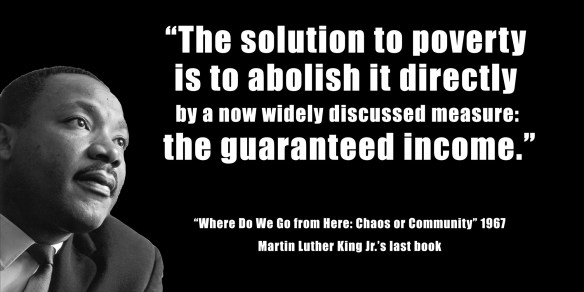
Careful analysis reveals a number of excellent arguments for the implementation of a Universal Basic Income.

By Paul Buchheit

Source: Nation of Change

It’s not hard to envision the benefits in work opportunities, stress reduction, child care, entrepreneurial activity, and artistic pursuits for American households with an extra $1,000 per month. It’s also very easy to justify a financial wealth tax, given that the dramatic stock market surge in recent years is largely due to an unprecedented degree of technological and financial productivity that derives from the work efforts and taxes of ALL Americans. A 2% annual tax on financial wealth is a small price to pay for the great fortunes bestowed on the most fortunate Americans.

The REASONS? Careful analysis reveals a number of excellent arguments for the implementation of a Universal Basic Income (UBI).

(1) Our Jobs are Disappearing

A 2013 Oxford study determined that nearly HALF of American jobs are at risk of being replaced by computers, AI, and robots. Society simply can’t keep up with technology. As for the skeptics who cite the Industrial Revolution and its job-enhancing aftermath (which actually took 60 years to develop), the McKinsey Global Institute says that society is being transformed at a pace “ten times faster and at 300 times the scale” of the radical changes of two hundred years ago.

(2) Half of America is Stressed Out or Sick

Half of Americans are in or near poverty, unable to meet emergency expenses, living from paycheck to paycheck, and getting physically and emotionally ill because of it. Numerous UBI experiments have led to increased well-being for their participants. A guaranteed income reduces the debilitating effects of inequality. As one recipient put it, “It takes me out of depression…I feel more sociable.”

(3) Children Need Our Help

This could be the best reason for monthly household stipends. Parents, especially mothers, are unable to work outside the home because of the all-important need to care for their children. Because we currently lack a UBI, more and more children are facing hunger and health problems and educational disadvantages.

(4) We Need More Entrepreneurs

A sudden influx of $12,000 per year for 126 million households will greatly stimulate the economy, potentially allowing millions of Americans to TAKE RISKS that could lead to new forms of innovation and productivity.

Perhaps most significantly, a guaranteed income could relieve some of the pressure on our newest generation of young adults, who are deep in debt, underemployed, increasingly unable to live on their own, and ill-positioned to take the entrepreneurial chances that are needed to spur innovative business growth. No other group of Americans could make more productive use of an immediate boost in income.

(5) We Need the Arts & Sciences

A recent Gallup poll found that nearly 70% of workers don’t feel ‘engaged’ (enthusiastic and committed) in their jobs. The work chosen by UBI recipients could unleash artistic talents and creative impulses that have been suppressed by personal financial concerns, leading, very possibly, to a repeat of the 1930s, when the Works Progress Administration hired thousands of artists and actors and musicians to help sustain the cultural needs of the nation.

Arguments against

The usual uninformed and condescending opposing argument is that UBI recipients will waste the money, spending it on alcohol and drugs and other ‘temptation’ goods. Not true. Studies from the World Bank and the Brooks World Poverty Institute found that money going to poor families is used primarily for essential needs, and that the recipients experience greater physical and mental well-being as a result of their increased incomes. Other arguments against the workability of the UBI are countered by the many successful experiments conducted in the present and recent past: FinlandCanada, Netherlands, Kenya, IndiaGreat Britain, Uganda, Namibia, and in the U.S. in Alaska and California.

How to pay for it

Largely because of the stock market, U.S. financial wealth has surged to $77 trillion, with the richest 10% owning over three-quarters of it. Just a 2 percent tax on total financial wealth would generate enough revenue to provide a $12,000 annual stipend to every American household (including those of the richest families).

It’s easy to justify a wealth tax. Over half of all basic research is paid for by our tax dollars. All the technology in our phones and computers started with government research and funding. Pharmaceutical companies wouldn’t exist without decades of support from the National Institutes of Health. Yet the tech and pharmaceutical companies claim patents on the products paid for and developed by the American people.

The collection of a wealth tax would not be simple, since only about half of U.S. financial wealth is held directly in equities and liquid assets (Table 5-2). But it’s doable. As Thomas Piketty notes, “A progressive tax on net wealth is better than a progressive tax on consumption because first, net wealth is better defined for very wealthy individuals..”

And certainly a financial industry that knows how to package worthless loans into A-rated mortgage-backed securities should be able to figure out how to tax the investment companies that manage the rest of our ever-increasing national wealth.


NYT: Don’t Be Progressive, Be a ‘Liberal’

By Jim Naureckas

Source: FAIR

A New York Times op-ed by political scientist (and former Bob Kerrey aide) Greg Weiner (7/13/18) may well be the New York Times–iest op-ed ever.

Its ostensible subject is why Democrats should call themselves “liberals” and not “progressives.” But in making that case, it hits most of the main points of the New York Times‘ ideology—one that has guided the paper since the late 19th century.

First and foremost, it’s a defense of the status quo. “The basic premise of liberal politics,” Weiner writes, “is the capacity of government to do good, especially in ameliorating economic ills.” But not too much good, mind you:  “A liberal can believe that government can do more good or less,” he stresses. Weiner draws a contrast with progressives: “Where liberalism seeks to ameliorate economic ills, progressivism’s goal is to eradicate them.”

So Lyndon Johnson’s Great Society is cited negatively as an example of “a progressive effort to remake society by eradicating poverty’s causes”—in the process supporting  “community action” and  financing the “political activism”—presented without explanation as a self-evident evil.  The explanation, presumably, is that the poor should remain passive as they remain poor, gratefully accepting the handouts that “alleviate” their plight, as “cutting checks,” as Weiner puts it, is “something government does competently.”

Coupled with this anxiety about “eradicating poverty’s causes” is the confident assurance that the truth is always somewhere in the middle. “Unlike liberalism, progressivism is intrinsically opposed to conservation,” Weiner warns:

Nothing structurally impedes compromise between conservatives, who hold that the accumulated wisdom of tradition is a better guide than the hypercharged rationality of the present, and liberals, because both philosophies exist on a spectrum.

Conservatives make better partners for liberals than progressives, because “one can debate how much to conserve.” But you can’t debate how much to progress, apparently: “Progressivism is inherently hostile to moderation because progress is an unmitigated good.”

In other words: Equality and justice, sure, but let’s not rush into things, is the “liberal’s” advice. He endorses “policies [that] develop gradually and command wide consensus—at least under normal circumstances.” (Progressives have an unnerving desire to “depress the accelerator.”)

Something that doesn’t change is the right wing of the left’s attraction to redbaiting. Weiner praises “the Cold War liberal who stood for social amelioration and against Soviet Communism,” a figure who “was often maligned by progressives.” Without coming out and accusing progressives of Stalinism, he describes progressives’ response to critics as “a passive-aggressive form of re-education,” one that “supersedes the rights of its opponents.” The example he gives of this is the “progressive indifference to the rights of those who oppose progressive policies in areas like sexual liberation”—an odd arena to cite, since the main “rights” that opponents of “sexual liberation” have demanded in recent years are the “right” of small businesses to discriminate against gay customers and the “right” to check the chromosome status of people who use public restrooms.


You can send a message to the New York Times at letters@nytimes.com  (Twitter:@NYTimes). Please remember that respectful communication is the most effective.

Financial Tyranny: ‘We the People’ Are the New Permanent Underclass in America

By John W. Whitehead

Source: The Rutherford Institute

“When plunder becomes a way of life for a group of men in a society, over the course of time they create for themselves a legal system that authorizes it and a moral code that glorifies it.” ― Frédéric Bastiat, French economist

Americans can no longer afford to get sick and there’s a reason why.

That’s because a growing number of Americans are struggling to stretch their dollars far enough to pay their bills, get out of debt and ensure that if and when an illness arises, it doesn’t bankrupt them.

This is a reality that no amount of partisan political bickering can deny.

Many Americans can no longer afford health insurance, drug costs or hospital bills. They can’t afford to pay rising healthcare premiums, out-of-pocket deductibles and prescription drug bills.

They can’t afford to live, and now they can’t afford to get sick or die, either.

To be clear, my definition of “affordable healthcare” is different from the government’s. To the government, you can “afford” to pay for healthcare if your income falls above the poverty line. That takes no account of rising taxes, the cost of living, the cost to clothe and feed a household, the cost of transportation and communication and education, or any of the other line items that add up to a life worth living.

As Helaine Olen points out in The Atlantic:

Just because a person is insured, it doesn’t mean he or she can actually afford their doctor, hospital, pharmaceutical, and other medical bills. The point of insurance is to protect patients’ finances from the costs of everything from hospitalizations to prescription drugs, but out-of-pocket spending for people even with employer-provided health insurance has increased by more than 50 percent since 2010.”

For too many Americans, achieving any kind of quality of life has become a choice between putting food on the table and paying one’s bills or health care coverage.

It’s a gamble any way you look at it, and the medical community is not helping.

Healthcare costs are rising, driven by a medical, insurance and pharmaceutical industry that are getting rich off the sick and dying.

Indeed, Americans currently pay $3.4 trillion a year for medical care. We spent more than $10,000 per person on health care in 2016. Those attempting to shop for health insurance coverage right now are understandably experiencing sticker shock with premiums set to rise 34% in 2018. It’s estimated that costs may rise as high as $15,000 by 2023.

As Bloomberg reports, “Rising health-care costs are eating up the wage gains won by American workers, who are being asked by their employers to pick up more of the heftier tab… The cost of buying health coverage at work has increased faster than wages and inflation for years, pressuring household budgets.”

Appallingly, Americans spend more than any developed country on healthcare and have less to show for it. We don’t live as long, we have higher infant mortality rates, we have fewer hospital and physician visits, and the quality of our healthcare is generally worse. We also pay astronomical amounts for prescription drugs, compared to other countries.

Whether or not you’re insured through an employer, the healthcare marketplace, a government-subsidized program such as Medicare or Medicaid, or have no health coverage whatsoever, it’s still “we the consumers” who have to pay to subsidize the bill whenever anyone gets sick in this country. And that bill is a whopper.

While Obamacare (a.k.a. the Affordable Care Act) may have made health insurance more accessible to greater numbers of individuals, it has failed to make healthcare any more affordable.

Why?

As journalist Laurie Meisler concludes, “One big reason U.S. health care costs are so high: pharmaceutical spending. The U.S. spends more per capita on prescription medicines and over-the-counter products than any other country.”

One investigative journalist spent seven months analyzing hundreds of bills from hospitals, doctors, drug companies, and medical equipment manufacturers. His findings confirmed what we’ve known all along: health care in America is just another way of making corporations rich at consumer expense.

An examination of an itemized hospital bill (only available upon request) revealed an amazing amount of price gouging. Tylenol, which you can buy for less than $10 for a bottle, was charged to the patient at a rate of $15 per pill, for a total of $345 for a hospital stay. $8 for a plastic bag to hold the patient’s personal items and another $8 for a box of Kleenex. $23 for a single alcohol swab. $53 per pair for non-sterile gloves (adding up to $5,141 for the entire hospital stay). $10 for plastic cup in which to take one’s medicine. $93 for the use of an overhead light during a surgical procedure. $39 each time you want to hold your newborn baby. And $800 for a sterile water IV bag that costs about a dollar to make.

This is clearly not a problem that can be remedied by partisan politics.

The so-called Affordable Care Act pushed through by the Obama administration is proving to be anything but affordable for anyone over the poverty line. And the Trump administration’s “fixes” promise to be no better. Indeed, for too many Americans who live paycheck to paycheck and struggle just to get by, the tax penalty for not having health insurance will actually be cheaper than trying to find affordable coverage that actually pays for care.

This is how the middle classes, who fuel the nation’s economy and fund the government’s programs, get screwed repeatedly.

When almost 60% of Americans are so financially strapped that they don’t have even $500 in savings and nothing whatsoever put away for retirement, and yet they are being forced to pay for government programs that do little to enhance their lives, we’re not living the American dream.

We’re living a financial nightmare.

We have no real say in how the government runs, or how our taxpayer funds are used, but that doesn’t prevent the government from fleecing us at every turn and forcing us to pay for endless wars that do more to fund the military industrial complex than protect us, pork barrel projects that produce little to nothing, and a police state that serves only to imprison us within its walls.

We have no real say, but we’re being forced to pay through the nose, anyhow.

George Harrison, who died 16 years ago this month, summed up this outrageous state of affairs in his song Taxman:

If you drive a car, I’ll tax the street,
If you try to sit, I’ll tax your seat.
If you get too cold I’ll tax the heat,
If you take a walk, I’ll tax your feet.

Don’t ask me what I want it for
If you don’t want to pay some more
‘Cause I’m the taxman, yeah, I’m the taxman

Now my advice for those who die
Declare the pennies on your eyes
‘Cause I’m the taxman, yeah, I’m the taxman
And you’re working for no one but me.

In other words, in the eyes of the government, “we the people, the voters, the consumers, and the taxpayers” are little more than indentured servants and sources of revenue.

If you have no choice, no voice, and no real options when it comes to the government’s claims on your property and your money, you’re not free.

Consider: The government can seize your home and your car (which you’ve bought and paid for) over nonpayment of taxes. Government agents can freeze and seize your bank accounts and other valuables if they merely “suspect” wrongdoing. And the IRS insists on getting the first cut of your salary to pay for government programs over which you have no say.

It wasn’t always this way, of course.

Early Americans went to war over the inalienable rights described by philosopher John Locke as the natural rights of life, liberty and property.

It didn’t take long, however—a hundred years, in fact—before the American government was laying claim to the citizenry’s property by levying taxes to pay for the Civil War. As the New York Times reports, “Widespread resistance led to its repeal in 1872.”

Determined to claim some of the citizenry’s wealth for its own uses, the government reinstituted the income tax in 1894. Charles Pollock challenged the tax as unconstitutional, and the U.S. Supreme Court ruled in his favor. Pollock’s victory was relatively short-lived. Members of Congress—united in their determination to tax the American people’s income—worked together to adopt a constitutional amendment to overrule the Pollock decision.

On the eve of World War I, in 1913, Congress instituted a permanent income tax by way of the 16th Amendment to the Constitution and the Revenue Act of 1913. Under the Revenue Act, individuals with income exceeding $3,000 could be taxed starting at 1% up to 7% for incomes exceeding $500,000.

It’s all gone downhill from there.

Unsurprisingly, the government has used its tax powers to advance its own imperialistic agendas and the courts have repeatedly upheld the government’s power to penalize or jail those who refused to pay their taxes.

Irwin A. Schiff was one of the nation’s most vocal tax protesters. He spent a good portion of his life arguing that the income tax was unconstitutional. He paid the price for his resistance, too: Schiff served three separate prison terms (more than 10 years in all) over his refusal to pay taxes. He died at the age of 87 serving a 14-year prison term. As constitutional activist Robert L. Schulz noted in Schiff’s obituary, “In a society where there is so much fear of government, and in particular of the I.R.S., [Schiff] was probably the most influential educator regarding the illegal and unconstitutional operation and enforcement of the Internal Revenue Code. It’s very hard to speak to power, but he did, and he paid a very heavy price.”

It’s still hard to speak to power, and those who do are still paying a very heavy price.

All the while the government continues to do whatever it likes—levy taxes, rack up debt, spend outrageously and irresponsibly—with little thought for the plight of its citizens.

The national debt is $20 trillion and growing. The amount this country owes is now greater than its gross national product (all the products and services produced in one year by labor and property supplied by the citizens). We’re paying more than $270 billion just in interest on that debt annually. And the top two foreign countries who “own” our debt are China and Japan.

To top it all off, all of those wars the U.S. is so eager to fight abroad are being waged with borrowed funds. As The Atlantic reports, “For 15 years now, the United States has been putting these wars on a credit card… U.S. leaders are essentially bankrolling the wars with debt, in the form of purchases of U.S. Treasury bonds by U.S.-based entities like pension funds and state and local governments, and by countries like China and Japan.”

If Americans managed their personal finances the way the government mismanages the nation’s finances, we’d all be in debtors’ prison by now.

Still, the government remains unrepentant, unfazed and undeterred in its money grabs.

While we’re struggling to get by, and making tough decisions about how to spend what little money actually makes it into our pockets after the federal, state and local governments take their share (this doesn’t include the stealth taxes imposed through tolls, fines and other fiscal penalties), the police state is spending our hard-earned tax dollars to further entrench its powers and entrap its citizens.

For instance, American taxpayers have been forced to shell out $5.6 trillion since 9/11 for the military industrial complex’s costly, endless so-called “war on terrorism.” That translates to roughly $23,000 per taxpayer to wage wars abroad, occupy foreign countries, provide financial aid to foreign allies, and fill the pockets of defense contractors and grease the hands of corrupt foreign dignitaries.

Mind you, that staggering $6 trillion is only a portion of what the Pentagon spends on America’s military empire.

That price tag keeps growing, too.

The 16-year war in Afghanistan, which now stands as the longest and one of the most expensive wars in U.S. history, is about to get even longer and more costly, thanks to President Trump’s promise to send more troops over.

In this way, the military industrial complex will get even richer, and the American taxpayer will be forced to shell out even more funds for programs that do little to enhance our lives, ensure our happiness and well-being, or secure our freedoms.

As Dwight D. Eisenhower warned in a 1953 speech:

Every gun that is made, every warship launched, every rocket fired signifies, in the final sense, a theft from those who hunger and are not fed, those who are cold and are not clothed. This world in arms is not spending money alone. It is spending the sweat of its laborers, the genius of its scientists, the hopes of its children. The cost of one modern heavy bomber is this: a modern brick school in more than 30 cities. It is two electric power plants, each serving a town of 60,000 population. It is two fine, fully equipped hospitals. It is some fifty miles of concrete pavement. We pay for a single fighter plane with a half million bushels of wheat. We pay for a single destroyer with new homes that could have housed more than 8,000 people. This is, I repeat, the best way of life to be found on the road the world has been taking. This is not a way of life at all, in any true sense. Under the cloud of threatening war, it is humanity hanging from a cross of iron. […] Is there no other way the world may live?

This is still no way of life.

Yet it’s not just the government’s endless wars that are bleeding us dry.

We’re also being forced to shell out money for surveillance systems to track our movements, money to further militarize our already militarized police, money to allow the government to raid our homes and bank accounts, money to fund schools where our kids learn nothing about freedom and everything about how to comply, and on and on.

Are you getting the picture yet?

The government isn’t taking our money to make our lives better. Just take a look at the nation’s failing infrastructure, and you’ll see how little is being spent on programs that advance the common good.

We’re being robbed blind so the governmental elite can get richer.

This is nothing less than financial tyranny.

“We the people” have become the new, permanent underclass in America.

It’s tempting to say that there’s little we can do about it, except that’s not quite accurate.

There are a few things we can do (demand transparency, reject cronyism and graft, insist on fair pricing and honest accounting methods, call a halt to incentive-driven government programs that prioritize profits over people), but it will require that “we the people” stop playing politics and stand united against the politicians and corporate interests who have turned our government and economy into a pay-to-play exercise in fascism.

We’ve become so invested in identity politics that label us based on our political leanings that we’ve lost sight of the one label that unites us: we’re all Americans.

As I make clear in my book Battlefield America: The War on the American People, the powers-that-be want to pit us against one another. They want us to adopt an “us versus them” mindset that keeps us powerless and divided. Trust me, the only “us versus them” that matters anymore is “we the people” against the police state.

We’re all in the same boat, folks, and there’s only one real life preserver: that’s the Constitution and the Bill of Rights.

The Constitution starts with those three powerful words: “We the people.”

The message is this: there is power in our numbers.

That remains our greatest strength in the face of a governmental elite that continues to ride roughshod over the populace. It remains our greatest defense against a government that has claimed for itself unlimited power over the purse (taxpayer funds) and the sword (military might). As Patrick Henry declared in the last speech before his death, “United we stand, divided we fall. Let us not split into factions … or … exhaust [our strength] in civil commotions and intestine wars.”

This holds true whether you’re talking about health care, war spending, or the American police state.

Wasted lives: The worldwide tragedy of youth suicide

Principles of goodness together with the golden seed of social justice – sharing – need to be the guiding ideals of a radically redesigned socio-economic paradigm.

By Graham Peebles

Source: Nation of Change

The pressures of modern life are colossal; for young people – those under 25 years of age – they are perhaps greater than at any other time. Competition in virtually every aspect of contemporary life, a culture obsessed with image and material success, and the ever-increasing cost of living are creating a cocktail of anxiety and self-doubt that drives some people to take their own lives and many more to self-abuse of one kind or another.

Amongst this age group today, suicide constitutes the second highest cause of death after road/traffic accidents, and is the most common cause of death in female adolescents aged 15–19 years. This fact is an appalling reflection on our society and the materialistic values driven into the minds of children throughout the world.

The World Health Organization (WHO) estimates that in total “close to 800,000 people die due to suicide every year, which is one person every 40 seconds. Many more attempt suicide,” and those who have attempted suicide are the ones at greatest risk of trying again. Whilst these figures are startling, WHO acknowledges that suicide is widely under-reported. In some countries (throughout Sub-Saharan Africa, for example) where stigma still attaches to suicide, it is not always recorded as the cause of death when in fact it should be, meaning the overall suicide figures are without doubt a great deal higher.

Unless there is fundamental change in the underlying factors that cause suicide, the WHO forecasts that by 2020 – a mere three years away, someone, somewhere will take their own life every 20 seconds. This worldwide issue, WHO states, is increasing year on year; it is a symptom of a certain approach to living – a divisive approach that believes humanity is inherently greedy and selfish and has both created, and is perpetuated by, an unjust socio-economic system which is at the root of many of our problems.

Sliding into despair

Suicide is a global matter and is something that can no longer be dismissed, nor its societal causes ignored. It is the final act in a painful journey of anguish; it signifies a desperate attempt by the victim to be free of the pain they feel, and which, to them, is no longer bearable. It is an attempt to escape inner conflict and emotional agony, persecution or intimidation. It may follow a pattern of self-harm, alcohol or drug abuse, and, is in many cases, but not all, related to depression, which blights the lives of more than 300 million people worldwide, is debilitating and deeply painful. As William Styron states in Darkness Invisible, “The pain of severe depression is quite unimaginable to those who have not suffered it, and it kills in many instances because its anguish can no longer be borne. The prevention of many suicides will continue to be hindered until there is a general awareness of the nature of this pain.”

Any suicide is a tragedy and a source of great sadness, particularly if the victim is a teenager, or someone in there twenties, who had their whole life ahead of them, but for some reason or another could not face it. As with all age groups, mental illness amongst young people is cited as the principle reason for, or an impelling cause of suicide, as well as for people suffering from an untreated illness such as anxiety anorexia or bulimia; alcohol and drug abuse are also regularly mentioned, as well as isolation.

All of these factors are effects, the result of the environment in which people – young and not so young – are living: family life, the immediate society, the broader national and world society. The values and codes of behavior that these encourage, and, flowing from this environment, the manner in which people treat one another together with their prevailing attitudes. It must be here that, setting aside any individual pre-disposition, the underlying causes leading to mental illness or alcohol/drug dependency in the first place are rooted.

Unsurprisingly young people who are unemployed for a long time; who have been subjected to physical or sexual abuse; who come from broken families in which there is continuous anxiety due to job insecurity and low wages are at heightened risk of suicide, as are homeless people, young gay and bi-sexual men and those locked up in prison or young offenders institutions. In addition, WHO states that, “Experiencing conflict, […] loss and a sense of isolation are strongly associated with suicidal behavior.”

Lack of hope is another key factor. Absence of hope leads to despair, and from despair flows all manner of negative thoughts and destructive actions, including suicide. In Japan, where suicide is the leading cause of death among people aged between 15 and 39 (death by suicide in Japan is around twice that of America, France and Canada, and three times that of Germany and the U.K.), the BBC reports that, “young people are killing themselves because they have lost hope and are incapable of seeking help.” Suicides began to increase dramatically in Japan in 1988 after the Asian financial crisis and climbed again after the 2008 worldwide economic crash. Economic insecurity is thought to be the cause, driven by “the practice of employing young people on short-term contracts.”

Hope is extremely important, hope that life will improve, that circumstances will change, that people will be kinder and that life will be gentler. That one’s life has meaning. Interestingly, in the aftermath of Princess Diana’s death in 1997, suicides in Britain increased by almost 20 per cent, and cases of self-harm rose by 44 per cent. To many people she was a symbol of compassion and warmth in a brittle, hostile world, and somehow engendered hope.

The list of those most vulnerable to suicide is general and no doubt incomplete; suicide is an individual act and flows from specific circumstances and a particular state of mind. Generalizations miss the subtleties of each desperate cry. Some suicides are spontaneous acts, spur of the moment decisions (as is often the case in Asian countries, where poison is the most common method of suicide), others may be drawn out over years, in the case of the alcoholic for example, punctuated perhaps by times of relief and optimism, only to collapse under the weight of life’s intense demands once more.

It is these constant pressures that are often the principle causes of the slide into despair and the desire to escape the agony of daily life. They are all pervasive, hard to resist, impossible, apparently, to escape. Firstly, we are all faced with the practical demands of earning a living, paying the rent or mortgage, buying food, and covering the energy bills etc. Secondly, there are the more subtle pressures, closely related to our ability to meet the practical demands of the day: the pressure to succeed, to make something of one’s life, to be strong – particularly of you’re a young man, to be sexually active, to be popular, to know what you want and have the strength to get it; to have the confidence to dream and the determination to fulfill your dreams. And if you don’t know what you want, if you don’t have ‘dreams’ in a world of dreamers, this is seen as weakness, which will inevitably result in ‘failure’. And by failure, is meant material inadequacy as well as unfulfilled potential and perhaps loneliness, because who would want to be with a ‘failure’?

These and other expectations and pressures constitute the relentless demands faced by us all, practical and psychological, and our ability to meet them colours the way we see ourselves and determines, to a degree, how others see us. The images of what we should be, how we should behave, what we should think and aspire too, the values we should adopt and the belief system we should accept are thrust into the minds of everyone from birth. They are narrow, inhibiting, prescribed and deeply unhealthy.

The principle tool of this process of psychological and sociological conditioning is the media, as well as parents and peers, all of whom have themselves fallen foul of the same methodology, and education.

Beyond reward and punishment

Step outside the so-called norm, stand out as someone different, and risk being persecuted, bullied and socially excluded. The notion of individuality has been outwardly championed but systematically and institutionally denied. Our education systems are commonly built on two interconnected foundations – conformity and competition – and reinforced through methods, subtle and crude, of reward and punishment. All of which stifles true individuality, which needs a quiet, loving space, free from judgment in which to flower. For the most sensitive, vulnerable and uncertain, the pressure to conform, to compete and succeed, is often too much to bear. Depression, self-doubt, anxiety, self-harm, addiction and, for some, suicide, are the dire consequences.

There are many initiatives aimed at preventing suicide amongst young people – alcohol/drug services, mental health treatment, reducing access to the means of suicide – and these are of tremendous value. However if the trend of increased suicides among young people is to be reversed it is necessary to dramatically reduce the pressures on them and inculcate altogether more inclusive values. This means changing the environments in which life is lived, most notably the socio-economic environment that infects all areas of society. Worldwide, life is dominated by the neoliberal economic system, an extreme form of capitalism that has infiltrated every area of life. Under this decrepit unjust model everything is classed as a commodity, everyone as a consumer, inequality guaranteed with wealth and power concentrated in the hands of a tiny percentage of the population – 1% of 1%, or less in fact. All facets of life have become commercialized, from health care to the supply of water and electricity, and the schooling of our children. The educational environment has become poisoned by the divisive values of the market place, with competition at the forefront, and competition has no place in schools and universities, except perhaps on the sports field: streaming and selection should be vetoed totally and testing, until final exams (that should be coursework based), scrapped.

All that divides within our societies should be called out and rejected, cooperation inculcated instead of competition in every area of human endeavor, including crucially the political-economic sphere; tolerance encouraged, unity built in all areas of society, local, national and global. These principles of goodness together with the golden seed of social justice – sharing – need to be the guiding ideals of a radically redesigned socio-economic paradigm, one that meets the needs of all to live dignified, fulfilled lives, promotes compassion, and, dare I say, cultivates love. Only then, will the fundamental causes of suicide, amongst young people in particular, but men and women of all ages, be eradicated.