After the Crash

Dispatches From a Long Recovery (Est. 10/2024)

After the Crash

The Omnipresent Surveillance State: Orwell’s 1984 Is No Longer Fiction

By John W. Whitehead

Source: The Rutherford Institute

“You had to live—did live, from habit that became instinct—in the assumption that every sound you made was overheard, and, except in darkness, every movement scrutinized.”—George Orwell, 1984

Tread cautiously: the fiction of George Orwell has become an operation manual for the omnipresent, modern-day surveillance state.

It’s been 70 years since Orwell—dying, beset by fever and bloody coughing fits, and driven to warn against the rise of a society in which rampant abuse of power and mass manipulation are the norm—depicted the ominous rise of ubiquitous technology, fascism and totalitarianism in 1984.

Who could have predicted that 70 years after Orwell typed the final words to his dystopian novel, “He loved Big Brother,” we would fail to heed his warning and come to love Big Brother.

“To the future or to the past, to a time when thought is free, when men are different from one another and do not live alone— to a time when truth exists and what is done cannot be undone: From the age of uniformity, from the age of solitude, from the age of Big Brother, from the age of doublethink — greetings!”—George Orwell

1984 portrays a global society of total control in which people are not allowed to have thoughts that in any way disagree with the corporate state. There is no personal freedom, and advanced technology has become the driving force behind a surveillance-driven society. Snitches and cameras are everywhere. People are subject to the Thought Police, who deal with anyone guilty of thought crimes. The government, or “Party,” is headed by Big Brother who appears on posters everywhere with the words: “Big Brother is watching you.”

We have arrived, way ahead of schedule, into the dystopian future dreamed up by not only Orwell but also such fiction writers as Aldous Huxley, Margaret Atwood and Philip K. Dick.

“If liberty means anything at all, it means the right to tell people what they do not want to hear.”―George Orwell

Much like Orwell’s Big Brother in 1984, the government and its corporate spies now watch our every move. Much like Huxley’s A Brave New World, we are churning out a society of watchers who “have their liberties taken away from them, but … rather enjoy it, because they [are] distracted from any desire to rebel by propaganda or brainwashing.” Much like Atwood’s The Handmaid’s Tale, the populace is now taught to “know their place and their duties, to understand that they have no real rights but will be protected up to a point if they conform, and to think so poorly of themselves that they will accept their assigned fate and not rebel or run away.”

And in keeping with Philip K. Dick’s darkly prophetic vision of a dystopian police state—which became the basis for Steven Spielberg’s futuristic thriller Minority Report—we are now trapped in a world in which the government is all-seeing, all-knowing and all-powerful, and if you dare to step out of line, dark-clad police SWAT teams and pre-crime units will crack a few skulls to bring the populace under control.

What once seemed futuristic no longer occupies the realm of science fiction.

Incredibly, as the various nascent technologies employed and shared by the government and corporations alike—facial recognition, iris scanners, massive databases, behavior prediction software, and so on—are incorporated into a complex, interwoven cyber network aimed at tracking our movements, predicting our thoughts and controlling our behavior, the dystopian visions of past writers is fast becoming our reality.

Our world is characterized by widespread surveillance, behavior prediction technologies, data mining, fusion centers, driverless cars, voice-controlled homes, facial recognition systems, cybugs and drones, and predictive policing (pre-crime) aimed at capturing would-be criminals before they can do any damage.

Surveillance cameras are everywhere. Government agents listen in on our telephone calls and read our emails. Political correctness—a philosophy that discourages diversity—has become a guiding principle of modern society.

“People sleep peaceably in their beds at night only because rough men stand ready to do violence on their behalf.”―George Orwell

The courts have shredded the Fourth Amendment’s protections against unreasonable searches and seizures. In fact, SWAT teams battering down doors without search warrants and FBI agents acting as a secret police that investigate dissenting citizens are common occurrences in contemporary America. And bodily privacy and integrity have been utterly eviscerated by a prevailing view that Americans have no rights over what happens to their bodies during an encounter with government officials, who are allowed to search, seize, strip, scan, spy on, probe, pat down, taser, and arrest any individual at any time and for the slightest provocation.

“The creatures outside looked from pig to man, and from man to pig, and from pig to man again; but already it was impossible to say which was which.”―George Orwell, Animal Farm

We are increasingly ruled by multi-corporations wedded to the police state.

What many fail to realize is that the government is not operating alone. It cannot. The government requires an accomplice. Thus, the increasingly complex security needs of the massive federal government, especially in the areas of defense, surveillance and data management, have been met within the corporate sector, which has shown itself to be a powerful ally that both depends on and feeds the growth of governmental overreach.

In fact, Big Tech wedded to Big Government has become Big Brother, and we are now ruled by the Corporate Elite whose tentacles have spread worldwide. For example, USA Today reports that five years after the 9/11 terrorist attacks, the homeland security business was booming to such an extent that it eclipsed mature enterprises like movie-making and the music industry in annual revenue. This security spending to private corporations such as Google, Amazon, Microsoft and others is forecast to exceed $1 trillion in the near future.

The government now has at its disposal technological arsenals so sophisticated and invasive as to render any constitutional protections null and void. Spearheaded by the NSA, which has shown itself to care little to nothing for constitutional limits or privacy, the “security/industrial complex”—a marriage of government, military and corporate interests aimed at keeping Americans under constant surveillance—has come to dominate the government and our lives. At three times the size of the CIA, constituting one third of the intelligence budget and with its own global spy network to boot, the NSA has a long history of spying on Americans, whether or not it has always had the authorization to do so.

Money, power, control. There is no shortage of motives fueling the convergence of mega-corporations and government. But who is paying the price? The American people, of course.

Orwell understood what many Americans, caught up in their partisan flag-waving, are still struggling to come to terms with: that there is no such thing as a government organized for the good of the people. Even the best intentions among those in government inevitably give way to the desire to maintain power and control over the citizenry at all costs. As Orwell explains:

The Party seeks power entirely for its own sake. We are not interested in the good of others; we are interested solely in power, pure power. What pure power means you will understand presently. We are different from the oligarchies of the past in that we know what we are doing. All the others, even those who resembled ourselves, were cowards and hypocrites. The German Nazis and the Russian Communists came very close to us in their methods, but they never had the courage to recognize their own motives. They pretended, perhaps they even believed, that they had seized power unwillingly and for a limited time, and that just around the corner there lay a paradise where human beings would be free and equal. We are not like that. We know what no one ever seizes power with the intention of relinquishing it. Power is not a means; it is an end. One does not establish a dictatorship in order to safeguard a revolution; one makes the revolution in order to establish the dictatorship. The object of persecution is persecution. The object of torture is torture. The object of power is power. Now you begin to understand me.

“The further a society drifts from truth the more it will hate those who speak it.” ― George Orwell

How do you change the way people think? You start by changing the words they use.

In totalitarian regimes—a.k.a. police states—where conformity and compliance are enforced at the end of a loaded gun, the government dictates what words can and cannot be used. In countries where the police state hides behind a benevolent mask and disguises itself as tolerance, the citizens censor themselves, policing their words and thoughts to conform to the dictates of the mass mind.

Dystopian literature shows what happens when the populace is transformed into mindless automatons. In Ray Bradbury’s Fahrenheit 451, reading is banned and books are burned in order to suppress dissenting ideas, while televised entertainment is used to anesthetize the populace and render them easily pacified, distracted and controlled.

In Huxley’s Brave New World, serious literature, scientific thinking and experimentation are banned as subversive, while critical thinking is discouraged through the use of conditioning, social taboos and inferior education. Likewise, expressions of individuality, independence and morality are viewed as vulgar and abnormal.

And in Orwell’s 1984, Big Brother does away with all undesirable and unnecessary words and meanings, even going so far as to routinely rewrite history and punish “thoughtcrimes.” In this dystopian vision of the future, the Thought Police serve as the eyes and ears of Big Brother, while the Ministry of Peace deals with war and defense, the Ministry of Plenty deals with economic affairs (rationing and starvation), the Ministry of Love deals with law and order (torture and brainwashing), and the Ministry of Truth deals with news, entertainment, education and art (propaganda). The mottos of Oceania: WAR IS PEACE, FREEDOM IS SLAVERY, and IGNORANCE IS STRENGTH.

All three—Bradbury, Huxley and Orwell—had an uncanny knack for realizing the future, yet it is Orwell who best understood the power of language to manipulate the masses. Orwell’s Big Brother relied on Newspeak to eliminate undesirable words, strip such words as remained of unorthodox meanings and make independent, non-government-approved thought altogether unnecessary. To give a single example, as psychologist Erich Fromm illustrates in his afterword to 1984:

The word free still existed in Newspeak, but it could only be used in such statements as “This dog is free from lice” or “This field is free from weeds.” It could not be used in its old sense of “politically free” or “intellectually free,” since political and intellectual freedom no longer existed as concepts….

Where we stand now is at the juncture of OldSpeak (where words have meanings, and ideas can be dangerous) and Newspeak (where only that which is “safe” and “accepted” by the majority is permitted). The power elite has made their intentions clear: they will pursue and prosecute any and all words, thoughts and expressions that challenge their authority.

This is the final link in the police state chain.

“Until they became conscious they will never rebel, and until after they have rebelled they cannot become conscious.”—George Orwell

Americans have been conditioned to accept routine incursions on their privacy rights. In fact, the addiction to screen devices—especially cell phones—has created a hive effect where the populace not only watched but is controlled by AI bots. However, at one time, the idea of a total surveillance state tracking one’s every move would have been abhorrent to most Americans. That all changed with the 9/11 attacks. As professor Jeffrey Rosen observes, “Before Sept. 11, the idea that Americans would voluntarily agree to live their lives under the gaze of a network of biometric surveillance cameras, peering at them in government buildings, shopping malls, subways and stadiums, would have seemed unthinkable, a dystopian fantasy of a society that had surrendered privacy and anonymity.”

Having been reduced to a cowering citizenry—mute in the face of elected officials who refuse to represent us, helpless in the face of police brutality, powerless in the face of militarized tactics and technology that treat us like enemy combatants on a battlefield, and naked in the face of government surveillance that sees and hears all—we have nowhere left to go.

We have, so to speak, gone from being a nation where privacy is king to one where nothing is safe from the prying eyes of government. In search of so-called terrorists and extremists hiding amongst us—the proverbial “needle in a haystack,” as one official termed it—the Corporate State has taken to monitoring all aspects of our lives, from cell phone calls and emails to Internet activity and credit card transactions. Much of this data is being fed through fusion centersacross the country, which work with the Department of Homeland Security to make threat assessments on every citizen, including school children. These are state and regional intelligence centers that collect data on you.

“Big Brother is Watching You.”―George Orwell

Wherever you go and whatever you do, you are now being watched, especially if you leave behind an electronic footprint. When you use your cell phone, you leave a record of when the call was placed, who you called, how long it lasted and even where you were at the time. When you use your ATM card, you leave a record of where and when you used the card. There is even a video camera at most locations equipped with facial recognition software. When you use a cell phone or drive a car enabled with GPS, you can be tracked by satellite. Such information is shared with government agents, including local police. And all of this once-private information about your consumer habits, your whereabouts and your activities is now being fed to the U.S. government.

The government has nearly inexhaustible resources when it comes to tracking our movements, from electronic wiretapping devices, traffic cameras and biometrics to radio-frequency identification cards, satellites and Internet surveillance.

Speech recognition technology now makes it possible for the government to carry out massive eavesdropping by way of sophisticated computer systems. Phone calls can be monitored, the audio converted to text files and stored in computer databases indefinitely. And if any “threatening” words are detected—no matter how inane or silly—the record can be flagged and assigned to a government agent for further investigation. Federal and state governments, again working with private corporations, monitor your Internet content. Users are profiled and tracked in order to identify, target and even prosecute them.

In such a climate, everyone is a suspect. And you’re guilty until you can prove yourself innocent. To underscore this shift in how the government now views its citizens, the FBI uses its wide-ranging authority to investigate individuals or groups, regardless of whether they are suspected of criminal activity.

“Nothing was your own except the few cubic centimetres inside your skull.” ― George Orwell

Here’s what a lot of people fail to understand, however: it’s not just what you say or do that is being monitored, but how you think that is being tracked and targeted. We’ve already seen this play out on the state and federal level with hate crime legislation that cracks down on so-called “hateful” thoughts and expression, encourages self-censoring and reduces free debate on various subject matter.

Say hello to the new Thought Police.

Total Internet surveillance by the Corporate State, as omnipresent as God, is used by the government to predict and, more importantly, control the populace, and it’s not as far-fetched as you might think. For example, the NSA is now designing an artificial intelligence system that is designed to anticipate your every move. In a nutshell, the NSA will feed vast amounts of the information it collects to a computer system known as Aquaint (the acronym stands for Advanced QUestion Answering for INTelligence), which the computer can then use to detect patterns and predict behavior.

No information is sacred or spared.

Everything from cell phone recordings and logs, to emails, to text messages, to personal information posted on social networking sites, to credit card statements, to library circulation records, to credit card histories, etc., is collected by the NSA and shared freely with its agents in crime: the CIA, FBI and DHS. One NSA researcher actually quit the Aquaint program, “citing concerns over the dangers in placing such a powerful weapon in the hands of a top-secret agency with little accountability.”

Thus, what we are witnessing, in the so-called name of security and efficiency, is the creation of a new class system comprised of the watched (average Americans such as you and me) and the watchers (government bureaucrats, technicians and private corporations).

Clearly, the age of privacy in America is at an end.

“If you want a picture of the future, imagine a boot stamping on a human face—for ever.”—Orwell

So where does that leave us?

We now find ourselves in the unenviable position of being monitored, managed and controlled by our technology, which answers not to us but to our government and corporate rulers. This is the fact-is-stranger-than-fiction lesson that is being pounded into us on a daily basis.

It won’t be long before we find ourselves looking back on the past with longing, back to an age where we could speak to whom we wanted, buy what we wanted, think what we wanted without those thoughts, words and activities being tracked, processed and stored by corporate giants such as Google, sold to government agencies such as the NSA and CIA, and used against us by militarized police with their army of futuristic technologies.

To be an individual today, to not conform, to have even a shred of privacy, and to live beyond the reach of the government’s roaming eyes and technological spies, one must not only be a rebel but rebel.

Even when you rebel and take your stand, there is rarely a happy ending awaiting you. You are rendered an outlaw.

So how do you survive in the American surveillance state?

We’re running out of options.

As I make clear in my book Battlefield America: The War on the American People, we’ll soon have to choose between self-indulgence (the bread-and-circus distractions offered up by the news media, politicians, sports conglomerates, entertainment industry, etc.) and self-preservation in the form of renewed vigilance about threats to our freedoms and active engagement in self-governance.

Yet as Aldous Huxley acknowledged in Brave New World Revisited: “Only the vigilant can maintain their liberties, and only those who are constantly and intelligently on the spot can hope to govern themselves effectively by democratic procedures. A society, most of whose members spend a great part of their time, not on the spot, not here and now and in their calculable future, but somewhere else, in the irrelevant other worlds of sport and soap opera, of mythology and metaphysical fantasy, will find it hard to resist the encroachments of those would manipulate and control it.”
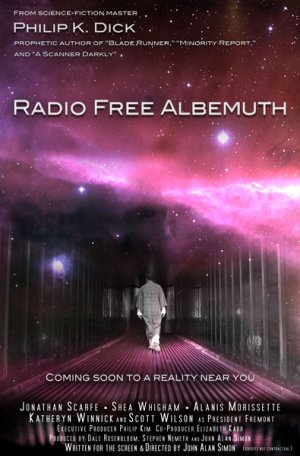
Saturday Matinee: Radio Free Albemuth

In light of Philip K. Dick’s birthday tomorrow (he would have been 90), it’s an appropriate time to visit (or revisit) the film adaptation of his posthumously published novel “Radio Free Albemuth”. Being a longtime PKD fan and one of the film’s Kickstarter contributors, I admittedly wouldn’t be a completely objective critic, but after having seen it a few times its achievements and shortcomings become more apparent.

Like the novel it’s based on, Radio Free Albemuth is one of the most personal of Philip K. Dick’s narratives, featuring the most faithful retelling of his 2-3-74 experiences. Filmed on a shoestring budget by John Alan Simon the movie has a fitting late 70s/early 80s aesthetic. Much of the dialogue is straight out of the novel but I personally would have wanted a more streamlined and nuanced script with less tangential details and exposition, though the actors across the board do a commendable job delivering their lines as naturally and believably as possible. The many dream sequences could have benefited from a higher budget and better visual consistency, but were able to accomplish what was needed for the plot. The prison scenes near the end seemed a bit rushed and not reflective of the oppressiveness of actual prisons, though that was probably largely due to budgetary reasons as well.

Despite its flaws, I still find the film engaging and worth recommending. Aspects of the story may come across to modern audiences as cheesy but still works on a meta level. In our sophisticated real life corporate techno-dystopia, the idea of individuals trying to incite revolution through subliminal messaging embedded in pop songs requires a suspension of disbelief. However in a more general general sense, countless creators through history (including writers and filmmakers) have made attempts to subvert society and culture with varying and impossible to quantify results.

Watch the full film on Hoopla here: https://www.hoopladigital.com/title/11350683

Nightmare Fuel, A Conspiracy Crisis

Part One: Mind-Control, Thought Implantation, and Telepathy Tech

By Equanimous Rex

Source: Modern Mythology

When technology can be produced that mimics diseases such as schizophrenia, or phenomena such as telepathy, how do we discern fact from fiction? When our memories are fallible, and when people can, over time with great repetition, replace true memories with false — where does this leave us?

“Is there anybody out there?

One day when I was a child, I enthusiastically told my father that I could “talk, but in my head, where no one can hear me.” When my father replied that what I had described was called “thinking”, and that everyone does it, my heart dropped a bit. It seemed so interesting to me, and so banal to him. The world and my place in it were still mysteries to me, as for all children, and even the most mundane experiences seemed wondrous. I couldn’t blame him for what I saw as his lack of imagination.

I was a book worm and movie enthusiast, science-fiction and fantasy. A few years later, while watching Star Trek: TNG, I realized that mind control and telepathy were a re-occuring theme. There were so many examples of mind altering technology within the series that it reawakened this childhood curiosity, and a fear.

“What if people really could read my thoughts?” I wondered. What if people could control them?

I wasn’t exactly concerned. It was just a childish fancy, something that gets under our skin, but we have already developed the reality testing to maintain it as a hypothetical. A popular trope meant to freak us out. Right? Even before science fiction tried to make mind control tech seem plausible, we spun tales about thoughts and desires altered at a distance, or clandestinely acquired information garnered from supernatural sources. Our inner voice has been a source of anxiety for virtual eons, after all, if someone can control it, how can we trust it?

Just fiction, right? Well, yes and no.

This series will explore some of these connections…


“Everybody’s Out To Get You Motherfucker”

I was mildly religious back in the day, a non-denominational flavor of generic Christian. I should have noticed the similarity between how I felt about fictional mind-control and telepathy, and how I felt about the idea of God watching every thought or move I made. That feeling of having no privacy, of having inner thoughts and opinions weighed out and measured, and judged. Or maybe even manipulated directly. Somehow, I never made a link between the idea of an omniscient deity reading all my thoughts and judging my eternal soul, and telepathy as found in science-fiction and fantasy.

At least, not as a child.

Now I understand the can of worms we are opening. As we will see through the rest of this series, through the fusion of global disinformation, technology that can beam voices into your mind by vibrating the tiny bones in your ear, and the ever-present hum of all ideologies vying for you to attribute those voices to their cause, we’re quickly approaching a semantic apocalypse. This sounds crazy, I know. That’s kind of the point. Imagine you’re hearing a voice in your head that is telling you to kill all the Jews, or that Obama is the Antichrist, and then you open Twitter to find the President is amplifying that paranoia. That’s a hell of force multiplier for mass insanity. Anyone who has watched the news recently should understand how deadly serious this epistemic crisis is.

Let’s begin with “the crazy.” Who hasn’t heard of people wearing “tin-foil hats”? Usually a pejorative allusion to someone who has bought into conspiracy theory, the first recorded idea of a telepathy-blocking device can actually be found in the strange non-fiction book Atomic Consciousness: An Explanation of Ghosts, Spiritualism, Witchcraft, Occult Phenomena and all Supernormal Manifestations written by self-proclaimed seer John Palfrey in 1909, under the name “James Bathurst”. He posited a hypothetical “insulative electrical contrivance encircling the head during thought” for use against “telepathic impactive impingement”.

The first allusion to a “foil-hat” specifically used to block telepathy comes from Julian Huxley, brother of Aldous Huxley, who wrote a short science-fiction story titled “The Tissue-Culture King” (1926), in which a hat made of foil is used to block others from reading the protagonist’s mind.

Philip K. Dick, a popular science fiction writer, was himself beset by strange visions that he assumed were some kind of transmission. Much of his fiction revolves around the dissociation, cognitive dissonance, and paranoia of psychosis, drug-induced or otherwise: forms of invasion, disruption of thought-privacy, and personal autonomy. And the day-to-day experience of living in the techno-authoritarian world we are coming to inhabit.

The tale of Dick’s experience is too long to go into here, and not the focus of the article, but if you’re interested you can find information about it online. There’s even a comic that details the reported experience. I’d like to focus in on a particular quote from Dick’s retelling of the experience. The quote is from a 1979 interview with author and journalist Charles Platt. Dick discusses his confusion about whether he thought the “transmissions” were a supernatural (“God”) or technological (“the Russians”) phenomena.

“On Thursdays and Saturdays I’d think it was God,” he told Platt. “On Tuesdays and Wednesdays, I’d think it was extraterrestrials. Some times I’d think it was the Soviet Union Academy of Sciences trying out their psychotronic microwave telepathic transmissions.”

You can find the interview audio (here).

Let’s consider both.


“ Very Superstitious, Wash Your Face and Hands

The trope of mind-control or telepathy is not one of modern invention. We can find examples of telepathy, and the various kinds of abuses it would entail, in folklore and mythology spanning centuries.

Readers familiar with Buddhism, particularly Japanese Buddhism, might know the term “satori”, which translates roughly to “comprehension; understanding”. However, there is another “satori”, a folkloric yōkai, a class of spirits or demon. The satori “monster” was said to be able to read people’s minds, and would then speak their thoughts aloud faster than the thinker could think them.

Another example of mind-control can be found in European folklore about witches. The Malleus Malificarum, a 15th century book on witch-hunting written by German inquisitor Heinrich Kramer, lists several ways in which a devil or witch may “enter the Human Body and the Head without doing any Hurt” and “the Method by which Devils through the Operations of Witches sometimes actually possess men.”

From the Malleus Malificarum:

“From this it is concluded that, since devils operates there where they are, therefore when they confuse the fancy and the inner perceptions they are existing in them. Again, although to enter the soul is possible only to God Who created it, yet devils can, with God’s permission, enter our bodies; and they an then make impressions on the inner faculties corresponding to the bodily organs. And by those impressions the organs are affected in proportion as the inner perceptions are affected in the way which has been shown: that the devil can draw out some image retained in a faculty corresponding to one of the senses; as he draws from the memory, which is in the back part of the head, an image of a horse, and locally moves that phantasm to the middle part of the head, where are the cells of imaginative power; and finally to the sense of reason, which is in the front of the head. And he causes such a sudden change and confusion, that such objects are necessarily thought to be actual things seen with the eyes.”

And of course, among countless other examples, there’s also the Abrahamic God with his alleged omniscience:

“12 For the word of God is alive and active. Sharper than any double-edged sword, it penetrates even to dividing soul and spirit, joints and marrow; it judges the thoughts and attitudes of the heart. 13 Nothing in all creation is hidden from God’s sight. Everything is uncovered and laid bare before the eyes of him to whom we must give account.” Hebrews 4:12–13 New International Version


“What I am is a control freak
I’ll infiltrate your life”

So whether in science-fiction, religion, or folklore, we can see that humanity has had anxieties about autonomy and privacy of thought for some time. But whether or not you believe in supposed psychic powers and the like, there remains the matter of self-fulfilling prophecies. We find inspiration from fiction, and in the case of weapons and warfare, developing technology specifically to frighten and confuse the targets, in addition to dealing physical harm. This is one of the many ways that fiction is written into reality. Given the role of reality television in politics at this time, we can probably imagine many more.

Where did this begin? There were probably many points of modern origin. But the most well known was MKULTRA was the code name for a now well-known series of declassified CIA experiments involving the use of psychotropic drugs and various techniques to coerce confessions from suspects, and yes, attempted mind-control. More books and articles than I can count have been written on this topic, so I mention it only as a reference point. While the project was ultimately deemed a failure by heavily-involved Sidney Gottlieb (chemist and employee of the CIA at the time of MKULTRA), it provides an example of real-world attempts at harnessing the mythological power of mind-control, a failed experiment that resulted in real casualties.

On November 28, 1953, Frank Olson, a scientist and CIA employee, jumped from a building and killed himself. Years later, the government admitted to his family that he had been covertly given LSD by his supervisor within the CIA just before the suicide. Later, it was uncovered that the CIA was at the time dosing people without their consent to further their MKULTRA experiments. This has been well dramatized on the recent Netflix series Wormwoodbut it is only one small piece of the CIA programs that grew out of the cold war conflict, such as Operation Midnight Climax, which by name alone is begging to be turned into another series.

Then there’s DARPA (Defense Advanced Research Projects Agency), an agency of the U.S. Department of Homeland Defense responsible for developing emerging technologies to be used by the U.S. Armed Forces. According to WIRED journalist Sharon Weinerberger’s 2007 article, DARPA is trying to develop what they call “hypersound”.

“The goal of the Sonic Projector program is to provide Special Forces with a method of surreptitious audio communication at distances over 1 km. Sonic Projector technology is based on the non-linear interaction of sound in air translating an ultrasonic signal into audible sound. The Sonic Projector will be designed to be a man-deployable system, using high power acoustic transducer technology and signal processing algorithms which result in no, or unintelligible, sound everywhere but at the intended target. The Sonic Projector system could be used to conceal communications for special operations forces and hostage rescue missions, and to disrupt enemy activities.” (Emphasis mine)

The Modern Mythology-adjacent publication Narrative Machines includes some of the details of how and why DARPA is interested in analyzing language and memes in particular.

The interests of organizations seeking to manipulate obviously spans scales and contexts, from global sentiment analysis and manipulation, persona management, and enhancing battlefield awareness. All of these technologies point toward the kind of world we will soon inhabit.


Everything Is Under Control

It isn’t only that people are looking for ways to implant thoughts, mind-control, or utilize what amounts to telepathy; we are also starting to realize just how unreliable our memories and perceptions are to begin with — how much of a narrative it is, and a fiction at that. What we consider a closed-off, private space — our minds — actually turns out to be more like a sponge. Porous, an open system with influx and efflux. Liable to fallibility, and exploitation.

There’s a term for when people assume everything they perceive and remember is accurate and accurately depicts the world: naive realism. Its counterpoint is indirect realism, also known as cognitive representationalism.

Indirect realism posits that we cannot have a direct perception of the world, instead we interpret our mental representations of the world. If you doubt cognitive representationalism, simply look at any of the number of “illusion” art pieces on the Internet. (Here are a few examples.)

If naive realism were entirely correct, then there would be no illusions. It’s pretty much that simple. Since there are illusions, we can assume naive realism is somewhat incorrect, even though it is both natural and intuitive for humans to be naive realists. This “intuition” has played a major part in events ranging from the Satanic Panic of the 90’s to reports of individuals under hypnosis “remembering” alien abductions.

Surprisingly, hypnosis has a history of working, though not as intended. A far cry from how it is depicted in fiction — spin the wheel, use the pendulum, get mind-controlled slaves, etc — hypnosis seems to be more applicable as a false-memory implantation technique, or a means of otherwise putting ourselves into a suggestible state.

Dr. Joseph Green, professor of psychology at Ohio State co-authored a study in which people were warned that going under hypnosis could create false memories, or as he calls them “pseudomemories”, found that more than quarter of the participants acquired the false memories anyway.

According to Green, “There’s a cultural expectation that hypnosis will lead to more accurate and earlier memories, but that’s not true.’’

And: “The results suggest that warnings are helpful to some extent in discouraging pseudomemories” […] “Warnings did not prevent pseudomemories and did not reduce the confidence subjects had in those memories.’’ […] “Most research supports the claim that our memories typically begin around age 3 or 4, so it seems quite unlikely that these very early memories actually happened at the stated time. Many people believe that hypnosis can lead to earlier memories, although that has never been shown to be true. People’s expectations about what hypnosis can do will influence what they remember.’’

Elizabeth F. Loftus, a cognitive psychologist and expert on human memory, is known for her work on the “misinformation effect”. She gained notoriety because she suggested that people were capable of accidentally fabricating memories, and for advocating for people convicted of crimes based on eye-witness testimony when such testimony seemed to fall under false-memory syndrome. Her work has been considered both controversial and ground-breaking.

One troubling example is the wrongful conviction of Steve Titus. On October 12, 1980, a teenage girl was raped while hitchhiking. She provided various details on her assailant when she later called the police. The victim later picked Titus out a line-up (both her assailant and he had beards) and his car was the same color as the one the victim described. Titus did not have a three-piece suit (which was one of the details given to police) and his car had several differences to that of the car described by the victim.

Originally only saying that Titus “most resembled” the man who had raped her, the victim eventually declared she was certain it was Titus. This was what led Elizabeth Flotus to get involved in the case upon request, suspicious that this followed the “modus operandi” of false-memory syndrome.

Titus was then convicted of the rape and sent to prison. Eventually, police caught the actual perpetrator, a serial rapist named Edward Lee King, who later confessed to the rape of the hitchhiking teenager while in police custody.

The case of Steve Titus is considered, looking back, an abortion of justice, and wrongful imprisonment. Titus would go on to sue the police department involved in the investigation, but died of a heart attack before the case went to court. The police officer Titus accused of planting evidence — a similar brown folder to that which the victim described in her assailants car was found in Titus’s vehicle, but he denied ever seeing it — died six years later himself of a heart attack.

“Unhappily, Steve Titus is not the only person to be convicted based on somebody’s false memory. In one project in the United States, information has been gathered on 300 innocent people, 300 defendants who were convicted of crimes they didn’t do. They spent 10, 20, 30 years in prison for these crimes, and now DNA testing has proven that they are actually innocent. And when those cases have been analyzed, three quarters of them are due to faulty memory, faulty eyewitness memory.” Loftus said in a TED talk discussion on false-memory.

Worse Than Yesterday

These various uncertainties about the privacy and ultimate agency of our thoughts are only one part of the epistemic crisis I’ve outlined. A broader view can be found in the unmooring effect of a consumer-tech society itself. Author and philosopher RS Bakker wrote a blog post in 2011 that is showing itself quite prescient, “What Is The Semantic Apocalypse?”, in which he wrote,

The result of this heterogeniety is a society lacking any universal meaning-based imperatives: all the ‘shoulds’ of a meaningful life are either individual or subcultural. As a result, the only universal imperatives that remain are those arising out of our shared biology: our fears and hungers. Thus, consumer society, the efficient organization of humans around the facts of their shared animality.

In biological terms, my fear is that the Semantic Apocalypse is about to happen. Despite the florid diversity of answers to the Question of Meaning, they tend to display a remarkable degree of structural convergence. This is what you would expect, given that we are neurologically wired for meaning, to look at the world in terms of intent, purpose, and propriety. Research in this last, the biology of morality, has found striking convergences in moral thought across what otherwise seem vast cultural chasms.

He continues,

The million dollar question is really one of what happens once that shared neurophysiology begins to fragment, and sharing imperatives becomes a matter of coincidence. It has to be madness, one that will creep upon us by technological degrees.

Why does it have to be madness? Because we define madness according what our brains normally do. Once we begin personalizing our brains, ‘normally do’ will become less and less meaningful. ‘Insanity’ will simply be what one tribe calls another, and from our antiquated perspective, it will all look like insanity.

James Curcio and I are currently exploring this premise (among other things) in the Fallen Cycle web-comic BLACKOUT. Beginning with the false memories and blank spaces of drug blackouts and half-remembered dreams, where we all agree on the extent of our uncertainty, this can so quickly be expanded to all our seemingly waking and sober states.

Sometimes, people acquire false memories on their own, to be sure. But they are just as likely to be goaded one way or the other, depending on their suggestibility, to remember things inquired about by a well-meaning therapist unconsciously guiding them towards a particular recollection. In fact, there is no reason to suspect that people don’t intentionally try to implant false memories and associations via suggestion into other people. That is, after all, the bread and butter of advertising and politics.

Gas-lighting is a popular topic (and activity) on the Internet. While it’s usage has changed somewhat with popular adoption, gas-lighting refers to a concentrated effort to use psychological manipulation to convince someone their sanity, memories, and perception are inaccurate even though in reality, they are accurate. This is only one of an incredibly large toolkit available for global psychic warfare. When amplified through the reach and precision of targeted social media and media echo chambers alone, the most basic school-yard psychological tactics can be devastatingly effective.

Humanity has concerned about the privacy of their minds for centuries, if not longer. We’re concerned that our minds, or our hearts, as mentioned in the Bible, will be laid bare in front of others (supernatural or mortal) to judge. Or even worse, that we may be invaded, made to do things against our wills, controlled. The scrutiny of the Palantir is only the most recent form of this anxiety.

This anxiety comes from a real place. Despite ideological, religious, or philosophical models that state the contrary, I believe we’ve always known on some level our minds are open-systems. This is indicated by anxieties about mind-control and telepathy spanning centuries, across cultures, found in many instances of folk-lore, religion, and mythology. That, no matter how much we might declare ourselves possessing metaphysical free-will, there is an intuitive understanding that we can be manipulated, that our wills can be forced or coerced without our even knowing. That freedom is fleeting when we can’t actually know ourselves. Being forced to confront our “open” minds leaves some of us aghast in cognitive dissonance, only to double down on faith in metaphysical free-will and total autonomy of thought.

Governments, corporations, in truth any group with suitable funding and desire, have taken these human anxieties, as old as humanity itself, and used them as a blueprint with which to forge a new generation of psycho-weaponry, to use on whomever they like.

Once you’ve weaponized insanity, you kick out the legs of people’s grasp on reality. Nobody is sure anymore whether they are ill or being attacked. Genuine insanity is getting reaffirmed, actualized, even actively funded, while the most sane and sober are paralyzed by self-doubtThe implications of a world with these sorts of technologies being used are far-reaching, and the damage it will do to people’s sense of security in the world, of their perceptions, is likely to cause unintended side-effects.

Much of our response to the development of these technologies will be long-overdue. Will they force us to face ourselves, our fallible minds, and those around us who utilize these cognitive exploits as weapons or means of control?

… Or will we just go off the deep end?

Consider a control situation: ten people in a lifeboat. two armed self-appointed leaders force the other eight to do the rowing while they dispose of the food and water, keeping most of it for themselves an doling out only enough to keep the other eight rowing. The two leaders now need to exercise control to maintain an advantageous position which they could not hold without it. Here the method of control is force — the possession of guns. Decontrol would be accomplished by overpowering the leaders and taking their guns. This effected, it would be advantageous to kill them at once. So once embarked on a policy of control, the leaders must continue the policy as a matter of self-preservation. Who, then, needs to control others but those who protect by such control a position of relative advantage? Why do they need to exercise control? Because they would soon lose this position and advantage and in many cases their lives as well, if they relinquished control. […]

Extending the lifeboat analogy to the Ship of State, few existing governments could withstand a sudden, all-out attack by all their underprivileged citizens, and such an attack might well occur if the intentions of certain existing governments were unequivocally apparent. Suppose the lifeboat leaders had built a barricade and could withstand a concerted attack and kill all eight of the rowers if necessary. They would then have to do the rowing themselves and neither would be safe from the other. Similarly, a modern government armed with heavy weapons and prepared for attack could wipe out ninety-five percent of its citizens. But who would do the work, and who would protect them from the soldiers and technicians needed to make and man the weapons? Successful control means achieving a balance and avoiding a showdown where all-out force would be necessary. This is achieved through various techniques of psychological control, also balanced. The techniques of both force and psychological control are constantly improved and refined, and yet worldwide dissent has never been so widespread or so dangerous to the present controllers. — “The Limits of Control,” William S. Burroughs.

Whose Dystopia Is It Anyway?

Reason writers debate which fictional dystopia best predicted our current moment.

By Mike Riggs, Katherine Mangu-Ward, Todd Krainin, Nick Gillespie, Jesse Walker, Robby Soave, Eric Boehm, Christian Britschgi, Peter Suderman & Brian Doherty

Source: Reason

With social media platforms seemingly unable to distinguish Russian trolls from red-blooded Americans, the last two years have felt like a Deckardian purgatory. The frequency with which intellectual elites accuse their detractors of laboring on behalf of an always-approaching-never-arriving foreign power, meanwhile, smacks of Orwell. And if the proliferation of opioids in the American heartland doesn’t sound like “delicious soma,” what does? (Marijuana? Alcohol? Twitter?)

“We live in Philip K. Dick’s future, not George Orwell’s or Aldous Huxley’s,” George Washington University’s Henry Farrell recently argued in the Boston Review. Despite being a poor prognosticator of what future technologies would look like and do, Dick, Farrell writes, “captured with genius the ontological unease of a world in which the human and the abhuman, the real and the fake, blur together.”

But the universe of possibilities is much larger than just Orwell, Huxley, or Dick. Below, Reason‘s editorial staffers make the case for nearly a dozen other Nostradamii of the right now, ranging from Edgar Allan Poe to Monty Python’s Terry Gilliam. As for why we’re debating dystopias, and not utopias: Because there is no bad in a utopia, and because no dystopia could persist for long without at least a little good, it’s safe to assume that if you’re living in an imperfect world—and you very much are—it’s a dystopian one.

Dick wasn’t wrong, but Edgar Allan Poe got there first, writes Nick Gillespie:

At the core of Philip K. Dick’s work is a profound anxiety about whether we are autonomous individuals or being programmed by someone or something else. In Do Androids Dream of Electric Sheep?, are the characters human or Nexus-6 androids? In The Three Stigmata of Palmer Eldritch and A Scanner Darkly, you’re never quite sure what’s real and what’s the product of too much “Chew-Z” and “Substance D,” hallucinogenic, mind-bending drugs that erode the already-thin line between reality and insanity.

Which is to say that Dick’s alternately funny and terrifying galaxy is a subset of the universe created by Edgar Allan Poe a century earlier. Poe’s protagonists—not really the right word for them, but close enough—are constantly struggling with basic questions of what is real and what is the product of their own demented minds.

This dilemma is front and center in Poe’s only novel, The Narrative of Arthur Gordon Pym (1838), which tells the story of a stowaway who ships out on the Grampus and endures mutiny, shipwreck, cannibalism, and worse. It becomes harder and harder for Pym to trust his senses about the most basic facts, such as what side of a piece of paper has writing on it. The conclusion—not really the right word for the book’s end, but close enough—dumps Pym’s epistemological problem into the reader’s lap in violent and hysterical fashion. A friend told me he threw the book across the room in disbelief when he read its final page, which anticipates the frustration so many of us feel while following the news these days. Just when you think reality can’t get any stranger or less believable, it does exactly that, in both Poe’s fictional world and our real one.

2018’s turn toward hamfisted authoritarianism echoes Terry Gilliam’s Brazil, says Christian Britschgi:

No-knock raids by masked, militarized, police officers. A ludicrously inefficient bureaucracy. Crackdowns on unlicensed repairmen. If all this sounds eerily familiar, you may have seen it coming in 1985’s Brazil.

Set in a repressive near-future Britain, the film tells the story of lowly civil servant Samuel Lowry, who wants nothing more than to hide in the comically inefficient bureaucratic machine that employs him, all while doing his level best to quietly resist both a narcissistic culture demanding he rise higher, and a brutish security apparatus looking to punish anyone who steps out of line.

Directed by Monty Python alum Terry Gilliam, Brazil is surreal, ridiculous, and often just plain silly. Yet there is something chilling about the film’s depiction of the state as a bumbling, byzantine bureaucracy that can’t help but convert every aspect of life into an endless series of permission slips, reinforced by a system of surveillance, disappearance, and torture.

Evil and inefficiency are intimately intertwined in Brazil—with the whole plot set in motion by a literal bug in the system that sends jackbooted thugs to raid the wrong house and arrest the wrong man. While the regime in Brazil lacks a central, dictatorial figure at the top of the pyramid, there is definitely something distinctly current about the world it depicts, with every application of force complemented by an equal element of farce. Trump’s first crack at imposing a travel ban, for instance, proved incredibly draconian and cruel precisely because of how rushed, sloppy, and incoherent the actual policy was.

Fortunately, our own world does manage to be far less authoritarian than the one depicted in Brazil and has mercifully better functioning technology as well. The parallels can still give one pause, however, when you consider what direction we might be headed in.

The current moment definitely tilts toward Ray Bradbury’s Fahrenheit 451, says Eric Boehm:

We are not living in a world where government agents raid homes to set books ablaze, but “there is more than one way to burn a book, and the world is full of people running about with lit matches,” as Ray Bradbury warned in a coda appended to post-1979 editions of his 1953 classic.

Specifically, Bradbury was warning about the dangers of authoritarian political correctness. In that coda, he relates anecdotes about an undergrad at Vassar College asking if he’d consider revising The Martian Chronicles to include more female characters, and a publishing house asking him to remove references to the Christian god in a short story they sought to reprint.

More generally, though, Bradbury was commenting on the common misunderstanding of Fahrenheit 451 as a story about an authoritarian government burning books. It is that, of course, but it’s really about how cultural decay allows authoritarianism to flourish. It was only after people had decided for themselves that books were dangerous that the government stepped in to enforce the consensus, Guy Montag’s boss tells him in one of the novel’s best scenes. “Technology, mass exploitation, and minority pressure carried the trick,” Captain Beatty explains. “Politics? One column, two sentences, a headline! Whirl man’s mind around so fast…that the centrifuge flings off all unnecessary, time-wasting thought!”

In place of literature and high culture, Bradbury’s dystopia has an eerily accurate portrayal of reality television. Montag’s wife is obsessed with the “parlor family” who inhabit the wall-sized television screens in the living room, and clearly has a closer attachment to them than to her husband. The ubiquity of those screens—and how the government exploits them—is on full display near the end of the story, when Montag is on the lam for revolting against orders to burn books, and messages are flashed across every parlor screen in the city telling people to look for the dangerous runaway fireman.

We might not live in Montag’s specific version of Bradbury’s dystopia, but we exist somewhere on the timeline that leads there—which is exactly what Bradbury, and Captain Beatty, are trying to tell us.

Wrong book! We’re really living in Neal Stephenson’s Snow Crash, says Katherine Mangu-Ward:

It’s 1992. Computers are running Windows 3.1. Mobile phones are rare and must be carried in a suitcase. A few nerds in Illinois are getting pretty close to inventing the first web browser, but they’re not quite there yet.

This is the year Neal Stephenson publishes Snow Crash, a novel whose action centers around a global fiber optic network, which can be accessed wirelessly via tiny computers and wearables. On this network, users are identifiable by their avatars, a Sanskrit word that Stephenson’s novel popularized; those avatars may or may not be reliable indications of what they are like in real life. Many of the characters work as freelancers, coding, delivering goods, or collecting information piecemeal. They are compensated in frictionless micropayments, some of which take place in encrypted online digital currency. Intellectual property is the most valuable kind of property, but knowledge is stored in vast digital libraries that function as fully searchable encyclopedias and compendia. Plus there’s this really cool digital map where you can zoom in and see anywhere on the planet.

Basically what I’m saying here is that every other entry in the feature is baloney. We are living in the world Neal Stephenson hallucinated after spending too much time in the library in the early 1990s. End of story.

Is it a dystopia? Sure, if you want to get technical about it: Our antihero, Hiro Protagonist (!), is beset by all manner of typical Blade Runner–esque future deprivations, including sub-optimal housing, sinister corporate villains, and a runaway virus that threatens to destroy all of humanity.

But in addition to the this-guy-must-have-a-secret-time-machine prescience of the tech, the book offers a gritty/pretty vision of anarcho-capitalism that’s supremely compelling—when they’re in meatspace, characters pop in and out of interestingly diverse autonomous quasi-state entities, and the remnants of the U.S. government is just one of the governance options.

Stephenson’s semi-stateless cyberpunk vision is no utopia, that’s for darn sure. But the ways in which it anticipated our technological world is astonishing, and I wouldn’t mind if our political reality inched a little closer to Snow Crash‘s imagined future as well.

Katherine is off by three years. 1989’s Back to the Future: Part II is actually the key to understanding 2018, says Robby Soave:

Back to the Future: Part II has always been the least-appreciated entry in the series: It’s the most confusing and kid-unfriendly, lacking both the originality of the first film and the emotional beats of the third. But almost 30 years after its release, the middle installment of Robert Zemeckis’s timeless time-travel epic is newly relevant: not for accurately depicting the future, but for warning us what life would be like with a buffoonish, bullying billionaire in charge.

2015, the furthest point in the future visited by Marty McFly and “Doc” Emmett Brown has come and gone, and we still don’t have flying cars, hover boards, or jackets that dry themselves. But we do have a president who seems ripped from the film’s alternate, hellish version of Hill Valley in 1985, where the loathsome Biff Tannen has become a powerful mogul after traveling into the past and using his knowledge of the future to rig a series of events in his favor.

The similarities between Trump and alternate-reality Biff are so numerous that Back to the Future writer Bob Gale has retroactively (and spuriously) claimed the 45th president as inspiration for the character. Biff buys Hill Valley’s courthouse and turns it into a casino hotel. Biff is a crony capitalist who weaponizes patriotism for personal enrichment (“I just want to say one thing: God bless America”). Biff is a paunchy playboy with two supermodel ex-wives, a bad temper, and even worse hair. There’s no escaping Biff: He’s a media figure, a businessman, a civic leader, and even a member of the family.

“Biff is corrupt, and powerful, and married to your mother!” Doc Brown laments to Marty. Millions of Americans no doubt feel the same way about a man who similarly possesses the uncanny ability to commandeer our attention and insert himself into every facet of modern life. Sometimes it’s hard to avoid the feeling that we’re simply living through the wrong timeline—thanks, McFly.

We may not have hoverboards, but America is teeming with the legal “Orb” from Woody Allen’s Sleeper, observes Todd Krainin:

The world never recovered after Albert Shanker, president of the United Federation of Teachers, acquired a nuclear warhead. Two hundred years later, in the year 2173, the territory once known as the United States is ruled by The Leader, the avuncular figurehead of a police state that brainwashes, surveils, and pacifies every citizen.

Every citizen except for our hero, Miles Monroe. Cryogenically frozen in the late 20th century, Monroe is thawed out in the 22nd. As the only person alive with no biometric record, Monroe is essentially an undocumented immigrant from the past, making him the ideal secret weapon for an underground revolutionary movement.

“What kind of government you guys got here?” asks a bewildered Monroe, after learning the state will restructure his brain. “This is worse than California!”

Monroe’s quest to take down the worse-than-Sacramento government takes him through a world that’s amazingly prescient for a film that aims for slapstick comedy. He gets high on the orb (space age marijuana), crunches on a 15-foot long stalk of techno-celery produced on an artificial farm (GMOs), impersonates a domestic assistant (Alexa), and joins a crunchy underground (#Resist), in order to defeat The Leader (guess who).

Sleeper‘s most memorable invention is the Orgasmatron, a computerized safe space that provides instant climaxes for a frigid and frightened populace. It’s basically the internet porn and sex robot for today’s intimacy-averse millennials.

In the highpoint of the film, Monroe attempts to clone The Leader from his nose. This in a film released 23 years before real doctors cloned Dolly the sheep from the cell of a mammary gland.

By the film’s end, Monroe is faced with the prospect of replacing The Leader with a revolutionary band of eco-Marxists. But some things never change.

“Political solutions don’t work,” he prophesies. “It doesn’t matter who’s up there. They’re all terrible.”

For a journalism outlet, we’ve been embarrassingly slow to recognize that Orson Scott Card’s Ender’s Game explains the media world we live in, argues Peter Suderman:

In a 2004 feature for Time, Lev Grossman explored of a new form of web-based journalism that was then radically reshaping both the political and media landscapes: blogs. Grossman profiled several bloggers, most of whom were young and relatively unknown, with little experience in or connection to mainstream journalism. Yet “blogs showcase some of the smartest, sharpest writing being published,” Grossman wrote. In particular, bloggers were influencing some pretty big national conversations about U.S. military actions and politics.

From the vantage of 2018, all this might seem like old news: The mainstream media has adopted and amplified many blogging practices. But even in 2004, the idea of user-produced, semi-anonymous journalism, posted directly to the net with no editorial filter, had been in circulation for years as a sci-fi conceit—perhaps most prominently in Orson Scott Card’s 1985 novel, Ender’s Game.

In the book, a child genius named Ender Wiggin is sent to an orbiting military academy to prepare for a military invasion. While he’s away, his adolescent siblings—themselves unusually gifted—hatch a plan to manipulate world politics by posting psuedononymous political arguments on “the nets.” These essays are read by citizens and politicians alike, and both siblings develop powerful followings. Eventually, they help prevent the world from exploding into planetary war, and pave the way for mankind’s colonial expansion into space.

Card’s narrative was too compact, its assumptions about the influence of online writing too simplistic. But it previewed the ways in which the internet would expand the reach and influence of little-known writers—especially political pundits—who lack conventional journalistic training or credentials. Today’s internet-based media landscape is neither a utopia nor a dystopia, but a lively, raucous, fascinating, and occasionally frustrating extrapolation of what Scott Card imagined before any of it existed in the real world.

This year is definitely one of Heinlein’s “crazy years,” says Brian Doherty:

Robert Heinlein was one of the first science fiction writers to create a fictional structure that seemed to privilege prediction, with his “Future History” sequence, collected in the volume The Past Through Tomorrow.

Prediction was not Heinlein’s purpose—storytelling was. But his “Future History” chart started off with the “Crazy Years”: “Considerable technical advance during this period, accompanied by a gradual deterioration of mores, orientation, and social institutions, terminating in mass psychoses in the sixth decade, and the interregnum.” Heinlein made this prediction in 1941, so the “sixth decade” meant the 1950s.

Did he really predict the Trump era? Heinlein fans have seen in wild ideological excesses on both left and right a clear sign that we are, collectively, losing our minds. Instapundit‘s Glenn Reynolds thinks we are certainly in Heinlein’s Crazy Years, noting it’s become a cliché among Heinlein fans to notice. He sees as evidence totemic but useless responses to policy crisis, and a social networking age that allows for tighter epistemic bubbles for information consumers and producers. Factually, the internet makes it stunningly easier for anyone to have opinions about politics and policy far better informed by accurate facts and trends than in any previous era. That so many might choose not to do so shows why predictions of “crazy years” can seem so eternally prescient: People can just be crazy (colloquially).

A lot of the “crazy” news these days that might lead to the never-witty declaration that it’s “not The Onion” come from unusual personal qualities of our president; some come from excesses of the desire to control others’ thought and expression. But if “crazy” means dangerous, then recent trends in crime domestically and wealth and health worldwide indicate we are mucking along well enough.

Indeed, as per the title of Heinlein’s anthology, the past is tomorrow and probably always will be. That times of technologic advance will be followed by “gradual deterioration” (read: changes) in mores, orientation, and social institutions is the kind of golden prediction of the dystopia we eternally are moving in (and always moving through) with which it’s hard to lose.

Loing before the 2016 Flyover Takeover, Walker Percy predicted a frayed nation would disassemble itself, writes Mike Riggs:

It’s the 1980s, and liberals have taken “In God We Trust” off the penny, while “knotheads”—conservatives—have mired the U.S. in a 15-year war with Ecuador. Liberals love “dirty movies from Sweden,” knotheads gravitate toward “clean” films, like The Sound of Music, Flubber, and Ice Capades of 1981. America’s big cities, meanwhile, are shells of themselves. “Wolves have been seen in downtown Cleveland, like Rome during the black plague.” Political polarization has even led to a change in international relations: “Some southern states have established diplomatic ties with Rhodesia. Minnesota and Oregon have their own consulates in Sweden.”

Our guide through the social hellscape of Love in the Ruins is Thomas More, a descendant of Sir Thomas More (author of 1516’s Utopia) and a lecherous Catholic psychiatrist with an albumin allergy who nevertheless chugs egg-white gin fizzes like water. A stand-in for Percy, More is a keen social taxonomist and a neutral party in the culture war. He notes that liberals tend to favor science and secularism; conservatives, business and God. But “though the two make much of their differences, I do not notice a great deal of difference between the two.” In the bustling Louisiana town of Paradise, wealthy knotheads and wealthy leftists live side by side, in nice houses, with new cars parked in their driveways, just as they currently do in Manhattan, Georgetown, and Palm Beach. One group may go to church on Sundays, the other bird watching, but they are more like each other than they are the “dropouts from, castoffs of, and rebels against our society” who live in the swamp on the edge of town.

Yet even the wealthy must bear the brunt of social frisson. A local golf course magnate alternates between depression and indignation as the poor of Paradise challenge his decision to automate the jobs at his country club.

Love in the Ruins is the most radical timeline extending from the King assassination, Kent State, and the Tate Murders, three historical moments that helped undo the World War II–era fantasy—ever more childish in hindsight—of America as a cohesive unit. We were not one then, and are not now. Percy saw 2018 coming from a four-decade mile.

You are all wrong, says Jesse Walker:

Identity has never been as fluid, fungible, and multiple as it is today. That guy you’re arguing with on Twitter might actually be a crowd of people. That crowd of people you’re arguing with might actually be just one guy. Trolls try on a persona for an hour, then discard it for something new. Bots adopt a persona and stick with it, but without an actual mind in command. Your identity might be stolen altogether, leaving you to learn that an entity that looks like you has been spending money, sending messages, or otherwise borrowing your life. You might even wake one day to discover that someone has inserted your head onto someone else’s body, all so a stranger can live out a fantasy.

You can decide for yourself how much of that is a utopia and how much is a dystopia. All I know is that at some point we started living in Being John Malkovich.

Philip K. Dick and the Fake Humans

(Editor’s note: on this 36th anniversary of the passing of Philip K. Dick, it seems an appropriate time to note the relevance of his work to our current dystopia as Henry Farrell does in the following essay. Unfortunately the author is less astute regarding the ways in which the dystopias of Orwell and Huxley are equally relevant to our current milieu.)

By Henry Farrell

Source: Boston Review

This is not the dystopia we were promised. We are not learning to love Big Brother, who lives, if he lives at all, on a cluster of server farms, cooled by environmentally friendly technologies. Nor have we been lulled by Soma and subliminal brain programming into a hazy acquiescence to pervasive social hierarchies.

Dystopias tend toward fantasies of absolute control, in which the system sees all, knows all, and controls all. And our world is indeed one of ubiquitous surveillance. Phones and household devices produce trails of data, like particles in a cloud chamber, indicating our wants and behaviors to companies such as Facebook, Amazon, and Google. Yet the information thus produced is imperfect and classified by machine-learning algorithms that themselves make mistakes. The efforts of these businesses to manipulate our wants leads to further complexity. It is becoming ever harder for companies to distinguish the behavior which they want to analyze from their own and others’ manipulations.

This does not look like totalitarianism unless you squint very hard indeed. As the sociologist Kieran Healy has suggested, sweeping political critiques of new technology often bear a strong family resemblance to the arguments of Silicon Valley boosters. Both assume that the technology works as advertised, which is not necessarily true at all.

Standard utopias and standard dystopias are each perfect after their own particular fashion. We live somewhere queasier—a world in which technology is developing in ways that make it increasingly hard to distinguish human beings from artificial things. The world that the Internet and social media have created is less a system than an ecology, a proliferation of unexpected niches, and entities created and adapted to exploit them in deceptive ways. Vast commercial architectures are being colonized by quasi-autonomous parasites. Scammers have built algorithms to write fake books from scratch to sell on Amazon, compiling and modifying text from other books and online sources such as Wikipedia, to fool buyers or to take advantage of loopholes in Amazon’s compensation structure. Much of the world’s financial system is made out of bots—automated systems designed to continually probe markets for fleeting arbitrage opportunities. Less sophisticated programs plague online commerce systems such as eBay and Amazon, occasionally with extraordinary consequences, as when two warring bots bid the price of a biology book up to $23,698,655.93 (plus $3.99 shipping).

In other words, we live in Philip K. Dick’s future, not George Orwell’s or Aldous Huxley’s. Dick was no better a prophet of technology than any science fiction writer, and was arguably worse than most. His imagined worlds jam together odd bits of fifties’ and sixties’ California with rocket ships, drugs, and social speculation. Dick usually wrote in a hurry and for money, and sometimes under the influence of drugs or a recent and urgent personal religious revelation.

Still, what he captured with genius was the ontological unease of a world in which the human and the abhuman, the real and the fake, blur together. As Dick described his work (in the opening essay to his 1985 collection, I Hope I Shall Arrive Soon):

The two basic topics which fascinate me are “What is reality?” and “What constitutes the authentic human being?” Over the twenty-seven years in which I have published novels and stories I have investigated these two interrelated topics over and over again.

These obsessions had some of their roots in Dick’s complex and ever-evolving personal mythology (in which it was perfectly plausible that the “real” world was a fake, and that we were all living in Palestine sometime in the first century AD). Yet they were also based on a keen interest in the processes through which reality is socially constructed. Dick believed that we all live in a world where “spurious realities are manufactured by the media, by governments, by big corporations, by religious groups, political groups—and the electronic hardware exists by which to deliver these pseudo-worlds right into heads of the reader.” He argued:

the bombardment of pseudo-realities begins to produce inauthentic humans very quickly, spurious humans—as fake as the data pressing at them from all sides. My two topics are really one topic; they unite at this point. Fake realities will create fake humans. Or, fake humans will generate fake realities and then sell them to other humans, turning them, eventually, into forgeries of themselves. So we wind up with fake humans inventing fake realities and then peddling them to other fake humans.

In Dick’s books, the real and the unreal infect each other, so that it becomes increasingly impossible to tell the difference between them. The worlds of the dead and the living merge in Ubik (1969), the experiences of a disturbed child infect the world around him in Martian Time-Slip (1964), and consensual drug-based hallucinations become the vector for an invasive alien intelligence in The Three Stigmata of Palmer Eldritch (1965). Humans are impersonated by malign androids in Do Androids Dream of Electric Sheep? (1968) and “Second Variety” (1953); by aliens in “The Hanging Stranger” (1953) and “The Father-Thing” (1954); and by mutants in “The Golden Man” (1954).

This concern with unreal worlds and unreal people led to a consequent worry about an increasing difficulty of distinguishing between them. Factories pump out fake Americana in The Man in the High Castle (1962), mirroring the problem of living in a world that is not, in fact, the real one. Entrepreneurs build increasingly human-like androids in Do Androids Dream of Electric Sheep?, reasoning that if they do not, then their competitors will. Figuring out what is real and what is not is not easy. Scientific tools such as the famous Voight-Kampff test in Do Androids Dream of Electric Sheep? (and Blade Runner, Ridley Scott’s 1982 movie based loosely on it) do not work very well, leaving us with little more than hope in some mystical force—the I Ching, God in a spray can, a Martian water-witch—to guide us back toward the real.

We live in Dick’s world—but with little hope of divine intervention or invasion. The world where we communicate and interact at a distance is increasingly filled with algorithms that appear human, but are not—fake people generated by fake realities. When Ashley Madison, a dating site for people who want to cheat on their spouses, was hacked, it turned out that tens of thousands of the women on the site were fake “fembots” programmed to send millions of chatty messages to male customers, so as to delude them into thinking that they were surrounded by vast numbers of potential sexual partners.

These problems are only likely to get worse as the physical world and the world of information become increasingly interpenetrated in an Internet of (badly functioning) Things. Many of the aspects of Joe Chip’s future world in Ubik look horrendously dated to modern eyes: the archaic role of women, the assumption that nearly everyone smokes. Yet the door to Joe’s apartment—which argues with him and refuses to open because he has not paid it the obligatory tip—sounds ominously plausible. Someone, somewhere, is pitching this as a viable business plan to Y Combinator or the venture capitalists in Menlo Park.

This invasion of the real by the unreal has had consequences for politics. The hallucinatory realities in Dick’s worlds—the empathetic religion of Do Androids Dream of Electric Sheep?, the drug-produced worlds of The Three Stigmata of Palmer Eldritch, the quasi–Tibetan Buddhist death realm of Ubik—are usually experienced by many people, like the television shows of Dick’s America. But as network television has given way to the Internet, it has become easy for people to create their own idiosyncratic mix of sources. The imposed media consensus that Dick detested has shattered into a myriad of different realities, each with its own partially shared assumptions and facts. Sometimes this creates tragedy or near-tragedy. The deluded gunman who stormed into Washington, D.C.’s Comet Ping Pong pizzeria had been convinced by online conspiracy sites that it was the coordinating center for Hillary Clinton’s child–sex trafficking ring [likewise, the masses may have been convinced by mainstream media that a real child-sex trafficking ring never existed].

Such fractured worlds are more vulnerable to invasion by the non-human. Many Twitter accounts are bots, often with the names and stolen photographs of implausibly beautiful young women, looking to pitch this or that product (one recent academic study found that between 9 and 15 percent of all Twitter accounts are likely fake). Twitterbots vary in sophistication from automated accounts that do no more than retweet what other bots have said, to sophisticated algorithms deploying so-called “Sybil attacks,” creating fake identities in peer-to-peer networks to invade specific organizations or degrade particular kinds of conversation.

Twitter has failed to become a true mass medium, but remains extraordinarily important to politics, since it is where many politicians, journalists, and other elites turn to get their news. One research project suggests that around 20 percent of the measurable political discussion around the last presidential election came from bots. Humans appear to be no better at detecting bots than we are, in Dick’s novel, at detecting replicant androids: people are about as likely to retweet a bot’s message as the message of another human being. Most notoriously, the current U.S. president recently retweeted a flattering message that appears to have come from a bot densely connected to a network of other bots, which some believe to be controlled by the Russian government and used for propaganda purposes.

In his novels Dick was interested in seeing how people react when their reality starts to break down. A world in which the real commingles with the fake, so that no one can tell where the one ends and the other begins, is ripe for paranoia. The most toxic consequence of social media manipulation, whether by the Russian government or others, may have nothing to do with its success as propaganda. Instead, it is that it sows an existential distrust. People simply do not know what or who to believe anymore. Rumors that are spread by Twitterbots merge into other rumors about the ubiquity of Twitterbots, and whether this or that trend is being driven by malign algorithms rather than real human beings.

Such widespread falsehood is especially explosive when combined with our fragmented politics. Liberals’ favorite term for the right-wing propaganda machine, “fake news,” has been turned back on them by conservatives, who treat conventional news as propaganda, and hence ignore it. On the obverse, it may be easier for many people on the liberal left to blame Russian propaganda for the last presidential election than to accept that many voters had a very different understanding of America than they do.

Dick had other obsessions—most notably the politics of Richard Nixon and the Cold War. It is not hard to imagine him writing a novel combining an immature and predatory tycoon (half Arnie Kott, half Jory Miller) who becomes the president of the United States, secret Russian political manipulation, an invasion of empathy-free robotic intelligences masquerading as human beings, and a breakdown in our shared understanding of what is real and what is fake.

These different elements probably would not cohere particularly well, but as in Dick’s best novels, the whole might still work, somehow. Indeed, it is in the incongruities of Dick’s novels that salvation is to be found (even at his battiest, he retains a sense of humor). Obviously, it is less easy to see the joke when one is living through it. Dystopias may sometimes be grimly funny—but rarely from the inside.

Initial Thoughts on Blade Runner 2049

Upon hearing early reports of a planned Blade Runner sequel a couple years ago, I felt both anticipation and dread. I considered it a singular vision which didn’t necessarily need a sequel, yet could understand the desire to re-immerse oneself in the compelling world it introduced. Re-experiencing the film through its Director’s Cut and Final Cut versions in subsequent years seemed to me as satisfying as watching sequels since even the relatively minor changes had a significant impact on its meaning and the richness of the sound and production design allows for the discovery of new details with every viewing. Also, one’s subjective experience watching even the same movie can be vastly different depending on one’s age and other circumstances.

One of my earliest cinematic memories was seeing the first Star Wars film as a toddler. At around the same time I remember staying up late with my parents to watch the network television premiere of 2001: A Space Odyssey. Though I was too young to fully comprehend those films’ narratives, the spectacle and sounds definitely left an impression and established a lifelong appreciation for the sci-fi genre and it’s mind-expanding possibilities.

Flash forward to an evening sometime in early 1982. After viewing a commercial for Blade Runner I instantly knew it was a movie I had to see. In the short trailer there were glimpses of flying cars over vast cityscapes, the guy that played Han Solo in a trench coat, bizarre humanoid robots within settings as strange yet detailed as 2001: a Space Odyssey. My parents, responsible as they were, refused to give in to incessant demands to see Blade Runner and that Summer I must have been the only kid who reluctantly agreed to see “E.T.” as a compromise. I probably did enjoy it more than I expected to, but might have enjoyed it more had I not viewed it as a weak Blade Runner substitute and if I actually paid attention to the entire film.

Back then our family usually saw films at drive-in theaters and the one we went to that night had two screens, one showing E.T. and the other, to my delight and frustration, happened to be Blade Runner. Even without sound and at a distorted angle I was awestruck by the establishing shots of LA in 2019 (which I glanced over to witness just as E.T.’s ship was landing on the screen in front of us, and for the entire duration of the films my eyes would switch back and forth between screens. Even without understanding anything about the plot of Blade Runner it made the most fantastical elements of E.T. pale in comparison. Judging from the box-office receipts of its theatrical run, the majority must have thought otherwise since Blade Runner earned a relatively meager $28 million while E.T. was the breakout hit of the year with nearly $360 million.

Within a few years I’d see portions of Blade Runner on cable TV at a friend’s house and finally saw the complete film after my family got a VCR and it was one of the first videos I rented. The film served as a gateway to many other interests such as cyberpunk, film noir, electronic music, but most importantly, an appreciation of the novels of Philip K. Dick. Like a psychedelic drug, they inspired philosophical questioning regarding the nature of reality, consciousness, society and what it means to be human.

This background, which is probably not too dissimilar to other stories of obsessive fandom, outlines how one’s immersion in media is rooted not just in the work itself but how it resonates with and shapes aspects of one’s identity and personal narrative as much as other memories. There’s also a nostalgia factor involved because, similar to a souvenir or any object with sentimental value, revisiting such media can recapture a sense of the feelings and sensations associated with the initial experience and sometimes the milieu of the content as well. Nostalgia is a longing for the past, even a past one has never directly experienced, never was and/or never will be, often prompted by loneliness and disconnectedness. Because it can sometimes provide comfort and hope it’s a feeling too often exploited by the marketing industry as well as media producers such as those behind reboots and sequels. Though Blade Runner 2049 may not have been solely created to cash in on nostalgia for the original, as with most big studio sequels it’s still a factor.

The type of nostalgia evoked by Blade Runner is singular, for it envisions a (near and soon to be past) future through the lens of the early eighties combining a pastiche of styles of previous eras. The film also serves as a meditation on the importance of memory and its relation to identity and the human experience. In a sense, being a longtime fan of the film is like having nostalgia for distilled nostalgia. Also unique is the fact that it took 35 years for the sequel to get made, just a couple years shy of the year in which the original takes place. The long delay is largely due to Blade Runner being so far ahead of its time it took over a decade for it to be widely regarded as a science fiction masterwork. Also, it took an additional decade and a half to develop plans for a sequel. But perhaps now is the ideal time for a follow-up as aspects of our world become more dystopian and there’s a greater need for nostalgic escape, even through narratives predicting dystopia.

While the future world of the original Blade Runner was definitely grim, it was also oddly alluring due to it’s depiction of a chaotic globalized culture, exotic yet functional-looking technology and hybrid retro/futuristic aesthetic shaped by sources as diverse as punk rock fashion, Heavy Metal magazine, film noir and Futurism among many others. The imagery of Blade Runner 2049 expands on the original by visualizing how the future (or alternate reality) LA has evolved over the course of 30 years as well as the environmentally and socially devastating impact of trying to sustain a technocratic corporate global system for so long.

Blade Runner opens with shots of oil refineries in the city intercut with close-ups of a replicant’s eye. 2049 opens with a close-up of an eye and transitions to an overhead shot of an endless array of solar panels, indicating a post peak-oil world. Despite the use of cleaner energy, the world of 2049 is far from clean with the entirety of San Diego depicted as a massive dumping ground for Los Angeles. Scavengers survive off the scraps which are recycled into products assembled by masses of orphaned child laborers in dilapidated sweatshop factories.

The Los Angeles of Blade Runner 2049 looks (and is) even colder and more foreboding than before. Gone are the Art Deco-inspired architecture and furnishings, replaced by Brutalist architecture and fluorescent-lit utilitarian interiors (with a few exceptions such as Deckard’s residence, Stelline Corporation headquarters and the Wallace Corporation building). Aerial shots reveal a vast elevated sprawl of uniform city blocks largely consisting of dark flat rooftops with glimmers of light emanating from below, visible only in the deep but narrow chasms between.

One of the more prominant structures is the LAPD headquarters which looks like an armored watchtower, signalling its role as a hub of the future surveillance state panopticon. Though an imposing feature of the city’s skyline, it’s dwarfed by larger structures housing even more powerful institutions. Just as a massive ziggurat owned by the Tyrell Corporation dominated the cityscape of the first film, by 2049 the Wallace Corporation has bought out the Tyrell Corporation and not only claims the ziggurat but has constructed an absurdly large pyramid behind it. Protecting the entire coastline of the city is a giant sea wall, presumably to prevent mass flooding from rising sea levels.

In a referential nod to the original film, city scenes of 2049 display some of the same ads such as Atari, Coca-Cola and Pan Am, but even more distracting are product placements for Sony, one of the companies which produced the new film. Such details might work as “Easter eggs” for fans (and shareholders), but takes away from the verisimilitude of the world depicted in the film where the Wallace Corporation has such seeming dominance over the economy and society in general, it probably wouldn’t leave much room for competition large enough to afford mass advertising.

While the background characters in the city of the first film seemed rude or largely indifferent to one another, 30 years later citizens are more outwardly hostile. This could reflect increasing social tensions from economic stratification as well as hostility towards replicants because the protagonist of this film is openly identified as one. Speaking of which, Ryan Gosling turns in an excellent performance as the new Blade Runner, Officer K (aka Joe, an obvious reference to Joseph K from Kafka’s “The Trial”).

Ironically, the replicants and other forms of AI in 2049 seem a little more self-aware and human-like while the humans and social institutions have become correspondingly android-like. From the perspective of the future CEOs (and some today), both replicants and non-wealthy humans (known as “little people” in cityspeak) exist to be exploited for labor and money and then “retired” when no longer needed. Reflecting this brutal reality are the largely grey and drab color scheme of the landscapes, interiors, and fashions. Adding to the mood is the soundtrack which, while at times evoking the calmer and more subtle Vangelis music of the original, is more often louder and harsher, sometimes blending with the noisy diegetic (background) soundscape.

2049‘s screenplay is almost a meta-sequel, introducing plot elements seemingly designed to address problems and inconsistencies in the original which have been pointed out by fans and critics through the years. Numerous references to Blade Runner, while nostalgic and crowd-pleasing, are almost distracting enough to break the spell of the film (at least for those who’ve re-watched the original enough times to memorize every detail). Fortunately, just as frequently new revelations, concepts and hints at potential new directions pulls one back in. I especially appreciated the further exploration of the origins and impact of false memories and its parallels to the creation and consumption of media and the way the film expanded the scope of the story beyond the city. Also surprising were references to films partly inspired by the works of Philip K. Dick such as Ghost in the Shell, The Matrix, and Her as well as stylistic influences from more contemporary aesthetic subcultures such as glitch and vaporwave.

Like with most sequels, the main draw for fans is the chance to see familiar faces from the original and 2049 doesn’t disappoint too much. Judging from the posters, trailers, interviews, etc. it was clear Harrison Ford would make a return, but unfortunately it wasn’t until after the majority of the duration of the film had passed. Nevertheless, the reappearance of Ford’s character Deckard was memorable, found by Agent K as a disheveled hermit in an abandoned casino surrounded by copious amounts of alcohol and ancient pop culture detritus. Deckard is apparently as much of a drinker as in the first film, but now not just to block out the pain of the past and present but to escape to an idealized past. Though his involvement in the plot seemed too brief it nevertheless plays a pivotal role in resolving the central mystery of the film and providing additional metacommentary.

Ford’s performance is arguably more compelling than his work in the original, though his character’s lack of charisma in the first film could be seen as intentional. Deckard’s character arc in the film, as well as that of Ford’s last two iconic roles from the 80s he reprised, cements his status as our culture’s archetype for the deadbeat father. This seems inevitable in hindsight because for a generation of latchkey kids (many with actual deadbeat dads), stars such as Harrison Ford were virtually surrogate father figures. Thus, it makes sense that the beloved characters Ford drifted away from for so long would be written as variations of a long absent deadbeat parent in their last installments.

An interesting detail about the way Deckard was characterized in the film was how he seemed more in line with a typical baby-boomer today than the gen x-er one would be at that age 32 years from now.  For example, people in their seventies today are probably more likely to be nostalgic for Elvis and Sinatra than a seventy-something person in 2049 who in our actual timeline would have more likely spent formative years listening to grunge or hiphop. A possible subtextual meaning might be that like false memories, nostalgia for media of enduring cultural value transcends lived experience. The referencing of “real” pop-culture figures within the world of the film seemed anachronistic at first, but the way it was done was interesting and worked with the themes and aesthetic (I suppose it’s preferable to having something like Beastie Boys’ “Sabotage” shoe-horned into the film like in the Star Trek reboots). Getting back to the point, in the original Blade Runner, nostalgia permeated the film through its themes, production design, costumes and soundtrack. In Blade Runner 2049, nostalgia is a subtext of repeated callbacks to the original film, Agent K’s idealized retro relationship with his AI girlfriend Joi and Deckard’s hideout within the ruins of a city once associated with fun and glamour. The simulacrum of iconic figures from the past like Elvis and Marilyn Monroe (and Ford) haunting the deserted casino like ghosts reinforces the idea of media and culture’s ability to “implant” memories and resultant nostalgia.

As for the finale, I was disappointed that it was so far from the unconventional conclusion of the showdown between Roy Batty and Deckard. One could argue it’s a reflection of the state of the world (in and of film and reality), but it’d be nice to have a little more creativity and risk-taking. Though viscerally exciting and suspenseful, it wasn’t distinguishable enough from countless modern action films to be truly memorable. More satisfying was the epilogue which paralleled the contemplative nature of the original while reconnecting to the film’s recurring themes.

In a sense, the writers and director of Blade Runner 2049 were in a catch-22 situation. Creating a film too unlike or similar to the original Blade Runner would provoke criticism from fans. What director Denis Villeneuve and co-writers Hampton Fancher and Michael Green have managed to pull off is a balancing act of a film that’s unique in many ways yet interwoven with the original; nostalgic, but not in an obvious or overly sentimental way. Both have their flaws, but while I admire the thought and craft put into the sequel, I prefer the originality, tone, texture and atmosphere of Blade RunnerBlade Runner 2049 will likely satisfy most sci-fi fans, but I’m not sure it proves a sequel was necessary or that it stands alone as a classic.

Though not given the recognition it deserved in its time, Blade Runner was a groundbreaking and visionary film upping the bar for intellectual depth, moral complexity, production design and special effects to a degree not seen since 2001: a Space Odyssey. Its influence can be spotted in countless dystopian science fiction films made since. Though it’s too early to tell how influential Blade Runner 2049 will be, it doesn’t seem to have pushed the genre forward to a similar extent (of course contemporaneous opinions can seem wildly off the mark in hindsight). Regardless, it’s an above-average science fiction film by any reasonable standard so it’s unfortunate that judging from disappointing initial box-office reports, it seems to be following in the footsteps of the first Blade Runner pretty closely in that regard. Time will tell whether it achieves a similar cult status in years to come. Perhaps in 35 years?


You Want a Picture of the Future? Imagine a Boot Stamping on Your Face

By John W. Whitehead

Source: The Rutherford Institute

“The Internet is watching us now. If they want to. They can see what sites you visit. In the future, television will be watching us, and customizing itself to what it knows about us. The thrilling thing is, that will make us feel we’re part of the medium. The scary thing is, we’ll lose our right to privacy. An ad will appear in the air around us, talking directly to us.”—Director Steven Spielberg, Minority Report

We have arrived, way ahead of schedule, into the dystopian future dreamed up by such science fiction writers as George Orwell, Aldous Huxley, Margaret Atwood and Philip K. Dick.

Much like Orwell’s Big Brother in 1984, the government and its corporate spies now watch our every move.

Much like Huxley’s A Brave New World, we are churning out a society of watchers who “have their liberties taken away from them, but … rather enjoy it, because they [are] distracted from any desire to rebel by propaganda or brainwashing.”

Much like Atwood’s The Handmaid’s Tale, the populace is now taught to “know their place and their duties, to understand that they have no real rights but will be protected up to a point if they conform, and to think so poorly of themselves that they will accept their assigned fate and not rebel or run away.”

And in keeping with Philip K. Dick’s darkly prophetic vision of a dystopian police state—which became the basis for Steven Spielberg’s futuristic thriller Minority Report which was released 15 years ago—we are now trapped into a world in which the government is all-seeing, all-knowing and all-powerful, and if you dare to step out of line, dark-clad police SWAT teams and pre-crime units will crack a few skulls to bring the populace under control.

Minority Report is set in the year 2054, but it could just as well have taken place in 2017.

Seemingly taking its cue from science fiction, technology has moved so fast in the short time since Minority Report premiered in 2002 that what once seemed futuristic no longer occupies the realm of science fiction.

Incredibly, as the various nascent technologies employed and shared by the government and corporations alike—facial recognition, iris scanners, massive databases, behavior prediction software, and so on—are incorporated into a complex, interwoven cyber network aimed at tracking our movements, predicting our thoughts and controlling our behavior, Spielberg’s unnerving vision of the future is fast becoming our reality.

Both worlds—our present-day reality and Spielberg’s celluloid vision of the future—are characterized by widespread surveillance, behavior prediction technologies, data mining, fusion centers, driverless cars, voice-controlled homes, facial recognition systems, cybugs and drones, and predictive policing (pre-crime) aimed at capturing would-be criminals before they can do any damage.

Surveillance cameras are everywhere. Government agents listen in on our telephone calls and read our emails. Political correctness—a philosophy that discourages diversity—has become a guiding principle of modern society.

The courts have shredded the Fourth Amendment’s protections against unreasonable searches and seizures. In fact, SWAT teams battering down doors without search warrants and FBI agents acting as a secret police that investigate dissenting citizens are common occurrences in contemporary America.

We are increasingly ruled by multi-corporations wedded to the police state. Much of the population is either hooked on illegal drugs or ones prescribed by doctors. And bodily privacy and integrity has been utterly eviscerated by a prevailing view that Americans have no rights over what happens to their bodies during an encounter with government officials, who are allowed to search, seize, strip, scan, spy on, probe, pat down, taser, and arrest any individual at any time and for the slightest provocation.

All of this has come about with little more than a whimper from a clueless American populace largely comprised of nonreaders and television and internet zombies. But we have been warned about such an ominous future in novels and movies for years.

The following 15 films may be the best representation of what we now face as a society.

Fahrenheit 451 (1966). Adapted from Ray Bradbury’s novel and directed by Francois Truffaut, this film depicts a futuristic society in which books are banned, and firemen ironically are called on to burn contraband books—451 Fahrenheit being the temperature at which books burn. Montag is a fireman who develops a conscience and begins to question his book burning. This film is an adept metaphor for our obsessively politically correct society where virtually everyone now pre-censors speech. Here, a brainwashed people addicted to television and drugs do little to resist governmental oppressors.

2001: A Space Odyssey (1968). The plot of Stanley Kubrick’s masterpiece, as based on an Arthur C. Clarke short story, revolves around a space voyage to Jupiter. The astronauts soon learn, however, that the fully automated ship is orchestrated by a computer system—known as HAL 9000—which has become an autonomous thinking being that will even murder to retain control. The idea is that at some point in human evolution, technology in the form of artificial intelligence will become autonomous and that human beings will become mere appendages of technology. In fact, at present, we are seeing this development with massive databases generated and controlled by the government that are administered by such secretive agencies as the National Security Agency and sweep all websites and other information devices collecting information on average citizens. We are being watched from cradle to grave.

Planet of the Apes (1968). Based on Pierre Boulle’s novel, astronauts crash on a planet where apes are the masters and humans are treated as brutes and slaves. While fleeing from gorillas on horseback, astronaut Taylor is shot in the throat, captured and housed in a cage. From there, Taylor begins a journey wherein the truth revealed is that the planet was once controlled by technologically advanced humans who destroyed civilization. Taylor’s trek to the ominous Forbidden Zone reveals the startling fact that he was on planet earth all along. Descending into a fit of rage at what he sees in the final scene, Taylor screams: “We finally really did it. You maniacs! You blew it up! Damn you.” The lesson is obvious here, but will we listen? The script, although rewritten, was initially drafted by Rod Serling and retains Serling’s Twilight Zone-ish ending.

THX 1138 (1970). George Lucas’ directorial debut, this is a somber view of a dehumanized society totally controlled by a police state. The people are force-fed drugs to keep them passive, and they no longer have names but only letter/number combinations such as THX 1138. Any citizen who steps out of line is quickly brought into compliance by robotic police equipped with “pain prods”—electro-shock batons. Sound like tasers?

A Clockwork Orange (1971). Director Stanley Kubrick presents a future ruled by sadistic punk gangs and a chaotic government that cracks down on its citizens sporadically. Alex is a violent punk who finds himself in the grinding, crushing wheels of injustice. This film may accurately portray the future of western society that grinds to a halt as oil supplies diminish, environmental crises increase, chaos rules, and the only thing left is brute force.

Soylent Green (1973). Set in a futuristic overpopulated New York City, the people depend on synthetic foods manufactured by the Soylent Corporation. A policeman investigating a murder discovers the grisly truth about what soylent green is really made of. The theme is chaos where the world is ruled by ruthless corporations whose only goal is greed and profit. Sound familiar?

Blade Runner (1982). In a 21st century Los Angeles, a world-weary cop tracks down a handful of renegade “replicants” (synthetically produced human slaves). Life is now dominated by mega-corporations, and people sleepwalk along rain-drenched streets. This is a world where human life is cheap, and where anyone can be exterminated at will by the police (or blade runners). Based upon a Philip K. Dick novel, this exquisite Ridley Scott film questions what it means to be human in an inhuman world.

Nineteen Eighty-Four (1984). The best adaptation of Orwell’s dark tale, this film visualizes the total loss of freedom in a world dominated by technology and its misuse, and the crushing inhumanity of an omniscient state. The government controls the masses by controlling their thoughts, altering history and changing the meaning of words. Winston Smith is a doubter who turns to self-expression through his diary and then begins questioning the ways and methods of Big Brother before being re-educated in a most brutal fashion.

Brazil (1985). Sharing a similar vision of the near future as 1984 and Franz Kafka’s novel The Trial, this is arguably director Terry Gilliam’s best work, one replete with a merging of the fantastic and stark reality. Here, a mother-dominated, hapless clerk takes refuge in flights of fantasy to escape the ordinary drabness of life. Caught within the chaotic tentacles of a police state, the longing for more innocent, free times lies behind the vicious surface of this film.

They Live (1988). John Carpenter’s bizarre sci-fi social satire action film assumes the future has already arrived. John Nada is a homeless person who stumbles across a resistance movement and finds a pair of sunglasses that enables him to see the real world around him. What he discovers is a world controlled by ominous beings who bombard the citizens with subliminal messages such as “obey” and “conform.” Carpenter manages to make an effective political point about the underclass—that is, everyone except those in power. The point: we, the prisoners of our devices, are too busy sucking up the entertainment trivia beamed into our brains and attacking each other up to start an effective resistance movement.

The Matrix (1999). The story centers on a computer programmer Thomas A. Anderson, secretly a hacker known by the alias “Neo,” who begins a relentless quest to learn the meaning of “The Matrix”—cryptic references that appear on his computer. Neo’s search leads him to Morpheus who reveals the truth that the present reality is not what it seems and that Anderson is actually living in the future—2199. Humanity is at war against technology which has taken the form of intelligent beings, and Neo is actually living in The Matrix, an illusionary world that appears to be set in the present in order to keep the humans docile and under control. Neo soon joins Morpheus and his cohorts in a rebellion against the machines that use SWAT team tactics to keep things under control.

Minority Report (2002). Based on a short story by Philip K. Dick and directed by Steven Spielberg, the setting is 2054 where PreCrime, a specialized police unit, apprehends criminals before they can commit the crime. Captain Anderton is the chief of the Washington, DC, PreCrime force which uses future visions generated by “pre-cogs” (mutated humans with precognitive abilities) to stop murders. Soon Anderton becomes the focus of an investigation when the precogs predict he will commit a murder. But the system can be manipulated. This film raises the issue of the danger of technology operating autonomously—which will happen eventually if it has not already occurred. To a hammer, all the world looks like a nail. In the same way, to a police state computer, we all look like suspects. In fact, before long, we all may be mere extensions or appendages of the police state—all suspects in a world commandeered by machines.

V for Vendetta (2006). This film depicts a society ruled by a corrupt and totalitarian government where everything is run by an abusive secret police. A vigilante named V dons a mask and leads a rebellion against the state. The subtext here is that authoritarian regimes through repression create their own enemies—that is, terrorists—forcing government agents and terrorists into a recurring cycle of violence. And who is caught in the middle? The citizens, of course. This film has a cult following among various underground political groups such as Anonymous, whose members wear the same Guy Fawkes mask as that worn by V.

Children of Men (2006). This film portrays a futuristic world without hope since humankind has lost its ability to procreate. Civilization has descended into chaos and is held together by a military state and a government that attempts to keep its totalitarian stronghold on the population. Most governments have collapsed, leaving Great Britain as one of the few remaining intact societies. As a result, millions of refugees seek asylum only to be rounded up and detained by the police. Suicide is a viable option as a suicide kit called Quietus is promoted on billboards and on television and newspapers. But hope for a new day comes when a woman becomes inexplicably pregnant.

Land of the Blind (2006). This dark political satire is based on several historical incidents in which tyrannical rulers were overthrown by new leaders who proved just as evil as their predecessors. Maximilian II is a demented fascist ruler of a troubled land named Everycountry who has two main interests: tormenting his underlings and running his country’s movie industry. Citizens who are perceived as questioning the state are sent to “re-education camps” where the state’s concept of reality is drummed into their heads. Joe, a prison guard, is emotionally moved by the prisoner and renowned author Thorne and eventually joins a coup to remove the sadistic Maximilian, replacing him with Thorne. But soon Joe finds himself the target of the new government.

All of these films—and the writers who inspired them—understood what many Americans, caught up in their partisan, flag-waving, zombified states, are still struggling to come to terms with: that there is no such thing as a government organized for the good of the people. Even the best intentions among those in government inevitably give way to the desire to maintain power and control at all costs.

Eventually, as I point out in my book Battlefield America: The War on the American People, even the sleepwalking masses (who remain convinced that all of the bad things happening in the police state—the police shootings, the police beatings, the raids, the roadside strip searches—are happening to other people) will have to wake up.

Sooner or later, the things happening to other people will start happening to us and our loved ones.

When that painful reality sinks in, it will hit with the force of a SWAT team crashing through your door, a taser being aimed at your stomach, and a gun pointed at your head. And there will be no channel to change, no reality to alter, and no manufactured farce to hide behind.

As George Orwell warned, “If you want a picture of the future, imagine a boot stamping on a human face forever.”

Four Kinds of Dystopia

welcome_to_dystopia_by_crystalryu

By Darren Allen

Source: ExpressiveEgg.org

The twentieth century saw four basic visions of hell on earth, or dystopia. These were:

Orwellian. Rule by autocratic totalitarian people, party or elite group, limitation of choice, repression of speech and repression of minorities, belief in order, routine and rational-morality. Control by enclosure, fear and explicit violence. Violent repression of dissent (via ‘the party line’). Erotic physicality and sexual freedom suppressed via control of sexual impulses. Control of thought by explicitly policing language (Orwellian Newspeak).

Huxleyan Rule by democratic totalitarian systems, excess of choice, limitation of access to speech platforms, assimilation of minorities, belief in emotional-morality, ‘imagination’ and flexibility, and control by desire, debt and implicit threat of violence. No overt control of dissent (system selects for system-friendly voices). Erotic physicality and sexual freedom suppressed via promotion of pornographic sensuality and dissolution. Control of thought by implicitly enclosing language within professional boundaries (Illichian Newspeak, or Uniquack).

Kafkaesque Rule by bureaucracy. Control of populace via putting them into writing, forcing people to spend free time on bureaucratic tasks, thereby inducing tractable stress and the schizoid, self-regulating self-consciousness (anxiety about low marks, unlikes, official judgements and the like) that bureaucratic surveillance engenders. Generation of a system which structurally rewards those who seek an indirect relationship with their fellows or who, through fear of life, seek to control it through the flow of paperwork.

Phildickian Rule by replacing reality with an abstract, ersatz virtual image of it. This technique of social control began with literacy*—and the creation of written symbols, which devalued soft conscious sensuous inspiration, fostered a private (reader-text) interaction with society, created the illusion that language is a thing, that meaning can be stored, owned and perfectly duplicated, that elite-language is standard and so on—and ended with virtuality—the conversion of classrooms, offices, prisons, shops and similar social spaces into ‘immersive’ on-line holodecks which control and reward participants through permanent, perfect surveillance, the stimulation of positive and negative emotion, offers of godlike powers, and threats to nonconformists of either narco-withdrawal or banishment to an off-line reality now so degraded by the demands of manufacturing an entire artificial universe, that only hellish production-facilities, shoddy living-units and prisons can materially function there.

The reader can decide for herself under which of above we currently struggle to eke out a life worth living. I would like to suggest that all modern societies are both Kafkaesque and Phildickian with either a Huxleyan or Orwellian overarching framework; modern, western, capitalist societies tend to be basically Huxleyan (HKP) and pre-modern, eastern, communist countries tend to be basically Orwellian (OKP).

The reason why ideological managers** (academics, film directors, journalists, etc) prefer to have two (or more) dystopian systems is that it makes us seem like the goodies and them the baddies. Communism is to blame for their foodbanks and breadlines, but capitalism has nothing to do with ours (or vice versa). Sure our masses have the same miserable lives as theirs, reel under the same bureaucratic insanity, stumble around the same shoddy unreal worlds, and witness the same catastrophic destruction of nature and beauty as theirs do, but at least we’ve got democracy! / at least our families stick together! / at least the trains run on time! / at least GTA 9 is coming out soon / at least the Olympics will cheer us up (delete as appropriate).


This is an adapted extract from The Apocalypedia.


* Obviously I’m not suggesting that literacy is inherently or completely dystopian, but it is the beginning of a dangerous and distorting process, which starts with societies demanding literacy for participation — and devaluing orality and improvised forms of expression — and ends with the complete eradication of reality. This danger and distortion increases with every step towards virtuality (print, perspective, photography, television, internet) until, by the time we reach VR, there remains no possibility of reverie, transcendence, humanity, meaning or genuine creativity, all of which become suspect.

** And of course for those who depend on their illusions.

Lara Trace Hentz

INDIAN COUNTRY NEWS

In Saner Thought

"It is the duty of every man, as far as his ability extends, to detect and expose delusion and error"..Thomas Paine

ZEDJournAI

Human in Algorithms

Rooster Crows

From the Roof Top

Aisle C

I See This

The Free

blog of the post capitalist transition.. Read or download the novel here + latest relevant posts

अध्ययन-अनुसन्धान(Essential Knowledge of the Overall Subject)

अध्ययन-अनुसन्धानको सार