In An Insane World, Madness Looks Moderate And Sanity Looks Radical

By Caitlin Johnstone

Source: CaitlinJohnstone.com

There are no moderate, mainstream centrists in the US-centralized empire. They do not exist.

It’s not that moderate, mainstream centrism is an inherently impossible position. In a healthy world, that’s exactly what the predominant worldview would be. But we do not live in a healthy world.

There are no moderate, mainstream centrists anywhere in the tight alliance of nations which function as a single empire on foreign policy, because that functional empire is built upon murder, terrorism, exploitation, oppression, ecocide and the stockpiling of armageddon weapons.

People who support the status quo of this empire are called “moderates”, but, just like the so-called “moderate rebels” of Syria, they are in fact violent extremists.

This is the reality of living in a world that is profoundly psychologically unhealthy. If you make a career out of facilitating wars which cause explosives to be dropped from the sky on top of innocent human beings causing their bodies to be ripped to shreds and buried in rubble, then you are treated as an exemplar of ideal leadership and rewarded with prestigious positions in politics, punditry, book publishing and think tankery. If you oppose those same wars, you are marginalized and smeared as at best an extremist whack job and at worst a literal traitor conducting psyops for a foreign government.

Because the plutocratic class owns the political class which advances depraved plutocratic agendas and the media class which normalizes and justifies those agendas, a mainstream consensus has been forcibly manufactured that maintaining the oppressive, exploitative, omnicidal, ecocidal status quo is a good and sane thing to do. Voices which point out that this is bat shit crazy are marginalized and ignored when possible and smeared and demonized when necessary.

The ability of our plutocratic rulers and their lackeys to do this is the only reason why defenders of the status quo get to call themselves “centrists” and “moderates”. It’s not because their position is middle-of-the-road in any way whatsoever, it’s because they stand in alignment with the consensus that has been deliberately artificially manufactured and shoved into the mainstream by sheer force of narrative control.

This consensus manufacturing is then carried home by a glitch in human cognition known as status quo bias, which causes us to tend toward holding to the familiar as a default preference and perceive the risk of losing what we have as far less favorable than the reward gaining something better. Psychology Today explains:

Research from Kahneman and Tversky suggests that losses are twice as psychologically harmful as gains are beneficial. In other words, individuals feel twice as much psychological pain from losing $100 as pleasure from gaining $100. One interpretation is that in order for an individual to change course from their current state of affairs is that the alternative must be perceived as twice as beneficial. This highlights the challenges we may face when considering a change to our usual way of doing things.

When military members are considering their choices as their contract comes to an end, many consider re-enlisting simply because they are unaware of the many opportunities that exist for them. Even when we understand our current path is no longer beneficial or no longer makes us happy, we must still overcome the natural urge to stay on the path unless the alternative is sufficiently attractive. In order for us to readily pursue an alternate path, we must believe that the alternative is clearly superior to the current state of affairs.

The status quo effect is pervasive in both inconsequential and major decisions. Oftentimes we are held back by what we believe to be the safe option, simply because it is the default. Bearing in mind our natural propensity for the status quo will enable us to recognize the allure of inertia and more effectively overcome it.

Status quo bias is further exacerbated in our current predicament by the fact that so many people are now so close to the brink of financial ruin and so terrified of what can happen to them if things change in a sudden and unpredictable way. The result of this is that now you’ve got the majority of people in the most dominant country on earth supporting the “slow incremental change” philosophy of so-called centrism, which in practice has always ended up meaning no change whatsoever. Meanwhile our ecosystem is dying and the US is escalating nuclear tensions with Russia and China and everyone’s getting more and more crazy and miserable under the oppressive and exploitative status quo.

Did you ever climb a tree when you were a kid and get stuck because you were afraid to climb down? It’s a common experience for a lot of us. You get lost in the joy of the climb and so pleased with yourself in how well you’re doing, then suddenly you notice that the branches are getting a lot thinner and the wind is starting to sway you back and forth, and suddenly you look down and get terrified.

Maybe you called out for your mother and she came out and told you to climb down, calling up “Well you can’t stay up there!” And you knew she was right, but in that moment the idea of looking down and letting go of the thin branches you were clinging to felt so much scarier than just staying put in your precarious and unsustainable position.

That’s exactly where we’re at right now with status quo bias in our current predicament. People know things need to change, but they’re in such a precarious position that the risk of change feels far too scary to take the leap and force a deviation from our trajectory toward disaster.

But that is our only choice if we are to survive as a species. We know we were able to climb down from whatever trees we got stuck in as kids, and we know that our mother was as right then as that small inner voice inside us is now: we can’t stay here. We’ve got to wake up from the status quo narrative management and find a way to get down from our precarious and unsustainable position to the stable ground of sanity.


From Soft to Hard Fascism: “Get In Your House Right Now!”

By Kurt Nimmo

Source: Another Day in the Empire

There can no longer be any doubt—America is now a full-blown fascist state. In the past, authoritarian fascism was kept reserved in the shadows, largely out of the public eye, but in a remarkably short period of time it has emerged from the darkness to show its fangs and snarl menacingly at the people, many of them cowed and dutifully following irrational orders from on high.

As the following video demonstrates, state violence is not directed exclusively at rioters and Antifa goons pretending to be anarchists (most would be unable to define the term) as they loot, burn, and attack the media and innocent bystanders. Violence is used to frighten and intimidate the real enemies of the state—the American people, or those who casually and defy the COVID lockdown and others peacefully protesting murder at the hand of a psychopathic cop.

Fortunately, the woman in the video was not seriously injured. She wasn’t looting Target or burning down Walmart. The woman made the mistake of venturing out on the porch of her home, her private property, and for this crime, she was shot with a paintball by a member of a “state militia” (now federalized).

The social fabric is coming apart at the seams. First mandatory lockdowns, state-imposed impoverishment, followed by an unfolding Greatest Depression as a result of a shutdown economy, and now social unrest, violence, theft, and arson in two dozen large cities across the country.

If this degree of violence and destruction is possible centered around the death of a single man, imagine what will happen when millions of people are in desperate straits, unemployed, many evicted, and homeless. It will not be simply police stations that go up in flames. It will be statehouses.   

However, the American people have demonstrated repeatedly they are gullible and easily steered into dead-end diversions pumped up and hyped 24/7 by a corporate propaganda media. The Trump hatefest and political polarization—worse than any in recent memory—will no doubt go by the wayside as millions of Americans face the “new normal” envisioned by their masters—a standard of living in rapid freefall, soon to crash on the rocks. None of this is happenstance or coincidental.

Most Americans may not have protested the endless wars and criminal economic scams of the ruling elite (mostly due to decades of incessant propaganda), but they will raise their voices and fists when they are unemployed for months on end, evicted from homes and apartments, have their cars repossessed, and are confronted with hunger, want, and homelessness.

In order to enforce the latest manifestation of psychopathic neoliberalism and predatory crony capitalism, the state will depend on steroid-headed soldiers and cops to frighten and intimidate the people.

It may be paintballs today, but tomorrow it might be live ammo.

Who Profits from the Pandemic?

West Virginia National Guard members reporting to a Charleston nursing home to assist with Covid-19 testing. April 6, 2020. (U.S. Army National Guard, Edwin L. Wriston)

By Pepe Escobar

Source: Consortium News

You don’t need to read Michel Foucault’s work on biopolitics to understand that neoliberalism – in deep crisis since at least 2008 – is a control/governing technique in which surveillance capitalism is deeply embedded.

But now, with the world-system collapsing at breathtaking speed, neoliberalism is at a loss to deal with the next stage of dystopia, ever present in our hyper-connected angst: global mass unemployment.

Henry Kissinger, anointed oracle/gatekeeper of the ruling class, is predictably scared. He claims that, “sustaining the public trust is crucial to social solidarity.” He’s convinced the Hegemon should “safeguard the principles of the liberal world order.” Otherwise, “failure could set the world on fire.”

That’s so quaint. Public trust is dead across the spectrum. The liberal world “order” is now social Darwinist chaos. Just wait for the fire to rage.

The numbers are staggering. The Japan-based Asian Development Bank (ADB), in its annual economic report, may not have been exactly original. But it did note that the impact of the “worst pandemic in a century” will be as high as $4.1 trillion, or 4.8 percent of global GDP.

This an underestimation, as “supply disruptions, interrupted remittances, possible social and financial crises, and long-term effects on health care and education are excluded from the analysis.”

We cannot even start to imagine the cataclysmic social consequences of the crash. Entire sub-sectors of the global economy may not be recomposed at all.

The International Labor Organization (ILO) forecasts global unemployment at a conservative, additonal 24.7 million people – especially in aviation, tourism and hospitality.

The global aviation industry is a humongous $2.7 trillion business. That’s 3.6 percent of global GDP. It employs 2.7 million people. When you add air transport and tourism —everything from hotels and restaurants to theme parks and museums — it accounts for a minimum of 65.5 million jobs around the world.

According to the ILO, income losses for workers may range from $860 billion to an astonishing $3.4 trillion. “Working poverty” will be the new normal – especially across the Global South.

“Working poor,” in ILO terminology, means employed people living in households with a per capita income below the poverty line of $2 a day. As many as an additional 35 million people worldwide will become working poor in 2020.

Switching to feasible perspectives for global trade, it’s enlightening to examine that this report about how the economy may rebound is centered on the notorious hyperactive merchants and traders of Yiwu in eastern China – the world’s busiest small-commodity, business hub.

Their experience spells out a long and difficult recovery. As the rest of the world is in a coma, Lu Ting, chief China economist at Nomura in Hong Kong stresses that China faces a 30 percent decline in external demand at least until next Fall.

Neoliberalism in Reverse?

In the next stage, the strategic competition between the U.S. and China will be no-holds-barred, as emerging narratives of China’s new, multifaceted global role – on trade, technology, cyberspace, climate change – will set in, even more far-reaching than the New Silk Roads. That will also be the case in global public health policies. Get ready for an accelerated Hybrid War between the “Chinese virus” narrative and the Health Silk Road.

The latest report by the China Institute of International Studies would be quite helpful for the West — hubris permitting — to understand how Beijing adopted key measures putting the health and safety of the general population first.

Now, as the Chinese economy slowly picks up, hordes of fund managers from across Asia are tracking everything from trips on the metro to noodle consumption to preview what kind of economy may emerge post-lockdown.

In contrast, across the West, the prevailing doom and gloom elicited a priceless editorial from The Financial Times. Like James Brown in the 1980s Blues Brothers pop epic, the City of London seems to have seen the light, or at least giving the impression it really means it. Neoliberalism in reverse. New social contract. “Secure” labor markets. Redistribution.

Cynics won’t be fooled. The cryogenic state of the global economy spells out a vicious Great Depression 2.0 and an unemployment tsunami. The plebs eventually reaching for the pitchforks and the AR-15s en masse is now a distinct possibility. Might as well start throwing a few breadcrumbs to the beggars’ banquet.

That may apply to European latitudes. But the American story is in a class by itself.

For decades, we were led to believe that the world-system put in place after WWII provided the U.S. with unrivalled structural power. Now, all that’s left is structural fragility, grotesque inequalities, unpayable Himalayas of debt, and a rolling crisis.

No one is fooled anymore by the Fed’s magic quantitative easing powers, or the acronym salad – TALF, ESF, SPV – built into the Fed/U.S. Treasury exclusive obsession with big banks, corporations and the Goddess of the Market, to the detriment of the average American.

It was only a few months ago that a serious discussion evolved around the $2.5 quadrillion derivatives market imploding and collapsing the global economy, based on the price of oil skyrocketing, in case the Strait of Hormuz – for whatever reason – was shut down.

Now it’s about Great Depression 2.0: the whole system crashing as a result of the shutdown of the global economy. The questions are absolutely legitimate: is the political and social cataclysm of the global economic crisis arguably a larger catastrophe than Covid-19 itself?  And will it provide an opportunity to end neoliberalism and usher in a more equitable system, or something even worse?

 ‘Transparent’ BlackRock

Wall Street, of course, lives in an alternative universe. In a nutshell, Wall Street turned the Fed into a hedge fund. The Fed is going to own at least two thirds of all U.S. Treasury bills in the market before the end of 2020.

The U.S. Treasury will be buying every security and loan in sight while the Fed will be the banker – financing the whole scheme.

So essentially this is a Fed/Treasury merger. A behemoth dispensing loads of helicopter money.

And the winner is BlackRock—the biggest money manager on the planet, with tentacles everywhere, managing the assets of over 170 pension funds, banks, foundations, insurance companies, in fact a great deal of the money in private equity and hedge funds. BlackRock — promising to be fully  “transparent” — will buy these securities and manage those dodgy SPVs on behalf of the Treasury.

BlackRock, founded in 1988 by Larry Fink, may not be as big as Vanguard, but it’s the top investor in Goldman Sachs, along with Vanguard and State Street, and with $6.5 trillion in assets, bigger than Goldman Sachs, JP Morgan and Deutsche Bank combined.

Now, BlackRock is the new operating system (OS) of the Fed and the Treasury. The world’s biggest shadow bank – and no, it’s not Chinese.

Compared to this high-stakes game, mini-scandals such as the one around Georgia Senator Kelly Loffler are peanuts. Loffler allegedly profited from inside information on Covid-19 by the CDC to make a stock market killing. Loffler is married to Jeffrey Sprecher – who happens to be the chairman of the NYSE, installed by Goldman Sachs.

While corporate media followed this story like headless chickens, post-Covid-19 plans, in Pentagon parlance, “move forward” by stealth.

The price? A meager $1,200 check per person for a month. Anyone knows that, based on median salary income, a typical American family would need $12,000 to survive for two months. Treasury Secretary Steven Mnuchin, in an act of supreme effrontry, allows them a mere 10 percent of that. So American taxpayers will be left with a tsunami of debt while selected Wall Street players grab the whole loot, part of an unparalleled transfer of wealth upwards, complete with bankruptcies en masse of small and medium businesses.

Fink’s letter to his shareholders almost gives the game away: “I believe we are on the edge of a fundamental reshaping of finance.”

And right on cue, he forecasted that, “in the near future – and sooner than most anticipate – there will be a significant reallocation of capital.”

He was referring, then, to climate change. Now that refers to Covid-19.

Implant Our Nanochip, Or Else?

The game ahead for the elites, taking advantage of the crisis, might well contain these four elements: a social credit system, mandatory vaccination, a digital currency and a Universal Basic Income (UBI). This is what used to be called, according to the decades-old, time-tested CIA playbook, a “conspiracy theory.” Well, it might actually happen.

A social credit system is something that China set up already in 2014. Before the end of 2020, every Chinese citizen will be assigned his/her own credit score – a de facto “dynamic profile”, elaborated with extensive use of AI and the internet of things (IoT), including ubiquitous facial recognition technology. This implies, of course, 24/7 surveillance, complete with Blade Runner-style roving robotic birds.

The U.S., the U.K., France, Germany, Canada, Russia and India may not be far behind. Germany, for instance, is tweaking its universal credit rating system, SCHUFA. France has an ID app very similar to the Chinese model, verified by facial recognition.

Mandatory vaccination is Bill Gates’s dream, working in conjunction with the WHO, the World Economic Forum (WEF) and Big Pharma. He wants “billions of doses” to be enforced over the Global South. And it could be a cover to everyone getting a digital implant.

Here it is, in his own words. At 34:15: “Eventually what we’ll have to have is certificates of who’s a recovered person, who’s a vaccinated person…Because you don’t want people moving around the world where you’ll have some countries that won’t have it under control, sadly. You don’t want to completely block off the ability for people to go there and come back and move around.”

Then comes the last sentence which was erased from the official TED video. This was noted by Rosemary Frei, who has a master on molecular biology and is an independent investigative journalist in Canada. Gates says: “So eventually there will be this digital immunity proof that will help facilitate the global reopening up.”

This “digital immunity proof” is crucial to keep in mind, something that could be misused by the state for nefarious purposes.

The three top candidates to produce a coronavirus vaccine are American biotech firm Moderna, as well as Germans CureVac and BioNTech.

Digital cash might then become an offspring of blockchain. Not only the U.S., but China and Russia are also interested in a national crypto-currency. A global currency – of course controlled by central bankers – may soon be adopted in the form of a basket of currencies, and would circulate virtually. Endless permutations of the toxic cocktail of IoT, blockchain technology and the social credit system could loom ahead.

Already Spain has announced that it is introducing UBI, and wants it to be permanent. It’s a form insurance for the elite against social uprisings, especially if millions of jobs never come back.

So the key working hypothesis is that Covid-19 could be used as cover for the usual suspects to bring in a new digital financial system and a mandatory vaccine with a “digital identity” nanochip with dissent not tolerated: what Slavoj Zizek calls the “erotic dream” of every totalitarian government.

Yet underneath it all, amid so much anxiety, a pent-up rage seems to be gathering strength, to eventually explode in unforeseeable ways. As much as the system may be changing at breakneck speed, there’s no guarantee even the 0.1 percent will be safe.

THEY ARE ROLLING OUT THE ARCHITECTURE OF OPPRESSION NOW BECAUSE THEY FEAR THE PEOPLE

By Caitlin Johnstone

Source: Waking Times

“As authoritarianism spreads, as emergency laws proliferate, as we sacrifice our rights, we also sacrifice our capability to arrest the slide into a less liberal and less free world,” NSA whistleblower Edward Snowden said in a recent interview. “Do you truly believe that when the first wave, this second wave, the 16th wave of the coronavirus is a long-forgotten memory, that these capabilities will not be kept? That these datasets will not be kept? No matter how it is being used, what is being built is the architecture of oppression.”

“Apple Inc. and Google unveiled a rare partnership to add technology to their smartphone platforms that will alert users if they have come into contact with a person with Covid-19,” reads a new report from Bloomberg. “People must opt in to the system, but it has the potential to monitor about a third of the world’s population.”

“World Health Organization executive director Dr. Michael Ryan said surveillance is part of what’s required for life to return to normal in a world without a vaccine. However, civil liberties experts warn that the public has little recourse to challenge these digital exercises of power once the immediate threat has passed,” reads a recent VentureBeat article titled “After coronavirus, AI could be central to our new normal“.

https://twitter.com/Lukewearechange/status/1248470867538931712

“White House senior adviser Jared Kushner’s task force has reached out to a range of health technology companies about creating a national coronavirus surveillance system to give the government a near real-time view of where patients are seeking treatment and for what, and whether hospitals can accommodate them, according to four people with knowledge of the discussions,” reads a recent article by Politico, adding, “But the prospect of compiling a national database of potentially sensitive health information has prompted concerns about its impact on civil liberties well after the coronavirus threat recedes, with some critics comparing it to the Patriot Act enacted after the 9/11 attacks.”

“Mass surveillance methods could save lives around the world, permitting authorities to track and curb the spread of the novel coronavirus with speed and accuracy not possible during prior pandemics,” The Intercept‘s Sam Biddle wrote last week, adding, “There’s a glaring problem: We’ve heard all this before. After the September 11 attacks, Americans were told that greater monitoring and data sharing would allow the state to stop terrorism before it started, leading Congress to grant unprecedented surveillance powers that often failed to preempt much of anything. The persistence and expansion of this spying in the nearly two decades since, and the abuses exposed by Snowden and others, remind us that emergency powers can outlive their emergencies.”

As we discussed recently, it’s an established fact that power structures will seize upon opportunities to roll out oppressive authoritarian agendas under the pretense of protecting ordinary people, when in reality they’d been working on advancing those agendas since long before the crisis being offered as the reason for them. It happened with 9/11, and we may be certain that it is happening now.

The reason for this is simple: the powerful are afraid of the public. They always have been. For as long as there has been government power, there has been the fear that the people will realize the power of their numbers and overthrow the government that is in power. And understandably so; it has happened many times throughout history.

This is more the case now than ever. The oppressive, exploitative nature of neoliberalism has created a dissatisfaction that’s converged with humanity’s historically unprecedented ability to network and share information, which has seen anti-government protests and movements arising all around the world. Despite the longstanding media blackout on the Yellow Vests protests in France, you may be absolutely certain that eyes widened and leaders snapped to attention all around the planet when the words “We’ve chopped off heads for less than this” were scrawled in graffiti on the Arc de Triomphe during the early days of the demonstrations.

Leaders are made vastly more fearful and skittish by the fact that this dissatisfaction with the current world order just happens to be occurring at a time when that world order is already at its most tenuous point in decades, with a surging China poised to surpass the US as a superpower on the world stage and collaborating with Russia and other unabsorbed nations to create a truly multipolar world. It becomes much more difficult to control dominant narratives in a way that can effectively manufacture consent for the aggression that will be necessary to freeze and reverse this shift away from unipolar domination when the denizens of that unipolar empire are out in the streets demanding its downfall.

And so of course internet censorship is being ramped up as well, with the mass media demanding that plutocrat-owned tech companies do more to combat coronavirus “disinformation” and these government-allied tech giants all too happy to oblige. In a recent escalation in this ongoing trend, Youtube changed its rules and began deleting videos accordingly after David Icke said there is a connection between coronavirus and 5G in a controversial video on that platform. Youtube is owned by Google, which has been a military-intelligence contractor with ties to the CIA and NSA since its very inception; you don’t have to like Icke or his views to be repulsed by the idea of this institution manipulating human communication with an increasingly iron fist.

The escalations in internet censorship and the escalations in surveillance are both directed at a last-ditch effort to control the masses before control is lost forever, and neither are intended to be rolled back when the threat of the virus is over. People are now off the streets, with their communications being restricted and the devices they carry in their pockets being monitored with more and more intrusiveness. There are of course some good faith actors who legitimately want to protect people from the virus, just as there were some good faith actors who wanted to protect people from terrorism after 9/11, but where there is power and fear of the public there will be an agenda to reel in the freedom of the masses.

Journalist Jonathan Cook said it best when he wrote, “Our leaders are terrified. Not of the virus – of us.”

Toxic Agriculture and the Gates Foundation

By Colin Todhunter

Source: Dissident Voice

The Bill and Melinda Gates Foundation was launched in 2000 and has $46.8 billion in assets (December 2018). It is the largest charitable foundation in the world and distributes more aid for global health than any government. One of the foundation’s stated goals is to globally enhance healthcare and reduce extreme poverty.

The Gates Foundation is a major funder of the CGIAR system (formerly the Consultative Group for International Agricultural Research) — a global partnership whose stated aim is to strive for a food-secured future. Its research is aimed at reducing rural poverty, increasing food security, improving human health and nutrition and ensuring sustainable management of natural resources.

In 2016, the Gates Foundation was accused of dangerously and unaccountably distorting the direction of international development. The charges were laid out in a report by Global Justice Now: ‘Gated Development – Is the Gates Foundation always a force for good?‘ According to the report, the foundation’s strategy is based on deepening the role of multinational companies in the Global South.

On release of the report, Polly Jones, the head of campaigns and policy at Global Justice Now, said:

The Gates Foundation has rapidly become the most influential actor in the world of global health and agricultural policies, but there’s no oversight or accountability in how that influence is managed.

She added that this concentration of power and influence is even more problematic when you consider that the philanthropic vision of the Gates Foundation seems to be largely based on the values of ‘corporate America’:

The foundation is relentlessly promoting big business-based initiatives such as industrial agriculture, private health care and education. But these are all potentially exacerbating the problems of poverty and lack of access to basic resources that the foundation is supposed to be alleviating.

The report’s author, Mark Curtis, outlines the foundation’s promotion of industrial agriculture across Africa, which would undermine existing sustainable, small-scale farming that is providing the vast majority of food across the continent.

Curtis describes how the foundation is working with US agri-commodity trader Cargill in an $8 million project to “develop the soya value chain” in southern Africa. Cargill is the biggest global player in the production of and trade in soya with heavy investments in South America where GM soya monocrops (and associated agrochemicals) have displaced rural populations and caused health problems and environmental damage.

According to Curtis, the Gates-funded project will likely enable Cargill to capture a hitherto untapped African soya market and eventually introduce GM soya onto the continent. The Gates foundation is also supporting projects involving other chemical and seed corporations, including DuPont, Syngenta and Bayer. It is effectively promoting a model of industrial agriculture, the increasing use of agrochemicals and patented seeds, the privatisation of extension services and a very large focus on genetically modified crops.

What the Gates Foundation is doing is part of the Alliance for a Green Revolution in Africa (AGRA) initiative, which is based on the premise that hunger and malnutrition in Africa are mainly the result of a lack of technology and functioning markets. Curtis says AGRA has been intervening directly in the formulation of African governments’ agricultural policies on issues like seeds and land, opening up African markets to US agribusiness.

More than 80% of Africa’s seed supply comes from millions of small-scale farmers recycling and exchanging seed from year to year. But AGRA is promoting the commercial production of seed and is thus supporting the introduction of commercial (chemical-dependent) seed systems, which risk enabling a few large companies to control seed research and development, production and distribution.

The report notes that over the past two decades a long and slow process of national seed law reviews, sponsored by USAID and the G8 along with Bill Gates and others, has opened the door to multinational corporations’ involvement in seed production, including the acquisition of every sizeable seed enterprise on the African continent.

Gates, pesticides and global health

The Gates Foundation is also very active in the area of health, which is ironic given its promotion of industrial agriculture and its reliance on health-damaging agrochemicals. This is something that has not been lost on environmentalist Dr Rosemary Mason.

Mason notes that the Gates Foundation is a heavy pusher of agrochemicals and patented seeds. She adds that the Gates Foundation is also reported to be collaborating in Bayer’s promotion of “new chemical approaches” and “biological crop protection” (i.e. encouraging agrochemical sales and GM crops) in the Global South.

After having read the recent ‘A Future for the World’s Children? A WHO-UNICEF-Lancet Commission’, Mason noticed that pesticides were conspicuous by their absence and therefore decided to write to Professor Anthony Costello, director of the UCL Institute for Global Health, who is the lead author of the report.

In her open 19-page letter, ‘Why Don’t Pesticides Feature in the WHO-UNICEF-Lancet Commission?’, she notes in the Costello-led report that there is much talk about greater regulation of marketing of tobacco, alcohol, formula milk and sugar-sweetened beverages but no mention of pesticides.

But perhaps this should come as little surprise: some 42 authors’ names are attached to the report and Mason says that in one way or another via the organisations they belong to, many (if not most) have received funding from the Bill and Melinda Gates Foundation. The Gates Foundation is a prominent funder of the World Health Organization and UNICEF. Gates has been the largest or second largest contributor to the WHO’s budget in recent years. His foundation provided 11% of the WHO’s entire budget in 2015, which is 14 times greater than the UK government’s contribution.

Perhaps this sheds some light on to why a major report on child health would omit the effects of pesticides. Mason implies this is a serious omission given what the UN expert on toxics  Baskut Tuncak said in a November 2017 article in the Guardian:

Our children are growing up exposed to a toxic cocktail of weedkillers, insecticides, and fungicides. It’s on their food and in their water, and it’s even doused over their parks and playgrounds. Many governments insist that our standards of protection from these pesticides are strong enough. But as a scientist and a lawyer who specialises in chemicals and their potential impact on people’s fundamental rights, I beg to differ. Last month it was revealed that in recommending that glyphosate – the world’s most widely-used pesticide – was safe, the EU’s food safety watchdog copied and pasted pages of a report directly from Monsanto, the pesticide’s manufacturer. Revelations like these are simply shocking.

Mason notes that in February 2020, Tuncak rejected the idea that the risks posed by highly hazardous pesticides could be managed safely. He told Unearthed (GreenPeace UK’s journalism website) that there is nothing sustainable about the widespread use of highly hazardous pesticides for agriculture. Whether they poison workers, extinguish biodiversity, persist in the environment or accumulate in a mother’s breast milk, Tuncak argued that these are unsustainable, cannot be used safely and should have been phased out of use long ago.

In his 2017 article, he stated:

The UN Convention on the Rights of the Child, the most ratified international human rights treaty in the world (only the US is not a party), makes it clear that states have an explicit obligation to protect children from exposure to toxic chemicals, from contaminated food and polluted water, and to ensure that every child can realise their right to the highest attainable standard of health. These and many other rights of the child are abused by the current pesticide regime. These chemicals are everywhere and they are invisible.

Tuncak added that paediatricians have referred to childhood exposure to pesticides as creating a “silent pandemic” of disease and disability. He noted that exposure in pregnancy and childhood is linked to birth defects, diabetes, and cancer and stated that children are particularly vulnerable to these toxic chemicals: increasing evidence shows that even at ‘low’ doses of childhood exposure, irreversible health impacts can result.

He concluded that the overwhelming reliance of regulators on industry-funded studies, the exclusion of independent science from assessments and the confidentiality of studies relied upon by authorities must change.

However, it seems that the profits of agrochemical manufacturers trump the rights of  children and the public at large: a joint investigation by Unearthed and the NGO Public Eye has found the world’s five biggest pesticide manufacturers are making more than a third of their income from leading products, chemicals that pose serious hazards to human health and the environment.

Mason refers to an analysis of a huge database of 2018’s top-selling ‘crop protection products’ which revealed the world’s leading agrochemical companies made more than 35% of their sales from pesticides classed as “highly hazardous” to people, animals or ecosystems. The investigation identified billions of dollars of income for agrochemical giants BASF, Bayer, Corteva, FMC and Syngenta from chemicals found by regulatory authorities to pose health hazards like cancer or reproductive failure.

This investigation is based on an analysis of a huge dataset of pesticide sales from the agribusiness intelligence company Phillips McDougall. This firm conducts detailed market research all over the world and sells databases and intelligence to pesticide companies. The data covers around 40% of the $57.6bn global market for agricultural pesticides in 2018. It focuses on 43 countries, which between them represent more than 90% of the global pesticide market by value.

While Bill Gates promotes a chemical-intensive model of agriculture that dovetails with the needs and value chains of agri-food conglomerates, Mason outlines the spiraling rates of disease in the UK and the US and lays the blame at the door of the agrochemical corporations that Gates has opted to get into bed with. She focuses on the impact of glyphosate-based herbicides as well as the cocktail of chemicals sprayed on crops.

Mason has discussed the health-related impacts of glyphosate in numerous previous reports and in her open letter to Costello again refers to peer-reviewed studies and official statistics which indicate that glyphosate affects the gut microbiome and is responsible for a global metabolic health crisis provoked by an obesity epidemic. Moreover, she presents evidence that glyphosate causes epigenetic changes in humans and animals – diseases skip a generation then appear.

However, the mainstream narrative is to blame individuals for their ailments and conditions which are said to result from ‘lifestyle choices’. Yet Monsanto’s German owner Bayer has confirmed that more than 42,700 people have filed suits against Monsanto alleging that exposure to Roundup herbicide caused them or their loved ones to develop non-Hodgkin lymphoma and that Monsanto covered up the risks.

Mason says that each year there are steady increases in the numbers of new cancers and increases in deaths from the same cancers, with no treatments making any difference to the numbers; at the same time, she argues, these treatments maximise the bottom line of the drug companies while the impacts of agrochemicals remains conspicuously absent from the disease narrative.

She states that we are exposed to a lifetime’s exposure to thousands of synthetic chemicals that contaminate the blood and urine of nearly every person tested – “a global mass poisoning.”

Gates Foundation in perspective

As part of its hegemonic strategy, the Gates Foundation says it wants to ensure global food security and optimise health and nutrition.

However, Rosemary Mason alludes to the fact that the Gates Foundation seems happy to ignore the deleterious health impacts of agrochemicals while promoting the interests of the firms that produce them, but it facilitates many health programmes that help boost the bottom line of drug companies.  Health and health programmes seem only to be defined with certain parameters which facilitate the selling of the products of the major pharmaceutical companies which the foundation partners with. Indeed, researcher Jacob Levich argues that the Gates Foundation not merely facilitates unethical low-cost clinical trials (with often devastating effects for participants) in the Global South but also assists in the creating new markets for the “dubious” products of pharmaceuticals corporations.

As for food security, the foundation would do better by supporting agroecological  (agrochemical-free) approaches to agriculture, which various high-level UN reports have advocated for ensuring equitable global food security. But this would leave smallholder agriculture both intact and independent from Western agro-capital, something which runs counter to the underlying aims of the corporations that the foundation supports – dispossession and market dependency.

And these aims have been part of a decades-long strategy where we have seen the strengthening of an emerging global food regime based on agro-export mono-cropping linked to sovereign debt repayment and World Bank/IMF ‘structural adjustment’ directives. The outcomes have included a displacement of a food-producing peasantry, the consolidation of Western agri-food oligopolies and the transformation of many countries from food self-sufficiency into food deficit areas.

While Bill Gates is busy supporting the consolidation of Western agro-capital in Africa under the guise of ensuring ‘food security’, it is very convenient for him to ignore the fact that at the time of decolonisation in the 1960s Africa was not just self-sufficient in food but was actually a net food exporter with exports averaging 1.3 million tons a year between 1966-70. The continent now imports 25% of its food, with almost every country being a net food importer. More generally, developing countries produced a billion-dollar yearly surplus in the 1970s but by 2004 were importing US$ 11 billion a year.

The Gates Foundation promotes a (heavily subsidised and inefficient – certainly when the externalised health, social and environment costs are factored in) corporate-industrial farming system and the strengthening of a global neoliberal, fossil-fuel-dependent food regime that by its very nature fuels and thrives on, among other things, unjust trade policies, population displacement and land dispossession (something which the Gates Foundation once called for but euphemistically termed “land mobility”), commodity monocropping, soil and environmental degradation, illness, nutrient-deficient diets, a narrowing of the range of food crops, water shortages, pollution and the eradication of biodiversity.

At the same time, the foundation is helping powerful corporate interests to appropriate and commodify knowledge. For instance, since 2003, CGIAR (mentioned at the start of this article) and its 15 centres have received more than $720 million from the Gates Foundation. In a June 2016 article in The Asian Age, Vandana Shiva says the centres are accelerating the transfer of research and seeds to corporations, facilitating intellectual property piracy and seed monopolies created through IP laws and seed regulations.

Besides taking control of the seeds of farmers in CGIAR seed banks, Shiva adds that the Gates Foundation (along with the Rockefeller Foundation) is investing heavily in collecting seeds from across the world and storing them in a facility in Svalbard in the Arctic — the ‘doomsday vault’.

The foundation is also funding Diversity Seek (DivSeek), a global initiative to take patents on the seed collections through genomic mapping. Seven million crop accessions are in public seed banks.

Shiva says that DivSeek could allow five corporations to own this diversity and argues:

Today, biopiracy is carried out through the convergence of information technology and biotechnology. It is done by taking patents by ‘mapping’ genomes and genome sequences… DivSeek is a global project launched in 2015 to map the genetic data of the peasant diversity of seeds held in gene banks. It robs the peasants of their seeds and knowledge, it robs the seed of its integrity and diversity, its evolutionary history, its link to the soil and reduces it to ‘code’. It is an extractive project to ‘mine’ the data in the seed to ‘censor’ out the commons.

She notes that the peasants who evolved this diversity have no place in DivSeek — their knowledge is being mined and not recognised, honoured or conserved: an enclosure of the genetic commons.

This process is the very foundation of capitalism – appropriation of the commons (seeds, water, knowledge, land, etc.), which are then made artificially scarce and transformed into marketable commodities.

The Gates Foundation talks about health but facilitates the roll-out of a toxic form of agriculture whose agrochemicals cause immense damage. It talks of alleviating poverty and malnutrition and tackling food insecurity but it bolsters an inherently unjust global food regime which is responsible for perpetuating food insecurity, population displacement, land dispossession, privatisation of the commons and neoliberal policies that remove support from the vulnerable and marginalised, while providing lavish subsidies to corporations.

The Gates Foundation is part of the problem, not the solution. To more fully appreciate this, let us turn to a February 2020 article in the journal Globalizations. Its author, Ashok Kumbamu, argues that the ultimate aim of promoting new technologies – whether GM seeds, agrochemicals or commodified knowledge — on a colossal scale is to make agricultural inputs and outputs essential commodities, create dependency and bring all farming operations into the capitalist fold.

To properly understand Bill Gates’s ‘philanthropy’ is not to take stated goals and objectives at face value but to regard his ideology as an attempt to manufacture consent and prevent and marginalise more radical agrarian change that would challenge prevailing power structures and act as impediments to capitalist interests. The foundation’s activities must be located within the hegemonic and dispossessive strategies of imperialism: displacement of the peasantry and subjugating those who remain in agriculture to the needs of global distribution and supply chains dominated by the Western agri-food conglomerates whose interests the Gates Foundation facilitates and legitimises.


The full text of Rosemary Mason’s 19-page document (with relevant references) — ‘Why Don’t Pesticides Feature in the WHO-UNICEF-Lancet Commission?’ — can be accessed via the academia.edu website)  

The Dem Establishment Successfully Cinched a Biden Super Tuesday Victory

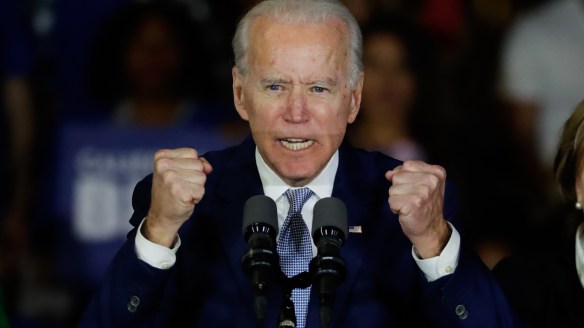
Democratic presidential candidate former Vice President Joe Biden speaks at a primary election night campaign rally Tuesday, March 3, 2020, in Los Angeles. (AP Photo/Chris Carlson)

Super Tuesday has raised the stakes and set the stage for a battle for the Democratic Party’s soul; one that will decide if it stays the course with neoliberalism with Biden or moves towards a progressive social-democratic model with Sanders.

By Alan Macleod

Source: Mint Press News

Former Vice-President Joe Biden built on his victory in South Carolina last week to emerge as the only credible “stop Bernie” candidate after Super Tuesday – where voters in 14 states decided on their nominations for president. While results are still not official, it is clear that the former Delaware senator won the popular vote in at least nine states yesterday, including in Texas, Massachusetts and North Carolina, amassing at least 433 delegates. Sanders has currently secured 388, although that number is likely to rise after all of California is counted.

In one of the most remarkable and drastic political turnarounds in American history, Biden – thought of by many as a yesterday’s man – secured a stunning upset victory after a series of key endorsements. His campaign had been flagging, virtually out of money and without organization or many activists on the ground. As of Monday, he had spent just $1.5 million on TV ads in Super Tuesday states, with aides admitting to CNN their goal was merely to “remain competitive;” a remarkable admission for a presidential campaign.

But facing a Sanders nomination, the establishment wing of the party went into overdrive to find a viable alternative to the Vermont senator. Both Pete Buttigieg and Amy Klobuchar dropped out and immediately endorsed him, as did other figures like former Texas congressman Beto O’Rourke. In a matter of mere hours, the Democratic Party higher-ups managed to coalesce around him in a way the Republicans were unable to in 2016 to stop Trump, proving to the world that the party is certainly not incompetent and can organize and carry out operations with military precision when they perceive it is in their interest to do so.

While the establishment pooled its resources (and delegates) in favor of Biden, Massachusetts senator Elizabeth Warren has refrained from dropping out, let alone endorsing Sanders, thus splitting the progressive vote. Warren finished a distant third in her home state and secured only 28 delegates yesterday. In a defeatist message, her campaign managers said they would hold a meeting to “assess the path forward.”

Biden declared victory in Los Angeles last night, presenting himself as an opponent of the wealthy and a champion of the people: “Let’s get something straight. Wall Street didn’t build this country. You built this country. The middle class built this country. And unions built the middle class,” he told the crowd. But his speech was upstaged by anti-dairy industry protestors who stormed the stage. Earlier in the speech he also confused his wife for his sister.

https://twitter.com/Breaking911/status/1235044512918941698

While it is clear that he will now be the establishment’s candidate for better or worse, the former vice-president has a long history of making egregious errors in speaking. Earlier this week at a rally he tried and failed to recite the preamble of the Declaration of Independence. “We hold these truths to be self evident. All men and women created by the…you know, the thing” he stuttered. And while he promises the working-class “cures for cancer, Alzheimer’s and diabetes” under his presidency, he also told his billionaire backers that he believes they are being “demonized” and that “nothing would change” about America if he were chosen. “I need you very badly,” he told a group of extremely wealthy donors last year.

His policy history and positions, too, might be cause for concern for many voters in the presidential election. These include advocating for cuts to social services, fighting against abortion rights, and supporting NAFTA, the PATRIOT Act and the attacks on Iraq and Libya. And while he retains strong support among Southern black voters, he helped write the 1994 Crime Bill and the Anti-Drug Abuse Bill that exploded the prison population, and fought for segregation and against integration. President Trump has already nicknamed him “Handsy Joe” in reference to his inappropriate touching of women and girls.

While Sanders supporters will be disappointed with the results, other candidates had even worse nights. Chief among them was Michael Bloomberg, who spent more than half a billion dollars on his campaign, picking up just 12 delegates, a third of them in American Samoa. Given his poor performance, that works out to nearly $50 million per delegate. The former Mayor of New York dropped out today, endorsing Biden for the nomination. If he is willing to financially aid Biden anything like how he lavishly spent on himself, Sanders will be fighting a seriously uphill battle.

“It really is a class war we’re up against,” said author and progressive journalist Naomi Klein, who has been traveling with the Sanders team.

The vast majority of this campaign are working class people who are daring to hope for the barest decent things in life. It is this amazing process of raising people’s expectations…What we’re seeing with this establishment pushback, this is not against Bernie Sanders, it is against them. It is against people saying ‘I have a right to healthcare. I have a right to a living wage,’ and it is really sad to see.”

Biden has strong support among the wealthy, the elderly and among Southern black voters. But if he is to win outright and beat Trump in November, he will need to address the age gap in voting. Even in Alabama, where he fared worst, Sanders still comfortably won the vote of those under 30. While there is much work to be done, yesterday was a good day for the establishment wing of the Democratic Party.

Next week will see six more states as well as the Democrats Abroad primaries decided. But Super Tuesday has raised the stakes and set the stage for a battle for the Democratic Party’s soul; one that will decide if it stays the course with neoliberalism with Biden or moves towards a progressive social-democratic model with Sanders.

Data governance and the new frontiers of resistance

The 21st century corporation is using algorithmic-based intelligence to accumulate data on a massive scale. Social movements need to grasp this change quickly.

By Anita Gurumurthy and Nandini Chami

Source: ROAR

Four centuries after the East India Company set the trend for corporate resource extraction, most of the world is now in the grip of unbridled corporate power. But corporate power is on the cusp of achieving “quantum supremacy” and social movements in the digital age need to understand this in order to shift gears in their struggles. The quantum shift here comes from “network-data” power; the ingredients that make up capitalism’s digital age recipe.

Contemporary capitalism is characterized by the accumulation of data-as-capital. Big Tech, as digital companies are collectively known, use the “platform” business model. This model provides a framework for interactions in the marketplace by connecting its many “nodes” — consumers, advertisers, service providers, producers, suppliers and even objects — that comprise the platform ecosystem, constantly harvesting their data and using algorithms to optimize interactions among them as a means to maximize profit.

The platform model emerged as a business proposition in the early 2000s when internet companies offering digital communication services began extracting user data from networked social interactions to generate valuable information for targeted advertising. It is estimated that by 2025, over 30 percent of global economic activity will be mediated by platform companies, an indication of the growing “platformization” of the real economy. In every economic sector, from agriculture to predictive manufacturing, retail commerce and even paid care work, the platform model is now an essential infrastructural layer.

Control over data-based intelligence gives platform owners a unique vantage point — the power to shape the nature of interactions among member nodes. Practices such as Amazon’s segmenting and hyper-targeting of consumers through price manipulation, Uber’s panoptic disciplining of its partner drivers, and TripAdvisor’s popularity ranking algorithm of listed properties, restaurants and hotels are all examples of how such platforms mediate economic transactions. The accumulation of data that feeds algorithmic optimization enables more intensified data extraction, in a self-propelling cycle that culminates in the platform’s totalizing control of entire economic ecosystems.

Amazon for instance, is no longer an online book store, and was perhaps never intended to be. With intimate knowledge about how the market works, Amazon is a market leader in anticipatory logistics and business analytics, providing both fulfillment and on-demand cloud-based computing services to third parties. Not only has it displaced traditional container-freight stations in port cities, it has begun to look increasingly like a shipping company. The dynamics of an intelligence economy have led to large swathes of economic activity being controlled by a handful of platform monopolies.

Studies suggest that in a matter of a couple of decades, platform monopolies have overtaken oil, automobile and financial corporations in market capitalization. Today, platform-based business models account for seven of the world’s top eight companies ranked by market capitalization. The pan-global platform corporation, with its DNA of data-based intelligence, has replaced the trans-national industrial corporation as the Leviathan of our times.

Enter the intelligent corporation

As the dominant form of economic organization in the capitalist world order, the corporation has always wielded power, not just in the market but also in political and socio-cultural realms. The rise of the “intelligent corporation” defined by the political economy of data capital has produced qualitative shifts in the exercise of corporate power, including the following.

From dominating the market to becoming the market

Like its predecessor, the intelligent corporation also aims at complete market domination. In platform-based capitalism, local business models based on intimate contextual knowledge are completely displaced by the data-based intermediation of marketplace and social transactions. It is by eliminating these disparate pockets of capital accumulation that platform owners maximize their profits.

The intelligent corporation also goes a step further, moving beyond “dominating the market” to “becoming the market.” Integrating across business lines, these companies both operate a platform and promote their own goods and services on it. This places them in direct competition with the businesses that use their infrastructure, and creates a conflict of interest. For example, Amazon uses its product marketplace data to consolidate its private labels, launching high-demand products at prices that undercut third-party sellers.

In this new strategy for acquiring market power, long-term market monopolization is privileged over the ability to break-even in the short run. The ecosystem that a platform seeks to capture has room only for one winner with the wherewithal to forgo immediate profits and invest in business integration — through aggressive acquisition — and systematic data-layer development. Other competitors are destined to fall by the wayside.

From cheap labor to freedom from labor

In the capitalist economy, the key contradiction is between capital and labor. Capital is in a perennial quest for freedom from labor through labor-substituting technological advances and territories to shift production to reduce labor costs. In the intelligence economy, capital seems to have come very close to realizing its primordial pursuit.

Using 360° surveillance, the intelligent corporation creates a self-optimizing ecosystem, manipulating each node, expanding its captive network, accumulating data capital and entrenching its dominance. It is able to achieve a global operational footprint with few assets and a minuscule employee base. Think Uber. Uber drivers are not considered to be employees in most places where the company runs its business. With a god’s eye view of the city and its roads, the customers and the driver, Uber takes over city transport, often without owning a single taxi. Passing off the liability to the driver, who must take a high-interest loan to acquire a vehicle to become Uber’s coveted “partner,” the corporation extracts from the driver more than just labor time.

In traditional labor-intensive manufacturing and services sectors, data capital is slowly but surely affecting far-reaching transformation. Projections show that automation based on artificial intelligence (AI) will eventually displace labor. It is estimated that over 40 percent of the global workforce will lose their jobs in AI-led disruption of manufacturing over the next 15–25 years. A limited number of high-paying jobs may open up for individuals with advanced skills in the development of data and AI technologies. But most of the labor force will end up in low-paid, personalized service work.

For countries in the Global South, the challenge will be especially pernicious. As rising wages erode the comparative advantage of labor in these economies, the shift to AI technology is likely to trigger a re-shoring trend whereby factories are relocated to richer countries that offer more sophisticated infrastructural support for deployment of AI systems. According to the World Bank, over two-thirds of the workforce in developing countries are likely to lose jobs. It is not clear how these changes will shift gender-based segmentation and gender hierarchies in labor markets. However, going by current trends, women seem to be the first to lose their jobs in this transition, with a reversal of both pay and status gains.

Planetary-scale time-space enclosure

Capturing previously non-commodified time and place has always been a central strategy of capitalist expansion. In the intelligence economy, we are witnessing a new phase of such “primitive accumulation” – through “data dispossession.” The expropriation of data from everyday social exchanges through the platform business model is comparable to the expropriation of natural resources for capitalist production in a previous age. The pervasive data extraction by platform companies has transformed data-mined social interaction into a factor of production, just as invaluable a resource as land for the creation of goods and services. The centralization of wealth and power today, derives from an unprecedented quality and scale of dispossession.

The dynamic of data dispossession is self-propelling. It is now well understood that platforms aggressively pursue a strategy of locking-in users, offering instant gratification in exchange for data and making it costly for them to leave a platform. The Chinese “super-platforms” WeChat and Meituan-Dianping combine news, entertainment, restaurant reviews, food delivery and ride-hailing, along with cross-cutting applications such as payment systems and digital wallets, demonstrating a “stickiness” that is almost addictive.

When participation in the platform on the platform owner’s terms becomes de facto the only choice for economic actors, data extractivism is normalized. Similar to the predatory practices of historical colonialism, the platform tactics of the intelligent corporation function as a neo-colonial project. The difference is that this time around, rather than European companies, the US and Chinese platform companies are in the driving seat.

A profoundly unsustainable exploitation of the natural world accompanies the rapid inroads of the intelligent corporation. Take the case of the vast ecological footprint of the online food-delivery sector. According to a 2018 study published in the science journal Resources, Conservation and Recycling, door-to-door fast-food delivery in China accounted for a nearly eightfold jump in packaging waste between 2015 and 2017, from 0.2 to 1.5 million tonnes. This has coincided with the exponential growth of the sector in the country, where the number of customers using food-delivery platforms has gone up from zero in 2009 to 406 million by the end of 2018! The intelligence economy is a veritable resource guzzler whose network data devices are expected to be consuming about one-fifth of global electricity by 2030 just to keep going.

The loss of self-determination for individuals and communities in these new intelligence-based modes of production reflects an asymmetry in power that was previously impossible. This is the route through which the brand-new corporation colonizes bodies and nature, takes control of production and social reproduction, and intensifies accumulation on a global scale.

The “deep corporate” and the death of the social contract

It is no secret that in the digital era, the deep state has had a makeover. Edward Snowden’s revelations and witness testimonies from China’s Uighur-dominated Xinjiang have exposed the dark workings of the contemporary military–industrial complex, the unholy nexus between Big Tech and the state. Trade justice activists have constantly pointed to the “hidden hand” of Silicon Valley and Chinese corporations using their governments to bat for their interests, reducing policy decisions to executive fiats for entrenching their power.

But what is only recently coming to light is the rise of the “deep corporate” — the extension of the Kraken-like tentacles of intelligent corporations into the heart of public life. The subsuming of social life by platform capitalism has distorted the political space thanks to the echo chambers of the automated public sphere. The contagion of mispropaganda and informational warfare in political campaigning has become impossible to contain in a public sphere determined by algorithmic filters. In this scenario, deliberative democracy itself is under the threat of extinction.

The social credit system being developed by China in partnership with eight tech companies takes the “corporatization” of governance to a whole new level. Access to benefits and citizens’ guaranteed rights are now predicated on behavioral scoring on the basis of online purchase history, financial transactions and social media connections on the partnering platforms. With the archetypal “good consumer” becoming the deserving citizen, citizenship is thus dislocated from political claims. The “deep corporate” acquires the formal authority to mediate the social contract.

Living with the intelligent corporation

We are living through a phase in capitalism that is marked by extreme market concentration, unprecedented inequality in wealth and the declining share of labor in global income; a state of affairs that has led even the IMF to express caution. It is no coincidence that this period of intensified economic injustice has coincided with the rise of platform capitalism and its real-world vehicle, the intelligent corporation.

What does living with the intelligent corporation mean?

What is new about this phase of capitalism that has spawned the intelligence economy is a deeply qualitative shift. Datafication and data capital transform the way capitalist “accumulation by dispossession” happens. “Intelligencification” makes plausible a planetary-scale colonization and commodification of everyday life by the new corporation in ways previously impossible. Both nature and caring bodies are trapped in a planetary enclosure insofar as everything and everybody can be turned into data.

It also feeds off and emboldens the financialization apparatus that runs the neoliberal economy. Through the perverse confluence of data and finance, the intelligent corporation universalizes and naturalizes its authority, destroying the marketplace of things and ideas.

Through data extractivism, the intelligent corporation ravages sociality, taking the ideological project of neoliberalism all the way to the expropriation of the political. This is a deep take-over, an “ontological encroachment” of human subjectivity.

Where does all this leave us?

As UNCTAD has highlighted, the pace of concentration of market power is extremely worrying. Consider this: Amazon’s profits-to-sales ratio increased from 10 percent in 2005 to 23 percent in 2015, while that of Alibaba increased in just four years from 10 percent in 2011 to 32 percent in 2015.

Policymakers across the world are struggling to reform their legacy laws to rein in the intelligent corporation. Even the domestic governments of powerful US and Chinese platform corporations are struggling to contain their excesses. The US Federal Trade Commission (FTC) is currently investigating Amazon and Facebook for abuse of market dominance while the US Justice Department is probing Google. The state of California is facing massive resistance from Uber and Lyft to its new regulation for labor rights of “gig” workers, with the two companies currently leading a $60 billion ballot initiative to extricate themselves from employer’s liability. In November 2019, the state administration for market regulation in China had to hold a meeting with Alibaba and other online retail platforms about their strong-arming of third-party vendors, in violation of existing regulations to curb anti-competitive conduct.

The loopholes of pre-digital taxation laws based on a physical presence in a given country have been effectively exploited by platform companies to escape tax liability, through profit shifting to low-tax jurisdictions. Similarly, when faced with liability for unfair market practices in overseas markets, it is very easy for platform companies to shift liability to their parent company outside the jurisdiction. For instance, Uber in South Africa resorted to the defense that its partner drivers were employees of the parent company headquartered in the Netherlands and not the South African subsidiary, in order to evade its liabilities under existing labor laws. The lack of binding international regulations governing cross-border data flows has also aided rampant data extractivism,

More recently, in the wake of malpractice lawsuits brought against Big Tech by their own employees; exposes about founding CEOs who have enjoyed a godly status; and public disenchantment with multiple revelations of clandestine data mining and algorithmic gaming, the early sheen seems to be wearing off. Google’s parent company Alphabet can no longer use its “Do the right thing” motto without irony. Facebook has been forced to switch to the “too big to fail” defense from the “protector and defender of the freedoms of the global community” line. Alibaba may not be able to proclaim its commitment to the development of small and medium enterprises in Africa for much longer. The façade has crumbled. And this rupture in the discursive hegemony of the intelligent corporation in which we are currently situated is the right moment to mount a collective challenge.

So, resist we must, so that the wealth of data and of networks can be appropriated and used to create a just and humane society. This means taking the intelligent corporation by the horns, and forging a movement that is able to grapple with the ethical–political boundaries of digital intelligence.

Taming the Leviathan and reclaiming the planet

Given the enormous economic and political clout of the modern corporation in the age of data, unshackling people and the planet from corporate power is an urgent task. Struggles against the extreme unfairness of the global trade and intellectual property regime by transnational social movements have shown the necessary connection between the agenda for development justice and the dismantling of corporate power.

Building alliances among movements has become a vital strategy in halting TNCs’ inexorable plunder. The trade justice movement against corporate globalization, the environment movement’s quest for sustainable development, feminist struggles to reclaim the body and the sphere of social reproduction from capital and workers’ struggle against the intensified squeeze on labor and the dismantling of social protection in neoliberal globalization are inspiring examples in this regard. Transnational civil society has painstakingly built alliances and solidarities across these movements to expose corporate excess, bringing pressure on the UN for a global binding treaty on TNCs’ human rights obligations in the face of near-insurmountable odds.

In the digital age, as corporate power assumes indomitable proportions — with tech CEOs carving out data dominions that they rule over — current frameworks of power analysis and action may not go very far. A concerted and coherent strategy is urgently needed in order to enable a more equitable distribution of the gains of data-based intelligence. The Digital Justice Manifesto released in November 2019 by the Just Net Coalition — through a process of strategic and sustained dialogue between digital rights, trade justice, feminist, environmental, labor and human rights groups and activists — outlines such a roadmap. As the Manifesto underlines, we need immediate action along three broad fronts to reclaim digital power from the intelligent corporation:

(a) Wrestling back ownership of our personal and collective data and intelligence by instituting an economic rights framework for data resources.

(b) Governing critical platform infrastructures as public utilities.

(c) Enforcing a local-to-global governance model for digital and data infrastructure that supports local economies and democratic self-determination of collectivities, preventing the enclosure of entire market and social ecosystems by a centralized intelligence. In other words, the governance of tech infrastructure must enable the flourishing of disparate local economies and make room for multiple platform models to function — co-operatives, social enterprises, public etc. — challenging the totalizing impetus of global intelligence capitalism.

Neoliberal globalization and financialization have led to profoundly unequal societies. The impunity of the TNC has been central to this dynamic. Social movements have placed several creative proposals to counter this: mandating charter renewal every five years overturning the principle of corporations’ perpetual legal existence; taxing stock trade on the basis of the holding period to contain excessive financial speculation; placing a cap on the individual assets of founders/CEOs and so on.

“Intelligencification” demands a new frontier for resistance. The power of the intelligent corporation must be contained through tactics small and big in political and cultural realms. A new wisdom about the governance of data must be explored for a truly emancipatory future for all.

Subcomandante Bloomberg

By CJ Hopkins

Source: Consent Factory, Inc.

Break out the pussyhats and vuvuzelas, folks, because the neoliberal Resistance is back, and this time they’re not playing around. No more impeachments and investigations. It’s time to go mano-a-mano with Trump, and they’ve finally got just the bad hombre to do it. No, not Bernie Sanders, you commies. A battle-hardened Resistance fighter. El Caballo Pequeño! El Jefe Mínimo! Subcomandante Michael Bloomberg!

Yes, that’s right, Michael Bloomberg, multi-billionaire Republicrat oligarch, has mobilized a guerilla army of overpaid PR professionals, Wall Street sociopaths, liberal racists, and anti-outdoor-smoking fanatics, and is steamrolling toward the Democratic convention to buy a brokered nomination and save America from “Putinism.” He’s had it with you sugary-soft-drink-drinking, chain-smoking, gun-toting, Oxy-gobbling, Hitler-loving, Putinist peasants and your infatuation with Donald Trump. So he’s decided to transform the entire country into a sterile, upscale, fascist themepark where you can rent a studio for $3,000 a month and the cops keep “the darkies” in their place, like he successfully did to New York City.

Although his campaign seemed to come out of nowhere (and sort of resembles a desperate attempt to prevent a Bernie Sanders nomination), the Resistance have been planning this corporatist Tet Offensive for quite some time. Apparently, Subcomandante Bloomberg and his inner circle of sub-subcomandantes have been hiding out deep in the mountainous jungles of Manhattan’s affluent Upper East Side (or in the Hamptons, or London, or in one of El Jefe’s other multi-million-dollar homes) since Trump and the Russians invaded the country, waiting for the perfect moment to start inundating the American people with television commercials and social media posts informing them of his “electability.”

Clearly, that moment has now arrived.

Bloomberg has spent over $400 million on TV, radio, and digital ads, and it isn’t even Super Tuesday yet. He bought the Democratic National Committee and had them change the rules so he could join the debates (which, based on his poor performance in Las Vegas, might not have been the most brilliant strategy). He has been buying politicians, community organizers, journalists, pundits, his opponents’ campaign staff, Instagram and Facebook influencers, and everyone else he can possibly buy to support his campaign to buy the presidency … which is totally legal, and the American way, and is our only hope of overthrowing the Putin-Nazi Occupation Government and regaining our God-given capitalist freedom!

Sure, to some folks, it looks … well, unseemly (not to mention decidedly undemocratic), this Wall Street oligarch attempting to bribe and bully his way into the White House, but, given the stakes, what choice do we have? As the corporate media and intelligence agencies have been telling us for the last three years, the country is under occupation by an evil conspiracy of Russian-backed Nazis personally controlled by Vladimir Putin! More or less any moment now, Putin is going to order Trump to nullify the U.S. Constitution, declare martial law, appoint himself Führer, and start rounding up and murdering the Jews … or investigating Hunter Biden, or the spooks who have been trying to force him out of office.

This Putin-Nazism cannot continue! Trump must be deposed, no matter the cost. As Robert Reich put it in this piece in The Guardian:

“If the only way we can get rid of the sociopathic tyrant named Trump is with an oligarch named Bloomberg, we will have to choose the oligarch.”

There you have it, folks. We’ll have to choose Bloomberg, or else his golf buddy, Literal Hitler, will destroy the fabric of democracy, or whatever.

Another op-ed in The Washington PostIt Might Be Time to Take Bloomberg Seriously, wondered, if it comes down to Bloomberg versus Bernie:

“Do you choose socialism or capitalism? An ideologue or an executive? Are you really going to ask Americans to trade one extreme for the other, or do you want to offer them a certified, electable moderate?”

Vox, in its “Case for Michael Bloomberg — Mike Bloomberg and His Billions Are What Democrats Need to Beat Trump,” observes that, sure, Bloomberg has drawbacks, like his history of racist remarks and policies, abusing women, oppressing the poor, and just generally being an arrogant little authoritarian corporatist creep, but hey, he’s apologized for all that stuff, and he’ll probably never do it again.

Plus, according to this piece in …uh, Bloomberg Opinion (which “does not necessarily reflect the views and opinions of Bloomberg LP and its owners”), The 2020 Election Is a Choice Between Democracy and Putinism! At the end of the day, once the dust has settled:

“It will come down to rule of law. In November, Americans will decide whether they will fight for the foundation of liberal democracy and democratic capitalism or whether they will accede to Putinism.”

You’ll be hearing variations of this message over and over, and over again, as we approach election day in November … that is, assuming Bloomberg and the rest of the Resistance can buy, bribe, badger, and bamboozle enough Democratic voters into nominating him. First, they need to deal with Bernie Sanders and his swarm of kill-crazy commie terrorists (who rumor has it are also being remotely controlled by Vladimir Putin). To do this, all they will need to do is deny Sanders a first ballot win in Milwaukee, which shouldn’t be too hard to accomplish. Sure, a brokered convention will be ugly, but, as Robert Reich said, they’ll have to do it, or else … well, you know, end of democracy.

Yes, I’m aware that Subcomandante Bloomberg blew his first debate (prompting Twitter pundits to pronounce him DOA) and that millions of “progressive” Democrats hate him, and that the corporate media are running a lot of “Bloomberg’s Nasty Past” pieces now (in order to maintain the appearance of journalism), but, make no mistake, if he secures the nomination, they’ll be lining up to “reluctantly” endorse him, because the alternative will be Russian Hitler!

Look, it’s easy to get distracted by the day-to-day ups and downs of the horse race (which is the primary purpose of the horse race, after all) and forget that we are in the middle of a global capitalist War on Populism … a war that GloboCap intends to win. Sure, they will survive another four years of Trump (or even four years of Sanders if they have to), but, at some point, in order to restore “normality,” or “democratic capitalism,” or whatever, they are probably going to need to stop dicking around and install a bona fide global capitalist oligarch in the Oval Office. They are going to need to do this in order to crush the hopes of the populist insurgency that erupted in the Spring of 2016, and led to the rise of Donald Trump, Bernie Sanders, Jeremy Corbyn, the Brexit, the ongoing protests in France, the downfall of Angela Merkel, etc.

Another Obama is not going to cut it … people aren’t buying that con anymore. No, if the empire is going to reestablish control, it is going to need to take its liberal mask off, and shove a blatant corporatist oligarch like Bloomberg down the public’s throat in order to remind everyone who’s boss. It may not be Michael Bloomberg this time, but it is going to be someone like Bloomberg eventually. Someone powerful, and extremely unpleasant, who will be sold to us as the only one who can save the world from the “Nazis” and the “Russians” … which will necessitate taking some very extreme measures, like the ones we took during the War on Terror. You remember the measures we took back then, don’t you?

Or what, you think that GloboCap has been manufacturing all this mass hysteria over “Russian election interference” and “Nazi terrorism” for their own amusement? Yeah, that’s probably all it is. It’s probably not a prelude to anything.