Government to Facebook Pipeline Reveals a Corrupt Mix of Social Media and the State

The next time someone tells you that “Facebook is a private company” ask them if they know about the dozens of government employees who fill its ranks.

By Matt Agorist

Source: The Free Thought Project

As the Free Thought Project has previously reported, the phrase “Facebook is a private company” is not accurate as they have formed a partnership with an insidious neoconservative “think tank” known as the Atlantic Council which is directly funded and made up of groups tied to the pharmaceutical industry, the military industrial complex, and even government itself. The Atlantic Council dictates to Facebook who is allowed on the platform and who is purged.

Because the Atlantic Council is funded in part by the United States government—and they are making decisions for Facebook—this negates the claim that the company is private. Since our six million followers and years of hard work were wiped off the platform during the October purge, TFTP has consistently reported on the Atlantic Council and their ties to the social media giant. This week, however, we’ve discovered something just as ominous—the government to Facebook pipeline and revolving door.

It is a telltale sign of a corrupt industry or company when they create a revolving door between themselves and the state. Just like Monsanto has former employees on the Supreme Court and Pharmaceutical industry insiders move back and fourth from the FDA to their companies, we found that Facebook is doing the same thing.

Below are just a few of corrupt connections we’ve discovered while digging through the list of current and former employees within Facebook.

Facebook’s Head of Cybersecurity Policy—aka, the man who doles out the ban hammer to anyone he wishes—is Nathaniel Gleicher. Before Gleicher was censoring people at Facebook, he prosecuted cybercrime at the U.S. Department of Justice, and served as Director for Cybersecurity Policy at the National Security Council (NSC) in the Obama White House.

While Facebook may have an interest in seeking out Gleicher’s expertise, this man is an outspoken advocate of tyranny.

After deleting the pages of hundreds of antiwar and pro-peace media and activist outlets in October, last month, Facebook made another giant move to silence. This time, they had no problem noting that they went after pages whose specific missions were “anti-corruption” or “protest” movements. And it was all headed up by Gleicher.

“Some of the Pages frequently posted about topics like anti-NATO sentiment, protest movements, and anti-corruption,” Gleicher wrote in a blog post. “We are constantly working to detect and stop this type of activity because we don’t want our services to be used to manipulate people.”

Seems totally legit, right?

The list goes on.

In 2017, as the Russian/Trump propaganda ramped up, Facebook hired Joel Benenson, a former top adviser to President Barack Obama and the chief strategist for Hillary Clinton’s failed 2016 presidential campaign, as a consultant.

While filling team Zuck with Obama and Clinton advisers, Facebook hired Aneesh Raman, a former Obama speechwriter who now heads up Facebook’s “economic impact programming.”

Highlighting the revolving door aspect of Facebook and the US government is Sarah Feinberg who left the Obama train in 2011 to join Facebook as the director of corporate and strategic communications. She then moved on after and went back to Obama in 2015 to act as the administrator of the Federal Railroad Administration (FRA).

David Recordon also highlights the revolving door between Facebook and the government. Recordon was the former Director of IT for Obama’s White House. He was also Engineering Director at Facebook prior to his role at the White House, and returned to the position after the 2016 election. He is currently Engineering Director for the Chan-Zuckerberg initiative.

Starting to see a pattern of political influence here? You should. But just in case you don’t, the list goes on.

Meredith Carden—who, you guessed, came from the Obama administration — joined the Facebook clan last year to be a part of Facebook’s “News Integrity Team.” Now, she’s battling fake news on the platform and as we’ve shown, there is a ridiculous amount of selective enforcement of these so-called “standards.”

In fact, there are dozens of former Obama staffers, advisers, and campaign associates who quite literally fill Facebook’s ranks. It is no wonder the platform has taken such a political shift over the past few years. David Ploufe, Josh W. Higgins, Lauryn Ogbechie, Danielle Cwirko-GodyckiSarah Pollack, Ben Forer, Bonnie Calvin, and Juliane Sun, are just some of the many Facebook execs hailing out of the Obama era White House.

But fret not right wingers, Facebook likes their neocons too.

Jamie Fly, who was a top adviser to neocon Florida Senator Marco Rubio and who started his career in US political circles as an adviser to the George W. Bush administration, actually took credit for the massive purge of peaceful antiwar pages that took place last October.

“They can invent stories that get repeated and spread through different sites. So we are just starting to push back. Just this last week Facebook began starting to take down sites. So this is just the beginning,” Fly said in December.

Fly backs up his words with the fact that he works with Facebook’s arm of the Atlantic Council to ensure those dangerous antiwar folks don’t keep pushing their propaganda of peace and community.

And yes, this list goes on.

Joel David Kaplan is Facebook’s vice president of global public policy. Prior to his major role within Facebook, Kaplan took the place of neocon extraordinaire Karl Rove as the White House Deputy Chief of Staff for George W. Bush. Before that, from 2001 to 2003 he was Special Assistant to the President for Policy within the White House Chief of Staff’s office. Then he served as Deputy Director of the Office of Management And Budget (OMB).

Myriah Jordan was a special policy assistant in the Bush White House, who was hired on as a policy manager for Facebook’s congressional relations team—aka, a lobbyist. Jordan has moved back and forth between the private sector and the US government multiple times over his career as he’s made millions greasing the skids of the state for his corrupt employers.

So there you have it. Facebook, who claims to be a private entity, is quite literally made up of and advised by dozens of members of government. We’re ready for a change, are you?

Facebook Wants You to Know if You’re Getting Your News From the Wrong Government

By Jim Naureckas

Source: FAIR

There’s a famous polling experiment that asked people in the Cold War-era US:

Do you think the United States should let Communist newspaper reporters from other countries come in here and send back to their papers the news as they see it?

When this question was posed on its own, only 36 percent of respondents said yes. But a separate sample was first asked:

Do you think a Communist country like Russia should let American newspaper reporters come in and send back to America the news as they see it?

When the questions were asked together—reminding people that restrictions on press freedom could be placed on their own country’s journalists, as well as on those of an official enemy—support for allowing access to Communist reporters doubled to 73 percent. (Ninety percent said that US reporters should be allowed to report freely from Russia—suggesting that only a relatively narrow slice of the population openly subscribed to the principle of free speech for me but not for thee.)

I thought of this experiment when Rania Khalek (who’s written for FAIR) told me that the viral video company she works for, In the Now, was taken off Facebook because of its indirect connection to the Russian government. (A majority stake in In the Now’s parent company, Maffick Media, is owned by a subsidiary of RT—a Moscow-based media group that, although organized as a private entity, is funded by the Russian government.)

Facebook suspended the page of In the Now, along with three other pages run by Maffick—the current affairs channel Soapbox, the environment-oriented Waste-Ed and the history-focused BackThen—after the social media giant was asked about the RT-connected pages by CNN. CNN (2/18/19), in turn, reported it was tipped off to the In the Now/RT connection by the Alliance for Securing Democracy, a group based at US government–funded German Marshall Fund.

In the Now is back on Facebook again—after a ten-day suspension—and returned with this rather user-unfriendly description:

In the Now is a brand of Maffick which is owned and operated by Anissa Naouai and Ruptly GmbH, a subsidiary of RT.

That’s not particularly helpful if you want to know what In the Now does, of course, but disclosure is good, right? For the goose but not the gander, apparently: Among the US-funded institutions with Facebook pages are, well, the German Marshall Fund. Its description just reads, “Strengthening Transatlantic Cooperation.” Will that page be taken down until the Fund acknowledges where its money comes from?

How about the PBS NewsHour, also funded by the US government? No mention of that on Facebook: Just, “On air and online, the PBS NewsHour provides in-depth analysis of the issues that matter to you.”

NPR’s Facebook page seems to go out of its way to conceal the fact that it’s US government–supported, calling itself “a privately supported, not-for-profit membership organization.” Maybe the P stands for “Private”?

Even straightforward propaganda outlets of the US government don’t have to identify themselves as such on Facebook. Take Radio Free Europe/Radio Liberty, set up at the height of the Cold War to broadcast the US government’s version of reality behind the Iron Curtain—and still going strong almost 70 years later. Its “About” on Facebook reads:

Uncensored news. Responsible and open debate. Specialized coverage of Russia, Ukraine, Central Asia, Caucasus, Iran, Balkans, South Asia, Eastern Europe.

For those who go the extra mile and click on “See More” under “Who We Are,” you do get this misleading semi-acknowledgement:

RFE/RL is registered with the IRS as a private, nonprofit Sec. 501(c)3 corporation, and is funded by a grant from the US Congress through the United States Agency for Global Media (USAGM) as a private grantee. RFE/RL‘s editorial independence is protected by US law.

Yes, RFE/RL is organized as a private entity—just like RT is. But just as the head of RT is also the head of the Russian state international news agency, the head of RFE/RL is appointed by the head of the USAGM—a government official picked by the president. That’s a funny kind of “independence.”

The Facebook page of Voice of America, the US government’s main broadcast outlet, is even squirrelier. There doesn’t seem to be any acknowledgement at all that VoA is connected to the US government—just the slogan, “The news may be good or bad. We shall tell you the truth”; the claim that it has “the world’s most interesting stories”; and information on how you can “have the best of VoA News delivered directly to your inbox each day.”

If you’re thinking that Facebook—90 percent of whose customers are not in the United States—should treat Russian-backed outlets differently than US-backed outlets because the US supports peace and democracy, or doesn’t use social media to try to manipulate other nations…. Well, this is why it’s important to get your information from a variety of sources.

But it’s not just US outlets that get to conceal their government funding on Facebook. The BBC doesn’t mention that it’s controlled and funded by the British government—only that its “mission is to enrich your life. To inform, educate and entertain.”

At Al Jazeera English’s Facebook page, you learn, “We are the voice of the voiceless”—not that they are owned by the monarchy of Qatar.

Facebook needs to have one rule for whether government-funded outlets need to disclose their connections. And it needs to apply that rule consistently.


Cyberpunk is Now and No One Knows What to Do With It

By Pattern Theory

Source: Modern Mythology

Cyberpunk broke science fiction. Creeping in alongside the commercialization of the internet, it extrapolated the corruption and dysfunction of its present into a brutal and interconnected future that remained just a heartbeat away. Cyberpunk had an attitude that refused to be tamed, dressed in a style without comparison. Its resurgence shows that little has changed since its inception, and that’s left cyberpunk incapable of discussing our future.

Ghost in the Shell got the live-action treatment in 2017, a problematic remakeof the 1995 adaptation. Some praised its art direction for increasing the visual fidelity of retrofuture anime cityscapes, but the general consensus was that the story failed to apply care and consideration towards human brains and synthetic bodies like Mamoru Oshii had more than two decades before. A few months later came Blade Runner 2049, a sequel to the cyberpunk classic. Critics and fans praised it for high production values, sincere artistic effort, and meticulous direction. Yet something had gone wrong. Director Denis Villeneuve couldn’t shake the feeling that he was making a period movie, not one about the future.

Enough has changed since the 1980s that cyberpunk needs reinvention. New aesthetics. An expanded vocabulary. Code 46 managed this years ago. It rejects a fetish for all things Japanese and embraces China’s economic dominance. Conversations being in English and are soon peppered with Mandarin and Spanish. Life takes place at night to avoid dangerous, unfiltered sunlight. Corporations guide government decisions. Genetics determine freedom of movement and interaction. Climate refugees beg to leave their freeway pastures for the safety of cities.

Code 46 is cyberpunk as seen from 2003, a logical future that is now also outdated.

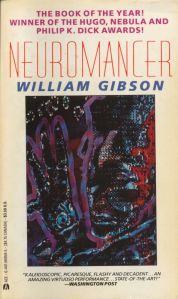
If Blade Runner established the look, Neuromancer defined cyberpunk’s voice. William Gibson’s debut novel was ahead of the curve by acknowledging the personal computer as a disruptive force when the Cold War was at its most threatening. “Lowlife and high tech” meant the Magnetic Dog Sisters headlining some creep joint across the street from a capsule hotel where console cowboys rip off zaibatsus with their Ono Sendai Cyberdeck. But Gibson’s view of the future would be incomplete without an absolute distrust of Reaganism:

“If I were to put together a truly essential thank-you list for the people who most made it possible for me to write my first six novels, I’d have to owe as much to Ronald Reagan as to Bill Gates or Lou Reed. Reagan’s presidency put the grit in my dystopia. His presidency was the fresh kitty litter I spread for utterly crucial traction on the icey driveway of uncharted futurity. His smile was the nightmare in my back pocket.” — William Gibson

“Fragments of a Hologram Rose” to Mona Lisa Overdrive is a decade of creative labor that was “tired of America-as-the-future, the world as a white monoculture.” The Sprawl is a cyberpunk trilogy where military superpowers failed and technology gave Japan leadership of the global village. Then Gibson wrote Virtual Light and readers witnessed extreme inequality shove the middle class into the gig economy as corporations schemed to profit off natural disasters with proprietary technology.

Gibson knew the sci-fi he didn’t care for would absorb cyberpunk and tame its “dissident influence”, so the genre could remain unchanged. “Punk” is the go-to suffix for emerging subgenres that want to appear subversive while posing a threat to nothing and no one. It’s how “hopepunk” becomes a thing. But to appreciate cyberpunk’s assimilation, look at how it’s presented sincerely.

CD Projekt Red (CDPR), known for the Witcher game series, has spent six years developing what’s arguably the most anticipated video game of the moment, Cyberpunk 2077. Like Gibson, Mike Pondsmith, creator the original “pen-n-paper” RPG, and collaborator on this adaptation of his work, has had his writing absorbed by mainstream sci-fi. CDPR could survive on that 31-year legacy, but they insist they’re taking their time with Cyberpunk 2077 to craft an experience with a distinct political identity that somehow allows players to remain apolitical. In a way this is reflective of CDPR’s reputation as a quality-driven business that’s pro-consumer, but has driven talent away by demanding they work excessive hours and promoting a hostile attitude towards unions. This crunch culture is a problem across the industry.

We’ll soon see how Cyberpunk 2077 developed. What we can infer from its design choices, like giving protagonist V a high-collar jacket seen on the cover of the 2nd edition game book from 1990, is that Cybperpunk 2077 will be familiar. Altered Carbon and Ready Player One share this problem. Altered Carbon is so derivative of first-wave cyberpunk it’s easy to forget its based on a novel from 2002. Ready Player One at least has the courtesy to be shameless in its love of pop culture, proud to proclaim that nothing is more celebrated today than our participation in media franchises without ever considering how that might be a problem.

What’s being suggested, intentionally or not, is that contemporary reality has avoided the machinations of the powerful at a time when technology is wondrous, amusing, and prolific. If only we were so lucky.

238 cities spent more than a year lobbying Amazon, one of two $1 trillion corporations in existence, for privilege of hosting their new office. In November it was announced that Amazon would expand to Crystal City, Virginia and Long Island City, Queens. Plenty of New Yorkers are incensedthat the world’s largest online marketplace will get $3 billion in subsidies, tax breaks, and grants to further disrupt a housing market that takes more from them than any city should allow. Some Amazon employees were so excited to relocate they made down payments on their new homes before the decision went public, telling real estate developers to get this corner of New York readyfor a few thousand transplants. But what of the people already there?

Long Island City is home to the Queensbridge Houses, the largest housing project in the US. Built in 1939, these two buildings are home to more then 6,000 people with an average income of $16,000. That’s far below the $54,000 for Queens residents overall. But neither group is anywhere near the average salary for the 25,000 employees Amazon will bring with them, which will exceed $150,000. How many of those positions will be filled by locals? How many will come from Queensbridge?

Over 800 languages are spoken in Queens, making it the most linguistically diverse place in the world. Those diverse speakers spend over 30% of their income on rent. They risk being priced out of their neighborhoods. Some will be forced out of the city. Has Governor Cuomo considered the threat this deal poses to people’s homes? Has Mayor de Blasio prepared for the inevitable drift to other boroughs once property values spike? Looking at Seattle and San Francisco, there’s no reason to expect local governments to be proactive. So New Yorkers have taken up the fight on their own.

Amazon boss Jeff Bezos toyed with these politicians. He floated the idea that any city could become the next Silicon Valley and they believed him. They begged for his recognition, handed over citizen data, and took part in the $100 billion ritual of subsidizing tech companies.

It was all for nothing. Crystal City is a 20-minute drive from Bezos’ house in Washington DC, where Amazon continues to increase its spending on lobbyists. That’ll seem like a long commute compared to the helicopter ride from Long Island City, the helipad for which is subsidized by the city, to Manhattan, the financial and advertising capital of the world, where Bezos owns four more houses.

The auction for Bezos’ favor was a farce. New York and Virginia give him regular access to people with decision-making power, invaluable data, and institutions that are are sure to expand his empire. These cities were always the only serious options.

Amazon’s plans read like the start of a corporate republic, a cyberpunk trope inspired by company towns. Employers were landlords, retailers, and even moral authorities to workforces too in debt to quit. Many had law enforcement and militias to call on in addition to the private security companies they hired to break labor strikes, investigate attempts at unionization, and maintain a sense of order that resulted in massacres like Ludlow, Colorado.

Amazon is known for labor abuses, monitoring, and tracking speed and efficiency in warehouses without bathroom breaks, where employees have collapsed from heat exhaustion. They sell unregulated facial recognition services to police departments, knowing it misidentifies subjects because of inherent design bias. Companies with a history of privacy abuses have unfettered access to their security devices. They control about half of all e-commerce in the US and, as Gizmodo’s Kashmir Hill found out, it is impossible to live our lives without encountering Amazon Web Services.

It doesn’t take a creative mind to imagine similar exposition being attributed to corporate villains like Cayman Global or Tai Yong Medical.

Rewarding corporations for their bad behavior is just one way the world resembles a fictive dystopia. We also have to face rapid ecological and institutional decay that fractionally adjusts our confidence in stability, feeding a persistent situational anxiety. That should make for broader and bolder conversations about the future, and a few artists have managed to do that.

Keiichi Matsuda is the designer and director behind Hyper-Reality, a short film that portrays augmented reality as a fever dream that influences consumption, and shows how freeing and frightening it is to be cut off from that network. Matsuda’s short film got him an invitation to the World Economic Forum in Davos to “speak truth to power.” What Matsuda witnessed were executives and billionaires pledging responsibility with t-shirts and sustainability, while simultaneously destroying the environment, as an audience of their peers and the press nodded and applauded “this brazen hypocrisy.” So Matsuda took a stanchion to his own installation.

Independence means Matsuda gets to decide how to talk about technology and capitalism, and how to separate his art and business. It also means smaller audiences and fewer productions.

Sam Esmail used a more visible platform to “bring cyberpunk to TV” with Mr. Robot. Like Gibson’s Pattern Recognition, it’s cyberpunk retooled for the present — post-cyberpunk. Esmail never hesitates to place our villains in Mr. Robot. Enron is an influence on logo designs and tactics of evil corps. Google, Verizon, and Facebook are called out for their complicity with the federal government in exposing customer data. AT&T’s Long Lines building, an NSA listening post since the 1970s, plays the role of a corporate data hub that reaches across the county. Even filming locations serve as commentary.

An anti-capitalist slant runs through Mr. Robot, exposing the American dream as a lie and our concept of meritocracy as a tool to protect the oligarchy, presenting hackers as in direct contact with a world of self-isolation and exploitation, those who dare to hope for a future affected by people rather than commerce. And Esmail somehow manages this without interference from NBC.

Blade Runner will get more life as an animeCowboy Bebop is joining Battle Angel Alita in live action. Altered Carbon is in the process of slipping into a new sleeve. There’s no shortage of revivals, remakes, and rehashing of cyberpunk’s past on the way. They’ll get bigger audiences than a short film about submitting to algorithms. More sites will discuss their pros and cons than a mobile tie-in that name-drops Peter Kropotkin and Maria Nikiforova. But in being descriptive and prescriptive, moving to the future and looking for sure footing in the accelerated present, Matsuda’s and Esmail’s work reminds us that cyberpunk needs to be more than just repeating what’s already been said about yuppies, Billy Idol, and the Apple IIc.

We live at a time where 3D printing is so accessible refugees can obtain prosthesis as part of basic aid. People forced to migrate because of an iceless arctic will rely on that assistance. Or we could lower temperatures and slow climate change by spraying the atmosphere with sulfate, an option that might disrupt advertising in low-orbit. Social credit systems are bringing oppressive governments together. Going cashless is altering our expectations of others. Young people earn so little they’re leveraging nude selfies to extend meager lines of credit. Productivity and constant notifications are enough to drive some into a locked room, away from anything with an internet connection. Deepfakes deny women privacy, compromise their identity, and obliterate any sense of safety in exchange for porn. Online communities are refining that same technology, making false video convincing, threatening our sense of reality. Researchers can keep our memories alive in chat bots distilled from social media, but the rich will outlive us all by transfusing bags of teenage blood purchased through PayPal.

In a world that increasingly feels like science fiction it’s important to remind ourselves that writing about the future is writing about the present. Artists worthy of an audience should be unable to look at the embarrassment of inspiration around them and refuse the chance to say something new.

A New Narrative Control Firm Works To Destroy Alternative Media

By Caitlin Johnstone

Source: CaitlinJohnstone.com

The frenzied, hysterical Russia narrative being promoted day in and day out by western mass media has had two of its major stories ripped to shreds in the last three days.

A report seeded throughout the mainstream media by anonymous intelligence officials back in September claimed that US government workers in Cuba had suffered concussion-like brain damage after hearing strange noises in homes and hotels with the most likely culprit being “sophisticated microwaves or another type of electromagnetic weapon” from Russia. A recording of one such highly sophisticated attack was analyzed by scientists and turned out to be the mating call of the male indies short-tailed cricket. Neurologists and other brain specialists have challenged the claim that any US government workers suffered any neurological damage of any kind, saying test results on the alleged victims were misinterpreted. The actual story, when stripped of hyperventilating Russia panic, is that some government workers heard some crickets in Cuba.

Another report which dominated news headlines all of yesterday claimed that former Trump campaign manager Paul Manafort (the same Paul Manafort who the Guardian falsely claimed met with Julian Assange in the Ecuadorian embassy) had shared polling data with a Russian associate and asked him to pass it along to Oleg Deripaska, who is often labeled a “Russian oligarch” by western media. The polling data was mostly public already, and the rest was just more polling information shared in the spring of 2016, but Deripaska’s involvement had Russiagaters burning the midnight oil with breathless excitement. Talking Points Memo‘s Josh Marshall went so far as to publish an article titled “The ‘Collusion’ Debate Ended Last Night”, substantiating his click-generating headline with the claim that “What’s crystal clear is that the transfer to Kilimnik came with explicit instructions to give the information to Deripaska. And that’s enough.”

Except Manafort didn’t give any explicit instructions to share the polling data with Deripaska, but with two Ukrainian oligarchs (who are denying it). The New York Times was forced to print this embarrassing correction to the story it broke, adding in the process that Manafort’s motivation was likely not collusion, but money.

These are just the latest in a long, ongoing pattern of terrible mass media debacles as reporters eager to demonstrate their unquestioning fealty to the US-centralized empire fall all over themselves to report any story that makes Russia look bad without practicing due diligence. The only voices who have been questioning the establishment Russia narrative that is being fed to mass media outlets by secretive government agencies have been those which the mass media refuses to platform. Alternative media outlets are the only major platforms for dissent from the authorized narratives of the plutocrat-owned political/media class.

Imagine, then, how disastrous it would be if these last strongholds of skepticism and holding power to account were removed from the media landscape. Well, that’s exactly what a shady organization called NewsGuard is trying to do, with some success already.

A new report by journalist Whitney Webb for MintPress News details how NewsGuard is working to hide and demonetize alternative media outlets like MintPress, marketing itself directly to tech companies, social media platforms, libraries and schools. NewsGuard is led by some of the most virulently pro-imperialist individuals in America, and its agenda to shore up narrative control for the ruling power establishment is clear.

The product which NewsGuard markets to the general public is a browser plugin which advises online media consumers whether a news media outlet is trustworthy or untrustworthy based on a formula with a very pro-establishment bias which sees outlets like Fox News and the US propaganda outlet Voice of America getting trustworthy ratings while outlets like RT get very low ratings for trustworthiness. This plugin dominates the bulk of what comes up when you start researching NewsGuard, but circulating a plugin which individual internet users can voluntarily download to help their rulers control their minds is not one of the more nefarious agendas being pursued by this company. The full MintPress article gives a thorough breakdown of the yucky things NewsGuard has its fingers in, but here’s a summary of five of its more disturbing revelations:

1. The company has created a service called BrandGuard, billed as a “brand safety tool aimed at helping advertisers keep their brands off of unreliable news and information sites while giving them the assurance they need to support thousands of Green-rated [i.e., Newsguard-approved] news and information sites, big and small.” Popularizing the use of this service will attack the advertising revenue of unapproved alternative media outlets which run ads. NewsGuard is aggressively marketing this service to “ad tech firms, leading agencies, and major advertisers”.

2. NewsGuard’s advisory board reads like the fellowships list of a neocon think tank, and indeed one of its CEOs, Louis Gordon Crovitz, is a Council on Foreign Relations member who has worked with the American Enterprise Institute and Heritage Foundation. Members of the advisory board include George W Bush’s Secretary of Homeland Security Tom Ridge, deep intelligence community insider Michael Hayden, and the Obama administration’s Richard Stengel, who once publicly supported the need for domestic propaganda in the US. All of these men have appeared in influential think tanks geared toward putting a public smiley face on sociopathic warmongering agendas.

3. Despite one of its criteria for trustworthy sources being whether or not they are transparent about their funding, the specifics of NewsGuard’s financing is kept secret.

4. NewsGuard is also planning to get its news-ranking system integrated into social media outlets like Facebook and Twitter, pursuing a partnership which will make pro-establishment media consumption a part of your experience at those sites regardless of whether or not you download a NewsGuard app or plugin.

5. NewsGuard markets itself to state governments in order to get its plugin installed in all of that state’s public schools and libraries to keep internet users from consuming unauthorized narratives. It has already succeeded in accomplishing this in the state of Hawaii, with all of its library branches now running the NewsGuard plugin.

https://twitter.com/Daniel_Rubino/status/1081271640925921280

We may be absolutely certain that NewsGuard will continue giving a positive, trustworthy ranking to the New York Times no matter how many spectacular flubs it makes in its coverage of the establishment Russia narrative, because the agenda to popularize anti-Russia narratives lines up perfectly with the neoconservative, government agency-serving agendas of the powers behind NewsGuard. Any attempt to advance the hegemony of the US-centralized power establishment will be rewarded by its lackeys, and any skepticism of it will be punished.

Whoever controls the narrative controls the world. Ruling power’s desire to regulate people’s access to information is so desperate that it has become as clumsy and ham-fisted as a teenager pawing at his date in the back seat of a car, and it feels about as enjoyable. They’re barely even concealing their desire to control our minds anymore, so it shouldn’t be too difficult to wake everyone up to their manipulations. We need to use every inch of our ability to communicate with each other before it gets shut down for good.

Lobotomized: Secrecy and the “Dis-enlightenment”

By Gordon Duff

Source: New Eastern Outlook

As we enter 2019, one thing above all others is clear, the mechanisms of human engagement, education, media and information, even what passes for human contact through social media and email, is all subjected to “algorithms,” whatever those are.

It was Snowden that brought it to our attention, from the Guardian back in 2014:

“Increasingly, we are watched not by people but by algorithms. Amazon and Netflix track the books we buy and the movies we stream, and suggest other books and movies based on our habits. Google and Facebook watch what we do and what we say, and show us advertisements based on our behavior. Google even modifies our web search results based on our previous behavior. Smartphone navigation apps watch us as we drive, and update suggested route information based on traffic congestion. And the National Security Agency, of course, monitors our phone calls, emails and locations, then uses that information to try to identify terrorists.”

Documents provided by Edward Snowden and revealed by the Guardian today show that the UK spy agency GHCQ, with help from the NSA, has been collecting millions of webcam images from innocent Yahoo users. And that speaks to a key distinction in the age of algorithmic surveillance: is it really okay for a computer to monitor you online, and for that data collection and analysis only to count as a potential privacy invasion when a person sees it? I say it’s not, and the latest Snowden leaks only make more clear how important this distinction is.”

When we look back on 2014 from where we are today, Edward Snowden’s warnings of an Orwellian nightmare seem innocent. Maybe it was Donald Trump that opened our eyes, if so, whatever contribution history attributes to him, he might well want to hang his hat on this one.

The fake science of intruding into lives in order to recognize and control “influencers” began in the private sector and was “tuned up” for political races, crime and terrorism prevention and more.

By “more,” we mean “dumbing down” the “masses,” as they are called, presenting reality as a consumer product, custom engineered to be believable, to create drama or fear, to raise concerns of imaginary threats, to distract, and, above all, to control.

Social scientists have postulated that humans can actually be programmed to respond to the most basic stimuli, touch, hearing, taste, based on “fake” information, that the human mind can be fooled into filtering out such basic sensory responses as smell.

The basic synaptic connections that tie sensory input to ideas or concepts, let’s look at one glaring example. Try to say the word “Palestinian” without following it with “terrorist.”

Then again, let’s go back one more step and define the difference between an “armed militant” and a “freedom fighter.” Nothing here is new, the rules were laid out a century ago.

Einstein predicted this in his “Autobiographical notes” on epistemology. It was some 50 years ago when Dr. John Ward of Michigan State University pounded this into my head in his Philosophy of Science lectures. “The relationship between sense experiences and concepts is entirely intuitive as are the relationships between all concepts. You see what you see, not because of what you see but because of what you think.”

It was quite one thing when such pursuits were endeavors of science and philosophy at our great universities, but it became something quite different when Wilson Bryan Key, back in 1973, wrote the seminal work, Subliminal Seduction, demonstrating how altered images could reach into the most basic primitive drives, the “reptile brain,” as it were, driving an unknowing viewer to alter both perceptions and reasoning, even toward lowering human survivability.

Key’s imagery, taken from popular magazines, strange figures of death’s heads or nude women, airbrushed into ice cubes, were an opening salvo. If thanatotic drive could sell liquor or cigarettes, how easy might it be to sell a war?

No more films like Sergeant York or Red Dawn needed, or perhaps only as a “supporting actor,” pounding the nail in just a bit more.

Twenty years prior to the publication of Key’s work, the US government began a project known as MK Ultra. Though it officially ended in 1973 after 20 years of poorly documented “research” into every form of psychological manipulation, in truth, MK Ultra and other programs as well, simply “went dark.”

The reason, of course, we are traveling his historical path today is that those programs, after not 50 but 65 years of still classified efforts, after billions of dollars in black funding, programs with no oversite, programs carried out on unsuspecting citizens, sometimes entire cities, sometimes on unwilling victims in “black sites,” are the precursors to the world of Google and Facebook today.

Looking at 2018, there were some obvious “projects,” the White Helmet staged fake gas attacks for sure. This involved Facebook posts, fake videos, but the key is that they were channeled directly to the President of the United States who had been programmed to ignore credible intelligence sources. Thus, Trump ordered an attack on Syria entirely based on a Facebook post.

But there are millions of Facebook posts every day. Why did he get this one? Who put it in front of him? Is Trump surrounded by handlers, traitors?

You see, it is one thing when something is put on the internet, the equivalent of leaving a post-it note in a public restroom on the “wrong side of town.” It is quite something else when the message, a parentless bastard of disinformation, is given to a man who has, according to sources within the White House, openly advocated use of tactical nuclear weapons against Syrian people in retribution for wildly fabricated accusations.

Consider the implications, even if someone, perhaps General Mattis, had taken the nuclear option off the table. Simply put, it lowers the standards of the United States exercising war powers in attacking a sovereign nation to an anonymous social media post.

Again, we ask, it is one thing posting something malicious and dangerous and quite something else when a national leader with access to nuclear weapons is programmed to seek out and act upon same.

Then again, were any other president to order a missile strike based on, well, based on nothing whatsoever, not even a decent lie, one might expect negative repercussions.

Let’s take a second to juxtapose. If a fake public narrative exists, and it is reasonable to postulate that “the public,” such as it is, is more than aware that a “real world” exists in which what is generally known and accepted as true is, in fact, utterly false.

In fact, some of the most popular television series of the past decades have exposed the flummery of generally accepted history. Shows like The Secret History of World War II and many if not endless others, feed a hungry public a continual diet of debunked reality.

What we are left with is this, an ongoing process, a spiral as it were, around and down, around and down, ever faster, ever more hopeless, intrusion into lives, into thoughts, planted feelings, manipulated responses, altered perceptions, until nothing can be trusted, especially not ourselves.


Gordon Duff is a Marine combat veteran of the Vietnam War that has worked on veterans and POW issues for decades and consulted with governments challenged by security issues. He’s a senior editor and chairman of the board of  Veterans Today, especially for the online magazine “New Eastern Outlook.”
https://journal-neo.org/2019/01/09/lobotomized-secrecy-and-the-dis-enlightenment/


Hyperreality (or What Not There Isn’t to Believe?)

By Kingsley L. Dennis

Source: Waking Times

‘The attraction of the void is irresistible.’ ~Jean Baudrillard

If you feel like you are unsure of what is real and what is unreal then you are not alone. Our materialistic mode of life is accelerating and expanding so rapidly that it is saturating our modern cultures to the point of abstraction. Life in materially-privileged societies is increasingly shifting into a world of image and show. Many people today are living within their bubbles that are customized by all the digital conveniences tailored to individual needs. By being surrounded by conveniences that satisfy all our needs we are deliberately excluding so much else, including all of life’s serendipities.

Reality – whatever that is or was – has retreated behind a spectacle of make-believe that is playing at being the new, shimmering façade for the 21st century. One result of this is that things which once stood in opposition to one another are losing their meaning and becoming indistinguishable. That is, fixed identities that used to make life easy for us – us/them, friend/enemy, good/bad, and the rest – are now more like false realities. Life has shifted, or has been pushed, into a realm of invention that is being exploited ever more overtly by politicians, mainstream media, and their propaganda machinery. Out of this, a different sense of reality has emerged that succeeds in absorbing differences and contradictions and making them seem smooth rather than jagged. And the result is what I refer to as hyperreality.

The Hyperreality Pill

It is no longer the jagged pill we are forced to swallow, but the smooth pill we are willing to pop. And this smoothness is presented as succulent and easy to swallow. Our modern cultures want us to think that they are simple, smooth, and therefore require our willing obedience. As a consequence, many of us no longer know, or care in knowing, where the resistance is. And if we do feel the need to express resistance, we find ourselves at a loss of where it should be placed. The ‘smooth ideal’ is that society is managed so there can be no efficient resistance against it. This is what Herbert Marcuse once referred to as a ‘comfortable, smooth, reasonable, democratic unfreedom.’ The hyperreal evades any real contact. It is like being at the end of a phone call when waiting for the automated voice service. This evasive strategy of the hyperreal has succeeded in obscuring any site of resistance. It’s all so ‘real,’ and yet of course it is not.

The original notion of hyperreality (a term borrowed from semiotics and postmodern theory) is an inability of consciousness to distinguish reality from a simulation of reality, especially in technologically advanced societies. We are no longer faced with the threat of struggling with our shadows – we are now faced with the threat of our clones. This may be the radical illusion we are slipping into.

Yet the radical illusion of the world has been faced by all cultures. It has been described by mystics, symbolized by art, and struggled over by philosophers. The notion of illusion is not the main issue – rather, it is the medium through which it is conveyed. Or, more importantly, whether it is deliberately exaggerated and amplified. And how, by who – and why? Illusion is now perhaps our greatest industry, especially in western societies. Illusion is the consensus story we are told when growing up and which we all believe in. It’s the story that’s always been told because ‘that’s the way it’s always been.’ No wonder there is so much confusion, which is then fed by another great western industry – therapy.

Hyperreality plays a somewhat different game, with new rules and a different deck of cards. The paradox today is that those of us caught up in the game have no idea what the gameplay is. This is similar to a Jorge Luis Borges short story ‘The Lottery in Babylon’ where all activities in life are governed by the lottery; that is, by chance. And the lottery is run by ‘The Company,’ the rules of which not only are the rules of the game but become the rules of life. If that’s not confusing enough, then we need another hyperreality pill.

Please Sir, Can I Have Some More Hyperreality?

Hyperreality – the inability to distinguish the real from simulation – has become our new reality structure (perception set) and is constructed so that everyone believes in it and goes along with it. There is an underlying feeling that something is not quite right, yet our sense of reality often appears so extreme that it becomes ‘extra-plausible.’ It appears that strange walls of falsehood are being erected between the individual and what is real. The result is a distortion of how we see things. In other words, a perception distortion. To put it simply, hyperreality can be described as the normalization of delusion. When mass society adheres to a collective delusion we call it normal, or ‘reality,’ and if one person strays too far from this consensus thinking then we often label them as delusional, or unstable. It is as if we have been struck by on-coming car headlights and we are like dazed rabbits in the middle of the road. Better not sit around too long wagging our fluffy tails!

The hyperreal smoothes and soothes all contradictions. When once we thought we had ‘left’ politics and ‘right’ politics, these distinctions are now nullified. There is no more any ‘left’ or ‘right,’ only agendas that use varying means to acquire the same power. Any basis of truth has slipped into the sleek substitution – the simulation. Let me ask a question: Do we really think that the face of politics, for example, represents any vestige of truth? There is no more truth in politics than there is in someone wearing a laboratory coat in a television commercial trying to persuade us to buy a particular brand of detergent. There is persuasion and falsity that parades as an element of truth, yet it is a pure simulation. We have slipped into an age where the new ‘reality principle’ tells us that nothing is out of reach and that almost everything can be bought for a price. That is, the real is solid and exists as the flow of goods, services, desires, wants, pleasures, and an almost instant availability.

The question now is how far can the world go before yielding to a permanent state of hyperreality? Perhaps we are already in this state right now; after all, the hyperreal is contagious, like a chain reaction. In the hyperreal world the space of communications is condensed into the simultaneous now; marginal spaces on the periphery are now the hidden spaces where secrecy flows in offshore networks. Our networks of mobility and movement are fragmented into those that privilege some and exclude the many. Even the space above our heads is colonized by the satellites that spy on us. We have street views being watched and analyzed by Google. Our movement, speech, and text being spied on, processed, and interpreted by intelligent algorithms. We have injected a ‘smart-virus’ into the Earth in order to monitor all activity.

Our smooth digital flows allow – with precision and efficiency – for many aspects of our national and private economies to be shifted to the periphery where the secret networks operate. Only the hyperreal economies remain in the spotlight. There is now a global offshore world that moves in exclusive, mostly secretive networks. The phenomenon of offshoring has transformed peripheral and marginal places into central nodes. Offshored economies had mostly operated in the unseen shadows until the scandal of the Panama Papers in 2015. This massive leaking of documents led to political and celebrity scandals across the world, forcing many politicians to resign from their coveted positions. Presidents are now further pressed to release their tax returns to prove their legitimacy. Yet with the farce within the hyperreal, such players as US President Donald Trump can evade these processes with blatant deceptions. Offshored secrecy and surveillance are central to the functioning of contemporary societies.

Hyperreality is also about disappearance.

Please Sir, Can You Tell Me Where I Can Find Some Hyperreality?

Hyperreality is not only about speed and velocity; it is also about size – things are condensing into ever smaller spaces before disappearing altogether. Our urban habitats, information flows, financial transactions, have all shown increased density at the same time as velocity. Financial crashes today are more explosive because they affect so many more systems on a global level. They are dense in their complexity.

At the core of the condensed form what we once knew as the real begins to disappear. At the extremity of economics, the value of money disappears. At the extremity of warfare there is no real humanity, only insanity and immense sorrow, loss, and pain. At the extremity of sexuality there is no warmth only the pornography of lust and the commodity of desire. At the extremity of goodness there is the greed to do good. And even at the extremity of love there is no real love, but obsession and possession. Within these extremities we lose touch with anything that once came close to the real. We are in the slipstream of the hyperreal where the substitute replaces its former host. And the substitute is ‘always-on’ 24/7.

An ‘always-on’ hyperreal world also creates the illusion of mobility. Precisely because we can be connected throughout the world by the technologies in our pocket we are no longer required to move. We can be in the office while speaking with colleagues across the globe; or chatting with friends on another continent whilst remaining seated on our sofas. The contradiction here is that hypermobility creates its own sedentary life. This was explored in the sci-fi film Surrogates (2009) where people purchase remote-controlled humanoid robots to conduct their social life and affairs whilst the real person remains at home wired to their chair. Of course, everyone chooses a pretty or handsome humanoid to represent them (just like avatars in the online world) whilst their real bodies lie fat and underused in the unmoving chair.

We have yet little cultural experience to protect us from the invasion of simulation, artificiality, and the hyperreal. It has all happened too quickly for us and our senses have not fully adjusted. Some of us are struggling with aching bodies, restless sleep cycles, and tired eyes from all the screens in our lives. It is not motion sickness we are suffering from more and more but monitor sickness. One of the features of hyperreality is that communication occurs extremely rapidly, and we are bombarded with information almost constantly.

The hyperreal brings to the fore a convincing collection of disastrous non-events. Everything that is happening somehow gets reported, transmitted, and commented upon, creating an explosive babble of micro-impacts that dominate our superficial conversations. Then the next day they have disappeared into a black hole of amnesia and replaced by another twenty-four-hour dose of attention-topics. This hyperreal lifestyle creates a background noise; a seemingly endless low static buzz that infests our everyday spaces. It’s like the static we experience when changing radio channels, or when a digital television channel isn’t yet synchronized.

Many of us are living in a high-velocity, always-connected, post-historic world. For those people who are not yet attuned to this it is highly unpleasant. Things seemingly take place, but we are not quite sure. This is the dilemma. The hyperreal takes the wounded soul and Photoshops it into a caricature of its former self. It becomes glorified and falsely beautified into the less real, but with hyper-appeal. Events and issues are glossed over, making truths little more than quick sound-bites that flash before our eyes. Despite these absurdities we are still living in a world that is physically very real.

The Hyperreal in Overreaction and Overload

We ultra-react because we are continually under bombardment by a stream of information that keeps us in overload. We wish to know as much as possible about what is going on in our environment because this used to be an evolutionary survival strategy for our ancestors. Yet our distant ancestors didn’t have the Internet, smartphones, and a whole array of connected gadgets – they had clubs and hatchets. We’ve changed our rhythms, or rather our new technologically-pervasive environment has altered our rhythms, and we’ve not had sufficient time biologically, as well as psychologically, to adjust. We are waking up to a world in a new rhythm, with a new, faster speed and an altered resonance; and frankly for most of us it makes us feel as if we’re partially inebriated. The world is making our children respond to its hyperreal energy, and then subsequently we go about tranquilizing them. The rise of young schoolchildren in the modern world taking medications for ADHD (attention deficit hyperactivity disorder) is phenomenal. In such a world it becomes much harder to practice and maintain certain types of attention, such as contemplative, reflective, and introspective thought. We are accessing information, yet less so are we translating this information into rich, interior states or memories.

It is as if we are afraid to be bored. We may feel that being bored – or being boring – is a failure; that we have failed to make use of all the information and opportunities at our fingertips. Yet the brain is continually working hard to process all information and external impacts, and so we need to take time off to relax, recharge, and replenish. We need to retain our attentiveness instead of giving in to the lazy approach of digitally-offloading our attention. We cannot navigate our own path through life by GPS. At the same time, retaining attention should not require artificial, chemical inducers. Nor should it require copious amounts of fantasy masquerading as the real. Many highly developed cultures are already basking in the ‘Disneyfication’ effect where western commercial pursuits, practices, and values are promoted around the world as a panacea for all. Disneyfication gives us bigger, faster, and better entertainment that’s the same the world over – US mass culture values on the global stage. Disneyfication hides the ‘real’ places, yet paradoxically many people seem to prefer being in the imaginary. Perhaps its real function is to make us believe that the rest of society is imaginary and only that which resides within the walls of Disney is real. In the hyperreal the spectacle becomes the lived space of our social lives. Disney is colonizing our lives and that colonization becomes the new world map.

The Argentinean writer Jorge Luis Borges famously wrote of a great Empire that created a map that was so detailed it was as large as the Empire itself. The actual map grew and decayed as the Empire itself conquered or lost territory. When the Empire finally crumbled, all that remained was the map. This ‘imaginary map’ finally became the only remaining reality of the great Empire: a simulation of the once physical reality that has now been colonized by its own spectacle. This is where the Real loses its center and becomes origin-less.

The hyperreal too evades a sense of origin, which accounts for the rise in nostalgia, retro-revival, and people dressing up as superheroes. Star trek conventions, speaking Klingon, and entering a whole new universe meshes with the online worlds and their avatars. In the realm of the hyperreal the origin is origin-less, and real place is place-less. We are given new maps of celebration and celebrity that hide a commodity fetishism – yet where is the meaning? We crave for meaning.

The hyperreal incorporates everything within itself. There is no outer or inner within its realm. The only escape is a form of transcendence – a process or act of gnosis – that can see through the superficiality of the spectacle. This is the current dilemma – our systems are extending but not transcending themselves. Many of us are in this situation: we go for more of the same, only a little bit different. The answer lies in becoming beyond difference. Life has always been a sequence of events that we ascribe meaning too. When we experience this sequence in a reasonable enough form then we create our meanings. It is when this sequence of events and signs becomes asymmetrical, non-linear, or accelerated beyond our limits of standardized perception that we begin to lose our ability to ascribe significance to it. Hyperreality is the zone where this slippage occurs and meaning loses its anchorage. The result is that we feel we are being carried away from ourselves. We are being pulled into the flux and flow of this hyperreality and we lose sight of the ground. Not only the grounded-ness of place, but also our inner ground – that part of us which makes us feel human. It is the soulful part of us that we are losing.

In these hyperreal times we need to find a new balance and arrangement between things. Our old arrangements are shifting, and those things once in perceived stability and order are losing their moorings. We should remember that the ‘Real’ exists somewhere inside of us and keep this in mind as the world outside continues its head-long rush into a frenetic, whirlwind of chaotic events. In the end, we can only truly rely on our own good sense and intuition. As Václev Havel stated in one of his addresses, ‘Transcendence is the only real alternative to extinction.’

We must try to remain stable and as sane as possible as life accelerates into its own hyperreality. Otherwise we may not find our own center within the global maelstrom. The ride has only just begun.


About the Author

Kingsley L. Dennis is the author of The Phoenix Generation: A New Era of Connection, Compassion, and Consciousnessand The Sacred Revival: Magic, Mind & Meaning in a Technological Age, available at Amazon. Visit him on the web at http://www.kingsleydennis.com/.

References:

[1] Yates, Francis. The Rosicrucian Enlightenment. London: Routledge, 2001.

[2] Quoted in Noble, David F. The Religion of Technology: The Divinity of Man and the Spirit of Invention. London: Penguin, 1999, 134.

[3] Davis, Erik. Techgnosis: Myth, Magic and Mysticism in the Age of Information. New York: Three Rivers Press, 1998, 9.

The Year of Putin-Nazi Paranoia

By C. J. Hopkins

Source: Dissident Voice

As my regular readers will probably recall, according to my personal, pseudo-Chinese zodiac, 2017 was “The Year of the Headless Liberal Chicken.” This year, having given it considerable thought, and having consulted the I Ching, and assorted other oracles, I’m designating 2018 “The Year of Putin-Nazi Paranoia.”

Not that 2017 wasn’t already paranoid. It was. It was completely paranoid, and otherwise clinically batshit crazy. But 2018 has been batshit crazier. It started out with the Internet companies that control the flow of information that most of us now perceive as “reality” launching an all-out War on Dissent, purportedly to protect the public from “divisive” and “confusing” content, and other forms of Russian “influencing.”

Twitter started sending out scary emails warning customers that there was “reason to believe” that they had “followed,” “retweeted,” or “liked the content of” accounts “connected to a propaganda effort by a Russian government-linked organization.” Facebook launched its own Ministry of Truth, manned by “a dedicated counter-terrorism team” of “former intelligence and law-enforcement officials” (also known as The Atlantic Council, NATO’s unofficial propaganda wing). Google stepped up its covert deranking of insufficiently Russia-hating and other “non-authoritative” websites.

This Orwellian corporate censorship campaign was enthusiastically welcomed by liberals and other Russia-and-Trump-obsessives, who by this time were already completely convinced that secret Russian Facebook agents were conspiring to transform the Western masses into zombified, Russia-loving neo-Nazis by means of some sort of irresistible Putin-Nazi hypno-technology that would melt their brains to oatmeal the second they clicked on one of those dancing cat GIFs.

But the paranoia was just getting started. By the Spring, professional Putin-Naziologists were issuing warnings explaining that anyone using words like “globalist,” “globalism,” or “global capitalism” was an anti-Semite. There was no such thing as “globalism,” they told us. “Globalist” was just Nazi codespeak for “JEW!” Moreover, anyone criticizing “the media,” or mentioning “banks,” “Wall Street,” or “Hollywood,” or, God help you, making fun of “George Soros,” was clearly a Russia-loving, Sieg-heiling Nazi.

Meanwhile, in London, Blairites were busy combing through six year-old Facebook posts in an effort to prove that Jeremy Corbyn had transformed the British Labour Party into his personal Putin-Nazi death cultThe Guardianpublished over one hundred articles smearing Corbyn as an anti-Semite and “linking” Labour to anti-Semitism. The BBC jacked up the Russia paranoia, doctoring Corbyn’s hat on TV to make it appear more insidiously Slavic. Owen Jones sprang to Corbyn’s defense, explaining that, yes, the Labour Party was a disgusting hive of anti-Semites, but they were doing their utmost to root out the Nazis, ban all criticism of the IDF, and reverse the mass exodus of Jews from London.

All this was happening in the wake of the notorious Novichok Porridge and Perfume Attacks, allegedly perpetrated by two totally incompetent, pot-smoking, prostitute-banging “assassins” that Putin personally dispatched to Salisbury to miserably fail to take out their target and then waltz around getting photographed by every CCTV camera in Great Britain. According to the corporate media, Putin tried to cover the crimes of these Jason Bourne-like GRU assassins by ordering his network of Putin-Nazi Twitter bots to flood the Internet with disinformation. Sky News captured and mercilessly interrogated one of these alleged “Twitter bots,” who it turned out was just a feisty British pensioner by the name of Ian, or at least that’s what Putin wants us to believe!

Back in America, millions of liberals and other Russia-and-Trump-obsessives were awaiting the Putin-Nazi Apocalypse, which despite the predictions of Resistance pundits had still, by the Summer, failed to materialize. The corporate media were speculating that Putin’s latest “secret scheme” was for Trump to destroy the Atlantic alliance by arriving late for the G7 meeting. Or maybe Putin’s secret scheme was to order Trump to sadistically lock up a bunch of migrants in metal cages, exactly as Obama had done before him … but these were special Nazi cages! And Trump was separating mothers and children, which, as General Michael Hayden reminded us, was more or less exactly the same as Auschwitz! Paul Krugman had apparently lost it, and was running around the offices of The New York Times shrieking that “America as we know it is finished!” Soros had been smuggled back into Europe to single-handedly thwart the Putin-Nazi plot to “dominate the West,” which he planned to do by canceling the Brexit (which Putin had obviously orchestrated) and overthrowing the elected government of Italy (which, according to Soros, was a Putin-Nazi front).

As if that wasn’t paranoia-inducing enough, suddenly, Trump flew off to Helisnki to personally meet with the Devil Himself. The neoliberal establishment went totally apeshit. A columnist for The New York Times predicted that Trump, Putin, Le Pen, the AfD, and other such Nazis were secretly forming something called “the Alliance of Authoritarian and Reactionary States,” and intended to disband the European Union, and NATO, and impose international martial law and start ethnically cleansing the West of migrants. That, or Trump and Putin were simply using the summit as cover to attend some Nazi-equestrian homosexual orgy, which The Times took pains to illustrate by creating a little animated film depicting Trump and Putin as lovers. In any event, Jonathan Chait was certain that Trump had been a “Russian intelligence asset” since at least as early as 1987, and was going to Helsinki to “meet his handler.”

In the wake of the summit, the neoliberal Resistance, like some multi-headed mythical creature in the throes of acute amphetamine psychosis, started spastically jabbering about “treason” and “traitors,” and more or less demanding that Trump be tried, and taken out and shot on the White House lawn. A frenzy of neo-McCarthyism followed. Liberals started accusing people of being “traitorous agents of Trump and Moscow,” and openly calling for a CIA coupbecause we were “facing a national security emergency!” A devastating Russian cyber-attack was due to begin at any moment. National Intelligence Director Dan Coats personally assured the Associated Press that the little “Imminent Russia Attack” lights he had on his desk were “blinking red.”

Into this maelstrom of monomania boldly slunk the Charlottesville Nazis, who had resolved to reenact their infamous national white supremacist tikki torch conclave right across the street from the White House this year. The Resistance and Antifa had been promoting this event as the long anticipated Putin-Nazi uprising, and Kristallnacht II, and other such nonsense, so it was a bit of a letdown when only twenty or thirty rather timid Nazis turned up. It felt like maybe the Great Nazi Panic of 2018 was finally over.

But no, of course, it wasn’t over. The Nazis had just gone underground. Weeks later, right there on national television, a Jewish-Mexican-American Nazi was spotted transmitting secret Nazi hand signals to her Nazi co-conspirators. One of them, a U.S. Coast Guard member, then relayed the secret Nazi signal to … well, it wasn’t entirely clear, perhaps the Underground Putin-Nazi Navy, which was steaming toward the Florida coast hidden in the eye of Hurricane Florence.

By the Autumn, with the midterm elections fast approaching, the Putin-Nazi terrorists finally struck. It soon became clear that those secret hand signs were just parts of a much larger Trumpian conspiracy to “embolden” a couple of totally psychotic wackos to unleash their hatred on the public. Wacko Number One accomplished this by mailing a series of non-exploding explosive devices to various prominent members of the neoliberal Resistance. Wacko Number Two stormed into a synagogue in Pittsburgh and murdered a lot of people. While the corporate media were unable to prove that Trump, Putin, or possibly Jeremy Corbyn, had personally “emboldened” these wackos, clearly, they had been “emboldened” by somebody, and thus were definitely domestic Putin-Nazi “terrorists,” and not just mentally disturbed individuals … like all the other mentally-disturbed individuals who go around murdering people all the time.

In November, at last, the tide began to turn. Despite the relentless “chaos campaign to undermine faith in American democracy” that the Russian bots and Nazis were waging, the Democrats managed to win back the House and rescue America from “the brink of fascism.” Apparently, the War on Dissent was working, because the millions of Black people that the Russians had brainwashed into not voting for Clinton in 2016 with those Jesus-doesn’t-like-masturbation memes had all miraculously been deprogrammed.

Liberals celebrated by singing hymns to Special Prosecutor Robert Muellerand compiling lists of people to subpoena to testify before congressional committees in what will someday be known as “the Hitlergate Hearings.” The New York Times even published a “roadmap” that Mueller and his team can follow to “send incriminating evidence directly to Congress,” thus protecting this “evidence” from the Justice Department, which is totally infested with Russians and Nazis!

But it’s not quite time for liberals to break out the vuvuzelas and Trump effigies yet … or to let up on the paranoia. The Putin-Nazi menace is still out there! The Internet is still literally crawling with all sorts of deviant, division sowing content! And now the Russian bots have brainwashed the French into staging these unruly Yellow Vest protests, and the Putin-Nazis have “weaponized” humor, and the economy, and religion, and Brexit, and Wikileaks, and pretty much everything else you can imagine. So this is no time to switch off the television, and log off the Internet, and start thinking critically … or to forget for one moment that THE NAZIS ARE COMING, and that A DEVASTATING RUSSIAN ATTACK IS IMMINENT!

So here’s wishing my Russia-and-Trump-obsessed readers a merry, teeth-clenching, anus-puckering Christmas and a somewhat mentally-healthier New Year! Me, I’m looking forward to discovering how batshit crazy things can get … I have a feeling we ain’t seen nothing yet.

C. J. Hopkins is an award-winning American playwright, novelist and satirist based in Berlin. His plays are published by Bloomsbury Publishing (UK) and Broadway Play Publishing (USA). His debut novel, ZONE 23, is published by Snoggsworthy, Swaine & Cormorant. He can reached at cjhopkins.com or consentfactory.org Read other articles by C. J..

The Dystopian Future of Facebook

By Mark Kernan

Source: CounterPunch

This year Facebook filed two very interesting patents in the US. One was a patent for emotion recognition technology; which recognises human emotions through facial expressions and so can therefore assess what mood we are in at any given time-happy or anxious for example. This can be done either by a webcam or through a phone cam. The technology is relatively straight forward. Artificially intelligent driven algorithms analyses and then deciphers facial expressions, it then matches the duration and intensity of the expression with a corresponding emotion. Take contempt for example. Measured by a range of values from 0 to 100, an expression of contempt could be measured by a smirking smile, a furrowed brow and a wrinkled nose. An emotion can then be extrapolated from the data linking it to your dominant personality traits: openness, introverted, neurotic, say.

The accuracy of the match may not be perfect, its always good to be sceptical about what is being claimed, but as AI (Artificial Intelligence) learns exponentially and the technology gets much better; it is already much, much quicker than human intelligence.

Recently at Columbia University a competition was set up between human lawyers and their AI counterparts. Both read a series of non-disclosure agreements with loopholes in them. AI found 95% compared to 88% by humans. The human lawyers took 90 minutes to read them; AI took 22 seconds. More incredibly still, last year Google’s AlphaZero beat Stockfish 8 in chess. Stockfish 8 is an open-sourced chess engine with access to centuries of human chess experience. Yet AlphaZero taught itself using machine learning principles, free of human instruction, beating Stockfish 8 28 times and drawing 72 out of 100. It took AlphaZero four hours to independently teach itself chess. Four hours from blank slate to genius.

A common misconception about algorithms is that they can be easily controlled, rather they can learn, change and run themselves-a process known as deep “neural” learning. In other words, they run on self-improving feed back loops. Much of this is positive of course, unthought of solutions by humans to collective problems like climate change are more possible in the future. The social payoffs could be huge too. But what of the use of AI for other means more nefarious. What if, as Yuval Noah Hariri says, AI becomes just another tool to be used by elites to consolidate their power even further in the 21stcentury. History teaches us that it isn’t luddite to ask this question, nor is it merely indulging in catastrophic thinking about the future. Rapidly evolving technology ending up in the hands of just a few mega companies, unregulated and uncontrolled, should seriously concern us all.

Algorithms, as Jamie Bartlett the author of The People Vs Tech puts it, are “the keys to the magic kingdom” of understanding deep seated human psychology: they filter, predict, correlate, target & learn. They also manipulate. We would be naive in the extreme to think they already don’t, and even more naive to think the manipulation is done only by commercial entities. After all, it’s not as if there aren’t lots of online tribes, some manufactured and some not, to be manipulated into and out of political viewpoints, our fleeced of their money.

In 2017 Facebook said they could detect teenagers’ moods and emotions such as feeling nervous and insecure by their entries, a claim they denied later, adding we do not, “offer tools to target people based on their emotional state”. The internal report was written by two Australian executives-Andy Sinn and David Fernandez. The report according to The Guardian was written for a large bank and said that, “the company has a database of its young users – 1.9 million high schoolers, 1.5 million tertiary students and 3 million young workers”.

Going one better still, Affectiva, a Boston company, claims to be able to detect and decode complex emotional and cognitive data from your face, voice and physiological state using emotion recognition technology (ECT)-amassing 12 billion “emotion data points” across gender, age & ethnicity.  Its founder has declared that Affectiva’s ECT can read your heart rate from a webcam without the you wearing any sensors, simply by using the reflection of your face which highlights blood flow-a reflection of your blood pressure. Next time you’re listening to Newstalk’s breakfast show, think of that.

Affectiva’s ultimate goal of course, when you get past all the feel-good optimistic guff about “social connectivity”, “awesome innovation”, and worst of all “empowering” is, to use their own words, to “enable media creators to optimize their content”. Profiting from decoding our emotional states in other words.

Maybe Facebook (and Google) would use this technology wisely for our benefit, then again maybe not. It isn’t such a stretch to imagine how it could be used unethically too. To microtarget customised ads and messages at us depending on our state of mind at given time, say, and allowing Cambridge Analytica to harvest the personal data of 87 million Facebook users to subvert democracy with Brexit & Trump. Facebook claims they weren’t aware of this though.  Well, maybe, maybe not, and in spite of their protests in recent years they are still not especially transparent or accountable given their enormous cultural and social power in our lives. Curiouser and Curiouser you might think, and you’d be right.

The second Facebook patent is even more interesting, if that’s the right word, or dystopian if you prefer. Patented this June, published under the code US20180167677 (with the abstract title of Broadcast Content View Analysis Based on Ambient Audio Recording, application no: 15/376,515) illustrates a process by which secret messages- ‘ambient audio fingerprints’ in the jargon-embedded in TV ads, would trigger your smart technology (phone or TV) to record you while the ad was playing. Presumably to gauge your reaction to the product being advertised at you through, perhaps, voice biometrics (i.e. the identification and recognition of the pitch and tone of your voice).

As the patent explains in near impenetrable but just about understandable jargon this is done by first, detecting one or more broadcasting signals (the advertisement) of a content item. Second, ambient audio of the content item is recorded, and then the audio feature is extracted “from the recorded ambient audio to generate an ambient fingerprint” and finally, wait for it, “ the ambient audio fingerprint, time information of the recorded ambient audio, and an identifier of an individual associated with a client device (you and your phone or smart TV) recording the ambient audio” is sent, “to an online system for determining whether there was an impression of the content by the individual.” It goes on to say that “the impression of the identified content item by the identified individual” is logged in a “data store of the online system”.

It goes on to state that “content providers have a vested interest in knowing who have listened and/or viewed their content” and that the feature described in the patent are not exhaustive, and that “many additional features and advantages will be apparent to one of ordinary skill in the art…”.

It is already obvious we don’t know how much Facebook and other big tech platforms monitor us, neither do we know how much data they hold on us individually and collectively and, critically, who has access to that data and how they could use it.

If you can sell consumer goods by such manipulation why not whole ideologies, chipping away at our human agency one dystopian tech innovation at a time, paving the way for the morphing of late stage capitalism into authoritarian capitalism; one efficiency gain at a time.

If put into place such “innovations” are designed to monitor our emotional states for monetary gain. In essence, it is a type of online mood tracking where we are the digital lab rats.  Facebook is already valued at half a trillion US dollars giving it huge economic and cultural power.

According to Private Eye magazine, Facebook’s legal team say the patent was filed “to prevent aggression from other companies”, and that “patents tend to focus on future-looking technology that is often speculative in nature and could be commercialised by other companies”. As Private Eye pointed out though, it’s not as if Facebook has been completely transparent about such secretive issues in the past or present. The fact that Facebook generates billions by manipulating our emotions is not a surprise us, their business model is based on it, but how they intend to do it in the future should surprise, and alert us. We are after all the product. Over 90% of their revenues comes from selling adverts. They have the market incentive.

How will all this play out in the future? It isn’t difficult to build a picture of a commercialised and rapacious big tech dystopia, the very opposite of the freedoms and civil liberties envisaged by the original pioneers of the internet, and the opposite of how they currently perceive themselves.

Verint, a leading multinational analytics & biometric corporation, with an office in Ireland, has been known to install and sell, “intrusive mass surveillance systems worldwide including to authoritarian governments”, according to Privacy International. Governments that routinely commit human rights abuses on their own citizens.

China, a world leader in surveillance capitalism, recently declared that by 2020 a national video surveillance network, Xueliang, will be fully operationable, Sharp Eyes in English-Kafka and Orwell must be smirking knowingly somewhere. The term sharp eyes harks back to the post war slogan in communist China of “The people have sharp eyes”, when neighbours were encouraged to spy and tell on other neighbours of counter revolutionary or defeatist gossip about the 1949 revolution.

Democracies too have built overarching systems of surveillance. Edward Snowden told us in 2013 that the NSA was given secret direct access to the servers of big tech companies (Facebook, YouTube, Google and others) to collect private communications. As Glenn Greenwald said, the NSA’s unofficial “motto of omniscience” is: Know it all, Collect it all, Process it all.

Jaron Lanier, pioneer of virtual reality technology and a tech renegade, and an apostate to some, recently called the likes of Facebook and Google “behaviour manipulation empires”. Their pervasive surveillance and subtle manipulation through “weaponised advertising” he argues debases democracy by polarising debate at a scale unthinkable even just five or ten years ago, and it’s not only advertising that can be weaponised. Facebook, Google, Twitter and Instagram all have “manipulation engines” (algorithms we know little about) running in the background Lanier says, designed specifically by thousands of psychological & “emotional engineers” (“choice architects” or “product philosophers” to use the inane corporate gobbledygook). Their job is to keep you addicted to what’s now known as the “attention economy”-and attention equals profit. A better description still might be the attention/anxiety economy. Twitter has for instance a 3 second time delay between the page loading and notification loading, Facebook something similar-and always red for urgent. They are known in psychology as intermittent variable rewards, negative reinforcement in this context which keep behaviour going by the hope of maybe being rewarded, with a like or a follower. This builds anticipation and releases feel good neurotransmitters, and taps into your need to belong, and to be heard-we’re intensely social creatures. The downside is the opposite of course,where we can be thrown into an emotional rollercoaster if the expected dopamine hit doesn’t come.

The goal is addiction into a consumption frenzy of socially approved validation. Big Tech’s social media universe is, as one reformed “choice architect” put it, “an attention seeking gravitational wormhole” that sucks you into their profit seeking universe. If you don’t think so, check how many times you look at your phone every day. The average person checks 150 times. Most of that is social media. We’re all in an attention arms race now.

There is a great German word: Zukunftsangst. It means translated, roughly, future-anxiety. Maybe it should be renamed Zuckerbergangst instead.