Saturday Matinee: Bamboozled

By Brian Eggert

Source: Deep Focus Review

Spike Lee’s Bamboozled begs the question: When does artistic representation stop being a creative force and become something destructive? Released in 2000 to divisive assessments from both critics and audiences, the film raises questions through Lee’s flashpoint narrative and many-layered extratextuality. It concerns the history and lasting presence of negative African American stereotypes in mainstream entertainment; at the same time, and perhaps to more penetrating effect, it explores how negative representations in the media, even when they have an ironic or satirical objective, corrode cultural identities. To illustrate the infamous history of Black performers forced into demeaning roles, and the damaging outcome of entertainers who employ those images as commentary without due consideration of their intellectual and social ramifications, Lee dreamt up a transgressive film in which a provocative new television variety show, called Mantan: The New Millennium Minstrel Show, seeks to expose the most disdainful of Black stereotypes by featuring performers of color in minstrel makeup. It’s a show that employs grotesque caricatures in outrageous comic routines and dance numbers by tap artist Savion Glover, in effect hoodwinking its audience into applauding racist imagery. When the idea backfires and becomes a nationwide pop-culture phenomenon, the complicity of the creators and their audience comes into question—but so does Lee’s choice of using this imagery to make his point. Therein lies the problem that Lee wields and underscores in his meta-infused discussion. His film is designed to confront the viewer with the history and continued appearance of racial stereotypes in television and cinema, serving as an awakening and exorcism of these images. Whether it is successful has been a matter of some debate. Even so, Bamboozled supplies a necessary discussion about how African Americans are often depicted in television and cinema, and a maddening, deliriously made reminder of the dehumanizing consequences of the mainstream entertainment industry.  

Bamboozled is satire wrapped in irony, with more satire piled on for good measure. Sifting through the influx of fast-paced stimuli, the director’s self-referential and self-critical humor, and the packed layers of commentary proved to be an understandable challenge for many. This is not an easy film to reconcile, if such a thing is even possible. Some critics, notably Roger Ebert, found the image alone of blackface so offensive that, despite it being used in a satiric format, he wrote in his review that he “had a struggle” to see beyond the image itself to find the satirical purpose underneath. “To ridicule something, you have to show it,” Ebert wrote. “And if what you’re attacking is a potent enough image, the image retains its negative power no matter what you want to say about it.” Critics other than Ebert called Lee’s approach to the material “unfocused” and “heavy-handed” and deemed it an “intriguing failure”—remarks that have accompanied many a Spike Lee joint. The message of the film, although interpreted as a commentary on race in the media, was often misunderstood. Writing in the New York Observer, Andrew Sarris missed the sweeping commentary and speculated, “If Mr. Lee meant to bring back blackface entertainment as a metaphor for the current Black performers he finds obnoxious, he has miscalculated.” Often seen as messy and full of thrilling contradictions, a rare few have judged Bamboozled to be one of Lee’s very best and most thought-provoking pictures. Among the few positive notices, The New York Times critic Stephen Holden wrote, “Its shelf life may not be long, nor will it probably be a big hit, since the laughter it provokes is the kind that makes you squirm.” Holden was right about his latter two claims, anyway—Bamboozled grossed only $2.2 million on a budget of $10 million for New Line Cinema. 

It would not be the first nor last time Lee took the history of representation of people of color, and to a larger extent, mainstream white entertainment, to task. In 1980, during his first year at New York University film school, Lee made a short film called “The Answer,” about a struggling African American screenwriter who takes on a fifty-million-dollar remake of D.W. Griffith’s The Birth of a Nation (1915). However, the writer soon comes to his senses and backs out of the project, only to have crosses burned on his lawn by the Klu Klux Klan. Lee’s 20-minute film contains clips from The Birth of a Nation and generally calls out Griffith’s work for its racism. The faculty at NYU was not amused or impressed by Lee’s first effort, and some of them sought to have Lee removed from the program for his aggressive rejection of the film canon—as The Birth of a Nation is studied by some film historians and filmmakers as a monument of formal breakthroughs and techniques that other directors have learned from and borrowed. In an interview for The New Yorker, Lee told journalist John Colpatino, “They taught that D.W. Griffith is the father of cinema […] They talk about all the ‘innovations’—which he did. But they never really talked about the implications of Birth of a Nation, never really talked about how that film was used as a recruiting tool for the KKK.” Lee would later call out this fact in his thrilling 2018 procedural, BlacKkKlansman

In a similar setup to “The Answer,” Bamboozled follows Pierre Delacroix (Damon Wayans), a Harvard graduate with a forced, inflected accent of superiority with which, in traditional film noir fashion (specifically Sunset Boulevard, 1950), he narrates the tale of his own demise. The sole Black television writer for cable network CNS, Delacroix has been reprimanded—by his white boss Dunwitty (Michael Rapaport), who says “I’m blacker than you”—for writing material that is “too white.” Delacroix is tasked with creating a new show that represents the racier side of race. In retaliation, Delacroix dreams up Mantan: The New Millennium Minstrel Show. Along with his assistant Sloan (Jada Pinkett Smith), he hires two homeless street performers, Manray (Savion Glover, from Bring in ‘Da Noise, Bring in ‘Da Funk) and Womack (Tommy Davidson), as his stars. Delacroix renames them “Mantan” and “Sleep-and-Eat,” after Black vaudevillian actors Mantan Moreland and Willie Best, and insists that the show’s all-Black cast perform in burnt cork blackface—the method used by original minstrel performers. Aside from Manray’s tap dancing, Delacroix arranges for Mantan to feature a litany of racist images and caricatures, including pickaninnies, Aunt Jemimas, Sambos, mammies, coons, and watermelon patches. After a lengthy and amusing audition process, Delacroix declares, “I don’t want to have anything to do with anything black for at least a week”—a remark that stands as a testament to his self-abasement. Despite some initial objections, Manray and Womack just want to perform, content notwithstanding. And anyway, Delacroix feels assured that no one in their right mind would approve such an over-the-top racist and politically incorrect program. 

But in hoping to make a point about how the white public only wants to see Black people portrayed as buffoons and racist stereotypes, and by extension continue the dehumanizing process of slavery in another form of commodification, Delacroix’s hypothesis ironically proves true when, instead of rejecting Mantan, CNS executives, critics, and audiences soon embrace the show. When it’s picked up, Delacroix can say nothing except, “There must be some mistake.” In fact, Dunwitty, along with his blond-haired, Swedish-born director Jukka Laks (Jani Blom), insists on injecting “funnier” material—comedy even more offensive than Delacroix conceived. A gaggle of white writers who embrace Black stereotypes all too much carry the material even further. Before long, Mantan has top ratings and race-unspecific live audiences who show their affection for their favorite show by wearing blackface. As the creator of “the newest sensation across the nation,” Delacroix’s fame is boundless, yet he cannot control his “Frankenstein’s monster” creation. Not unlike Max Bialystock in The Producers (1967)—the Jewish stage producer whose intended failure, the Nazi-themed musical Springtime for Hitler, becomes a sensation—Delacroix’s guaranteed failure becomes a hit at considerable personal expense. However, after visiting his father, a standup comedian named Junebug (Paul Mooney), who drinks too much and lives from paycheck to paycheck, Delacroix resolves to embrace the success of his show over his father’s alternative example. He even enjoys the spoils of his efforts most opportunistically, accepting awards for his writing and becoming what he calls “Hollywood’s favorite Negro.”

With Delacroix’s love of success and gradual defense of his show, he begins to discount the power of negative African American stereotypes as modes of strengthening a white supremacist worldview. He adopts a “just go with it” attitude and concerns himself more with the humor and sensationalism of the show, detaching himself from the social implications. Sloan argues that he cannot afford to deceive himself into ignoring their history as if it doesn’t matter, as it’s a form of soul-crushing self-hatred. But Delacroix dismisses the significance of racialized slavery, which he claims ended “400 years ago,” as insignificant in the modern world. “We need to stop thinking that way, stop crying over ‘the white man this, the white man that.” He adds, “This is the new millennium, and we must join in.” Sloan refuses to forget, soberly reminding Delacroix, Manray, and Womack about the history of such imagery. Later in the film, after the show becomes a hit, Sloan gives Delacroix a toy from the turn of the twentieth century called a “Jolly Nigger Bank” to remind him “of a time in our history in this country when [people of color] were considered inferior, subhuman, and we should never forget that.” Sloan wants Delacroix—who is so filled with self-hatred, so disgusted with his own identity as a Black man that he has changed his name from Peerless Dothan to the more “white-sounding” name—to look at the toy and ask, “Whose puppet are you?”

Sloan is Delacroix’s conscience and, therefore, the moral center of Bamboozled. She’s suspicious of Mantan from the start, and she questions any representation that could become a form of minstrelsy or contain racist overtones. Lee’s greater argument in the film is how blackness itself has become a pop-culture gimmick and warns of the dangers of falling prey to this sales pitch. Consider Sloan’s critical attitude toward her brother (Mos Def), a rapper nicknamed Big Blak Afrika, and his Black-obsessed radical outfit called the Mau Maus, named after the anticolonial uprising in Kenya that lasted from 1952 to 1960. The group dons entirely black clothing and produces a new album called “The Black Album,” but they also support detrimental stereotypes by drinking 64 oz. malt liquor called “Da Bomb” and wearing “Timmy Hillnigger” fashions—two products which Lee’s film presents in faux commercials that demonstrate a modern form of stereotyping evident in advertising and media. Lee argues that the popularization of African Americans in culture has resulted in “blackness” having a new set of cultural signifiers, which is another, somehow socially acceptable form of racism. Saying “I’m black” no longer refers to race or color for characters in the film; blackness becomes less a cultural identity than a pop-culture phenomenon. When the Mau Maus are shot down by the police in the third act of the film, the sole white member remains standing, shouting in desperation, “Why didn’t you shoot me too? I’m black!” Elsewhere, Dunwitty claims to have more experience with blackness than Delacroix: “I got a Black wife and three bi-racial children,” he asserts, defending his overt cultural appropriation. As for Dunwitty’s liberal use of the N-word, he will not apologize, in spite of “what that prick Spike Lee” said in his highly publicized debate over Quentin Tarantino’s use of the word in his films. 

As a satire, Bamboozled exists in the same realm as Elia Kazan’s A Face in the Crowd (1957) and Sidney Lumet’s Network (1976), each about an unbelievable cultural phenomenon that sweeps through America like a plague. The ignorant masses embrace the sensation, whereas a few characters in each picture see the harmful extent of what they have done. In Bamboozled, Womack, who went along with Mantan to get off the street and earn some money, finally leaves the show: “It’s the same bullshit,” he says, “Just done over.” When Manray too realizes the extent of what he’s done by “This buck dancing, this blackface shit,” he makes his way to the stage free of blackface and announces, “Cousins, I want you to go to your window, yell out, scream with all the life you can muster up inside your bruised and battered and assaulted bodies, ‘I’m sick and tired of niggers and I’m not gonna take it anymore!’” This clear nod to Peter Finch’s pronouncement in Network, “I’m mad as hell, and I’m not going to take this anymore!” implies that minstrelsy allows the audience to take pleasure in white-comforting racial stereotypes, which by extension assumes the inferiority of another race of human beings and denies their equal share of humanity. But it’s also this moment where Bamboozled forgoes sending up these images and routines and transforms itself into a powerful melodrama.

Lee brings his film to a fitting, tragic conclusion. Could Bamboozled end any other way? Confronted by his part on the show and his role in its cultural degradation, Manray quits, only to be kidnapped by the Mau Maus and executed on the internet in retaliation. The authorities then corner the Mau Maus and kill, among the others, Big Blak Afrika. Shaken by Manray and her brother’s death, Sloan confronts Delacroix in his apartment, where she finds him at his lowest and most guilt-ridden, donning blackface in an act of shame and self-destruction. She accuses Delacroix and his show of causing all this death and cultural anarchy, and she shoots him in the stomach—an action for which he immediately forgives by telling her “It’s okay,” as if he now recognizes that he must die. Lee’s rather classical approach here, harkening back to film noir again, punishes the wicked for their misdeeds in perpetuating racist stereotypes. The ruthless violence with which he excises the film’s evildoers who have contributed to demeaning minstrel imagery is grandiose and arguably excessive, but nothing about Bamboozled is anything less than heightened, and in this context, the punishment fits the crime. As Delacroix dies, Sloan puts on a videotape with a procession of footage, racist images from American cultural history. In the punishing three-minute montage that follows, the videotape shows images from Griffith’s The Birth of a NationThe Jazz Singer (1927), Gone with the Wind (1939), Holiday Inn (1942), Ub Iwerks’ cartoon “Little Black Sambo” (1935), the Merrie Melodies short “All This and Rabbit Stew” (1941), and the sitcom Amos ‘n Andy (1951-1953). The list goes on and on, and Lee sets it against a nightmarish laugh track to accentuate its horror with appalling irony. 

As the montage comes to a close, Lee returns to Delacroix’s noirish voiceover for a final, oblique statement that underlines the persistence of Black performers conforming to negative racial stereotypes in American entertainment: “As I bled to death, as my very life oozed out of me, all I could think of was something that the great Negro James Baldwin had written: ‘People pay for what they do, and still more for what they have allowed themselves to become, and they pay for it very simply by the lives they lead.’ Maybe Baldwin was right, maybe he was wrong. But as my father often told me, always keep ‘em laughing.” With that, Lee returns to an image of Manray in his Mantan garb, an unsettling close-up of his face, dappled with beads of sweat atop the corked-up blackface makeup, holding an exaggerated through-the-pain smile. Manray takes one pose after another as an off-screen crowd cheers, and Lee holds the shot for an unbearably long time. And in doing so, he asks the viewer to think about the roles people of color, such as Hattie McDaniel or Eddie Anderson, were forced to play historically, whereas today, Black entertainers have more choice in the matter. Lee told Allison Samuels in Newsweek, “Nowadays we don’t have to do this stuff.” But Lee’s argument with Bamboozled is that such stereotypes remain prevalent in American entertainment because, in part, too few Black performers have learned from past examples, but worse, the trends in entertainment remain a mere sample of the larger problems within American society.

By conforming to pop-culture demands, Delacroix convinces himself to carry on harmful traditions by distancing himself from his own race and refusing to acknowledge the power of the imagery he resolved to employ, even for satirical and comic purposes. It’s the very thing that has sparked Lee’s criticism of similar real-life television shows, including Keenen Ivory Wayans’ Emmy-winning In Living Color, a sketch-comedy and variety show that aired on Fox between 1990 and 1994. The show gave a start to comedians and performers like Jamie Foxx, David Alan Grier, Jim Carrey, and Jennifer Lopez, but it also employed negative stereotypes for the sake of comedy, sometimes using motifs that originated in minstrelsy. Lee has been vocal about his critiques of In Living Color, a show he references in Bamboozled. He also hired the program’s former cast members, Wayans and Davidson, in conspicuous roles that at once atone for and magnify the show’s occasionally problematic representations. Wayans, in particular, has had a complex if bankable career playing sometimes troubling stereotypes, evidenced in the feature films Mo’ Money (1992), Blankman (1994), and Major Payne (1995). The connections between In Living Color and Mantan may not be one-to-one, but they have a similar effect on their viewers, encouraging a racially diverse mainstream audience to laugh at harmful imagery. Lee’s film incites his audience to question our willingness to laugh at such material and, instead, think about the cultural consequences of that laughter. 

Lee’s commentary would prove not only reflective but prescient. A more recent example that follows In Living Color’s legacy was the oft-scandalous Chappelle’s Show (2003-2006), Comedy Central’s sketch-comedy hit whose journey through American pop-culture mirrored Bamboozled. The show famously ended at its height after star Dave Chappelle left the production, questioning if his show was making fun of stereotypes or reinforcing them. The catalyst for Chappelle leaving the show came as he filmed a sketch for the third season in November 2004, about “magic pixies that embody stereotypes about the races.” In the sketch, Chappelle plays a Black pixie and wears blackface, and he tries to convince people of color to behave in a stereotypical manner. But as Chappelle told Time magazine interviewer Christopher John Farley, when a white crew member laughed, he began to question whether he started reinforcing stereotypes instead of lampooning them, and his crisis of conscience led to Chappelle leaving the show. In the cases of both Delacroix and Chappelle, when they embrace their respective shows’ racist material, they forget that such damaging imagery of African Americans exists and conveniently ignore that fact for the sake of humor and entertainment. Anything to “feed the idiot box,” as Delacroix reminds himself. Harsher critics of Bamboozled might argue that Lee engages in the same irresponsible form of representation in his film; however, Bamboozled is not a pure comedy for the masses. It recycles what is appealing about minstrel shows—such as the talent required to carry out “coon” routines, as they’re referred to—and through them represents and opens up a discussion about their dangers in the film’s violent third act.

Lee’s maximalist aesthetic on the film—replete with jagged editing by Sam Pollard that switches freely amid cinematographer Ellen Kuras’ multiple cameras—aligns with his subject matter in its disorienting effect. Bamboozled was shot fast almost entirely on consumer-grade digital cameras, in a period before digital was the industry standard, and then later converted to 35mm for a grainy and dreary-looking outcome. The Mantan show sequences were filmed on Super-16mm film stock to contrast the gritty everyday scenes shot on digital and accentuate the performers’ cork-black and “fire engine red” makeup. Lee and Kuras steeped the film set with multiple cheap cameras for maximum coverage, which in turn reduced the production’s costs. The approach is most evident through Pollard’s kinetic editing, a style that often repeats a particular moment two or three times for emphasis. Extreme low angles, conversely muted and color-saturated palettes, and a pointedly digital look give the entire film the suspicious quality of home-movie reality. And yet, the exaggerated situations and performances (most expressly Wayans and Rapaport), present a juxtaposition that forces the viewer to think about Bamboozled as a reflection of how African Americans in entertainment and advertising are portrayed. All the while, the forlorn music by Terence Blanchard, in one of his very best scores for Lee, imbues the material with weighty implications far removed from satire alone.

However challenging and outlandish Bamboozled may have seemed in 2000, it’s not such a fantasy today—certainly not after life imitated Lee’s art to such an extreme with Chappelle’s Show. Perhaps this is why critics and scholars have kept returning to the film over the years and discovering, through its many layers, the brilliant complexity of Lee’s film. Admittedly, I was uncomfortable, exhausted, and skeptical about the film upon first seeing it, but gradually, I came to recognize how much of Bamboozled proved true in the ensuing years, and along with repeated viewings, I have recognized that much of what Lee discusses in the film continues to play out in our entertainment and society today. One need not look further than the Rachel Dolezal incident in 2015, when the NAACP leader at the Spokane branch turned out to be a white woman posing as African American. And critic Ashley Clark wrote in his book about the film, Facing Blackness, that Bamboozled was “effectively howling with hallows laughter at the utopian notion of a ‘post-racial society’ eight years before the concept gained traction with the election of President Barack Obama.” Whether it’s entertainment we consume or our response to public figures, Lee’s film leads to bigger questions about appropriation—and about what scholar Michael Rogin, writing in Cineaste, called minstrelsy’s “white form of appropriative access to imagined black experience”—which resonates in ways that many American audiences could not recognize in their society or predict for their future at the time of Bamboozled’s release. 

Then again, maybe we should have anticipated that Lee was ahead of the curve. Lee’s approach had already been thoroughly demonstrated by the time Bamboozled was unleashed into theaters. With School Daze (1988), Do the Right Thing(1989), Malcolm X (1992), and other films, Lee draws historical parallels by using images from the past that relate to our present, reminding us that the roots of history are sometimes right under our feet. It’s a method he employed on BlacKkKlansmanas well—in a screenplay that finally earned Lee an Oscar—by drawing comparisons between the KKK in The Birth of a Nation, the KKK in Colorado Springs in the 1970s, and the 2017 Unite the Right rally in Charlottesville. Similarly with Bamboozled, Lee investigates history to call out how television and cinema rarely have a place for African Americans outside of stereotypes, negative or otherwise—even in Oscar-winning roles for actors of color, from Octavia Spencer’s sassy maid in the white-savior feel-good drama The Help(2011) to Lupita Nyong’o’s role as a slave in Steve McQueen’s 12 Years a Slave(2013). Nevertheless, Lee knows that the issues and dynamics concerning race in America are complex and multifaceted, that they demand investigation and debate. And he knew that his appropriately-named film would be met with confusion, anger, misunderstanding, and frustration—but that’s the point, evidenced by his use of a clip of Denzel Washington’s performance in Malcolm X and his line, “You’ve been hoodwinked. You’ve been had. You’ve been took. You’ve been led astray. Led amok. You’ve been bamboozled.” 

Bamboozled’s passionate and provocative look at the stereotypes faced by African Americans has prompted responses ranging from outrage to laughter, empathy to sadness, anger to acknowledgment. Though a controversial choice, Lee allows his audience to experience first-hand the dangerously entertaining appeal and humor derived from minstrel acts, and through it, he demands that his audience reflects on the consequences of such representations. Just as Delacroix intended for Mantan, Lee wants to offend; he argues that if you aren’t offended or questioning the material, there’s something very wrong. Lee told Cineaste in a 2001 interview, “I want people to think about the power of images, not just in terms of race, but how imagery is used and what sort of social impact it has […] I want them to see how film and television have historically, from the birth of both mediums, produced and perpetuated distorted images. Film and television started out that way, and here we are, at the dawn of a new century and a lot of that madness is still with us.” Although no certainty or universality will ever be reached about what representations should be considered appropriate or how far is going too far, the discussion is crucial to understanding our feelings on the subject. Even if Lee’s only intent with Bamboozled was to ignite fiery discourse about race and representation in entertainment, his film remains a rousing achievement as both art and a social prompt.

____________________

Watch Bamboozled on Hoopla here: https://www.hoopladigital.com/title/16138885

Did David Foster Wallace predict the future?

Our world is more dystopian than Infinite Jest

By Sarah Ditum

Source: UnHerd

Infinite Jest is frequently attention-repellent. David Foster Wallace’s brick-sized novel is physically challenging, an 800g book that forces you to flick back and forth to the errata. This is not optional. Major plot points hinge on throwaway glosses. 

I was a bratty, bookish 15-year-old when it was published in 1996. A 1,000-page-plus novel bloated with endnotes that have their own footnotes was an irresistible challenge. David Foster Wallace was not an obscurantist in his own literary taste — he taught Stephen King and Thomas Harris at Illinois state university — but Infinite Jest is a book at bloody-minded war with its own bookness. With its maddening excess of information that you must hold in your hand as best you can, it feels more like the internet.

As well as being attention-repellent, it is also sometimes just repellent. There are scenes of comedically extreme horror: a woman dying after the handbag that holds her artificial heart is snatched from her, a man dying in his own filth while obsessively watching reruns of M*A*S*H, a dog dragged behind a car until all that’s left is a leash, a collar and a “nubbin”. Before livestreamed mass shootings and animal cruelty for clicks, Wallace knew that the grisly and grotesque was what the public wanted.

He did not see the future. But he saw the forces shaping the future, and understood the ways they would deform people in turn. 

In an aside, Wallace writes about how, with the introduction of the “Teleputer” (what we would call a laptop), video calls enjoyed huge popularity, followed by dramatic decline. Users quickly discover that being seen is enormously anxiety-inducing, partly because it means you must visibly be paying attention to the other party at all times, partly because you must also pay attention to how you look when making a call.

The answer to this anxiety is, first, “high definition masking” — a flattering composite of the user’s face digitally overlaid on the screen. Then comes actual masking — hyperreal rubber versions of the user’s face that can be quickly strapped on for calls. Eventually, in response to this “stressfully vain repulsion at their own videophonic appearance”, consumers revert to audio-only, which is now “culturally approved as a kind of chic integrity”. 

This divide between the real and the represented has been borne out by our experience of Zoom, Instagram and TikTok: filters are now so advanced that they can be applied to moving images, and you can digitally beautify yourself while livestreaming. Only instead of resorting to rubber masks, we remodel the flesh itself: “filter face” tweakments, intended to bring the human closer to the digital ideal, are on the rise. Wallace was right about the way pervasive exposure to our own image would break us. It’s just that the way we’ve responded is, somehow, even more dystopian than he imagined.

Infinite Jest’s near future is now our near past, and in 2008, Wallace killed himself after suffering decades of profound depression. By the middle of the next decade, his greatest novel had been recast as a byword for tedious white masculinity, the author himself cancelled. This was, at least in the biographical sense, deserved. In 1990, Wallace had met the poet Mary Karr. He was a resident in a halfway house, she was a volunteer, and he became obsessed with her. They dated, they broke up, then he assaulted and stalked her. In 2018, Karr tweeted that he had “tried to buy a gun. kicked me. climbed up the side of my house at night. followed my son age 5 home from school. had to change my number twice, and he still got it. months and months it went on.”

The novel includes multiple men in recovery steeping in the shame of their past violence, and it would be nice to imagine that this was Wallace examining his own conscience. On the other hand, it also includes a reciprocated love story between the large, lunkish, David-Foster-Wallace-ish character Don Gately, and the beautiful, idealised, Mary-Karr-ish Joelle van Dyne. Infinite Jest was, arguably, an implement of his ongoing harassment and should not be dishonestly mined for signs of redemption.

Still, it is a very contemporary thing to demand moral purity in artists: the kind of impulse that, perhaps, comes from seeking simplicity when far too much knowing is possible. “What do we do with the art of monstrous men?” asked Claire Dederer, as though to be an audience is inevitably to be an accomplice. Good art can be made by people who’ve done bad things, and perhaps only a monstrous man can faithfully portray the outlines of his own monstrosity. Reading is not an act of worship, although one of the problems for Infinite Jest is that certain male readers have treated it as such. 

And so, Infinite Jest has plummeted from literary touchstone to confirmed red flag. In a viral tweet from 2020 listing “Top 7 Warning Signs In a Man’s Bookshelf”, the first item was “A dog-eared copy of Infinite Jest”. The “dog-eared” was important: it was the act of having read it, rather than posing as someone who might read it, that sounded the klaxon.

But unread copies could be equally alarming: when the actor Jason Segal bought Infinite Jest in preparation for playing Wallace in a film, he recalled that the female bookseller rolled her eyes and said: “Every guy I’ve ever dated has an unread copy on his bookshelf.” Nicole Cliffe made it number four on her catalogue of “Books that Literally All White Men Own”. 

I have never run into a “DFW guy” — they’re probably more of an American campus thing. But I ran into the “Philip Roth guy” at university and recognise the type: clammy, proprietorial, forcing his literary taste on girls in lieu of forcing himself. That I had read Infinite Jest felt vaguely embarrassing. All that effort, and it turned out the most high-status option would have been to not read it and then be glibly dismissive. 

It’s perversely appropriate that Infinite Jest ended up holding such a key place in the vocabulary of this irony-bound strand of performative feminism, because irony was one of the things that Wallace was both appalled and fascinated by. In a 1993 essay, he writes that “irony and ridicule are entertaining and effective, and that at the same time they are agents of a great despair and stasis in US culture.”

Infinite Jest isn’t above irony, but it often pits itself against irony. “It’s like there’s some rule that real stuff can only get mentioned if everybody rolls their eyes or laughs in a way that isn’t happy,” thinks one character. Another feels an “aftertaste of shame after revealing passion of any belief and type when with Americans, as if he had made flatulence instead of had revealed belief” (the weird syntax is because this character is Quebecois). When sincerity is untenable, it becomes easier to engage with symbols than things. 

Over and again in the novel, the “real” gets displaced by the representation, like the rubber faces that can replace flesh ones on video calls. One of the centrepiece scenes of Infinite Jest features a geopolitical strategy game called Eschaton — a kind of Risk, but played by teenagers with balls and rackets to stand for missiles. The game comes violently undone when the players start hitting each other and the referee can’t work out how to distinguish between the territory and the map. As for the M*A*S*H-obsessive, “crucial distinctions had collapsed” between the fiction and the real.

And maybe this is connected to the novel’s weirdly well-informed interest in transsexuality. The gender ideology that makes front-page news now was a niche interest in the Nineties, confined mostly to academic papers and message boards for transitioners. Wallace’s inclusion of a young, effeminate, gay, “gender-dysphoric” character and a middle-aged, masculine, straight crossdresser suggests a hefty familiarity with the sexology literature long before any of this had crossed into the mainstream — it’s effectively a thumbnail sketch of the influential theory, developed by Ray Blanchard in the Eighties and Nineties, that male transsexuality divides into “two types”, the autogynephiliac and the homosexual.

But it also fits with the vision of an America where the signifiers that stand for “woman” hold more weight than the physical fact of femaleness. Gender as we experience it now — the idea of an “essence” or “true self” that renders the material body irrelevant — couldn’t have come to exist without the internet. Only when technology allowed people to present themselves as pure language, signifier unmoored from signified, did it become possible to believe that sex was malleable or unreal. Maybe transsexuality fascinated Wallace because he saw it as another way that humans confuse the symbol with the thing itself, the feminine with the female.

This summer, I started rereading Infinite Jest, mostly out of curiosity. It is, still, a very annoying book. But there’s something I didn’t understand about it in 1996 that I do now I’m older than Wallace was when he wrote it. He saw American culture as an exhausted force, trapped smirking in a hall of mirrors. And he saw that getting worse as screens extended their influence.

One of Wallace’s influences, Thomas Pynchon, wrote stories about the technology that made America possible: geographical surveys (Mason Dixon), the postal service (The Crying of Lot 49). Infinite Jest is about the technology that could undo a state: a kind of entertainment so compelling that it turns consumers utterly away from reality. It asks whether the real, or something like it, might be worth recovering. 

It is, still, a difficult book — and difficult in new ways. The wheedling presence of my phone is competition that Infinite Jest never had to contend with the first time around. The disturbing fact of Wallace’s own bad acts, too, was not available to me in the Nineties, and even if it had been it probably wouldn’t have struck me as a problem for the novel. But the difficulty is, and always has been, the point. Of course Infinite Jest could be shorter, lighter, less infuriating. But if it’s heavy, it’s because it’s weighing you back down in the physical world.

Fauci and the Hagiographical Style of American Journalism

By Justin Hart

Source: Brownstone Institute

Norah O’Donnell has known Dr. Fauci and his wife for ages: “How are you guys?” she starts her interview with Dr. Fauci for InStyle Magazine where Fauci posed for the most hubris-exuding photo of the pandemic.

“With all due modesty, I think I’m pretty effective!” – Dr. Anthony Fauci, July 2020, InStyle Magazine

This was 3 years ago this past week:

Norah’s husband, Chef Geoff, owns the Georgetown restaurant, “Deluxe Hospitality” She admits in her opening that Dr. Fauci and his wife, the bioethicist, Dr. Christine Grady, are frequent patrons there.

“… these days mostly for takeout.” O’Donnell chuckles.

Revisiting this horrible puff piece you can’t help but see the obtuseness of the leader of the pandemic policy in stark relief.

First, as always, the man is incapable of actual reflection:

NO: What have we done wrong?

A F: You know, that’s almost an unanswerable question. There are so many possibilities. I don’t like to phrase it in the context of what we’ve done wrong, as opposed to let’s take a look at what happened and maybe we can have lessons learned.

Showing once again that Dr. Fauci (in July 2020) believed that we did NOT lock down hard enough:

If you look at the European countries, they shut down about 90 to 95 percent of the country. Whereas when we shut down, the calculation is that we shut down about 50 percent. So, put all of those factors together, I can’t say we did anything wrong, you know, but certainly we’ve got to do better.

Lambasting any move to “re-open” he continues: “What we need to do now is to learn the lesson of what happened with the recent surges. We’ve got to pause in the opening and maybe even take a step back in our phases…”

Pushing masks was a high priority for the man who months earlier admitted in an email that they don’t really do anything:

As we try to proceed, we need to really take seriously the issue of wearing masks all the time and not congregating in bars. I think we can stop that by just closing them, because they are certainly an important mechanism of this spread. Keep distances, wash hands, avoid crowds, wear a mask … I think if we diligently do those things, we can turn this around.

Norah asks him about the “noble lie” he told around masks (which is just ridiculous parsing):

NO: It’s been recently reminded to us by the White House that you advised against people wearing masks in public, and, of course, that was due to the surge because the concern was about saving PPEs for medical professionals. Do you regret that comment?

A F: No. I don’t regret anything I said then because in the context of the time in which I said it, it was correct.

I’m always struck as to the casual and flippant manner in which Dr. Fauci proscribed the policies. Here he is continuing to defend his noble lie and pushing masks with assertions that STILL have no science behind them – in fact, quite the opposite.

And also, it soon became clear that we had enough protective equipment and that cloth masks and homemade masks were as good as masks that you would buy from surgical supply stores.

The plan to vaccinate millions was already in place as this comments affirms:

By the beginning of the year we should have the first tens of millions and then hundreds of millions of doses. That being the case, I would think we could vaccinate a substantial portion of the population as we get into 2021 — if the vaccine is safe and effective.

The the hubris really kicks in:

NO: And how long do you see yourself at the NIAID?

A F: I don’t see any termination within the near future because I judge [my career] by my energy and my effectiveness. And right now, with all due modesty, I think I’m pretty effective.

Norah turns to Mrs. Fauci (Dr. Grady):

NO: Let me ask you, Chris, as a bioethicist, what do you make of this moment we’re in, when even a mask has become more of a divisive issue?

CG: Well, I would say that masks shouldn’t be divisive. It’s a relatively easy way to protect one’s self and others. And so for public health reasons, I think everybody should do it. From an ethical perspective there is always this tension between what you ask people to do that feels like a restriction of their liberty and what is required for public health. And in this case, it seems like a slam dunk. It’s not restricting liberty much, and it’s very helpful for public health.

She goes on to lament how “unfair” it all seems to her:

when he gets criticized, it feels unfair to me because he is working so hard for the right reasons.

NO: What feels unfair?

CG: That people are looking for things to criticize — I mean, for anything. They are making things up. They are not putting into perspective the contribution that he is making.

A curious aside, Dr. Fauci and Dr. Grady’s first encounter began with a lie – seems kind of appropriate if you’ll forgive my commentary on that.

CG: [laughs] I had just come back from spending two years with Project Hope in Brazil and came to work at the NIH. There was a patient, Pedro, on the unit at the time who was Brazilian and didn’t speak English. One day he asked me if I could speak to his doctors about sending him home because he really wanted to go home. So I set up a meeting with the fellows who were taking care of him and Tony, who was the attending physician. I had not met Tony before that. I was the interpreter. And Tony told him, “He may go home and be very careful about taking care of his health and doing his dressings and sitting with his leg up and things like that.” And when I told him that, Pedro said, “There’s no way I’m doing that. I’ve been in the hospital for months. I’m going to the beach, and I’m going dancing at night.” And I sort of in a split second decided to tell Tony, “He said he’d do exactly what you said.”

AF: She lied! [laughs]

CG: I lied! So the next day I was walking down the hall, and Dr. Fauci came by and said, “Can I see you in my office at the end of the day?” I thought I was going to get fired. But he asked me out to dinner. [laughs]

The entire hagiographical interview in hindsight is a classic look at the elitist bubble around the people in Washington, D.C. during the pandemic. Dr. Fauci’s contribution to history will not be seen in a kind light.

Why Propaganda Works

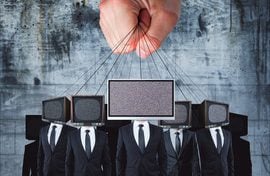
The primary reason people tend to remain committed to their propaganda-installed perspectives has a simple, well-documented explanation.

By Caitlin Johnstone

Source: Consortium News

It’s not really deniable that Western civilization is saturated with domestic propaganda geared toward manipulating the way the public thinks, acts, works, shops and votes.

Mass media employees have attested to the fact that they experience constant pressure to administer narratives which are favorable to the political status quo of the U.S. empire. The managers of empire have publicly acknowledged that they have a vested interest in manipulating public thought.

Casual naked-eye observation of the way the mass media reliably support every U.S. war, rally behind the U.S. foreign policy objective of the day and display overwhelming bias against empire-targeted governments makes it abundantly obvious that this is happening when viewed with any degree of critical thought.

To deny that these mass-scale manipulations have an effect would be as absurd as denying that advertising — a near trillion-dollar industry — has an effect.

It’s just an uncomfortable fact that as much as we like to think of ourselves as free-thinking sovereign agents immune to outside influence, human minds are very hackable. Manipulators understand this, and the science of modern propaganda which has been advancing for over a century understands this with acute lucidity.

By continually hammering our minds with simple, repeated messaging about the nature of the world we live in, propagandists are able to exploit glitches in human cognition like the illusory truth effect, which causes our minds to mistake the experience of having heard something before with the experience of having heard something that is true.

Our indoctrination into the mainstream imperial worldview begins when we are very young, largely because schooling is intertwined with the same power structures whose information interests are served by that worldview and because powerful plutocrats such as John D. Rockefeller actively inserted themselves into the formation of modern schooling systems.

Our worldview is formed when we are young in the interests of our rulers, and from there cognitive biases take over which protect and reinforce that worldview, typically preserving them in more or less the same form for the rest of our lives.

This is what makes it so hard to convince someone that their beliefs about an issue are falsehoods born of propaganda.

I see a lot of people blame this problem on the fact that critical thinking isn’t taught in schools and I’ve seen some strains of Marxist thought arguing that Westerners choose to espouse propaganda narratives because they know it advances their own class interests.

I’m sure both of these factor into the equation exist to some extent. But the primary reason people tend to remain committed to their propaganda-installed perspectives actually has a much simpler, well-documented explanation.

Modern psychology tells us that people don’t just tend to hold onto their propaganda-induced belief systems; people tend to hold onto any belief system.

 Belief perseverance, as the name suggests, describes the way people tend to cling to their beliefs even when presented with evidence disproving them. The theory goes that back when most humans lived in tribes that were often hostile to each other, our tribal cohesion and knowing who we can trust mattered more to our survival than taking the time to figure out what’s objectively true.

So now we’ve got these brains that tend to prioritize loyalty to our modern “tribes” like our nation, our religion, our ideological factions and our pet causes.

This tendency can take the form of motivated reasoning, where our emotional interests and “tribal” loyalties color the way we take in new information. It can also give rise to the backfire effect, where being confronted with evidence which conflicts with one’s worldview will not only fail to change their beliefs but actually strengthen them.

So the simple answer to why people cling to beliefs instilled by imperial propaganda is because that’s just how minds work. If you can consistently and forcefully indoctrinate someone from an early age and then give them a mainstream ideological “tribe” with which to identify in their indoctrination, the cognitive glitches in these newly-evolved brains of ours act as sentries protecting those implanted worldviews.

Which is exactly what modern propaganda, and our modern political systems, are set up to do.

I often see people expressing bewilderment about the way the smartest people they know subscribe to the most ridiculous propaganda narratives out there. This is why.  A smart person who has been effectively indoctrinated by propaganda will just be more clever than someone of average intelligence in defending their beliefs.

Some of the most foam-brained foreign policy think pieces you’ll ever read come from PhDs and Ivy League graduates, because all their intelligence gives them is the ability to make intelligent-sounding arguments for why it would be good and smart for the U.S. military to do something evil and stupid.

The Oatmeal has a great comic about this (which someone also made into a video if you prefer). Importantly, the author correctly notes that the mind’s tendency to forcefully protect its worldview does not mean it’s impossible for someone to change beliefs in light of new evidence, only that it is more difficult than accepting beliefs which confirm biases.

It takes some work, and it takes sincerity and self-honesty, but it can be done. Which is happy news for those of us who have an interest in convincing people to abandon their propaganda-constructed worldviews for reality-based ones.

Sometimes just being patient with someone, showing empathy, treating them how we’d like to be treated, and working to establish things in common to overcome the primitive psychology which screams we’re from a hostile tribe can accomplish a lot more than just laying out tons of objective facts disproving their believed narrative about Russia or China or their own government or what have you.

And above all we can just keep telling the truth, in as many fresh, engaging and creative ways as we can come up with. The more we do this, the more opportunities there are for someone to catch a glimmer of something beyond the veil of their propaganda-installed worldview and the cognitive biases which protect it.

The more such opportunities we create, the greater a chance the truth has of getting a word in edgewise.

Caitlin Johnstone’s work is entirely reader-supported, so if you enjoyed this piece please consider sharing it around, following her on FacebookTwitterSoundcloudYouTube, or throwing some money into her tip jar on Ko-fiPatreon or Paypal. If you want to read more you can buy her books. The best way to make sure you see the stuff she publishes is to subscribe to the mailing list at her website or on Substack, which will get you an email notification for everything she publishes.  For more info on who she is, where she stands and what she’s trying to do with her platform, click here. All works are co-authored with her American husband Tim Foley.

Julian Assange’s Imprisonment Is The Intellectual Imprisonment of Us All

By Eric Zuesse

Source: The Duran

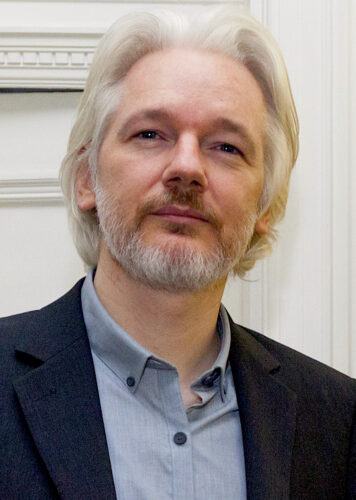
Julian Assange has been imprisoned since 2012 because he had provided, to whistleblowers who were in government and who saw and could supply to his WikiLeaks organization, items of evidence which indicated that their government was breaking its own laws, protection of their personal identity, which confidentiality they could then rely upon for their personal safety, to protect those whistleblowers against retaliation by their government. No regular ‘news’-medium could or would reliably do that, but Assange and his WikiLeaks organization could, and they always did. This is why governmental whistleblowers did go to them for this purpose.

The power that a government has to ‘classify’ documents is the power that it has to hide evidence from its public and so to rule its population as being their subjects instead of (authentically) their citizens: it is the ability to BE a dictatorship. (It might arguably be acceptable when a democracy is being invaded by a foreign country, but never — other than that — can there be governmental secrecy to protect itself unless the government is a dictatorship — NOT a democracy — in which case the Government is, itself, being the enemy of its own population.) Without such secrecy against the public, the government would be a democracy, because then the population would be voting in an authentically free information-environment where there exists uncensored information to the public, so that each individual can make one’s OWN individual judgments regarding what is true, and what is false. But, otherwise, a government is a dictatorship.

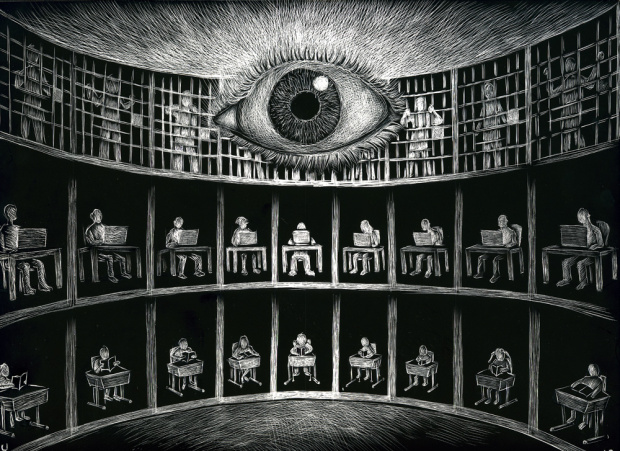
This power (classifying governmental information) is also a government’s power of legal impunity so that it can violate its own laws and know that the voting public will not know that it did. That routine power of classifying information is the intellectual imprisonment of the nation’s entire population.

Julian Assange is not a subject (‘citizen’) of the U.S. Government, nor is he a subject of the UK Government, nor is he a subject of the other two Governments (Sweden and Ecuador) that have participated in assisting America and Britain to place and keep him in varying forms of (now super-max) imprisonment for over a decade, but they have done it, during all of this time, and never yet has he been tried and convicted of anything other than his having jumped bail in 2012 on a phony rape charge that even its alleged victim admitted had been false; so, in effect, if not in reality, his very imprisonment is an example of those governments’ dictatorships — it has already been long-term imprisonment without trial. ONLY a dictatorship does that. Only a dictatorship can do that.

Assange is instead a subject of the Australian dictatorship, which has done nothing at all to assist him or to protest his being raped by ‘law’ in those foreign lands. The fact that there are not revolutions overthrowing and replacing the Governments in each one of the countries that has participated in this ‘legal’ rape of Assange is testimony to the effectiveness of the intellectual imprisonment of each one of those nations’ populations.

Assange has been in various forms of imprisonment by UK for the last ten years without his ever having been convicted of anything except that in 2012 he was sentenced to 50 weeks in prison for jumping bail (on sexual charges against him that even the alleged accuser denied were true). And yet he remains now in solitary confinement (“23 hours a day locked in their cells”) in a super-max British prison, because the U.S. Government won’t stop its demand that he be extradited to the U.S. (and killed here — imprisoned for up to 175 years — instead of in Britain). His only ‘crime’ was his publishing only truths, especially truths that cut to the core of exposing the U.S. regime’s constant lying. So, this blatant and illegal injustice against an international hero (virtually everywhere except in the United States) is today one prominent disproof of the U.S. and UK lies to the effect that they are democracies. On 26 September 2021, Yahoo News reported (based largely on reporting in Madrid’s El Pais on 5 January 2021) that the Trump Administration felt so embarrassed by some information that had been WikiLeaked, they drew up detailed plans to kidnap Assange at the Ecuadorian Embassy in London to “rendition” him for possible execution by America. The plans, including “meetings with authorities or approvals signed by the president,” were finally stopped at the National Security Council, as being too risky. “Discussions over kidnapping or killing Assange occurred ‘at the highest levels’ of the Trump administration”, even without any legal basis to try him in the United States. So: the Trump Administration then prepared an indictment against Assange (to legalize their extradition-request), and the indictment became unsealed or made public on the same day, 11 April 2019, when Ecuador’s Government allowed UK’s Government to drag Assange out into UK super-max solitary-confinement imprisonment, and this subsequently produced lie-based U.S. & UK tussles over how to prevent Assange from ever again being able to reach the public, either by continuing his solitary confinement, or else by, perhaps, poisoning him, or else convicting him of something and then executing him. On 4 January 2021, a British judge nixed Assange’s defense case: “I reject the defence submissions concerning staying extradition [to U.S.] as an abuse of the process of this court.” Earlier, her handling of Assange’s only ‘trial’, which was his extradition hearing, was a travesty, which would have been expected in Hitler’s courts, and which makes clear that UK’s courts can be just as bad as Nazi courts had been. However, the U.S. regime’s efforts to grab Assange continued on. Barack Obama, Donald Trump, Joe Biden, and the overwhelmingly compliant U.S. Congress, are all to blame for that dictatorial regime’s pursuit against that champion of truth-telling; and the same blame applies to the leadership in UK. On 10 December 2021, BBC bannered “Julian Assange can be extradited to the US, court rules”. Blatantly, both America and England lie in order to refer to themselves as being democracies. In fact, America has the world’s highest percentage of its residents in prisons. It’s the world’s #1 police-state. Is that because Americans are worse than the people in other countries, or is it instead because the thousand or so individuals who collectively control the nation’s Government are, themselves, especially psychopathic? Evidence will now be linked-to on that question: America has been scientifically examined more than any other country has, in regards to whether it is an aristocracy, or instead a democracy, and the clear and consistent finding is that it’s an aristocracy. And it clearly is that at the federal level. (Here is a video summarizing the best single study of that, and it finds America to be an aristocracy, because it’s controlled by the richest few). And Norway’s aristocracy had also been part of this scandal. It is an international scandal, and keeps getting worse.

On June 19th, Chris Hedges headlined “The Imminent Extradition of Julian Assange & the Death of Journalism” and documented that the alleged ‘assurances’ that the U.S. regime had provided to the UK regime on the basis of which the latter dictatorship would be transferring Assange to a super-max prison in the United States, had as many holes in it as a ton of Swiss cheese.

ONLY in barbaric dictatorships is any of this even possible, but here it is real.

Assange’s ‘trial’ will be the trial of ‘democracy’ in whatever nation it will be executed.

—————

Investigative historian Eric Zuesse’s new book, AMERICA’S EMPIRE OF EVIL: Hitler’s Posthumous Victory, and Why the Social Sciences Need to Change, is about how America took over the world after World War II in order to enslave it to U.S.-and-allied billionaires. Their cartels extract the world’s wealth by control of not only their ‘news’ media but the social ‘sciences’ — duping the public.

15 Questions That Are More Useful Than “What Presidential Candidate Should Americans Vote For?”

By Caitlin Johnstone

Source: CaitlinJohnstone.com

People keep asking me to weigh in on the US presidential race and its candidates, which is what always happens whenever there’s a US presidential race on because media saturation makes it so central in the minds of Americans it’s often the main issue they want to talk about, even if they’re fairly aware.

I really don’t have anything to say about who Americans should vote for, other to repeat what I’ve said already about the fact that you can’t vote your way out of a mess you never voted yourself into in the first place.

But what I can do instead is offer my American friends some questions to ask that would probably be much more helpful to them and their nation than the question “Which presidential candidate should we vote for?”

Here are 15 such questions:

1. Why does nothing change no matter who we vote for?

2. Why does US foreign policy always continue along the same trajectory regardless of the president’s party or platform?

3. What keeps our voting population split right down the middle into two political factions of equal size, with neither side ever gaining enough of a majority to democratically change society in any meaningful way?

4. Why does the stalemate described in #3 always seem to benefit the rich, the powerful, and the war-horny?

5. Why is it that the most consequential US government policies like plutocratic influence, privatization, globalization, ecocidal capitalism and nuclear brinkmanship are never on the ballot? Why do these things keep happening, against our interests, without our ever voting for them or electing anyone who campaigned on the pledge to enact them?

6. If our federal government’s behavior never changes no matter who we elect, could it be that there are other bodies involved in government policy-setting whom we did not elect, and who remain in positions of influence regardless of the comings and goings of our official elected government?

7. If the above is the case, then who is it? Who’s really calling the shots in this country?

8. Could it be that everything we’ve been told about our country, our government, our political processes and our world is untrue?

9. If so, what are the implications of the fact that our schools and our media have been feeding us lies since we were small?

10. What forces would be responsible for keeping all these lies flowing throughout our society? What might keep an ostensibly free press spinning more or less the same lies throughout the western world day after day, year after year, generation after generation?

11. Is it possible that our entire electoral system is a sham designed to give the public the illusion of control so that they’ll let oligarchs and empire managers run the country undisturbed?

12. If the electoral system is a sham, then how do we enact the changes we so desperately need?

13. Is it possible that there are other ways to effect change in the United States which don’t involve casting a pretend vote in a fake election?

14. Could it be that those other means of forcing change are precisely what the charade of casting pretend votes in fake elections is meant to divert us from?

15. Should we perhaps spend less energy bickering about who should get sworn into the White House a year and a half from now, and more energy examining other possible avenues toward advancing meaningful change?

The Twilight of Freedom

By Craig Murray

Source: CraigMurray.org.uk

Three British journalists I know personally – Johanna Ross, Vanessa Beeley and Kit Klarenberg – have each in the last two years been detained at immigration for hours on re-entering their own country, and questioned by police under anti-terrorist legislation.

This is plainly an abuse of the power to detain at port of entry, because in each case they could have been questioned at any time in the UK were there legitimate cause, and the questioning was not focused on their travels.

They were in fact detained and interrogated simply for holding and publishing dissident opinion on foreign policy, and in particular for supporting a more collaborative approach to Russia – with which, lest we forget, the UK is not at war.

These detentions have taken place over the period of a couple of years. All were targeted for journalism and this is plainly a continuing policy of harassment of dissident British journalists.

I have three times in that same period been questioned by police in my own home in Edinburgh for journalism, over three separate matters. I spent four months in jail for publicising essential information to show that a high level conspiracy was behind the false accusations against Scottish Independence leader Alex Salmond.

Julian Assange remains in maximum security jail for publicising the truth about war crimes. Meanwhile a new National Security Bill goes through the Westminster parliament, which will make it illegal for a journalist possess or publish classified information.

This has never been illegal. The responsibility has always lain with the whistleblower or leaker, not the journalist or publisher. It seeks to enshrine in UK law precisely what the US Government is seeking to achieve against Assange using the US 1917 Espionage Act. This is a huge threat to journalism.

It is also worth pointing out that, if Evan Gershkovich was indeed doing nothing more than he has claimed to have been doing in Russia, that action would land him a long jail sentence in either the USA or the UK under the provisions which both governments are attempting to enforce.

On top of that, you have the Online Safety Bill, which under the excuse of protecting against paedophilia, will require social media gatekeepers to remove any kind of content the government deems as illegal.

When you put all this together with the new Public Order Act, which effectively gives the police authority to ban any protest they wish to ban, there is a fundamental change happening.

This is not just a theoretical restriction on liberty. Active enforcement against non-approved speech is already underway, as shown by those detentions and, most strongly of all, by Julian’s continued and appalling incarceration.

To complete the horror, there is no longer a genuine opposition within the political class. Keir Starmer’s Labour Party opposes none of this wave of attacks on civil liberties. The SNP has been sending out identical stock replies from its MPs on Julian Assange, 100% backing the UK government line on his extradition and imprisonment.

I feel this very personally. I know all of these people affected – Julian, Alex, Kit, Vanessa, Johanna, and view them as colleagues whose rights I defend, even though I do not always agree with all of their disparate views.

Two other people I know personally and admire are under attack. The campaign of lies and innuendo against Roger Waters this last few weeks has been astonishing in both its viciousness and its mendacity, recalling the dreadful attacks on Jeremy Corbyn.

More mundane but also part of the same phenomenon, my friend Randy Credico has had his Twitter account cancelled.

To be a dissident in the UK, or indeed the “West”, today is to see, every single day, your friends persecuted and to see the walls close in upon yourself.

A unified political class, controlled by billionaires, is hurtling us towards fascism. That now seems to me undeniable.

Being a Radical Has Led Me to Sometimes Live a Double Life

Is that a good thing?

By Mickey Z.

Source: Dissident Voice

Throughout the 2000s, you’d find me regularly riding NYC’s subways during the very early morning hours — specifically from Queens into Manhattan — to work with personal training clients in gyms. In fact, right up to the plandemic, I was still training a couple of clients in their homes.

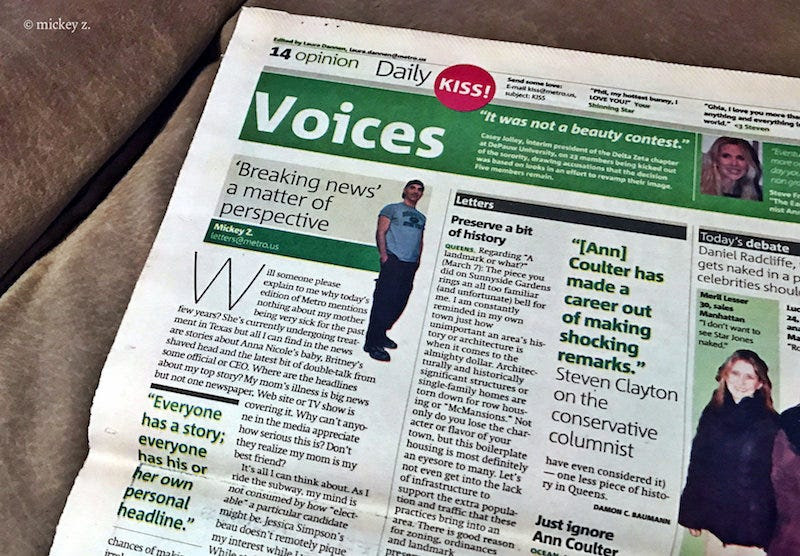
On those subway rides, I’d sometimes grab a copy of Metro — one of NYC’s free newspapers delivering a daily dose of corporate media propaganda. However, there was a brief period of time when Metro would allow some subversive voices into the mix. That included yours truly.

From about 2004 to 2007, Metro went through a phase of paying edgy freelancers so I jumped in with both feet. This even included an author photo shoot!

Thus, for a couple of years, my decidedly non-mainstream perspective — and my decidedly non-mainstream photo (wearing a “dumpster diving team” t-shirt, no less) — were on display for millions of New Yorkers to peruse during their morning ride to work or school (see image up top).

As someone who can remember when newspaper columnists held sway in my hometown, let me tell you, it was pretty cool to be jammed into a crowded subway car next to someone reading my latest article.

I’ll never know how many New Yorkers read my Metro columns. To the best of my knowledge, none of my affluent clients saw my column or photo (probably because none of them would ever ride the subway).

Over the years, I did make a select few clients aware of my double life (a couple have even bought my books and attended my talks). But, since many of them were wealthy and mainstream, I typically chose not to divulge anything about my radical writing.

As a result, I sometimes found myself making up elaborate fabrications to account for why I wouldn’t be around for a day or two when, for example, I just so happened to be heading up to MIT to lecture on US foreign policy in 2003.

Yep, this high school grad addressed a huge audience there on the topic of Henry Kissinger and the 1973 Chilean coup on a Monday night… and by Wednesday morning, was back in the gym — working with dumbbells (insert rimshot here).

Looking back now, I ponder my strategy of keeping a big part of myself a secret in the name of maintaining personal trainer income. Why was I so sure that wealthy capitalists would shun me and maybe fire me as their trainer if they encountered my radical mindset?

Perhaps a better question: What did it do to me emotionally to hide something that’s always been very important to me?

I contemplate questions like this now because, well… it’s never too late. I may not have affluent gym clients anymore. But, in Covid-era NYC, I have plenty of others around whom I could start speaking far more openly.

After all, it’s not like I can’t point to cases from the 2000s when my double life was exposed and things went well.

For example, I trained three high-powered lawyers at their high-powered law firm’s gym. This arrangement required me to check in with the doorman — or was he a concierge? (It’s funny to me that I might insult a concierge by calling him a doorman.) Anyway, doormen display one of three basic behavior patterns towards personal trainers.

The first and most common is indifference (we’re used to that). Secondly, they relate to us as fellow blue-collar common people saddled with the same fate: serving the well-heeled. Lastly, in a futile attempt to align themselves with a winner, some doormen openly look down their noses at us.

This was definitely the case at the law firm until a certain concierge saw my handsome face staring back at him from the pages of Metro.

The guy was completely flabbergasted when he read a little something of mine called “Re-Examining Rumsfeld’s Ratio” (which talked about, among other things, the United States unselfconsciously using “Apache” helicopters to quell “ethnic cleansing”).

A political junkie, the concierge now saw me as an “expert” and fell all over himself to shake my hand and introduce himself.

My new best friend could not get enough of me and it became the new norm for him to quiz me about current events before and after my training sessions.

One morning, as I was passing through the lobby, he called me over and pulled out a legal pad. Believe it or not, he had written a page or two of notes to remember all the things he wanted to ask me!

Yeah, just another tricky day in the life of a muscular militant… 

In 2001-2, I worked evenings in a corporate gym (cue the shame and self-loathing) in midtown Manhattan. One night, I was wearing a Yankees t-shirt with the name “Justice” emblazoned on the back (for former Yank David Justice).

A woman named Mary, probably in her late 60s, asked me if I was a Yankee fan. I told her my real reason for wearing the shirt was all about the word “justice.” She smiled and declared that justice was a “noble idea.”

I braced myself for the inevitable “we need to show those towel heads some justice,” (remember, this was early post-9/11 NYC) but instead, Mary told me — albeit in a stage whisper — she was soon going to DC to march against the impending US invasion of Iraq.

After this confession, Mary looked genuinely nervous. Her facial expression seemed to ask: Have I gone too far? In my best French Resistance voice, I reassured her: “Don’t worry, I’m with you.”

After that, we’d talk each and every time she’d come to work out. The corporation eventually phased out its gym facility but just before my last day, I saw Mary and complimented her on how hard she’d been training.

She leaned close to me and whispered: “When the revolution comes, I’ll be ready.”

As for me, my next revolution is to be even more open and transparent about my “controversial” stances. No more hiding.

After all, “a truthful witness saves lives.”