In An Insane World, Revolution Is The Moderate Position

By Caitlin Johnstone

Source: CaitlinJohnstone.com

It should not be considered radical or extremist to oppose mass murder for profit and power.

It should not be considered radical or extremist to oppose the globe-spanning power alliance that is perpetrating most of that mass murder on the world stage today.

It should not be considered radical or extremist to oppose the existence of secretive government agencies which have extensive histories of committing horrific crimes.

It should not be considered radical or extremist to say that everyone ought to have a basic standard of living instead of being deprived of food, shelter and medicine if they have the wrong imaginary numbers in their bank account.

It should not be considered radical or extremist to oppose the existence of a small class of elites who use their vast fortunes to manipulate our entire society toward their advantage.

It should not be considered radical or extremist to want plutocrats and government agencies to stop deliberately manipulating people’s minds using mass media propaganda.

It should not be considered radical or extremist to want everyone to have an equal chance of getting their voice heard in our information ecosystem instead of a few select power-serving lackeys.

It should not be considered radical or extremist to want a society that is ruled by the many for the benefit of the many instead of one that is run by the few for the benefit of the few.

It is very normal, sane and healthy to want a world where everyone has what they need to live, where everyone is free to do, say and think whatever they like as long as it isn’t hurting anyone else, and where nobody is being murdered by powerful governments. This is a very basic, intuitive, common sense desire to have for yourself and for your fellow human beings; it’s wanting for your society what you want for yourself.

Yet people who promote policies which are aimed at creating this kind of world are consistently marginalized and dismissed as radicals and extremists. It’s okay to say you oppose war in principle, but if you oppose any specific acts of warmongering being perpetrated by your government you’ll get labeled a Russian asset, a dictator apologist and all sorts of other pejorative labels which exist solely to justify keeping you off of mainstream platforms. It’s okay to think we should live in peaceful collaboration with each other and our ecosystem, but if you promote specific policies to make that happen you’re an evil commie, a class warrior and a moonbat in the same way.

Simply advocating sanity over insanity gets you shoved out of sight and out of mind by the narrative managers responsible for preserving a world order that is stark raving insane from top to bottom. If you oppose the systems exploited by the ruling power establishment which murders, exploits and oppresses people at home and abroad all day every day while destroying the very ecosystem we depend on for survival, then you are branded a lunatic and your wrongthink quarantined so as not to infect the mainstream herd.

This dynamic is made possible by the fact that the powerful are constantly pouring their wealth and influence into manufacturing the collective delusion that madness is sanity and sickness is health. The plutocrat-controlled political class and the plutocrat-owned media class feed the public an unceasing stream of propaganda aimed at convincing them that capitalism is totally working, that western imperialism is a kooky conspiracy theory, and that the military, police and politicians are our friends. This is what’s constantly being done by mainstream news media, and with varying degrees of subtlety it’s what is being done by every show on television and every movie churned out by Hollywood as well.

But that’s all it is: a collective propaganda-induced delusion. In reality it is the mainstream promoters of the establishment-authorized status quo who are the violent extremists, and it is those who desire health and sanity who are the moderates.

The madness of our world will necessarily continue for as long as we are unable to collectively find our way out of it, and we will be unable to collectively find our way out of it for as long as they are able to keep us collectively confused about what is madness and what is sanity. About what is normal and what is abnormal. About what is moderate and what is extreme.

If you oppose the madness of our world, don’t make an identity out of being a “radical”. Don’t build an egoic structure around life on the fringe. You are not radical, and your ideas should not be fringe. To live a revolutionary life, you should insist on the normality and mundaneness of your own position. Sanity should not be special and unusual, and we should not participate in the delusion that it is.

Let your life be an expression of the common sense ordinariness of revolution.

Big Media: Selling the Narrative and Crushing Dissent for Fun and Profit

By Charles Hugh Smith

Source: Of Two Minds

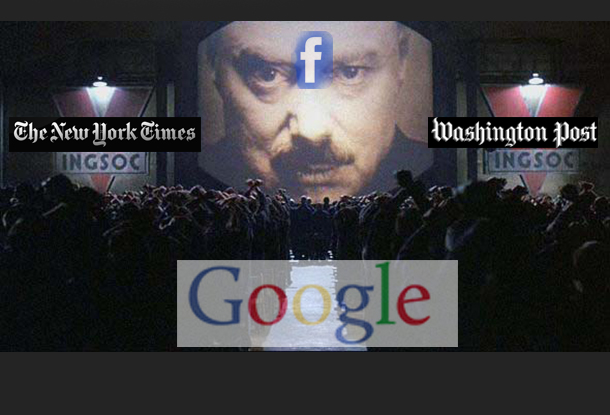
The profit-maximizing Big Tech / Big Media Totalitarian regime hasn’t just strangled free speech and civil liberties; it’s also strangled democracy.

The U.S. has entered an extremely dangerous time, and the danger has nothing to do with the Covid virus. Indeed, the danger long preceded the pandemic, which has served to highlight how far down the road to ruin we have come.

The danger we are ill-prepared to deal with is the consolidation of the private-sector media and its unification of content into one Approved Narrative which is for sale to the highest bidders. This is the perfection of for-profit Totalitarianism in which dissent is crushed, dissenters punished and billions of dollars are reaped in managing the data and content flow of the one Approved Narrative.

So don’t post content containing the words (censored), (censored) or (censored), or you’ll be banned, shadow-banned, demonetized, demonized and marginalized. Your voice will be erased from public access via the Big Media platforms and you will effectively be disappeared but without any visible mess or evidence–or recourse in the courts.

That’s the competitive advantage of for-profit Totalitarianism–no legal recourse against the suppression of free speech and dissent. And if you’re shadow-banned as I was, you won’t even know just how severely your free speech has been suppressed because the Big Tech platforms are black boxesno one outside the profit-maximizing corporation knows what its algorithms and filters actually do or exactly what happens to the disappeared / shadow-banned.

Shadow-banning is an invisible toxin to free speech: if you’re shadow-banned, you won’t even know that the audience for your posts, tweets, etc. has plummeted to near-zero and others can no longer retweet your content. You only see your post is online as usual, because this is the whole point of shadow-banning: you assume your speech is still free even as its been strangled to death by Big Tech black box platforms.

Since Andy Grove’s dictum only the paranoid survive is my Prime Directive, I’ve paid a bit more to have access to server traffic data. So I can pinpoint precisely when I was shadow-banned: my overall traffic fell off a cliff and the number of readers visiting from links on Big Tech platforms fell from thousands to near-zero.

The new consolidated Big Media Totalitarians play an interesting game of circular sources: in the traditional, now-obsolete / suppressed form of journalism, a reporter would be required to identify a minimum of three different sources for the story, and make at least a desultory effort to present two sides of the issue.

That model is out the window in the USSA’s Big Media Totalitarian regime. Now reporters only have to use a completely bogus, fabricated source in another Big Media story. Just being in another Big Media platform / publication is now “proof” that the source is legitimate.

In other words, investigative journalism is nothing but a Potemkin Village of circular sources conjured out of thin air by Big Media. Here’s an example from my own experience of being shadow-banned.

1. A completely bogus organization pops up out of nowhere and doesn’t bother identifying its owners, managers or sources.

2. This complete travesty of a mockery of a sham fabrication then issues a list of websites which it claims, with zero evidence, are stooges / outlets of Russian propaganda.

3. With zero investigation of this slanderous, evidence-free “source,” the venerable Washington Post (owned by Jeff Bezos) publishes an evidence-free hit piece glorifying this fabrication on Page One.

4. The other Big Media giants then amplify the bogus slander because it came from a “legitimate source,” the Washington Post.

Do you understand how circular sourcing works now? Once a flagrantly bogus bit of propaganda is embraced by one Big Media giant as part of the Approved Narrative, then every other Big Media / Big Tech corporation promotes the fabrication as “real news” even as it is obviously the acme of “fake news”, a complete fabrication.

The fake “source” was called PropOrNot, and the list included dozens of well-respected independent websites, all slandered with a completely fake accusation for one reason: each site had published some content that cast a skeptical eye on the crowning of Hillary Clinton in 2016 and the crushing of Bernie Sanders’ campaign by Big Media’s Approved Narrative.

As long as you post videos of kittens and kids dancing, you’re OK because your content (owned and controlled by the platform you posted it on–read the terms of Service) is free to the platforms and they use your content to “engage” users which generates billions in profits.

But if you question the Approved Narrative, you put a big day-glo target on your back. Now if you’re a multi-millionaire, you know, a top 0.1% per-center, you can afford to keep posting dissenting views even after you’ve been demonetized and your income falls to near-zero.

The rest of us aren’t quite so privileged. This is another of the toxic elements in Big Media / Big Tech’s consolidated control of what was once known as free speech: They don’t have to ban your content outright, which might cause a few ripples of tame protest; all they have to do is starve you into submission by strangling your source of income.

Thanks to watertight terms of service, even a multi-millionaire is legally powerless against the USSA’s Big Media Totalitarian regime. By posting content, you already gave away all your rights. So you can go solo and post content on some obscure corner of the web that no one knows exist, but that’s the functional equivalent of being banned and demonetized.

So go right ahead and enter a sound-proof box and scream your head off; nobody can hear you. Welcome to the totally privately owned, legally untouchable Big Tech / Big Media Totalitarian regime that will let you know what’s in the Approved Narrative because that’s all you’re allowed to see.

Gordon Long and I cover these topics and many more in our latest video Buying the Narrative (35:41) Since I’d like the video to actually be viewed more than 11 times, I avoided using the terms (censored), (censored) or (censored), and that’s the final fatal poison delivered by our profit-maximizing Big Tech / Big Media Totalitarian regime: self censorship. You know what you can’t say, so don’t say it. Stick with the kitten videos and you’ll be just fine.

You’ll be just fine but you no longer live in a functioning democracy. The profit-maximizing Big Tech / Big Media Totalitarian regime hasn’t just strangled free speech and civil liberties; it’s also strangled democracy.

It’s all fun and games until the pendulum of Totalitarian Consolidation and its Approved Narrative reaches an extreme (like, say, right now) and the pendulum swings back to an equal extreme at the other end of the spectrum. Keep in mind that hubris and money are no match for history: the more powerful you claim to be, the greater your fall. The way of the Tao is reversal.

Welcome to the U.S.S.A.’s Banquet of Consequences (December 8, 2020)

6 Factors Which Point to a Rigged Election


The mainstream media are quick to call the claim “baseless”, but there’s plenty of evidence for anyone willing to see it.

By Kit Knightly

Source: Off-Guardian

The US Election is still a burning issue almost two weeks after the people went to the polls, and though the race has been called for Biden by every mainstream media outlet in the world, the recounts are ongoing and irregularities manifest.

Trump’s legal team, and many in the alternate media, are claiming the election was rigged. With one voice the mainstream media – and the entire political establishment – denounce these claims as “baseless”, and scream there is “no evidence”.

This is incorrect. There is plenty of evidence, both circumstantial and direct, which breaks down into six basic categories:

  1. Precedent – It has happened before.
  2. Motive – Deep State/Military dislike of Trump’s policies is widely known.
  3. Foreknowledge – Establishment voices predicted this exact situation.
  4. Opportunity – The voting system is highly susceptible to fraud.
  5. Voting Irregularities – Known software “glitches” & irregularities in the reporting of the results.
  6. Cover-up – Dishonesty in the reporting of the situation.

1. Precedent

There is plenty of evidence that US elections have been rigged before.

Nobody is talking about it much, but US elections have been rigged before. Everyone is more than familiar with the 2000 election, which was called for Al Gore before Florida flipped to Bush and swung the election. The controversy over “hanging chads” and misplaced votes was all people talked about for weeks.

One noteworthy “error” with electronic voting machines, switched over 10000 votes from Gore to an obscure third-party candidate.

After weeks of legal battles, Gore eventually conceded. Within a year the “attacks” of 9/11 had happened, and the US was at war in Afghanistan and planning six more wars within 3 years.

More recently, it was revealed the DNC had gone out of its way to hand Hillary the presidential nomination over Sanders in 2016. Then in the 2020 primaries, despite embarrassingly losses in the first few primaries, Biden’s presidential campaign had a “miraculous turnaround”, thanks largely to irregularities in postal ballots in Ohio, Wisconsin and New Jersey.

This is evidence of precedent.

2. Motive

The US Deep State has clear and publicly known motives for wanting to remove Trump from office.

It is no secret that many members of the US’s political establishment oppose Trump and Trump’s policies. This includes neo-con warmongers and chiefs of the military and intelligence agencies.

“The Resistance”, billed as some voice of the progressive alternative, boasted former members of George Bush’s cabinet as members.

The most strident opposition to Trump was on foreign policy – most specifically in the Middle East. Trump was committed to withdrawing from Syria, in direct opposition to the “Assad Must Go” crowd at the Pentagon and State Dept.

Just last week it was revealed that Department of Defense actually lied to Trump about their troop numbers in Syria, claiming to have pulled out almost everyone whilst they actually kept their covert war going.

Conversely, Biden has always been firmly in the establishment camp on Syria, and many warmongers are already predicting that Biden will want to “restore some dignity” to the Syrian people.

The US Deep State has carried out coups all around the world, many of them bloody and violent, in order to maintain Imperial ambitions and keep wars-for-profit going. They have every motive to want to remove Trump and put Biden in his place.

This is evidence of motive.

3. Foreknowledge

Establishment voices have been predicting, and planning for, this exact situation for almost a year.

In January of this year – well before anyone could have predicted the effect the “pandemic” would have on the world – legal scholars were Wargaming the outcome of a disputed Presidential election based on postal ballots in Pennsylvania.

In August a group naming themselves the Transition Integrity Project published a document predicting a “disputed” election, that the counting would take much longer than usual and that it would not be certain who was President until January.

More generally, the outcome of the election was widely “predicted”, with multiple press outlets claiming there would be a “red mirage” and a “blue shift”. Meaning it would look like Trump would win, and then suddenly Biden would win at the last minute.

This is evidence of foreknowledge.

4. Opportunity

There is plenty of evidence that the US voting system is open to potential corruption.

Voting machines, for example, are owned and distributed by private companies. Many of which have political ties. An article in the Guardian, of all places, went into great detail about this just last year, when they were suggesting that Trump may have stolen the 2016 election.

Likewise, postal ballots are known to be susceptible to fraud. William Barr, the Attorney General, summed it up in a television interview in September, and written reports in 2007 and earlier this year, have gone into great detail about historical cases of postal vote fraud and possibilities of future occurrences.

This is evidence of opportunity.

5. Voting Irregularities

There are plenty of irregularities in the results which suggest the possibility of something strange going on.

The story of the election by the numbers doesn’t really make logical sense. The turnout is said to be 72%, the highest in 120 years, and the first over 60% for over 50 years.

In the process Joe Biden, we are told, shattered Barack Obama’s popular vote record by almost 10 million votes.

Joe Biden?

This Joe Biden?

…got more votes than Barack Obama or Hillary Clinton?

Meanwhile Donald Trump increased his own popular vote by over 10 million, whilst increasing his vote share in almost every ethnic demographic, as well as with women and LGBT voters.

Making him the first incumbent president to increase his popular vote but still lose in over a century, and the only one since all 50 states were part of the union.

Even if you believe that narrative is possible, there’s more than enough evidence of voting irregularities to warrant at least questioning the result and investigating further.

In one Michigan county an error in the software configuration swung thousands of votes from Republican to Democrat and called a Congressional seat for the wrong party.

This error was only spotted because of the historically republican record of the county. In a more hotly disputed seat, this error could potentially never have been picked up.

Another Michigan county reported an error which switched 5,500 votes from Trump to Biden – a swing of 11,000 votes.

The software used in this county is used in 30 other states – including Wisconsin, Georgia, Arizona and Pennsylvania, all of which were decided by less than 1% of the vote, and any two of which could swing the election to Trump.

In fact Dominion, the company which supplied the questionable voting software, was denied a contract by the state of Texas in 2019 when judges found there were “concerns” about “whether [it] is safe from fraudulent or unauthorized manipulation”.

A subsidiary of Dominion was kicked out of the Philippines for being too easy to hack.

This video clip appears to show CNN’s coverage switching over 19,000 votes from Trump to Biden in Pennsylvania.

The graphed results of both Michigan and Wisconsin show decidedly odd jumps in Biden’s vote.

The counting itself was also deeply suspect, with several states taking almost a week to count the last few percent of the vote, whilst managing to count over 90% of the vote on the first evening. In Wisconsin the National Guard were brought in to “transcribe” damaged ballots, whilst in Pennsylvania they were allowed to count postal votes with “no clear post mark”.

As Glen Greenwald wrote, the very fact the count was so arduous and complicated raises questions about the outcome.

6. The Cover-Up

The media are engaging in lies and censorship.

To state there is “no evidence” of election rigging is a lie. There is plenty of evidence. Every news outlet, channel and website is singing from the same hymn sheet on this – even Fox News, so often Trump’s supposed favourite channel.

Even before the election, as discussed above, all the mainstream media were running articles defending mail-in ballots, and claiming that they are not historically weak to voter fraud. This is totally untrue, as anyone who cared to research the topic would tell you.

In fact many countries have incredibly rigid controls on postal voting for exactly that reason.

And then, after the election, social media companies and mainstream media outlets censor the President of the United States.

So, why are all the media telling the same lies? Why are people being denied a platform?

This is evidence of a cover-up.

*

Ask yourself:

  • If, in 2016, some voting software used in 30 states had flipped 5500 from Hillary to Trump, and later been revealed to be financial tied to the Republican party, would that have been “just a glitch”, or evidence of cheating?
  • If the Brexit referendum had swung violently to Leave after dumps of suspect postal ballots were permitted into the count by a judge who was a known Brexit supporter, would the media have kept quiet?
  • If, in Russia, the media denied a platform to the opposition to accuse Putin of voter fraud, would that be “responsible media practice”, or evidence of bias and censorship?

We don’t know exactly what happened, or how the election was result was controlled, but as of right now the specifics do not matter.

The point is there is plenty of evidence suggesting something happened, more than enough to warrant asking rational questions and expecting reasonable answers.

Every time the media ignores the evidence, or censors those seeking it, they only display further that there must be some fire behind all of this smoke.


Battlefield Social Media: The West’s Growing Censorship

Censorship in the West flourishes as tech giants turn social media back into traditional programmed media. 

By Gunnar Ulson

Source: Land Destroyer

The United States, United Kingdom and the European Union are fond of passing judgement on nations around the globe regarding “free speech.”

While it is increasingly clear to a growing number of people that this “concern” is disingenuous and aimed at merely defending agitators funded and directed by Western special interests in these targeted nations, the West still likes to fashion itself as a sort of champion of free speech.

Yet back home the Internet has been taken over by social media and tech giants like Google, Facebook and Twitter.

Their platforms clearly serve as online public squares where everything is discussed and even election campaigns play out. Yet these companies have, over the years, begun to eliminate voices of dissent against a notion known as “consensus.”

If you are speaking out against “consensus” you are in real danger of disappearing from these platforms. Some of these platforms, like Google-owned YouTube, serve as the livelihood to people who have for years built up their audiences, produced hundreds of videos and when their accounts are deleted for speaking out against the “consensus,” they have their livelihoods destroyed.

In the wake of these incremental “purges” is a chilling effect with content creators self-censoring or even withdrawing entirely from Western social media.

It is the sort of very real censorship the West has crusaded against in fiction around the globe for decades. 

Concensus or Else 

A more recent example is Google’s decision to ban ad revenue for those going against the Coronavirus Disease 2019 (COVID-19) “consensus.”

CNBC in their story “Google will ban ads from running on stories spreading debunked coronavirus conspiracy theories,” would claim:

Google next month will ban publishers from using its ad platform to show advertisements next to content that promotes conspiracy theories about Covid-19. It will also ban ads that promote those theories. In cases where a particular site publishes a certain threshold of material that violates these policies, it will ban the entire site from using its ad platforms.

Those “conspiracy theories” might include questioning the official death rates of COVID-19. Yet even the British government itself has been recently forced to investigate its statistics regarding death rates, vindicating the very sort of people who would have been either forced into silence or forced to give up ad revenue.

The London Guardian in its article, “Matt Hancock orders urgent review of PHE Covid-19 death figures,” would admit:

The UK health secretary, Matt Hancock, is ordering an urgent review of the daily Covid-19 death statistics produced by Public Health England, after it emerged that they may include recovered former sufferers who could have died of other causes.

False reporting over deaths to hype COVID-19, induce greater public panic and pave the way for billions in government handouts to pharmaceutical giants is at the very core of many of these so-called “conspiracy theories” Google seeks to silence through its campaign of financial coercion.

Imagine if this chilling effect was achieved sooner. Would the British government have even bothered investigating its faulty statistics if there weren’t people suspicious of them?

The chilling effect this has over openly discussing something as serious as COVID-19 considering its socioeconomic impact is truly alarming and much more so because it is happening in the so-called “free world” overseen by its self-appointed arbitrators in the US, UK and EU.

A similar campaign was carried out to purge Google, Twitter and Facebook of anyone allegedly connected with “Russia” who also so happened to be anti-war and anti-NATO for waging those wars.

Entire lists are compiled by Western government-funded organizations which are then submitted to these tech giants for purging. The Western media writes accompanying articles announcing, justifying and spinning the purges… but also sending a warning to those left about what is and isn’t going to be tolerated on these platforms.

Social Media Transforming Back into Programmed Media 

Content creators are faced with two decisions; to either self-censor themselves to protect their work, their audiences and their livelihood, or to accept the possibility they will eventually be “purged” (censored) and need to rebuild their audiences from scratch on platforms with far fewer potential readers, viewers and patrons.

Social media, of course, is no longer social media in this sort of environment, but more akin to the sort of programmed media giant Western special interests built their power on over the course of the 20th and early 21st century.

Private Public Squares? 

Of course the defense is that Google, Facebook and Twitter are “private companies”and can do as they please with their platforms. In reality, these companies work in tandem with Western governments whether it is fomenting political destabilization abroad or creating “concensus” at home.

The notion that censorship is “ok” because the US, UK and EU governments launder it through private companies ignores the close relationship these companies have with the government and how their platforms have been transformed into defacto public squares and critical channels of public communication and participation.

The West’s growing overt censorship leaves it with a choice; to either accept that it is in reality as guilty of censorship and manipulating the public as it has claimed its opponents are, or continue pretending it isn’t but at the continued cost of its legitimacy upon the global stage.

There is a very good reason the West is in decline around the globe and why its attempts to leverage notions like “human rights” and “free speech” against nations like China or Russia are increasingly impotent. That reason can be found, at least in part, among the growing number of purge lists, censorship campaigns and calls for “consensus” across Western social media.

Finally, the increasingly overt nature of censorship and controlled narratives promoted by tech giants like Google, Facebook and Twitter should have them facing restrictions and bans around the globe. Why should any nation host a “public square” where discourse is entirely controlled by interests oceans away? Why shouldn’t a local alternative be created instead where the revenue is kept locally and if narratives are to be controlled, controlled in a way that best suits people locally?

It is ironic that, China for example, is condemned for not allowing Google, Facebook and Twitter to operate freely within their information space because it is a violation of “free speech,” even as Google, Facebook and Twitter cudgel free speech on their own respective platforms.

How much longer will the world tolerate these double standards? How long until individuals, organizations and even entire nations begin creating alternatives to Google, Facebook and Twitter to at the very least balance out the lopsided power and influence they have collectively accrued and abused? 

Saturday Matinee: How to Operate Your Brain

Source: Open Culture

Speaking at the Human Be-In in January 1967, Timothy Leary uttered the famous phrase borrowed from Marshall McLuhan, “Turn on, tune in, drop out.” It was shorthand for saying experiment with psychedelics and achieve new levels of consciousness.

Almost 30 years later, Leary hadn’t lost his missionary zeal. In 1993 (and only a few years before his death), the former Harvard psychology professor recorded “a public service video” called How to Operate Your Brain. Here, Leary narrates an almost epileptic seizure-inducing video, providing what some consider “a guided meditation” of sorts. I’d prefer to call it an unorthodox “user manual” that tries to impart Leary’s unique sense of enlightenment:

The aim of human life is to know thyself. Think for yourself. Question authority. Think with your friends. Create, create new realities. Philosophy is a team sport. Philosophy is the ultimate, the ultimate aphrodisiac pleasure. Learning how to operate your brain, learning how to operate your mind, learning how to redesign chaos.

As you get deeper into the meditation, you’ll realize one thing. Three decades may have passed since Leary popularized the catchphrase of the counterculture. But he’s still getting his ideas from McLuhan. If you follow the video (or transcript) to the end, you’ll discover that ones and zeros have basically taken the place of LSD. Leary says:

Now we have digital communication. We can create our fantasies. We can create our rhythms, design on screen…. Anyone in any culture watching this screen will get the general picture. It’s one global village. It’s one global human spirit, one global human race. As we link up through screens, linked by electrons and photons, we will create for the first time a global humanity, not separated by words or minds or nationalities or religious biases.

You can find McLuhan meditating on the concept of an Electronic Global Village in another vintage clip.

Media Responds With Apathy, Disappointment as US-Backed Coup Gov’t Concedes Defeat in Bolivia

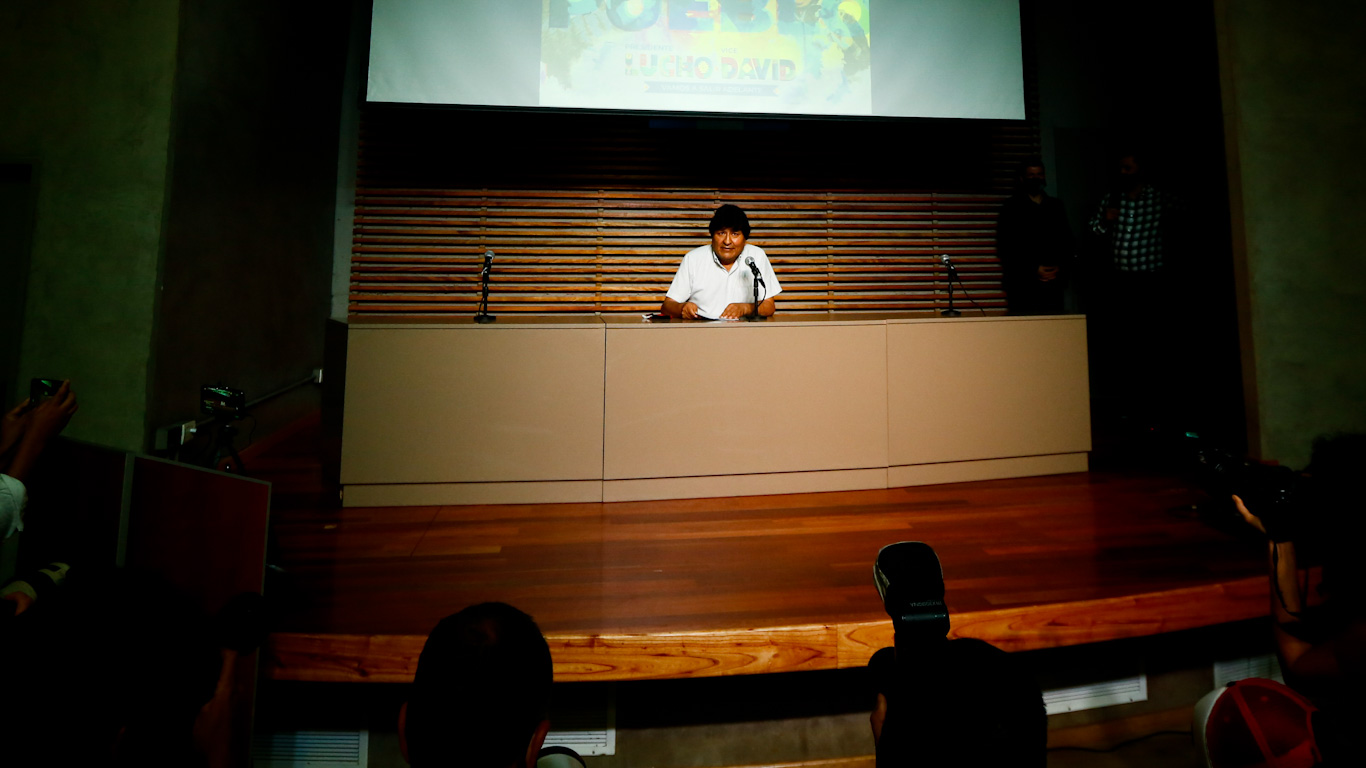
Former Bolivian President Evo Morales attends a press conference in Buenos Aires, Argentina, after general elections in his home country, Monday, Oct. 19. 2020. (AP Photo/Marcos Brindicci)

Across the spectrum, corporate media has endorsed last year’s rightwing takeover of Bolivia, refusing to label it as a coup. Coverage of Sunday’s historical elections hasn’t been much better.

By Alan Macleod

Source: Mint Press News

Bolivia’s Movement to Socialism (MAS) party is celebrating what appears to be a crushing, landslide victory in Sunday’s elections. Although official vote counting is far from over, exit polls show an overwhelming triumph for the socialists, and a repudiation of the right-wing military government of Jeanine Añez, who has ruled since the coup last November. At the same time, the corporate press appears less than pleased about the return to democracy for the Andean country.

In order to win outright in the first round, the top candidate needs at least 40 percent of the popular vote and a lead of 10 points over their nearest rival, and multiple polls have indicated that the MAS ticket of Luis Arce and David Choquehuanca has won more than 50 percent, and have achieved a lead of over 20 points on their nearest challenger, Carlos Mesa (president between 2003 and 2005) — quite a feat in a five-way election. The MAS is also expected to have won a large majority in the senate.

Añez, who came to power in a coup overthrowing President Evo Morales last November, and whose government has constantly postponed the election throughout the year, knew the game was up and lauded the MAS on their remarkable achievement. “We do not yet have an official count, but from the data we have, Mr. Arce and Mr. Choquehuanca have won the election. I congratulate the winners and ask them to govern with Bolivia and democracy in mind,” she wrote. Añez decided to drop out of the election herself last month in an attempt to boost Mesa’s chances of stopping Arce. However, today Mesa accepted defeat as well. “The result is overwhelming and clear. The difference is wide,” he lamented.


Media disappointment at return of democracy

Across the spectrum, corporate media endorsed the events of November, refusing to label them a coup. The New York Times editorial board claimed that the “increasingly autocratic” tyrant Morales had actually “resigned,” after “protests” over a “highly fishy vote.” The Washington Post did the same. “There can be little doubt who was responsible for the chaos: newly resigned president Evo Morales,” their editorial board wrote, as they expressed their relief that Bolivia was finally in the hands of “more responsible leaders” like Añez, (who, at the time, was giving security forces orders to shoot her opponents in the streets). Despite this, The Wall Street Journal’s board decided the events of November constituted “a democratic outbreak in Bolivia.”

Today, therefore, the corporate press is in a very tough spot, as they have to explain to their readers why the Bolivian people have just handed an overwhelming, landslide victory to a party they have been presenting as an authoritarian dictatorship who were overthrown by popular protests last year.

A number of outlets solved this by simply fastidiously avoiding reporting on the events of November or using the word “coup” to describe them. NPR’s Philip Reeves, for example, claimed Morales “resigned” amid an annulled election after “allegations of fraud,” leading to an “interim government” (Añez’s own public relations-minded phrase for her administration). The word “coup” only appears in the mouth of Morales, someone whose credibility the outlet has spent months undermining. Other organizations like Deutsche Welt and Bloomberg failed to use the word at all in their reporting.

The Associated Press, meanwhile, referenced the coup, but did not use the word, instead describing it as when “police and military leaders suggested he [Morales] leave.” It takes great linguistic skill to refrain from using by far the most appropriate word to describe events in Bolivia for what they are: a coup. Indeed, the linguistic gymnastics necessary to avoid using the word would be genuinely impressive were not an exercise in deceit and manufacturing consent for regime change.

CNN at least included the phrase “claims of a coup,” but presents it beside apparently equally justified “allegations of fraud among contested national elections.” But these two things are nothing like the same. One is a statement of fact while another is a debunked, discredited talking point used to overthrow a legitimate government.

Meanwhile, the BBC’s article on the election had an entire section called “why is the country so divided” which did not mention the massacres, the firesale of the country’s economy, the repression of media or activists, the persecution of the MAS or the U.S. role in overthrowing the elected government. Instead, it presented Morales himself as the prime agent of polarization, a common tactic among media discussing enemy states.

The New York Times also published a long, in-depth article on the election, yet it appeared that the only MAS “supporters” it was willing to quote were ones who constantly badmouthed Morales, the article also suggesting that MAS’ figures might be inflated, despite the fact they have now been accepted by Añez and Mesa as essentially accurate.

As such the corporate press refused to cover the incredible story of nationwide nonviolent resistance to authoritarian rule, forcing a government into accepting its own defeat, reminiscent of Gandhi’s campaign against the British in India.

A year of political turbulence

Last October, Morales won an unprecedented and not uncontentious fourth term. Yet the U.S.-backed opposition refused to accept the results, claiming that they had been rigged. The Organization of American States immediately backed them up, producing a flawed report on election meddling, something that was almost immediately disproven. Nevertheless, the right-wing mobilized and began a widespread campaign of terror, targeting, attacking, and kidnapping MAS politicians. On November 10, police and military commanders joined the coup, demanding Morales resign or else they would take matters into their own hands. Morales decided to flee to Mexico but made clear he was only leaving to prevent a bloodbath.

The military picked Añez, a little known senator from a party who gained only four percent of the public vote, to become president. She immediately granted security forces total pre-immunity for all crimes committed during the “re-establishment of order.” Her new interior minister, Arturo Murillo, oversaw the creation of masked, black-clad paramilitary units specifically aimed at political subversives, foreigners, and human rights groups. Journalists were attacked and, in one case, beaten to death, while foreign and alternative media were shut down completely. Murillo promised to “hunt down” his opponents like dogs. Morales himself was charged with crimes against humanity and faces spending the rest of his life in prison if he returns to his home country. Other MAS leaders on yesterday’s ballot also face long prison terms on dubious charges.

https://twitter.com/AliMortell/status/1318221632306089985

Añez pushed through the privatization of natural resources and state-owned businesses while in office, accepting loans from predatory organizations like the International Monetary Fund. She also reorientated her country’s foreign policy away from an independent path towards one completely in line with U.S. foreign policy aims, pulling out of multiple regional alliances and entering new ones. Under Morales, for example, Bolivia had declared Israel a ‘terrorist state.” Yet less than a month after the coup, Añez and Murillo were inviting IDF troops to the country to train their police forces in dealing with “leftist terrorism.”

The government’s response to the coronavirus pandemic has also taken on a decidedly right-wing tone. Cuts to health provisions and the expulsion of hundreds of Cuban doctors (whom the government labeled as “terrorists”) caused the public health system to crash just before the pandemic became worldwide news. As a result, Bolivia has the third-highest COVID-19 death per capita rate in the world, comfortably surpassing the United States in severity. Añez herself contracted the virus in July.

Añez used the intensity of the pandemic as justification to continually suspend the elections she claimed she would hold, calling herself merely an “interim president.” Yet many inside the country felt the coronavirus was being used as an excuse to keep herself in power indefinitely. Throughout the year, Bolivia was engulfed in near continual protests, shutting the country down. As a result, the summer was marked by the rise of the virus and by a weeks-long peaceful general strike calling for elections. Fearing a potential revolution, Añez conceded and agreed to hold them in October.

After months of organized popular struggle in the face of a coup government that had been massacring them, Sunday’s result has been widely interpreted as a repudiation of the coup and a vote for socialism. MintPress’ Ollie Vargas, who has never made a secret of his political persuasions, said in the wake of the results:

On a personal level, I can’t believe this is finally happening, but it’s what we’ve always known. Despite the massacres, despite the persecution, despite U.S. intervention, the MAS is back and even more powerful. They can’t put a lid on the majority of the people.”

Morales celebrated the ascension of his former minister of finance to Bolivia’s top job. “We’ve received our democracy” he declared. “Sisters and brothers: the will of the people has been imposed. There has been a resounding victory for the MAS. Our political movement will have a majority in both houses. We have returned millions, now we are going to restore dignity and freedom to the people,” he added on Twitter.

Arce himself was in an equally joyous mood, telling Vargas last night that, “It seems that a great part of the Bolivian people have recovered their soul.” “I think the Bolivian people want to retake the path we were on,” he added. MAS supporters took to the streets to celebrate their victory, made all the more unlikely given the repression they have been subject to under Añez’s military regime.

Fears of violence and vote rigging against the MAS were rife, especially as the government had blocked foreign election observers from overseeing events, threatening to jail them. On Saturday, Argentinian congressman Federico Fagioli, an official observer representing his government, was arrested by police at El Alto airport. Video of the incident shows Fagioli shouting “I am being kidnapped” as multiple officers pick him up and forcefully carry him away.

What’s Next?

If Añez’s government does indeed step down, it will represent only the second time in Latin American history that a U.S.-backed coup against a progressive administration has been overturned. However, in Venezuela in 2002, the countercoup took less than 48 hours. In Bolivia, people have organized for nearly a year to achieve the same ends, giving the government far more time to embed and establish itself. The Bolivian people have a long history of organized struggle bringing down governments. In the early 2000s, nationwide protests against gas and water privatizations rocked the country, toppling unrepresentative regimes (including that of Mesa’s in 2005), setting the stage for Morales to become the most influential figure in Bolivian politics of the last 15 years.

The first indigenous president in the majority indigenous country’s history, Morales ran on the idea of 21st-century socialism, using his country’s considerable mineral wealth to fund social programs that cut poverty by half and extreme poverty by three-quarters, halving unemployment and increasing the country’s GDP by 50 percent. Yet his nationalization program and his outspoken criticism of capitalism and American imperialism on the world stage made him a prime target for regime change in Washington, who strongly supported the events of November, immediately recognizing and supporting Añez’s legitimacy.

Despite the fact that the MAS’ electoral victory looks certain, it is far from clear what sort of resistance they will face from other sources of power. “The next few days will be key for consolidating democracy in Bolivia. The MAS will need to embrace the patriotic elements within the police and military, to ensure the U.S./Murillo don’t launch a second coup against the majority of Bolivians,” Vargas warned. And how will the MAS deal with the coup plotters themselves, clearly guilty of serious human rights abuses. Are they really in any position to exert authority over the situation?

Of late, wherever there are governments critical of U.S. power (Cuba, Nicaragua, Venezuela, Iran, etc.) they are met with crushing sanctions in an attempt to destroy their ability to oppose Washington. Bolivia under Morales had already been labeled by some in the U.S. as a “narco-dictatorship.” If Arce does indeed come to rule his country, will he receive the Nicolas Maduro treatment?

For MAS supporters, however, those are questions for a different day. Today, they are celebrating a stunning and historic victory cheered by progressives the world over but angering Washington and corporate journalists in equal measure.

The End of Reality?

By Edward Curtin

Source: Behind the Curtain

In 1888,  the year before he went insane, Friedrich Nietzsche wrote the following in Twilight of the Idols:

We have got rid of the real world: what world is left?  The apparent world perhaps? … But no!  Along with the real world we’ve done away with the apparent world as well.

So, if you feel you also may be going insane in the present climate of digital screen life, where real is unreal but realer than real, the apparent is cryptic, and up is down, true is false, and what you see you don’t, it has a history.  One hundred and thirty-two years ago, Nietzsche added that “something extraordinarily nasty and evil is about to make its debut.”  We know it did, and the bloody butcher’s bench known as the twentieth century was the result. Nihilism stepped onto center stage and has been the star of the show ever since, straight through to 2020.  Roberto Calasso puts it this way in Literature and the Gods:

Here we are, announces Nietzsche, and it would be hard not to hear a mocking ring in his voice.  We thought we were living in a world where the fog had lifted, a disenchanted, ascertainable, verifiable world.  And instead everything has gone back to being a ‘fable’ again.  How are we to get our bearings … This is the paralysis, the peculiar uncertainty of modern times, a paralysis that all since have experienced.

Obviously, we haven’t gotten our bearings.  We are far more adrift today on a stormy electronic sea where the analogical circle of life has been replaced by the digital, and “truths” like numbers click into place continuously to lead us in wrong, algorithm-controlled directions. The trap is almost closed.

Of course, Nietzsche did not have the Internet, but he lived at the dawn of the electric era, when space-time transformations were occurring at a rapid pace.  Inventions such as photography, the phonograph, the telephone, electricity, etc. were contracting space and time and a disembodied “reality” was being born.  With today’s Internet and digital screen life, the baby is full-grown and completely disembodied.  It does nothing but look at its image that is looking back into a lifeless void, whose lost gaze can’t figure out what it’s seeing.

Take, for example, the phonograph, invented by Thomas Edison in 1878.  If you could record a person’s voice, and if that person died, were you then listening to the voice of a living person or one who was dead?  If the person whose voice was recorded was alive and was miles away, you had also compressed earthly space. The phonograph suppressed absence, conjured ghosts, and seemed to overcome time and death as it captured the flow of time in sound.  It allowed a disembodied human voice to inhabit a machine, an early example of downloading.

“Two ruling ambitions in modern technology,” writes John Durham Peters in his wonderful book, Speaking into the Air, “appear in the phonograph: the creation of artificial life and the conjuring of the dead.”

Many people started to hear voices, and these people were not called deluded. Soon, with the arrival of cinema, they would see ghosts as well.  Today, speaking ghosts are everywhere, hiding in hand-held devices. It’s Halloween all year round as we are surrounded by electronic zombies in a screen culture.

This technological annihilation of space and time that was happening at a frenetic pace was the material background to Nietzsche’s thought.  His philosophical and epistemological analyses emerged from German intellectual life of his time as well, where theologians and philosophers were discovering that knowledge was relative and had to be understood in situ, i.e., within its historical and social place or context.

Without going into abstruse philosophical issues here, suffice it to say, Nietzsche was suggesting that not only was God dead because people killed him, but that knowledge was a fiction that changed over time and was a human construction.  All knowledge, not just science, had to be taken “as if” it were true.  This was a consoling mental trick but falsely reassuring, for most people could not accept this, since “knowledge” was a protection racket from pain and insanity. It still is. In other words, not only had people murdered God, but they had slain absolutes as well. This left them in the lurch, not knowing if what they knew and believed were really true, or sort of true – maybe, perhaps. The worm of uncertainty had entered modern thought through modern thought.

While the average person did not delve into these revolutionary ideas, they did, through the inventions that were entering their lives, and the news about Darwin, science, religion, etc., realize, however vaguely, that something very strange and dramatic was under way. Life was passing from substance to shadow because of human ingenuity.

It is similar to what so many feel today: that reality and truth are moving beyond their grasp as technological forces that they voluntarily embrace push everyday life towards some spectral denouement.  An inhuman, trans-human, on-line electronic life where everything is a parody of everything that preceded it, like an Andy Warhol copy of a copy of a Campbell’s soup can with a canned mocking laugh track that keeps repeating itself.  All this follows from the nineteenth century relativization of knowledge, or what at least was taken as such, for to say all knowledge is relative is an absolute statement.  That contradiction goes to the heart of our present dilemma.

This old feeling of lostness is perhaps best summarized in a few lines from Mathew Arnold’s 19th century poem, “Dover Beach”:

The Sea of Faith
Was once, too, at the full, and round earth’s shore
Lay like the folds of a bright girdle furled.
But now I only hear
Its melancholy, long, withdrawing roar,
Retreating, to the breath
Of the night-wind, down the vast edges drear
And naked shingles of the world.

But that was then.  Today, the Joker’s sardonic laughter would suffice.

***

I am sitting outside as I write, sipping a glass of wine before dinner.  Although New England fall weather is approaching, a nasty mosquito is buzzing around my head.  I hear it.  I am in killer mode since these bastards love to bite me.  This is real life.  If I went into the house and connected to the Internet on the computer screen – news, social media, anything – I would be entering another dimension.  Screen life, not real life. The society of the spectacle. No real mosquitoes, no wine, no trees swaying in the evening breeze.

In his novel, The Sun Also Rises, written between Nietzsche’s time and now, Ernest Hemingway, a man who surely lived in the physical world, writes of how Robert Cohn, the boxing champion from Princeton University, wants Jake Barnes, the book’s protagonist, to take a trip with him to South America.  As they sit and talk in Paris, Barnes says no, and tells Cohn, “All countries look just like the moving pictures.”

Whether Hemingway was being ironic or not, or simply visionary, I don’t know.  For in the 1920s, before passports and widespread tourism, there were many places you could only see if you traveled to them and they would never appear in moving pictures, while today there is almost no place that is not available to view beforehand on the internet or television.  So why go anywhere if you’ve already seen it all on a screen? Why travel to nowhere or to where you have already been?  Déjà vu all over again, as Yogi Berra put it and everyone laughed.  Now the laugh is on us.

***

This is neither an argument nor a story.  It’s real.  I am trying to get my bearings in a disorienting situation. Call it a compass, a weather-vane, a prayer.  You can call me Al or Ishmael.  Call me crazy.  Perhaps this writing is just an “as if.”

***

About fifteen years ago, I was teaching at a college where most communication was done via email.  I was, as they say, out of the loop since I didn’t do email. I was often asked why I didn’t, and I would repeatedly reply, like Melville’s Bartleby, because “I prefer not to.”  Finally, in order to keep my job, I succumbed and with the laptop computer they provided me, I went “on-line.”  There were 6,954.7 emails in my in-box from the past three years.  In those three years, I had performed all my duties scrupulously and hadn’t missed a beat.  Someone showed me how to delete the emails, which I did without reading any, but I had entered the labyrinth. I went electronic.  My reality changed. I am still searching for Ariadne’s thread.

***

But I am not yet a machine and refuse the invitation to become one.  It’s a very insistent invitation, almost an order.  Neil Postman (Oh such a rich surname!) sums it up well in Technopoly: The Surrender of Culture to Technology:

The fundamental metaphorical message of the computer, in short, is that we are machines – thinking machines, to be sure, but machines nonetheless.  It is for this reason that the computer is the quintessential, incomparable, near perfect machine for Technopoly.  It subordinates the claims of our nature, our biology, our emotions, our spirituality.  The computer claims sovereignty over the whole range of human experience, and supports its claim by showing that it ‘thinks’ better than we can…John McCarthy, the inventor of the term ‘artificial intelligence’…claims that ‘even machines as simple as thermostats can be said to have beliefs…What is significant about this response is that it has redefined the meaning of the word ‘belief’ … rejects the view that humans have internal states of mind that are the foundation of belief and argues instead that ‘belief’ means only what someone or something does … rejects the idea that the mind is a biological phenomenon … In other words, what we have here is a case of metaphor gone mad.

Postman wrote that in 1992, before the computer and the internet became ubiquitous and longer before on-line living had become de rigueur – before it was being shoved down our throats as it is today under the cover of COVID-19.

There is little doubt that we are being pushed to embrace what Klaus Schwab, the Executive Chairman of the World Economic Forum (WEF), calls COVID-19:The Great Reset, that involves a total acceptance of the electronic, on-line life.  On-line learning, on-line news, on-line everything – only an idiot (from Greek, idiotes, a private person who pays not attention to public affairs) would fail to see what is being promoted.  And who controls the electronic life and internet?  Not you, not I, but the powers that be, the intelligence agencies and the power elites. Goodbye  body, goodbye blood – “I don’t think we should ever shake hands ever again, to be honest with you,” said Dr. Anthony Fauci, the director of the National Institute of Allergy and Infectious Diseases (NIAID) in support of human estrangement.

Peter Koenig, one of the most astute investigators of this propaganda effort, puts it this way:

The panacea of the future will be crowned by the Pearl of the Fourth Industrialization – Artificial intelligence (AI). It will be made possible by a 5G electromagnetic field, allowing the Internet of Things (IoT). Schwab and Malleret [Schwab’s co-author] won’t say, beware, there is opposition. 5G could still be blocked. The 5G existence and further development is necessary for surveillance and control of humanity, by digitizing everything, including human identity and money.

It will be so simple, no more cash, just electronic, digital money – that is way beyond the control of the owner, the truthful earner of the money, as it can be accessed by the Global Government and withheld and / or used for pressuring misbehaving citizens into obeying the norms imposed from above. You don’t behave according to our norms, no money to buy food, shelter and health services, we let you starve. No more travel. No more attending public events. You’ll be put gradually in your own solitary confinement. The dictatorial and tyrannical global commandeering by digital control of everything is the essence of the 4th Age of Industrialization – highly promoted by the WEF’s Great Reset.

***

Like everything, of course, this push to place life under the aegis of cyberspace has a history, one that deifies the machine and attempts to convince people that they too are machines without existential freedom.  Thus the ongoing meme pumped out for the past three decades has been that we are controlled by our brains and that the brain is a computer and vice versa. Brain research has received massive government funding. Drugs have been offered as the solution to every human problem. So-called diseases and disorders have been created through the Diagnostic and Statistical Manual of  Mental Disorders (DSM) and matched to pharmaceutical drugs (or the revers) for scandalous profits. And the mind has been reduced to a figment of deluded  imaginations. People are machines; that’s the story, marvelous machines.  They have no freedom.

If one wishes an example of techno-fascism, there is one from the art world. Back in the 1920s and 1930s there was an art movement known as Futurism.  Its leader proponent was an Italian Fascist, friend of Mussolini, Filippo Tommaso Marinetti.  The futurists claimed that all life revolves around the machine, that the machine was god, that it was beyond human control and had to be obeyed.  They extolled war and speed and claimed that humans were no more significant than stones.  Patriotism, militarism, strength, method, and the kingdom of experts were their blueprint for a corporate fascist state.  The human eye and mind would be re-educated to automatically obey the machine’s dictates.

Now we have cyberspace, digital machines, and the internet, an exponential extension of the machine world of the 1930s and the rise of Mussolini, Fascism, and Hitler.  That this online world is being pushed as the new and future normal by trans-national elite forces should not be surprising.  If human communication becomes primarily digitally controlled on-line and on screens, those who control the machines will have achieved the most powerful means of mind control ever invented. That will be MKULTRA on a vast scale.  Surveillance will be complete.

Yes, there are places on the internet where truth is and will be told, such as this site where you are reading this; but as we can see from today’s growing censorship across the web, those power elites and intelligence forces who  control the companies that do their bidding will narrow the options for dissenting voices. Such censorship starts slowly, and then when one looks again, it is a fait accompli. The frog in the pan of slowly heating cold water never realizes it is being killed until it is too late. Free speech is now being strangled. Censorship is widespread.

The purpose of so much internet propaganda is to confuse, obsess, depress, and then repress the population. The overlords accomplish this by the “peculiar linking together of opposites – knowledge with ignorance, cynicism with fanaticism – [which] is one of the chief distinguishing marks of Oceanic society,” writes Orwell in Nineteen Eighty-Four.  “The official ideology abounds with contradictions even where there is no practical reason for them.”  One look into one’s life will suffice to see how the overlords have set people against each other.  It’s a classic tactic.  Divide and conquer. Trump vs. Biden, Democrats vs. Republicans, whites vs. blacks, liberals vs. conservatives. Pure mind games. Contradictions every day to create social disorientation.  Orwell describes Doublethink as follows:

Doublethink means the power of holding two contradictory beliefs in one’s mind simultaneously, and accepting both of them.  The Party intellectual knows in which direction his memories must be altered; he therefore knows he is playing tricks with reality; but by the exercise of doublethink he also satisfies himself that reality is not violated.  The process has to be conscious, or it would not be carried out with sufficient precision, but it also has to be unconscious, or it would bring with it a feeling of falsity and hence of guilt…To tell deliberate lies while genuinely believing them, to forget any fact that has become inconvenient, and then, when it becomes necessary again, to draw it back from oblivion for just as long as it is needed, to deny the existence of objective reality and all the while to take account of the reality which one denies – all this is indispensably necessary…If one is to rule, and to continue ruling, one must be able to dislocate the sense of reality. [author’s emphasis]

Nietzsche said that along with the real world we have done away with the apparent as well.  Digital online life has accomplished that.  It has allowed the rulers – through the media who are the magicians who serve them – to create counterfeit news and doctored videos at will, to present diametrically opposed points of view within the same paragraph, and to push breaking news items so fast that no one half-way sane could keep up with their magic shows. Nietzsche obviously didn’t foresee this technology, but he sensed the madness that the relativity of knowledge and the technology of his day would usher in.

***

The popular 1990s term “Information Superhighway,” meaning the internet and all digital telecommunications, was the perfect term to describe this lunacy. Get on that highway and go as fast as you can while trying to catch the meaning of all the information flashing past you as you speed to nowhere.  For not only does censorship, propaganda, disinformation, mixed messages, and contradictions line the road you are traveling, but contextless information overload is so heavy that even if you were stopped in a traffic jam, there is too much information to comprehend.  And if you think this Superhighway is a freeway, think again, for the cost is high. No one puts out their hand and asks you to pay up; but the more you travel down this road you’ll notice you are missing a bit of flesh here and some blood there.  And without a speed pass, you are considered road kill.

To make matters much worse, they say we need 5G to go much faster.

Paul Virilio, who has devoted himself to the study of speed (dromology), puts it this way in Open Sky:

The speed of the new optoelectronic and electroacoustic milieu becomes the final void (the void of the quick), a vacuum that no longer depends on the interval between places or things and so on the world’s very extension, but on the interface of an instantaneous transmission of remote appearances, on a geographic and geometric retention in which all volume, all relief vanishes.

***

And yet I don’t have a simple answer to the internet dilemma. You are reading it on-line and I am posting it there.  It is very convenient and quick. And yet…and yet….

Can we just walk away from it?  Maybe.  Perhaps like those few who, in Ursula K. Le Guin’s excruciating story, “The Ones Who Walk Away From Omelas,” we may decide the price for our conveniences and so-called happiness is too high and that there are hidden victims that this techno-scientific “progress” creates beneath its veneer of efficiency.  Others, us, our children, all children, who are reaching out not for speed and machines, but for the human touch that the on-line propagandists hope to destroy.  In Le Guin’s story, the price nearly all the citizens of Omelas are willing to pay for their happiness and comfort is the imprisonment of a single child.  Perhaps we should consider what we are doing to all the world’s children and their futures.

My friend Gary recently sent me this letter.  I believe it sums up what many people feel. There is a vast hunger for reality and truth. The analog life. How to live it – the question hangs in the air as the artificial intelligence/digital controllers try to reduce us to machines.

Although apparently it isn’t clear if Twain ever said this, it’s still a great quote:  (“If you don’t read the newspaper, you’re uninformed.  If you do, you’re misinformed.”)  To which “amen” is the only appropriate response.

I continue to daily stay abreast of events through the web, and these days much of what passed for “progressive media” simply regurgitates the covid madness as if it had been delivered on stone tablets – rather than by the same MSM that lie to us daily about literally ANYTHING of any importance.

There are days I wonder “why” I continue to bother to follow the unfolding madness as if it made some “difference.”  I could certainly play guitar more, and I might even get it together to write a few pieces on the nature of our collective madness, for which I have studiously assembled copious notes.  I really don’t need any more information or examples – I think I have things covered on that front.

Instead I find myself daily doing the little dance we’re all familiar with – uncomfortable with being “uninformed” – yet at almost every turn finding myself being routinely – “misinformed” – and so having to sift through the endless debris to have any chance at developing any coherent understanding of the world.

So yes, I totally get the draw of just saying to hell with the internet.  After years of shifting through the endless propaganda operations our generation has been subject too, I have no doubt you and I see through most the nonsense for what it is before we even have the proof in hand.  Once the rose-colored glasses of ‘American exceptionalism’ are off, one can almost sense and see through the lies in real time even as they are being uttered.

Reading Gary’s words reminded me of those of the Trappist monk Thomas Merton’s definition of the Unspeakable:

It is the void that contradicts everything that is spoken even before the words are said, the void that gets into the language of public and official declarations at the very moment when they are pronounced, and makes them ring dead with the hollowness of the abyss.  It is the void out of which Eichmann drew the punctilious exactitude of his obedience…

Yes, real time, real life – as we do our little dances.

Can we do our little dances and preserve reality?  I’m not sure.

37 Tips For Navigating A Society That Is Full Of Propaganda And Manipulation

By Caitlin Johnstone

Source: Axis of Logic

For as long as there has been human language, humans have been using it to manipulate one another. The fact that it is possible to skillfully weave a collection of symbolic mouth noises together in such a way as to extract favors, concessions, votes and consent from other humans has made manipulation so common that it now pervades our society from top to bottom, from personal relationships between two people to international relationships between government agencies and the public.

This has made it very difficult to figure out what’s going on, both in our lives and in the world. Here are some tips for navigating this complex manipulation-laden landscape, whether that be the manipulations you may encounter in your small-scale personal interactions or the large-scale manipulations which impact the entire world:

1 — Understand the fact that humans are storytelling animals, and that whoever controls the stories controls the humans. Mental narrative dominates human consciousness; thought is essentially one continuous, churning monologue about the self and what it reckons is going on in its world, and that monologue is composed entirely of mental stories. These stories can and will be manipulated, on an individual scale by people we encounter and on a mass scale by skillful propagandists. We base our actions on our mental assessments of what’s going on in the world, and those mental assessments can be manipulated by narrative control.

2 — Be humble and open enough to know that you can be fooled. Your cognitive wiring is susceptible to the same hacks as everyone else, and manipulators of all sorts are always looking to exploit those vulnerabilities. It’s not shameful to be deceived, it’s shameful to deceive people. Don’t let shame and cognitive dissonance keep you compartmentalized away from considering the possibility that you’ve been duped in some way.

3 — Watch people’s behavior and ignore the stories they tell about their behavior. This applies to people in your life, to politicians, and to governments. Narratives can be easily manipulated and distorted in many different ways, while behavior itself, when examined with as much objectivity as possible, cannot be. Pay attention to behavior in this way and eventually you’ll start noticing a large gap between what some people’s actions say and what their words say. Those people are the manipulators. Distrust them.

4 — Be suspicious of people who keep telling you what they are and how they are, because they’re trying to manipulate your narrative about them. Be doubly suspicious of people who keep telling you what you are and how you are, because they’re trying to manipulate your narrative about you.

5 — Learn to see how trust and sympathy are used by manipulators to trick people into subscribing to their narratives about what’s going on. Every manipulator uses trust and/or sympathy as a primer for their manipulations, because if you don’t have trust or sympathy for them, you’re not going to mentally subscribe to their stories. This is true of mass media outlets, it’s true of State Department press releases which implore you to have sympathy for the people of Nation X, and it’s true of family members and coworkers. Once you’ve spotted a manipulator, your task is to kill off all of your sympathy for them and your trust in them, no matter how hard they start playing the victim to suck you back in.

6 — Be suspicious of anyone who refuses to articulate themselves clearly. Word salading is a tactic notoriously used by abusive narcissists, because it keeps the victim confused and unable to figure out what’s going on. If they can’t get a clear handle on what the manipulative abuser is saying, they can’t form their own solid position in relation to it, and the abuser knows this. Insist on lucid communication, and if it’s refused to you, remove trust and sympathy. Apply this to people in your life, to government officials, and to 8chan propaganda constructs.

7 — Familiarize yourself with cognitive biases, the glitches in human cognition which cause us to perceive things in a way that is not rational. Pay special attention to confirmation bias, the backfire effect, and the illusory truth effect. Humans have an annoying tendency to seek out cognitive ease in their information-gathering and avoid cognitive dissonance, rather than seeking out what’s true regardless of whether it brings us cognitive ease or dissonance. This means we tend to choose what we believe based on whether believing it is psychologically comfortable, rather than whether it’s solidly backed by facts and evidence. This is a weakness in our cognitive wiring, and manipulators can and do exploit it constantly. And, again, be humble enough to know that this means you.

8 — Trust your own understanding above anyone else’s. It might not be perfect, but it’s a damn sight better than letting your understanding be controlled by narrative managers and dopey partisan groupthink, or by literally anyone else in a narrative landscape that is saturated with propaganda and manipulation. You won’t get everything right, but betting on your own understanding is the very safest bet on the table. It can be intimidating to stand alone and sort out the true from the false by yourself on an instance-by-instance basis, but the alternative is giving someone else authority over your understanding of the world. Abdicating your responsibility to come to a clear understanding of what’s going on in your world is a shameful, cowardly thing to do. Be brave enough to insist that you are right until such time as you yourself come to your own understanding that you were wrong.

9 — Understand that propaganda is the single most overlooked and under-appreciated aspect of our society. Everyone’s constantly talking about what’s wrong with the world, but hardly any of those discussions are centered around the fact that the public been manipulated into supporting the creation and continuation of those problems by mass media propaganda. The fact that powerful people are constantly manipulating the way we think, act and vote should be at the forefront of everyone’s awareness, not relegated to occasional discussions in fringe circles.

10 — Respect the fact that the science of modern propaganda has been in research and development for over a century. Think of all the military advancements that have been made in the last century to get an idea of how sophisticated this science must now be. They are far, far ahead of us in terms of research and understanding of the methods of manipulating the human psyche toward ends which benefit the powerful. If you ever doubt that the narrative managers could be advanced and cunning enough to pull off a given manipulation, you can lay that particular doubt to rest. Don’t underestimate them.

11 — Understand that western mass media propaganda rarely consists of full, outright lies. At most, such outlets will credulously publish the things that are told to them by government agencies which lie all the time. More often, the deception comes in the form of distortions, half-truths, and omissions. Pay more attention to discrepancies in things that are covered versus things that aren’t, and to what they’re not saying.

12 — Put effort into developing a good news-sense, a sense for what’s newsworthy and what’s not. This takes time and practice, but it lets you see which newsworthy stories are going unreported by the mass media and which non-stories are being overblown to shape an establishment-friendly narrative. When you’ve got that nailed down, you’ll notice “Why are they acting like this is a news story?” and “Why is nobody reporting this??” stories all the time.

13 — Be patient and compassionate with yourself when it comes to developing your narrative navigating skills. Like literally any skill set, you’ll suck at it for a while. If you learn you’ve been wrong about something, just take in the new information, adjust appropriately, and keep plugging away. Don’t expect to have mastered this thing before you’ve had time to master it. Like anything else, if you put in the hours you’ll get good at it.

14 — Find reliable news reporters who have a good sense for navigating the narrative matrix, and keep track of them to orient yourself and stay on top of what’s going on. Use individual reporters, not outlets; no outlet is 100 percent solid, but some reporters are pretty close on some specific subjects. Click this hyperlink for an article on one way to do build a customized and reliable news stream. Click this hyperlink for a list of all my favorite news reporters on Twitter right now.

15 — Don’t let paranoia be your primary or only tool for navigating the narrative matrix. Some people’s only means of understanding the world is to become intensely suspicious of everything and everyone, which is about as useful as a compass which tells you that every direction is north. Spend time in conspiracy and media criticism circles and you’ll run into many such people. Rejecting everything as false leaves you with nothing as true. Find positive tools for learning what’s true.

16 — Hold your worldview loosely enough that you can change it at any time in the light of new information, but not so loosely that it can be slapped out of your head by someone telling you what to think in a confident, authoritative tone. As Carl Sagan once said, “It pays to keep an open mind, but not so open your brains fall out.”

17 — Speaking of confident, authoritative tones, be suspicious of confident, authoritative tones. It’s amazing how much traction people can get with a narrative just by posturing as though they know that what they’re saying is true, whether they’re an MSNBC pundit or a popular conspiracy Youtuber. So many people are just plain faking it, because it works. You run into this all the time in debates on online political forums; people come at you with a supremely confident posture, but if you push them to present their knowledge on the subject and the strength of their arguments, there’s not actually anything there. They’re just accustomed to people assuming they know what they’re talking about and leaving their claims unchallenged, and it completely throws them off when someone doesn’t buy their feigned confidence shtick.

18 — Be aware that sociopaths exist. There are people who, to varying degrees, do not care what happens to others, and these are the types of people who will use manipulation to get their way whenever it serves them. If you don’t care about truth or other people beyond the extent to which you can use them, then there’s no disincentive to manipulating.

19 — Be aware of projection, and be aware of the fact that it cuts both ways: unhealthy people tend to project their wickedness onto others, while healthy people tend to project their goodness. Don’t let your goodness trick you into thinking there aren’t monsters who will deceive and manipulate you, and don’t let sociopaths project their own sinister motives onto you by telling you how rotten you are. This mixes a lot of good people up, especially in their personal lives. Not everyone is good, and not everyone is truthful. See this clearly.

20 — Be suspicious of those who excessively advocate civility, rules and politeness. Manipulators thrive on rules and civility, because they know how to manipulate them. Someone who’s willing to color outside the lines and get angry at someone noxious even when they’re acting within the rules makes a manipulator very uncomfortable. Often times those telling you to calm down and behave yourself when you are rightfully upset are manipulators who have a vested interest in getting you to adhere to the rules set they’ve learned to operate within.

21 — Meditation, mindfulness, self-inquiry and other practices are powerful tools which can help you understand your own inner processes, which in turn helps you understand how manipulators can manipulate you, and how they manipulate others. Just be sure that you are using them for this purpose, not for escapism as most “spiritual” types do. You’re trying to become fully aware of what makes you tick mentally, emotionally and energetically; you’re not trying to become some vapid spiritual bliss bunny. The goal isn’t to feel better, the goal is to get better at feeling. Better at consciously experiencing your own inner world.

22 — Be relentlessly honest with yourself about your own inner narratives and the various ways you engage in manipulation. You can’t navigate your way through the narrative control matrix if you aren’t clear on your own role in it. Look inside and consciously take an inventory.

23 — Understand that truth doesn’t generally move in a way that is pleasing to the ego, i.e. in a way Hollywood scripts are written to appeal to. Any narrative that points to a Hollywood ending where the bad guy gets karate kicked into lava and the hero gets the girl is manufactured. Russiagate and QAnon are both perfect examples of an egoically pleasing narrative with the promise of a Hollywood ending, either by Trump and his cohorts being dragged off in chains or by the “white hats” overcoming the Deep State and throwing all the Democrats and Never-Trumpers in prison for pedophilia. Ain’t gonna happen, folks.

24 — Try to view the world with fresh eyes rather than with your tired old grown-up eyes which have taught you to see all this as normal. Hold an image in your mind of what a perfectly healthy and harmonious world would look like; the sharp contrast between this image and the world we have now allows you see through the campaign of the propagandists to normalize things like war, poverty, ecocide, and impotent electoral systems which keep seeing the same government behavior regardless of who people vote for. None of this is normal.

25 — Know that the truth has no political party, and neither do the social engineers. All political parties are used to manipulate the masses in various ways, and nuggets of truth can and do emerge from any of them. Thinking along partisan lines is guaranteed to give you a distorted view. Ignore the imaginary lines between the parties. You may be certain that your rulers do.

26 — Remain always aware of this simple dynamic: the people who become billionaires are generally the ones who are sociopathic enough to do whatever it takes to get ahead. This class has been able to buy up near-total narrative control via media ownership/influence, corporate lobbying, think tank funding, and campaign finance, and are thus able to manipulate the public into consenting to agendas which benefit nobody but plutocrats and their lackeys. This explains pretty much every major problem that we are facing right now.

27 — Understand that nations are pure narrative constructs; they only exist to the extent that people agree to pretend that they do. The narrative managers know this, and they exploit the fact that most of us don’t. Take Julian Assange, perfect example: he was pried out of the embassy and imprisoned by an extremely obvious collaboration between the US, UK, Sweden, Ecuador, and Australia, yet they each pretended that they were acting as separate, sovereign nations completely independently of one another. Sweden pretended it was deeply concerned about rape allegations, the UK pretended it was deeply concerned about a bail violation, Ecuador pretended it was deeply concerned about skateboarding and embassy cat hygiene, the US pretended it was deeply concerned about the particulars of the way Assange helped Chelsea Manning cover her tracks, Australia pretended it was too deeply concerned about honoring the sovereign affairs of these other countries to intervene on behalf of its citizen, and it all converged in a way that just so happened to look exactly the same as imprisoning a journalist for publishing facts. You see this same dynamic constantly, whether it’s with military interventions, trade deals, or narrative-shaping campaigns against non-aligned governments.

28 — Understand that war is the glue which holds the US-centralized empire together. Without the carrot of military/economic alliance and the stick of military/economic violence, the US-centralized empire would cease to exist. This is why war propaganda is constant and sometimes so forced that glaring plot holes become exposed; it’s so important that they need to force it through, even if they can’t get the narrative matrix around it constructed just right. If they ceased manufacturing consent for the empire’s relentless warmongering, people would lose all trust in government and media institutions, and those institutions would lose the ability to propagandize the public effectively. Without the ability to propagandize the public effectively, our rulers cannot rule.

29 — Remember that when it comes to foreign policy, the neocons are always wrong. They’ve been so remarkably consistent in this for so long that whenever there’s a question about any narrative involving hostilities between the US-centralized power alliance and any other nation, you can just look at what Bill Kristol, Max Boot and John Bolton are saying about it and believe the exact opposite. They’re actually a very helpful navigation tool in this way.

30 — Notice how the manipulators like to split the population in two and then get them arguing over how they should serve the establishment. Arguing over whether it’s better to vote Democrat or Republican, arguing over whether it’s better to increase hostilities with Iran and Venezuela or with Syria and Russia, over whether you should support the US president or the FBI, arguing over how internet censorship should happen and whom should be censored rather than if censorship should happen in the first place. The longer they can keep us arguing over the best way to lick the imperial boot, the longer they keep us from talking about whether we want to lick it at all.

31 — Watch out for appeals to emotion. It’s much easier to manipulate someone by appealing to their feely bits rather than their capacity for rational analysis, which is why any time they want to manufacture support for military interventionism you see pictures of dead children on news screens everywhere rather than a logical argument for the advantages of using military violence based on a thorough presentation of facts and evidence. You see the same strategy used in the guilt trips they lay on third-party voters; it’s all emotional hyperbole that crumbles under any fact-based analysis, but they use it because it works. They go after your heart strings to
circumvent your head.

32 — Pay attention to how much propaganda goes into maintaining the propaganda machine itself. This is done this because propaganda is just that central to the maintenance of dominant power structures. Much effort is spent building trust in establishment narrative management outlets while sowing distrust in sources of dissent. You’ll see entire propaganda campaigns built around accomplishing solely this.

33 — Make a practice of asking “Who benefits from this narrative I’m being sold?” and “Who benefits from this belief I have?” Who benefits from your hating China or the Latest Official Bad Guy? Who benefits from the belief that the status quo is acceptable? Keep asking this about the narratives coming to you, and about the beliefs you already hold in your head.

34 — Learn the art of perceiving life without the perceptual filter of narrative. Mentally “mute” the narrative soundtrack and watch where all the resources are going, where the weapons are moving to and coming from, who’s being killed and imprisoned etc, to get a clear picture of what’s going on in the world.

35 — Whenever the mass media begin declaring that some dastardly deed has been committed which requires immediate military action, your default assumption should be that they’re lying, because they’ve got an extensively documented history of doing so. After lying so consistently about such things so many times, the burden of proof is always on the western power structures who are making the claim, and that burden requires mountains of independently verifiable evidence to be met.

36 — Dismiss all Latest Official Bad Guy narratives. The only ones who benefit from you hating a foreign government are the powerful people who are targeting that government and seeking to manufacture support for future actions against it. Don’t be a pro bono CIA propagandist.

37 — Be acutely aware that the only reason the status quo is accepted as “normal”, and its defenders regarded as “moderate”, is because vast fortunes are poured into making it seem that way. If we could see the status quo of this world with fresh eyes, we’d scream in horror.