Apocalypse Now: The Government’s Use of Controlled Chaos to Maintain Power

By John & Nisha Whitehead

Source: The Rutherford Institute

Figure One: Just stop a few of their machines and radios and telephones and lawn mowers…throw them into darkness for a few hours and then you just sit back and watch the pattern. 

Figure Two: And this pattern is always the same? 

Figure One: With few variations. They pick the most dangerous enemy they can find…and it’s themselves. And all we need do is sit back…and watch…and let them destroy themselves. — “The Monsters Are Due on Maple Street,” Twilight Zone

Will 2024 be the year the Deep State’s exercise in controlled chaos finally gives way to an apocalyptic dismantling of our constitutional republic, or what’s left of it?

All the signs seem to point in this direction.

For years now, the government has been pushing us to the brink of a national nervous breakdown.

This breakdown—triggered by polarizing circus politics, media-fed mass hysteria, militarization and militainment (the selling of war and violence as entertainment), a sense of hopelessness and powerlessness in the face of growing corruption, the government’s alienation from its populace, and an economy that has much of the population struggling to get by—has manifested itself in the polarized, manipulated mayhem, madness and tyranny that is life in the American police state today.

Why is the Deep State engineering this societal madness? What’s in it for the government?

What is playing out before us is a chilling lesson in social engineering that keeps the populace fixated on circus politics and conveniently timed spectacles, distracted from focusing too closely on the government’s power grabs, and incapable of standing united in defense of our freedoms.

It’s not conspiratorial.

It’s a power play.

Rod Serling, the creator of the Twilight Zone, understood the dynamics behind this power play.

In the Twilight Zone episode, “The Monsters Are Due on Maple Street,” Serling imagined a world in which the powers-that-be carry out a social experiment to see how long it would take before the members of a small American neighborhood, frightened by a sudden loss of electric power and caught up in fears of the unknown, will transform into an irrational mob and turn on each other.

It doesn’t take long at all.

Likewise, in Netflix’s apocalyptic thriller Leave the World Behind (produced by Barack and Michelle Obama’s studio), unexplained crises lead to a technological blackout that leaves the populace disconnected, disoriented, isolated, suspicious, and under attack from mysterious ailments and each other.

As one of Leave the World’s characters speculates, the culprit behind the escalating catastrophes, which range from WiFi outages and mysterious health ailments to cities under siege from rogue forces, may be the result of a military campaign intended to destabilize a nation by forcing people to turn against each other.

It’s really not so far-flung a scenario when you consider some of the many ways the government already has the ability to manufacture crises in order to sow fear, fuel hysteria, destabilize the nation and institute martial law.

The government has the tools and the know-how to manufacture health crises. Long before COVID-19 locked down the nation, the U.S. government was creating lethal viruses and unleashing them on an unsuspecting public.

The government has the tools and the know-how to manufacture civil unrest and political upheaval. Since the days of J. Edgar Hoover, the FBI has been using agent provocateurs to infiltrate activist groups in order to “expose, disrupt, misdirect, discredit and otherwise neutralize” them.

The government has the tools and the know-how to manufacture economic instability. As the national debt continues to rise upwards of $34 trillion, with little attempt by federal agencies to curtail spending, it stands as the single-most pressing threat to the economy.

The government has the tools and the know-how to manufacture environmental disasters. Deployed in 1947, Project Cirrus, an early precursor to HAARP, the government’s weather-altering agency, attempted to disable a hurricane as it was moving out to sea. Instead of weakening the storm, however, the government steered it straight into Georgia, resulting in millions of dollars in damaged properties.

The government has the tools and the know-how to manufacture communications blackouts. Internet and cell phone kill switches enable the government to shut down communications at a moment’s notice. It’s a practice that has been used before in the U.S. In 2005, cell service was disabled in four major New York tunnels (reportedly to avert potential bomb detonations via cell phone). In 2009, those attending President Obama’s inauguration had their cell signals blocked (again, same rationale). And in 2011, San Francisco commuters had their cell phone signals shut down (this time, to thwart any possible protests over a police shooting of a homeless man).

The government has the tools and the know-how to manufacture terrorist attacks. Indeed, the FBI has a pattern and practice of entrapment that involves targeting vulnerable individuals, feeding them with the propaganda, know-how and weapons intended to turn them into terrorists, and then arresting them as part of an elaborately orchestrated counterterrorism sting.

The government has the tools and the know-how to manufacture propaganda aimed at mind control and psychological warfare. Not long ago, the Pentagon was compelled to order a sweeping review of clandestine U.S. psychological warfare operations (psy ops) conducted through social media platforms. The investigation came in response to reports suggesting that the U.S. military had been creating bogus personas with AI-generated profile pictures and fictitious media sites on Facebook, Twitter and Instagram in order to manipulate social media users. Of the many weapons in the government’s vast arsenal, psychological warfare (or psy ops) can take many forms: mind control experiments, behavioral nudging, propaganda. In fact, the CIA spent nearly $20 million on its MKULTRA program, reportedly as a means of programming people to carry out assassinations and, to a lesser degree, inducing anxieties and erasing memories, before it was supposedly shut down.

We must never forget that the government no longer exists to serve its people, protect their liberties and ensure their happiness.

Rather, “we the people” are the unfortunate victims of the diabolical machinations of a make-works program carried out on an epic scale whose only purpose is to keep the powers-that-be permanently (and profitably) employed.

This is how tyranny rises and freedom falls.

Almost every tyranny being perpetrated by the U.S. government against the citizenry—purportedly to keep us safe and the nation secure—has come about as a result of some threat manufactured in one way or another by our own government.

Think about it: Cyberwarfare. Terrorism. Bio-chemical attacks. The nuclear arms race. Surveillance. The drug wars. Domestic extremism. The COVID-19 pandemic.

In almost every instance, the U.S. government has in its typical Machiavellian fashion sown the seeds of terror domestically and internationally in order to expand its own totalitarian powers.

Consider that this very same government has taken every bit of technology sold to us as being in our best interests—GPS devices, surveillance, nonlethal weapons, etc.—and used it against us, to track, trap and control us.

Are you getting the picture yet?

The U.S. government isn’t protecting us from threats to our freedoms.The U.S. government is creating the threats to our freedoms.

It’s telling that in Leave the World Behind, before disaster strikes, the main characters—on their way to a family vacation—are utterly oblivious, connected to their electronic devices and insulated from each other and the world around them. Adding to the disconnect, the family’s teen daughter, Rose, is fixated on binge-watching episodes of Friends, even as the world falls apart around them. As TV critic Jen Chaney explains, the sitcom’s presence in the story “underlines how human beings crave escapism at the expense of embracing the actual present, a different way of ‘leaving the world behind.’

We’re in a similar escapist bubble, suffering from a “crisis of the now,” which keeps us distracted, deluded, amused, and insulated from reality.

Professor Jacques Ellul studied this phenomenon of overwhelming news, short memories and the use of propaganda to advance hidden agendas. “One thought drives away another; old facts are chased by new ones,” wrote Ellul.

“Under these conditions there can be no thought. And, in fact, modern man does not think about current problems; he feels them. He reacts, but he does not understand them any more than he takes responsibility for them. He is even less capable of spotting any inconsistency between successive facts; man’s capacity to forget is unlimited. This is one of the most important and useful points for the propagandists, who can always be sure that a particular propaganda theme, statement, or event will be forgotten within a few weeks.”

Yet in addition to being distracted by our electronic devices and diverted by bread-and-circus entertainment spectacles, we are also being polarized by political theater, which aims to keep us divided and at war with each other.

This is the underlying cautionary tale of Leave the World Behind and “The Monsters Are Due on Maple Street”: we are being manipulated by forces beyond our control.

A popular meme circulating a while back described it this way:

“If you catch 100 red fire ants as well as 100 large black ants, and put them in a jar, at first, nothing will happen. However, if you violently shake the jar and dump them back on the ground the ants will fight until they eventually kill each other. The thing is, the red ants think the black ants are the enemy and vice versa, when in reality, the real enemy is the person who shook the jar. This is exactly what’s happening in society today. Liberal vs. Conservative. Black vs. White. Pro Mask vs. Anti Mask. The real question we need to be asking ourselves is who’s shaking the jar … and why?”

As I make clear in my book Battlefield America: The War on the American People and in its fictional counterpart The Erik Blair Diaries, the government has never stopped shaking the jar.

A State of Never-Ending Crisis: The Government Is Fomenting Mass Hysteria

By John & Nisha Whitehead

Source: The Rutherford Institute

This country has been having a nationwide nervous breakdown since 9/11. A nation of people suddenly broke, the market economy goes to shit, and they’re threatened on every side by an unknown, sinister enemy. But I don’t think fear is a very effective way of dealing with things—of responding to reality. Fear is just another word for ignorance.”—Hunter S. Thompson, gonzo journalist

We have become guinea pigs in a ruthlessly calculated, carefully orchestrated, chillingly cold-blooded experiment in how to control a population and advance a political agenda without much opposition from the citizenry.

This is mind-control in its most sinister form.

With alarming regularity, the nation is being subjected to a spate of violence that terrorizes the public, destabilizes the country, and gives the government greater justifications to crack down, lock down, and institute even more authoritarian policies for the so-called sake of national security without many objections from the citizenry.

Take this latest shooting in Nashville, Tenn.

The 28-year-old shooter (a clearly troubled transgender individual in possession of several military-style weapons) opened fire in a Christian elementary school, killing three children and three adults.

Already, fingers are being pointed and battle lines are being drawn.

Those who want safety at all costs are clamoring for more gun control measures (if not at an outright ban on assault weapons for non-military, non-police personnel), widespread mental health screening of the general population, more threat assessments and behavioral sensing warnings, more CCTV cameras with facial recognition capabilities, more “See Something, Say Something” programs aimed at turning Americans into snitches and spies, more metal detectors and whole-body imaging devices at soft targets, more roaming squads of militarized police empowered to do random bag searches, more fusion centers to centralize and disseminate information to law enforcement agencies, and more surveillance of what Americans say and do, where they go, what they buy and how they spend their time.

This is all part of the Deep State’s master plan.

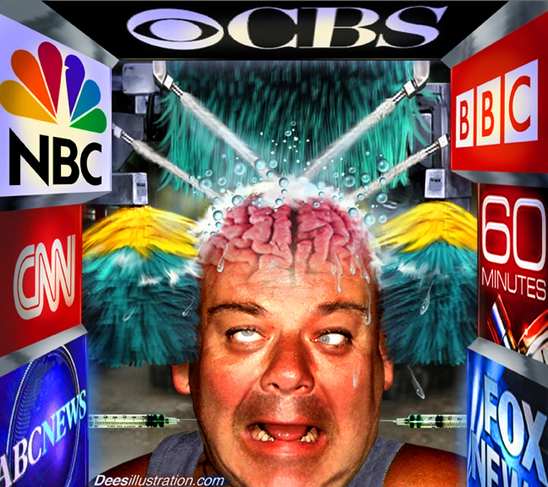
Ask yourselves: why are we being bombarded with crises, distractions, fake news and reality TV politics? We’re being conditioned like lab mice to subsist on a steady diet of bread-and-circus politics and an endless spate of crises.

Caught up in this “crisis of the now,” the average person has a hard time keeping up with and remembering all of the “events,” manufactured or otherwise, which occur like clockwork in order to keep us distracted, deluded, amused, and insulated from reality.

As investigative journalist Mike Adams points out:

“This psychological bombardment is waged primarily via the mainstream media which assaults the viewer by the hour with images of violence, war, emotions and conflict. Because the human nervous system is hard wired to focus on immediate threats accompanied by depictions of violence, mainstream media viewers have their attention and mental resources funneled into the never-ending ‘crisis of the NOW’ from which they can never have the mental breathing room to apply logic, reason or historical context.”

Professor Jacques Ellul studied this phenomenon of overwhelming news, short memories and the use of propaganda to advance hidden agendas. “One thought drives away another; old facts are chased by new ones,” wrote Ellul.

All the while, the government continues to amass more power and authority over the citizenry.

When we’re being bombarded with wall-to-wall news coverage and news cycles that change every few days, it’s difficult to stay focused on one thing—namely, holding the government accountable to abiding by the rule of law—and the powers-that-be understand this.

Yet as John Lennon reminds us, “nothing is real,” especially not in the world of politics.

In other words, it’s all fake, i.e., manufactured, i.e., manipulated to distort reality.

Much like the fabricated universe in Peter Weir’s 1998 film The Truman Show, in which a man’s life is the basis for an elaborately staged television show aimed at selling products and procuring ratings, the political scene in the United States has devolved over the years into a carefully calibrated exercise in how to manipulate, polarize, propagandize and control a population.

This is the magic of the reality TV programming that passes for politics today.

As long as we are distracted, entertained, occasionally outraged, always polarized but largely uninvolved and content to remain in the viewer’s seat, we’ll never manage to present a unified front against tyranny (or government corruption and ineptitude) in any form.

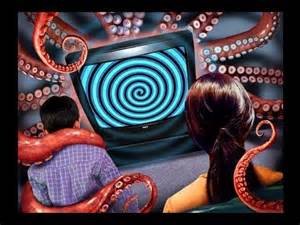
The more that is beamed at us, the more inclined we are to settle back in our comfy recliners and become passive viewers rather than active participants as unsettling, frightening events unfold.

Reality and fiction merge as everything around us becomes entertainment fodder.

We don’t even have to change the channel when the subject matter becomes too monotonous. That’s taken care of for us by the programmers (the corporate media).

“Living is easy with eyes closed,” says Lennon, and that’s exactly what reality TV that masquerades as American politics programs the citizenry to do: navigate the world with their eyes shut.

As long as we’re viewers, we’ll never be doers.

Studies suggest that the more reality TV people watch—and I would posit that it’s all reality TV, entertainment news included—the more difficult it becomes to distinguish between what is real and what is carefully crafted farce.

“We the people” are watching a lot of TV.

On average, Americans spend five hours a day watching television. By the time we reach age 65, we’re watching more than 50 hours of television a week, and that number increases as we get older. And reality TV programming consistently captures the largest percentage of TV watchers every season by an almost 2-1 ratio.

This doesn’t bode well for a citizenry able to sift through masterfully-produced propaganda in order to think critically about the issues of the day, whether it’s fake news peddled by government agencies or foreign entities.

Those who watch reality shows tend to view what they see as the “norm.” Thus, those who watch shows characterized by lying, aggression and meanness not only come to see such behavior as acceptable and entertaining but also mimic the medium.

This holds true whether the reality programming is about the antics of celebrities in the White House, in the board room, or in the bedroom.

It’s a phenomenon called “humilitainment.”

A term coined by media scholars Brad Waite and Sara Booker, “humilitainment” refers to the tendency for viewers to take pleasure in someone else’s humiliation, suffering and pain.

Humilitainment” largely explains not only why American TV watchers are so fixated on reality TV programming but how American citizens, largely insulated from what is really happening in the world around them by layers of technology, entertainment, and other distractions, are being programmed to accept the brutality, surveillance and dehumanizing treatment of the American police state as things happening to other people.

The ramifications for the future of civic engagement, political discourse and self-government are incredibly depressing and demoralizing.

This is what happens when an entire nation—bombarded by reality TV programming, government propaganda and entertainment news—becomes systematically desensitized and acclimated to the trappings of a government that operates by fiat and speaks in a language of force.

Ultimately, the reality shows, the entertainment news, the surveillance society, the militarized police, and the political spectacles have one common objective: to keep us divided, distracted, imprisoned, and incapable of taking an active role in the business of self-government.

Look behind the political spectacles, the reality TV theatrics, the sleight-of-hand distractions and diversions, and the stomach-churning, nail-biting drama, and you will find there is a method to the madness.

How do you change the way people think? You start by changing the words they use.

In totalitarian regimes—a.k.a. police states—where conformity and compliance are enforced at the end of a loaded gun, the government dictates what words can and cannot be used.

In countries where the police state hides behind a benevolent mask and disguises itself as tolerance, the citizens censor themselves, policing their words and thoughts to conform to the dictates of the mass mind.

Even when the motives behind this rigidly calibrated reorientation of societal language appear well-intentioned—discouraging racism, condemning violence, denouncing discrimination and hatred—inevitably, the end result is the same: intolerance, indoctrination, infantilism, the chilling of free speech and the demonizing of viewpoints that run counter to the cultural elite.

Labelling something as “fake news” is a masterful way of dismissing truth that may run counter to the ruling power’s own narrative.

As George Orwell recognized, “In times of universal deceit, telling the truth is a revolutionary act.”

Orwell understood only too well the power of language to manipulate the masses. In Orwell’s 1984, Big Brother does away with all undesirable and unnecessary words and meanings, even going so far as to routinely rewrite history and punish “thoughtcrimes.”

In this dystopian vision of the future, the Thought Police serve as the eyes and ears of Big Brother, while the Ministry of Peace deals with war and defense, the Ministry of Plenty deals with economic affairs (rationing and starvation), the Ministry of Love deals with law and order (torture and brainwashing), and the Ministry of Truth deals with news, entertainment, education and art (propaganda). The mottos of Oceania: WAR IS PEACE, FREEDOM IS SLAVERY, and IGNORANCE IS STRENGTH.

Orwell’s Big Brother relied on Newspeak to eliminate undesirable words, strip such words as remained of unorthodox meanings and make independent, non-government-approved thought altogether unnecessary.

Where we stand now is at the juncture of Oldspeak (where words have meanings, and ideas can be dangerous) and Newspeak (where only that which is “safe” and “accepted” by the majority is permitted).

Truth is often lost when we fail to distinguish between opinion and fact, and that is the danger we now face as a society. Anyone who relies exclusively on television/cable news hosts and political commentators for actual knowledge of the world is making a serious mistake.

Unfortunately, since Americans have by and large become non-readers, television has become their prime source of so-called “news.” This reliance on TV news has given rise to such popular news personalities who draw in vast audiences that virtually hang on their every word.

In our media age, these are the new powers-that-be.

Yet while these personalities often dispense the news like preachers used to dispense religion, with power and certainty, they are little more than conduits for propaganda and advertisements delivered in the guise of entertainment and news.

Given the preponderance of news-as-entertainment programming, it’s no wonder that viewers have largely lost the ability to think critically and analytically and differentiate between truth and propaganda, especially when delivered by way of fake news criers and politicians.

The bottom line is simply this: Americans should beware of letting others—whether they be television news hosts, political commentators or media corporations—do their thinking for them.

A populace that cannot think for themselves is a populace with its backs to the walls: mute in the face of elected officials who refuse to represent us, helpless in the face of police brutality, powerless in the face of militarized tactics and technology that treat us like enemy combatants on a battlefield, and naked in the face of government surveillance that sees and hears all.

As I make clear in my book Battlefield America: The War on the American People and in its fictional counterpart The Erik Blair Diaries, it’s time to change the channel, tune out the reality TV show, and push back against the real menace of the police state.

If not, if we continue to sit back and lose ourselves in political programming, we will remain a captive audience to a farce that grows more absurd by the minute.

The Incantational Bewitchment of Propaganda

By Edward Curtin

Source: Behind the Curtain

“We’ll know our disinformation is complete when everything the America public believe is false.”   – William Casey, CIA Director, February 1981

All propaganda succeeds because it satisfies needs that it has first created.  If you follow the daily rat-a-tat mainstream news reports and react to them, you will be caught in a labyrinth that has been set to entrap you.  You will keep finding that your mind will be like a bed that is already made up and your daylight hours filled with nightmares.  What you assume are your real needs will be met, but you will swiftly tumble into the free-floating anxiety that the media has created to keep you on edge and confused.  They will provide you with objects – Covid-19, the U.S. “withdrawal” from Afghanistan, the Russian and Chinese “threats,” the need to crack down on domestic dissidents, 9/11, etc. (an endless panoply of lies) – that you can attach your anxiety to, but they will be no help. They are not meant to; their purpose is to befuddle; to make you more anxious by wondering if currently there is any contrast between the real world and the apparent one. The corporate mainstream media serve phantasmagoria on a 24/7 basis, all shifting like quicksand.  For anyone with a modicum of common sense, this should be obvious.  But then again, as Thoreau put it:

The commonest sense is the sense of men asleep, which they express by snoring.

Perhaps some health expert will soon recommend that 24 hours of sleep a day is optimal, but maybe I am dreaming or being redundant.

For many decades, the corporate mainstream media and the CIA have been synonymous.  They were married down in hell and now daily do the devil’s work up above.  Now that news is conveyed primarily through digital media via the internet, their power to induce electronic trances has increased exponentially.  Linguistic and visual mind control is their raison d’être.  Fear is their favorite tactic.  And since the fear and anxiety of death is the archetypal source of all anxiety, death becomes a core element in their fear-mongering.

In a recent powerful article, Canadian independent journalist Eva Bartlett, a brave and free war correspondent who has reported from inside Syria and Gaza, has shown how the ongoing Covid-19 “fear porn” spewed out by the media has dramatically increased people’s anxiety levels and thrown so many into a perpetual state of near panic.  This, of course, is not an accident.

Fear immobilizes people and drives them into a cataleptic state where clear thinking is impossible.  They become hypnotized in a “private” space that is actually social, an instantaneous identification with the media news reports that are addressed to millions but feel personal and greatly exacerbate the great loneliness that lies at the core of high-tech society.

As I have said before, the new digital order is the world of teleconferencing and the online life, existence shorn of physical space and time and people. A world where shaking hands is a dissident act. A haunted world of masked specters, distorted words and images that can appear and disappear in a nanosecond. A magic show. A place where, in the words of Charles Manson, you can “get the fear,” where fear is king. A locus where, as you stare at the screens, you are no longer there since you are spellbound.

In a high-tech society, loneliness is far more prevalent than in the past.  The technology has imprisoned people behind their screens and now the controlling forces are intent on closing this mechanistic circle if they can.  They call it The Great Reset.

They have spent decades using technology to invade and pare down people’s inner private space where freedom to think and decide resides.

They have repeated ad nauseam the materialistic mantra that freedom is an illusion and that we are amazing machines determined by our genes and social forces.

They have reiterated that the spiritual and transcendent realms are illusions.

And they have pushed their transhuman agenda to assert more and more power and control.

This is the essence of the corona crisis and the push to vaccinate everyone.

Drip by drip, year by year, they have cultivated the necessary preconditions and predispositions for this technological fascism with its nihilistic underpinnings to succeed.

When the inner dimension of existence is lost, there is no way to critique the outer world, its politics, and social structure.  Dissent becomes a useless passion when people instantly identify with the social. Human nature doesn’t change but social structures and technology do and they can be used to try to destroy people’s humanity.  Herbert Marcuse put it clearly long before the latest digital technology:

This immediate, automatic identification (which may have been characteristic of primitive forms of association) reappears in high industrial civilization; its new ‘immediacy,’ however, is the product of a sophisticated, scientific management and organization. In this process, the “inner” dimension of the mind in which opposition to the status quo can take root is whittled down. The loss of this dimension, in which the power of negative thinking – the critical power of Reason – is at home, is the ideological counterpart to the very material process in which advanced industrial society silences and reconciles the opposition.

Once upon a time, people sat together and talked.  They even touched and shared their thoughts and feelings. They conspired in a most natural way apart from the prying eyes and ears of the electronic spies.  Now so many sit and check their cell phones.  They “connect,” thinking they are with it while not knowing they have been lured into another dimension where frenetic passivity reigns and trance states are the rule.

“Propaganda is the true remedy for loneliness,” said Jacques Ellul in his masterpiece, Propaganda.  He was being simultaneously accurate and facetious.  For propaganda provides a doorway to pseudo-community, a place to lose oneself in the group, to satisfy the need to believe and obey in mass technological society where emotional emptiness and lack of meaning are widespread and the need to fill up the empty self is dutifully met by propaganda, which is a drug by any other name, indeed the primary drug.  The empty-self craves ful-fillment, anything to consume to fill the void that a consumer culture dangles everywhere.  Think alike, buy alike, dress alike – and you will be one big happy community.  It is all abstract of course, even as its rational character is irrational, but that doesn’t matter a whit since the fear of “not going along” and appearing dissident plagues people.

Now we have endless digital propaganda that is the “remedy” for loneliness.  Ah, all the lonely people, keeping their masks in a jar by the side of the door together with Eleanor Rigby.  They think they know what their masks are for but don’t know why they are lonely or that they have been played with. Masks upon masks are donned to ward off the fear that is pumped out through the electronic airwaves.  It is doubtful that many ever heard of William Casey or can imagine the breadth and depth of the propaganda that he and his current protégés in the intelligence agencies and corporate media dispense daily.

“When everything the American people believes is false.”  Casey must be smiling in hell.

A grim submissiveness has settled over the lives of millions of hypnotized people in so many countries.  Grim, grim, grim, as Charles Dickens wrote of his 1842 visit to the puritanical Shaker religious sect in western Massachusetts.  He said:

I so abhor, and from my soul detest, that bad spirit, no matter by what class or sect it may be entertained, which would strip life of its healthful, graces, rob youth of its innocent pleasures, pluck from maturity and age their pleasant ornaments, and make existence but a narrow path to the grave….

And yet, the fundamental things still do apply, as time goes by.  Love, glory, loneliness, beauty, fear, faith, and courage.  Lovers and true artists, fighters both, resist this machine tyranny and its endless lies because they smell a rat intent on destroying their passionate love of the daring adventure that is life.  They feel life is an agon, an arena for struggle, “a fight for love and glory,” a case of do-and-die. They have bull-shit detectors and see through the elites’ propaganda that is used to literally kill millions around the world and to kill the spirit of rebellion in so many others.  And they know that it is in the inner sanctuary of every individual soul where resistance to evil is born and fear is defeated. They know too that the art and love must be shared and this is how social solidarity movements are created.

Listen.  The fight is on.  “This Has Gotta Stop.”

The United States of America’s Doll House: A Vast Tapestry of Lies and Illusions

By Edward Curtin

Source: Behind the Curtain

This is an updated and revised version of the full cover-story that appeared in the important publication, garrison: The Journal of History and Deep Politics, Issue 003.  Issue 004 is due out this week and I urge readers to purchase it.  You will read articles there that you will find no place else, brilliant, eye-opening analyses of issues that the MSM will never touch.

“It never happened. Nothing ever happened. Even while it was happening it wasn’t happening. It didn’t matter. It was of no interest. The crimes of the United States have been systematic, constant, vicious, remorseless, but very few people have actually talked about them. You have to hand it to America. It has exercised a quite clinical manipulation of power worldwide while masquerading as a force for universal good. It’s a brilliant, even witty, highly successful act of hypnosis.”

Harold Pinter’s Nobel Prize Acceptance Speech, 2005

While truth-tellers Julian Assange and Chelsea Manning sit inside jail cells and Edward Snowden lives in exile in Russia, the American people hole up in an illusionary dwelling constructed to reduce them to children afraid of the truth.  Or is it the dark?  This is not new; it has been so for a very long time, but it has become a more sophisticated haunted doll’s house, an electronic one with many bells and whistles and images that move faster than the eye can see. We now inhabit a digital technological nightmare controlled by government and corporate forces intent on dominating every aspect of people’s lives. This is true despite the valiant efforts of dissidents to use the technology for human liberation. The old wooden doll houses, where you needed small fingers to rearrange the furniture, now only need thumbs that can click you into your cell’s fantasy world.  So many dwell there in the fabricated reality otherwise known as propaganda.  The result is mass hallucination.

In a 1969 interview, Jim Garrison, the District Attorney of New Orleans and the only person to ever bring to trial a case involving the assassination of President John F. Kennedy, said that as a result of the CIA’s murderous coup d’état on behalf of the military-industrial-financial-media-intelligence complex that rules the country to this day, the American people have been subjected to a fabricated reality that has rendered them a nation of passive Eichmanns, who sit in their living rooms, popping pills and watching television as their country’s military machine mows down people by the millions and the announcers tell them all the things they should be afraid of, such as bacteria on cutting boards and Russian spies infiltrating their hair salons.  Garrison said:

The creation of such inanities as acceptable reality and unacceptable reality is necessary for the self-preservation of the super-state against its greatest danger: understanding on the part of the people as to what is really happening.  All factors which contribute to its burgeoning power are exaggerated.  All factors which might reveal its corrosive effect on the nation are concealed.  The result is to place the populace in the position of persons living in a house whose windows no longer reveal the outside but on which murals have been painted.  Some of the murals are frightening and have the effect of reminding the occupants of the outside menaces against which the paternal war machine is protecting them.  Other murals are pleasant to remind them how nice things are inside the house.

But to live like this is to live in a doll’s house.  If life has one lesson to teach us, it is that to live in illusion is ultimately disastrous.

In the doll’s house into which America gradually has been converted, a great many of our basic assumptions are totally illusory. [i]

Fifty years have disappeared behind us since the eloquent and courageous Garrison (read On the Trail of the Assassins) metaphorically voiced the truth, despite the CIA’s persistent efforts to paint him as an unhinged lunatic through its media mouthpieces.  These days they would probably just lock him up or send him fleeing across borders, as with Assange, Manning, and Snowden.

It is stunning to take a cue from his comment regarding the JFK assassination, when he suggested that one reverse the lone assassin scenario and place it in the U.S.S.R.  No American could possibly believe a tale that a former Russian soldier, trained in English and having served at a top Soviet secret military base, who had defected to the U.S. and then returned home with the help of the K.G.B., could kill the Russian Premier with a defective and shoddy rifle and then be shot to death in police headquarters in Moscow by a K.G.B. connected hit man so there would be no trial and the K.G.B. would go scot free.  That would be a howler!  So too, of course, are the Warren Commission’s fictions about Oswald.

Snowden, Assange, and Manning

If we then update this mental exercise and imagine that Snowden, Assange, and Manning were all Russian, and that they released information about Russian war crimes, political corruption,  and a system of total electronic surveillance of the Russian population, and were then jailed or sent fleeing into exile as a result, who in the U.S., liberal, libertarian or conservative, would possibly believe the Russian government’s accusations that these three were criminals.

Nevertheless, Barack Obama, the transparency president, made sure to treat them as such, all the while parading as a “liberal” concerned for freedom of speech and the First Amendment.  He made sure that Snowden and Manning were charged under the Espionage Act of 1917, and that Assange was corralled via false Swedish sex charges so he had to seek asylum in the Ecuadorian Embassy in London (a form of jail).  He brought Espionage Act prosecutions against eight people, more than all former presidents combined.   He hypocritically pardoned Manning on his way out the door as if this would polish his deluded liberal legacy after making her suffer terribly through seven years of imprisonment.  He set the stage for Trump to re-jail Manning to try to get this most courageous woman to testify against Assange, which she will not do, and for the collaborationist British government to jail Assange in preparation for his extradition to the United States and a show trial.  As for Snowden, he has been relegated to invisibility, good for news headlines once and for a movie, but now gone and forgotten.

Obama and Trump, arch political “enemies,” have made sure that those who reveal the sordid acts of the American murderous state are cruelly punished and silenced.  This is how the system works, and for most Americans, it is not happening.  It doesn’t matter.  They don’t care, just as they don’t care that Obama backed the 2009 coup d’état in Honduras that has resulted in so many deaths at the hands of U.S trained killers, and then Trump ranted about all these “non-white” people fleeing to the U.S. to escape a hell created by the U.S., as it has been doing throughout Latin America for so long.  Who does care about the truth?  Has anyone even noticed how the corporate media has disappeared the “news” of all those desperate people clamoring to enter the U.S.A. from Mexico?  One day they were there and in the headlines; the next day, gone.  It’s called news.

The Sleepwalkers

But even though a majority of Americans have never believed the government’s explanation for JFK’s murder, they nevertheless have insouciantly gone to sleep for half a century in the doll’s house of illusions as the killing and the lies of their own government have increased over the years and any semblance of a democratic and peaceful America has gone extinct. The fates of courageous whistle-blowers Assange, Manning, and Snowden don’t concern them. The fates of Hondurans don’t concern them.  The fates of Syrians don’t concern them. The fates of Iraqis, Afghans, Yemenis, Palestinians don’t concern them. The fates of America’s victims all around the world don’t concern them.  Indifference reigns.

Obviously, if you are reading this, you are not one of the sleepwalkers and are awake to the parade of endless lies and illusions and do care. But you are in a minority.

That is not the case for most Americans.  When approximately 129 million people cast their votes for Donald Trump and HilIary Clinton in the 2016 presidential election, you know idiocy reigns and nothing has been learned. Ditto for the votes for Obama, Bush, Clinton, et al.  You can keep counting back.  It is an ugly fact and sad to say.  Such a repetition compulsion is a sign of a deep sickness, and it will no doubt be repeated in the 2020 election.  The systemic illusion must be preserved at all costs and the warfare state supported in its killing.  It is the American way.

It is true that average Americans have not built the doll’s house; that is the handiwork of the vast interconnected and far-reaching propaganda arms of the U.S. government and their media accomplices.  But that does not render them innocent for accepting decades of fabricated reality for so-called peace of mind by believing that a totally corrupt system works.  The will to believe is very powerful, as is the propaganda.   The lesson that Garrison spoke of has been lost on far too many people, even on those who occasionally leave the doll house for a walk, but who only go slightly down the path for fear of seeing too much reality and connecting too many dots.  There is plain ignorance, then there is culpable ignorance, to which I shall return.

Denying Existential Freedom

One of the first things an authoritarian governing elite must do is to convince people that they are not free.  This has been going on for at least forty years, ever since the Church Committee’s revelations about the CIA in the mid-seventies, including its mind-control program, MKULTRA.  Everyone was appalled at the epiphany, so a different tactic was added.  Say those programs have been ended when in fact they were continued under other even deeper secret programs, and just have “experts” – social, psychological, and biological “scientists” – repeat ad infinitum that there is no longer any mind control since we now know there is no mind; it is an illusion, and it all comes down to the brain.  Biology is destiny, except in culturally diversionary ways in which freedom to choose is extolled – e.g. the latest fashions, gender identity, the best hair style, etc.  Create and lavishly fund programs for the study of the brain, while supporting and promoting a vast expansion of pharmaceutical drugs to control people.  Do this in the name of helping people with their emotional and behavioral problems that are rooted in their biology and are beyond their control.  And create criteria to convince people that they are sick and that their distress has nothing to do with the coup d’état that has rendered them “citizens” of a police state.

We have been interminably told that our lives revolve around our brains (our bodies) and that the answers to our problems lie with more brain research, drugs, genetic testing, etc. It is not coincidental that the U. S. government declared the 1990s the decade of brain research, followed up with 2000-2010 as the decade of the behavior project, and our present decade being devoted to mapping the brain and artificial intelligence, organized by the Office of Science and Technology Project and the Defense Advanced Research Projects Agency (DARPA). How convenient! George H. W. Bush, Clinton, George W. Bush, Obama, Trump — what a difference! But this is science and the welfare of the world.  Science for idiots.

Drip by drip, here and there, in the pattern of the best propaganda, as the French sociologist Jacques Ellul says – “for propaganda is not the touch of the magic wand. It is based on slow, constant impregnation. It creates conviction and compliance through imperceptible influences that are effective only by continuous repetition”[ii] – articles, books, media reports have reiterated that people are “determined” by biological, genetic, social, and psychological forces over which they have no control. To assert that people are free in the Sartrean sense (en soir, condemned to freedom, or free will) has come to be seen as the belief of a delusional fool living in the past , a bad philosopher, an anti-scientist, a poorly informed religionist, one nostalgic for existential cafes, Gauloises, and black berets.  One who doesn’t grasp the truth since he doesn’t read the New York Times or watch CBS television. One who believes in nutty conspiracy theories.

The conventional propaganda – I almost said wisdom – created through decades-long media and academic repetition, is that we are not free.

Let me repeat: we are not free.  We are not free.

Investigator reporter John Rappoport has consistently exposed the propaganda involved in the creation and expansion of the Diagnostic and Statistical Manual (DSM) with its pseudo-scientific falsehoods and collusion between psychiatrists and the pharmaceutical industry.  As he correctly notes, the CIA’s MKULTRA mind-control program has morphed into modern psychiatry, both with the same objectives of disabling and controlling people by convincing them that they are not free and are in need of a chemical brain bath.[iii]

Can anyone with an awareness of this history doubt there is a hidden hand behind this development?  Once you have convinced people that they are not free in the most profound sense, the rest is child’s play.  Convinced that they are puppets, they become puppets to be willingly jerked around.

“He played with me just as I used to play with dolls,” says Nora in Ibsen’s A Doll’s House.

Now who would want to get people to believe they were not free?  The answer is obvious given a minute of thought.  It is not just Nora’s husband Torvald.

Perfect examples of the persistence of the long-term, repetitive, impregnating propaganda appear in news headlines constantly.  Here is an egregious example concerning the little understood case of the assassination of Senator Robert Kennedy.  On Friday, August 30, 2019, Sirhan, who has been in prison for fifty-two years for the murder of RFK that he did not commit, was stabbed by another prisoner.  A quick click through the MSM headlines reporting this showed the same words repeated by all the corporate media as they fulfilled their function as CIA stenographers. One example, from CBS News, will suffice: “Robert Kennedy assassin hospitalized after prison stabbing.”[iv]  RFK assassin, RFK assassin, RFK assassin … all the media said the same thing, which they have been doing for fifty-two years. Their persistency endures despite all the facts that refute their disinformation and show that Senator Kennedy, who was on his way to becoming president, was murdered, like his brother John, by forces of the national security state.

Sartre and Bad Faith

Lying and dissembling are ubiquitous.  Being deceived by the media liars is mirrored in people’s personal lives.  People lie and want to be deceived.  They choose to play dumb, to avoid a confrontation with truth.  They want to be nice (Latin, nescire, not to know, to be ignorant) and to be liked.  They want to tuck themselves into a safe social and cultural framework where they imagine they will be safe. They like the doll’s house. They choose to live in what Jean Paul Sartre called bad faith (mauvaise foi):  In Existential Psychoanalysis he put it thus:

In bad faith it is from myself that I am hiding the truth. But with this ‘lie’ to myself, the one to whom the lie is told and the one who lies are one and the same person, which means that I must know in my capacity as deceiver the truth which is hidden from me in my capacity as the one deceived.

Such bad faith allows people to fabricate a second act of bad faith: that they are not responsible for their ignorance of the truths behind the government’s and corporate media’s lies and propaganda, even as the shades of the prison house ominously close around us and the world edges toward global death that could arrive in an instant with nuclear war or limp along for years of increasing suffering.

Those of us who write about the U.S. led demented wars and provocations around the world and the complementary death of democracy at home are constantly flabbergasted and discouraged by the willed ignorance of so many Americans.  For while the mainstream media does the bidding of the power elite, there is ample alternative news and analyses available on the internet from fine journalists and writers committed to truth, not propaganda. There is actually far too much truth available, which poses another problem. But it doesn’t take a genius to learn how to research important issues and to learn how to distinguish between bogus and genuine information.  It takes a bit of effort, and, more importantly, the desire to compare multiple, opposing viewpoints and untangle the webs the Web weaves.  We are awash in information (and disinformation) and both good and bad reporting, but it is still available to the caring inquirer.

The problem is the will to know.  But why?  Why the refusal to investigate and question; why the indifference?  Stupidity?  Okay, there is that.  Ignorance?  That too.  Willful ignorance, ditto.  Laziness, indeed. Careerism and ideology?  For certain.  Upton Sinclair put it mildly when he said, “It is difficult to get a man to understand something, when his salary depends on not understanding it.”  Difficult?  No, it’s almost impossible.

But then there are many very intelligent people who have nothing to lose and yet adamantly refuse to entertain alternative possibilities to the reigning orthodoxies that have them in their grip.  As do many others, I know many such people who will yes me to death and then never fully research issues.  They will remain in limbo or else wink to themselves that what may be true couldn’t be true.  They close down.  This is a great dilemma and frustration faced by those who seek to convince people to take an active part in understanding what is really going on in the world today, especially as the United States wages war across the globe, threatens Russia, China, and Iran, among many others, and expands and modernizes its nuclear weapons capabilities.

As for Assange, Manning, and Snowden, their plight matters not a whit.  In fact, they have been rendered invisible inside the doll’s house, except as the murals on the windows flash back their images as threats to the occupants, Russian monsters out to eat them up.  As the great poet Constantine Cavafy wrote long ago in his poem “Waiting for the Barbarians” and they never come: “Now what’s going to happen to us without barbarians?  Those people were a kind of solution.”  Then again, for people like U.S. Representative Adam Schiff, who knows the Russian barbarians have and will come again, life must be terrifying as he tries so manfully to bar the gates.  The Russians have been the American solution in this fairy tale for so long that it’s hard for many Americans to believe another story.

The Two-Headed Monster

On the one hand, there is the massive propaganda apparatus operated by American intelligence agencies in conjunction with their media partners.

On the other, there is the human predilection for untruth and illusions, the sad need to be comforted and to submit to greater “authority,” gratefully to accept the myths proffered by one’s masters.  This tendency applies not just to the common people, but even more so to the intellectual classes, who act as though they are immune.  Erich Fromm, writing about Germans and Hitler, but by extension people everywhere, termed this the need to “escape from freedom,” since freedom conjures up fears of vertiginous aloneness and the need to decide, which in turn evokes the fear of death.[v]  There are also many kinds of little deaths that precede the final one: social, career, money, familiar, etc., that are used to keep people in the doll’s house.

Fifty years ago, the CIA coined the term “conspiracy theory” as a weapon to be used to dismiss the truths expressed by critics of its murder of President Kennedy, and those of Malcom X, MLK, and RFK.  All the media echoed the CIA line.  While they still use the term to dismiss and denounce, their control of the mainstream media is so complete today that every evil government action is immediately seconded, whether it be the lies about the attacks of September 11, 2001, the wars against Afghanistan, Iraq, Syria, Libya, Yemen, Iran, etc., the coups disguised as color revolutions in Ukraine, Venezuela, Bolivia, Hong Kong, the downing of the Malaysian jetliner there, drone murders, the Iranian “threat,” the looting of the American people by the elites, alleged sarin gas attacks in Syria, the anti-Russia bashing and the Russia-gate farce, the “criminals” Assange, Manning, Snowden – everything.  The New York Times, Wall Street Journal, The Guardian, Fox News, the Washington Post, CNN, NPR, etc. – all are stenographers for the deep state.

So much of the ongoing propaganda travels under the banner of “the war on terror,” which is, of course, an outgrowth of the attacks of September 11, 2001, appropriately named and constantly reinforced as 9/11 in a wonderful example of linguistic mind-control: a constant emergency reminder to engender anxiety, depression, panic, and confusion, four of the symptoms that lead the DSM “experts” and their followers to diagnose and drug individuals.  The term 9/11 was first used in the New York Times on September 12, 2001 by Bill Keller, the future Times’ editor and Iraq war cheerleader.  Just a fortuitous coincidence, of course.Jacques Ellul on Propaganda

Jacques Ellul has argued convincingly that modern propaganda in a technological mass society is more complicated than the state and media lying and deceiving the population.  He argues that propaganda meets certain needs of modern people and therefore the process of deceit is reciprocal.  The modern person feels lost, powerless, and empty. Ellul says, “He realizes that he depends on decisions over which he has no control, and that realization drives him to despair.”  But he can’t live in despair; desires that life be meaningful; and wants to feel he lives in a world that makes sense.  He wants to participate and have opinions that suggest he grasps the flow of events.  He doesn’t so much want information, but value judgments and preconceived positions that provide him with a framework for living.  Ellul wrote the following in 1965 in his classic book Propaganda:

The majority prefers expressing stupidities to not expressing any opinion: this gives them the feeling of participation.  For they need simple thoughts, elementary explanations, a ‘key’ that will permit them to take a position, and even ready-made opinions….The man who keeps himself informed needs a framework….the more complicated the problems are, the more simple the explanations must be; the more fragmented the canvas, the simpler the pattern; the more difficult the question, the more all-embracing the solution; the more menacing the reduction of his own worth, the greater the need for boosting his ego.  All this propaganda – and only propaganda – can give him.[vi]

Another way of saying this is that people want to be provided with myths to direct them to the “truth.”  But such so-called truth has been preconceived within the overarching myth provided by propaganda, and while it satisfies people’s emotional need for coherence, it also allows them to think of themselves as free individuals arriving at their own conclusions, which is a basic function of good propaganda.  In today’s mass technological society, it is essential that people be convinced that they are free-thinking individuals acting in good faith.  Then they can feel good about themselves as they lie and act in bad faith.

Culpable Ignorance

It is widely accepted that political leaders and the mass media lie and dissemble regularly, which, of course, they do. That is their job in an oligarchy.  Today we are subjected to almost total, unrelenting media and government propaganda. Depending on their political leanings, people direct their anger toward politicians of parties they oppose and media they believe slant their coverage to favor the opposition.  Trump is a liar.  No, Obama is a liar.  And Hillary Clinton.  No, Fox News.  Ridiculous! – it’s CNN or NBC.  And so on and so forth in this theater of the absurd that plays out within a megaplex of mainstream media propaganda, where there are many shows but one producer, whose overall aim is to engineer the consent of all who enter, while setting the different audiences against each other.  It is a very successful charade that evokes name-calling from all quarters.

In other words, for many people their opponents lie, as do other people, but not them. This is as true in personal as well as public life.  Here the personal and the political converge, despite protestations to the contrary.  Dedication to truth is very rare.

But there is another issue with propaganda that complicates the picture further.  People of varying political persuasions can agree that propaganda is widespread.  Many people on the left, and some on the right, would agree with Lisa Pease’s statement in her book on the RFK assassination, A Lie Too Big to Fail: The Real History of the Assassination of Robert F. Kennedy, that “the way the CIA took over America in the 1960s is the story of our time.” [vii]  That is also what Garrison thought when he spoke of the doll’s house.

If that is so, then today’s propaganda is anchored in the events of the 1960s, specifically the infamous government assassinations of JFK, Malcolm X, MLK, and RFK, the truth of which the CIA has worked so hard to conceal. In the fifty or so years since, a vast amount of new information has made it explicitly clear that these murders were carried out by elements within the U.S. government, and were done so to silence the voices of four charismatic leaders who were opposed to the American war machine and the continuation of the Cold War. To turn away from this truth and to ignore its implications can only be described as an act of bad faith and culpable ignorance, or worse.  But that is exactly what many prominent leftists have done.  Then to compound the problem, they have done the same with the attacks of September 11, 2001.

One cannot help thinking of what the CIA official Cord Meyer called these people in the 1950s: “the compatible left.”  He felt that effective CIA propaganda, beside the need for fascist-minded types such as Allen Dulles and James Jesus Angleton, depended on “courting” leftists and liberal into its orbit. For so many of the compatible left, those making a lot of money posing as opponents of the ruling elites but often taking the money of the super-rich, the JFK assassination and the truth of September 11, 2001 are inconsequential, never to be broached, as if they never happened, except as the authorities say they did. By ignoring these most in-your-face events with their eyes wide shut, a coterie of influential leftists has done the work of Orwell’s crime-stop and has effectively succeeded in situating current events in an ahistorical and therefore misleading context that abets U.S. propaganda.  They truncate the full story to present a narrative that distorts the truth.

Without drawing a bold line connecting the dots from November 22, 1963 up to the present, a critique of the murderous forces ruling the United States is impossible.

Among the most notable of such failures are Noam Chomsky, Alexander Cockburn, Howard Zinn, and Chris Hedges, men idolized by many liberals and leftists.  And there are many others who have been deeply influenced by Chomsky, Cockburn, and Zinn and follow in their footsteps.  Their motivations remain a mystery, but there is no doubt their refusals have contributed to the increased power of those who control the doll’s house.  To know better and do as they have is surely culpable ignorance.

From Bad to Worse

Ask yourself: Has the power of the oligarchic, permanent warfare state with its propaganda and spy networks, increased or decreased in the past half century?  Who is winning the battle, the people or the ruling elites?  The answer is obvious. It matters not at all whether the president has been Trump or Bill Clinton, Ronald Reagan or George W. Bush, Barack Obama or George H. W. Bush, Richard Nixon or Jimmy Carter.  The power of the national security state has grown under them all and everyone is left to moan and groan and wonder why.  All the while the doll’s house has become more and more sophisticated and powerful with the growth of electronic media and cell phone usage.

The new Cold War now being waged against Russia and China is a bi-partisan affair, as is the confidence game played by the secret government intended to create a fractured consciousness in the population.  This fragmentation of consciousness prevents people from grasping the present from within because so many suffer from digital dementia as their attention hops from input to output in a never-ending flow of mediated, disembodied data. Trump and his followers on one side of the coin; liberal Democrats on the other. The latter, whose bibles are the New York Times, NPR, The Washington Post, Democracy Now, The Guardian, etc. – can only see propaganda when they can attribute it to Trump or the Russians. The former see everything as a liberal conspiracy to take down Trump.  The liberals have embraced a new McCarthyism and allied themselves with the deep-state forces that they were once allegedly appalled by, including Republicans.  Their embrace of the formerly despised war-monger John Bolton in the impeachment trial of Trump is a laughable case in point, if it weren’t so depraved and slimy.  It surely isn’t the bloodthirsty policies of the Trump administration or his bloviating personality, for these liberals allied themselves with Obama’s anti-Russian rhetoric, his support for the U.S. orchestrated neo-fascist Ukrainian coup, his destruction of Libya, his wars of aggression across the Middle East, his war on terror, his trillion dollar nuclear weapons modernization, his enjoyment of drone killing, his support for the coup in Honduras, his embrace of the CIA and his CIA Director John Brennan, his prosecution of whistle-blowers, etc.  The same media that served the CIA so admirably over the decades became the liberals’ paragons of truth.  It’s enough to make your head spin, which is the point.  Spin left, spin right, spin all around, because we have possessed your mind in this spectacular image game where seeming antinomies are the constancy of the same through difference, all the presidents coined by the same manufacturer who knows that coin flipping serves to entertain the audience eager for hope and change.

This is how the political system works to prevent change.  It is why little has changed for the better over half a century and the American empire has expanded.  While it may be true that there are signs that this American hegemony is coming to an end (I am not convinced), I would not underestimate the power of the U.S. propaganda apparatus to keep people docile and deluded in the doll’s house, despite the valiant efforts of independent truth-tellers.

How, for example, is it possible for so many people to see such a stark difference between the despicable Trump and the pleasant Obama?  They are both puppets dancing to their masters’ tunes – the same masters.  They both front for the empire.

In his excellent book, Obama’s Unending Wars: Fronting the Foreign Policy of the Permanent Warfare State, Jeremy Kuzmarov assiduously documents Obama’s crimes, including his CIA background.[viii] As Glen Ford, of Black Agenda Report, says in the first sentence of his forward, “Barack Obama may go down in presidential history as the most effective-and deceptive-imperialist of them all.” Read the book if you want all the details.  They form an overwhelming indictment of the con artist and war criminal that is irrefutable.  But will those who worship at the altar of Barack Obama read it?  Of course not.  Just as those deluded ones who voted for the reality television flim-flam man Trump will ignore all the accumulating evidence that they’ve been had and are living under a president who is Obama’s disguised doppelganger, carrying out the orders of his national security state bosses. This, too, is well documented, and no doubt another writer will arise in the years to come to put it between a book’s covers.

Yet even Jeremy Kuzmarov fails to see the link between the JFK assassination and Obama’s shilling for the warfare state.  His few references to Kennedy are all negative, suggesting he either is unaware of what Kennedy was doing in the last year of his life and why he was murdered by the CIA, or something else.  He seems to follow Noam Chomsky, a Kennedy hater, in this regard.  I point out this slight flaw in an excellent book because it is symptomatic of certain people on the left who refuse to complete the circle.  If, as Kuzmarov, argues, Obama was CIA from the start and that explains his extraordinarily close relationship with the CIA’s John Brennan, an architect, among many things, of the CIA’s extraordinary rendition program, and that Obama told CIA Director Panetta that the CIA would “get everything it wanted,” and the CIA killed JFK, well, something’s amiss, an enormous gap in the analysis of our current condition.

The doll’s house is a mind game of extraordinary proportions, orchestrated by the perverted power elites that run the show and ably abetted by their partners in the corporate mass media, even some in the alternative press who mean well but are confused, or are disinformation agents in the business of sowing confusion together with their mainstream Operation Mockingbird partners.  It is a spectacle of open secrecy, in which the CIA has effectively suckered everyone into a game of to-and-fro in which only they win.

Our only hope for change is to try and educate as many people as possible about the linkages between  events that started with the CIA coup d’état in Dallas on November 22, 1963, continued through the killings of Malcolm X, MLK, RFK and on through so much else up to September 11, 2001, and have brought us to the deeply depressing situation we now find ourselves in where truthtellers like Julian Assange, Chelsey Manning, and Edward Snowden are criminalized, while the real perpetrators of terrible evils roam free.

Yes, we must educate but also agitate for the release of this courageous trio.  Their freedom is ours; their imprisonment is ours, whether we know it or not.  The walls are closing in.

Lisa Pease is so right: “The way the CIA took over America in the 1960s is the story of our time, and too few recognize this.  We can’t fix a problem we can’t even acknowledge exists.”

If we don’t follow her advice, we will be toyed with like dolls for a long time to come.  There will be no one else to blame.


  1. Interview with Jim Garrison, District Attorney of Parish of Orleans, Louisiana, May 27, 1969, kennedysandking.com
  2. Propaganda: The Formation of Men’s Attitudes, Jacques Ellul, Vintage Books, 1973, pp. 17-18
  3. CIA mind control morphed into psychiatry?” Jon Rappoport, com, July 11, 2017
  4. Robert Kennedy assassin Sirhan Sirhan hospitalized after prison stabbing,” Caroline Linton, CBS, August 31, 2019
  5. Escape from Freedom, Erich Fromm, Rinehart & Company, Inc., 1941
  6. Ellul, op cit., p. 140
  7. A Lie Too Big To Fail, Lisa Pease, Feral House, 2018, pp.500-501
  8. Obama’s Unending Wars: Fronting the Foreign Policy of the Permanent Warfare State, Jeremy Kuzmarov, Clarity Press, 2019

Jacques Ellul: A Prophet for Our Tech-Saturated Times

Read his works to understand how we’ve been caught in technology’s nightmarish hold.

By Andrew Nikiforuk

Source: The Tyee

By now you have probably read about the so-called “tech backlash.”

Facebook and other social media have undermined what’s left of the illusion of democracy, while smartphones damage young brains and erode the nature of discourse in the family.

Meanwhile computers and other gadgets have diminished our attention spans along with our ever-failing connection to reality.

The Foundation for Responsible Robotics recently created a small stir by asking if “sexual intimacy with robots could lead to greater social isolation.”

What could possibly go wrong?

The average teenager now works about two hours of every day — for free — providing Facebook and other social media companies with all the data they need to engineer young people’s behaviour for bigger Internet profits.

Without shame, technical wonks now talk of building artificial scientists to resolve climate change, poverty and, yes, even fake news.

The media backlash against Silicon Valley and its peevish moguls, however, typically ends with nothing more radical than an earnest call for regulation or a break-up of Internet monopolies such as Facebook and Google.

The problem, however, is much graver, and it is telling that most of the backlash stories invariably omit any mention of technology’s greatest critic, Jacques Ellul.

The ascent of technology

Ellul, the Karl Marx of the 20th century, predicted the chaotic tyranny many of us now pretend is the good and determined life in technological society.

He wrote of technique, about which he meant more than just technology, machines and digital gadgets but rather “the totality of methods rationally arrived at and having absolute efficiency” in the economic, social and political affairs of civilization.

For Ellul, technique, an ensemble of machine-based means, included administrative systems, medical tools, propaganda (just another communication technique) and genetic engineering.

The list is endless because technique, or what most of us would just call technology, has become the artificial blood of modern civilization.

“Technique has taken substance,” wrote Ellul, and “it has become a reality in itself. It is no longer merely a means and an intermediary. It is an object in itself, an independent reality with which we must reckon.”

Just as Marx deftly outlined how capitalism threw up new social classes, political institutions and economic powers in the 19th century, Ellul charted the ascent of technology and its impact on politics, society and economics in the 20th.

My copy of Ellul’s The Technological Society has yellowed with age, but it remains one of the most important books I own. Why?

Because it explains the nightmarish hold technology has on every aspect of life, and also remains a guide to the perplexing determinism that technology imposes on life.

Until the 18th century, technical progress occurred slowly and with restraint. But with the Industrial Revolution it morphed into something overwhelming due in part to population, cheap energy sources and capitalism itself.

Since then it has engulfed Western civilization and become the globe’s greatest colonizing force.

“Technique encompasses the totality of present-day society,” wrote Ellul. “Man is caught like a fly in a bottle. His attempts at culture, freedom, and creative endeavour have become mere entries in technique’s filing cabinet.”

Ellul, a brilliant historian, wrote like a physician caught in the middle of a plague or physicist exposed to radioactivity. He parsed the dynamics of technology with a cold lucidity.

Yet you’ve probably never heard of the French legal scholar and sociologist despite all the recent media about the corrosive influence of Silicon Valley.

His relative obscurity has many roots. He didn’t hail from Paris, but rural Bordeaux. He didn’t come from French blue blood; he was a “meteque.”

He didn’t travel much, criticized politics of every stripe and was a radical Christian.

But in 1954, just a year before American scientists started working on artificial intelligence, Ellul wrote his monumental book, The Technological Society.

The dense and discursive work lays out in 500 pages how technique became for civilization what British colonialism was for parts of 19th-century Africa: a force of total domination.

In the book Ellul explains in bold and uncompromising terms how the logic of technological innovation conquered every aspect of human culture.

Ellul didn’t regard technology as inherently evil; he just recognized that it was a self-augmenting force that engineered the world on its terms.

Machines, whether mechanical or digital, aren’t interested in truth, beauty or justice. Their goal is to make the world a more efficient place for more machines.

Their proliferation combined with our growing dependence on their services inevitably led to an erosion of human freedom and unintended consequences in every sphere of life.

Ellul was one of the first to note that you couldn’t distinguish between bad and good effects of technology. There were just effects and all technologies were disruptive.

In other words, it doesn’t matter if a drone is delivering a bomb or book or merely spying on the neighbourhood, because technique operates outside of human morality: “Technique tolerates no judgment from without and accepts no limitations.”

Facebook’s mantra “move fast and break things” epitomizes the technological mindset.

But some former Facebook executives such as Chamath Palihapitiya belatedly realized they have engineered a force beyond their control. (“The short-term dopamine-driven feedback loops that we have created are destroying how society works,” Palihapitiya has said.)

That, argued Ellul, is what technology does. It disrupts and then disrupts again with unforeseen consequences, requiring more techniques to solve the problems created by latest innovations.

As Ellul noted back in 1954, “History shows that every technical application from its beginnings presents certain unforeseeable secondary effects which are more disastrous than the lack of the technique would have been.”

Ellul also defined the key characteristics of technology.

For starters, the world of technique imposes a rational and mechanical order on all things. It embraces artificiality and seeks to replace all natural systems with engineered ones.

In a technological society a dam performs better than a running river, a car takes the place of the pedestrians — and may even kill them — and a fish farm offers more “efficiencies” than a natural wild salmon migration.

There is more. Technique automatically reduces actions to the “one best way.” Technical progress is also self-augmenting: it is irreversible and builds with a geometric progression.

(Just count the number of gadgets telling you what to do or where to go or even what music to play.)

Technology is indivisible and universal because everywhere it goes it shows the same deterministic face with the same consequences. And it is autonomous.

By autonomous, Ellul meant that technology had become a determining force that “elicits and conditions social, political and economic change.”

The role of propaganda

The French critic was the first to note that technologies build upon each other and therefore centralize power and control.

New techniques for teaching, selling things or organizing political parties also required propaganda.

Here again Ellul saw the future.

He argued that propaganda had to become as natural as breathing air in a technological society, because it was essential that people adapt to the disruptions of a technological society.

“The passions it provokes — which exist in everybody — are amplified. The suppression of the critical faculty — man’s growing incapacity to distinguish truth from falsehood, the individual from the collectivity, action from talk, reality from statistics, and so on — is one of the most evident results of the technical power of propaganda.”

Faking the news may have been a common practice on Soviet radio during Ellul’s day, but it is now a global phenomenon leading us towards what Ellul called “a sham universe.”

We now know that algorithms control every aspect of digital life and have subjected almost aspect of human behaviour to greater control by techniques whether employed by the state or the marketplace.

But in 1954 Ellul saw the beast emerging in infant form.

Technology, he wrote, can’t put up with human values and “must necessarily don mathematical vestments. Everything in human life that does not lend itself to mathematical treatment must be excluded… Who is too blind to not see that a profound mutation is being advocated here.”

He, too, warned about the promise of leisure provided by the mechanization and automatization of work.

“Instead of being a vacuum representing a break with society,” our leisure time will be “literally stuffed with technical mechanisms of compensation and integration.”

Good citizens today now leave their screens at work only to be guided by robots in their cars that tell them the most efficient route to drive home.

At home another battery of screens awaits to deliver entertainments and distractions, including apps that might deliver a pizza to the door.

Stalin and Mao would be impressed — or perhaps disappointed — that so much social control could be exercised with such sophistication and so little bloodletting.

Ellul wasn’t just worried about the impact of a single gadget such as the television or the phone but “the phenomenon of technical convergence.”

He feared the impact of systems or complexes of techniques on human society and warned the result could only be “an operational totalitarianism.”

“Convergence,” he wrote, “is a completely spontaneous phenomenon, representing a normal stage in the evolution of technique.”

Social media, a web of behavioural and psychological systems, is just the latest example of convergence.

Here psychological techniques, surveillance techniques and propaganda have all merged to give the Russians and many other groups a golden opportunity to intervene in the political lives of 126 million North Americans.

Social media has achieved something novel, according to former Facebook engineer Sam Lessin.

For the first time ever a political candidate or party can “effectively talk to each individual voter privately in their own home and tell them exactly what they want to hear… in a way that can’t be tracked or audited.”

In China the authorities have gone one step further. Using the Internet the government can now track the movements of every citizen and rank their political trustworthiness based on their history of purchases and associations. It is, of course, a fantastic “counterterrorism” tool.

The Silicon Valley moguls and the digerati promised something less totalitarian. They swore that social media would help citizens fight bad governments and would connect all of us.

Facebook, vowed the pathologically adolescent Mark Zuckerberg, would help the Internet become “a force for peace in the world.”

But technology obeys its own rules and prefers “the psychology of tyranny.”

The digerati also promised that digital technologies would usher in a new era of decentralization and undo what mechanical technologies have already done: centralize everything into big companies, big boxes and big government.

Technology assuredly fragments human communities, but in the world of technique centralization remains the norm.

“The idea of effecting decentralization while maintaining technical progress is purely utopian,” wrote Ellul.

Towards ‘hypernormalization’

It is worth noting that the word “normal” didn’t come into currency until the 1940s along with technological society.

In many respects global society resembles the Soviet Union just prior to its collapse when “hypernormalization” ruled the day.

A recent documentary defined what hypernormalization did for Russia: it “became a society where everyone knew that what their leaders said was not real, because they could see with their own eyes that the economy was falling apart. But everybody had to play along and pretend that it was real because no one could imagine any alternative.”

In many respects technology has hypernormalized a technological society in which citizens exercise less and less control over their lives every day and can’t imagine anything different.

Throughout his life Ellul maintained that he was “neither by nature, nor doctrinally, a pessimist, nor have I pessimistic prejudices. I am concerned only with knowing whether things are so or not.”

He called a spade a spade, and did not sugarcoat his observations.

If you are growing more anxious about our hypernormalized existence and are wondering why you own a phone that tracks your every movement, then read The Technological Society.

Ellul believed that the first act of freedom a citizen can exercise is to recognize the necessity of understanding technique and its colonizing powers.

Resistance, which is never futile, can only begin by becoming aware and bearing witness to the totalitarian nature of technological society.

Ellul believed that Christians had a special duty to condemn the worship of technology, which has become society’s new religion.

To Ellul, resistance meant teaching people how to be conscious amphibians, with one foot in traditional human societies, and to purposefully choose which technologies to bring into their communities.

Only citizens who remain connected to traditional human societies can see, hear and understand the disquiet of the smartphone blitzkrieg or the Internet circus.

Children raised by screens and vaccinated only by technology will not have the capacity to resist, let alone understand, this world any more than someone born in space could appreciate what it means to walk in a forest.

Ellul warned that if each of us abdicates our human responsibilities and leads a trivial existence in a technological society, then we will betray freedom.

And what is freedom but the ability to overcome and transcend the dictates of necessity?

In 1954, Ellul appealed to all sleepers to awake.

Read him. He remains the most revolutionary, prophetic and dangerous voice of this or any century.

Reviving the Spirit of Existential Rebellion in a World of Propaganda, Lies, and Self Deception

By Edward Curtin

Source: Dissident Voice

Search for nothing anymore, nothing except truth.
Be very still and try to get at the truth.
And the first question to ask yourself is:
How great a liar am I?
— D. H. Lawrence, Search For Truth

Like existential freedom, honesty and truth-seeking demand a perpetually renewed commitment. No one ever fully arrives, and all of us are blown off course on the journey.  Even when we think we have reached our destination, we are often startled by the enigma of arrival, and must set sail again.  We are all in the same boat. The search for truth is a process, an experiment, an essay – a trying without end.

Yet surely it is not an exaggeration to say that most people are liars and self-deceivers.  Honesty, while touted as a virtue, is practiced far less than it is praised.  There is almost nothing that people are less honest about than their attitudes toward honesty.  Few think of themselves as dishonest, and even to hint that someone is so is received as a great insult that usually elicits an angry response.  So most people follow the advice of the character Jean-Baptiste Clamence from Albert Camus’ The Fall: “Promise to tell the truth and then lie as best you can.”  In that way you satisfy your own and others’ secret desires for deception and play-acting, and other people will love you for it.

However, it is widely accepted that political leaders and the mass media lie and dissemble regularly, which, of course, they do. That is their job in an oligarchy.  Today we are subjected to almost total, unrelenting media and government propaganda. Depending on their political leanings, people direct their anger toward politicians of parties they oppose and media they believe slant their coverage to favor the opposition.  Trump is a liar.  No, Obama is a liar.  And Hillary Clinton.  No, Fox News. Ridiculous! – it’s CNN or NBC.  And so on and so forth in this theatre of the absurd that plays out within a megaplex of mainstream media (MSM) propaganda, where there are many shows but one producer, whose overall aim is to engineer the consent of all who enter while setting the different audiences against each other.  It is a very successful charade that evokes name-calling from all quarters.

In other words, for many people their opponents lie, as do other people, but not them. This is as true in personal as well as public life. Here the personal and the political converge, despite protestations to the contrary.

Sartre and Bad Faith

Lying and dissembling are ubiquitous.  Being lied to by the MSM is mirrored in people’s personal lives.  People lie and want to be deceived. They choose to play dumb, to avoid a confrontation with truth.  They want to be nice (Latin, nescire, not to know, to be ignorant) and to be liked.  They want to tuck themselves into a safe social and cultural framework where they imagine they will be safe. They choose to live in what Jean Paul Sartre called bad faith (mauvaise foi).  He put it as follows:

In bad faith it is from myself that I am hiding the truth. But with this “lie” to myself, the one to whom the lie is told and the one who lies are one and the same person, which means  that I must know in my capacity as deceiver the truth which is hidden from me in my capacity as the one deceived.

Such bad faith allows people to fabricate a second act of bad faith: that they are not responsible for their ignorance of the truths behind the government’s and corporate media’s lies and propaganda, even as the shades of the prison house ominously close around us and the world edges toward global death that could arrive in an instant with nuclear war or limp along for years of increasing suffering.

Those of us who write about the U.S.-led demented wars and provocations around the world and the complementary death of democracy at home are constantly flabbergasted and discouraged by the willed ignorance of so many Americans.  For while the mainstream media does the bidding of the power elite, there is ample alternative news and analyses available on the internet from fine journalists and writers committed to truth, not propaganda. There is actually far too much truth available, which poses another problem. But it doesn’t take a genius to learn how to research important issues and to learn how to distinguish between bogus and genuine information.  It takes a bit of effort, and, more importantly, the desire to compare multiple, opposing viewpoints and untangle the webs the Web weaves.  We are awash in information (and disinformation) and both good and bad reporting, but it is still available to the caring inquirer.

The problem is the will to know.  But why, why the refusal to investigate and question; why the indifference? Stupidity?  Okay, there is that.  Ignorance?  That too.  Willful ignorance, ditto.  Laziness, indeed. Careerism and ideology?  For certain.  Upton Sinclair put it mildly when he said, “It is difficult to get a man to understand something, when his salary depends on not understanding it.” Difficult?  No, it’s almost impossible.

But then there are many very intelligent people who have nothing to lose and yet adamantly refuse to entertain alternative possibilities to the reigning orthodoxies that have them in their grip.

As do many others, I know many such people who will yes me to death and then never fully research issues. They will remain in limbo or else wink to themselves that what may be true couldn’t be true.  They close down. This is a great dilemma and frustration faced by those who seek to convince people to take an active part in understanding what is really going on in the world today, especially as the United States wages war across the globe, threatens Russia and China, among others, as it expands and modernizes its nuclear weapons capabilities.

Jacques Ellul on Propaganda

The French sociologist, Jacques Ellul, has argued  convincingly that modern propaganda in a technological mass society is more complicated than the state and media lying and deceiving the population.  He argues that propaganda meets certain needs of modern people and therefore the process of deceit is reciprocal.  The modern person feels lost, powerless, and empty. Ellul says, “He realizes that he depends on decisions over which he has no control, and that realization drives him to despair.”  But he can’t live in despair; desires that life be meaningful; and wants to feel he lives in a world that makes sense.  He wants to participate and have opinions that suggest he grasps the flow of events.  He doesn’t so much want information, but value judgments and preconceived positions that provide him with a framework for living.  Ellul wrote the following in 1965 in his classic book Propaganda:

The majority prefers expressing stupidities to not expressing any opinion: this gives them the feeling of participation.  For they need simple thoughts, elementary explanations, a ‘key’ that will permit them to take a position, and even readymade opinions….The man who keeps himself informed needs a framework….the more complicated the problems are, the more simple the explanations must be; the more fragmented the canvas, the simpler the pattern; the more difficult the question, the more all-embracing the solution; the more menacing the reduction of his own worth, the greater the need for boosting his ego.  All this propaganda – and only propaganda – can give him.

Another way of saying this is that people want to be provided with myths to direct them to the “truth.”  But such so-called truth has been preconceived within the overarching myth provided by propaganda, and while it satisfies people’s emotional need for coherence, it also allows them to think of themselves as free individuals arriving at their own conclusions, which is a basic function of good propaganda.  In today’s mass technological society, it is essential that people be convinced that they are free-thinking individuals acting in good faith. Then they can feel good about themselves as they lie and act in bad faith.

The Spirit of Existential Rebellion 

In the wake of World War II and the complete shattering of any illusion about the human capacity for evil, there arose in Western Europe, particularly in France and Germany a “philosophy” called existentialism. More an attitude towards life rather than a formal philosophy, and with its roots going back at least as far as Kierkegaard and Nietzsche in the 19th century, existentialism emphasized individual freedom, authenticity, personal responsibility, and the need to confront the unimaginable horrors of World War II and the absurd situation in which human beings had created nuclear weapons that could obliterate the planet in a flash, as the United States had used to incinerate Hiroshima and Nagasaki.  How to respond to the birth of global state nuclear terrorism became a task for the existential imagination.

The traditional belief that an all-powerful God could bring the world to an end had now been replaced by the idolatry of nuclear madmen who had hubristically violated the limits that the Greeks had long ago warned us not to exceed by making themselves into gods. Having unleashed the Furies, these false gods have created a world in which the droning sound of nuclear intercontinental missiles haunts the secret nightmares of the world. We have been living with this unspeakable and unspoken truth for more than seventy years.

Opposition to the nuclear standoff and its accompanying proxy wars has waxed and waned over the years. Dissident minorities and sometimes many millions across the globe have mobilized to oppose not only nuclear weapons but the war makers who have waged continuous wars of aggression throughout the world and have created the national-security warfare state, seemingly intent on world destruction.

However, today the sound of silence fills the empty streets, as passivity has overtaken those who oppose the growing nuclear threat and the ongoing U.S.- led wars throughout the world. The spirit of resistance has gone to sleep. The German writer Karl Kraus understood this in the days of Hitler’s rise during the 1930s when he said, “The real end of the world is the destruction of the spirit; the other kind depends on the insignificant attempt to see whether after such destruction the world can go on.”

We need to somehow resurrect the spirit of resistance that will bring together millions of people across the world who oppose the death dealers. I think it is time to recall the power and possibility implicit in the spirit of existential thought.

The existential emphasis on individual responsibility and authentic truth telling in the works of various writers, including Jean Paul Sartre, Simone de Beauvoir, Gabriel Marcel, and Albert Camus (who didn’t consider himself an existentialist but whose work emphasized many of the same themes), inspired large numbers of people in the late’ 50s into the mid-to-late ’60s, including the international anti-nuclear movement and young American anti-war activists. Contrary to popular understanding, existentialism is not about navel gazing and hopelessness, but is about responding freely and authentically to the situations people find themselves in, which today, is the end- time that is a time when the fate of the world lies in the hands of nuclear madmen.

But by the end of the 1960s this existential spirit of rebellion started to dissipate. Academic gibberish replaced this rebellious spirit with the introduction of ideas, such as post structuralism, leading eventually to postmodernist nonsense that not only refuted the need for personal responsibility, but eliminated the person altogether. By 1999 a leading exponent of postmodern rhetoric, Jean Baudrillard, was dismissing everything the existentialists emphasized. He said, “No one needs this kind of ‘existential garb’ any more. Who cares about freedom, bad faith, and authenticity today?”

If such words were just the ranting of an intellectual lost in a fantasy world of abstractions, that would be one thing. But they are a form of propaganda echoed throughout western societies, particularly the United States, through the repeated emphases over the decades that people are not free but are the products of biological brain processes, etc. Deterministic memes have become dominant in cultural mind control. Such postmodern abstractions have denied everything that makes possible the fight against nuclear annihilation and the warfare states’ domination of western Europe and NATO, led by the United States.

The self is an illusion. Freedom is an illusion. Responsibility is an illusion. Guilt is an illusion. Everything is an illusion. A kaleidoscopic mad world in which no on exists and nothing really matters. This deterministic and nihilistic message has become the main current in western cultural propaganda since the late 1960s and has reached a crescendo in the present day. It is responsible for the growth of passivity and denial that dominates contemporary public consciousness. It underlies the refusal of so many otherwise intelligent people to engage themselves in the search for truth that would lead to their joining forces with others to create a mass anti-war movement.

While many people think of existentialism as only an atheistic approach to existence, this is incorrect. There are atheist and agnostic existentialists, yes, but existentialism’s core emphases have deep roots in the various religious traditions, such as Judaism and Christianity, etc. That is because freedom, authenticity, truth telling, and social responsibility, while often buried within the institutional structures of these faiths, lie at their core. So if we are going to resurrect the spirit of rebellion necessary to transform today’s world, we need to renew the virtues that the existentialists emphasize.

The first step in this process is to ask with D.H.Lawrence the question, “How great a liar am I?”

Anti-war activist and author of the indispensable book JFK and the Unspeakable: Why He Died and Why It Matters, James Douglass, made an intriguing suggestion in another book, Lightning East To West, when he said:

The exact opposite of the H bomb’s destructive purpose, but psychic equivalent of its energy, is the Kingdom of Reality which would be the final victory of Truth in history –a force of truth and love powerful enough to fuse billions of individual psyches into a global realization of essential oneness. There is no reason why the same psyche which, when turned outward, was able to create the condition for a self-acting force of over 100 million degrees of heat, thus realizing an inconceivable thermonuclear fusion, cannot someday turn sufficiently inward to create the condition for an equally inconceivable (but nature balancing) fusion in its own psychic or spiritual reality. An end-time can also be a beginning. Gandhi said: ‘When the practice of the law becomes universal, God will reign on the earth as God does in heaven. Earth and heaven are in us. We know the earth, and we are strangers to the heaven within us.

While Gandhi’s words are couched in religious language, their meaning can resonate with secular-minded people as well. These words speak to the power implicit in the human spirit as a whole. That power begins and builds when people of all persuasions are convinced that they must freely pursue the truth at all costs. As the poet Theodore Roethke wrote, “In a dark time, the eye begins to see.”

In these very dark times – these end- times created by nuclear weapons – seeing the truth is dependent on the will to truth, and the will to truth only arises when people believe they are free to alter the circumstances in which they find themselves. This belief in freedom is at the core of all existential thought and is why we need to resurrect it today.

Snow, Death, and the Bewildered Herd

By Edward Curtin

Source: Behind the Curtain

Few people at this hour – and I refer to the time before the breaking out of this most grim war, which is coming to birth so strangely, as if it did not want to be born – few, I say, these days still enjoy that tranquility which permits one to choose the truth, to abstract one in reflection.  Almost all the world is in tumult, is beside itself, and when man is beside himself he loses his most essential attribute: the possibility of meditating, or withdrawing into himself to come to terms with himself and define what it is he believes and what it is that he does not believe; what he truly esteems and what he truly detests.  Being beside himself bemuses him, blinds him, forces him to act mechanically in a frenetic somnambulism.

-Ortega Y Gasset “The Self and the Other”

As I write these words, the house is being buried in a snowstorm. Heavy flakes fall slowly and silently as a contemplative peace muffles the frenetic agitation and speed of a world gone mad. A beautiful gift like this has no price, though there are those who would like to set one, as they do on everything.  In my mind’s eye I see Boris Pasternak’s Yurii Zhivago, sitting in the penumbra of an oil lamp in the snowy night stillness of Varykino, scratching out his poems in a state of inspired possession.  Outside the wolves howl. Inside the bedroom, his doomed lover, Lara, and her daughter sleep peacefully.  The wolves are always howling.

Then my mind’s lamp flickers, and Ignacio Silone’s rebel character, Pietro Spina (from the novel Bread and Wine) appears.  He is deep into heavy snow as he flees the Italian fascists by hiking into the mountains. There, too, howl the wolves, the omnipresent wolves, as the solitary rebel – the man who said “No” – slowly trudges in a meditative silence, disguised as a priest.

Images like these, apparitions of literary characters who never existed outside the imagination, might at first seem eccentric. But they appear to me because they are, like the silent snow that falls outside, evocative reminders of our need to stop the howling media streams long enough to set our minds on essential truths, to think and meditate on our fates – the fate of the earth and our individual fates. To resist the forces of death we need to concentrate, and that requires slow silence in solitude.  That is why the world’s archetypal arch-enemy, Mr. Death himself, aka Satan, aka Screwtape, advises his disciple Wormwood in C. S. Lewis’s The Screwtape Letters to befuddle people against the aberration of logic by keeping them distracted with contradictory, non-stop news reports. He tells him that “Your business is to fix his attention on the stream.  Teach him to call it ‘real life’ and don’t let him ask what he means by ‘real.’ “

It is a commonplace to say that we are being buried in continuous and never-ending information. Yet it is true.  We are being snowed by this torrent of indigestible “news,” and it’s not new, just vastly increased in the last twenty-five years or so.

Writing fifty-eight years ago, C. Wright Mills argued:

It is not only information they need – in the Age of Fact, information often dominates their attention and overwhelms their capacities to assimilate it….What they need…is a quality of mind that will help them to use information and to develop reason in order to achieve lucid summations of what is going on in the world and of what may be happening within themselves….what may be called the sociological imagination.

Today, as we speed down the information superhighway, Mills’s words are truer than ever.  But how to develop an imagination suffused with reason to arrive at lucid summations?  Is it possible now that “the information bomb” (attributed to Einstein) has fallen?

Albert Camus once said that “at any street corner the feeling of absurdity can strike any man in the face.”  While that is still true today, I would add that the feeling of an agitated and distracted bewilderment is everywhere to be seen as multitudes scan their idiot boxes for the latest revelations. Beeping and peeping, they momentarily quell their nervous anxieties by being informed and simulating proximity through the ether. Permanently busy in their mediated “reality,” they watch as streaming data are instantly succeeded by streaming data in acts of digital dementia. For Camus the absurd was a starting point for a freer world of rebellion. For Walter Lippman, the influential journalist and adviser to presidents and potentates, “the bewildered herd” – his name for regular people, the 99 % – was a beginning and a wished for end. His elites, the 1 %, would bewilder the herd in order to control them. His wish has come true.

A surfeit of information, fundamental to modern propaganda, prevents people from forming considered judgments.  It paralyzes them. Jacques Ellul writes in Propaganda:

Continuous propaganda exceeds the individual’s capacity for attention or adaptations. This trait of continuity explains why propaganda can indulge in sudden twists and turns.  It is always surprising that the content of propaganda can be so inconsistent that it can approve today what it condemned yesterday.

Coherence and unity in claims aren’t necessary; contradictions work just as well.  And the more the better: more contradictions, more consistency, more complementarity – just make it more.  The system demands more.  The informed citizen craves more; craves it faster and faster as the data become dada, an absurdist joke on logical thinking.

Wherever you go in the United States these days, you sense a generalized panic and an inability to slow down and focus.  Depression, anxiety, hopelessness fill the air.  Most people sense that something is seriously wrong, but don’t know exactly what. So they rage and rant and scurry along in a frenzy. It seems so huge, so everything, so indescribable.  Minds like pointilliste canvases with thousands of data dots and no connections.

In the mid-1990s, when the electronic world of computers and the internet were being shoved down our throats by a consortium of national security state and computer company operatives (gladly swallowed then by many and now resulting in today’s total surveillance state), I became a member of The Lead Pencil Club foundered by Bill Henderson (The Pushcart Press) in honor of Thoreau’s father’s pencil factory and meant as a whimsical protest: “a pothole on the information superhighway.”  There were perhaps 37 1/3 members worldwide, no membership roll, and no dues – just a commitment to use pencils to write and think slowly.

“Why should we live with such hurry and waste of life?” Thoreau asked.  “We are determined to be starved before we are hungry.”

So I am writing these words with a pencil, an object, to paraphrase Walter Benjamin, which haunts our present electronic world by being a ruin of the past.  It is not a question of nostalgia, for we are not returning to our lost homes, despite a repressed urge for simpler times. But the pencil is an object that stands as a warning of the technological hubris that has pushed our home on earth to the brink of nuclear extinction and made mush of people’s minds in grasping the reasons why.

I think of John Berger, the great writer on art and life, as I write, erase, cross out, rewrite – roll the words over and look at them, consider them.  Berger who wrote: “Writing is an off-shoot of something deeper”; that “most mainstream political discourse today is composed of words that, separated from any creature of language, are inert….dead ‘word-mongering’ [that] wipes out memory and breeds a ruthless complacency.”

The pencil is not a fetish; it is a reminder to make haste slowly, to hear and feel my thinking on the paper, to honor the sacredness of what Berger calls the “confabulation” between words and their meaning.  I smell the pencil’s wood, the tree of life, its slow ascent, rooted in the earth, the earth our home, our beginning and our end.

Imagining our ends, while always hard, has become much harder in modern times in western industrialized nations, especially the United States that reigns death down on the rest of the world while pretending it is immortal and immune from the nuclear weapons it brandishes. Yet the need to do so has become more important. When in 1939 Ortega y Gasset warned in the epigraph of a most grim war coming to birth so strangely, as people acted “mechanically in a frenetic somnambulism,” he was writing before nuclear weapons, the ultimate technology. If today we cannot imagine our individual deaths, how can we imagine the death of the earth? In a 1944 newspaper column George Orwell made an astute observation: “I would say that the decay of the belief in personal immortality has been as important as the rise of machine civilization.” He connected this growing disbelief to the modern cult of power worship.  “I do not want the belief in life after death to return,” he added, “and in any case it is not likely to return.  What I do point out is that its disappearance has left a big hole, and that we ought to take notice of that fact.”

I think that one reason we have not taken notice of this fact of the presence of a huge absence (not to say whether this disbelief is “true”) is the internet of speed, celebrated and foreseen by the grandmaster of electronic wizardry and obscurantic celebrator of retribalized man, Marshall McLuhan, who called the electronic media our gods whom we must serve and who argued that the extensions of human faculties through media would bring about abstract persons who would wear their brains outside their skulls and who would need an external conscience. Shall we say robots on fast forward?

Once the human body is reduced to a machine and human intercourse accepted as a “mediated reality” through so-called smart devices, we know – or should – that we are in big trouble.  John Ralston Saul, a keen observer of the way we live now, mimics George Carlin by saying, “If Marx were functioning today, he would have been hard put to avoid saying that imaginary sex is the opiate of the people.”

Saul is also one of the few thinkers to follow-up on Orwell’s point.  “Inexplicable violence is almost always the sign of deep fears being released and there can be no deeper fear than mortality unchained.  With the disappearance of faith and the evaporation of all magic from the image, man’s fear of mortality has been freed to roam in a manner not seen for two millennia.”  Blind reason, amoral and in the service of expertise and power, has replaced a holistic approach to understanding that includes at its heart art, language, “spirit, appetite, faith and emotion, but also intuition, will and, most important, experience.”  People, he argues, run around today in an inner panic as if they are searching for a lost forgotten truth.

Zygmunt Bauman, the brilliant sociological thinker, is another observer who has noticed the big hole that is staring us in the face.  “The devaluation of immortality,” he writes, “cannot but augur a cultural upheaval, arguably the most decisive turning point in human cultural history.”  He too connects our refusal in the west to contemplate this fact to the constant busyness and perpetual rushed sense of emergency engendered by the electronic media with its streaming information.  To this end he quotes Nicole Aubert:

Permanent busyness, with one emergency following another, gives the security of a full life or a ‘successful career’, sole proofs of self-assertion in a world from which all references to the ‘beyond’ are absent, and where existence, with its finitude, is the only certainty…When they take action people think short-term – of things to be done immediately or in the very near future…All too often, action is only an escape from the self, a remedy from the anguish.

McLuhan’s abstract persons, who rush through the grey magic of electronic lives where flesh and blood don’t exist, not only drown in excessive data that they can’t understand, but drift through a world of ghostly images where “selves” with nothing at the core flit to and fro. Style, no substance.  Perspective, no person.  Life, having passed from humans to things and the images of things, reduced and reified.  Nothing is clear, the images come and go, fact and fiction blend, myth and history coalesce, time and space collapse in a collage of confusion, surfaces appear as depths, the person becomes a perspective, a perspective becomes a mirror, a mirror reflects an image, and the individual is left dazed and lost, wondering what world he is in and what personality he should don. In McLuhan’s electronic paradise that is ours, people don’t live or die, people just float through the ether and pass away, as do the victims of America’s non-stop wars of aggression simply evaporate as statistics that float down the stream, while the delusional believe the world will bloodlessly evaporate in a nuclear war that they can’t imagine coming and won’t see gone. Who in this flow can hear the words of Federico Garcia Lorca: “Beneath all the totals, a river of warm blood/A river that goes singing/past the bedrooms…”?

If you shower the public with the thousands of items that occur in the course of a day or a week, the average person, even if he tries hard, will simply retain thousands of items which mean nothing to him.  He would need a remarkable memory to tie some event to another that happened three weeks or three months ago….To obtain a rounded picture one would have to do research, but the average person has neither the desire or time for it.  As a result, he finds himself in a kind of kaleidoscope in which thousands of unconnected images follow each other rapidly….To the average man who tries to keep informed, a world emerges that is astonishingly incoherent, absurd, and irrational, which changes rapidly and constantly for reasons he cannot understand.

Jaques Ellul wrote that in 1965. Lucid summations are surely needed now.

Here’s one from Roberto Calasso from The Forty-Nine Steps: “The new society is an agnostic theocracy based on nihilism.”

Anyone who sits silently and does a modicum of research while honestly contemplating the current world situation will have no trouble in noticing that there is one country in the world – the U.S.A. – that has used nuclear weapons, is modernizing its vast obscene arsenal, and has announced that it will use it as a first strike weapon. A quick glance at a map will reveal the positioning of U.S. NATO troops and weapons right up to Russia’s borders and the aggressive movement of U.S. forces close to China.  Hiroshima and Nagasaki make no difference.  The fate of the earth makes no difference. Nothing makes a difference. Obama started this aggressiveness, but will this change under Trump?  That’s very unlikely. We are talking about puppets for the potentates. It’s easy to note that the U.S. has 1,000,000 troops stationed in 175 countries because they advertise that during college basketball games, and of course you know of all the countries upon which the U.S. is raining down death and destruction in the name of peace and freedom.  That’s all you need to know.  Meditate on that and that hole that has opened up in western culture, and perhaps in your heart.

“If you are acquainted with the principle,” wrote Thoreau, “what do you care for myriad instances and applications?”  Simplify, simplify, simplify.

But you may prefer complexity, following the stream.

The snow is still falling, night has descended, and the roads are impassable.  The beautiful snow has stopped us in our tracks. Tomorrow we can resume our frantic movements, but for now we must simply stay put and wonder.

Eugene Ionesco, known for his absurdist plays, including Rhinoceros, puts it thus:

In all the cities of the world, it is the same.  The universal and modern man is the man in a rush (i.e. a rhinoceros), a man who has no time, who is a prisoner of necessity, who cannot understand that a thing might be without usefulness; nor does he understand that, at bottom, it is the useful that may be a useless and back-breaking burden.  If one does not understand the usefulness of the useless and the uselessness of the useful, one cannot understand art.  And a country where art is not understood is a country of slaves and robots.

Ionesco emphasized the literal insanity of everyday life, comparing people to rhinoceroses that think and act with a herd mentality because they are afraid of the solitude and slowness necessary for lucid thought. They rush at everything with their horns.  Behind this lies the fear of freedom, whose inner core is the fear of death.  Doing nothing means being nothing, so being busy means being someone.  And today being busy means being “plugged into the stream” of information meant to confound, which it does.

I return to the artist Pasternak, since the snowy night can’t keep me away. Or has he returned to me? I hear Yurii Zhivago’s uncle Nikolai speaking:

Only individuals seek the truth, and they shun those whose sole concern is not the truth.  How many things in the world deserve our loyalty?  Very few indeed.  I think one should be loyal to immortality, which is another word for life, a stronger word for it ….What you don’t understand is that it is possible to be an atheist, it is possible to not know whether God exists, or why, and yet believe that man does not live in a state of nature but in history….Now what is history?  It is the centuries of systematic explorations of the riddle of death, with a view to overcoming death. That’s why people discover mathematical infinity and electromagnetic waves, that’s why they write symphonies.  Now, you can’t advance in this direction without a certain faith.  You can’t make such discoveries without spiritual equipment.  And the basic elements of this equipment are in the Gospels.  What are they?  To begin with, love of one’s neighbor, which is the supreme form of vital energy.  Once it fills the heart of man it has to overflow and spend itself.  And then the two basic ideals of modern man – without them he is unthinkable – the idea of free personality and the idea of life as sacrifice.  Mind you, all of this is still extraordinarily new….Man does not die in a ditch like a dog – but at home in history, while the work toward the conquest of death is in full swing; he dies sharing in this work.  Ouf!  I got quite worked up, didn’t I?  But I might as well be talking to a blank wall.

I look outside and see the snow has stopped.  It is time to sleep.  Early tomorrow the plows will grind up the roads and the rush will ensue.  Usefulness will flow.

But for now the night is beautiful and slow. A work of art.

Something Is Happening

collapse-era

By William Hawes

Source: Gods & Radicals

SOMETHING IS HAPPENING HERE, but you don’t know what it is: Do you? No one knows, really, as this something is still evolving. As we look back to 2016, though, it is abundantly clear that history has awoken from its slumber. We’ve had a couple events in the West last year: Brexit and Trump.

Politically-charged, dynamic events (as Alain Badiou might define them) have been rare in the West since the fall of the Berlin Wall and the disintegration of the USSR. Capitalism made it seem as if neoliberalism was winning in the 1990s, even as the US wantonly murdered in Iraq and took perverse pleasure in helping to dismember Yugoslavia, among other things.

In fact, one could argue there have only been four notable Western political events in the post-Cold War era: the 9/11 attacks, the 2003 protests against the Iraq War, the 2008 banking crisis and following protest movements of 2011 (Occupy and 15-M Movement), and the populist, anger-driven aforementioned events of 2016.

You see, authentic, spontaneous political events (in the form of uprisings or popular revolts against the elite) are a no-no in the West. History is supposed to have ended, remember? Max Weber called this the Iron Cage, and for good reason.

Now, though, the meaninglessness and rootlessness of our lives trapped inside the cage have become too obvious to ignore, for most of us. As each day passes, our political discourse glosses over how lazy, ignorant, mean-spirited, and numb our society has become. We import luxuries from all over the globe, but can’t be bothered to cook or grow our own food, assemble our own electronics, expand renewable energy projects, provide clean water to inner cities, organize high-speed transport, or educate our youth without drowning them in debt, etc.

So, many have lashed out against the system, and our more vulnerable members of society, in anger, defiance, out of sheer ignorance. Could it be because, deep down, we know how helpless, sheltered, and out-of-touch our society is, compared to the rest of the world? What are the root causes of this disintegration of public discourse?

One cause is our utter dependency on the capitalist system to clothe, feed, and shelter us. What we used to inherit from our mothers and fathers, important agricultural knowledge, artisanal and cultural wisdom, a sense of place and belonging, have all been traded in for money, the privilege to be exploited by capitalism, toiling in jobs that alienate us from ourselves, families, the Earth. Paper bills and electronic bank accounts are a pitiful substitute for self-reliance. This loss, this grief, isn’t allowed to be expressed in public. Logical positivism tells us that progress will prevail, the future will be better than the past, and anyone who thinks otherwise must be some sort of Luddite.

Since real income has fallen and social services have been slashed in the last 40-plus years, many have seen their loved ones’ lives cut short (lack of access to health care and quality food and produce, air and water pollution), their dreams defiled (steady jobs gone, factories shuttered), their entertainment homogenized and dangerous (sports mania has become normalized, “Go Team!”, alcohol, painkiller, and opiate addiction is rampant), their hopes for the future shattered (community and public space swallowed by corporations).

There are those, as well, still too plugged into the system (both Trump and Clinton voters), too attached to their gadgets, to the hum of their slave-labor appliances, to the glow emanating from their screens. They will cry incessantly about the turning away of Muslims from flights, but there is only silence for the millions killed abroad by the US war machine. Mainstream liberals are just as likely as the meanest, most selfish conservatives to fall prey to emotional pleas, demagoguery, and pathetic attempts to see themselves as victims in this Age of Anger.

The urge to resort to the myth of a righteous, homogenous, “pure” social group, to denigrate the other, is strong in such dire, despondent situations. In America, though, material poverty cannot be said to be the only, or even the main causal factor, behind this return of nativism and tribalism. Rather, it is undoubtedly a spiritual malaise that has swept over the West. Ever since the rise of the Industrial Revolution, it has been technology which has provided the underlying weltanschauung for our culture. Sprouting from this, an inhuman and Earth-destroying morality has formed. Jacques Ellul explains:

“A principal characteristic of technique … is its refusal to tolerate moral judgments. It is absolutely independent of them and eliminates them from its domain. Technique never observes the distinction between moral and immoral use. It tends on the contrary, to create a completely independent technical morality.” (1)

Thus, Western society, through the use of mass-produced electronics and disseminated in what some call our “Information Age”, has now seemingly accelerated the pace of change and ecological destruction beyond the scope of any group or nation which could possibly control it. We are then confronted with the thought that only an economic collapse or series of natural disasters could possibly provide the impetus for revolutionary change to occur. This only leaves us feeling helpless, depressed, and passive in the face of government oppression and capitalist exploitation.

Not only that, but capitalism has quite literally dulled our senses and disconnected us from our source of being, planet Earth. Don’t believe me? Read this amazing paper on how Polynesian wayfinders discovered islands thousands of miles apart without any modern technology. This is part of what Morris Berman means by Coming to our Senses. To re-establish our unity with nature, the Western notion of an ego-driven, domineering and reductionist search for truth, meaning, and creativity must be thrown out. Here, Berman invokes Simone Weil:

“‘decreate’ yourself in order to create the work, as God (Weil says) diminished Himself in order to create the world. It would be more accurate to say that you don’t create the work, but rather you step out of the way and let it happen.” (2)

This isn’t really discussed among wide swaths of leftists, the social-justice crowd, or with mainstream liberals. It’s anathema to a materialistic, dead world where freedom has been traded for comforting lies, money has been substituted for the ability to provide for ourselves and our communities, and the abundance and resiliency (truly a miracle!) of the Earth is taken for granted as we chase our next fix for consumer goods, our next chance for drugs or gadgets to dim our perception.

What you’re not supposed to say in public, of course, is that our world is falling apart, and we are doing nothing to stop it. The reactions are too raw, the reality too grim, even as we know, for example, that 10% or more of the total species on Earth will be gone by 2050.

Yet we can do something: there is an opening now in political discourse which has been previously denied to us. The Republican and Democratic parties have thoroughly delegitimized themselves by offering up Trump and Clinton as their figureheads: these were widely considered the most widely disliked candidates in recent memory, if not the history of our republic. There is room for Libertarians, Greens, and Socialists to gain power: yet only if they avoid their own regrettable sectarianism, organize, and promote an inclusive, broad-based platform.

To do so, citizens will have to gain some perspective on their lives. A slow pace of life needs to be seen as a virtue, not a sin: many on the right and left are quick to denounce the hedonism of the jet-setting, parasitic globalists, the Davos men; yet refuse to see their own lifestyles and actions as smaller examples of such outlandish consumption.

If we are open to life and our environment as part of a greater whole, an unfathomable mystery, we can refuse our culture’s siren songs of death, misery, and destruction. While modern technology can be useful if reined in by an Earth-conscious, responsible morality, some things are better left unknown, undiscovered, if it risks destroying the Earth in order to find the answer. Rather than running a cost/benefit analysis to determine the land’s worth, some aspects of the planet and the universe are better Left Sacred.

Also, acknowledging our mortality, and accepting the basic fact that death could come for you at any moment, can liberate our souls and propel them to unimaginable heights. Joe Crookston explains this quite well:

“And then when I turn dry and brown
I’ll lay me down to rest
I’ll turn myself around again
As part of an eagle’s nest
And when that eagle learns to fly
I’ll flutter from that tree
I’ll turn myself around again
As part of the mystery”


Notes:
1.) Ellul, Jacques. The Technological Society. Vintage Books, 1964. p. 97.
2.) Berman, Morris. Coming to Our Senses: Body and Spirit in the Hidden History of the West. Simon & Schuster, 1989. p. 337


William Hawes is a writer specializing in politics and environmental issues. His articles have appeared online at Global Research, Countercurrents, Dissident Voice, The World Financial Review, Gods & Radicals, and Counterpunch. He is author of the ebook Planetary Vision: Essays on Freedom and Empire. You can reach him at wilhawes@gmail.com