Ransacking the World Economy Until “You’ll Own Nothing.”

Part 1: 5,000 Years Setting the Stage
By Robert J. Burrowes

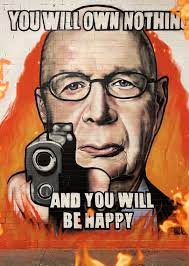
According to a video published by the World Economic Forum in 2016, by 2030 ‘You’ll Own Nothing. And You’ll Be Happy.’

See 8 predictions for the world in 2030’.

Clearly, if this prediction is to come true, then many things must happen. Let me identify why the World Economic Forum believes it will happen and then investigate these claims. Among other questions, I will examine whether those who will own nothing will include the Rothschild, Rockefeller and other staggeringly wealthy families. Or, perhaps, whether they just mean people like you and me.

In fact, a primary intention behind the Elite’s ongoing technocratic coup, initiated in January 2020, is to trigger a process of depopulation, as well fundamentally reshape world order including by turning those humans left alive into “transhuman slaves”, drive the global economy to collapse and implement the final redistribution of global wealth from everyone else to this Elite.

Let me start with the briefest of histories so that what is happening can be understood as the ultimate conclusion of a long-standing agenda, identify who I mean by the ‘Global Elite’ (and its agents), then present the evidence to explain how this is happening and, most importantly, a comprehensive strategy to defeat it.

Needless to say, in the interests of keeping this study manageable, many critical historical events – including how imperialism and colonialism, the international slave trade, a great number of wars and coups, Wall Street support for the Bolshevik Revolution in Russia in 1917 and precipitation of the Great Depression in 1929, were used to advance the Elite program – are not addressed in this investigation. But for accounts of the latter two events which provide evidence consistent with the analysis offered below, see Wall Street and The Bolshevik Revolution and The Secrets of the Federal Reserve.

A Brief Economic History

Following the Neolithic revolution 12,000 years ago, agriculture allowed human settlement to supersede the hunter-gatherer economy. However, while the Neolithic revolution occurred spontaneously in several parts of the world, some of the Neolithic societies that emerged in Asia, Europe, Central America and South America resorted to increasing degrees of social control, ostensibly to achieve a variety of social and economic outcomes, including increased efficiency in food production.

Civilizations emerged just over 5,000 years ago and, utilizing this higher degree of social control, were characterized by towns or cities, efficient food production allowing a large minority of the community to be engaged in more specialized activities, a centralized bureaucracy and the practice of skilled warfare. See ‘A Critique of Human Society since the Neolithic Revolution’.

With the emergence of civilization, elites of a local nature (such as the Pharoahs of Egypt), elites with imperial reach (including Roman emperors), elites of a religious nature (such as Popes and officials of the Vatican), elites of an economic character (particularly the City of London Corporation) and elites of a ‘national’ type (especially the monarchies of Europe) progressively emerged, essentially to manage the administration associated with maintaining and expanding their realms (political, economic and/or religious).

The Peace of Westphalia in 1648 formally established the nation-state system in Europe. Enriched by the long-standing and profitable legacy of their control over local domestic populations, support for the imperial conquest of non-European lands, colonial subjugation of indigenous peoples and the international slave trade, European elites, backed by military violence, were able to impose a long series of changes over national political, economic and legal systems which facilitated the emergence of industrial capitalism in Europe in the 18th century.

These interrelated political, economic and legal changes facilitated scientific research that was increasingly geared towards utilizing new resources and technological innovation that drove the ongoing invention of machinery and the harnessing of coal-fired power to make industrial production possible.

Beyond this, and following several centuries of more and less formal versions of it, Elite political and economic imperatives drove the ‘legal’ enclosure of the Commons to force people off their land and into the poorly-paid labour force needed in the emerging industrial cities. In these cities, an ongoing series of developments in the organization of work in factories, electrification, banking, and other changes and technologies dramatically expanded the gap between rich and poor. Along with subsequently imposed changes to education and, later, healthcare, national economies and the global economy were increasingly structured to profoundly disconnect ‘ordinary’ people from their land, traditional knowledge and long-standing healthcare practices to make them dependent while dramatically reinforcing an institutional reality progressively consolidated since the dawn of human civilization: Elite control ensured that the economy perpetually redistributed wealth from those who have less to those who have more.

As noted by Adam Smith, for example, in his classic work An Inquiry into the Nature and Causes of the Wealth of Nations published in 1775: ‘All for ourselves, and nothing for other people, seems, in every age of the world, to have been the vile maxim of the masters of mankind’.

And this was exemplified, for example, by the 150-year struggle between the bankers working to establish a privately-owned central bank in the newly independent United States and those Presidents (such as Andrew Jackson and Abraham Lincoln) and members of Congress who worked tirelessly to defeat it. In fact: ‘Most of the founding fathers realized the potential dangers of banking and feared bankers’ accumulation of wealth and power.’ Why?

Having observed how the privately-owned British central bank, the Bank of England, had run up the British national debt to such an extent that Parliament had been forced to place unfair taxes on the American colonies, the founders in the US understood the evils of a privately-owned central bank, which Benjamin Franklin later claimed was the real cause of the American Revolution.

As James Madison, principal author of the US Constitution argued: ‘History records that the Money Changers used every form of abuse, intrigue, deceit, and violent means possible to maintain their control over governments by controlling money, and its issuance.’ Another founder, Thomas Jefferson, put it this way: ‘I sincerely believe that banking institutions are more dangerous to our liberties than standing armies. The issuing power should be taken from the banks and restored to the people to whom it properly belongs.’ As it turns out, the battle over who would get the power to issue US money raged from 1764, changing hands eight times, until the bankers’ final deceitful victory in 1913 with the establishment of the Federal Reserve System. ‘The battle over who gets to issue our money has been the pivotal issue throughout the history of the United States. Wars are fought over it. Depressions are caused to acquire it. Yet after WWI, this battle was rarely mentioned in the newspapers or history books. Why? By WWI, the Money Changers with their dominant wealth had seized control of most of the nation’s press.’ Watch The Money Masters: How International Bankers Gained Control of America (with the relevant section of the four-part transcript of the video available here: The Money Masters: Part I.)

Why the objection to a private central bank? Well, consider the formation and ownership of the inaccurately named Bank of England, established in 1694.

By the end of the C17th, England was in financial ruin: 50 years of more or less continuous wars with France and Holland had depleted it. So government officials asked the bankers for the loans necessary to pursue their political purposes. What did these bankers want in return? ‘The price was high: a government-sanctioned, privately owned bank which could issue money created out of nothing.’ It became the world’s first privately-owned central bank and, although it was deceptively called the Bank of England to make people think it was part of the government, it was not. Moreover, like any other private corporation, the Bank of England sold shares to get started. ‘The investors, whose names were never revealed, were supposed to put up 1,250,000 British pounds in gold coins, to buy their shares in the bank. But only 750,000 pounds was ever received.’ Despite that, the bank was duly chartered in 1694 and started the business of loaning out several times the money it supposedly had in reserves, all at interest.

Let me restate that for clarity: The British government legislated to create a privately-owned central bank (that is, a bank owned by a small group of wealthy individuals) that loaned out vast amounts of money it did not have so that it could make a profit by charging interest.

This practice is called ‘fractional reserve banking’ to make it sound like some sophisticated economic concept rather than a deceitful practice that, should you or I do it, we would be jailed. ‘In exchange the Bank would loan the British politicians as much of the new currency as they wanted, as long as they secured the debt by direct taxation of the British people.’ In other words, the Bank could not lose.

So, as William T. Still notes: ‘legalization of the Bank of England amounted to nothing less than the legal counterfeiting of a national currency for private gain.’

‘Unfortunately’, he goes on, ‘nearly every nation now has a privately controlled central bank, using the Bank of England as their basic model. Such is the power of these central banks, that they soon take total control over a nation’s economy. It soon amounts to nothing else than a plutocracy, rule by the rich.’ Watch The Money Masters: How International Bankers Gained Control of America (with the relevant section of the four-part transcript of the video available here: The Money Masters: Part I.)

Before proceeding, if how the banking system works isn’t your strong point, this brief video does a good job of spelling out essential points in a non-technical way. Watch ‘Banking – the Greatest Scam on Earth’.

And for a thoughtful explanation of the meaning and history of money, see Nick Szabo’s superb article  ‘Shelling Out: The Origins of Money’.

In any case, the fundamental point is simple: After 5,000 years, the various processes by which local elites, then ‘national’ elites, then international elites, and now the Global Elite have continuously asserted their control to enhance their capacity to shape how the world works and to accumulate wealth has now reached its climax. Thus we are on the brink of being herded into an Elite-controlled technocracy in which, as the World Economic Forum makes clear: By 2030 ‘You’ll Own Nothing. And You’ll Be Happy.’

So you will own nothing.

And why would you be happy about that? Because you will be a transhuman slave: an organism that no longer even owns their own mind.

Who is the Global Elite and How does it Operate?

Many authors have, directly or indirectly, addressed this question and each has come up with their own nuanced combination of wealthy individuals and families, their political connections, as well as the financial instruments and organizational structures through which their power is gained and exercised.

For the purposes of this study, I am going to define the Global Elite as those families that had acquired their vast wealth and firmly established their preeminent political and economic power in global society by the end of the 19th century. These families have thus played the central role in shaping institutions and events both before but also since that time, thus providing the framework in which other wealthy people have since emerged.

In order to perform their fundamental role in shaping the modern world to serve their purposes, this Elite has facilitated the creation of a vast network of agents – corporations, institutions, other families and individuals – who are owned and/or controlled by this Elite and act as ‘fronts’ to advance Elite interests. In any given period, the Elite families remain largely unchanged (while succeeding generations of individuals further the families’ interests) but the organizational and individual agents through which these families work vary, depending on Elite aims in the contexts it precipitates.

Let me briefly illustrate my approach by using one family – the ‘House of Rothschild’ – as a case study before moving onto a wider description of how Elite families use their wealth to shape corporations, institutions, events and people to serve their own purposes.

This example is drawn from the official Rothschild Archive and two (sometimes conflicting) Rothschild-authorized accounts of the family’s history written at different times. See The Rothschild ArchiveThe House of Rothschild – Money’s Prophets, 1798-1848 and The Rothschilds: A Family Portrait.

In addition, the account draws on sources that report neutrally on Rothschild involvement as well as some sources that are critical. These sources are cited in context below.

By the mid-18th century, the ancestors of Mayer Amschel had long been small merchants in the town ghetto of Frankfurt. But, as a Jew without a family name and before street numbering was used, Mayer was also known by the name some ancestors had used on the house sign where they once lived: Rothschild (Red Shield). With more ability than other merchants and having been sent to learn the rudiments of business in the firm of Wolf Jakob Oppenheim, he became a dealer in rare coins, medals and antiques, the buyers of which were almost invariably aristocratic collectors, including William, Hereditary Prince of Hesse-Kassel. It was this business that enabled Mayer Amschel to accumulate the capital to move into banking, a natural outgrowth of his policy of extending credit to some of his clients. His wealth started to increase rapidly as he focused more on state and merchant banking, both local and international.

With a policy of seeking little profit from interest on loans while seeking trade concessions in other areas, seeking clientele only among ‘the noblest personages in Germany’, secret bookkeeping in parallel with the official one and, later, deploying his five sons to replicate his style and activities in England (Nathan, who, after a few years in Manchester, established himself in the City of London), Paris (Jakob, known as James), Naples (Kalman, or Carl), Vienna (Salomon) as well as Frankfurt (where eldest son Amschel eventually succeeded father Mayer), the Rothschild dynasty and ‘multinational business model’ quickly established itself throughout Europe. Critically, it was serviced by the maintenance of close relationships with leading political figures and salaried agents working in financial markets who provided essential political and commercial news, as well as private communications channels (including coaches with secret compartments) that worked with enormous efficiency.

And it was this ‘Red Shield’ communication network, later operating under Royal patronage, combined with a certain audacity, that enabled the Rothschilds to profit handsomely from a variety of adverse circumstances including the restrictions on trade between England and the continent which characterized the Napoleonic period, and the Napoleonic Wars as well. This included smuggling vast amounts of contraband goods from England to the continent and transferring a substantial hoard of gold bullion through France to finance the feeding of Wellington’s army.

Most spectacularly, and despite family efforts to suppress awareness of this fact, the Rothschilds profited enormously from their privileged notice that Wellington defeated Napoleon at Waterloo in 1815, as recorded by William T. Still and Patrick S.J. Carmack in their 3.5 hour documentary The Money Masters: How International Bankers Gained Control of America (with the relevant section of the four-part transcript of the video available here: The Money Masters: Part II.)

How did this happen?

Following a long series of wars across Europe and the eastern Mediterranean, during which he was very successful, rapidly promoted and, in 1804, elected Emperor of France, Napoleon was eventually defeated. He abdicated and was exiled to Elba, an island off the Tuscan coast, in 1814 but escaped nine months later in February 1815.

As he returned to Paris, French troops were sent out to capture Napoleon but such was his charisma that ‘the soldiers rallied around their old leader and hailed him as their emperor once again.’ And, having borrowed funds to rearm, in March 1815 Napoleon’s freshly equipped army marched out to be ultimately defeated by Britain’s Duke of Wellington at Waterloo less than three months later. As Still remarks: ‘Some writers claimed Napoleon borrowed 5 million pounds from the Bank of England to rearm. But it appears these funds actually came from Ubard Banking House in Paris. Nevertheless, from about this point on, it was not unusual for privately controlled central banks to finance both sides in a war.’

‘Why would a central bank finance opposing sides in a war?’ Still asks. ‘Because war is the biggest debt generator of them all. A nation will borrow any amount for victory. The ultimate loser is loaned just enough to hold out the vain hope of victory, and the ultimate winner is given enough to win. Besides, such loans are usually conditioned upon the guarantee that the victor will honor the debts of the vanquished.’

While the outcome of the battle at Waterloo was certainly in doubt, back in London Nathan Rothschild planned to use the outcome, no matter who won or lost, to try to seize control over the British stock and bond market and possibly even the Bank of England. How did he do this? Here is one account. ‘Rothschild stationed a trusted agent, a man named Rothworth, on the north side of the battlefield, closer to the English Channel.’ Once the battle had been decided, at the cost of many thousands of French, English and other European lives, Rothworth headed immediately for the Channel. He delivered the news to Nathan Rothschild, a full 24 hours before Wellington’s own courier arrived with the news.

Rothschild hurried to the stock market and, with all eyes on him given the Rothschild’s legendary communications network was well known, others present observed Rothschild knowing that if Wellington had been defeated, and Napoleon was again at large in Europe, the British financial situation would become grave indeed. Rothschild began selling his consoles (British government bonds). ‘Other nervous investors saw that Rothschild was selling. It could only mean one thing: Napoleon must have won, Wellington must have lost.’

The market plummeted. Soon everyone was selling their own consoles and prices dropped sharply. ‘But then Rothschild started secretly buying up the consoles through his agents for only a fraction of their worth hours before.’

Fallacious? As Still concludes this recounting of the episode: ‘One hundred years later, the New York Times ran the story that Nathan Rothschild’s grandson had attempted to secure a court order to suppress a book with that stock market story in it. The Rothschild family claimed that the story was untrue and libelous. But the court denied the Rothschilds’ request and ordered the family to pay all court costs.’

In any case, having built their initial fortune using various means – some of which, as just illustrated, were neither moral nor legal – throughout the 19th century the Rothschild family continued to accumulate wealth through the international bond market, which they played a key role in developing, as well as other forms of financial business: bullion broking and refining, accepting and discounting commercial bills, direct trading in commodities, foreign exchange dealing and arbitrage, even insurance. The Rothschilds also had a select group of clients – usually royal and aristocratic individuals whom they wished to cultivate – to whom they offered a range of ‘personal banking services’ ranging from large personal loans (such as that to the Austrian Chancellor Prince Metternich) to a first class private postal service (for Queen Victoria). The family also had substantial mining interests and was a major industrial investor backing the construction of railway lines in Europe in the 1830s and 1840s. But, apart from its other interests, the family continued to be heavily involved in ‘the money trade’.

‘From 1870 onwards, London was the centre of Britain’s greatest export: money. Vast quantities of savings and earnings were gathered and invested at considerable profit through the international merchant banks of Rothschild, Baring, Lazard, and Morgan in the City’. See Hidden History: The Secret Origins of the First World War, p. 220.

But what, exactly, is the City?

The City of London Corporation, an independent square mile in the heart of London, was founded in about AD50 and quickly established itself as an important commercial centre which ultimately gave birth to some of the world’s greatest financial institutions such as the London Stock Exchange, Lloyd’s of London and, in 1694, the Bank of England. The City’s ‘modern period’ is sometimes dated from 1067.

However, as explained by Nicholas Shaxson, the City ‘is an ancient, [semi-foreign] entity lodged inside the British nation state; a “prehistoric monster which had mysteriously survived into the modern world”, as a 19th century would-be City reformer put it…. the corporation is an offshore island inside Britain, a tax haven in its own right.’ Of course, the term ‘tax haven’ is a misnomer, ‘because such places aren’t just about tax. What they sell is escape: from the laws, rules and taxes of jurisdictions elsewhere, usually with secrecy as their prime offering. The notion of elsewhere (hence the term “offshore”) is central. The Cayman Islands’ tax and secrecy laws are not designed for the benefit of the 50,000-odd Caymanians, but help wealthy people and corporations, mostly in the US and Europe, get around the rules of their own democratic societies. The outcome is one set of rules for a rich elite and another for the rest of us.’

In the words of Shaxson:

The City’s ‘elsewhere’ status in Britain stems from a simple formula: over centuries, sovereigns and governments have sought City loans, and in exchange the City has extracted privileges and freedoms from rules and laws to which the rest of Britain must submit. The City does have a noble tradition of standing up for citizens’ freedoms against despotic sovereigns, but this has morphed into freedom for money. See The tax haven in the heart of Britain.

As Gerry Docherty and Jim Macgregor explain it then, by 1870:

City influence and investments crossed national boundaries and raised funds for governments and companies across the entire world. The great investment houses made billions, their political allies and agents grew wealthy…. Edward VII, both as king and earlier as Prince of Wales, swapped friendship and honours for the generous patronage of the Rothschilds, Cassel, and other Jewish banking families like the Montagus, Hirschs and Sassoons…. The Bank of England was completely in the hands of these powerful financiers, and the relationship went unchallenged….

The flow of money into the United States during the nineteenth century advanced industrial development to the immense benefit of the millionaires it created: Rockefeller, Carnegie, Morgan, Vanderbilt and their associates. The Rothschilds represented British interests, either directly through front companies or indirectly through agencies that they controlled. Railroads, steel, shipbuilding, construction, oil and finance blossomed…. These small groups of massively rich individuals on both sides of the Atlantic knew one another well, and the Secret Elite in London initiated the very select and secretive dining club, the Pilgrims, that brought them together on a regular basis. See Hidden History: The Secret Origins of the First World War, p. 220.

To choose one example from those just listed, you can read an official account of the Rothschild family’s early involvement in oil production, including its ‘decisive influence’ in the formation of Royal Dutch Shell, in the Rothschild Archive. See Searching for Oil in Roubaix’.

Beyond their investments in the industries just listed, however, the Rothschilds had significant media interests: Their Paribas Bank ‘controlled the all-powerful news agency Havas, which in turn owned the most important advertising agency in France.’ See Hidden History: The Secret Origins of the First World War, p. 214.

And, by the late 19th century, direct Rothschild investment in major ‘armaments companies’ (now better known as weapons corporations) and related industries was substantial with official biographer Niall Ferguson candidly noting ‘If late-nineteenth-century imperialism had its “military-industrial complex” the Rothschilds were unquestionably part of it.’ See The House of Rothschild – Volume 2 – The World’s Banker, 1849-1998, p. 579.

Of course, as noted previously, the Rothschild family is not the only family that uses its wealth to exercise enormous economic and political power and to profit from war, but the evidence suggests that it has long been the most deeply entrenched in the institutions, including those it has created, that facilitate the exercise of this power. Moreover, it is linked to many other wealthy families through a multitude of arrangements as will be shown.

Consider the following examples of how the power of wealth is exercised and note the names of some other wealthy families.

Invariably working ‘in the background’, elite figures spend considerable time manipulating ‘well-positioned’ people, and none are more adept at this than the Rothschilds. To cite just one of many examples, ‘both the great estates of Balmoral and Sandringham, so intimately associated with the British royal family, were facilitated, if not entirely paid for, through the largess of the House of Rothschild’ thus maintaining the long-standing Rothschild tradition of gifting ‘loans’ – that is, bribes, as the brothers had long before privately acknowledged – to royalty (and other key officials).

Of course, this manipulation of people is done to ensure the creation of particular institutions or to precipitate or facilitate a particular sequence of events. Just one obvious example of this occurred when the British government was manipulated into the Boer War of 1899-1902 by ‘the secret society of Cecil Rhodes’ as it was originally known and of which Lord (Nathan) Rothschild was a founding member along with Alfred, later Lord, Milner who succeeded Rhodes as head of this exclusive secret club. While the British public was given a more palatable pretext for this war via the media, it was fundamentally fought to defend and consolidate the rich South African gold-mining interests of wealthy businesspeople, including the Rothschilds. By the time the war ended, the Transvaal’s gold was finally in their hands. The cost? ‘32,000 deaths in the concentration camps, [of whom more than 26,000 were women and children]; 22,000 British Empire troops were killed and 23,000 wounded. Boer casualties numbered 34,000. Africans killed amounted to 14,000.’ See Hidden History: The Secret Origins of the First World War, pp. 23 & 38-50 and The Anglo-American Establishment: From Rhodes to Cliveden.

The US Federal Reserve System

In his classic work The Creature from Jekyll Island: A Second Look at the Federal Reserve, in which he describes the formation, structure and function of the US Federal Reserve System, which governs banking in the United States, G. Edward Griffin identified the seven men and who they represented, at the secret meeting held at the private resort of J.P. Morgan on Jekyll Island off the coast of Georgia in November 1910 when the System was conceived (and later passed as The Federal Reserve Act in 1913).

The seven men at this meeting represented the great financial institutions of Wall Street and, indirectly, Europe as well: that is, they represented one-quarter of the total wealth of the entire world. They were Nelson W. Aldrich, Republican ‘whip’ in the US Senate, Chair of the National Monetary Commission and father-in-law of John D. Rockefeller Jr.; Henry P. Davison, senior partner of J.P. Morgan Company; Charles D. Norton, President of the 1st National Bank of New York; A. Piatt Andrew, Assistant Secretary of the Treasury; Frank A. Vanderlip, President of the National City Bank of New York, representing William Rockefeller; Benjamin Strong, head of J.P. Morgan’s Bankers Trust Company and later to become head of the System; and Paul M. Warburg, a partner in Kuhn, Loeb & Company, representing the Rothschilds and Warburgs in Europe.

But lest you think that there is some ‘diversity’ here, long-standing ties generated from huge financial injections at crucial times meant that several other key banks owed much to Rothschild wealth. For example, in 1857 a run on U.S. banks saw the bank Peabody, Morgan and Company in deep trouble as four other banks were driven out of business. But Peabody, Morgan and Company was saved by the Bank of England. Why? Who initiated the rescue? According to Docherty and Macgregor, ‘The Rothschilds held immense sway in the Bank of England and the most likely answer is that they intervened to save the firm. Peabody retired in 1864, and Junius Morgan inherited a strong bank with powerful links to Rothschild.’ Junius was the father of J.P. Morgan. See Hidden History: The Secret Origins of the First World War, p. 222.

A similar thing happened when Nathaniel Rothschild headed the Bank of England committee that rescued Barings Bank from imminent collapse in 1890. But other big banks ‘were beholden to or fronts for the Rothschilds…. Like J.P. Morgan, Barings and Kuhn Loeb, the M.M. Warburg Bank owed its survival and ultimate success to Rothschild money.’ To reiterate then: ‘by the early twentieth century numerous major banks, including J.P. Morgan and Barings, and armaments firms, were beholden to or fronts for the Rothschilds.’ And this had many advantages. J.P. Morgan, who was deeply involved with the Pilgrims – an exclusive club that linked major U.K. and U.S. businesspeople – was clearly perceived as an upright Protestant guardian of capitalism, who could trace his family roots to pre-Revolutionary times, so by acting in the interests of the London Rothschilds he shielded their American profits from the poison of anti-Semitism.

But the connections do not end there. Superficially, ‘there were periods of blistering competition between the investment and banking houses, the steel companies, the railroad builders and the two international goliaths of oil, Rockefeller and Rothschilds, but by the turn of the century the surviving conglomerates adopted a more subtle relationship, which avoided real competition.’ A decade earlier, Baron de Rothschild had accepted an invitation from John D. Rockefeller to meet in New York behind the closed doors of Standard Oil’s headquarters on Broadway where they had quickly reached a confidential agreement. ‘Clearly both understood the advantage of monopolistic collusion.’ The apparent rivalry between major stakeholders in banking, industry and commerce has long been a convenient facade, which they are content to leave much of the world believing. See Hidden History: The Secret Origins of the First World War, pp. 222-225.

Beyond business and financial links of this nature, of course, there is marriage. For example, according to  Dean Henderson: ‘The Warburgs, Kuhn Loebs, Goldman Sachs, Schiffs and Rothschilds have intermarried into one big happy banking family. The Warburg family… tied up with the Rothschilds in 1814 in Hamburg, while Kuhn Loeb powerhouse Jacob Schiff shared quarters with Rothschilds in 1785. Schiff immigrated to America in 1865. He joined forces with Abraham Kuhn and married Solomon Loeb’s daughter. Loeb and Kuhn married each others sisters and the Kuhn Loeb dynasty was consummated. Felix Warburg married Jacob Schiff’s daughter. Two Goldman daughters married two sons of the Sachs family, creating Goldman Sachs. In 1806 Nathan Rothschild married the oldest daughter of Levi Barent Cohen, a leading financier in London.’ See Big Oil and Their Bankers in the Persian Gulf: Four Horsemen, Eight Families and Their Global Intelligence, Narcotics and Terror Network, p. 488.

So to return to the foundation of the US Federal Reserve System, according to Griffin:

The reason for secrecy was simple. Had it been known that rival factions of the banking community had joined together, the public would have been alerted to the possibility that the bankers were plotting an agreement in restraint of trade – which, of course, is exactly what they were doing.

What emerged was a cartel agreement with five objectives:

stop the growing competition from the nation’s newer banks;

obtain a franchise to create money out of nothing for the purpose of lending;

get control of the reserves of all banks so that the more reckless ones would not be exposed to currency drains and bank runs;

get the taxpayer to pick up the cartel’s inevitable losses; and convince Congress that the purpose was to protect the public.

It was realized that the bankers would have to become partners with the politicians and that the structure of the cartel would have to be a central bank. The record shows that the Fed has failed to achieve its stated objectives. That is because those were never its true goals. As a banking cartel, and in terms of the five objectives stated above, it has been an unqualified success.

To reiterate Griffin’s key point: ‘a primary objective of that cartel was to involve the federal government as an agent for shifting the inevitable losses from the owners of those banks to the taxpayers.’ And this is confirmed by the ‘massive evidence of history since the System was created’.

Or, in the words of economics Professor Antony C. Sutton, who carefully detailed the longstanding links between Wall Street and the family of US President Franklin D. Roosevelt, including Roosevelt himself (a banker and speculator from 1921 to 1928): ‘The Federal Reserve System is a legal private monopoly of the money supply operated for the benefit of a few under the guise of protecting and promoting the public interest.’ See Wall Street and F.D.R.

And, as U.S. Congressman Louis Thomas McFadden, chairman of the House Committee on Banking and Currency, observed in 1932: ‘When the Federal Reserve Act was passed, the people of the United States did not perceive that… this country was to supply financial power to an international superstate – a superstate controlled by international bankers and international industrialists acting together to enslave the world for their own pleasure.’ See ‘Speech by Rep. Louis T. McFadden denouncing the Federal Reserve System’.

Equally importantly, creation of the Federal Reserve was just one of many preliminary steps taken over a 25-year period by a select group of men in key positions who conspired to ignite The Great War to both shape the future world order and profit enormously from the death and destruction. You can read detailed accounts of what took place, including key players, their motives and instigation of the Boer War in South Africa, touched on above, as part of the process, in books such as these:

Hidden History: The Secret Origins of the First World War,

The Anglo-American Establishment: From Rhodes to Cliveden,

The House of Rothschild – Volume 2 – The World’s Banker, 1849-1998 and

Prolonging the Agony: How the Anglo-American Establishment Deliberately Extended WWI by Three-and-a-Half Years.

There is also a thoughtful summary in ‘A crime against humanity: the Great Reset of 1914-1918’ and an excellent video on the subject: ‘The WWI Conspiracy’.

The primary cost of World War I was 20 million human lives, but it was immensely profitable for some.

The Bank for International Settlements

Another critical development in this period was the creation of the Bank for International Settlements (BIS) – as ‘the central bank of central banks’ – in 1930. As described by Professor Carroll Quigley, the BIS was the apex of efforts by elite bankers ‘to create a world system of financial control in private hands able to dominate the political system of each country and the economy of the world as a whole.’

But the push started many years before with Montagu Norman (Bank of England) and Benjamin Strong (the first governor of the Federal Reserve Bank of New York) both committed advocates. ‘In the 1920’s, they were determined to use the financial power of Britain and of the United States to force all the major countries of the world to go on the gold standard and to operate it through central banks free from all political control, with all questions of international finance to be settled by agreements by such central banks without interference from governments.’

This system was to be controlled in a feudalist fashion by the central banks of the world acting in concert, by secret agreements arrived at in frequent private meetings and conferences. The apex of the system was to be the Bank for International Settlements in Basle, Switzerland, a private bank owned and controlled by the world’s central banks which were themselves private corporations.

Each central bank, in the hands of men like Montagu Norman of the Bank of England, Benjamin Strong of the New York Federal Reserve Bank, Charles Rist of the Bank of France, and Hjalmar Schacht of the Reichsbank, sought to dominate its government by its ability to control Treasury loans, to manipulate foreign exchanges, to influence the level of economic activity in the country, and to influence cooperative politicians by subsequent economic rewards in the business world. The B.I.S. as a private institution was owned by the seven chief central banks and was operated by the heads of these, who together formed its governing board.

But, Quigley points out:

It must not be felt that these heads of the world’s chief central banks were themselves substantive powers in world finance. They were not. Rather, they were the technicians and agents of the dominant investment bankers of their own countries, who had raised them up and were perfectly capable of throwing them down.

The substantive financial powers of the world were in the hands of these investment bankers (also called ‘international’ or ‘merchant’ bankers) who remained largely behind the scenes in their own unincorporated private banks.

These formed a system of international cooperation and national dominance which was more private, more powerful, and more secret than that of their agents in the central banks. This dominance of investment bankers was based on their control over the flows of credit and investment funds in their own countries and throughout the world. They could dominate the financial and industrial systems of their own countries by their influence over the flow of current funds through bank loans, the discount rate, and the re-discounting of commercial debts; they could dominate governments by their control over current government loans and the play of the international exchanges. Almost all of this power was exercised by the personal influence and prestige of men who had demonstrated their ability in the past to bring off successful financial coupe, to keep their word, to remain cool in a crisis, and to share their winning opportunities with their associates. In this system the Rothschilds had been preeminent during much of the nineteenth century. See Tragedy & Hope: A History of the World in Our Time, pp. 242-3 & 245.

Ensuring that this select group of international bankers could operate without any form of accountability to any other authority in the world, the BIS ‘Headquarters Agreement with Switzerland’ Articles 4 and 12 specifically identify a range of ‘privileges and immunities’ that, among others, provide that ‘The Bank shall enjoy immunity from jurisdiction’ and ‘members of the Board of Directors of the Bank, together with the representatives of those central banks which are members of the Bank’ with ‘immunity from arrest or imprisonment’. See ‘Agreement between the Swiss Federal Council and the Bank for International Settlements to determine the Bank’s legal status in Switzerland’.

In plain language, the BIS and its members are beyond the reach of governments, key international organizations and the rule of law. They are accountable to no-one. And this is why the BIS was never held to account for its commission of war crimes. See ‘History – the BIS during the Second World War (1939-48)’. For an excellent and detailed account of the Bank for International Settlements, see Adam LeBor’s Tower of Basel: The Shadowy History of the Secret Bank that Runs the World.

Beyond this, as Sutton notes, because politicians sympathetic to financial capitalism and academics with ideas about world control are kept in line with a system of rewards and penalties, ‘in the early 1930s the guiding vehicle for this international system of financial and political control’ was the BIS, headquartered in Basle. The BIS ‘continued its work during World War II as the medium through which the bankers – who… were not at war with each other – continued a mutually beneficial exchange of ideas, information, and planning for the post-war world.’ In this sense only, the war was irrelevant to them. See Wall Street and The Rise of Hitler, pp. 11-12.

So while elite figures, including the Rothschilds, continued to shape institutions and events to restructure world order and make it more profitable for themselves, virtually everyone else in the world was an unwitting victim of their secret programs, many at the cost of their own life.

A notable exception was US Major General Smedley Butler who at least spelled out the critical role that war played in wealth creation for the elite. Following more than three decades of highly-decorated service in the US Marine Corp, Butler later described his experience in the following terms: ‘I spent most of my time being a high-class muscle man for Big Business, for Wall Street and for the bankers. In short, I was a racketeer for capitalism.’ See ‘Major General Smedley Butler’.

In his book published in 1935, he wrote:

‘War is a racket. It always has been. It is possibly the oldest, easily the most profitable, surely the most vicious…. It is the only one in which the profits are reckoned in dollars and the losses in lives…. It is conducted for the benefit of the very few, at the expense of the very many. Out of war a few people make huge fortunes.’

He went on to describe some of the individuals and corporations that made huge profits out of World War I. See War IA Racket.

World War II

And, just a few years later, World War II demonstrated that ‘war is a racket’ yet again. By carefully penetrating the cloak of deception behind which it was hidden, Professor Antony C. Sutton considered original documentation and eyewitness accounts to reveal what remains one of the most remarkable and under-reported facts of World War II. In his account of this orchestrated conflagration, Sutton carefully documents how prominent Wall Street banks and US businesses supported Hitler’s rise to power by financing and trading with Nazi Germany, reaching the unsavory conclusion that ‘the catastrophe of World War II was extremely profitable for a select group of financial insiders’ including J.P. Morgan, T.W. Lamont, the Rockefeller interests, General Electric, Standard Oil, and the National City, Chase, and Manhattan banks, Kuhn, Loeb and Company, General Motors, Ford Motor Company, and scores of others in ‘the bloodiest, most destructive war in history’. See Wall Street and The Rise of Hitler.

To illustrate the complex and wide-ranging collaboration between US business interests and the Nazis throughout the war, consider just one example: On the eve of World War II the German chemical complex of I.G. Farben, which included the banker Max Warburg (brother of Paul of the US Federal Reserve) on its Board of Directors, was the largest chemical manufacturing enterprise in the world, with extraordinary political and economic power within Hitler’s Nazi state. The Farben cartel dated from 1925 and had been created with financial assistance from Wall Street by the organizing genius of Hermann Schmitz, a prominent early Nazi who, through I.G. Farben, helped fund Hitler’s seizure of control in March 1933. Schmitz created the super-giant chemical enterprise out of six already giant German chemical companies.

So critical was I.G. Farben to the Nazi war effort that it produced 100% of its lubricating oil and various other products, 95% of its poison gas – ‘enough gas to kill 200 million humans’ – used in the extermination chambers, 84% of its explosives, 70% of its gunpowder, and very high proportions of many other critical products including aviation fuel. As Sutton concludes: ‘Without the capital supplied by Wall Street, there would have been no I.G. Farben in the first place and almost certainly no Adolf Hitler and World War II.’ See Wall Street and The Rise of Hitler, pp.17-20.

The cost in human lives of World War II was 70-85 million. But there was no cost to those Wall Street corporations and their fellow war profiteers that collaborated with Nazi Germany. Just massive profits.

Following World War II

Documenting what had become the long-standing collusion between political, corporate and military elites, sociology Professor C. Wright Mills published his classic work The Power Elite in 1956. This scholarly effort was among the earliest of the post-World War II era to document the nature of the US elite and how it functioned, highlighting the interlocking power of corporate, political and military elites as they exercised control over US national society and went about the task of exploiting the general population.

But a weakness of the account by Mills was his failure to grapple with the already long-standing power of a global elite to manipulate key events in any one country, and certainly the United States, even if much of this was done through the relevant national elite(s).

This ‘global reach’ of the Elite is again clearly apparent in any study of ownership of the world’s oil resources. In his 1975 book The Seven Sisters, Anthony Sampson popularized this collective name for the shadowy oil cartel that, throughout its history, had vigorously worked to eliminate competitors and control the world’s oil. See The Seven Sisters: The Great Oil Companies and the World They Shaped. Several decades later, Dean Henderson simply observed that ‘After a tidal wave of mergers at the turn of the millennium, Sampson’s Seven Sisters were Four Horsemen: Exxon Mobil, Chevron Texaco, BP Amoco and Royal Dutch/Shell.’ Beyond this, however, Henderson noted the following:

The oil wealth generated in the Persian Gulf region is the main source of capital [for the international mega-banks]. They sell the Gulf Cooperation Council sheiks 30-year treasury bonds at 5% interest, then loan the sheiks’ oil money out to Third World governments and Western consumers alike at 15-20% interest. In the process these financial overlords – who produce nothing of economic import – use debt as their lever in consolidating control over the global economy.

See Big Oil and Their Bankers in the Persian Gulf: Four Horsemen, Eight Families and Their Global Intelligence, Narcotics and Terror Network, pp. 168, 451.

And, following a series of mergers and then the 2008 banking crisis, four giant banks emerged to dominate the US economy: JP Morgan Chase, Citigroup, Bank of America and Wells Fargo. Moreover, these banks, along with Deutsche Bank, Banque Paribas, Barclays ‘and other European old money behemoths’, own the four oil giants and are also ‘among the top 10 stock holders of virtually every Fortune 500 corporation’ giving them vast control over the global economy.

See Big Oil and Their Bankers in the Persian Gulf: Four Horsemen, Eight Families and Their Global Intelligence, Narcotics and Terror Network, pp. 470, 473.

So who owns these banks? By now it should come as no surprise that several scholars at different times during the past 100 years have investigated this issue and come to essentially the same conclusion: the major families, increasingly interrelated by blood, marriage and/or business interests, have simply consolidated their control over the banks. Apart from scholars already mentioned above, in the 1983 revision of his book, Eustace Mullins noted that a few families still controlled the New York City banks which, in turn, hold the controlling stock of the Federal Reserve Bank of New York. Mullins identified the families of the Rothschilds, Morgans, Rockefellers, Warburgs and others.

See The Secrets of the Federal Reserve, p. 224.

Several scholars have written on the subject of elite power since Mills with Professor Peter Phillips penning the 2018 book Giants: The Global Power Elite which reviews ‘the transition from the nation state power elites described by Mills to a transnational power elite centralized on the control of global capital around the world. The Global Power Elite function as a nongovernmental network of similarly educated wealthy people with common interests of managing, facilitating, and protecting concentrated global wealth and insuring the continued growth of capital.’

Aside from the obvious criticism that Phillips effectively repeats the mistake made by Mills in assuming that there was no pre-existing ‘transnational power elite’ even if in different form, Phillips goes on to usefully identify the world’s top seventeen asset management firms, such as BlackRock and J.P Morgan Chase, that collectively manage (by now) more than $US50 trillion in a self-invested network of interlocking capital that spans the globe.

More precisely, Phillips identifies the 199 individual directors of the seventeen global financial Giants and the importance of those transnational institutions that serve a unifying function – including:

the World Bank, International Monetary Fund, G20, G7, World Trade Organization (WTO),

World Economic Forum  (WEF), Trilateral Commission,

Bilderberg Group(with a review of Daniel Estulin’s book The True Story of the Bilderberg Group here:

‘“The True Story of the Bilderberg Group” and What They May Be Planning Now’),

Bank for International Settlements and the Council on Foreign Relations

(see ‘One World Governance and the Council on Foreign Relations. “We Shall have World Government… by Conquest or Consent.”’) – and particularly two very important global elite policy-planning organizations:

the Group of Thirty (which has 32 members) and the extended executive committee of the Trilateral Commission (which has 55 members).

And Phillips carefully explains why and how the Global Elite defends its power, profits and privilege against rebellion by the ‘unruly exploited masses’: ‘the Global Power Elite uses NATO and the US military empire for its worldwide security…. The whole system continues wealth concentration for elites and expanded wretched inequality for the masses.’ Advocating the importance of systemic change and the redistribution of wealth, Phillips goes on to argue that ‘This concentration of protected wealth leads to a crisis of humanity, whereby poverty, war, starvation, mass alienation, media propaganda, and environmental devastation are reaching a species-level threat.’

Hence, it is worth reiterating: War plays an ongoing and vital role in the exercise of Elite power to reshape world order to maximize wealth concentration by the Elite. If you want further evidence of this, you might find these recent reports instructive: the US Congressional Research Service report

‘Instances of Use of United States Armed Forces Abroad, 1798-2022’,

the Tufts University Fletcher Center for Strategic Studies report ‘Military Intervention Project (MIP) Research’

and an article and video that summarize and discuss these two reports in US launched 251 military interventions since 1991, and 469 since 1798.

But, as the discussion above and below illustrates, war is not the only mechanism the Elite uses.

For an account which focuses on identifying many of the world’s largest corporations, in many industries, and then illustrates the interlocking nature of corporate ownership while demonstrating that they are all owned by the same small group of giant asset management corporations – notably including Vanguard, BlackRock and State Street – this video is very instructive: ‘Monopoly: Who Owns the World?’

And for a penetrating critique of BlackRock and its overall strategy to acquire vast worldwide control, including by using its Aladdin investment analysis technology (which employs massive data collection, artificial intelligence and machine learning to derive investment insight),

see ‘BlackRock: Bringing Together Man and Machine’

and this three-part series by James Corbett: ‘How BlackRock Conquered the World’.

In the ‘Monopoly’ video, you will again see the names of some familiar individuals and families who own significant shareholdings in these corporations and asset management firms. After showcasing families such as the Rothschilds, Rockefellers and Morgans, the narrator simply observes in relation to Vanguard that its ‘largest shareholders are the private funds and nonprofit organizations of these families’.

And if you think that national Elites in countries like China and Russia are somehow not involved in all this, you might find it interesting to read articles that discuss the wealth and political influence of the Chinese ‘immortals’ and the Russian oligarchs –

see ‘China’s red aristocracy’ and ‘List of Oligarchs and Russian elites featured in ICIJ investigations’ – or read the ‘Joint Statement of the Russian Federation and the People’s Republic of China on the International Relations Entering a New Era and the Global Sustainable Development’.

Beyond this, however, Emanuel Pastreich points out that if anyone attributes responsibility for Chinese policies in relation to data collection and control based on QR codes and contact tracing, they inevitably identify the Chinese government.

‘But the truth is that few, or none, of these policies were made up or implemented by the Chinese government itself, but rather that the Chinese government is occupied by IT corporations that report to the billionaires (often through Israel and the United States) and bypass the Chinese government altogether.’

Pastreich goes on to offer some insight into how key Elite intelligence and finance corporations are driving the technocratic social control policies being implemented under cover of the ‘virus’ in China.

See ‘The Third Opium War Part One: The agenda behind the COVID-19 assault on China’and ‘The Third Opium War Part Two: The True Threat Posed by China’ or watch ‘Western Tech & China: Who Serves whom?’

In fact, as Patrick Wood points out, referencing a much earlier book of his own and Professor Antony Sutton – see Trilaterals Over Washington Volumes I & II  – ‘Thanks to early members of the [Elite’s] Trilateral Commission, China was brought out of its dark ages Communist dictatorship and onto the world stage. Furthermore, the Trilateral Commission orchestrated and then facilitated a massive transfer of technology to China in order to build up its non-existent infrastructure….  As a failed Communist dictatorship, China was a blank slate with over 1.2 billion citizens under its control. However, Chinese leadership knew nothing about capitalism and free enterprise, and [key Trilateralist Zbigniew] Brzezinski made no effort to teach them about it. Instead, he planted seeds of Technocracy…. In the 20-year period from 1980 to 2000, a transformation took place that was considered nothing short of an economic miracle; but it was not of China’s doing. Rather, it can be fully attributed to the masters of Technocracy within the ranks of the Trilateral Commission.’ After listing several key features of China’s technocracy (5G, AI, social credit scores…), Wood concludes that ‘China is a full-blown Technocracy and it is the first of its kind on planet earth.’ See this article on China as one of Wood’s 12-part series on technocracy: ‘Day 7: China Is A Technocracy’.

And in relation to Russia,  Riley Waggaman simply observes that ‘As for “COVID-triggered” economic restructuring: the Russian government has openly embraced the World Economic Forum’s Fourth Industrial Revolution. In October [2021], the Russian government and the WEF signed a memorandum on the establishment of a Center for the Fourth Industrial Revolution in Russia.

Russia has already adopted a law allowing for “experimental legal regimes” to allow corporations and institutions to deploy AI and robots into the economy, without being encumbered by regulatory red tape. Returning to Gref and his digital Sbercoin: Russia’s central bank is already planning to test-run a digital ruble that, among other nifty features, could be used to restrict purchases.’ See ‘I believe we are facing an evil that has no equal in human history’.

Moreover, according to Mikhail Delyagin, a deputy of the State Duma of the Russian Federation: ‘In the 90s, under Yeltsin, the external management of global banksters was carried out through the IMF and through [Russian oligarch Anatoly] Chubais. Now under Putin, external management will be done by Big Tech, social global platforms, and Big Pharma through the WHO. Exactly the same management.’ Cited in ‘Duma deputy: “Protect yourself and Russia from a coup d’état!”. Russian lawmaker issues video appeal to the nation. Will anyone listen?’

Separately from this, bear in mind that the Elite, as well as its agents and organizations (including those in China and Russia), have vast wealth stashed in ‘secrecy jurisdictions’ (better known as tax havens): locations around the world where wealthy individuals, criminals and terrorists, as well as governments and government agencies (such as the CIA), banks, corporations, hedge funds, international organizations (such as the Vatican) and crime syndicates (such as the Mafia), can stash their money so that they can avoid regulation and oversight, and evade tax. Just how much wealth is stashed in tax havens? While this is impossible to know precisely, it can only be measured in tens of trillions of dollars as well as an unknown number of gold bricks, artworks, yachts and racehorses.

See ‘Elite Banking at Your Expense: How Secretive Tax Havens are Used to Steal Your Money’.

How is this possible? Well, it is protected by government legislation and legal systems, with an ‘army’ of Elite agents – accountants, auditors, bankers, businesspeople, lawyers and politicians – ensuring that they remain protected. The point here is simple: if you have enough money, the law simply does not exist. And you can evade taxes legally and in the full knowledge that your vast profits (even from immorally-acquired wealth such as sex trafficking, gun-running, endangered species trafficking, conflict diamonds and drug trafficking) are ‘lawful’ and will escape regulation and oversight of any kind. See ‘The Rule of Law: Unjust and Violent’.

But legal systems facilitate monstrous injustice in other ways too. For example, they ensure that owners of corporations are enabled to ruthlessly exploit both their workers and all taxpayers as well. For a thoughtful and straightforward account of how this works, see this article by Professor James Petras: ‘How Billionaires Become Billionaires’.

And to briefly revisit a subject discussed above: Who owns the US Federal Reserve System now?

According to Dean Henderson writing in 2010, it is ‘the Goldman Sachs, Rockefellers, Lehmans and Kuhn Loebs of New York; the Rothschilds of Paris and London; the Warburgs of Hamburg; the Lazards of Paris; and the Israel Moses Seifs of Rome.’

Henderson goes on to state that ‘The control that these banking families exert over the global economy cannot be overstated and is quite intentionally shrouded in secrecy. Their corporate media arm is quick to discredit any information exposing these money powers as halfbaked conspiracy theory. The word “conspiracy” itself has been demonized, much like the word “communism”. Anyone who dare utter the word is quickly excluded from public debate and written off as insane. Yet the facts remain.’

See Big Oil and Their Bankers in the Persian Gulf: Four Horsemen, Eight Families and Their Global Intelligence, Narcotics and Terror Network, pp. 473-4.

Other scholars in the field agree.

In his exceptionally detailed investigation into three major historical events of the C20th – the Bolshevik Revolution, the rise of Franklin D. Roosevelt and the rise of Hitler – Professor Antony Sutton identified the seat of political power in the United States not as the US Constitution authorized but ‘the financial establishment in New York: the private international bankers, more specifically the financial houses of J.P. Morgan, the Rockefeller-controlled Chase Manhattan Bank, and in earlier days (before amalgamation of their Manhattan Bank with the former Chase Bank), the Warburgs.’

For most of the twentieth century the Federal Reserve System, particularly the Federal Reserve Bank of New York (which is outside the control of Congress, unaudited and uncontrolled, with the power to print money and create credit at will), has exercised a virtual monopoly over the direction of the American economy. In foreign affairs the Council on Foreign Relations, superficially an innocent forum for academics, businessmen, and politicians, contains within its shell, perhaps unknown to many of its members, a power center that unilaterally determines U.S. foreign policy. The major objective of this submerged – and obviously subversive – foreign policy is the acquisition of markets and economic power (profits, if you will), for a small group of giant multi-nationals under the virtual control of a few banking investment houses and controlling families. See Wall Street and The Rise of Hitler, pp.125-126.

So what has changed?

Nothing has changed.

But it is not just fine scholars who have reached this conclusion. Consider David Rockefeller’s delusionary whitewashing of his own family’s key role in the killing, devastation and destruction outlined above: ‘Some even believe we are part of a secret cabal working against the best interests of the United States, characterizing my family and me as “internationalists” and of conspiring with others around the world to build a more integrated global political and economic structure – one world, if you will. If that’s the charge, I stand guilty, and I am proud of it…. one of the most enduring [conspiracies] is that a secret group of international bankers and capitalists, and their minions, control the world’s economy…. [but these people] ignore the tangible benefits that have resulted from our active international role during the past half-century’. See Memoirs, p. 483.

If you are wondering how all of this happens without any significant pushback from within elite circles, there is a simple answer: They are all insane and control to maximize resource accumulation has become the perpetual substitute for their destroyed capacity to engage emotionally in their own lives and empathize with their fellow human beings. For more detail, see ‘Love Denied: The Psychology of Materialism, Violence and War’ and ‘The Global Elite is Insane Revisited’.

So while some of us occasionally ponder how we can contribute more to improve the human condition and the state of the world, and then endeavour to do something along those lines, there are plenty of terrified people whose daily life is consumed (consciously or unconsciously) by the question ‘How can I take more?’ And people like that have been taking more since the dawn of human civilization and, no doubt, earlier.

The Global Elite is simply those who have been insanely ruthless and organized enough to take more, whatever the cost to humanity and all other life on Earth.

The Post World War II Superstructure to Transform World Order, Destroy the World Economy and Capture All Wealth

So how, precisely, is the Global Elite driving the transformation of world order, the collapse of the world economy and capturing final control of all wealth?

There are three parts to the answer to this question: 1. The foundations progressively laid over the past 5,000 years, as outlined above; 2. The superstructure (including such institutions as the United Nations, the World Bank and International Monetary Fund) that has been built since World War II and, more recently, under the guise of the United Nation’s Sustainable Development agenda, to impose global governance on the human population and, particularly, to intrude global financial governance into every aspect of our lives. In the words of Iain Davis and Whitney Webb, this is because the UN’s sustainable development goals ‘do not promote “sustainability” as most conceive it and instead utilise the same debt imperialism long used by the Anglo-American Empire to entrap nations in a new, equally predatory system of global financial governance’ – see ‘Sustainable Debt Slavery’ – and 3. The final part relates to political, economic and, especially, technological measures being imposed as part of the World Economic Forum’s ‘Great Reset’ under cover of the fake narrative about a Covid-19 ‘pandemic’.

If we briefly consider elements of the post-World War II superstructure, for example, both the World Bank and International Monetary Fund have historically used debt to force countries, mostly in the developing world, to adopt policies that redistribute wealth to the elite via their banks, corporations and institutions. But corporations have employed their own ‘economic hit men’ to do the same thing: By identifying and ‘persuading’ leaders of developing nations, using a variety of devices – ranging from false economic projections and bribes to military threats and assassinations – to accept enormous ‘development’ loans for projects which are contracted with western corporations, countries quickly become entrapped in debt. This is then used to force those countries to implement unpopular austerity policies, deregulate financial and other markets, and privatize state assets, thus eroding national sovereignty. See The New Confessions of an Economic Hit Man.

If you want to read further evidence of the role of the World Bank and the IMF as agents of Elite policy against nation-states, you might find the US Army’s manual of unconventional warfare interesting. See ‘Army Special Operations Forces: Unconventional Warfare’. Originally released by Wikileaks in 2008 and described by them as the US military’s ‘regime change handbook’, as elaborated by Webb, ‘the U.S. Army states that major global financial institutions – such as the World Bank, International Monetary Fund (IMF), the Organization for Economic Cooperation and Development (OECD) [and the Bank for International Settlements (BIS] – are used as unconventional, financial “weapons in times of conflict up to and including large-scale general war,” as well as in leveraging “the policies and cooperation of state governments.”’ See ‘Leaked Wikileaks Doc Reveals US Military Use of IMF, World Bank as “Unconventional” Weapons’.

Beyond this, however, what we have seen since the UN, increasingly a tool of corporations since the 1990s, adopted its Sustainable Development Goals is a dramatically expanded set of mechanisms designed to enslave the bulk of the human population, not just those in ‘developing’ countries, and take complete control of Earth’s ecosystems and natural processes.

Among many initiatives, for example, the Global Public-Private Partnership has been presented by Klaus Schwab and Peter Vanham, on behalf of the World Economic Forum. See Stakeholder Capitalism: A Global Economy that Works for Progress, People and Planet summarized in What is stakeholder capitalism?

While this sanitized account obscures the threat it poses to humankind, Iain Davis and Whitney Webb have thoughtfully critiqued it – see ‘Sustainable Debt Slavery’ – noting that even a 2016 UN Department of Economic and Social Affairs report – see ‘Public-Private Partnerships and the 2030 Agenda for Sustainable Development: Fit for purpose?’ – also found it ‘unfit for purpose’. So what is it? According to Davis, the Global Public-Private Partnership (G3P) is a worldwide network of stakeholder capitalists and their partners: the Bank for International Settlements, central banks, global (including media) corporations, the ‘philanthropic’ foundations of multi-billionaires, policy think tanks, governments (and their agencies), key non-governmental organizations and global charities, selected academic and scientific institutions, labour unions and other chosen ‘thought leaders’. (You can see an instructive diagram in the article cited below.)

The G3P controls the world economy and global finance. ‘It sets world, national and local policy (via global governance) and then promotes those policies using the mainstream media’, typically distributes the policies through an intermediary such as the IMF, WHO or IPCC and uses governments to transform G3P global governance into hard policy, legislation and law at the national level. ‘In this way, the G3P controls many nations at once without having to resort to legislation. This has the added advantage of making any legal challenge to the decisions made by the most senior partners in the G3P (an authoritarian hierarchy) extremely difficult.’ In short: global governance has already superseded the national sovereignty of states: ‘National governments had been relegated to creating the G3P’s enabling environment by taxing the public and increasing government borrowing debt.’ See ‘What Is the Global Public-Private Partnership?’

As Davis notes: We are supposed to believe that a G3P-led system of global governance is beneficial for us and to accept that global corporations are committed to putting humanitarian and environmental causes before profit, when the conflict of interest is obvious. ‘Believing this requires a considerable degree of naïveté.’ Davis clearly perceives ‘an emergent global, corporate dictatorship that cares not one whit about truly stewarding the planet. The G3P will determine the future state of global relations, the direction of national economies, the priorities of societies, the nature of business models and the management of a global commons. There is no opportunity for any of us to participate in either their project or the subsequent formation of policy.’ Davis goes on: ‘in theory, governments do not have to implement G3P policy, in reality they do. Global policies have been an increasing facet of our lives in the post-WW2 era…. It doesn’t matter who you elect, the policy trajectory is set at the global governance level. This is the dictatorial nature of the G3P and nothing could be less democratic.’

Another initiative was launched at the COP26 conference in November 2021. The Glasgow Financial Alliance for Net Zero (GFANZ) is an industry-led and UN-convened alliance of private banking and financial institutions that announced plans to overhaul the role of global and regional financial institutions, including the World Bank and IMF, as part of a broader plan to ‘transform’ the global financial system. See ‘Our progress and plan towards a net-zero global economy’.

But this report makes it clear that GFANZ will simply employ the same exploitative tactics that the ‘economic hitmen’ and agents such as the multilateral ‘development’ banks (MDBs) – including the World Bank, Inter-American Development Bank, Asian Development Bank, the African Development Bank and the European Bank for Reconstruction and Development – have long used to force even greater deregulation on ‘developing’ countries to facilitate supposedly climate and environmentally-friendly investments by alliance members. In fact, composed of several “subsector alliances”, including the Net Zero Asset Managers Initiative, the Net Zero Asset Owner Alliance and the Net Zero Banking Alliance, GFANZ commands ‘a formidable part of global private banking and finance interests’. Moreover, the ‘largest financial players’ who dominate GFANZ include the CEOs of BlackRock, Citi, Bank of America, Banco Santander and HSBC as well as the CEO of the London Stock Exchange Group and chair of the Investment Committee of the David Rockefeller Fund. In essence then, as Whitney Webb goes on to explain it:

[T]hrough the proposed increase in private-sector involvement in MDBs, such as the World Bank and regional development banks, alliance members seek to use MDBs to globally impose massive and extensive deregulation on developing countries by using the decarbonization push as justification. No longer must MDBs entrap developing nations in debt to force policies that benefit foreign and multinational private-sector entities, as climate change-related justifications can now be used for the same ends….

Though GFANZ has cloaked itself in lofty rhetoric of ‘saving the planet,’ its plans ultimately amount to a corporate-led coup that will make the global financial system even more corrupt and predatory and further reduce the sovereignty of national governments in the developing world. See ‘UN-Backed Banker Alliance Announces “Green” Plan to Transform the Global Financial System’.

But, again, it is not just their fellow human beings over whom the Elite wants total control. They want that control over nature too, and that is yet another project in which the Elite has been long engaged.

Hence, in September 2021, the New York Stock Exchange (NYSE) announced the launch of a new asset class, jointly developed with Intrinsic Exchange Group (IEG) – whose founding investors included the Inter-American Development Bank and the Rockefeller Foundation – for Natural Asset Companies: ‘sustainable enterprises that hold the rights to ecosystem services’ that enable natural asset owners ‘to convert nature’s value into financial capital, providing additional resources necessary to power a sustainable future’.

According to the IEG: ‘Natural areas, underpinned by biodiversity, are inherently valuable in and of themselves.’ See ‘Natural Areas’. Either unaware of their ignorance or, perhaps, making hypocritically tokenistic use of some key words often-expressed by indigenous peoples and deep ecologists (including the inventor of the term ‘deep ecology’, Professor Arne Naess, in his 1973 article ‘The Shallow and the Deep, Long-Range Ecology Movement’) – the IEG goes on to express this ‘value’ in strictly economic terms: ‘They also contribute life supporting services upon which humanity and the global economy depends. These include provisioning services such as food, water, timber, and genetic resources; regulating services that affect climate, floods, disease, and water quality; cultural services that provide recreational, aesthetic, and spiritual benefits; and supporting services such as soil formation, photosynthesis, and nutrient cycling.’

And in its report on this subject, the World Economic Forum’s Global Future Council on Nature-Based Solutions urged investors, corporations and governments ‘to create and strengthen market-based mechanisms for valuing nature.’ See ‘Scaling Investments in Nature: The Next Critical Frontier for Private Sector Leadership’, p.14.

Elaborating the IEG’s delusional conception of how further business investment in natural resources will work, Douglas Eger, the CEO of IEG, suggests that ‘This new asset class on the NYSE will create a virtuous cycle of investment in nature that will help finance sustainable development for communities, companies and countries.’ Really? I wonder how. But IEG’s motives are more likely revealed in this fact: ‘The asset class was developed to enable exposure to the opportunities created by the estimated $125 trillion annual global ecosystem services market, encompassing areas such as carbon sequestration, biodiversity and clean water.’

See ‘NYSE to List New “Natural Asset Companies” Asset Class, Targeting Massive Opportunity in Ecosystem Services’.

Hence, to clarify: corporations are now engaged in the largest land and resource grab in history. This will enable Elite corporations to privately own the ecosystem services of a pristine rainforest, a majestic waterfall plunging into a lagoon, an expansive grassland, a picturesque cave, a magnificent wetland, a trout-filled lake, a beautiful coral reef or other natural area and then sell clean air, fresh water, pollination services, food, medicines, and a range of biodiversity services such as the enjoyment of nature, while displacing the world’s remaining indigenous populations.

So what about the Commons? ‘The Commons is property shared by all, inclusive of natural products like air, water, and a habitable planet, forests, fisheries, groundwater, wetlands, pastures, the atmosphere, the high seas, Antarctica, outer space, caves, all part of ecosystems of the planet.’ Or are corporations finally about to own the Commons as well? See ‘Mother Nature, Inc.’

Are we to reduce everything in nature to its value as a profit-making commodity?

As Robert Hunziker concludes his own critique of this initiative: ‘The sad truth is Mother Nature, Inc. will lead to extinction of The Commons, as an institution, in the biggest heist of all time. Surely, private ownership of nature is unseemly and certainly begs a much bigger relevant question that goes to the heart of the matter, to wit: Should nature’s ecosystems, which benefit society at large, be monetized for the direct benefit of the few?’ See ‘Mother Nature, Inc.’

More could be written about this, as Webb, for example, has done in ‘Wall Street’s Takeover of Nature Advances with Launch of New Asset Class’.

But if you believe that corporations – extensively documented to destroy pristine natural environments in their rapacious efforts to exploit fossil fuels, minerals, rainforest products and a vast range of other products, as well as force indigenous peoples off their land to do so: see, for example, ‘Seven (of Hundreds) Environmental Nightmares Created by Open Pit Mines (and the Obligatory Tailings Ponds) that have Caused Irremediable, Highly Toxic Contamination Downstream’ – are about to become ‘virtuous investors’ in nature when 4 billion years of Earth’s history and 200,000 years of indigenous people living harmoniously with nature have an impeccable record of preserving ecosystems and their services, without the involvement of these ‘virtuous investors’, then you will do extremely well on any gullibility test you attempt.

In Part 2 of this investigation, I will examine how the Global Elite is implementing its final coup to take complete technocratic control over all life on Earth and what we must do to prevent this happening.

I thank Anita McKone for thoughtful suggestions to improve the original draft of this investigation.

Robert J. Burrowes has a lifetime commitment to understanding and ending human violence. He has done extensive research since 1966 in an effort to understand why human beings are violent and has been a nonviolent activist since 1981. He is the author of ‘Why Violence?’ His email address is flametree@riseup.net and his website is here. He is a regular contributor to Global Research.

The 500 Years Old WESTERN HEGEMONY is Coming to an END and the World is about to ENTER a VERY DANGEROUS PERIOD

For 500 years the world has been run from Europe or the US: that’s about to change and nobody is sure what its replacement will look like

By Timofey Bordachev

Source: The 21st Century

The most dramatic and unique aspect of the current state of affairs in international politics is that we cannot count on the ability of a single state, or a group of sufficiently powerful countries, to play a leadership role in the future.

This means it is difficult for us to imagine who will be able to force states to comply with the rules of conduct in their foreign policy, and how such strictures can even be enforced.

Indeed, the question of why individuals, or in this case countries, should abide by regulations is the most fundamental one in political philosophy.

And despite all the imperfections of the power method, humanity has not yet invented any other way of achieving such goals, even in minimal amounts, other than by force.

Over the last 500 years, the rules of international communication have been created within the narrow community of Western countries, first in Europe, before in the 20th century the US joined in, providing the power needed to enforce the system.

At first, this was done through the balance of power of leading European states, joined by Russia in 1762.

After the international order that had emerged in the mid-17th century came under attack from revolutionary France, control of the rules became a matter for a small group of major empires.

They, led by Russia and Britain, defeated Napoleon and in 1815 created an order which had at its heart a general agreement that mutiny in international affairs was unacceptable.

By the end of the nineteenth century, politics had become global, but the European powers, including Russia, could still control the rest through brute force and their colossal military-industrial superiority.

The dramatic events of 1914-1945 brought the US to the forefront of global politics, as the leader of the Western community on a global scale.

International institutions, starting with the United Nations, were established with the primary objective of preserving the monopoly position of the West.

This, however, required the emergence of formal institutions of justice in the form of international law, or the participation in the highest UN body, the Security Council, of the Soviet Union and China, which were inherently hostile to US and Western European interests.

The institutional form of Western power dominance has become overbearing and the main question now is whether it can be preserved.

Therefore, the collapse of US and Western European power positions in international politics entails not just a change of leadership, but a revision of the existing institutions and rules at the global level.

In other words, the entire formal international order that has emerged after World War II (and in reality over the last few centuries) will cease to exist.

It was based on a special system of rights and privileges for a limited group of great powers, and later the illusion of fairness of which was created by international institutions led by the UN.

It was this system that played the role of the main legitimizing principle of the existing world order, although in practice it was often replaced by the West’s ability to exert a decisive influence on world affairs

Thus, the collapse of international political institutions will very probably prove to be a consequence of the disappearance of their power base, whose presence has been unchallenged for several centuries.

We are now witnessing the destruction of both the formal and the real basis of the international order. In all likelihood, this process can no longer be stopped.

The coming period will be a time of defining the new global power base, and it is difficult to say yet which players, and to what extent, will become part of it.

What is important is that the top states of the present time – the US, Russia, China and India – are not close to each other, especially in terms of values and understanding of the basic principles of international rules.

The greatest problem so far is the behaviour of the US and certain Western European countries, which, for internal reasons, are pursuing an aggressive policy towards the outside world.

These states have embarked on a very troubling path of qualitative changes in the basic things that make up the social, gender and, consequently, political structures of society. For most other civilizations, this path is a challenge and will be rejected.

We also do not know the extent to which the internal development of the West depends on the spread of its ideals, as it did in previous periods.

In the event that the trends emerging in the West will, like revolutionary France, the Bolshevik regime or Nazi Germany, demand not just recognition from others, but expansion globally, the future will become very worrying.

We can already see that the conflict between the values favored by the West and the foundations of domestic legitimacy in a number of countries, is becoming a ground for aggravated political relations.

It would, however, be a mistake to hope that the other great and middle powers confronting the West are completely united in their understanding of the foundations of justice at the domestic level.

Even if Russia, India, China or Brazil now demonstrate a common understanding of the basic principles of a “proper” world order, this does not mean that they have the same vision of a better domestic order.

This is all the more true of the states of the Islamic world and other major developing countries. Their conservative values are often in conflict with those of the West, but this does not mean that they can create unity between themselves.

In other words, the new international order will, for the first time, be without a reliable link with the domestic ambitions of the leading powers, and this is indeed a qualitative change compared to all the historical eras we discussed.

Such a phenomenon seems very important because we have no experience of understanding how relations between states will develop under such conditions.

Brute force could become the only relatively tangible basis to assert the order, but this may not be enough to make the conditions imposed by it sustainable, even in the short term.

Another unique feature of today’s revolutionary situation is that the revision of the international order is not being carried out by one or a few powers – it has now become the business of the world’s majority.

The countries that make up about 85% of the world’s population are in one way or another no longer prepared to live with conditions created without their direct involvement.

That said, their resistance is often expressed without direct intention and depends on the power capabilities of the particular power.

What from the point of view of Russia or Iran looks like lack of resolve in dealing with the US may seem like a great challenge for Kazakhstan or another young sovereign country – after all, their entire socio-economic system was created to exploit a liberal world order.

The fragile states of Africa, or the former Soviet space, are far less capable of behaving consistently than the prosperous monarchies of the Persian Gulf. China, though now the second most powerful economic power, is also aware of its weaknesses.

But all this does not change the most important thing – even if the destruction of the existing status quo takes the form of soft sabotage rather than decisive military action, it does not simply reflect a general discontent with Western authoritarianism, but creates a new order, and the basic features of this are as yet undetermined.

In the coming years, most countries in the world will seek to make the most of the weakening of the power base of international politics in their self-interest.

So far, these actions constitute a constructive conflict, since they objectively undermine a system based on fantastic injustice.

However, as time goes on the US-EU bloc will weaken and lock itself away, and Russia or China will never be strong enough to take their place.

And in the perspective of the next 10 to 15 years, the international community will face the problem of replacing the power monopoly of the West with new universal instruments of coercion, the nature and content of which are still unknown to us.

Pity the Nation

Credit: JOEL PETT

Pity the Nation

Pity the nation whose people are sheep

And whose shepherds mislead them…

Pity the nation oh pity the people

Who allow their rights to erode

and their freedoms to be washed away

– Lawrence Ferlinghetti

By Scott Ritter

Source: Consortium News

In the past few months, the United States has undergone a kind of transformation that one only reads about in history books — from a nation which imperfectly, yet stolidly, embraced the promise, if not principle, of freedom, especially when it came to that most basic of rights — the freedom of expression. Democracies live and die on the ability of an informed citizenry to engage in open debate, dialogue and discussion about difficult issues. Freedom of speech is one of the touch-stone tenets of American democracy — the idea that, no matter how out of step with mainstream society one’s beliefs might be, the retained right to freely express opinions thus derived without fear of censorship or repression existed.

No more.

In the aftermath of the Russian invasion of Ukraine, the Russophobia which had taken grip in the United States since Russia’s first post-Cold War president, Boris Yeltsin, handed the reins of power over to his hand-picked successor, Vladimir Putin, has emerged much like the putrid core of an over-ripe boil. That this anti-Russian trend existed in the United States was, in and of itself, no secret. Indeed, the United States had, since 2000, pushed aside classic Russian area studies in the pursuit of a new school espousing the doctrine of “Putinism,” centered on the flawed notion that everything in Russia revolved around the singular person of Vladimir Putin.

The more the United States struggled with the reality of a Russian nation unwilling to allow itself to be once again constrained by the yoke of carpetbagger economics disguised as “democracy” that had been prevalent during the Yeltsin era, the more the dogma of “Putinism” took hold in the very establishments where intellectual examination of complex problems was ostensibly transpiring — the halls of academia which in turn produced the minds that guided policy formulation and implementation.

Outliers like Jack Matlock, John Mearsheimer and Stephen Cohen were cashiered in favor of a new breed of erstwhile Russian expert, led by the likes of Michael McFaul, Fiona Hill and Anne Applebaum. Genuine Russian area studies was supplanted by a new field of authoritarian studies, where the soul of a nation that once was defined by the life and works of Dostoevsky, Tolstoy, Gorky, Lenin, Stalin, Sakharov, and Gorbachev was distilled into a shallow caricature of one man — Putin.

We had seen this play before, in the buildup to the U.S.-led invasion and occupation of Iraq, when the national identity of a people who traced their heritage back to the Biblical times of Babylon was encapsulated in the person of one man, Saddam Hussein. By focusing solely on a manufactured narrative derived from a simplistic understanding of one man, the United States papered over the complex internal reality of the Iraqi nation and its people, and in doing so set itself up for defeat. It was if Iraq’s long and storied history ceased to exist.

The impact this erasure of context and relevance from the national discourse was felt in the lead up to the decision to initiate what was, by all sense and purposes, an illegal war of aggression — the greatest war crime of all, according to U.S. Supreme Court justice and U.S. chief prosecutor during the Nuremburg War Crimes Tribunal, Robert H. Jackson.

My own personal experience serves as witness to this reality. As a former chief weapons inspector in Iraq from 1991-1998, I was uniquely positioned to comment on the veracity of the claims made by the United States that Iraq retained weapons of mass destruction capability in violation of its obligation to be disarmed of such. When my stance was deemed convenient to a narrative attacking a Democratic president, Bill Clinton, I was readily embraced. However, when my fact-based narrative ran afoul of the regime-change policies of Clinton’s successor, George W. Bush, I was cast aside as a pariah.

Politics of Personal Destruction

The politics of personal destruction were employed in full, and I was attacked for being a shill of Saddam and, perhaps worst of all for someone who served his nation proudly and honorably as an officer of U.S. Marines, anti-American. It didn’t matter that, without exception, the fact-based arguments I made challenging the case for war with Iraq proved to be accurate — at the time and place where the arguments could have, and should have, resonated greatest (during the buildup to the invasion) — that my voice had been effectively silenced.

I see the same template in play again today when it comes to the difficult topic of Russia. Like every issue of importance, the Russian-Ukraine conflict has two sides to its story. The humanitarian tragedy that has befallen the citizens of Ukraine is perhaps the greatest argument one can offer up in opposition to the Russian military incursion.  But was there surely a viable diplomatic off ramp available which could have avoided this horrific situation?

To examine that question, however, one must be able and willing to engage in a fact-based discussion of Russian motives. The main problem with this approach is that the narrative which would emerge is not convenient for those who espouse the Western dogma of “Putinism,” based as it is on the irrational proclivities and geopolitical appetite of one man — Vladimir Putin.

The issue of NATO expansion and the threat it posed to Russian national security is dismissed with the throw-away notion that NATO is a defensive alliance and as such could pose no threat to Russia or its leader. The issue of the presence of the cancer of neo-Nazi ideology in the heart of the Ukrainian government and national identity is countered with the “fact” that Ukraine’s current president is himself a Jew. The eight-year suffering of the Russian-speaking citizens of the Donbass, who lived and died under the incessant bombardment brought on by the Ukrainian military, is simply ignored as if it never happened.

The problem with the pro-Ukrainian narrative is that it is at best incomplete, and worse incredibly misleading. NATO expansion has been consistently identified by Russia as an existential threat. The domination of the hate-filled neo-Nazi ideology of the Ukrainian far-right is well documented, up to and including their threat to kill the incumbent president, Volodymyr Zelensky, if he did not do their bidding. And the fact that the former president of Ukraine, Petro Poroshenko, promised to make the Russian-speaking population of the Donbass cower in the basements under the weight of Ukrainian artillery fire is well documented.

Unfortunately for those seeking to have an informed, fact-based discussion, dialogue, and debate about the complex problem that is Ukraine-Russian relations is the reality that facts are not conducive to the advancement of the “Putinism” dogma that has gripped American academia, government, and mainstream media today.

The Saddam-era tactics of smearing the character of anyone who dares challenge what passes for conventional wisdom when it comes to Russia and its leader is alive and well and living in the land of the free and the home of the brave. The age-old tactic of boycotting such voices by the mainstream media is in full-swing — the so-called news channels are flooded with the acolytes of “Putinism,” while anyone who dares challenge the officially sanctioned narrative of “Ukraine good, Russia bad” is excluded from participating in the “discussion.”

‘Russian Misinformation’

And, in this age where social media has, in many ways, supplanted the mainstream media as the source of choice for most Americans, the U.S. government has colluded with the commercial providers of the major platforms used to share information to label anything that deviates from the official line as “Russian misinformation,” going so far as to label data derived from Russian sources as “state-sponsored,” along with a warning that supposes the information within is somehow flawed and dangerous to normal democratic discourse.

The ultimate sanction, however, came when the U.S. government pressured the corporate internet providers to shut down all Russian-affiliated media, leading to the closure of RT America and other media outlets whose accuracy and impartiality, upon examination, far exceeded that of their American counterparts.

Now America is taking it to the next level when it comes to the pandemic of Russophobia that is sweeping across the country, purging everything Russian from the national discourse and experience. Russian books are being banned and Russian restaurants boycotted and worse, attacked. The massive economic sanctions enacted against Russia and the Russian people has extended to what amounts to an erasure of all things Russian from the American experience.

Where will this stop? History shows that America is capable of healing itself — the national shame that was the treatment of Japanese- Americans during World War II is a clear demonstration of this phenomenon. However, the politics of cancellation which has emerged in the American body politic has never carried with it the kind of potential blow-back that exists in the case of Russia.

In the pell-mell rush toward cancelling Russia in the name of defeating Putin, emotion has replaced common sense, to the point that people are ignoring the fact that Russia is a nuclear power willing and able to use its Armageddon-inducing arsenal in defense of what it views as its legitimate national security interests.

There has never been a time when a national discussion has been more essential to the continued survival of the American people and all humanity. If this discussion could occur armed with the full range of facts and opinions relating to Russia, there might be hope that reason would prevail, and all nations would walk away from the abyss of our collective suicide. Unfortunately, the American experiment in democracy is not conducive for such near-term embrace of sanity and reason.

“Pity the nation,” Ferlinghetti wrote, “whose leaders are liars, whose sages are silenced, and whose bigots haunt the airwaves.”

Pity America.

American Pravda: Anne Frank, Sirhan Sirhan, and AIDS

By Ron Unz

Source: The Unz Review

As an heir to the most famous political family in modern American history, Robert F. Kennedy, Jr. is hardly an obscure individual, and recent events have greatly elevated his national prominence.

Although he had spent most of his career as a highly-successful environmental attorney, during the early 2000s he gradually became involved with the grassroots movement questioning the safety and efficacy of our proliferating vaccines, a cause widely ridiculed or ignored by our national elites but increasingly resonating with many worried families.

Then the sudden Covid epidemic moved public health issues to the absolute center of the political debate, including the highly controversial steps taken to control the disease. For the first time in history, most Americans were suddenly subjected to lockdowns, which imposed severe restrictions upon their freedom of movement and assembly, and although these were originally presented as temporary measures expected to last only a couple of weeks, across much of the country they actually remained in place for a year or longer. Moreover, the permanent solution proposed for the crisis was the largest mass-vaccination drive in world history, with the leading vaccines relying upon a new and relatively untested mRNA biotechnology developed by our profit-hungry pharmaceutical giants, a situation that raised deep suspicions among many citizens.

Given these developments, the once marginal anti-vaxxing movement suddenly exploded onto the national stage, cutting across many existing political, social, and ideological fault-lines and encompassing perhaps 20-30% of America’s population, with Kennedy and his Children’s Health Defense non-profit soon becoming leading champions of these fearful individuals. Despite lacking any media coverage or a promotional advertising campaign, his book The Real Anthony Fauci sold over 500,000 copies by early January, spending two months on the Amazon bestseller list, much of that time at the very top.

The media establishment regards our vaccination drive as an absolutely crucial national priority and is intensely hostile to those who challenge it, so Kennedy soon became one of its leading villains. In mid-December, a team of six journalists and researchers at the Associated Press unleashed a ferocious 4,000 word assault, followed a few weeks later by a similar critique in leftist Counterpunch. But both these pieces attacked Kennedy on rather mundane grounds, claiming that his anti-vaccination arguments were wrong, dangerous, and possibly financially motivated, and neither gained much attention, nor seemed to damage his popular momentum.

When the media targets an individual, it monitors his every utterance, seeking the slightest opening to vilify him, and last week an opportunity came as Kennedy spoke before a crowd of 30,000 anti-vaxxers at a rally in Washington, DC. Indulging in overly-heated rhetoric, he declared “We have witnessed over the last 20 months a coup d’état against democracy, and the controlled demolition of the United States Constitution and the Bill of Rights.” He further suggested that that government requirements for vaccinations and mandates were imposing “fascism” on our society, with families having nowhere to escape: “Even in Hitler’s Germany, you could cross the Alps to Switzerland. You could hide in an attic like Anne Frank did.”

In our deeply secular society, Nazi Germany has replaced Satan as the epitome of pure evil, while Anne Frank—a Jewish teenager who died of typhus in a German hospital near the end of the war—has been elevated to the status of a sacred martyr. Although drawing such historical analogies is hardly uncommon in political rhetoric, it can sometimes produce angry reactions, especially if these are orchestrated by a hostile media, and Kennedy’s supposedly scandalous references immediately provoked a firestorm of critical coverage, soon leading him to apologize.

With Kennedy’s enemies fanning the flames, his brief reference to the sad fate of a girl who died three generations ago may have received a hundred times more media coverage than the large rally he had headlined or the huge sales of his national bestseller. When the media seeks to destroy someone’s reputation, it will react with hair-trigger reflexes to his slightest misstep.

Yet oddly enough, the same media organs that created a major national controversy out of a few ill-chosen words at a political rally had previously allowed certain of Kennedy’s other, seemingly far greater vulnerabilities to pass almost entirely unnoticed.

These days being labeled a “conspiracy theorist” is a particularly serious charge, with the slur suggesting dangerous mental illness, and surely stigmatizing Kennedy in such a manner would have been an ideal means of discrediting him. But although the author had publicly proclaimed himself a conspiracy theorist of the most explicit sort last month, almost all our hostile journalists carefully averted their eyes.

In the 1960s the conspiratorial term of abuse was first applied to those who challenged the official story that President Kennedy had died at the hands of a deranged lone gunman, and was later broadened to include the many other assassinations that soon followed, including that of the president’s own brother. And on December 8th, nearly the entire Forum page of the San Francisco Chronicle was filled by a Kennedy column arguing that his father Sen. Robert F. Kennedy had been slain by a group of secret conspirators, with the convicted gunman merely being an innocent patsy who should finally be released from prison.

Yet although Kennedy’s legion of media critics attacked him on almost all other grounds, fair or unfair, they carefully avoided that seemingly easy means of branding him as delusional. The long AP attack that ran a week later mentioned not a word, nor did the January Counterpunch piece. As a consequence, I doubt whether more than a tiny slice of the public is aware that Kennedy is a “conspiracy theorist.”

The obvious reason for this strange media reticence was that Kennedy’s position was very solidly grounded in hard factual evidence. In 2018 I drew upon some of the material in David Talbot’s widely-praised 2008 book Brothers to describe the strange aspects of the assassination.

If the first two dozen pages of the Talbot book completely overturned my understanding of the JFK assassination, I found the closing section almost equally shocking. With the Vietnam War as a political millstone about his neck, President Johnson decided not to seek reelection in 1968, opening the door to a last minute entry into the Democratic race by Robert Kennedy, who overcame considerable odds to win some important primaries. Then on June 4, 1968, he carried gigantic winner-take-all California, placing him on an easy path to the nomination and the presidency itself, at which point he would finally be in a position to fully investigate his brother’s assassination. But minutes after his victory speech, he was shot and fatally wounded, allegedly by another lone gunman, this time a disoriented Palestinian immigrant named Sirhan Sirhan, supposedly outraged over Kennedy’s pro-Israel public positions, although these were no different than those expressed by most other political candidates in America.

All this was well known to me. However, I had not known that powder burns later proved that the fatal bullet had been fired directly behind Kennedy’s head from a distance of three inches or less although Sirhan was standing several feet in front of him. Furthermore, eyewitness testimony and acoustic evidence indicated that at least twelve bullets were fired although Sirhan’s revolver could hold only eight, and a combination of these factors led longtime LA Coroner Dr. Thomas Naguchi, who conducted the autopsy, to claim in his 1983 memoir that there was likely a second gunman. Meanwhile, eyewitnesses also reported seeing a security guard with his gun drawn standing immediately behind Kennedy during the attack, and that individual happened to have a deep political hatred of the Kennedys. The police investigators seemed uninterested in these highly suspicious elements, none of which came to light during the trial. With two Kennedy brothers now dead, neither any surviving members of the family nor most of their allies and retainers had any desire to investigate the details of this latest assassination, and in a number of cases they soon moved overseas, abandoning the country entirely. JFK’s widow Jackie confided in friends that she was terrified for the lives of her children, and quickly married Aristotle Onassis, a Greek billionaire, whom she felt would be able to protect them.

Over the years, the 1968 Robert Kennedy assassination has attracted merely a sliver of the books and research devoted to the earlier killing of his elder brother in Dallas, and Talbot’s text spent only a few pages sketching out the strong evidence that the convicted gunman was merely an innocent dupe, manipulated by the true conspirators. But in 2018, two additional books appeared that were entirely focused on the case.

A Lie Too Big To Fail by longtime journalist and conspiracy researcher Lisa Pease ran 500 pages and covered the events of that fatal California evening in exhaustive detail, winning the endorsements of filmmaker Oliver Stone and renowned JFK researcher James W. Douglass. When I read it a few months ago, I found the huge volume of material quite useful but felt that it relied too heavily upon the recollections of eyewitnesses, which can easily grow attenuated over the decades. I was also disturbed to note that the text sometimes seemed to gradually transform reasonable suspicions into apparent certainties, eventually arguing that 3-4 different gunmen were probably firing at the presidential candidate that evening while Sirhan’s own gun had held only blanks.

At the very end, the author also veered off into building castles in the air with regard to other assassinations, arguing that Oswald probably had multiple personalities and that Jack Ruby was operating under a post-hypnotic suggestion, thinly documented claims that seriously weakened her credibility, as did her earlier suggestion that John Lennon had been killed by a government-programmed assassin in 1980 for his past criticism of the Vietnam War. Sometimes less is better, and I think that Pease’s book would have been much stronger if it had been heavily edited and substantially cut. All those extraneous elements should have been left on the cutting-room floor rather than distracting from the central evidence she provided regarding the existence of an RFK assassination conspiracy and Sirhan’s likely innocence.

Meanwhile, The Assassination of Robert F. Kennedy by Tim Tate and the Brad Johnson was released that same year and suffered from none of these flaws. The two conspiracy researchers had spent some 25 years heavily involved in the case, and although their volume was only around half the length of the Pease book, it seemed a far more effective treatment of the topic, including eyewitness accounts but focused primarily upon the undeniable physical and forensic evidence while avoiding any damaging bouts of unwarranted speculation.

While working at CNN, one of the authors had originally obtained the audiotape establishing the number of shots fired, which probably constitutes the single strongest piece of evidence in the case. The book analyzed and evaluated that crucial item in tremendous detail, and also focused upon the fatal shot, which was fired at point-blank range from behind the candidate while Sirhan, the supposed gunman, was standing several feet in front. But since both the publisher and the lead author were British, the work seems to have received much less attention in this country, and I only discovered and read it after Kennedy cited it in his SF Chronicle column.

Unlike many other controversial American killings or terrorist attacks, the powerful evidence of a conspiracy in the case of the RFK assassination was physical and seemingly undeniable. Wikipedia is notoriously reluctant to promote conspiratorial narratives, but in this case the striking facts are presented with only rather weak challenges.

The conclusive proof from the audio recording only came to light in 2004, but I was surprised to discover that all the other strong evidence, including the large number of unexplained bullet holes, had already been known and reported for decades.

Former Congressman Allard K. Lowenstein had been heavily involved in the 1968 election campaign, playing a major role in the effort to unseat incumbent President Lyndon Johnson. In 1977 he published a long cover-story in the influential Saturday Review, setting forth the overwhelming evidence that a second gunman had been involved in the shooting, and my content-archiving system provides a convenient PDF copy. So nearly all the crucial facts in the case have been known for 45 years, but were almost always ignored by our dishonest or cowardly American media.

Three years after publicly revealing that explosive information, Lowenstein himself was dead, supposedly shot at the age of 51 by a deranged lone gunman who had been a former student of his, but I have been informed that his personal friends never believed that story.

Given this massive preponderance of evidence, we can easily understand why the harsh media attacks upon Kennedy had so carefully avoided mentioning his conspiratorial beliefs regarding his father’s assassination. Such criticism would have merely brought the issue to wider public attention, and anyone who began looking into the matter would have quickly concluded that Kennedy was probably correct while our media had spent a half-century covering up the true facts of the 1968 assassination. And if Kennedy were telling the truth and the media lying, many people would begin to wonder if the same might also be true on the vaxxing issue.

Over the last couple of months, I have noted that this pattern of media reticence has been even more pronounced with regard to the actual contents of Kennedy’s landmark book. Perhaps one might argue that his statements about the death of his father were personal matters exempt from media scrutiny, or even that the details of a particular assassination so many decades ago had no relevance to his vaxxing arguments. But it seemed utterly bizarre that all of the harsh attacks on his book had carefully avoided mentioning its major theme.

I had opened Kennedy’s book assuming that it would focus almost entirely on the vaccination issues with which the author had long been identified. Yet I soon discovered that nearly half the text—some 200 pages—was instead devoted to the disease of AIDS, an entirely different topic, and that the claims he made were absolutely incendiary. As I wrote in December:

Yet according to the information provided in Kennedy’s #1 Amazon bestseller, this well-known and solidly-established picture, which I had never seriously questioned, is almost entirely false and fraudulent, essentially amounting to a medical media hoax. Instead of being responsible for AIDS, the HIV virus is probably harmless and had nothing to do with the disease. But when individuals were found to be infected with HIV, they were subjected to the early, extremely lucrative AIDS drugs, which were actually lethal and often killed them. The earliest AIDS cases had mostly been caused by very heavy use of particular illegal drugs, and the HIV virus had been misdiagnosed as being responsible. But since Fauci and the profit-hungry drug companies soon built enormous empires upon that misdiagnosis, for more than 35 years they have fought very hard to maintain and protect it, exerting all their influence to suppress the truth in the media while destroying the careers of any honest researchers who challenged that fraud. Meanwhile, AIDS in Africa was something entirely different, probably caused mostly by malnutrition or other local conditions.

I found Kennedy’s account as shocking as anything I have ever encountered.

In 1985 AZT, an existing drug, was found to kill the HIV virus in laboratory tests. Fauci then made tremendous efforts to speed it through clinical trials as an appropriate treatment for healthy, HIV-positive individuals, with FDA approval finally coming in 1987, producing Fauci’s first moment of triumph. Priced at $10,000/year per patient, AZT was one of the most expensive drugs in history, and with the cost covered by health insurance and government subsidies, it produced an unprecedented financial windfall for its manufacturer.

Kennedy devotes an entire chapter to the story of AZT, and the tale he tells is something out of Kafka or perhaps Monty Python. Apparently, Fauci had been under enormous pressure to produce medical breakthroughs justifying his large budget, so he manipulated the AZT trials to conceal the extremely toxic nature of the drug, which rapidly killed many of the patients who received it, with their symptoms being ascribed to AIDS. So following FDA approval in 1987, hundreds of thousands of perfectly healthy individuals found to be infected with HIV were placed on a regimen of AZT, and the large number of resulting deaths was misattributed to the virus rather than to the anti-viral drug. According to the scientific experts cited in the book, the vast majority of post-1987 “AIDS deaths” were actually due to AZT.

Prior to the Covid outbreak, AIDS had spent almost four decades as the world’s highest-profile disease, absorbing perhaps a couple of trillion dollars of funding and becoming the central focus of an army of scientists and medical experts. It simply boggles the mind for someone to suggest that HIV/AIDS might have largely been a hoax, and that the vast majority of deaths were not from the illness but from the drugs taken to treat it.

My science textbooks sometimes mentioned that during the benighted 18th century, leading Western physicians treated all manner of ailments with bleeding, a quack practice that regularly caused the deaths of their patients, with our own George Washington often numbered among the victims. Indeed, some have argued that for several centuries prior to modern times, standard medical treatments inadvertently took far more lives than they saved, and those too poor or backward to consult a doctor probably benefited from that lack. But I had never dreamed that this same situation might have occurred during the most recent decades of our modern scientific age.

Since the 1980s AIDS has been an explosive topic in the public sphere, and anyone—whether scientist or layman—who questioned the orthodox narrative was viciously denounced as having blood on his hands. During the early 2000s South African President Thabo Mbeki had cautiously raised such possibilities and was massively vilified by the international media and the academic community. Yet when Kennedy’s #1 Amazon bestseller went much farther, devoting seven full chapters to making the case that HIV/AIDS was merely a medical hoax, his media antagonists carefully avoided that subject even while they attacked him on all other grounds.

Once again, the only plausible explanation is that the hostile journalists and their editors have recognized that Kennedy’s factual evidence was too strong and any such attacks might prove disastrously counter-productive. As far back as the 1990s, a former Harvard professor had publicly declared that the AIDS hoax was as great a scientific scandal as the notorious Lysenko fraud, and if a substantial portion of the American public concluded that AIDS was indeed a medical phantom that had been promoted for 35 years by our gullible and dishonest media, the credibility of the latter on current vaccination issues might be completely annihilated.

It would have been the easiest thing in the world for the media to accurately blast Kennedy as “a conspiracy theorist whose book claims that AIDS is a hoax,” and that simple, short phrase would have immediately dealt a massive body-blow to his public reputation. But many people would then have begun looking into the facts, and once they did so, the tables might have quickly turned, destroying the credibility of his critics. The total silence of the media suggests that they greatly feared that possibility.

The hostile media demanded that Kennedy immediately apologize for his heated words regarding fascism and Anne Frank, and to his credit he quickly did so. But I believe that he now has every right to demand that the same media publicly apologize for having spent the last fifty years concealing the true facts of his father’s assassination from his own family and from the American people. And he and others should also begin demanding that the media and medical establishments apologize for the catastrophic HIV/AIDS disaster they inflicted upon our society, a disaster that probably led to the horrible deaths of hundreds of thousands of perfectly healthy Americans. These two matters carry vastly greater weight than a glancing spoken reference to the events of World War II.

One reason that the remarkable silence surrounding Kennedy’s controversial disclosures was so easily apparent to me is that I have become familiar with that pattern. Over the last several years both media outlets and activist organizations have similarly shied away from the published contents of this website and my own writings, doing their best to avert their eyes from material that was many times more controversial than what they would have eagerly attacked and denounced elsewhere. I have discussed what I call this “Lord Voldemort Effect,” and have described some notable examples in the media.

Many of my own essays have dealt directly with the same controversial topics highlighted in Kennedy’s writings and public statements, and for those so interested in exploring them, they are conveniently grouped together in these categories:

Related Reading:

The end of childhood play

By Brian Kaller

Source: resilience

Recorded history is the history of adults–generals, statesmen, explorers and scientists–but all of those adults began their path as children. And running beneath this official history is the unofficial history of childhood games and rituals, many of which were passed down for generations; children inhabited a separate universe of traditions, contests, solemn rituals and codes of honour, like a Viking horde living in your house unnoticed. It was in this world that every future general first learned to lead, every future scientist first turned over logs to delight in the tiny nightmares underneath, and every future explorer first plucked up the courage to enter the haunted woods. Elderly people here in Ireland, who grew up without electricity or many cars, still remember the feral exploration and creative play that was once the birthright of every child.

“Children today don’t have to think much about games given to them – we made up our own,” said one elder. “We played spin the top, marbles, hoop the hoop, hop scotch, conkers, kick the can, scut the whip, jackstones, and box the fox. Hop scotch has survived to some extent, but only among girls … Even when the dark evenings closed in we played ‘Battle In, Battle Out,’ and ‘Jack jack show the light.’”

The games varied widely from person to person; villages only a few miles away could apparently have very different game-traditions. City streets, perhaps because they drew families from so many rural villages, seem to have been a vast melting pot of such games; when British novelist Norman Douglas published his whimsical overview of the children’s games of London in 1916, he spent dozens of pages–most of the book–just listing games. Not dozens of games, mind you–dozens of pages of lists of games, any of which could be as complex as any video game today and most of which were known to most children.

The games, rhymes, and rituals children invented were so ubiquitous, and so often out of sight of adults, that they were little remarked upon or recorded, and only now, when they have almost disappeared, can we look back and see how remarkable they were. In the 1950s the husband-and-wife team of Peter and Iona Opie interviewed children on playgrounds around the UK and found that, instead of being silly and spontaneous, children’s rhymes and stories actually preserved historical traditions their parents had lost.

“Boys continue to crack jokes that Swift collected from his friends in Queen Anne’s time,” Opie wrote. “They ask riddles which were posed when Henry VIII was a boy. . . . They learn to cure warts . . . after the manner which Francis Bacon learned when he was young. . . . They rebuke one of their number who seeks back a gift with a couplet known in Shakespeare’s day. . . . and they are [perpetuating stories] which were gossip in Elizabethan times.” They re-discovered the observation of Queen Anne’s physician John Arbuthnot, who said that “nowhere was tradition preserved pure and uncorrupt but amongst school-boys, whose games and plays are delivered down invariably from one generation to another.”

This is especially remarkable since most of these rituals were not taught by parents or grandparents, who might have learned them decades earlier, but by other children who could only have known them for a few years. Since they were re-transmitted over years rather than decades, their transmission signal should have decayed more quickly. Instead, the children proved stronger at retaining historical knowledge than most adults–not in the sense of reciting facts, but in treasuring their past.

Some of their superstitions, like a blister as proof of lying, date back at least to the 1500s, and they chanted a rhyme that apparently dates back to the era of France’s Henry IV in 1610. Most interestingly, country children still wore oak leaves or an acorn in their button-holes on 29 May to remember the return of Charles II in 1651–and could explain why they did so–at a time when few adults remembered the date.

Keep in mind, also, that few people were writing in the 1500s, most writing was not about children’s games, and much of what was written then has been lost–so if a ritual was first recorded in the 1500s, it could well be much older. Oral traditions can endure for thousands or even tens of thousands of years; Australian Aborigines have traditions about the sea level changing that seem to date from the last Ice Age. No one knows if any children’s rhymes and games date back so far, but Douglas believed that one chant stretched back to the time of Nero, and the Opies seemed to agree.

Their games and rituals were still very local, even in the 1950s when mass media was already washing away the local cultures of villages and neighbourhoods. “While some children roll eggs at Easter,” the Opies wrote, “or nettle the legs of classmates on the 29th of May, or leave little gifts on people’s doorsteps on St. Valentine’s Day, or act under the delusion that they are above the law on a night in November, other children, sometimes living only the other side of a hill, will have no knowledge of these activities.”

Here, too, Ireland held onto this heritage later than most countries, and a radio documentary of children playing in a Dublin school-yard in 1977 showed them using their own complicated musical chants. They weren’t all local traditions–one chant cited Shirley Temple, “the girl with the curly hair”–but even that showed the staying power of these songs, as this was two generations after she had been famous.

The Opies also noted that children spontaneously adopted a “code of oral legislation”–cultural institutions for testing truthfulness, swearing affirmation, making bets and bargains, and determining the ownership of property–the adult legal code in miniature. These codes universally included a practice absent from adult law, however–that of asking for respite, what we recognize as “calling time out,” and what today’s children reportedly call “pause,” a usage imported from video games.

“Throughout history, bands of children gathered and roamed city streets and countrysides, forming their own societies each with its own customs, legal rules and procedures, parodies, politics, beliefs, and art,” the blog Carcinisation pointed out. “With their rhymes, songs, and symbols, they created and elaborated the meaning of their local landscape and culture, practicing for the adult work of the same nature. We are left with only remnants and echoes of a once-magnificent network of children’s cultures, capable of impressive feats of coordination.”

This seems to have been true of all human cultures–anthropologists report it in hunter-gather tribes, and Zechariah 8:5 said that “the streets of the city shall be full of boys and girls playing.” Certainly it was true among people I knew in Ireland or the USA in living memory. To see how recently outdoor play was assumed, look at a map of most American cities; anything built before World War II is typically a grid for easy transport, but post-war suburban streets curl like tossed spaghetti and end in cul-de-sacs in order to do the opposite, to slow and discourage traffic to be “safe for families.” The sprawl that covers much of America looks the way it does because it was made to be safe for children to play in the street–which in 1945 was exactly what they would be doing.

If the returning GIs who first moved into these homes could be transported to the present day, however, they would be puzzled. Aside from the fact that the future never happened–no flying cars or robot butlers–the most glaring difference would be the absence of any children. To a time traveler it would seem like the beginning of a Twilight Zone episode, and they’d would demand to know what happened–was there a plague? An alien invasion? Are the children grown from pods now? Are they marched to an altar and sacrificed to a dark god? Or is this some horrific science-fiction future where children grow up staring at glowing rectangles, and are drugged when they get restless?

“Even the idea of a children’s game seems to be slipping from our grasp,” Neil Postman wrote in 1982. “A children’s game, as we used to think of it, requires no instructors or umpires or spectators; it uses whatever space and equipment are at hand; it is played for no other reason than pleasure. . . . Who has seen anyone over the age of nine playing Jacks, Johnny on the Pony, Blindman’s Buff, or ball-bouncing rhymes? . . . Even Hide-and-Seek, which was played in Periclean Athens more than two thousand years ago, has now almost completely disappeared from the repertoire of self-organized children’s amusements. Children’s games, in a phrase, are an endangered species.”

The decline began a few generations ago, when television steamrolled over children’s cultural traditions, and that screen has now multiplied into a billion hand-held ones. When children everywhere carry all the world’s pornography in their pocket, as well as electronic games psychologically designed to addict people as powerfully as heroin, few future leaders will organise their mates, and few budding scientists will turn over any logs. Moreover, children today grow up under effective house arrest, as local ordinances, paranoid neighbours and police conspire to prohibit children from venturing far outside. They grow up learning no lessons, organising no peers, and exploring no territory, unless it be shifting electrons around a screen, and the screen becomes their world.

This unnatural state takes all the power of modern society to maintain, and it does not have to be inevitable or permanent; even now some parents keep their children unplugged and gather with other parents who do the same. If they don’t live near the country themselves, they might visit family who do. They teach small children some games from old books, and let the children take it from there. How this guerrilla action proceeds will depend on the situation, but it needs to be done. Otherwise, today’s children will live in a country filled with the most dependent and least self-sufficient humans who ever lived, polarised and paralysed by their screens, and facing a difficult future. We will need a new generation of people who can strategise, negotiate, and work together again, and to do that we need children to experience childhood once more.

The Empire Does Not Forgive

The Americans, like the British and the Soviets before them, dug their own graveyard in Afghanistan.

By Chris Hedges

Source: ScheerPost.com

The Carthaginian general Hannibal, who came close to defeating the Roman Republic in the Second Punic War, committed suicide in 181 BC in exile as Roman soldiers closed in on his residence in the Bithynian village of Libyssa, now modern-day Turkey. It had been more than thirty years since he led his army across the alps and annihilated Roman legions at the Battle of Trebia, Lake Trasimene and Cannae, considered one of the most brilliant tactical victories in warfare which centuries later inspired the plans of the German Army Command in World War I when they invaded Belgium and France. Rome was only able to finally save itself from defeat by replicating Hannibal’s military tactics. 

It did not matter in 181 BC that there had been over 20 Roman emperors since Hannibal’s invasion. It did not matter that Hannibal had been hunted for decades and forced to perpetually flee, always just beyond the reach of Roman authorities. He had humiliated Rome. He had punctured its myth of omnipotence. And he would pay. With his life. Years after Hannibal was gone, the Romans were still not satisfied. They finished their work of apocalyptic vengeance in 146 BC by razing Carthage to the ground and selling its remaining population into slavery. Cato the Censor summed up the sentiments of empire: Carthāgō dēlenda est (Carthage must be destroyed). Nothing about empire, from then until now, has changed.

Imperial powers do not forgive those who expose their weaknesses or make public the sordid and immoral inner workings of empire. Empires are fragile constructions. Their power is as much one of perception as of military strength. The virtues they claim to uphold and defend, usually in the name of their superior civilization, are a mask for pillage, the exploitation of cheap labor, indiscriminate violence, and state terror.

The current American empire, damaged and humiliated by the troves of internal documents published by WikiLeaks, will, for this reason, persecute Julian Assange for the rest of his life. It does not matter who is president or which political party is in power. Imperialists speak with one voice. The killing of thirteen U.S. troops by a suicide bomber at the Hamid Karzai International Airport in Kabul on Thursday evoked from Joe Biden the full-throated cry of all imperialists: “To those who carried out this attack … we will not forgive, we will not forget, we will hunt you down and make you pay.” This was swiftly followed by two drone strikes in Kabul against suspected members of the Islamic State in Khorasan Province, ISKP (ISIS-K), which took credit for the suicide bombing that left some 170 dead, including 28 members of the Taliban.

The Taliban, which defeated U.S. and coalition forces in a 20-year war, is about to be confronted with the wrath of a wounded empire. The Cuban, Vietnamese, Iranian, Venezuelan and Haitian governments know what comes next. The ghosts of Toussaint Louverture, Emilio Aguinaldo, Mohammad Mossadegh, Jacobo Arbenz, Omar Torrijos, Gamal Abdul Nasser, Juan Velasco, Salvador Allende, Andreas Papandreou, Juan Bosh, Patrice Lumumba, and Hugo Chavez know what comes next. It isn’t pretty. It will be paid for by the poorest and most vulnerable Afghans. 

The faux pity for the Afghan people, which has defined the coverage of the desperate collaborators with the U.S. and coalition occupying forces and educated elites fleeing to the Kabul airport, begins and ends with the plight of the evacuees. There were few tears shed for the families routinely terrorized by coalition forces or the some 70,000 civilians who were obliterated by U.S. air strikes, drone attacks, missiles, and artillery, or gunned down by nervous occupying forces who saw every Afghan, with some justification, as the enemy during the war. And there will be few tears for the humanitarian catastrophe the empire is orchestrating on the 38 million Afghans, who live in one of the poorest and most aid-dependent countries in the world.

Since the 2001 invasion the United States deployed about 775,000 military personnel to subdue Afghanistan and poured $143 billion into the country, with 60 percent of the money going to prop up the corrupt Afghan military and the rest devoted to funding economic development projects, aid programs and anti-drug initiatives, with the bulk of those funds being siphoned off by foreign aid groups, private contractors, and outside consultants.

Grants from the United States and other countries accounted for 75 percent of the Afghan government budget. That assistance has evaporated. Afghanistan’s reserves and other financial accounts have been frozen, meaning the new government cannot access some $9.5 billion in assets belonging to the Afghan central bank. Shipments of cash to Afghanistan have been stopped. The International Monetary Fund (IMF) announced that Afghanistan will no longer be able to access the lender’s resources.

Things are already dire. There are some 14 million Afghans, one in three, who lack sufficient food. There are two million Afghan children who are malnourished. There are 3.5 million people in Afghanistan who have been displaced from their homes. The war has wrecked infrastructure. A drought destroyed 40 percent of the nation’s crops last year. The assault on the Afghan economy is already seeing food prices skyrocket. The sanctions and severance of aid will force civil servants to go without salaries and the health service, already chronically short of medicine and equipment, will collapse. The suffering orchestrated by the empire will be of Biblical proportions. And this is what the empire wants.

UNICEF estimates that 500,000 children were killed as a direct result of sanctions on Iraq.  Expect child deaths in Afghanistan to soar above that horrifying figure. And expect the same imperial heartlessness Madeline Albright, then the U.S. Ambassador to the United Nations, exhibited when she told “60 Minutes” correspondent Lesley Stahl that the deaths of half a million Iraqi children because of the sanctions was “worth it.” Or the heartlessness of Hillary Clinton who joked “We came, we saw, he died,” when informed of Libyan leader Muammar Qaddafi’s brutal death. Or the demand by Democratic Senator Zell Miller of Georgia who after the attacks of 9/11 declared, “I say, bomb the hell out of them. If there’s collateral damage, so be it.” No matter that the empire has since turned Libya along with Afghanistan, Iraq, Syria, and Yemen into cauldrons of violence, chaos, and misery. The power to destroy is an intoxicating drug that is its own justification.

Like Cato the Censor, the U.S. military and intelligence agencies are, if history is any guide, at this moment planning to destabilize Afghanistan by funding, arming, and backing any militia, warlord or terrorist organization willing to strike at the Taliban. The CIA, which should exclusively gather intelligence, is a rogue paramilitary organization that oversees secret kidnappings, interrogation at black sites, torture, manhunts, and targeted assassinations across the globe. It carried out commando raids in Afghanistan that killed a large number of Afghan civilians, which repeatedly sent enraged family members and villagers into the arms of the Taliban. It is, I expect, reaching out to Amrullah Saleh, who was Ashraf Ghani’s vice president and who has declared himself “the legitimate caretaker president” of Afghanistan. Saleh is holed up in the Panjashir Valley.  He, along with warlords Afgand Massoud, Mohammad Atta Noor and Abdul Rashid Dostum, are clamoring to be armed and supported to perpetuate conflict in Afghanistan.

“I write from the Panjshir Valley today, ready to follow in my father’s footsteps, with mujahideen fighters who are prepared to once again take on the Taliban,” Ahmad Massoud wrote in an opinion piece in The Washington Post. “The United States and its allies have left the battlefield, but America can still be a ‘great arsenal of democracy,’ as Franklin D. Roosevelt said when coming to the aid of the beleaguered British before the U.S. entry into World War II,” he went on, adding that he and his fighters need “more weapons, more ammunition and more supplies.”

These warlords have done the bidding of the Americans before. They will do the bidding of the Americans again. And since the hubris of empire is unaffected by reality, the empire will continue to sow dragon’s teeth in Afghanistan as it has since it spent $9 billion—some estimates double that figure—to back the mujahedeen that fought the Soviets, leading to a bloody civil war between rival warlords once the Soviets withdrew in 1989 and the ascendancy in 1996 of the Taliban.

The cynicism of arming and funding the mujahedeen against the Soviets exposes the lie of America’s humanitarian concerns in Afghanistan. One million Afghan civilians were killed in the nine-year conflict with the Soviets, along with 90,000 mujahedeen fighters, 18,000 Afghan troops, and 14,500 Soviet soldiers.  But these deaths, along with the destruction of Afghanistan, were “worth it” to cripple the Soviets.

Jimmy Carter’s national security advisor, Zbigniew Brzezinski, along with the Pakistan’s Inter-Services Intelligence (ISI) agency, oversaw the arming of the most radical Islamic mujahedeen groups fighting the Soviet occupation forces, leading to the extinguishing of the secular, democratic Afghan opposition. Brzezinski detailed the strategy, designed as he said to give the Soviet Union its Vietnam, taken by the Carter administration following the 1979 Soviet invasion to prop up the Marxist regime of Hafizullah Amin in Kabul:

We immediately launched a twofold process when we heard that the Soviets had entered Afghanistan. The first involved direct reactions and sanctions focused on the Soviet   Union, and both the State Department and the National Security Agency prepared long lists of sanctions to be adopted, of steps to be taken to increase the international costs to the Soviet Union of their actions. And the second course of action led to my going to Pakistan a month or so after the Soviet invasion of Afghanistan, for the purpose of coordinating with the Pakistanis a joint response, the purpose of which would be to   make the Soviets bleed for as much and as long as is possible; and we engaged in that effort in a collaborative sense with the Saudis, the Egyptians, the British, the Chinese, and we started providing weapons to the Mujaheddin, from various sources again — for example, some Soviet arms from the Egyptians and the Chinese. We even got Soviet arms from the Czechoslovak communist government, since it was obviously susceptible to material incentives; and at some point we started buying arms for the Mujahedeen from the Soviet army in Afghanistan, because that army was increasingly corrupt.

The clandestine campaign to destabilize the Soviet Union by making it “bleed for as much and as long as is possible” was carried out, like the arming of the contra forces in Nicaragua, largely off the books. It did not, as far as official Washington was concerned, exist, a way to avoid the unwelcome scrutiny of covert operations carried out by the Church Committee hearings in the 1970s that made public the three decades of CIA-backed coups, assassinations, blackmail, intimidation, dark propaganda, and torture. The Saudi government agreed to match the U.S. funding for the Afghan insurgents. The Saudi involvement gave rise to Osama bin Laden and Al Qaeda, which fought with the mujahedeen. The rogue operation, led by Brzezinski, organized secret units of assassination teams and paramilitary squads that carried out lethal attacks on perceived enemies around the globe. It trained Afghan mujahedeen in Pakistan and China’s Xinjiang province. It shifted the heroin trade, used to fund the insurgency, from southeast Asia to the border between Afghanistan and Pakistan.

This pattern of behavior, which destabilized Afghanistan and the region, is reflexive in the military and the intelligence community. It will, without doubt, be repeated now in Afghanistan, with the same catastrophic results. The chaos these intelligence agencies create becomes the chaos that justifies their existence and the chaos that sees them demand more resources and ever greater levels of violence.

All empires die. The end is usually unpleasant. The American empire, humiliated in Afghanistan, as it was in Syria, Iraq, and Libya, as it was at the Bay of Pigs and in Vietnam, is blind to its own declining strength, ineptitude, and savagery. Its entire economy, a “military Keynesianism,” revolves around the war industry. Military spending and war are the engine behind the nation’s economic survival and identity. It does not matter that with each new debacle the United States turns larger and larger parts of the globe against it and all it claims to represent. It has no mechanism to stop itself, despite its numerous defeats, fiascos, blunders and diminishing power, from striking out irrationally like a wounded animal. The mandarins who oversee our collective suicide, despite repeated failure, doggedly insist we can reshape the world in our own image. This myopia creates the very conditions that accelerate the empire’s demise.

The Soviet Union collapsed, like all empires, because of its ossified, out-of-touch rulers, its imperial overreach, and its inability to critique and reform itself. We are not immune from these fatal diseases. We silence our most prescient critics of empire, such as Noam Chomsky, Angela Davis, Andrew Bacevich, Alfred McCoy, and Ralph Nader, and persecute those who expose the truths about empire, including Julian Assange, Edward Snowden, Daniel Hale, and John Kiriakou. At the same time a bankrupt media, whether on MSNBC, CNN or FOX, lionizes and amplifies the voices of the inept and corrupt political, military and intelligence class including John Bolton, Leon Panetta, Karl Rove, H.R. McMaster and David Petraeus, which blindly drives the nation into the morass.

Chalmers Johnson in his trilogy on the fall of the American empire – “Blowback,” “The Sorrows of Empire” and “Nemesis” – reminds readers that the Greek goddess Nemesis is “the spirit of retribution, a corrective to the greed and stupidity that sometimes governs relations among people.” She stands for “righteous anger,” a deity who “punishes human transgression of the natural, right order of things and the arrogance that causes it.” He warns that if we continue to cling to our empire, as the Roman Republic did, “we will certainly lose our democracy and grimly await the eventual blowback that imperialism generates.”

“I believe that to maintain our empire abroad requires resources and commitments that will inevitably undercut our domestic democracy and, in the end, produce a military dictatorship or its civilian equivalent,” Johnson writes. “The founders of our nation understood this well and tried to create a form of government – a republic – that would prevent this from occurring. But the combination of huge standing armies, almost continuous wars, military Keynesianism, and ruinous military expenses have destroyed our republican structure in favor of an imperial presidency. We are on the cusp of losing our democracy for the sake of keeping our empire. Once a nation is started down that path, the dynamics that apply to all empires come into play – isolation, overstretch, the uniting of forces opposed to imperialism, and bankruptcy. Nemesis stalks our life as a free nation.”

If the empire was capable of introspection and forgiveness, it could free itself from its death spiral. If the empire disbanded, much as the British empire did, and retreated to focus on the ills that beset the United States it could free itself from its death spiral. But those who manipulate the levers of empire are unaccountable. They are hidden from public view and beyond public scrutiny. They are determined to keep playing the great game, rolling the dice with lives and national treasure. They will, I expect, preside gleefully over the deaths of even more Afghans, assuring themselves it is worth it, without realizing that the gallows they erect are for themselves.  

When America Became The Roman Empire: Wars, Social turmoil and Economic Decline

America has never been an empire. We may be the only great power in history that had the chance, and refused – preferring greatness to power and justice to glory

George W. Bush

By Timothy Alexander Guzman

Source: Silent Crow News

America is the modern-day Rome.  There are many lessons from the collapse of the Roman empire that America can learn from.  The fiasco of Trump supporters and various agitators from the Democratic Party who charged into the US capital building to prevent Joe Biden’s stolen election win from getting certified is the latest sign of America’s societal collapse.  The comparisons between the Roman Republic that became an empire, to America’s rise as a global super power is uncanny.  On various levels from its endless wars for world domination to the creation of a domestic police state, in many ways, America fits the criteria of being an empire.  Historical research suggests that Rome’s rise and their eventual downfall is the most accurate scenario that America is following.

Rome’s downfall was caused by a long chain of events.  It had severe financial problems that was caused by their ongoing wars so they overtaxed its citizenry causing inflation, thus allowing many to escape tax authorities into the countryside.  Then in the second century, there was a labor deficit when Rome’s expansion slowed down due to a shortage of imported slave labor they usually brought back from the lands they conquered resulting in the decline of agriculture and essential commercial production which had an impact on trade.  Rome had rampant corruption and political instability with internal coups of sitting emperors carried out by the Praetorian Guard who were the bodyguards to the sitting emperor as they used their power to decide who would be emperor and who would be removed and sometimes even murdered for political reasons.  All sounds similar to the Military-Industrial Complex and its power it holds within the American establishment.  There was even a civil war within Rome around the third century when the emperor at the time, Alexander Severus had been assassinated by his own troops while at a meeting with his military cabinet so that Maximus Thrax can become the next Roman emperor.  On a global scale, Rome had launched many wars  against Britannia (England/Wales), Gaul (France), Hispania (Spain), Achaea (Greece), Judea (Middle East) and others as its army eventually faltered in the face of its perceived enemies which were many.  Rome eventually collapsed under its own weight.  After the fall of Rome, several major empires throughout history were born including Great Britain, France, Spain, Portugal, the Ottomans and others that followed the same path and all of them eventually collapsed.

Wars for Empire

Washington has committed numerous actions around the world to spread it’s form of democracy through wars of aggression, regime change, covert operations to interfere in foreign elections and economic warfare by using its dollar reserve status to impose sanctions on nations to maintain its global empire.  The US military has troops stationed in more than 80 countries with proactive wars in Afghanistan, Syria and Iraq.  Now they have their sights on the oil-rich country of Venezuela and Iran.  For sure, Washington is getting ready to re-adjust its sights on Syria and Russia if Biden is successfully inaugurated on January 20th.  Today, the American empire has one of the largest military budgets in the world that has surpassed the next 10 countries combined.  Trump’s signed a defense bill worth more than $738 billion for 2020.  Rome also had an expensive military budget where emperors raised taxes that lead to inflation which put a strain on its economy.

Since World War II, the American citizenry became more patriotic especially during the Cold War against communism.  Like America, Rome’s citizenry was also patriotic but it came with a price of high-taxation to fund Rome’s military adventures around the world.  An interesting article from Smithsonian magazine Lessons in the Decline of Democracy From the Ruined Roman Republic’ by Jason Daley explained how Rome became a hegemonic power, but it came with their share of consequences.  Daley said that “the Roman people’s strong sense of patriotism was unique in the Mediterranean world. Like the United States after World War II, Rome, after winning the Second Punic War in 201 B.C. (the one with Hannibal and the elephants), became the world’s hegemon” and that “it lead to a massive increase in their military spending, a baby boom, and gave rise to a class of super-wealthy elites that were able to use their money to influence politics and push their own agendas”  which sounds like what’s happening in Washington D.C. today.  Wars of conquest and maintaining an army to defend its borders due to barbarian attacks put pressure on the Roman bureaucracy so it increased taxes on the people.

Washington always manages to find enough funds to support its Military-Industrial Complex and its continuous wars of destruction.  They manage to bail out the billionaires, its American corporations and institutions through the Federal Reserve bank’s printing press who basically creates money out of thin air.  The Federal Reserve and the government then puts the burden on the American people by raising taxes and creating inflation to support America’s wars abroad while poverty is increasing at home.  Military spending was a priority for Rome who disregarded public housing for its citizens or abandoned the maintenance and upkeep of its crumbling roads and aqueducts as the ‘super-wealthy elites’ became more influential in politics. In America, there is crumbling infrastructure problem where airports, bridges, roads and subways such as the New York City mass transit system is practically falling apart.

As time went by, the citizens of Rome had lost faith in their government as the social and economic impact of being a hegemonic power became problematic so many chose not to defend the empire due to government mismanagement of resources.  What is interesting is that Rome recruited solders from what was called “unemployed city mobs” or even foreigners who were looking for ways to earn money even if it meant going to war and risking their lives.  Similarly, in America, there has been a “poverty draft”,  meaning the military either drafted people up to the time of the Vietnam war or they recruited people from mostly impoverished neighborhoods while promising them a world of benefits and bonuses which most never do receive.  The wealthy elites almost never join the US military as they recruit men from poor or middle class backgrounds and newly arrived immigrants with promises of citizenship and other benefits for them and their families if of course they come back home in one piece.  There have been cases of immigrants who fought in U.S. wars abroad were still deported back to their countries of origin.

The Economics of Empire

During Rome’s last days, farming was literally done with forced slave labor on large estates called latifundia’s owned by ultra rich landowners.  The average farmer in Rome had to pay workers, so they could not compete.  Farmers could not produce the goods as cheaply and more efficiently as the rich landowners so they had to sell their farms and lay-off their workers creating massive unemployment levels because there were no jobs left.  High levels of crime and corruption also took hold in Rome.  Rome had depended on humans and animals for labor intensive purposes, but failed to find or even create new technologies to produce new goods efficiently.

In America, the automotive industry was once competitive, but today they cannot compete with Germany, Japan, South Korea and others who produce better quality cars.  The closure of manufacturing companies that produced goods and services have been shipped to other countries including China, Indonesia and others has impacted the middle class who depended on those jobs have joined the ranks of the unemployed.  With Washington’s thirst for war, high levels of unemployment and poverty are increasing across the nation where cities and towns are going bankrupt and breadlines are becoming the norm.  Investments in crucial industries and reducing government taxes on small businesses and manufacturers will give American companies an opportunity to produce better products, to create jobs and to compete economically.  But like Rome, America is interested in war and conquest, not in producing quality products such as televisions, appliances and cars it needs to compete internationally with the exception of its high tech companies such as Apple, Microsoft and others.

As the Federal Reserve Bank continues to print money to support the powers that be and give peanuts to the masses, they will cause inflation.  The dollar will lose its value.  Rome famously clipped coins adding less value to its purchasing power for its population causing inflationary prices in food and other necessities.

History Is Repeating Itself

Past empires usually destroyed themselves from within followed by fighting endless wars and imposing economic policies that impoverished its people leading to social and moral decay.  In Rome, alcoholism was a major problem, America has an opioid problem killing tens of thousands of people annually since the problem began.  Before the opioids crisis, they (America) had a heroin and crack epidemics that destroyed many communities.

Empires past and present should be thrown into the dustbins of history.  Peace and prosperity with respect to cultural and political differences should be the norm between all nations, but the global elites or the world order is the problem.  Rome collapsed due to its foreign and domestic wars that eventually lead to its social and moral decline while it slowly destroyed its own economy are the same policies that are pursued by Washington today.

The social turmoil between Democrat and Republican cultists in America will lead to some form of civil war coupled with a fragile economy followed by the consequences of the of Covid-19 lockdowns that will have a guaranteed policy of endless money printing no matter who sits at the White House.  All will have a devastating impact on the American people for decades to come.  There will also be a coming war on any of the following countries including Syria, Lebanon (Hezbollah) that will set the stage for a possible devastating wider war with Iran, Russia and China reflects on the reality that America resembles the Roman empire who chose the same path of self-destruction.

“Watch this!”

By Dmitry Orlov

Source: Club Orlov

There are times in my career as a collapse observer and systematizer when my running commentary can quite reasonably be pared down to just two words: “Watch this!” The current severe stage of the financial and economic collapse sequence that was initiated in 2008, which is being artificially masked (no pun intended) by the fake Covid “pandemic,” and now a hung and fraudulent US election on top of it is just such an occasion: why not just sit back and watch the world burn? But I happen to be in a particularly good and sprightly mood today, and when I get that way few things can hold me back from holding forth and bloviating prophetically.

Let’s start with a quick jaunt down memory lane. I first realized that the USA was going to follow the general trajectory of the USSR back in 1995. I also immediately realized that the USSR was rather well prepared for collapse whereas the USA was about to be blindsided by it, and so, as a public service, I thought I should warn people. “And a fat lot of good that did!” some of you might immediately exclaim. But you would be wrong: lots of people have written to me to say how much better adjusted they are psychologically now that they have heard and accepted my message, for now they are ready to accept collapse with equanimity and poise. This is sure to make their company less tedious moving forward.

And so I had my “Eureka!” moment in 1995, and a decade later, in 2005, I went public with my observations. I got a surprisingly sympathetic response from some particularly enlightened people (even if they said so themselves). And now, a quarter of a century after my initial insight, as the US enters national bankruptcy and institutional collapse, the whole world is being treated to an end-of-empire spectacular election extravaganza starring none other than the consummate showman and impresario extraordinaire Donald Trump. He used to run beauty pageants, while this one is more of an ugliness pageant, but then beauty is rare and always fades while ugliness is commonplace and usually just gets uglier, making it a much safer bet. And so let’s accept it as a parting present to the world from a vanishing nation that gave us horror flicks, reality television and three-ring circuses with sideshow freaks.

Within the sweeping panoramic tableau of the 2020 election, Trump (our hero) appears bathed in a golden sunset glow of nostalgia for lost American greatness which he forever promises to rekindle. Rest assured, Trump or no Trump, America will never be great again. But Trump’s magic halo extends out from his resplendent orange cranial plumage and enfolds all those who pine for the lost Pax Americana and fear and loathe what America is fast becoming—which is, to put it bluntly, a holding tank for degenerates of every stripe presided over by a freak show. They pine for a time when men were manly and women womanly, when secretaries were flattered when their bosses took time away from their busy schedules to rub up against them, and when everyone was either a WASP, or worked hard on trying to look and act like one, or kept to their assigned station in life and knew better than to get too uppity. They want to believe that the ethnic melting pot can still produce noble alloys, preferably Corinthian bronze, and certainly not clinker or slag.

Arrayed against our fearless orange-hued leader, who at 74 is no spring chicken himself, is a ghoulish gaggle of geriatric gerontocrats. There is Joe Biden, 77, whose brain ran away and joined a circus some years ago but who imagines himself to be president-elect, or senator, or vice-president, or something. Having spent eight years lurking in the shadows as Obama’s VP, Biden is as fit to lead as a pig is kosher after rubbing its side against a corner of a synagogue. To assist Biden in his dodderings there is his party-appointed nanny, Kamala Harris, a mere slip of a girl at 56.

Also haunting the balcony of the American mausoleum is Nancy Pelosi, 80, who still runs the House of Representatives even though proper employment for her at this point would be up on a pole keeping the birds off the corn. There is also Bernie Sanders, 79, a sad pagliaccio whose permanent role in the political Commedia dell’Arte that the Democratic Party stages every four years is to simulate democracy by cheerleading crowds of young imbeciles in Act I, to feign death after falling off his pogo stick in Act II, and to stagger to his feet, wave and smile for the curtain call.

Last but not least, there is the horrid harpy Hillary Clinton, who is relatively young at 73 but whose putrid smell and cadaverous, ghastly visage are not longer fit for public display except in most delicately contrived circumstances. Hidden even further backstage is the suppurating cadaver of George Soros who, at 90, is still pulling the strings and wreaking havoc in the US and around the world. (His minions had recently spread color revolution to Armenia, in turn causing it to “elect” Pashinyan, a choice imbecile and a traitor, who then lost a big chunk of Armenian territory to Azerbaijan.) I could mention quite a few other financial corpses and oligarchic cadavers, but will refrain, to avoid giving you nightmares. Nobody lives forever, not even Henry Kissinger, 97, and so all we have to do is wait.

In healthy societies, older leaders age out and make room for younger leaders who take over for them after a lengthy period of study and apprenticeship. In sick societies, older leaders cling to power with no one competent there to replace them and once they die are replaced by traitors and criminals. The USSR and the USA are two such examples. The late Soviet serial gerontocracy of Brezhnev, Andropov and Chernenko, who for a time haunted the balcony of the Lenin mausoleum and, once dispatched to the netherworld, were swiftly replaced by the traitorous duo of blabbermouth Mikhail Gorbachëv and Drunk President Boris Yeltsin, was a tragedy for Russia. The resulting die-off was of the same order of magnitude as the losses incurred during World War II. In accordance with the worn-out cliché about history repeating, the current American gerontocracy is more of a farce than a tragedy, but its results are likely to be no less lethal for the population.

To complete this ghastly tableau, in the ongoing US presidential election, an almost-dead candidate and his charming assistant have been voted for by an army of the undead: voters that have mailed in their ballots in spite of being deceased. I have spot-checked a bit of the incriminating evidence myself, and I am pretty sure that there were over 11,000 such voters in a single Michigan county alone. But this is by no means a local scam: among many other vote-counting shenanigans, it appears that there was a nationwide effort to order mail-in ballots for dead people, fill them out for Biden, and mail them in. You might say that this is a human rights issue: why deprive dead people of their right to vote? Isn’t it about time to stop discriminating against the dead? Perhaps LGBTQ should be amended to LGBTQD for “Dead.” But why stop there? Why not also add a “U” for the unborn and stop this unpardonable discrimination against abortions?

In any case, dead voters for Biden turn out to be just the tip of an entire iceberg of election fraud. There are also the over 1.8 million nonexistent yet registered voters discovered by Judicial Watch back in September. Add to that the faulty voting system, creepily named “Dominion,” which miscounted votes to favor Biden. Add to that the undeservedly kid-gloved and fawning press coverage afforded to Biden and the US mass media’s overwhelmingly hostile attitude toward Trump. Add to that the fraudulent poll data which, just as prior to the 2016 election, was contrived to make a fraudulent Biden victory seem plausible. Add to that the amply funded organizations such as BLM and Antifa (in which the “Anti-” prefix is gratuitous, this organization in fact being very much “Fa…”) which have been ordered to protest, loot and riot in many major US cities, moving their mercenaries from location to location, where they then recruit useful idiots among the locals. What this adds up to is a vast, brazen, carelessly self-incriminating conspiracy to overthrow a sitting president through election fraud.

If you believe even for a moment that I am scandalized, disgusted and outraged by this trampling of the sacred principles of democracy, then pardon me while I shake my head sardonically while quietly chuckling to myself. No, I am not the least bit upset. In fact, this development fills me with optimism for the future. I believe that this ghastly institutional failure is a wonderful development that offers great hope to the rest of the world, and perhaps even to the US itself, although the political environment in the US appears to be rather hopeless irrespective of how horribly or wonderfully its ridiculous electoral system can be made to function.

In any case, it would be futile to try to give the US some semblance of a democratic election system. It would be like trying to clean up a beach by picking up empty beer cans around a beached whale. The presidency, after four years of ham-handed efforts to unseat a president using false evidence, is a failed institution. Congress, which now nonchalantly overspends federal revenue by a factor of three, is a fiscal zombie. The Federal Reserve, which is now a pure pyramid scheme, is a financial zombie. And then there is the rest of the ridiculously bloated US economy, which is waiting for a stiff gust of wind to cause ephemeral wealth to flood out of stocks and bonds and into cash, much of it evaporating in the process and the rest causing a tsunami of consumer price inflation.

In the course of this spectacle, the false image of the US as a shining city on a hill, a beacon for huddled masses yearning to breathe free and a beneficent global policeman safeguarding “universal human rights,” enforcing “universal human values” and spreading “freedom and democracy” around the world is being stomped into the dirt, having excrement poured all over it, and being stomped into the dirt some more. As the curtain descends on this final act of Pax Americana, the image of the orange enfant terrible and the senile puppet with his child-nurse in tow playing on the teeter-totter of electoral dysfunction on the playground of second childhood will forever remain etched into the retinas of the whole world. The whole world will then be able to move on and look for worthier role models and for less corrupt policemen. And that’s progress!

The collapse of the USA will make the collapse of the USSR look like a stroll through a leafy park and a boat ride on a placid pond. I’ve been saying this for 15 years now. My message is still there, for all those who wish to understand what’s been happening and to keep their sanity.