Another Mega Group Spy Scandal? Samanage, Sabotage, and the SolarWinds Hack

By Whitney Webb

Source: The Unz Review

The devastating hack on SolarWinds was quickly pinned on Russia by US intelligence. A more likely culprit, Samanage, a company whose software was integrated into SolarWinds’ software just as the “back door” was inserted, is deeply tied to Israeli intelligence and intelligence-linked families such as the Maxwells.

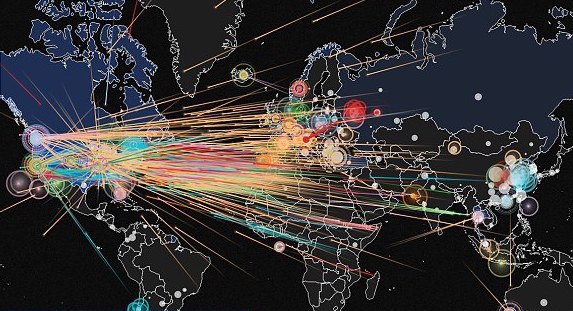
In mid-December of 2020, a massive hack compromised the networks of numerous US federal agencies, major corporations, the top five accounting firms in the country, and the military, among others. Despite most US media attention now focusing on election-related chaos, the fallout from the hack continues to make headlines day after day.

The hack, which affected Texas-based software provider SolarWinds, was blamed on Russia on January 5 by the US government’s Cyber Unified Coordination Group. Their statement asserted that the attackers were “likely Russian in origin,” but they failed to provide evidence to back up that claim.

Since then, numerous developments in the official investigation have been reported, but no actual evidence pointing to Russia has yet to be released. Rather, mainstream media outlets began reporting the intelligence community’s “likely” conclusion as fact right away, with the New York Times subsequently reporting that US investigators were examining a product used by SolarWinds that was sold by a Czech Republic–based company, as the possible entry point for the “Russian hackers.” Interest in that company, however, comes from the fact that the attackers most likely had access to the systems of a contractor or subsidiary of SolarWinds. This, combined with the evidence-free report from US intelligence on “likely” Russian involvement, is said to be the reason investigators are focusing on the Czech company, though any of SolarWinds’ contractors/subsidiaries could have been the entry point.

Such narratives clearly echo those that became prominent in the wake of the 2016 election, when now-debunked claims were made that Russian hackers were responsible for leaked emails published by WikiLeaks. Parallels are obvious when one considers that SolarWinds quickly brought on the discredited firm CrowdStrike to aid them in securing their networks and investigating the hack. CrowdStrike had also been brought on by the DNC after the 2016 WikiLeaks publication, and subsequently it was central in developing the false declarations regarding the involvement of “Russian hackers” in that event.

There are also other parallels. As Russiagate played out, it became apparent that there was collusion between the Trump campaign and a foreign power, but the nation was Israel, not Russia. Indeed, many of the reports that came out of Russiagate revealed collusion with Israel, yet those instances received little coverage and generated little media outrage. This has led some to suggest that Russiagate may have been a cover for what was in fact Israelgate.

Similarly, in the case of the SolarWinds hack, there is the odd case and timing of SolarWinds’ acquisition of a company called Samanage in 2019. As this report will explore, Samanage’s deep ties to Israeli intelligence, venture-capital firms connected to both intelligence and Isabel Maxwell, as well as Samange’s integration with the Orion software at the time of the back door’s insertion warrant investigation every bit as much as SolarWinds’ Czech-based contractor.

Orion’s Fall

In the month since the hack, evidence has emerged detailing the extent of the damage, with the Justice Department quietly announcing, the same day as the Capitol riots (January 6), that their email system had been breached in the hack—a “major incident” according to the department. This terminology means that the attack “is likely to result in demonstrable harm to the national security interests, foreign relations, or the economy of the United States or to the public confidence, civil liberties, or public health and safety of the American people,” per NextGov.

The Justice Department was the fourth US government agency to publicly acknowledge a breach in connection to the hack, with the others being the Departments of Commerce and Energy and the Treasury. Yet, while only four agencies have publicly acknowledged fallout from the hack, SolarWinds software is also used by the Department of Defense, the State Department, NASA, the NSA, and the Executive Office. Given that the Cyber Unified Coordination Group stated that “fewer than ten” US government agencies had been affected, it’s likely that some of these agencies were compromised, and some press reports have asserted that the State Department and Pentagon were affected.

In addition to government agencies, SolarWinds Orion software was in use by the top ten US telecommunications corporations, the top five US accounting firms, the New York Power Authority, and numerous US government contractors such as Booz Allen Hamilton, General Dynamics, and the Federal Reserve. Other notable SolarWinds clients include the Bill & Melinda Gates Foundation, Microsoft, Credit Suisse, and several mainstream news outlets including the Economist and the New York Times.

Based on what is officially known so far, the hackers appeared to have been highly sophisticated, with FireEye, the cybersecurity company that first discovered the implanted code used to conduct the hack, stating that the hackers “routinely removed their tools, including the backdoors, once legitimate remote access was achieved—implying a high degree of technical sophistication and attention to operational security.” In addition, top security experts have noted that the hack was “very very carefully orchestrated,” leading to a consensus that the hack was state sponsored.

FireEye stated that they first identified the compromise of SolarWinds after the version of the Orion software they were using contained a back door that was used to gain access to its “red team” suite of hacking tools. Not long after the disclosure of the SolarWinds hack, on December 31, the hackers were able to partially access Microsoft’s source code, raising concerns that the act was preparation for future and equally devastating attacks.

FireEye’s account can be taken with a grain of salt, however, as the CIA is one of FireEye’s clients, and FireEye was launched with funding from the CIA’s venture capital arm In-Q-tel. It is also worth being skeptical of the “free tool” FireEye has made available in the hack’s aftermath for “spotting and keeping suspected Russians out of systems.”

In addition, Microsoft, another key source in the SolarWinds story, is a military contractor with close ties to Israel’s intelligence apparatus, especially Unit 8200, and their reports of events also deserve scrutiny. Notably, it was Unit 8200 alumnus and executive at Israeli cybersecurity firm Cycode, Ronen Slavin, who told Reuters in a widely quoted article that he “was worried by the possibility that the SolarWinds hackers were poring over Microsoft’s source code as prelude to a much more ambitious offensive.” “To me the biggest question is, ‘Was this recon for the next big operation?’” Slavin stated.

Also odd about the actors involved in the response to the hack is the decision to bring on not only the discredited firm CrowdStrike but also the new consultancy firm of Chris Krebs and Alex Stamos, former chief information security officer of Facebook and Yahoo, to investigate the hack. Chris Krebs is the former head of the Department of Homeland Security’s Cybersecurity and Infrastructure Security Agency (CISA) and was previously a top Microsoft executive. Krebs was fired by Donald Trump after repeatedly and publicly challenging Trump on the issue of election fraud in the 2020 election.

As head of CISA, Krebs gave access to networks of critical infrastructure throughout the US, with a focus on the health-care industry, to the CTI League, a suspicious outfit of anonymous volunteers working “for free” and led by a former Unit 8200 officer. “We have brought in the expertise of Chris Krebs and Alex Stamos to assist in this review and provide best-in-class guidance on our journey to evolve into an industry leading secure software development company,” a SolarWinds spokesperson said in an email cited by Reuters.

It is also worth noting that the SolarWinds hack did benefit a few actors aside from the attackers themselves. For instance, Israeli cybersecurity firms CheckPoint and CyberArk, which have close ties to Israeli intelligence Unit 8200, have seen their stocks soar in the weeks since the SolarWinds compromise was announced. Notably, in 2017, CyberArk was the company that “discovered” one of the main tactics used in an attack, a form of SAML token manipulation called GoldenSAML. CyberArk does not specify how they discovered this method of attack and, at the time they announced the tactic’s existence, released a free tool to identify systems vulnerable to GoldenSAML manipulation.

In addition, the other main mode of attack, a back door program nicknamed Sunburst, was found by Kaspersky researchers to be similar to a piece of malware called Kazuar that was also first discovered by another Unit 8200-linked company, Palo Alto Networks, also in 2017. The similarities only suggest that those who developed the Sunburst backdoor may have been inspired by Kazuar and “they may have common members between them or a shared software developer building their malware.” Kaspersky stressed that Sunburst and Kazuar are not likely to be one and the same. It is worth noting, as an aside, that Unit 8200 is known to have previously hacked Kaspersky and attempted to insert a back door into their products, per Kaspersky employees.

Crowdstrike claimed that this finding confirmed “the attribution at least to Russian intelligence,” only because an allegedly Russian hacking group is believed to have used Kazuar before. No technical evidence linking Russia to the SolarWinds hacking has yet been presented.

Samanage and Sabotage

The implanted code used to execute the hack was directly injected into the source code of SolarWinds Orion. Then, the modified and bugged version of the software was “compiled, signed and delivered through the existing software patch release management system,” per reports. This has led US investigators and observers to conclude that the perpetrators had direct access to SolarWinds code as they had “a high degree of familiarity with the software.” While the way the attackers gained access to Orion’s code base has yet to be determined, one possibility being pursued by investigators is that the attackers were working with employee(s) of a SolarWinds contractor or subsidiary.

US investigators have been focusing on offices of SolarWinds that are based abroad, suggesting that—in addition to the above—the attackers were likely working for SolarWinds or were given access by someone working for the company. That investigation has focused on offices in eastern Europe, allegedly because “Russian intelligence operatives are deeply rooted” in those countries.

It is worth pointing out, however, that Israeli intelligence is similarly “deeply rooted” in eastern European states both before and after the fall of the Soviet Union, ties well illustrated by Israeli superspy and media tycoon Robert Maxwell’s frequent and close associations with Eastern European and Russian intelligence agencies as well as the leaders of many of those countries. Israeli intelligence operatives like Maxwell also had cozy ties with Russian organized crime. For instance, Maxwell enabled the access of the Russian organized crime network headed by Semion Mogilevich into the US financial system and was also Mogilevich’s business partner. In addition, the cross-pollination between Israeli and Russian organized crime networks (networks which also share ties to their respective intelligence agencies) and such links should be considered if the cybercriminals due prove to be Russian in origin, as US intelligence has claimed.

Though some contractors and subsidiaries of SolarWinds are now being investigated, one that has yet to be investigated, but should be, is Samanage. Samanage, acquired by SolarWinds in 2019, not only gained automatic access to Orion just as the malicious code was first inserted, but it has deep ties to Israeli intelligence and a web of venture-capital firms associated with numerous Israeli espionage scandals that have targeted the US government. Israel is deemed by the NSA to be one of the top spy threats facing US government agencies and Israel’s list of espionage scandals in the US is arguably the longest, and includes the Jonathan Pollard and PROMIS software scandals of the 1980s to the Larry Franklin/AIPAC espionage scandal in 2009.

Though much reporting has since been done on the recent compromise of SolarWinds Orion software, little attention has been paid to Samanage. Samanage offers what it describes as “an IT Service Desk solution.” It was acquired by SolarWinds so Samanage’s products could be added to SolarWinds’ IT Operations Management portfolio. Though US reporting and SolarWinds press releases state that Samanage is based in Cary, North Carolina, implying that it is an American company, Samanage is actually an Israeli firm. It was founded in 2007 by Doron Gordon, who previously worked for several years at MAMRAM, the Israeli military’s central computing unit.

Samanage was SolarWinds’ first acquisition of an Israeli company, and, at the time, Israeli media reported that SolarWinds was expected to set up its first development center in Israel. It appears, however, that SolarWinds, rather than setting up a new center, merely began using Samanage’s research and development center located in Netanya, Israel.

Several months after the acquisition was announced, in November 2019, Samanage, renamed SolarWinds Service Desk, became listed as a standard feature of SolarWinds Orion software, whereas the integration of Samanage and Orion had previously been optional since the acquisition’s announcement in April of that year. This means that complete integration was likely made standard in either October or November. It has since been reported that the perpetrators of the recent hack gained access to the networks of US federal agencies and major corporations at around the same time. Samanage’s automatic integration into Orion was a major modification made to the now-compromised software during that period.

Samanage appears to have had access to Orion following the announcement of the acquisition in April 2019. Integration first began with Orion version 2019.4, the earliest version believed to contain the malicious code that enabled the hack. In addition, the integrated Samanage component of Orion was responsible for “ensuring the appropriate teams are quickly notified when critical events or performance issues [with Orion] are detected,” which was meant to allow “service agents to react faster and resolve issues before . . . employees are impacted.”

In other words, the Samanage component that was integrated into Orion at the same time the compromise took place was also responsible for Orion’s alert system for critical events or performance issues. The code that was inserted into Orion by hackers in late 2019 nevertheless went undetected by this Samanage-made component for over a year, giving the “hackers” access to millions of devices critical to both US government and corporate networks. Furthermore, it is this Samanage-produced component of the affected Orion software that advises end users to exempt the software from antivirus scans and group policy object (GPO) restrictions by providing a warning that Orion may not work properly unless those exemptions are granted.

Samanage, Salesforce, and the World Economic Forum

Around the time of Samange’s acquisition by SolarWinds, it was reported that one of Samanage’s top backers was the company Salesforce, with Salesforce being both a major investor in Samanage as well as a partner of the company.

Salesforce is run by Marc Benioff, a billionaire who got his start at the tech giant Oracle. Oracle was originally created as a CIA spin-off and has deep ties to Israel’s government and the outgoing Trump administration. Salesforce also has a large presence in Israel, with much of its global research and development based there. Salesforce also recently partnered with the Unit 8200-linked Israeli firm Diagnostic Robotics to “predictively” diagnose COVID-19 cases using Artificial Intelligence.

Aside from leading Salesforce, Benioff is a member of the Vatican’s Council for Inclusive Capitalism alongside Lynn Forester de Rothschild, a close associate of Jeffrey Epstein and the Clintons, and members of the Lauder family, who have deep ties to the Mega Group and Israeli politics.

Benioff is also a prominent member of the board of trustees of the World Economic Forum and the inaugural chair of the WEF’s Centre for the Fourth Industrial Revolution (C4IR), making him one of the most critical players in the unfolding of the WEF-backed Great Reset. Other WEF leaders, including the organization’s founder Klaus Schwab, have openly discussed how massive cyberattacks such as befell SolarWinds will soon result in “even more significant economic and social implications than COVID-19.”

Last year, the WEF’s Centre for Cybersecurity, of which Salesforce is part, simulated a “digital pandemic” cyberattack in an exercise entitled Cyber Polygon. Cyber Polygon’s speakers in 2020 included former UK Prime Minister Tony Blair, the Prime Minister of Russia Mikhail Mishustin, WEF founder Klaus Schwab, and IBM executive Wendi Whitmore, who previously held top posts at both Crowdstrike and a FireEye subsidiary. Notably, just months before the COVID-19 crisis, the WEF had held Event 201, which simulated a global coronavirus pandemic that crippled the world’s economy.

In addition to Samanage’s ties to WEF big shots such as Marc Benioff, the other main investors behind Samanage’s rise have ties to major Israeli espionage scandals, including the Jonathan Pollard affair and the PROMIS software scandal. There are also ties to one of the WEF’s founding “technology pioneers,” Isabel Maxwell (the daughter of Robert Maxwell and sister of Ghislaine), who has long-standing ties to Israel’s intelligence apparatus and the country’s hi-tech sector.

The Bronfmans, the Maxwells, and Viola Ventures

At the time of its acquisition by SolarWinds, Samanage’s top investor was Viola Ventures, a major Israeli venture-capital firm. Viola’s investment in Samanage, until its acquisition, was managed by Ronen Nir, who was also on Samanage’s board before it became part of SolarWinds.

Prior to working at Viola, Ronen Nir was a vice president at Verint, formerly Converse Infosys. Verint, whose other alumni have gone on to found Israeli intelligence-front companies such as Cybereason. Verint has a history of aggressively spying on US government facilities, including the White House, and created the backdoors into all US telecommunications systems and major tech companies, including Microsoft, Google and Facebook, on behalf of the US’ NSA.

In addition to his background at Verint, Ronen Nir is an Israeli spy, having served for thirteen years in an elite IDF intelligence unit, and he remains a lieutenant colonel on reserve duty. His biography also notes that he worked for two years at the Israeli embassy in Washington, DC, which is fitting given his background in espionage and the major role that Israeli embassy has played in several major espionage scandals.

As an aside, Nir has stated that “thought leader” Henry Kissinger is his “favorite historical character.” Notably, Kissinger was instrumental in allowing Robert Maxwell, Israeli superspy and father of Ghislaine and Isabel Maxwell, to sell software with a back door for Israeli intelligence to US national laboratories, where it was used to spy on the US nuclear program. Kissinger had told Maxwell to connect with Senator John Tower in order to gain access to US national laboratories, which directly enabled this action, part of the larger PROMIS software scandal.

In addition, Viola’s stake was managed through a firm known as Carmel Ventures, which is part of the Viola Group. At the time, Carmel Ventures was advised by Isabel Maxwell, whose father had previously been directly involved in the operation of the front company used to sell bugged software to US national laboratories. As noted in a previous article at Unlimited Hangout, Isabel “inherited” her father’s circle of Israeli government and intelligence contacts after his death and has been instrumental in building the “bridge” between Israel’s intelligence and military-linked hi-tech sector to Silicon Valley.

Isabel also has ties to the Viola Group itself through Jonathan Kolber, a general partner at Viola. Kolber previously cofounded and led the Bronfman family’s private-equity fund, Claridge Israel (based in Israel). Kolber then led Koor Industries, which he had acquired alongside the Bronfmans via Claridge. Kolber is closely associated with Stephen Bronfman, the son of Charles Bronfman who created Claridge and also cofounded the Mega Group with Leslie Wexner in the early 1990s.

Kolber, like Isabel Maxwell, is a founding director of the Peres Center for Peace and Innovation. Maxwell, who used to chair the center’s board, stepped down following the Epstein scandal, though it’s not exactly clear when. Other directors of the center include Tamir Pardo, former head of Mossad. Kolber’s area of expertise, like that of Isabel Maxwell, is “structuring complex, cross-border and cross industry business and financial transactions,” that is, arranging acquisitions and partnerships of Israeli firms by US companies. Incidentally, this is also a major focus of the Peres Center.

Other connections to Isabel Maxwell, aside from her espionage ties, are worth noting, given that she is a “technology pioneer” of the World Economic Forum. As previously mentioned, Salesforce—a major investor in Samanage—is deeply involved with the WEF and its Great Reset.

The links of Israeli intelligence and Salesforce to Samanage, and thus to SolarWinds, is particularly relevant given the WEF’s “prediction” of a coming “pandemic” of cyberattacks and the early hints from former Unit 8200 officers that the SolarWinds hack is just the beginning. It is also worth mentioning the Israeli government’s considerable ties to the WEF over the years, particularly last year when it joined the Benioff-chaired C4IR and participated in the October 2020 WEF panel entitled “The Great Reset: Harnessing the Fourth Industrial Revolution.”

Start Up Nation Central, an organization aimed at integrating Israeli start-ups with US firms set up by Netanyahu’s longtime economic adviser Eugene Kandel and American Zionist billionaire Paul Singer, have asserted that Israel will serve a “key role” globally in the 4th Industrial Revolution following the implementation of the Great Reset.

Gemini, the BIRD Foundation, and Jonathan Pollard

In addition to Viola, another of Samange’s leading investors is Gemini Israel Ventures. Gemini is one of Israel’s oldest venture-capital firms, dating back to the Israeli government’s 1993 Yozma program.

The first firm created by Yozma, Gemini was put under the control of Ed Mlavsky, who Israel’s government had chosen specifically for this position. As previously reported by Unlimited Hangout, Mlavsky was then serving as the executive director of the Israel-US Binational Industrial Research and Development (BIRD) Foundation, where “he was responsible for investments of $100 million in more than 300 joint projects between US and Israeli high-tech companies.”

A few years before Gemini was created, while Mlavsky still headed BIRD, the foundation became embroiled in one of the worst espionage scandals in US history, the Jonathan Pollard affair.

In the indictment of US citizen Pollard for espionage on Israel’s behalf, it was noted that Pollard delivered the documents he stole to agents of Israel at two locations, one of which was an apartment owned by Harold Katz, the then legal counsel of the BIRD Foundation and an adviser to Israel’s military, which oversaw Israel’s scientific intelligence-gathering agency, Lekem. US officials told the New York Times at the time that they believed Katz “has detailed knowledge about the [Pollard] spy ring and could implicate senior Israeli officials.”

Subsequent reporting by journalist Claudia Wright pointed the finger at the Mlavsky-run BIRD Foundation as one of the ways Israeli intelligence funneled money to Pollard before his capture by US authorities.

One of the first companies Gemini invested in was CommTouch (now Cyren), which was founded by ex-IDF officers and later led by Isabel Maxwell. Under Maxwell’s leadership, CommTouch developed close ties to Microsoft, partially due to Maxwell’s relationship with its cofounder Bill Gates.

A Coming “Hack” of Microsoft?

If the SolarWinds hack is as serious as has been reported, it’s difficult to understand why a company like Samanage would not be looked into as part of a legitimate investigation into the attack. The timing of Samanage employees gaining access to the Orion software and the company’s investors including Israeli spies and those with ties to past espionage scandals where Israel used back doors to spy on the US and beyond raises obvious red flags. Yet, any meaningful investigation of the incident is unlikely to take place, especially given the considerable involvement of discredited firms like CrowdStrike, CIA fronts like FireEye and a consultancy firm led by former Silicon Valley executives with their own government/intelligence ties.

There is also the added fact that both of the main methods used in the attack were analogous or bore similarities to hacking tools that were both discovered by Unit 8200-linked companies in 2017. Unit 8200-founded cybersecurity firms are among the few “winners” from the SolarWinds hack, as their stocks have skyrocketed and demand for their services has increased globally.

While some may argue that Unit 8200 alumni are not necessarily connected to the Israeli intelligence apparatus, numerous reports have pointed out the admitted fusion of Israeli military intelligence with Israel’s hi-tech sector and its tech-focused venture capital networks, with Israeli military and intelligence officials themselves noting that the line between the private cybersecurity sector and Israel’s intelligence apparatus is so blurred, it’s difficult to know where one begins and the other ends. There is also the Israeli government policy, formally launched in 2012, whereby Israel’s intelligence and military intelligence agencies began outsourcing “activities that were previously managed in-house, with a focus on software and cyber technologies.”

Samanage certainly appears to be such a company, not only because it was founded by a former IDF officer in the military’s central computing unit, but because its main investors include spies on “reserve duty” and venture capital firms linked to the Pollard scandal as well as the Bronfman and Maxwell families, both of whom have been tied to espionage and sexual blackmail scandals over the years.

Yet, as the Epstein scandal has recently indicated, major espionage scandals involving Israel receive little coverage and investigations into these events rarely lead anywhere. PROMIS was covered up largely thanks to Bill Barr during his first term as Attorney General and even the Pollard affair has all been swept under the rug with Donald Trump allowing Pollard to move to Israel and, more recently, pardoning the Israeli spy who recruited Pollard during his final day as President. Also under Trump, there was the discovery of “stingray” surveillance devices placed by Israel’s government throughout Washington DC, including next to the White House, which were quickly memory holed and oddly not investigated by authorities. Israel had previously wiretapped the White House’s phone lines during the Clinton years.

Another cover up is likely in the case of SolarWinds, particularly if the entry point was in fact Samanage. Though a cover up would certainly be more of the same, the SolarWinds case is different as major tech companies and cybersecurity firms with ties to US and Israeli intelligence now insist that Microsoft is soon to be targeted in what would clearly be a much more devastating event than SolarWinds due to the ubiquity of Microsoft’s products.

On Tuesday, CIA-linked firm FireEye, which apparently has a leadership role in investigating the hack, claimed that the perpetrators are still gathering data from US government agencies and that “the hackers are moving into Microsoft 365 cloud applications from physical, on-premises servers,” meaning that changes to fix Orion’s vulnerabilities will not necessarily deny hacker access to previously compromised systems as they allegedly maintain access to those systems via Microsoft cloud applications. In addition to Microsoft’s own claims that some of its source code was accessed by the hackers, this builds the narrative that Microsoft products are poised to be targeted in the next high-profile hack.

Microsoft’s cloud security infrastructure, set to be the next target of the SolarWinds hackers, was largely developed and later managed by Assaf Rappaport, a former Unit 8200 officer who was most recently the head of Microsoft’s Research and Development and Security teams at its massive Israel branch. Rappaport left Microsoft right before the COVID-19 crisis began last year to found a new cybersecurity company called Wiz.

Microsoft, like some of Samanage’s main backers, is part of the World Economic Forum and is an enthusiastic supporter of and participant in the Great Reset agenda, so much so that Microsoft CEO Satya Nadella wrote the foreword to Klaus Schwab’s book “Shaping the Fourth Industrial Revolution.” With the WEF simulating a cyber “pandemic” and both the WEF and Israel’s head of Israel’s National Cyber Directorate warning of an imminent “cyber winter”, SolarWinds does indeed appear to be just the beginning, though perhaps a scripted one to create the foundation for something much more severe. A cyberattack on Microsoft products globally would certainly upend most of the global economy and likely have economic effects more severe than the COVID-19 crisis, just as the WEF has been warning. Yet, if such a hack does occur, it will inevitably serve the aims of the Great Reset to “reset” and then rebuild electronic infrastructure.

How Government and Media Are Prepping America for a Failed 2020 Election

FILE – In this May 6, 2019, file photo Microsoft CEO Satya Nadella delivers the keynote address at Build, the company’s annual conference for software developers in Seattle. Microsoft says it has detected more than 740 infiltration attempts by nation-state actors in the past year targeting U.S.-based political parties, campaigns and other democracy-focused organizations including think tanks and other non-profits. (AP Photo/Elaine Thompson, File)

Russia, China and Iran are already being blamed for using tech to undermine the 2020 election. Yet, the very technologies they are allegedly using were created by a web of companies with deep ties to Israeli intelligence.

By Whitney Webb

Source: Mint Press News

As World War II drew to a close in Europe, British philosopher Bertrand Russell wrote that “neither a man nor a crowd nor a nation can be trusted to act humanely or to think sanely under the influence of a great fear.”

Though numerous examples in the post-World War II era have proven Russell’s point, perhaps one of the best examples was the U.S. public’s willingness to swallow lie after lie about Saddam Hussein’s Iraq due to the climate of fear that followed the September 11 attacks. Those lies, propagated by dubious intelligence, government officials and a compliant media, resulted in catastrophes – large and small, both abroad and at home.

Today, an analogous narrative is being crafted by many of the same players – both in media and government – yet it has avoided scrutiny, even from independent media.

Over the past several months and with a renewed zeal in just the last few weeks, anonymous intelligence officials, dubious “experts” and establishment media outlets have crafted a narrative about the coming “chaos” of the 2020 election, months before it takes place. Per that narrative, certain state actors will use specific technologies to target the “American mind” in order to undermine the coming presidential election. The narrative holds that those efforts will be so successful that the U.S. will never recover as a democracy.

Though these anonymous government sources and their stenographers have already named the countries who will be responsible and the technologies they will use, they also admit that no evidence yet exists to back up these claims, meaning they are — at best — pure speculation.

Headlines such as “Hackers Are Coming for the 2020 Election — And We’re Not Ready,” “Basically Every US National Security Leader Is Warning About Foreign Interference In The 2020 Election,” and “U.S. intel agencies: Russia and China plotting to interfere in 2020 election” have become increasingly common, despite no available evidence, as have warnings that the American public is defenseless against the old scourge of “fake news” and the new scourge of “deep fakes.” Some media reports have gone so far to say that actual foreign meddling isn’t even necessary as merely the fear of foreign meddling could be enough to upend the American political system beyond repair.

Historically, the goal of such fear-inducing narratives has been the trading of civil liberties for increased security, or rather, the appearance of increased security. Yet, when the need for security is felt due to a fear that is based on government-driven speculation and not on evidence, the goal of that narrative is not about protecting the public from a real, tangible threat but instead about the consolidation of power by the very groups responsible for crafting it — in this case, the intelligence community and other key players in the national security state.

However, what is particularly odd about this narrative surrounding imminent “chaos” and meddling in the upcoming 2020 election is the fact that, not only have the instruments of said meddling been named and described in detail, but their use in the election was recently simulated by a company with deep ties to both U.S. and Israeli intelligence. That simulation, organized and run by the Israeli-American company Cybereason, ended with scores of Americans dead, the cancellation of the 2020 election, the imposition of martial law and a spike in fear among the American populace.

Many of the technologies used to create that chaotic and horrific scenario in the Cybereason simulation are the very same technologies that U.S. federal officials and corporate media outlets have promoted as the core of the very toolkit that they claim will be used to undermine the coming election, such as deep fakes and hacks of critical infrastructure, consumer devices and even vehicles.

While the narrative in place has already laid the blame at the feet of U.S. rival states China, Russia and Iran, these very technologies are instead dominated by companies that are tied to the very same intelligence agencies as Cybereason, specifically Israeli military intelligence.

With intelligence agencies in the U.S. and Israel not only crafting the narrative about 2020 foreign meddling, but also dominating these technologies and simulating their use to upend the coming election, it becomes crucial to consider the motivations behind this narrative and if these intelligence agencies have ulterior motives in promoting and simulating such outcomes that would effectively end American democracy and hand almost total power to the national security state.


Media, intelligence foreshadow tech-powered doom for 2020

Even though the 2020 U.S. election is still months away, a plethora of media reports over the past six months (and even before then) have been raising concern after concern about how the U.S. election is still so vulnerable to foreign meddling that such meddling is essentially an inevitability.

Part of the reason for the recent pick-up in fear mongering appears to have been the release of a joint statement issued by key members of the Trump administration last November. That statement, authored by Attorney General Bill Barr, Defense Secretary Mark Esper, acting DHS Secretary Kevin McAleenan, acting Director of National Intelligence Joseph Maguire, FBI Director Christopher Wray, NSA Director Gen. Paul Nakasone, and Cybersecurity and Infrastructure Security Agency (CISA) Director Christopher Krebs, claimed that foreign interference in 2020 was imminent despite admitting that there is no evidence of interference having taken place:

Our adversaries want to undermine our democratic institutions, influence public sentiment and affect government policies. Russia, China, Iran, and other foreign malicious actors all will seek to interfere in the voting process or influence voter perceptions. Adversaries may try to accomplish their goals through a variety of means, including social media campaigns, directing disinformation operations or conducting disruptive or destructive cyber-attacks on state and local infrastructure.

While at this time we have no evidence of a compromise or disruption to election infrastructure that would enable adversaries to prevent voting, change vote counts or disrupt the ability to tally votes, we continue to vigilantly monitor any threats to U.S. elections (emphasis added).”

Despite the key caveat of there being no evidence at the time the statement was issued, media reports used the statement to claim that foreign interference in 2020 was imminent, such as in these reports from BuzzFeed, ABC News, and Newsweek.

In addition to the reports that have cast the involvement of state actors — namely Russia, Iran and China — as assured despite no evidence, other reports have made the claim that this allegedly imminent interference will inevitably be successful, largely due to claims that the tactics used will rely heavily on technology that the U.S. can’t hope to successfully counter. CSO Online, an online news outlets that provides news, analysis and research on security and risk management, recently warned that “fixing America’s voting and election infrastructure problems is a long-term proposition, one that won’t be fixed in time for the election in November” while the New York Times warned of imminent chaos and that “stealthier” malevolent foreign actors had already created the foundation for “an ugly campaign season marred by hacking and disinformation.” Wired claimed last year that U.S. election security “is still hurting at every level.”

In another example, Rolling Stone published an article earlier this month with the headline “Hackers Are Coming for the 2020 Election — And We’re Not Ready,” which claims that “the reality is that: “We’ve made progress since the last election — but we’re much less secure than we should be.” The article goes on to say that claim that the goal isn’t necessarily to hack voting machines or change results, but “to merely create the impression of an attack as a way to undermine our faith in the electoral process.”

It continues:

The target is the minds of the American people,” says Joshua Geltzer, a former counterterrorism director on the National Security Council. “In some ways, we’re less vulnerable than we were in 2016. In other ways, it’s more.” Nearly every expert agrees on this: The worst-case scenario, the one we need to prepare for, is a situation that causes Americans to question the bedrock of our democracy — free and fair elections.”

Well before this type of rhetoric made its way into the U.S. media, Israeli intelligence-linked tech firm Cybereason claiming in a release on its website that “messing with a voter’s mind” would have a bigger impact than changing vote totals, even before the 2016 election. That release, published by Cybereason prior to the last presidential election, was authored by the company’s CEO, Lior Div, who used to lead offensive hacking operations against nation-states for Israeli military intelligence.

Notably, of all of these media reports, there is a clear consensus that one of the main tactics that will soon be used to meddle in the coming U.S. election will be the use of so-called “deep fakes.” Deriving its name from a combination of “deep learning” and “fake,” deep fakes involve video and audio that has been manipulated using artificial intelligence (AI) to create media that appears to be authentic, but is not. Concern about its use in the upcoming election has spurred not only a wealth of media reports on the matter but has prompted both the U.S. military and Congress to take action to limit its potential misuse.

One thing that stands out about the media narrative regarding election meddling and deep fakes is that several news organizations have published articles that state that deep fakes will be used to undermine the 2020 election, as opposed to stating that they could be used or that they are a phenomenon worthy of attention (though some reports have taken this more measured approach).

The reason for this level of confidence may owe to statements made by prominent U.S. intelligence officials last year, including those made by Dan Coats, the former Director of National Intelligence (DNI), who claimed in the 2019 Worldwide Threat Assessment for the U.S. Intelligence Community that deep fakes and other hi-tech forms of fake media would be used to disrupt the 2020 election. Coats specifically stated:

Adversaries and strategic competitors probably will attempt to use deep fakes or similar machine-learning technologies to create convincing—but false—image, audio, and video files to augment influence campaigns directed against the United States and our allies and partners.”

Since Coats made the warning, numerous media reports have promoted the concern with little scrutiny, representing just one of the numerous times in U.S. history where narratives first authored by U.S. intelligence are subsequently promoted heavily by U.S. media, even when the claim made by intelligence officials is speculative, as it is in this case. Indeed, the narratives being promoted with respect to the 2020 election involve many of the same intelligence agencies (American and Israeli) and media outlets who promoted claims that were later proven false about “weapons of mass destruction” in Iraq prior to the 2003 invasion, among other pertinent examples.

Notably, deep fakes figured prominently and was the tool most used by malevolent hackers in Cybereason’s 2020 election simulation, which saw both video and audio-only deep fakes used to spread misinformation on national and local TV channels in order to impersonate police officers and election officials and to create fake bomb threats by posing as the terror group Daesh (ISIS). Cybereason also happens to be a partner of the organization funding the most well-known creator and producer of deep fakes in the world, an organization that — much like Cybereason itself — is openly tied to Israeli intelligence.

Aside from deep fakes, other technologies weaponized in Cybereason’s election simulation have also been the subject of several media reports, such as the hacking of Internet of Things (IoT) devices and appliances and even the hacking of vehicles that have some form of internet connectivity.  In the Cybereason simulation, IoT hacks were used to cut power to polling stations and disseminate disinformation while vehicles were hacked to conduct terror attacks against civilians waiting in line to vote, killing several and injuring hundreds.

Most media reports have claimed that these technologies will be part of the coming “explosion” in cyber warfare in 2020 and do not specifically link them to imminent election meddling. Others, however, have made the link to the election explicit.


Naming the culprits in advance

In addition to the apparent consensus on how foreign meddling will occur during the 2020 election, there is also agreement regarding which countries will be responsible. Again, this is largely based on statements made by U.S. national security officials. For instance, the joint statement issued last November by the DOJ, DOD, DHS, DNI, FBI, NSA, and CISA regarding 2020 election security, states that “Russia, China, Iran, and other foreign malicious actors all will seek to interfere in the voting process or influence voter perceptions” before adding “at this time we have no evidence.”

Similarly, the 2019 Worldwide Threat Assessment for the U.S. Intelligence Community, written by then-Director of National Intelligence Dan Coats, names these same three countries in relation to imminent 2020 election interference and states that their interference in the 2020 election is “almost certain.” The assessment adds the following about each nation:

  • Russia: “Russia’s social media efforts will continue to focus on aggravating social and racial tensions, undermining trust in authorities, and criticizing perceived anti-Russia politicians.”
  • China: “China will continue to use legal, political, and economic levers—such as the lure of Chinese markets—to shape the information environment. It is also capable of using cyber attacks against systems in the United States to censor or suppress viewpoints it deems politically sensitive.”
  • Iran: “Iran, which has used social media campaigns to target audiences in both the United States and allied nations with messages aligned with Iranian interests, will continue to use online influence operations to try to advance its interests.”

Coats’ assessment was enough to spawn numerous stories on the imminent threat that these three nations pose to the 2020 election, with headlines such as “U.S. intel agencies: Russia and China plotting to interfere in 2020 election.”

The vast majority of warnings regarding future election interference have come from U.S. intelligence officials with a dubious record of trustworthiness and a history of using the media to spread propaganda and disinformation, most famously through Operation Mockingbird. Most — if not all — of the recent and numerous articles on imminent interference rely heavily on claims made by the two aforementioned government documents, documents crafted by U.S. intelligence agencies for public consumption, as well as claims made by anonymous U.S. officials.

A recent New York Times article, for example, titled “Chaos Is the Point’: Russian Hackers and Trolls Grow Stealthier in 2020,” is based almost entirely on “interviews with dozens of officials and experts,” though the only government official named in the article is Shelby Pierson, the intelligence community’s election threats executive. The most quoted experts named in the article are Ben Nimmo, formerly of the hawkish, NATO-funded Atlantic Council and now with Graphika, and Laura Rosenberger, director of the neoconservative-created Alliance for Securing Democracy. The article nonetheless cites “American officials” and “current and former officials” several times to make claims about imminent election interference that paint a bleak picture of the current election season.

A recent article from The Hill relies on the acting head of DHS, Chad Wolf, as its only source, citing Wolf’s claim that “we fully expect Russia to attempt to interfere in the 2020 elections to sow public discord and undermine our democratic institutions” amid other warnings that Wolf gave about Chinese and Iranian cyber threats to U.S. elections. Other articles, including one titled “Russia, China plan to adjust their tactics to hack, influence 2020 elections” cite only Shelby Pierson of the U.S. intelligence community as its source for that headline’s claim. Another titled “Russia isn’t the only threat to 2020 elections, says U.S. intel” cites only anonymous U.S. intelligence officials, as the headline suggests.

Though Russia and China have consistently been named as the most likely election meddlers, reports have also been drumming up the likelihood that Iran will emerge as 2020’s foreign meddler of choice, especially in the months prior to and weeks after the killing of Iranian General Qassem Soleimani by the Trump administration. A recent “informal poll” conducted by the Washington Post asked hawkish think tank fellows, employees at companies like Raytheon and current and former federal officials if Iran would likely retaliate against the U.S. via cyberattack. The Post ran the results of the poll under the headline “Get ready for serious cyberattacks from Iran, experts say.”

Despite the media’s numerous warnings of imminent and “serious” cyber-retaliation from Iran, the only cyberattack attributed to the country after Soleimani’s death was the vandalism of the Federal Depository Library Program website, a rather benign act that was nevertheless blasted across headlines such as “US government website hacked with pro-Iranian messages, image of bloodied Trump.” The U.S. government is quoted in that article as saying that “At this time, there is no confirmation that this was the action of Iranian state-sponsored actors.”

Also notably absent from media reports is the fact that WikiLeaks revealed in 2017 that the CIA had stockpiled a library of “stolen” cyberattack techniques produced in other nations, including Russia and Iran. Those revelations, part of the Vault 7 release, revealed that the CIA’s UMBRAGE group was capable of “misdirect[ing] attribution [for cyberattacks actually done by the CIA] by leaving behind the ‘fingerprints’ of the groups that the attack techniques were stolen from.” In other words, the CIA was more than capable of conducting “false flag” cyber attacks and blaming them on foreign actors.

Notably, one of the viruses being blamed on Iran for cyberattacks targeting the U.S. ahead of the 2020 election — called Shamoon — was “stolen” by the CIA’s UMBRAGE and cited in the WikiLeaks release.


Conflict of interest-ridden Microsoft “defends democracy”

Last year saw the tech behemoth Microsoft join the effort to blame foreign state actors, specifically Iran, for cyberattacks against the U.S. This helped to bolster assertions that had largely originated with a handful of U.S. intelligence officials and hawkish, neoconservative-aligned think tanks as media reports on Microsoft’s related claims treated the company as an independent private sector observer.

Yet, as MintPress investigations have revealed, Microsoft has clear conflicts of interest with respect to election interference. Its “Defending Democracy” program has spawned tools like “NewsGuard” and “ElectionGuard” that it claims will help protect U.S. democracy, but — upon closer examination — instead have the opposite effect.

Last January, MintPress exposed NewsGuard’s neoconservative backers and how special interest groups were backing the program in an effort to censor independent journalism under the guise of the fight against “fake news.” Subsequent investigations revealed the risk that Microsoft’s ElectionGuard poses to U.S. voting machines, which it claims to make more secure and how the platform was developed by companies closely tied to the Pentagon’s infamous research branch DARPA and Israeli military intelligence Unit 8200.

ElecionGuard software has since been adopted by numerous voting machine manufacturers and is slated to be used in some Democratic Primary votes. Notably, the push for the adoption of ElectionGuard software has been spearheaded by the recently created Cybersecurity and Infrastructure Security Agency (CISA), which is the federal agency tasked with overseeing election security and is headed by Christopher Krebs, a former high level Microsoft executive.

In recent months, Microsoft has also been at the center of claims that Iran attempted to hack U.S. presidential campaigns ahead of 2020 as well as claims that Iran plans to target the U.S. power grid and other critical infrastructure with cyberattacks.

Last October, Microsoft penned a blog post discussing a “threat group” it named Phosphorus that they “believe originates from Iran and is linked to the Iranian government.” The post went on to claim that Phosphorus attempted to target a U.S. presidential campaign, which later media reports claimed was President Trump’s re-election campaign. Microsoft concluded that the attempt was “not technically sophisticated” and ultimately unsuccessful, but felt compelled to disclose it and link it to Iran’s government.

Though it provided no evidence for the hack or its reasons for “believing” that the attack originated from Iran, media reports treated Microsoft’s declaration as proof that Iran had begun actively meddling in the 2020 election. Headlines such as “Iranian Hackers Target Trump Campaign as 2020 Threats Mount,” “Iran-linked Hackers Target Trump 2020 Campaign, Microsoft says”, “Microsoft: Iran government-linked hacker targeted 2020 presidential campaign” and “Microsoft Says Iranians Tried To Hack U.S. Presidential Campaign,” were blasted across the front pages of American media. None of the reports scrutinized Microsoft’s claims or noted the clear conflict of interest Microsoft had in making such claims due to its efforts to see its own ElectionGuard Software adopted nationwide.

Media reports also left out the fact that Microsoft is a major government contractor for the U.S. intelligence community and the Pentagon. Notably, the Trump campaign, which Microsoft said was the target of this attack, was later identified as the only major presidential campaign using Microsoft’s “AccountGuard” software, part of its dubious “Defending Democracy” program that also spawned NewsGuard and ElectionGuard. AccountGuard claims to protect campaign-linked emails and data from hackers.

Microsoft surfaced not long after, again claiming that Iran was maliciously targeting the United States’ civilian infrastructure. This subsequent claim was first published by Wired and later covered by other outlets. Those reports cite a single person, Microsoft security researcher Ned Moran, who claimed that an Iran-backed hacking group called APT33 was targeting the U.S. “physical control systems used in electric utilities, manufacturing, and oil refineries.”

“They’re trying to deliver messages to their adversaries and trying to compel and change their adversaries’ behavior,” Moran told Wired. Moran also stated that “Microsoft hasn’t seen direct evidence of APT33 carrying out a disruptive cyberattack rather than mere espionage or reconnaissance, it’s seen incidents where the group has at least laid the groundwork for those attacks (emphasis added).”


Cybereason helps craft the narrative

While U.S. intelligence officials and media outlets alike have been largely responsible for setting the narrative that imminent meddling will be conducted by Russia, China and Iran, key components of that narrative, particularly with respect to China and Iran, have been laid by Cybereason, a company that recently ran 2020 doomsday election simulations and that has close ties to the intelligence communities of both the U.S. and Israel.

Shortly after the killing of Iranian General Qassem Soleimani earlier this month, an operation conducted in concert with Israeli intelligence, Cybereason warned that Iran could imminently retaliate with a cyber threat and quoted its own employees who explained what and how Iran would likely target in retaliation. Cybereason’s CSO Sam Curry, who actively participated in the firm’s 2020 doomsday election simulations, stated:

 This means that Iran’s “forceful revenge” response is likely to be less about the flash and all about the bang. If you have connected systems that are responsible for kinetic world effects, like ICS systems and critical infrastructure around water, energy or vital services, it’s time to pay attention. Iran and the US are engaged in Cyber brinksmanship, which means that the gloves are off as Iran picks it’s targets (emphasis added).”

Cybereason also quoted visiting fellow for the National Security Institute and former advisor to the U.S. Secret Service (which participated in Cyberaeson’s election simulations), Anne Marie Zettlemoyer, who claimed that Iran could soon target Wall Street and critical U.S. infrastructure like the power grid:

 An attack against the financial systems can be devastating economically and weaken the confidence and viability of markets. However, we cannot ignore the physical consequences and manifestations that can come from a cyberattack, particularly against critical infrastructure like energy and industry control systems.”

Cybereason’s claims regarding Iran’s interest in “critical infrastructure” systems likely originated with Microsoft, the claims were then parroted by the media in several reports, many of which quoted Cybereason’s Sam Curry. Curry is also a contributor to major news outlets like Forbes where he writes about Iran’s cyber warfare capabilities. 

Notably, in Cybereason’s recent allegations against Iran, it states that “it’s clear that Iran has been preparing for future geopolitical conflict by gaining access to critical infrastructure and other important operations in the United States.” It backs these claims by citing an article authored by Curry for Forbes. Following Soleimani’s death, numerous media reports, including in the UK’s The Independent and ABC News, have cited Curry as an “expert” source in claiming that Iran would retaliate with cyberattacks.

Microsoft’s claims about foreign hackers and meddling — the evidence for which have never been made public but has been parroted as fact nonetheless — are frequently supported by Cybereason.

Last August, Microsoft claimed to have foiled Russian attempts at hacking two Republican-affiliated think tanks and, despite providing no evidence, Cybereason’s then-senior director of intelligence services Ross Rustici was quoted as an expert in several media reports as saying that such behavior was to be expected from Russia. In one such report, Rustici stated:

We’re very good at fighting the last war, but the Russians are very good at evolving their game. I suspect if they’re going to do a psychological operation around the elections, the way they do it will be different than what they did in 2016. How effective the defenses we’ve built for what they did in 2016 will be for those attacks is yet to be seen.”

None of the media reports quoting Rustici mentioned Cybereason’s ties to Israeli intelligence, referring to tech firms only a “Boston-based cybersecurity company” and similar variants. Cybereason’s Intelligence Group is stuffed with former and active members of U.S. and Israeli intelligence services and has released several reports about nation-state hacking with a focus on Russia and China.

Cybereason has also been at the forefront of claims that China has been engaged in aggressive cyberattacks against multinational companies that have also seen widespread coverage in U.S. media, despite the untransparent nature of the evidence for Cybereason’s claims.

In a story that received major coverage from outlets such as Fox News, Reuters, CNBC and others, Cybereason unveiled what it called “Operation Soft Cell,” an operation that stole mass troves of data from several global telecommunications companies. In each story, Cybereason is the sole source of the claim and declined to provide the name or location of any of the affected companies. The firm also claimed to have determined that the attack was likely perpetrated by someone “backed by a nation state, and is affiliated with China.” It further claimed to have debriefed and coordinated responses with U.S. intelligence.

In an article for Reuters, Cybereason stated that “this time as opposed to in the past we are sure enough to say that the attack originated in China” while Cybereason separately told CyberScoop that it had “found hacking tools such as a modified web shell and a remote access trojan that are commonly associated with, but not unique to, Chinese hackers.” Despite the incongruity, media reports laid the blame squarely on China, as seen in headlines such as “Chinese spies have been sucking up call records at multinational telecoms, researchers say.”

Prior to uncovering Operation Soft Cell, Cybereason had warned on its blogs in the months and years prior that China would imminently target U.S. companies. The revelation of Operation Soft Cell — which originated exclusively with Cybereason — has been used to build the case that China is openly engaged in cyberwarfare against its rival states, like the United States, and targeting “democracy itself.”


Best Known Deep Fake Creator is Funded by Israeli Intelligence

While the media, and even Cybereason itself, have helped lay the foundation to blame specific state actors for 2020 election meddling well ahead of the fact, it is worth revisiting Cybereason’s “Operation Blackout” election simulation and the tactics used by the “bad actors” in that scenario.

That simulation, discussed in detail in the first installment of this series, saw the weaponization of specific technologies, namely deep fakes, hacks of Internet of Things (IoT) devices and hacks of vehicles, in order to target the 2020 U.S. election, resulting in the cancellation of the election and the imposition of martial law.

Given the current narrative regarding what state actors are likely to meddle in the 2020 election — namely Russia, China and Iran — and the tactics they will allegedly use, it is important to explore the sources of the technologies weaponized per that narrative as well as in “Operation Blackout.”

Indeed, if there is any clear overlap between the creators of those technologies and the state actors being blamed in advance for their imminent use, it would certainly lend credibility to the claims promoted by U.S. intelligence, the media and companies like Microsoft and Cybereason.

Yet, upon closer examination, it becomes clear that the companies and state actors most involved in developing these technologies are the very ones claiming that Russia, China and Iran will use them to undermine the 2020 election.

Take for instance the use of deep fakes. Not only have numerous media reports focused on how deep fakes will be used to meddle in the 2020 elections, but Cybereason’s doomsday election simulation saw “bad actors” rely heavily on their use to spread disinformation and even make fake bomb threats. While much has been said of the coming election and deep fakes, remarkably few reports have bothered to look at the company best known for creating viral deep fakes.

Canny AI has garnered considerable media attention over the past few years for its persuasive deep fake videos that have frequently gone viral. In the last year alone, the tech firm’s viral deep fakes have included a controversial video of Mark Zuckerberg where the Facebook co-founder appears to be saying “Imagine this for a second: One man, with total control of billions of people’s stolen data, all their secrets, their lives, their futures,” as well as a video showing Richard Nixon giving a speech he never actually gave. More recently, Canny AI was behind the viral videos immediately prior to the 2019 U.K. general election that appeared to show Jeremy Corbyn and his rival Boris Johnson endorsing each other and another video that showed world leaders singing John Lennon’s “Imagine”:

Oddly, many of the media reports that discuss these viral videos fail to mention the role of Canny AI in creating these viral deep fakes and instead only mention the organization or artists with whom Canny AI partnered to create them. For instance, the Corbyn-Johnson videos were reported to have been produced by the group Future Advocacy and artist Bill Posters, but it was actually Canny AI that created those videos for that group. Similarly, the Nixon Speech deep fake was reported by several outlets as having been solely created by MIT’s Center for Advanced Virtuality. However, the Boston Globe noted that “the [MIT] team worked with Canny AI, an Israeli company that does Video Dialogue Replacement, and Respeecher, a Ukrainian startup specializing in speech-to-speech synthetic voice production” to create the video.

The Zuckerberg deep fake that Canny AI created led to lots of positive press for the company, with several media reports dubbing them as the company using “deep fakes for good” and that uses the controversial technology “responsibly.” The Zuckerberg deep fake has been cited as one of the main drivers behind Facebook’s new “deep fake” policy, which only bans some deep fake videos and has been criticized by U.S. lawmakers as insufficient. Notably, neither Facebook nor Facebook-owned Instagram ever took down Canny AI’s deep fake of Zuckerburg.

Given the concern over deep fakes in relation to the coming election and Canny AI standing out as the main producer of deep fakes that have gone viral over the past year, it is important to point out that Canny AI has ties to a state actor with a history of election meddling: the state of Israel.

Indeed, Canny AI is 100 percent funded by an Israeli start-up accelerator called Xcelerator, a joint venture between Tel Aviv University and Israeli intelligence agency Shin Bet (sometimes called Shabak). According to Start Up Nation Central, the Paul Singer-created organization that promotes Israeli technology start ups, Xcelerator-funded “start-ups participating in the program benefit from close mentoring from content and technology experts from the Shabak, experts from Tel Aviv University, and industry leaders. The connection to the Shabak also provides the entrepreneurs with ways to test the capabilities of their technologies and cooperation opportunities (emphasis added).”

In addition, Xcelerator is partnered not only with Israeli intelligence directly, but also with Cybereason, the very company that explored the use of deep fakes in the 2020 U.S. presidential election that saw the election cancelled and martial law declared as well as a company that itself has deep ties to Israeli intelligence. Other notable partners of Xcelerator include NEC Corp, which has intimate ties to top Cybereason investor Softbank; Check Point Technologies, which has ties to Israeli military intelligence Unit 8200; and the Israeli start-up accelerator Team8. In previous reports published by MintPress, Team8 was discussed in detail, particularly their recent hire of former director of the NSA and former head of U.S. Cyber Command Mike Rogers, and their close ties to Paul Singer’s Start Up Nation Central, which itself has deep ties to U.S. neoconservatives.

It is also worth noting that Xcelerator also backs an “anti-fake news” start-up called Cyabra, which has direct ties to Israel’s Mossad and offers its AI-driven “disinformation protection” to government agencies as well as politicians, particularly during election seasons. Two of Cyabra’s co-founders previously co-founded Psy-Group, which attempted to interfere in the 2016 U.S. election by weaponizing “fake news” and social media and later closed down its operations after U.S. government scrutiny into its activities began as part of the Mueller investigation.

Psy-Group also engaged in doxxing campaigns targeting Palesintian rights activists in the U.S. which were planned in conjunction with Ram Ben-Barak, the former deputy director of the Mossad who now advises Cyabra. Given that much of the concern ahead of the next election is related not only to deep fakes but also “fake news,” Cyabra’s rise and its clear ties to Mossad and the now defunct Psy-Group are important to note.

Furthermore, in examining the other technologies weaponized during Cybereason’s 2020 election simulation and cited in the aforementioned media narrative regarding 2020 meddling, a pattern similar to that of Canny AI emerges.

Indeed, the other technologies linked to these “bad actors” and foreign meddlers — namely hacking IoT devices and hacking vehicles — are also pioneered by companies with deep ties to Israeli military intelligence, specifically Unit 8200, and Israeli tech companies that have aggressively spied on U.S. government institutions in collusion with Israeli intelligence in the past, namely Comverse (now Verint) and Amdocs.


Hacking the Internet of Things

In Cybereason’s doomsday election simulation, another of the tactics used was the hacking of devices and appliances connected to the internet, often referred to as the Internet of Things (IoT) and which includes everything from smartphones to power grid infrastructure to city traffic lights.

While most reports on IoT hacks to date have focused on “lone wolf” or non-state-aligned actors, one company has stood out for its efforts to create a tool that would allow governments and intelligence agencies to hack these devices with ease. That company, called Toka, announced in 2018 that it planned to offer “a one-stop hacking shop for governments that require extra capability to fight terrorists and other threats to national security in the digital domain,” with “a special focus on [hacking] the so-called Internet of Things (IoT), covering tech like Amazon Echo, Nest connected home products, as well as connected fridges, thermostats and alarms.”

The Israel-based company, which raised $12.5 million within months of launching, has since been busy marketing its services to governments around the world, most recently France where it described its product portfolio as “empower[ing] governments, Intelligence, and law enforcement agencies to enhance Homeland Security with groundbreaking cyber-intelligence and operational capabilities” during an exposition in Paris last November.

Even though Toka openly markets the ability to hack private consumer devices to governments and law enforcement agencies around the world, the clear threat to privacy has gone ignored by media outlets as the company has garnered nearly no media attention since it launched nearly two years ago.

Yet, Toka is not only notable for what it offers but also for its founders and investors. Indeed, the co-founders of Toka have been described as an “all-star” team, largely because of the role of former Israeli Prime Minister and former head of Israeli military intelligence, Ehud Barak. Barak, in addition to co-founding the company, serves as its director and is also the chairman of the board of the controversial Israeli company Carbyne911, which markets software to emergency call centers in the United States. Interestingly, Cybereason’s 2020 doomsday election simulation also dealt with the hacking and weaponization of 911 call centers. Also of note is the fact that another of Carbyne911’s leadership team, former Unit 8200 commander Pinchas Buchris, is an adviser to Cybereason.

Toka’s top brass is a who’s who of former Israeli military and intelligence officials

In addition to Barak, Toka was co-founded by retired Brigadier General Yaron Rosen, former Chief of the IDF’s cyber staff, where he was “the lead architect of all [IDF] cyber activities” including those executed by Israeli military intelligence Unit 8200. Rosen, who now serves as Toka’s CEO, has stated that Toka’s technology will only be sold to countries allied with the U.S. and Israel, telling Forbes that “Russia, China and ‘other enemy countries’ would never be customers.”

Toka’s leadership and software architects are similarly tied into Israel’s national security state. Several — including the “architect” of its hacking software — previously worked for Israel’s Prime Minister’s Office and developed “offensive technologies” for Israel’s head of state and other top Toka employees and executives share numerous connections to Unit 8200, other divisions of Israeli military intelligence and Unit 8200-connected tech companies like Check Point Technologies.

Though Toka’s leadership team makes its ties to Israeli military intelligence abundantly clear, important connections also appear in examining Toka’s investors. One of the major investors in Toka is Dell technologies, one of the world’s largest technology companies that was founded by Michael Dell, a well-known pro-Israel partisan who has donated millions of dollars to the Friends of the IDF and one of the top supporters of the so-called “anti-BDS” bills that prevent publicly employed individuals or public institutions from supporting non-violent boycotts of Israel, even on humanitarian grounds. It goes without saying that a major technology company investing in a company that markets the hacking of that very technology (computers, IoT, smartphones, etc.) should be a red flag.

With a major foot in the door through its connections to Dell, whose products are used by the private and public sectors around the world, other investors in Toka again reveal its ties to Israel’s military intelligence and the same controversial Israeli tech companies that have aggressively spied on the U.S. government in the past — Amdocs and Comverse. For instance, Entrèe Capital, a venture capital fund that is one of Toka’s main investors, is managed by Aviad Eyal and Ran Achituv. The latter, who manages Entrée’s investment in Toka and sits on Toka’s board of directors, is the founder of the IDF’s satellite-based signals intelligence unit and also a former senior Vice President at both Amdocs and Comverse Infosys (Verint).

Another notable investor in Toka is the venture capital firm Andreesen Horowitz, which is advised by former Secretary of the Treasury Larry Summers, a close friend of the infamous pedophile Jeffery Epstein, whose own ties to Israeli military intelligence have been discussed in several MintPress reports. Epstein was also a close friend of Ehud Barak, co-founder and director of Toka, and invested at least $1 million in another company with close ties to Barak, Carbyne911. The remaining investors in Toka are Launch Capital, which is deeply tied to the Pritzker family — one of the wealthiest families in the U.S. with close ties to the Clintons and Obamas as well as the U.S.’ pro-Israel lobby, and Ray Rothrock, a venture capitalist who spent nearly three decades at VenRock, the Rockefeller family venture capital fund.


Unit 8200 – From Hacking Cars to Protecting Them?

Arguably the most disturbing aspect of Cybereason’s “Operation Blackout” election simulation was the hacking of vehicles that were then rammed into civilians waiting in line to vote at polling stations. In the simulation, this led to scores of dead Americans and hundreds of injuries.

As was the case with other technologies used to undermine the 2020 election in the simulation, this technology — the hacking of vehicles — is the bread and butter of an Israeli cybersecurity firm called Upstream Security that specializes in automobiles and boasts deep ties to the country’s military intelligence service.

Though vehicle hacking seemed out of left field when the 2020 election simulation took place last November, media reports about the imminent dangers of “car hacking” began to emerge just a month after the exercise took place, most of which cited a December 2019 report created by Upstream. Some of those reports have warned that car hacking could be used to undermine the coming U.S. election.

One report titled “Car Hacking Hits the Streets,” cites only Upstream’s report to claim that “In 2020, the connected-car market will reach a tipping point, with the majority of vehicles already connected to the Internet when sold in the United States, representing a large base of potential targets for attacks.” Another report, titled “New study shows just how bad vehicle hacking has gotten,” uses Upstream’s report (i.e. study) to claim that hacks of regular vehicles have exploded since 2016 and that most of the cars on U.S. roads today are vulnerable to hackers and that over 80 percent of those hacks occur remotely.

Neither report noted Upstream’s ties to Israeli military intelligence. Equally notable is the fact that both reports that covered the Upstream-written study say that only manufacturers can address the problem by partnering with a company like Upstream.

Lucky for Upstream, they have already partnered with a slew of auto manufacturers, including Hyundai, Volvo, Renault and even U.S. auto insurance giants like Nationwide, who now number among Upstream’s most important investors. The company’s original investors are Charles River Ventures, one of Cybereason’s first investors, and Israeli venture capital firm Glilot Capital.

Glilot Capital’s interest in Upstream is telling given the firm’s deep ties to Israel’s Unit 8200. Glilot was founded by two former Israeli military intelligence officers and has “a heavy focus on the cyber sector and the entrepreneurs who emerge from the elite Unit 8200,” according to the Jerusalem Post. Even the name of the firm is an homage to Unit 8200, as the unit’s main base is located in Glilot, near Herzliya.

“It’s as if Americans called a VC Fort Meade Capital [the US Army base in Maryland where the National Security Agency and the United States Cyber Command are headquartered], some VC names are meant to be symbolic, as in our case. Glilot is the home of several of the best intelligence and technology units in the IDF, it’s where we came from and it is where we find our best entrepreneurs,” Glilot Capital co-founder Arik Kleinstein told the Jerusalem Post in 2016.

Upstream is certainly the type of company that Glilot Capital is used to investing in. It was founded by two Israelis who both served in the IDF, with one of them serving in an elite intelligence unit. Upstream’s co-founders, Yoav Levy and Yonathan Appel, met while working at Check Point Technologies, the Unit 8200 alumni-founded company with deep ties to Israel’s military intelligence and military-industrial complex as well as the IoT hacking company Toka. Notably, Upstream recently partnered with the Japanese company Fujitsu, a longtime partner with Softbank — Cybereason’s main investor.

Softbank has also invested heavily in another Unit 8200-founded vehicle security start-up called Argus Cyber Security, a firm known for its numerous demonstrations showing how easy it is to hack vehicles. Argus is also backed by Nadav Zafrir, the former Unit 8200 commander who now runs Team8. Argus’ CEO Ofer Ben-Noon, a former captain in Unit 8200, told Forbes in 2014 that “Everything will be hacked in every single [car] brand. It will take time, it might be weeks, months, or a couple of years, but eventually it will happen.”

Since then, Unit 8200 alumni from Argus, Upstream and other Israeli automobile cybersecurity firms have shown media outlets around the world how much easier hacking vehicles has become in the years since Ben-Noon first made the claim. One such report from VICE includes a vehicle hacking demonstration, courtesy of a Unit 8200 alumni, and notes that “most cars today are susceptible to hacker attacks.”

Of course, Unit 8200 isn’t the only intelligence agency known to be experts at hacking vehicles. Indeed, in 2017, WikiLeaks revealed that the CIA was capable of hacking vehicles and exploring their use in committing “undetectable assassinations.”


“Bring down nations to their knees”

At the Tel Aviv Cybertech Conference in 2017, Israeli Prime Minister Benjamin Netanyahu stated the following:

Today warfare has changed dramatically…With a click of a button, you can bring down nations to their knees very rapidly if you so desire and if you’re willing to take the risks, because every system can be hacked. Our hospitals, our airplanes, our cars, our banks. The most important word here is our data banks, they can be hacked.”

Media reports and even members of the Israeli public and private sector have openly acknowledged that Israel’s intelligence apparatus — from Unit 8200 to the Mossad — remains directly linked to many of the private technology companies founded by its former members, especially in the field of cybersecurity. Though reports on the matter often praise this merging of Israel’s public and private spheres, they rarely acknowledge the documented corruption within Unit 8200, the unit’s dark past in recruiting felons and even pedophiles to join its ranks, or the danger posed by having companies directly linked to foreign intelligence being given access to the U.S. government’s most classified and sensitive systems and data.

The last omission is particularly troubling given that Israeli intelligence has not only been caught aggressively using private tech companies to spy on U.S. federal agencies and networks, but also intercepting the private communications of at least two U.S. presidents and using a notorious pedophile to sexually blackmail American politicians.

As was mentioned in the first installment of this series, Cybereason’s CEO Lior Div offers a clear example of this worrisome bridge between Israel’s public and private sector, as Div has openly stated that he views his work at Cybereason as a “continuation” of his service to Israeli military intelligence, where he led offensive cyberattacks against other nations.

Given Div’s past statements and his company’s clear ties to both Israeli and U.S. intelligence, Cybereason’s simulation of the 2020 U.S. election — which involved terrorist attacks and led to the election’s cancellation and the imposition of martial law — is highly concerning. This is particularly so considering that Cybereason’s investors have direct ties to individuals who would benefit from the election’s cancellation and also considering the clear narrative that has emerged in recent months regarding how the coming election will inevitably fall victim to tech-driven “chaos” in coming months.

The clear overlap between Cybereason’s simulation and the intelligence-driven media narrative is clear cause for concern, especially considering that the technologies that they highlight as ultimately upending the election are dominated by the very same intelligence agencies simulating and crafting that narrative.

The keyword that has been used to describe the end result of both Cybereason’s simulation and the prevailing media narrative regarding the 2020 election is “chaos,” chaos so imminent, widespread and unruly that it will shake American democracy to its core.

What has been left unsaid, however, is that a government’s solution to “chaos” is always the imposition of “order.” This means that — whatever “chaos” ultimately ensues prior to or on election day — will result in a government response that will do much more to crush freedom and undermine democracy than any act of foreign meddling has, be it real or imagined.

US Seeks to Monopolize Cyberwarfare

By Ulson Gunnar

Source: New Eastern Outlook

The use of information to enhance martial power goes back to the beginning of human civilization itself, where propaganda and psychological warfare went hand-in-hand with slings, arrows, swords and shields.

The most recent iteration of this takes the form of social media and cyberwarfare where tools are being developed and deployed to influence populations at home and abroad, to manipulate political processes of foreign states and even tap into and exploit global economic forces.

In the beginning of the 21st century, the United States held an uncontested monopoly over the tools of cyberwarfare. Today, this is changing quickly, presenting an increasingly balanced cyberscape where nations are able to defend themselves on near parity with America’s ability to attack them.

To reassert America’s control over information and the technology used to broker it, Jared Cohen, current Google employee and former US State Department staff, has proposed a US-created and dominated “international” framework regarding cyberconflict.

His op-ed in the New York Times titled, “How to Prevent a Cyberwar,” begins by admitting the very pretext the US is using to expand its control over cyberwarfare is baseless, noting that “specifics of Russia’s interference in the 2016 America election remain unclear.”

Regardless, Cohen continues by laying out a plan for reasserting American control over cyberwarfare anyway, by claiming:

Cyberweapons won’t go away and their spread can’t be controlled. Instead, as we’ve done for other destructive technologies, the world needs to establish a set of principles to determine the proper conduct of governments regarding cyberconflict. They would dictate how to properly attribute cyberattacks, so that we know with confidence who is responsible, and they would guide how countries should respond.

Cohen, unsurprisingly, nominates the US to lead and direct these efforts:

The United States is uniquely positioned to lead this effort and point the world toward a goal of an enforceable cyberwarfare treaty. Many of the institutions that would be instrumental in informing these principles are based in the United States, including research universities and the technology industry. Part of this effort would involve leading by example, and the United States can and should establish itself as a defender of a free and open internet everywhere.

Cohen never explains how this US-dominated framework will differ from existing “international” frameworks regarding conventional warfare the US regularly abuses to justify a growing collection of devastating conflicts it is waging worldwide.

And as has been repeatedly documented, the United States’ definition of a “free and open internet everywhere” is an Internet dominated by US tech companies seeking to enhance and expand US interests globally.

Cohen ironically notes that:

Cyberweapons have already been used by governments to interfere with elections, steal billions of dollars, harm critical infrastructure, censor the press, manipulate public conversations about crucial issues and harass dissidents and journalists. The intensity of cyberconflict around the world is increasing, and the tools are becoming cheaper and more readily available.

Indeed, cyberweapons have already been used, primarily by the United States.

Jared Cohen himself was directly involved in joint operations between Google, Facebook, the US State Department and a number of other US tech and media enterprises which before and during 2011 set the stage for the so-called “Arab Spring.”

It included the training, funding and equipping of activists years ahead of the the uprisings as well as active participation in the uprisings themselves, including providing assistance to both protesters and militants everywhere from Libya to Syria in overthrowing governments targeted by Washington for regime change.

One such tool used in these efforts was described in a UK Independent article titled, “Google planned to help Syrian rebels bring down Assad regime, leaked Hillary Clinton emails claim,” which would report that:

An interactive tool created by Google was designed to encourage Syrian rebels and help bring down the Assad regime, Hillary Clinton’s leaked emails have reportedly revealed.

By tracking and mapping defections within the Syrian leadership, it was reportedly designed to encourage more people to defect and ‘give confidence’ to the rebel opposition.

The article would continue, mentioning Jared Cohen by name:

The email detailing Google’s defection tracker purportedly came from Jared Cohen, a Clinton advisor until 2010 and now-President of Jigsaw, formerly known as Google Ideas, the company’s New York-based policy think tank.

In a July 2012 email to members of Clinton’s team, which the WikiLeaks release alleges was later forwarded to the Secretary of State herself, Cohen reportedly said: “My team is planning to launch a tool on Sunday that will publicly track and map the defections in Syria and which parts of the government they are coming from.”

Would Cohen’s more recently proposed “framework” have prevented the United States’ use of these cyberweapons against sovereign states to undermine sociopolitical stability, overturn entire governments and plunge them into enduring chaos many still remain in 6 years later? Most likely not.

What Cohen and the interests he represents are truly concerned with is that nations are now not only able to recognize, prepare for and defend against US cyberwarfare, they may be capable of retaliating against the US.

Cohen’s proposal for an international framework to govern cyberwarfare simply seeks to define it in terms that leaves the US with both an uncontested monopoly over cyberwarfare as well as the means to wield it globally with absolute impunity.

It would be not unlike current “international” frameworks used to govern conflicts between nations which the US has used to justify an expansive, global campaign of extraterritorial war stretching from North Africa to Central Asia and beyond.

Such frameworks have become enablers of injustice, not a deterrence to it.

As nations from Iran to North Korea are discovering, the only true means of defending oneself from foreign military aggression is creating a plausible deterrence to dissuade foreign nations from attacking. This is done by creating a price for attacking and invading that is higher than the perceived benefits of doing so.

Nations like Russia and China have already achieved this balance with the United States in terms of conventional and nuclear warfare, and have now nearly established a similar deterrence in terms of cyber and information warfare. For the rest of the world, developing cyberdefense is not as costly as conventional military or nuclear arsenals, making cyberwarfare a corner of the battlefield unlikely to be monopolized by the US as it had done at the turn of the century.

Ensuring that no single nation ever has the opportunity to abuse such a monopoly again means exposing and confronting efforts by those like Google’s Jared Cohen and his proposal for an “international framework” for cyberwarfare that resembles the same sort of enabling the United Nations provides the US in terms of proliferating conventional conflicts across the globe.

Globalisation: Hyperstition, Surveillance, and the Empire of Reason

By S.C. Hickman

Source: Techno Occulture

Edmund Berger in his essay Underground Streams speaking of various tactics used by the Situationists, Autonomia, and the Carnivalesque:

“Like the Situationists the Autonomia would engage with the tradition of the Carnivalesque alongside a Marxist political analysis. Bakhtin had described the carnival as “political drama without footlights,” where the dividing line between “symbol and reality” was extremely vague, and the Autonomia had embodied this approach through their media-oriented tactics of detournement. But under a regime of emergency laws a great portion of the Autonomia was sent to prison or into exile, leaving its legacy through an extensive network of radical punk and anarchist squats and social centers.”

One of the things we notice is that the Autonomia movement actually struck a nerve at the heart of Power and forced their hand, which obligingly reacted and used their power over and dominion of the Security System to screen out, lock up, and exclude this threat. That’s the actual problem that will have to be faced by any emancipatory movement in the present and future: How to create a movement that can be subversive of the system, and yet chameleon like not rouse the reactionary forces to the point of invoking annihilation or exclusionary measures?

A movement toward bottom-up world building, hyperstition, and exit from this Statist system will have to do it on the sly utilizing a mirror world strategy that can counter the State and Public Security and Surveillance strategies.  Such Counter-Worlds of Exit and Hyperstitional instigation will need to work the shadow climes of the energetic unconscious, triggering a global movement from the shadows rather than in direct opposition.

In many ways as I think we need a politics of distortion, allure, and sincerity, one that invents a hyperstitional hyperobject among the various multidimensional levels of our socio-cultural systems, calling forth the energetic forces at the heart of human desire and intellect, bypassing the State and Corporate filters and Security Systems of power and control. Such a path will entail knowing more about the deep State’s secret Security apparatus and Surveillance methodologies, technologies, and tactics than most thinkers are willing to acknowledge or even apprehend. Like the Hacker movements of the 90’s up to Anonymous one will need to build shadow worlds that mimic the stealth weapons of the State and Corporate Global apparatus and assemblages; but with one caveat – these weapons are non-violent “weapons of the mind”, and go unseen and unrecognized by the State Security Systems at Local and Global levels.

A global system of mass, warrantless, government surveillance now imperils privacy and other civil liberties essential to sustaining the free world. This project to unilaterally, totally control information flow is a product of complex, ongoing interplay between technological, political, legal, corporate, economic, and social factors, including research and development of advanced, digital technologies; an unremitting “war on terror”; relaxed surveillance laws; government alliances with information technology companies; mass media manipulation; and corporate globalism. One might say it as the Googling of the World.

The United Stats internally hosts 17 intelligence agencies under the umbrella known as the Security Industrial Complex. They are also known for redundancy, complexities, mismanagement and waste. This “secret state” occupies 10,000 facilities across the U.S. Over the past five years the total funding budget exceeded half a trillion dollars. The notion of globalization which has its roots in the so called universalist discourses of the Enlightenment had as its goal one thing: to impose a transparent and manageable design over unruly and uncontrollable chaos: to bring the world of humans, hitherto vexingly opaque, bafflingly unpredictable and infuriatingly disobedient and oblivious to human wishes and objectives, into order: a complete, incontestable and unchallenged order. Order under the indomitable rule of Reason.1

This Empire of Reason spreads its tentacles across the known world through networks and statecraft, markets and tradecraft, war and secrecy, drugs and pharmakon.  The rise of the shadow state during Truman’s era began a process that had already been a part of the Corporate worldview for decades. The monopoly and regulation of a mass consumption society was and always will be the goal of capitalist market economies. In our time the slow and methodical spread of the American surveillance state and apparatus has shaped the globalist agenda. Because of it the reactionary forces of other state based control systems such as Russia and China are exerting their own power and surveillance systems as counters to Euro-American hegemony.

Surveillance is a growing feature of daily news, reflecting its rapid rise to prominence in many life spheres. But in fact surveillance has been expanding quietly for many decades and is a basic feature of the modern world. As that world has transformed itself through successive generations, so surveillance takes on an ever changing character. Today, modern societies seem so fluid that it makes sense to think of them being in what Bauman terms a ‘liquid’ phase. Always on the move, but often lacking certainty and lasting bonds, today’s citizens, workers, consumers and travelers also find that their movements are monitored, tracked and traced. Surveillance slips into a liquid state.

As Bauman relates it liquid surveillance helps us grasp what is happening in the world of monitoring, tracking, tracing, sorting, checking and systematic watching that we call surveillance. Such a state of affairs engages with both historical debates over the panopticon design for surveillance as well as contemporary developments in a globalized gaze that seems to leave nowhere to hide, and simultaneously is welcomed as such. But it also stretches outwards to touch large questions sometimes unreached by debates over surveillance. It is a conversation in which each participant contributes more or less equally to the whole. (Bauman)

Our network society has installed its own “superpanopticon” (Mark Poster). Such a system is ubiquitous and invisible to the mass of users. As Poster states it “The unwanted surveillance of one’s personal choice becomes a discursive reality through the willing participation of the surveilled individual. In this instance the play of power and discourse is uniquely configured. The one being surveilled provides the information necessary.” For Poster, this supply of self-surveillance is provided through consumer transactions stored and immediately retrievable via databases in their constitution of the subject as a “sum of the information in the fields of the record that applies to that name.” The database compiles the subject as a composite of his or her online choices and activities as tracked by IFS. This compilation is fixed on media objects (images, text, MP3s, Web pages, IPs, URLs) across the deluge of code that can be intercepted through keyword pattern recognition and private lists of “threatening” URLs.2

Our so called neoliberal society has erased the Public Sphere for the atomized world of total competition in a self-regulated market economy devoid of politics except as stage-craft. As authors in the Italian autonomist movements have argued for the past fifty and more years, this “total subsumption” of capital upon the life-sphere has been accomplished through “material” and “immaterial” means.  According to these authors, capital in late capitalism and neoliberalism has attempted to progressively colonize the entire life-sphere. Resistance, they argue, comes through the “reserves” to capital that remain as the social and intellectual foundation from which capital draws, including through “immaterial labor” using digital means. Gradually during modernity, such theorists have argued, life itself has been taken as a target for capitalist subsumption, through the cooptation of communication, sexual and familial relationships (Fortunati 1995), education, and every other sphere of human activity, with economic exchange and survival as the ultimate justification for all relationships.3

Capital’s “apparatus of capture” has become increasingly efficient and broad in its appropriation of selves as subjects of its political economy through the combination of appropriating governmental functions such as: buying off political actors and agencies, cutting public funding to modernist institutions and infrastructures, redefining the agenda of education and other cultural institutions toward capitalist values, owning and narrowing the focus of the media, forcing family structures and individuals to adapt to scarcity economies, and using government police and surveillance forces and economic pressures to crush resistance. In short, it is said that neoliberalism has advanced by the totalitarian institutionalization of national and international capitalism, one nation after another, using domestic means to force compliance in domestic markets and using international pressures (economic, military, cultural) to do the same to other countries, cultures, and peoples. (Day, pp. 126-127)

The increased accuracy (or believed accuracy) of increased surveillance and feedback targeting through the collection of social big data and its analyses and social and political uses (ranging from drone predators to state surveillance in both democratic and communist/ authoritarian governments to consumer targeting— for example, the targeting done by Target Corporation, as described in a 2012 New York Times article [Duhigg 2012])— belong to a conjoined mechanism of cybernetic and neoliberal governmentality, which crosses governmental and corporate databases and organizations. Social big data seeks to demarcate trends, which then directly or indirectly act as norms, which further consolidate individual and group action within market-determined norms (Rouvroy 2013). People are forced into competition, into a “freedom” that is monitored and checked within systems of feedback control. As Norbert Weiner suggested in the Cold War period (Wiener 1954, 1961), communicative control can be used toward a discourse of “rationality”; a rationality that is seen as proper to a given political economy. The documentary indexing of the subject provides the codes for the subject’s social positioning and expressions by others and by itself. Thanks to networked, mobile devices, the subject can attempt to continuously propose him- or herself to the world as the subject of documentary representation. (Day, pp. 132-133)

Those of us in the West who use mobile devices are becoming hooked into an elaborate datasociety in which every aspect of our lives is conditioned to enforce a self-regulatory system of choices and taboos. The surveillance is done at the level of individuals, who are monitored and whose actions are predicted throughout key moments of their consumption or production, marking changes in trends and phase states, and recalculating the trajectory of entities according to these new parameters and relationships. Our algorithmic society is splicing us all into a grid of total control systems from which it will become increasingly difficult to extricate ourselves.

As Douglas Rushkoff said recently digital technology is programmed. This makes it biased toward those with the capacity to write the code. In a digital age, we must learn how to make the software, or risk becoming the software. It is not too difficult or too late to learn the code behind the things we use—or at least to understand that there is code behind their interfaces. Otherwise, we are at the mercy of those who do the programming, the people paying them, or even the technology itself.4 More and more our mass society is being programmed through an immaterial grid of datafied compliance and surveillance that captures our desires and regulates our choices. In some ways we’ve become the mindless generation, unable to stand back from the immersive worlds of our technosphere in which we live and breath. We’ve become enamored with our Mediatainment Industrial Complex that encompasses us to the point that those being born now will not know there ever was a word without gadgets. In fact we’ve all become gadgets in a market world of science fiction, our desires captured by the very gadgets we once thought would free us from the drudgery of time. Instead we’ve been locked within a world without time, a timeless realm in which the very truth of history has been sucked out of it and instead we live in a mythic time of no time, prisoners of a cartoon world of endless entertainment and false desires. In such a world the virtual has become actual, we wander through life caught in the mesh of a fake world of commodity cartoons, citizens of a dreamland turned nightmare. Shall we ever wake up?

Modern radical thought has always seen subjectivation as an energetic process: mobilization, social desire and political activism, expression, participation have been the modes of conscious collective subjectivation in the age of the revolutions. But in our age, energy is running out and desire, which has given modern social dynamics their soul, is absorbed in the black hole of virtualization and financial games, as Jean Baudrillard argues in his 1976 book, Symbolic Exchange and Death. In this book, Baudrillard analyzes the hyperrealistic stage of capitalism, and the instauration of the logic of simulation.

The end of the spectacle brings with it the collapse of reality into hyperrealism, the meticulous reduplication of the real, preferably through another reproductive medium such as advertising or photography. Through reproduction from one medium into another the real becomes volatile, it becomes the allegory of death, but it also draws strength from its own destruction, becoming the real for its own sake, a fetishism of the lost object which is no longer the object of representation, but the ecstasy of denegation and its own ritual extermination: the hyperreal. […]

The reality principle corresponds to a certain stage of the law of value. Today the whole system is swamped by indeterminacy, and every reality is absorbed by the hyperreality of the code and simulation. The principle of simulation governs us now, rather that the outdated reality principle. We feed on those forms whose finalities have disappeared. No more ideology, only simulacra. We must therefore reconstruct the entire genealogy of the law of value and its simulacra in order to grasp the hegemony and the enchantment of the current system. A structural revolution of value. This genealogy must cover political economy, where it will appear as a second-order simulacrum, just like all those that stake everything on the real: the real of production, the real of signification, whether conscious or unconscious.

Capital no longer belongs to the order of political economy: it operates with political economy as its simulated model. The entire apparatus of the commodity law of value is absorbed and recycled in the larger apparatus of the structural law of value, this becoming part of the third order of simulacra. Political economy is thus assured a second life, an eternity, within the confines of an apparatus in which it has lost all its strict determinacy, but maintains an effective presence as a system of reference for simulation. (Baudrillard 1993a: 71-72, 2).5

We’ve all become simulations now. It’s not our bodies that matter in this digital universe of data, but rather the dividual traces we leave across the virtualized world that can be manipulated to produce profit. In the sphere of semiocapitalism, financial signs are not only signifiers pointing to particular referents. The distinction between sign and referent is over. The sign is the thing, the product, the process. The “real” economy and financial expectations are no longer distinct spheres. In the past, when riches were created in the sphere of industrial production, when finance was only a tool for the mobilization of capital investment in the field of material production, recovery could not be limited to the financial sphere. It also took employment and demand. Industrial capitalism could not grow if society did not grow. Nowadays, we must accept the idea that financial capitalism can recover and thrive without social recovery. Social life has become residual, redundant, irrelevant. (Bifo)

Those of us of an older generation still remember what existed the other side of the virtual screen, but the mass of young being born now will not have that luxury and their minds will be completely immersed in this new virtual actuality with no sense of the Outside.

While those on the Left still ponder outmoded political worlds the world of capital has abandoned both the political and the social. It’s time to wake up … I wanted to say, “before it’s too late”. My problem, my despair is that it is already too late. And, yet, I continue throwing out my little posts in hopes that someone is listening, that someone will awaken from their dogmatic slumber and act… is that you?


  1. Bauman, Zygmunt; Lyon, David. Liquid Surveillance: A Conversation (PCVS-Polity Conversations Series) (pp. 79-80). Wiley. Kindle Edition.
  2. Raiford Guins. Edited Clean Version: Technology and the Culture of Control (Kindle Locations 1304-1308). Kindle Edition.
  3. Day, Ronald E.. Indexing It All: The Subject in the Age of Documentation, Information, and Data (History and Foundations of Information Science) (p. 126). The MIT Press. Kindle Edition.
  4. Douglas Rushkoff. Program or Be Programmed (Kindle Locations 1363-1367). Kindle Edition.
  5. Berardi, Franco Bifo. After the Future (Kindle Locations 2276-2294). AK Press. Kindle Edition.

Saturday Matinee: Summer Wars

“Summer Wars” (2009) is a sci-fi anime directed by Mamoru Hosoda (The Girl Who Leapt Through Time) and animated by Madhouse studio. The film’s plot follows Kenji Koiso, an eleventh-grade math prodigy who, while visiting his friend Natsuki’s great-grandmother, is falsely implicated in the hacking of a virtual world by a rogue AI called Love Machine. With the help of his community, Kenji must undo the damage and prevent the AI’s spread into the real world.

Watch the full film here.

Unaccounted Power is Dragging Global Society Into An Orwellian Dystopia

By Dr Nozomi Hayase

WikiLeaks dropped a bombshell on the U.S. Central Intelligence Agency. Code-named “Vault 7”, the whistleblowing site began releasing the largest publication of confidential documents, that have come from the top secret security network at the Cyber Intelligence Center.

Long before the Edward Snowden revelations, Julian Assange noted how “The Internet, our greatest tool of emancipation, has been transformed into the most dangerous facilitator of totalitarianism we have ever seen.” He decried the militarisation of the Internet with the penetration by the intelligence agencies like NSA and GCHQ, which created “a military occupation of civilian space”.

Now, WikiLeaks’ latest disclosures shed further light on this cyber-warfare, exposing the role of the CIA.

At a recent press conference from the Ecuadorian embassy in London, Assange explained how the CIA developed its own cyber-weapons arsenal and lost it after storing it all in one place. What is alarming is that the CIA became aware of this loss and didn’t warn the public about it. As a result, this pervasive technology that was designed to hide all traces, can now be used by cyber-mafias, foreign agents, hackers and by anyone for malicious purposes.

Part one of this WikiLeaks publication dubbed “Year Zero”, revealed the CIA’s global hacking force from 2013 to 2016. The thousands of documents released contain visceral revelations of the CIA’s own version of an NSA. With an ability to hack any Android or iPhone, as well as Samsung TVs and even cars, they spy on citizens, bypassing encrypted messaging apps like Signal and Telegram. The Vault 7 leaks that exposed the CIA’s excessive power is of great importance from a point of view of security for individual privacy. But it has larger significance tied to the mission of WikiLeaks.

Opening Government into the Deep State

Describing itself on its site as “a multi-national media organisation and associated library”, WikiLeaks aims to open governments in order to bring justice. In the speech at the SWSX conference in Texas, delivered via Skype in 2014, Assange described the particular environment that spawned the culture of disclosure this organisation helped to create.

He noted how “we were living in some fictitious representation of what we thought was the world” and that the “true history of the world” is “all obscured by some kind of fog”. This founder and editor in chief of innovative journalism explained how disclosures made though their publications break this fog.

The magnitude of this Vault 7 cache, which some say may be bigger than the Snowden revelations, perhaps lies in its effect of clearing the fog to let people around the world see the ground upon which the narratives of true history are written.

Since coming online in 2007, WikiLeaks has published more than 10 million documents. Each groundbreaking disclosure got us closer to where the real power of the world resides. In 2010, WikiLeaks rose to prominence with the publication of the Collateral Murder video. With the release of documents concerning U.S. Wars in Iraq and Afghanistan, they hit on the nerves of the Pentagon —the central nervous system of the Military Industrial Complex. With the release of the U.S. Diplomatic Cables, they angered the State Department and came head to head with this global superpower.

Last year, this unprecedented publisher with its perfect record of document authentication, began to blow the cover off American democracy a step further to clear the fog. WikiLeaks played an important role in the 2016 U.S. Presidential election. The DNC leaks disrupted the prescribed script of corporate sponsored lesser of two evils charade politics. The publication of the Podesta emails that revealed internal workings of the Clinton campaign, gave the American people an opportunity to learn in real time about the function of the electoral arena as a mechanism of control.

With the demise of the Democratic Party, led by its own internal corruption, the cracks in this façade widened, unveiling the existence of a government within a government.

People are beginning to glimpse those who seek to control behind the scenes – anonymous unelected actors who exercise enduring power in Washington by manipulating public perception.

This unraveling that has been slowly unfolding, appeared to have reached a peak last month when Trump’s former National Security Adviser, Michael Flynn resigned. He was forced to do this on the grounds that leaked classified information revealed he was lying about his phone conversation discussing sanctions with the Russian Ambassador.

WikiLeaks now entered its 10th year. The momentum continues, bringing us to a new pinnacle of disclosure. At the end of last year, in anticipation of this new release, WikiLeaks tweeted, “If you thought 2016 was a big WikiLeaks year, 2017 will blow you away.” During the dramatic takedown of General Flynn, the media created a frenzy around unconfirmed claims that Russia was meddling with the U.S. election and Putin’s alleged ties with Trump, creating another fog of obfuscation. It was in this climate that WikiLeaks published documents showing CIA espionage in the last French presidential election.

History Awakening

The idea of a shadow government has been the focus of political activists, while it has also been a subject of ridicule as conspiracy theories. Now, WikiLeaks’ pristine documents provide irrefutable evidence about this hidden sector of society. The term ‘deep state’ that is referenced in the mainstream media, first hit the major airwaves in 2014, in Bill Moyers’ interview with Mike Lofgren. This former congressional staff member discussed his essay titled “Anatomy of the Deep State” and explained it as the congruence of power emerging as a “hybrid of corporate America and national security state”.

We are now watching a deep state sword-fight against the elected Caesar of American plutocracy in this gladiator ring, surrounded by the cheers of liberal intelligentsia, who are maddened with McCarthy era hysteria. As the Republic is falling with its crumbling infrastructure and anemic debt economy, far away from the coliseum, crazed with the out-of-tune national anthem, the silent pulse of hope begins to whisper.

WikiLeaks unlocked the vaults that had swallowed the stolen past. As the doors open into this hidden America, history awakens with dripping blood that runs deep inside the castle. As part of the release of this encrypted treasure-trove of documents, WikiLeaks posted on Twitter the following passphrase; “SplinterItIntoAThousandPiecesAndScatterItIntoTheWinds.” These were actually words spoken by President John F. Kennedy, a month before his assassination. His exact words wereI will splinter the CIA into a thousands pieces and scatter it into the wind” – which shows his attitude toward the CIA as an arm of the deep state and what many believe to be the real reason for his assassination.

The secret stream of history continues, taking control over every aspect of civil life and infecting the heart of democracy. The U.S. has long since lost its way. We have been living in a fictitious representation of the flag and the White House. It is not judicial boundaries drawn by the Constitution or even the enlightenment ideals that once inspired the founders of this country that now guide the course of our lives. Tyranny of the old world casts its shadow, binding Congress, the Supreme Court and the President into a rule of oligarchy. CIA documents revealed that the U.S. Consulate in Frankfurt was used as a covert hacking base, while CIA officers work under the cover of the State Department to penetrate with these intelligence operations. The Wall Street Journal now reports that President Trump has given the CIA expanded authority to carry out drone attacks, which was power that prior to that had only been given to the Pentagon.

Decisions that radically alter the direction of our society are not made in a fair democratic election, a public hearing or the senate floor. They are made in the FISA Court and secret grand juries, bypassing judicial warrants and democratic accountability. This hidden network of power that exists above the law entangles legislators, judges and the press into a web of deception through dirty money and corrupt influence. It controls perception of the past, present and future.

The Internet Generation

As the deep state comes to the surface, we are able to see the real battle on the horizon. What is revealed here is a clash of values and two radically different visions of a future civilization. In his response to the Vault 7 publication, Michael Hayden, the former CIA director was quick to lay blame on the millennials. He said, “This group of millennials and related groups simply have different understandings of the words loyalty, secrecy and transparency than certainly my generation did”. To him, these young people are the problem, as if their different cultural approach and instincts must be tempered and indoctrinated into this hierarchical system, so they know who their masters are.

Who are these people that are treated as a plague on society? This is the Internet generation, immersed with the culture of the free-net, freedom of speech and association. They believe in privacy for individuals, while demanding transparency for those in power. Peter Ludlow, a philosopher who writes under the pseudonym Urizenus Sklar, shared his observation of a cultural shift that happened in 2011. He noted that WikiLeaks had become a catalyst for an underground subculture of hackers that burst into the mainstream as a vital political force.

Assange recognised this development in recent years as a “politicisation of the youth connected to Internet” and acknowledged it as “the most significant thing that happened in the world since the 1960s”.

This new generation ran into the deep state and those who confront it are met with intense hostility. Despite his promise of becoming the most transparent government, Obama engaged in unprecedented persecution of whistleblowers. Now this dark legacy seems to be continuing with the present administration. Vice president Mike Pence vowed to “use the full force of the law” to hunt down those who released the Intelligence Agency’s secret material.

As these conflicts heat up, resistance continues in the Internet that has now become a battleground. Despite crackdowns on truthtellers, these whistleblowers won’t go away. From Manning to Snowden, people inside institutions who have come to see subversion of government toward insidious control and want change, have shown extraordinary courage.

According to a statement given to WikiLeaks, the source behind the CIA documents is following the steps of these predecessors. They want this information to be publicly debated and for people to understand the fact that the CIA created its own NSA without any oversight. The CIA claims its mission is to “aggressively collect foreign intelligence overseas to protect America from terrorists, hostile nation states and other adversaries”. With these documents that have now been brought back to the historical archive, the public can examine whether this agency has itself lost control and whose interests they truly serve.

The Future of Civilisation

As the world’s first stateless 4th estate, WikiLeaks has opened up new territory where people can touch the ground of uncensored reality and claim creative power to participate in the history that is happening. In a press conference on Periscope, Assange made reference to a statement by the President of Microsoft, who called for the creation of a digital Geneva Convention to provide protection against nation-states and cyber-attacks. He then affirmed WikiLeaks’s role as a neutral digital Switzerland for people all over the world.

WikiLeaks is taking the first step toward this vision. After they carefully redacted the actual codes of CIA hacking tools, anonymised names and email addresses that were targeted, they announced that they will work with tech companies by giving them some exclusive access to the material. Assange explained that this could help them understand vulnerabilities and produce security fixes, to create a possible antidote to the CIA’s breach of security and offer countermeasures. WikiLeaks tweeted notifying the public that they now have contacted Apple, Microsoft, Google, Mozilla and MicroTik to help protect users against CIA malware.

The Internet unleashed the beast that grows its force in the dark. Unaccounted power is dragging global society down into an Orwellian dystopia. Yet, from this same Internet, a new force is arising. Courage of the common people is breaking through the firewall of secrecy, creating a fortress that becomes ever more resilient, as the network of people around the world fighting for freedom expands.

When democracy dies in darkness, it can be reborn in the light of transparency. The deep state stretches across borders, sucking people into an abyss of totalitarian control. At the same time, the epic publication of Vault 7 that has just begun, reminds us that the greatness in each of us can awaken to take back the power of emancipation and participate in this battle for democracy, the outcome of which could not only determine the future of the Internet, but of our civilisation.


Nozomi Hayase, Ph.D., a native of Japan, is a columnist, researcher, and the First Amendment advocate. She is member of The Indicter‘s Editorial Board and a former contributing writer to WL Central and has been covering issues of free speech, transparency and the vital role of whistleblowers in global society.

The Future of Crime

mindinvaders

(Editor’s note: This essay was originally published in G-Spot 14 Winter 1994 and later included in the anthology book Mind Invaders: A Reader in Psychic Warfare, Cultural Sabotage and Semiotic Terrorism [Home, 1997]. Though intended as speculative satire, aspects of it now seem eerily prophetic.)

By Stewart Home

Source: Stewart Home Society

In the nineteen-sixties a group of French radicals called the Situationists suggested that ‘freedom is the crime that contains all other crimes’. Things have changed a lot since then, although those at the top of the social heap still believe that the vast mass of humanity are simply cattle to be fattened and slaughtered. It sounds like a cliche, but it’s now ten years since 1984 and the hardware for our total electronic control not only exists, it is also completely obsolete.

The industrial economy based around railways, electricity and the car is a historical curiosity. Until recently, the technological innovations revolutionising society were centred on the generation, storage, processing and transmission of information. Today, we are witnessing the rise of a new technological revolution, a bioeconomy dependent upon genetic engineering, nanotechnology and neurocomputers. Obviously, the level of scientific, technological and cultural development within any given society dictates the types of crime that may be committed within it. Among nomadic tribes, the chief crimes are rape and murder. With the establishment of agriculture and the development of a class system, theft became the major concern of those who controlled the fast expanding, and increasingly bureaucratic, legal system.

A lot of would-be trendy magazines and tv programmes like to pretend they’re covering the cutting edge of crime by running features on computer hacking. Basically, what these people present as the future of crime is hi-tech theft, with cybernauts ripping off money from bank accounts and credit card facilities. When you think about it, this scenario isn’t so different from some farmer of three thousand years ago stealing his neighbour’s cow. A theft, is a theft, is a theft, despite the fact that the methodology of larceny is transformed by technological developments.

What isn’t being reported by the mainstream media is the way in which biotechnology, based on genetic engineering, is being used to boost the profits of multinational corporations as it simultaneously destroys the health of ordinary people. At its most simple, this consists of drugs like Thalidomide being prescribed to pregnant women in Brazil, despite the fact that Thalidomide is banned in Europe because it causes children to be born without limbs. Biotechnology gets even sicker when it’s combined with pre-existing forms of mind control based on psychiatric and electro-shock treatments.

While RoboCop and Terminator were presented to the public as futuristic scenarios, they portray a situation that already exists. The technology required to remake a man or woman, either psychologically or physically, has existed for years. This is where the future of crime really lies, because the police and intelligence services require criminal activity to keep them in a job. While biotechnology is being used to transform the bulk of the population into obedient slaves, the psychological aspect of such mass brainwashing works much more effectively when a minority of individuals are programmed to act as violent psychopaths. The passive majority already accept that the constant surveillance of both public places and cyberspace is fully justified to protect them from those maniacs who threaten the smooth functioning of a well ordered society.

A huge body of publicly available literature exists on CIA experiments such as MK-Ultra, which used LSD as a means of turning ordinary men and women into mind controlled zombies. A number of MK-Ultra test subjects were programmed to slaughter their fellow citizens. Everyone from Luc Jouret and Charles Manson, to Jim Jones and Mark Chapman, the bloke who murdered former Beatle John Lennon, is a victim of coercive psychiatry which transformed them from a regular guy into a murder maniac. During LSD sessions, these future killers were subjected to ‘psychic driving’, a torture technique which consists of revelations extracted under psychoanalysis being played back over and over again, via a helmet the victim can’t remove. In the future, virtually every piece of mayhem to gain widespread publicity will be the involuntary act of some helpless sap whose murderous antics were pre-programmed in a government institution.

Alongside increasingly sophisticated mass murder programmes sponsored by the security services and multinational corporations, there will be resistance from those groups who have already been criminalised for wanting the freedom to party. The Criminal Justice Act, now in force, makes raves illegal and worse is to follow. Fortunately there are still plenty of people about who want to defend themselves from this crackdown. In England, the resistance will be led by the London Psychogeographical Association, who will use games of three-sided football to free people from the shackles of dualistic thinking. Already, the state is preparing to outlaw football played on triangular pitches, with three goals, where a tally of the goals conceded reveals who has won. The shifting allegiances this game brings into play teaches people to break out of the dualistic system of thought that tricks them into becoming victims of the mind control techniques employed by the ruling class.

When three-side football is banned, which will certainly happen in the next two or three years, the London Psychogeographical Association will organise games in abandoned multi-storey car parks and the basements of deserted office blocks. Some games will be played for a full ninety minutes, while others will be broken up by the cops. Anyone arrested will have been told in advance to claim that they are Luther Blissett, a name which has been appearing mysteriously on buildings all over Bologna, Italy, in recent weeks.  Some of those who are nicked during games of three-sided football will later reappear among their friends, and with great sadness they will be killed, to free them from the programming that’s destroyed their personality and will compulsively drive them to murder anyone who resists the state. This is the future of crime and it demonstrates that the Situationists were right. FREEDOM IS THE CRIME THAT CONTAINS ALL OTHER CRIMES.

Let’s Give the CIA the Credit It Deserves

By Norman Solomon

Source: OpEdNews.com

For months now, our country has endured the tacit denigration of American ingenuity. Countless statements — from elected officials, activist groups, journalists and many others — have ignored our nation’s superb blend of dazzling high-tech capacities and statecraft mendacities.

Fortunately, this week the news about release of illuminating CIA documents by WikiLeaks has begun to give adequate credit where due. And not a moment too soon. For way too long, Russia has been credited with prodigious hacking and undermining of democracy in the United States.

Many Americans have overlooked the U.S. government’s fantastic hacking achievements. This is most unfair and disrespectful to the dedicated men and women of intelligence services like the CIA and NSA. Far from the limelight, they’ve been working diligently to undermine democracy not just overseas but also here at home.

Today, the massive new trove of CIA documents can help to put things in perspective. Maybe now people will grasp that our nation’s undermining of democracy is home-grown and self-actualized. It’s an insult to the ingenious capacities of the United States of America to think that we can’t do it ourselves.

Contrary to all the public relations work that U.S. intelligence agencies have generously done for them, the Russians don’t even rank as peripheral to the obstacles and prospects for American democracy. Rest assured, throughout the long history of the United States, we haven’t needed foreigners to get the job done.

In our current era, can Vladimir Putin take any credit for purging huge numbers of African Americans, Latinos and other minority citizens from the voter rolls? Of course not.

Did Putin create and maintain the barriers that prevented many low-income people from voting on November 8? Only in his dreams.

Can the Kremlin hold a candle to the corporate-owned cable TV channels that gave Donald Trump umpteen free hours of uninterrupted air time for speeches at his campaign rallies? Absolutely not.

Could any Russian operation claim more than a tiny sliver of impact compared to the handiwork of FBI Director James Comey as he boosted Donald Trump’s prospects with a pair of gratuitous announcements about a gratuitously re-opened probe of Hillary Clinton’s emails during the last days of the 2016 campaign? No way.

Is Putin anything but a miniscule lightweight in any efforts to manipulate the U.S. electorate compared to “dark money” American billionaires like the Koch brothers? Give us a break.

And how about the Fourth Amendment of the U.S. Constitution? The Kremlin can only marvel at the way that the CIA, the NSA and the bipartisan leadership in Washington have shredded the Fourth Amendment while claiming to uphold it.

To sum up: The CIA’s efforts to tout Russia add up to jaw-dropping false modesty! The humility of “deep state” leaders in Langley is truly awesome.

Let’s get a grip. Overwhelmingly, the achievements of thwarting democracy in America have been do-it-yourself operations. It’s about time that we give adequate credit to the forces perpetuating this country’s self-inflicted wounds to American democracy.

To loosely paraphrase the beloved comic-strip character Pogo, when the subject is grievous damage to democracy at home, “We have met the ingenuity and it is U.S.” But we’re having a terrible time recognizing ourselves.