OUR NEW, HAPPY LIFE? THE IDEOLOGY OF DEVELOPMENT

By Charles Eisenstein

Source: Waking Times

In George Orwell’s 1984, there is a moment when the Party announces an “increase” in the chocolate ration – from thirty grams to twenty. No one except for the protagonist, Winston, seems to notice that the ration has gone down not up.

‘Comrades!’ cried an eager youthful voice. ‘Attention, comrades! We have glorious news for you. We have won the battle for production! Returns now completed of the output of all classes of consumption goods show that the standard of living has risen by no less than 20 percent over the past year. All over Oceania this morning there were irrepressible spontaneous demonstrations when workers marched out of factories and offices and paraded through the streets with banners voicing their gratitude to Big Brother for the new, happy life which his wise leadership has bestowed upon us.

The newscaster goes on to announce one statistic after another proving that everything is getting better. The phrase in vogue is “our new, happy life.” Of course, as with the chocolate ration, it is obvious that the statistics are phony.

Those words, “our new, happy life,” came to me as I read two recent articles, one by Nicholas Kristof in the New York Times and the other by Stephen Pinker in the Wall Street Journal, both of which asserted, with ample statistics, that the overall state of humanity is better now than at any time in history. Fewer people die in wars, car crashes, airplane crashes, even from gun violence. Poverty rates are lower than ever recorded, life expectancy is higher, and more people than ever are literate, have access to electricity and running water, and live in democracies.

Like in 1984, these articles affirm and celebrate the basic direction of society. We are headed in the right direction. With smug assurance, they tell us that thanks to reason, science, and enlightened Western political thinking, we are making strides toward a better world.

Like in 1984, there is something deceptive in these arguments that so baldly serve the established order.

Unlike in 1984, the deception is not a product of phony statistics.

Before I describe the deception and what lies on the other side of it, I want to assure the reader that this essay will not try to prove that things are getting worse and worse. In fact, I share the fundamental optimism of Kristof and Pinker that humanity is walking a positive evolutionary path. For this evolution to proceed, however, it is necessary that we acknowledge and integrate the horror, the suffering, and the loss that the triumphalist narrative of civilizational progress skips over.

What hides behind the numbers

In other words, we need to come to grips with precisely the things that Stephen Pinker’s statistics leave out. Generally speaking, metrics-based evaluations, while seemingly objective, bear the covert biases of those who decide what to measure, how to measure it, and what not to measure. They also devalue those things which we cannot measure or that are intrinsically unmeasurable. Let me offer a few examples.

Nicholas Kristof celebrates a decline in the number of people living on less than two dollars a day. What might that statistic hide? Well, every time an indigenous hunter-gatherer or traditional villager is forced off the land and goes to work on a plantation or sweatshop, his or her cash income increases from zero to several dollars a day. The numbers look good. GDP goes up. And the accompanying degradation is invisible.

For the last several decades, multitudes have fled the countryside for burgeoning cities in the global South. Most had lived largely outside the money economy. In a small village in India or Africa, most people procured food, built dwellings, made clothes, and created entertainment in a subsistence or gift economy, without much need for money. When development policies and the global economy push entire nations to generate foreign exchange to meet debt obligations, urbanization invariably results. In a slum in Lagos or Kolkata, two dollars a day is misery, where in the traditional village it might be affluence. Taking for granted the trend of development and urbanization, yes, it is a good thing when those slum dwellers rise from two dollars a day to, say, five. But the focus on that metric obscures deeper processes.

Kristof asserts that 2017 was the best year ever for human health. If we measure the prevalence of infectious diseases, he is certainly right. Life expectancy also continues to rise globally (though it is leveling off and in some countries, such as the United States, beginning to fall). Again though, these metrics obscure disturbing trends. A host of new diseases such as autoimmunity, allergies, Lyme, and autism, compounded with unprecedented levels of addiction, depression, and obesity, contribute to declining physical vitality throughout the developed world, and increasingly in developing countries too. Vast social resources – one-fifth of GDP in the US – go toward sick care; society as a whole is unwell.

Both authors also mention literacy. What might the statistics hide here? For one, the transition into literacy has meant, in many places, the destruction of oral traditions and even the extinction of entire non-written languages. Literacy is part of a broader social repatterning, a transition into modernity, that accompanies cultural and linguistic homogenization. Tens of millions of children go to school to learn reading, writing, and arithmetic; history, science, and Shakespeare, in places where, a generation before, they would have learned how to herd goats, grow barley, make bricks, weave cloth, conduct ceremonies, or bake bread. They would have learned the uses of a thousand plants and the songs of a hundred birds, the words of a thousand stories and the steps to a hundred dances. Acculturation to literate society is part of a much larger change. Reasonable people may differ on whether this change is good or bad, on whether we are better off relying on digital social networks than on place-based communities, better off recognizing more corporate logos than local plants and animals, better off manipulating symbols rather than handling soil. Only from a prejudiced mindset could we say, though, that this shift represents unequivocal progress.

My intention here is not to use written words to decry literacy, deliciously ironic though that would be. I am merely observing that our metrics for progress encode hidden biases and neglect what won’t fit comfortably into the worldview of those who devise them. Certainly, in a society that is already modernized, illiteracy is a terrible disadvantage, but outside that context, it is not clear that a literate society – or its extension, a digitized society – is a happy society.

The immeasurability of happiness

Biases or no, surely you can’t argue with the happiness metrics that are the lynchpin of Pinker’s argument that science, reason, and Western political ideals are working to create a better world. The more advanced the country, he says, the happier people are. Therefore the more the rest of the world develops along the path we blazed, the happier the world will be.

Unfortunately, happiness statistics encode as assumptions the very conclusions the developmentalist argument tries to prove. Generally speaking, happiness metrics comprise two approaches: objective measures of well-being, and subjective reports of happiness. Well-being metrics include such things as per-capita income, life expectancy, leisure time, educational level, access to health care, and many of the other accouterments of development.  In many cultures, for example, “leisure” was not a concept; leisure in contradistinction to work assumes that work itself is as it became in the Industrial Revolution: tedious, degrading, burdensome. A culture where work is not clearly separable from life is misjudged by this happiness metric; see Helena Norberg-Hodge’s marvelous film Ancient Futures for a depiction of such a culture, in which, as the film says, “work and leisure are one.”

Encoded in objective well-being metrics is a certain vision of development; specifically, the mode of development that dominates today. To say that developed countries are therefore happier is circular logic.

As for subjective reports of individual happiness, individual self-reporting necessarily references the surrounding culture. I rate my happiness in comparison to the normative level of happiness around me. A society of rampant anxiety and depression draws a very low baseline. A woman told me once, “I used to consider myself to be a reasonably happy person until I visited a village in Afghanistan near where I’d been deployed in the military. I wanted to see what it was like from a different perspective. This is a desperately poor village,” she said. “The huts didn’t even have floors, just dirt which frequently turned to mud. They barely even had enough food. But I have never seen happier people. They were so full of joy and generosity. These people, who had nothing, were happier than almost anyone I know.”

Whatever those Afghan villagers had to make them happy, I don’t think shows up in Stephen Pinker’s statistics purporting to prove that they should follow our path. The reader may have had similar experiences visiting Mexico, Brazil, Africa, or India, in whose backwaters one finds a level of joy rare amidst the suburban boxes of my country. This, despite centuries of imperialism, war, and colonialism. Imagine the happiness that would be possible in a just and peaceful world.

I’m sure my point here will be unpersuasive to anyone who has not had such an experience first-hand. You will think, perhaps, that maybe the locals were just putting on their best face for the visitor. Or maybe that I am seeing them through romanticizing “happy-natives” lenses. But I am not speaking here of superficial good cheer or the phony smile of a man making the best of things. People in older cultures, connected to community and place, held close in a lineage of ancestors, woven into a web of personal and cultural stories, radiate a kind of solidity and presence that I rarely find in any modern person. When I interact with one of them, I know that whatever the measurable gains of the Ascent of Humanity, we have lost something immeasurably precious. And I know that until we recognize it and turn toward its recovery, that no further progress in lifespan or GDP or educational attainment will bring us closer to any place worth going.

What other elements of deep well-being elude our measurements? Authenticity of communication? The intimacy and vitality of our relationships? Familiarity with local plants and animals? Aesthetic nourishment from the built environment? Participation in meaningful collective endeavors? Sense of community and social solidarity? What we have lost is hard to measure, even if we were to try. For the quantitative mind, the mind of money and data, it hardly exists. Yet the loss casts a shadow on the heart, a dim longing that no assurance of new, happy life can assuage.

While the fullness of this loss – and, by implication, the potential in its recovery – is beyond measure, there are nonetheless statistics, left out of Pinker’s analysis, that point to it. I am referring to the high levels of suicide, opioid addiction, meth addiction, pornography, gambling, anxiety, and depression that plague modern society and every modernizing society. These are not just random flies that have landed in the ointment of progress; they are symptoms of a profound crisis. When community disintegrates, when ties to nature and place are severed, when structures of meaning collapse, when the connections that make us whole wither, we grow hungry for addictive substitutes to numb the longing and fill the void.

The loss I speak of is inseparable from the very institutions – science, technology, industry, capitalism, and the political ideal of the rational individual – that Stephen Pinker says have delivered humanity from misery. We might be cautious, then, about attributing to these institutions certain incontestable improvements over Medieval times or the early Industrial Revolution. Could there be another explanation? Might they have come despite science, capitalism, rational individualism, etc., and not because of them?

The empathy hypothesis

One of the improvements Stephen Pinker emphasizes is a decline in violence. War casualties, homicide, and violent crime, in general, have fallen to a fraction of their levels a generation or two ago. The decline in violence is real, but should we attribute it, as Pinker does, to democracy, reason, rule of law, data-driven policing, and so forth? I don’t think so. Democracy is no insurance against war – in fact, the United States has perpetrated far more military actions than any other nation in the last half-century. And is the decline in violent crime simply because we are better able to punish and protect ourselves from each other, clamping down on our savage impulses with the technologies of deterrence?

I have another hypothesis. The decline in violence is not the result of perfecting the world of the separate, self-interested rational subject. To the contrary: it is the result of the breakdown of that story, and the rise of empathy in its stead.

In the mythology of the separate individual, the purpose of the state was to ensure a balance between individual freedom and the common good by putting limits on the pursuit of self-interest. In the emerging mythology of interconnection, ecology, and interbeing, we awaken to the understanding that the good of others, human and otherwise, is inseparable from our own well-being.

The defining question of empathy is, What is it like to be you? In contrast, the mindset of war is the othering, the dehumanization and demonization of people who become the enemy. That becomes more difficult the more accustomed we are to considering the experience of another human being. That is why war, torture, capital punishment, and violence have become less acceptable. It is not that they are “irrational.” To the contrary: establishment think tanks are quite adept at inventing highly rational justifications for all of these.

In a worldview in which competing self-interested actors is axiomatic, what is “rational” is to outcompete them, dominate them, and exploit them by any means necessary? It was not advances in science or reason that abolished the 14-hour workday, chattel slavery, or debtors’ prisons.

The worldview of ecology, interdependence, and interbeing offers different axioms on which to exercise our reason. Understanding that another person has an experience of being, and is subject to circumstances that condition their behavior, makes us less able to dehumanize them as a first step in harming them. Understanding that what happens to the world in some way happens to ourselves, reason no longer promotes war. Understanding that the health of soil, water, and ecosystems is inseparable from our own health, reason no longer urges their pillage.

In a perverse way, science & technology cheerleaders like Stephen Pinker are right: science has indeed ended the age of war. Not because we have grown so smart and so advanced over primitive impulses that we have transcended it. No, it is because science has brought us to such extremes of savagery that it has become impossible to maintain the myth of separation. The technological improvements in our capacity to murder and ruin make it increasingly clear that we cannot insulate ourselves from the harm we do to the other.

It was not primitive superstition that gave us the machine gun and the atomic bomb. Industry was not an evolutionary step beyond savagery; it applied savagery at an industrial scale. Rational administration of organizations did not elevate us beyond genocide; it enabled it to happen on an unprecedented scale and with unprecedented efficiency in the Holocaust. Science did not show us the irrationality of war; it brought us to the very extreme of irrationality, the Mutually Assured Destruction of the Cold War. In that insanity was the seed of a truly evolutive understanding – that what we do to the other, happens to ourselves as well. That is why, aside from a retrograde cadre of American politicians, no one seriously considers using nuclear weapons today.

The horror we feel at the prospect of, say, nuking Pyongyang or Tehran is not the dread of radioactive blowback or retributive terror. It arises, I claim, from our empathic identification with the victims. As the consciousness of interbeing grows, we can no longer easily wave off their suffering as the just deserts of their wickedness or the regrettable but necessary price of freedom. It as if, on some level, it would be happening to ourselves.

To be sure, there is no shortage of human rights abuses, death squads, torture, domestic violence, military violence, and violent crime still in the world today. To observe, in the midst of it, a rising tide of compassion is not a whitewash of the ugliness, but a call for fuller participation in a movement. On the personal level, it is a movement of kindness, compassion, empathy, taking ownership of one’s judgments and projections, and – not contradictorily – of bravely speaking uncomfortable truths, exposing what was hidden, bringing violence and injustice to light, telling the stories that need to be heard. Together, these two threads of compassion and truth might weave a politics in which we call out the iniquity without judging the perpetrator, but instead seek to understand and change the circumstances of the perpetration.

From empathy, we seek not to punish criminals but to understand the circumstances that breed crime. We seek not to fight terrorism but to understand and change the conditions that generate it. We seek not to wall out immigrants, but to understand why people are so desperate in the first place to leave their homes and lands, and how we might be contributing to their desperation.

Empathy suggests the opposite of the conclusion offered by Stephen Pinker. It says, rather than more efficient legal penalties and “data-driven policing,” we might study the approach of new Philadelphia District Attorney Larry Krasner, who has directed prosecutors to stop seeking maximum sentences, stop prosecuting cannabis possession, steer offenders toward diversionary programs rather than penal programs, cutting inordinately long probation periods, and other reforms. Undergirding these measures is compassion: What is it like to be a criminal? An addict? A prostitute? Maybe we still want to stop you from continuing to do that, but we no longer desire to punish you. We want to offer you a realistic opportunity to live another way.

Similarly, the future of agriculture is not in more aggressive breeding, more powerful pesticides, or the further conversion of living soil into an industrial input. It is in knowing soil as a being and serving its living integrity, knowing that its health is inseparable from our own. In this way, the principle of empathy (What is it like to be you?) extends beyond criminal justice, foreign policy, and personal relationships. Agriculture, medicine, education, technology – no field is outside its bounds. Translating that principle into civilization’s institutions (rather than extending the reach of reason, control, and domination) is what will bring real progress to humanity.

This vision of progress is not contrary to technological development; neither will science, reason, or technology automatically bring it about. All human capacities can be put into service to a future embodying the understanding that the world’s wellbeing, human and otherwise, feeds our own.

How The Guardian Fulfills George Orwell’s Prediction of ‘Newspeak’

By Eric Zuesse

Source: Strategic Culture Foundation

On Sunday April 15th, Britain’s Guardian bannered “OPCW inspectors set to investigate site of Douma chemical attack” and pretended that there was no question that a chemical attack in Douma Syria on April 7th had actually occurred, and the article then went further along that same propaganda-line, to accuse Syria’s Government of having perpetrated it. This ‘news’ story opened [and clarificatory comments from me will added in brackets]:

UN chemical weapons investigators were set on Sunday to begin examining the scene of a chemical attack in the Syrian city of Douma, which had prompted the joint US, French and British strikes against military installations and chemical weapons facilities near the capital, Damascus.

The arrival of the delegation from the Organisation for the Prohibition of Chemical Weapons (OPCW) came as the Syrian military announced that it had “purified” [no source provided, but this — from 7 March 2018  is the only source that existed prior to the April 14th missiles-invasion of Syria, and its meaning is very differentthe region of eastern Ghouta, of which Douma is a part, after a two-month campaign that killed nearly 2,000 civilians [no source provided as regards either the number, or that all of them were ‘civilians’ and that none of them were jihadists or “terrorists”], following years of siege.

The propaganda-article continued directly:

“Units of our brave armed forces, and auxiliary and allied forces, completed the purification of eastern Ghouta, including all its towns and villages, of armed terrorist organisations,” the general command statement said.

No source was provided for that, but this sentence is a sly mind-manipulation, because here is what the Syrian Government’s General Command had actually said: “Statement of the Army General Command declaring Eastern Ghouta clear of terrorism” as headlined by the Syrian Government itself. In other words: the Guardian’s ‘journalist’ had substituted the word “clear” by the word “purify” and did this after having already asserted but not documented, that the Government had just completed “a two-month campaign that killed nearly 2,000 civilians.” When the Syrian Government announces that an area has been “cleared of terrorists (or of terrorism),” the US-allied propagandist uses the word “purify,” such as “purified the region of eastern Ghouta” or “the purification of eastern Ghouta, including all its towns and villages, of armed terrorist organisations.” But by the time that the reader gets there to “purification … of armed terrorist organisations,” the reader has already been indoctrinated to believe that Syria’s Government is trying to “purify” land, or perpetrate some type of ethnic-cleansing.

Later, the article asserts that, “The OPCW mission will arrive in Douma eight days after the chemical attack, and days after the area fell to the control of Russian military and Syrian government forces. That delay, along with the possibility of the tampering of evidence by the forces accused of perpetrating the attack, raises doubts about what the OPCW’s inspectors might be able to discover.” However, a fierce debate is being waged over whether this was not any real “chemical attack” but instead a staged event by the jihadists in order to draw Trump back into invading Syria. In other words: any journalistic reference yet, at this time, to the event as “the chemical attack” instead of as “the alleged chemical attack” is garbage, just as, prior to the guilty-verdict in a murder trial, no journalistic reference may legitimately be made to the defendant as “the murderer,” instead of as “the defendant.” That is lynch-mob ‘journalism’, which Joseph Goebbels championed.

The Joseph-Goebbels-following ‘journalist’ has thus opened by implying that the Russia-allied Syrian Government is trying to crush a democratic revolution, instead of the truth, that the US-allied Governments are trying to overthrow and replace the Russia-allied Syrian Government. It’s a big difference, between the lie, and the truth.

Another story in the April 15th Guardian was “Pressure grows on Russia to stop protecting Assad as US, UK and France press for inquiry into chemical weapons stockpiles” and this one pretended that the issue is for “Russia to stop protecting Assad,” who is the democratically electedand popular President of Syria, and not to stop the invasion of Syria since 2011 by US and Saudi backed foreign jihadists to overthrow him. Furthermore, as regards “press for inquiry into chemical weapons stockpiles,” the real and urgent issue right now is to allow the Organization for the Prevention of Chemical Weapons (OPCW) into Douma to hold an independent and authoritative investigation into the evidence there. Russia pressed for it at the U.N. Security Council and the US and its allies blocked it there. But the OPCW went anyway — even after the US-allied invasion on April 14th — and this courageous resistance by them against the US dictatorship can only be considered heroic.

That type of ‘news’-reporting is virtually universal in The West, among the US and its allied governments, which refer to themselves as ‘democracies’ and refer to any Government that they wish to overthrow and replace by their own selected dictator, as ‘dictatorships’, such as these regimes had referred to Iraq in 2003, Libya in 2011, Syria forever, and Ukraine in 2014.


Whose Dystopia Is It Anyway?

Reason writers debate which fictional dystopia best predicted our current moment.

By Mike Riggs, Katherine Mangu-Ward, Todd Krainin, Nick Gillespie, Jesse Walker, Robby Soave, Eric Boehm, Christian Britschgi, Peter Suderman & Brian Doherty

Source: Reason

With social media platforms seemingly unable to distinguish Russian trolls from red-blooded Americans, the last two years have felt like a Deckardian purgatory. The frequency with which intellectual elites accuse their detractors of laboring on behalf of an always-approaching-never-arriving foreign power, meanwhile, smacks of Orwell. And if the proliferation of opioids in the American heartland doesn’t sound like “delicious soma,” what does? (Marijuana? Alcohol? Twitter?)

“We live in Philip K. Dick’s future, not George Orwell’s or Aldous Huxley’s,” George Washington University’s Henry Farrell recently argued in the Boston Review. Despite being a poor prognosticator of what future technologies would look like and do, Dick, Farrell writes, “captured with genius the ontological unease of a world in which the human and the abhuman, the real and the fake, blur together.”

But the universe of possibilities is much larger than just Orwell, Huxley, or Dick. Below, Reason‘s editorial staffers make the case for nearly a dozen other Nostradamii of the right now, ranging from Edgar Allan Poe to Monty Python’s Terry Gilliam. As for why we’re debating dystopias, and not utopias: Because there is no bad in a utopia, and because no dystopia could persist for long without at least a little good, it’s safe to assume that if you’re living in an imperfect world—and you very much are—it’s a dystopian one.

Dick wasn’t wrong, but Edgar Allan Poe got there first, writes Nick Gillespie:

At the core of Philip K. Dick’s work is a profound anxiety about whether we are autonomous individuals or being programmed by someone or something else. In Do Androids Dream of Electric Sheep?, are the characters human or Nexus-6 androids? In The Three Stigmata of Palmer Eldritch and A Scanner Darkly, you’re never quite sure what’s real and what’s the product of too much “Chew-Z” and “Substance D,” hallucinogenic, mind-bending drugs that erode the already-thin line between reality and insanity.

Which is to say that Dick’s alternately funny and terrifying galaxy is a subset of the universe created by Edgar Allan Poe a century earlier. Poe’s protagonists—not really the right word for them, but close enough—are constantly struggling with basic questions of what is real and what is the product of their own demented minds.

This dilemma is front and center in Poe’s only novel, The Narrative of Arthur Gordon Pym (1838), which tells the story of a stowaway who ships out on the Grampus and endures mutiny, shipwreck, cannibalism, and worse. It becomes harder and harder for Pym to trust his senses about the most basic facts, such as what side of a piece of paper has writing on it. The conclusion—not really the right word for the book’s end, but close enough—dumps Pym’s epistemological problem into the reader’s lap in violent and hysterical fashion. A friend told me he threw the book across the room in disbelief when he read its final page, which anticipates the frustration so many of us feel while following the news these days. Just when you think reality can’t get any stranger or less believable, it does exactly that, in both Poe’s fictional world and our real one.

2018’s turn toward hamfisted authoritarianism echoes Terry Gilliam’s Brazil, says Christian Britschgi:

No-knock raids by masked, militarized, police officers. A ludicrously inefficient bureaucracy. Crackdowns on unlicensed repairmen. If all this sounds eerily familiar, you may have seen it coming in 1985’s Brazil.

Set in a repressive near-future Britain, the film tells the story of lowly civil servant Samuel Lowry, who wants nothing more than to hide in the comically inefficient bureaucratic machine that employs him, all while doing his level best to quietly resist both a narcissistic culture demanding he rise higher, and a brutish security apparatus looking to punish anyone who steps out of line.

Directed by Monty Python alum Terry Gilliam, Brazil is surreal, ridiculous, and often just plain silly. Yet there is something chilling about the film’s depiction of the state as a bumbling, byzantine bureaucracy that can’t help but convert every aspect of life into an endless series of permission slips, reinforced by a system of surveillance, disappearance, and torture.

Evil and inefficiency are intimately intertwined in Brazil—with the whole plot set in motion by a literal bug in the system that sends jackbooted thugs to raid the wrong house and arrest the wrong man. While the regime in Brazil lacks a central, dictatorial figure at the top of the pyramid, there is definitely something distinctly current about the world it depicts, with every application of force complemented by an equal element of farce. Trump’s first crack at imposing a travel ban, for instance, proved incredibly draconian and cruel precisely because of how rushed, sloppy, and incoherent the actual policy was.

Fortunately, our own world does manage to be far less authoritarian than the one depicted in Brazil and has mercifully better functioning technology as well. The parallels can still give one pause, however, when you consider what direction we might be headed in.

The current moment definitely tilts toward Ray Bradbury’s Fahrenheit 451, says Eric Boehm:

We are not living in a world where government agents raid homes to set books ablaze, but “there is more than one way to burn a book, and the world is full of people running about with lit matches,” as Ray Bradbury warned in a coda appended to post-1979 editions of his 1953 classic.

Specifically, Bradbury was warning about the dangers of authoritarian political correctness. In that coda, he relates anecdotes about an undergrad at Vassar College asking if he’d consider revising The Martian Chronicles to include more female characters, and a publishing house asking him to remove references to the Christian god in a short story they sought to reprint.

More generally, though, Bradbury was commenting on the common misunderstanding of Fahrenheit 451 as a story about an authoritarian government burning books. It is that, of course, but it’s really about how cultural decay allows authoritarianism to flourish. It was only after people had decided for themselves that books were dangerous that the government stepped in to enforce the consensus, Guy Montag’s boss tells him in one of the novel’s best scenes. “Technology, mass exploitation, and minority pressure carried the trick,” Captain Beatty explains. “Politics? One column, two sentences, a headline! Whirl man’s mind around so fast…that the centrifuge flings off all unnecessary, time-wasting thought!”

In place of literature and high culture, Bradbury’s dystopia has an eerily accurate portrayal of reality television. Montag’s wife is obsessed with the “parlor family” who inhabit the wall-sized television screens in the living room, and clearly has a closer attachment to them than to her husband. The ubiquity of those screens—and how the government exploits them—is on full display near the end of the story, when Montag is on the lam for revolting against orders to burn books, and messages are flashed across every parlor screen in the city telling people to look for the dangerous runaway fireman.

We might not live in Montag’s specific version of Bradbury’s dystopia, but we exist somewhere on the timeline that leads there—which is exactly what Bradbury, and Captain Beatty, are trying to tell us.

Wrong book! We’re really living in Neal Stephenson’s Snow Crash, says Katherine Mangu-Ward:

It’s 1992. Computers are running Windows 3.1. Mobile phones are rare and must be carried in a suitcase. A few nerds in Illinois are getting pretty close to inventing the first web browser, but they’re not quite there yet.

This is the year Neal Stephenson publishes Snow Crash, a novel whose action centers around a global fiber optic network, which can be accessed wirelessly via tiny computers and wearables. On this network, users are identifiable by their avatars, a Sanskrit word that Stephenson’s novel popularized; those avatars may or may not be reliable indications of what they are like in real life. Many of the characters work as freelancers, coding, delivering goods, or collecting information piecemeal. They are compensated in frictionless micropayments, some of which take place in encrypted online digital currency. Intellectual property is the most valuable kind of property, but knowledge is stored in vast digital libraries that function as fully searchable encyclopedias and compendia. Plus there’s this really cool digital map where you can zoom in and see anywhere on the planet.

Basically what I’m saying here is that every other entry in the feature is baloney. We are living in the world Neal Stephenson hallucinated after spending too much time in the library in the early 1990s. End of story.

Is it a dystopia? Sure, if you want to get technical about it: Our antihero, Hiro Protagonist (!), is beset by all manner of typical Blade Runner–esque future deprivations, including sub-optimal housing, sinister corporate villains, and a runaway virus that threatens to destroy all of humanity.

But in addition to the this-guy-must-have-a-secret-time-machine prescience of the tech, the book offers a gritty/pretty vision of anarcho-capitalism that’s supremely compelling—when they’re in meatspace, characters pop in and out of interestingly diverse autonomous quasi-state entities, and the remnants of the U.S. government is just one of the governance options.

Stephenson’s semi-stateless cyberpunk vision is no utopia, that’s for darn sure. But the ways in which it anticipated our technological world is astonishing, and I wouldn’t mind if our political reality inched a little closer to Snow Crash‘s imagined future as well.

Katherine is off by three years. 1989’s Back to the Future: Part II is actually the key to understanding 2018, says Robby Soave:

Back to the Future: Part II has always been the least-appreciated entry in the series: It’s the most confusing and kid-unfriendly, lacking both the originality of the first film and the emotional beats of the third. But almost 30 years after its release, the middle installment of Robert Zemeckis’s timeless time-travel epic is newly relevant: not for accurately depicting the future, but for warning us what life would be like with a buffoonish, bullying billionaire in charge.

2015, the furthest point in the future visited by Marty McFly and “Doc” Emmett Brown has come and gone, and we still don’t have flying cars, hover boards, or jackets that dry themselves. But we do have a president who seems ripped from the film’s alternate, hellish version of Hill Valley in 1985, where the loathsome Biff Tannen has become a powerful mogul after traveling into the past and using his knowledge of the future to rig a series of events in his favor.

The similarities between Trump and alternate-reality Biff are so numerous that Back to the Future writer Bob Gale has retroactively (and spuriously) claimed the 45th president as inspiration for the character. Biff buys Hill Valley’s courthouse and turns it into a casino hotel. Biff is a crony capitalist who weaponizes patriotism for personal enrichment (“I just want to say one thing: God bless America”). Biff is a paunchy playboy with two supermodel ex-wives, a bad temper, and even worse hair. There’s no escaping Biff: He’s a media figure, a businessman, a civic leader, and even a member of the family.

“Biff is corrupt, and powerful, and married to your mother!” Doc Brown laments to Marty. Millions of Americans no doubt feel the same way about a man who similarly possesses the uncanny ability to commandeer our attention and insert himself into every facet of modern life. Sometimes it’s hard to avoid the feeling that we’re simply living through the wrong timeline—thanks, McFly.

We may not have hoverboards, but America is teeming with the legal “Orb” from Woody Allen’s Sleeper, observes Todd Krainin:

The world never recovered after Albert Shanker, president of the United Federation of Teachers, acquired a nuclear warhead. Two hundred years later, in the year 2173, the territory once known as the United States is ruled by The Leader, the avuncular figurehead of a police state that brainwashes, surveils, and pacifies every citizen.

Every citizen except for our hero, Miles Monroe. Cryogenically frozen in the late 20th century, Monroe is thawed out in the 22nd. As the only person alive with no biometric record, Monroe is essentially an undocumented immigrant from the past, making him the ideal secret weapon for an underground revolutionary movement.

“What kind of government you guys got here?” asks a bewildered Monroe, after learning the state will restructure his brain. “This is worse than California!”

Monroe’s quest to take down the worse-than-Sacramento government takes him through a world that’s amazingly prescient for a film that aims for slapstick comedy. He gets high on the orb (space age marijuana), crunches on a 15-foot long stalk of techno-celery produced on an artificial farm (GMOs), impersonates a domestic assistant (Alexa), and joins a crunchy underground (#Resist), in order to defeat The Leader (guess who).

Sleeper‘s most memorable invention is the Orgasmatron, a computerized safe space that provides instant climaxes for a frigid and frightened populace. It’s basically the internet porn and sex robot for today’s intimacy-averse millennials.

In the highpoint of the film, Monroe attempts to clone The Leader from his nose. This in a film released 23 years before real doctors cloned Dolly the sheep from the cell of a mammary gland.

By the film’s end, Monroe is faced with the prospect of replacing The Leader with a revolutionary band of eco-Marxists. But some things never change.

“Political solutions don’t work,” he prophesies. “It doesn’t matter who’s up there. They’re all terrible.”

For a journalism outlet, we’ve been embarrassingly slow to recognize that Orson Scott Card’s Ender’s Game explains the media world we live in, argues Peter Suderman:

In a 2004 feature for Time, Lev Grossman explored of a new form of web-based journalism that was then radically reshaping both the political and media landscapes: blogs. Grossman profiled several bloggers, most of whom were young and relatively unknown, with little experience in or connection to mainstream journalism. Yet “blogs showcase some of the smartest, sharpest writing being published,” Grossman wrote. In particular, bloggers were influencing some pretty big national conversations about U.S. military actions and politics.

From the vantage of 2018, all this might seem like old news: The mainstream media has adopted and amplified many blogging practices. But even in 2004, the idea of user-produced, semi-anonymous journalism, posted directly to the net with no editorial filter, had been in circulation for years as a sci-fi conceit—perhaps most prominently in Orson Scott Card’s 1985 novel, Ender’s Game.

In the book, a child genius named Ender Wiggin is sent to an orbiting military academy to prepare for a military invasion. While he’s away, his adolescent siblings—themselves unusually gifted—hatch a plan to manipulate world politics by posting psuedononymous political arguments on “the nets.” These essays are read by citizens and politicians alike, and both siblings develop powerful followings. Eventually, they help prevent the world from exploding into planetary war, and pave the way for mankind’s colonial expansion into space.

Card’s narrative was too compact, its assumptions about the influence of online writing too simplistic. But it previewed the ways in which the internet would expand the reach and influence of little-known writers—especially political pundits—who lack conventional journalistic training or credentials. Today’s internet-based media landscape is neither a utopia nor a dystopia, but a lively, raucous, fascinating, and occasionally frustrating extrapolation of what Scott Card imagined before any of it existed in the real world.

This year is definitely one of Heinlein’s “crazy years,” says Brian Doherty:

Robert Heinlein was one of the first science fiction writers to create a fictional structure that seemed to privilege prediction, with his “Future History” sequence, collected in the volume The Past Through Tomorrow.

Prediction was not Heinlein’s purpose—storytelling was. But his “Future History” chart started off with the “Crazy Years”: “Considerable technical advance during this period, accompanied by a gradual deterioration of mores, orientation, and social institutions, terminating in mass psychoses in the sixth decade, and the interregnum.” Heinlein made this prediction in 1941, so the “sixth decade” meant the 1950s.

Did he really predict the Trump era? Heinlein fans have seen in wild ideological excesses on both left and right a clear sign that we are, collectively, losing our minds. Instapundit‘s Glenn Reynolds thinks we are certainly in Heinlein’s Crazy Years, noting it’s become a cliché among Heinlein fans to notice. He sees as evidence totemic but useless responses to policy crisis, and a social networking age that allows for tighter epistemic bubbles for information consumers and producers. Factually, the internet makes it stunningly easier for anyone to have opinions about politics and policy far better informed by accurate facts and trends than in any previous era. That so many might choose not to do so shows why predictions of “crazy years” can seem so eternally prescient: People can just be crazy (colloquially).

A lot of the “crazy” news these days that might lead to the never-witty declaration that it’s “not The Onion” come from unusual personal qualities of our president; some come from excesses of the desire to control others’ thought and expression. But if “crazy” means dangerous, then recent trends in crime domestically and wealth and health worldwide indicate we are mucking along well enough.

Indeed, as per the title of Heinlein’s anthology, the past is tomorrow and probably always will be. That times of technologic advance will be followed by “gradual deterioration” (read: changes) in mores, orientation, and social institutions is the kind of golden prediction of the dystopia we eternally are moving in (and always moving through) with which it’s hard to lose.

Loing before the 2016 Flyover Takeover, Walker Percy predicted a frayed nation would disassemble itself, writes Mike Riggs:

It’s the 1980s, and liberals have taken “In God We Trust” off the penny, while “knotheads”—conservatives—have mired the U.S. in a 15-year war with Ecuador. Liberals love “dirty movies from Sweden,” knotheads gravitate toward “clean” films, like The Sound of Music, Flubber, and Ice Capades of 1981. America’s big cities, meanwhile, are shells of themselves. “Wolves have been seen in downtown Cleveland, like Rome during the black plague.” Political polarization has even led to a change in international relations: “Some southern states have established diplomatic ties with Rhodesia. Minnesota and Oregon have their own consulates in Sweden.”

Our guide through the social hellscape of Love in the Ruins is Thomas More, a descendant of Sir Thomas More (author of 1516’s Utopia) and a lecherous Catholic psychiatrist with an albumin allergy who nevertheless chugs egg-white gin fizzes like water. A stand-in for Percy, More is a keen social taxonomist and a neutral party in the culture war. He notes that liberals tend to favor science and secularism; conservatives, business and God. But “though the two make much of their differences, I do not notice a great deal of difference between the two.” In the bustling Louisiana town of Paradise, wealthy knotheads and wealthy leftists live side by side, in nice houses, with new cars parked in their driveways, just as they currently do in Manhattan, Georgetown, and Palm Beach. One group may go to church on Sundays, the other bird watching, but they are more like each other than they are the “dropouts from, castoffs of, and rebels against our society” who live in the swamp on the edge of town.

Yet even the wealthy must bear the brunt of social frisson. A local golf course magnate alternates between depression and indignation as the poor of Paradise challenge his decision to automate the jobs at his country club.

Love in the Ruins is the most radical timeline extending from the King assassination, Kent State, and the Tate Murders, three historical moments that helped undo the World War II–era fantasy—ever more childish in hindsight—of America as a cohesive unit. We were not one then, and are not now. Percy saw 2018 coming from a four-decade mile.

You are all wrong, says Jesse Walker:

Identity has never been as fluid, fungible, and multiple as it is today. That guy you’re arguing with on Twitter might actually be a crowd of people. That crowd of people you’re arguing with might actually be just one guy. Trolls try on a persona for an hour, then discard it for something new. Bots adopt a persona and stick with it, but without an actual mind in command. Your identity might be stolen altogether, leaving you to learn that an entity that looks like you has been spending money, sending messages, or otherwise borrowing your life. You might even wake one day to discover that someone has inserted your head onto someone else’s body, all so a stranger can live out a fantasy.

You can decide for yourself how much of that is a utopia and how much is a dystopia. All I know is that at some point we started living in Being John Malkovich.

Philip K. Dick and the Fake Humans

(Editor’s note: on this 36th anniversary of the passing of Philip K. Dick, it seems an appropriate time to note the relevance of his work to our current dystopia as Henry Farrell does in the following essay. Unfortunately the author is less astute regarding the ways in which the dystopias of Orwell and Huxley are equally relevant to our current milieu.)

By Henry Farrell

Source: Boston Review

This is not the dystopia we were promised. We are not learning to love Big Brother, who lives, if he lives at all, on a cluster of server farms, cooled by environmentally friendly technologies. Nor have we been lulled by Soma and subliminal brain programming into a hazy acquiescence to pervasive social hierarchies.

Dystopias tend toward fantasies of absolute control, in which the system sees all, knows all, and controls all. And our world is indeed one of ubiquitous surveillance. Phones and household devices produce trails of data, like particles in a cloud chamber, indicating our wants and behaviors to companies such as Facebook, Amazon, and Google. Yet the information thus produced is imperfect and classified by machine-learning algorithms that themselves make mistakes. The efforts of these businesses to manipulate our wants leads to further complexity. It is becoming ever harder for companies to distinguish the behavior which they want to analyze from their own and others’ manipulations.

This does not look like totalitarianism unless you squint very hard indeed. As the sociologist Kieran Healy has suggested, sweeping political critiques of new technology often bear a strong family resemblance to the arguments of Silicon Valley boosters. Both assume that the technology works as advertised, which is not necessarily true at all.

Standard utopias and standard dystopias are each perfect after their own particular fashion. We live somewhere queasier—a world in which technology is developing in ways that make it increasingly hard to distinguish human beings from artificial things. The world that the Internet and social media have created is less a system than an ecology, a proliferation of unexpected niches, and entities created and adapted to exploit them in deceptive ways. Vast commercial architectures are being colonized by quasi-autonomous parasites. Scammers have built algorithms to write fake books from scratch to sell on Amazon, compiling and modifying text from other books and online sources such as Wikipedia, to fool buyers or to take advantage of loopholes in Amazon’s compensation structure. Much of the world’s financial system is made out of bots—automated systems designed to continually probe markets for fleeting arbitrage opportunities. Less sophisticated programs plague online commerce systems such as eBay and Amazon, occasionally with extraordinary consequences, as when two warring bots bid the price of a biology book up to $23,698,655.93 (plus $3.99 shipping).

In other words, we live in Philip K. Dick’s future, not George Orwell’s or Aldous Huxley’s. Dick was no better a prophet of technology than any science fiction writer, and was arguably worse than most. His imagined worlds jam together odd bits of fifties’ and sixties’ California with rocket ships, drugs, and social speculation. Dick usually wrote in a hurry and for money, and sometimes under the influence of drugs or a recent and urgent personal religious revelation.

Still, what he captured with genius was the ontological unease of a world in which the human and the abhuman, the real and the fake, blur together. As Dick described his work (in the opening essay to his 1985 collection, I Hope I Shall Arrive Soon):

The two basic topics which fascinate me are “What is reality?” and “What constitutes the authentic human being?” Over the twenty-seven years in which I have published novels and stories I have investigated these two interrelated topics over and over again.

These obsessions had some of their roots in Dick’s complex and ever-evolving personal mythology (in which it was perfectly plausible that the “real” world was a fake, and that we were all living in Palestine sometime in the first century AD). Yet they were also based on a keen interest in the processes through which reality is socially constructed. Dick believed that we all live in a world where “spurious realities are manufactured by the media, by governments, by big corporations, by religious groups, political groups—and the electronic hardware exists by which to deliver these pseudo-worlds right into heads of the reader.” He argued:

the bombardment of pseudo-realities begins to produce inauthentic humans very quickly, spurious humans—as fake as the data pressing at them from all sides. My two topics are really one topic; they unite at this point. Fake realities will create fake humans. Or, fake humans will generate fake realities and then sell them to other humans, turning them, eventually, into forgeries of themselves. So we wind up with fake humans inventing fake realities and then peddling them to other fake humans.

In Dick’s books, the real and the unreal infect each other, so that it becomes increasingly impossible to tell the difference between them. The worlds of the dead and the living merge in Ubik (1969), the experiences of a disturbed child infect the world around him in Martian Time-Slip (1964), and consensual drug-based hallucinations become the vector for an invasive alien intelligence in The Three Stigmata of Palmer Eldritch (1965). Humans are impersonated by malign androids in Do Androids Dream of Electric Sheep? (1968) and “Second Variety” (1953); by aliens in “The Hanging Stranger” (1953) and “The Father-Thing” (1954); and by mutants in “The Golden Man” (1954).

This concern with unreal worlds and unreal people led to a consequent worry about an increasing difficulty of distinguishing between them. Factories pump out fake Americana in The Man in the High Castle (1962), mirroring the problem of living in a world that is not, in fact, the real one. Entrepreneurs build increasingly human-like androids in Do Androids Dream of Electric Sheep?, reasoning that if they do not, then their competitors will. Figuring out what is real and what is not is not easy. Scientific tools such as the famous Voight-Kampff test in Do Androids Dream of Electric Sheep? (and Blade Runner, Ridley Scott’s 1982 movie based loosely on it) do not work very well, leaving us with little more than hope in some mystical force—the I Ching, God in a spray can, a Martian water-witch—to guide us back toward the real.

We live in Dick’s world—but with little hope of divine intervention or invasion. The world where we communicate and interact at a distance is increasingly filled with algorithms that appear human, but are not—fake people generated by fake realities. When Ashley Madison, a dating site for people who want to cheat on their spouses, was hacked, it turned out that tens of thousands of the women on the site were fake “fembots” programmed to send millions of chatty messages to male customers, so as to delude them into thinking that they were surrounded by vast numbers of potential sexual partners.

These problems are only likely to get worse as the physical world and the world of information become increasingly interpenetrated in an Internet of (badly functioning) Things. Many of the aspects of Joe Chip’s future world in Ubik look horrendously dated to modern eyes: the archaic role of women, the assumption that nearly everyone smokes. Yet the door to Joe’s apartment—which argues with him and refuses to open because he has not paid it the obligatory tip—sounds ominously plausible. Someone, somewhere, is pitching this as a viable business plan to Y Combinator or the venture capitalists in Menlo Park.

This invasion of the real by the unreal has had consequences for politics. The hallucinatory realities in Dick’s worlds—the empathetic religion of Do Androids Dream of Electric Sheep?, the drug-produced worlds of The Three Stigmata of Palmer Eldritch, the quasi–Tibetan Buddhist death realm of Ubik—are usually experienced by many people, like the television shows of Dick’s America. But as network television has given way to the Internet, it has become easy for people to create their own idiosyncratic mix of sources. The imposed media consensus that Dick detested has shattered into a myriad of different realities, each with its own partially shared assumptions and facts. Sometimes this creates tragedy or near-tragedy. The deluded gunman who stormed into Washington, D.C.’s Comet Ping Pong pizzeria had been convinced by online conspiracy sites that it was the coordinating center for Hillary Clinton’s child–sex trafficking ring [likewise, the masses may have been convinced by mainstream media that a real child-sex trafficking ring never existed].

Such fractured worlds are more vulnerable to invasion by the non-human. Many Twitter accounts are bots, often with the names and stolen photographs of implausibly beautiful young women, looking to pitch this or that product (one recent academic study found that between 9 and 15 percent of all Twitter accounts are likely fake). Twitterbots vary in sophistication from automated accounts that do no more than retweet what other bots have said, to sophisticated algorithms deploying so-called “Sybil attacks,” creating fake identities in peer-to-peer networks to invade specific organizations or degrade particular kinds of conversation.

Twitter has failed to become a true mass medium, but remains extraordinarily important to politics, since it is where many politicians, journalists, and other elites turn to get their news. One research project suggests that around 20 percent of the measurable political discussion around the last presidential election came from bots. Humans appear to be no better at detecting bots than we are, in Dick’s novel, at detecting replicant androids: people are about as likely to retweet a bot’s message as the message of another human being. Most notoriously, the current U.S. president recently retweeted a flattering message that appears to have come from a bot densely connected to a network of other bots, which some believe to be controlled by the Russian government and used for propaganda purposes.

In his novels Dick was interested in seeing how people react when their reality starts to break down. A world in which the real commingles with the fake, so that no one can tell where the one ends and the other begins, is ripe for paranoia. The most toxic consequence of social media manipulation, whether by the Russian government or others, may have nothing to do with its success as propaganda. Instead, it is that it sows an existential distrust. People simply do not know what or who to believe anymore. Rumors that are spread by Twitterbots merge into other rumors about the ubiquity of Twitterbots, and whether this or that trend is being driven by malign algorithms rather than real human beings.

Such widespread falsehood is especially explosive when combined with our fragmented politics. Liberals’ favorite term for the right-wing propaganda machine, “fake news,” has been turned back on them by conservatives, who treat conventional news as propaganda, and hence ignore it. On the obverse, it may be easier for many people on the liberal left to blame Russian propaganda for the last presidential election than to accept that many voters had a very different understanding of America than they do.

Dick had other obsessions—most notably the politics of Richard Nixon and the Cold War. It is not hard to imagine him writing a novel combining an immature and predatory tycoon (half Arnie Kott, half Jory Miller) who becomes the president of the United States, secret Russian political manipulation, an invasion of empathy-free robotic intelligences masquerading as human beings, and a breakdown in our shared understanding of what is real and what is fake.

These different elements probably would not cohere particularly well, but as in Dick’s best novels, the whole might still work, somehow. Indeed, it is in the incongruities of Dick’s novels that salvation is to be found (even at his battiest, he retains a sense of humor). Obviously, it is less easy to see the joke when one is living through it. Dystopias may sometimes be grimly funny—but rarely from the inside.

Freedom Is a Myth: We Are All Prisoners of the Police State’s Panopticon Village

“We’re run by the Pentagon, we’re run by Madison Avenue, we’re run by television, and as long as we accept those things and don’t revolt we’ll have to go along with the stream to the eventual avalanche…. As long as we go out and buy stuff, we’re at their mercy… We all live in a little Village. Your Village may be different from other people’s Villages, but we are all prisoners.”— Patrick McGoohan

By John W. Whitehead

Source: The Rutherford Institute

First broadcast in Great Britain 50 years ago, The Prisoner—a dystopian television series described as “James Bond meets George Orwell filtered through Franz Kafka”—confronted societal themes that are still relevant today: the rise of a police state, the freedom of the individual, round-the-clock surveillance, the corruption of government, totalitarianism, weaponization, group think, mass marketing, and the tendency of humankind to meekly accept their lot in life as a prisoner in a prison of their own making.

Perhaps the best visual debate ever on individuality and freedom, The Prisoner (17 episodes in all) centers around a British secret agent who abruptly resigns only to find himself imprisoned, monitored by militarized drones, and interrogated in a mysterious, self-contained, cosmopolitan, seemingly tranquil retirement community known only as the Village. The Village is an idyllic setting with parks and green fields, recreational activities and even a butler.

While luxurious and resort-like, the Village is a virtual prison disguised as a seaside paradise: its inhabitants have no true freedom, they cannot leave the Village, they are under constant surveillance, their movements are tracked by surveillance drones, and they are stripped of their individuality and identified only by numbers.

The series’ protagonist, played by Patrick McGoohan, is Number Six.

Number Two, the Village administrator, acts as an agent for the unseen and all-powerful Number One, whose identity is not revealed until the final episode.

“I am not a number. I am a free man,” was the mantra chanted on each episode of The Prisoner, which was largely written and directed by McGoohan.

In the opening episode (“The Arrival”), Number Six meets Number Two, who explains to him that he is in The Village because information stored “inside” his head has made him too valuable to be allowed to roam free “outside.”

Throughout the series, Number Six is subjected to interrogation tactics, torture, hallucinogenic drugs, identity theft, mind control, dream manipulation, and various forms of social indoctrination and physical coercion in order to “persuade” him to comply, give up, give in and subjugate himself to the will of the powers-that-be.

Number Six refuses to comply.

In every episode, Number Six resists the Village’s indoctrination methods, struggles to maintain his own identity, and attempts to escape his captors. “I will not make any deals with you,” he pointedly remarks to Number Two. “I’ve resigned. I will not be pushed, filed, stamped, indexed, debriefed or numbered. My life is my own.”

Yet no matter how far Number Six manages to get in his efforts to escape, it’s never far enough.

Watched by surveillance cameras and other devices, Number Six’s getaways are continuously thwarted by ominous white balloon-like spheres known as “rovers.” Still, he refuses to give up. “Unlike me,” he says to his fellow prisoners, “many of you have accepted the situation of your imprisonment, and will die here like rotten cabbages.”

Number Six’s escapes become a surreal exercise in futility, each episode an unfunny, unsettling Groundhog’s Day that builds to the same frustrating denouement: there is no escape.

As journalist Scott Thill concludes for Wired, “Rebellion always comes at a price. During the acclaimed run of The Prisoner, Number Six is tortured, battered and even body-snatched: In the episode ‘Do Not Forsake Me Oh My Darling,’ his mind is transplanted to another man’s body. Number Six repeatedly escapes The Village only to be returned to it in the end, trapped like an animal, overcome by a restless energy he cannot expend, and betrayed by nearly everyone around him.”

The series is a chilling lesson about how difficult it is to gain one’s freedom in a society in which prison walls are disguised within the trappings of technological and scientific progress, national security and so-called democracy.

As Thill noted when McGoohan died in 2009, “The Prisoner was an allegory of the individual, aiming to find peace and freedom in a dystopia masquerading as a utopia.”

The Prisoner’s Village is also an apt allegory for the American Police State: it gives the illusion of freedom while functioning all the while like a prison: controlled, watchful, inflexible, punitive, deadly and inescapable.

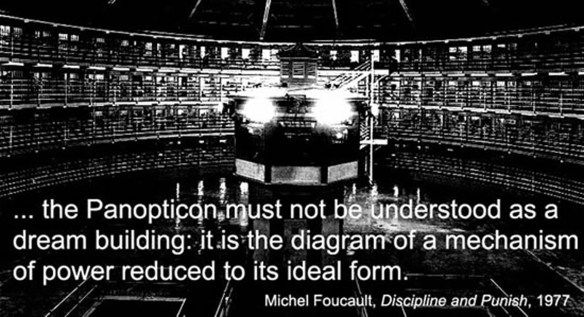
The American Police State, much like The Prisoner’s Village, is a metaphorical panopticon, a circular prison in which the inmates are monitored by a single watchman situated in a central tower. Because the inmates cannot see the watchman, they are unable to tell whether or not they are being watched at any given time and must proceed under the assumption that they are always being watched.

Eighteenth century social theorist Jeremy Bentham envisioned the panopticon prison to be a cheaper and more effective means of “obtaining power of mind over mind, in a quantity hitherto without example.”

Bentham’s panopticon, in which the prisoners are used as a source of cheap, menial labor, has become a model for the modern surveillance state in which the populace is constantly being watched, controlled and managed by the powers-that-be and funding its existence.

Nowhere to run and nowhere to hide: this is the new mantra of the architects of the police state and their corporate collaborators (Facebook, Amazon, Netflix, Google, Instagram, etc.).

Government eyes are watching you.

They see your every move: what you read, how much you spend, where you go, with whom you interact, when you wake up in the morning, what you’re watching on television and reading on the internet.

Every move you make is being monitored, mined for data, crunched, and tabulated in order to form a picture of who you are, what makes you tick, and how best to control you when and if it becomes necessary to bring you in line.

When the government sees all and knows all and has an abundance of laws to render even the most seemingly upstanding citizen a criminal and lawbreaker, then the old adage that you’ve got nothing to worry about if you’ve got nothing to hide no longer applies.

Apart from the obvious dangers posed by a government that feels justified and empowered to spy on its people and use its ever-expanding arsenal of weapons and technology to monitor and control them, we’re approaching a time in which we will be forced to choose between obeying the dictates of the government—i.e., the law, or whatever a government official deems the law to be—and maintaining our individuality, integrity and independence.

When people talk about privacy, they mistakenly assume it protects only that which is hidden behind a wall or under one’s clothing. The courts have fostered this misunderstanding with their constantly shifting delineation of what constitutes an “expectation of privacy.” And technology has furthered muddied the waters.

However, privacy is so much more than what you do or say behind locked doors. It is a way of living one’s life firm in the belief that you are the master of your life, and barring any immediate danger to another person (which is far different from the carefully crafted threats to national security the government uses to justify its actions), it’s no one’s business what you read, what you say, where you go, whom you spend your time with, and how you spend your money.

Unfortunately, George Orwell’s 1984—where “you had to live—did live, from habit that became instinct—in the assumption that every sound you made was overheard, and, except in darkness, every movement scrutinized”—has now become our reality.

We now find ourselves in the unenviable position of being monitored, managed and controlled by our technology, which answers not to us but to our government and corporate rulers.

Consider that on any given day, the average American going about his daily business will be monitored, surveilled, spied on and tracked in more than 20 different ways, by both government and corporate eyes and ears.

A byproduct of this new age in which we live, whether you’re walking through a store, driving your car, checking email, or talking to friends and family on the phone, you can be sure that some government agency, whether the NSA or some other entity, is listening in and tracking your behavior.

This doesn’t even begin to touch on the corporate trackers that monitor your purchases, web browsing, Facebook posts and other activities taking place in the cyber sphere.

Stingray devices mounted on police cars to warrantlessly track cell phones, Doppler radar devices that can detect human breathing and movement within in a home, license plate readers that can record up to 1800 license plates per minute, sidewalk and “public space” cameras coupled with facial recognition and behavior-sensing technology that lay the groundwork for police “pre-crime” programs, police body cameras that turn police officers into roving surveillance cameras, the internet of things: all of these technologies add up to a society in which there’s little room for indiscretions, imperfections, or acts of independence—especially not when the government can listen in on your phone calls, monitor your driving habits, track your movements, scrutinize your purchases and peer through the walls of your home.

As French philosopher Michel Foucault concluded in his 1975 book Discipline and Punish, “Visibility is a trap.”

This is the electronic concentration camp—the panopticon prison—the Village—in which we are now caged.

It is a prison from which there will be no escape if the government gets it way.

As Glenn Greenwald notes:

“The way things are supposed to work is that we’re supposed to know virtually everything about what [government officials] do: that’s why they’re called public servants. They’re supposed to know virtually nothing about what we do: that’s why we’re called private individuals. This dynamic – the hallmark of a healthy and free society – has been radically reversed. Now, they know everything about what we do, and are constantly building systems to know more. Meanwhile, we know less and less about what they do, as they build walls of secrecy behind which they function. That’s the imbalance that needs to come to an end. No democracy can be healthy and functional if the most consequential acts of those who wield political power are completely unknown to those to whom they are supposed to be accountable.”

Even now, the Trump Administration is working to make some of the National Security Agency’s vast spying powers permanent.

In fact, Attorney General Jeff Sessions is pushing for Congress to permanently renew Section 702 of the Foreign Intelligence Surveillance Act, which allows government snoops to warrantlessly comb through and harvest vast quantities of our communications.

And just like that, we’re back in the Village, our escape plans foiled, our future bleak.

Except this is no surprise ending: for those who haven’t been taking the escapist blue pill, who haven’t fallen for the Deep State’s phony rhetoric, who haven’t been lured in by the promise of a political savior, we never stopped being prisoners.

So how do we break out?

For starters, wake up. Resist the urge to comply.

The struggle to remain “oneself in a society increasingly obsessed with conformity to mass consumerism,” writes Steven Paul Davies, means that superficiality and image trump truth and the individual. The result is the group mind and the tyranny of mob-think.

Think for yourself. Be an individual. As McGoohan commented in 1968, “At this moment individuals are being drained of their personalities and being brainwashed into slaves… As long as people feel something, that’s the great thing. It’s when they are walking around not thinking and not feeling, that’s tough. When you get a mob like that, you can turn them into the sort of gang that Hitler had.”

In a media-dominated age in which the lines between entertainment, politics and news reporting are blurred, it is extremely difficult to distinguish fact from fiction. We are so bombarded with images, dictates, rules and punishments and stamped with numbers from the day we are born that it is a wonder we ever ponder a concept such as freedom. As McGoohan declared, “Freedom is a myth.”

In the end, as I make clear in my book Battlefield America: The War on the American People, we are all prisoners of our own mind.

In fact, it is in the mind that prisons are created for us. And in the lockdown of political correctness, it becomes extremely difficult to speak or act individually without being ostracized. Thus, so often we are forced to retreat inwardly into our minds, a prison without bars from which we cannot escape, and into the world of video games and television and the Internet.

We have come full circle from Bentham’s Panopticon to McGoohan’s Village to Huxley’s Brave New World.

As cultural theorist Neil Postman observed:

What Orwell feared were those who would ban books. What Huxley feared was that there would be no reason to ban a book, for there would be no one who wanted to read one. Orwell feared those who would deprive us of information. Huxley feared those who would give us so much that we would be reduced to passivity and egoism. Orwell feared we would become a captive audience. Huxley feared the truth would be drowned in a sea of irrelevance. Orwell feared that we would become a captive culture. Huxley feared we would become a trivial culture, preoccupied with some equivalent of the feelies, the orgy porgy, and the centrifugal bumblepuppy. As Huxley remarked in Brave New World Revisited, the civil libertarians and rationalists who are ever on the alert to oppose tyranny “failed to take into account man’s almost infinite appetite for distractions.” In Brave New World, they are controlled by inflicting pleasure. In short, Orwell feared that what we hate would ruin us. Huxley feared that what we love will ruin us.

You want to be free? Break out of the circle.

Our Protected, Predatory Oligarchy: Dirty Secrets, Dirty Lies

By Charles Hugh Smith

Source: Of Two Minds

If you want to understand why the status quo is unraveling, start by examining the feudal structure of our society, politics and economy.

The revelations coming to light about Hollywood Oligarch Harvey Weinstein perfectly capture the true nature of our status quo: a rotten-to-the-core, predatory, exploitive oligarchy of dirty secrets and dirty lies protected by an army of self-serving sycophants, servile toadies on the make and well-paid legal mercenaries. Predators aren’t an aberration of the Establishment; they are the perfection of the Establishment, which protects abusive, exploitive predator-oligarchs lest the feudal injustices of life in America be revealed for all to see.

The predators reckon their aristocratic status in Hollywood/D.C. grants them a feudal-era droit du seigneur (rights of the lord) to take whatever gratifications they desire from any female who has the grave misfortune to enter their malefic orbit.

Anyone who protests or makes efforts to go public is threatened by the oligarch’s thugs and discredited/smeared by the oligarch’s take-no-prisoners legal mercenaries. (Recall the Clintons’ Crisis Management Team tasked with crushing any Bimbo Eruptions, i.e. any eruptions of the truth about Bill’s well-known-to-insiders predation of the peasantry.)

The dirty secret is that the oh-so-hypocritical power elites of Hollywood and Washington D.C. circle the wagons to protect One of Their Own from being unmasked. The first weapons of choice in this defense are (as noted above) threats from thugs, discrediting the exploited via the oligarchy’s paid goons and lackeys in the mainstream media and dirty lies about what a great and good fellow the oligarch predator is. The last line of defense is a hefty bribe to silence any peasant still standing after the oligarchs’ onslaught of threats, smears and lies.

Should the worst happen and some sliver of the truth emerge despite the best efforts of the thugs, corporate media, legal mercenaries and PR handlers, then the playbook follows the script of any well-managed Communist dictatorship: the oligarch predator is thrown to the wolves to protect the oligarchs’ systemic predation and exploitation of the peasantry/debt-serfs.

Just as in a one-party Communist dictatorship, an occasional sacrificial offering is made to support the propaganda that the predators are outliers rather than the only possible output of a predatory, exploitive feudal status quo comprised of a small elite of super-wealthy and powerful oligarchs at the top and all the powerless debt-serfs at the bottom who must do their bidding in bed, in the boardroom, in the corridors of political power, and in the private quarters of their yachts and island hideaways.

Media reports suggest that the real reason Mr. Weinstein has been fired is not his alleged conduct over the past 27 years but his loss of the golden touch in generating movie-magic loot for the oh-so-liberal and politically correct Hollywood gang that was pleased to protect Mr. Weinstein when he was busy enriching them.

What’s truly noteworthy here is not the sordid allegations and history of payoffs–it’s the 27 years of intense protection the Hollywood/ media /D.C. status quo provided, despite hundreds of insiders knowing the truth. Just as hundreds of insiders with top secret clearance knew about the contents of the Pentagon Papers, and thus knew the Vietnam War was little more than an accumulation of official lies designed to protect the self-serving elites at the top of the power pyramid, only one analyst had the courage to risk his career and liberty to release the truth to the American public: Daniel Ellsberg.

Why are we not surprised that Hollywood, the corporate media and Washington D.C. lack even one courageous insider?

If you want to understand why the status quo is unraveling, start by examining the feudal structure of our society, politics and economy, and the endemic corruption, predation and exploitation of the privileged oligarchs at the top.

Then count the armies of self-serving sycophants, toadies, lackeys, hacks, apologists, flunkies, careerists and legal-team mercenaries who toil ceaselessly to protect their oligarch overlords from exposure.

Open your eyes, America: there are two systems of “justice”: one for the wealthy and powerful oligarchs, and an overcrowded gulag of serfs forced to plea-bargain in the other. If John Q. Public had done the deeds Mr. Weinstein is alleged to have done, Mr. Public would have long been in prison.

As Orwell observed about a totalitarian oligarchy, some are more equal than others.


As Babies are Prescribed Pharmaceuticals, Have We Reached Dystopia?

Tablets Pills Baby

By Joe Jarvis

Source: The Daily Bell

Would you let a five-year-old smoke a joint? I certainly hope not. Yet that would probably be less harmful than loading kids up on pharmaceuticals.

Currently, over a million American children UNDER SIX YEARS OLD are taking psychiatric drugs. Babies are literally being doped up by the pharmaceutical industry. Over 274,000 babies UNDER ONE-YEAR-OLD are given drugs, mostly for anxiety.

Anxiety drugs for babies. Have they tried motherly love? Or is that just an old fashioned, outdated concept?

You know, I like to mention society’s similarity to Orwell’s 1984. And surely the growing police state, war on drugs, and endless military campaigns–where the enemy seems to change daily–are reminiscent of the fictional dictatorship of Big Brother.

But it seems the powers that be are working tirelessly to blend together the dystopia of 1984, with that of Aldous Huxley’s Brave New World.

In that dystopia, there is no police state or war. Society has been perfectly designed by scientists, inspired by Ford’s assembly line. Babies are grown in the lab, cloned to all look alike, depending on their class. Parents are an embarrassing relic of the past. How silly to think a child needs family when they have the state!

The lower castes are deprived of oxygen as embryos to stunt their mental development. In America, they use fluoride in the drinking water instead.

In Brave New World, children listen to 24-hour propaganda in their cribs. Betas hear:

Alpha children wear grey. They work much harder than we do, because they’re so frightfully clever. I’m really awfully glad I’m a Beta, because I don’t work so hard. And then we are much better than the Gammas and Deltas. Gammas are stupid. They all wear green, and Delta children wear khaki. Oh no, I don’t want to play with Delta children. And Epsilons are still worse.

White pride, black pride, gay pride, national pride. Pride is not meant for accidents of birth. You should be proud of accomplishments and achievements, not genetics and geography. Perhaps someone has been whispering in these radicalized children’s ears.

And how jealous the Department of Education must be of the incubators of Brave New World! They have to sometimes wait years to indoctrinate children. But at least the government gets to drug them up at a young age! And if the TV is left on, most of the programming is done for them.

Of course, the adults are drugged up in Brave New World as well, just like in America. If anyone feels the least bit anxious, nervous, sad–or any other troublesome emotion–they get “soma.” It’s the perfect mix of drugs with only pleasant feelings and no ill side effects.

The 1 in 6 Americans on antidepressants, antipsychotics, and anti-anxiety medication still have to put up with side effects.

The 50 million plus Americans on psychiatric medication sometimes kill themselves, or go mad and kill others. I guess the government is still working out the kinks. Or it’s just another creative blending of 1984 and Brave New World. In the former, the proles must be properly terrified.

And there is one more thing I can remember from Brave New World that strikes eerily similar to modern America.

At what age does the public education system start teaching sex ed? Kindergarteners in some states receive “age appropriate”–according to the government–sexual education. Some studies suggest teen pregnancies rise in areas where sex ed is taught at younger ages.

How young is too young for a sex change? Kids can now choose between 43 genders, or make up a new one! It’s like Mr. Potato head, but with their own bodies. And they will be given corresponding drugs to enhance the “natural” changes.

In the classrooms of Brave New World:

“We had Elementary Sex for the first forty minutes,” she answered. “But now it’s switched over to Elementary Class Consciousness.”

The Director walked slowly down the long line of cots. Rosy and relaxed with sleep, eighty little boys and girls lay softly breathing…

He let out the amazing truth. For a very long period before the time of Our Ford, and even for some generations afterwards, erotic play between children had been regarded as abnormal (there was a roar of laughter); and not only abnormal, actually immoral (no!): and had therefore been rigorously suppressed.

Drugging the population, programming citizens with propaganda, sexualizing children, creating class divisions.

These dystopian novels were meant to be warnings, not instruction manuals.


You Want a Picture of the Future? Imagine a Boot Stamping on Your Face

By John W. Whitehead

Source: The Rutherford Institute

“The Internet is watching us now. If they want to. They can see what sites you visit. In the future, television will be watching us, and customizing itself to what it knows about us. The thrilling thing is, that will make us feel we’re part of the medium. The scary thing is, we’ll lose our right to privacy. An ad will appear in the air around us, talking directly to us.”—Director Steven Spielberg, Minority Report

We have arrived, way ahead of schedule, into the dystopian future dreamed up by such science fiction writers as George Orwell, Aldous Huxley, Margaret Atwood and Philip K. Dick.

Much like Orwell’s Big Brother in 1984, the government and its corporate spies now watch our every move.

Much like Huxley’s A Brave New World, we are churning out a society of watchers who “have their liberties taken away from them, but … rather enjoy it, because they [are] distracted from any desire to rebel by propaganda or brainwashing.”

Much like Atwood’s The Handmaid’s Tale, the populace is now taught to “know their place and their duties, to understand that they have no real rights but will be protected up to a point if they conform, and to think so poorly of themselves that they will accept their assigned fate and not rebel or run away.”

And in keeping with Philip K. Dick’s darkly prophetic vision of a dystopian police state—which became the basis for Steven Spielberg’s futuristic thriller Minority Report which was released 15 years ago—we are now trapped into a world in which the government is all-seeing, all-knowing and all-powerful, and if you dare to step out of line, dark-clad police SWAT teams and pre-crime units will crack a few skulls to bring the populace under control.

Minority Report is set in the year 2054, but it could just as well have taken place in 2017.

Seemingly taking its cue from science fiction, technology has moved so fast in the short time since Minority Report premiered in 2002 that what once seemed futuristic no longer occupies the realm of science fiction.

Incredibly, as the various nascent technologies employed and shared by the government and corporations alike—facial recognition, iris scanners, massive databases, behavior prediction software, and so on—are incorporated into a complex, interwoven cyber network aimed at tracking our movements, predicting our thoughts and controlling our behavior, Spielberg’s unnerving vision of the future is fast becoming our reality.

Both worlds—our present-day reality and Spielberg’s celluloid vision of the future—are characterized by widespread surveillance, behavior prediction technologies, data mining, fusion centers, driverless cars, voice-controlled homes, facial recognition systems, cybugs and drones, and predictive policing (pre-crime) aimed at capturing would-be criminals before they can do any damage.

Surveillance cameras are everywhere. Government agents listen in on our telephone calls and read our emails. Political correctness—a philosophy that discourages diversity—has become a guiding principle of modern society.

The courts have shredded the Fourth Amendment’s protections against unreasonable searches and seizures. In fact, SWAT teams battering down doors without search warrants and FBI agents acting as a secret police that investigate dissenting citizens are common occurrences in contemporary America.

We are increasingly ruled by multi-corporations wedded to the police state. Much of the population is either hooked on illegal drugs or ones prescribed by doctors. And bodily privacy and integrity has been utterly eviscerated by a prevailing view that Americans have no rights over what happens to their bodies during an encounter with government officials, who are allowed to search, seize, strip, scan, spy on, probe, pat down, taser, and arrest any individual at any time and for the slightest provocation.

All of this has come about with little more than a whimper from a clueless American populace largely comprised of nonreaders and television and internet zombies. But we have been warned about such an ominous future in novels and movies for years.

The following 15 films may be the best representation of what we now face as a society.

Fahrenheit 451 (1966). Adapted from Ray Bradbury’s novel and directed by Francois Truffaut, this film depicts a futuristic society in which books are banned, and firemen ironically are called on to burn contraband books—451 Fahrenheit being the temperature at which books burn. Montag is a fireman who develops a conscience and begins to question his book burning. This film is an adept metaphor for our obsessively politically correct society where virtually everyone now pre-censors speech. Here, a brainwashed people addicted to television and drugs do little to resist governmental oppressors.

2001: A Space Odyssey (1968). The plot of Stanley Kubrick’s masterpiece, as based on an Arthur C. Clarke short story, revolves around a space voyage to Jupiter. The astronauts soon learn, however, that the fully automated ship is orchestrated by a computer system—known as HAL 9000—which has become an autonomous thinking being that will even murder to retain control. The idea is that at some point in human evolution, technology in the form of artificial intelligence will become autonomous and that human beings will become mere appendages of technology. In fact, at present, we are seeing this development with massive databases generated and controlled by the government that are administered by such secretive agencies as the National Security Agency and sweep all websites and other information devices collecting information on average citizens. We are being watched from cradle to grave.

Planet of the Apes (1968). Based on Pierre Boulle’s novel, astronauts crash on a planet where apes are the masters and humans are treated as brutes and slaves. While fleeing from gorillas on horseback, astronaut Taylor is shot in the throat, captured and housed in a cage. From there, Taylor begins a journey wherein the truth revealed is that the planet was once controlled by technologically advanced humans who destroyed civilization. Taylor’s trek to the ominous Forbidden Zone reveals the startling fact that he was on planet earth all along. Descending into a fit of rage at what he sees in the final scene, Taylor screams: “We finally really did it. You maniacs! You blew it up! Damn you.” The lesson is obvious here, but will we listen? The script, although rewritten, was initially drafted by Rod Serling and retains Serling’s Twilight Zone-ish ending.

THX 1138 (1970). George Lucas’ directorial debut, this is a somber view of a dehumanized society totally controlled by a police state. The people are force-fed drugs to keep them passive, and they no longer have names but only letter/number combinations such as THX 1138. Any citizen who steps out of line is quickly brought into compliance by robotic police equipped with “pain prods”—electro-shock batons. Sound like tasers?

A Clockwork Orange (1971). Director Stanley Kubrick presents a future ruled by sadistic punk gangs and a chaotic government that cracks down on its citizens sporadically. Alex is a violent punk who finds himself in the grinding, crushing wheels of injustice. This film may accurately portray the future of western society that grinds to a halt as oil supplies diminish, environmental crises increase, chaos rules, and the only thing left is brute force.

Soylent Green (1973). Set in a futuristic overpopulated New York City, the people depend on synthetic foods manufactured by the Soylent Corporation. A policeman investigating a murder discovers the grisly truth about what soylent green is really made of. The theme is chaos where the world is ruled by ruthless corporations whose only goal is greed and profit. Sound familiar?

Blade Runner (1982). In a 21st century Los Angeles, a world-weary cop tracks down a handful of renegade “replicants” (synthetically produced human slaves). Life is now dominated by mega-corporations, and people sleepwalk along rain-drenched streets. This is a world where human life is cheap, and where anyone can be exterminated at will by the police (or blade runners). Based upon a Philip K. Dick novel, this exquisite Ridley Scott film questions what it means to be human in an inhuman world.

Nineteen Eighty-Four (1984). The best adaptation of Orwell’s dark tale, this film visualizes the total loss of freedom in a world dominated by technology and its misuse, and the crushing inhumanity of an omniscient state. The government controls the masses by controlling their thoughts, altering history and changing the meaning of words. Winston Smith is a doubter who turns to self-expression through his diary and then begins questioning the ways and methods of Big Brother before being re-educated in a most brutal fashion.

Brazil (1985). Sharing a similar vision of the near future as 1984 and Franz Kafka’s novel The Trial, this is arguably director Terry Gilliam’s best work, one replete with a merging of the fantastic and stark reality. Here, a mother-dominated, hapless clerk takes refuge in flights of fantasy to escape the ordinary drabness of life. Caught within the chaotic tentacles of a police state, the longing for more innocent, free times lies behind the vicious surface of this film.

They Live (1988). John Carpenter’s bizarre sci-fi social satire action film assumes the future has already arrived. John Nada is a homeless person who stumbles across a resistance movement and finds a pair of sunglasses that enables him to see the real world around him. What he discovers is a world controlled by ominous beings who bombard the citizens with subliminal messages such as “obey” and “conform.” Carpenter manages to make an effective political point about the underclass—that is, everyone except those in power. The point: we, the prisoners of our devices, are too busy sucking up the entertainment trivia beamed into our brains and attacking each other up to start an effective resistance movement.

The Matrix (1999). The story centers on a computer programmer Thomas A. Anderson, secretly a hacker known by the alias “Neo,” who begins a relentless quest to learn the meaning of “The Matrix”—cryptic references that appear on his computer. Neo’s search leads him to Morpheus who reveals the truth that the present reality is not what it seems and that Anderson is actually living in the future—2199. Humanity is at war against technology which has taken the form of intelligent beings, and Neo is actually living in The Matrix, an illusionary world that appears to be set in the present in order to keep the humans docile and under control. Neo soon joins Morpheus and his cohorts in a rebellion against the machines that use SWAT team tactics to keep things under control.

Minority Report (2002). Based on a short story by Philip K. Dick and directed by Steven Spielberg, the setting is 2054 where PreCrime, a specialized police unit, apprehends criminals before they can commit the crime. Captain Anderton is the chief of the Washington, DC, PreCrime force which uses future visions generated by “pre-cogs” (mutated humans with precognitive abilities) to stop murders. Soon Anderton becomes the focus of an investigation when the precogs predict he will commit a murder. But the system can be manipulated. This film raises the issue of the danger of technology operating autonomously—which will happen eventually if it has not already occurred. To a hammer, all the world looks like a nail. In the same way, to a police state computer, we all look like suspects. In fact, before long, we all may be mere extensions or appendages of the police state—all suspects in a world commandeered by machines.

V for Vendetta (2006). This film depicts a society ruled by a corrupt and totalitarian government where everything is run by an abusive secret police. A vigilante named V dons a mask and leads a rebellion against the state. The subtext here is that authoritarian regimes through repression create their own enemies—that is, terrorists—forcing government agents and terrorists into a recurring cycle of violence. And who is caught in the middle? The citizens, of course. This film has a cult following among various underground political groups such as Anonymous, whose members wear the same Guy Fawkes mask as that worn by V.

Children of Men (2006). This film portrays a futuristic world without hope since humankind has lost its ability to procreate. Civilization has descended into chaos and is held together by a military state and a government that attempts to keep its totalitarian stronghold on the population. Most governments have collapsed, leaving Great Britain as one of the few remaining intact societies. As a result, millions of refugees seek asylum only to be rounded up and detained by the police. Suicide is a viable option as a suicide kit called Quietus is promoted on billboards and on television and newspapers. But hope for a new day comes when a woman becomes inexplicably pregnant.

Land of the Blind (2006). This dark political satire is based on several historical incidents in which tyrannical rulers were overthrown by new leaders who proved just as evil as their predecessors. Maximilian II is a demented fascist ruler of a troubled land named Everycountry who has two main interests: tormenting his underlings and running his country’s movie industry. Citizens who are perceived as questioning the state are sent to “re-education camps” where the state’s concept of reality is drummed into their heads. Joe, a prison guard, is emotionally moved by the prisoner and renowned author Thorne and eventually joins a coup to remove the sadistic Maximilian, replacing him with Thorne. But soon Joe finds himself the target of the new government.

All of these films—and the writers who inspired them—understood what many Americans, caught up in their partisan, flag-waving, zombified states, are still struggling to come to terms with: that there is no such thing as a government organized for the good of the people. Even the best intentions among those in government inevitably give way to the desire to maintain power and control at all costs.

Eventually, as I point out in my book Battlefield America: The War on the American People, even the sleepwalking masses (who remain convinced that all of the bad things happening in the police state—the police shootings, the police beatings, the raids, the roadside strip searches—are happening to other people) will have to wake up.

Sooner or later, the things happening to other people will start happening to us and our loved ones.

When that painful reality sinks in, it will hit with the force of a SWAT team crashing through your door, a taser being aimed at your stomach, and a gun pointed at your head. And there will be no channel to change, no reality to alter, and no manufactured farce to hide behind.

As George Orwell warned, “If you want a picture of the future, imagine a boot stamping on a human face forever.”