No Need To Wait – Dystopia Is Almost Upon Us

Source: TruePublica

Microsoft’s CEO has warned the technology industry against creating a dystopian future, the likes of which have been predicted by authors including George Orwell and Aldous Huxley. Satya Nadella kicked off the the company’s 2017 Build conference with a keynote that was as unexpected as it was powerful. He told the developers in attendance that they have a huge responsibility, and that the choices they make could have enormous implications.

They won’t listen of course. The collection of big data along with management, selling and distribution and the systems architecture to control it is now worth exactly double global military defence expenditure. In fact, this year, the big data industry overtook the worlds most valuable traded commodity – oil.

The truth is that the tech giants have already captured us all. We are already living in the beginnings of a truly dystopian world.

Leaving aside the endemic surveillance society our government has chosen on our behalf with no debate, politically or otherwise, we already have proof of the now and where it is leading. With fingerprint scanning, facial recognition, various virtual wallets to pay for deliveries, some would say your identity is as good as stolen. If it isn’t, it soon will be. That’s because the hacking industry, already worth a mind blowing $1trillion annually is expected to reach $2.1 trillion in just 14 months time.

The reality of not being able to take public transportation, hire a car, buy a book, or a coffee – requiring full personal identification is almost upon us. Britain even had an intention to be completely cashless by 2025 – postponed only by the impact of Brexit.

Alexa, the Amazon home assistant listens to everything said in the house. It is known to record conversations. Recently, police in Arkansas, USA demanded that Amazon turn over information collected from a murder suspect’s Echo — the speaker that controls Alexa, because they already knew what information could be extracted from it.

32M is the first company in the US that provides a human chip, allowing employees “to make purchases in their break-room micro market, open doors, login to computers, use the copy machine.” 3M also confirmed what the chip could really do – telling employees to “use it as your passport, public transit and all purchasing opportunities.”

Various Apps now locate people you may know and your own location can be shared amongst others without your knowledge and we’ve known for years that governments and private corporations have access to this data, whether you like it not.

Other countries are providing even scarier technologies.  Hypebeast Magazine reports that  Aadhaar is a 12-digit identity number issued to all Indian residents based on their biometric and demographic data. “This data must be linked to their bank account or else they’ll face the risk of losing access to their account. Folks have until the end of the year to do this, with phone numbers soon to be connected through the 12 digits by February. Failure to do so will deactivate the service. ” The technology has the ability to refuse access to state supplied services such as healthcare.

Our article “Insurance Industry Leads The Way in Social Credit Systems” also highlights what the fusion of technology and data is likely to end up doing for us. An astonishing 96 per cent of insurers think that ecosystems or applications made by autonomous organisations are having a major impact on the insurance industry. The use of social credit mechanisms is being developed, some already implemented, which will determine our future behaviour, which will affect us all – both individually and negatively.”

The Chinese government plans to launch its Social Credit System in 2020. Already being piloted on 12 million of its citizens, the aim is to judge the trustworthiness – or otherwise – of its 1.3 billion residents. Something as innocuous as a person’s shopping habits become a measure of character. But the system not only investigates behaviour – it shapes it. It “nudges” citizens away from purchases and behaviours the government does not like. Friends are considered as well and individual credit scores fall depending on their trustworthiness. It’s not possible to imagine how far this will go in the end.

However to get us all there, to that situation, we need to be distracted from what is going on in the background. Some, are already concerned.


Distraction – detaching us from truth and reality

The Guardian wrote an interesting piece recently which highlighted some of the concerns of those with expert insider knowledge of the tech industry. For instance, Justin Rosenstein, the former Google and Facebook engineer who helped build the ‘like’ button –  is concerned. He believes there is a case for state regulation of smartphone technology because it is “psychologically manipulative advertising”, saying the moral impetus is comparable to taking action against fossil fuel or tobacco companies.

If we only care about profit maximisation,” he says, “we will go rapidly into dystopia.” Rosenstien also makes the observation that after Brexit and the election of Trump, digital forces have completely upended the political system and, left unchecked, could render democracy as we know it obsolete.

Carole Cadwalladre’s recent Exposé in the Observer/Guardian proved beyond doubt that democracy has already departed.  Here we learn about a shadowy global operation involving big data and billionaires who influenced the result of the EU referendum. Britain’s future place in the world has been altered by technology.

Nir Eyal 39, the author of Hooked: How to Build Habit-Forming Products writes: “The technologies we use have turned into compulsions, if not full-fledged addictions.” Eyal continues: “It’s the impulse to check a message notification. It’s the pull to visit YouTube, Facebook, or Twitter for just a few minutes, only to find yourself still tapping and scrolling an hour later.” None of this is an accident, he writes. It is all “just as their designers intended”.

Eyal feels the threat and protects his own family by cutting off the internet completely at a set time every day. “The idea is to remember that we are not powerless,” he said. “We are in control.”

The truth is we are no longer in control and have not been since we learned that our government was lying to us with the Snowden revelations back in 2013.

Tristan Harris, a 33-year-old former Google employee turned vocal critic of the tech industry agrees about the lack of control. “All of us are jacked into this system,” he says. “All of our minds can be hijacked. Our choices are not as free as we think they are.” Harris insists that billions of people have little choice over whether they use these now ubiquitous technologies, and are largely unaware of the invisible ways in which a small number of people in Silicon Valley are shaping their lives.

Harris is a tech whistleblower. He is lifting the lid on the vast powers accumulated by technology companies and the ways they are abusing the influence they have at their fingertips – literally.

“A handful of people, working at a handful of technology companies, through their choices will steer what a billion people are thinking today.”

The techniques these companies use such as social reciprocity, autoplay and the like are not always generic: they can be algorithmically tailored to each person. An internal Facebook report leaked this year, ultimately revealed that the company can identify when teenagers feel “worthless or “insecure.” Harris adds, that this is “a perfect model of what buttons you can push in a particular person”.

Chris Marcellino, 33, a former Apple engineer is now in the final stages of retraining to be a neurosurgeon and notes that these types of technologies can affect the same neurological pathways as gambling and drug use. “These are the same circuits that make people seek out food, comfort, heat, sex,” he says.

Roger McNamee, a venture capitalist who benefited from hugely profitable investments in Google and Facebook, has grown disenchanted with both of the tech giants. “Facebook and Google assert with merit that they are giving users what they want,” McNamee says. “The same can be said about tobacco companies and drug dealers.”

James Williams ex-Google strategist who built the metrics system for the company’s global search advertising business, says Google now has the “largest, most standardised and most centralised form of attentional control in human history”. “Eighty-seven percent of people wake up and go to sleep with their smartphones,” he says. The entire world now has a new prism through which to understand politics, and Williams worries the consequences are profound.

Williams also takes the view that if the attention economy erodes our ability to remember, to reason, to make decisions for ourselves – faculties that are essential to self-governance – what hope is there for democracy itself?

“The dynamics of the attention economy are structurally set up to undermine the human will,” he says. “If politics is an expression of our human will, on individual and collective levels, then the attention economy is directly undermining the assumptions that democracy rests on. If Apple, Facebook, Google, Twitter, Instagram and Snapchat are gradually chipping away at our ability to control our own minds, could there come a point, I ask, at which democracy no longer functions?”

“Will we be able to recognise it, if and when it happens?” Williams says. “And if we can’t, then how do we know it hasn’t happened already?”


The dystopian arrival

Within ten years, some are speculating that many of us will be wearing eye lenses. Coupled with social media, we’ll be able to identify strangers and work out that a particular individual, in say a bar, has a low friend compatibility, and data shows you will likely not have a fruitful conversation. This idea is literally scratching the surface of the information overload en-route right now.

It is not at all foolish to think that in that same bar a patron is shouting at the bartender, who refuses to serve him another drink because the glass he was holding measured his blood-alcohol level through the sweat in his fingers. He’ll have to wait at least 45 minutes before he’ll be permitted to order another scotch. You might even think that is a good idea – it isn’t.

Google’s Quantum Artificial Intelligence  Lab, already works with other organisations associated with NASA. Google’s boss sits on the Board of the Pentagon with links plugged directly into the surveillance architecture of the NSA in the USA and GCHQ in Britain. This world, where artificial intelligence makes its mark, as Williams mentions earlier, will deliberately undermine the ability to think for yourself.

In the scenario of the eye lenses, you might even have the ability to command your eyewear to shut down. But when you do, suddenly you are confronted with an un-Googled world. It appears drab and colourless in comparison. The people before you are bland, washed out and unattractive. The art, plants, wall paint, lighting and decorations had all been shaped by your own preferences, and without the distortion field your wearable eyewear provided, the world appears as a grey, lifeless template.

You find it difficult to last without the assistance of your self imposed augmented life, and accompanied by nervous laughter you switch it back on. The world you view through the prism of your computer eyewear has become your default setting. You know you have free will, but don’t feel like you need it. As Marcellino says the same neurological pathways as gambling and drug use drive how you choose to see the world.

This type of technology will be available and these types of scenario’s will become real, sooner than you think.

Our governments, allied with the tech giants are coercing us into a place of withering obedience with the use of 360 degree state surveillance. New technology, which is somehow seen as the road to liberty, contentment and prosperity, is really our future being shaped by a system that will destroy our civil liberties, crush our human rights and it will eventually ensnare and trap us all. This much they are already attempting in China and Japan with social credit mechanisms and pre-crime technology which is a truly frightening prospect. Without debate or our knowledge, here in western democracies, these technologies are already in use.


THE MONOPOLIZATION OF AMERICA: The biggest economic problem you’re hearing almost nothing about

By Robert Reich

Source: Nation of Change

Not long ago I visited some farmers in Missouri whose profits are disappearing. Why? Monsanto alone owns the key genetic traits to more than 90 percent of the soybeans planted by farmers in the United States, and 80 percent of the corn. Which means Monsanto can charge farmers much higher prices.

Farmers are getting squeezed from the other side, too, because the food processors they sell their produce to are also consolidating into mega companies that have so much market power they can cut the prices they pay to farmers.

This doesn’t mean lower food prices to you. It means more profits to the monopolists.

Monopolies all around

America used to have antitrust laws that stopped corporations from monopolizing markets, and often broke up the biggest culprits. No longer. It’s a hidden upward redistribution of money and power from the majority of Americans to corporate executives and wealthy shareholders.

You may think you have lots of choices, but take a closer look:

1. The four largest food companies control 82 percent of beef packing, 85 percent of soybean processing, 63 percent of pork packing, and 53 percent of chicken processing.

2. There are many brands of toothpaste, but 70 percent of all of it comes from just two companies.

3. You may think you have your choice of sunglasses, but they’re almost all from one company: Luxottica – which also owns nearly all the eyeglass retail outlets.

4. Practically every plastic hanger in America is now made by one company, Mainetti.

5. What brand of cat food should you buy? Looks like lots of brands but behind them are basically just two companies.

6. What about your pharmaceuticals? Yes, you can get low-cost generic versions. But drug companies are in effect paying the makers of generic drugs to delay cheaper versions. Such “pay for delay” agreements are illegal in other advanced economies, but antitrust enforcement hasn’t laid a finger on them in America. They cost you and me an estimated $3.5 billion a year.

7. You think your health insurance will cover the costs? Health insurers are consolidating, too. Which is one reason your health insurance premiums, copayments, and deductibles are soaring.

8. You think you have a lot of options for booking discount airline tickets and hotels online? Think again. You have only two. Expedia merged with Orbitz, so that’s one company. And then there’s Priceline.

9. How about your cable and Internet service? Basically just four companies (and two of them just announced they’re going to merge).

Why the monopolization of America is a huge problem

The problem with all this consolidation into a handful of giant firms is they don’t have to compete. Which means they can – and do – jack up your prices.

Such consolidation keeps down wages. Workers with less choice of whom to work for have a harder time getting a raise. When local labor markets are dominated by one major big box retailer, or one grocery chain, for example, those firms essentially set wage rates for the area.

These massive corporations also have a lot of political clout. That’s one reason they’re consolidating: Power.

Antitrust laws were supposed to stop what’s been going on. But today, they’re almost a dead letter. This hurts you.

We’ve forgotten history

The first antitrust law came in 1890 when Senator John Sherman responded to public anger about the economic and political power of the huge railroad, steel, telegraph, and oil cartels – then called “trusts” – that were essentially running America.

A handful of corporate chieftains known as “robber barons” presided over all this – collecting great riches at the expense of workers who toiled long hours often in dangerous conditions for little pay. Corporations gouged consumers and corrupted politics.

Then in 1901, progressive reformer Teddy Roosevelt became president. By this time, the American public was demanding action.

In his first message to Congress in December 1901, only two months after assuming the presidency, Roosevelt warned, “There is a widespread conviction in the minds of the American people that the great corporations known as the trusts are in certain of their features and tendencies hurtful to the general welfare.”

Roosevelt used the Sherman Antitrust Act to go after the Northern Securities Company, a giant railroad trust run by J. P. Morgan, the nation’s most powerful businessman. The U.S. Supreme Court backed Roosevelt and ordered the company dismantled.

In 1911, John D. Rockefeller’s Standard Oil Trust was broken up, too. But in its decision, the Supreme Court effectively altered the Sherman Act, saying that monopolistic restraints of trade were objectionable if they were “unreasonable” – and that determination was to be made by the courts. What was an unreasonable restraint of trade?

In the presidential election of 1912, Roosevelt, running again for president but this time as a third party candidate, said he would allow some concentration of industries where there were economic efficiencies due to large scale. He’d then he’d have experts regulate these large corporations for the public benefit.

Woodrow Wilson, who ended up winning the election, and his adviser Louis Brandeis, took a different view. They didn’t think regulation would work, and thought all monopolies should be broken up.

For the next 65 years, both views dominated. We had strong antitrust enforcement along with regulations that held big corporations in check.

Most big mergers were prohibited. Even large size was thought to be a problem. In 1945, in the case of United States v. Alcoa (1945), the Supreme Court ruled that even though Alcoa hadn’t pursued a monopoly, it had become one by becoming so large that it was guilty of violating the Sherman Act.

What happened to antitrust?

All this changed in the 1980s, after Robert Bork – who, incidentally, I studied antitrust law with at Yale Law School, and then worked for when he became Solicitor General under President Ford – wrote an influential book called The Antitrust Paradox, which argued that the sole purpose of the Sherman Act is consumer welfare.

Bork argued that mergers and large size almost always create efficiencies that bring down prices, and therefore should be legal. Bork’s ideas were consistent with the conservative Chicago School of Economics, and found a ready audience in the Reagan White House.

Bork was wrong. But since then, even under Democratic administrations, antitrust has all but disappeared.

The monopolization of high tech

We’re seeing declining competition even in cutting-edge, high-tech industries.

In the new economy, information and ideas are the most valuable forms of property. This is where the money is.

We haven’t seen concentration on this scale ever before.

Google and Facebook are now the first stops for many Americans seeking news. Meanwhile, Amazon is now the first stop for more than a half of American consumers seeking to buy anything. Talk about power.

Contrary to the conventional view of an American economy bubbling with innovative small companies, the reality is quite different. The rate at which new businesses have formed in the United States has slowed markedly since the late 1970s.

Big Tech’s sweeping patents, standard platforms, fleets of lawyers to litigate against potential rivals, and armies of lobbyists have created formidable barriers to new entrants. Google’s search engine is so dominant, “Google” has become a verb.

The European Union filed formal antitrust charges against Google, accusing it of forcing search engine users into its own shopping platforms. And last June, it fined Google a record $2.7 billion.

But not in America.

It’s time to revive antitrust

Economic and political power cannot be separated because dominant corporations gain political influence over how markets are organized, maintained, and enforced – which enlarges their economic power further.

One of the original goals of the antitrust laws was to prevent this.

Big Tech – along with the drug, insurance, agriculture, and financial giants – is coming to dominate both our economy and our politics.

There’s only one answer: It is time to revive antitrust.

Social Media Behemoths Sweep Alternative News into the Memory Hole

By Kurt Nimmo

Source: Another Day in the Empire

The squabbling between self-identified progressives and conservatives continues as social media transforms itself into a news, information, and opinion gatekeeper.

All information that contradicts the establishment narrative will either be downgraded into obscurity or excluded outright on social media.

Take for instance ThinkProgress, the Soros-financed news website, a project of the Center for American Progress Action Fund welded to the infrastructure of the Democrat party. On May 2, it complained that a bias study at Facebook will be run by conservatives, that is to say establishment Republicans, notably former Arizona Congress critter Jon Kyl.

ThinkProgress believes there is no such thing as bias aimed at conservatives—it’s the liberals who are routinely downgraded at Facebook while so-called conservatives are free to post what progressives characterize as an evil and poisonous ideology.

According to Libby Watson at Splinter News, conservatives are involved in “grift,” flimflamming poor Mark Zuckerberg with untrue claims of bias against the likes of Breitbart News.

It’s all part of a never ending and hugely counterproductive “culture war” that has raged between the ostensible right and left going on thirty years now. Ms. Watson manages to squeeze identity politics into her screed.

“The conservative movement has done a remarkable job over the last half century to bellow and bully its way into having its most ridiculous and reality-divorced concerns taken seriously,” she writes. “It lies about and distorts everything: about tax cuts, about Benghazi and her emails, about immigration, about healthcare, about Diamond and Silk. The further Facebook descends down the path of letting that screaming white face of faux outrage dictate how they run their platform, the harder it’s going to be for them to get away from them.”

The progressive news website Common Dreams complains it has weathered “significant drops in traffic since Google and Facebook began changing algorithms and talking openly about their new attempts to control the kind of news content users see. According to internal data and Google Analytics, traffic to Common Dreams from Google searches fell by 34 percent after the powerful search giant unveiled its new search protocol in April 2017.”

Meanwhile, on the other side of the yawning divide, Brent Bozell, founder of the Media Research Center, rallied around 60 conservatives and fired off an open letter to the social media giants demanding transparency, clarity on the definition of hate speech, equality for conservatives, and respect for the First Amendment.

“Social media censorship and online restriction of conservatives and their organizations have reached a crisis level,” the open letter states. “Facebook CEO Mark Zuckerberg’s hearings on Capitol Hill only served to draw attention to how widespread this problem has become. Conservative leaders now have banded together to call for equal treatment on tech and social media.”

Both liberals and conservatives are missing the point.

Facebook and Google will continue and enlarge the effort to gatekeep information that does not jive with the establishment narrative, be it from the right or left.

The internet and web upended the establishment’s carefully constructed propaganda machine—the CIA’s “Mighty Wurlitzer” under its Operation Mockingbird beginning in the early 1950s—deeply embedded within corporate media.

Beginning with Friendster, MySpace, and like projects in the early 2000s and eventually morphing into the corporate behemoths Facebook, YouTube, and Twitter, social media platforms have extended the reach of alternative media, much to the displeasure of the establishment. Its preferred propaganda conduits have withered and this has seriously hampered its ability to control the narrative.

Both the right and left need to nurture their own social media platforms and drive traffic there.

Of course, this will not be as effective as plugging into the massive matrix of social connectivity provided by the corporate tech giants, but the alternative is to be marginalized and eventually swept into the memory hole as the context of “extremism” narrows and constricts expression, excluding all but the most token disagreement with the establishment narrative.

However, I’m not sure we’re up to it.

The elite has done a remarkable job of using the time tested divide and conquer concept, endlessly pitting the so-called right against the amorphously defined left and vice versa. Liberals and conservatives continue to fight over frivolous ideological points as the funny money asset-driven economy prepares to implode and the mission of infinity war expands to the point where it endangers life on planet Earth.

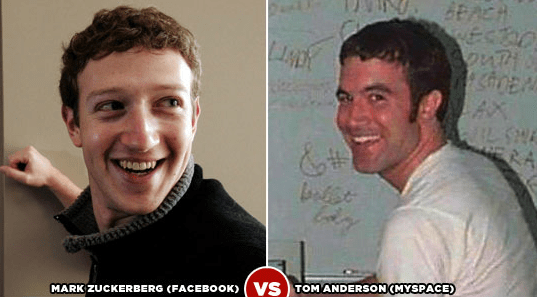
MySpace Tom beat Facebook in the long run

Wouldn’t you rather be a rich nobody than whatever Mark Zuckerberg is?

By Jeremy Gordon

Source: The Outline

My MySpace profile was abandoned when, at the ripe age of 18, I decided it was just a little too juvenile — the glittering GIFs affixed to every page, the garish customized designs, the pressure on maintaining your top 8. By 2006, Facebook offered a cleaner social experience; by 2009, Twitter offered a more casual one. MySpace was a complete relic by this point, even though only a few years had passed since its launch.

Back in 2005, though, long before MySpace burned out, its founder, Tom Anderson — whose grinning face greeted every new user as their first “friend” — sold the site for $580 million to Rupert Murdoch’s News Corporation. While his site was becoming a punchline during the rise of Facebook, Twitter, Instagram, and the other social media networks we now use everyday, Anderson disappeared entirely from the tech scene. Now, he travels the world, documenting his visits to exotic locations.

Contrast that with what’s currently happening to Facebook’s Mark Zuckerberg, who’s on day two of being grilled by a Senate committee for Facebook’s role in haphazardly collecting all of our personal data, and possibly swinging the 2016 presidential election toward Donald Trump. What was supposed to be a basic networking tool has now become one of the chief mediators of how people interact with each other and the world around them, and how information is absorbed and disseminated on the internet. It’s now apparent that Facebook and Zuckerberg didn’t really consider any of this when aggressively pursuing growth, and now we’re all screwed as we try to untangle the consequences.

MySpace Tom? His most recent Instagram post from seven days ago is a giveaway for a stay at an Iceland hotel. He doesn’t have to issue any terse statements about his company’s commitment to fostering a healthy society; he doesn’t have to sit on a booster seat for seven hours and take dipshit questions from a procession of Senate ghouls. He isn’t worth as much money as Zuckerberg, of course, but unless you’re an oil baron, $580 million is enough to tide you over for the length of your lifetime, and your children’s lifetime, and your children’s children’s lifetime, and so on. (Even after taxes!) And yes, yes, being that rich is good for nobody, but without getting into an argument about the perils of capitalism, we can agree that personally speaking, Anderson is having a much better go of things.

It puts MySpace’s failure to evolve in a new light, as perhaps the healthy thing is for a platform to die and for everyone to move on. Its aesthetic and form, back when everyone had emo bangs and listened to Hawthorne Heights, couldn’t change without altering the meaning of the site altogether, and by that time, everyone was gone. Had Facebook not gotten too good at inserting itself between human users, there’s no way it would’ve run into their current problems at such a wide scope. The suspicious CEO is not the one who cashes out; it’s the one who sticks around and creates a behemoth.

Zuckerberg could have sold off his share and avoided becoming literally one of the most disliked people in the present moment. I never thought we’d declare MySpace the winner over Facebook, but then again, I never thought a lot of things about the moment we’re in.


Mass Deception and the Prelude to World War

By Colin Todhunter

Source: Defend Democracy Press

In Libya, NATO bombed a path to Tripoli to help its proxy forces on the ground oust Gaddafi. Tens of thousands lost their lives and that country’s social fabric and infrastructure now lies in ruins. Gaddafi was murdered and his plans to assert African independence and undermine Western (not least French) hegemony on that continent have been rendered obsolete.

In Syria, the US, Turkey, France, Britain, Saudi Arabia and Qatar have been helping to arm militants. The Daily Telegraph’s March 2013 article “US and Europe in ‘major airlift of arms to Syrian rebels through Zagreb’” reported that 3,000 tons of weapons dating back to the former Yugoslavia had been sent in 75 planeloads from Zagreb airport to the rebels. The New York Times March 2013 article “Arms Airlift to Syria Rebels Expands, With CIA Aid” stated that Arab governments and Turkey had sharply increased their military aid to Syria’s opposition fighters. This aid included more than 160 military cargo flights.

Sold under the notion of a spontaneous democratic uprising against a tyrannical political leader, Syria is little more than an illegal war for capital, empire and energy. The West and its allies have been instrumental in organising the war as elaborated by Tim Anderson in his book ‘The Dirty War on Syria’.

Over the last 15 years or so, politicians and the media have been manipulating popular sentiment to get an increasingly war-fatigued Western public to support ongoing wars under the notion of protecting civilians or a bogus ‘war on terror’. They spin a yarn about securing women’s rights or a war on terror in Afghanistan, removing despots from power in Iraq, Libya or Syria or protecting human life, while then going on to attack or help destabilise countries, resulting in the loss of hundreds of thousands of civilian lives.

Emotive language designed to instill fear about potential terror attacks in Europe or myths about humanitarianism intervention are used as a pretext to wage imperialist wars in mineral-rich countries and geostrategically important regions.

Part of the battle for the public’s hearts and minds is to keep people confused. They must be convinced to regard these wars and conflicts as a disconnected array of events and not as the planned machinations of empire. The ongoing disinformation narrative about Russian aggression is part of the strategy. Ultimately, Russia (and China) is the real and increasingly imminent target: Moscow has stood in the way of the West’s plans in Syria and both Russia and China are undermining the role of the dollar in international trade, a lynchpin of US power.

The countries of the West are effectively heading for war with Russia but relatively few among the public seem to know or even care. Many are oblivious to the slaughter that has already been inflicted on populations with the help of their taxes and governments in far-away lands. With the reckless neoconservative warmonger John Bolton now part of the Trump administration, it seems we could be hurtling towards major war much faster than previously thought.

Most of the public remains blissfully ignorant of the psy-ops being directed at them through the corporate media. Given recent events in the UK and the ramping up of anti-Russia rhetoric, if ordinary members of the public think that Theresa May or Boris Johnson ultimately have their best interests at heart, they should think again. The major transnational corporations based on Wall Street and in the City of London are the ones setting Anglo-US policy agendas often via the Brookings Institute, Council on Foreign Relations, International Crisis Group, Chatham House, etc.

The owners of these companies, the capitalist class, have off-shored millions of jobs as well as their personal and company tax liabilities to boost their profits and have bankrupted economies. We see the results in terms of austerity, unemployment, powerlessness, privatization, deregulation, banker control of economies, corporate control of food and seeds, the stripping away of civil liberties, increased mass surveillance and wars to grab mineral resources and ensure US dollar hegemony. These are the interests the politicians serve.

It’s the ability to maximise profit by shifting capital around the world that matters to this class, whether on the back of distorted free trade agreements, which open the gates for plunder, or through coercion and militarism, which merely tear them down.

Whether it is the structural violence of neoliberal economic policies or actual military violence, the welfare of ordinary folk around the world does not enter the equation. In an imposed oil-thirsty, war-driven system of globalised capitalism and over-consumption that is wholly unnecessary and is stripping the planet bare, the bottom line is that ordinary folk – whether workers in the West, farmers in India or civilians displaced en masse in war zones like Syria – must be bent according to the will of Western capital.

We should not be fooled by made-for-media outpourings of morality about good and evil that are designed to create fear, outrage and support for more militarism and resource-grab wars. The shaping of public opinion is a multi-million-dollar industry.

Take for instance the mass harvesting of Facebook data by Cambridge Analytica to shape the outcomes of the US election and the Brexit campaign. According to journalist Liam O’Hare, its parent company Strategic Communications Laboratories (SCL) has conducted ‘behavioural change’ programmes in over 60 countries and its clients have included the British Military of Defence, the US State Department and NATO. According to O’Hare, the use of the media to fool the public is one of SCL’s key selling points.

Among its activities in Europe have been campaigns targeting Russia. The company has “sweeping links” with Anglo-American political and military interests. In the UK, the interests of the governing Conservative Party and military-intelligence players are brought together via SCL: board members include “an array of Lords, Tory donors, ex-British army officers and defense contractors.”

O’Hare says it is clear is that all SCL’s activities have been inextricably linked to its Cambridge Analytica arm. He states:

“International deception and meddling is the name of the game for SCL. We finally have the most concrete evidence yet of shadowy actors using dirty tricks in order to rig elections. But these operators aren’t operating from Moscow… they are British, Eton educated, headquartered in the City of London and have close ties to Her Majesty’s government”

So, what are we to make of the current anti-Russia propaganda we witness regarding the nerve agent incident in Salisbury and the failure of the British government to provide evidence to demonstrate Russian culpability? The relentless accusations by Theresa May and Boris Johnson that have been parroted across the corporate media in the West indicate that the manipulation of public perception is everything and facts count for little. It is alarming given what is at stake – the escalation of conflict between the West and a major nuclear power.

Welcome to the world of mass deception à la Edward Bernays and Josef Goebbels.

US social commentator Walter Lippmann once said that ‘responsible men’ make decisions and have to be protected from the ‘bewildered herd’ – the public. He added that the public should be subdued, obedient and distracted from what is really happening. Screaming patriotic slogans and fearing for their lives, they should be admiring with awe leaders who save them from destruction.

Although the West’s political leaders are manipulating, subduing and distracting the public in true Lippmannesque style, they aren’t ‘saving’ anyone from anything: their reckless actions towards Russia could lead towards a war that could wipe out all life on the planet.


* Colin Todhunter is a frequent contributor to Global Research and Asia-Pacific Research.

The New York Times takes on the social media “hordes”

By Andre Damon

Source: WSWS.org

Since late 2016, the New York Times, working together with the US intelligence agencies and the Democratic Party, has been engaged in a campaign to promote internet censorship in the guise of targeting “fake news” and “Russian propaganda.”

In waging this campaign, the Times’ motives are both political and pecuniary. Speaking for a ruling elite that sees the growth of social opposition on all sides and expects far worse, the Times has promoted censorship to remove opportunities for the working class to organize outside the framework of official politics.

In addition, the Times, for the most part a clearinghouse for staid and predigested state propaganda, is seeking to carve back market share it has lost to online publications that carry out genuine investigative journalism and oppose the lies peddled by the US government and media.

In recent months, this campaign has entered a new and malignant phase. Increasingly dropping the pretext of “Russian meddling,” the Times is now directly attacking its main target: the fact that the internet, and in particular social media, helps empower the population to access oppositional sources of news and have their voices heard in public.

Among the Times’ latest broadsides against freedom of expression is an article by its “State of the Art” columnist Farhad Manjoo headlined “For Two Months, I Got My News From Print Newspapers. Here’s What I Learned.” The piece, supposedly written as a first-hand account of a journalist turning off social media and only reading the news from print newspapers, is—in an unusually literal sense—a piece of lying propaganda from beginning to end.

As the Columbia Journalism Review pointed out, during the period in which he supposedly stopped using social media, Manjoo managed to post on Twitter virtually every day. “Manjoo remained a daily, active Twitter user throughout the two months he claims to have gone cold turkey, tweeting many hundreds of times, perhaps more than 1,000,” the Review pointed out.

Manjoo’s blatant falsifying of his own social media use is hardly the most sinister aspect of his piece. However, it expresses something essential about the Times’ notion of “reporting”: its writers feel they can say anything and get away with it, so long as their claims conform to the dictates of the establishment and the intelligence agencies whose interests determine what is and what is not reported in the US media.

The columnist’s dishonesty about his own activities provides much needed context for his article as a whole, which is little more than a long-form denunciation of a reading public that feels compelled to obtain its news from sources not massaged by the CIA-vetted hacks at the New York Times. In the process, Manjoo gives his unqualified blessings to the pronouncements of his own publication and castigates anyone who would question them as a member of an ignorant “herd,” whose opinions ought to be suppressed.

During his pretended sojourn into the desert of print media, Manjoo said he learned to value having the news spoon-fed to him by “professionals,” without having to worry about whether what he was reading was true or false.

As he puts it, “It takes professionals time to figure out what happened, and how it fits into context… This was the surprise blessing of the newspaper. I was getting news a day old, but in the delay between when the news happened and when it showed up on my front door, hundreds of experienced professionals had done the hard work for me.”

He continues, “Now I was left with the simple, disconnected and ritualistic experience of reading the news, mostly free from the cognitive load of wondering whether the thing I was reading was possibly a blatant lie.”

Here, we assume, the reader is supposed to heave a sigh of relief. How soothing not to have to think for oneself! The author’s surrender of his critical faculties supposedly did wonders for his health and general well being. Not only did he become “less anxious,” but he had the time to “take up pottery” and “became a more attentive husband and father”! Wonderful! And so much more wonderful if he hadn’t actually made up the story about his abstinence from social media.

Manjoo’s condemnation of critical thinking aside, the real core of the piece is a scathing denunciation of the public, which he describes as a “herd” and a “crowd,” and which, moreover, is empowered to express its rotten opinions by the sinister power of social media.

“Avoid social [media],” he declares. “Technology allows us to burrow into echo chambers, exacerbating misinformation and polarization and softening up society for propaganda.”

The statements posted by the “online hordes” are not “quite news, and more like a never-ending stream of commentary, one that does more to distort your understanding of the world than illuminate it,” Manjoo adds. “On social networks … People don’t just post stories—they post their takes on stories, often quoting key parts of a story to underscore how it proves them right.”

People are posting “their takes on stories!” The horror! Instead of just consuming the news as worked over by the Times, complete with big lies (“weapons of mass destruction”) and small ones (its technology columnist giving up Twitter for two months), social media allows users to critically examine the stories they read. In other words, the internet allows the public to bypass the monopoly of “professional” falsifiers and “gatekeepers” like Manjoo, Judith Miller, Thomas Friedman and the like.

The author’s only hope is that “the government” and “Facebook” will soon “fix” this problem. The clear implication is that once social media is “fixed,” the “herd,” “crowd,” and “hordes” will no longer be allowed to pollute cyberspace by questioning the pronouncements of the New York Times. Manjoo’s self-righteous pontifications, worthy of Polonius (if Polonius were also a liar), would be comical if they were not so ominous. Faced with a growing wave of social struggles, the ruling elite is preparing censorship on a massive scale. Having succeeded in dramatically reducing traffic to left-wing web sites, the technology giants and intelligence agencies are proceeding to the next phase: censoring all expressions of social opposition, in particular by the working class, on social media.

If You Come to a Fork in the Road, Take It

By James Howard Kunstler

Source: Kunstler.com

Various readers, fans, blog commenters, Facebook trolls, and auditors twanged on me all last week about my continuing interest in the RussiaRussiaRussia hysteria, though there is no particular consensus of complaint among them — except for a general “shut up, already” motif. For the record, I’m far more interested in the hysteria itself than the Russia-meddled-in the-election case, which I consider to be hardly any case at all beyond 13 Russian Facebook trolls.

The hysteria, on the other hand, ought to be a matter of grave concern, because it appears more and more to have been engineered by America’s own intel community, its handmaidens in the Dept of Justice, and the twilight’s last gleamings of the Obama White House, and now it has shoved this country in the direction of war at a time when civilian authority over the US military looks sketchy at best. This country faces manifold other problems that are certain to reduce the national standard of living and disrupt the operations of an excessively complex and dishonest economy, and the last thing America needs is a national war-dance over trumped-up grievances with Russia.

The RussiaRussiaRussia narrative has unspooled since Christmas and is blowing back badly through the FBI, now with the firing (for cause) of Deputy Director Andrew McCabe hours short of his official retirement (and inches from the golden ring of his pension). He was axed on the recommendation of his own colleagues in the FBI’s Office of Professional Responsibility, and they may have been influenced by the as-yet-unreleased report of the FBI Inspector General, Michael Horowitz, due out shortly.

The record of misbehavior and “collusion” between the highest ranks of the FBI, the Democratic Party, the Clinton campaign, several top political law firms, and a shady cast of international blackmail peddlars is a six-lane Beltway-scale evidence trail compared to the muddy mule track of Trump “collusion” with Russia. It will be amazing if a big wad of criminal cases are not dealt out of it, even as The New York Times sticks its fingers in its ears and goes, “La-la-la-la-la….”

It now appears that Mr. McCabe’s statements post-firing tend to incriminate his former boss, FBI Director James Comey — who is about to embark, embarrassingly perhaps, on a tour for his self-exculpating book, A Higher Loyalty: Truth, Lies, and Leadership.

A great aura of sanctimony surrounds the FBI these days. Even the news pundits seem to have forgotten the long, twisted reign of J. Edgar Hoover (1924 – 1972), a dangerous rogue who excelled at political blackmail. And why, these days, would any sane American take pronouncements from the CIA and NSA at face value? What seems to have gone on in the RussiaRussiaRussia matter is that various parts of the executive branch in the last months under Mr. Obama gave each other tacit permission, wink-wink, to do anything necessary to stuff HRC into the White House and, failing that, to derail her opponent, the Golden Golem of Greatness.

The obvious lesson in all this huggermugger is that the ends don’t justify the means. I suspect there are basically two routes through this mess. One is that the misdeeds of FBI officers, Department of Justice lawyers, and Intel agency executives get adjudicated by normal means, namely, grand juries and courts. That would have the salutary effect of cleansing government agencies and shoring up what’s left of their credibility at a time when faith in institutions hangs in the balance.

The second route would be for the authorities to ignore any formal response to an evermore self-evident trail of crimes, and to allow all that political energy to be funneled into manufactured hysteria and eventually a phony provocation of war with Russia. Personally, I’d rather see the US government clean house than blow up the world over an engineered hallucination.

Mueller’s Fraudulent Indictment

(Rex Features via AP Images)

The Internet Research Agency: clickbait farm or KGB plot?

By Justin Raimondo

Source: Antiwar.com

The indictment handed down by Robert Mueller against 13 Russians connected to the Internet Research Agency, a Russian-owned- and- operated clickbait farm, is the capstone of my case that we have indeed entered Bizarro World, an alternate universe where up is down, black is white and truth is a ridiculous falsehood.

Yes, I said clickbait farm – because that’s precisely what the Internet Research Agency (IRA) is: founded by Yevgeny Prigozhin, a former Russian chef who wanted to figure out a new way to make money, the IRA, as pointed out here, is a money-making operation. Mueller seems to acknowledge this when, in his laughable “indictment,” we read this:

“Defendants and their co-conspirators also used the accounts to receive money from real U.S. persons in exchange for posting promotions and advertisements on the ORGANIZATION-controlled social media pages. Defendants and their coconspirators typically charged certain US merchants and US social media sites between 25 and 50 US dollars per post for promotional content on their popular false US persona accounts, including Being Patriotic, Defend the 2nd, and Blacktivist.”

What kind of a propaganda/spy operation charges its coconspirators a fee?

The total Russian/IRA buy was $100,000, including $300 in Pennsylvania, $832 in Michigan, and $1979 in Wisconsin (mostly before the primary). Most of the “Russian” ads ran after the election, and they didn’t support any candidates: instead, they focused on “hot button” issues – precisely the sort of thing intended to attract visits and make money for the creators via ads.

This business model has been widely utilized by enterprising Macedonian teenagers and others out to make a quick buck, and it works quite effectively if you know what you’re doing. The IRA, like other clickbait operations, isn’t really about politics, although it deals with political subjects: it’s about making money for it owners. Period. As the Moon of Alabama blogger points out:

“There were, according to the indictment, eighty people working on the “translator project”. These controlled “hundreds” of sock-puppets online accounts each with a distinct “political” personality. Each of these sock-puppets had a large number of followers – in total several hundred-thousands. Now let’s assume that one to five promotional posts can be sold per day on each of the sock-puppets content stream. The scheme generates several thousand dollars per day ($25 per promo, hundreds of sock-puppets, 1-5 promos per day per sock-puppet). The costs for this were limited to the wages of up to eighty persons in Moscow, many of them temps, of which the highest paid received some $1,000 per month.”

All in all, a fairly profitable business – not a state-run “disinformation” project, but rather good old free enterprise.

Yes, I know that some of the IRA’s employees traveled to America for a week or two to do “research.” But what, exactly, does this mean? Does anybody have a record of where they stayed, or whom they associated with? There’s nothing about that in the indictment. In short, they could have come to America for the same reasons tens of thousands do every day of the week: to enjoy themselves as tourists. After all, what could they possibly learn in a week-long stay that could … sway a presidential election? I mean, what are we talking about here?

The weird-stupid aura hanging over this whole affair was underscored when CNN actually knocked on the door of some woman whom they accused of running a “Russian-sponsored” pro-Trump rally in Florida: the woman laughed in the “reporter’s” face and said she’d never spoken to a single Russian in her entire life. So how many Trump supporters will be visited not just by CNN but by the FBI in order to intimidate them in a similar manner?

What I want to know is this: what in the name of all that’s holy does Robert Mueller think he’s doing? Is he just plain ignorant of the internet and how it works – or is he mocking us? His “indictment” is nothing but a joke. And as for the hysterics proclaiming it shows that the Russians have launched the equivalent of the attack on Pearl Harbor – these people need to be heavily sedated. Three-thousand people died at Pearl Harbor: how many were killed by Prigozhin’s clickbait farm?

My recent cancer diagnosis has really focused my attention on an issue I had hardly considered before: spending time refuting nonsense is essentially a waste of my time. And at this point, it’s the kind of luxury I can no longer afford. If these are truly my last days on earth, I’d rather be writing about something substantial, and meaningful, thank you very much.

So I’ll just end with this: anyone who says they believe the Mueller narrative outlined in his laughable indictment is either clueless or is a cynic who will say anything. The “charges” detailed in this “indictment” – “Conspiracy to Defraud the United States” – are precisely what the authors of this disgraceful document are guilty of themselves.

Russia-gate is a hoax – I’ve told my readers that from the very beginning. This “indictment” underscores the extent of the hoax – and the contempt that the government officials and their journalist collaborators who thought this would bring down a President have for the American people. They expect us to swallow this fraud whole. Well, guess what – it’s not happening, folks. A child could see through this nonsense.

It’s high time to shut this fraud on the country down, and return Mueller to private life (where he can contemplate how badly he messed up not only this but also the anthrax investigation).