Saturday Matinee: Star Trek Acid Party

Saturday Matinee: How to Operate Your Brain

Source: Open Culture

Speaking at the Human Be-In in January 1967, Timothy Leary uttered the famous phrase borrowed from Marshall McLuhan, “Turn on, tune in, drop out.” It was shorthand for saying experiment with psychedelics and achieve new levels of consciousness.

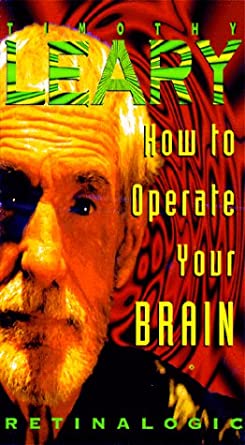
Almost 30 years later, Leary hadn’t lost his missionary zeal. In 1993 (and only a few years before his death), the former Harvard psychology professor recorded “a public service video” called How to Operate Your Brain. Here, Leary narrates an almost epileptic seizure-inducing video, providing what some consider “a guided meditation” of sorts. I’d prefer to call it an unorthodox “user manual” that tries to impart Leary’s unique sense of enlightenment:

The aim of human life is to know thyself. Think for yourself. Question authority. Think with your friends. Create, create new realities. Philosophy is a team sport. Philosophy is the ultimate, the ultimate aphrodisiac pleasure. Learning how to operate your brain, learning how to operate your mind, learning how to redesign chaos.

As you get deeper into the meditation, you’ll realize one thing. Three decades may have passed since Leary popularized the catchphrase of the counterculture. But he’s still getting his ideas from McLuhan. If you follow the video (or transcript) to the end, you’ll discover that ones and zeros have basically taken the place of LSD. Leary says:

Now we have digital communication. We can create our fantasies. We can create our rhythms, design on screen…. Anyone in any culture watching this screen will get the general picture. It’s one global village. It’s one global human spirit, one global human race. As we link up through screens, linked by electrons and photons, we will create for the first time a global humanity, not separated by words or minds or nationalities or religious biases.

You can find McLuhan meditating on the concept of an Electronic Global Village in another vintage clip.

The Political Value of Psychedelics

By Dr. James Cooke

Source: Reality Sandwich

Psychedelics and Politics

Psychedelics are political.  Their use in the 1960s had a political impact that is still being felt today, and their widespread banning was driven by political motives.  But how can a class of chemicals consistently impact our opinions of how we organize and relate to each other?  Psychedelics can affect the brains of individuals in ways that produce consistent insights.  These insights have direct relevance for our individual and collective wellbeing, and can point the way towards political change that would benefit us all.

The 1960s

The LSD-fuelled hippie movement was instrumental in the origins of the modern ecological awareness in politics that is so widespread today.  It helped birth modern anti-war peace movements and the practice of living in sustainable, eco-friendly communes.  What is it about the time we live in and the effects of psychedelic substances that result in their producing this kind of change in political thinking?  To understand this, we have to not only consider how psychedelics act in the brain, but we also have to understand both the unusual situation humans have found themselves in since the advent of civilization and the psychology that gave rise to it.

The Human Animal

We live in an unusual time.  For approximately 97% of human existence our species lived close to nature in small social groups.  Like other animals, evolution programmed us with a survival instinct and fear of death.  This fear incentivized us to control the world around us in order to make us feel safe.  Unlike other animals, however, we succeeded in dominating nature.  Thanks to our capacity for language and our dexterous hands that were freed up by our walking upright, it became possible for us to create culture and technology.  The preservation of knowledge from generation to generation that comes with language allowed for greater and greater control of the world around us.  Eventually we found ourselves in complex civilizations, a very long way from home.

The Price of Progress

This way of being that led to the relentless growth of civilizations is characterized by a particular kind of psychology, one that is governed by fear.  Sacrificing one’s happiness today in order to prepare for tomorrow can often make sense, but being consistently emotionally hijacked by fear without realising it can lead to a lot of unnecessary suffering.  This is true for individuals suffering with trauma and it’s true for our species as a whole.  In such a situation, there is the loss of the ability to find peace and wellbeing in the present.  We desperately look towards the future in the hope that if we just keep pushing forwards we will find a way out of our situation, not realizing that this way of being in itself is the problem.  The result is that, while we may no longer be routinely at risk of being eaten by predators, we are suffering from an epidemic of disorders of alienation, such as addiction, anxiety and depression.

The Fear Trap

Why do we continue to do this?  One reason is that we are naturally fearful creatures.  It makes sense that we would have evolved to sacrifice our wellbeing today in order to ensure our survival tomorrow.  Evolution is about staying alive, it’s not about being happy.  Another reason is that evolution has endowed us with incredible coping mechanisms.  We can be living in agony but, if we see now no other option, our capacity for language allows us to tell ourselves a story about why our situation is actually fine.  It is by taking these stories to be more real than our felt conscious experiences that we manage to repress our anguish.

Civilization and Control

Beyond the individual, there are other dynamics that keep us trapped in the game of “progress” at the expense of our wellbeing.  Once agriculture had been invented it became possible to generate surplus food, paving the way for a minority of individuals to hoard resources.  This made it possible for wealthy individuals to coerce the majority into doing their bidding as they had something that they needed for their very survival.  The ability of humans to live in stories has also been crucial in perpetuating this control.  Our ability to rationalize and normalize our experiences made it possible for each generation to grow up believing that this situation was correct or right in some way, instead of seeing how they are being exploited.

Deep Ecology

It wasn’t always this way.  Prior to the hierarchical arrangements of control that define civilization, humans throughout the world routinely explored their being part of the natural world through religious and spiritual practices.  Psychedelic plant medicines were widely used in order to explore our interconnectedness with the natural world.  The Norwegian philosopher Arne Næss coined the term “deep ecology” to refer to the non-hierarchical principles of interdependence and interconnectedness that are deeper than a superficial concern for the environment.  Ecology in this sense can apply equally to the natural world, to social arrangements or even to the contents of your own mind.

Ecology vs. Hierarchy

While the systems of control that define “civilized” states typically separate and atomize people so they can be used to generate wealth for others, human communities centred around ecological and spiritual principles are based on collaboration and the valuing of individual and collective wellbeing.  Psychedelics promote these ecological and spiritual perspectives, making them a threat to dominating systems of control.

Psychedelics and the Wisdom of Ecology

How do psychedelics promote ecological thinking?  In the brain of the individual, psychedelics can temporarily topple the hierarchical, control-based modes of thought that usually dominate our minds.  As is well attested to in Buddhist philosophy, it is these modes of thought that are responsible for the majority of our suffering.  With these structures of control dissolved, what’s revealed is a sense of interconnection and a more harmonious way of being.  This experience can produce insight into the wisdom of ecological principles such as openness, collaboration and naturalness as opposed to the controlling, atomizing and artificial arrangements that currently dominate society.  As our well-being as social primates depends on the community as a whole, it only follows that their relevance of these insights would extend beyond the individual to those who have an impact on us in society.

Hippies, Peace, Communes and the Environment

LSD use in the 60s pushed the brains of a generation in the direction of ecological thinking.  Many young people who might otherwise have unquestioningly fought in the Vietnam war suddenly saw their situation afresh, the propaganda of their home country replaced with a vision of a world of collective collaboration rather than one of conflict and domination.  The suicidal logic of ecological destruction was also laid bare, the narrative of progress through the domination of nature seemingly nothing more than an excuse for the powerful to line their pockets, a project that would soon take the earth and all of us with it.  A critical mass of young people came to similar conclusions and the hippie movement was born.

Science and Psychedelic Personality Change

Modern science is now mapping how psychedelics change people’s political opinions.  A study published in 2017 found that the number of times people use a psychedelic and the strength of their most powerful ego-dissolving experience correlate with increased nature relatedness, openness and reduced authoritarian thinking [1].  These aspects of the personality all reflect this movement towards greater ecological thinking.

The Psychology of Control

Without the benefit of psychedelics to help us travel in the direction of ecological thinking and greater wellbeing, many get trapped in coping mechanisms of control.  The traumatic nature of existence pushes some to move in the opposite direction, disowning their capacity for empathy and connection and reaffirming their sense of separation.  This process can result in disorders of the ego such as narcissism, sociopathy and psychopathy, all characterized by a lack of empathy and a delusionally high opinion of oneself.  We currently live in a system crafted to suit such personality types.  The coping mechanisms emerge in response to severe trauma early in life, when the child is learning how to connect with the world around them.  Investment in the ego and lack of concern for others is a pathology that can help such people cope with this powerful trauma.  It also represents the psychological dynamic that keeps society sick and blocks collective healing through the widespread adoption of the ecological perspective.

The Key Roadblock to Change

Society only consists of individuals interacting.  As a result, our political crises largely originate in the internal crises of individuals.  The collective trauma carried by the human race is passed on generation after generation.  A critical amount of narcissistic behaviour results in a society based around the separation and atomization of individuals, as well as around domination and control, of the environment and each other.  The extent to which our fellow humans are unconsciously trapped in narcissistic coping mechanisms is the extent to which our species will be trapped in its current mode of domination, control and suffering.

Psychedelic Medicine and the Healing of Collective Trauma

Psychedelic medicine holds the promise of moving culture in the direction of trauma healing and deep ecological thinking that is necessary to save our species and the planet from ecological destruction.  The main challenge will be how we engage with those at the other end of the spectrum, the narcissists and psychopaths so affected by trauma that they will defend their protective systems of domination at all costs. Psychedelic medicine may be able to reach some but perhaps the single greatest impact of psychedelics in years to come will be moving the public conversation toward a greater awareness of how the dynamics of trauma have deranged our world.  The creation of a global ecological culture that centers around trauma healing, emotional wellbeing and an awareness of the psychology of narcissism is the only hope our species and planet has for survival, and psychedelics are perhaps the most powerful tool we have in making this culture a reality.


References:

Nour MM, Evans L, Carhart-Harris RL. Psychedelics, Personality and Political Perspectives. J Psychoactive Drugs. 2017;49(3):182-191. doi:10.1080/02791072.2017.1312643

THE ONLY OBSTACLE TO A HEALTHY WORLD IS GOVERNMENT SECRECY AND PROPAGANDA

By Caitlin Johnstone

Source: Waking Times

If people in power were no longer able to hide secrets and spin lies about what’s going on in the world, all of our major problems would come to an end. Because secretive and manipulative power structures are the source of all of our major problems.

If the public could see what’s actually happening in their world, they would immediately begin using the power of their numbers to overhaul our current system. This is why our current system pours so much energy into preventing the public from seeing what’s actually happening in their world.

If it weren’t for the constant campaign of obfuscation and manipulation of public perception via veils of government secrecy and propaganda, humanity would naturally find its way out of the power-driven tribulations it now faces, as surely as you’ll avoid obstacles and hazards in your path when you are walking with your eyes open. The only problem in this case is that our eyes have not been permitted to open.

It isn’t actually necessary to hold a bunch of hard, rigid ideas about exactly what kind of society we should have, what kind of political system we should have, what kind of economic system we should have. There’s nothing wrong with promoting ideas and having preferences of course, but really if you just gave humanity the ability to navigate through its own troubles by removing the blindfolds of propaganda and power opacity, it would organically create a healthy society, and realistically such a society probably won’t look a whole lot like our mental models.

You do have the option, then, of simply promoting the end of government/political/corporate/financial opacity and the end of establishment perception management. Wanting humanity to see with clear eyes so that it can make its own informed decisions about where to take itself is a complete political position, in and of itself. You don’t have to hold any other political preferences of any kind if you don’t want to.

The desire for an end to the obfuscations and manipulations of the powerful so that humanity can find its own way is the most anti-authoritarian position you can possibly take, because it also protects the world from your own authoritarian impulses.

I personally am very leftwardly inclined and believe that if humanity had its perception management blindfolds removed it would naturally create a world where we’re all truly equal and everyone is taken care of by the collective each according to their need, but what the hell do I know? Maybe if the blindfold is removed I’d be proven wrong. I respect human sovereignty enough to want to find out, free from my own political preferences. I should not be the one making such societal decisions, society as a whole should. I just want human perception to be freed up enough to make that call.

If you choose to make the end of perception management your foremost priority, that means you push for government transparency at every opportunity and support any movement to take away secret hiding places from the powerful.

It means opposing the way the powerful bolt shut all the doors on public scrutiny of their behavior, smear anyone who speculates about what they might be up to as a crazy conspiracy theorist, and imprisons anyone who leaks information about what they’re really doing to the people.

It means you support whistleblowers like Chelsea Manning and Edward Snowden who help shine light on the things power tries to keep hidden in the dark.

It means you support WikiLeaks and Julian Assange and any journalist who helps expose the secrets of the powerful.

It means you fight the empire’s propaganda machine at every opportunity to break public trust in its manipulations.

It means you support breaking up the monolithic mass media and giving everyone the equal ability to influence the dominant narratives.

It means opposing internet censorship, since Silicon Valley plutocrats propping up the establishment their kingdoms are built upon by censoring anti-establishment voices is another way of keeping people from being shown the truth about their world.

I personally would add that it means supporting the decriminalization of psychedelics, because seeing within ourselves is just as important as seeing what’s happening in our world and entheogens can facilitate this seeing, but maybe that’s just me.

Again, there’s no harm in engaging in politics and pushing for the changes you’d like to see in your world, and there can be many benefits to doing so. But as long as people are successfully prevented from seeing and understanding what’s really happening in their world by the obfuscation of information and by the manipulation of people’s perception of that information, the status quo will always remain in place.

So in my opinion this is the most sensible point upon which to converge our energy. I personally have no interest in controlling what humanity does, and desire only that people come to see freely enough to make their own decisions.

It’s absolutely insane that information which affects us all is kept hidden away from our clear vision by secrecy and propaganda. It’s even crazier that they shame us when we wonder what’s really going on and throw us in prison when we try to find out. We must liberate ourselves from this madness so we can create a healthy world together.

The Varieties of Psychonautic Experience: Erik Davis’s ‘High Weirdness’

Art by Arik Roper

By Michael Grasso

Source: We Are the Mutants

High Weirdness: Drugs, Esoterica, and Visionary Experience in the Seventies
By Erik Davis
Strange Attractor Press/MIT Press, 2019

Two months ago, I devoured Erik Davis’s magisterial 2019 book High Weirdness: Drugs, Esoterica, and Visionary Experience in the Seventies the same weekend I got it, despite its 400-plus pages of sometimes dense, specialist prose. And for the past two months I have tried, in fits and starts, to gather together my thoughts on it—failing every single time. Sometimes it’s been for having far too much to say about the astonishing level of detail and philosophical depth contained within. Sometimes it’s been because the book’s presentation of the visionary mysticism of three Americans in the 1970s—ethnobotanist and psychonaut Terence McKenna, parapolitical trickster Robert Anton Wilson, and paranoid storyteller-mystic Philip K. Dick—has hit far too close to home for me personally, living in the late 2010s in a similarly agitated political (and mystical) state. In short, High Weirdness has seemed to me, sitting on my bookshelf, desk, or in my backpack, like some cursed magical grimoire out of Weird fiction—a Necronomicon or The King in Yellow, perhaps—and I became obsessed with its spiraling exploration of the unfathomable universe above and the depthless soul below. It has proven itself incapable of summary in any linear, rationalist way.

So let’s dispense with rationalism for the time being. In the spirit of High Weirdness, this review will try to weave an impressionistic, magical spell exploring the commonalities Davis unveils between the respective life’s work and esoteric, drug-aided explorations of McKenna, Wilson, and Dick: explorations that were an attempt to construct meaning out of a world that to these three men, in the aftermath of the cultural revelations and revolutions of the 1960s that challenged the supposed wisdom and goodness of American hegemony, suddenly offered nothing but nihilism, paranoia, and despair. These three men were all, in their own unique ways, magicians, shamans, and spiritualists who used the tools at their disposal—esoteric traditions from both East and West; the common detritus of 20th century Weird pop culture; technocratic research into the human mind, body, and soul; and, of course, psychedelic drugs—to forge some kind of new and desperately-needed mystical tradition in the midst of the dark triumph of the Western world’s rationalism.

A longtime aficionado of Weird America, Davis writes in the introduction to High Weirdness about his own early encounters with Philip K. Dick’s science fiction, the Church of the SubGenius, and other underground strains of the American esoteric in the aftermath of the ’60s and ’70s. As someone who came late in life to a postgraduate degree program (High Weirdness was Davis’s doctoral dissertation for Rice University’s Religion program, as part of a curriculum focus on Gnosticism, Esotericism, and Mysticism), I find it incredibly easy to identify with Davis’s desire to tug at the edges of his longtime association with and love for the Weird in a scholarly context. This book’s scholarly origins do not make High Weirdness unapproachable to the layperson, however. While Davis does delve deeply into philosophical and spiritual theorists and the context of American mysticism throughout the book, he provides succinct and germane summaries of this long history, translating the work of thinkers as diverse as early 20th century psychologist and student of religious and mystical experience William James to contemporary theorists such as Peter Sloterdijk and Mark Fisher. Davis’s introduction draws forth in great detail the long tradition of admitting the ineffable, the scientifically-inexplicable, into the creation of subjective, individual mystical experiences.

Primary among Davis’s foundational investigations, binding together all three men profiled in the book, is a full and thorough accounting of the question, “Why did these myriad mystical experiences all occur in the first half of the 1970s?” It’s a fairly common historical interpretation to look at the Nixon years in America as a hangover from the cultural revolution of the late 1960s, a retrenchment of Nixon’s “silent majority” of middle- and working-class whites vs. the perceived chaos of a militant student movement and identity-based politics among racial and sexual minorities. Davis admits that the general mystical seeking that went on in the early ’70s is a reaction to this revanchism. And while he quotes Robert Anton Wilson’s seeming affirmation of this idea—“The early 70s were the days when the survivors of the Sixties went a bit nuts”—his interest in the three individuals at the center of his study allows him to delve deeper, offering a more profound explanation of the politics and metaphysics of the era. In the immediate aftermath of the assassinations, the political and social chaos, and the election of Nixon in 1968, there was an increased tendency among the younger generation to seek alternatives to mass consumption culture, to engage in what leftist philosopher Herbert Marcuse would term “the Great Refusal.” All three of the figures Davis focuses on in this book, at some level or another, decided to opt out of what their upbringings and conformist America had planned for them, to various levels of harm to their livelihoods and physical and mental health. This refusal was part of an awareness of what a suburban middle-class life had excised from human experience: a sense of meaning-making, of a more profound spirituality detached from the streams of traditional mainline American religious life.

To find something new, the three men at the center of High Weirdness were forced to become bricoleurs—cobbling together a “bootstrap witchery,” in Davis’s words—from real-world occult traditions (both Eastern and Western); from the world of Cold War technocratic experimentation with cybernetics, neuroscience, psychedelics, and out-and-out parapsychology; and from midcentury American pop culture, including science fiction, fantasy, comic books, and pulp fiction. Davis intriguingly cites Dick’s invention of the term “kipple” in his 1968 novel Do Androids Dream of Electric Sheep? as a key concept in understanding how this detritus can be patched together and brought new life. Given Dick’s overall prescience in predicting our 21st century world of social atomization and disrepair, this seems a conceptual echo worth internalizing a half-century later. If the late 1960s represented a mini-cataclysm that showed a glimpse of what a world without the “Black Iron Prison” might look like, those who graduated to the 1970s—the ones who “went a bit nuts”—needed to figure out how to survive by utilizing the bits and scraps left behind after the sweeping turbulence blew through. In many ways, McKenna, Wilson, and Dick are all post-apocalyptic scavengers.

All three men used drugs extensively, although not necessarily as anthropotechnics specifically designed to achieve enlightenment (Davis notes that Dick in particular had preexisting psychological conditions that, in conjunction with his prodigious use of amphetamines in the 1960s, were likely one explanation for his profound and sudden breaks with consensus reality in the ’70s). But we should also recognize (as Davis does) that McKenna, Wilson, and Dick were also, in many ways, enormously privileged. As well-educated scions of white America, born between the Great Depression and the immediate aftermath of World War II, they had the luxury to experiment with spirituality, psychedelic drugs, and technology to various degrees while holding themselves consciously separate from the mainstream institutions that would eventually co-opt and recuperate many of these strains of spirituality and individual seeking into the larger Spectacle. As Davis cannily notes, “Perhaps no one can let themselves unravel into temporary madness like straight white men.” But these origins also help explain the expressly technocratic bent of many of their hopes (McKenna) and fears (Wilson and Dick). Like their close confederate in Weirdness, Thomas Pynchon (who spent his early adulthood working for defense contractor Boeing, an experience which allowed him a keener avenue to his literary critiques of 20th century America), all three men were adjacent to larger power structures that alternately thrilled and repelled them, and which also helped form their specific esoteric worldviews.

It would be a fool’s errand to try to summarize the seven central chapters of the book, which present in great detail Terence (and brother Dennis) McKenna’s mushroom-fueled experiences contacting a higher intelligence in La Chorrera, Colombia in 1971, Robert Anton Wilson’s LSD-and-sex-magick-induced contact with aliens from the star Sirius in 1973 and ’74 as detailed in his 1977 book Cosmic Trigger: The Final Secret of the Illuminati, and Philip K. Dick’s famous series of mystical transmissions and revelations in February and March of 1974, which influenced not only his fiction output for the final eight years of his life but also his colossal “Exegesis,” which sought to interpret these mystical revelations in a Christian and Gnostic context. Davis’s book is out there and I can only encourage you to buy a copy, read these chapters, and revel in their thrilling detail, exhilarating madness, and occasional absurdity. Time and time again, Davis, like a great composer of music, returns to his greater themes: the environment that created these men gave them the tools and technics to blaze a new trail out of the psychological morass of Cold War American culture. At the very least, I can present some individual anecdotes from each of the three men’s mystical experiences, as described by Davis, that should throw some illumination on how they explored their own psyches and the universe using drugs, preexisting religious/esoteric ritual, and the pop cultural clutter that had helped shape them.

Davis presents a chapter focusing on each man’s life leading up to his respective spiritual experiences, followed by a chapter (in the case of Philip K. Dick, two) on his mystical experience and his reactions to it. For Terence McKenna and his brother Dennis, their research into organic psychedelics such as the DMT-containing yagé (first popularized in the West in the Cold War period by William S. Burroughs), alternately known as oo-koo-hé or ayahuasca, led them to South America to find the source of these natural, indigenous entheogens. But at La Chorrera in Colombia they instead met the plentiful and formidable fungus Psilocybe cubensis. In their experiments with the mushroom, Terence and Dennis tuned into perceived resonances with long-dormant synchronicities within their family histories, their childhood love of science fiction, and with the larger universe. Eventually, Dennis, on a more than week-long trip on both mushrooms and ayahuasca, needed to be evacuated from the jungle, but not before he had acted as a “receiver” for cryptic hyper-verbal transmissions, the hallucinogens inside him a “vegetable television” tuned into an unseen frequency—a profound shamanic state that Terence encouraged. The language of technology, of cybernetics, of science is never far from the McKenna brothers’ paradigm of spirituality; the two boys who had spent their childhoods reading publications like Analog and Fate, who had spent their young adulthoods studying botany and science while deep in the works of Marshall McLuhan (arguably a fellow psychedelic mystic who, like the McKennas and Wilson, was steeped in a Catholic cultural tradition), used the language they knew to explain their outré experiences.

Wilson spent his 20s as an editor for Playboy magazine’s letters page and had thus been exposed to the screaming gamut of American political paranoia (while contributing to it in his own inimitable prankster style). He had used this parapolitical wilderness of mirrors, along with his interest in philosophical and magickal orientations such as libertarianism, Discordianism, and Crowleyian Thelema as fuel for both the Illuminatus! trilogy of books written with Robert Shea (published in 1975), and his more than year-long psychedelic-mystical experience in 1973 and 1974, during which he claimed to act as a receiver on an “interstellar ESP channel,” obtaining transmissions from the star Sirius. His experiences as detailed in Cosmic Trigger involve remaining in a prolonged shamanic state (what Wilson called the “Chapel Perilous,” a term redolent with the same sort of medievalism as the McKenna brothers’ belief that they would manifest the Philosopher’s Stone at La Chorrera), providing Wilson with a constant understanding of the universe’s playfully unnerving tendency towards coincidence and synchronicity. Needless to say, the experiences of one Dr. John C. Lilly, who was also around this precise time tuned into ostensible gnostic communications from a spiritual supercomputer, mesh effortlessly with Wilson’s (and Dick’s) experiences thematically; Wilson even used audiotapes of Lilly’s lectures on cognitive meta-programming to kick off his mystical trances. Ironically, it was UFO researcher and keen observer of California’s 1970s paranormal scene Jacques Vallée who helped to extract Wilson out of the Chapel Perilous—by retriggering his more mundane political paranoia, saying that UFOs and other similar phenomena were instruments of global control. In Davis’s memorable words, “Wilson did not escape the Chapel through psychiatric disenchantment but through an even weirder possibility.”

Philip K. Dick, who was a famous science fiction author at the dawn of the ’70s, had already been through his own drug-induced paranoias, political scrapes, and active Christian mystical seeking. Unlike McKenna and Wilson, Dick was a Protestant who had stayed in close contact with his spiritual side throughout adulthood. In his interpretation of his mystical 2-3-74 experience, Dick uses the language and epistemology of Gnostic mystical traditions two millennia old. Davis also notes that Dick used the plots of his own most overtly political and spiritual ’60s output to help him understand and interpret his transcendent experiences. Before he ever heard voices or received flashes of information from a pink laser beam or envisioned flashes of the Roman Empire overlapping with 1970s Orange County California, Dick’s 1960s novels, specifically The Three Stigmata of Palmer Eldritch (1965) and Ubik (1969), had explored the very nature of reality and admitted the possibility of a Gnostic universe run by unknowable, cruel demiurges. Even in these hostile universes, however, there exists a messenger of hope and mercy who seeks to destroy the illusion of existence and bring relief. These existing pieces of cultural and religious “kipple,” along with the parasocial aspects of Christian belief that were abroad in California at the time, such as the Jesus People movement (the source of the Ichthys fish sign that triggered the 2-3-74 experience), gave Dick the equipment he needed to make sense of the communications he received and the consoling realization that he was not alone, that he was instead part of an underground spiritual movement that acted as a modern-day emanation of the early Christian church.

After learning about these three figures’ shockingly similar experiences with drug-induced contact with beyond, the inevitable question emerges: what were all these messages, these transmissions from beyond, trying to convey? One common aspect of all three experiences is how cryptic they are (and how difficult and time-consuming it was for each of these men to interpret just what the messages were saying). It’s also a little sobering to discover through Davis’s accounts how personal all three experiences were, whether it’s Terence and Dennis’s private fraternal language during the La Chorrera experiment, or mysterious phone calls placed back in time to their mother in childhood, or a lost silver key that Dennis was able to, stage-magician-like, conjure just as they were discussing it, or the message Philip K. Dick received to take his son Christopher to the doctor for an inguinal hernia that could have proven fatal. But alongside these personal epiphanies, there is also always an undeniable larger social and political context, especially as both Wilson and Dick saw their journeys in 1973 and 1974 as a way to confront and deal with the intense paranoia around Watergate and the fall of Richard Nixon (in his chapter setting the scene of the ’70s, Davis calls Watergate “a mytho-poetic perversion of governance”). In every case, the message from beyond requires interpretation, meaning-making, and, in Davis’s terminology, “constructivism.” The reams of words spoken and written by all three men analyzing their respective mystical experiences are an essential part of the experience. And these personal revelations all are attempts by the three men to make sense of the chaos of both their personal lives and their existence in an oppressive 20th century technocratic society: to inject some sense of mystery into daily existence, even if it took the quasi-familiar and, yes, somewhat comforting form of transmissions from a mushroom television network or interstellar artificial intelligence.

Over the past nine months I’ve spent much of my own life completing (and recovering from the process of completing) a Master’s degree. My own academic work, focusing on nostalgia’s uses in binding together individuals and communities with their museums, tapped into my earliest memories of museum visits in the late 1970s, when free education was seemingly everywhere (and actually free), when it was democratic and diverse, when it was an essential component of a rapidly-disappearing belief in social cohesion. In a lot of ways, my work at We Are the Mutants over the past three years is the incantation of a spell meant to conjure something new and hopeful from the “kipple” of a childhood suffused in disposable pop culture, the paranormal and “bootstrap witchery,” and science-as-progress propaganda. At the same time, over the past three years the world has been at the constant, media-enabled beck and call of a figure ten times more Weird and apocalyptic and socially malignant than any of Philip K. Dick’s various Gnostic emanations of Richard Nixon.

Philip K. Dick believed he was living through a recapitulation of the Roman Empire, that time was meaningless when viewed from the perspective of an omniscient entity like VALIS. In the correspondences and synchronicities I have witnessed over the past few months—in the collapse of political order and the revelation of profound, endemic corruption behind the scenes of the ruling class—this sense of recurring history has sent me down a similar set of ecstatic and paranoid corridors as McKenna, Wilson, and Dick. The effort to find meaning in a world that once held some inherent structure in childhood but has become, in adulthood, a hollow facade—a metaphysical Potemkin village—is profoundly unmooring. But meaning is there, even if we need technics such as psychedelic drugs, cybernetics (Davis’s final chapter summarizing how the three men’s mystical explorations fed into the internet as we know it today is absolutely fascinating), and parapolitical activity to interpret it. On this, the 50th anniversary of the summer of 1969, commonly accepted as the moment the Sixties ended, with echoes of moon landings and Manson killings reverberating throughout the cultural theater, is it any wonder that the appeal of broken psychonauts trying to pick up the pieces of a shattered world would appeal to lost souls in 2019? High Weirdness as a mystical tome remains physically and psychically close to me now, and probably will for the remainder of my life; and if the topics detailed in this review intrigue you the way they do me, it will remain close to you as well.

Saturday Matinee: The Emerald Forest

A drama about the clash between an Amazonian rainforest tribe with an ecological ethic and modern corporate interests who measure everything by progress.

Review by Frederic and Mary Ann Brussat

Source: Spirituality & Practice

“Rainforests are one of the most complex, beautiful and important of the many ecological systems on the planet,” naturalist Gerald Durrell has stated. “They are also ones that, primarily out of greed, we are destroying with the savage, unthinking ferocity of a troop of drunken apes in an art gallery. But whereas pictures can be repainted, tropical rainforests can’t be recreated.”

“When I was a boy,” says Wanadi, a primitive tribal chief who has kept his Invisible people out of contact with the twentieth century, “the edge of the world was very far. But every year it comes closer.” The Emerald Forest depicts the clash between this rainforest tribe, who adapt themselves to the environment and treat it like a friend, and inhabitants of the modern world, who measure everything by progress. Director John Boorman (Beyond Rangoon, Excalibur, Hope and Glory) shot this compelling film in Brazil in the rainforest of the Amazon.

The story begins with Bill Markham (Powers Boothe), an American engineer, taking his wife and two children to the site of a new hydroelectric dam he is building in Brazil. During the visit, seven-year-old Tommy wanders into the jungle and does not return. Ten years later, Markham is completing his work on the dam and still searching for his son. He finds him living with a Stone Age tribe who call themselves the Invisible People. They use a green dye to camouflage their presence in the Amazon rainforest. Although Markham wants Tommy to return with him to civilization, the youth — now called Tomme (Charley Boorman) — has become part of the tribe and views Wanadi (Rui Polonah), the shaman and chief elder of the Invisible People, as his true father. While staying with the tribe and seeing how his son has adapted to their way of life, Markham realizes that he cannot force Tomme to come home with him. He leaves alone. Shortly afterward, the Invisible People are attacked by a cannibal tribe, the Fierce People. These warriors kidnap the women, taking them to a shantytown which has grown up around the dam. They plan to sell them to brothel keepers. Tomme, now responsible for the Invisible People, realizes that he needs Markham’s technology to rescue the women since the Fierce People have acquired machine guns. His son’s return compels the engineer to take a hard look at the values which have motivated him to build the dam and the impact of his work on the Invisible People and their home in the rainforest.

In the spirit of Nicholas Roeg’s Walkabout, Peter Weir’s The Last Wave, and Werner Herzog’s Where the Green Ants Dream, the story conveys the ancient wisdom of the primitives who relish dream time and have found a way to dignify the different stages of life with meaningful rituals. Equally important is the message that an ecological ethic is far superior to the domineering ravaging of the earth that has come to characterize the “advance” of civilization.

Watch the full film here.

Saturday Matinee: The Sunshine Makers

A real-life Breaking Bad for the psychadellic set, The Sunshine Makers reveals the entertaining, untold story of Nicholas Sand and Tim Scully, the unlikely duo at the heart of 1960s American drug counterculture. United in a utopian mission to save the planet through the consciousness-raising power of LSD, Orange Sunshine, as they tried to stay one step ahead of the feds.

Watch the full film here.

Saturday Matinee: Metamorphosis

(In memory of Terence McKenna, November 16, 1946 – April 3, 2000)

CHAOS AND THE WORLD SOUL

By Richard Kadrey

Source: Wired

METAMORPHOSIS – A video “trialogue” featuring Ralph Abraham, Terence McKenna, and Rupert Sheldrake – is part shamanic journey and part New Physics 101. It’s mostly talk, with touches of simple computer graphics and music adorning the presentation. But what talk it is. We’ve got Abraham, a mathematician and the godfather of chaos theory; McKenna, a shamanologist, ethnopharmacologist, and psychedelic philosopher; and Sheldrake, a radical biologist and originator of the idea of “morphic resonance,” a memory embedded in all natural systems. Their free-form discussion ranges from drug experiments to the anima mundi (world soul), chaos and complexity, and the effects of language and imagination on the shape of the universe – all in search of a new field theory that encompasses art, science, and philosophy.

In this particular chaotic system, McKenna is the strange attractor around which Abraham and Sheldrake orbit. The three unite in a quest for knowledge and an exchange about the sciences they’ve studied. Sheldrake talks passionately about trying to redefine biology in terms of living organisms, not the abstract dead things found in textbooks and labs. Abraham, not surprisingly, explains how protests over the Vietnam War lead him to leave his sheltered academic life, pursue meditation in the Himalayas, and study chaos theory.

With McKenna as the ringleader (and biggest talker), imagination and chaos are the principal themes. Chaos, as McKenna describes it, is a science to study, an opportunity to reshape the world by looking through the lens of nonlinear processes, and a metaphor to help us think about our place in the universe. In McKenna’s words, chaos “is telling us that the intimation of mysticism, the intimation of a possibility of transcendence, is all firmly grounded in science.”

This is heady stuff. Though you half expect the psychedelic proselytizing to drift off into some kind of Birkenstock-and-bean-sprout dead end, the rigor, intelligence, and wit of these three minds keep the ideas sharp and fast. For anyone interested in the edge of science, this video is both entertaining and inspiring.