Plagues

By

Source: AntiWar.com

One indicator of human development is the number of people who die from preventable diseases and epidemics.

For example, the plague, as “Black Death” one of the horrors of the Middle Ages, is extinct in Europe, but still occasionally occurs worldwide – in “underdeveloped” regions, of course. Insufficient hygienic conditions are the first prerequisite for the occurrence and spread of this disease. After all, at least there are effective drugs to treat it.

Smallpox was a very dangerous disease. This epidemic also claimed millions of lives, especially in areas where there was no immunity in the population. The American Indians are to be mentioned here, who were particularly numerous victims of smallpox.

Smallpox is my favorite disease, firstly because it has been eradicated – “only an eradicated epidemic is a good epidemic” – and secondly because I myself have been engaged in eradicating it, working in the Smallpox Eradication Program, the only successful project worldwide carried out by the World Health Organization in the 1970s. With our well-designed approach we quickly could bring even major outbreaks of this epidemic under control.

Cholera is a particularly serious disease. Cholera can spread practically unhindered if there is no clean drinking water and water is contaminated by contaminated waste water. Cholera, dysentery and typhus indicate a lack of clean drinking water and are life-threatening for malnourished people, primarily for children and the elderly.

Perhaps you remember the 500,000 children in Iraq who were killed by the sanctions imposed on Iraq after the Gulf War – yes, those who according to US Secretary of State Madeleine Albright were “worth the price”?

I deliberately and intentionally write “were killed” and not “have died”, have “lost their lives” or as can be heard in the mendacious media in this country/in the West, if at all. A report by UNICEF has been slammed in the Security Council by the United States of America and the United Kingdom. In my opinion a mass murder has been carried out on a huge scale, with the greatest unscrupulousness and with the cooperation and agreement of the Western community, including the United Nations, this pathetic bureaucratic Moloch with its low life existence under the whip of the US State Department.

In Washington and London they certainly know that poor hygiene conditions promote the spread of epidemics. Well, what does this mean for the rulers and commanders of the most aggressive rogue states of our time?

They let destroy power stations, drinking water systems and sewage treatment plants by their own and by the war planes of their respective “coalitions”.

And then?

Then they impose sanctions to block and prevent the necessary materials for repairs being brought into the country. Or prevent food or medicine from being brought into the country, or whatever evil the criminal brains in these command centers will devise to damage and harass people who do not obey. Sooner or later, the desired effect will appear, which can only be described as planned mass murder. This has happened in recent years in Afghanistan, Iraq, Libya, Syria and most recently in Yemen. Gaza can be counted as one of the places where this “policy” has also been practiced for years, interrupted only by further bombing of residential buildings and infrastructure. The fact that the Western media hardly ever report about these gigantic crimes against humanity makes these “free media” accomplices in the style of Nazi media.

The terrorist superpower, the United States of America, apparently is not mainly interested in conquering these countries – it is enough for them to have them rendered helpless and defenseless, at least not being able to stand in the way of the aggressive ambitions of those striving for world domination. It easily can be found out on any world map where they are heading to.

Many millions of people killed, crippled and displaced will have to continue to be worth the “prize” that the aspirations of the terrorist superpower and their criminal “community” will require, at least in case things are developing according to their intentions.

As already mentioned the management of preventable diseases is a benchmark for the development of mankind.

If certain states cause the death and unspeakable suffering of countless people with tremendous effort, this is directly directed against the development and the interests of humanity. The fight against such parasitic states and their criminal aspirations is justified in every respect.

The fact, that a terrorist superpower and its terrorist appendage are granted civilizing, cultural or even humanitarian competence in spite of their manifest crimes against peace and against humanity is obviously an outstanding feature – symptom – of a society whose spiritual state is situated deeply in the realm of pathology.

Obviously, we are dealing with an epidemic here, too. A plague that affects people’s brains. Just as cholera bacteria attack the organism by programming its functions to self-destruction.

Guess if there is an “immune system”, too? That can prevent mankind being led into self-destruction?

You may assume that there is one and that you too can be a potential/potent part of this immune system.

As always in such cases it starts at a small scale. The chances of a movement growing against the current madness, that ultimately will prevail, are intact. Mankind at first glance may not appear getting constantly smarter, but on closer inspection it becomes clear that this inevitably must be the case. I would be surprised if the organism of mankind will not, in the foreseeable future, discard the elements that cynically endanger and trample underfoot the fate of mankind as a whole out of selfish interests. So far we have made it anyway…


Klaus Madersbacher is editor of www.antikrieg.com, an antiwar website in German with mainly articles from antiwar.com which he translates into German.

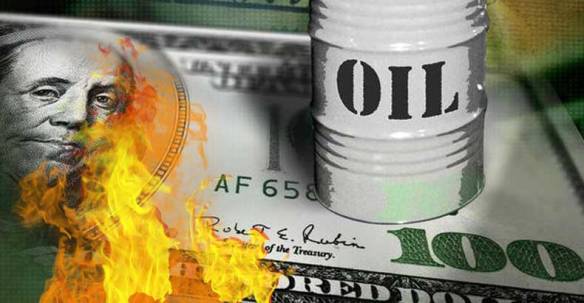
Demise Of The Petrodollar Has The Potential To Reshape The Geopolitical World

By James ONeill

Source: New Eastern Outlook

In the early 1970s President Richard Nixon instigated two changes that had profound effects. The first of these was taking United States off the gold standard; i.e. henceforth US dollars would no longer be convertible to Gold. Ordinarily this might have been expected to have significant ramifications for the value of the US dollar.

Deleterious effects however, were avoided by another equally profound change. Nixon’s National Security Adviser Henry Kissinger negotiated an agreement with Saudi Arabia that henceforth all oil(initially from Saudi Arabia but rapidly extended to all OPEC) countries would be traded only in US dollars, the birth of the so called petrodollar.

It was a classic mafia style arrangement. In exchange for Saudi Arabia’s agreement to the sole use of the dollar for oil transactions, the US underwrote Saudi Arabia’s security thereby ensuring the continuity of one of the world’s most corrupt and repressive regimes.

Also unknown at the time, the US and Saudi Arabia entered an arrangement whereby Islamist terrorist groups (as long as they were Sunni) would be financed by Saudi Arabia and armed by the Americans and then used in pursuit of US geopolitical goals. Operation Cyclone, begun under the Carter administration in the 1970s was an early forerunner of this tactic, but it has been refined and utilized in different formats in a wide number of countries ever since.

The objective was always fundamentally the same: to undermine and if necessary replace governments that were insufficiently compliant with US geopolitical aims. As and when necessary, US troops and their “coalition” allies would be inserted into the target countries. The destruction of Afghanistan (2001 and continuing) Iraq (2003 and continuing) Libya (2011 and continuing) are only three of the better-known examples.

The huge financial cost of these military and geopolitical ventures did not impose a proper price upon the US because of the hegemonic role of the US dollar. The US, in effect, had their multiple wars of choice paid for by other countries as the dollar’s role in world trade created a constant demand for US Treasury bonds.

The role of the US dollar also permitted the US to impose sanctions on recalcitrant countries. The selective nature of the sanctions, always directed toward a US geopolitical or commercial advantage, were clearly an instrument of repressive power. Notwithstanding claims that they were to “punish” the alleged misconduct of the specified country, their actually use betrayed their geopolitical purpose.

Sanctions against Russia for its” invasion” of Ukraine “annexation” of Crimea, and against Iran for its “nuclear program” are two of the better known illustrations of sanctions being justified on spurious grounds..

The use and abuse of the dollar’s power is clearly unacceptable, but the capacity to invoke countermeasures was until quite recently severely limited. The single most important countervailing force is the rise of China as the economic powerhouse of the world, and importantly, the creation of alternative structures in trade, finance and security, that translate China’s economic power into a force for major change.

That change is assisted by the number of collateral developments. In 1990, the G7 nations (Canada, France, Germany, Italy, Japan, the US and UK) had a combined GDP approximately six times greater then the seven economically most important emerging nations (Brazil, China, India, Indonesia, Mexico, Russia and South Korea).

By 2013 the “emerging seven” had surpassed the G7’s GDP total and according to the IMF’s estimates for 2017, the GDP of the two groups will be $47 .5 trillion and $37.8 trillion for the emerging seven and the G7 respectively. Turkey, which is growing at 5% per annum, has replaced Mexico in the top emerging seven.

BRICS, which contains four of the emerging seven nations and the Shanghai Corporation Organisation (SCO), which includes China, India and Russia, are working together on the architecture of a monetary alternative to the dollar. The SCO alone contains 42% of the world’s population.

India’s role in BRICS and the SCO is one reason it is being assiduously cultivated by Australia, Japan and the United States in an attempt to set up a “quadrilateral four” to slow and undermine the role of China and Russia in creating an alternative to longstanding western domination and exploitation.

It was in this context that Russia’s President Putin at the recent BRICS meeting in Xiamen, China said that

“Russia shares the BRICS countries concerns over the unfairness of the global financial and economic architecture, which does not give due regard to the growing weight of the emerging economies.”

This speech developed a theme that Putin had developed in an article published prior to the BRICS meeting. Putin bluntly vowed to destroy the US led financial system, aiming to reform a system that gives excessive domination to a limited number of reserve (i.e. predominantly western) currencies.

China has developed a new Cross Border Interbank Payments System (CIPS) to replace the US dominated SWIFT system, itself used as a tool for financial bullying by the US. Russia has also taken steps to insulate itself from the ill effects of being excluded from SWIFT.

Other major changes are also occurring. Venezuela, with the world’s largest known oil reserves, has ceased accepting payment in US dollars. In the past US retaliation through regime change would have been immediate as happened to Libya’s Gaddafi (confirmed by Clinton’s leaked emails) and the Iraq’s Saddam Hussein who had announced that he would henceforth accept payment in euros and not dollars.

China and Qatar recently concluded a $50 billion deal denominated in Yuan. There were immediate threats and absurd demands from Saudi Arabia, undoubtedly acting as the voice of the US administration, but nothing more serious. The lack of military intervention or attempted regime change was probably attributable to Turkey’s military intervention, a series of agreements with Iran, and the probable implied threat of Chinese intervention should the Saudis further demonstrate their military incompetence (as in Yemen) by anything as rash as direct military moves against Qatar.

Saudi Arabia is rapidly reaching a crunch point in its relationship with China, a huge purchaser of Saudi Arabia’s oil. It is widely known that China wants future oil contracts denominated in Yuan. The attraction for Saudi Arabia is that the Chinese guarantee their Yuan with gold traded on the Hong Kong and Shanghai exchanges. Ironically, this puts China in the same position as the United States prior to Nixon’s withdrawal from the gold backed dollar.

The dilemma for the Saudis is that if they comply with the Chinese demands they risk losing the Americans underwriting their security. US instigated regime change in Saudi Arabia is a very real possibility and the recent maneuverings by Mohammad bin Salman to consolidate his power can be interpreted as a response to that possibility.

Typically, the western media focused on relative trivialities, such as women being able to drive motor vehicles from 2018 (in limited circumstances), rather than examining the underlying geopolitical power struggle.

The other major development worth mentioning in this context is the rapid increase in the number of countries doing deals with China using the Yuan or their own national currencies as the medium of exchange. China’s Belt and Road Initiative, currently involving 65 nations, will undoubtedly accelerate this trend. Russia and China are already each other’s critically important trading partners and all agreements between them are being denominated in either Yuan or Rubles.

It would be naïve to assume that this is all going to occur without a massive rearguard action by the Americans who know full well that their ability to defy economic logic is only possible because of the dollar’s unique role, allowing in turn military interventions to prop up their now rapidly declining power.

The United States’ aggressive and provocative actions in the South China Sea, North Korea, Ukraine, Syria and elsewhere our best interpreted as the flailing’s of a declining empire. The real question is will the United States accept the disappearance of the unique power that it has wielded since the Bretton Woods agreement of 1944 and adjust its policies accordingly, or destroy us all in their attempts to recapture a lost world.

Perpetual Prosperity And The ‘Strategy of Tension’

By Graham Vanbergen

Source: TruePublica

Marco Rubio, the American politician, attorney and former Speaker of the Florida House of Representatives once said; “Every nation on the Earth that embraces market economics and the free enterprise system is pulling millions of its people out of poverty. The free enterprise system creates prosperity, not denies it.”

Statements such as these are common amongst politicians, especially wealthy ones who hold wealth driven values. But one man’s prosperity is another man’s misery in a world blighted by an economic model that demands eternal growth.

The only one constant that sits well with this model is that world population continues to increase, but even that is tailing off. Global population currently sits at 7.5 billion and rising at a rate of 80 million per year. The rate of population increase was 2.19 percent at its peak in 1963, which has now halved.

Concerns of the Fourth Industrial Revolution fusing the physical, digital and biological worlds, and impacting all disciplines, economies and industries emanate from the corporations who now see their future declining revenue potential being rescued through reduced reliance on human labour.

Get Briefed, Get Weekly Intelligence Reports – Essential Weekend Reading – Safe Subscribe

Subscribe!

To keep prosperity on a perpetual upward trajectory in the backdrop of a continually shrinking and less well off consumer base, the most politically influential now work in concert with the corporate behemoths – the new rulers of the world.

The strategies adopted to keep the ball rolling over the last few decades centre around a financial architecture that requires drastic anti-democratic political support. As Noam Chomsky warns “The very design of neoliberal principles is a direct attack on democracy.

One does not have to look far to see these principles at work. Trillions of desperately needed taxes to support a decaying system of civil society are illegally offshored by household named corporations and individuals. Unfortunately, this form of extreme neoliberalism still isn’t enough to keep the ball rolling.

Naomi Klein’s 2007 book ‘Shock Doctrine, the rise of Disaster Capitalism’ exploded the myth that the global free market triumphed democratically. Klein highlights how the “puppet strings behind the world-changing crises and wars of the last four decades is the real story of how America’s “free market” policies came to dominate the world, through the exploitation of disaster-shocked people and countries.”

Then, one year later, Klein’s prognosis saw the 2008 financial crisis offering up more disaster shocked peoples at the global level as neoliberalism wriggled free from the remnants of regulation to reach a new pinnacle for the few and a created an even greater crisis of daily life for the hundreds of millions left behind.

This erroneous ideology delivered little more than world economic stagnation, crippling austerity, peak inequality, a global environmental crisis, the slowest economic recovery in history and monumental debt of every country it infected. This was no mistake, no unforeseen event, that we were told stunned our leaders and their captains.

The problem always existed that extreme wealth was never going to come from a global post-war peace through globalisation – so a ‘strategy of tension’, an Anglo/American innovation, was invented to keep the exploitation model alive.

The actual definition of this strategy is that “Western governments during the Cold War used tactics that aimed to divide, manipulate and control public opinion using fear, propaganda, disinformation, psychological warfare, agents provocateurs, and terrorist actions in order to achieve their strategic aims.

Amongst many, one of those aims was financial domination.

During the closing days of the Cold War, the UK, US and other western governments along with the secret services colluded to engineer terrorist attacks inside Western Europe, to be blamed on Russia. This is now so well documented it needs no elaboration here (1).

However, the objective was always clear. By mobilising public opinion against left-wing parties (and their policies) and legitimising war, capitalism was to be forever invigorated. Ultimately though, this required the denying of national independence movements, mainly in the third world, to fund new forms of Western wealth.

The Cold War, stoked and fuelled by a deliberate strategy of tension gave us ‘Red Russia’ and the potential for nuclear Armageddon. When that ran its course, imaginary foes such as Saddam Hussein and Gaddafi were invented. The war on terror was used as a means to an end. Today, Red Russia is back on the agenda once again.

Dr Nafeez Ahmed, the award winning investigative journalist wrote about this Strategy of Tension:

The immense fear and chaos generated by the impact of this phenomenon throughout Western Europe was instrumental in legitimising the interventionist policies of the Anglo-American alliance throughout the Cold War period. The number of people killed across the third world as a consequence of this militarisation process is shocking, its implications genuinely difficult to absorb.” (2)

Ahmed goes on to say that 12 to 15 million people since WW2 have been sacrificed for this strategy with many millions more suffering as their economies were destroyed and denied the right to restructure whilst Western corporations made fortunes at their ultimate expense.

Dr Daniele Ganser, a Swiss historian who specialises in contemporary history, international politics, covert warfare, resource wars and geo-strategy confirms that this strategy is very much alive and in use to this day.

“What you may have, if you translate our experience from the Cold War to the current day situation, is that a strategy of tension is still being implemented, but this time against Muslims,” Ganser says. “We all know that the west is dependent upon oil, and a pretext is needed to develop more operations in Iran, Iraq etc. We can’t just go there and invade them, so we have to have this idea that they’re trying to kill us, then it’s possible, or at least imaginable that a strategy of tension in which the Muslims are playing the role that the communists played in the Cold War, is happening.”

The result is that the world is facing a new desperate multi-faceted game of thrones – as it morphs into something even more destructive.

Conflict and change is now the new norm. Global peace and domestic security is fading as the world order spirals out of control. This engineered spiral is going to prove to be a disaster for everyone, in what looks a lot like a coming global collapse on every front.

Civil society is now shrouded in a cycle of fear, terrorism, surveillance and experiencing a perpetual loss of rights and liberties as the world order disintegrates.

Today, we are now unable to make reasonable predictions of our near future as war, lawlessness, terrorism and now threats of nuclear annihilation become ever more real.

Even hope is diminishing. People of the West are now so afraid they want to stop perceived threats from foreigners, they want them expelled. Manufactured geo-political tensions have created a migration of people in the 21st century even greater than mankind’s greatest tragedy – the last world war. This is no mistake, no unforeseen event either.

China was once the greatest economic power on earth, followed by India, Britain and then America. Not once has the continent of Africa produced a global GDP exceeding 5% in its history, with 16% of the world’s population.

Having deprived this entire continent any possible chance of progression, a migrant surge is now destabilising the very regions responsible for pillaging it.

Alongside all of these pressures, environmental collapse seems inevitable when extreme capitalism sees natural catastrophic events such as the oil industry viewing melting ice caps as nothing more than an investment opportunity.

America is still fighting wars in the Middle East, threatening China, Iran, Korea, India, and even the European Union. The EU is breaking down into four distinct regions as the fifty-year unity project is visibly disintegrating. Is this just a fight for dwindling resources or something else?

Total global debt is now $227 trillion – or 327 percent of global GDP and something like 45 percent higher than the 2008 apex of the financial meltdown.

The Bank of International Settlements urged just two months ago that policymakers need to press on with rate rises notwithstanding the financial market turbulence it will cause.

The world’s six largest pension saving systems – the US, UK, Japan, Netherlands, Canada and Australia – are expected to reach a $224 trillion gap by 2050, a new study by the World Economic Forum shows. Implosion is its only obvious trajectory as there is nowhere near than amount of money anywhere in the world to plug such a gap as that (3).

Total US household debt surged by $460 billion last year, the sharpest one-year rise ever, with an eye-watering $13 trillion outstanding (4). Britain’s household debt is rising at 10 percent per year, five times the rate of earnings growth and has just surpassed the 2008 level of debt as households struggle to keep afloat (5).

The World Economic Forum has also determined that unemployment, an energy price shock, fiscal crisis, failure of national governance and profound social instability makes up the top five global risks to economic performance (6).

To rid the world of its debt’s, kick-start the world economy and take advantage of the shifting global chess board, some believe conflict is the only consequential route left. NATO’s threats to Russia supported by mass media hysteria only adds to the WEF global risks list.

We have a lot to be fearful of. The fact that any combination of the risk list could happen at the same time in today’s world is no longer the conspiratorial thinking of doom-mongers but the architecture of a strategy that the world has seen before.

Public intellectual Tariq Ali wrote a warning in his 2010 book “The Obama Syndrome: Surrender at Home, War Abroad:

This is the permanent tension that lies at the heart of a capitalist democracy and is exacerbated in times of crisis. In order to ensure the survival of the richest, it is democracy that has to be heavily regulated rather than capitalism.”

Seven years after Ali’s book we are experiencing a never-ending relay of crisis after crisis; democracy under threat, capitalism out of control and the very real threat of facing another human catastrophe.

In his sobering analysis, Professor Ugo Bardi, a professor in Physical Chemistry at the University of Florence and president of the Association for the Study of Peak Oil (ASPO), dissects historical statistics on war to unpick the patterns of the violence of the past. He warns that statistical data suggests we are on the brink of heading into another round of major wars resulting, potentially, in mass deaths on a scale that could rival what we have seen in the early 20th century. This is confirmation indeed that a ‘Strategy of Tension’, controlled or not, is heading towards its ultimate apogee. At this juncture, it is reasonable to conclude we are all in trouble.


(1) Operation Gladio (see Post war creation) https://en.wikipedia.org/wiki/Operation_Gladio

(2) Nafeez Ahmed – Strategy of Tension: http://www.nafeezahmed.com/2007/05/strategy-of-tension.html

( 3 ) Global pension funding gap: https://www.weforum.org/press/2017/05/global-pension-timebomb-funding-gap-set-to-dwarf-world-gdp/

(4) US household debt: https://www.wsws.org/en/articles/2017/02/20/debt-f20.html

(5) UK household debt: http://www.telegraph.co.uk/business/2017/07/31/growing-risk-uk-household-debts-warns-moodys-amid-lending-boom/

(6) World Economic Forum – Global Risks: http://reports.weforum.org/global-risks-2017/global-risks-of-highest-concern-for-doing-business-2017/

Newsletter: From Neoliberal Injustice To Economic Democracy

By Kevin Zeese and Margaret Flowers

Source: Dissident Voice

The work to transform society involves two parallel paths: resisting harmful systems and institutions and creating new systems and institutions to replace them. Our focus in this article is on positive work that people are doing to change current systems in ways that reduce the wealth divide, meet basic needs, ensure sustainability, create economic and racial justice and provide people with greater control over their lives.

When we and others organized the Occupation of Washington, DC in 2011, we subtitled the encampment ‘Stop the Machine, Create a New World’, to highlight both aspects of movement tasks — resistance and creation. One Popular Resistance project, It’s Our Economy, reports on economic democracy and new forms of ownership and economic development.

Throughout US history, resistance movements have coincided with the growth of economic democracy alternatives such as worker cooperatives, mutual aid and credit unions. John Curl writes about this parallel path in “For All the People,” which we summarized in “Cooperatives and Community Work are Part of American DNA.”

Mahatma Gandhi’s program of nonviolent resistance, satyagraha, had two components: obstructive resistance and constructive programs. Gandhi promoted Swaraj, a form of “self-rule” that would bring independence not just from the British Empire but also from the state through building community-based systems of self-sufficiency. He envisioned economic democracy at the village level. With his approach, economics is tied to ethics and justice — an economy that hurts the moral well-being of an individual or nation is immoral and business and industry should be measured not by shareholder profit but by their impact on people and community.

Today, we suffer from an Empire Economy. We can use Swaraj to break free from it. Many people are working to build a new economy and many cities are putting in place examples of economic democracy. One city attempting an overall transformation is Cooperation Jackson in Jackson, Mississippi.

Economic Democracy in response to neoliberalism

In his new book, Out of the Wreckage: A New Politics for an Age of Crisis, George Monbiot argues that a toxic ideology of greed and self–interest resulting in extreme competition and individualism rules the current economic and political culture. It is built on a misrepresentation of human nature. Evolutionary biology and psychology show that humans are actually supreme altruists and cooperators.  Monbiot argues that the economy and government can be radically reorganized from the bottom up, enabling people to take back control and overthrow the forces that have thwarted human ambitions for a more just and equal society.

In an interview with Mark Karlin, Monbiot describes how neolibealism arose over decades, beginning in the 1930s and 40s with John Maynard Keynes, Friedrich Hayek and others, and is now losing steam, as ideologies do. Monbiot says we need a new “Restoration Story.”

We are in the midst of writing that new story as people experience the injustice of the current system with economic and racial inequality, destruction of the environment and never ending wars. Indeed, we are further ahead in creating the new Restoration Story than we realize.

Cooperatives

New research from the University of Wisconsin–Madison’s Center for Cooperatives (UWCC) has found there are 39,594 cooperatives in the United States, excluding the housing sector, and there are 7 million employer businesses that remain “potential co-op candidates.” These cooperatives account for more than $3 trillion in assets, more than $500 billion in annual revenue and sustain nearly two million jobs. This May, the Office of Management and Budget approved including coop questions in the Economic Census so that next year the US should have more accurate figures. The massive growth of cooperatives impacts many segments of the economy including banking, food, energy, transit and housing among others.

In cooperatives, workers or consumers decide directly how their business operate and work together to achieve their goals; it is a culture change from the competitive extreme capitalist view dominated by self-interest.

In Energy Democracy: Advancing Equity in Clean Energy Solutions, editors Denise Fairchild and Al Weinrub describe energy cooperatives that are creating a new model for how we organize the production and distribution of energy, which is decentralized, multi-racial and multi-class.

Lyn Benander of Co-op Power, a network of many cooperatives in New England and New York, writes that they transform not just energy but also their communities:

First, people come together across class and race to make change in their community by using their power as investors, workers, consumers, and citizens ready to take action together. Then, they work together to build community-owned enterprises with local capital and local jobs to serve local energy needs. It’s a proven strategy for making a real difference.

In Lancaster, CA, the mayor has turned the town into a solar energy capital where they produce power not just for themselves, but also to sell to other cities. They are also moving to create manufacturing jobs in electric buses, which more cities are buying, and energy storage. Research finds that rooftop solar and net-metering programs reduce electricity prices for all utility customers, not just those with solar panels. The rapid growth of rooftop solar is creating well-paying jobs at a rate that’s 17 times faster than the total U.S. economy. Rooftop solar, built on existing structures, such as homes and schools, puts energy choices in the hands of customers rather than centralized monopolies, thereby democratizing energy.

Including housing cooperatives would greatly increase the number of cooperatives. According to the National Association of Housing Cooperatives, “Housing cooperatives offer the more than one million families who live in them several benefits such as: a collective and democratic ownership structure, limited liability, lower costs and non-profit status.”  Residents of a mobile home park in Massachusetts decided to create a housing cooperative to put the residents in charge of the community when the owner planned to sell it.

Related to this are community land trusts. A section of land is owned in a trust run as a non-profit that represents the interests of local residents and businesses. Although the land is owned by the trust, buildings can be bought and sold. The trust lowers prices and can prevent gentrification.

Universal Basic Income

Another tool gaining greater traction is a universal basic income.  James King writes in People’s Policy Project that “. . . a universal basic income (UBI) – a cash payment made to every person in the country with no strings attached – is becoming increasingly popular in experimental policy circles. . . payments  [would be] large enough to guarantee a minimum standard of living to every person independent of work. In the US, that would be roughly $12,000 per person based on the poverty line.”

The wealth divide has become so extreme in the United States that nearly half of all people are living in poverty. A small UBI would provide peace of mind, financial security and the possibility of saving money and building some wealth. A report by the Roosevelt Institute, this week, found that a conservative analysis of the impact of a UBI of $1,000 per month would grow the economy by 12.56 percent after an eight-year implementation, this translates to a total growth of $2.48 trillion.

Public Finance

Another major area of economic democracy is the finance sector. At the end of 2016 there were 2,479 credit unions with assets under 20 million dollars in the United States. Members who bank in credit unions are part of a cooperative bank where the members vote for the board and participate in other decisions.

Another economic democracy approach is a public bank where a city, state or even the national government creates a bank using public dollars such as taxes and fee revenues. Public banks save millions of dollars that are usually paid in fees to Wall Street banks, and the savings can be used to fund projects such as infrastructure, transit, housing, healthcare and education, among other social needs. Public banks can also partner with community banks or credit unions to fund local projects. This could help to offset one of the negative impacts of Dodd-Frank, which has been a reduction in community banks. In testimony, the Secretary of Treasury, Stephen Munchin, said we could “end up in a world where we have four big banks in this country.”

North Dakota is the only state with a public bank, and it has the most diverse, locally-owned banking system in the country. Stacey Mitchell writes that “North Dakota has six times as many locally owned financial institutions per person as the rest of the nation. And these local banks and credit unions control a resounding 83 percent of deposits in the state, more than twice the 30 percent market share such banks have nationally.” Public banking campaigns are making progress in many parts of the country, among them are Oakland, Los Angeles, Philadelphia, Santa Fe, and other areas.

Mutual Aid

When crises occur, no matter what their cause, people can work together cooperatively and outside of slow and unresponsive state systems to meet their needs. This is happening in Athens, Greece, which has been wracked by financial crisis and austerity for years. People have formed “networks of resistance” that meet in community assemblies organized around needs of the community, such as health care and food. They started with time banks as a base for a new non-consumer society.

Similar efforts are underway in Puerto Rico following the devastation of Hurricane Maria. A group called El Llamado is coordinating more than 20 mutual aid efforts, and providing political education and support for self-organizing at the same time.

As George Monbiot describes it, this is consistent with the truth about what human beings are:

We survived despite being weaker and slower than both our potential predators and most of our prey. We did so through developing, to an extraordinary degree, a capacity for mutual aid. As it was essential to our survival, this urge to cooperate was hard-wired into our brains through natural selection.

As we face more crises, whether in lack of access to health care, education, housing, food or economic and climate disasters, let’s remember that we have the capacity to meet our needs collectively.  In fact, every day, people are putting in place a new economic democracy that allows people to participate based on economic and racial justice as well as real democracy. As these alternatives are put in place, they may become dominant in our economy, communities and politics and bring real democracy and security to our lives.


Kevin Zeese and Margaret Flowers are co-directors of Popular Resistance. Read other articles by Kevin Zeese and Margaret Flowers.

“The Richest Nation On Earth” Why Are Many Americans Broke?

By Timothy Gatto

Source: OpEdNews.com

I’m going to talk about some things that many people take for granted and that most writers not will write about. I’m going to throw a lot of information and figures out in this article and I really hope that people start to think about what these facts and figures really mean.

I want to preface this that I am not a mathematician nor am I an economist. I am however, someone who can read and the figures on going to give you come directly from the government. I didn’t make these numbers up.

Many people have read some of my articles know that I detest the fact that 55% of our national budget is comprised of our so-called “defense budget”. Many Americans have written and talked about the fact that this nation is involved “in endless war”. What most people don’t realize is how much of our national treasure is devoted to our military.

Let me start by telling how much this nation spends on our so-called “defense budget”. This money that we spend isn’t to defend people of the United States, these funds go to enrich the defense contractors and the people who fund our politicians in Congress.

This is the part where I throw the amounts that fund our so-called “defense budget”:

$2,988,083.00 is the total amount for the US budget. Out of this almost $3 trillion, $582 billion dollars go to the Department of Defense. This doesn’t include all the money that goes to the defense investigative agency the DIA, or to the CIA, or to the NSA, or to the FBI or any other intelligence agencies.

The number of people in the United States in 2017 is 326,474,083. If Congress cut the defense budget for 25% by closing overseas bases and cutting the number military that serve in our endless war machine, we would save $145 billion dollars. If you divide that number by the number of people living in the United States, every man woman and child, it would come out to almost $485,260,952. If Congress only returned 5% of that money “as a dividend” to the American people that would mean a windfall of almost $25,000. A family of four would receive hundred thousand dollars.

I’m not supposing that the government would do anything of the sort, I’m just throwing some numbers around to make people think. We always hear the United States is the richest nation on earth, and this just illustrates where all our wealth is going. Many people explain that the defense industry and shore up our economy and we stop producing arms and having a large military it would hurt the United States economically. What I’m saying is that if we cut the military spending by 25% we would not only give a windfall to the American people, but we could also rebuild our infrastructure and pay down our national debt.

If people honestly looked at those numbers, it should make them angry. How many aircraft carriers do we need to defend the people of the United States? How many cruise missiles do we need to protect the people of the United States? How many spy agencies do we need to protect us from our so-called enemies? We have an ocean on each side of the United States. We have enemies across the world that we ourselves have created. One only must look at the demonization of Russia to understand how United States makes an enemy. The United States needs an enemy to justify the amount of money spent on the military. We are all being sold a giant bill of goods that is unjustifiable and really is criminal when you look at how much money we spend.

I am not isolationist nor my pacifist, I’m just someone who holds citizenship in a country that has lost its perspective.

I would also like to point out that the recent fires in California should be looked at by every citizen in the United States. There are anomalies about these fires vaporizing brick, melting glass and vaporizing steel. There also anomalies where houses were demolished by this fire, yet trees next to these houses were not touched by fire. There also videos on YouTube that showed a tree burning from the inside out. What disturbs me is that many of the videos I looked at looked much like the anomalies that happened at the World Trade Center. I’m not explaining the fires, but I would like people to look at these videos and judge for yourself. I wasn’t going to write about this, but I felt an obligation to at least mention it.

Instead of just accepting the way America puts its money into our war Department, we should demand accountability and justification for all that they do. As a retired servicemember with over 20 years in the United States Army I feel that the military is out of control. Never in my lifetime have I seen military spending on the scale with no discernible enemy creeping up on our shores. As citizens I believe that every American should hold count Congress accountable for this wasteful military spending that should really go to rebuilding United States infrastructure and creating an economy that consumes things instead of just treading water to stay alive. “As the richest nation on earth” we should be helping our citizens instead of interfering in the affairs of other nations. As an American citizen I am angry as hell and I believe that every citizen should feel the same anger that I feel.


Tim Gatto is Ret. US Army and has been writing against the Duopoly for the last decade. He has two books on Amazon, “Kimchee Days, or Stoned-Cold Warriors” and “Complicity to Contempt”.

FIGHTING FOR OKINAWA — MY HOME, NOT A MILITARY BASE

By Moé Yonamine

Source: Rethinking Schools

My family moved to the United States from Okinawa when I was 7. But Okinawa is still home — and I’m hurt and angered at how the United States and Japan continue to treat Okinawa as little more than a colonial outpost. As a teacher, I’m even more dismayed at how the conventional school curriculum keeps young people in this country ignorant about the abuse, but also about the resistance, in my home islands.

“They are burying our beautiful ocean,” read the recent message from my mother in Okinawa, as though she was grieving the loss of a loved one. After decades of protest by Okinawan people to completely get rid of all U.S. military bases that occupy a fifth of the Ryukyu Island chain, the United States and Japan signed a treaty to evacuate one of the most contested bases located in the center of the main island, Futenma Marine Corps (MCAS) base. In exchange for the removal, both governments announced that they would construct a floating military base off the northeast coast of Henoko. Okinawans expressed vehement opposition, with a majority voting in a referendum for the complete removal of all bases. Still the construction continued and the people persisted in protest — marching for miles down main streets, creating human chains for peace, linking arms around military bases, elders repeatedly lying down in front of bulldozers. Governor Takeshi Onaga demanded the Japanese government terminate the heliport construction and city mayors prevented access of U.S. military construction vehicles through their districts — later overturned by federal court order last December sought by the Japanese federal government.

Today, the concrete seawalls are finished, and soon, rocks will be crushed and sand will pile high, burying the tropical, clear waters. The Japanese government and U.S. military continue to pursue the construction of the runway, despite community complaints of environmental damage and pollution, endangerment to sea life, harm to the fishing and tourism industry, as well as the ongoing threat to cultural survival and island sovereignty. On July 6th the Ryukyu Shimpo announced that the Japanese government would not return the land occupied by MCAS Futenma to the Okinawan people. The U.S. and Japan added a condition to the promise for Futenma’s removal: The Naha International Airport must be made available for the U.S. military any time they declare an emergency. When Governor Onaga rejected this demand, the U.S. military withdrew its promise to remove Futenma. Japanese Defense Minister Tomomi Inada stated, “If the requisite conditions for the return of Futenma are not met, it will not be returned.” In a surge of anger, pain and frustration, word spread quickly in Okinawa across social media.

Devastated at the sacrifice of my home, I turned to the news here in the United States, and there was not one story about Okinawa on any major network. Frustrated, I recalled my conversation with an elderly grandmother I met at a peace rally in my neighborhood when I went home last summer. When I told her I was a teacher in the United States, she told me that the best thing we as teachers can do is to teach kids about what’s happening in Okinawa and how we want a world without war. She said, “They need to know our story so they can stand up with us.”

But when I turn to a typical U.S. textbook, I see how students are ill-equipped to understand what’s happening in Okinawa. For example, in Holt McDougal’s widely used The Americans, there are a mere three paragraphs about Okinawa under the section, “The Atomic Bomb Ends the War.”

Discussion of Okinawa begins and ends with a skewed description of the Battle of Okinawa during WWII: “In April 1945, U.S. Marines invaded Okinawa,” it begins. “By the time the fighting ended on June 21, 1945, more than 7,600 Americans had died. But the Japanese paid an even greater price — 110,000 lives — in defending Okinawa.” Okinawans are completely invisible in this account of the war, the bloodiest battle in the history of the Pacific, where our islands were used as a battleground between the United States and Japan. The highest cost was in Okinawan lives, where more than a third of the population was killed within three months — almost 150,000 — and more than 92 percent were left homeless. The majority of today’s families — including mine — have experienced grief and loss of loved ones.What The Americans does not teach is that Okinawa was once an independent kingdom, was colonized by Japan, then controlled by the United States for 27 years, and finally became a Japanese prefecture. At the end of the war, the U.S. military stripped Japan of its constitution and replaced it with one that took away Japan’s right to have an offensive military. Henceforth, the United States would “protect” Japan, and create bases throughout Japanese territory. However, three-quarters of all U.S. bases on Japanese territory are on Okinawa, even though Okinawa makes up only .6 percent of Japan’s total landmass. Okinawa’s main island is just 62 miles long; and its width averages one mile.

MCAS Futenma was constructed in the middle of our skinny island — creating environmental destruction, air pollution and noise pollution, blocking direct access to roads in a densely populated community, and exposing survivors and families to the sights and sounds of war. Frequent violent crimes against women and children continue to bring hundreds of thousands of protesters together demanding justice and humanity — and the complete removal of U.S. military bases.

Not only do commercial textbooks fail to equip students to understand what’s happening in Okinawa, the mainstream school curriculum does not help students understand issues affecting island people more broadly. I have seen time and time again the shock when my high school students in Portland, Oregon, learn about the U.S. military’s long-standing nuclear testing in the Marshall Islands, the environmental damage to Vieques in Puerto Rico, or the history of U.S. military trainings on indigenous Hawaiian soil. Many of my students are confused when they learn that Guam is a “U.S. territory,” has the highest per capita U.S. military enlistment, has a huge U.S. base presence, but its people have no right to vote in U.S. elections. When I talk about the International Women’s Network Against Militarism, students wonder why women from places with high U.S. military presence — the Philippines, South Korea, Hawai’i, Puerto Rico, Guam and Okinawa — gather regularly to talk and organize.

When people say to me, “Why are Okinawans complaining? We’re there to protect you,” I want them to learn our whole history and to know our colonized story. When people ask, “Why don’t Okinawans complain to the Japanese government?” I want them to know about the history of our people’s movements to demand our rights. When people say, “So what? It’s just one little island,” I want them to know this is my home; it’s sacred — these are my loved ones. What’s more, our story of struggle today represents issues affecting so many island people.

The elderly grandmother from the peace rally told me that we must teach the children “that we have been fighting because we have always wanted peace but now we need the world to fight with us. Go back and tell our story.” Our story though, is much more than three short paragraphs in a textbook. It is a story about a people’s determination for sovereignty in the face of imperialism, resilience in midst of colonization, and perseverance for peace as survivors of war. Our story is urgent and it is a call for global action in the name of peace and justice. The history of Okinawa is a story of resistance but also a call to the world.


Moé Yonamine (moe@rethinkingschools.org) teaches at Roosevelt High School in Portland, Oregon, and is an editor of Rethinking Schools magazine. Yonamine is part of a network of Zinn Education Project teachers developing original people’s history curriculum. She is the author of “The Other Internment: Teaching the Hidden Story of Japanese Latin Americans During WWII,” “‘ANPO: Art X War’: A Film Tackles the U.S. Occupation of Japan,” a film review with teaching activities of “ANPO: Art X War,” a documentary about visual resistance to U.S. military bases in Japan, and “Uchinaaguchi: The Language of My Heart.”

George W. Bush and Barack Obama: Kings of Pain

Giggling Mass-Murderers

By Cindy Sheehan

Source: Cindy Sheehan’s Soapbox

The facts don’t lie.

Under the regimes of George W. Bush and Barack Obama, millions of civilians in places such as Iraq, Afghanistan, Libya, Syria, and Yemen have been slaughtered, wounded, displaced and made desperately ill with the effects of toxins such as depleted uranium: the “gift” that never ends, literally—it has a half-life of 4.5 billion years.

Now, “because Trump,” the image of George W. Bush has been rehabilitated and (if one can believe polls) now enjoys a 59% approval rating. He left office with ratings in the mid-20’s, which I thought were far too generous, at the time.

Since the imperial agenda of W. Bush murdered my son in Iraq on April 04, 2004, my personal grief has expanded to become global in nature and I can’t stomach any of this Bush-lite just because he has been critical of someone with whom his family has personal issues. Remember when Trump humiliated Jeb? Jeb, whom I believe was the next crown prince of the Bush Crime Family?

This is not a defense of Trump. I am sure given one or two full-terms, his regime will equal that of his predecessors in gore and pain, but he has a way to go if he wants to catch up with them. I also know, that when his term ends, whenever that is, whichever presidents are still alive will laugh it up with him, no matter what political points they seem to be scoring today.
Recently, when The Five Former Presidents™ were on their “hurricane relief” tour (god help those poor people who have already been through so much), Bill Clinton was speaking with George and Barack standing behind him. George Bush apparently said something that “cracked” up Barack Obama. Of course, whenever one killer is making another laugh, the joke is usually on us. However, what disheartens me, is how many are raving about those two mass-murderers giggling just like 7th graders at a school assembly when so many are suffering because of their allegiance to empire.
Of course, the presidencies of Carter, Bush Sr. (perv and self-pro-claimed, “David Cop-a-Feel”) and Clinton (W. Bush destroyed Iraq, but Clinton “softened” it up with regular bombing raids and a decade of crippling sanctions that killed around 2 million) were blood-soaked, but Obama and W. Bush seem to radiate a certain kind of sleazy vibrancy.

To see these killers who have caused so much lingering pain have so much delightful fun (at taxpayer’s expense, by the way), is heartrending.

Even when I am at my happiest with my grandchildren and I feel my heart is filled with joy, it isn’t, quite. There is always a black hole of anguish that can never be filled. At any moment, without warning, I can be plunged back into despair, but, hey, at least The Five Former Presidents™ are still able to yuck it up and garner millions for speeches and public appearances. Who am I to deny all these war criminals a renewed lease on life?

They are not good humans and they ALL (yes even Carter) deserve to be incarcerated for life at The Hague, never to bother anyone again. Just because they all left office unfettered by shackles doesn’t mean they should be able to live long lives of peace and profit.

The people of the United States need to be deprogrammed from their cultish devotion to these mass-murderers: Absent incarceration in The Hague, they should be shunned and ridiculed at every opportunity.

I intend to make it my life’s work to hold them accountable.

Cause of USA Meltdown and Collapse of Civil Rights

By Denis Rancourt

Source: Dissident Voice

SUMMARY: Societies of social animals, including humans, are dominance hierarchies. Civil rights are codified in law to protect mechanisms of essential counter measures against excessive exploitation of the hierarchy by elite classes, which destabilizes the entire society. Systemic pathology arises when elite classes can change the regulatory codes themselves, including civil rights protections, with impunity. Laws that quash civil rights are pathological in that they impede the system-repair mechanisms that are: free expression, free association, class opposition, and negotiated structural adjustments (otherwise known as democracy). Present anti-speech laws are extreme examples of pathological laws, the application of which is a measure of the degree of totalitarianism in the society. The history of the USA of recent decades is an eminent illustration of the concepts.

*****

The USA meltdown has been decades in the making and is the collateral result of an elite predation that has degraded structural elements needed for a healthy and resilient nation.

The aftermath is “too much regulation at the bottom, not enough at the top”: a pathological legislative and institutional structure in which elite interests have too much freedom to challenge and exploit democratic nation states, whereas middle, working and professional class actors, including small and medium-size private business, are economically, ideologically and politically constrained and suppressed to an excessive degree.

It has been a class war in which the predatory classes have barricaded themselves while inflicting humiliating defeat and loss of power, purpose and identity on the lower-stratum classes, which are incited to fight among themselves within the confines of new rules and the guarded illusion that these rules are an actuation of natural order.

In this way, personal and community motivation and inventiveness are sapped. The very motor of a vibrant modern society is jammed and the entire system becomes a system of debt-ransom extraction and management of globalized exploitation for the benefit of a secluded elite.

In this emergent system of excessive class exploitation, civil rights that protect critics and organizers become a threat against the exploiters rather than needed protections of personal and community emancipation that sustains economic production and innovation.

Allow me to explain, starting from fundamental considerations.

Arguably, the most fundamental statement that a social scientist can make is that humans interact by both violent and non-violent means, both individually and as groups, to establish and maintain societal dominance hierarchies. Call it by any name (tribalism, capitalism, socialism, totalitarianism…) humans always establish, maintain and grow dominance hierarchies, using whatever technology of the day.

The political end-point concept of “anarchy” is the theoretical absence of dominance hierarchy, which has never been ideally achieved and which is evidently unstable against growth of and replacement by dominance hierarchy. The reality of social animals is dominance hierarchy, which spontaneously adapts itself to environmental conditions and to the population size, while integrating accumulated knowledge and technological advances.

Within a dominance hierarchy (within a society), the essential counter against destabilizing excesses of dominance is push-back from individuals and groups — engendered by the individual desire for life, freedom and local influence — which acts in every stratum of the hierarchy.

In historically recent human societies, essential push-back is formalized with written laws that protect the individual against dominance encroachments that would be so severe that they would threaten hierarchical stability by increasing the potential for rebellion. These laws were at times deemed to be God-given and are now referred to as “civil rights”. They include both: (1) protections of the individual and of the nuclear and extended family against arbitrary attacks by the state or by rogue elements, and (2) protections for the individual and groups to seek redress and express grievances.

All laws are evolving codes to organise, stabilize and enforce an ever changing (often growing and complexifying) dominance hierarchy. “Good” laws find a “balance” between the graded benefits of hierarchy and the stratified oppressions against individuals and groups, a balance which stabilizes the whole system against deterioration (“injustice”), complete overhaul (“revolution”), or extinction (“downfall”).

Predictably, the codes themselves are often “hacked” by upper-strata groups that are overly ambitious in seeking additional relative advantages. The hacking upper-strata groups will recklessly change the laws for their own advantage in ways that materially threaten overall stability. This produces “pathological” laws that destabilize the overall hierarchy by driving society towards an intolerable degree of totalitarianism.

A now recognized on-going example is the decades-long elite attack, by taxation and global-finance reforms, against the USA middle class, which has prematurely destabilized the USA-centered global empire and its domestic internal society. The blowback from and defences against the USA’s practice of aggressive global dominance has also contributed, where the latter practice is similarly enabled by hacked foreign-policy and global governance laws.

When law-makers themselves can be bought by selfish elites self-segregated from the broad or domestic society, it is a recipe for disaster. In the USA and Canada law-enactment errors are multiplying, and there are no substantial Senatorial safeguards. Law-makers are formed or trained into compliance by career-enabling elites, rather than informed, principled and concerned about public service. Political parties are systematically controlled and constrained by the highest hierarchical echelons, which control the economy and the media.

When the backbone structure of the dominance hierarchy is thus degraded, as with the present crisis of the middle class, there is an impulse for both societal groups and lawmakers to become frantic and for the barricaded elite to exploit and ride out the storm rather than participate in repair. Every new manifestation of rebellion is interpreted as a fire to be extinguished rather than as necessary pushback needing to be allowed to play out. Decades of built-up fuel in the underbrush and extended drought are conditions for a devastating inferno but our “representatives” are successfully goaded into superficially addressing every new spark and violently suppressing every outbreak rather than dealing with the fundamentals.

Over decades, a complete restructuring of the relation between the state and the economy has been engineered, which, in its oppressive excesses, has led to the present crisis. The assault was accompanied by massive propaganda campaigns regarding the security benefits of government control and the welfare benefits of corporate rule. For example, predatory corporate take-over “investment” in public-service infrastructure is now presented as a good thing that should be actively sought using public funds.

The restructuring included: rolling back taxation of the wealthy while maintaining taxation of the middle and working classes, reducing or eliminating corporate taxation, increasing capital mobility, allowing investment flight, allowing infiltration of government-oversight and regulatory agencies (especially in the finance sector), gutting corporate regulatory agencies while transferring to self-regulatory models, unprecedented ideological control of professional workers in the public service (teachers, police, scientists, public servants, judges…), unrestrained lobby and think-tank influence, and unprecedented limitations (regulatory burdens) imposed on small and medium-size private businesses.

Top-level elite desires and machinations have become embedded into the very institutional structure of the economy and of the “deep state” more than ever previously. This is the result of decadal erosion of democracy and continuous increase of integration of government itself into the hierarchical power structure. The global-scale project is enabled by owned military, surveillance, communication, transportation and resource-extraction technologies; and surveillance and projection-of-power capabilities are unprecedented in history.

The resulting decadal overhaul of Western nations — in the march towards USA-centered globalism and the neutralization of Western middle and professional classes — has built-in deleterious structural features, as follows.

Mega corporations and financiers and their deep-state partners have not only militarily and covertly occupied the exploitable globe, they have also installed predation against the Western middle classes and Western public infrastructures. They have gutted mass education and maintained only elite schools for their managers and engineers. And they have gutted the Western middle and professional class mind and ethos and replaced these with canned concepts devoid of emancipating political thrust. More importantly, the educational and societal-maintenance institutions themselves have been transformed by removing professional independence and responsibility and replacing them with ideological obedience and observance of dictated think-tank-produced mantras.

The consequential suicidal pathology of the system’s operational code is twofold.

First, the new freedom and power of the USA-centered mega entities are used to eviscerate the very nation state whose structure evolved to optimally stabilize the nation-based dominance hierarchy. Even the world structures of international relations are hijacked and eviscerated to a higher degree.

Second, the middle and professional classes palpably lose many of the benefits accrued from accepting hierarchical domination, including loss of influence, and consequently suffer a crisis of identity, meaning and outlook… driven by real economic threat (loss or degradation of job and home).

Macro-economic data reveal the decadal transformation since 1980 but do not explain its source or describe its cultural, psychological and class impact. The data are generally cast as the result of an accident that can be fixed by more of the same from one of the two front parties.1

In the real circumstances of the worsening middle-class crisis, it is natural that grievances are aired and solutions are sought to recover lost status. But at the same time, advocacy and the potential for an organized response are threats to the top-layer elites and embedded deep-state managers who have intentionally driven the system towards greater hierarchical control and increased upper-stratum gain.

That is why the system reacts by removing civil rights and sabotaging any technology or application venture that would enable communication and free association.

Whereas expression and grass-roots political response would repair the edifice, the needed remedy is aggressively quashed by those at the top who judge that the crisis is not one that can truly threaten them, is one that will dissipate with time or can be fixed synthetically, and that the distributed spontaneous solution is unacceptably risky in its potential to expose them.

There results the paradox that the system delays self-repair, builds up the pressure for repair, and creates worsening societal conditions rather than allow the proven natural remedy: free expression, free association, class opposition (based on the actual grievances rather than surrogates), and negotiated structural adjustments.

The pathology of the system in rejecting self-repair can be understood as follows.

Dominance hierarchies are both stable and evolutionarily advantageous only if effective balancing forces against creeping or runaway totalitarianism are admitted. A dominance hierarchy is doomed when its highest codes allow an elite class to have disproportionate power, including the power to modify the highest codes without restraint. In particular, in a society in which the state — controlled by an elite class — effectively has a technological monopoly on lethal force, the balancing mechanism of free expression, free association, and real influence — otherwise known as “democracy” — must be allowed.

It follows that any code that prevents free expression and free association is itself pathological. If all expression and all association are allowed, then the optimal conditions for self-repair are realized and a stable and resilient hierarchical structure will result. Since it is grounded in free expression and free association, then it will be optimally just. Justice is a thus self-organized and maintained hierarchy, not elite-given “equity” within a totalitarian matrix.

For free expression and free association to be meaningful many necessary conditions are implied: access to information, actual institutional transparency, access to the travel and communication infrastructures, absence of imposed barriers to association, absence of controls over personal choices, real opportunity for decent economic conditions that allow significant democratic participation, and the very novel concept of uniform application of just laws… Any rule that in-effect bars a necessary condition is also itself pathological.

I end this essay with a consideration of the special features that make anti-expression laws pathological, in the above sense of preventing self-repair of the societal dominance hierarchy.

The anti-speech laws, whether cast as “hate speech” criminal code provisions, or civil defamation law, or civility “codes of conduct” on campuses, have been manipulatively introduced by the elite because the elite are those most threatened by free speech and free association.

Speech is the means by which individuals use non-violent persuasion to acquire influence in society. It is the means that enables politics. In the USA, where citizens have a beneficial right even to bear arms for any required overthrow of the government2,3, freedom of expression was meant to be absolute, in that the USA constitution does not have a “balancing” clause as is common in other Western jurisdictions.4

Laws that enforce punishment for individual speech allegedly “causing” negative personal reactions in society at large are antithetical to democracy, and are immeasurably harmful to human emancipation and personal development. The above-mentioned examples are such anti-speech laws, notably including defamation law.5 They enforce punishments against individual speech that is alleged to “cause” an emotional or persuasive effect in others, which is deemed an unacceptable effect that must be targeted for elimination by state intervention against the presumed “cause”.

The said “emotional or persuasive effect” alleged to arise from the spoken words, in different laws, includes:

  • being induced to feel “hate” (anger, hostility, animosity) against a group in society
  • being induced to have a negative overall opinion about a specific person
  • being induced to adopt an ideology or political stance deemed impermissible (“hateful”)
  • being induced to commit suicide
  • being induced to participate in actuating a genocide
  • being induced to commit crimes of physical aggression or property damage

The underlying principle of these laws is that the person speaking words carries a punishable liability for what those words might induce in unspecified others, irrespective whether any actual physical crime occurs and irrespective of whether the words determinatively “cause” an actual physical crime. To be clear, under these laws, a judge arbitrarily (without needing evidence beyond the impugned words themselves and their method of delivery) decides whether the words induce deemed undesirable thoughts, opinions and attitudes in unspecified persons at large. Nothing else is required to establish liability or guilt, and by design it is impossible to disprove the charge, nor is an attempt to disprove admitted in court.

No matter how it may be masked with legalese or scholarly rationalization, this is precisely the nature of the anti-speech codes that are: “hate speech” criminal code provisions, anti-blasphemy laws, anti-historical-revisionism laws, anti-obscenity laws, the common law of civil defamation, and campus codes of conduct. One could add any “norms of expressive conduct” law.

For example, in defamation law, the impugned words are presumed to “cause” a low opinion of the plaintiff in the minds of unspecified others at large. In legalese: “general damage to reputation is presumed”. No causation proof is required of the claimant. Intent to harm is irrelevant (malice is presumed). No actual damage (loss of job, etc.) need be established. The words themselves as perceived by the judge are sufficient evidence. The judge must only opine, not on the intended meaning of the words, but on the meaning of the words in the mind of an imaginary listener. Such is civil defamation law, and there is no legal limit on the quantum of damages or the duration of gag orders that may be ordered under penalty of jail.5

These anti-speech laws, of course, are distinguished from laws that address harassment and intimidation of a specific target person (actual victim) or that address chain-of-command orders to commit crimes. They are also distinguished from the tort (law) of injurious falsehood, which “consists of the malicious publication of a falsehood concerning the plaintiff that leads other persons to act in a manner that causes actual loss, damage, or expense to the plaintiff,” irrespective of any effect on “reputation”.6

Thus, the anti-expression laws are eminently pathological from a systemic perspective. They directly impede repair of the dominance hierarchy, without providing any systemic benefit. They achieve this by suppressing the individual impulse to influence by communication, which is the elemental foundation of democracy.

As such, a study of the development of and pervasive use of anti-speech laws informs us both of the intensity of harmful elite efforts to protect illegitimate advantages and of the degree of totalitarianism in society. The present USA (civil) war on “hate expression” and its condoning by large swaths of society is a measure of a high degree of totalitarianism and a concomitant high degree of manipulation of public sentiment. It is an indicator of fundamental internal instability of the kind that accompanies the collapse of an empire.

  1. Our Broken Economy, in One Simple Chart”, by David Leonhardt, The New York Times, 2017-08-07. []
  2. Negroes with Guns”, by Robert F. Williams, 1962 (Martino Publishing, CT, 2013). []
  3. How Nonviolence Protects the State”, by Peter Gelderloos, 2007 (South End Press). []
  4. Towards a Rational Legal Philosophy of Individual Rights”, by Denis Rancourt, Dissident Voice, 2016-11-15. []
  5. Canadian defamation law is noncompliant with international law”, by Denis Rancourt, Ontario Civil Liberties Association, 2016-02-01. (And published in Dissident VoicePart-1Part-2). [] []
  6. Injurious Falsehood”, mcconchie law corporation (legal encyclopedia), accessed on 2017-09-06. []