The Need for a Greater Vision: Recognizing Reality

By Jennifer Ladd

Source: Resilience

Question Beliefs

We live in a culture that is embedded in unquestioned beliefs passing as truth. These beliefs are the source of our current crisis. We attempt to solve the problems of degradation of our environment and climate disruption, but we do not look at these core beliefs. We hold on to the idea that capitalism is the only right way to organize an economy, that democracy is essential to our freedom, that freedom itself is a core ingredient to our happiness. We believe corporate slogans such as “Progress is our most important product” (General Electric), and subscribe to the belief that technology will solve whatever problems we have, even the ones caused by technology.

Grasp the Scope of the Crisis

Most of us are unable to back away far enough to grasp the whole picture. We are like a tourist with a flashlight trying to get a view of a huge mural that covers a block-long wall. The news media can only focus our attention on a tiny fraction of the image at any one time. We read daily reports of record temperatures in the arctic, of ice sheets melting in the Antarctic, of floods, forest fires all over the world, political gridlock, and recession fears. We are deluged with information. Most of us have been touched directly by at least one aspect of the crisis. Today I am breathing the smoke of fires in British Columbia and Alaska hundreds of miles away. These are direct experiences, yet there are still those who deny that climate change is real or that it is a problem. And worse yet we do not have the political will or mechanism to respond. Many scientists clam we are beyond the tipping point. They say the damage done to the ecosystem is so great that further decline is assured, even if we drastically reduce our impact in the next 5 years.

We are confronting a confluence of issues – environmental degradation, climate disruption, political tension and economic instability – that create an unprecedented risk to future generations. Climate disruption is getting all the headlines, but talk to a fisherman anywhere on the coast and he will point to depleted fish stocks making it impossible to earn a living fishing. Some of that is due to climate, but over-fishing, water pollution and destruction of spawning grounds also play major roles. Agricultural runoff is creating large dead zones at the mouths of rivers, areas that used to be some of the most productive.

Insect populations are plummeting with some reports of 75% loss in the last 50 years1.Insects are the base of the food chain for many creatures. If they die off then we will all go. The cause is not simple but insecticides on farm land and habitat destruction are major factors.

Fresh water is another resource in critical decline. We have been pumping water from aquifers at rates that far exceed the rate of recharge. Worldwide, 40% of our food grown on irrigated land.2 Without irrigation we will face severe food shortages. In addition, much of the remaining irrigated land is dependent on snowpack that feeds reservoirs in the mountains. As the climate warms there is less snow and it melts sooner, reducing the amount of stored water available.

If we listen to the economic news we cannot help but be aware of the rapid increase in the US national debt. Politicians seem incapable of holding the debt in check, especially the Trump administration that established policies and tax cuts that have dramatically increased the debt at a time when the economy is doing relatively well and we should be reducing the debt. Despite the ignorance of some lawmakers, debt cannot continue to rise indefinitely. Many countries have tried that. In the end it leads to hyper inflation, and in extreme cases, a collapse of the government.

A more subtle and less talked about issue is that of resource depletion. True, Malthus warned the world of this 200 years ago during a time when energy resources in the form of wood were being depleted.Then we discovered coal, then oil, and the industrial revolution sparked a new level of development and environmental destruction on a level Malthus could never have foreseen. The issue is that while technology has kept the price of raw materials from increasing dramatically, metals like copper, and energy sources like oil and gas are finite. The deeper we have to mine or drill and the more complex the extraction process, the smaller the final product derived from the energy expended to get the material. When oil was first discovered it took roughly one barrel of oil’s worth of energy to extract 100 barrels. Now that one barrel might get us 10 barrels. The costs are multiplied throughout the system. In other words if it now takes 3 times as much energy to mine a ton of copper as it did 50 years ago, because the high quality and easily extracted ore are gone, and that energy is derived from oil which itself requires 10 times more energy to extract, then the two factors multiply the real cost of the copper. In our example it now “costs” the equivalent of 30 times more oil to produce a ton of copper. Again, we run into limits.

I am proposing that the solution is a radical redesign of our civilization based on a more sustainable model. To do that we need to examine the core beliefs of our society to see which ones are compatible with a new vision and which ones need to be abandoned. This requires that we face our fear of change, grieve for the losses, clear our nervous systems of intergenerational trauma that blinds us to seeing the reality of our time and open our hearts to living in connection. This cannot come about by any rational decision by a governing body. Those in power have a vested interest in keeping the current system alive as long as possible. Call it a form of corruption, but it is also simply a matter of self preservation. We can, however, make changes on a personal and local level. We can have working models established on a small scale that can replace systems on a national level as they fail. We either cling to the existing paradigm as it implodes, or we can place our attention and focus our energy on creating new systems that support life in harmony on the planet.

Look Below the Symptoms

A partial list of these beliefs was mentioned already – that our prosperity depends on capitalism, democracy, and progress through technology. Let’s go deeper to see how these structures of society evolved, and how they affect us today. The core belief that underlies our current civilization is the idea that we are separate from nature and superior to other creatures and even other races of human beings. It leads to a distrust of nature which shows up even in the fables we tell our children, which are filled with images of the dark and dangerous forest and the merciless ocean depths.

Another belief is that security consists of having enough food or money stored away to last through hard times. In itself the belief is true, but it becomes dysfunctional in a world of finite resources when each person is focused on maximizing their own resources without consideration for the whole. To justify our actions we convince ourselves that there are no limits, we can have it all and, through technology, everyone can be raised up to the lifestyle we enjoy in the USA.

We are embedded in the psychology of capitalism, and we live in a world shrouded in fear. The combination is lethal. Fear leads to contraction and thinking only of one’s own survival. Capitalism promotes the value of gathering resources for our own use and enjoyment. When capitalism is combined with the Puritan work ethic, it allows us to justify income inequality because of the unspoken belief that if we have more than our neighbor it is because we worked harder or smarter and therefore deserve the rewards. We may feel no obligation to share our good fortune because those who are less well off obviously did not work hard enough. The result is a society that is fundamentally adversarial, pitting the wealthy against the poor, those in power against those who would like to be in control.

That leads to us versus them thinking that pervades our culture and shows up on all levels, particularly in public arenas like politics. The two party system has devolved into two conflicting ideologies that feel irreconcilable. Each party has become more isolated and rigid in their doctrine to the point that many people only listen to information that supports their point of view or their party’s view. Where is the middle ground that allows for a cooperative solution? Problems that require dramatic solutions like climate disruption cannot be effectively addressed.

Capitalism has been the driving force behind the industrial age. It has brought us technology that was unimaginable 200 years ago.  The problem is that it is fundamentally incompatible with a sustainable world. The core precepts – private ownership of goods and land, a competitive market for labor and materials, emphasis on capital accumulation – lead to a society that is made up of a few wealthy “owners” and a large number of “workers”. The system is dependent on keeping the wages paid to labor low enough that the owners can produce products that are competitive in the market place. When labor unions were strong there was a balance of power, but the advent of free trade and multinational corporations has robbed labor unions of their bargaining power because of the availability of cheap labor in the developing world. The result is an ever increasing disparity of wealth between the owners and the workers, and an ever increasing number of workers at the lowest level of the economy. Until the last 10 years, this has been partly disguised by an overall improvement in living standards through technology, but when one compares the hours worked in 1950 to support a family, when one person’s income was adequate, compared to the present when both adults of the family have to work, it’s clear that the average working family has to work harder simply to pay for the necessities of life. Free time to enjoy life has evaporated. We do not account for that in the statistics of progress like GDP.

To facilitate the transactions of a capitalistic economy we invented money and a banking system to manage the creation of money. In our system, money is created by the banks in an equal amount to the loans they make. In other words the creation of money is dependent on the creation of debt. Debt, however, once created, tends to grow faster than the money supply because of the effect of compounding interest. Debt will tend to accumulate with those members of society that are unable to pay it off, and capital will accumulate to those who have wealth already and are free from debt. At first it works well, but as debt accumulates to the workers, they have less money to buy the goods produced by the owners and the economy goes into recession. Debt is reduced through bankruptcies and foreclosures. Capital is reduced by the downsizing and failure of businesses. Eventually a new cycle begins. Historically, the cycle often becomes extreme and outcome is revolution as the tension between the wealthy and the poor becomes intolerable.

Capitalism is a natural outgrowth of our survival instinct in disconnected world. If we do not feel supported by our fellow humans, by the natural world, and by a greater presence, then there is a level of insecurity that we continually try to appease by building protective shells around us. In modern times this translates into ownership of land, house, and enough money and other resources to allow us to feel secure. Unfortunately in the rush to acquire these items we have sold our soul to the banks which in effect own our homes and often our cars. We end up feeling even less secure because we now have even more to lose if the economy turns down and we lose our job. We crave a sense of control over our lives, but we can no longer hunt for our food or harvest it directly from the earth so even to eat we are dependent on a complex web of corporate-run systems of transportation and production that we do not control or even understand.

Healing the Wound Of Separation

In order to live in harmony with each other and with the earth we need to heal the core wound of separation from a close community, separation from the earth and the natural world, and separation from the spiritual ground from which all of this manifested world arises. Without resolving all three levels of separation we will continue to live in fear and grief, maybe depression. It is that core sense of not enough that drives the Euro-American addiction to doing, to trying to get somewhere or get something that we think will cure that sense of not enough. We invent better technology, more powerful machines to get us there faster, but the result is that we find out ever sooner that the goal we had set is not going to satisfy the sense of lack. We may accumulate more wealth at the expense of the community around us and defend that wealth with all our strength, but it does not bring us the security we seek.

In order to heal, let us acknowledge the true state of our own life and of the world. Let us fully feel the grief of the separation and fully feel the rage that lies hidden. We may have a sense of being betrayed by the society that we were taught to trust as a child. We accepted the promise of perpetual progress and came to expect that we should have a better life than our parents.

On a global level, can we feel the pain and destruction this has caused to the earth? Can we acknowledge and feel the horrors of genocide against the native population of this country and other colonized places in the world? Can we feel the full impact of enslaving millions of African natives to work our fields? The grief is immense. We have kept it suppressed for centuries, but it must be felt. Let us clear the intergenerational trauma so we can come into our hearts and truly feel the connection with the earth and with each other.

Only then, free from clinging to a failing system, in the hope of preserving the status quo, can we reconnect with source and make the leap to a new way of living. We do not have to invent better ways of living on this planet. There are models of aboriginal societies that have lived here for more than 10,000 years without destroying their environment or collapsing from internal dysfunction. They have evolved sophisticated systems of government and economic systems that allowed the wealth that was accumulated to be redistributed to those in need. They held their land in common for the benefit of the whole tribe. We have much to learn from their societies.

1. In 2017, scientists reported a decline of more than 75 percent in insect biomass across 63 nature areas in Germany between 1989 and 2016. https://www.scientificamerican.com/article/as-insect-populations-decline-scientists-are-trying-to-understand-why/

2 .http://www.fao.org/nr/water/aquastat/infographics/Irrigated_eng.pdf

The Tech Giants Are a Conduit for Fascism

By Michael Krieger

Source: Liberty Blitzkrieg

A second former Amazon employee would spark more controversy. Deap Ubhi, a former AWS employee who worked for Lynch, was tasked with gathering marketing information to make the case for a single cloud inside the DOD. Around the same time that he started working on JEDI, Ubhi began talking with AWS about rejoining the company. As his work on JEDI deepened, so did his job negotiations. Six days after he received a formal offer from Amazon, Ubhi recused himself from JEDI, fabricating a story that Amazon had expressed an interest in buying a startup company he owned. A contracting officer who investigated found enough evidence that Ubhi’s conduct violated conflict of interest rules to refer the matter to the inspector general, but concluded that his conduct did not corrupt the process. (Ubhi, who now works in AWS’ commercial division, declined comment through a company spokesperson.)

Ubhi worsened the impression by making ill-advised public statements while still employed by the DOD. In a tweet, he described himself as “once an Amazonian, always an Amazonian.”

– From the must read ProPublica expose: How Amazon and Silicon Valley Seduced the Pentagon

That U.S. tech giants are willing participants in facilitating mass government surveillance has been widely known for a while, particularly since whistleblower Edward Snowden risked his life and liberty to tell us about it six years ago. We also know what happens to executives who don’t play ball.

Perhaps the most high profile example relates to Joseph Nacchio, CEO of telecom company Qwest in the aftermath of 9/11. Courageously, he was the only executive who pushed back against government attempts to violate the civil liberties of his customers. A few years later, he was thrown in jail for insider trading and stayed locked up for four years. He claimed his incarceration was retaliation for not bending the knee to government, which seems likely.

Charges his defense team claimed were U.S. government retaliation for his refusal to give customer data to the National Security Agency in February, 2001. This defense was not admissible in court because the U.S. Department of Justice filed an in limine motion, which is often used in national security cases, to exclude information which may reveal state secrets. Information from the Classified Information Procedures Act hearings in Nacchio’s case was likewise ruled inadmissible

Fast forward to today, and the tech giants have willingly and enthusiastically transformed themselves into compliant organs of the national security state. Big tech executives have by and large embraced this extremely lucrative and powerful role rather than push back against it. There’s simply too much money at stake, and nobody wants to go to the big house like Joe Nacchio. There is no resistance.

Just yesterday, we learned that Twitter’s executive for the Middle East is an actual British Army ‘psyops’ soldier. Unfortunately, this is not a joke.

As reported by Middle East Eye:

The senior Twitter executive with editorial responsibility for the Middle East is also a part-time officer in the British Army’s psychological warfare unit, Middle East Eye has established.

Gordon MacMillan, who joined the social media company’s UK office six years ago, has for several years also served with the 77th Brigade, a unit formed in 2015 in order to develop “non-lethal” ways of waging war.

The 77th Brigade uses social media platforms such as Twitter, Instagram and Facebook, as well as podcasts, data analysis and audience research to wage what the head of the UK military, General Nick Carter, describes as “information warfare”.

Here’s how Twitter responded to the revelation…

Twitter would say only that “we actively encourage all our employees to pursue external interests.”

They don’t even care.

While that’s troubling enough, I want to focus your attention on a brilliant and extremely important piece published a couple of months ago at ProPublica, which many of you may have missed. It details the troubling and incestuous relationship between Amazon and Google executives with the Department of Defense. A relationship which virtually guarantees these CEOs immunity as long as they play ball. It’s impossible to read this piece and come away thinking these are “just private companies.” They demonstrably are not.

In the case of Amazon, a Pentagon whistleblower named Roma Laster grew uncomfortable with the cozy relationship Jeff Bezos had with DOD leaders.

We learn:

On Aug. 8, 2017, Roma Laster, a Pentagon employee responsible for policing conflicts of interest, emailed an urgent warning to the chief of staff of then-Secretary of Defense James Mattis. Several department employees had arranged for Jeff Bezos, the CEO of Amazon, to be sworn into an influential Pentagon advisory board despite the fact that, in the year since he’d been nominated, Bezos had never completed a required background check to obtain a security clearance.

Mattis was about to fly to the West Coast, where he would personally swear Bezos in at Amazon’s headquarters before moving on to meetings with executives from Google and Apple. Soon phone calls and emails began bouncing around the Pentagon. Security clearances are no trivial matter to defense officials; they exist to ensure that people with access to sensitive information aren’t, say, vulnerable to blackmail and don’t have conflicts of interest. Laster also contended that it was a “noteworthy exception” for Mattis to perform the ceremony. Secretaries of defense, she wrote, don’t hold swearing-in events…

The swearing-in was canceled only hours before it was scheduled to occur.

Bezos would’ve certainly been sworn into that board had Laster not had the courage to speak up. She later received her reward.

Laster did her best to enforce the rules. She would challenge the Pentagon’s cozy relationship not only with Bezos, but with Google’s Eric Schmidt, the chairman of the defense board that Bezos sought to join. The ultimate resolution? Laster was shunted aside. She was removed from the innovation board in November 2017 (but remains at the Defense Department). “Roma was removed because she insisted on them following the rules,” said a former DOD official knowledgeable about her situation.

Real whistleblowers are never celebrated by mass media and are always punished. That’s how you distinguish a real whistleblower from a fraud.

As mentioned above, Laster also called out and angered Eric Schmidt who, as chairman of Alphabet (Google, Youtube, etc), was trying to sell services to the Pentagon while at the same time serving as Chairman of the Department of Defense’s Innovation Board. That’s about as incestuous and corrupt as it gets.

Schmidt, the chairman of the innovation board, embraced the mission. In the spring and summer of 2016, he embarked, with fellow board members, on a series of visits to Pentagon operations around the world. Schmidt visited a submarine base in San Diego, an aircraft carrier off the coast of the United Arab Emirates and Creech Air Force Base, located deep in the Nevada desert near Area 51.

Inside the drone operations center at Creech, according to three people familiar with the trip, Schmidt observed video as a truck in a contested zone somewhere was surveilled by a Predator drone and annihilated. It was a mesmerizing display of the U.S. military’s lethal reach…

A little more than a year after Schmidt’s visit, Google won a $17 million subcontract in a project called Maven to help the military use image recognition software to identify drone targets — exactly the kind of function that Schmidt witnessed at Creech…

Schmidt’s influence, already strong under Carter, only grew when Mattis arrived as defense secretary. Schmidt’s travel privileges at the DOD, which required painstaking approval from the agency’s chief of staff for each stop of every trip, were suddenly unfettered after Schmidt requested carte blanche, according to three sources knowledgeable about the matter. Mattis granted him and the board permission to travel anywhere they wanted and to talk to anyone at the DOD on all but the most secret programs.

Such access is unheard-of for executives or directors of companies that sell to the government, say three current and former DOD officials, both to prevent opportunities for bribery or improper influence and to ensure that one company does not get advantages over others. “Mattis changed the rules of engagement and the muscularity of the innovation board went from zero to 60,” said a person who has served on Pentagon advisory boards. “There’s a lot of opportunity for mischief”…

Over the next months, Schmidt and two other board members with Google ties would continue flying all over the country, visiting Pentagon installations and meeting with DOD officials, sessions that no other company could attend. It’s hard to reconstruct what occurred in many of those meetings, since they were private. On one occasion, Schmidt quizzed a briefer about which cloud service provider was being used for a data project, according to a memo that Laster prepared after the briefing. When the briefer told him that Amazon handled the business, Schmidt asked if they’d considered other cloud providers. Laster’s memo flagged Schmidt’s inquiry as a “point of concern,” given that he was the chairman of a major cloud provider.

The DOD became unusually deferential to Schmidt. He preferred to travel on his personal jet, and he would ferry fellow board members with him. But that created a problem for his handlers: DOD employees are not permitted to ride on private planes. Still, the staff at the board didn’t want to inconvenience Schmidt by making him wait for his department support team to arrive on commercial flights. So, according to a source knowledgeable about the board’s spending, on at least one occasion the department requisitioned military aircraft at a cost of $25,000 an hour to transport its employees to meet Schmidt on his tour. (The DOD’s spokesperson said employees did this because “there were no commercial flights available.”)

Similar to the situation with Bezos, Roma Laster started asking questions, which angered master of the tech and military-industrial-complex universe Eric Schmidt.

Schmidt responded by threatening to go over her head to Mattis, according to her grievance. She was told to stand down and never again speak to Schmidt. According to the grievance, her boss told her, “Mr. Schmidt was a billionaire and would never accept pushback, warnings or limits.”

There’s so much more in this excellent article, but the key takeaway is the troubling extent of the existing merger between tech giants and the national security state. Disturbingly, this appears to have become even worse in the aftermath of the Snowden revelations, and the reasons why are clear. First, there are billions upon billions of dollars to be made. Second, nobody from the private sector ever gets punished for violating the civil liberties of the American public on behalf of the government and intelligence agencies. On the contrary, the only people who ever lose their freedoms and livelihoods are those who blow the whistle on government criminality (Thomas Drake, John Kiriakou, Chelsea Manning, Edward Snowden and Julian Assange, just to name a few).

Which brings up a very uncomfortable, yet fundamental question. How dangerous are tech giants that have near monopoly level power in core areas such as communications and online retail and also enjoy state sponsorship and the total immunity that comes with it? Add to the equation the enormous amount of money up for grabs provided you play ball with the national security state and you have a very precarious situation. This isn’t a hypothetical future dystopian scenario. It’s where we stand today. 

Facebook and Google are two companies with known ties to the national security state that together have enormous control over who, for all practical purposes, gets to speak in the modern online public square. Then consider that the tech giants represent a perfect vehicle for the national security state to censor or disappear from the conversation those deemed problematic to imperial narratives.

The U.S. government cannot explicitly restrict most kinds of speech, but tech giants can do whatever they please and don’t even need to provide a reasonable justification. This means any relationship between companies with this sort of online speech-policing power and the national security state is extremely dangerous. It’s a conduit for fascism.

Then there’s Amazon. A company that has a $600 million contract with the CIA, has used questionable practices in attempts to secure a $10 billion JEDI cloud deal with Pentagon, is aggressively marketing its facial recognition software to police departments across the country, and is coaching cops on how to obtain surveillance footage from its Ring doorbell camera without a warrant. But it gets even worse.

In light of recent public concerns around facial recognition, Bezos and his company are actively writing legislation for Congress on the issue.

We learn:

Amazon CEO Jeff Bezos says his company is developing a set of laws to regulate facial recognition technology that it plans to share with federal lawmakers.

In February, the company, which has faced escalating scrutiny over its controversial facial recognition tech, called Amazon Rekognition, published guidelines it said it hoped lawmakers would consider enacting. Now Amazon is taking another step, Bezos told reporters in a surprise appearance following Amazon’s annual Alexa gadget event in Seattle on Wednesday.

“Our public policy team is actually working on facial recognition regulations; it makes a lot of sense to regulate that,” Bezos said in response to a reporter’s question.

The idea is that Amazon will write its own draft of what it thinks federal legislation should look like, and it will then pitch lawmakers to adopt as much of it as possible…

In a statement, ACLU Northern CA Attorney Jacob Snow said:

“It’s a welcome sign that Amazon is finally acknowledging the dangers of face surveillance. But we’ve seen this playbook before. Once companies realize that people are demanding strong privacy protections, they sweep in, pushing weak rules that won’t protect consumer privacy and rights. Cities across the country are voting to ban face surveillance, while Amazon is pushing its surveillance tech deeper into communities.”

Meanwhile, Amazon is now using mafia tactics to pressure retailers who feel forced to use the platform given its dominance in online retail, to pay for advertising. It’s not just small brands under the gun, even large companies with high name recognition like Samsonite are being twisted via increasingly unethical practices.

Via Vox:

As Recode’s Jason Del Rey explored in his Land of the Giants podcast about the rise of Amazon, companies that sell on Amazon are increasingly having to pay to show up in search results — even when people are searching for their specific brands.

Case in point: the luggage brand Samsonite, which has to pay for sponsored ads in order to be the top result when you search “Samsonite” on Amazon.

As Samsonite’s Chief E-commerce Officer Charlie Cole told Del Rey, “Amazon is making money off your products, making money off your data by creating brands, and Amazon is making money off the privilege of being on their platform by selling you advertising to protect your brand.”

“It’s been a tough relationship,” he added.

Think about how completely insane that is, yet it’s also exactly what you’d expect to happen when one company comes to completely dominate a space as fundamental to the modern economy as online shopping.

Naturally, there’s more. It’s been well documented how Amazon uses its knowledge of product sales on its platform to then rip off existing brands by copying them and making its own version.

The more connected these tech giants are to the national security state, the more dangerous and unassailable they become. A destructive process which is already very much underway.

Centralized and unaccountable government power is alway an existential threat to human liberty, but centralized and unaccountable government power exercised via tech behemoths which aren’t restrained by the Constitution is even worse. This is the world being built around us, and we’d be wise to address it soon.

Now That We’ve Incentivized Sociopaths–Guess What Happens Next

By Charles Hugh Smith

Source: Of Two Minds

As long as central banks create and distribute trillions in conscience-free credit to conscience-free financiers and corporations, the incentives for sociopathy only increase.

“Sociopath” is a word we now encounter regularly in the mainstream media, but what does it mean? Here is a list of 16 traits, many of which are visible in lionized corporate and political leaders and entrepreneurs.

One key trait is a lack of moral responsibility or conscience; the sociopath feels no remorse if he/she takes advantage of people or exploits them.

Sociopaths are masters of superficial charm, intelligence and confidence, and adept at massaging or misrepresenting reality up to and including outright lying to persuade others or get their way.

Like all psychological syndromes (manic depression, autism, bipolar disorder, etc.), there is a wide spectrum of sociopathological traits, some of which may offer some adaptive benefits (and hence their continued presence in the human genome). In other words, an individual can have a few of the traits in greater or lesser proportions.

Thus the modern BBC Sherlock Holmes (played by Benedict Cumberbatch) describes himself as a “high-functioning sociopath” (though many contest this diagnosis of the original Holmes in Arthur Conan Doyle’s stories).

Anyone who has read Walter Isaacson’s biography of Steve Jobs can readily see manifestations of sociopathy in Jobs: his famous “reality distortion field,” his refusal to accept that he’d fathered a daughter, his lack of empathy, his wild emotional swings (from verbal abuse to weeping), his dietary extremes, his charm, so quickly turned on or off, his uneven parenting, and so on. His obsessive-compulsive behavior was also on full display. Yet Jobs is lauded and even worshiped as a genius and unparalleled entrepreneur. Was this the result of his sociopathological traits, or something that arose despite them?

The ledger of costs and benefits of Jobs’ output is weighted by the global benefits of the products he shepherded to market and the hundreds of billions of dollars in sales and net worth he generated for investors while the head of Apple. Though narcissistic in many ways (with the resulting negative effects on many of his intimates), Jobs was clearly focused on creating “insanely great” products that would benefit customers and users. Despite his sociopathological traits, there is no evidence he set out to deceive anyone with the objective of exploiting their good will or belief in his vision to skim billions of dollars from unwary investors.

But the ledgers of others manifesting sociopathy are far less beneficial, as the billions of dollars they generated were in essence a form of fraud.

The rise and fall of WeWork is a recent textbook example of sociopathy reaping enormous financial gains for the sociopaths without creating any actual value. There are plenty of media accounts of the founders’ excesses (including the goal of becoming the world’s first trillionaire), some of which we might have expected to raise flags in venture capitalists, board members, etc., but these traits were overlooked in the rush for all involved to garner billions of dollars in fees and net worth when WeWork went public.

This example (among many) illustrates that sociopathy is incentivized in our socio-political-economic system, and sociopathic “winners” are lionized as epitomes of ambitious success. (The entire charade of the stock market rising due to Federal Reserve-enabled stock buybacks is an institutionalized example of sociopathy.)

Correspondent Tom D. recently summarized the core dynamic and consequence of this systemic incentivization of sociopathy:

I’ve been a successful business owner, but I’m not a sociopath–I deliver value to my customers, my investors, and I don’t move forward if I see anyone being substantially hurt by my actions.

My peers and I look at organizations such as WeWorks, see the rewards reaped by the sociopathic leaders, and realize we are at a constitutional disadvantage working within such a system.

I could never conceive of taking a $700-900m payday at the expense of investors for whom I’ve generated no value whatsoever.

I simply could not do it.

If ‘out-sociopathing’ the sociopaths is what it takes to ‘succeed’ in todays business climate– I’ll fail.

So I don’t try.

From the sociopath’s standpoint, that’s probably a feature not a bug–one that helps keep effective competition out of the marketplace.

I wonder how much of civilizational decline is simply due to good people accepting their lot and opting out.

If the system incentivizes conscience-free sociopaths more than it incentivizes those creating real value, the system will eventually fall into the equivalent of Gresham’s law (“bad money drives out good money”): the con-men and fraudsters will drive out entrepreneurs with a conscience who create real value for customers, investors and society at large.

If we look at recent IPOs and compare them to the Apple IPO, it seems we’ve already reached that point. Apple went public as a highly profitable company. Uber, Lyft, Beyond Meat and WeWork (if their IPO fraud hadn’t been revealed) are all unprofitable, in some cases losing billions of dollars with little prospect for eventual profits.

Venture capital folks explain this by noting that the flood of central bank credit-money-creation has generated trillions of dollars of liquid capital seeking “the next big thing” that will “disrupt” existing models and therefore generate billions in profits.

This pinpoints one key source of the incentivization of sociopaths: central banks’ creation of trillions of dollars of conscience-free capital seeking a quick profit anywhere on the planet, by any means available.

Conscience-free capital is an easy mark for a conscience-free sociopath. It’s a marriage made in heaven, a perfect match.

Those with a conscience are essentially squeezed out of the system. The choice is binary: either play and lose or opt out.

I’ve written about “opting out” since 2009, since it was one of the few options available to commoners in the final decline of the Western Roman Empire. If we feel we’re at a systemic disadvantage, i.e. the system is rigged against us, opting out makes much more sense than sacrificing oneself in a fruitless battle to stay alive in a system that incentivizes amoral sociopaths.

If we consider what generates outsized success in our rapidly changing economy, we find a variety of factors supporting “winner take most” asymmetric gains. As economist Michael Spence has observed, those who develop new business models earn outsized gains because new forms of capital and labor that are scarce create the most value.

Many of these new business models disintermediate existing models, obsoleting entire layers of middlemen and management.

Netflix is a good example: the move from mailing CDs to streaming content obsoleted cable companies. Now Disney is disrupting Netflix by launching its own streaming service at $6.99 a month, offering content that cable subscribers had to pay $60+ a month to access via a “premium” cable add-on, most of which they didn’t even use.

In contrast, WeWork sold itself as a “tech innovator” when in fact it was simply a commercial real estate packager, leasing large spaces and chopping them up into small spaces with common areas and a few services.

How does our system incentivize sociopathy? By focusing exclusively on short-term gains reaped from IPOs (initial public offerings) and by blindly seeking “the next disruptor that will generate billions,” the system is easy prey for charming sociopaths who can tell a good (if not quite truthful) story.

The amoral sociopath with the story attracts amoral sociopaths in venture capital, banking and politics, as these fields are all focused on short-term, outsized, quickly skimmed gains, regardless of the consequences to investors or society at large.

What would change this incentivization of sociopathy? Ending the Federal Reserve’s delivery of trillions of dollars in conscience-free capital to sociopaths and limiting the VC-IPO flim-flam machine would be a start, but given Wall Street’s dependence on these profits and the millions the Street gives to political campaigns, this is politically unfeasible. Any such regulation that reaches Congress will be watered down or larded with loopholes.

There may be no way to excise the incentives for sociopathy, because the incentives all favor the sociopaths’ most fertile ground: the Federal Reserve’s money spigot of nearly free money for the most sociopathological financiers and corporations; amoral, conscience-free greed; the worship of short-term gains, regardless of consequences, and the extreme profitability of rigged games and The Big Con PR (“we’re only evil when it’s profitable, which is, well, all the time”.)

As long as central banks create and distribute trillions in conscience-free credit to conscience-free financiers and corporations, the incentives for sociopathy only increase, and the incentives for everyone else to opt out increase proportionately.

What happens next? The dead wood of sociopathy is ignited by a random lightning strike, and the entire financial system (and the economy it feeds) burns to the ground in an uncontrollable conflagration of blowback, consequence and karma.

The Unraveling Quickens

By Charles Hugh Smith

Source: Of Two Minds

Even if we don’t measure the erosion of intangible capital, the social and political consequences of this impoverishment are manifesting in all sorts of ways.

The central thesis of my new book Will You Be Richer or Poorer? is the financial “wealth” we’ve supposedly gained (or at least a few of us have gained) in the past 20 years has masked the unraveling of our intangible capital: the resilience of our economy, our social capital, i.e. our ability to find common ground and solve real-world problems, our sense that the playing field, while not entirely level, is not two-tiered, and our sense of economic security–have all been shredded.

The unraveling of everything that actually matters is quickening. While every “news” outlet cheerleads the stock market (“The Dow soared today as investor optimism rose… blah blah blah”), our “leadership” and our media don’t even attempt to measure what’s unraveling, much less address the underlying causes.

The hope is that if we ignore what’s unraveling, it will magically go away. But that’s not how reality works.

The unraveling is gathering momentum because prices have been pushing higher while wages lag, feeding the rising precariousness and inequality of our economy. The connection between people losing ground and social disorder/disunity has been well established by historians such as Peter Turchin Ages of Discord and David Hackett Fischer The Great Wave: Price Revolutions and the Rhythm of History.

In our era, trust in the legitimacy of our institutions is unraveling because the statistics presented as “facts” are so clearly designed to support the status quo narrative that everything’s getting better every day in every way rather than the politically unwelcome reality that the bottom 95% are losing ground and whatever they do earn and own is increasingly at risk from forces outside their control.

Economic decay leads to social and political disorder / disunity. The sudden rise of vast homeless encampments is one manifestation of the social fabric unraveling. In the political realm, the insanity of accusing Democratic candidates of being “Russian agents” matches the hysterical destructiveness of the McCarthy era in the 1950s.

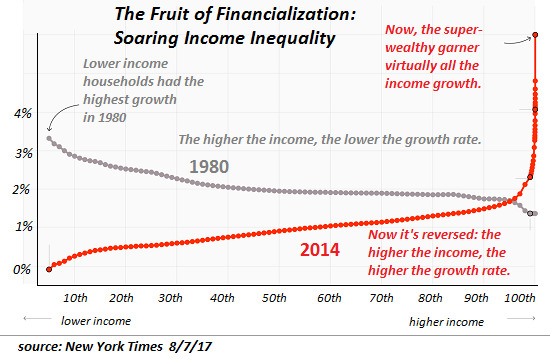
It all starts with economic decay, so let’s look at some charts. Here’s a chart of income inequality which helps drive wealth inequality.

Note that the only group that benefited from the past 20 years of speculative bubbles is the top 1%. The whole idea that inflating bubbles creates a “wealth effect” that “trickles down” is preposterous, as evidenced by the decline of the middle 60% of households while the speculators and owners of bubble-assets skimmed the vast majority of income gains.

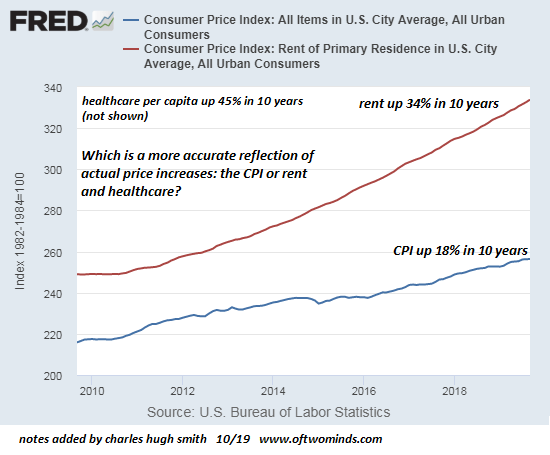
Meanwhile, we’re told inflation is less than 2% annually while rising costs have outpaced meager wage increases. What’s a more realistic measure of real-world inflation–the official Consumer Price Index (CPI) at 18% over ten years or rent and healthcare at 34% and 45%?

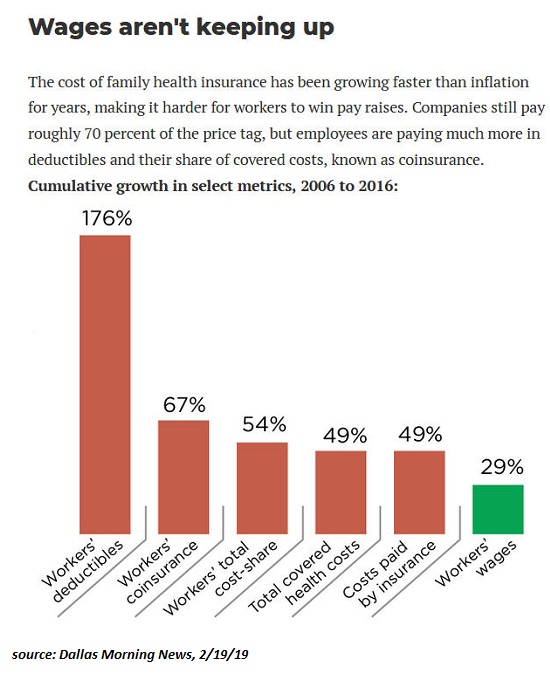
According to the Chapwood Index, real-world inflation in urban America is running 9% to 13% annually. This is more in line with reality than the bogus CPI, as evidenced by this chart of wages and healthcare costs:

Even if we don’t measure the erosion of intangible capital, the social and political consequences of this impoverishment are manifesting in all sorts of ways: large-scale social disorder is breaking out around the globe, and the political middle ground has completely vanished: no matter which way an issue is decided, one camp will refuse to accept the outcome.

The only way forward with any chance of success is to start by acknowledging the decay of our economy due to rampant financialization, legalized looting, the pathologies of “winner take most” speculation and the realities of a two-tiered system in which entrenched elites are “more equal” than the rest of us, economically, socially and politically. We have to accept the limits of technology to reverse the unraveling and assess the damage that’s already been done to our shared capital.

Acting as if the system is working just fine and the problem is perception/optics is accelerating the unraveling.

The Key to a Sustainable Economy Is 5,000 Years Old

By Ellen Brown

Source: Truthdig

We are again reaching the point in the business cycle known as “peak debt,” when debts have compounded to the point that their cumulative total cannot be paid. Student debt, credit card debt, auto loans, business debt and sovereign debt are all higher than they have ever been. As economist Michael Hudson writes in his provocative 2018 book, “…and forgive them their debts,” debts that can’t be paid won’t be paid. The question, he says, is how they won’t be paid.

Mainstream economic models leave this problem to “the invisible hand of the market,” assuming trends will self-correct over time. But while the market may indeed correct, it does so at the expense of the debtors, who become progressively poorer as the rich become richer. Borrowers go bankrupt and banks foreclose on the collateral, dispossessing the debtors of their homes and their livelihoods. The houses are bought by the rich at distress prices and are rented back at inflated prices to the debtors, who are then forced into wage peonage to survive. When the banks themselves go bankrupt, the government bails them out. Thus the market corrects, but not without government intervention. That intervention just comes at the end of the cycle to rescue the creditors, whose ability to buy politicians gives them the upper hand. According to free-market apologists, this is a natural cycle akin to the weather, which dates all the way back to the birth of modern economics in ancient Greece and Rome.

Hudson counters that those classical societies are not actually where our financial system began, and that capitalism did not evolve from bartering, as its ideologues assert. Rather, it devolved from a more functional, sophisticated, egalitarian credit system that was sustained for two millennia in ancient Mesopotamia (now parts of Iraq, Turkey, Kuwait and Iran). Money, banking, accounting and modern business enterprise originated not with gold and private trade, but in the public sector of Sumer’s palaces and temples in the third century B.C. Because it involved credit issued by the local government rather than private loans of gold, bad debts could be periodically forgiven rather than compounding until they took the whole system down, a critical feature that allowed for its remarkable longevity.

The True Roots of Money and Banking

Sumer was the first civilization for which we have written records. Its notable achievements included the wheel, the lunar calendar, our numerical system, law codes, an organized hierarchy of priest-kings, copper tools and weapons, irrigation, accounting and money. It also produced the first written language, which took the form of cuneiform figures impressed on clay. These tablets were largely just accounting tools, recording the flow of food and raw materials in the temple and palace workshops, as well as IOUs (mainly to these large public institutions) that had to be preserved in writing to be enforced. This temple accounting system allowed for the coordinated flow of credit to peasant farmers from planting to harvesting, and for advances to merchants to engage in foreign trade.

In fact, it was the need to manage accounts for a large labor force under bureaucratic control that is thought to have led to the development of writing. The people willingly accepted this bureaucratic control because they viewed the gods as having decreed it. According to their cuneiform writings, humans were genetically engineered to work the fields and the mines after certain lower gods tasked with that hard labor rebelled.

Usury, or the charging of interest on loans, was an accepted part of the Mesopotamian credit system. Interest rates were high and remained unchanged for two millennia. But Mesopotamian scholars were well aware of the problem of “debts that can’t be paid.” Unlike in today’s academic economic curriculum, Hudson writes:

Babylonian scribal students were trained already c. 2000 BC in the mathematics of compound interest. Their school exercises asked them to calculate how long it took a debt at interest of 1/60th per month to double. The answer is 60 months: five years. How long to quadruple? 10 years. How long to multiply 64 times? 30 years. It must’ve been obvious that no economy can grow in keeping with this rate of increase.

Sumerian kings solved the problem of “peak debt” by periodically declaring “clean slates,” in which agrarian debts were forgiven and debtors were released from servitude to work as tenants on their own plots of land. The land belonged to the gods under the stewardship of the temple and the palace and could not be sold, but farmers and their families maintained leaseholds to it in perpetuity by providing a share of their crops, service in the military and labor in building communal infrastructure. In this way, their homes and livelihoods were preserved, an arrangement that was mutually beneficial, since the kings needed their service.

Jewish scribes, who spent time in captivity in Babylon in the sixth century B.C, adapted these laws in the year or jubilee, which Hudson argues was added to Leviticus after the Babylonian captivity. According to Leviticus 25:8-13, a Jubilee Year was to be declared every 49 years, during which debts would be forgiven, slaves and prisoners freed and their property leaseholds restored. As in ancient Mesopotamia, property ownership remained with Yahweh and his earthly proxies. The Jubilee law effectively banned the outright sale of land, which could only be leased for up to 50 years (Leviticus 25:14-17). The Levitican Jubilee represented an advance over the Mesopotamian “clean slates,” Hudson says, in that it was codified into law rather than relying on the whim of the king. But its proclaimers lacked political power, and whether the law was ever enforced is unclear. It served as a moral rather than a legal prescription.

Ancient Greece and Rome adopted the Mesopotamian system of lending at interest, but without the safety valve of periodic “clean slates,” since the creditors were no longer the king or the temple, but private lenders. Unfettered usury resulted in debt bondage and forfeiture of properties, consolidation into large landholdings, a growing wedge between rich and poor, and the ultimate destruction of the Roman Empire.

As for the celebrated development of property rights and democracy in ancient Greece and Rome, Hudson argues that they did not actually serve the poor. They served the rich, who controlled elections, just as rich donors do today. Taking power away from local governments by privatizing once-communal lands allowed private creditors to pass laws by which they could legally confiscate property when their debtors could not pay. “Free markets” meant the freedom to accumulate massive wealth at the expense of the poor and the state.

Hudson maintains that when Jesus Christ preached “forgiveness of debts,” he was also talking about economic debt, not just moral transgressions. When he overturned the tables of the money changers, it was because they had turned a house of prayer into “a den of thieves.” But creditors’ rights had by then gained legal dominance, and Christian theologians lacked the power to override them. Rather than being a promise of economic redemption in this life, forgiveness of debts thus became a promise of spiritual redemption in the next.

How to Pull Off a Modern Debt Jubilee

Such has been the fate of debtors in modern Western economies. But in some modern non-Western economies, vestiges of the debt write-off solution remain. In China, for instance, nonperforming loans are often carried on the books of state-owned banks or canceled rather than putting insolvent debtors and banks into bankruptcy. As Dinny McMahon wrote in June in an article titled “China’s Bad Data Can Be a Good Thing”:

In China, the state stands behind the country’s banks. As long as authorities ensure those banks have sufficient liquidity to meet their obligations, they can trundle along with higher delinquency levels than would be regarded safe in a market economy.

China’s banking system, like that of ancient Mesopotamia, is largely in the public sector, so the state can back its banks with liquidity as needed. Interestingly, the Chinese state also preserves the ancient Near Eastern practice of retaining ownership of the land, which citizens can only lease for a period of time.

In Western economies, most banks are privately owned and heavily regulated, with high reserve and capital requirements. Bad loans mean debtors are put into foreclosure, jobs and capital infrastructure are lost, and austerity prevails. The Trump administration is now aggressively pursuing a trade war with China in an effort to level the playing field by forcing it into the same austerity regime, but a more productive and sustainable approach might be for the U.S. to engage in periodic debt jubilees itself.

The problem with that solution today is that most debts in Western economies are owed not to the government but to private creditors, who will insist on their contractual rights to payment. We need to find a way to pay the creditors while relieving the borrowers of their debt burden.

One possibility is to nationalize insolvent banks and sell their bad loans to the central bank, which can buy them with money created on its books. The loans can then be written down or voided out. Precedent for this policy was established with “QE1,” the Fed’s first round of quantitative easing, in which it bought unmarketable mortgage-backed securities from banks with liquidity problems.

Another possibility would be to use money generated by the central bank to bail out debtors directly. This could be done selectively, by buying up student debt or credit card debt or car loans bundled as “asset-backed securities,” then writing the debts down or off, for example. Alternatively, debts could be relieved collectively with a periodic national dividend or universal basic income paid to everyone, again drawn from the deep pocket of the central bank.

Critics will object that this would dangerously inflate the money supply and consumer prices, but that need not be the case. Today, virtually all money is created as bank debt, and it is extinguished when the debt is repaid. That means dividends used to pay this debt down would be extinguished, along with the debt itself, without adding to the money supply. For the 80% of the U.S. population now carrying debt, loan repayments from their national dividends could be made mandatory and automatic. The remaining 20% would be likely to save or invest the funds, so this money too would contribute little to consumer price inflation; and to the extent that it did go into the consumer market, it could help generate the demand needed to stimulate productivity and employment. (For a fuller explanation, see Ellen Brown, “Banking on the People,” 2019).

In ancient Mesopotamia, writing off debts worked brilliantly well for two millennia. As Hudson concludes:

To insist that all debts must be paid ignores the contrast between the thousands of years of successful Near Eastern clean slates and the debt bondage into which [Greco-Roman] antiquity sank. … If this policy in many cases was more successful than today’s, it is because they recognized that insisting that all debts must be paid meant foreclosures, economic polarization and impoverishment of the economy at large.

Is the U.S. Becoming a Third World Nation?

By Charles Hugh Smith

Source: Of Two Minds

This is a chart of an informal kleptocracy which cloaks itself in the faux finery of democracy and a (rigged) “market” economy.

Back in the day, nations that didn’t qualify as either developed (First World) or developing (Second World) were by default Third World, impoverished, corrupt and what we now refer to as failed states–governments that were incapable of improving the lives of their people and the machinery of governance, generally as a result of corruption and self-serving elites, i.e. kleptocracies.

Is the U.S. slipping into Third World status? While many scoff at the very question, others citing the rise of homelessness, entrenched pockets of abject poverty and the decaying state of infrastructure might nod “yes.”

These are not uniquely Third World problems, they’re symptoms of a status quo that’s fast losing First World capabilities. What characterizes Third World/Failing States isn’t just poverty, crumbling infrastructure and endemic corruption; at a systems level these are the key dynamics in Third World/Failing States:

1. The status quo protects insiders at the expense of everyone else.

2. There is no real accountability; failure has no consequences, bureaucrats are never fired for incompetence, reforms are watered down or neutered by institutional sclerosis.

3. Pay-to-play is the most cost-effective way to influence policy or evade consequences.

4. The status quo is incapable of differentiating between complexity that serves the legitimate purposes of transparency and accountability and complexity that serves no purpose beyond guaranteeing insiders’ paper-shuffling jobs. As a consequence, complexity that adds no value chokes the economy and the government.

5. There are two sets of laws: one for insiders and the super-wealthy, and another harsher set for everyone else.

6. The super-wealthy fear nothing because the system functions to serve their interests.

7. The super-wealthy and state insiders control the media’s narratives and the machinery of governance to serve their interests. Reforms are in name only; the faces of elected officials change but nothing changes structurally.

8. Insiders, well-paid pundits and the technocrats serving the corporate and state elites believe the status quo is just fine because they’re doing fine; they are blind to the soaring inequality, systemic corruption, stupendous waste and the impossibility of real reform.

Does America’s status quo protect insiders at the expense of everyone else? Yes. As for the other seven characteristics: yes, yes, yes, yes, yes, yes and yes.

And lets’ not forget #9: the vast majority of the economic gains flow to the elite at the very top of the wealth-power pyramid: is this true in the U.S.? Definitively yes. Just look at this chart: this is a chart of an informal kleptocracy which cloaks itself in the faux finery of democracy and a (rigged) “market” economy.

That’s the very definition of a Third World failed state.

Related Video:

A New Aesthetic

By Damaris Zehner

Source: Resilience

There are all these good ideas – intensive agriculture, organic farming, permaculture, the local food movement. But why is most food still not grown this way, if it really is better? Why don’t farmers switch to sustainable land use methods? It seems to me there are at least four reasons.

First is the conservative nature of farming. Any activity that involves a large and long investment for an uncertain outcome is going to be conservative; no one wants to experiment when a year’s income is riding on the results. Farmers tend to stick to what has seemed to work. The psychology of previous investment plays a part in their choices as well. Once you’ve bought the huge combine, well, you have to use it.

Even when things don’t work so well, farmers will keep doing them if there are financial incentives to do so. This is the second reason. Government programs have tended to encourage big agribusinesses and have been less friendly to smaller, more varied farms.

Third, farmers love their machines. All Americans do. We fall every time for the promise that new technology will make our lives easier, more fun, more productive, and more sophisticated, and people with outdated technology, whether cell phones or tractors, get made fun of. Many people don’t have the time or the patience for more manual ways of working. I knew of a horse farmer who recently complained that he wouldn’t hire young men on his farm because they got impatient with the horses and, as he put it, just wanted to be roaring off with an internal combustion engine. (His workers were young women). These young men have become habituated to the speed and power made possible by fossil fuels and get rattled when asked to move more slowly.

Finally, there is an unconscious but still powerful motivation why farmers don’t want to stop spraying and switch to more natural methods of food production. It is a mistaken aesthetic that dictates how people see and judge the land around them, that tells us what looks beautiful and productive and “American” – that is, efficient, high-tech, and gleaming with the promise of the future. Perfect, undisturbed expanses of commodity crops, synchronized lines of combines churning through thousand-acre wheat fields, shiny factories, and brightly colored grocery stores are our proof that we are not a third-world nation, or Amish, or hippies – that we are still orthodox worshipers of the god of progress.

I don’t dispute the attraction of the aesthetic. Honestly, the land around here looks pretty good. Or at least it looks pretty. But the cost of those perfect fields and vast expanses of monoculture may be more than we can pay. Our aesthetics are as damaging to the environment as our greed or carelessness. So we need to move toward a new aesthetic.

Before we can do so, we need to ask ourselves: how much of the world are we responsible for tidying up? Nature is messy by our standards. A patch of disturbed earth becomes populated with a swirling mob of what we’d call weeds – dock, plantain, dandelion, mulberry, crabgrass, lamb’s quarters, and a hundred plants I don’t have a name for. And that bothers us. We spray, mow, and weed, in the process disturbing the natural succession of plants. We say that keeping our lawns, gardens, and fields as pure monoculture is more efficient and attractive. I drove with farmers past fields of soybeans shortly after the introduction of Round-Up herbicide, and they talked about how beautiful the thick carpet of identical plants is. They’re not wrong. The lush uniformity is beautiful. But I’m not sure we have the right to expect the same sort of beauty from nature that we can create within our houses. Should a farm field look like wall-to-wall carpeting? Should every molehill be leveled, every fence row scorched, whatever t cost, just because we think it looks nicer?

We have neighbors down the road whose property has been described as a doll’s house because of its detailed perfection. It’s a good description – they treat their two acres as if it were as entirely under their control as a doll’s house. The fences have lines of brown under them where the mower can’t reach and herbicide has been sprayed. Their lawn is grass only, no violets or dandelions. Their mature hardwood trees are all pollarded to be a matching height. It’s pretty, I suppose. It’s also horrifying as an illustration of their attitude toward natural beauty. To speak in hyperbolic terms, those friendly neighbors are conducting an all-out war on nature, with policies of scorched earth and ethnic cleansing, and the result is extreme totalitarianism. This stands in striking contrast to the permaculture sites I’ve visited, which look like a hodgepodge of annuals, perennials, weeds, and small creatures and don’t involve any mowing. I suspect that everyone’s first reaction to seeing permaculture in action is, in fact, “Why don’t they mow?” They have their reasons, and they have a different aesthetic.

I admit I like the cleanliness and order that humans impose. I’m all right with keeping my house clean, but I have to decide how far my household extends. If I find insects on my kitchen counter, I kill them. But should I kill the insects in my yard? All the insects in the world? Because if farmers adopt a policy of insect genocide, as most do, it’s going to have costs to the surroundings – which include me. When the summer crop-dusting airplanes fly overhead carpet-bombing bugs and weeds, I have to run to bring the laundry inside and shut the windows if it’s windy, which it usually is, because – call me a crazy tree-hugger – I prefer my sheets and towels to smell of fresh air and not the toxin du jour. That’s where my aesthetic differs from the farmers’.

Farmers around here will tell you that they are aiming for efficiency, and I do appreciate that harvesting crops is easier when the equipment is not clogged with morning glory vines and ragweed stalks. I also understand that weeds and other plants compete with the crops and lower farmers’ yields, so there is a financial as well as an aesthetic motivation for them to keep their fields clean. But there’s no question that these farmers are also driven by the false aesthetic of human-imposed purity. I watch while they grub out a small patch of trees that they had no problem maneuvering around, just so the field looks “clean.”

It’s a competitive aesthetic, too. People in this small community will gossip about and criticize landowners whose fields aren’t clean – I hear them every year talking about whose land isn’t yet sprayed, tilled, or ditched. People from out of our area have asked me when they’ve come over to visit, “Whose land is that down the road? It looks bad.” What they mean when they say that farmers are not keeping their land “clean” is that farmers are not leaving a toe-hold for nature on their property. Rabbits and deer have no right to a corridor of shelter; killdeer and quail have to keep packing up and moving as their surroundings are cut down; coyotes are shot. And once we’ve expunged the aborigines, we can live the mindless imperialist lifestyle we like.

I have some sympathy, I guess. I don’t want coyotes eating my goats or rabbits ruining my garden. But I have to ask the question again: how much of the natural world do we have the right to control at the same level that we control our houses and yards? If we are going to live in a better balance with nature than we do now, we have to change not only our acquisitiveness and our focus on profit and exploitation; we also have to learn to see beauty in what we now consider messiness.

Billionaires are a Sign of Economic Failure

Inherited wealth and crony capitalism have created an aristocratic class that undermines social mobility and democracy

By Max Lawson

Source: Inequality.org

The New York Times published an editorial comment on its front page in January 2019, provocatively entitled “abolish billionaires.” The editorial raised a serious question: what if instead of being a sign of economic success, billionaires are a sign of economic failure?  In what ways can the boom in billionaires, and the dramatic increase in extreme wealth generally, be harmful?

To answer this question, we need to understand the origins of billionaire wealth, and to understand how that wealth is used once it is gained.  The answer to both these questions I think rightly casts doubt on the value of the super-rich in our society.

Approximately one third of billionaire wealth comes from inheritance. It is very hard to make the case for the economic utility of inherited wealth, and instead there is a strong case for the fact that it undermines social mobility and economic progress. It creates instead a new aristocracy who are rich simply because their parents were rich which is hard to see as a good thing.

Whether inherited or secured in other ways, extreme wealth takes on a momentum of its own.  The super-rich have the money to spend on the best investment advice, and billionaire wealth has increased since 2009 by an average of 11 percent a year, far higher than rates ordinary savers can obtain.

Bill Gates is worth nearly $100 billion dollars in 2019, almost twice what he was worth when he stepped down as head of Microsoft.  This is despite his admirable commitment to giving his money away.  As Thomas Piketty said in his book Capital in the 21st Century, “No matter how justified inequalities of wealth may be initially, fortunes can grow beyond any rational justification in terms of social utility.”

My Oxfam colleague Didier Jacobs calculated a few years ago that another third of billionaire wealth comes from crony connections to government and monopoly.  This could be for example when billionaires secure concessions to provide services exclusively from government, using crony connections and corruption.  The Economist has developed a similar measure of crony capitalism with similar findings. What is clear it seems to me is that corruption and crony connections to governments are behind a significant proportion of billionaire wealth.

Almost all sectors of our global economy are also now characterized by monopoly power, as is detailed by Nick Shaxson in his great new book, the Finance Curse. Whether food, pharmaceuticals, media, finance, or technology, each sector is characterized by a handful of huge corporations.

Decades of largely unquestioned mergers and acquisitions, where corporations have bought up competitors, have led to this.  Historically, and especially in the United States in the early part of the 20th century, monopoly power was rightly viewed as a serious threat to the economy and to society, and steps were taken to break up monopolies.  It was President Franklin Roosevelt who famously said that “government by organized money is just as dangerous as government by organized mob.” However, in recent decades, neoliberal economics has led a much more benign view of monopoly power, and very little action is now taken to dismantle them. I think this is a key distinction between neoliberalism and classical liberal economics.  These monopolies impose hidden monopoly taxes on every consumer, as it enables these companies, and their wealthy shareholders, to extract excessive profits from the market, directly fueling the growth in extreme wealth at the expense of ordinary citizens.

The actions of corporations, including the move towards monopoly, are driven by a relentless focus on ever-increasing returns to shareholders — shareholders who are primarily the very same extremely wealthy people.  Our new Oxfam paper on the “Seven Deadly Sins” of the G7, released this week, shows how returns to shareholders have increased dramatically whilst real wages have barely increased.

Behind corporate power and corporate actions is increasingly the power of super-rich shareholders.

Once billionaire wealth is accumulated, the way it is used also casts doubt on how useful it is to have billionaires.  The super-rich use their wealth to pay as little tax as possible, making active use of a secretive global network of tax havens, as revealed by the Panama Papers and other exposes.

One ground-breaking study that made use of this leaked information showed that the super-rich are paying as much as 30 percent less tax than they should, denying governments billions in lost tax revenue, that could have been spent on schools or on hospitals.  The super-rich are supported in this by the Society of Trust and Estate Practitioners (STEP), a secretive organization of over 20,000 wealth managers that actively pressures governments to reduce taxes on the richest.

Billions are not just used to ensure lower taxes. They can also be used to buy impunity from justice, to buy politicians, or to buy a pliant media.  The use of “dark” money to influence elections and public policy is a growing problem all over the world. The Koch brothers — Charles and the recently deceased David — two of the richest men in the world, have had a huge influence over conservative politics in the United States.

Another recent Oxfam study  showed the many ways in which politics has been captured by the very rich in Latin America.  Many of today’s new breed of nationalist, racist leaders have substantial financial backing.

This active political influencing by the super-rich directly drives greater inequality, by constructing reinforcing feedback loops, in which the winners of the game get even more resources to win even bigger next time.

For all these reasons, I think there is a strong case to be made that rather than being celebrated, as one U.S. commentator recently said, “every billionaire is a policy failure,” and that in particular if we are to end poverty and build fairer societies, we need to bring an end to extreme wealth.