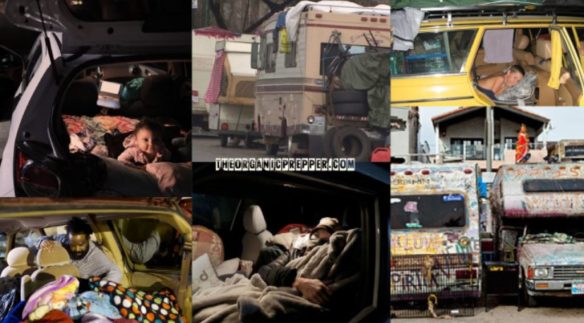
A recent story floating around mainstream media regarding “modern-day nomads” reads like a contemporary article on Henry David Thoreau. It shares stories of people looking to downsize their life and live simply and stories of people who have fallen on hard times, unable to afford rent.
However, what is lacking is the exposure of the dark underbelly of the “modern-day nomad” culture. In other words, they neglect to mention the fact that the enormous growth of the “modern-day nomad” is rooted in the fact that the world economy has all but collapsed, now mired in a global economic depression of unemployment, low wages, and personal financial catastrophes.
While it sounds romantic, it’s often rooted in desperation.
If you look closely on city streets, campgrounds, and stretches of desert run by the Bureau of Land Management, you’ll see more Americans living in vehicles than ever before. It was never their plan.
“I wasn’t prepared when I had to move into my SUV. The transmission was going. I had no money saved. I was really scared,” said April Craren, 52, bundled in blankets atop a cot inside her new minivan, a 2003 Toyota Sienna.
She flipped the camera on her phone to show me the camp stove she uses to make coffee and her view of the sun rising over the Colorado River. She has no toilet, shower, or refrigeration.
After separating from her husband, April found herself homeless in June 2020, exacerbating the depressive disorder for which she receives $1,100 a month in disability benefits.
“I could have gotten an apartment but in a crappy unsafe place with no money to do anything at all,” she explained.
Last year, where April lived in Nixa, Missouri, the average rent for an apartment was $762, slightly less than the national average. Like nearly half of American renters, she would have been crippled by the cost.
It’s not surprising, then, that job loss, divorce, or, say, the sudden onset of global health or financial crisis can push so many over the edge.
It doesn’t sound so bad to those of us with minimalist persuasions
At 52, April Craren didn’t choose this life. It was thrust upon her by unfortunate life circumstances. Craren couldn’t afford the exorbitant rent that is now average across the country on a fixed income. (Partly due to inflation but mostly due to the housing crash in 2008.)
The coordination of lockdowns and COVID restrictions have plunged the world into a deep depression of which we are only beginning to see. Even Wall Street couldn’t have caused this much damage.
“If the Great Recession was a crack in the system, Covid and climate change will be the chasm,” says Bob Wells, the nomad who plays himself in the film Nomadland. Thankfully, Wells was able to help Craren adopt her lifestyle so she can now survive as a “nomad” through his Home On Wheels Alliance.
Wells’s lifestyle was a choice. But the newfound interest in the nomadic lifestyle is not a choice for many.
From Yahoo:
Realizing he had something valuable to share, he bought the domain name Cheap RV Living in 2005. He posted tips and tricks about better vehicle-dwelling, but what he was really offering was a road map to a better life.
Four years later, when close to 10 million Americans were displaced after the Great Recession, traffic to his site exploded. Finding himself at the center of a growing online community, he decided to create a meet-up in Quartzsite, Arizona. He dubbed it the Rubber Tramp Rendezvous (RTR), and in January 2011, 45 vehicles showed up. Eight years later, an estimated 10,000 vehicles convened for what was said to be the largest nomad gathering in the world.
The event’s explosive growth is undoubtedly a reflection of America’s increasing interest in van life as an answer to the affordable housing crisis, an idea made accessible by Bob on his YouTube channel, also named Cheap RV Living, created in 2015.
The “increasing interest in van life” that Yahoo News refers to is not some petit-bourgeois fantasy being realized by privileged middle-class white kids, able to go home at any time. It is the necessity of formerly middle class, working-class, and poor people all across America who are out of work or are working but cannot afford housing.
Minimalism is a legitimate lifestyle for some; others have no choice
For many, this culture of minimalism is genuinely how they wish to live. Nomads have a genuine desire to see empty overconsumption come to an end. However, we can not ignore that minimalism is being promoted to prepare the Western population who are used to high living standards to accept those that are much lower.
For those who are already nomads, whether by choice or forced by economic circumstance, it might be helpful to know that there are many prepping options available to you. There is no need to be left to the mercy of wherever you are right now.
I highly encourage you to access Daisy Luther’s article, “There’s Another Option Besides Hunkering Down and Bugging Out: Nomadic Living.” It will give you the perspective of someone who has voluntarily experienced and lived the nomadic lifestyle while also the mindset of remaining prepared for anything and everything.
At the rate the Great Reset is taking shape, many of us may find ourselves embracing the nomadic lifestyle, willingly or not.
Please study these charts as a means of understanding the inevitability of economic stagnation and a revolt of the decapitalized middle class.
I’ve been covering the decline of America’s middle class for over a decade with charts, data and commentary on the social depression that has accompanied the decline.
While there are many mutually reinforcing dynamics in this 45-year decline–demographics, global energy costs, financialization and globalization, to name a few– one term describes the accelerating erosion of America’s middle class: decapitalization.
To understand decapitalization, we need to start with the fundamentals of any economy between labor (wages) and capital and between investment and speculation. Although it’s tempting to oversimplify and demonize one or the other of these basics (speculators bad! etc.), they each provide an essential role in a healthy economy, one which is in dynamic equilibrium, a state analogous to a healthy ecosystem with constantly changing interactions of numerous species, individuals and inputs (weather, etc.). This variability enables the order of fluctuations (to use Ilya Prigogine’s profound phrase), a dynamic stability / equilibrium.
If labor’s share of the economy drops too low, the workforce cannot consume enough to support their households and the economy as a whole. If capital can no longer earn an attractive return, investment dries up and production stagnates. If speculators are not allowed to take on risk, liquidity dries up and risk crushes investment. But if speculation becomes the foundation of the economy’s “growth,” then the inevitable collapse of speculative bubbles will crash the economy.
In modern social-capitalist systems, the core stabilizer of the system is the wage-earning middle class which provides the stable workforce driving production and the stable pool of consumers needed to borrow money and consume enough to soak up the production of goods and services at a profit to producers.
Without a stable, dominant middle class, capital has few opportunities to invest in productive capacity. Without a stable, dominant middle class, the economy stagnates and is prone to collapse as it is far from equilibrium.
The process of middle class decline is best explained as decapitalization because the middle class is fundamentally a means of transforming labor into capital via savings and investment. The traditional ladder of social mobility from the working class to the middle class is one of capitalizing work: time and savings are invested in higher education, in effect capitalizing future labor by increasing productivity.
Capital isn’t limited to cash, land or tools; in an information economy, knowledge and skills are also capital, as is the social capital of social networking and relationships formed with mentors, suppliers, lenders, colleagues, investors, etc.
The second way to capitalize work is to save earnings and invest the savings in assets that produce income or gain value: a house, land, rental property, small business and income-producing financial assets such as bonds or dividend-paying stocks.
Thrift, investing, long-term planning and deferred consumption are all essential to capitalizing work by turning that labor into income-producing assets. As the household’s ownership of these assets that yield unearned income rises, so does their income and wealth. These increase the financial security of the household and build a nestegg which can be passed down to the next generation, improving their security via inheritance of income-producing assets.
As long as productivity is increasing the value of their labor, the middle class can leverage future earnings into assets by borrowing money to invest in assets: to buy a house, a mortgage is borrowed against future earnings. As long as the mortgage is a fixed-interest loan and income can be expected to rise with productivity, then this is a win-win situation: capital earns a predictable, low-risk return from the mortgage and the middle class household has stake in a family home, an asset which acts as a savings mechanism as the mortgage slowly pays down the debt and increases the household’s home equity–a form of savings.
The processes of decapitalization have upended this entire structure. In the systems context outlined above, our economy is out of balance and far from equilibrium and thus prone to collapse.
For the bottom 90%, which of course includes the middle class however you define it, it’s increasingly difficult to capitalize labor into capital. There are a number of factors driving this decapitalization:
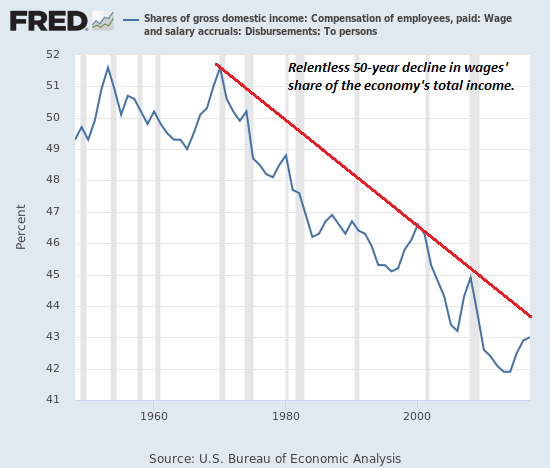
1. Wages’ share of the national income has continued a five-decade downtrend. (See chart below) National income since 1973 has shifted from labor (wages) to capital and more specifically, to debt and speculative gaming of the system, a.k.a. financialization.
Total household income in the U.S. in 2018 was $17.6 trillion. The decline in wages’ share of the national income from 1973 to 2018 is about 8.5%, which equals $1.5 trillion, the sum shifted from labor to capital every year. (See chart below)(source: https://www.statista.com/statistics/216756/us-personal-income/)
No, this is not a typo. As this RAND report documents, $50 trillion has been siphoned from labor (the lower 90% of the workforce) to the Financial Aristocracy and their technocrat lackeys (the top 10%) who own the vast majority of the capital (see charts below): Trends in Income From 1975 to 2018.
2. Within the workforce, wages have shifted to the top 10% who now earn 50% of all taxable income. (See RAND chart below) Financialization and globalization have decapitalized the skills of entire sectors of the workforce as automation and offshoring reduced the human capital of workers’ skills and experience and the value of their social capital. When the entire industry is offshored, skills and professional relationships lose their market value.
In a fully globalized economy, every worker producing tradable goods/services is competing with the entire global workforce, a reality that reduces wages in high-cost developed nations such as the U.S.
Financialization has heavily rewarded workers with specialized gaming the financial system skills and devalued every other skill as only the skills of financialization are highly profitable in a globalized, financialized economy.
3. As the high-wage jobs and capital shifted to coastal urban centers, middle class owners of homes and capital elsewhere saw the value of their assets decline. If a home valued at $100,000 in the late 1990s is now worth $150,000, the owners lost ground even with “official” inflation. In terms of real-world purchasing power, their home actually lost significant value in the past 23 years.
Meanwhile, middle class owners who bought their home in a coastal hot-spot for $100,000 23 years ago are now enjoying home valuations close to $1 million. Homes, along with every other asset, have been shifted into a casino where almost everyone is sorted into winners and losers, less often by skill and more often by luck.
For those who were too young to buy in 1997, sorry–the opportunity to buy a home for three times average middle class income is gone. The lucky generation who bought in the late 1990s in booming coastal magnets for global capital joined the top 10% and their colleagues in less desirable regions lost ground.
4. As capital siphoned off income and appreciation from labor (human and social capital), the gains accruing to capital accelerated. Those who already owned income-producing assets reaped both income and asset appreciation gains as yields on savings collapsed to near-zero as the Federal Reserve and other central banks dropped yields to near-zero in 2009 and kept them low for the following 13 years.
This had two devastating effects on the middle class: hundreds of billions of dollars that once flowed to savers and money markets disappeared, swallowed by the banks as a direct (and intentional) effect of the Fed’s ZIRP (zero-interest rate policy).
Since the Fed destroyed low-risk yields, anyone seeking any real yield (i.e. above inflation) would have to enter the casino and compete with hedge funds, insiders and the Financial Aristocracy. Very few middle class workers have the skills and experience to beat the pros in the casino, and so income and wealth accrued to those who already owned capital.
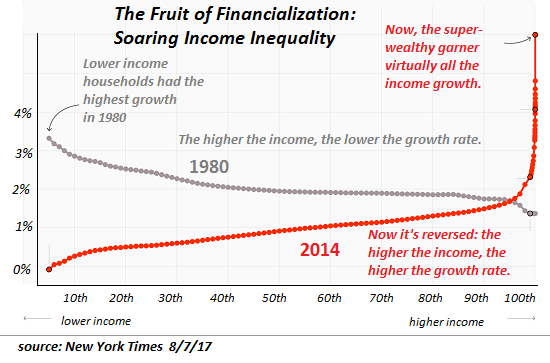
This is a key reason why the rich got richer and the poor got poorer. Those with capital accrued the majority of gains in income and wealth, leaving the bottom 90% in the dust.
Ten percent of Americans now control 97 percent of all capital income in the country. Nearly half of the new income generated since the global financial crisis of 2008 has gone to the wealthiest one percent of U.S. citizens. The richest three Americans collectively have more wealth than the poorest 160 million Americans. (emphasis added.)
The 3% of income from capital collected by the bottom 90%–which includes the middle class– is basically signal noise: the middle class collects inconsequential crumbs of income from capital.
Prior to the Fed’s ZIRP and financialization of the economy, the middle class could both collect income from capital they owned and they could afford to acquire assets that yielded low-risk solid returns. Now they can do neither. Even worse, the puchasing power of their labor continues to decline, leaving them less able to save and buy assets.
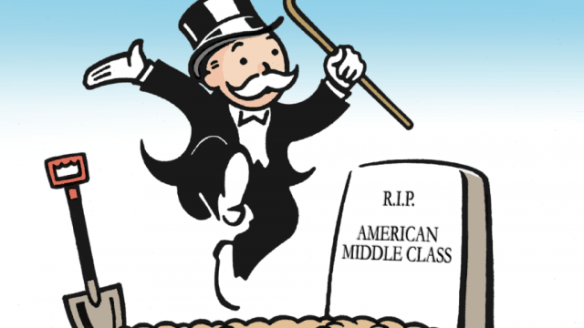
This is why The Top 10% Is Doing Just Fine, The Middle Class Is Dying on the Vine. Please study these charts as a means of understanding the inevitability of economic stagnation and a revolt of the decapitalized middle class.
It is a general rule that corrupt economies tend to operate on faith and not on fundamentals. And to be clear, it’s not so much about naive faith that the system is stable or functional. No, it’s more about the masses having faith that the corruption and instability will never be derailed. Most people are not as stupid as the establishment and central bankers think they are – Almost everyone knows the system is broken, they just refuse to consider the possibility that the fraud will be disrupted, or that it will be allowed to fail.
The old mantra “too big to fail” is a lie. NOTHING is too big to fail, and that includes the US economy, the dollar and the elaborate Kabuki theater that keeps them both afloat. All it takes is a single moment, an epiphany that the Ponzi scheme is unsustainable rather than unstoppable.
I’m reminded specifically of the inflationary crisis of Argentina in 2001 – 2002.
Argentina’s economy was highly dependent on foreign capital inflows, and its currency peg to the US dollar, not to mention they were precariously reliant on support from the IMF. The IMF openly validated the government of Argentina and their currency peg model, but foreign capital began to decline and the peg became unsustainable. Without tangible growth in manufacturing and a strong middle class, an economy cannot survive for long. A top down system based on illusory “financial products” and creative accounting is doomed to crash eventually.
All it took was for the IMF to criticize the policies they initially endorsed and announced that they were removing financial aid, and all hell broke loose in Argentina.
Almost overnight the Argentina peso plunged in value, interest rates spiked and inflation struck hard. People poured into the streets and civil unrest erupted. The IMF would later admit it made “errors” in its handling of the Argentina situation, but this was simply spin control designed to protect them from further scrutiny. The IMF avoided most of the blame and has been growing into a monstrous global centralization machine ever since.
I think we are witnessing the beginning of a similar end of mass faith in fraud in the US. The recent Robinhood short squeeze event as well as the current decoupling of physical silver prices from the paper ETF market have accelerated the timetable. Not surprisingly, these moves have forced the establishment to intervene to some extent to essentially stop renegade traders from freely investing. Accusations are flying and deplatforming has ensued. The idea that the system is a functional fraud is gone; The world now knows it is a dysfunctional fraud, and collapse cannot be very far behind.
Furthermore the collusion between banks, hedge funds and Big Tech is blatantly revealed. These relationships are supposed to remain hidden in the ether. They are obvious to anyone with any financial knowledge and sense, but they aren’t supposed to be wielded in the open. Conspirators aren’t supposed to admit to the conspiracy? Right?
Some people might say the establishment has been forced to unmask by activists. Maybe. But, as I have been warning for many years, when criminals start openly admitting to their crimes it is probably because they think that it’s too late for anyone to do anything about it.
The point is, bankers and globalists have ways of avoiding responsibility for the disasters they engineer. When the con-game breaks, they always have patsies to take the fall.
This sets up a bizarre dynamic in which the money elites that constructed the economy like a time-bomb are treated like victims (or heroes) and the people telling the truth about the fraud are treated like villains and criminals. Are activist stock market traders and silver market guerrillas to blame for any crisis that erupts in the near future? No, of course not, but they will be blamed anyway.
That said, propaganda narratives and scapegoats may not be enough to save the bankers this time. They will never allow a major fiscal crash to develop in a vacuum. They need more cover, and they need to have the means to lock down the public to prevent civil unrest or rebellion from spilling over into their backyards. I have long suspected that the covid pandemic is a useful tool in this regard. As I noted in my article ‘How Viral Pandemic Benefits The Globalist Agenda’, published in January of 2020:
“Even if a pandemic does not kill a large number of people, it still disrupts international travel, it disrupts exports and imports, it disrupts consumer behavior and retail sales, and it disrupts domestic trade. If it does kill a large number of people, and if the Chinese government’s response is any indication, it could result in global martial law. With many economies including the US economy already in a precarious balancing act of historic debt vs. crashing demand and useless central bank repo market intervention, there is little chance that the system can withstand such a tsunami…”
As we all know, medical martial law in the name of “public health” is being established in most countries regardless of the actual death rate. The insane globalist rantings of the World Economic Forum and Klaus Schwab have been very revealing; Schwab and other elites have even called the pandemic a “perfect opportunity” to execute there agenda for the “Great Reset”.
However, the globalists are highly fallible, and mistakes in judgment have been made. During the Event 201 pandemic wargame on a coronavirus outbreak (conveniently held two months before the real thing happened), the elites forecast at least 65 million initial deaths globally from such a virus. We are a year into the pandemic and nowhere near that kind of death rate. In fact, the death rate is so minuscule (0.26%), that the public is beginning to realize the lockdown mandates are pointless.
In the US, conservative states are moving on and keeping their economies wide open. Half the population is refusing to take the vaccines, and many members of law enforcement are refusing to implement lockdown policies. I don’t think this is what the globalists expected at all. They needed mass fear and they are getting mass defiance.
They’re going to need a bigger threat, or a bigger virus.
This is why I have been repeatedly warning that the talk of reopenings by Biden and other democrats is going to be very short lived. I have predicted that Biden will attempt a federal lockdown similar to the Level 4 lockdowns used in Europe and Australia after a couple of months of relative calm. I based this prediction on the covid “mutation” narrative being spread right now by the mainstream media and establishment cronies like Anthony Fauci. It is not hard to see where this is headed.
The globalists must have the “legal” option of restricting public movement as well as large gatherings, and they must have the option of surveillance on individuals 24/7 through contact tracing. This is the only way to prevent rebellion against the Reset and rising anger due to economic turmoil. The veil has been lifted, the conspiracy is being widely broadcast. Martial law alone would only inspire more dissent, medical tyranny in the name of “saving lives” is the ONLY play the globalists have. They have to have help from a large portion of the citizenry, so they must maintain the appearance that they are operating from the moral high ground.
The covid mutation story is clearly the next play, and Bank of America economists appear to agree with me. They recently stated that they see little optimism in terms of a reopening of the economy, and that hard lockdowns will return, possibly in March or April.
Another factor to consider is that the economic crash will have to reach a peak soon because Joe Biden now resides in the White House. If the crash happens in the near term, activist investors can be blamed, Trump can be blamed, and conservatives and liberty activists can be blamed. If the crash happens a year or two from now, only Biden and the globalists will get the blame.
Without lockdowns and scapegoats the scenario will end very badly for the globalists. It might end badly for them anyway. Be ready for more chaos by Spring; I suspect the elites are getting desperate, and if they allow America to go back to normal and for the pandemic to end with a whimper they will never get another chance at their precious Reset.
Most rational Americans have correctly criticized and denounced the violent insurrection in the Capitol last week. Those moments of attack by a racist, disgusting mob have not lacked for condemnation and denunciation. They were violent. They were reprehensible. They called for the killing of lawmakers, demanded the hanging of Congress members. The liberal media and even most of Fox News have not held their tongues when it comes to excoriating the morally bankrupt people who took part. And I agree with those thoughts.
BUT – why don’t we see an equal amount of disgust and condemnation for the violence done by our ruling class, the courtesans of corporate destruction?
Is allowing people to die or fall ill due to lead pipes in Flint, Chicago, Pittsburgh, and hundreds of other citiesnot violence?
Is allowing citizens to lose their lives to cancer from Teflon™ chemicals dumped in their water or preventable oil spills not violence?
Is allowing tens of thousands to die of preventable illnesses from our garbage healthcare system not violence?
It’s violence on a breathtaking scale, far greater than what was done at the Capitol and far greater than any of us will witness in person. And yet large scale corporate-endorsed violence, death and destruction is not only allowable, it’s celebrated, it’s furthered, and promoted. Oil company documents show that they tell cities that oil spills are good for the economy. Other documents show that fossil fuel companies have known about the harm climate change would do since the 1970’s, but they simply saw it as the price of doing business. Corporate sacrifice zones like “Cancer Alley” in Louisiana are well known to be deadly to those who live there, yet it doesn’t matter to the corporations because their money will be green nonetheless. It doesn’t matter to the politicians because the poor who live in these sacrifice zones have no political power. The 40% of food that’s thrown out is not a secret. The subsidies paid to factory farms encourage them to produce heaping mountains of food and dairy and meat even if they can’t sell it all in our market economy. So they throw it out or bury it. Giving it to those in need would take too much time and effort.
Should the racist violent insurrectionists at the Capitol be punished? Absolutely. But so too should the bought-off politicians who do the bidding of our morally bankrupt corporate America. These politicians and the CEOs they serve are purveyors of violence. They trade in, produce, and reap violence. They sit on hordes of money—the obscene profit from feeding American lives into the death cult of unfettered capitalism.
Our mainstream media are blanketing the airwaves with talk of how the violent insurrectionists must be punished, and while they are not wrong, the criminal behavior those same talking heads and “reporters” ignore speaks volumes. All violence is not equal. Some of it is profitable and protected. Some of it is the American way.
Here’s looking at you, Federal Reserve–thanks for perfecting ‘legalized looting’ and neofeudalism in America.
The problem with pushing a pendulum to its maximum extreme on one end is that it will swing back to the other extreme minus a tiny bit of friction.
America has pushed wealth/income inequality, unfairness and legalized looting to the maximum extreme. Now it will experience the swing back to the other extreme. This will manifest in a number of ways, one of which is a self-organizing populist war on wealth and the wealthy.
To say the system is rigged to benefit the already-wealthy and powerful is a gross understatement. Take the tax code as an example–thousands of pages of arcane tax breaks and giveaways passed by a thoroughly corrupted Congress and thousands more pages of arcane regulations and legal precedents.
How many pages apply to the bottom 95% of American taxpayers? Very few. There’s the standard deductions for mortgage interest, healthcare costs, etc., but virtually no other tax breaks. Very few pages apply to even the 99%–go talk to a CPA and you’ll find there are no more tax breaks for a sole proprietor making $500,000 in earned income than than there are for a sole proprietor making $50,000.
99.9% of the tax code benefits the top 0.1% and the corporations, LLCs and philanthro-capitalist foundations and trusts they own / control. Stripped of artifice and spin, America’s tax code is nothing but legalized looting. This is only one small slice of the entire pie of legalized looting, of course, but it’s one we can all understand.
A sole proprietor pays 15.3% in Social Security and Medicare taxes. Why don’t America’s billionaires pay 15.3% in Social Security and Medicare taxes? Aren’t Social Security and Medicare/Medicaid the bedrock social safety net programs of the American people? Then why does a struggling sole proprietor pay 15.3% tax to support these essential programs and billionaires pay essentially zero?
There’s a term for this disparity / injustice / unfairness: legalized looting. The super-wealthy pay essentially zero percent of their income and wealth to the programs that provide basic economic security for the disabled/elderly citizenry, while Jose the sole proprietor pays 15.3% of every dollar he earns.
So explain to us again why Mr. Buffett can’t afford to pay 15.3% of every dollar of his income to help fund basic economic security for the disabled/elderly. In a system of even the most basic fairness, every dollar of income would be taxed at the same rate. In a system of even the most basic fairness, those with incomes of $100 million would pay the same 15.3% Social Security and Medicare tax as the sole proprietor earning $100,000.
Needless to say, if this most basic fairness was applied to America’s wealthy and powerful, these programs would not be facing insolvency.
If Joe the sole proprietor hits the bigtime, he pays 32% federal tax over $165,000, 35% over $210,000 and 37% over $524,000. If we add 15.3% to 37%, we get 52.3%. How many of America’s super-wealthy / billionaires pay 52% in Social Security-Medicare and income taxes? Zero.
Could America’s super-wealthy / billionaires afford to pay 52%? Of course they could–they own the majority all financial assets and skim the majority of all income. But they won’t, because the system is rigged to benefit the few at the expense of the many via legalized looting.
It isn’t just the inequality of ownership of capital and power that enrages the oppressed; it’s the blatant unfairness of our neofeudal / neocolonial system. As I explained in Neofeudalism and the Neocolonial-Financialization Model (May 24, 2012) and Welcome to Neocolonialism, Exploited Peasants! (October 21, 2016), the Financial Nobility have “come home” and applied the same rapacious exploitation they perfected in colonialism to the domestic populace.
Here’s looking at you, Federal Reserve–thanks for perfecting legalized looting and neofeudalism in America.
The gulf between the lavishly praised American ideals and the putrid, corrupt reality of America’s neofeudal system is wider than the Grand Canyon. As the pendulum accelerates to an extreme equal but opposite to the current extremes of unfairness, exploitation and legalized looting, those who have suffered the consequences of this systemic inequality will find expression in whatever ways are available.
Since it’s difficult to get to the protected compounds of the super-wealthy, the signifiers of the merely wealthy will offer readily available targets. The new Tesla won’t just get keyed; it will be “reworked,” to the great satisfaction of the “workers.”
Please note that I am not promoting a war on wealth and the wealthy, I am merely pointing out that it is as inevitable as the gravity pulling the pendulum.
The war on wealth and the wealthy will manifest politically, socially and economically. It won’t be a tightly controlled, top-down movement. It will be spontaneous, self-organizing and unquenchable.
If you don’t understand why a war on wealth and the wealthy is inevitable, please study this chart: the way of the Tao is reversal.
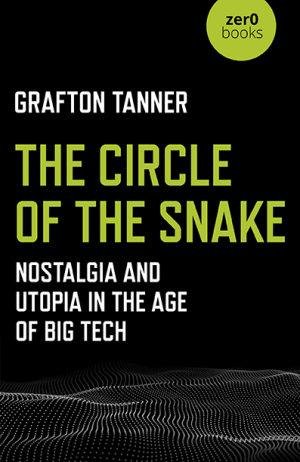
The Circle of the Snake: Nostalgia and Utopia in the Age of Big Tech
By Grafton Tanner
Zero Books, 2020
I’m sure many members of Generation X have taken a moment to look around the pop culture landscape over the past decade and a half and had a sudden moment of realization: there are certainly a whole lot of people trying to sell me things using the media of my youth. Ultimately, this is nothing new. I remember when every pop culture moment, from sitcoms to TV commercials, seemed to be using the Baby Boomers’ favorite songs to sell them cars and sneakers. But in 2020, the dominance of these re-treaded properties is even more nakedly cynical, whether its the endless sequels of the Star Wars and Marvel cinematic universes, or the easy-to-consume, signifier-filled pastiches of the worlds of Stranger Things and Ready Player One. The cultural marketplace, as dominated by bloated media and tech empires, no longer sees any need to admit the novel, the fresh, the unusual.
Both the “why” and the “how” of this cultural and technological tendency are explored by author Grafton Tanner in his new book, The Circle of the Snake: Nostalgia and Utopia in the Age of Big Tech. (Disclosure: Tanner is an occasional contributor to We Are The Mutants.) Tanner explores not only the pop culture properties that utilize nostalgia in an effort to assuage the anxieties of contemporary life in the aftermath of the 2008 financial rupture; he also explains how tech companies use the feedback from algorithmic analysis to keep consumers locked into a never-ending cycle—an ouroboros—of digital satisfaction of their subconscious desires for an older, more secure time. This nostalgic digital utopia, in turn, keeps consumers constantly “on,” working through endless “quests” that approximate proactivity but in the end keep people locked into pointless and unproductive cycles of feedback, emotional satisfaction, and control. “Recommender systems and predictive analytics—the very tools that allow our contemporary media to function—zero in on quick reactions, such as a flash of anger or a swell of nostalgia,” says Tanner in his Introduction. “These reactions are noted by algorithms, which then make recommendations based on them… The result is a nostalgic feedback loop wherein old ideas travel round.”
Tanner examines how the Big Tech tendency towards technolibertarianism and monopoly over the past 20 years has created the material conditions for this self-reinforcing system of psychic feedback. With an increasing belief in culture as disposable and “just for fun,” the material and political implications of this system of control are obfuscated. The way that these cultural narratives award Big Tech further and deeper power over all of us is merely part of the game. And we are enlisted as active players, not merely passive viewers, as in the era of television’s height. The online world, Tanner notes, demands a keen eye for analysis and a deep capacity for paying attention. The technolibertarian and neoliberal alike view our tech-suffused world—everyone is plugged in, 24/7—as a kind of utopia-in-waiting, or indeed a permanent utopia, where the idealized past can be endlessly revisited and basked in, while the present never changes from its current state of cultural and political stasis. This virtual plaza of commerce, emotional satisfaction, the illusion of proactivity, and control and surveillance describe the boundaries of Big Tech’s dominance of both our material and psychic space at the beginning of the 2020s.
The interview below was conducted in November and December 2020 via email and has been lightly edited for clarity.
***
GRASSO: Given the topic of your first book for Zero, Babbling Corpse: Vaporwave and the Commodification of Ghosts, the topic for The Circle of the Snake seems like a natural outgrowth. But from reading the book it also seems like there were a lot of specific events and observations about the world of Online and Big Tech over the past few years that led to the book’s development. What are the origins of The Circle of the Snake, and what kinds of specific cultural developments led you to propose and write the book?
TANNER: I can pinpoint the exact moment I knew I was going to write a book on Big Tech. I was living in a kind of exile in 2016, in this small town in Georgia, trying to piece my life back together after a series of false starts after college. I was sitting in a Barnes & Noble reading the 2016 Tech Issue of The Atlantic, and there was a story by Bianca Bosker about former Google employee Tristan Harris, who left the Valley and started an advocacy group called Time Well Spent because he thought Big Tech was eroding mental health. He was on a mission to fix Big Tech by making it work for us, not against us. But the piece didn’t make me feel better about tech. In fact, it was terrifying: here is an ex-Valley technocrat, mournful that he had invented habit-forming technology with severe public side effects, asking us to not only forgive him, but believe in him to create newer, better tech. I was incensed.
Shortly thereafter, we learned that Cambridge Analytica sharpened their psychographic modeling techniques by harvesting Facebook data from millions of users without their permission, all to aid in the election of Donald Trump. There was suddenly this huge backlash against Big Tech. I was supportive of it, but I also understood it came a little too late. Tech critics had been sounding the alarm for years and years. It took the election of a fascist for the left to wake up to the tech nightmare, only to realize the ones promising to end the nightmare were former technocrats themselves.
And yet, as many were loudly critiquing Big Tech for its role in throwing elections, spreading fascism, and worsening mental health, the culture industry was churning out politically retrograde nostalgia-bait. Was it really that the techlash had made everyone even more nostalgic for the pre-digital past? Or was there some kind of connection between nostalgia and Big Tech? These were the questions I had in mind when I started writing.
GRASSO: I think one of the things I like best about the book is your fusion of theory, philosophy, and epistemology with the material and economic realities of 21st century Big Tech and Big Media. Throughout the book you explore concepts such as surveillance, sublimity, nostalgia (of course), and virtuality with concrete examples from the online plaza. Essentially, if I’m not mistaken, you’re saying that the people who created the feedback loops that keep us hooked on technology and the internet and mine our data for still more ways to sell to us have themselves studied their philosophy, economic history, and techniques of mass psychology and persuasion with great attention?
TANNER: Persuasion techniques, yes, but I wouldn’t go so far as to say the technocrats have studied much else beyond their limited worldview, which is scientistic. Yes, technocrats like James Williams and Tristan Harris like to cite philosophers, but they usually do it to support their self-help solutions to the attention economy. Wake up with a little philosophy, they say, because reading Socrates is better for the mind than scrolling through Twitter. It’s a very neckbeard way of thinking about cultural consumption.
Make no mistake: these technocrats are uninterested in anything other than making a lot of money. If that means learning psychological techniques of persuasion with Stanford psychologist B.J. Fogg, then so be it. They weren’t and aren’t trying to make the world a better place or something. Like the banks before the Great Recession, the technocrats are out to make a quick buck by any means necessary, and they would have kept on doing what they were doing if the bubble hadn’t burst. People were disgruntled with Facebook for years before Cambridge Analytica, and tech critique was already a robust genre by 2016. But it took a kind of implosion, a Great Recession-style reckoning with Big Tech, to change the public opinion. Honestly, the technocrats would probably benefit from studying a little history and philosophy, instead of cloistering themselves in the ideological fortress of STEM.
GRASSO: I think one of the “oh shit” moments in the text for me was finding out that the Black Mirror special choose-your-own-adventure episode “Bandersnatch,” which I quite liked mostly for its material and inspirational signifiers (early ’80s computing, references to Philip K. Dick) was also used to mine viewers’ data in a delightfully dark real-life Dickean stroke. It’s not merely that nostalgia offers us a safe place from the dangerous present, but that those who create these nostalgic visions are working hand-in-hand with the very media empires that make us crave the past: another ouroboros.
TANNER: “Bandersnatch” not only exploits viewers’ nostalgia for its own gain, but it further normalizes the feeling of being controlled. Everyone today knows we’re being controlled from afar: by Twitter, Instagram, Amazon, insurance companies, think tanks, banks, and so forth. We are part of this giant social experiment called consumer capitalism. The purpose is to find out what we’ll buy. But we aren’t being controlled by future gamers or, as much as Elon Musk would like to believe, programmers in this computer simulation we call life. “Bandersnatch” is a work of fiction masquerading a horrible fact—that Netflix is the one controlling us, that we are not as in control as we think. The irony, of course, is that we relinquish our control via the technology we use every day, but we ultimately have very little choice in the matter. Students use devices at school, and jobs often require employees to have smartphones. We aren’t puppets, but we’re by no means totally free either.
GRASSO: So that leads me to asking you about your critique of specific media franchises: Stranger Things and the endless array of sequels and especially reboots we’ve seen since the end of the aughts. You very cannily explore Stranger Things‘ reliance on physical signifiers of commodities and objects that are no longer extant but remind us of the shackles of our technology-laden present (the old landline telephone, the shopping mall) as a key to its appeal to both Gen-Xers who were there and Zoomers who weren’t. Likewise the cinematic reboot is a way to cheaply create product and content that will connect with multiple generations. This element of “spot the Easter egg, aren’t you smart?” for older generations melds with the offer of a trip to a now-alien time for younger generations. These franchises seem to simultaneously reward passive immersion in nostalgia with an illusion of proactivity.
TANNER: Well, the spot-the-Easter-egg activities are very often nostalgic exercises themselves. Viewers are invited to find the nostalgic signifiers, even if they don’t know what they are. That’s the brilliance of Easter egg marketing for advertisers: you might not know what the hidden clue means, but you know it’s a clue and so you make note of it. Of course, the “real” fans will be able to cite all the references, but regular viewers can sometimes recognize a clue, like a corded phone or a VCR or a reference to an older movie, when they see it.
Easter egg marketing is the advertising tactic of choice in the prosumer age. It turns watching into a game. And it’s very heuristic. The films with the most Easter eggs inspire the most “count them all” YouTube videos or Buzzfeed listicles. The problem here isn’t that movies and series reference a bunch of older media; the problem is that Easter eggs reference certain things and leave others out, thus establishing these unnecessary pop culture canons. I don’t care that the Halloween franchise makes reference to itself. It’s an extended universe at this point—of course it’s going to do that. What I find questionable is its constant updating in an attempt to recapture the magic of the original film. I’m always signaling my love of Halloween III: Season of the Witch, but that film is too wacky to be included in the Halloween universe, because the franchise is desperately trying to give us the original again, as if it were the first time, without all the messy parts of the sequels. The Halloween filmmakers want to keep the bloodline of the first film pure, which means anything standing in the way must be excised.
GRASSO: You mark the period between 9/11 and the financial crisis of 2008 (and its aftermath) as the final foreclosure of any alternative to our current future and one of the dividing lines between an idealized past depicted in our nostalgic media and the forever Now. Unsurprisingly, so many of the elements of online life we now recognize as irredeemably toxic (social media, ranking and rating apps, tentpole cinematic universes full of identical sequels) began around the end of the Bush years as well.
TANNER: One of these days, I’m going to write a history-critique of the 2000s. I find the decade fascinating. It was probably the nadir of contemporary culture. Mark Fisher called it “the worst period for (popular) culture since the 1950s.”
It’s true: there was no breaking point at which contemporary nostalgia ramped up. It was a gradual shift between 9/11 and the Great Recession. Directly after 9/11, the U.S. was reeling from shock. Before nostalgia set in later in the decade, there was a feeling of futurelessness, as Robert Jay Lifton wrote—a feeling that there can be no future after 9/11, that the fear of another terrorist attack foreclosed the future altogether, that if people could fly planes into buildings on a regular weekday morning, then anything horrific is possible. During these years, we saw the birth of cinematic universes with the Star Wars prequels and the first megabudget superhero films. Of course, there were Batman, Superman, and Star Wars films before the twenty-first century, but it was after 9/11 that we saw the avalanche of these movies, several of which could not have been made without post-9/11 Pentagon support, with its bloated influence and near-endless supply of capital. You cannot downplay the reach these films have. They’re seen all over the world. And they aren’t just pro-military propaganda, they are engines of nostalgia.
After the Great Recession, nostalgia calcified. People were moving back in with their parents, revisiting old memories to soothe the anxiety of joblessness. Financial recessions are progressive only for the bankers, if they’re bailed out. For workers, they’re regressive. They set people back and invite the sufferers to hide away from it all. There is nothing wrong with this reaction. We cannot blame people who were hit by the Recession for their nostalgia. But we can blame the ones who caused it. And austerity measures only increase the desire to escape into nostalgic feelings. In short, financial meltdowns are crises that affect the future because they erase the plausibility of surviving the present.
GRASSO: You state that nostalgia is not only an emotion used to track us and to trigger specific emotional responses (which themselves are often assuaged by consumption), but also, possibly most importantly, to control us. And that control is not only physical/material but also social/aesthetic, limiting our options to wander away from the digital plaza. How do nostalgia and nostalgic media help this attempt by the market to quantify, objectify, and commodify us, the consumer?
TANNER: Content creators—a sickening term that reduces art and culture to commodities—understand the value of nostalgia. Consumer scientists have known for years that nostalgia sells. If anger draws your attention to the screen, then nostalgia triggers you to buy what will soothe the anger. That’s the cycle we’re dealing with in the present century.
And the worse things get, the more that nostalgia will naturally rise to the surface for many people. It’s not that media companies force-feed nostalgia to us. Many people are already feeling the emotion. It’s inescapable because nostalgia is a modern condition. Corporations merely go the extra mile by locking nostalgia into these feedback loops. The more you feed nostalgia into the cultural industry, the more of it you will consume because entire companies depend on you to want it. We live in a world of disruption, and every modern displacement is accompanied by nostalgia. Corporate capital knows this and depends on it.
GRASSO: Two of the specific technologies you talk about, Instagram and virtual reality, have undergone mutations in their appeals to our desire to escape the modern world. Instagram started off as a fairly disposable nostalgic evocation of the Polaroid camera aesthetic and has become a playground for big-money influencers and exhibitionists; virtual reality has evolved into just another facet of the internet’s control apparatus, despite its conceptual origins in early ’80s cyberpunk and its promised potential to give people the ability to create their own worlds. Why do these technologies seem to always mutate in the direction of greater commercialization and/or control, despite their initial apparent harmlessness or revolutionary promise?
TANNER: In the case of Instagram, its nostalgia factor was mainly due to the horrible photo quality of early smartphone cameras. With some Wi-Fi, a phone, and an app, you could take photos anywhere and upload them on the spot, which was enticing enough for many people to do just that, but you couldn’t deny the photo quality was very poor. So one way to deal with this poor quality was to saturate photos in a kind of analog haze, which could be done by applying one of several different stock filters. I can’t emphasize this enough: so much of our nostalgic appetite in the early 2010s was whetted by the inability to take and post a decent looking digital photo.
Whether it’s Instagram or virtual reality, digital technology is never totally harmless. It’s like when Tristan Harris and the Center for Humane Tech guys tell us we can have our digital cake and eat it too. You can’t have “humane tech” because tech is driven by the profit motive, which itself is often powered by another force: the military. Have you seen this new recruiting ad for the Marine Corps? It’s basically telling young people that joining the military will be an escape from the overwhelming anxieties of the digital age. The scariest thing about the ad is that it conceals the long relationship between tech and the military. Which is to say, the “tech” presented in the ad couldn’t exist without the military-industrial complex. At this point, any new, possibly revolutionary digital technology will either be bought out by a Big Tech monopoly or put to use on the battlefield.
GRASSO: As far as solutions and escapes from this predicament go, you talk a little bit about the ineffectual attempts of former technocrats to try to ameliorate our enslavement to the internet and social media with apps that limit time on websites or “safety labels,” and find them all wholly wanting. Likewise, you mention attempts to make nostalgia something constructive, playful, reflective (in the schema of Svetlana Boym). And yet the very structure of the internet and Big Media as it stands now denies all alternatives to the current control stasis. What does a constructivist nostalgia look like? Where could it exist in the cracks of the current marketplace? Is there a place for nostalgia as a political instrument of the left outside of the usual avenue of Left Melancholy?
TANNER: I’m currently writing a history of nostalgia, out fall 2021 with Repeater Books, called The Hours Have Lost Their Clock: A Recent History of Nostalgia. In it, I put forth a theory of radical nostalgia, drawing on the work of Alastair Bonnett and Svetlana Boym. Radical nostalgia is the third “R” beyond reflective and restorative nostalgia, which Boym coined. She was right about nostalgia, but over the first two decades of the present century, restorative nostalgia ballooned while the reflective strains were edged to the margins. But there needs to be this third form, radical nostalgia, because the melancholic disposition of reflective nostalgia just hasn’t been working for the left and the restorative tint has proven to be destructive.
Radical nostalgia is the act of looking back to those moments when collective action stood up to capital. It yearns for the social movements of the past. It aches for them. It isn’t interested in “getting back there,” in restoring what’s been lost, but in learning from those who came before: the struggle for indigenous rights, the staunch anti-capitalism of Martin Luther King Jr., Stonewall, the Battle of Seattle. When Richard Branson signals his support for LGBTQ+ communities, that isn’t radical nostalgia. There’s nothing radical about it; it’s mere nostalgia. Radical nostalgia looks to these and other movements to continue the fight for a more egalitarian future. It is inherently anti-fascist.
Radical nostalgia takes the action step of restorative and the aching heart of reflective nostalgia and fuses them together. It knows that the past isn’t perfect, which means what we yearn for shouldn’t be either. Restorative nostalgia is too clean, too high-definition. Reflective nostalgia kicks the can around, although reflectors might recognize the problems of the past long before the restorers do. But radical nostalgia knows that everything is imbued with horror, the past especially. Many revolutionary movements of the past suffered from machismo and intolerance, even in their own collectives. Radical nostalgia knows this and endeavors to leave it in the past. Some things must remain buried.
And radical nostalgia is one perspective we can take to resist the utopian thinking of tech. At this point, Big Tech is about the only entity that circulates visions of the future, but those visions are falling out of favor thanks to the techlash. Get ready, because they will absolutely be replaced with a different utopian vision: the humane tech movement. We’re going to be dealing with the technocrats for years. It’s going to seem like we should trust Tristan Harris and the Center for Humane Tech guys. They’re going to be pushing their vision of the future for years to come. But they are the new boss, same as the old. Only collective action, informed by the decolonial and anti-fascist movements of history, can resist what’s coming in the next decade and beyond.
In 1935, reflecting on the creed of productivity which prevailed in modern technological societies, Bertrand Russell, philosopher, pacifist and devout humanist wrote that:
“I think that there is far too much work done in the world, that immense harm is caused by the belief that work is virtuous, and that what needs to be preached in modern industrial countries is quite different from what always has been preached.”
‘In Praise of Idleness and other essays’ is a collection of striking power and originality. Whereas the receieved wisdom of his era held that virtue consisted in yielding to work, monotony and routine, Russell maintained it was not the sole end of life, that beyond work, people needed leisure and pleasure in order to fully live, that what was sought to truly advance society and fortify the human condition was the “organized diminution of work.”
Through the 1920s and 30s Fordism advocated the exact opposite and the cult of productivity began to exert a strong hold on economic and social organization in Europe, the USA and Soviet Union. In the story Brave New World, Aldous Huxley envisioned a society of tyrannical collectivism which raised hell on Earth. In this dehumanizing, nihilistic oblivion, Henry Ford was worshipped as a deity and the fundamentalism of mass production crept in to all spheres of life, rigidly classifying people whose whole lives were planned out on a callow basis of crude economic worth. It was a study in how powerful forces of sublimation and repression incarnate in the edifice of the modern world mutilate our most vital, human instincts and wrench us from our roots.
Huxley’s main belief was that technological ‘progress’ had empowered the worst bureaucrats to assimilate citizens in to a sophisticated machine of repression and control which blocked and frustrated their freedom. Although, as Russell observes, in truth “with modern technique it would be possible to distribute leisure justly without injury to civilization“, the owners of the means of production in the capitalist economy absorb modern technique in to their arsenal against collective liberation. It is not in their interests to free us from bonds.
Of the proprietary class, Russell says:
“their desire for comfortable idleness is historically the source of the whole gospel of work. The last thing they have ever wished is that others should follow their example. “
That is to say that freedom and unfreedom aren’t opposites. The affluence and freedom of the proprietors actively depends on the subjugation of workers who create value.
Throughout his life Bertrand Russell was keenly involved with communities of students, activists and workers who organized against imperialism and the war machine. His belief that people could work less and live more was part of his belief that the economic system could be harnessed to more altruistic ends, justified more reasonably, attuned to satisfy people’s needs and fit to unleash their inherent creative power, instead of conforming to bourgeois imperatives.
Lately Professor Stephen Hawking has weighed in on the question of modern social organization and proffered the view that people need not be scared of machines, but ought to be wary of the systems and people who wield them. Why be scared of the unknown power of machines when what we know about the people who own them is far, far scarier?
Hawking said:
“If machines produce everything we need, the outcome will depend on how things are distributed. Everyone can enjoy a life of luxurious leisure if the machine-produced wealth is shared, or most people can end up miserably poor if the machine-owners successfully lobby against wealth redistribution. So far, the trend seems to be toward the second option, with technology driving ever-increasing inequality.”
Hawking’s view is much like Russell’s and would be called post-scarcity economics. The crux of this view is that competition for resources is not a necessary feature of an economy, that material abundance may be universal instead of there being a socially imposed monopoly of access, regulated by money and work. Like trickle-down theory, scarcity economics is not necessarily based in reality. It goes without saying that obviously we need to find a way reach this economy and mode of production in accordance with environmental protection, which models after the Industrial Revolution got disastrously wrong.
The challenge of the future is to make machines our allies and not our jailers.
When the top 10%’s bubble pops in 2021, the loss of illusions/delusions of security and wealth will be shattering to all those who believed artifice and illusory “wealth” were real.
A great many people are living in bubbles that are about to pop. The largest bubble is the one inhabited by people who complacently believe in time travel, i.e. that the world of 2019 is about to replace the nightmare of 2020 and we can all go back to our carefree debt-funded consumption frenzy and illusions of ever-greater wealth forever and ever.
The greater one’s sense of security, the more durable the bubble. Those in America’s top 10% who have reaped virtually all the gains in income and wealth of the past 20 years live in a bubble that they view as unbreakable: no matter what problems arise, their personal income and wealth is secured by the government, central bank, etc.
Put another way, the top 10% are confident their position atop the wealth-power pyramid is secure no matter what happens. Any dip in stocks, bonds, real estate, bat guano futures, etc. that causes their personal wealth to decline (horrors!) will be instantly bought because the Federal Reserve will print another couple trillion dollars and funnel it into risk assets, as it has done for the past 20 years.
Any spot of bother in the gravy trains that fund the top 10%–local and state government, universities, Big Tech, Big Pharma, Department of Defense, Wall Street, hedge funds, venture capital, etc.– will be doused with trillions of dollars borrowed or printed into existence by the Treasury or Fed. No matter what spot of bother arises, the solution–more trillions–is just a few keystrokes away.
The top 10% are supremely confident in the godlike powers of these agencies and solutions: the idea that these “solutions” become insoluble problems does not compute, just as a decline in asset valuations that doesn’t rebound within three weeks thanks to Fed intervention is firmly outside the realm of possibility.
The top 10% are also supremely confident in the rightness of their position atop the heap. That their position atop the heap is largely the result of a web of privilege and a long run of extraordinarily good fortune does not enter their bubble at all; in their bubble, their wealth, status, prestige and income are all the result of hard work and merit.
While this is certainly true for some, it is not true for all, and even those who scraped their way to the top the hard way do not recognize that their success over the past 20 years (and arguably the past 50 years) has been largely the result of a financialized rising tide raising all boats. In a Bull Market in virtually everything (except commodities), everyone is a hard-working genius who got it all via merit.
On top of this myopic belief that their success is all the result of their own endeavors rather than a tide of financialization, the top 10% are equally blind to the toxic consequences of the wealth/income inequality that has so richly benefited the few at the expense of the many. The idea that the bottom 90% might rebel against the financial / political system that has favored the already-wealthy for a generation is outside the top 10%’s realm of possibility.
But tides do not run in one direction forever, and a revolt against the unprecedented inequality that heavily favors the top 10% is not “impossible,” it’s a certainty. The top 10% are accustomed to being admired and respected for their accomplishments, expertise, wise investing and professional acumen. They are accustomed to viewing themselves as the essential technocrat class that keeps the U.S. system functioning.
The problem with this self-congratulatory perspective is the U.S. system is now in thrall to process rather than results. The technocrat class has been trained to follow needlessly complex procedures and compliance processes as the path to professional advancement while avoiding accountability for the increasingly dismal results of America’s bloated, sclerotic, insider-dominated systems.
All this needless complexity will be jettisoned once printing/borrowing trillions become the problem rather than the solution. The bottom 90% will demand not just a fairer distribution of income and wealth, they will also demand a system that actually functions for the greater social good rather than for insiders, parasites, leeches and technocrat processors who declare victory not from results but from their success in following approved processes / narratives.
Once costs must be cut and results take precedence over process, much of the technocrat class will find itself replaced by automated software. Those that remain will be valued for getting results by whatever means are available, up to and including ignoring all compliance procedures and bureaucratic box-ticking.
The top 10%–the rentier-technocrat class–will find the bottom 90% can no longer pay their rent, insurance, etc.–all the “services” that employ and enrich the top 10%. In other words, the losses as unproductive complexity unravels will finally fall on the top 10%, many of whom have been protected from exposure to market forces and risk.
Lastly, the top 10%’s ownership of assets will be crushed by asset deflation as insolvency can no longer be papered over by liquidity. Assets that are the foundation of top 10% wealth (that the bottom 90% own very little of) will go bidless as phantom wealth dissipates into the thin air from whence it came.
The top 10% reckon they’re untouchable, safe and protected in their asset lifeboats, and the sinking of the 90% won’t affect them. The top 10%’s bubble is about to burst. Not only will their lifeboats prove unstable, every level of government will come after whatever is left as taxes will soar on virtually every form of income and wealth.
Unlike the bottom 60%, who have few illusions about the rampant unfairness and predation of real-world America, the top 10%’s bubble is 90% illusion seasoned with 10% absolute delusion. The comfortable are about to experience some of the discomfort that is everyday life for the bottom 60%, and an increasing percentage of the next 30% who still aspire to fantasies of middle-class security will find social mobility is an escalator down.
We cannot print wealth, or borrow it into existence. All we can print/borrow is artifice, phantom representations of illusory “wealth” that will vanish into thin air, in a reverse of how the “money” was created–out of thin air.
When the top 10%’s bubble pops in 2021, the loss of illusions/delusions of security and wealth will be shattering to all those who believed artifice and illusory “wealth” were real. What’s real is the tide of financialization and globalization reversed over a year ago. The tide is now running out, but few loading their “wealth” into lifeboats have noticed–yet.





 After the Crash