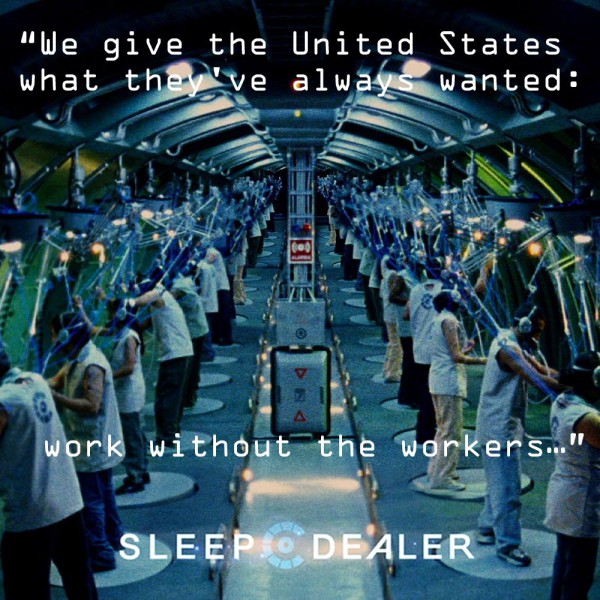
Saturday Matinee: Sleep Dealer

sleep-dealer-work

“Sleep Dealer” (2008) is a dystopian parable directed and co-written by Alex Rivera. Luis Fernando Peña stars as Memo, a hacker who also works as a type of virtual migrant worker. It’s revealed through flashback how his situation was a result of a drone attack on his family and homestead. While trying to find work, Memo meets Luz (Leonor Varela), a fellow hacker who, with additional assistance from a repentant drone pilot in the US, helps him strike a blow against the system.

Note: may not play on some portable devices.

http://www.hulu.com/watch/703496

Tomgram: Frida Berrigan, A Mother Thinks the Unthinkable

Children-of-Men-1024x550

By Tom Engelhardt and Frida Berrigan

Source: TomDispatch.com

Frida Berrigan’s piece today speaks to me very personally. At 71, I have two children and a grandchild in this world, and I feel some responsibility for the sorry planet I’m leaving them. TomDispatch began as a no-name listserv, springing from a post-9/11 foreboding that, though I had been mobilized and active in the Vietnam War era, what was coming would be the worst years of my life, politically speaking. As those repetitive ceremonies in which we celebrated ourselves and our country as the greatest victims, survivors, and dominators on the planet spread, as they refused to end, as the urge for revenge of some all-encompassing sort grew and was encouraged by the Bush administration, as I began to grasp where its top officials were thinking about taking us (to hell and back, to quote a movie title of my childhood), I had the urge to do something.

I had done good work as a book editor over the years, but this was different.  It was a powerful feeling that I couldn’t just leave what seemed to be a degrading country or world to my children without lifting a hand, without trying to do something.  I had no idea what, but from that feeling, thanks to happenstance, dumb luck, and obsession, TomDispatch stumbled into existence.  And because I was then indeed doing something, I felt, amid the gloom, a certain hope.

So I’ve never looked back.  But, of course, one small critical website that attempts to offer ways to reframe what’s happening on our increasingly embattled planet hardly represents a world-saving act, nor did I ever think that such an act could be mine — or really any individual’s.  What this has meant, though, is that, 14 years later, when with utter exuberance my grandson “races” me down a city block pulling me by the hand, I feel just the sort of pleasure (at one remove since I’m no longer the parent) that TomDispatch regular Berrigan describes so movingly with her own daughter.  And every time I’m with him, just as she describes, there are those other moments, the ones when I suddenly remember what’s happening on this planet, the ones when I look at him and feel overcome by sadness verging on grief at the potentially devastated world that may be his inheritance, my “gift” to him.  Those are indeed fears “too big to name.”  Still, Berrigan does a remarkable job of bringing to consciousness a new sensibility that, however seldom mentioned, must be increasingly common currency on this planet. Tom

Parenting on the Brink
Wrestling With Fears Too Big to Name
By Frida Berrigan

Madeline is in the swing, her face the picture of delight. “Mo, mo,” she cries and kicks her legs to show me that she wants me to push her higher and faster. I push, and push, and push with both hands. There is no thought in my head except for her joy. I’m completely present in this moment. It’s perfection. Madeline embodies the eternal now and she carries me with her, pulling me out of my worries and fears and plans.

But not forever: after a few minutes, my mind and eyes wander. I take in the whole busy playground, crowded with toddlers plunging headlong into adventure and their attendant adults shouting exhortations to be careful, offering snacks, or lost in the tiny offices they carry in their hands. It’s a gorgeous day. Sunny and blue and not too hot, a hint of fall in the breeze. And then my eye is caught by a much younger mom across the playground trying to convince her toddler that it’s time to go.

When Madeline graduates from high school, I will be 57. Jeez, I think, that mom will still be younger than I am now when her kid walks across that stage. If I live to be 85, Madeline will be 46 and maybe by then I’ll have some grandkids.  In fact, I’m suddenly convinced of it.  Between Madeline and her three-year-old brother Seamus and their eight-year-old sister Rosena, I will definitely live to see grandkids.  I reassure myself for the millionth time that having kids in my late thirties was totally fine.

And then another thought comes to mind, the sort of thought that haunts the parents of this moment: When I’m 85, it will be 2059, and what will that look like? When my grandkids are my age now, it could be almost a new century. And what will our planet look like then? And I feel that little chill that must be increasingly commonplace among other parents of 2015.

And then I’m gone. You wouldn’t know it to look at me.  After all, I’m still pushing the swing, still cooing and chatting with my buoyant 18-month-old daughter, but my mind is racing, my heart is pounding. This playground will not be here. This tranquil, stable, forever place wasn’t built to last 100 years, not on a planet like this one at this moment anyway.

I look around and I know. None of this — the municipal complex, the school across the street, the supermarket up the road — is built for 100 years, especially not this hundred years. It won’t last. And I can’t imagine a better future version of this either. What comes to mind instead are apocalyptic images, cheesy ones cribbed from The Walking Dead, that zombie series on AMC; The Day After, a 1980s made-for-TV dramatization of a nuclear attack on the United States; Cormac McCarthy’s haunting novel The Road; Brad Pitt’s grim but ultimately hopeful World War Z; and The Water Knife, a novel set in the western United States in an almost waterless near future.

They all rush into my head and bump up against the grainy black-and-white documentary footage of Hiroshima in 1945 that I saw way too young and will never forget. This place, this playground, empty, rusted, submerged in water, burned beyond recognition, covered in vines, overrun by trees. Empty. Gone.

Then, of course, Madeline brings me back to our glorious present. She wants to get out of the swing and hit the slides. She’s fearless, emphatic, and purposeful. She deserves a future.  Her small body goes up those steps and down the slide over and over and over again. And the rush of that slide is new every time. She shouts and laughs at the bottom and races to do it again. Now. Again. Now. This is reality. But my fears are real, too. The future is terrifying. To have a child is to plant a flag in the future and that is no small responsibility.

We Have Nothing to Fear but…

We mothers hear a lot these days about how to protect our children. We hear dos and don’ts from mommy magazines, from our own mothers, our pediatricians, each other, from lactation experts and the baby formula industry, from the Centers for Disease Control and the Food and Drug Administration, from Doctor Bob Sears, from sociologists and psychiatrists and child development specialists. We are afraid for our kids who need to be protected from a world of dangers, including strangers, bumblebees, and electrical outlets.

Such threats are discussed, dissected, and deconstructed constantly in the media and ever-newer ones are raised, fears you never even thought about until the nightly news or some other media outlet brought them up. But hanging over all these humdrum, everyday worries is a far bigger fear that we never talk about and that you won’t read about in that mommy magazine or see in any advice column.  And yet, it’s right there, staring us in the face every single day, constant, existential, too big to name.

We can’t say it, but we are increasingly afraid of the future, of tomorrow, afraid for our children in ways that, in themselves, are frightening to bring up. It’s as diffuse as “anything can happen” and as specific as we are running out of ______ [fill in the blank: clean water, fossil fuels, space for people, arable land, cheap food stuffs, you name it]. Even if the supply of whatever you chose to think about isn’t yet dwindling in our world, you know that it will one of these days. Whatever it is, that necessity of everyday life will be gone (or too expensive for ordinary people) by ______ [2020, 2057, 2106].

It’s paralyzing to look at Madeline and think such thoughts, to imagine an ever-hotter planet, ever-less comfortable as a home not just for that vague construct “humanity,” but for my three very specific children, not to speak of those grandchildren of my dreams and fantasies.

It’s something that’s so natural to push away. Who wouldn’t prefer not to think about it?  And at least here, in our world, on some level we can still do that.

For those of us who are white and western and relatively financially stable, it’s still possible to believe we’re insulated from disaster — or almost possible anyway. We can hold on to the comfort that our children are unlikely to be gunned down or beaten to death by police, for example. We can watch the news and feel sadness for the mass exodus out of Syria and all those who are dying along the way, but those feelings are tinged with relief in knowing that we will not be refugees ourselves.

But for how long? What if?

They say: enjoy your kids while they’re young; pretty soon they’ll be teenagers. Haha, right? Actually, I’m excited about each stage of my kids’ lives, but Madeline won’t be a teenager until 2027. According to climate scientists and environmentalists, that may already be “past the point of no return.” If warming continues without a major shift, there will be no refreezing those melting ice shelves, no holding back the rising seas, no scrubbing smog-clogged air, no button we can press to bring water back to parched landscapes.

These are things I know. This is a future I, unfortunately, can imagine. These are the reasons I try to do all the right things: walk, eat mostly vegetarian, grow some of our own food, conserve, reuse, reduce, recycle. We had solar panels installed on our roof. We only have one car. We’re trying, but I know just as well that such lifestyle choices can’t turn this around.

It will take everyone doing such things — and far more than that. It will require governments to come to their senses and oil companies to restrain the urge to get every last drop of fossil fuel out of the ground.  It will take what Naomi Klein calls a “Marshall Plan for the Earth.” In her groundbreaking and hopeful book, This Changes Everything, she writes,

“I am convinced that climate change represents a historic opportunity on an even greater scale [than the New Deal]. As part of the project of getting our emissions down to the levels many scientists recommend, we once again have the chance to advance policies that dramatically improve lives, close the gap between rich and poor, create huge numbers of good jobs, and reinvigorate democracy from the ground up.”

Which brings me to fear and how it paralyzes. I don’t want to be paralyzed in the face of catastrophic climate change or any other looming calamity. I want to be motivated and spurred to action not by an apocalyptic vision of our local playground engulfed in flames or submerged under several feet of water, but by the potential for the brighter future than is surely within our grasp — within my grasp today and Madeline’s in some future that she truly deserves.

Preparing for the Unthinkable 

Growing up, I heard this a lot: “Don’t be so First World, Frida.”

That’s what Phil Berrigan — former priest, brazenly nonviolent activist, tireless organizer for peace and justice — would tell me, his eldest daughter. If I was flippant or tweenish, that’s what he would always say. “Don’t be so First World.” It was his rejoinder when I asked for spending money or permission to go to the movies. What he meant was: regulate your wants, consider others, be comfortable being alone, put yourself second, listen, be in solidarity, choose the harder path.

My father’s admonishment sounds a discordant note amid today’s morass of parenting messages with their emphasis on success and ease and happiness. But it prepared me for much of what I encountered along the road to adulthood and it resonates deeply as I parent three children whose futures I cannot imagine. Not really. Will they have clean water, a home, a democracy, a playground for their children? Will they be able to buy food — or even grow it? Will they be able to afford transportation? I don’t know.

What I can do is prepare them to distinguish needs from wants, to share generously and build community, to stand up for what they believe and not stand by while others are abused. When, as with Madeline at that playground, the unspoken overwhelms me, I wonder whether I shouldn’t sooner or later start teaching them how the world works and basic skills that will serve them well in an uncertain future: what electricity is and how to start a fire, how to navigate by the stars, how to feed themselves by hunting and gathering, how to build a shelter or find and purify water, or construct a bicycle out of parts they come across on the road to perdition.

The only problem is that, like most of my peers and friends, I actually don’t know how to do any of that (except maybe for the bicycle building), so I better get started. I should also be planting nut trees in our backyard and working for global nuclear disarmament. I can help New London (a water’s edge community) be prepared and more resilient in the face of rising sea levels and be active in our local Green Party.

I know that there’s no simple solution, no easy or individual fix to what’s coming down the road. I know as well that there is no future except the one we are making right now, this second, again and again and again. And in our world, I call that hope, not despair. Perhaps you could just as easily call it folly.  Call it what you will.  I don’t have a label for my parenting style. I’m not a helicopter mom or a tiger mom. But like a lot of other people right now, whether they know it or not, realize it or not, I am parenting on the brink of catastrophe. I’m terrified for my children, but I am not paralyzed and I know I am not alone, which makes me, despite everything, hopeful, not for myself, but for Madeline.


Frida Berrigan, a TomDispatch regular, writes the Little Insurrections blog for WagingNonviolence.org, is the author of It Runs In The Family: On Being Raised By Radicals and Growing Into Rebellious Motherhood, and lives in New London, Connecticut.


Weaponized Hyperreality: Social Engineering Through Corporate State Propaganda and Religion

2789bbece2d59ed130d9d0ee1aeea307

By Luther Blissett and J. F. Sebastian of Arkesoul

Perhaps no philosophical concept more aptly describes the current cultural milieu than hyperreality, characterized by wikipedia as “an inability of consciousness to distinguish reality from a simulation of reality, especially in technologically advanced postmodern societies.” The predominance of hyperreality comes at a time when people in power have never had more to conceal, distort and distract the population from while there’s never been more people who have more means and motives to stay distracted. This is evident in many aspects of contemporary life from corporate news narratives shaped by sponsors and “official sources”, increasingly absurd denials of the true state of the economy from (mis)leaders, widespread dependence on pharmaceuticals worsened by direct-to-consumer advertising and a sham drug war, fanatical worship of celebrities, to slavish acquiescence to fads and fashion. But most obvious is the increasing amount of time spent in front of screens whether for work, shopping, social media, education, self-expression, games, web content, or the exponentially growing volume of video entertainment. Though video games and web series are catching up, the primary narrative formats for cultural expression and transmission today are still television and film.

Struggling to retain their cultural/economic status in the face of increased competition while appeasing shareholders of their monolithic multinational corporate owners, large film and television studios are increasingly risk averse. This is glaringly apparent in the output of major studios which are for the most part the media equivalent of comfort food; familiar (formulaic), satisfying (crowd pleasing), full of empty calories (lacking intellectual/emotional complexity or challenging ideas) and generally bland in terms of content and presentation. On television this is commonly displayed through clichéd tropes, characters and situations while films are now more than ever driven by CGI enhanced spectacle. Both rely on repeating what has worked in the past and (for viewers of a certain age) appealing to nostalgia while pandering to current cultural trends.

Of course such strategies overlap, as there’s more than a few television programs that offer Hollywood style spectacle and big budget movies which imitate successful formulas in the form of adaptations, sequels, prequels, reboots, spin-offs, and mockbusters. In fact the majority of Hollywood’s summer blockbuster output is now comprised of such derivative and safe content predominantly in the form of fantasy and science fiction films.

The ideological motives and functions of cinema and other pop culture are manifold, but a major one is control and influence of mass audiences. We now know the US government has been doing it at least since the 1950s. According to a Church Committee investigation detailing Operation Mockingbird in 1976:

“The CIA currently maintains a network of several hundred foreign individuals around the world who provide intelligence for the CIA and at times attempt to influence opinion through the use of covert propaganda. These individuals provide the CIA with direct access to a large number of newspapers and periodicals, scores of press services and news agencies, radio and television stations, commercial book publishers, and other foreign media outlets.”

More recently, in 1991 the Task Force Report on Greater CIA Openness revealed the CIA “now has relationships with reporters from every major wire service, newspaper, news weekly, and television network in the nation,” which enables them to “turn some ‘intelligence failure’ stories into ‘intelligence success’ stories, and has contributed to the accuracy of countless others.” It also revealed that the CIA has “persuaded reporters to postpone, change, hold, or even scrap stories that could have adversely affected national security interests…” (Global Research, Lights, Camera… Covert Action: The Deep Politics of Hollywood)

Government influence of culture factories such as Hollywood through covert infiltration or embedded advisors ensures that the end product reflects the values and behaviors they wish to promote (ie. xenophobia, deference to authority, nationalism, parochialism, narcissism, anti-intellectualism, consumerism, rapaciousness, etc). In some cases, most notably Zero Dark Thirty and United 93,  the goal is to cement an official narrative into the collective consciousness. A more sophisticated method of social engineering via Hollywood is predictive programming; presenting through media societal changes to be implemented by leaders in order to gradually condition the public and reduce resistance to such changes.

Manipulation of public sentiment through mass media also makes sense from a purely corporate perspective. Why wouldn’t media owners gear the ideological content of their products to support the systems they benefit from while screening out more critical messages? Occasional subversive content may get past the gatekeepers if it’s immediately profitable (which it sometimes can be if particularly resonant), can be co-opted in some way that serves the status quo, or if the creative minds behind it are particularly lucky, talented, and/or well connected. Regardless, one could argue uncritical media consumption is a form of pacification through distraction and escapism and all corporate media content are a result of calculating the highest return on investment, which more often than not reflects the culture’s most deeply ingrained values and myths.

This is particularly true for fantasy/sci film films, which have become ubiquitous for a number of reasons including cultural tastes of global demographics, aesthetic trends (eg. hyperreal CG effects for evermore spectacular imagery), impact of changing media technology on the economics of production and distribution, growing awareness of the value of properties belonging to rich fictional universes which can be mined by worldbuilding studio screenwriters, and in many cases, resonance with our increasingly dystopian world. Most fundamental is profitability, especially as sfx technology becomes more advanced and affordable, licensing opportunities increase, and film franchises that come with large and passionate built-in fan bases reduce the need for marketing and practically sell themselves.

Many who grow up immersed in geek culture already have a hyperreal relationship with fantasy and science fiction realms which heightens the nostalgia evoked by the stream of multimedia incarnations and product tie-ins (bolstered by cult-like fan communities). Is it any surprise that fans who’ve extrapolated on the “Jedi” concept from the Star Wars films turned it into a religion? The Jedi cosmology (and similar ones from countless sci-fi/fantasy films) are modeled on mysticism, a philosophical framework which could fill a void for spiritually deprived materialist cultures. For many people, comic book fandom is another safe and entertaining way to explore concepts that might otherwise be too “out there” (perhaps especially among those who share an equally strong interest in materialist science). At the same time, because of the influence of marketing, the greater role of technology in society and changing cultural trends, geek culture has become a larger part of mainstream culture. Combined with celebrity worship, the lure of technology (both on-screen and off), and increasingly omnipotent powers of multinational corporations, modern big budget sci-fi/fantasy films represent a confluence of potent socioreligious crosscurrents.

Recent works such as Christopher Knowles’s Our Gods Wear Spandex and Grant Morrison’s Supergods examine to an extent superheroes as modern mythological archetypes. Bill Moyer’s The Power of Myth explored how Joseph Campbell’s theory of the monomyth (or hero’s journey) influenced and shaped the Star Wars films (which itself has influenced myriad blockbusters since). In The Hero With a Thousand Faces, Campbell identified a story template used in almost all pre-modern cultures across the globe which goes something like this:

A reluctant “chosen one” in an ordinary world receives a call to adventure and warning of a danger that must be confronted. With the training and wisdom of a mentor the hero crosses the threshold into the unknown. Companions acquired along the way assist in overcoming a series of challenges and temptations until reaching the depth of their fears and resultant apotheosis or rebirth. This empowers them to achieve their goal and return triumphant to an admiring family/community/nation etc.

It’s not hard to see the attraction of narratives such as this which tap into primal emotional needs and can be found in a wide range of religious narratives such as the lives of Buddha, Christ, Muhammad and Rama among others. It also serves as a metaphor for spiritual/psychological journeys through life.

In a recent post on his Secret Sun blog, Christopher Knowles states “Myths grow out of times of crisis and upheaval, in one way or another. The current vogue for superheroes is a symptom of the powerlessness felt by a populace under assault by the realities of Globalist social engineering, war-making and economic redundancy.” I would add that myths can also be exploited to function as part of a cultural assault to perpetuate Globalist agendas. Authoritarians are all too eager to depict themselves as monomythic demigod saviors and/or those serving them as self-sacrificing rugged individualist heroes fulfilling their grand destinies.

In the same piece, Knowles concludes: “But myths do die. They aren’t immortal. The next war or wars may in fact sweep away the myths of the 20th Century entirely. The wars may send people reaching back to far older myths as civil wars can rekindle the bonfires of identity, sending people back to the myths of ancestors. This has always emerged in times of close conflict, particularly in conflicts seen as struggles against occupying powers.”

If he’s correct, there may be some hope for our culture to reclaim myths as a means of understanding reality rather than serve as a trapdoor to fabricated hyperreality. The problem is that there is a gap that needs “filling in” between reality and hyperreality. One of the many consequences of postmodernism is the complete blurring of the line between what is real and what is not. A sort of apathy has kicked in within the human psyche given that crushing truths, not easily discernable in the past, are all out there in the raw. Religious and scientific truths once held sacred can be easily discarded. Morality is a rare hobby in a generation both cynical and powerless to discern reality. This is as well due to globalism and technology, which serve as hubs for information retrieval that wasn’t readily available. Humanity has developed thicker skin, while at the same time widened the existential void left by a reality that is less and less objectifiable. Opinion makers are everywhere, information is ubiquitous, and the species is obsessed with being entertained while answers are readily manufactured in the shape of capital fetishes, all the while ideology that purportedly made a call for a “better and different” world, such as Marxism and psychoanalysis, has become both a haunting spectre and an empty promise.

In the past these formulae failed. In the future they seem more and more unlikely. Capitalism has adapted itself to revolutionary ideology. It has generated even more power from it, defusing the motivation for change and twisting the definition of revolution, all the while turning such concepts into brands. The irony. There is call for a “new objectivism”, however. A bet for a system reboot, in which categorical truths can be retrieved and argued from. The analogy is this: keeping what works and dismissing what doesn’t. Sounds like a simple and logical plan. The problem is that those who get to define what works and what doesn’t will be the powerful, uncanny minority. This is their game, and we have cynically accepted it. It is the way it is. Unless we can evolve from reality to hyperreality, and from hyperreality back into reality, as a species that learns, adapts, understands how high the stakes really are, and moves forward as a collective that is conscious and responsible of its flaws, it appears we are doomed. Three scenarios: first, the narrative will continue as is: the majority will continue to be repressed, and will perpetually seek escape by the hand that feeds until lost completely in hyperreality. Technology moves forward, religion condenses into inconvenient myth: we completely “plug in”. Then what? Well, you just have to see Her to see into this future. The second, war extinguishes civilization and winds back the evolutionary clock, think Mad Max, until we reach the first scenario, as if in a loop. The third and most bleak, nuclear war. The species ends.

What we learn from this exercise is that we are at the apex. This is it. The crushing truth of existence is firmly on our shoulders. War is unravelling. An ever-shrinking number of brands dominate the world. And an even smaller number of people call the shots. In between reality and hyperreality there is confusion. There is no longer a basis to discern between the two. We are as it were, lost. We need to fill in this gap. We need to dig deeper than ever before for a reason to dissolve our differences. Somehow the dilemma is set: surrender or die. But the crux of the problem can be overridden if we use the knowledge and tools we have to fight for a better, and more responsible alternative.

Keeping The Portal Open: Erik Davis on TechGnosis and the Blurring “Real” & “Virtual”

51klnRMeb8L

By Michael Garfield

Source: Reality Sandwich

Erik Davis is the author of TechGnosis: Myth, Magic, & Mysticism in the Age of Information (recently reissued by North Atlantic Books with a new afterword).  An investigation into how our transcendental urges play out in the realm of high technology, it is a rare treat – both an exemplary work of scholarship and also a delightful read – a florid, fun, and virtuosic play of language.  Even more impressive is that in our metamorphic times, this book has aged considerably well.  TechGnosis is in ways more relevant today than it was in the rosy dawn of 1998, before The Matrix and the iPhone, Facebook, and Edward Snowden.  We’re living in the future.  Read this book and learn the territory.

Over a glitchy Google Hangout (you can watch both parts on YouTube), Erik and I discussed our culture’s highest hopes and darkest dreams for our collective future, and how they’ve both become more complicated since the turn of the Millennium.

If you imagine browser windows as a kind of portal in between dimensions – if you wonder when the apes and whales will open social media accounts – if you believe that we can find a way to surf the turbulence of our connected century with grace and humor – then read on…

(Thanks to Terra Celeste and Ivan Marko for transcribing this!  This is about one-third of the full conversation.  You can also read the transcript in its raw entirety here.)

Erik: I apologize for our developing-world level of internet connectivity. Here in San Francisco! That’s right, folks, you heard it right: I live in the city of San Francisco, the absolute white hot center of the technological creative mutation, and yet my internet’s kind of crappy.

Michael: Well, you know, San Francisco was where Skynet was headquartered in the last Terminator film, so it may just be that your home is becoming ever-more inimical to human existence.

Erik: And the Federation, too! In a way those were the two models, right? On the one hand, you have the Federation from Star Trek, where it’s a liberal, UN, kind of globalist model – we’re no longer fighting nation states, we’re still human beings, we have desires, we get to drink tea and explore the universe. That sounds pretty cool from a humanist point of view, and yet on the other side we have Skynet, which is of course a whole other ball of wax. In a way, isn’t that it? It’s the struggle between the Federation and Skynet.

Michael:  It’s funny, ‘cause most of what I wanted to talk to you about today was about how your book -– which is a brilliant piece of writing – has aged since 1998. The new volume includes a new afterword from the 2004 edition, as well as a new afterword from the 2015 edition. One of the things that you discuss is the way that the expectation that we had of boundary dissolution and transcendence at the turn of the millennium has become more complex. Now, it’s more of just a general shifting and metamorphosis of the construction of new boundaries. And so, like in the most recent Star Trek films and Terminator films, we now have good Terminators that believe they are people and are willing to donate their heart to the dying members of the human resistance. You know, the actual human heart that these Terminators possess, in order spoof human security systems. And then, in the latest Star Trek film, the threat comes from within the Federation, from a black box military program. Our culture seems to be getting more and more comfortable with these liminal zones and these ethical complexities. Less naïve with respect to that kind of simple dyadic distinction.

Erik: Techgnosis first came out in ’98. I talk a lot about gnosticism in the book and about these ancient Christian heresies about the spark in us that can escape from this prison that’s run by evil demons who are fabricating reality. That ancient model of mysticism and theology just fits like a hand and glove in our digital era. And then the Matrix films come along and I was like, “Oh my God, so beautiful.” It was just a perfect expression, and I wrote about that in the afterword for the 2004 edition. Nowadays a lot of the topics that I wrote about are even more available and perceivable through popular culture because popular culture has gotten weirder, more full of occultism, more intense, even as, in some ways, it’s become more ordinary. A lot of these sort of topics were very fringe in the ’80s or even the ’90s, in the sense that you had to kinda dig for occultism, for Satanism, for people who believed that they were channeling deities. All this stuff was part of a subculture, an outsider culture. Whether we believed it or not doesn’t matter. In a way, it’s not that there are necessarily more people who believe in these things. It’s just that they’re more available, because of the way that popular culture introduces these ideas. We become fans of shows. Fantasy and science fiction have become the norm.

Michael:  I’m sure you remember when James Cameron’s Avatar came out, and the Avatar world immediately took off within the LARPing community. And so you started to see this foreshadowing of a new dysphrenia, a psychological disorder of the possible fragmentation of worldspaces that we seem kind of doomed to experience with the advent of the true landing of virtual reality. These people were so just morose and desperate because they became so immersed in the Pandora world that they couldn’t readjust to their life as human beings. It’s sort of akin to my generation’s wave of acid burnouts, maybe. As we invest more and more of ourselves into this increasingly popular and available and sexy because it’s not just animated by our religious impulses, but it’s actively being advertised, and commercialized and sold to us. We’re really being encouraged to throw ourselves into these alternative worldspaces. And then there isn’t a landing pad for when we get back. So I feel like one of the lasting lessons of your book, one of the reasons that I feel its resonance remains, is because it allows a person to integrate those experiences. In a way, it functions as a manual for understanding our drives and the larger emotional matrix in which we play with new freedoms to explore occult realities.

Erik: That’s very well said, actually, because in conventional society, even very recently, these things have largely been shuttered out. My generation grew up in the shadow of the hippies, and those things were around, but they were very much part of the counterculture. They were either mocked or ignored in the New York Times reality, which is still kind of a good symbol for consensus reality. I’m not even sure if we have a consensus reality anymore, or if it’s not some crazy topological knot, but in the old days, it had a little bit more stability to it, and you would never see these things acknowledged. Or if they were, they were pathologized – it was crazy, it was absurd, it was narcissistic and navel-gazing. This was true for a whole range of things – meditation, esotericism, UFOs, psychedelics, the whole range of extraordinary experience that people wanted to seek and experience.

As someone who basically keeps my feet on the ground, I’m largely skeptical in temperament. I’m very anthropological in my approach, which means I like to go into environments and participate as I observe, that classic stance of participant-observation. And what’s come from that is a realization that you can plunge very deeply into very interesting, rich otherworlds that are full of magic and enchantment and bizarre synchronicities and wonderful downloads, but at the same time you can also trust the ability to return to the body, to the ordinary, to the conditions of human experience in an everyday way, and that those don’t have to be in conflict so much.

I think that these experiences are not only really valuable, but they’re absolutely necessary to understand what’s actually happening. Whether people acknowledge it or not, a lot of the time we are driven by desires to be in dreamworlds, to achieve unusual-states-of-consciousness, to find them inside ourselves and see the way that they’re driving us. There’s a strong kind of rationalist technologized way of thinking about experience that’s very pervasive now, that’s actually carried like a philosophical virus through the widespread notions of tweaking and controlling your experience, of making yourself more efficient or powerful. So for me it’s really important to keep portals open to the unknown, to the mystery, to the bizarre, because it’s precisely in those encounters that we see beyond the rationalistic frame, which often is, in my opinion, benighted. Instead, we can adopt a more open-ended, but not necessarily mystical, attitude to the whole range of otherworldly experiences.

Michael: There’s a through-line here in one of the last chapters of Coming into Being: Artifacts and Texts in the Evolution of Consciousness by William Irwin Thompson, someone whom I know that has inspired us both immensely. That books last chapter a chapter is about how the Ramayana tells how humans and animals allied to expel the demons from what we now take as take as mundane, everyday reality. Bill Thompson’s view was that the Electrical Imaginary descending back into our networked global civilization is opening a portal, and that the screen is literally a shamanic window through which these spirits are granted fresh access to our world. And then in your latest afterword you talk about how the irony of these ultra-hyper-realist-skeptic-atheist-revenge-of-the-enlightenment types is that you can’t actually create a complete model of the mundane world. You can’t perfectly map the enlightened cosmos without getting into all of the weird stuff, the out-of-body experiences, the UFO abductions. These things have to be explained in order to cast out all of the shadows, but the naïve attempt to cast them out is really just an invocation. It’s like the topological knot you mentioned earlier, where merely addressing them makes them a more vivid part of our reality.

Erik: Absolutely. I think that that’s part of the deeper logic behind the renaissance of psychedelics. In many ways, “psychedelics” as a topic is a key site in understanding how modern technological scientific people recover, rediscover, and repackage, if you will, these kinds of liminal states and otherworldly encounters, with their potential sources of meaning and spiritual experiences. I also think that one of the reasons we have seen such an incredible renaissance emerge so quickly is because it was an inevitable part of scientific logic. Science has to take the brain seriously, it has to take the experiences in the brain seriously. Psychedelics are clearly physical, material agents that produce somewhat regular phenomenological effects. We have to understand that if we’re going to understand the brain. Any reasonable scientist is going to say that. And, whoa, lo and behold, it actually seems to do some good. So the genie is out of the bottle, and the genie doesn’t mean that we’re going to return to some kind of mystical worldview. I don’t believe we are. I think we’re in a state of tremendous mixing, of a multidimensional view where we have to learn how to move between different kinds of frameworks, including occult and animist frameworks, including mystical or religious frameworks, but also including secular, critical, analytic frameworks – scientific in that classic sense as well. How to do that I don’t know. But I do know that it’s a multidimensional field and I think that that’s why we see this turn towards the very multidimensional psychedelics.

Michael: Yeah, definitely. That is, in the sense of the original articulation of TechGnosis. You’ve got that chapter, “The Path is a Network”. There is something about the way the network allows for this manifold, multifaceted appraisal of reality, that really breeds and encourages and nourishes multiperspectivism. And so, in a way, I think the inherently psychedelic nature of our age, and what’s become really just like much more imminently and vividly obvious and easy to spot about the mainstream culture in general, is that we don’t all agree. It’s a much deeper revelation of the same kind of cultural relativism that we started to experience through the global interchange and commerce a couple hundred years ago, but now it’s to the point where culture has splintered to such an extraordinary degree due to the fact that everyone at the dinner table is occupying their own iPhone reality portal, that the main yoga of at least the first half of the twentieth century seems to be the psychedelic yoga, of being able to take our ontological conclusions lightly, and to be able to juggle them and to adopt them when they’re appropriate but to treat them with the kind of middle-way balance of skepticism and sympathy that you have modeled for your readers.

Erik: Yeah, that’s a really important thing for me. Also, itIt also plays an important role in a lot of the stuff that we haven’t been talking about, which is the dark side of the tale. Probably my proudest thing about TechGnosis is that it first came out in 1998, so the book was written during the first internet bubble. This was the time when a truly millennialist set of ideas were held by many people working in technology, the new rules of the economy of abundance. That kind of utopian thinking.was partly legitimately believed. I knew a lot of these people, I was kinda part of that world, of people who were imagining the potential of virtual reality, of new kinds of political formations, people drawn together in new forms of community, etc. At the same time those ideas were also ruthlessly exploited by capitalist forces, which created essentially a kind of ponzi scheme of IPOs. And so, the sense that something new and different was actually happening was simultaneously exploited.

When I was writing TechGnosis, it would have been easy for someone to write a much more happy, fluffy vision of the connections between spirituality and technology. “Here we are, just around the corner, just about to break through!” But for me, that sense of transformation was always accompanied by a shadow. If you open the portal and you accept the existence of these half-fantastic beings, there are demons there as well. In our future visions now we feel the presence apocalyptic energies. There’s the sense of mass breakdown, of ecological collapse, or the rise of a fascist surveillance state. On some intimate level we know that every time we’re using a device we’re moving through a shadow realm where we don’t know what sorts of agents – entities, algorithms, human beings – are perceiving and making meaning out of our operations. That is an unnerving, uncanny situation, and it’s one that we have to live with.

We have to acknowledge that we do have these fears and terrors, and apocalyptic presumptions inside of us, inside our imaginations, inside our hearts, inside our stories, inside our cultural traditions. And so we have to be very careful about where and how we mix the apocalyptic templates that we carry in our imaginations with the actual real conditions that we find ourselves in. It’s very tricky, but I suspect it takes that same sort of balance of skepticism and sympathy into the shadow realm as well as the utopian, or at least poetic possibility. And in a lot of ways I feel that’s where we’re at. That’s part of why I do what I do, is to try to kind of map that ginger, open, but questioning space, because it seems like one of the places to try to navigate these very difficult issues.

Michael: So many people worship the idea of the return to nature, or Terence McKenna’s idea of an archaic revival, this sort of forward-escape atavism where we go all the way around and end up back where we started, transformed. But we’re also naïve to the lived reality of not being on the top of the food chain, and that’s absolutely part of this that comes back, it can’t be divorced from the rest of it. We long for the community of the tribal life that we left behind, for the openness, the permeability of the self that we experience. The last experiment of civilization was profoundly dissociative, isolated, and lonely, and as consequence, we have a totally pathological relationship to the natural world. But in restoring that, in the humility of science recognizing its ultimate ignorance, we move back into an age where we’re no longer able to kid ourselves quite so successfully about the dragons that we have swept under the map. They’re still there, and they’re in a way even more alive for us now.

In your interview with Vice, you said a god is just a fiction that everyone believes in. So in a way – and this is kind of Information Warfare 101 – even if the NSA did not have supercomputers inside that Utah data complex, the fact that they built it, and that it can be observed on Google Maps, holds this profound power over the human imagination, and so we’re all having to catch up really quickly to these magical concepts. Even if they’re not clothed in the language and trappings of magical traditions, we’re being reacquainted with the power of the symbol and the power of ritual, and the sway that an idea has over the population when it becomes harder and harder to verify things beyond the shadow of a doubt.

Erik: You could call it conspiracy thinking, although that gets defined in all sorts of ways, some of which I think are themselves forms of mind-gaming. Either way, we’re in a realm of mind-games, where perception is reality, and where the crafting of perception takes place on multiple levels through multiple agendas. Multiple agents are crafting reality in a more and more overt way, even as we’re technically learning to craft subjective experience more and more. Here we’re getting into the edge of Virtual Reality 2.0.  I think that, again, familiarity with these occult or even animist liminal zones will help us navigate through the jungle that we’re in. I mean, I can totally understand why people want to drop out of this thing. Like, fully drop out – whether into criminal underworlds, into darknet trafficking, or whether they go off the grid, or try to monkey-wrench the show. Those desires makes a lot of sense to me. It’s not who I am, it’s not where I am, but I can resonate with that. So, as long as I’m still participating in this network world that we’re sharing, that we’re fabricating, that the machines are fabricating, that we’re sharing with the machines, we have to develop that kind of light step.

You also mentioned a sense of the larger ecological framework that we’re in. As we look at what’s happening with technology, as we try to understand what’s happening with communication and human civilization, it’s impossible to extricate it from this larger ecological condition of crisis and no-going-back. It really feels like what we’re being asked to do, ethically and imaginatively, is to extend our ability to sympathize, to engage with, and even just to leave a space open for that which is outside of us, outside of the human frame, outside of the human story. That Outside may be technology, in the sense of the algorithmic intelligences that are already beginning to swamp our world, as well as the complex institutions and networks that are distributing these things. But that Outside also supports a more ecological and even cosmic view. We’re on a planet, the planet’s changing rapidly, spinning in space. All of those larger views, I think, are what we’re called upon to connect with.

I think one of my greater fears or concerns – I mean, I have so many, but just talking specifically about technology, and how people use it – is that it’s very easy to stay within a kind of human narcissistic world through media, especially social media, and the internet. I see people putting their energy into virtual or technological information circuitry, getting absorbed into a mass-cybernetic web of media, with its transmission of human stories and human perceptions and human egos and identification and projection. The whole game is so absorbing, so seductive, so fascinating, so enervating, that it can drown out our ability to wrestle with the non-human – whether it’s technology, geology, animals, capital flows. We need to become better post-humans, not narcissistic post-humans seeking our pleasure buttons, figuring out the best way to design some kind of crazy experience. That’s great, it’s part of the whole picture, but we have to also really think about what does it mean to live in a profoundly interwoven cosmos that necessarily draws us out of our narrow human egoic frame.

Michael: I totally agree. So, in light of that, I’m really fascinated by what you might have to say on recent developments on the interspecies internet – have you heard much about this? There was a TED talk about it a year or two ago.

Erik: I think I know what you mean. Why don’t you set it up?

Michael: A couple of years ago, Vint Cerf, Peter Gabriel, and a couple other people – dolphin researchers, bonobo researchers, and technologists – came forward at a TED conference to launch the idea that we can get into the sensorium of other animals and understand the way they experience things well enough to create computer interfaces for them that perform something like “Babel Fish” or Google Translate, so that we can communicate – whether it’s through music, symbols, or something else – with some of these other animals that we know have high intelligence and a sense of self.

I was really excited about being a part of this in some way, just throwing my bid into this process, and then I started thinking about how it got more complex. Because, what’s really going on here is that we can scarcely recognize a world beyond ourselves without immediately attempting to colonize it with our technological bid for control. To reference George Dvorsky of io9, there’s something really beautiful in his fascination with animal uplift, and his vision of our ethical responsibility to involve non-human species in the fate of the planet – which is currently being decided by human parliamentary action. The dolphins should get a vote. The gorillas should get a vote. And the only way that they can get a vote is to involve them in the technological infrastructure that we’re creating that is allows us the hope and the opportunity for that Star Trek world government. At the same time, it enfolds them into our own personal and transpersonal nightmare that we just discussed, and ultimately they may not want to participate in our uniquely human breed of insanity.

Erik: Yeah, that’s very well put. You know, we keep stumbling onto this Faustian bargain. It increasingly seems to describe these kinds of situations. There are people who believe that we can design a good enough system where, even despite its flaws, we’re drawing in others to decisions about the best and most ethical thing to do. And at the same time you’re going to have people who are just, like, gagging in their throats.  It’s like, after all of the violence we have exerted on the animal world, to do this is the final, most nihilistic violence – to draw them into this madness! And you could have the same discussion about the desire to colonize planets. How could we not get excited about the idea of human beings on Mars or even robots landing on asteroids? It’s just totally fascinating and wonderful, and yet it’s pretty easy to see what that would look like as an industry, and the kinds of problems that would arise in the way that seems stitched into the nature of human beings. Sometime you can almost be Christian about it. It’s a kind of original sin, a way of, like, always fighting and competing and outmaneuvering and exploiting and trying to create elites. All these things that civilization has been doing since the get-go, since we stepped outside of the Paleolithic life and made a pact with writing and social organization, with pyramidical structures. It’s an old, old, old pact, and it’s deeply religious. Our religion is fundamentally bound up with the mythology of the state.

And so, where I stumble now is…where is the state? Is it everywhere? Is it nowhere? Are we at a point where that whole relationship is shifting? Is it worth extending hope into these things, or is it reasonable to say, “Look, we just keep doing the same horrible thing over and over again, so let’s just tear it down.”

Getting back to the specific question about animals, though. I really buy that radical democratic notion in a lot of ways. Turning to the Outside, whether it’s animals or elements of technology or geological forces, is part of what democracy means. Part of the constitution in Ecuador recognizes the rights of nature. Not just nature, but “Pachamama” – and, as people who are interested in medicine work and indigenous worldviews know, Pachamama is a goddess. It’s a way of understanding and relating to the fecund, beneficent giving quality of the earth, in a spiritual light, or a personhood light, or an animist light, whatever you want to call it. And that’s part of the constitution, part of a legal document. The thinking behind that document is, “Look, it’s just extending the idea of rights, which is a modern construct. The notion of inalienable rights emerges at a certain point in Western history, it gets installed into governmental and legal forms. Initially it’s just for white men with property, then it’s just for men, then women get it, then people of color, whatever – you have this spreading of the notion of rights, so that now we are called upon to spread it into the environment as well.” Very tricky, very complicated, very confusing. What does it mean, to give nature a voice? Is “nature”, or Pachamama, even the right word? And at the same time, that seems like a very vital and significant mutation in the operating system of the state. You’ve got to factor in these others, even though exactly how that happens is so difficult to understand. So again, here we go! Plunging into the Faustian bargain!

Michael: It’s very much related to a book that I feel stands in a fun balance with yours. It came out this last year by Christian Schwägerl. It’s called The Anthropocene, and if you haven’t read it I highly recommend the read (editor’s note: Shwägerl has a number of excerpts published on Reality Sandwich). It ignores the mystical dimensions of things. Schwägerl lives in Berlin, and he’s very much operating from a secular, European Union, modern global ecological sensibility.  But the whole idea of his book is that the last remaining wild places are, in a sense, artifacts, because they only exist due to the determination of the human hand to preserve them. That there is no real wilderness anymore on our planet, at least in the natural world. Everything is indoors, and we have to find a way to first recognize that the so-called “Human Age” is actually tilting us into this much more profound, complex, and difficult relationship with the non-human world.

But we do have to find a way to express that world in our own language and our own systems – for example, by honoring what he calls “ecosystem services” in our economy, not factoring out that the water cycle, the carbon cycle, and all of these supporting systems that have an order of magnitude greater economic value than anything we’re trading on the stock market. They must be preserved at literally all costs. But he is ethically divided by the question, “Do we have to talk about the rainforest in terms of its monetary value in order to save it?”

Erik: That’s the crux. I’m glad you brought up this topic of wilderness, because I think it’s a good way to reflect on one of the problems we face. On the one hand, we have the wild – what the wild represents, what it means to be wild, what it means to stumble across the wild in your life, We are talking the unknown, the mystery, the chaos, a kind of Dionysian encounter, an intensity that takes you beyond reason, whether it’s experienced in a natural environment or in your head, or in the city. There’s something about wildness that’s profound to human beings. It has a lot to do with what people seek when they’re spiritual seekers, when they’re religious, when they are plumbing the depths. When people question the autonomy or imperial demands of reason, it’s often in the name of some kind of wild – whether it’s the sacred or the archaic or the nonhuman.

At the same time, you can sit down and go, “But this whole idea of wilderness, of natural wilderness, well, it’s a construct, it’s part of the European imagination, and that imagination is over. It’s not doing anyone any good anymore.” Some very serious environmentalists will argue that ideas of wilderness or even “nature” are actually in the way. The argument is that the religious and spiritual ideas about nature that were such an important part of twentieth century environmentalism actually get in the way of the process of introducing these non-human factors into the system in a way that would actually force the system to recognize and negotiate with them, rather than pretending in this abstract, insidious way that they don’t exist. And I don’t know what to do with that tension between these two “wildernesses”. All I know is that it’s incredibly vital in whatever way that we keep a portal open to the wild.

In that sense I’m very different than rationalist people who think we just need to introduce everything into the system – that it has to be drawn into the logic of capital, it has to be commodified, it has to be seen.  That the way to deal with pollution is to create carbon debt and to introduce it into the financial system. But that solution is a house of cards. I have a slightly, perhaps darker view that whatever tumult lies ahead, whatever sorts of forms of chaos we confront, whether they’re through a highly developed technological society that manages to keep things going, or whether society is forced to reorganize in the face of a major hiccups and breakdowns, whatever the thing is, the more that we are actually able to handle the wild, the chaos, the unknown, the mystery, the others, the whispers on the edge of our vision, the better we’ll be able to actually navigate that situation on an individual and a cultural level. There is a problem with the rational, reasonable, incorporate-everything logic, with its call to squeeze everything for its monetary value, to quantify everything, to quantify the self. All of that may be fine and well, but only as long as it keeps a space open for those kinds of encounters, for that kind of imagination, for that kind of risk and vulnerability.

But that’s often what doesn’t happen. So, in a way, my work, not just in TechGnosis, but in all the writing and conversations that I’ve done and continue to do is about riding these edges. I just want to keep those portals open, to keep the spaces open, so that people don’t feel like they have to be fools in order to engage these broader ways of seeing the world. That’s why it’s really important to keep those portals, those edges open.


Read more by Erik Davis here.

Read more by Michael Garfield here.

The Dying Americans

1365203033_2628_auschwitz

By Chad Hill

Source: The Hipcrime Vocab

I’ve often used the term “the final solution for the working class,” in reference to the current American policy towards its vast intercoastal peasantry who, for reasons of circumstance or inclination, do not subject themselves to the decade or so of wildly expensive education that qualifies them for the remaining jobs on offer. It may be a reflection of my readership that I haven’t received any pushback. As someone who is in that same working class, I can clearly see what is happening around me, and I’m not alone. David J. Blacker, in his book, The Falling Rate of Learning and the Neoliberal Endgame, also broached the subject of eliminationism, going so far as to study the German holocaust literature of the 1930’s which calmly and rationally discussed how to deal with the problem of getting rid of the millions of excess people whom the elites determined were “undesirable” in the brave new world they were creating.

After last week, it’s hard to argue that this is hyperbole. The news that America’s white working class between the ages of 45-65 has dramatically falling life expectancy, alone against nearly the entire world, received a surprising (to me) bit of coverage. When I first read it, I assumed it would be just another footnote story that I would write about here, but would be ignored everywhere else. But it received a surprising amount of coverage: even Paul Krugman wrote about it. I suspect a large part of that was due to the fact that it was research by the most recent economics “Nobel” laureate Angus Deaton and his wife, so it was harder to ignore than if it had been from some unknown researcher.

Often times you hear about a “dieoff” due to our situation. I think this study confirms beyond a doubt that the dieoff is already happening. Yet, consider that, before this study became popularized, you would have never heard about it in the mainstream press. Still doubt the collapse is real?

It’s not people dying in the streets, though, unlike some of the more feverish TEOTWAKI peak oil predictions. From the research, elevated levels of suicide and drug abuse are the prime culprits. It’s the million little deaths that go unnoticed in the obituary columns of decaying communities all across this formerly prosperous nation. Someone overdosed in a back alley. Or a meth lab exploded. Or maybe they were killed in a car accident, or decapitated while driving their motorcycle too fast. Or they were shot by police. Or they are dying of liver failure by age 40. Or, increasingly, they are ground down slowly by the many chronic diseases such as diabetes that are symptomatic of the chronic stress and horrid (yet highly profitable) junk food diet of most Americans. It’s a dieoff all right, but it’s never framed as such. You can see it all around you: the overcrowded jails filled with unemployed people, the overcrowded hospitals filled with sick, obese people, the folks standing on the medians and freeway offramps with cardboard signs and living their cars, all while the media just goes on reporting about spectator sports and celebrity gossip as though nothing bad is happening. Ignorance really is bliss.

The obvious analogy here is Russia after the fall of the Soviet Union, as many people writing about the study have pointed out: The Dying Russians (New York Review of Books). But there was no “collapse” of the United States. Or was there? Instead, we’re told by the media and politicians that everything in every way is getting better and better for everyone. Just look at the latest iPhone! Television screens are huge! Even the very poor have indoor plumbing! And you can Google anything you like, so what are you complaining about, loser?

Everything is famed as personal failure, thus the dieoff is just a million stories of individual failure with no overall pattern. Nothing to see here, more along. Study and “work hard” (whatever that means), and you’ll be okay. Certainly that fear is behind the epidemic of overwork, presenteeism and grinding hours of unpaid overtime Americans are putting in at work in the hope of not being next. It’s like being the model prisoner in a concentration camp, though. Ask the turkeys this month if being a good turkey had any effect on their ultimate fate. The Parable of the Happy Turkey (Global Guerrillas)

Up until now, Americans have been happy turkeys. Thus, they cannot comprehend what is happening to them. In America it is taken for granted that the ultimate locus of control is on the individual, and that there is no such thing as society. That belief has been heavily promoted over the past thirty years, along with the “create your own reality” and other assorted positive thinking nonsense (thanks Oprah!), and I think we can see why.

And since we see this always as personal failure and are not allowed to see it as systemic failure, the poor and formerly middle classes take it out on themselves instead of the system. After all, America is the land of opportunity; if you don’t “make it’ (whatever that means), you have no one to blame but yourself! Of course it is not true; the musical chairs job market and winner-take-all economy means that only a tiny number of people even have a shot at the middle class anymore, and a lot of that is due to geography, pre-existing social connections and luck.

They don’t have to kill you if they can get you to kill yourself.

And although framed as a tragedy, I wonder if to some extent this behavior on the part of working class males is a logical response to living in the kind of society that the United States has become. In a society that has no use for them anymore and where they have no sense of purpose and no hope for the future, it seems like suicide is a rational response. After a certain age, you realize that you have been sorted to the “losers” pile. If you live in the vast suburban flatland of Middle America, you likely live in a decrepit house somewhere in the anonymous miasma of strip-mall suburbia, buy disposable plastic crap made in China from baleful fluorescent-lit Dollar Stores, drive an older model pickup truck or SUV with a bad muffler and bad brakes over potholed streets and under rusty bridges, while all the jobs around you aside from the hospital and the university (which are mainly female-staffed) are minimum wage, dead-end jobs where you have to smile and wear a uniform. You realize you’re never going to meet the girl of your dreams since hypergamy is still baked into female mating choice, despite what some feminists claim. You realize you will never get that that great job that will allow you to be upwardly mobile and live in relative ease and comfort, and life is a bitter, hard struggle relieved only by the occasional joint and video games. Or you’re divorced and paying child support to your former wife who’s managed to keep herself presentable enough to hook up with one of the few remaining alpha-males, and half your income goes to support the kids you never see. Or your deadbeat loser children have been working multiple McJobs and living in the basement for years with no hope of even affording a one-bedroom apartment, and between them and the wife you never speak to anymore, you can’t even get into your own damn bathroom. You realize that, like most Americans, you will never afford to retire and will have to work your boring, dead-end job under your asshole supervisor until you literally drop dead. So why wait?

I mean, who wouldn’t kill themselves or anesthetize themselves with drugs and booze in an environment like this?

I once read an online commenter say that the rich are the beta testers for the lifestyles we will all be living in the future (and thus no restraints must be put on their wealth accumulation if we are to experience that future). But that commenter had it wrong. Rather, it is the poor–those living on less than a few dollars a day; those who live in ghettos marred by gangs and drug abuse; those with their heat, water, and streetlights turned off, who are the beta testers for the lifestyles that most of us will be “enjoying” in the near future. As William Gibson said, the future is already here, just not evenly distributed.

Given the above, I can’t help but think of the “Rat Park” experiment. Rats in a cage, when given  a choice between water and drugs, would overdose themselves to death on the drugs, neglecting even basic self-maintenance. But a cage is a boring, repetitive, stressful environment for a rat, so you might expect the animals to anesthetize themselves with whatever was on offer. But rats living in an environment specifically designed to be pleasant and give the rats what they needed to thrive did not overdose themselves to death; they preferred healthier behaviors instead. It’s worth noting that most of the drugs we use today have been known for hundreds or even thousands of years, but were not abused by the native peoples who discovered them. That is reserved for modern, “advanced” societies. The Rat Park experiment (io9)

I once wrote that if you wanted to intentionally design a social environment to drive a primate insane, you would develop something pretty much identical to modern-day America (advertising, chronic stress, inequality, separation from nature and each other, boring, repetitive work, constant surveillance, and on and on…). It’s pretty obvious how Rat Park parallels life in twenty-first century America with its ubiquitous television, concentration-camp schools complete with metal detectors, freeways and cul-de-sacs and landscapes of Applebees™ and Walmarts; along with a steady diet of Pizza Hut and Taco Bell. It’s hardly an environment designed for human flourishing, is it? Rather, it is designed to maximize “economic growth” at all costs. The results of that experiment are as plain to see as they are predictable.

Most people who are still relatively comfortable are content to write off the people who are living in deprived circumstances among them right now, especially in the United States where so many of those poor are African-American. But more and more, whites are experiencing what they had previously dismissed as “black problems” due to their racist attitudes: the hopelessness and despair, the unemployment, the sociological pathologies; the drug abuse, divorces, domestic violence, youth gangs and so on. It’s not race, it’s environment, as Rat Park showed. Given a certain environment, an animal–any animal–will behave a certain way. Its totally predictable. We know this, but why do we pretend it is not true? Instead we reliably chalk it all up to “the Cult of Personal Failure.”

But this leads to an even larger question, one that gets to the heart of our modern predicament. We have to ask ourselves, what kind of society are we creating where so many people see death as preferable to living in such a society? In what kind of a society do people see life as so miserable that they prefer to kill themsleves, either slowly or immediately?  That is, why is this the end result of hundreds of years of supposed “progress?”

Fundamentally, how do you feel about this society? Do you feel good about this society? Do you feel good about the school-to-prison pipeline? Do you feel good that there are more prisoners than small yeoman farmers? Do you feel good that it is a felony to show us how our food is produced? Do you feel good about students mortgaging their future for jobs that won’t exist by the time the bill comes due? Do you feel good about hospitals treating chronic diseases taking the place of farming and making things as basis of the America’s rural economies? Do you feel good about police armed with body armor and and tear gas? Do you feel good about wall-to-wall advertising preying on our weakness and insecurities? Do you feel good about the atmosphere of incessant adversarial competition against everyone else for the shrinking pool of jobs on offer which pay enough to afford rent?

If so, why?

This puts a crimp on the Panglossian “everything in every way is getting better for everyone,” rhetoric that you hear so often in the media. What I find amusing is that this rhetoric used to come from the Left–that the welfare state would eliminate poverty, racism, that everything was under control and circles of cooperation would get larger and larger, and so on. But now, I mostly hear the Panglossian rhetoric coming primarily from the Right, whose preferred God is the unregulated “free” market. It’s in the Right-wing propaganda now that I constantly hear how wonderful everything is, and that those who are complaining are either delusional misfits or just jealous. Here is a prime example from the Right-wing National Review:

Good news abroad, and good news at home: In 1990, there were 2,245 murders in New York City. That number has fallen by 85 percent. Murders are down, often dramatically, in cities across the country. The overall rate of violent crime has fallen by about half in recent decades. U.S. manufacturing output per worker trebled from 1975 to 2005, and our total manufacturing output continues to climb. Despite the no-knowthings [sic] who go around complaining that “we don’t make things here anymore,” the United States continues to make the very best of almost everything and, thanks to our relatively free-trading ways, to consume the best of everything, too. General-price inflation, the bane of the U.S. economy for some decades, is hardly to be seen. Flexible and effective institutions helped ensure that we weathered one of the worst financial crises of modern times with surprisingly little disruption in the wider economy. Despite politicians who would usurp our rights, our courts keep reliably saying that the First Amendment and the Second Amendment pretty much mean what they say. I just filled up my car for $1.78 a gallon.

 The world isn’t ending.

The world is healthier, wealthier, and less hungry mainly because of the efforts of millions of unknown investors, entrepreneurs, farmers, workers, bankers, etc., all working without any central coordinating authority….There is much left to do: We have unsustainable fiscal situations in the Western welfare states, irreconcilable Islamist fanatics originating in points east but spread around the world, environmental challenges, and that tenth of the human race that still needs lifting out of hardcore poverty. But we have achieved a remarkable thing in that unless we mess things up really badly, in 50 years we’ll be having to explain to our grandchildren what a famine was, how it came to be that millions of people died every year for want of clean water — and they will look at us incredulously, wondering what it must have been like to live in the caveman times of the early 21st century.

Liberal Democracy and Free Markets, Take a Bow (National Review) Or better yet, strap on flight suit and hang up a “Mission Accomplished” banner.

Yes, for the folks on the Right, it truly is a Golden Age. There are a few flaws in the ointment like those pesky welfare states and all that but, hey, gas is cheap! Can’t you just feel the bright, shiny future ahead? Here’s a another sampling from The Wall Street Journal:

The trajectory of the world doesn’t justify this pessimism. People are living longer on every continent. They’re doing less arduous, backbreaking work. Natural disasters are killing fewer people. Fewer crops are failing. Some 100,000 people are being lifted out of poverty every day, according to World Bank data.

Life is also getting better in the U.S., on multiple measures, but the survey found that 55% of Americans think the “rich get richer” and the “poor get poorer” under capitalism. Sixty-five percent agree that most big businesses have “dodged taxes, damaged the environment or bought special favors from politicians,” and 58% want restrictions on the import of manufactured goods.

Has the World Lost Faith in Capitalism? (WSJ) Silly people, how dare they “lose faith!” Once we stamp out every last vestige of “socialism” we can restore that faith.

So what’s going on here? Listening to the Right, one gets the appearance that things have never been better, and that people are just totally irrational and determined to complain no matter how good they have it, despite voluminous scientific literature portraying optimism bias as the default cognitive condition for most people.

I think it stems from two areas – the Neoliberal experiment has clearly been an unmitigated disaster, so the literature constantly has to portray a rosy picture for those still living in the elite ideological bubble by cherry-picking data: Cheer – Inequality is Falling Globally!! (and similar nonsense) (Pieria). It’s much like the “happy peasant” literature that prevailed on the eve of the French Revolution and during early Industrialism to convince upper-class readers that their efforts were actually for the good of all, not just themselves; it’s just that the feckless peasants were too short-sighted to realize it. The elites, for some reason, have a need to believe, despite all the evidence to the contrary, that the free-market fundamentalism they subscribe to is making everyone–not just them–better off. Perhaps it is a remedy for cognitive dissonance and a guilty conscience.

The second agenda might be to cover up the agenda of eliminationism referred to above.
Going back to the original topic, it’s fairly clear that getting rid of the lower classes is, as The Joker put it in The Dark Knight, “all part of the plan.”

Now that might seem a bit paranoid, but consider this – the governors of many states are withdrawing basic social protections for their poorest citizens, and actually paying for the priviliege! Here’ Kevin Drum:

…the states that refuse to expand Medicaid are denying health care to the needy and paying about $2 billion for the privilege. Try to comprehend the kind of people who do this. 

The residents of every state pay taxes to fund Obamacare, whether they like it or not. Residents of the states that refuse to expand Medicaid are paying about $50 billion in Obamacare taxes each year, and about $20 billion of that is for Medicaid expansion. Instead of flowing back into their states, this money is going straight to Washington DC, never to be seen again. So they’re willing to let $20 billion go down a black hole and pay $2 billion extra in order to prevent Obamacare from helping the needy. It’s hard to fathom, isn’t it?

Red States Spent $2 Billion in 2015 to Screw the Poor (Mother Jones)

Last week, McClatchy documented the unnecessary pain being inflicted on red state residents by their elected Republican representatives…Roughly 260 million Americans (roughly 85 percent) already have health insurance provided by their employers, the government or through individual policies they purchased. In places like Oregon, Colorado, New York, California and other, mostly Democratic states, governors and state legislators accepted the expansion of Medicaid to provide free health insurance for those earning up to 138 percent of the federal poverty (FPL). For those earning between 138 and 400 percent of the FPL, the Affordable Care Act’s subsidies will help them purchase insurance in the private market. But in the states where Republicans said “no” to the expansion of Medicaid, the picture is much different. As the AP explained the coverage gap:

Nearly 2 in 3 uninsured people who would qualify for health coverage under an expansion of Medicaid live in states which won’t broaden the program or have not yet decided on expansion.

The resulting Republican body count is staggering. Thanks to the GOP’s rejection of Medicaid expansion, 1.3 million people in Texas, 1 million in Florida, 534,000 in Georgia and 267,000 in Missouri will be ensnared in the coverage gap.

Health Insurance “Coverage Gap” Coming To A Red State Near You (Crooks and Liars)

That’s right, Republican governors are blowing a hole in their budget just to remove social protections for the poor. Often times, “unaffordability” is cited as a justification, but clearly this is not at work here. It’s pure ideology. But what is that ideology? Here’s more detail:

American conservatives for the past several decades have shown a remarkable hostility to poor people in our country. The recent effort to slash the SNAP food stamp program in the House; the astounding refusal of 26 Republican governors to expand Medicaid coverage in their states — depriving millions of poor people from access to Medicaid health coverage; and the general legislative indifference to a rising poverty rate in the United States — all this suggests something beyond ideology or neglect.

The indifference to low-income and uninsured people in their states of conservative governors and legislators in Texas, Florida, and other states is almost incomprehensible. Here is a piece in Bustle that reviews some of the facts about expanding Medicaid coverage:

In total, 26 states have rejected the expansion, including the state of Mississippi, which has the highest rate of uninsured poor people in the country. Sixty-eight percent of uninsured single mothers live in the states that rejected the expansion, as do 60 percent of the nation’s uninsured working poor.

These attitudes and legislative efforts didn’t begin yesterday. They extend back at least to the Reagan administration in the early 1980s…

Most shameful, many would feel, is the attempt to reduce food assistance in a time of rising poverty and deprivation. It’s hard to see how a government or party could justify taking food assistance away from hungry adults and children, especially in a time of rising poverty. And yet this is precisely the effort we have witnessed in the past several months in revisions to the farm bill in the House of Representatives. In a recent post Dave Johnson debunks the myths and falsehoods underlying conservative attacks on the food stamp program in the House revision of the farm bill.

This tenor of our politics indicates an overt hostility and animus towards poor people. How is it possible to explain this part of contemporary politics on the right? What can account for this persistent and unblinking hostility towards poor people?

Why a war on poor people? (Understanding Society)

Let’s restate this to be clear to make sure the point is not lost: these states are willing to lose money in order to make sure their poor die quicker. Clear enough? And we’re not even talking about things like the outright cold-blooded murder of the homeless by police, the breaking up of homeless encampments, the mass incarceration, and return of debtors’ prisons, and so on. It’s expensive to be poor in  America. We do everything by the Matthew Effect from jobs to education, and wonder why class mobility is nonexistent. Yet we’re still told that everyone wants to be an American, that it’s the land of opportunity, and that things have literally never been better.

Thrown in jail for being poor: the booming for-profit probation industry (Guardian)

Much of the well-funded efforts of plutocrats and their allies has been to repeal the Affordable Care Act (which was designed by Right-wing think tanks), not to reform it or replace it with something more effective, but to return to the predatory status quo ante. Now, businessmen may be greedy, short-sighted and sociopathic, but they are not stupid. They surely know that the American System is wildly more expensive than any other place on earth, but they are willing to lose billions of dollars in profit just to make sure people don’t get health care! Think about that. A European friend said to me once that he didn’t understand why American businesses seemed to want sick, insecure employees who either don’t have access to health care, or are worried about going broke trying to pay for it. It seemed totally irrational to him. But it’s only irrational if you don’t understand the underlying ideology of eliminationism. Some societies actually want to kill off their own people, as Nazi Germany and other tragic examples have shown.

And it’s of a piece with the withdrawal of mass education that Blacker documents in his book. The elites are disinvesting from society in every way because they just don’t need us anymore. And their propaganda mills are dedicated to making sure the blame is squarely placed on individuals so that we will internalize learned helplessness which has prevented any effective resistance. Or their mills are insisting that it’s just not happening, and everybody is really better off, as we saw above, except for a few churlish losers who have no one to blame but themselves (and are probably looking for a handout).

Who turned my blue state red? (NYT). A great explanation of America’s crab mentality.

I’ve featured the analogy of horses that some economists use before. Human beings may have found other jobs (which is debatable), but the population of horses just went down in line with the work that was available for them to do. I think it’s obvious that this is a good analogy for what’s happening.

…Similarly, one could just as easily have said, a century ago, that: “Fundamental economic principles will continue to operate. Scarcities will still be with us…. Most horses will still have useful tasks to perform, even in an economy where the capacities of power sources and automation have increased considerably…”

Yet demand for the labor of horses today is vastly less than it was a century ago, even though horses are extremely strong, fast, capable and intelligent animals. “Peak horse” in the U.S. came in the 1910s, I believe. After that there was no economic incentive to keep the horse population of America from declining sharply, as at the margin the horse was not worth its feed and care. And in a marginal-cost pricing world, in which humans are no longer the only plausible source of Turing-level cybernetic control mechanisms, what will happen to those who do not own property should the same come to be true, at the margin, of the human? What would “peak human” look like? Or–a related but somewhat different possibility–even “peak male”?

Technological Progress Anxiety: Thinking About “Peak Horse” and the Possibility of “Peak Human” (Brad DeLong)

Off to the glue factory with the middle class, then. As long as it’s kept diffuse enough, it will never be picked up on; “Work Makes You Free” hangs in the air over our heads instead of over the entry gates. Perhaps we should just inscribe it on the Gateway Arch.

So, all told, the self-destructive habits of the middle-aged white poor are hardly irrational. Rather, it seems to be to be the most rational response to the type of world we’ve created. The only question is, why do so many of us apparently want to stay on this path?

Saturday Matinee: Children of Men

Children_of_men_ver4Today marks the birthday of Alfonso Cuarón, director of such notable films as Y Tu Mamá También, Gravity, and The Shock Doctrine short documentary. In my view, his greatest achievement is the dystopian classic Children of Men (2005), an adaptation of P.D. James’s 1992 novel. For those who have not yet seen it, an HD version is available here:

http://www.disclose.tv/action/viewvideo/145534/Children_of_Men/

Note: Streaming seems to run smoother when viewed in full-screen mode.

Saturday Matinee: Land of the Dead

3768363“Land of the Dead” (2005) is writer/director George Romero’s fourth film in his “Night of the Living Dead” series and  is possibly the most underrated installment so far. The film offers a variety of new twists to the series such as the development of basic problem solving skills among zombies and the not-too-subtle symbolism of a walled city ruled by a dictator from the top of a luxury high rise. It continues and heightens the social commentary most apparent in the second film of the series, “Dawn of the Dead” while steering it in surprising directions. While the film is not without it’s share of plot holes, it’s screenplay is satisfying nevertheless, and features good performances from Dennis Hopper, Simon Baker, John Leguizamo, Asia Argento and Eugene Clark (with surprise cameos by Shaun of the Dead’s Simon Pegg and Edgar Wright).

http://www.dailymotion.com/video/x2ja94s

The Role of Dystopian Fiction in a Dystopian World

images

By Luther Blissett and J. F. Sebastian of Arkesoul

A few years ago, Neal Stephenson wrote a widely-shared article called Innovation Starvation for the World Policy Institute. He began the piece lamenting our inability to fulfill the hopes and dreams of mid-20th century mainstream American society. Looking back at the majority of sci-fi visions of the era, it’s clear many thought we’d be living in a utopian golden age and exploring other planets by now. In reality, the speed of technological innovation has seemingly declined compared to the first half of the 20th century which saw the creation of cars, airplanes, electronic computers, etc. Stephenson also mentions the Deepwater Horizon oil spill and Fukushima disasters as examples of how we’ve collectively lost our ability to “execute on the big stuff”.

Stephenson’s explanation for this predicament is two-fold; outdated bureaucratic structures which discourage risk-taking and innovation, and the failure of cultural creatives to provide “big visions” which dispute the notion that we have all the technology we’ll ever need. While there’s much to be said about archaic, inefficient (and corrupt) bureaucracies, there’s also a compelling argument invoked over the cultural importance of storytelling and art and how best to utilize it. One of the solutions offered by Stephenson, in this regard, is Project Hieroglyph which he describes as “an effort to produce an anthology of new SF that will be in some ways a conscious throwback to the practical techno-optimism of the Golden Age.”

While Project Hieroglyph may be a noble endeavor, one could argue that it’s based on a flawed premise. The role of science fiction has never been just about supplying grand visions for a better future, but to make sense of the present. There seems to be an assumption that the optimistic Golden Age had a causal relationship with a perceived technological golden age when it may have simply been a reflection of it— just as dystopian sci-fi reflects and strongly resonates with the world today. Stephenson may be correct in his view that much SF today is written in a “generally darker, more skeptical and ambiguous tone”, but this more nuanced perspective does not necessarily signify the belief that “we have all the technology we’ll ever need”. Rather, it reflects decades of collective experience and knowledge of unforeseen and cumulative effects of technologies. Nor does such fiction focus only on destructive effects of technology, as large a component of the narrative it may be simply because it makes for better drama and the subtext is often intended as a critique rather than celebration. For example, the archetypal hacker protagonists of technocratic cyberpunk dystopias employ technology for more positive ends (though some question whether good SF, as in speculative fiction, needs to involve new technology at all).

A particularly positive function for dystopian sci-fi is its use as rhetorical shorthand. It’s increasingly common in public discourse on major issues of the day to invoke dystopian references. Disastrous social effects of peak oil or post-collapse are often characterized as Mad Max scenarios. Various negative aspects of genetic modification and pharmaceutical development conjure Brave New World. Anxiety over out-of-control AI and resultant devaluing of human life brings to mind films as varied as Blade Runner, The Matrix and Terminator films. The expanding police/surveillance state is reminiscent of 1984 and numerous classics which have followed in its footsteps including V for Vendetta and Brazil. General fears of duplicitous, psychopathic power elites and social manipulation have elevated They Live from relatively obscure b-movie to cult classic. The entry of the term “zombie apocalypse” into the popular lexicon may in part stem from fear (and uncomfortable recognition) of images of viral social disintegration and martial law-enforced containment efforts depicted throughout various media. The burgeoning omnipotence of multinational corporations and hackers in Mr. Robot may have been the stuff of cyberpunk dystopias such as Neuromancer and Max Headroom 30 years ago, yet, it still has much to contribute to the public discourse as contemporary drama. Such visions may not prevent (or have not prevented) the scenarios they warn us of but have provided a vocabulary and framework for understanding such problems, and who’s to say how much worse it could be had such cautionary memes never existed?

The prophetic nature of storytelling, inasmuch as it derives from the minds of authors, artists and commentators that coexist with tensions and contexts particular to their epochs, resonate with the oughts, ifs, and whats inherent to our daily lives. As it were, the cautionary element of narrative is a natural product of the human mind, and the premium of what involves sharing our mental reserves to the world. To creatively dwelve and concoct problems and solutions from experience, is an axiom analogous to that of the categorical imperative—purely, and in abstract terms of what rationality involves. Yet, often times, we find material that is in favor of cultural malaise; of all things pathological in our society, such as censorship, conformity, bureaucracy, authoritarianism, militarism, and capital marketing; things which underpin issues that, if left untouched, can engulf the real brilliance of our spirit.

Stephenson fails to see this point. SF, as any form of intelligent culture, denounces and opposes systems of oppression, and even shows us the how, when, and why—the frameworks, the makings of apparent utopias into dystopias. Dystopian storytelling can serve the efforts of downtrodden creators with utopian ideals as effectively as utopian stories can reframe a societal trajectory led by beneficiaries of real world dystopia (though it may be experienced as utopia for a privileged few). SF does not only conjure visions of better futures. They lend us vocabularies and syntaxes to understand, and impede the fallenness of a confused, and ever increasingly isolated humanity. They are languages that pervade our interiorities, and that allow the exterior to change.

At the core, SF is prophecy through reasoned extrapolation and artistic intuition. This is what SF stands for when properly aligned with the subjectivities of the oppressed, and not with the voices of oppression: true testaments of a space and a time; visions of the future that carefully partake in not committing the mistakes of the past; and tools for our personal and collective flourishing.