Saturday Matinee: Stare Into The Lights My Pretties

Source: https://stareintothelightsmypretties.jore.cc/

Logline

A film about screen culture and its implications. While the world burns, where are we?

Introduction

We live in a world of screens. The average adult spends the majority of their waking hours in front of some sort of screen or device. We’re enthralled, we’re addicted to these machines. How did we get here? Who benefits? What are the cumulative impacts on people, society and the environment? What may come next if this culture is left unchecked, to its end trajectory, and is that what we want?

Stare Into The Lights My Pretties investigates these questions with an urge to return to the real physical world, to form a critical view of technological escalation driven by rapacious and pervasive corporate interest. Covering themes of addiction, privacy, surveillance, information manipulation, behaviour modification and social control, the film lays the foundations as to why we may feel like we’re sleeprunning into some dystopian nightmare with the machines at the helm. Because we are, if we don’t seriously avert our eyes to stop this culture from destroying what is left of the real world.

Purpose

This independent film was made with no budget (adding to its authenticity) with no affiliations, is not-for-profit, and is released to the world for free for the purposes of critical discourse, education, and for cultivating radical social and political change.

Philip K. Dick and the Fake Humans

(Editor’s note: on this 36th anniversary of the passing of Philip K. Dick, it seems an appropriate time to note the relevance of his work to our current dystopia as Henry Farrell does in the following essay. Unfortunately the author is less astute regarding the ways in which the dystopias of Orwell and Huxley are equally relevant to our current milieu.)

By Henry Farrell

Source: Boston Review

This is not the dystopia we were promised. We are not learning to love Big Brother, who lives, if he lives at all, on a cluster of server farms, cooled by environmentally friendly technologies. Nor have we been lulled by Soma and subliminal brain programming into a hazy acquiescence to pervasive social hierarchies.

Dystopias tend toward fantasies of absolute control, in which the system sees all, knows all, and controls all. And our world is indeed one of ubiquitous surveillance. Phones and household devices produce trails of data, like particles in a cloud chamber, indicating our wants and behaviors to companies such as Facebook, Amazon, and Google. Yet the information thus produced is imperfect and classified by machine-learning algorithms that themselves make mistakes. The efforts of these businesses to manipulate our wants leads to further complexity. It is becoming ever harder for companies to distinguish the behavior which they want to analyze from their own and others’ manipulations.

This does not look like totalitarianism unless you squint very hard indeed. As the sociologist Kieran Healy has suggested, sweeping political critiques of new technology often bear a strong family resemblance to the arguments of Silicon Valley boosters. Both assume that the technology works as advertised, which is not necessarily true at all.

Standard utopias and standard dystopias are each perfect after their own particular fashion. We live somewhere queasier—a world in which technology is developing in ways that make it increasingly hard to distinguish human beings from artificial things. The world that the Internet and social media have created is less a system than an ecology, a proliferation of unexpected niches, and entities created and adapted to exploit them in deceptive ways. Vast commercial architectures are being colonized by quasi-autonomous parasites. Scammers have built algorithms to write fake books from scratch to sell on Amazon, compiling and modifying text from other books and online sources such as Wikipedia, to fool buyers or to take advantage of loopholes in Amazon’s compensation structure. Much of the world’s financial system is made out of bots—automated systems designed to continually probe markets for fleeting arbitrage opportunities. Less sophisticated programs plague online commerce systems such as eBay and Amazon, occasionally with extraordinary consequences, as when two warring bots bid the price of a biology book up to $23,698,655.93 (plus $3.99 shipping).

In other words, we live in Philip K. Dick’s future, not George Orwell’s or Aldous Huxley’s. Dick was no better a prophet of technology than any science fiction writer, and was arguably worse than most. His imagined worlds jam together odd bits of fifties’ and sixties’ California with rocket ships, drugs, and social speculation. Dick usually wrote in a hurry and for money, and sometimes under the influence of drugs or a recent and urgent personal religious revelation.

Still, what he captured with genius was the ontological unease of a world in which the human and the abhuman, the real and the fake, blur together. As Dick described his work (in the opening essay to his 1985 collection, I Hope I Shall Arrive Soon):

The two basic topics which fascinate me are “What is reality?” and “What constitutes the authentic human being?” Over the twenty-seven years in which I have published novels and stories I have investigated these two interrelated topics over and over again.

These obsessions had some of their roots in Dick’s complex and ever-evolving personal mythology (in which it was perfectly plausible that the “real” world was a fake, and that we were all living in Palestine sometime in the first century AD). Yet they were also based on a keen interest in the processes through which reality is socially constructed. Dick believed that we all live in a world where “spurious realities are manufactured by the media, by governments, by big corporations, by religious groups, political groups—and the electronic hardware exists by which to deliver these pseudo-worlds right into heads of the reader.” He argued:

the bombardment of pseudo-realities begins to produce inauthentic humans very quickly, spurious humans—as fake as the data pressing at them from all sides. My two topics are really one topic; they unite at this point. Fake realities will create fake humans. Or, fake humans will generate fake realities and then sell them to other humans, turning them, eventually, into forgeries of themselves. So we wind up with fake humans inventing fake realities and then peddling them to other fake humans.

In Dick’s books, the real and the unreal infect each other, so that it becomes increasingly impossible to tell the difference between them. The worlds of the dead and the living merge in Ubik (1969), the experiences of a disturbed child infect the world around him in Martian Time-Slip (1964), and consensual drug-based hallucinations become the vector for an invasive alien intelligence in The Three Stigmata of Palmer Eldritch (1965). Humans are impersonated by malign androids in Do Androids Dream of Electric Sheep? (1968) and “Second Variety” (1953); by aliens in “The Hanging Stranger” (1953) and “The Father-Thing” (1954); and by mutants in “The Golden Man” (1954).

This concern with unreal worlds and unreal people led to a consequent worry about an increasing difficulty of distinguishing between them. Factories pump out fake Americana in The Man in the High Castle (1962), mirroring the problem of living in a world that is not, in fact, the real one. Entrepreneurs build increasingly human-like androids in Do Androids Dream of Electric Sheep?, reasoning that if they do not, then their competitors will. Figuring out what is real and what is not is not easy. Scientific tools such as the famous Voight-Kampff test in Do Androids Dream of Electric Sheep? (and Blade Runner, Ridley Scott’s 1982 movie based loosely on it) do not work very well, leaving us with little more than hope in some mystical force—the I Ching, God in a spray can, a Martian water-witch—to guide us back toward the real.

We live in Dick’s world—but with little hope of divine intervention or invasion. The world where we communicate and interact at a distance is increasingly filled with algorithms that appear human, but are not—fake people generated by fake realities. When Ashley Madison, a dating site for people who want to cheat on their spouses, was hacked, it turned out that tens of thousands of the women on the site were fake “fembots” programmed to send millions of chatty messages to male customers, so as to delude them into thinking that they were surrounded by vast numbers of potential sexual partners.

These problems are only likely to get worse as the physical world and the world of information become increasingly interpenetrated in an Internet of (badly functioning) Things. Many of the aspects of Joe Chip’s future world in Ubik look horrendously dated to modern eyes: the archaic role of women, the assumption that nearly everyone smokes. Yet the door to Joe’s apartment—which argues with him and refuses to open because he has not paid it the obligatory tip—sounds ominously plausible. Someone, somewhere, is pitching this as a viable business plan to Y Combinator or the venture capitalists in Menlo Park.

This invasion of the real by the unreal has had consequences for politics. The hallucinatory realities in Dick’s worlds—the empathetic religion of Do Androids Dream of Electric Sheep?, the drug-produced worlds of The Three Stigmata of Palmer Eldritch, the quasi–Tibetan Buddhist death realm of Ubik—are usually experienced by many people, like the television shows of Dick’s America. But as network television has given way to the Internet, it has become easy for people to create their own idiosyncratic mix of sources. The imposed media consensus that Dick detested has shattered into a myriad of different realities, each with its own partially shared assumptions and facts. Sometimes this creates tragedy or near-tragedy. The deluded gunman who stormed into Washington, D.C.’s Comet Ping Pong pizzeria had been convinced by online conspiracy sites that it was the coordinating center for Hillary Clinton’s child–sex trafficking ring [likewise, the masses may have been convinced by mainstream media that a real child-sex trafficking ring never existed].

Such fractured worlds are more vulnerable to invasion by the non-human. Many Twitter accounts are bots, often with the names and stolen photographs of implausibly beautiful young women, looking to pitch this or that product (one recent academic study found that between 9 and 15 percent of all Twitter accounts are likely fake). Twitterbots vary in sophistication from automated accounts that do no more than retweet what other bots have said, to sophisticated algorithms deploying so-called “Sybil attacks,” creating fake identities in peer-to-peer networks to invade specific organizations or degrade particular kinds of conversation.

Twitter has failed to become a true mass medium, but remains extraordinarily important to politics, since it is where many politicians, journalists, and other elites turn to get their news. One research project suggests that around 20 percent of the measurable political discussion around the last presidential election came from bots. Humans appear to be no better at detecting bots than we are, in Dick’s novel, at detecting replicant androids: people are about as likely to retweet a bot’s message as the message of another human being. Most notoriously, the current U.S. president recently retweeted a flattering message that appears to have come from a bot densely connected to a network of other bots, which some believe to be controlled by the Russian government and used for propaganda purposes.

In his novels Dick was interested in seeing how people react when their reality starts to break down. A world in which the real commingles with the fake, so that no one can tell where the one ends and the other begins, is ripe for paranoia. The most toxic consequence of social media manipulation, whether by the Russian government or others, may have nothing to do with its success as propaganda. Instead, it is that it sows an existential distrust. People simply do not know what or who to believe anymore. Rumors that are spread by Twitterbots merge into other rumors about the ubiquity of Twitterbots, and whether this or that trend is being driven by malign algorithms rather than real human beings.

Such widespread falsehood is especially explosive when combined with our fragmented politics. Liberals’ favorite term for the right-wing propaganda machine, “fake news,” has been turned back on them by conservatives, who treat conventional news as propaganda, and hence ignore it. On the obverse, it may be easier for many people on the liberal left to blame Russian propaganda for the last presidential election than to accept that many voters had a very different understanding of America than they do.

Dick had other obsessions—most notably the politics of Richard Nixon and the Cold War. It is not hard to imagine him writing a novel combining an immature and predatory tycoon (half Arnie Kott, half Jory Miller) who becomes the president of the United States, secret Russian political manipulation, an invasion of empathy-free robotic intelligences masquerading as human beings, and a breakdown in our shared understanding of what is real and what is fake.

These different elements probably would not cohere particularly well, but as in Dick’s best novels, the whole might still work, somehow. Indeed, it is in the incongruities of Dick’s novels that salvation is to be found (even at his battiest, he retains a sense of humor). Obviously, it is less easy to see the joke when one is living through it. Dystopias may sometimes be grimly funny—but rarely from the inside.

Junk Planet: Is Earth the Largest Garbage Dump in the Universe?

By Robert J. Burrowes

Is Earth the largest garbage dump in the Universe? I don’t know. But it’s a safe bet that Earth would be a contender were such a competition to be held. Let me explain why.

To start, just listing the types of rubbish generated by humans or the locations into which each of these is dumped is a staggering task beyond the scope of one article. Nevertheless, I will give you a reasonably comprehensive summary of the types of garbage being generated (focusing particularly on those that are less well known), the locations into which the garbage is being dumped and some indication of what is being done about it and what you can do too.

But before doing so, it is worth highlighting just why this is such a problem, prompting the United Nations Environment Programme to publish this recent report: ‘Towards a pollution-free planet’.

As noted by Baher Kamal in his commentary on this study: ‘Though some forms of pollution have been reduced as technologies and management strategies have advanced, approximately 19 million premature deaths are estimated to occur annually as a result of the way societies use natural resources and impact the environment to support production and consumption.’ See ‘Desperate Need to Halt “World’s Largest Killer” – Pollution’ and ‘Once Upon a Time a Planet… First part. Pollution, the world’s largest killer’.

And that is just the cost in human lives.

So what are the main types of pollution and where do they end up?


Atmospheric Pollution

The garbage, otherwise labelled ‘pollution’, that we dump into our atmosphere obviously includes the waste products from our burning of fossil fuels and our farming of animals. Primarily this means carbon dioxide, methane and nitrous oxide generated by driving motor vehicles and burning coal, oil and gas to generate electricity, and agriculture based on the exploitation of animals. This is having a devastating impact on Earth’s climate and environment with a vast array of manifestations adversely impacting all life on Earth. See, for example, ‘The World Is Burning’ and ‘The True Environmental Cost of Eating Meat’.

But these well-known pollutants are not the only garbage we dump into the atmosphere. Airline fuel pollutants from both civil and military aircraft have a shocking impact too, with significant adverse public health outcomes. Jet emissions, particularly the highly carcinogenic benzpyrene, can cause various cancers, lymphoma, leukemia, asthma, and birth defects. Jet emissions affect a 25 mile area around an airport; this means that adults, children, animals and plants are ‘crop dusted’ by toxic jet emissions for 12 miles from a runway end. ‘A typical commercial airport spews hundreds of tons of toxic pollutants into our atmosphere every day. These drift over heavily populated areas and settle onto water bodies and crops.’ Despite efforts to inform relevant authorities of the dangers in the USA, for example, they ‘continue to ignore the problem and allow aviation emissions to remain unregulated, uncontrolled and unreported’. See Aviation Justice. It is no better in other countries.

Another category of atmospheric pollutants of which you might not be aware is the particulate aerosol emitted into the atmosphere by the progressive wear of vehicle parts, especially synthetic rubber tyres, during their service life. Separately from this, however, there are also heavier pollutants from wearing vehicle tyres and parts, as well as from the wearing away of road surfaces, that accumulate temporarily on roads before being washed off into waterways where they accumulate.

While this substantial pollution and health problem has attracted little research attention, some researchers in a variety of countries have been investigating the problem.

In the USA as early as 1974, ‘tire industry scientists estimated that 600,000 metric tonnes of tire dust were released by tire wear in the U.S., or about 3 kilograms of dust released from each tire each year’. In 1994, careful measurement of air near roadways with moderate traffic ‘revealed the presence of 3800 to 6900 individual tire fragments in each cubic meter of air’ with more than 58.5% of them in the fully-breathable size range and shown to produce allergic reactions. See ‘Tire Dust’.

A study in Japan reported similar adverse environmental and health impacts. See ‘Dust Resulting from Tire Wear and the Risk of Health Hazards’.

Even worse, a study conducted in Moscow reported that the core pollutant of city air (up to 60% of hazardous matter) was the rubber of automobile tyres worn off and emitted as a small dust. The study found that the average car tyre discarded 1.6 kilograms of fine tyre dust as an aerosol during its service life while the tyre from a commercial vehicle discarded about 15 kilograms. Interestingly, passenger tyre dust emissions during the tyre’s service life significantly exceeded (by 6-7 times) emissions of particulate matters with vehicle exhaust gases. The research also determined that ‘tyre wear dust contains more than 140 different chemicals with different toxicity but the biggest threat to human health is poly-aromatic hydrocarbons and volatile carcinogens’. The study concluded that, in the European Union: ‘Despite tightening the requirements for vehicle tyres in terms of noise emission, wet grip and rolling resistance stipulated by the UN Regulation No. 117, the problem of reduction of tyre dust and its carcinogenic substance emissions due to tyre wear remains unaddressed.’ See ‘Particulate Matter Emissions by Tyres’.

As one toxicologist has concluded: ‘Tire rubber pollution is just one of many environmental problems in which the research is lagging far behind the damage we may have done.’ See ‘Road Rubber’.

Another pollution problem low on the public radar results from environmental modification techniques involving geoengineering particulates being secretly dumped into the atmosphere by the US military for more than half a century, based on research beginning in the 1940s. This geoengineering has been used to wage war on the climate, environment and ultimately ourselves. See, for example, ‘Engineered Climate Cataclysm: Hurricane Harvey’, ‘Planetary Weapons and Military Weather Modification: Chemtrails, Atmospheric Geoengineering and Environmental Warfare’, ‘Chemtrails: Aerosol and Electromagnetic Weapons in the Age of Nuclear War’ and ‘The Ultimate Weapon of Mass Destruction: “Owning the Weather” for Military Use’.

With ongoing official denials about the practice, it has fallen to the ongoing campaigning of committed groups such as GeoEngineering Watch to draw attention to and work to end this problem.

Despite the enormous and accelerating problems already being generated by the above atmospheric pollutants, it is worth pausing briefly to highlight the potentially catastrophic nature of the methane discharges now being released by the warming that has already taken place and is still taking place. A recent scientific study published by the prestigious journal Palaeoworld noted that ‘Global warming triggered by the massive release of carbon dioxide may be catastrophic, but the release of methane from hydrate may be apocalyptic.’ This refers to the methane stored in permafrost and shelf sediment. Warning of the staggering risk, the study highlights the fact that the most significant variable in the Permian Mass Extinction event, which occurred 250 million years ago and annihilated 90 percent of all the species on Earth, was methane hydrate. See Methane Hydrate: Killer cause of Earth’s greatest mass extinction’ and Release of Arctic Methane “May Be Apocalyptic,” Study Warns’.

How long have we got? Not long, with a recent Russian study identifying 7,000 underground [methane] gas bubbles poised to “explode” in Arctic’.

Is much being done about this atmospheric pollution including the ongoing apocalyptic release of methane? Well, there is considerable ‘push’ to switch to renewable (solar, wind, wave, geothermal) energy in some places and to produce electric cars in others. But these worthwhile initiatives aside, and if you ignore the mountain of tokenistic measures that are sometimes officially promised, the answer is ‘not really’ with many issues that critically impact this problem (including rainforest destruction, vehicle emissions, geoengineering, jet aircraft emissions and methane releases from animal agriculture) still being largely ignored.

If you want to make a difference on this biosphere-threatening issue of atmospheric pollution, you have three obvious choices to consider. Do not travel by air, do not travel by car and do not eat meat (and perhaps other animal products). This will no doubt require considerable commitment on your part. But without your commitment in these regards, there is no realistic hope of averting near-term human extinction. So your choices are critical.


Ocean Garbage

Many people will have heard of the problem of plastic rubbish being dumped into the ocean. Few people, however, have any idea of the vast scale of the problem, the virtual impossibility of cleaning it up and the monumental ongoing cost of it, whether measured in terms of (nonhuman) lives lost, ecological services or financially. And, unfortunately, plastic is not the worst pollutant we are dumping into the ocean but I will discuss it first.

In a major scientific study involving 24 expeditions conducted between 2007 and 2013, which was designed to estimate ‘the total number of plastic particles and their weight floating in the world’s oceans’ the team of scientists estimated that there was ‘a minimum of 5.25 trillion particles weighing 268,940 tons’. See ‘Plastic Pollution in the World’s Oceans: More than 5 Trillion Plastic Pieces Weighing over 250,000 Tons Afloat at Sea’ and ‘Full scale of plastic in the world’s oceans revealed for first time’.

Since then, of course, the problem has become progressively worse. See Plastic Garbage Patch Bigger Than Mexico Found in Pacific’ and ‘Plastic Chokes the Seas’.

‘Does it matter?’ you might ask. According to this report, it matters a great deal. See New UN report finds marine debris harming more than 800 species, costing countries millions’.

Can we remove the plastic to clean up the ocean? Not easily. The US National Oceanic and Atmospheric Adminstration has calculated that ‘if you tried to clean up less than one percent of the North Pacific Ocean it would take 67 ships one year’. See ‘The Great Pacific Garbage Patch’. Nevertheless, and despite the monumental nature of the problem – see ‘“Great Pacific garbage patch” far bigger than imagined, aerial survey shows’ – organizations like the Algalita Research Foundation, Ocean Cleanup and Positive Change for Marine Life have programs in place to investigate the nature and extent of the problem and remove some of the rubbish, while emphasizing that preventing plastic from entering the ocean is the key.

In addition, the UN Convention on Biological Diversity outlined a series of measures to tackle the problem in its 2016 report ‘Marine Debris Understanding, Preventing and Mitigating the Significant Adverse Impacts on Marine and Coastal Biodiversity’. In February 2017, the UN launched its Clean Seas Campaign inviting governments, corporations, NGOs and individuals to sign the pledge to reduce their plastic consumption. See #CleanSeas Campaign and ‘World Campaign to Clean Torrents of Plastic Dumped in the Oceans’.

Sadly, of course, it is not just plastic that is destroying the oceans. They absorb carbon dioxide as one manifestation of the climate catastrophe and, among other outcomes, this accelerates ocean acidification, adversely impacting coral reefs and the species that depend on these reefs.

In addition, a vast runoff of agricultural poisons, fossil fuels and other wastes is discharged into the ocean, adversely impacting life at all ocean depths – see Staggering level of toxic chemicals found in creatures at the bottom of the sea, scientists say’ – and generating ocean ‘dead zones’: regions that have too little oxygen to support marine organisms. See Our Planet Is Exploding With Marine “Dead Zones”’.

Since the Fukushima nuclear reactor disaster in 2011, and despite the ongoing official coverup, vast quantities of radioactive materials are being ongoingly discharged into the Pacific Ocean, irradiating everything within its path. See ‘Fukushima: A Nuclear War without a War: The Unspoken Crisis of Worldwide Nuclear Radiation’.

Finally, you may not be aware that there are up to 70 ‘still functional’ nuclear weapons as well as nine nuclear reactors lying on the ocean floor as a result of accidents involving nuclear warships and submarines. See ‘Naval Nuclear Accidents: The Secret Story’ and ‘A Nuclear Needle in a Haystack The Cold War’s Missing Atom Bombs’.

Virtually nothing is being done to stem the toxic discharges, contain the Fukushima radiation releases or find the nuclear weapons and nuclear reactors on the ocean floor.


Waterways and Groundwater Contamination

Many people would be familiar with the contaminants that find their way into Earth’s wetlands, rivers, creeks and lakes. Given corporate negligence, this includes all of the chemical poisons and heavy metals used in corporate farming and mining operations, as well as, in many cases around the world where rubbish removal is poorly organised, the sewage and all other forms of ‘domestic’ waste discharged from households. Contamination of the world’s creeks, rivers, lakes and wetlands is now so advanced that many are no longer able to fully support marine life. For brief summaries of the problem, see ‘Pollution in Our Waterways is Harming People and Animals – How Can You Stop This!’, ‘Wasting Our Waterways: Toxic Industrial Pollution and the Unfulfilled Promise of the Clean Water Act’ and ‘China’s new weapon against water pollution: its people’.

Beyond this, however, Earth’s groundwater supplies (located in many underground acquifers such as the Ogallala Aquifer in the United States) are also being progressively contaminated by gasoline, oil and chemicals from leaking storage tanks; bacteria, viruses and household chemicals from faulty septic systems; hazardous wastes from abandoned and uncontrolled hazardous waste sites (of which there are over 20,000 in the USA alone); leaks from landfill items such as car battery acid, paint and household cleaners; and the pesticides, herbicides and other poisons used on farms and home gardens. See ‘Groundwater contamination’.

However, while notably absent from the list above, these contaminants also include radioactive waste from nuclear tests – see ‘Groundwater drunk by BILLIONS of people may be contaminated by radioactive material spread across the world by nuclear testing in the 1950s’ – and the chemical contamination caused by hydraulic fracturing (fracking) in search of shale gas, for which about 750 chemicals and components, some extremely toxic and carcinogenic like lead and benzene, have been used. See ‘Fracking chemicals’.

There are local campaigns to clean up rivers, creeks, lakes and wetlands in many places around the world, focusing on the primary problems – ranging from campaigning to end poison runoffs from mines and farms to physically removing plastic and other trash – in that area. But a great deal more needs to be done and they could use your help.


Soil Contamination

Our unsustainable commercial farming and soil management practices are depleting the soil of nutrients and poisoning it with synthetic fertilisers, herbicides, pesticides and antibiotics (the latter contained in animal manure) at such a prodigious rate that even if there were no other adverse impacts on the soil, it will be unable to sustain farming within 60 years. See ‘Only 60 Years of Farming Left If Soil Degradation Continues’.

But not content to simply destroy the soil through farming, we also contaminate it with heavy metal wastes from industrial activity, as well as sewer mismanagement – see ‘“Black Soils” Excessive Use of Arsenic, Cadmium, Lead, Mercury…’ – the waste discharges from corporate mining – see, for example, ‘The $100bn gold mine and the West Papuans who say they are counting the cost’ – and the radioactive and many other toxic wastes from military violence, discussed below.

We also lose vast quantities of soil by extensive clearfelling of pristine forests to plant commercially valuable but ecologically inappropriate ‘garbage species’ (such as palm oil trees – see ‘The Great Palm Oil Scandal’ – soya beans – see ‘Soy Changes Map of Brazil, Set to Become World’s Leading Producer’ – and biofuel crops). This leaves the soil vulnerable to rainfall which carries it into local creeks and rivers and deposits it downstream or into the ocean.

Staggering though it may sound, we are losing tens of billions of tonnes of soil each year, much of it irreversibly.

Is anything being done? A little. In response to the decades-long push by some visionary individuals and community organizations to convert all farming to organic, biodynamic and/or permaculture principles, some impact is being made in some places to halt the damage caused by commercial farming. You can support these efforts by buying organically or biodynamically-certified food (that is, food that hasn’t been poisoned) or creating a permaculture garden in your own backyard. Any of these initiatives will also benefit your own health.

Of course, there is still a long way to go with the big agricultural corporations such as Monsanto more interested in profits than your health. See ‘Killing Us Softly – Glyphosate Herbicide or Genocide?’, Top 10 Poisons that are the legacy of Monsanto’ and Monsanto Has Knowingly Been Poisoning People for (at Least) 35 Years’.

One other noteworthy progressive change occurred in 2017 when the UN finally adopted the Minimata Convention, to curb mercury use. See ‘Landmark UN-backed treaty on mercury takes effect’ and ‘Minamata Convention, Curbing Mercury Use, is Now Legally Binding’.

As for the other issues mentioned above, there is nothing to celebrate with mining and logging corporations committed to their profits at the expense of the local environments of indigenous peoples all over the world and governments showing little effective interest in curbing this or taking more than token interest in cleaning up toxic military waste sites. As always, local indigenous and activist groups often work on these issues against enormous odds. See, for example, ‘Ecuador Endangered’.

Apart from supporting the work of the many activist groups that work on these issues, one thing that each of us can do is to put aside the food scraps left during meal preparation (or after our meal) and compost them. Food scraps and waste are an invaluable resource: nature composts this material to create soil and your simple arrangement to compost your food scraps will help to generate more of that invaluable soil we are losing.


Antibiotic Waste

One form of garbage we have been producing, ‘under the radar’, in vast quantities for decades is antiobiotic and antifungal drug residue. See ‘Environmental pollution with antimicrobial agents from bulk drug manufacturing industries… associated with dissemination of… pathogens’.

However, given that the bulk of this waste is secretly discharged untreated into waterways by the big pharmaceutical companies – see ‘Big Pharma fails to disclose antibiotic waste leaked from factories’ – the microbes are able to ‘build up resistance to the ingredients in the medicines that are supposed to kill them’ thus ‘fueling the creation of deadly superbugs’. Moreover, because the resistant microbes travel easily and have multiplied in huge numbers all over the world, they have created ‘a grave public health emergency that is already thought to kill hundreds of thousands of people a year.’

Are governments acting to end this practice? According to the recent and most comprehensive study of the problem ‘international regulators are allowing dirty drug production methods to continue unchecked’. See ‘Big Pharma’s pollution is creating deadly superbugs while the world looks the other way’.

Given the enormous power of the pharmaceutical industry, which effectively controls the medical industry in many countries, the most effective response we can make as individuals is to join the rush to natural health practitioners (such as practitioners of homeopathy, ostepathy, naturopathy, Ayurvedic medicine, herbal medicine and Chinese medicine) which do not prescribe pharmaceutical drugs. For further ideas, see ‘Defeating the Violence in Our Food and Medicine’.


Genetic Engineering and Gene Drives

Perhaps the most frightening pollutant that we now risk releasing into the environment goes beyond the genetic mutilation of organisms (GMOs) which has been widely practiced by some corporations, such as Monsanto, for several decades. See, for example, ‘GM Food Crops Illegally Growing in India: The Criminal Plan to Change the Genetic Core of the Nation’s Food System’.

Given that genetic engineering’s catastrophic outcomes are well documented – see, for example, ‘10 Reasons to Oppose Genetic Engineering’ – what are gene drives? ‘Imagine that by releasing a single fly into the wild you could genetically alter all the flies on the planet – causing them all to turn yellow, carry a toxin, or go extinct. This is the terrifyingly powerful premise behind gene drives: a new and controversial genetic engineering technology that can permanently alter an entire species by releasing one bioengineered individual.’

How effective are they? ‘Gene drives can entirely re-engineer ecosystems, create fast spreading extinctions, and intervene in living systems at a scale far beyond anything ever imagined.’ For example, if gene drives are engineered into a fast-reproducing species ‘they could alter their populations within short timeframes, from months to a few years, and rapidly cause extinction.’ This radical new technology, also called a ‘mutagenic chain reaction’, combines the extreme genetic engineering of synthetic biology and new gene editing techniques with the idea ‘that humans can and should use such powerful unlimited tools to control nature. Gene drives will change the fundamental relationship between humanity and the natural world forever.’

The implications for the environment, food security, peace, and even social stability are breathtaking, particularly given that existing ‘government regulations for the use of genetic engineering in agriculture have allowed widespread genetic contamination of the food supply and the environment.’ See ‘Reckless Driving: Gene drives and the end of nature’.

Consistent with their track records of sponsoring, promoting and using hi-tech atrocities against life, the recently released (27 October 2017) ‘Gene Drive Files’ reveal that the US military and individuals such as Bill Gates have been heavily involved in financing research, development and promotion of this grotesque technology. See ‘Military Revealed as Top Funder of Gene Drives; Gates Foundation paid $1.6 million to influence UN on gene drives’ and the ‘Gene Drive Files’.

‘Why would the US military be interested?’ you might ask. Well, imagine what could be done to an ‘enemy’ race with an extinction gene drive.

As always, while genuinely life-enhancing grassroots initiatives struggle for funding, any project that offers the prospect of huge profits – usually at enormous cost to life – gets all the funding it needs. If you haven’t realised yet that the global elite is insane, it might be worth pondering it now. See ‘The Global Elite is Insane’.

Is anything being done about these life-destroying technologies? A number of groups campaign against genetic engineering and SynBioWatch works to raise awareness of gene drives, to carefully explain the range of possible uses for them and to expose the extraordinary risks and dangers of the technology. You are welcome to participate in their efforts too.


Nanowaste

A nanoparticle is a microscopic particle whose size is measured in nanometers. One nanometer is one billionth of a meter. In simple English: Nanoparticles are extraordinarily tiny.

Nanoparticles are already being widely used including during the manufacture of cosmetics, pharmacology products, scratchproof eyeglasses, crack- resistant paints, anti-graffiti coatings for walls, transparent sunscreens, stain-repellent fabrics, self-cleaning windows and ceramic coatings for solar cells. ‘Nanoparticles can contribute to stronger, lighter, cleaner and “smarter” surfaces and systems.’ See ‘What are the uses of nanoparticles in consumer products?’

Some researchers are so enamored with nanoparticles that they cannot even conceal their own delusions. According to one recent report: ‘Researchers want to achieve a microscopic autonomous robot that measures no more than six nanometers across and can be controlled by remote. Swarms of these nanobots could clean your house, and since they’re invisible to the naked eye, their effects would appear to be magical. They could also swim easily and harmlessly through your bloodstream, which is what medical scientists find exciting.’ See ‘What are Nanoparticles?’

Unfortunately, however, nanoparticle contamination of medicines is already well documented. See ‘New Quality-Control Investigations on Vaccines: Micro- and Nanocontamination’.

Another report indicates that ‘Some nanomaterials may also induce cytotoxic or genotoxic responses’. See ‘Toxicity of particulate matter from incineration of nanowaste’. What does this mean? Well ‘cytotoxic’ means that something is toxic to the cells and ‘genotoxic’ describes the property of chemical agents that damage the genetic information within a cell, thus causing mutations which may lead to cancer.

Beyond the toxic problems with the nanoparticles themselves, those taking a wider view report the extraordinary difficulties of managing nanowaste. In fact, according to one recent report prepared for the UN: ‘Nanowaste is notoriously difficult to contain and monitor; due to its small size, it can spread in water systems or become airborne, causing harm to human health and the environment.’ Moreover ‘Nanotechnology is growing at an exponential rate, but it is clear that issues related to the disposal and recycling of nanowaste will grow at an even faster rate if left unchecked.’ See ‘Nanotechnology, Nanowaste and Their Effects on Ecosystems: A Need for Efficient Monitoring, Disposal and Recycling’.

Despite this apparent nonchanlance about the health impacts of nanowaste, one recent report reiterates that ‘Studies on the toxicity of nanoparticles… are abundant in the literature’. See ‘Toxicity of particulate matter from incineration of nanowaste’.

Moreover, in January, European Union agencies published three documents concerning government oversight of nanotechnology and new genetic engineering techniques. ‘Together, the documents put in doubt the scientific capacity and political will of the European Commission to provide any effective oversight of the consumer, agricultural and industrial products derived from these emerging technologies’. See ‘European Commission: Following the Trump Administration’s Retreat from Science-Based Regulation?’

So, as these recent reports makes clear, little is being done to monitor, measure or control these technologies or monitor, measure and control the harmful effects of discharging nanowaste.

Fortunately, with the usual absence of government interest in acting genuinely on our behalf, activist groups such as the Institute for Agriculture and Trade Policy and the Organic Consumers Association campaign against nanotechnology as part of their briefs. Needless to say, however, a lot more needs to be done.


Space Junk

Not content to dump our garbage in, on or under the Earth, we also dump our junk in Space too.

‘How do we do this?’ you may well ask. Quite simply, in fact. We routinely launch a variety of spacecraft into Space to either orbit the Earth (especially satellites designed to perform military functions such as spying, target identification and detection of missile launches but also satellites to perform some civilian functions such as weather monitoring, navigation and communication) or we send spacecraft into Space on exploratory missions (such as the Mars Exploration Rover Opportunity).

However, getting spacecraft into Space requires the expenditure of vast amounts of energy (which adds to pollution of the atmosphere) and the progressive discarding of rocket propulsion sections of the launch craft. Some of these fall back to Earth as junk but much of it ends up orbiting the Earth as junk. So what form does this junk take? It includes inactive satellites, the upper stages of launch vehicles, discarded bits left over from separation, frozen clouds of water and tiny flecks of paint. All orbiting high above Earth’s atmosphere. With Space junk now a significant problem, the impact of junk on satellites is regularly causing damage and generating even more junk.

Is it much of a problem? Yes, indeed. The problem is so big, in fact, that NASA in the USA keeps track of the bigger items, which travel at speeds of up to 17,500 mph, which is ‘fast enough for a relatively small piece of orbital debris to damage a satellite or a spacecraft’. How many pieces does it track? By 2013, it was tracking 500,000 pieces of space junk as they orbited the Earth. See ‘Space Debris and Human Spacecraft’. Of course, these items are big enough to track. But not all junk is that big.

In fact, a recent estimate indicates that the number of Space junk items could be in excess of 100 trillion. See ‘Space Junk: Tracking & Removing Orbital Debris’.

Is anything being done about Space junk? No government involved in Space is really interested: It’s too expensive for that to be seriously considered.

But given the ongoing government and military interest in weaponizing Space, as again reflected in the recent US ‘Nuclear Posture Review 2018’, which would add a particularly dangerous type of junk to Space, the Global Network Against Weapons and Nuclear Power in Space has been conducting an effective worldwide campaign since 1992 to mobilize resistance to weapons and nuclear power being deployed and used in Space.


Military Waste

The carnage and waste produced by preparation for and the conduct of military violence is so vast that it almost defies description and calculation. In its most basic sense, every single item produced to perform a military function – from part of a uniform to a weapon – is garbage: an item that has no functional purpose (unless you believe that killing people is functional). To barely touch on it here then, military violence generates a vast amount of pollution, which contaminates the atmosphere, oceans, all fresh water sources, and the soil with everything from the waste generated by producing military uniforms to the radioactive waste which contaminates environments indefinitely.

For just a taste of this pollution, see the Toxic Remnants of War Project, the film ‘Scarred Lands & Wounded Lives’, ‘U.S. Military World’s Largest Polluter – Hundreds of Bases Gravely Contaminated’, ‘Depleted Uranium and Radioactive Contamination in Iraq: An Overview’ and ‘The Long History of War’s Environmental Costs’.

Many individuals, groups and networks around the world campaign to end war. See, for example, War Resisters’ International, the International Peace Bureau and World Beyond War.

You can participate in these efforts.


Nuclear Waste

Partly related to military violence but also a product of using nuclear power, humans generate vast amounts of waste from exploitation of the nuclear fuel cycle. This ranges from the pollution generated by mining uranium to the radioactive waste generated by producing nuclear power or using a nuclear weapon. But it also includes the nuclear waste generated by accidents such as that at Chernobyl and Fukushima.

Again, for just a taste of the monumental nature of this problem, see Emergency Declared at Nuclear Waste Site in Washington State, ‘Disposing of Nuclear Waste is a Challenge for Humanity’ and ‘Three Years Since the Kitty Litter Disaster at Waste Isolation Pilot Plant’.

While the London Dumping Convention permanently bans the dumping of radioactive and industrial waste at sea (which means nothing in the face of the out-of-control discharges from Fukushima, of course) – see ‘1993 – Dumping of radioactive waste at sea gets banned’ – groups such as Friends of the Earth and Greenpeace continue to campaign against the nuclear industry (including radioactive waste dumping) and to promote renewable energy.

They would be happy to have your involvement.


Our Bodies

Some of the garbage that ends up being dumped is done via our bodies. Apart from the junk food produced at direct cost to the environment, the cost of these poisoned, processed and nutritionally depleted food-like substances also manifests as ill-health in our bodies and discharges of contaminated waste. Rather than eating food that is organically or biodynamically grown and healthily prepared, most of us eat processed food-like substances that are poisoned (that is, grown with large doses of synthetic fertilizers, herbicides and pesticides that also destroy the soil and kill vast numbers of insects – see ‘Death and Extinction of the Bees’ and ‘Insectageddon: farming is more catastrophic than climate breakdown’ – and then cook this food in rancid oils and perhaps even irradiate (microwave) it before eating. Although microwave ovens were outlawed in the Soviet Union in 1976, they remain legal elsewhere. See ‘The Hidden Hazards of Microwave Cooking’, ‘How Your Microwave Oven Damages Your Health In Multiple Ways’ and ‘Microwave Cooking is Killing People’.

Unfortunately, however, considerable official effort still goes into developing new ways to nuclearize (contaminate) our food – see ‘Seven examples of nuclear technology improving food and agriculture’ – despite long-established natural practices that are effective and have no damaging side effects or polluting outcomes.

But apart from poisoned, processed and unhealthily prepared food, we also inject our bodies with contaminated vaccines – see ‘New Quality-Control Investigations on Vaccines: Micro- and Nanocontamination’, ‘Dirty Vaccines: New Study Reveals Prevalence of Contaminants’ and ‘Aluminum, Autoimmunity, Autism and Alzheimer’s’ – consume medically-prescribed antibiotics (see section above) and other drugs – see ‘The Spoils of War: Afghanistan’s Multibillion Dollar Heroin Trade. Washington’s Hidden Agenda: Restore the Drug Trade’ – and leave the environment to deal with the contaminated waste generated by their production and the discharges from our body.

Many individuals and organizations all over the world work to draw attention to these and related issues, including the ‘death-dealing’ of doctors, but the onslaught of corporate media promotion and scare campaigns means that much of this effort is suppressed. Maintaining an unhealthy and medically-dependent human population is just too profitable.

If you want to genuinely care for your health and spare the environment the toxic junk dumped though your body, the ideas above in relation to growing and eating organic/biodynamic food and consulting natural health practitioners are a good place to start.


‘Ordinary’ Rubbish

For many people, of course, dealing with their daily garbage requires nothing more than putting it into a rubbish bin. But does this solve the problem?

Well, for a start, even recycled rubbish is not always recycled, and even when it is, the environmental cost is usually high.

In fact, the various costs of dealing with rubbish is now so severe that China, a long-time recipient of waste from various parts of the world, no longer wants it. See ‘China No Longer Wants Your Trash. Here’s Why That’s Potentially Disastrous’.

Of course there are also special events that encourage us to dump extra rubbish into the Earth’s biosphere. Ever thought about what happens following special celebrations like Christmas – see ‘The Environmental Christmas Hangover’ – or the waste discharged from cruise ships? See ‘16 Things Cruise Lines Never Tell You’.

Does all this pollution really matter? Well, as mentioned at the beginning, we pay an enormous cost for it both in terms of human life but in other ways too. See ‘The Lancet Commission on pollution and health’.


Junk information

One category of junk, which is easily overlooked and on which I will not elaborate, is the endless stream of junk information with which we are bombarded. Whether it is corporate ‘news’ (devoid of important news about our world and any truthful analysis of what is causing it) on television, the radio or in newspapers, letterbox advertising, telephone marketing or spam emails, our attention is endlessly distracted from what matters leaving most humans ill-informed and too disempowered to resist the onslaught that is destroying our world.


So what can we do about all of the junk identified above?

Well, unless you want to continue deluding yourself that some token measures taken by you, governments, international organizations (such as the United Nations) or industry are going to fix all of this, I encourage you to consider taking personal action that involves making a serious commitment.

This is because, at the most fundamental level, it is individuals who consume and then discharge the waste products of their consumption. And if you choose what you consume with greater care and consume less, no one is going to produce what you don’t buy or discharge the waste products of that production on your behalf.

Remember Gandhi? He was not just the great Indian independence leader. His personal possessions at his death numbered his few items of self-made clothing and his spectacles. We can’t all be like Gandhi but he can be a symbol to remind us that our possessions and our consumption are not the measure of our value. To ourselves or anyone else.

If the many itemized suggestions made above sound daunting, how does this option sound?

Do you think that you could reduce your consumption by 10% this year? And, ideally, do it in each of seven categories: water, household energy, vehicle fuel, paper, plastic, metals and meat? Could you do it progressively, reducing your consumption by 10% each year for 15 consecutive years? See ‘The Flame Tree Project to Save Life on Earth’.

I am well aware of the emotional void that makes many people use ‘shopping therapy’ to feel better or to otherwise consume, perhaps by traveling, to distract themselves. If you are in this category, then perhaps you could tackle this problem at its source by ‘Putting Feelings First’.

No consumer item or material event can ever fill the void in your Selfhood. But you can fill this void by traveling the journey to become the powerful individual that evolution gave you the potential to be. If you want to understand how you lost your Selfhood, see Why Violence?’ and Fearless Psychology and Fearful Psychology: Principles and Practice.

You might also help ensure that children do not acquire the consumption/pollution addiction by making ‘My Promise to Children’.

If you want to campaign against one of the issues threatening human survival discussed briefly above, consider planning a Nonviolent Campaign Strategy.

And if you wish to commit to resisting violence of all kinds, you can do so by signing the online pledge of The Peoples Charter to Create a Nonviolent World.

In the final analysis, each of us has a choice. We can contribute to the ongoing creation of Earth as the planet of junk. Or we can use our conscience, intelligence and determination to guide us in resisting the destruction of our world.


Biodata: Robert J. Burrowes has a lifetime commitment to understanding and ending human violence. He has done extensive research since 1966 in an effort to understand why human beings are violent and has been a nonviolent activist since 1981. He is the author of Why Violence? His email address is flametree@riseup.net and his website is here.


Robert J. Burrowes
P.O. Box 68
Daylesford, Victoria 3460
Australia

Email: flametree@riseup.net

Websites:
Nonviolence Charter
Flame Tree Project to Save Life on Earth
‘Why Violence?’
Feelings First
Nonviolent Campaign Strategy
Nonviolent Defense/Liberation Strategy
Anita: Songs of Nonviolence
Robert Burrowes
Global Nonviolence Network

A False Agenda for Humanity

By Julian Rose

Source: Waking Times

Humanity has, for millennia, been led down the road of an entirely false agenda. So much so, that every aspect of society is almost the precise reverse of what it should be.

Just a glimmer of awareness reveals that the true potential of the majority of mankind remains locked away, unable to exert any influence on the course of events on our planet.

Given the scale of this imprisonment, it becomes apparent that the world has been moving on a trajectory invented and directed by a false intelligence, whose interests are diametrically opposed to the intelligence of natural planetary consciousness.

I use the word ‘intelligence’ because its hard to find the right word to describe that which is very clever, but lacks the ability to feel love or compassion; and is often ruthless without ever showing emotion. Intelligence should have a more human ring to it, but the word has been hijacked by the spying networks: the CIA, FBI, MI5 for example, all call themselves ‘intelligence agencies’. Not exactly warm-blooded institutions!

Within the hierarchies of banks, corporations, the military, governments, the media and various global trading organizations, one will find a plethora of quasi-humans in line to get their hands onto the levers of the central control system. The top-down pyramid which steers the daily agenda for millions of mortals caught-up in the 9 to 5 treadmill. Yet, those climbing the employment ladder within these same institutions, more often than not lack any awareness of what is going on above their heads.

We should consider the following question: at exactly what point within this typical corporate pyramid, does the ordinary mortal metamorphose into the ranks of the subhuman control master? Which floor serves as the subtle switch-point where the 9 to 5 worker ‘just doing a job’ shifts into a dedicated trainee in the art of ‘power over the people’ management?

I am not proposing to answer this, as it is a largely hypothetical question; but I suggest that the process whereby the false agenda for humanity is able to be maintained, year in year out, relies heavily on the unquestioning cooperation of those who, at some point, change their identity – or have their identity changed – from just ordinary workers to corporate clones. In other words those who see the world entirely through the lens of the corporation they work for.

The renowned social psychiatrist/psychologist Dr Erich Fromm, in his last major thesis ‘The Anatomy of Human Destructiveness’ traces the decline of the sentient human at the hands of a ‘corporate intelligence’ which is specifically designed to dehumanize those climbing up its ranks. So that by the time they reach the top, such people have become robotic, in virtually every action they undertake.

Here lies the mechanism whereby the human becomes less than human; the less than human becomes inhuman; and the inhuman becomes a biological robotic clone and proponent of Transhumanist Artificial Intelligence – which takes the false agenda for humanity ever nearer to its ultimate goal.

Perhaps not ultimate, but far enough to ensure that humanity as we know it, is superseded by another form of ‘intelligence’ that has nothing to do with nature or the exigence expressed in natural human emotions of love, joy, pain and sorrow.

Cyborgian artificial intelligence is just that: artificial. Art put in reverse so as to eliminate the godly, the beautiful, the spontaneous – all that which gives expression to what it really means to be human.

But consider the fact that it is people suffering these type of symptoms who are in the driving seat of world affairs; running governments, banks and technocratic institutions like the European Union. The mentality is that of a corporate trained control freak – and the greater the power on hand, the greater the ego fueled top-down control manipulation becomes.

The structural design of the neoliberal/neoconservative capitalist Leviathon is not an accident. It is a deliberate formula for the entrapment of mankind. One which puts into reverse – and thereby completely distorts – the true hierarchical themes of nature and the cosmos. In just the same way as Hitler inverted and reversed the design of the original swastika, an ancient peace symbol from Southern India, into a twisted symbol of war.

The symbols that adorn all top-end corporate chains and industries, follow this same pattern. They are nearly all based upon ancient archetypal forms. Forms that symbolized man’s desire to give expression to the powers of nature, as well as the cosmic influences that were mythologized into gods and pantheistic forces of power and influence. Symbols that expressed higher aspirations of bygone civilisations.

The big-chiefs of corporate globalization adorn their high-rise totems and plush office suites with the very same symbols, but what do they stand for now?

Quite simply, a crassly materialistic paradigm which has usurped the nature gods of old; declaring itself the new ‘supreme force’ to which mankind must go on its knees in unquestionoing obeisance.

And, as we know, the majority of mankind has been complicit in fulfilling this role, ensuring a self-inflicted avenue of slavery and passive acceptance of the role assigned by the prevailing status quo.

Indeed, there appears to be no end to the butchery and bullying in the cause of keeping the Leviathan rolling forward. The US military – backed by its European ‘allies’ – ranges the planet in support of the ceaseless profligate mining of valuable minerals, to make the fuels that fill the tanks of Big Pharma, Big Agro, Big Army and Big Business. While the public, rather than rising up against mammon, appear to be paralyzed by the spectacle, unable to imagine anything less destructively domineering that might take its place.

I used the words “appear to be” because there is, of course, another emergent energy that tells another story. That breaks through the deception that man is nothing more than a psychopathetic instrument in the hands of all dominant, aggressive and less than human oppressors.

It is not just ‘any’ other energy. It is the long-buried – and steadily more volcanic – energy of liberated spirit. A revivified spirit which is finding its way back into the arteries of an ever-growing number of ex hostages of the status quo, as well as new arrivals on this planet.

Everyday this spirit is gaining further momentum and a stronger equilibrium. Cracks in the false agenda are widening; the confidence of its perpetrators is wavering; the old power base is leaking.

Chinks of light glitter amongst the darkness; the sense of an upwardly rising change is in the air, counteracting the stench of stagnation and decline.

What is this?

We ‘the people’ have arrived at a critical point in this apocalyptic epoch, finding out that we are possessed of power we never knew we had; starting to believe in a Self we never knew we cradled; hearing a voice we never could hear before. Finding in each other, sources of mutual support, not just a shackled fellow prisoner.

As this process grows, so the false agenda is further revealed for what it is, and its chief perpetrators are exposed ever more clearly for what they are. The seemingly inexorable drive towards a cybernetic future, or one populated and run by gender-bent, micro-chipped mock-humans, is being infiltrated by warm-blooded, nature loving true humans. Trees are being planted where concrete was once the only landscape.

We are learning that where our thoughts go – energy follows. And that if these thoughts are full of creativity and life, so will our lives also be. We are learning that we can take charge of our destinies after all. That, at any moment, we could dispense with the false reality of the top down centralized command system, and be free to start our own version of reality. One informed by our love of Truth – a determination to act on this truth – and a growing aspiration to Be rather than to have.


Julian Rose is an early pioneer of UK organic farming, a writer, actor and international activist.

Freedom Is a Myth: We Are All Prisoners of the Police State’s Panopticon Village

“We’re run by the Pentagon, we’re run by Madison Avenue, we’re run by television, and as long as we accept those things and don’t revolt we’ll have to go along with the stream to the eventual avalanche…. As long as we go out and buy stuff, we’re at their mercy… We all live in a little Village. Your Village may be different from other people’s Villages, but we are all prisoners.”— Patrick McGoohan

By John W. Whitehead

Source: The Rutherford Institute

First broadcast in Great Britain 50 years ago, The Prisoner—a dystopian television series described as “James Bond meets George Orwell filtered through Franz Kafka”—confronted societal themes that are still relevant today: the rise of a police state, the freedom of the individual, round-the-clock surveillance, the corruption of government, totalitarianism, weaponization, group think, mass marketing, and the tendency of humankind to meekly accept their lot in life as a prisoner in a prison of their own making.

Perhaps the best visual debate ever on individuality and freedom, The Prisoner (17 episodes in all) centers around a British secret agent who abruptly resigns only to find himself imprisoned, monitored by militarized drones, and interrogated in a mysterious, self-contained, cosmopolitan, seemingly tranquil retirement community known only as the Village. The Village is an idyllic setting with parks and green fields, recreational activities and even a butler.

While luxurious and resort-like, the Village is a virtual prison disguised as a seaside paradise: its inhabitants have no true freedom, they cannot leave the Village, they are under constant surveillance, their movements are tracked by surveillance drones, and they are stripped of their individuality and identified only by numbers.

The series’ protagonist, played by Patrick McGoohan, is Number Six.

Number Two, the Village administrator, acts as an agent for the unseen and all-powerful Number One, whose identity is not revealed until the final episode.

“I am not a number. I am a free man,” was the mantra chanted on each episode of The Prisoner, which was largely written and directed by McGoohan.

In the opening episode (“The Arrival”), Number Six meets Number Two, who explains to him that he is in The Village because information stored “inside” his head has made him too valuable to be allowed to roam free “outside.”

Throughout the series, Number Six is subjected to interrogation tactics, torture, hallucinogenic drugs, identity theft, mind control, dream manipulation, and various forms of social indoctrination and physical coercion in order to “persuade” him to comply, give up, give in and subjugate himself to the will of the powers-that-be.

Number Six refuses to comply.

In every episode, Number Six resists the Village’s indoctrination methods, struggles to maintain his own identity, and attempts to escape his captors. “I will not make any deals with you,” he pointedly remarks to Number Two. “I’ve resigned. I will not be pushed, filed, stamped, indexed, debriefed or numbered. My life is my own.”

Yet no matter how far Number Six manages to get in his efforts to escape, it’s never far enough.

Watched by surveillance cameras and other devices, Number Six’s getaways are continuously thwarted by ominous white balloon-like spheres known as “rovers.” Still, he refuses to give up. “Unlike me,” he says to his fellow prisoners, “many of you have accepted the situation of your imprisonment, and will die here like rotten cabbages.”

Number Six’s escapes become a surreal exercise in futility, each episode an unfunny, unsettling Groundhog’s Day that builds to the same frustrating denouement: there is no escape.

As journalist Scott Thill concludes for Wired, “Rebellion always comes at a price. During the acclaimed run of The Prisoner, Number Six is tortured, battered and even body-snatched: In the episode ‘Do Not Forsake Me Oh My Darling,’ his mind is transplanted to another man’s body. Number Six repeatedly escapes The Village only to be returned to it in the end, trapped like an animal, overcome by a restless energy he cannot expend, and betrayed by nearly everyone around him.”

The series is a chilling lesson about how difficult it is to gain one’s freedom in a society in which prison walls are disguised within the trappings of technological and scientific progress, national security and so-called democracy.

As Thill noted when McGoohan died in 2009, “The Prisoner was an allegory of the individual, aiming to find peace and freedom in a dystopia masquerading as a utopia.”

The Prisoner’s Village is also an apt allegory for the American Police State: it gives the illusion of freedom while functioning all the while like a prison: controlled, watchful, inflexible, punitive, deadly and inescapable.

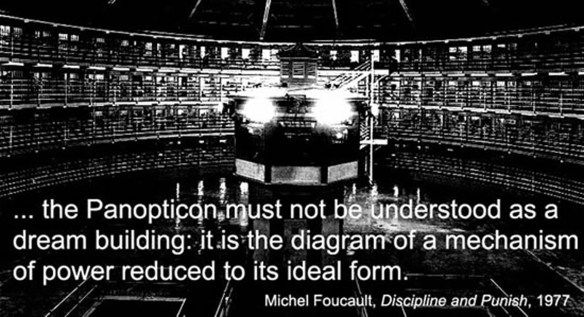
The American Police State, much like The Prisoner’s Village, is a metaphorical panopticon, a circular prison in which the inmates are monitored by a single watchman situated in a central tower. Because the inmates cannot see the watchman, they are unable to tell whether or not they are being watched at any given time and must proceed under the assumption that they are always being watched.

Eighteenth century social theorist Jeremy Bentham envisioned the panopticon prison to be a cheaper and more effective means of “obtaining power of mind over mind, in a quantity hitherto without example.”

Bentham’s panopticon, in which the prisoners are used as a source of cheap, menial labor, has become a model for the modern surveillance state in which the populace is constantly being watched, controlled and managed by the powers-that-be and funding its existence.

Nowhere to run and nowhere to hide: this is the new mantra of the architects of the police state and their corporate collaborators (Facebook, Amazon, Netflix, Google, Instagram, etc.).

Government eyes are watching you.

They see your every move: what you read, how much you spend, where you go, with whom you interact, when you wake up in the morning, what you’re watching on television and reading on the internet.

Every move you make is being monitored, mined for data, crunched, and tabulated in order to form a picture of who you are, what makes you tick, and how best to control you when and if it becomes necessary to bring you in line.

When the government sees all and knows all and has an abundance of laws to render even the most seemingly upstanding citizen a criminal and lawbreaker, then the old adage that you’ve got nothing to worry about if you’ve got nothing to hide no longer applies.

Apart from the obvious dangers posed by a government that feels justified and empowered to spy on its people and use its ever-expanding arsenal of weapons and technology to monitor and control them, we’re approaching a time in which we will be forced to choose between obeying the dictates of the government—i.e., the law, or whatever a government official deems the law to be—and maintaining our individuality, integrity and independence.

When people talk about privacy, they mistakenly assume it protects only that which is hidden behind a wall or under one’s clothing. The courts have fostered this misunderstanding with their constantly shifting delineation of what constitutes an “expectation of privacy.” And technology has furthered muddied the waters.

However, privacy is so much more than what you do or say behind locked doors. It is a way of living one’s life firm in the belief that you are the master of your life, and barring any immediate danger to another person (which is far different from the carefully crafted threats to national security the government uses to justify its actions), it’s no one’s business what you read, what you say, where you go, whom you spend your time with, and how you spend your money.

Unfortunately, George Orwell’s 1984—where “you had to live—did live, from habit that became instinct—in the assumption that every sound you made was overheard, and, except in darkness, every movement scrutinized”—has now become our reality.

We now find ourselves in the unenviable position of being monitored, managed and controlled by our technology, which answers not to us but to our government and corporate rulers.

Consider that on any given day, the average American going about his daily business will be monitored, surveilled, spied on and tracked in more than 20 different ways, by both government and corporate eyes and ears.

A byproduct of this new age in which we live, whether you’re walking through a store, driving your car, checking email, or talking to friends and family on the phone, you can be sure that some government agency, whether the NSA or some other entity, is listening in and tracking your behavior.

This doesn’t even begin to touch on the corporate trackers that monitor your purchases, web browsing, Facebook posts and other activities taking place in the cyber sphere.

Stingray devices mounted on police cars to warrantlessly track cell phones, Doppler radar devices that can detect human breathing and movement within in a home, license plate readers that can record up to 1800 license plates per minute, sidewalk and “public space” cameras coupled with facial recognition and behavior-sensing technology that lay the groundwork for police “pre-crime” programs, police body cameras that turn police officers into roving surveillance cameras, the internet of things: all of these technologies add up to a society in which there’s little room for indiscretions, imperfections, or acts of independence—especially not when the government can listen in on your phone calls, monitor your driving habits, track your movements, scrutinize your purchases and peer through the walls of your home.

As French philosopher Michel Foucault concluded in his 1975 book Discipline and Punish, “Visibility is a trap.”

This is the electronic concentration camp—the panopticon prison—the Village—in which we are now caged.

It is a prison from which there will be no escape if the government gets it way.

As Glenn Greenwald notes:

“The way things are supposed to work is that we’re supposed to know virtually everything about what [government officials] do: that’s why they’re called public servants. They’re supposed to know virtually nothing about what we do: that’s why we’re called private individuals. This dynamic – the hallmark of a healthy and free society – has been radically reversed. Now, they know everything about what we do, and are constantly building systems to know more. Meanwhile, we know less and less about what they do, as they build walls of secrecy behind which they function. That’s the imbalance that needs to come to an end. No democracy can be healthy and functional if the most consequential acts of those who wield political power are completely unknown to those to whom they are supposed to be accountable.”

Even now, the Trump Administration is working to make some of the National Security Agency’s vast spying powers permanent.

In fact, Attorney General Jeff Sessions is pushing for Congress to permanently renew Section 702 of the Foreign Intelligence Surveillance Act, which allows government snoops to warrantlessly comb through and harvest vast quantities of our communications.

And just like that, we’re back in the Village, our escape plans foiled, our future bleak.

Except this is no surprise ending: for those who haven’t been taking the escapist blue pill, who haven’t fallen for the Deep State’s phony rhetoric, who haven’t been lured in by the promise of a political savior, we never stopped being prisoners.

So how do we break out?

For starters, wake up. Resist the urge to comply.

The struggle to remain “oneself in a society increasingly obsessed with conformity to mass consumerism,” writes Steven Paul Davies, means that superficiality and image trump truth and the individual. The result is the group mind and the tyranny of mob-think.

Think for yourself. Be an individual. As McGoohan commented in 1968, “At this moment individuals are being drained of their personalities and being brainwashed into slaves… As long as people feel something, that’s the great thing. It’s when they are walking around not thinking and not feeling, that’s tough. When you get a mob like that, you can turn them into the sort of gang that Hitler had.”

In a media-dominated age in which the lines between entertainment, politics and news reporting are blurred, it is extremely difficult to distinguish fact from fiction. We are so bombarded with images, dictates, rules and punishments and stamped with numbers from the day we are born that it is a wonder we ever ponder a concept such as freedom. As McGoohan declared, “Freedom is a myth.”

In the end, as I make clear in my book Battlefield America: The War on the American People, we are all prisoners of our own mind.

In fact, it is in the mind that prisons are created for us. And in the lockdown of political correctness, it becomes extremely difficult to speak or act individually without being ostracized. Thus, so often we are forced to retreat inwardly into our minds, a prison without bars from which we cannot escape, and into the world of video games and television and the Internet.

We have come full circle from Bentham’s Panopticon to McGoohan’s Village to Huxley’s Brave New World.

As cultural theorist Neil Postman observed:

What Orwell feared were those who would ban books. What Huxley feared was that there would be no reason to ban a book, for there would be no one who wanted to read one. Orwell feared those who would deprive us of information. Huxley feared those who would give us so much that we would be reduced to passivity and egoism. Orwell feared we would become a captive audience. Huxley feared the truth would be drowned in a sea of irrelevance. Orwell feared that we would become a captive culture. Huxley feared we would become a trivial culture, preoccupied with some equivalent of the feelies, the orgy porgy, and the centrifugal bumblepuppy. As Huxley remarked in Brave New World Revisited, the civil libertarians and rationalists who are ever on the alert to oppose tyranny “failed to take into account man’s almost infinite appetite for distractions.” In Brave New World, they are controlled by inflicting pleasure. In short, Orwell feared that what we hate would ruin us. Huxley feared that what we love will ruin us.

You want to be free? Break out of the circle.

Saturday Matinee: Natural City

“Natural City” (2003) is a dystopian science fiction film from South Korean director Min Byeong-cheon. The plot focuses on two cops, R and Noma, who (not unlike Blade Runners) must hunt down renegade cyborgs. The rogue cyborgs are designed for roles ranging from military commandos to companion “dolls” and have a limited 3 year lifespan, though black market technology enables the transfer of a cyborg’s mind into the brain of a human host. This breakthrough compels R into finding Cyon, an orphaned prostitute who could potentially host the mind of Ria, a doll he’s fallen deeply in love with and who has only a few days left before expiration. Eventually, R must make a difficult decision testing his split personal and professional loyalties.

Watch the full film here.

A Tale of Two Americas: Where the Rich Get Richer and the Poor Go to Jail

By John W. Whitehead

Source: The Rutherford Institute

“It is said that no one truly knows a nation until one has been inside its jails. A nation should not be judged by how it treats its highest citizens, but its lowest ones.” ― Nelson Mandela

This is the tale of two Americas, where the rich get richer and the poor go to jail.

Aided and abetted by the likes of Attorney General Jeff Sessions—a man who wouldn’t recognize the Constitution if it smacked him in the face—the American dream has become the American scheme: the rich are getting richer and more powerful, while anyone who doesn’t belong to the power elite gets poorer and more powerless to do anything about the nation’s steady slide towards fascism, authoritarianism and a profit-driven police state.

Not content to merely pander to law enforcement and add to its military largesse with weaponry and equipment designed for war, Sessions has made a concerted effort to expand the police state’s power to search, strip, seize, raid, steal from, arrest and jail Americans for any infraction, no matter how insignificant.

Now Sessions has given state courts the green light to resume their practice of jailing individuals who are unable to pay the hefty fines imposed by the American police state. In doing so, Sessions has once again shown himself to be not only a shill for the Deep State but an enemy of the people.

First, some background on debtors’ prisons, which jail people who cannot afford to pay the exorbitant fines imposed on them by courts and other government agencies.

Congress banned debtors’ prisons in 1833.

In 1983, the U.S. Supreme Court ruled the practice to be unconstitutional under the Fourteenth Amendment’s Equal Protection clause.

“Despite prior attempts on the federal level and across the country to prevent the profound injustice of locking people in cages because they are too poor to pay a debt,” concludes The Atlantic, “the practice persists every day.”

Where things began to change, according to The Marshall Project, was with the rise of “mass incarceration.” As attorney Alec Karakatsanis stated, “In the 1970s and 1980s, we started to imprison more people for lesser crimes. In the process, we were lowering our standards for what constituted an offense deserving of imprisonment, and, more broadly, we were losing our sense of how serious, how truly serious, it is to incarcerate. If we can imprison for possession of marijuana, why can’t we imprison for not paying back a loan?”

By the late 1980s and early 90s, “there was a dramatic increase in the number of statutes listing a prison term as a possible sentence for failure to repay criminal-justice debt.” During the 2000s, the courts started cashing in big-time “by using the threat of jail time – established in those statutes – to squeeze cash out of small-time debtors.”

Fast-forward to the present day which finds us saddled with not only profit-driven private prisons and a prison-industrial complex but also, as investigative reporter Eli Hager notes, “the birth of a new brand of ‘offender-funded’ justice [which] has created a market for private probation companies. Purporting to save taxpayer dollars, these outfits force the offenders themselves to foot the bill for parole, reentry, drug rehab, electronic monitoring, and other services (some of which are not even assigned by a judge). When the offenders can’t pay for all of this, they may be jailed – even if they have already served their time for the offense.”

Follow the money trail. It always points the way.

Whether you’re talking about the government’s war on terrorism, the war on drugs, or some other phantom danger dreamed up by enterprising bureaucrats, there is always a profit-incentive involved.

The same goes for the war on crime.

At one time, the American penal system operated under the idea that dangerous criminals needed to be put under lock and key in order to protect society. Today, the flawed yet retributive American “system of justice” is being replaced by an even more flawed and insidious form of mass punishment based upon profit and expediency.

Sessions’ latest gambit plays right into the hands of those who make a profit by jailing Americans.

Sharnalle Mitchell was one such victim of a system for whom the plight of the average American is measured in dollars and cents. As the Harvard Law Review recounts:

On January 26, 2014, Sharnalle Mitchell was with her children in Montgomery, Alabama when police showed up at her home to arrest her. Mitchell was not accused of a crime. Instead, the police came to her home because she had not fully paid a traffic ticket from 2010. The single mother was handcuffed in front of her children (aged one and four) and taken to jail. She was ordered to either pay $2,800 or sit her debt out in jail at a rate of fifty dollars a day for fifty-nine days. Unable to pay, Mitchell wrote out the numbers one to fifty-eight on the back of her court documents and began counting days.

This is not justice.

This is yet another example of how greed and profit-incentives have not only perverted policing in America but have corrupted the entire criminal justice system.

As the Harvard Law Review concludes:

[A]s policing becomes a way to generate revenue, police start to “see the people they’re supposed to be serving not as citizens with rights, but as potential sources of revenue, as lawbreakers to be caught.” This approach creates a fugitive underclass on the run from police not to hide illicit activity but to avoid arrest for debt or seizure of their purportedly suspicious assets… In turn, communities … begin to see police not as trusted partners but as an occupying army constantly harassing them to raise money to pay their salaries and buy new weapons. This needs to end.

Unfortunately, the criminal justice system has been operating as a for-profit enterprise for years now, covertly padding its pockets through penalty-riddled programs aimed at maximizing revenue rather than ensuring public safety.

All of those seemingly hard-working police officers and code-enforcement officers and truancy officers and traffic cops handing out ticket after ticket after ticket: they’re not working to make your communities safer—they’ve got quotas to fill.

Same goes for the courts, which have come to rely on fines, fees and exorbitant late penalties as a means of increased revenue. The power of these courts, magnified in recent years through the introduction of specialty courts beyond your run-of-the-mill traffic court (drug court, homeless court, veterans court, mental health court, criminal court, teen court, gambling court, prostitution court, community court, domestic violence court, truancy court), is “reshaping the American legal system—with little oversight,” concludes the Boston Globe.

And for those who can’t afford to pay the court fines heaped on top of the penalties ($302 for jaywalking, $531 for an overgrown yard, or $120 for arriving a few minutes late to court), there’s probation (managed by profit-run companies that tack on their own fees, which are often more than double the original fine) or jail time (run by profit-run companies that charge inmates for everything from food and housing to phone calls at outrageous markups), which only adds to the financial burdens of those already unable to navigate a costly carceral state.

“When bail is set unreasonably high, people are behind bars only because they are poor,” stated former Attorney General Loretta Lynch. “Not because they’re a danger or a flight risk — only because they are poor. They don’t have money to get out of jail, and they certainly don’t have money to flee anywhere. Other people who do have the means can avoid the system, setting inequality in place from the beginning.”

In “Policing and Profit,” the Harvard Law Review documents in chilling detail the criminal justice system’s efforts to turn a profit at the expense of those who can least afford to pay, thereby entrapping them in a cycle of debt that starts with one minor infraction:

In the late 1980s, Missouri became one of the first states to let private companies purchase the probation systems of local governments. In these arrangements, municipalities impose debt on individuals through criminal proceedings and then sell this debt to private businesses, which pad the debt with fees and interest. This debt can stem from fines for offenses as minor as rolling through a stop sign or failing to enroll in the right trash collection service. In Ferguson, residents who fall behind on fines and don’t appear in court after a warrant is issued for their arrest (or arrive in court after the courtroom doors close, which often happens just five minutes after the session is set to start for the day) are charged an additional $120 to $130 fine, along with a $50 fee for a new arrest warrant and 56 cents for each mile that police drive to serve it. Once arrested, everyone who can’t pay their fines or post bail (which is usually set to equal the amount of their total debt) is imprisoned until the next court session (which happens three days a month). Anyone who is imprisoned is charged $30 to $60 a night by the jail. If an arrestee owes fines in more than one of St. Louis County’s eighty-one municipal courts, they are passed from one jail to another to await hearings in each town.

Ask yourself this: at a time when crime rates across the country remain at historic lows (despite Sessions’ inaccurate claims to the contrary), why does the prison population continue to grow?

The prison population continues to grow because of a glut of laws that criminalize activities that should certainly not be outlawed, let alone result in jail time. Overcriminalization continues to plague the country because of legislators who work hand-in-hand with corporations to adopt laws that favor the corporate balance sheet. And when it comes to incarceration, the corporate balance sheet weighs heavily in favor of locking up more individuals in government-run and private prisons.

As Time reports, “The companies that build and run private prisons have a financial interest in the continued growth of mass incarceration. That is why the two major players in this game—the Corrections Corporation of America and the GEO Group—invest heavily in lobbying for punitive criminal justice policies and make hefty contributions to political campaigns that will increase reliance on prisons.”

It’s a vicious cycle that grows more vicious by the day.

According to The Atlantic, “America spends $80 billion a year incarcerating 2.4 million people.” But the costs don’t end there. “When someone goes to prison, nearly 65 percent of families are suddenly unable to pay for basic needs such as food and housing… About 70 percent of those families are caring for children under the age of 18.”

Then there are the marked-up costs levied against the inmate by private companies that provide services and products to government prisons. Cereal and soup for five times the market price. $15 for a short phone call.

The Center for Public Integrity found that “prison bankers collect tens of millions of dollars every year from inmates’ families in fees for basic financial services. To make payments, some forego medical care, skip utility bills and limit contact with their imprisoned relatives… Inmates earn as little as 12 cents per hour in many places, wages that have not increased for decades. The prices they pay for goods to meet their basic needs continue to increase.”

Worse, as human rights attorney Jessica Jackson points out, “the fines and fees system has turned local governments into the equivalent of predatory lenders.” For instance, Jackson cites:

Washington state charges a 12% interest rate on all its criminal debt. Florida adds a 40% fee that goes into the pockets of a private collections agency. In California, penalties can raise a $100 fine to $490, or $815 if the initial deadline is missed. A $500 traffic ticket can actually cost $1,953, even if it is paid on time. And so we are left with countless tales of lives ruined—people living paycheck to paycheck who cannot afford a minor fine, and so face ballooning penalties, increasing amounts owed, a suspended license, jail time, and being fired from their jobs or unable to find work.

This isn’t the American Dream I grew up believing in.

This certainly isn’t the American Dream my parents and grandparents and those before them worked and fought and sacrificed to achieve.

This is a cold, calculated system of profit and losses.

Now you can shrug all of this away as a consequence of committing a crime, but that just doesn’t cut it. Especially not when average Americans are being jailed for such so-called crimes as eating SpaghettiOs (police mistook them for methamphetamine), not wearing a seatbelt, littering, jaywalking, having homemade soap (police mistook the soap for cocaine), profanity, spitting on the ground, farting, loitering and twerking.

There is no room in the American police state for self-righteousness. Not when we are all guilty until proven innocent.

As I make clear in my book Battlefield America: The War on the American People, this is no longer a government “of the people, by the people, for the people.”

It is fast becoming a government “of the rich, by the elite, for the corporations,” and its rise to power is predicated on shackling the American taxpayer to a debtors’ prison guarded by a phalanx of politicians, bureaucrats and militarized police with no hope of parole and no chance for escape.

Boobs on Credit

From BreastImplantFailure.net

By Jim Quinn

Source: The Burning Platform

Do you ever hear something so startlingly mind numbingly ridiculous you realize it must be a sign things have gotten so fucked up something has got to give? As I was driving to work yesterday morning on the Schuylkill Expressway a commercial comes on the radio from a plastic surgeon advertising for anyone looking for a better set of boobs. I had never heard a plastic surgeon commercial before, so I thought that was unusual. But, that wasn’t the best part. This plastic surgeon was offering no money down 18 month interest free financing on your new boobs.

I wonder if they are moving boobs with subprime debt the same way the auto companies have used subprime debt to move cars. Of course, when a deadbeat defaults on an auto loan the car is easily repossessed. What happens when a bimbo defaults on her boob loan? How narrow minded of me. What happens when some dude who wants to be a bimbo defaults on his/her loan? I guess it was just a matter of time before breast enhancement met debt enhancement in this warped world of materialism, narcissism, financialization, and delusions.

Now that revolving credit has reached a new all-time high of $1 trillion and total consumer debt outstanding has exceeded it’s 2008 peak at $12.8 trillion, the Fed has completed its job of helping the average American again in-debt themselves up to their eyeballs. This is considered a success story in this twisted, perverted, bizarro world we call America today. The solution to an epic debt induced global financial catastrophe caused by Federal Reserve easy money, Wall Street fraud, and Washington DC corruption has been to increase global debt by 50% since 2007, with virtually all of it created by central bankers and the governments they control.

In what demented Ivy League educated academic mind would piling $68 trillion more debt on the backs of taxpayers as a cure for a disease caused by the initial $149 trillion of debt be considered rational and sustainable? It’s like having pancreatic cancer and trying to cure it with a self inflicted gunshot. And no one seems to care about or even notice the coming reset when this mass debt induced hysteria of delusion turns into the biggest financial collapse in the history of mankind.

This entire ponzi scheme edifice of debt is nothing but a confidence game. When people begin to realize they can’t repay their own debts, start to understand their governments will never honor their debt based promises, and realize central bankers are nothing more than pretend wizards behind a curtain, the confidence will evaporate in an instant and a collapse which will make 2008/2009 look like a walk in the park will ensue. That’s when civil and global war will engulf the world and teach people real lessons about the real world.

The boobs on credit commercial I heard this week is just another example of Wall Street and their Deep State crony co-conspirators completing their scheme to financialize every aspect of our lives and entrap us in chains of debt, beholden to these modern day Wall Street slave owners. When you see the record number of retail bankruptcies and store closings happening when GDP is supposedly rising by 3% and witness with your own two eyes the number of vacant storefronts and restaurants across our great land of materialism, you might wonder why revolving credit card debt is at a new all-time high.

The answer is Wall Street has successfully financialized virtually every aspect of our day to day lives. Consumer and taxpayer transactions which required cash or check ten years ago can now be paid with a credit card. You can pay your IRS bill with a credit card. You can pay your real estate taxes with a credit card. You can pay your utilities with a credit card. You can pay your school tuition with a credit card. You can pay your rent with a credit card. You can “buy” furniture and appliances without paying for seven years. And guess what? That’s what millions of average Americans are doing. In addition, they are driving “rented” $35,000 automobiles on seven year nothing down payment plans.

This massive debt induced fraud of a recovery gives the appearance of normalcy and stability. The stock market is at all-time highs is used as the narrative of central banker success. We’ve experienced extremely low volatility as the central bankers around the world have coordinated their money printing/debt creating schemes to purposely elevate financial markets to give the masses confidence that all is well. Anyone with critical thinking skills knows all is not well. The longer this fake stability is maintained the greater the collapse. Success breeds disregard for the possibility of catastrophe.

So you can call me the boy who cried wolf, but our Minsky Moment is approaching. Sometimes they do ring a bell at the top. In this case they are shaking fake boobs at the top.

“Stability leads to instability. The more stable things become and the longer things are stable, the more unstable they will be when the crisis hits.”Hyman Minsky