The Five Stages of Collapse, 2019 Update

By Dmitry Orlov

Source: Club Orlov

Collapse, at each stage, is a historical process that takes time to run its course as the system adapts to changing circumstances, compensates for its weaknesses and finds ways to continue functioning at some level. But what changes rather suddenly is faith or, to put it in more businesslike terms, sentiment. A large segment of the population or an entire political class within a country or the entire world can function based on a certain set of assumptions for much longer than the situation warrants but then over a very short period of time switch to a different set of assumptions. All that sustains the status quo beyond that point is institutional inertia. It imposes limits on how fast systems can change without collapsing entirely. Beyond that point, people will tolerate the older practices only until replacements for them can be found.

Stage 1: Financial collapse. Faith in “business as usual” is lost.

Internationally, the major change in sentiment in the world has to do with the role of the US dollar (and, to a lesser extent, the Euro and the Yen—the other two reserve currencies of the three-legged globalist central banker stool). The world is transitioning to the use of local currencies, currency swaps and commodities markets backed by gold. The catalyst for this change of sentiment was provided by the US administration itself which sawed through its own perch by its use of unilateral sanctions. By using its control over dollar-based transactions to block international transactions it doesn’t happen to like it forced other countries to start looking for alternatives. Now a growing list of countries sees throwing off the shackles of the US dollar as a strategic goal. Russia and China use the ruble and the yuan for their expanding trade; Iran sells oil to India for rupees. Saudi Arabia has started to accept the yuan for its oil.

This change has many knock-on effects. If the dollar is no longer needed to conduct international trade, other nations no longer have hold large quantities of it in reserve. Consequently, there is no longer a need to buy up large quantities of US Treasury notes. Therefore, it becomes unnecessary to run large trade surpluses with the US, essentially conducting trade at a loss. Further, the attractiveness of the US as an export market drops and the cost of imports to the US rises, thereby driving up cost inflation. A vicious spiral ensues in which the ability of the US government to borrow internationally to finance the gaping chasm of its various deficits becomes impaired. Sovereign default of the US government and national bankruptcy then follow.

The US may still look mighty, but its dire fiscal predicament coupled with its denial of the inevitability of bankruptcy, makes it into something of a Blanche DuBois from the Tennessee Williams play “A Streetcar Named Desire.” She was “always dependent on the kindness of strangers” but was tragically unable to tell the difference between kindness and desire. In this case, the desire is for national advantage and security, and to minimize risk by getting rid of an unreliable trading partner.

How quickly or slowly this comes to pass is difficult to guess at and impossible to calculate. It is possible to think of the financial system in terms of a physical analogue, with masses of funds traveling at some velocity having a certain inertia (p = mv) and with forces acting on that mass to accelerate it along a different trajectory (F = ma). It is also possible to think of it in terms of hordes of stampeding animals who can change course abruptly when panicked. The recent abrupt moves in the financial markets, where trillions of dollars of notional, purely speculative value have been wiped out within weeks, are more in line with the latter model.

Stage 2: Commercial collapse. Faith that “the market shall provide” is lost.

Within the US there is really no other alternative than the market. There are a few rustic enclaves, mostly religious communities, that can feed themselves, but that’s a rarity. For everyone else there is no choice but to be a consumer. Consumers who are broke are called “bums,” but they are still consumers. To the extent that the US has a culture, it is a commercial culture in which the goodness of a person is based on the goodly sums of money in their possession. Such a culture can die by becoming irrelevant (when everyone is dead broke) but by then most of the carriers of this culture are likely to be dead too. Alternatively, it can be replaced by a more humane culture that isn’t entirely based on the cult of Mammon—perhaps, dare I think, through a return to a pre-Protestant, pre-Catholic Christian ethic that values people’s souls above objects of value?

Stage 3: Political collapse. Faith that “the government will take care of you” is lost.

All is very murky at the moment, but I would venture to guess that most people in the US are too distracted, too stressed and too preoccupied with their own vices and obsessions to pay much attention to the political realm. Of the ones they do pay attention, a fair number of them seem clued in to the fact that the US is not a democracy at all but an elites-only sandbox in which transnational corporate and oligarchic interests build and knock down each others’ sandcastles.

The extreme political polarization, where two virtually identical pro-capitalist, pro-war parties pretend to wage battle by virtue-signaling may be a symptom of the extremely decrepit state of the entire political arrangement: people are made to watch the billowing smoke and to listen to the deafening noise in the hopes that they won’t notice that the wheels are no longer turning.

The fact that what amounts to palace intrigue—the fracas between the White House, the two houses of Congress and a ghoulish grand inquisitor named Mueller—has taken center stage is uncannily reminiscent of various earlier political collapses, such as the disintegration of the Ottoman Empire or of the fall and the consequent beheading of Louis XVI. The fact that Trump, like the Ottoman worthies, stocks his harem with East European women, lends an eerie touch. That said, most people in the US seem blind to the nature of their overlords in a way that the French, with their Gilets Jaunes movement (just as an example) are definitely not.

Stage 4: Social collapse. Faith that “your people will take care of you” is lost.

I have been saying for some years now that within the US social collapse has largely run its course, although whether people actually believe that is an entire matter entirely. Defining “your people” is rather difficult. The symbols are still there—the flag, the Statue of Liberty and a predilection for iced drinks and heaping plates of greasy fried foods—but the melting pot seems to have suffered a meltdown and melted all the way to China. At present half the households within the US speak a language other than English at home, and a fair share of the rest speak dialects of English that are not mutually intelligible with the standard North American English dialect of broadcast television and university lecturers.

Throughout its history as a British colony and as a nation the US has been dominated by the Anglo ethnos. The designation “ethnos” is not an ethnic label. It is not strictly based on genealogy, language, culture, habitat, form of government or any other single factor or group of factors. These may all be important to one extent or another, but the viability of an ethnos is based solely on its cohesion and the mutual inclusivity and common purpose of its members. The Anglo ethnos reached its zenith in the wake of World War II, during which many social groups were intermixed in the military and their more intelligent members were allowed to become educated and to advance socially by the GI Bill.

Fantastic potential was unleashed when privilege—the curse of the Anglo ethnos since its inception—was temporarily replaced with merit and the more talented demobilized men, of whatever extraction, were given a chance at education and social advancement by the GI Bill. Speaking a new sort of American English based on the Ohio dialect as a Lingua Franca, these Yanks—male, racist, sexist and chauvinistic and, at least in their own minds, victorious—were ready to remake the entire world in their own image.

They proceeded to flood the entire world with oil (US oil production was in full flush then) and with machines that burned it. Such passionate acts of ethnogenesis are rare but not unusual: the Romans who conquered the entire Mediterranean basin, the barbarians who then sacked Rome, the Mongols who later conquered most of Eurasia and the Germans who for a very brief moment possessed an outsized Lebensraum are other examples.

And now it is time to ask: what remains of this proud conquering Anglo ethnos today? We hear shrill feminist cries about “toxic masculinity” and minorities of every stripe railing against “whitesplaining” and in response we hear a few whimpers but mostly silence. Those proud, conquering, virile Yanks who met and fraternized with the Red Army at the River Elbe on April 25, 1945—where are they? Haven’t they devolved into a sad little subethnos of effeminate, porn-addicted overgrown boys who shave their pubic hair and need written permission to have sex without fear of being charged with rape?

Will the Anglo ethnos persist as a relict, similar to how the English have managed to hold onto their royals (who are technically no longer even aristocrats since they now practice exogamy with commoners)? Or will it get wiped out in a wave of depression, mental illness and opiate abuse, its glorious history of rapine, plunder and genocide erased and the statues of its war heroes/criminals knocked down? Only time will tell.

Stage 5: Cultural collapse. Faith in “the goodness of humanity” is lost.

The term “culture” means many things to many people, but it is more productive to observe cultures than to argue about them. Cultures are expressed through people’s stereotypical behaviors that are readily observable in public. These are not the negative stereotypes often used to identify and reject outsiders but the positive stereotypes—cultural standards of behavior, really—that serve as requirements for social adequacy and inclusion. We can readily assess the viability of a culture by observing the stereotypical behaviors of its members.

• Do people exist as a single continuous, inclusive sovereign realm or as a set of exclusive, potentially warring enclaves segregated by income, ethnicity, education level, political affiliation and so on? Do you see a lot of walls, gates, checkpoints, security cameras and “no trespassing” signs? Is the law of the land enforced uniformly or are there good neighborhoods, bad neighborhoods and no-go zones where even the police fear to tread?

• Do random people thrown together in public spontaneously enter into conversation with each other and are comfortable with being crowded together, or are they aloof and fearful, and prefer to hide their face in the little glowing rectangle of their smartphone, jealously guarding their personal space and ready to regard any encroachment on it as an assault?

• Do people remain good-natured and tolerant toward each other even when hard-pressed or do they hide behind a façade of tense, superficial politeness and fly into a rage at the slightest provocation? Is conversation soft in tone, gracious and respectful or is it loud, shrill, rude and polluted with foul language? Do people dress well out of respect for each other, or to show off, or are they all just déclassé slobs—even the ones with money?

• Observe how their children behave: are they fearful of strangers and trapped in a tiny world of their own or are they open to the world and ready to treat any stranger as a surrogate brother or sister, aunt or uncle, grandmother or grandfather without requiring any special introduction? Do the adults studiously ignore each others’ children or do they spontaneously act as a single family?

• If there is a wreck on the road, do they spontaneously rush to each others’ rescue and pull people out before the wreck explodes, or do they, in the immortal words of Frank Zappa, “get on the phone and call up some flakes” who “rush on over and wreck it some more”?

• If there is a flood or a fire, do the neighbors take in the people who are rendered homeless, or do they allow them to wait for the authorities to show up and bus them to some makeshift government shelter?

It is possible to quote statistics or to provide anecdotal evidence to assess the state and the viability of a culture, but your own eyes and other senses can provide all the evidence you need to make that determination for yourself and to decide how much faith to put in “the goodness of humanity” that is evident in the people around you.

Jacques Ellul: A Prophet for Our Tech-Saturated Times

Read his works to understand how we’ve been caught in technology’s nightmarish hold.

By Andrew Nikiforuk

Source: The Tyee

By now you have probably read about the so-called “tech backlash.”

Facebook and other social media have undermined what’s left of the illusion of democracy, while smartphones damage young brains and erode the nature of discourse in the family.

Meanwhile computers and other gadgets have diminished our attention spans along with our ever-failing connection to reality.

The Foundation for Responsible Robotics recently created a small stir by asking if “sexual intimacy with robots could lead to greater social isolation.”

What could possibly go wrong?

The average teenager now works about two hours of every day — for free — providing Facebook and other social media companies with all the data they need to engineer young people’s behaviour for bigger Internet profits.

Without shame, technical wonks now talk of building artificial scientists to resolve climate change, poverty and, yes, even fake news.

The media backlash against Silicon Valley and its peevish moguls, however, typically ends with nothing more radical than an earnest call for regulation or a break-up of Internet monopolies such as Facebook and Google.

The problem, however, is much graver, and it is telling that most of the backlash stories invariably omit any mention of technology’s greatest critic, Jacques Ellul.

The ascent of technology

Ellul, the Karl Marx of the 20th century, predicted the chaotic tyranny many of us now pretend is the good and determined life in technological society.

He wrote of technique, about which he meant more than just technology, machines and digital gadgets but rather “the totality of methods rationally arrived at and having absolute efficiency” in the economic, social and political affairs of civilization.

For Ellul, technique, an ensemble of machine-based means, included administrative systems, medical tools, propaganda (just another communication technique) and genetic engineering.

The list is endless because technique, or what most of us would just call technology, has become the artificial blood of modern civilization.

“Technique has taken substance,” wrote Ellul, and “it has become a reality in itself. It is no longer merely a means and an intermediary. It is an object in itself, an independent reality with which we must reckon.”

Just as Marx deftly outlined how capitalism threw up new social classes, political institutions and economic powers in the 19th century, Ellul charted the ascent of technology and its impact on politics, society and economics in the 20th.

My copy of Ellul’s The Technological Society has yellowed with age, but it remains one of the most important books I own. Why?

Because it explains the nightmarish hold technology has on every aspect of life, and also remains a guide to the perplexing determinism that technology imposes on life.

Until the 18th century, technical progress occurred slowly and with restraint. But with the Industrial Revolution it morphed into something overwhelming due in part to population, cheap energy sources and capitalism itself.

Since then it has engulfed Western civilization and become the globe’s greatest colonizing force.

“Technique encompasses the totality of present-day society,” wrote Ellul. “Man is caught like a fly in a bottle. His attempts at culture, freedom, and creative endeavour have become mere entries in technique’s filing cabinet.”

Ellul, a brilliant historian, wrote like a physician caught in the middle of a plague or physicist exposed to radioactivity. He parsed the dynamics of technology with a cold lucidity.

Yet you’ve probably never heard of the French legal scholar and sociologist despite all the recent media about the corrosive influence of Silicon Valley.

His relative obscurity has many roots. He didn’t hail from Paris, but rural Bordeaux. He didn’t come from French blue blood; he was a “meteque.”

He didn’t travel much, criticized politics of every stripe and was a radical Christian.

But in 1954, just a year before American scientists started working on artificial intelligence, Ellul wrote his monumental book, The Technological Society.

The dense and discursive work lays out in 500 pages how technique became for civilization what British colonialism was for parts of 19th-century Africa: a force of total domination.

In the book Ellul explains in bold and uncompromising terms how the logic of technological innovation conquered every aspect of human culture.

Ellul didn’t regard technology as inherently evil; he just recognized that it was a self-augmenting force that engineered the world on its terms.

Machines, whether mechanical or digital, aren’t interested in truth, beauty or justice. Their goal is to make the world a more efficient place for more machines.

Their proliferation combined with our growing dependence on their services inevitably led to an erosion of human freedom and unintended consequences in every sphere of life.

Ellul was one of the first to note that you couldn’t distinguish between bad and good effects of technology. There were just effects and all technologies were disruptive.

In other words, it doesn’t matter if a drone is delivering a bomb or book or merely spying on the neighbourhood, because technique operates outside of human morality: “Technique tolerates no judgment from without and accepts no limitations.”

Facebook’s mantra “move fast and break things” epitomizes the technological mindset.

But some former Facebook executives such as Chamath Palihapitiya belatedly realized they have engineered a force beyond their control. (“The short-term dopamine-driven feedback loops that we have created are destroying how society works,” Palihapitiya has said.)

That, argued Ellul, is what technology does. It disrupts and then disrupts again with unforeseen consequences, requiring more techniques to solve the problems created by latest innovations.

As Ellul noted back in 1954, “History shows that every technical application from its beginnings presents certain unforeseeable secondary effects which are more disastrous than the lack of the technique would have been.”

Ellul also defined the key characteristics of technology.

For starters, the world of technique imposes a rational and mechanical order on all things. It embraces artificiality and seeks to replace all natural systems with engineered ones.

In a technological society a dam performs better than a running river, a car takes the place of the pedestrians — and may even kill them — and a fish farm offers more “efficiencies” than a natural wild salmon migration.

There is more. Technique automatically reduces actions to the “one best way.” Technical progress is also self-augmenting: it is irreversible and builds with a geometric progression.

(Just count the number of gadgets telling you what to do or where to go or even what music to play.)

Technology is indivisible and universal because everywhere it goes it shows the same deterministic face with the same consequences. And it is autonomous.

By autonomous, Ellul meant that technology had become a determining force that “elicits and conditions social, political and economic change.”

The role of propaganda

The French critic was the first to note that technologies build upon each other and therefore centralize power and control.

New techniques for teaching, selling things or organizing political parties also required propaganda.

Here again Ellul saw the future.

He argued that propaganda had to become as natural as breathing air in a technological society, because it was essential that people adapt to the disruptions of a technological society.

“The passions it provokes — which exist in everybody — are amplified. The suppression of the critical faculty — man’s growing incapacity to distinguish truth from falsehood, the individual from the collectivity, action from talk, reality from statistics, and so on — is one of the most evident results of the technical power of propaganda.”

Faking the news may have been a common practice on Soviet radio during Ellul’s day, but it is now a global phenomenon leading us towards what Ellul called “a sham universe.”

We now know that algorithms control every aspect of digital life and have subjected almost aspect of human behaviour to greater control by techniques whether employed by the state or the marketplace.

But in 1954 Ellul saw the beast emerging in infant form.

Technology, he wrote, can’t put up with human values and “must necessarily don mathematical vestments. Everything in human life that does not lend itself to mathematical treatment must be excluded… Who is too blind to not see that a profound mutation is being advocated here.”

He, too, warned about the promise of leisure provided by the mechanization and automatization of work.

“Instead of being a vacuum representing a break with society,” our leisure time will be “literally stuffed with technical mechanisms of compensation and integration.”

Good citizens today now leave their screens at work only to be guided by robots in their cars that tell them the most efficient route to drive home.

At home another battery of screens awaits to deliver entertainments and distractions, including apps that might deliver a pizza to the door.

Stalin and Mao would be impressed — or perhaps disappointed — that so much social control could be exercised with such sophistication and so little bloodletting.

Ellul wasn’t just worried about the impact of a single gadget such as the television or the phone but “the phenomenon of technical convergence.”

He feared the impact of systems or complexes of techniques on human society and warned the result could only be “an operational totalitarianism.”

“Convergence,” he wrote, “is a completely spontaneous phenomenon, representing a normal stage in the evolution of technique.”

Social media, a web of behavioural and psychological systems, is just the latest example of convergence.

Here psychological techniques, surveillance techniques and propaganda have all merged to give the Russians and many other groups a golden opportunity to intervene in the political lives of 126 million North Americans.

Social media has achieved something novel, according to former Facebook engineer Sam Lessin.

For the first time ever a political candidate or party can “effectively talk to each individual voter privately in their own home and tell them exactly what they want to hear… in a way that can’t be tracked or audited.”

In China the authorities have gone one step further. Using the Internet the government can now track the movements of every citizen and rank their political trustworthiness based on their history of purchases and associations. It is, of course, a fantastic “counterterrorism” tool.

The Silicon Valley moguls and the digerati promised something less totalitarian. They swore that social media would help citizens fight bad governments and would connect all of us.

Facebook, vowed the pathologically adolescent Mark Zuckerberg, would help the Internet become “a force for peace in the world.”

But technology obeys its own rules and prefers “the psychology of tyranny.”

The digerati also promised that digital technologies would usher in a new era of decentralization and undo what mechanical technologies have already done: centralize everything into big companies, big boxes and big government.

Technology assuredly fragments human communities, but in the world of technique centralization remains the norm.

“The idea of effecting decentralization while maintaining technical progress is purely utopian,” wrote Ellul.

Towards ‘hypernormalization’

It is worth noting that the word “normal” didn’t come into currency until the 1940s along with technological society.

In many respects global society resembles the Soviet Union just prior to its collapse when “hypernormalization” ruled the day.

A recent documentary defined what hypernormalization did for Russia: it “became a society where everyone knew that what their leaders said was not real, because they could see with their own eyes that the economy was falling apart. But everybody had to play along and pretend that it was real because no one could imagine any alternative.”

In many respects technology has hypernormalized a technological society in which citizens exercise less and less control over their lives every day and can’t imagine anything different.

Throughout his life Ellul maintained that he was “neither by nature, nor doctrinally, a pessimist, nor have I pessimistic prejudices. I am concerned only with knowing whether things are so or not.”

He called a spade a spade, and did not sugarcoat his observations.

If you are growing more anxious about our hypernormalized existence and are wondering why you own a phone that tracks your every movement, then read The Technological Society.

Ellul believed that the first act of freedom a citizen can exercise is to recognize the necessity of understanding technique and its colonizing powers.

Resistance, which is never futile, can only begin by becoming aware and bearing witness to the totalitarian nature of technological society.

Ellul believed that Christians had a special duty to condemn the worship of technology, which has become society’s new religion.

To Ellul, resistance meant teaching people how to be conscious amphibians, with one foot in traditional human societies, and to purposefully choose which technologies to bring into their communities.

Only citizens who remain connected to traditional human societies can see, hear and understand the disquiet of the smartphone blitzkrieg or the Internet circus.

Children raised by screens and vaccinated only by technology will not have the capacity to resist, let alone understand, this world any more than someone born in space could appreciate what it means to walk in a forest.

Ellul warned that if each of us abdicates our human responsibilities and leads a trivial existence in a technological society, then we will betray freedom.

And what is freedom but the ability to overcome and transcend the dictates of necessity?

In 1954, Ellul appealed to all sleepers to awake.

Read him. He remains the most revolutionary, prophetic and dangerous voice of this or any century.

Lobotomized: Secrecy and the “Dis-enlightenment”

By Gordon Duff

Source: New Eastern Outlook

As we enter 2019, one thing above all others is clear, the mechanisms of human engagement, education, media and information, even what passes for human contact through social media and email, is all subjected to “algorithms,” whatever those are.

It was Snowden that brought it to our attention, from the Guardian back in 2014:

“Increasingly, we are watched not by people but by algorithms. Amazon and Netflix track the books we buy and the movies we stream, and suggest other books and movies based on our habits. Google and Facebook watch what we do and what we say, and show us advertisements based on our behavior. Google even modifies our web search results based on our previous behavior. Smartphone navigation apps watch us as we drive, and update suggested route information based on traffic congestion. And the National Security Agency, of course, monitors our phone calls, emails and locations, then uses that information to try to identify terrorists.”

Documents provided by Edward Snowden and revealed by the Guardian today show that the UK spy agency GHCQ, with help from the NSA, has been collecting millions of webcam images from innocent Yahoo users. And that speaks to a key distinction in the age of algorithmic surveillance: is it really okay for a computer to monitor you online, and for that data collection and analysis only to count as a potential privacy invasion when a person sees it? I say it’s not, and the latest Snowden leaks only make more clear how important this distinction is.”

When we look back on 2014 from where we are today, Edward Snowden’s warnings of an Orwellian nightmare seem innocent. Maybe it was Donald Trump that opened our eyes, if so, whatever contribution history attributes to him, he might well want to hang his hat on this one.

The fake science of intruding into lives in order to recognize and control “influencers” began in the private sector and was “tuned up” for political races, crime and terrorism prevention and more.

By “more,” we mean “dumbing down” the “masses,” as they are called, presenting reality as a consumer product, custom engineered to be believable, to create drama or fear, to raise concerns of imaginary threats, to distract, and, above all, to control.

Social scientists have postulated that humans can actually be programmed to respond to the most basic stimuli, touch, hearing, taste, based on “fake” information, that the human mind can be fooled into filtering out such basic sensory responses as smell.

The basic synaptic connections that tie sensory input to ideas or concepts, let’s look at one glaring example. Try to say the word “Palestinian” without following it with “terrorist.”

Then again, let’s go back one more step and define the difference between an “armed militant” and a “freedom fighter.” Nothing here is new, the rules were laid out a century ago.

Einstein predicted this in his “Autobiographical notes” on epistemology. It was some 50 years ago when Dr. John Ward of Michigan State University pounded this into my head in his Philosophy of Science lectures. “The relationship between sense experiences and concepts is entirely intuitive as are the relationships between all concepts. You see what you see, not because of what you see but because of what you think.”

It was quite one thing when such pursuits were endeavors of science and philosophy at our great universities, but it became something quite different when Wilson Bryan Key, back in 1973, wrote the seminal work, Subliminal Seduction, demonstrating how altered images could reach into the most basic primitive drives, the “reptile brain,” as it were, driving an unknowing viewer to alter both perceptions and reasoning, even toward lowering human survivability.

Key’s imagery, taken from popular magazines, strange figures of death’s heads or nude women, airbrushed into ice cubes, were an opening salvo. If thanatotic drive could sell liquor or cigarettes, how easy might it be to sell a war?

No more films like Sergeant York or Red Dawn needed, or perhaps only as a “supporting actor,” pounding the nail in just a bit more.

Twenty years prior to the publication of Key’s work, the US government began a project known as MK Ultra. Though it officially ended in 1973 after 20 years of poorly documented “research” into every form of psychological manipulation, in truth, MK Ultra and other programs as well, simply “went dark.”

The reason, of course, we are traveling his historical path today is that those programs, after not 50 but 65 years of still classified efforts, after billions of dollars in black funding, programs with no oversite, programs carried out on unsuspecting citizens, sometimes entire cities, sometimes on unwilling victims in “black sites,” are the precursors to the world of Google and Facebook today.

Looking at 2018, there were some obvious “projects,” the White Helmet staged fake gas attacks for sure. This involved Facebook posts, fake videos, but the key is that they were channeled directly to the President of the United States who had been programmed to ignore credible intelligence sources. Thus, Trump ordered an attack on Syria entirely based on a Facebook post.

But there are millions of Facebook posts every day. Why did he get this one? Who put it in front of him? Is Trump surrounded by handlers, traitors?

You see, it is one thing when something is put on the internet, the equivalent of leaving a post-it note in a public restroom on the “wrong side of town.” It is quite something else when the message, a parentless bastard of disinformation, is given to a man who has, according to sources within the White House, openly advocated use of tactical nuclear weapons against Syrian people in retribution for wildly fabricated accusations.

Consider the implications, even if someone, perhaps General Mattis, had taken the nuclear option off the table. Simply put, it lowers the standards of the United States exercising war powers in attacking a sovereign nation to an anonymous social media post.

Again, we ask, it is one thing posting something malicious and dangerous and quite something else when a national leader with access to nuclear weapons is programmed to seek out and act upon same.

Then again, were any other president to order a missile strike based on, well, based on nothing whatsoever, not even a decent lie, one might expect negative repercussions.

Let’s take a second to juxtapose. If a fake public narrative exists, and it is reasonable to postulate that “the public,” such as it is, is more than aware that a “real world” exists in which what is generally known and accepted as true is, in fact, utterly false.

In fact, some of the most popular television series of the past decades have exposed the flummery of generally accepted history. Shows like The Secret History of World War II and many if not endless others, feed a hungry public a continual diet of debunked reality.

What we are left with is this, an ongoing process, a spiral as it were, around and down, around and down, ever faster, ever more hopeless, intrusion into lives, into thoughts, planted feelings, manipulated responses, altered perceptions, until nothing can be trusted, especially not ourselves.


Gordon Duff is a Marine combat veteran of the Vietnam War that has worked on veterans and POW issues for decades and consulted with governments challenged by security issues. He’s a senior editor and chairman of the board of  Veterans Today, especially for the online magazine “New Eastern Outlook.”
https://journal-neo.org/2019/01/09/lobotomized-secrecy-and-the-dis-enlightenment/


Wake From The Nightmare Or Eternal Sleep For Humanity

By Frank Scott

Source: Dissident Voice

The tradition of the dead generations weighs like a nightmare on the minds of the living.

— Karl Marx

Marx offered a thought for all seasons but one that might especially ring true during what is supposed to be a season of peace, joy and humanity. Contradicted by the ever more insanely harsh reality of marketing mass murder under the guise of creating freedom, much of our race, though still too few to radically transform the totality of our reality, has begun to rise in defense of all against a system that profits only a few. France’s recent experience was part of a hopeful trend in that segments of a public which has been bought, sold and rented into near poverty showed they are tired and demanded social justice over becoming what capital sees as a loss of its private profits. Their awakening from humanity’s nightmare, however brief it may seem, is inspiring as well as overdue. The actions of a predominately working class group of citizens demonstrating with enough fervor to force the French government to at least renege on some issues is in stark contrast to Americans trooping off to the polls to “resist” a personality while their system – the same one the French are up in arms about – disintegrates all around them. If we have anything to be happy about during the annual shopping frenzy of an alleged spiritual time for humanity, in a small way it’s a few changes in our congress, but in a greater way it’s the sign of awakening we see in France which will hopefully spread to more places in the New Year.

The social democratic salvation capital arranged after the depression of the twenties and thirties has collapsed and become a renewal of the worst forms of fascist capital that preceded and soon followed that brief cosmetic safety for some made possible only by the reduction to disfigured ugliness of others. The rise in status of a new middle class for millions in the western world was only possible with the misery of greater multitudes in what was called the third, or undeveloped world, but also the poverty class in that same west. There were people sleeping on the streets of America before, during, and after the last breakdown of capital given the brand name “the great depression”. This latest collapse that began in 2008 and is very possibly the last one that will wake up more than the French is only different in that it is worse and the numbers in the street have grown so much only the intellectually and morally blind cannot see them.

The wealth accumulation of the return to market fundamentalist roots was and continues to be shared by a shrinking minority while growing majorities have seen the facade of humanity brought about by social democratic capitalism dissolve in the reality of a take-no-prisoners brand of marketing. This Artificially Intelligent farce not only prides itself on the creation of poverty and warfare but dulls the sense of many of its innocent subjects by filling heads with propaganda that passes for news, entertainment to distract consciousness further, and the combination of the two that marketers call “infotainment”.

Thus we have a perverse form of capital therapy that herds us into near frenzied lynch mobs of genuinely frustrated and set upon souls directing energy at everything but the cause of most if not all the things that plague us. Rich individuals approaching deity status with economic powers beyond those of past royal despots are relatively invisible while some of their employees in government attract enough attention to be replaced by other of their employees who appeal to one or another interest or identity group affording pleasure to some, pain to most and continued ruling power to the incredibly rich minority at the top of the modern pyramid of capital.

Preposterous stories blaming Russia, China, Iran and possibly the Tooth Fairy for every sign of failure in what passes for a language perversion called the “free world” confuse and convince enough among the well fed and supposedly educated classes for the moment. When hardship eventually hits them in a material, rather than mental way, they will hopefully leave their identity groups and join the human race in the work necessary to transform global society.

Until the public good comes before private profit, things will get worse for all of us and any focus that continues separation of humans from potential majorities into smaller identity groups is simply the age old divide and conquer strategies always employed by minority rulers. This helps lead people with individual moral codes that find poverty and injustice intolerable to not only tolerate but to practice the most dreadful social policies imaginable. Privately, we Americans are as good, kind, compassionate, decent, and humane as any people on earth. Socially, however, we spend trillions on war, billions on pets, leave millions to live in poverty and hundreds of thousands to live on the street, and thus collectively become among the most degenerate moral perverts on the planet.

The skin tone, ethnicity, religion, sex or sexual preference of those serving capital while eating meals and flushing toilets at the white house or in slightly lesser roles in congress makes no difference to their victims reduced to cleaning the debris of death and destruction in the places where they oversee the bombing and looting. After their homes and nations are ruined we welcome some of them as migrants offering us cheap labor and a balm for our souls to maintain holiday spirit until the next slaughter we conduct. Food, clothing and shelter are basic human needs, not separate identity practices. They become so under private profit first economics that assure only some of the public will experience good, and that group is shrinking. The only way to assure a better life for all is for the ruling power to come from people who put the public good first, before any private gain is considered. Everyone has to be assured of food, clothing and shelter before anyone can aspire and work for even more by achieving private profit at the market. There is only one way to achieve that change and end society’s nightmare: the democratic forces of humanity must replace the market forces of capital. Happy New Year.

Hyperreality (or What Not There Isn’t to Believe?)

By Kingsley L. Dennis

Source: Waking Times

‘The attraction of the void is irresistible.’ ~Jean Baudrillard

If you feel like you are unsure of what is real and what is unreal then you are not alone. Our materialistic mode of life is accelerating and expanding so rapidly that it is saturating our modern cultures to the point of abstraction. Life in materially-privileged societies is increasingly shifting into a world of image and show. Many people today are living within their bubbles that are customized by all the digital conveniences tailored to individual needs. By being surrounded by conveniences that satisfy all our needs we are deliberately excluding so much else, including all of life’s serendipities.

Reality – whatever that is or was – has retreated behind a spectacle of make-believe that is playing at being the new, shimmering façade for the 21st century. One result of this is that things which once stood in opposition to one another are losing their meaning and becoming indistinguishable. That is, fixed identities that used to make life easy for us – us/them, friend/enemy, good/bad, and the rest – are now more like false realities. Life has shifted, or has been pushed, into a realm of invention that is being exploited ever more overtly by politicians, mainstream media, and their propaganda machinery. Out of this, a different sense of reality has emerged that succeeds in absorbing differences and contradictions and making them seem smooth rather than jagged. And the result is what I refer to as hyperreality.

The Hyperreality Pill

It is no longer the jagged pill we are forced to swallow, but the smooth pill we are willing to pop. And this smoothness is presented as succulent and easy to swallow. Our modern cultures want us to think that they are simple, smooth, and therefore require our willing obedience. As a consequence, many of us no longer know, or care in knowing, where the resistance is. And if we do feel the need to express resistance, we find ourselves at a loss of where it should be placed. The ‘smooth ideal’ is that society is managed so there can be no efficient resistance against it. This is what Herbert Marcuse once referred to as a ‘comfortable, smooth, reasonable, democratic unfreedom.’ The hyperreal evades any real contact. It is like being at the end of a phone call when waiting for the automated voice service. This evasive strategy of the hyperreal has succeeded in obscuring any site of resistance. It’s all so ‘real,’ and yet of course it is not.

The original notion of hyperreality (a term borrowed from semiotics and postmodern theory) is an inability of consciousness to distinguish reality from a simulation of reality, especially in technologically advanced societies. We are no longer faced with the threat of struggling with our shadows – we are now faced with the threat of our clones. This may be the radical illusion we are slipping into.

Yet the radical illusion of the world has been faced by all cultures. It has been described by mystics, symbolized by art, and struggled over by philosophers. The notion of illusion is not the main issue – rather, it is the medium through which it is conveyed. Or, more importantly, whether it is deliberately exaggerated and amplified. And how, by who – and why? Illusion is now perhaps our greatest industry, especially in western societies. Illusion is the consensus story we are told when growing up and which we all believe in. It’s the story that’s always been told because ‘that’s the way it’s always been.’ No wonder there is so much confusion, which is then fed by another great western industry – therapy.

Hyperreality plays a somewhat different game, with new rules and a different deck of cards. The paradox today is that those of us caught up in the game have no idea what the gameplay is. This is similar to a Jorge Luis Borges short story ‘The Lottery in Babylon’ where all activities in life are governed by the lottery; that is, by chance. And the lottery is run by ‘The Company,’ the rules of which not only are the rules of the game but become the rules of life. If that’s not confusing enough, then we need another hyperreality pill.

Please Sir, Can I Have Some More Hyperreality?

Hyperreality – the inability to distinguish the real from simulation – has become our new reality structure (perception set) and is constructed so that everyone believes in it and goes along with it. There is an underlying feeling that something is not quite right, yet our sense of reality often appears so extreme that it becomes ‘extra-plausible.’ It appears that strange walls of falsehood are being erected between the individual and what is real. The result is a distortion of how we see things. In other words, a perception distortion. To put it simply, hyperreality can be described as the normalization of delusion. When mass society adheres to a collective delusion we call it normal, or ‘reality,’ and if one person strays too far from this consensus thinking then we often label them as delusional, or unstable. It is as if we have been struck by on-coming car headlights and we are like dazed rabbits in the middle of the road. Better not sit around too long wagging our fluffy tails!

The hyperreal smoothes and soothes all contradictions. When once we thought we had ‘left’ politics and ‘right’ politics, these distinctions are now nullified. There is no more any ‘left’ or ‘right,’ only agendas that use varying means to acquire the same power. Any basis of truth has slipped into the sleek substitution – the simulation. Let me ask a question: Do we really think that the face of politics, for example, represents any vestige of truth? There is no more truth in politics than there is in someone wearing a laboratory coat in a television commercial trying to persuade us to buy a particular brand of detergent. There is persuasion and falsity that parades as an element of truth, yet it is a pure simulation. We have slipped into an age where the new ‘reality principle’ tells us that nothing is out of reach and that almost everything can be bought for a price. That is, the real is solid and exists as the flow of goods, services, desires, wants, pleasures, and an almost instant availability.

The question now is how far can the world go before yielding to a permanent state of hyperreality? Perhaps we are already in this state right now; after all, the hyperreal is contagious, like a chain reaction. In the hyperreal world the space of communications is condensed into the simultaneous now; marginal spaces on the periphery are now the hidden spaces where secrecy flows in offshore networks. Our networks of mobility and movement are fragmented into those that privilege some and exclude the many. Even the space above our heads is colonized by the satellites that spy on us. We have street views being watched and analyzed by Google. Our movement, speech, and text being spied on, processed, and interpreted by intelligent algorithms. We have injected a ‘smart-virus’ into the Earth in order to monitor all activity.

Our smooth digital flows allow – with precision and efficiency – for many aspects of our national and private economies to be shifted to the periphery where the secret networks operate. Only the hyperreal economies remain in the spotlight. There is now a global offshore world that moves in exclusive, mostly secretive networks. The phenomenon of offshoring has transformed peripheral and marginal places into central nodes. Offshored economies had mostly operated in the unseen shadows until the scandal of the Panama Papers in 2015. This massive leaking of documents led to political and celebrity scandals across the world, forcing many politicians to resign from their coveted positions. Presidents are now further pressed to release their tax returns to prove their legitimacy. Yet with the farce within the hyperreal, such players as US President Donald Trump can evade these processes with blatant deceptions. Offshored secrecy and surveillance are central to the functioning of contemporary societies.

Hyperreality is also about disappearance.

Please Sir, Can You Tell Me Where I Can Find Some Hyperreality?

Hyperreality is not only about speed and velocity; it is also about size – things are condensing into ever smaller spaces before disappearing altogether. Our urban habitats, information flows, financial transactions, have all shown increased density at the same time as velocity. Financial crashes today are more explosive because they affect so many more systems on a global level. They are dense in their complexity.

At the core of the condensed form what we once knew as the real begins to disappear. At the extremity of economics, the value of money disappears. At the extremity of warfare there is no real humanity, only insanity and immense sorrow, loss, and pain. At the extremity of sexuality there is no warmth only the pornography of lust and the commodity of desire. At the extremity of goodness there is the greed to do good. And even at the extremity of love there is no real love, but obsession and possession. Within these extremities we lose touch with anything that once came close to the real. We are in the slipstream of the hyperreal where the substitute replaces its former host. And the substitute is ‘always-on’ 24/7.

An ‘always-on’ hyperreal world also creates the illusion of mobility. Precisely because we can be connected throughout the world by the technologies in our pocket we are no longer required to move. We can be in the office while speaking with colleagues across the globe; or chatting with friends on another continent whilst remaining seated on our sofas. The contradiction here is that hypermobility creates its own sedentary life. This was explored in the sci-fi film Surrogates (2009) where people purchase remote-controlled humanoid robots to conduct their social life and affairs whilst the real person remains at home wired to their chair. Of course, everyone chooses a pretty or handsome humanoid to represent them (just like avatars in the online world) whilst their real bodies lie fat and underused in the unmoving chair.

We have yet little cultural experience to protect us from the invasion of simulation, artificiality, and the hyperreal. It has all happened too quickly for us and our senses have not fully adjusted. Some of us are struggling with aching bodies, restless sleep cycles, and tired eyes from all the screens in our lives. It is not motion sickness we are suffering from more and more but monitor sickness. One of the features of hyperreality is that communication occurs extremely rapidly, and we are bombarded with information almost constantly.

The hyperreal brings to the fore a convincing collection of disastrous non-events. Everything that is happening somehow gets reported, transmitted, and commented upon, creating an explosive babble of micro-impacts that dominate our superficial conversations. Then the next day they have disappeared into a black hole of amnesia and replaced by another twenty-four-hour dose of attention-topics. This hyperreal lifestyle creates a background noise; a seemingly endless low static buzz that infests our everyday spaces. It’s like the static we experience when changing radio channels, or when a digital television channel isn’t yet synchronized.

Many of us are living in a high-velocity, always-connected, post-historic world. For those people who are not yet attuned to this it is highly unpleasant. Things seemingly take place, but we are not quite sure. This is the dilemma. The hyperreal takes the wounded soul and Photoshops it into a caricature of its former self. It becomes glorified and falsely beautified into the less real, but with hyper-appeal. Events and issues are glossed over, making truths little more than quick sound-bites that flash before our eyes. Despite these absurdities we are still living in a world that is physically very real.

The Hyperreal in Overreaction and Overload

We ultra-react because we are continually under bombardment by a stream of information that keeps us in overload. We wish to know as much as possible about what is going on in our environment because this used to be an evolutionary survival strategy for our ancestors. Yet our distant ancestors didn’t have the Internet, smartphones, and a whole array of connected gadgets – they had clubs and hatchets. We’ve changed our rhythms, or rather our new technologically-pervasive environment has altered our rhythms, and we’ve not had sufficient time biologically, as well as psychologically, to adjust. We are waking up to a world in a new rhythm, with a new, faster speed and an altered resonance; and frankly for most of us it makes us feel as if we’re partially inebriated. The world is making our children respond to its hyperreal energy, and then subsequently we go about tranquilizing them. The rise of young schoolchildren in the modern world taking medications for ADHD (attention deficit hyperactivity disorder) is phenomenal. In such a world it becomes much harder to practice and maintain certain types of attention, such as contemplative, reflective, and introspective thought. We are accessing information, yet less so are we translating this information into rich, interior states or memories.

It is as if we are afraid to be bored. We may feel that being bored – or being boring – is a failure; that we have failed to make use of all the information and opportunities at our fingertips. Yet the brain is continually working hard to process all information and external impacts, and so we need to take time off to relax, recharge, and replenish. We need to retain our attentiveness instead of giving in to the lazy approach of digitally-offloading our attention. We cannot navigate our own path through life by GPS. At the same time, retaining attention should not require artificial, chemical inducers. Nor should it require copious amounts of fantasy masquerading as the real. Many highly developed cultures are already basking in the ‘Disneyfication’ effect where western commercial pursuits, practices, and values are promoted around the world as a panacea for all. Disneyfication gives us bigger, faster, and better entertainment that’s the same the world over – US mass culture values on the global stage. Disneyfication hides the ‘real’ places, yet paradoxically many people seem to prefer being in the imaginary. Perhaps its real function is to make us believe that the rest of society is imaginary and only that which resides within the walls of Disney is real. In the hyperreal the spectacle becomes the lived space of our social lives. Disney is colonizing our lives and that colonization becomes the new world map.

The Argentinean writer Jorge Luis Borges famously wrote of a great Empire that created a map that was so detailed it was as large as the Empire itself. The actual map grew and decayed as the Empire itself conquered or lost territory. When the Empire finally crumbled, all that remained was the map. This ‘imaginary map’ finally became the only remaining reality of the great Empire: a simulation of the once physical reality that has now been colonized by its own spectacle. This is where the Real loses its center and becomes origin-less.

The hyperreal too evades a sense of origin, which accounts for the rise in nostalgia, retro-revival, and people dressing up as superheroes. Star trek conventions, speaking Klingon, and entering a whole new universe meshes with the online worlds and their avatars. In the realm of the hyperreal the origin is origin-less, and real place is place-less. We are given new maps of celebration and celebrity that hide a commodity fetishism – yet where is the meaning? We crave for meaning.

The hyperreal incorporates everything within itself. There is no outer or inner within its realm. The only escape is a form of transcendence – a process or act of gnosis – that can see through the superficiality of the spectacle. This is the current dilemma – our systems are extending but not transcending themselves. Many of us are in this situation: we go for more of the same, only a little bit different. The answer lies in becoming beyond difference. Life has always been a sequence of events that we ascribe meaning too. When we experience this sequence in a reasonable enough form then we create our meanings. It is when this sequence of events and signs becomes asymmetrical, non-linear, or accelerated beyond our limits of standardized perception that we begin to lose our ability to ascribe significance to it. Hyperreality is the zone where this slippage occurs and meaning loses its anchorage. The result is that we feel we are being carried away from ourselves. We are being pulled into the flux and flow of this hyperreality and we lose sight of the ground. Not only the grounded-ness of place, but also our inner ground – that part of us which makes us feel human. It is the soulful part of us that we are losing.

In these hyperreal times we need to find a new balance and arrangement between things. Our old arrangements are shifting, and those things once in perceived stability and order are losing their moorings. We should remember that the ‘Real’ exists somewhere inside of us and keep this in mind as the world outside continues its head-long rush into a frenetic, whirlwind of chaotic events. In the end, we can only truly rely on our own good sense and intuition. As Václev Havel stated in one of his addresses, ‘Transcendence is the only real alternative to extinction.’

We must try to remain stable and as sane as possible as life accelerates into its own hyperreality. Otherwise we may not find our own center within the global maelstrom. The ride has only just begun.


About the Author

Kingsley L. Dennis is the author of The Phoenix Generation: A New Era of Connection, Compassion, and Consciousnessand The Sacred Revival: Magic, Mind & Meaning in a Technological Age, available at Amazon. Visit him on the web at http://www.kingsleydennis.com/.

References:

[1] Yates, Francis. The Rosicrucian Enlightenment. London: Routledge, 2001.

[2] Quoted in Noble, David F. The Religion of Technology: The Divinity of Man and the Spirit of Invention. London: Penguin, 1999, 134.

[3] Davis, Erik. Techgnosis: Myth, Magic and Mysticism in the Age of Information. New York: Three Rivers Press, 1998, 9.

The Year of Putin-Nazi Paranoia

By C. J. Hopkins

Source: Dissident Voice

As my regular readers will probably recall, according to my personal, pseudo-Chinese zodiac, 2017 was “The Year of the Headless Liberal Chicken.” This year, having given it considerable thought, and having consulted the I Ching, and assorted other oracles, I’m designating 2018 “The Year of Putin-Nazi Paranoia.”

Not that 2017 wasn’t already paranoid. It was. It was completely paranoid, and otherwise clinically batshit crazy. But 2018 has been batshit crazier. It started out with the Internet companies that control the flow of information that most of us now perceive as “reality” launching an all-out War on Dissent, purportedly to protect the public from “divisive” and “confusing” content, and other forms of Russian “influencing.”

Twitter started sending out scary emails warning customers that there was “reason to believe” that they had “followed,” “retweeted,” or “liked the content of” accounts “connected to a propaganda effort by a Russian government-linked organization.” Facebook launched its own Ministry of Truth, manned by “a dedicated counter-terrorism team” of “former intelligence and law-enforcement officials” (also known as The Atlantic Council, NATO’s unofficial propaganda wing). Google stepped up its covert deranking of insufficiently Russia-hating and other “non-authoritative” websites.

This Orwellian corporate censorship campaign was enthusiastically welcomed by liberals and other Russia-and-Trump-obsessives, who by this time were already completely convinced that secret Russian Facebook agents were conspiring to transform the Western masses into zombified, Russia-loving neo-Nazis by means of some sort of irresistible Putin-Nazi hypno-technology that would melt their brains to oatmeal the second they clicked on one of those dancing cat GIFs.

But the paranoia was just getting started. By the Spring, professional Putin-Naziologists were issuing warnings explaining that anyone using words like “globalist,” “globalism,” or “global capitalism” was an anti-Semite. There was no such thing as “globalism,” they told us. “Globalist” was just Nazi codespeak for “JEW!” Moreover, anyone criticizing “the media,” or mentioning “banks,” “Wall Street,” or “Hollywood,” or, God help you, making fun of “George Soros,” was clearly a Russia-loving, Sieg-heiling Nazi.

Meanwhile, in London, Blairites were busy combing through six year-old Facebook posts in an effort to prove that Jeremy Corbyn had transformed the British Labour Party into his personal Putin-Nazi death cultThe Guardianpublished over one hundred articles smearing Corbyn as an anti-Semite and “linking” Labour to anti-Semitism. The BBC jacked up the Russia paranoia, doctoring Corbyn’s hat on TV to make it appear more insidiously Slavic. Owen Jones sprang to Corbyn’s defense, explaining that, yes, the Labour Party was a disgusting hive of anti-Semites, but they were doing their utmost to root out the Nazis, ban all criticism of the IDF, and reverse the mass exodus of Jews from London.

All this was happening in the wake of the notorious Novichok Porridge and Perfume Attacks, allegedly perpetrated by two totally incompetent, pot-smoking, prostitute-banging “assassins” that Putin personally dispatched to Salisbury to miserably fail to take out their target and then waltz around getting photographed by every CCTV camera in Great Britain. According to the corporate media, Putin tried to cover the crimes of these Jason Bourne-like GRU assassins by ordering his network of Putin-Nazi Twitter bots to flood the Internet with disinformation. Sky News captured and mercilessly interrogated one of these alleged “Twitter bots,” who it turned out was just a feisty British pensioner by the name of Ian, or at least that’s what Putin wants us to believe!

Back in America, millions of liberals and other Russia-and-Trump-obsessives were awaiting the Putin-Nazi Apocalypse, which despite the predictions of Resistance pundits had still, by the Summer, failed to materialize. The corporate media were speculating that Putin’s latest “secret scheme” was for Trump to destroy the Atlantic alliance by arriving late for the G7 meeting. Or maybe Putin’s secret scheme was to order Trump to sadistically lock up a bunch of migrants in metal cages, exactly as Obama had done before him … but these were special Nazi cages! And Trump was separating mothers and children, which, as General Michael Hayden reminded us, was more or less exactly the same as Auschwitz! Paul Krugman had apparently lost it, and was running around the offices of The New York Times shrieking that “America as we know it is finished!” Soros had been smuggled back into Europe to single-handedly thwart the Putin-Nazi plot to “dominate the West,” which he planned to do by canceling the Brexit (which Putin had obviously orchestrated) and overthrowing the elected government of Italy (which, according to Soros, was a Putin-Nazi front).

As if that wasn’t paranoia-inducing enough, suddenly, Trump flew off to Helisnki to personally meet with the Devil Himself. The neoliberal establishment went totally apeshit. A columnist for The New York Times predicted that Trump, Putin, Le Pen, the AfD, and other such Nazis were secretly forming something called “the Alliance of Authoritarian and Reactionary States,” and intended to disband the European Union, and NATO, and impose international martial law and start ethnically cleansing the West of migrants. That, or Trump and Putin were simply using the summit as cover to attend some Nazi-equestrian homosexual orgy, which The Times took pains to illustrate by creating a little animated film depicting Trump and Putin as lovers. In any event, Jonathan Chait was certain that Trump had been a “Russian intelligence asset” since at least as early as 1987, and was going to Helsinki to “meet his handler.”

In the wake of the summit, the neoliberal Resistance, like some multi-headed mythical creature in the throes of acute amphetamine psychosis, started spastically jabbering about “treason” and “traitors,” and more or less demanding that Trump be tried, and taken out and shot on the White House lawn. A frenzy of neo-McCarthyism followed. Liberals started accusing people of being “traitorous agents of Trump and Moscow,” and openly calling for a CIA coupbecause we were “facing a national security emergency!” A devastating Russian cyber-attack was due to begin at any moment. National Intelligence Director Dan Coats personally assured the Associated Press that the little “Imminent Russia Attack” lights he had on his desk were “blinking red.”

Into this maelstrom of monomania boldly slunk the Charlottesville Nazis, who had resolved to reenact their infamous national white supremacist tikki torch conclave right across the street from the White House this year. The Resistance and Antifa had been promoting this event as the long anticipated Putin-Nazi uprising, and Kristallnacht II, and other such nonsense, so it was a bit of a letdown when only twenty or thirty rather timid Nazis turned up. It felt like maybe the Great Nazi Panic of 2018 was finally over.

But no, of course, it wasn’t over. The Nazis had just gone underground. Weeks later, right there on national television, a Jewish-Mexican-American Nazi was spotted transmitting secret Nazi hand signals to her Nazi co-conspirators. One of them, a U.S. Coast Guard member, then relayed the secret Nazi signal to … well, it wasn’t entirely clear, perhaps the Underground Putin-Nazi Navy, which was steaming toward the Florida coast hidden in the eye of Hurricane Florence.

By the Autumn, with the midterm elections fast approaching, the Putin-Nazi terrorists finally struck. It soon became clear that those secret hand signs were just parts of a much larger Trumpian conspiracy to “embolden” a couple of totally psychotic wackos to unleash their hatred on the public. Wacko Number One accomplished this by mailing a series of non-exploding explosive devices to various prominent members of the neoliberal Resistance. Wacko Number Two stormed into a synagogue in Pittsburgh and murdered a lot of people. While the corporate media were unable to prove that Trump, Putin, or possibly Jeremy Corbyn, had personally “emboldened” these wackos, clearly, they had been “emboldened” by somebody, and thus were definitely domestic Putin-Nazi “terrorists,” and not just mentally disturbed individuals … like all the other mentally-disturbed individuals who go around murdering people all the time.

In November, at last, the tide began to turn. Despite the relentless “chaos campaign to undermine faith in American democracy” that the Russian bots and Nazis were waging, the Democrats managed to win back the House and rescue America from “the brink of fascism.” Apparently, the War on Dissent was working, because the millions of Black people that the Russians had brainwashed into not voting for Clinton in 2016 with those Jesus-doesn’t-like-masturbation memes had all miraculously been deprogrammed.

Liberals celebrated by singing hymns to Special Prosecutor Robert Muellerand compiling lists of people to subpoena to testify before congressional committees in what will someday be known as “the Hitlergate Hearings.” The New York Times even published a “roadmap” that Mueller and his team can follow to “send incriminating evidence directly to Congress,” thus protecting this “evidence” from the Justice Department, which is totally infested with Russians and Nazis!

But it’s not quite time for liberals to break out the vuvuzelas and Trump effigies yet … or to let up on the paranoia. The Putin-Nazi menace is still out there! The Internet is still literally crawling with all sorts of deviant, division sowing content! And now the Russian bots have brainwashed the French into staging these unruly Yellow Vest protests, and the Putin-Nazis have “weaponized” humor, and the economy, and religion, and Brexit, and Wikileaks, and pretty much everything else you can imagine. So this is no time to switch off the television, and log off the Internet, and start thinking critically … or to forget for one moment that THE NAZIS ARE COMING, and that A DEVASTATING RUSSIAN ATTACK IS IMMINENT!

So here’s wishing my Russia-and-Trump-obsessed readers a merry, teeth-clenching, anus-puckering Christmas and a somewhat mentally-healthier New Year! Me, I’m looking forward to discovering how batshit crazy things can get … I have a feeling we ain’t seen nothing yet.

C. J. Hopkins is an award-winning American playwright, novelist and satirist based in Berlin. His plays are published by Bloomsbury Publishing (UK) and Broadway Play Publishing (USA). His debut novel, ZONE 23, is published by Snoggsworthy, Swaine & Cormorant. He can reached at cjhopkins.com or consentfactory.org Read other articles by C. J..

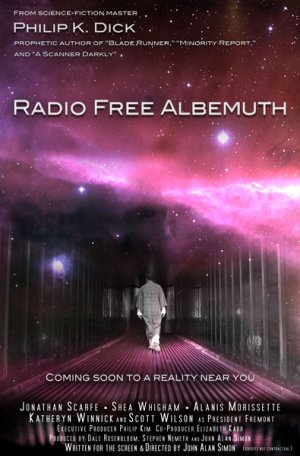
Saturday Matinee: Radio Free Albemuth

In light of Philip K. Dick’s birthday tomorrow (he would have been 90), it’s an appropriate time to visit (or revisit) the film adaptation of his posthumously published novel “Radio Free Albemuth”. Being a longtime PKD fan and one of the film’s Kickstarter contributors, I admittedly wouldn’t be a completely objective critic, but after having seen it a few times its achievements and shortcomings become more apparent.

Like the novel it’s based on, Radio Free Albemuth is one of the most personal of Philip K. Dick’s narratives, featuring the most faithful retelling of his 2-3-74 experiences. Filmed on a shoestring budget by John Alan Simon the movie has a fitting late 70s/early 80s aesthetic. Much of the dialogue is straight out of the novel but I personally would have wanted a more streamlined and nuanced script with less tangential details and exposition, though the actors across the board do a commendable job delivering their lines as naturally and believably as possible. The many dream sequences could have benefited from a higher budget and better visual consistency, but were able to accomplish what was needed for the plot. The prison scenes near the end seemed a bit rushed and not reflective of the oppressiveness of actual prisons, though that was probably largely due to budgetary reasons as well.

Despite its flaws, I still find the film engaging and worth recommending. Aspects of the story may come across to modern audiences as cheesy but still works on a meta level. In our sophisticated real life corporate techno-dystopia, the idea of individuals trying to incite revolution through subliminal messaging embedded in pop songs requires a suspension of disbelief. However in a more general general sense, countless creators through history (including writers and filmmakers) have made attempts to subvert society and culture with varying and impossible to quantify results.

Watch the full film on Hoopla here: https://www.hoopladigital.com/title/11350683

The Largest Conspiracy Theory Peddlers Are MSM And The US State Department

By Caitlin Johnstone

Source: CaitlinJohnstone.com

The US State Department has issued a statement accusing the Syrian government of having carried out a false flag chemical weapons attack in northwestern Aleppo with the intent to blame it on the jihadist factions in the region, citing “credible info” that the public has not been permitted to see. Never mind the known fact that there are actual, literal Al Qaeda affiliates who have admitted to using chemical weapons in Aleppo, and who are known to have used chemical weapons throughout Syria even by the State Department’s own admission: the Official Narrative is that only the Syrian government uses chemical weapons, so the chemical weapons usage must necessarily be a false flag staged by Syrian president Bashar al-Assad.

Except they didn’t use the words “false flag”. Despite the accusation being the exact definition of the thing that a false flag attack is, you won’t see the US government using that term, nor will you ever see it used in this instance by any of the authorized mainstream narrative-framing institutions like CNN or Fox News. This is because the term “false flag” is reserved solely for mention when referring to crazy, kooky Kremlin propaganda, as in the insane, unhinged, tinfoil hat belief that terrorists in Syria might possibly have some kind of motive to stage a false flag chemical attack in order to get the US, UK and France to act as their air force in a retaliatory strike against the Syrian government. That kind of false flag would be completely inconceivable to any right-minded empire loyalist, and is forbidden to even think about.

At the same time we are seeing a push from the mass media to advance a narrative that the Yellow Vests protests in France are due to Russian influence, with Iraq-raping neocon Max Boot publishing a column today in the Washington Post that is based entirely around the talking point that two trending Russian topics on social media have been “giletsjaune” and “France,” and Bloomberg putting out an article blatantly titled “Pro-Russia Social Media Takes Aim at Macron as Yellow Vests Rage”. Their entire theory is that since there are people in Russia talking about a major event that everyone else in the world is also talking about, the protests against Macron’s unpopular centrist policies are therefore the result of a conspiracy seeded by Russia.

But you’ll never hear this theory about a Russian conspiracy referred to as a “conspiracy theory” by the mainstream press. The theory that Russian elites have conspired to infiltrate the highest levels of the US government has been given serious treatment at the top echelons of media and political influence, despite its lacking any discernible evidence whatsoever, but when they talk about these alleged conspiracies they always make a point of using the word “collusion” instead. There is no actual difference between the words collude and conspire when used in this way, but the former is used because a deliberate effort has been made to stigmatize the word “conspiracy” while the word “collude” remains effectively neutral in the public eye.

But the fact of the matter is that conspiracy theories have gone mainstream, and there is no legitimate reason to call the authorized, power-manufactured conspiracy theories by a different name than the grassroots narratives like those about 9/11 or the JFK assassination. Indeed, due to the nature of populist folk narratives there is a lot more publicly available evidence contradicting the official 9/11 and JFK assassination stories than there is for the establishment Russia conspiracy theories, because those narratives often boil down to nothing more than secretive intelligence agencies saying “This is true because we said so.” Since grassroots conspiracy theories are unable to rely on empty assertions from authority, they tend to be built upon information that is publicly available.

Some people get annoyed with me for using the term conspiracy theory at all, but I insist that the phrase is itself intrinsically neutral: a theory about a conspiracy. The problem is not the phrase, it is the stigma that has been attached to that phrase by establishment media and establishment politicians; shifting to a different phrase to describe theories about conspiracies would only ensure that that phrase becomes stigmatized in the exact same way by the same sort of campaign. This would only ensure the survival of the tactic of regurgitating a pre-stigmatized label in the war of ideas instead of advancing actual arguments. The fact of the matter is that powerful people do indeed conspire, those conspiracies do indeed need to be talked about, and the largest promulgators of conspiracy theories are not Infowars or RT, but mainstream media and the US State Department.

Those who dismiss an idea by calling it a “conspiracy theory” without providing further argumentation are simply admitting to you that they have no argument, and it is right to point this out when they do it, because something being a conspiracy theory doesn’t mean it’s not grounded in facts. Some conspiracy theories are good and are backed by solid evidence, some are stupid and are circulated for intellectually dishonest reasons. Once upon a time you would be called a conspiracy theorist for saying the west is arming terrorists in Syria or the DNC is conspiring to ensure the primary victory of Hillary Clinton; those things are now conspiracy facts, as history has vindicated the solid theories which predicted them. Other conspiracy theories are promulgated by dim-witted partisan loyalists for no other reason than dim-witted partisan loyalty, like the aforementioned Russiagate conspiracy theory, or the QAnon conspiracy theory which claims Donald Trump is leading a rebellion against the Deep State as cryptically reported by an anonymous user on 8chan.

Other conspiracy theories are subscribed to simply because they help people escape the cognitive dissonance of conflicting beliefs. For example, a strong believer in capitalism who sees the undeniable signs that a plutocratic class has control of their government, but who cannot accept that this plutocratic takeover was facilitated by a rampant capitalist system which ensures that the greediest sociopaths rise to the top, may avoid cognitive dissonance by explaining the existence of the corrupt dominator class with conspiracy theories about Jews or pedovore cults. A liberal who cannot accept that neoliberal empire loyalists like Macron have failed to “make centrism cool” as Max Boot predicted will avoid cognitive dissonance by explaining the failures of the Church of the Status Quo with conspiracy theories about Russian social media campaigns.

Conspiracy theories, in reality, are nothing more than people’s attempts to explain what is going on in their world. Why Trump got elected. Why things stay shitty despite our perfectly rational attempts to change them. Why voting doesn’t seem to make much difference in the actual behaviors of one’s government. Why we keep marching into stupid wars, Orwellian dystopia and climate collapse despite having every incentive not to. Why the wealthiest of the wealthy keep getting wealthier while everyone else gets poorer and poorer. Some attempts to explain these things will come from a well-informed and intellectually honest place, and some will come from a myopic and intellectually dishonest place. Their individual merits can only be assessed on a case-by-case basis.

And in my opinion the conspiracy theories coming from the world’s most powerful institutions are the most dishonest by far. I saw a recent post by the WikiLeaks Twitter account which referred to the corporate media as “the narrative business pretending to be in the news business,” which is in my opinion a perfect way to phrase it. The real currency of the world is not gold, nor is it bureaucratic fiat, nor even raw military force; it’s narrative control. The ability to control the stories people tell about what’s going on in their world means the ability to control how they think, how they vote, how they behave, and how they all agree money and power itself operates within our society. Since society is made of narrative, controlling the narrative is controlling that society.

Conspiracy theories are a way for those in power to manipulate the narrative without actually giving the public any hard facts and evidence, and the world’s most powerful institutions are increasingly relying on conspiracy theories because they don’t have facts and evidence on their side. And why would they? The same power establishment which deceived the world into destroying Iraq is obviously far too depraved to be able to justify its global hegemony with factual evidence. All they have is narrative control, and they’re starting to lose even that.