RUDOLF STEINER: DWELLER ON THE THRESHOLD

By Gary Lachman

Source: Waking Times

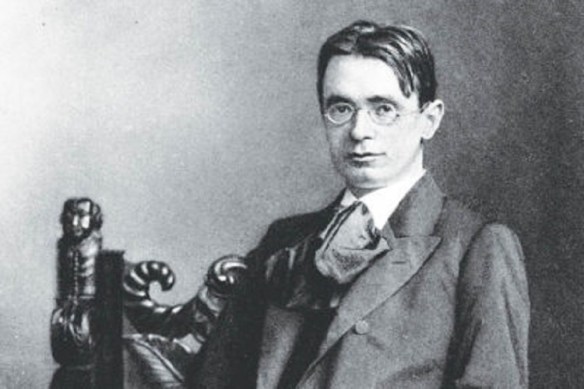
The most enigmatic figure to emerge from the “occult revival” of the early twentieth century was also the most successful, the Austrian “spiritual scientist” Rudolf Steiner (1861-1925). Although many of his contemporaries were outwardly more eccentric – think of Madame Blavatsky, Gurdjieff or Aleister Crowley – it’s precisely Steiner’s sobriety that is so striking, making him seem somewhat out of place in the often flamboyant world of the esoteric.

We generally associate ideas of the occult, higher consciousness and spiritual worlds with exotic, extraordinary characters with something of the trickster about them; Blavatsky, Gurdjieff and Crowley would certainly fall into this category. Steiner was precisely the opposite. Standing at the lectern with his pince-nez in hand, he projected an image of irreproachable rectitude. Steiner was earnestness incarnate, his one gesture of bohemian extravagance the flowing bow ties he was fond of wearing, a remnant of his early student days. Where Blavatsky, Gurdjieff and Crowley each took pains to present a formidable self-image, there was something simple and peasant-like about Steiner. Combined with this wholesomeness was an encyclopedic erudition. If we were to use an archetype to describe Steiner, it would have to be that of “the Professor” – or more precisely, “the Doctor,” as he was known by those around him. Commenting on her magnum opus, The Secret Doctrine, Madame Blavatsky once remarked that she “wrote, wrote, wrote” like the Wandering Jew “walks, walks, walks.” Steiner too wrote a great deal, but his main mode of disseminating his ideas was lecturing, and in the years between 1900 and 1925, he lectured, lectured, lectured, delivering more than 6,000 talks across Europe.

In a dry and often pedantic style, Steiner informed his audience of the results of his spiritual research, his “supersensible” readings of the occult history of the world made available to him through what is called “the Akashic Record.” In matter-of-facts terms, he introduced them to his teaching, Anthroposophy, telling them along the way about ancient Atlantis, life after death, astral and etheric bodies, the true meaning of Christianity and much, much more. Yet this humble, self-effacing character became one of the most influential, and simultaneously vilified, forces in the spiritual and cultural life of early twentieth century Europe, and his ideas are still relevant today.

Steiner’s efforts to lead “the Spiritual in the human being to the Spiritual in the Universe” have produced remarkably concrete results. Since his death, more than 1,000 schools around the world work with Steiner’s pedagogical principles, not to mention the many special-needs schools, working along lines developed by Steiner a century ago. There are also the hundreds of “bio-dynamic” farms, employing Steiner’s agricultural insights, developed decades in advance of our interest in ecology and organic foods. The practical application of Steiner’s ideas had also informed very successful avenues in holistic healing, the arts, architecture, economics, religion and other areas.

Given these achievements in the “real world,” which certainly exceed those of other esoteric teachers, why isn’t Steiner better known? You would reasonably expect the average educated person to have some idea of who, say, Jung is, or Krishnamurti, or the Dalai Lama; possibly even Blavatsky, Gurdjieff or Crowley. But Steiner? He remains something of a mystery, a name associated with a handful of different disciplines and endeavours, but not solidly linked to any one thing. He remains, as one of his most eloquent apologists, the Inkling Owen Barfield, called him “the best kept secret of the twentieth century.” It’s certainly time that he was better known.

Rudolf Steiner was born on 27 February 1861, in the small rural town of Kraljevec in what was then Hungary but is today part of Croatia. His father was a telegraph operator for the Southern Austrian Railway, and Steiner spent his first years amidst magnificent scenery: mountain ranges and green plains were his playgrounds. Steiner felt that it was significant that he grew up in a part of Europe where East meets West, as it was also significant that childhood had an equal measure of natural beauty and modern technology – at the time, both the railways and the telegraph were relatively new innovations.

In Knowledge of the Higher Worlds and its Attainment (1905), Steiner relates that a crucial experience on the path of higher consciousness is an encounter with the Guardian of the Threshold, a spiritual being embodying one’s unredeemed karma. Well before his career as an esoteric teacher, Steiner was himself a dweller on several thresholds, having one foot in the mysteries of nature, the other in the methodology of science. It was this combination of mystic visionary and disciplined thinker that gave Steiner’s later career its peculiar character.

When Steiner was eight, his father was transferred to Neudörfl, near the border with Lower Austria. An argument with the local teacher led his father to educate the boy himself, and this meant that he spent a great deal of time on his own at the railway station where his father worked. Young Steiner was deeply introverted; as he admits in his Autobiography (1925), he had great difficulty relating to the outer world. He also had an inquisitive mind and was obsessed with many questions the adults he knew seemed unable to answer. This subjectivity might have taken a morbid turn were it not for his discovery of mathematics. When Steiner came upon a book of geometry, it was a revelation. “That one can work out forms which are seen purely inwardly, independent of the outer senses, gave me a feeling of deep contentment. I found consolation for the loneliness caused by the many unanswered questions. To be able to grasp something purely spiritual brought me an inner joy. I know that through geometry I first experienced happiness.”1

Steiner’s joy upon discovering geometry may strike us as odd, yet the experience was essential in getting him through an early crisis. What impressed Steiner so greatly about geometry was that it seemed to offer proof that within the mind there existed a kind of “soul space,” an inner equivalent of the external space of the natural world. The soul space was “the setting for spiritual beings and events.” Thoughts for the young Steiner were not “mere pictures we form of things”; they were rather the “revelations of a spiritual world seen on the stage of the soul.” Geometry, Steiner believed, although produced by the human mind, had an objective reality independent of it, and for him this meant that the soul space in which it was revealed was also real.2

Rather precocious stuff, perhaps, but Steiner’s early years included an event that made him question the outer world’s monopoly on reality.

A Paranormal Encounter

One day at the railway station, he had a paranormal experience, an early manifestation of his psychic abilities. Sitting in the waiting room, he saw a strange woman enter; although he didn’t know her, he felt she resembled other members of his family. Standing in the middle of the room, the woman spoke to the boy. “Try to help me as much as you can – now as well as in later life,” she said. Then she walked into the stove and disappeared. Steiner decided not to tell his parents, afraid that they would scold him for lying. But he noticed that his father was sad, and he later discovered that a female relative who lived in the neighbouring town had committed suicide at the same time that he had had his vision.

This early experience marks for Steiner the beginning of a life-long involvement with the dead. Much of his later esoteric teaching involves accounts of the soul’s experiences in the afterlife and of the machinery of karma and reincarnation, the balancing of the spiritual books that casts the departed back into the stream of life in order to complete their tasks. While other boys of his age were fantasising about the Austrian equivalent of cowboys and Indians, Steiner was preoccupied with the reality of the spirit worlds and the soul’s encounter with the beings that inhabit them.

Later, as a young man, Steiner would on two occasions have unusual opportunities to verify some of his ideas about the meaning of death. Twice he would come into intimate contact with families in which the father was a recluse who would die soon after Steiner made their acquaintance. Yet on both occasions, although never actually meeting the man, Steiner formed a profound intuitive relation with the deceased, so deep and insightful in fact that he was asked by both families to give the funeral orations. Later still, during his years as an esoteric teacher, Steiner informed his followers that one means of helping the dead in their spiritual journeys was to read to them from his writings.

When Steiner was eighteen, his father was transferred once again, this time to Inzersdorf. His new location had the advantage of being close to Vienna, and it was decided that Steiner would study at the Technical School there. Although he had leanings toward literature and philosophy, he chose instead to work towards becoming a science teacher.

One day on the train to Vienna, he met a man who would have a profound influence on his life. Felix Koguzki was a herb-gatherer who travelled to Vienna regularly to sell his wares. It’s not known how they fell into conversation, but the teenaged Steiner soon discovered that this simple, uneducated man had strange experiences like his own, and a deep, personal knowledge of the other worlds. He was the first person with whom he could speak about his spiritual visions, and their talks boosted Steiner’s confidence; more than likely, they also convinced him that he wasn’t crazy.

Meeting a Master

Around the same time, Steiner had an encounter with another individual whose name has not come down to us. Steiner refers to him only as “the Master.” The French writer Edouard Schuré, author of the bestselling The Great Initiates (1889), and later a friend and follower of Steiner, remarked that the Master was “one of those potent personalities who are on Earth to fulfil a mission under the mask of some homely occupation.” Steiner had by this time read widely in philosophy, specifically the German Idealists, and had worked his way through Hegel, Schelling and several others, absorbing Kant’s Critique of Pure Reason during his history class, which bored him. Steiner was obsessed, then and later, with refuting scientific materialism, and this became the impulse that drove his philosophical studies.

Although he doesn’t mention this episode in his Autobiography, in a lecture given in Berlin in 1913, Steiner spoke of the experience. Speaking in the third person, he told his audience: “from that time onward a soul-life began to develop in the boy which made him entirely conscious of worlds from which not only external trees or mountain speak to the human soul, but also the Beings who live behind them…”3

What little we know of the Master is that he pointed out some passages in the work of Johann Gottlieb Fichte, one of Kant’s most important followers, which helped Steiner in his quest. Fichte’s work focused on the centrality of the human ego, the “I,” the locus of consciousness and the self that scientific materialism argued was mere illusion. Steiner’s spiritual experiences convinced him that this was palpably false and the “I,” rather than being an illusion, was a concrete, irreducible reality. For the next twenty years, until Steiner’s re-invention as a spiritual leader, his work would focus on developing a methodical epistemology proving this fact.

Introduction to Goethe

The single most important influence on his ideas, however, was the work of Johann Wolfgang von Goethe. Goethe is best known for his drama Faust (1808-1832), which takes a cautionary tale about a pact with the Devil and transforms it into an archetype of Western consciousness. Although he’s never enjoyed the same reputation among English speakers, Goethe is one of the Olympians of Western literature, sharing the top shelf with Plato, Dante and Shakespeare (Jung too thought Goethe a key figure, even to the extent of sometimes believing he was an illegitimate descendent of the great man.) Often regarded as the last true Renaissance man, Goethe was not just a giant of literature but also a statesman, traveller, and most important for Steiner, a scientist, making important contributions to botany, anatomy, mineralogy, and optics. Through his literature tutor Karl Schröer, who opened his mind to Goethe’s importance, Steiner was offered what must have seemed the chance of a lifetime. At twenty-two, he was head-hunted as the editor of Goethe’s scientific writings for a major edition of the polymath’s work.

For an unknown rural scholar to be offered such a position might seem unusual, but the general consensus on Goethe’s scientific musings at this point was that they were useless as science and dreary as literature; in truth, no one else wanted the job of editing them. Aside from his early success in proving that the human upper jaw contained the intermaxillary bone found in other mammals – Goethe was, in a different way, an evolutionist long before Darwin – most scientists found Goethe’s attempts to disprove Newton’s theory of colour, or to demonstrate the existence of what he called the Urpflanze, the archetypal plant from which others emerged, muddleheaded if not insane.

Yet for Steiner, Goethe’s science was the prototype for what would become his own phenomenology of the spirit worlds. Instead of the conventional scientist’s cold, dispassionate eye regarding the world as mere matter, passive to his intrusions, Goethe called instead for “objective imagination,” an active participation in the reality under scrutiny. The subjectivity of the scientist – his state of consciousness – was vastly more important than the increasingly hair-splitting exactitude provided by his instruments. This “objective imagination” became for Steiner the basis for his own “supersensible cognition.”

Encountering Nietzsche

Steiner’s work on Goethe opened many doors. One led to Weimar, Goethe’s city, where he was asked to work on the Goethe Archive, another prestigious task. Although Steiner found few congenial colleagues, the work had other compensations. He was introduced to the city’s literary and cultural life and made many acquaintances. One in particular led to a momentous meeting. Elizabeth Forster Nietzsche, sister of the ill-fated philosopher, approached Steiner to work with her in establishing a Nietzsche Archive. This led to Elizabeth introducing Steiner to her brother, who had been insane from syphilis for several years. Elizabeth had taken to dressing the defenceless Friedrich in a toga, and positioning him by the window, where his blank stare and unkempt appearance provided the impression of a great prophet. Steiner, aware of Nietzsche’s madness, was nevertheless impressed – not with the figure before him, but with its spiritual aura. He saw Nietzsche’s soul “hovering over his head, infinitely beautiful in its spiritual sight…” It was a soul that “brought from former lives on Earth golden riches of great spirituality…”4

If mention of Nietzsche’s “soul” brimming with “golden riches of great spirituality” suggests to readers familiar with the author of Beyond Good and Evil and The Antichrist that Steiner was as ignorant of Nietzsche’s philosophy as his sister Elizabeth notoriously was, they should have a look at Steiner’s book Friedrich Nietzsche: Fighter for Freedom (1895), a remarkable perceptive study which at times even reads like Nietzsche. Throughout his career, Steiner had an uncanny knack for entering into and defending the ideas of thinkers with whom he had profound disagreements – like the staunch materialist Ernst Haeckel – a critical sympathy that often led to much misunderstanding.

When his work at Weimar was ending, rather than embark on academic career (Steiner had received his doctorate in philosophy during his stay and could easily have found a comfortable niche somewhere), he decided instead to move to Berlin, home of Germany’s nascent avant-garde. He had by this time published what many believe to be his most important book, The Philosophy of Freedom (1894), an exhilarating, if often difficult work of epistemology which Steiner believed established beyond doubt the reality of the human “I.” Others, like the influential philosopher Eduard von Hartmann, author of the once immensely popular The Philosophy of the Unconscious, were less convinced and suggested he had muddled the question. Steiner, however, was undaunted and believed he had a mission to disseminate his ideas. He also needed to find work. Although his followers tend to see Steiner’s life as the undeviating unfolding of a pre-ordained destiny – and Steiner himself, we must admit, contributes to this belief – like the rest of us, he was looking for his place in the world and the means to get on in it. He was also filled – rightly so – with the conviction of his own genius. The literary and cultural world of Berlin might offer opportunities not available elsewhere.

Steiner, however, made the thoroughly impractical decision of buying a moribund periodical, The Magazine for Literature. His previous brief catastrophic experience in Vienna as an editor of a political magazine seemingly forgotten, Steiner proceeded to run the already failing Magazine for Literature into the ground, alienating its readers with his persistent exhortations regarding the spiritual life. In the age of Strindberg, Wilde, Ibsen, Wedekind, and Shaw, Steiner’s idealism seemed a stale leftover from a forgotten time.

Yet, although he bemoaned the burden destiny had placed on him, Steiner seems to have enjoyed hobnobbing with bohemians: his acquaintances include poets, playwrights, novelists and political activists. In fact, his reputation among the demi-monde caused academics to cancel their subscriptions, and Steiner earned the unique distinction of being the one esoteric teacher – as far as I know – to have a periodical banned in Czarist Russia, because its editor was known to socialise with anarchists.

It was also in Berlin that Steiner married his first wife, although one gets the impression that the relationship with Anna Eunicke was little more than platonic. Anna had been Steiner’s landlady in Weimar, and when he moved to Berlin she followed him. There he moved in with her again, and, almost as an afterthought, married her in 1899 in a civil ceremony. (It was in the Eunicke household in Weimar that Steiner had had one of his experiences with the death of a reclusive father.) Anna, not particularly well-educated or cultured, was apparently very happy to have Herr Doctor Steiner under her roof; Steiner, for his part, thus avoided the “misery of living alone,” as well as that of the cheap lodgings and bad food he had endured up till then. Anna was ten years older than Rudolf, and their relationship raises the question of Steiner’s sexuality, of which there is no mention in the entire 406 pages of his Autobiography. I do have it on the authority of one Steiner scholar, Christopher Bamford, that the Doctor was indeed celibate.

Berlin & Theosophy

But it was in Berlin that Steiner’s real career began. For a time he seemed willing to speak to any group who would listen to him. He lectured on history and other subjects at the Workingman’s College, surreptitiously slipping large doses of Idealism to budding Marxist materialists. He also lectured to the Giordano Bruno Society and The Coming Day, a quasi-Nietzschean cultural group. He managed, however, to alienate all of this (as well as Anna Eunicke, whom he soon left) when he accepted a request to lecture to the Berlin Theosophical Society. For years, Steiner had tried to express his insights into the spiritual worlds under the cover of philosopher. Now, at the turn of the century and the age of forty, he decided to forgo the camouflage and speak directly of his experiences.

Steiner quickly rose to prominence among the Theosophists and was soon made head of the society’s branch. One member of his audience was particularly struck. Marie von Sivers, who became Steiner’s second wife in 1914, was a Baltic Russian actress. She asked if it weren’t time for a new spiritual movement to arise in Europe. More to the point, didn’t Steiner think he should lead it? Steiner did, but he insisted that any such movement would be firmly based on Western esoteric sources. Steiner had recently passed through a spiritual crisis which convinced him that the “Christ event” was the single most important incident in human history. He had no time for “Eastern wisdom” or mystic Mahatmas. He more or less adopted the cosmic evolutionary framework of Madame Blavatsky’s Secret Doctrine and informed it with large helpings of German Idealist philosophy and Christian mysticism, developing a peculiarly idiosyncratic neo-Rosicrucian system of esoteric thought, aided by his own readings of the Akashic Record. In light of this it’s difficult to ignore the occult historian James Webb’s remark that Steiner joined the Theosophical Society in order to take it over.

His relationship to the society was rocky, and in 1913 he and its head, the ex-Fabian Annie Besant, came to rhetorical blows over C.W. Leadbeater’s advocacy of the Indian boy Krishnamurti as the second coming of Christ. Steiner was disgusted at the idea, and even more so at Leadbeater’s known paedophilic predilections. He demanded Besant’s resignation; she retaliated by ex-communicating him. Steiner left with much of his flock – by this time several thousand – and started his own group, the Anthroposophical Society. As opposed to Theosophy, which spoke of the wisdom of the gods, anthroposophy was concerned with the wisdom of the human being.

Building a New Movement & the Goetheanum

Practically the first thing Steiner did was to build a temple for his new movement. Land was secured in Dornach, Switzerland, and during WWI Steiner gathered a community of followers from several different countries to construct the Goetheanum, a weirdly beautiful fusion of art nouveau and Expressionist architecture that Steiner himself designed. His lecturing was curtailed by the fighting, but his greatest popularity came with the war’s end. Steiner’s plan to reconstruct Europe, The Threefold Commonwealth (1922), sold some 80,000 copies in its first edition, and audiences for his public appearances were now in the thousands; on one occasion the crowds outside a Berlin auditorium were so great they stopped traffic.

This period, however, also saw the start of the anti-Steiner campaign that would plague him henceforth. Practically everybody hated him: Catholics, Protestants, Marxists, proto-Nazis, not to mention other esotericists. There were at least two attempts on his life, and the number of occult attacks fomented by the “black brotherhoods” is unknown. One clear victory from this time was the establishment of the first Steiner school in Stuttgart in 1919. Based on pedagogical principles developed over decades of tutoring – in Vienna he had cured a retarded hydrocephalic boy to the extent that child grew up to earn a medical degree – Steiner’s educational ideas earned him deserved renown, and an international reputation among experts that continues today.

Steiner endured vilification in the press and disruption at his lectures with equanimity, but one victim of the attacks was, many believe, the Goetheanum, which burned to the ground on New Year’s Eve 1922. Arson by right-wing proto-Nazis is the common assumption, although an electrical fault remains a possibility. In any case, a decade’s effort, not to mention an architectural wonder, was lost overnight: the building was made of the same wood as that used in making violins and burned fiercely. Steiner took the tragedy as a sign that some changes in the society were necessary. His original occult teachings, based on the idea of an evolution of consciousness and the ability to achieve “supersensible thinking,” were, he felt, obscured by the success of subsequent initiatives.

Steiner education, the Christian Community (a religious group using Steiner’s ideas), the Threefold Movement for social change, eurythmy – a form of what he called “visible speech” – and newer developments like bio-dynamic farming and anthroposophical medicine were taking centre stage. Steiner had attracted many younger followers after the war, eager to rebuild society, and these clashed with his older, more esoterically inclined devotees. Bickering within the Anthroposophical Society, whose numbers had swollen in the post-war years, threatened to undo much that had been achieved. On the first anniversary of the Goetheanum’s destruction, Steiner announced plans for a second temple; it stands today in Dornach, defiantly made of concrete. He also told his followers that he was reconstructing the society as well. Although he had not previously even been a member of the society, remaining only its spiritual guide and adviser, he now declared himself president of the newly formed General Anthroposophical Society which, although most successful in Germany, today has branches around the world.

Ahriman & Coming World Inferno

Steiner’s last years were spent in sowing as many seeds as possible for future work; they were also darkened by his belief in a coming world conflagration, when the archangel Michael, overseer of the current stage of human consciousness, would face off against the power of Ahriman, a spiritual being who seeks to prevent humanity’s development. Steiner spoke ominously of the incarnation of Ahriman, an Antichrist-like figure, whose display of miraculous powers would precede a catastrophic “war of all against all.” Steiner believed this unavoidable destiny would take some time to unfold – Ahriman is scheduled to arrive in the 3000s – yet many of his followers suspect that in recent years the process has been speeded up. Steiner himself had grave doubts about the growing pace of technological development, warning his followers that materialist science gains its great power through unwittingly releasing Ahrimanic entities. In his last communications, Steiner called on his followers to develop their consciousness in order to rise above nature to the same extent that technology sank below it. He also gave series of lectures about karma and its work in human history.

Steiner died on 30 March 1925. He had been ill for at least a year with an undisclosed stomach ailment, although there is some speculation he had been poisoned. He continued lecturing until it was physically impossible for him to do so, and his followers were astounded when, on the evening of his last scheduled lecture, they found a note saying that it had to be cancelled because of the Doctor’s health. Nothing like this had ever happened before. The Doctor, they believed, was invulnerable.

The exact nature of Steiner’s illness remains unknown, but it is clear that his inability to refuse help to those who came to him was a key factor. Along with his public and private lectures, and his practical work as a teacher, architect, and agriculturalist, Steiner made himself available to any who needed his counsel. For many years, he had practically no free time, and wherever he went his hotel room saw a constant stream of visitors including, on one occasion, Franz Kafka. Some asked about their astral bodies; others their diet or their marriages; Kafka asked about his writing. Steiner advised them all, giving little bits of himself to thousands. He was, as the Russian novelist Andrei Biely, a follower, once remarked, “a giant of the power of kindness.”5 It’s not hard to see how such solicitude would eventually wear anyone down.

In the end, it’s difficult to give an exact assessment of a man whose work combines cogent criticisms of Kant with accounts of life in Atlantis. But this “mild, gentle, good, kindly man,” whose achievement in “humanitarian terms is remarkable and enduring,” as the psychiatrist Anthony Storr wrote of Steiner in his study of gurus, Feet of Clay, remains, for devotees and non-initiate alike, something of an enigma.

Death: A Simple Idea with a Powerful Punch

By Edward Curtin

Source: Off-Guardian

Since death is one idea that has no history except as an idea and not a reality any of us have experienced, it is the most frightening idea there is and also quite simple. It is the ultimate unknown. It has always haunted human beings, whether consciously or unconsciously.

It lies at the root of war, violence, religion, art, love, and civilization. The good and the bad, the beautiful and the ugly, why we like to win and not lose, pass and not fail, “pass on” and not die. It is so funny and so sad. We would be lost without it, even when we feel lost when thinking about it. And it is fundamental for understanding the action and reaction to Covid-19.

Societies have always been people banded together in the face of death. And since people are not just physical beings but symbolic creatures who can think and imagine the past and the future, societies are necessarily mythic symbol systems whose job is not only to protect people physically, but symbolically as well.

Sometimes, however, the protection is a protection racket with racketeers holding people hostage to fabricated fears that keep them locked in a living-death.

Thus death, this most potent imaginative idea and reality that doesn’t exist except as a mystery about which anything we say is speculation, can be used for good and evil, depending on who controls society.

Death is the great fear, the human haunting that hangs by a thread over life like the sword of Damocles.

In 1944 in a newspaper column, George Orwell made an astute remark:

There is little doubt that the modern cult of power worship is bound up with the modern man’s feeling that life here and now is the only life there is. If death ends everything, it becomes much harder to believe that you can be in the right even if you are defeated…. I would say that the decay in the belief in personal immortality has been as important as the rise of machine civilization.

Beliefs, of course, like “personal immortality” and all others, such as the recent rise in the belief in atheism, which is as much a belief as belief in God, are, partially at least, relative to time and place, and develop out of social storytelling. The “hard facts” on which many feel their lives and security rest are themselves dependent upon the symbols which give them legitimacy.

Reality is indeed precarious with society suspended by a web of myths and symbols. It is through cultural and social symbol systems that society’s meaning is transmitted to individuals, and it is within the symbol systems that the control and release of action resides.

In today’s electronic mass media world, those who control the mass media that control the narrative flow – the storytelling – control the majority’s beliefs and actions.

Since society is held together by this myth system – the beliefs and values people live for and live by – that sustains it, societies have always had to offer symbolic “answers” to death. For without a meaningful symbolic for coming to terms with death, human action would be stymied and people would be reduced to what the psychiatrist Allan Wheelis termed “intense, preoccupying yearning.”

Today we can hear such yearning everywhere.

Shortly after Orwell made his prescient comment in The Tribune, nuclear weapons were developed and used by the United States to kill hundreds of thousands of innocent Japanese civilians. With those weapons and their use, the ages-old symbolic narrative of life and death was transformed in a flash.

“The significance of the possibility of nuclear death is that it radically affects the meaning of death, of immortality, of life itself,” wrote Hans Morgenthau.

The traditional symbolic sources that once served to allow humans to transcend death were fundamentally undercut, and the search for new modes of death transcendence was carried on beneath the portentous covering of the nuclear umbrella.

A qualitative transformation in the meaning of human existence was thus brought about as humans, who had the weapons, replaced the belief in God as the holder of the power over life and death, since nuclear war could result in the extinction of human life, leaving no one left to die.

This is our world today, and it is where the Covid-19 story takes place. A world not just of nuclear fear, but a host of other fears constantly inflamed by the mass media that hypnotize people through the conjuring of death-fear.

In his great work on group psychology, Freud showed us how it was not just mental contagion and the herd instinct that got people to join in group behavior. People could be induced to become little children and obey their leaders because they have “an extreme passion for authority.”

When leaders speak, the children hear the inner voices of their parents telling them to be careful, be very careful, the bogeyman is everywhere, so listen and obey. Freud, the Jewish atheist, and Dostoevsky, the Russian Orthodox Christian, were in agreement about people’s desire to give up their freedom to authority figures who would allegedly shelter them within their warm embrace.

The easiest way to do this is to convince people that death is stalking them, for the bogeyman is always death in one form or another.

It works to get people to support the terrifying sadism of wars against fabricated “others,” who are always portrayed as aliens who are out to kill the good people.

It works to get people to give up their freedoms out of fear of “terrorists,” who are said to slide and hide in the interstices of everyday life, ready to pounce and kill at any moment.

And it works to get people to obey orders to protect themselves from terrifying viruses that are lying in wait everywhere to strike them dead.

In his novel The Brothers Karamazov, Dostoevsky said that people want miracles, mystery, and authority, not freedom. His Grand Inquisitor, while a fictional creation, lives on in reality.

For the Grand Inquisitor represents those power elites across the world who wish to cower people into accepting their dicta on Covid-19 as truth without questioning its logic or rationale.

To question has become an act of insubordination deserving death by censorship or the defiling of one’s name via the term “conspiracy theorist,” a name used by the CIA to dismiss anyone questioning its murder of President Kennedy. Death comes in many forms, and the fear of it has always been used by the powerful to render the common people speechless and obedient.

How can any thinking person, anyone not totally crippled by fear, not question what is going on with the coronavirus disaster when reading what Peter Koenig, a thirty-year veteran economist of the World Bank and World Health Organization, writes in his article The Farce and Diabolical Agenda of a ‘Universal Lockdown’:

The pandemic was needed as a pretext to halt and collapse the world economy and the underlying social fabric.

There is no coincidence. There were a number of preparatory events, all pointing into the direction of a worldwide monumental historic disaster. It started at least 10 years ago – probably considerably earlier – with the infamous 2010 Rockefeller Report, which painted the first phase of a monstrous Plan, called the “Lock Step” scenario. Among the last preparatory moves for the “pandemic” was Event 201, held in NYC on 18 October 2019.

The event was sponsored by the Johns Hopkins Center for Public Health, the Bill and Melinda Gates Foundation (BMGF) and the World Economic Forum (WEF), the club of the rich and powerful that meets every January in Davos, Switzerland. Participating were a number of pharmaceuticals (vaccine interest groups), as well as the Centers for Disease Control and Prevention (CDC)’s of the US and – of China.

One of the objectives of Event 201 was a computer simulation of a corona virus pandemic. The simulated virus was called SARS-2-nCoV, or later 2019-nCoV. The simulation results were disastrous, killing 65 million people in 18 months and plunging the stock market by more than 30% — causing untold unemployment and bankruptcies. Precisely the scenario of which we are now living the beginning.

The Lock Step scenario foresees a number of ghastly and disturbing events or components of The Plan to be implemented by the so called Agenda ID2020, a Bill Gates creation, fully integrated into the UN’s Sustainable Development Goals (SDG) – target date for completion – 2030 (also called Agenda 2030, the hidden agenda unknown to most of the UN members), the same target date for completion of the Agenda ID02020.

I ask the question but I am afraid I know the answer: miracle, mystery, and authority usually defeat evidence and simple logic. Fear of death and free thought scare children. The Grand Inquisitor lives on:

But man seeks to bow before that only which is recognized by the greater majority, if not by all his fellow-men, as having a right to be worshipped; whose rights are so unquestionable that men agree unanimously to bow down to it.

Death: A simple idea with such a powerful punch.

Slow suicide and the abandonment of the world

By Edward Curtin

Source: Intrepid Report

“The condition of alienation, of being asleep, of being unconscious, of being out of one’s mind, is the condition of the normal man. Society highly values its normal man. It educates children to lose themselves and to become absurd, and thus to be normal. Normal men have killed perhaps 100,000,000 of their fellow normal men in the last fifty years. Our behavior is a function of our experience. We act the way we see things. If our experience is destroyed, our behavior will be destructive. If our experience is destroyed, we have lost our own selves.”—R.D. Laing, The Politics of Experience, 1967

“The artist is the man who refuses initiation through education into the existing order, remains faithful to his own childhood being, and thus becomes ‘a human being in the spirit of all times, an artist.’”—Norman O. Brown, Life Against Death

Most suicides die of natural causes, slowly and in silence.

But we hear a lot about the small number of suicides, by comparison, who kill themselves quickly by their own hands. Of course their sudden deaths elicit shock and sadness since their deaths, usually so unexpected even when not a surprise, allow for no return. Such sudden once-and-for-all endings are even more jarring in a high-tech world where people are subconsciously habituated to thinking that everything can be played back, repeated, and rewound, even lives.

If the suicides are celebrities, the mass media can obsess over why they did it. How shocking! Wasn’t she at the peak of her career? Didn’t he finally seem happy? And then the speculative stories will appear about the reasons for the rise or fall of suicide rates, only to disappear as quickly as the celebrities are dropped by the media and forgotten by the public.

The suicides of ordinary people will be mourned privately by their loved ones in their individual ways and in the silent recesses of their hearts. A hush will fall over their departures that will often be viewed as accidental.

And the world will roll on as the earth absorbs the bodies and the blood. “Where’s it all going all this spilled blood,” writes the poet Jacques Prévert. “Murder’s blood . . . war’s blood . . . blood of suicides . . . the earth that turns and turns with its great streams of blood.”

Of such suicides Albert Camus said, “Dying voluntarily implies you have recognized, even instinctively, the ridiculous character of that habit [of living], the absence of any profound reason for living, the insane character of that daily agitation, and the uselessness of suffering.” He called this feeling the absurd, and said it was widespread and involved the feeling of being an alien or stranger in a world that couldn’t be explained and didn’t make sense. Assuming this experience of the absurd, Camus wished to explore whether suicide was a solution to it. He concluded that it wasn’t.

Like Camus, I am interested in asking what is the meaning of life. “How to answer it?” he asked in The Myth of Sisyphus. He added that “the meaning of life is the most urgent of questions.” But I don’t want to explore his line of reasoning to his conclusions, whether to agree or disagree. I wish, rather, to explore the reasons why so many people choose to commit slow suicide by immersing themselves in the herd mentality and following a way of life that leads to inauthenticity and despair; why so many people so easily and early give up their dreams of a life of freedom for a proverbial mess of pottage, which these days can be translated to mean a consumer’s life, one focused on staying safe by embracing conventional bromides and making sure to never openly question a system based on systemic violence in all its forms; why, despite all evidence to the contrary, so many people embrace getting and spending and the accumulation of wealth in the pursuit of a chimerical “happiness” that leaves them depressed and conscience dead. Why so many people do not rebel but wish to take their places on this ship of fools.

So what can we say about the vast numbers of people who commit slow suicide by a series of acts and inactions that last a long lifetime and render them the living dead, those whom Thoreau so famously said were the mass of people who “lead lives of quiet desperation”? Is the meaning of life for them simply the habit of living they fell into at the start of life before they thought or wondered what’s it all about? Or is it the habit they embraced after shrinking back in fear from the disturbing revelations thinking once brought them? Or did they ever seriously question their place in the lethal fraud that is organized society, what Tolstoy called the Social Lie? Why do so many people kill their authentic selves and their consciences that could awaken them to break through the social habits of thought, speech, and action that lead them to live “jiffy lube” lives, periodically oiled and greased to smoothly roll down the conventional highway of getting and spending and refusing to resist the murderous actions of their government?

An unconscious despair rumbles beneath the frenetic surface of American society today. An unspoken nothingness. I think the Italian writer Robert Calasso says it well: “The new society is an agnostic theocracy based on nihilism.” It’s as though we are floating on nothing, sustained by nothing, in love with nothing—all the while embracing any thing that a materialistic, capitalist consumer culture can throw at us. We are living in an empire of illusions, propagandized and self-deluded. Most people will tell you they are stressed and depressed, but will often add—“who wouldn’t be with the state of the world”—ignoring their complicity through the way they have chosen compromised, conventional lives devoid of the spirit of rebellion.

I keep meeting people who, when I ask them how they are, will respond by saying, “I’m hanging in there.”

Don’t common sayings intimate unconscious truths? Hang—among its possible derivatives is the word “habit” and the meaning of “coming to a standstill.” Stuck in one’s habits, dangling over nothing, up in the air, going nowhere, hanging by a string. Slow suicides. The Beatles’ sang it melodically: “He’s a real nowhere man/Sitting in his nowhere land/Making all his nowhere plans for nobody/Doesn’t have a point of view/Knows not where he’s going to/Isn’t he a bit like you and me.” It’s a far cry from having “the world on a string,” as Harold Arlen wrote many years before.

Maybe if we listen to how people talk or what popular culture throws up, we will learn more through creative associations than through all the theories the experts have to offer.

There have been many learned tomes over the years trying to explain the act of suicide, an early and very famous one being Emile Durkheim’s groundbreaking sociological analysis Suicide (1897). In thousands of books and articles other thinkers have approached the subject from various perspectives—psychological, philosophical, biological, etc. They contain much truth and a vast amount of data that appeal to the rational mind seeking general explanations. But in the end, general explanations are exactly that—general—while a mystery usually haunts the living whose loved ones have killed themselves.

But what about the slow suicides, those D. H. Lawrence called the living dead (don’t let “the living dead eat you up”), those who have departed the real world for a conscienceless complacency from which they can cast aspersions on those whose rebellious spirits give them little rest. Where are the expert disquisitions about them?

We’ve had more than a century of pseudo-scientific studies of suicide and the world has gotten much worse. More than a century of psychotherapy and people have grown progressively more depressed. Large and increasing numbers are drugged to the teeth with pharmaceutical drugs and television and the Internet and cell phones and shopping and endless talk about food and diets and sports and nothing. Talk to talk, surface to surface. Pundits pontificate daily in streams of endless bullshit for which they are paid enormous sums as they smile with their fake whiter-than-white teeth flashing from their makeup masks. People actually listen to these fools to “inform” themselves. They even watch television news and think they know what is happening in the world. We are drowning in a “universe of disembodied data,” as playwright John Steppling has so aptly phrased it. People obsessively hover over their cell phones, searching for the key that will unlock the cells they have locked themselves in. Postliteracy, mediated reality, and digital dementia have become the norm. Minds are packaged and commodified. Perhaps you think I exaggerate, but I feel that madness is much more the norm today than when Laing penned his epigraphic comment.

Not stark raving screaming madness, just a slow, whimpering acceptance of an insane society whose very fabric is toxic and which continues its God-ordained mission of spreading death and destruction around the world in the name of freedom and democracy, while so many of its walking dead citizens measure out their lives with coffee spoons. A nice madness, you could say, a pleasant, depressed and repressed madness. A madness in which people might say with T. S. Eliot’s J. Alfred Prufrock (if they still read or could remember): “I have measured out my life with coffee spoons . . . And I have seen the eternal Footman hold my coat, / and snicker, / And in short, I was afraid.”

But why are so many so afraid? Everyone has fears, but so many normal people seem extremely fearful, so fearful they choose to blend into the social woodwork so they don’t stand out as dissenters or oddballs. They kill their authentic selves; become conscience-less. And they do this in a society where their leaders are hell-bent on destroying the world and who justify their nuclear madness at every turn. I think Laing was right that this goes back to our experience. When genuine experience is denied or mystified (it’s now disappeared into digital reality), real people disappear. Laing wrote:

In order to rationalize our industrial-military complex, we have to destroy our capacity to see clearly any more what is in front of, and to imagine what is beyond, our noses. Long before a thermonuclear war can come about, we have had to lay waste our sanity. We begin with the children. It is imperative to catch them in time. Without the most thorough and rapid brainwashing their dirty minds would see through our dirty tricks. Children are not yet fools, but we shall turn them into imbeciles like ourselves, with high I. Q.s if possible. From the moment of birth, when these forces of violence, called love, as its mother and father, as their parents and their parents before them, have been. These forces are mainly concerned with destroying most of it potentialities, and on the whole this enterprise is successful. By the time the new human is fifteen or so, we are left with a being like ourselves, a half-crazed creature more or less adjusted to a mad world. This is normality in our present age. Love and violence, properly speaking, are polar opposites. Love lets the other be, but with affection and concern. Violence attempts to constrain the other’s freedom, to force him to act in the way we desire, but with ultimate lack of concern, with indifference to the other’s own existence or destiny. We are effectively destroying ourselves by violence masquerading as love . . . We live equally out of our bodies and out of our minds.

So yes, I do think most people are victims. No one chooses their parents, or to be born into poverty, or to be discriminated against for one’s race, etc. No one chooses to have their genuine experience poisoned from childhood. No one chooses to be born into a mad society. This is all true. Some are luckier than others. Suicides, fast and slow, are victims. But not just victims. This is not about blame, but understanding. For those who commit to lives of slow suicide, to the squelching of their true selves and their consciences in the face of a rapacious and murderous society, there is always the chance they can break with the norm and go sane. Redemption is always possible. But it primarily involves overcoming the fear of death, a fear that manifests itself in the extreme need to preserve one’s life, so-called social identity, and sense of self by embracing social conventions, no matter how insane they may be or whether or not they bring satisfaction or fulfillment. Whether or not they give life a meaning that goes deep.

But for those who have taken their lives and are no longer among us, hope is gone. But we can learn from their tragedies if we are truthful. For them the fear of life was primary, and death seemed like an escape from that fear. Life was too much for them. Why? We must ask. So they chose a life-in-death approach through fast suicide. Everyone is joined to them in that fear, just as everyone is joined by the fear of death. It is a question of which dominates, and when, and how much courage we can muster to live daringly. The fear of death leads one to constrict one’s life in the safe surround of conventional society in the illusion that such false security will save one in the end. Death is too much for them. So they accept a death-in-life approach that I call slow suicide.

But in the end as in the beginning and throughout our lives, there is really no escape. The more alive we are, the closer death feels because really living involves risks and living outside the cocoon of the social lie. Mr. Pumpkin Head might seize you, whether he is conceived as your boss, an accident, disease, social ostracism, or some government assassin. But the deader we feel, the further away death seems because we feel safe. Pick your poison.

But better yet, perhaps there is no need to choose if we can regain our genuine experience that parents and society, for different reasons, conspire to deny us. Could the meaning of our lives be found, not in statements or beliefs, but in true experience? Most people think of experience as inner or outer. This is not true. It is a form of conventional brainwashing that makes us schizoid. It is the essence of the neuro-biological materialism that reduces humans to unfree automatons. Proffered as the wisdom of the super intelligent, it is sheer stupidity.

All experience is in-between, not the most eloquent of phrasing, I admit, but accurate. Laing, a psychiatrist, puts it in the same way as do the mystics and those who embrace the Tao. He says, “The relation of my experience to behavior is not that of inner to outer. My experience is not inside my head. My experience of this room is outside in this room. To say that my experience is intrapsychic is to presuppose that there is a psyche that my experience is in. My psyche is my experience, my experience is my psyche.” Reverie, imagination, prayer, dream, etc., are as much outer as inner, they are modalities of experience that exist in-between. We live in-between, and if we could experience that, we would realize the meaning of life and our connection to all living beings, including those our government massacres daily, and we would awaken our consciences to our complicity in the killing. We would realize that the victims of the American killing machine are human beings like us; are us, and we, them. We would rebel.

Thoreau said a life without principle was not worth living. Yet for so many of the slow suicides the only principals they ever had were those they had in high school. Such word confusion is understandable when illiteracy is the order of the day and spelling passé. Has anyone when in high school ever had Thoreau’s admonition drummed into his head: “The ways by which you may get money almost without exception lead downward. To have done anything by which you earned money merely is to have been truly idle or worse.” Of course not, since getting a “good” living is never thought to involve living in an honest, inviting, and honorable way. It is considered a means to an end, the end being a consumer’s paradise. “As for the means of living,” Thoreau added, “it is wonderful how indifferent men of all classes are about it, even reformers, so called—whether they inherit, or earn, or steal it.” Is it any wonder so many people end up committing slow suicide? “Is it that men are too much disgusted with their own experience to speak of it?”

What the hell–TGIH!

I believe the story has it that when he was in jail for refusing the poll tax that supported slavery and the Mexican-American war, Thoreau was visited by his friend Ralph Waldo Emerson, who asked him, “Henry, what are you doing in there?” To which Thoreau responded, “Ralph, what are you doing out there?” Today, however, most folks don’t realize that being outside their cells is being in them, and such imprisonment is far from principled. That’s not a text message they’re likely to receive.

I recently met a woman, where or when I can’t recall. It might have been when walking on the open road or falling in a dreaming hole. She told me “if you look through a window, you can see the world outside. If you look in a mirror, you can see yourself outside. If you look into the outside world, you can see everyone inside out. When the inside is seen outside and the outside is seen inside, you will know what you face. Everything becomes simple then,” as she looked straight through me and my face fell off.

Snow, Death, and the Bewildered Herd

By Edward Curtin

Source: Behind the Curtain

Few people at this hour – and I refer to the time before the breaking out of this most grim war, which is coming to birth so strangely, as if it did not want to be born – few, I say, these days still enjoy that tranquility which permits one to choose the truth, to abstract one in reflection.  Almost all the world is in tumult, is beside itself, and when man is beside himself he loses his most essential attribute: the possibility of meditating, or withdrawing into himself to come to terms with himself and define what it is he believes and what it is that he does not believe; what he truly esteems and what he truly detests.  Being beside himself bemuses him, blinds him, forces him to act mechanically in a frenetic somnambulism.

-Ortega Y Gasset “The Self and the Other”

As I write these words, the house is being buried in a snowstorm. Heavy flakes fall slowly and silently as a contemplative peace muffles the frenetic agitation and speed of a world gone mad. A beautiful gift like this has no price, though there are those who would like to set one, as they do on everything.  In my mind’s eye I see Boris Pasternak’s Yurii Zhivago, sitting in the penumbra of an oil lamp in the snowy night stillness of Varykino, scratching out his poems in a state of inspired possession.  Outside the wolves howl. Inside the bedroom, his doomed lover, Lara, and her daughter sleep peacefully.  The wolves are always howling.

Then my mind’s lamp flickers, and Ignacio Silone’s rebel character, Pietro Spina (from the novel Bread and Wine) appears.  He is deep into heavy snow as he flees the Italian fascists by hiking into the mountains. There, too, howl the wolves, the omnipresent wolves, as the solitary rebel – the man who said “No” – slowly trudges in a meditative silence, disguised as a priest.

Images like these, apparitions of literary characters who never existed outside the imagination, might at first seem eccentric. But they appear to me because they are, like the silent snow that falls outside, evocative reminders of our need to stop the howling media streams long enough to set our minds on essential truths, to think and meditate on our fates – the fate of the earth and our individual fates. To resist the forces of death we need to concentrate, and that requires slow silence in solitude.  That is why the world’s archetypal arch-enemy, Mr. Death himself, aka Satan, aka Screwtape, advises his disciple Wormwood in C. S. Lewis’s The Screwtape Letters to befuddle people against the aberration of logic by keeping them distracted with contradictory, non-stop news reports. He tells him that “Your business is to fix his attention on the stream.  Teach him to call it ‘real life’ and don’t let him ask what he means by ‘real.’ “

It is a commonplace to say that we are being buried in continuous and never-ending information. Yet it is true.  We are being snowed by this torrent of indigestible “news,” and it’s not new, just vastly increased in the last twenty-five years or so.

Writing fifty-eight years ago, C. Wright Mills argued:

It is not only information they need – in the Age of Fact, information often dominates their attention and overwhelms their capacities to assimilate it….What they need…is a quality of mind that will help them to use information and to develop reason in order to achieve lucid summations of what is going on in the world and of what may be happening within themselves….what may be called the sociological imagination.

Today, as we speed down the information superhighway, Mills’s words are truer than ever.  But how to develop an imagination suffused with reason to arrive at lucid summations?  Is it possible now that “the information bomb” (attributed to Einstein) has fallen?

Albert Camus once said that “at any street corner the feeling of absurdity can strike any man in the face.”  While that is still true today, I would add that the feeling of an agitated and distracted bewilderment is everywhere to be seen as multitudes scan their idiot boxes for the latest revelations. Beeping and peeping, they momentarily quell their nervous anxieties by being informed and simulating proximity through the ether. Permanently busy in their mediated “reality,” they watch as streaming data are instantly succeeded by streaming data in acts of digital dementia. For Camus the absurd was a starting point for a freer world of rebellion. For Walter Lippman, the influential journalist and adviser to presidents and potentates, “the bewildered herd” – his name for regular people, the 99 % – was a beginning and a wished for end. His elites, the 1 %, would bewilder the herd in order to control them. His wish has come true.

A surfeit of information, fundamental to modern propaganda, prevents people from forming considered judgments.  It paralyzes them. Jacques Ellul writes in Propaganda:

Continuous propaganda exceeds the individual’s capacity for attention or adaptations. This trait of continuity explains why propaganda can indulge in sudden twists and turns.  It is always surprising that the content of propaganda can be so inconsistent that it can approve today what it condemned yesterday.

Coherence and unity in claims aren’t necessary; contradictions work just as well.  And the more the better: more contradictions, more consistency, more complementarity – just make it more.  The system demands more.  The informed citizen craves more; craves it faster and faster as the data become dada, an absurdist joke on logical thinking.

Wherever you go in the United States these days, you sense a generalized panic and an inability to slow down and focus.  Depression, anxiety, hopelessness fill the air.  Most people sense that something is seriously wrong, but don’t know exactly what. So they rage and rant and scurry along in a frenzy. It seems so huge, so everything, so indescribable.  Minds like pointilliste canvases with thousands of data dots and no connections.

In the mid-1990s, when the electronic world of computers and the internet were being shoved down our throats by a consortium of national security state and computer company operatives (gladly swallowed then by many and now resulting in today’s total surveillance state), I became a member of The Lead Pencil Club foundered by Bill Henderson (The Pushcart Press) in honor of Thoreau’s father’s pencil factory and meant as a whimsical protest: “a pothole on the information superhighway.”  There were perhaps 37 1/3 members worldwide, no membership roll, and no dues – just a commitment to use pencils to write and think slowly.

“Why should we live with such hurry and waste of life?” Thoreau asked.  “We are determined to be starved before we are hungry.”

So I am writing these words with a pencil, an object, to paraphrase Walter Benjamin, which haunts our present electronic world by being a ruin of the past.  It is not a question of nostalgia, for we are not returning to our lost homes, despite a repressed urge for simpler times. But the pencil is an object that stands as a warning of the technological hubris that has pushed our home on earth to the brink of nuclear extinction and made mush of people’s minds in grasping the reasons why.

I think of John Berger, the great writer on art and life, as I write, erase, cross out, rewrite – roll the words over and look at them, consider them.  Berger who wrote: “Writing is an off-shoot of something deeper”; that “most mainstream political discourse today is composed of words that, separated from any creature of language, are inert….dead ‘word-mongering’ [that] wipes out memory and breeds a ruthless complacency.”

The pencil is not a fetish; it is a reminder to make haste slowly, to hear and feel my thinking on the paper, to honor the sacredness of what Berger calls the “confabulation” between words and their meaning.  I smell the pencil’s wood, the tree of life, its slow ascent, rooted in the earth, the earth our home, our beginning and our end.

Imagining our ends, while always hard, has become much harder in modern times in western industrialized nations, especially the United States that reigns death down on the rest of the world while pretending it is immortal and immune from the nuclear weapons it brandishes. Yet the need to do so has become more important. When in 1939 Ortega y Gasset warned in the epigraph of a most grim war coming to birth so strangely, as people acted “mechanically in a frenetic somnambulism,” he was writing before nuclear weapons, the ultimate technology. If today we cannot imagine our individual deaths, how can we imagine the death of the earth? In a 1944 newspaper column George Orwell made an astute observation: “I would say that the decay of the belief in personal immortality has been as important as the rise of machine civilization.” He connected this growing disbelief to the modern cult of power worship.  “I do not want the belief in life after death to return,” he added, “and in any case it is not likely to return.  What I do point out is that its disappearance has left a big hole, and that we ought to take notice of that fact.”

I think that one reason we have not taken notice of this fact of the presence of a huge absence (not to say whether this disbelief is “true”) is the internet of speed, celebrated and foreseen by the grandmaster of electronic wizardry and obscurantic celebrator of retribalized man, Marshall McLuhan, who called the electronic media our gods whom we must serve and who argued that the extensions of human faculties through media would bring about abstract persons who would wear their brains outside their skulls and who would need an external conscience. Shall we say robots on fast forward?

Once the human body is reduced to a machine and human intercourse accepted as a “mediated reality” through so-called smart devices, we know – or should – that we are in big trouble.  John Ralston Saul, a keen observer of the way we live now, mimics George Carlin by saying, “If Marx were functioning today, he would have been hard put to avoid saying that imaginary sex is the opiate of the people.”

Saul is also one of the few thinkers to follow-up on Orwell’s point.  “Inexplicable violence is almost always the sign of deep fears being released and there can be no deeper fear than mortality unchained.  With the disappearance of faith and the evaporation of all magic from the image, man’s fear of mortality has been freed to roam in a manner not seen for two millennia.”  Blind reason, amoral and in the service of expertise and power, has replaced a holistic approach to understanding that includes at its heart art, language, “spirit, appetite, faith and emotion, but also intuition, will and, most important, experience.”  People, he argues, run around today in an inner panic as if they are searching for a lost forgotten truth.

Zygmunt Bauman, the brilliant sociological thinker, is another observer who has noticed the big hole that is staring us in the face.  “The devaluation of immortality,” he writes, “cannot but augur a cultural upheaval, arguably the most decisive turning point in human cultural history.”  He too connects our refusal in the west to contemplate this fact to the constant busyness and perpetual rushed sense of emergency engendered by the electronic media with its streaming information.  To this end he quotes Nicole Aubert:

Permanent busyness, with one emergency following another, gives the security of a full life or a ‘successful career’, sole proofs of self-assertion in a world from which all references to the ‘beyond’ are absent, and where existence, with its finitude, is the only certainty…When they take action people think short-term – of things to be done immediately or in the very near future…All too often, action is only an escape from the self, a remedy from the anguish.

McLuhan’s abstract persons, who rush through the grey magic of electronic lives where flesh and blood don’t exist, not only drown in excessive data that they can’t understand, but drift through a world of ghostly images where “selves” with nothing at the core flit to and fro. Style, no substance.  Perspective, no person.  Life, having passed from humans to things and the images of things, reduced and reified.  Nothing is clear, the images come and go, fact and fiction blend, myth and history coalesce, time and space collapse in a collage of confusion, surfaces appear as depths, the person becomes a perspective, a perspective becomes a mirror, a mirror reflects an image, and the individual is left dazed and lost, wondering what world he is in and what personality he should don. In McLuhan’s electronic paradise that is ours, people don’t live or die, people just float through the ether and pass away, as do the victims of America’s non-stop wars of aggression simply evaporate as statistics that float down the stream, while the delusional believe the world will bloodlessly evaporate in a nuclear war that they can’t imagine coming and won’t see gone. Who in this flow can hear the words of Federico Garcia Lorca: “Beneath all the totals, a river of warm blood/A river that goes singing/past the bedrooms…”?

If you shower the public with the thousands of items that occur in the course of a day or a week, the average person, even if he tries hard, will simply retain thousands of items which mean nothing to him.  He would need a remarkable memory to tie some event to another that happened three weeks or three months ago….To obtain a rounded picture one would have to do research, but the average person has neither the desire or time for it.  As a result, he finds himself in a kind of kaleidoscope in which thousands of unconnected images follow each other rapidly….To the average man who tries to keep informed, a world emerges that is astonishingly incoherent, absurd, and irrational, which changes rapidly and constantly for reasons he cannot understand.

Jaques Ellul wrote that in 1965. Lucid summations are surely needed now.

Here’s one from Roberto Calasso from The Forty-Nine Steps: “The new society is an agnostic theocracy based on nihilism.”

Anyone who sits silently and does a modicum of research while honestly contemplating the current world situation will have no trouble in noticing that there is one country in the world – the U.S.A. – that has used nuclear weapons, is modernizing its vast obscene arsenal, and has announced that it will use it as a first strike weapon. A quick glance at a map will reveal the positioning of U.S. NATO troops and weapons right up to Russia’s borders and the aggressive movement of U.S. forces close to China.  Hiroshima and Nagasaki make no difference.  The fate of the earth makes no difference. Nothing makes a difference. Obama started this aggressiveness, but will this change under Trump?  That’s very unlikely. We are talking about puppets for the potentates. It’s easy to note that the U.S. has 1,000,000 troops stationed in 175 countries because they advertise that during college basketball games, and of course you know of all the countries upon which the U.S. is raining down death and destruction in the name of peace and freedom.  That’s all you need to know.  Meditate on that and that hole that has opened up in western culture, and perhaps in your heart.

“If you are acquainted with the principle,” wrote Thoreau, “what do you care for myriad instances and applications?”  Simplify, simplify, simplify.

But you may prefer complexity, following the stream.

The snow is still falling, night has descended, and the roads are impassable.  The beautiful snow has stopped us in our tracks. Tomorrow we can resume our frantic movements, but for now we must simply stay put and wonder.

Eugene Ionesco, known for his absurdist plays, including Rhinoceros, puts it thus:

In all the cities of the world, it is the same.  The universal and modern man is the man in a rush (i.e. a rhinoceros), a man who has no time, who is a prisoner of necessity, who cannot understand that a thing might be without usefulness; nor does he understand that, at bottom, it is the useful that may be a useless and back-breaking burden.  If one does not understand the usefulness of the useless and the uselessness of the useful, one cannot understand art.  And a country where art is not understood is a country of slaves and robots.

Ionesco emphasized the literal insanity of everyday life, comparing people to rhinoceroses that think and act with a herd mentality because they are afraid of the solitude and slowness necessary for lucid thought. They rush at everything with their horns.  Behind this lies the fear of freedom, whose inner core is the fear of death.  Doing nothing means being nothing, so being busy means being someone.  And today being busy means being “plugged into the stream” of information meant to confound, which it does.

I return to the artist Pasternak, since the snowy night can’t keep me away. Or has he returned to me? I hear Yurii Zhivago’s uncle Nikolai speaking:

Only individuals seek the truth, and they shun those whose sole concern is not the truth.  How many things in the world deserve our loyalty?  Very few indeed.  I think one should be loyal to immortality, which is another word for life, a stronger word for it ….What you don’t understand is that it is possible to be an atheist, it is possible to not know whether God exists, or why, and yet believe that man does not live in a state of nature but in history….Now what is history?  It is the centuries of systematic explorations of the riddle of death, with a view to overcoming death. That’s why people discover mathematical infinity and electromagnetic waves, that’s why they write symphonies.  Now, you can’t advance in this direction without a certain faith.  You can’t make such discoveries without spiritual equipment.  And the basic elements of this equipment are in the Gospels.  What are they?  To begin with, love of one’s neighbor, which is the supreme form of vital energy.  Once it fills the heart of man it has to overflow and spend itself.  And then the two basic ideals of modern man – without them he is unthinkable – the idea of free personality and the idea of life as sacrifice.  Mind you, all of this is still extraordinarily new….Man does not die in a ditch like a dog – but at home in history, while the work toward the conquest of death is in full swing; he dies sharing in this work.  Ouf!  I got quite worked up, didn’t I?  But I might as well be talking to a blank wall.

I look outside and see the snow has stopped.  It is time to sleep.  Early tomorrow the plows will grind up the roads and the rush will ensue.  Usefulness will flow.

But for now the night is beautiful and slow. A work of art.

Marrying robots, killing with drones, and making empty selfies

by Edward Curtin

Source: Intrepid Report

Today everything has become a spectacle, including writing. My title probably caught your eye, as it was intended. But now I would like to tell you a personal story about a man whose brilliant work foreshadowed and dissected the issues of my title before it existed. In this he was prophetic, and it is why his work is so important. He always insisted that true artists were able to uncover society’s conflicts before they emerged consciously. Though a psychologist by profession, he was in this sense an artist as well.

His name, Rollo May, has disappeared from public discourse in this era of biological psychology and psychiatry. This great American thinker and writer was the man who introduced existential psychology to the United States. And though he died twenty-one years ago, his prescient voice begs to be heard in our current conditions.

From his first important book in 1950—The Meaning of Anxiety—he examined key underlying issues that have plagued this country ever since: the worship of technology as a death cult; the loss of a genuine sense of self; sex obsessions leading to lovelessness and impotence; and violence yoked to a lack of compassion.

In book after book, he reiterated one of his central themes: that full passionate life is only possible when one refuses to block off from consciousness the frightful emotions of anxiety, guilt, and despair. In this, his life’s work ran against the grain of the emerging zeitgeist of happy pills, mood stabilizers, and the happiness industry. “After despair,” he wrote, “the one thing left is possibility.” For possibility (Latin, posse, to be able) means power, and true power only comes to those who dare to be weak and freely embrace their personal destinies and the truth of their political and cultural conditions. I think it is not an exaggeration to say that we are presently living in an era of despair, and to embrace that reality is a hard but necessary pill to swallow. May is a wonderful guide.

While topical, in many ways his message is timeless as well. But I would like to tell you about some things I learned from him years ago that speak to our current condition. And it seems fitting that I should begin these thoughts on a day when a prominent, mainstream website has published an article arguing that humans should be able to marry robots and the day of those blissful conjugal ties is in our not too distant future. So I will proceed with those lovely words ringing in my mind: “I now pronounce you robot and wife.”

It was during the closing years of the Cold War when he and I sat down for a long conversation about his thought. Cold War rhetoric and nuclear saber rattling dominated the news and a strong anti-nuclear movement was astir. I had been deeply impressed with May’s paradoxical thinking ever since I had read his award-winning Love and Will in 1969, a year in which I had been forced out of a college teaching position for “heretical” thinking and opposition to the Vietnam war. In his work, which was not openly political, I nevertheless found a voice of deep wisdom and prophetic power. He seemed to be unearthing hidden springs of the madness sweeping the country, and in so doing also addressing the future, and, of course, me. I was feeling particularly vulnerable, yet paradoxically intensely strong, as I had recently declared myself a conscientious objector from war and the Marine Corps. It was a time like today when death and destruction were in the air, and, as Yeats puts it: “Things fall apart; the center cannot hold/Mere anarchy is loosed upon the world/The blood-dimmed tide is loosed, and everywhere/The ceremony of innocence is drowned/The best lack all conviction, while the worst/Are full of passionate intensity.”

The first thing I noticed about May the day we met was that he seemed painfully vulnerable, as though he had so opened himself to existence that the slightest breeze could blow him away. Yet when he began talking I sensed a fierceness, as well, as I recalled a favorite quote of his from Beethoven: “I will seize fate by the throat.”

So I asked him, “In reading your works one of the things that strikes me is the vitality you draw from an awareness of death. Most people would call this morbid and depressing, and yet it seems to bring you joy. I wonder how this began for you?”

“Well,” he answered without hesitation but in his ruminative way, “I’ve had some long bouts with killing illnesses. I had tuberculosis for five or six years. I had malaria fever when I was in Greece. And I’ve had several other bouts with death. If most people would call the consciousness of death depressive, I think they are the ones who have the—what I would call—masochistic or neurotic viewpoint. All through human history mortality has been faced directly and out of it, and this especially true for the ancient Greeks, they got the sense of the value of life from the fact that we are mortal. Now our age is afraid of death and we repress it and we think the only wise thing is to think about living, which strikes me as itself very sick. It’s because we’ve wedded ourselves to technology, and technology is really a study of death. You say ‘vitality.’ You can’t speak of technology as having vitality. Vitality is the human beings contribution and he ought to use technology to make his life richer. But we have become identified with it.”

Presto! Back to the present/future! As if on cue, a refutation of May’s dismissal of machines having life walks in my door. I see the mailman deliver our mail, so I get up and fetch it. An invitation has arrived for a public lecture at the college where I teach—a lecture by the futurist Ray Kurzweil, the man of “Singularity” fame, the prognosticator of the day he says is coming when artificial intelligence will surpass human intelligence and human biology will disappear into the machine. Ray has a plan to never die, so he takes 130 plus supplements a day to keep himself alive until he is able to upload his consciousness onto a hard drive and become one with the machine for a happy immortality as bits of information. Sounds like a great hereafter. And Ray has a backup plan in case the pills don’t do the trick and keep him going until he impregnates the machine; he’ll be fresh frozen at the Alcor Life Extension Foundation where he expects to be defrosted like a frozen burrito in no more than fifty years.

May said to me, “I’m very much against the quantitative views of human life. You could live exceptionally as Pascal did and die in your middle forties. As Kierkegaard did also. The length of life I don’t think is relevant. The idea that we are going to prolong life for two hundred years seems to me to be the most misplaced goal in the whole technological, crazy scheme.”

It looks like Rollo had a point: the worship of technology as a death cult. He could see it then, and today it is carrying us to our doom unless we change course. “More and more,” he wrote, “the question is being asked whether society as a whole is psychotic, and the pause after the question is a sign that the answer could be yes as well as no.” There was, he then felt, a fear of psychosis on a very broad scale, and at the heart of this fear is a loss of faith in the reality of the self, as well as a widespread feeling that one can never be sure anything is real. This sense of unreality has increased exponentially since then, and the issue of self-identity has become a hall of mirrors in our reality-media funhouse. “As in a Kafka novel, everything is waiting for us, but we ourselves do not appear.” But what does appear today, as then, but in a slightly different guise, and grows larger and larger as people’s faith in themselves grows smaller and smaller and their sense of impotence increases, is the possibility of nuclear warfare and world destruction—a new cold war started by the United States by encircling Russia and setting Ukraine ablaze. The ultimate technological death cult is, of course, nuclear weapons .

May made the connections. Like the great sociologist C. Wright Mills, he knew that our destinies are personal and social, and to deny one is to deny the other. By being existential he meant understanding the individual, not as an atomized self, but as a person-in-the world. Mills called it the sociological imagination; May preferred the term paradoxical. But they were on the same page. One’s sense of self—self-identity—is rooted social and historical conditions.

Starting with Man’s Search for Himself in the 1950s and continuing until his death in 1994, May repeatedly explored the reasons why there was an increasing loss of a genuine sense of self resulting in widespread identity confusion and a growing apathy linked to a lack of compassion. He clearly described the anxiety and loneliness that ate at so many people who “not only do not know what they want; they often do not have any clear idea of what they feel.” Feeling only empty and bored and lacking a real sense of self, they conform to hollow cultural values and mores while consuming the goods and services that a consumer culture offers to fill them up. Consuming, they are consumed. This powerless dependency, rooted in a lack of self-identity and the need to be liked, leads to painful anxiety, despair, and powerlessness resulting in acquiescence to social ills. This is today’s selfie/media culture in a nutshell, what Christopher Lasch once called the culture of narcissism.

I obviously couldn’t ask him when we talked, but I can imagine his response to today’s trends of people marrying robots, selfie photos, Facebook, avatars and second lives in cyberspace, the growth of pornography, sex with machines, the sexual saturation of culture, electronic warfare, drone killings, etc.—a bemused laugh and a comment suggesting the tragedy of it all. In Love and Will he wrote that “the contemporary paradoxes in sex and love have one thing in common, namely the banalization of sex and love. By anesthetizing feeling in order to perform better, by employing sex as a tool to prove prowess and identity, by using sensuality to hide sensitivity, we have emasculated sex and left it vapid and empty. The banalization of sex is well-aided and abetted by our mass communication. . . . They oversimplify love and sex, treating the topic like a combination and learning to play tennis and buying life insurance. In this process, we have robbed sex of its power by sidestepping eros (the creative life force); and we have ended by dehumanizing both.” He predicted that this technical approach to sex would lead to sex obsessions, lovelessness, and increased sexual impotence. And here we are—Viagra, big butts, enhanced this and enhanced that—all in the service of sexual satisfaction produced by the cult of technique and devoid of passion.

“Shooting” yourself with a phone camera, sex with a robot or a machine, and killing with drones—this is life today. We have become separated from our humanity by our machines. We worship our images and in so doing can’t grasp the death and destruction caused by our drones and foreign wars. Others don’t exist in this solipsistic culture. May saw it coming and explained why. He saw that violence was yoked to a lack of compassion and that this lack of compassion (to suffer with others) was connected to our flight from death and emotions we consider negative. He saw this form of thinking as an effort to control life that was self-defeating and could only lead to more violence.

“Paradoxical thinking,” he told me, “seems to me to be the only kind that gets to the root of human existence. I don’t think analytical thinking does. It leaves out too much. You remember Heraclitus. I think he’s quite right that we always think in terms of positive/negative. We think like electricity, thus both the negative and positive pole and the oscillation back and forth, and human thinking is a play with opposites.”

Since he has written so much about the breakdown of our traditional myths and symbols, I asked him if there was any one word or symbol that he thought encompassed the body of his work.

After a long pause, he said, “No, I think that’s impossible for any person who writes to say. I think you could say it much better than I could because we’re so much in it. All I know is that I think paradoxically.” And without pause or any word from me, he continued. “Well, if you wanted to push me, I would say that what I think is the basic, well, the basic symbol of my life, I would say that it is compassion. That’s what matters most to me. I grew up in a rather difficult family, quite difficult. I did not have a good childhood. I was quite lonely as a child. And I did suffer a good deal.”

Out of this childhood pain, he learned early to be a therapist for his family, and felt that these experiences gave him an acute sensitivity to others’ feelings. In his memoir Paulus, about his friend, Paul Tillich, the great Protestant theologian, he wrote words that could equally apply to himself: “Someone has to mediate, to make a connection through his own life between opposites.” For out of his wounds, May has created a powerful body of writings, and out of a torn self, a paradox of wholeness.

For us today, in the era of apathy, depression, and indifference to the suffering and deaths of “others” everywhere, May’s work begs to be resurrected. He urges us to care again, and to let our care and compassion lead us to act to stop the violence that we are taught to ignore. Don’t look away, I can hear him say, face fully all dimensions of the human experience, the negative and positive; remember that despair and joy are linked to the possibility of freedom; reject the cult of death that hides within technological obsessiveness; and remember that love brings the intimation of our mortality but also our greatest joys and passions.

And if he were still sitting across from me—and you—today, he’d probably also say with a grin, “Above all, don’t marry a robot.”

Edward Curtin is a sociologist and writer who teaches at Massachusetts College of Liberal Arts and has published widely.

Numbered Man – An Analysis of The Prisoner (1967)

index

An excellent analysis from Jay Dyer of one of the best television series created so far, imho.

Rest in Peace, Amiri Baraka

Photo: Gary Settle/The New York Times

Photo: Gary Settle/The New York Times

Yesterday Amiri Baraka, a longtime activist and one of the great American poets, passed away at age 79. The cause of his death, at Beth Israel Medical Center in Newark, New Jersey, was not immediately released, but he was hospitalized in the facility’s intensive care unit since Dec. 21 and had a long struggle with diabetes.

Reflecting the exploratory and always-evolving nature of his mind, Amiri’s career path connected him to the Greenwich Village Beat community, the Black Nationalists, the Black Arts Movement (which he founded in 1964), and Marxist-Leninists. Though his beliefs during different stages of life may have different labels, he was consistently committed to justice, unity, social change and the struggle against oppression. As a revolutionary organizer, cultural critic, poet, novelist, essayist, historian, playwright, publisher and orator, Amiri Baraka’s words and ideas have influenced and inspired untold numbers of people around the world. His works have also been the source of much controversy, outrage and condemnation, at least during the initial time of their release.

One of Baraka’s last great acts as a rabble-rouser was his recitation of his poem “Somebody Blew Up America” before 2,000 people at the September 2002 Geraldine R. Dodge Poetry Festival held in Stanhope, New Jersey. This was incredibly courageous because throughout the country (especially on the East Coast) just one year after the attacks, questioning the official 9/11 story was enough to make one viewed as a conspiracy theorist, an apologist for terrorists, possibly traitorous, and/or insensitive to victims and their families. To do so and implicate the Israeli government, as Amiri Baraka did in his poem, led to accusations of antisemitism from the Anti-Defamation League. Many at the time believed the accusations even though under closer scrutiny it was obviously untrue because in the poem he clearly condemns the murder of Jews in the Holocaust and the lines in question could more accurately be described as anti-Zionist.

Who know why Five Israelis was filming the explosion And cracking they sides at the notion?

This is in reference to the well-documented case of the five dancing Israelis arrested on 9/11.

Who knew the World Trade Center was gonna get bombed Who told 4000 Israeli workers at the Twin Towers To stay home that day Why did Sharon stay away?

The most well-known incidence of Israeli foreknowledge are probably the reports from employees of instant messaging service Odigo. Other cases are listed here: http://911review.org/Wget/www.cooperativeresearch.org/wot/sept11/911mossad.html

Amiri Baraka was appointed Poet Laureate of New Jersey just one month before delivering “Somebody Blew Up America” to the public. Despite pressure from the powers that be to resign immediately, he steadfastly refused. In his own words, from an October 2, 2002 post on his website: “I WILL NOT ‘APOLOGIZE’, I WILL NOT ‘RESIGN!'” Governor Jim McGreevey and state legislators discovered there was no legal way to remove Poet Laureate appointees so in an act revealing their fear, hatred and desperation, they abolished the post in July 2003. This is just one chapter of many from Baraka’s often history-making career, but it’s emblematic of his courage, integrity, dedication to truth, and stubborn stance against injustice. This isn’t to say he was a saint or superhero. None of us are without fault, but what we can learn from Amiri is that development of political thought and civic engagement can and should be lifelong processes, and one can remain true to oneself yet open to new ideas and experiences. Above all, his life is a reminder that simple words (especially when composed and unleashed with skill at the right place and time) contain immense power; sometimes enough to change the world.

Photo: Ruth Fremson/The New York Times

Photo: Ruth Fremson/The New York Times

Somebody Blew Up America

They say its some terrorist, some barbaric A Rab, in Afghanistan It wasn’t our American terrorists It wasn’t the Klan or the Skin heads Or the them that blows up nigger Churches, or reincarnates us on Death Row It wasn’t Trent Lott Or David Duke or Giuliani Or Schundler, Helms retiring

It wasn’t The gonorrhea in costume The white sheet diseases That have murdered black people Terrorized reason and sanity Most of humanity, as they pleases

They say (who say?) Who do the saying Who is them paying Who tell the lies Who in disguise Who had the slaves Who got the bux out the Bucks

Who got fat from plantations Who genocided Indians Tried to waste the Black nation

Who live on Wall Street The first plantation Who cut your nuts off Who rape your ma Who lynched your pa

Who got the tar, who got the feathers Who had the match, who set the fires Who killed and hired Who say they God & still be the Devil

Who the biggest only Who the most goodest Who do Jesus resemble

Who created everything Who the smartest Who the greatest Who the richest Who say you ugly and they the goodlookingest

Who define art Who define science

Who made the bombs Who made the guns

Who bought the slaves, who sold them

Who called you them names Who say Dahmer wasn’t insane

Who? Who? Who?

Who stole Puerto Rico Who stole the Indies, the Philipines, Manhattan Australia & The Hebrides Who forced opium on the Chinese

Who own them buildings Who got the money Who think you funny Who locked you up Who own the papers

Who owned the slave ship Who run the army

Who the fake president Who the ruler Who the banker

Who? Who? Who?

Who own the mine Who twist your mind Who got bread Who need peace Who you think need war

Who own the oil Who do no toil Who own the soil Who is not a nigger Who is so great ain’t nobody bigger

Who own this city

Who own the air Who own the water

Who own your crib Who rob and steal and cheat and murder and make lies the truth Who call you uncouth

Who live in the biggest house Who do the biggest crime Who go on vacation anytime

Who killed the most niggers Who killed the most Jews Who killed the most Italians Who killed the most Irish Who killed the most Africans Who killed the most Japanese Who killed the most Latinos

Who? Who? Who?

Who own the ocean

Who own the airplanes Who own the malls Who own television Who own radio

Who own what ain’t even known to be owned Who own the owners that ain’t the real owners

Who own the suburbs Who suck the cities Who make the laws

Who made Bush president Who believe the confederate flag need to be flying Who talk about democracy and be lying

Who the Beast in Revelations Who 666 Who know who decide Jesus get crucified

Who the Devil on the real side Who got rich from Armenian genocide

Who the biggest terrorist Who change the bible Who killed the most people Who do the most evil Who don’t worry about survival

Who have the colonies Who stole the most land Who rule the world Who say they good but only do evil Who the biggest executioner

Who? Who? Who?

Who own the oil Who want more oil Who told you what you think that later you find out a lie

Who? Who? Who?

Who found Bin Laden, maybe they Satan Who pay the CIA, Who knew the bomb was gonna blow Who know why the terrorists Learned to fly in Florida, San Diego

Who know why Five Israelis was filming the explosion And cracking they sides at the notion

Who need fossil fuel when the sun ain’t goin’ nowhere

Who make the credit cards Who get the biggest tax cut Who walked out of the Conference Against Racism Who killed Malcolm, Kennedy & his Brother Who killed Dr King, Who would want such a thing? Are they linked to the murder of Lincoln?

Who invaded Grenada Who made money from apartheid Who keep the Irish a colony Who overthrow Chile and Nicaragua later

Who killed David Sibeko, Chris Hani, the same ones who killed Biko, Cabral, Neruda, Allende, Che Guevara, Sandino,

Who killed Kabila, the ones who wasted Lumumba, Mondlane, Betty Shabazz, Die, Princess Di, Ralph Featherstone, Little Bobby

Who locked up Mandela, Dhoruba, Geronimo, Assata, Mumia, Garvey, Dashiell Hammett, Alphaeus Hutton

Who killed Huey Newton, Fred Hampton, Medgar Evers, Mikey Smith, Walter Rodney, Was it the ones who tried to poison Fidel Who tried to keep the Vietnamese Oppressed

Who put a price on Lenin’s head

Who put the Jews in ovens, and who helped them do it Who said “America First” and ok’d the yellow stars

Who killed Rosa Luxembourg, Liebneckt Who murdered the Rosenbergs And all the good people iced, tortured, assassinated, vanished

Who got rich from Algeria, Libya, Haiti, Iran, Iraq, Saudi, Kuwait, Lebanon, Syria, Egypt, Jordan, Palestine,

Who cut off peoples hands in the Congo Who invented Aids Who put the germs In the Indians’ blankets Who thought up “The Trail of Tears”

Who blew up the Maine & started the Spanish American War Who got Sharon back in Power Who backed Batista, Hitler, Bilbo, Chiang kai Chek

Who decided Affirmative Action had to go Reconstruction, The New Deal, The New Frontier, The Great Society,

Who do Tom Ass Clarence Work for Who doo doo come out the Colon’s mouth Who know what kind of Skeeza is a Condoleeza Who pay Connelly to be a wooden negro Who give Genius Awards to Homo Locus Subsidere

Who overthrew Nkrumah, Bishop, Who poison Robeson, who try to put DuBois in Jail Who frame Rap Jamil al Amin, Who frame the Rosenbergs, Garvey, The Scottsboro Boys, The Hollywood Ten

Who set the Reichstag Fire

Who knew the World Trade Center was gonna get bombed Who told 4000 Israeli workers at the Twin Towers To stay home that day Why did Sharon stay away?

Who? Who? Who?

Explosion of Owl the newspaper say The devil face cd be seen

Who make money from war Who make dough from fear and lies Who want the world like it is Who want the world to be ruled by imperialism and national oppression and terror violence, and hunger and poverty.

Who is the ruler of Hell? Who is the most powerful

Who you know ever Seen God?

But everybody seen The Devil

Like an Owl exploding In your life in your brain in your self Like an Owl who know the devil All night, all day if you listen, Like an Owl Exploding in fire. We hear the questions rise In terrible flame like the whistle of a crazy dog

Like the acid vomit of the fire of Hell Who and Who and WHO who who Whoooo and Whooooooooooooooooooooo!

Copyright 2002. AMIRI BARAKA.

Facing Death

Cemetery_PanoramaSharpweb

Jasun Horsley at Omni Reboot recently shared a number of intriguing insights on the topic of death and how it relates to science fiction, culture and transhumanism. He outlines how science fiction, whether utopia or dystopia, are scientific versions of a belief in a spiritual afterlife since they can soothe awareness of mortality and make us feel better about the present.

Horsley cites the work of Sheldon Solomon which shows how culture is a means of denying death via the manufacturing of extensions of the self and the body, including values which are carried by artifacts we create (ie. books, IPods, spaceships, etc.). The technology we create is meant to improve our lives and bring us closer to the utopia of sci-fi fantasies, but more often than not contributes to a dystopian reality. In his opinion, this happens because we’re unconscious of whatever it is within us causing the problems we’re trying to solve. We’re making things worse the more we try and improve them. A classic metaphor for this is Shelley’s Frankenstein which describes how the inability to accept death and the drive to “play God” creates a tragic monster.

According to Horsley, transhumanism is the religion of the (imagined) future, which most of us are already followers of, whether aware of it or not. For those not familiar with transhumanism (also known as extropianism), he provides an accurate and succinct definition in the following excerpt:

Transhumanism is a scientistic movement based on the belief that who (and what) we are can be divorced from biology. In its more extreme camps, Transhumanism divorces human existence from the psyche by suggesting that:

• At least some of the elements of consciousness can be converted to digital information.

• This data will be self-aware.

• It will be a continuation of the biologically-based awareness which it copied.

Horsley is skeptical of this view because it ignores the importance of the unconscious. In his words:

“Who we are” is not a mind-body system but a psyche-body system. We aren’t meat vessels with an internal stream of mental data running through them and animating them. The vast majority of our total “psychosoma” system functions at an unconscious level.

What he sees as a potentially more productive and fulfilling approach is the acceptance of death. Because it’s such an uncharted path (for the majority of us) it’s difficult to imagine the social impact such a paradigm shift would have, but he asks the following speculative questions which encourages further exploration:

Time is supposed to bestow wisdom on human beings. But can there be wisdom without acceptance of death?

How would both our fantasies and our culture be transformed if, instead of conquering death, we learned to accept it?

If death anxiety fuels human progress, maybe accepting death would not only be the end of fantasy, but the end of the fantasy we call “history”?

What it would be the beginning of, however, is anybody’s guess.

On a related note, rest in peace Nelson Mandela.

“Death is something inevitable. When a man has done what he considers to be his duty to his people and his country, he can rest in peace. I believe I have made that effort and that is, therefore, why I will sleep for the eternity.” – Mandela (1996)