The Wounded Mind

By Kingsley L. Dennis

Source: Waking Times

There’s something fundamentally wrong with how the world is right now. Don’t you see it – feel it? We are a species with noble character, with a great spirit, and with a sacred soul. In our hearts we wish only for the betterment of all people; for love and justice and communion. And yet what we see going on in the world is nothing less than complete madness. We have to say it exactly as it is – there is a sickness going on and this pathogen is being perpetrated on a vast scale.

I propose the possibility for the existence of some kind of infection/invasion/contagion that produces a form of mental ‘madness’ that is so normalized within us that we hardly recognize its presence. That is, this ‘presence’ has embedded itself into our various forms of social conditioning (or perhaps even produces this conditioning) in order to veil its existence. This normalized madness then usurps genuine thinking patterns, with the result that when everyone shares the collective psychosis then the madness of the world appears to be a ‘normal feature’ of human civilization. And those people who are ‘awake’ to the genuine human spirit and mind are considered the crazies – the anomalies – as the following tale shows:

There was once a wise and powerful king who ruled in a remote city of a far kingdom. And the king was feared for both his might and his love of wisdom. At the heart of the city was a well whose water was cool and crystalline, and all the inhabitants drank from this well, even the king and his courtiers, because there was no other well in the city. One night, while everyone was asleep, a witch entered the city and poured seven drops of a strange liquid into the well, and said:

‘From now on, anyone who drinks this water will go crazy.’

The next morning all the inhabitants drank the water from the well, except the king and his lord chamberlain, and very soon everyone went mad, as the witch had foretold. During that day, all people went through the narrow streets and public places whispering to each other:
‘The king is mad. Our king and his lord chamberlain have lost their reason. Naturally, we cannot be ruled by a mad king. We must dethrone him!’

That night, the king ordered a golden cup of water from the well to be brought to him. And when they brought the cup the king and his lord chamberlain drank heavily from it. Soon after that there was great rejoicing in that distant city of a far kingdom because the king and his lord chamberlain had regained their reason.

The King and his love of wisdom (Genuine Mind) was corrupted by the poisonous drops of the witch’s liquid (virus/pathogen) that resulted in the mass epidemic of craziness (psychosis/Wounded Mind). This corrupted mind then became the dominant narrative that influenced social behavior. This Wounded Mind is like a contagion that infects.

Our collective ‘cultural mind’ is continually being shaped by dominant social-cultural narratives that normalize our mental and emotional behavioral patterns. These norms are then transferred into cultural myths that serve to transmit and reinforce these mass-minded belief systems. We end up validating our own corrupted thinking through unconscious affirmations. Once this seed of psychosis is planted then it aims to propagate and strengthen through diversions and manifestations that legitimate its own ‘logical’ existence. Like a mental cancer it ingratiates itself into our own neural pathways as an insider rather than an outsider so that we fail to notice its toxic presence. Yet there remains a niggling sense of something being ‘not-quite-right’ deep within any sensible/sensitive person.

This strange reality of ours becomes internalized so that we adapt to a form of ‘normality’ and anyone who speaks up or questions this ‘paradigm of normality’ is considered either odd, eccentric or, at worst, crazy. A more recent category for such people is now to be designated as a ‘conspiracy theorist’ which is a quick brush to dismiss people with ideas or thinking contrary to this ‘norm.’ And those people who appear to accept and encourage such norms are quickly brought ‘into the fold’ and supported in their career paths. The majority of those manifesting the Wounded Mind are not in psychiatric care but running most of our social, political, and financial institutions. Positions of great power necessitate their own specific mindset, one that is generally provided by the corrupted mind.

A Disturbance of Mind

The presence of the Wounded Mind is like a sickness of the soul, and it manifests as a disturbance in the collective unconscious. Just like any other virus or pathogen, it seeks to spread itself by infecting as many carriers as possible. Those people who carry the Wounded Mind (whether knowingly or not) act as transmitters and amplifiers for it, strengthening its frequency within the collective nonlocal field of consciousness. A collective possession is what we refer to as a psychic epidemic, or a disturbance in the field. Such disturbances can have varying affects upon people’s mental health and well-being.

People who suffer from a Wounded Mind may carry it as an ‘undefinable’ trauma within them, and it is common to turn to alcoholism or drug dependencies as a way of coping (or of escape). When a person feels stressed or traumatized they are like an open wound for further mental invasion. And it can be quite subtle at first as our modern societies have devised endless ways for our interference. We are distracted to look away from our own minds and thus miss the psycho-pathogen in action. As a person further integrates the Wounded Mind they may find themselves vulnerable to victimization; such as through social harassment and bullying (especially online nowadays), or as addicted-consumers of sexual deviancy, pornography, and socially-sanctioned extreme experiences. The monk Thomas Merton said that our modern societies suffer from a crisis of sanity:

‘The problems of the nations are the problems of mentally deranged people, but magnified a thousand times because they have the full-straight-faced approbation of a schizoid society, schizoid national structures, schizoid military and business complexes.’1

If all modern institutions are infected by a corrupted system of mental thinking patterns then, as Merton suggests, this instability will be amplified and made worse. Individual neuroses are given institutional sanction and support within a culture that has based its social norms upon such irrationalities. The irrational has broken through and implanted itself as the rational standard rule. It is perhaps little wonder that people can be so susceptible to this mental pathogen when it comes to us dressed up in sheep’s clothing. As is always the case, those people most vulnerable are usually those who are conditioned to authority and/or passivity. This trait, unfortunately, is one that is first implanted through compulsory schooling.

Likewise, people who are easily influenced by external opinions, and whom are prone to group-thinking, are amongst the first to give away their mental independence to external sources. The virus of the Wounded Mind preys upon such ‘group-think’ individuals as they are the mass open playing fields for psychic epidemics. The ‘mass mind’ of humanity helps in the transmission and proliferation of the psychic pathogen – the wounded mind. As the famous psychiatrist R.D. Laing once said – ‘The condition of alienation, of being asleep, of being unconscious, of being out of one’s mind, is the condition of the normal man…normal men have killed perhaps 100,000,000 of their fellow normal men in the last fifty years.’2 Conscious awareness is perhaps our greatest antidote.

If we are to see human history from a wider perspective then it is important we view major events, human actions, propaganda, social disturbances, power struggles, and the rest, from this standpoint of the wounded mind. The modern human mind has been formed from many traits that include greed, lust, ambition, materialism, insincerity, and a ‘split’ personality. In all, these are traits that mark a lack of authenticity. The Wounded Mind seeks to develop greater degrees of inauthenticity and lack of empathy within the individual. We can see such personalities walking across the world stage.

The peril of the Wounded Mind is that resistance may also help to spread it. That is, people who often start out resisting and fighting against this corrupted mindset often find themselves adopting it’s values in order to survive. It’s the ‘if you can’t beat them, join them’ type of thinking. And this cliché too is very likely to have been a product of the Wounded Mind intending to verify itself. It may seem that we are struggling to awaken against our very own spell of sleep.

Under the Pathogen Spell

It has often been said – by mystics, sages, and wisdom traditions – that humanity is collectively asleep. Our ignorance over our condition, and the absence of real knowledge, indicates we are asleep.  Similarly, the Gnostics viewed humanity as being ‘asleep’ under a trance – a form of material spell – that has severed us from contact with a genuine divine source. Instead, we are ruled by a false or ‘flawed god,’ a demiurge, that has malevolent intentions to keep us trapped within the material realms.

The more we breed this Wounded Mind within our societies and cultures the more people will behave and live like automatons. We will live within a tighter range of conditioned stimuli that programs specific opinions and thinking patterns that validate the pathogen. A person who is more conditioned to obedience is more susceptible to receive the mental virus. Perhaps this is why our modern societies are establishing rigid orders of control and obedience, such as when we travel, pass through airports, etc. It can be likened to a preparation for automated behavior as a requisite for an automated mind. The mystic George Gurdjieff wrote:

‘Contemporary culture requires automatons. And people are undoubtedly losing their acquired habits of independence and turning into automatons, into parts of machines…. Man is becoming a willing slave. He no longer needs chains. He begins to grow fond of his slavery, to be proud of it. And this is the most terrible thing that can happen to a man.’3

By adopting the mentality of the Wounded Mind, we participate in our own suppression and further the behavior of an automaton. We need to recognize that many of our incumbent social systems are set-up to corroborate and reinforce the consensus mind-set. Any genuine resistance cannot come from any ‘mass movement’ but only from those persons who can think and act independently.

It is important to recognize that the Wounded Mind is a field phenomenon, and that our own mind and thoughts do not exist securely guarded within our heads. Since we are all interconnected within the non-local field, we are all susceptible to the infection of this predatory virus. The first step we can take is to accept the possibility that the pathogen virus exists. The Gnostic text The Gospel of Philip says: ‘So long as the root of wickedness is hidden, it is strong. But when it is recognized, it is dissolved. When it is revealed, it perishes…’ The danger lies in our distraction.

We must guard against being diverted away from our authenticity and lured into the modern distractions of hedonistic pleasure-seeking, greed and materialism, and the running after shallow satisfactions. After all, this illusive psychosis offers false promises. Our modern cultures appear to want to prevent the majority of people from pursuing their own genuine developmental paths. This is no doubt because our capitalist-consumer based societies require a regular mass of workers and consumers whom live a regulated, predictable, and conformist life.

Yet it is now necessary to see the Wounded Mind for what it is – recognition and acknowledgement is key. If we cannot bring harmony and good sense to the world around us, then we should at least bring it upon ourselves. We are the wounded ones who can become our own wounded healers.

Our Vanishing World: Insects

By Robert J. Burrowes

About 12,000 years ago, late stone age humans precipitated the neolithic (agricultural) revolution that marked the start of the steady rise to civilization. Coincidentally, this occurred at the same time as the beginning of what is now known as the Holocene Epoch, the geological epoch in which humans still live.

However, since the industrial revolution commencing in about 1750, just 270 years ago, humans have been destroying Earth’s biosphere with such tremendous ferocity that the Earth we inherited at the beginning of the Holocene Epoch is vanishing before our eyes. And life is vanishing with it.

While this catastrophe first gained significant public attention with the publication of Rachel Carson’s book Silent Spring in 1962, efforts in response to her effort to raise the alarm, credited with inspiring the modern environmental movement, have paled in comparison to the ongoing human effort to silence Spring.

In fact, we are destroying the biosphere with such ruthless efficiency that the global extinction rate is now 200 species per day, with another million species ‘under threat’. Moreover, according to the recent Global Assessment Report on Biodiversity and Ecosystem Services researched and published by the Intergovernmental Science-Policy Platform on Biodiversity and Ecosystem Services (IPBES) – the scientific body which assesses the state of biodiversity and the ecosystem services this provides to society – ‘Nature is declining globally at rates unprecedented in human history.’

So severe is the crisis through which we are now living that the normally sober tone of scientific papers is vanishing too, with words such as ‘biological annihilation’, a ‘frightening assault on the foundations of human civilisation’ and the ‘sixth mass extinction’ event in Earth’s history are being used with increasing frequency. See, for example, ‘Biological annihilation via the ongoing sixth mass extinction signaled by vertebrate population losses and declines’.

So how extreme is the threat?

Well, despite the number of elite-controlled intergovernmental processes and corporate scientists paid to promulgate delusion about our timeframe, an increasing number of scientists are now warning that existing and accumulating evidence indicates that human extinction is likely to occur by 2026 (assuming that we can prevent nuclear war and prevent the deployment of 5G in the meantime). Unfortunately, too, the full extent of this unfolding catastrophe is readily masked if the many interrelated factors – emotional, political, economic, social, climatic, environmental, military, nuclear, geoengineering and electromagnetic – synergistically shaping this outcome are not each and all considered. See ‘Human Extinction by 2026? A Last Ditch Strategy to Fight for Human Survival’.

For example, it is poor science to measure climate impacts in isolation from the cascading impacts they generate ‘downstream’ (such as the adverse impact of temperature increases on insect populations in rainforests and what this means for the rainforest habitats they occupy) and to predict outcomes for humanity based on the climate impacts alone. If enough insects are gone – whether through destruction of habitat, extensive pesticide use, 5G electromagnetic radiation, climate impacts… or a combination of these and other factors – before we reach the critical climate ‘tipping point’, then human food chains will collapse rapidly followed by the human population whatever the state of the climate at the time.

However, rather than reiterate the comprehensive evidence in relation to the synergistic threats to human survival here, let me instead present the evidence only in relation to the decimation of the global insect population – variously given such labels as ‘insectageddon’ and ‘insect apocalypse’ in an attempt to convey the gravity of the crisis – including what is driving it and what it means.

The Importance of Insects

So how important are insects? According to one recent study conducted by Caspar A. Hallmann and eleven associates, insects are vital to ecosystem functioning:

‘Insects play a central role in a variety of processes, including pollination, herbivory and detrivory [an organism, such as a bacterium, fungus or insect, that feeds on dead plant or animal matter], nutrient cycling and providing a food source for higher trophic levels such as birds, mammals and amphibians. For example, 80% of wild plants are estimated to depend on insects for pollination, while 60% of birds rely on insects as a food source. The ecosystem services provided by wild insects have been estimated at $57 billion annually in the USA. Clearly, preserving insect abundance and diversity should constitute a prime conservation priority.’ See ‘More than 75 percent decline over 27 years in total flying insect biomass in protected areas’.

To underscore the importance of insects, in their study Bradford C. Lister & Andres Garcia simply note that ‘arthropods comprise over two-thirds of terrestrial species’. See ‘Climate-driven declines in arthropod abundance restructure a rainforest food web’. And, as Robert Hunziker observes: without insects ‘burrowing, forming new soil, aerating soil, pollinating food crops…’ and providing food for many bird species, the biosphere simply collapses. See ‘Insect Decimation Upstages Global Warming’.

However, despite their crucial role in maintaining the habitable biosphere, insects have been in decline for several decades. And the decline is accelerating.

The Decline of Insects

Any study of insect populations readily confirms their rapid decline. For example, in the recent study by Lister and Garcia, they note that ‘Arthropods, invertebrates including insects that have external skeletons, are declining at an alarming rate. While the tropics harbor the majority of arthropod species, little is known about trends in their abundance.’ Hence they compared arthropod biomass in Puerto Rico’s Luquillo rainforest with data taken by Lister back in 1976. They found that ‘biomass had fallen 10 to 60 times’ and their analyses revealed ‘synchronous declines in the lizards, frogs, and birds that eat arthropods’. Moreover, they noted, over the past 30 years forest temperatures have risen 2.0 °C and their study indicated that ‘climate warming is the driving force behind the collapse of the forest’s food web’. Ominously, they observe: ‘A number of studies indicate that tropical arthropods should be particularly vulnerable to climate warming. If these predictions are realized, climate warming may have a more profound impact on the functioning and diversity of tropical forests than currently anticipated.’ See ‘Climate-driven declines in arthropod abundance restructure a rainforest food web’ and ‘Insect collapse: “We are destroying our life support systems”’.

Why? Well although climate warming is disrupting the entire biosphere at an accelerating pace, the rate is generally slower in tropical habitats. Nevertheless, the evidence still clearly suggests that tropical ectotherms (organisms reliant on environmental heat sources) may be particularly vulnerable to the warming climate. Citing an earlier report based on research by Daniel H. Janzen – see ‘Why Mountain Passes are Higher in the Tropics’ – Lister and Garcia note that tropical species that evolved in comparatively aseasonal environments have ‘narrower thermal niches, reduced acclimation to temperature fluctuations, and exist at or near their thermal optima. Consequently, even small increments in temperature can precipitate sharp decreases in fitness and abundance. These predictions have been verified in a variety of tropical reptiles, amphibians, and invertebrates.’ See ‘Climate-driven declines in arthropod abundance restructure a rainforest food web’.

In another recent report ‘Worldwide decline of the entomofauna: A review of its drivers’, Francisco Sánchez-Bayo and Kris A.G. Wyckhuys present ‘a comprehensive review of 73 historical reports of insect declines from across the globe, and systematically assess the underlying drivers’. In essence, their research reveals ‘dramatic rates of decline’ with the main drivers being i) habitat loss and conversion to intensive agriculture and urbanization; ii) pollution, mainly by synthetic pesticides (glyphosate, neonicotinoids and others) and fertilisers; iii) biological factors, including pathogens and introduced species; and iv) the climate catastrophe. ‘The latter factor is particularly important in tropical regions, but only affects a minority of species in colder climes and mountain settings of temperate zones.’

Moreover, they note, the general studies of insect declines are ‘in line with previous reports on population declines among numerous insect taxa (i.e. butterflies, ground beetles, ladybirds, dragonflies, stoneflies and wild bees) in Europe and North America over the past decades. It appears that insect declines are substantially greater than those observed in birds or plants over the same time periods and this could trigger wide-ranging cascading effects within several of the world’s ecosystems.’

But perhaps the most alarming report is the one written following research conducted by Caspar A. Hallmann and his associates. Noting widespread concern about insect loss, they observe that ‘Loss of insect diversity and abundance is expected to provoke cascading effects on food webs and to jeopardize ecosystem services.’ Employing a standardized protocol to measure total insect biomass using Malaise traps, deployed over 27 years in 63 nature protection areas in Germany (with 96 unique location-year combinations) their analysis estimated ‘a seasonal decline of 76%, and mid-summer decline of 82% in flying insect biomass over the 27 years of study’. Moreover, the decline was apparent regardless of habitat type. ‘This yet unrecognized loss of insect biomass must be taken into account in evaluating declines in abundance of species depending on insects as a food source, and ecosystem functioning in the European landscape.’ See ‘More than 75 percent decline over 27 years in total flying insect biomass in protected areas’.

Just one cascading impact of the rapid decline of insects in Germany is the ‘decimation’ of the bird population. See ‘“Decimated”: Germany’s birds disappear as insect abundance plummets 76%’.

In summary, from the study by Sánchez-Bayo and Wyckhuys: More than 40 percent of the world’s insect species are on the fast track to extinction. See ‘Worldwide decline of the entomofauna: A review of its drivers’.

Why are insects declining?

In essence, apart from the causes of insect decline noted above, such as destruction of habitat, poisoning (using glyphosate, neonicotinoids and other pesticides) – see, for example, ‘Trump EPA OKs “Emergency” to Dump Bee-killing Pesticide on 16 Million Acres’ – and the climate catastrophe, insects are also adversely impacted by light – see ‘Light pollution a reason for insect decline’ – ingestion of plastic – see ‘Microplastic ingestion by riverine macroinvertebrates’ – wars, nuclear contamination – see, for example, ‘Fukushima butterflies highlight heavy cost of nuclear disaster’ – and will be further and horrifically impacted, along with all life on Earth, if 5G is deployed. For an earlier study identifying the existing problem of electromagnetic radiation on life, see ‘Bees, Birds and Mankind: Destroying Nature by “Electrosmog”’, but for recent updates on the extraordinary hazards of 5G to all life, see ‘5G and the Wireless Revolution: When Progress Becomes a Death Sentence’ and ‘Western Insanity and 5G Electromagnetic Radiation’.

In essence, without sufficient diversity and density of insects the existing biosphere will collapse and homo sapiens will join the fossil record. And we are rapidly approaching that particular tipping point.

Part of the problem is that far too much attention is being directed at the climate catastrophe while ignoring the vast evidence from other disciplines offering highly instructive research not only in relation to climate impacts but to other human behaviours that are negatively impacting ecosystem functioning.

This has a range of negative impacts, including that it deludes people into seeking outcomes that are hopelessly inadequate if we are to address the full extent of the crisis in our biosphere.

Is anything being done?

Not much. The elite’s corporations have enormous political power so have little trouble resisting efforts to contain their destruction of the biosphere, including of insect populations.

Hence, while scientists routinely offer fine suggestions, such as the following one, they are also routinely ignored.

‘A rethinking of current agricultural practices, in particular a serious reduction in pesticide usage and its substitution with more sustainable, ecologically-based practices, is urgently needed to slow or reverse current trends, allow the recovery of declining insect populations and safeguard the vital ecosystem services they provide. In addition, effective remediation technologies should be applied to clean polluted waters in both agricultural and urban environments.’ See ‘Worldwide decline of the entomofauna: A review of its drivers’.

But, to reiterate, it is corporations that have political power and that also control the media narrative; not scientists.

So what can we do?

Given that the insect apocalypse is deeply connected to other issues of critical importance to human survival, as always it is vital that this issue is addressed strategically from a holistic perspective. For that reason, we must approach the issue by addressing fundamental drivers but also several vital symptoms that arise from those drivers. Let me explain what I mean.

The fundamental question is this: Why are humans behaving in a way that destroys Earth’s biosphere? Surely, this is neither sensible nor even sane. And anyone capable of emotional engagement and rational thinking who seriously considers this behaviour must realize this. So why is it happening?

Fundamentally it is because our parenting and education models fail utterly to produce people of conscience, people who are emotionally functional and capable of critical analysis, people who care and who can plan and respond strategically.

Given the preoccupation of modern society with producing submissively obedient students, workers, soldiers, citizens (that is, taxpayers and voters) and consumers, the last thing society wants is powerful individuals who are each capable of searching their conscience, feeling their emotional response to events, thinking critically and behaving strategically in response. Hence our parenting and education models use a ruthless combination of visible, ‘invisible’ and ‘utterly invisible’ violence to ensure that our children become terrified, self-hating and powerless individuals like virtually all of the adults around them.

This multifaceted violence ensures that the adult who emerges from childhood and adolescence is suppressing awareness of an enormous amount of fear, pain and anger (among many other feelings) and must live in delusion to remain unaware of these suppressed feelings. This ensures that, as part of their delusion, people develop a strong sense that what they are doing already is functional and working (no matter how dysfunctional and ineffective it may actually be) while unconsciously suppressing awareness of any evidence that contradicts their delusion. See ‘Why Violence?’, ‘Fearless Psychology and Fearful Psychology: Principles and Practice’, ‘Do We Want School or Education?’ and ‘Love Denied: The Psychology of Materialism, Violence and War’.

So if we are going to address the fundamental driver of both the insect apocalypse and destruction of the biosphere generally, we must address this cause. For those adults powerful enough to do this, there is an explanation in ‘Putting Feelings First’. And for those adults committed to facilitating children’s efforts to realize their potential and become self-aware (rather than delusional), see ‘My Promise to Children’.

Beyond this cause, however, we must also resist, strategically, the insane elite corporations that are a key symptom of this crisis by manufacturing and marketing a vast range of insect (and life)-destroying products ranging from weapons (conventional and nuclear) and fossil fuels to products made by the destruction of habitat (including rainforests) and the poisoning of agricultural land (to grow the food that most people eat) while now planning the imminent worldwide deployment of 5G. See Nonviolent Campaign Strategy.

But we can also undermine this destruction, for example, by refusing to buy the products provided by the elite’s corporations (with the complicity of governments) that fight wars (to enrich weapons corporations) to steal fossil fuels (to enrich energy, aircraft and vehicle-manufacturing corporations) or those corporations that make profits by destroying rainforests or producing poisoned food, for example. We can do this by systematically reducing and altering our consumption pattern and becoming more locally self-reliant as outlined in ‘The Flame Tree Project to Save Life on Earth’ or, even more simply, by committing to The Earth Pledge (below). In a nutshell, for example, if we do not buy and eat poisoned food, corporations will stop poisoning our food and this will save vast numbers of insects (and many other life forms besides).

You can also consider joining those working to end violence in all contexts by signing the online pledge of ‘The People’s Charter to Create a Nonviolent World’.

The Earth Pledge

Out of love for the Earth and all of its creatures, and my respect for their needs, from this day onwards I pledge that:

  1. I will listen deeply to children (see explanation above)
  2. I will not travel by plane
  3. I will not travel by car
  4. I will not eat meat and fish
  5. I will only eat organically/biodynamically grown food
  6. I will minimize the amount of fresh water I use, including by minimizing my ownership and use of electronic devices
  7. I will not buy rainforest timber
  8. I will not buy or use single-use plastic, such as bags, bottles, containers, cups and straws
  9. I will not use banks, superannuation (pension) funds or insurance companies that provide any service to corporations involved in fossil fuels, nuclear power and/or weapons
  10. I will not accept employment from, or invest in, any organization that supports or participates in the exploitation of fellow human beings or profits from killing and/or destruction of the biosphere
  11. I will not get news from the corporate media (mainstream newspapers, television, radio, Google, Facebook, Twitter…)
  12. I will make the effort to learn a skill, such as food gardening or sewing, that makes me more self-reliant
  13. I will gently encourage my family and friends to consider signing this pledge.

Conclusion

In response to a range of synergistically impacting behaviours, homo sapiens is on the fast track to extinction. Just one critical and largely ignored variable in this rush to extinction is our decimation of the world insect population denying us an ever-expanding range of ecological services.

On this count alone, we have already crossed a dangerous tipping point that will cause increasing problems over time. Whether we can stop short of the ultimate tipping point depends on what you decide.


Biodata: Robert J. Burrowes has a lifetime commitment to understanding and ending human violence. He has done extensive research since 1966 in an effort to understand why human beings are violent and has been a nonviolent activist since 1981. He is the author of ‘Why Violence?’ His email address is flametree@riseup.net and his website is here.


Human Violence: Pervasive, Multi-dimensional and Extinction-threatening

By Robert J. Burrowes

Violence is pervasive throughout human society and it has a vast range of manifestations. Moreover, some of these manifestations – particularly the threat of nuclear war (which might start regionally), the climate catastrophe and the ongoing ecological devastation, as well as geoengineering and the deployment of 5G – threaten imminent human extinction if not contained. Separately from these extinction-threatening manifestations, however, violence occurs in a huge range of other contexts denying many people the freedom, human rights and opportunities necessary for a meaningful life. Moreover, human violence is now driving 200 species of life on Earth to extinction daily with another 1,000,000 species under threat.

For just a sample of the evidence in relation to the threats noted above see, for example, ‘Rapidly expanding nuclear arsenals in Pakistan and India portend regional and global catastrophe’, ‘Plan A’, ‘City on Fire’, ‘Human Extinction by 2026? A Last Ditch Strategy to Fight for Human Survival’, Geoengineering Watch, ‘International Appeal: Stop 5G on Earth and in Space’ and ‘5G and the Wireless Revolution: When Progress Becomes a Death Sentence’.

Given the expanding range of threats to human survival that require a strategic response if they are to be contained, is that possible?

Well, any candid assessment of the relevant scientific literature coupled with an understanding of the psychological, sociological, political, economic and military factors driving the violence, clearly indicates that the answer is ‘highly unlikely’. Particularly because so many people are so (unconsciously) terrified and incapable of responding powerfully.

However, this does not mean that many people are not trying and some of these people perceive the interrelated and synergistic nature of these threats and know that we must be addressing each of them strategically if humanity and an enormous number of other species are to have any meaningful chance of survival in a viable biosphere. These people range from ‘ordinary’ activists, who work passionately to end violence in one context or another, to globally prominent individuals doing the same. Let me tell you about some of them.

Ramesh Agrawal is a prominent social and environmental activist in India who has devoted many years to educating and organizing local village people, including adivasi communities, to defend their homes and lands from those corporations and governments that would deprive them of their rights, livelihoods, health and a clean environment for the sake of mining the abundant coal in the state of Chhattisgarh. However, because his ongoing efforts to access and share key information and his organization of Gandhian-inspired grassroots satyagrahas (nonviolent campaigns) have been so effective, he has also paid a high price for his activism, having been attacked on many occasions. In 2011, for example, he was arrested despite ill-health at the time and chained to a hospital bed. A year later he was shot in the leg, which required multiple operations. He still has difficulty walking with six metal rods inserted through his thigh.

The Jan Chetna (‘peoples’ awareness’) movement started by Ramesh has spread to several parts of Chhattisgarh as well as other states of India. For the latest account of his efforts including the recent ‘coal satyagrapha’ focused on coal blocks owned by state power companies but being developed and operated by Adani Enterprises, see ‘Thousands Hold “Coal Satyagraha”, Allege Manufacturing of Consent at Public Hearing’. For his nonviolent activism, Ramesh was awarded the Goldman Environmental Prize in 2014. See ‘Ramesh Agrawal: 2014 Goldman Prize Recipient Asia’ and ‘Chhattisgarh activist, Ramesh Agrawal, bags Goldman prize’.

In Ghana, the Women’s International League for Peace and Freedom (WILPF) continues its work under the leadership of President Dr. Ayo Ayoola-Amale, a certified mediator and peacebuilder. One recent activity was a two weeks training course on negotiation and mediation as a tool for conflict resolution for women in the Upper West region of Ghana, particularly three districts: Lawra, Nadowli and Lambussie. The training was aimed at providing local NGOs, community elders, administrators and others with the skills and knowledge to further improve their capacity in the work they do. In such courses, Ayo emphasizes the importance of trust, identity and relationship building issues, quoting Dr. Martin Luther King Jr.: ‘Life and history give eloquent testimony to the fact that conflicts are never resolved without trustful give and take on both sides.’

But Ayo has also conducted other courses, such as a three day workshop on peacemaking and mediation skills for the teachers and students at Okyereko Methodist Junior High School which taught skills such as communication (listening, speaking, silence), cooperation, trusting, empathy, responsibility, reconciliation and problem solving. Ayo also used her storytelling skills to convey an understanding of what it means to be a responsible person and how that puts us in charge of our lives. Through the storytelling she reveals some of the personal benefits that come from being honest, reliable, trustworthy and principled and how treating people with respect helps us get along with each other, avoid and resolve conflicts, and create a positive social climate. She told workshop participants that every choice they make helps define the kind of person they are choosing to be and their character is defined by what they do, not what they say or believe.

Professor René Wadlow, President of the Association of World Citizens headquartered in France, has been involved for decades in efforts to engage people in world events rather than leave these events to be mismanaged by elites with a vested interest in a particular outcome. In this article, for example, he reflects thoughtfully on the ‘Iran Crisis: Dangers and Opportunities’ by drawing attention to opportunities for citizen engagement through NGOs to influence how the conflict plays out. As he notes: ‘The dangers are real. We must make the most of the opportunities.’ René also continues to examine issues and throw light on subjects well outside the spotlight of the corporate media, such as conflicts in Africa. See, for example, his article ‘Sahel Instability Spreads’.

Since 2017 Dr Marthie Momberg in South Africa has been working with international colleagues to address Zionism amongst Christians. Along with a colleague from Kairos USA, Marthie offered, for example, a seminar entitled ‘Christianity and the Shifting of Perceptions on Zionism’ at Stellenbosch University’s Beyers Naudé Centre. ‘With some other colleagues we are also in the midst of a research project at this Centre to understand how to sensitise Christians on the nature of Zionism and how it serves as an important lens on so many other struggles in our world. I am also in the process of writing a number of scholarly articles on ethics and religion in the context of Israel and the Palestinian struggle.’

And while on Palestine, US activist journalist Abby Martin recently completed her debut feature film Gaza Fights for Freedom. Directed, written and narrated by Abby, the film had its origins while Abby was reporting in Palestine, where she was denied entry into Gaza by the Israeli government on the accusation she was a ‘propagandist’. Connecting with a team of journalists in Gaza to produce the film through the blockaded border, this collaboration shows you Gaza’s protest movement ‘like you’ve never seen it before’. Filmed during the height of the Great March Of Return protests, it features riveting footage of demonstrations ‘where 200 unarmed civilians have been killed by Israeli snipers since March 30, 2018’ and is a thorough indictment of the Israeli military for war crimes, and a stunning cinematic portrayal of the heroic resistance by Palestinians. You can watch a preview of the film here: Gaza Fights for Freedom (preview). And if you would like to buy or rent the film (and support Abby’s work) you can do so here: Gaza Fights for Freedom.

In Guatemala, Daniel Dalai continues his visionary work providing opportunities for girls to develop their leadership capacities at Earthgardens. If you haven’t previously been aware of their work, including in Bolivia and Nicaragua, you will find it fascinating to read how girls – including Carmen, Angelica, Reyna, Katiela, Yapanepet, Zenobia, Deysi, Rosalba, Charro, Katarina and Marleni – in this community each changed their society, often by forming ‘Eco-Teams’, with a remarkable variety of initiatives.

The Asia Institute ‘is the first truly pan-Asian think tank. A research institution that addresses global issues with a focus on Asia, The Asia Institute is committed to presenting a balanced perspective that takes into account the concerns of the entire region. The Asia Institute provides an objective space wherein a significant discussion on current trends in technology, international relations, the economy and the environment can be carried out.’ Focused on research, analysis and dialogue, and headed by president Emanuel Yi Pastreich, the Institute was originally founded in 2007 while Emanuel was working in Daejeon, Republic of (South) Korea. Emanuel writes extensively on culture, technology, the environment and international relations with a focus on Northeast Asia. He also serves as president of the Earth Management Institute, a global think tank dedicated to developing original approaches to global governance in this dangerous age. But for more on The Asia Institute, see the website above.

While the individuals and organizations mentioned above are just a sample of those directly involved, they are part of an expanding worldwide network in 105 countries committed to working to end human violence in all of its manifestations. Whatever the odds against it, they refuse to accept that violence cannot be ended, and each has chosen to focus on working to end one or more manifestations of violence, according to their particular circumstances and interests. If you would like to join these people, you are welcome to sign the online pledge of The Peoples Charter to Create a Nonviolent World.

If your own interest is campaigning on a peace, climate, environment or social justice issue, consider doing it strategically. See Nonviolent Campaign Strategy.

If your focus is a defense or liberation struggle being undertaken by a national group, consider enhancing its strategic impact. See Nonviolent Defense/Liberation Strategy.

If your preference is addressing the climate and environmental catastrophes systematically while working locally, consider participating in (and inviting others to participate in) The Flame Tree Project to Save Life on Earth.

If you would like to tackle violence at its source, consider revising your parenting in accordance with ‘My Promise to Children’. If you want the evidence to understand why this is so crucial, see Why Violence?’ and Fearless Psychology and Fearful Psychology: Principles and Practice.

If you are self aware enough to know that you are not dealing effectively with our deepening, multifaceted crisis, consider doing the personal healing necessary to do so. See ‘Putting Feelings First’.

Perhaps ending human violence is impossible. If that is true, then human extinction is inevitable and it will occur as a result of one cause or another. Moreover, it will happen in the near term. But every person who believes that human violence can be ended, and then takes strategic action to end it, is participating in the most important undertaking in human history: a last ditch strategy to fight for human survival.


Biodata: Robert J. Burrowes has a lifetime commitment to understanding and ending human violence. He has done extensive research since 1966 in an effort to understand why human beings are violent and has been a nonviolent activist since 1981. He is the author of Why Violence? His email address is flametree@riseup.net and his website is here.


The Unraveling Quickens

By Charles Hugh Smith

Source: Of Two Minds

Even if we don’t measure the erosion of intangible capital, the social and political consequences of this impoverishment are manifesting in all sorts of ways.

The central thesis of my new book Will You Be Richer or Poorer? is the financial “wealth” we’ve supposedly gained (or at least a few of us have gained) in the past 20 years has masked the unraveling of our intangible capital: the resilience of our economy, our social capital, i.e. our ability to find common ground and solve real-world problems, our sense that the playing field, while not entirely level, is not two-tiered, and our sense of economic security–have all been shredded.

The unraveling of everything that actually matters is quickening. While every “news” outlet cheerleads the stock market (“The Dow soared today as investor optimism rose… blah blah blah”), our “leadership” and our media don’t even attempt to measure what’s unraveling, much less address the underlying causes.

The hope is that if we ignore what’s unraveling, it will magically go away. But that’s not how reality works.

The unraveling is gathering momentum because prices have been pushing higher while wages lag, feeding the rising precariousness and inequality of our economy. The connection between people losing ground and social disorder/disunity has been well established by historians such as Peter Turchin Ages of Discord and David Hackett Fischer The Great Wave: Price Revolutions and the Rhythm of History.

In our era, trust in the legitimacy of our institutions is unraveling because the statistics presented as “facts” are so clearly designed to support the status quo narrative that everything’s getting better every day in every way rather than the politically unwelcome reality that the bottom 95% are losing ground and whatever they do earn and own is increasingly at risk from forces outside their control.

Economic decay leads to social and political disorder / disunity. The sudden rise of vast homeless encampments is one manifestation of the social fabric unraveling. In the political realm, the insanity of accusing Democratic candidates of being “Russian agents” matches the hysterical destructiveness of the McCarthy era in the 1950s.

It all starts with economic decay, so let’s look at some charts. Here’s a chart of income inequality which helps drive wealth inequality.

Note that the only group that benefited from the past 20 years of speculative bubbles is the top 1%. The whole idea that inflating bubbles creates a “wealth effect” that “trickles down” is preposterous, as evidenced by the decline of the middle 60% of households while the speculators and owners of bubble-assets skimmed the vast majority of income gains.

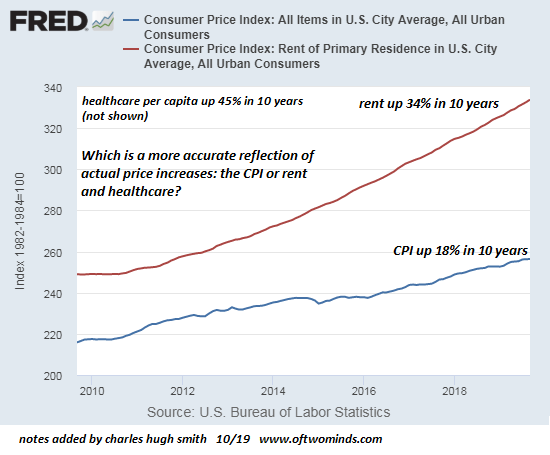
Meanwhile, we’re told inflation is less than 2% annually while rising costs have outpaced meager wage increases. What’s a more realistic measure of real-world inflation–the official Consumer Price Index (CPI) at 18% over ten years or rent and healthcare at 34% and 45%?

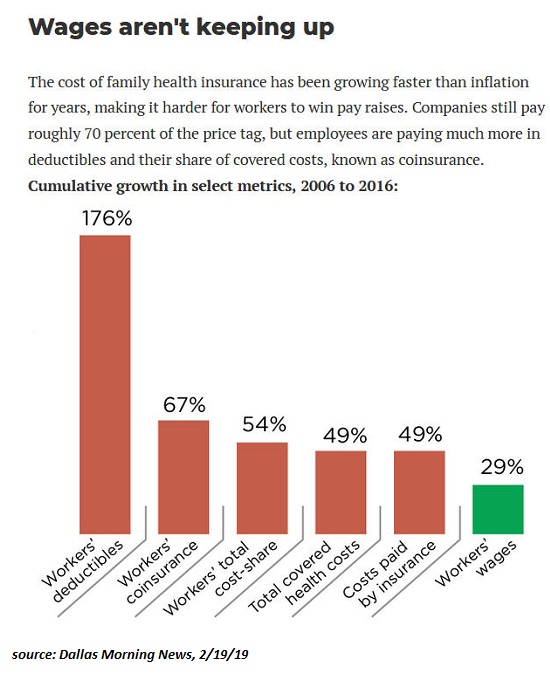
According to the Chapwood Index, real-world inflation in urban America is running 9% to 13% annually. This is more in line with reality than the bogus CPI, as evidenced by this chart of wages and healthcare costs:

Even if we don’t measure the erosion of intangible capital, the social and political consequences of this impoverishment are manifesting in all sorts of ways: large-scale social disorder is breaking out around the globe, and the political middle ground has completely vanished: no matter which way an issue is decided, one camp will refuse to accept the outcome.

The only way forward with any chance of success is to start by acknowledging the decay of our economy due to rampant financialization, legalized looting, the pathologies of “winner take most” speculation and the realities of a two-tiered system in which entrenched elites are “more equal” than the rest of us, economically, socially and politically. We have to accept the limits of technology to reverse the unraveling and assess the damage that’s already been done to our shared capital.

Acting as if the system is working just fine and the problem is perception/optics is accelerating the unraveling.

Automatons – Life Inside the Unreal Machine

By Kingsley L. Dennis

Source: Waking Times

ɔːˈtɒmət(ə)n/

noun

a moving mechanical device made in imitation of a human being.

a machine which performs a range of functions according to a predetermined set of coded instructions.

used in similes and comparisons to refer to a person who seems to act in a mechanical or unemotional way.

“Don’t you wish you were free, Lenina?”

“I don’t know what you mean. I am free. Free to have the most wonderful time. Everybody’s happy nowadays.”

He laughed. “Yes, ‘Everybody’s happy nowadays.’ We have been giving the children that at five. But wouldn’t you like to be free to be happy in some other way, Lenina? In your own way, for example; not in everybody else’s way.”

“I don’t know what you mean,” she repeated.

Aldous Huxley, Brave New World

Are we turning into a mass of unaware sleepwalkers? Our eyes are seemingly open and yet we are living as if asleep and the dream becomes our waking lives. It seems that more and more people, in the highly technologized nations at least, are in danger of succumbing to the epidemic of uniformity. People follow cycles of fashions and wear stupid clothes when they think it is the ‘in thing;’ and hyper-budget films take marketing to a whole new level forcing parents to rush out to buy the merchandise because their kids are screaming for it. And if one child in the class doesn’t have the latest toy like all their classmates then they are ostracized for this lack. Which means that poor mummy and daddy have to make sure they get their hands on these gadgets. Put the two items together – zombies and uniformity – and what do you get? Welcome to the phenomenon of Black Fridays, which have become the latest manifestation of national Zombie Days.

Unless you’ve been living in a cave somewhere (or living a normal, peaceful existence) then you will know what this event is – but let me remind you anyway of what a Black Friday is. It is a day when members of the public are infected with the ‘must buy’ and ‘act like an idiot’ virus that turns them into screaming, raging hordes banging on the doors of hyper-market retailers hours before they open. Many of these hordes sleep outside all night to get early entry. Then when the doors are finally opened they go rushing in fighting and screaming as if re-enacting a scene from Games of Thrones. Those that do survive the fisticuffs come away with trolleys full of boxes too big to carry. This display of cultural psychosis, generally named as idiocracy, is also a condition nurtured by societies based on high-consumption with even higher inequalities of wealth distribution. In other words, a culture conditioned to commodity accumulation will buy with fervour when things are cheap. This is because although conditioned to buy, they lack the financial means to satiate this desire. Many people suffer from a condition which psychologists have named as ‘miswanting,’ which means that we desire things we don’t like and like things we don’t desire. What this is really saying is that we tend to ‘want badly’ rather than having genuine need. What we are witnessing in these years is an epidemic of idiocracy and its propagating faster than post-war pregnancies. And yet we are programmed by our democratic societies to not think differently. In this respect, many people also suffer from a condition known as ‘confirmation bias.’

Confirmation bias is our conditioned tendency to pick and choose that information which confirms our pre-existing beliefs or ideas. Two people may be able to look at the same evidence and yet they will interpret it according to how it fits into and validates their own thinking. That’s why so many debates go nowhere as people generally don’t wish to be deviated away from those ideas they have invested so much time and effort in upholding. It’s too much of a shock to realize that what we thought was true, or valid, is not the case. To lose the safety and security of our ideas would be too much for many people. It is now well understood in psychology that we like to confirm our existing beliefs; after all, it makes us feel right!

Many of our online social media platforms are adhering to this principle by picking and choosing those items of news, events, etc that their algorithms have deemed we are most likely to want to see. As convenient as it may seem, it is unlikely to be in our best interests in the long term. The increasing automation of the world around us is set to establish a new ecology in our hyperreality. We will be forced to acknowledge that algorithms and intelligent software will soon, if it isn’t already, be running nearly everything in our daily lives. Historian Yuval Harari believes that ‘the twenty-first century will be dominated by algorithms. “Algorithm” is arguably the single most important concept in our world. If we want to understand our life and our future, we should make every effort to understand what an algorithm is.’1 Algorithms already follow our shopping habits, recommend products for us, pattern recognize our online behavior, help us drive our cars, fly our planes, trade our economies, coordinate our public transport, organize our energy distribution, and a lot, lot more that we are just not really aware of. One of the signs of living in a hyperreality is that we are surrounded by an invisible coded environment, written in languages we don’t understand, making our lives more abstracted from reality.

Modern societies are adapting to universal computing infrastructures that will usher in new arrangements and relations. Of course, these are only the early years, although there is already a lot of uncertainty and unpredictability. As it is said, industrialization didn’t turn us into machines and automation isn’t going to turn us into automatons. Which is more or less correct; after all, being human is not that simple. Yet there will be new dependencies and relations forming as algorithms continue to create and establish what can be called ‘pervasive assistance.’ Again, it is a question of being alert so that we don’t feel compelled just to give ourselves over to our algorithms. The last thing we want is for a bunch of psychologists trying to earn yet more money from a new disease of ‘algorithmic dependency syndrome’ or something similar.

It needs stating that by automating the world we also run the risk of being distanced from our own responsibilities. And this also implies, importantly, the responsibility we have to ourselves – to transcend our own limitations and to develop our human societies for the better. We should not forget that we are here to mature as a species and we should not allow the world of automation to distract us from this. Already literature and film have portrayed such possibilities. Examples are David Brin’s science-fiction novel Kiln People (2002 – also adapted into the film Surrogates, 2009), which clearly showed how automation may provide a smokescreen for people to disappear behind their surrogate substitutes.

Algorithms are the new signals that code an unseen territory all around us. In a world of rapidly increasing automation and digital identities we’ll have to keep our wits about us in order to retain what little of our identities we have left. We want to make sure that we don’t get lost in our emoji messages, our smilies of flirtation; or, even worse, loose our life in the ‘death cult’ of the selfies. Identities by their very nature are constructs; in fact, we can go so far as to call them fake. They are constructed from layers of ongoing conditioning which a person identifies with. This identity functions as a filter to interpret incoming perceptions. The limited degree of perceptions available to us almost guarantees that identities fall into a knowable range of archetypes. We would be wise to remember that who we are is not always the same as what we project. And yet some people on social media are unable to distinguish their public image from their personal identity, which starts to sound a bit scary. Philosopher Jean Baudrillard, not opposed to saying what he thought, stated it in another way:

We are in a social trance: vacant, withdrawn, lacking meaning in our own eyes. Abstracted, irresponsible, enervated. They have left us the optic nerve, but all the others have been disabled…All that is left is the mental screen of indifference, which matches the technical in-difference of the images.2

Baudrillard would probably be the first to agree that breathing is often a disguise to make us think that someone is alive. After all, don’t we breathe automatically without thinking about it?

We must not make the human spirit obsolete just because our technological elites are dreaming of a trans-human future. Speaking of such futures, inventor and futurist Ray Kurzweil predicts that in the 2030s human brains will be able to connect to the cloud and to use it just like we use cloud computing today. That is, we will be able to transfer emails and photos directly from the cloud to our brain as well as backing up our thoughts and memories. How will this futuristic scenario be possible? Well, Kurzweil says that nanobots – tiny robots constructed from DNA strands – will be swimming around in our brains. And the result? According to Kurzweil we’re going to be funnier, sexier, and better at expressing our loving sentiments. Well, that’s okay then – nanobot my brain up! Not only will being connected to the computing cloud make us sexier and funnier humans, it will even take us closer to our gods says Kurzweil – ‘So as we evolve, we become closer to God. Evolution is a spiritual process. There is beauty and love and creativity and intelligence in the world – it all comes from the neocortex. So we’re going to expand the brain’s neocortex and become more godlike.’It’s hard to argue with such a bargain – a few nanobots in our brain to become godlike? I can imagine a lot of people will be signing up for this. There may even be a hefty monthly charge for those wanting more than 15GB of back-up headspace. Personally, I prefer the headspace that’s ad infinitum and priceless. I hope I’m not in the minority.

Looking at the choices on offer so far it seems that there is the zombie option, which comes with add-on idiocracy (basic model), and the trans-human nanobot sexy-god upgrade (pricy). But then let’s not forget that in an automated world it may be the sentient robots that come out on top. Now, that would be an almost perfect demonstration of a simulation reality.

Life in Imitation

There are those who believe that self-awareness is going to be the end game of artificial intelligence – the explosive ‘wow factor’ that really throws everything into high gear. The new trend now is deep machine-learning to the point where machines will program not only themselves but also other machines. Cognitive computer scientists are attempting to recapture the essence of human consciousness in the hope of back-engineering this complexity into machine code. It’s a noble endeavor, if not at least for their persistence. The concern here is that if machines do finally achieve sentience then the next thing that we’ll need to roll out will be machine psychologists. Consciousness, after all, comes at a price. There is no free lunch when it comes to possessing a wide-awake brain. With conscious awareness comes responsibilities, such as values, ethics, morality, compassion, forgiveness, empathy, goodness, and good old-fashioned love. And I personally like the love part (gives me a squishy feeling every time).

It may not actually be the sentient robots we need to worry about; it’s the mindless ones we need to be cautious of (of course, we could say the same thing about ourselves). One of the methods used in training such robots is, in the words of their trainers, to provide them with enough ‘intrinsic motivation.’ Not only will this help the robots to learn their environments, it is also hoped that it will foster attention in them to acquire sufficient situational awareness. If I were to write a science-fiction scenario on this I would make it so that the sentient robots end up being more human than we are, and humans turn into their automated counterparts. Funny, maybe – but more so in the funny-bone hurting sort of way rather than the laugh-out-loud variety. Or perhaps it’s already been done. It appears that we are attempting to imbue our devices with qualities we are also striving to possess for ourselves. Humans are naturally vulnerable; it is part of our organic make-up. Whatever we create may inherit those vulnerabilities. However, this here is not a discussion on the pros and cons of smart machines and artificial intelligence (there are many more qualified discussions on that huge topic).

While we are creating, testing, worrying, or arguing over machines and their like we are taking our attention away from the center – ourselves. The trick of surviving in the ‘unreal machine’ of life is by becoming more human, the very antithesis of the robotic. Technology can assist us in interacting and participating to a better degree with our environments. The question, as always, is the uses to which such tools are put – and by whom. Such tools can help us realize our dreams, or they can entrap us in theirs. Algorithms, smart machines, intelligent infrastructure, and automated processes: these are all going to come about and be a part of our transforming world. And in many respects, they will make life more comfortable for us. Yet within this comfort zone we still need to strive and seek for our betterment. We should not allow an automated environment to deprive us of our responsibility, and need, to find meaning and significance in our world. Our technologies should force us to acknowledge our human qualities and to uplift them, and not to turn us into an imitation of them.

Another metaphor for the simulated ‘robotic’ creature is the golem. The golem legend speaks of a creature fashioned from clay, a Cabbalistic motif which has appeared frequently in literary and cinematic form (such as Frankenstein). The Cabbalistic automaton that is the golem, which means ‘unformed,’ has often been used to show the struggle between mechanical limitation and human feelings. This struggle depicts the tension that combines cogs and consciousness; the entrapment in matter and the spirit of redemption and liberation. This is a myth that speaks of the hubris in humanity fashioning its own creatures and ‘magically’ bestowing life upon them. It is the act of creating a ‘sacred machine’ from the parts and pieces of a material world and then to imbue them with human traits. And through this human likeness they are required to fulfil human chores and work as slaves. Sounds familiar? The Cabbalistic humanoid – the sentient robot – is forever doomed, almost like the divine nature of Man trapped within the confines and limitations of a material reality. They represent the conflict of being torn between a fixed fate and freedom.

Our material reality may be the ultimate unreal machine. We are the cogs, the clay golem, the imperfect creature fashioned by another. Our fears of automation may only be a reflection of our own automation. We struggle to express some form of release whilst unaware that the binds that mechanize us are forever tightening.

We have now shifted through the zombie-idiocracy model (basic), the trans-human nanobot sexy-god model (pricy), to arrive at the realization that it is us – and not our sentient robots – that are likely to be the automaton (tragic). And this is the biblical fall from grace; the disconnection from our god(s). We have come loose from Central Source and we have lost our way.

We are now living in the hyperreal realm where zombies, cyborgs, and golem robots all reside – but it is not the place for the genuine human. Things are going to have to change. Not only do we have to retain our humanity, we also must remain sane. With our continuing modern technologies, our augmented reality and bioengineering, the difference between fiction and reality will blur even further. And this blurring is likely to become more prominent as people increasingly try to reshape reality to fit around their own imaginative fictions. Staying sane, grounded, and balanced is going to be a very, very good option for the days to come.

We are going to be sharing our planetary space with the new smart machines. I am reminded of the Dr. Seuss book Horton Hears a Who! that has the refrain, ‘a person’s a person no matter how small.’ Size doesn’t count – but being human does. And staying human in these years will be the hard task allotted to us.

Phantom Performances – The Rise of the Spectacle

By Kingsley L. Dennis

Source: Waking Times

ˈspɛktək(ə)l/

noun

a visually striking performance or display

an event or scene regarded in terms of its visual impact

“Now the death of God combined with the perfection of the image has brought us to a whole new state of expectation. We are the image.” ~John Ralston Saul, Voltaire’s Bastards

“Magical thinking is the currency not only of celebrity culture, but also of totalitarian culture.” ~Chris Hedges, Empire of Illusion

Welcome to the spectacle. Or perhaps I should say the kind of spectacle that has become the face of entertainment that pervades our westernized cultures. The way that the spectacle succeeds is that it isn’t so much about fooling us into believing its lies as real, but rather that it is we who ask to be fooled. We seek to suspend our sense of reality, to pursue a space of escape. The spectacle pulls us in because we lend our willingness to its agenda. If we are honest, in this post-truth age, we will admit to living in an age of spectacle. And it is from this that many of us receive our interpretation of reality. Since the middle of the 20th century onwards the ‘western spectacle’ has been in the form of media advertisement and propaganda. We may think that we’ve only recently arrived at the age of the spectacle, where Disneylandification is becoming the norm, and Super Bowls are interspersed with scantily-clad singers, and TV programs appear in the slots between advertisers. Yet the whole spectacle show has been a form of function creep ever since telecommunications first emerged as a social phenomenon. The image has been with humanity since the first dawn of our arising; from cave paintings to hieroglyphics to cuneiform clay tablets. The major difference is that today the spectacle of the image has not only gone global, but it has also gotten inside of our heads.

Western cultures especially (and the US specifically) have now made the image, the spectacle, and hence the illusion so grand, so vivid, and so persuasively realistic that they are becoming our basis of reality. We swing from one illusion to the alternative, which is still yet another grand spectacle; just as we swing from the political left to the right, believing each side is distinctly different. Yet each is a part of the same bubble that customizes our lives – they form a part of our news, our heroes, our tragedies, and our dreams. We now serve a mosaic of ideals carefully crafted as a patchwork of phantom performances. Nothing is ever real anymore except the painful extremes that pervade our daily existence: the violence, the suffering, the deprivation, the inequality, the disease. Only these fragments that create great pain become the real, and from these many of us seek refuge in a plenitude of diversions, distractions, and triviality.

Western civilization has chosen to be played out upon a grand stage where the performance – of invented storylines and scripts – runs the show. We move through social realities that are an entanglement of signs, virtual connections, and social media status. It’s all about who is going to be the next ‘influencer’? We are encouraged to project back into the world our entertainment-mediatized fantasies. People begin to act out their imaginary landscapes, often in violent and distorted ways, as young students massacre their classmates before going to eat at McDonalds. This is the hyperreal that distorts a stable reality, making it harder to gain a grounded perspective on things. People are increasingly being guided by the false totems of media-militarized-entertainment.

The media spectacle gives us our modern guiding images. This is similar to how in the Middle Ages images depicted in stained glass windows and paintings of religious torment or salvation acted to control and influence the social behavior of our ancestors. For many of us the white-bearded god above is dead, so we have media depictions of heroes, adventurers, McGyvers, celebrity-cosmetic makeovers, beauty pageants, talk shows and reality television to be our social guides. An illusory sensate reality has been erected that runs on pseudo-lives and phantom performances. Such phantom performances mask our personal failures and conveniently hide them behind a curtain of the unreal. People prefer to watch the rich and famous on television rather than face the domestic unhappiness of their own lives. Why have ice when you can have bubblegum-flavored ice-cream?

Luckily for those of us who live in the west we inhabit a world of easy-correction where we can make ourselves better if we buy certain products, ingest certain foods, and hang-out in the right yoga gyms. For every situation there is seemingly a commercial solution. We have not been abandoned, after all. In the realm of hyperreality, our fantasies are no longer an impediment to success. On the contrary, our fantasies are the portals through which we enter. All we need is for the world of the media to give us our dream. Everybody has talent, as the reality shows tell us – ‘Britain’s Got Talent,’ ‘America’s Got Talent:’ in fact, we’ve all got talent! We are all of us hidden unique performers, and the world ‘out there’ is begging for our arrival. This is not to be confused with the manipulation by greedy commercial enterprises that are ready to discard you as soon as your ‘talent’ no longer sells.

Yet the truth of the matter is that the spectacle of celebrity culture seeks commodities, not real individuals or souls. It doesn’t want that we seek for any form of transcendence, illumination, or real growth. It is a world that seeks only those that feed the phantom and encourage others to do the same. It is the ‘real’ that gets pushed into a black hole – to become a figment of the imagination, whilst imaginary dreams take its place. Celebrity culture thrives from the very lack of inner reflection. There is no ‘going within’ unless it is a form of medication going down our throats. If we are brutally honest, the celebrity spectacle is an ugly specter that can be as cruel as it is superficial.

The Spectacle of Celebrity Culture

No one achieves celebrity status on their own. It is a stage performance that requires a hoard of cultural enablers; from media, marketers, promoters, agents, handlers, and a host of hungry and gullible people. It is a veritable stage of actors, with each person in it to gain something for themselves. They either seek attention, satisfaction, fame, wealth, or a combination of these. Celebrity culture has come to dominate how many of us define our sense of belonging. It has come to define how we relate to the world around us, and in this respect has disfigured our notions of social belonging and community. Celebrity culture funds and feeds our own movies inside our heads as we invent our roles and behavior. It is a culture in which very few participants are even real for a day.

We idolize celebrities and often project them as idealized forms of ourselves. And yet through this substitution we move further away from any real self-actualization. The transcendent – the Real – does not do substitutes. By throwing our fantasies onto others we are diminishing our own power. In the words of one serious journalist,

We are chained to the flickering shadows of celebrity culture, the spectacle of the arena and the airwaves, the lies of advertising, the endless personal dramas, many of them completely fictional, that have become the staple of news, celebrity gossip, New Age mysticism, and pop psychology …in contemporary culture the fabricated, the inauthentic, and the theatrical have displaced the natural, the genuine, and the spontaneous, until reality itself has been converted into stagecraft. 1

We are subtly pushed through the well-structured stagecraft whilst all the time thinking that it is real. Our contemporary ‘death of the gods’ has been replaced by a divine adoration of celebrities and celebrity culture. Celebrity items, like holy relics, are paraded, idolized, and sold for vast sums. People rush for autographs, only to sell them later on eBay to make an unhealthy profit. Celebrity personal possessions are sold off at prestigious auction houses for astronomical prices, so aging people can wear the clothes of their idols. The glitzy suit that Elvis wore before dying in a Las Vegas toilet; or the dress that Marilyn Monroe wore to show her knickers to the world above a subway vent. Everything is up for grabs – the profane is made sacred, and then sacrificed as celebrity talismans. It all engenders a performance of hysteria, leading sometimes to stalking, or what is nowadays referred to as ‘trolling,’ as celebrity private photos are hacked and shared online. It’s happened to Emma Watson, Jennifer Lawrence, Kate Upton, Jessica Alba, Kate Hudson, Scarlett Johansson…and the list goes on, and on, and on.

The world of celebrity culture thrusts us into a moral void. People are valued by their appearance and their skin-deep beauty rather than their humanity. Such a culture focuses upon onanistic desires and ways for self-gratification. The cult of self ‘has within it the classic traits of psychopaths: superficial charm, grandiosity, and self-importance; a need for constant stimulation, a penchant for lying, deception, and manipulation, and the inability to feel remorse or guilt.’2 The cult of self also promotes the right to get whatever we wish, and celebrity media plays into this, often at the cost of the celebrity who suffers from social media harassment and online trolling. Celebrity public life is not a sacred space; instead, it has become a theatre of performance that is open for all spectators. And those spectators who surround themselves with celebrity culture tend to live in the present, fed by an endless stream of packaged information. They live by credit promises, ignorant to the future prospect of unmanageable debt. They are hostage to a culture that keeps them enthralled, like a television commercial replete with pleasing jingles. They navigate their purchases through well-known brands, eyeing the famous logos as guides. It is an image-saturated reality, bright and tantalizing, offering comfort and satisfaction upon all levels – until the credit runs out. Then the person becomes an outlaw to the very system that fattened them up like foie gras ducks.

These are the trivial diversions that for many are necessary, and which exist in cultures that prize shallow entertainment above substance. We may wonder whether the consumerist celebrity culture is a compensation for the loss of our true freedom regarding the human spirit and our well-being. And celebrities too are often trapped within their own fairy-tale prisons. They are skillfully controlled by their handlers and pushed in front of the media – all this to compensate for the insatiable appetites of those thirsty spectators that swarm upon celebrity culture. We are tantalizingly shown that even us, the humble spectators, can triumph in fame through the lens of reality television. The celebrity machinery oils itself on the media-creation of third and fourth-rate celebrities that have their fifteen minutes of fame – crammed together on desert islands, stuffing insects into their mouths as they bad-mouth their once beloved ‘best-friend’ and vote them off the show. Reality survival, it seems, comes at a cost. And then when they finally emerge into the ‘real world’ of the hyperreal they throng and mingle with other reality-stars under the glare of media spotlight in the vain hope that together they can populate an illusory world of the celebrity.

The world of reality television is another limb on the body of phantom performance. In the last decade a multitude of reality shows have cropped up on our television screens; and they all have one thing in common – they involve being constantly watched. Popular shows such as Big Brother put strangers to live together with round-the-clock constant surveillance. These strangers are even videoed in their beds as they sleep or fondle and kiss with other contestants. Sex lives are ogled over alongside the tears and on-screen breakdowns. Then the television psychologists are wheeled out to offer ‘expert commentary’ on the contestant’s state for mass consumption. Yet underneath all this glamour and glitz is the subtle message that intrusive surveillance is a normal feature of contemporary societies. In fact, it even masquerades as something cool that can be shared online, and which can make us famous. However, the brute reality is that such reality shows normalize what would otherwise be blatant non-constitutional intervention. And yet such shows make surveillance not only routine but a potentially enjoyable part of our modern lives. We are being conditioned into monitoring and sharing our own lives for others to see. Our phantom performances can make any one of us into an enviable star.

Social media is now rife with home-grown videos where everyone from toddler to teenager to retiree is making their performances visible to the image-hungry collective. Selfies too are the new fashionable rage as we perform in front of ourselves. This trend has become so pervasive that each year the number of selfie-related deaths has been increasing. In 2015 more people died from taking selfies than from shark attacks.[i] A dedicated online Wikipedia page has been established to record some of the ongoing ‘selfie-deaths.’ Here are a few examples:

Two young men died in the Ural Mountains after they pulled the pin from a live hand grenade to take a selfie. The phone with the picture remained as evidence of the circumstance of their deaths. (Russia, January 2015)

An 18-year-old died when she attempted to take the “ultimate selfie”, posing with a friend on top of a train in the north-eastern Romanian city of Iași when her leg touched a live wire above which electrocuted her with 27,000 volts. (Romania, May 2015)

A 19-year-old from Houston died after trying to take an Instagram selfie while holding a loaded gun to his head. He accidentally fired the gun and shot himself in the throat. (USA, September 2015)

A 17-year-old student, Andrey Retrovsky from Vologda, Russia, fell to his death attempting to take a selfie while hanging from a rope from a nine-story building. The rope snapped. Retrovsky was known for taking ‘extreme’ selfies and posting them to his Instagram account. (Russia, September 2015)

Selfie deaths, it seems, are global – and not a rare occurrence. Our phantom performances come at a cost. In a world where the image is iconic, more and more people are losing themselves in a reality where a sense of achievement comes from catching the ‘ultimate selfie.’

The drive for inner fulfilment, transcendence, and growth has been wavered aside in favor of the pixilated image. We fear not being seen. We dread being anonymous. Even being a spectral ghost is preferable to being dead.

We Are the Image

The new perspective on the world is pixilated. We are awash with images without substance and which are routinely fetishized as iconic. Signs are lacking immanence; they are fleeting and transient like never before. That is why corporations spend millions trying to find an image logo that will stick around long enough to be implanted into our minds. Images are becoming signs to the disappearance of the real. Images are the new believable reality; now no one cares that the original behind the image has quietly slipped away. The world exists as if in a play of phantom appearances. The image has taken centerstage within the space of the new real. We are now the image.

Yet the danger here is that in being given the image with its glamour and glitz we are in return giving up our critical and intellectual tools that help us cope with a complex world. Where once we had the faculty of separating illusion from reality we now have a simplified hyperreal world where everything can be explained away by a platitude of post-truth phrases. Does it even matter anymore that Las Vegas with its illusion of France with the mock Eiffel Tower, or its pseudo-canals of Venice, are far from the reality of France or Venice? How many people care? Or that the fantasy worlds within the various Disney theme parks are merging with the entertainment-saturated lives outside? Would it truly matter if we were all living within a controlled environment as depicted within the film The Truman Show? Or maybe, just maybe, such films are actually trying to tell us something – to wake us up?

The danger now is that our cultural spectacles – our celebrity culture and spectral images – are making any other alternative seem dull to us. It may be that in an age of simplified gratification any complex reality is boring. What the ‘real’ presents us with may no longer be enough. In its place we are perhaps seeking a false magic.

We have lost touch with that essential something that can work like magic in our lives. As one thinker recently stated:

We live in changing times whereby humanity is undergoing a transformation…We need to understand phenomena at deeper levels, and not just accept what we are told, or what is fed to us through well-structured social institutions and channels. We must learn to accept that our thinking is a great tangible spiritual force for change. 2

The notion that our ideas, our vision, our projections onto the world can be a ‘great tangible spiritual force for change’ is eluding us. Never before has it been so important to trust in the power of the human spirit, and to put forth, with honesty and integrity, the innate human power. The alternative is that we slide into the slipstream of our own phantom performances – we become the image.


Extract from the book Bardo Times: hyperreality, high-velocity, simulation, automation, mutation – a hoax?

Endnotes 

Hedges, Chris. 2010. Empire of Illusion: The End of Literacy and the Triumph of Spectacle. New York: Nation Books, p15

 Gulbekian, S.E. 2004. In the Belly of the Beast: Holding Your Own in Mass Culture. Charlottesville, VA: Hampton Roads, p251

[i] See http://www.telegraph.co.uk/technology/11881900/More-people-have-died-by-taking-selfies-this-year-than-by-shark-attacks.html

How Real Mind Control Works

By Brandon Smith

Source: Alt-Market.com

When people are confronted with the idea of “mind control” they often think of something out of television or film media; a lone prisoner tortured, chemically dazed and conditioned into a hollow zombie as his captors squeeze information from him or use him to complete a task he would not normally do or morally accept. And while there is actually some truth to this kind of Hollywood depiction, as is evidenced in the exposure of government programs like MK Ultra, the most insidious forms of mind control are far more subtle.

Governments and the elitists behind them do not necessarily need to physically cage, drug and brutalize people in order to influence how they behave. All they need to do is manage their perceptions, expectation and assumptions. This can be accomplished with large portions of the public, rather than one person at a time.

The elites have always been fascinated with the idea of mass hypnotism. In the 18th century Franz Mesmer was famous for entertaining European royalty with displays of what he called “animal magnetism”, which included what we now know as hypnosis of individuals and groups. Mesmerism has since become synonymous with the attempt to befuddle people and dictate their actions while in a kind of trance. Hypnotism is still a very active subject in psychiatric circles and the US government took avid interest in hypnotism as a weapon during their MK Ultra experiments in the 1950s.

People involved in the field of hypnotism are quick to point out that a hypnotized person cannot be made to do something that goes against their code of ethics, but this is not exactly the whole story. A hypnotist makes suggestions that the subject chooses to follow (or refuses to follow) while in a trance state, however, what if they can be convinced (or fooled) through hypnosis into believing that a particular action is in their best interest in spite of their moral code or sense of self preservation?

This type of control over a subject can and has been accomplished in hypnotic therapy, and examples of “covert” hypnotherapy are also on record, including the example of an Ohio divorce attorney that used covert hypnotism against multiple female clients and is suspected of using it against some court employees to disarm their psyches and then rape them without memory of the incident.

About two thirds of any given population are capable of being hypnotized to varying degrees. Stanford University has been avidly searching for a brain pattern that acts as a fingerprint for those that are more prone to hypnotic influence, and they believe they have found certain factors involving areas of the brain that handle heightened focus and attention. Reduced peripheral awareness also helps to increase the subject’s vulnerability to hypnosis and vastly increases suggestibility.

These conditions can in fact be encouraged in large crowds of people. Consider this for a moment – What daily activity is the average person involved in that hyperfocuses their attention on a single point in space for long periods of time and removes almost all of their peripheral awareness? If you said “cell phone use” then you win a chicken dinner. Beyond creating an artificial and constant low dose of dopamine in the human brain leading to addiction, cell phones and other small electronic devices actually create the perfect conditions for a person to be hypnotized as they rip them away from all peripheral awareness and make them highly suggestible to those who know how to use covert methods.

To reiterate, a hypnotic state can be induced in large groups of people for extended periods of time with the correct long term stimulus. Watch here as mentalist Darren Brown hypnotizes or “brainwashes” an entire shopping mall of people into raising their hands exactly when he wants them to without them being aware of why they are doing it. Notice that around two thirds of the crowd complies.

Hypnotic suggestions last as long as the subjects continue to believe that the suggestions are correct. Hypnotism is essentially an agreement between the hypnotist and the persons being hypnotized that a particular belief is true (even if it is not). In the case of a victim of an attack, the person may want to believe that the traumatic event did not happen, and thus they can be convinced through hypnosis to forget it. In the case of a group of people, the hypnotist would have to identify an idea or fear that they all share and WANT to believe is real, and then exploit it.

I think some of the political applications of this are obvious.

The false left/right paradigm is a perfect Petri dish for obtaining or manufacturing the consent of the masses to be hypnotized. They WANT to believe that their team, which they have willingly joined, is the correct team and that the leadership of that team has their best interests at heart. They want to believe that the actions of their party, through legislation or direct means, are always rational and morally sound. And, even when the leaders of their party do things which are completely contrary to the beliefs and morals of the people who make up the party, those people still want to believe that there must be some logical reason behind these decisions that they do not yet grasp.

Beyond this, the threat of the “other party” or team is an ever constant stimulus in the form of fear.  We watch the scripted battles of these two fabricated teams play out in elaborate forms of Kabuki theater, yet nothing ever really changes except that the global elites grow more powerful.  Still, many people actually believe these battles to be real, and invest immense amounts of energy and focus into them as if the fate of the world is being decided within the antics of a political soap opera.

When people are afraid or hyperfocused on an outside threat, they once again become more suggestible. This is why mainstream political discussions focus less on understanding of the threat (the “How” and the “Why”) and more on perpetuating the threat.  With understanding of the enemy (or false enemy), the threat can be assessed and fear is reduced, even if the threat is real. Without understanding, fear only increases. Political powers seek to constantly remind us that threats exist without allowing us the benefit of context.  They do not want us to have an in-depth knowledge of the mechanics behind the threats.

We are told that our system works in a particular way that seems logical, but it only makes sense to us so long as we want to believe that the system functions as we were taught.  We have to have blind faith that what we were initially told was absolutely true.  The question is, why should we?  Isn’t it better to remain skeptical of most things and to study what is handed to us?  If we’re given a strange elixir by an utter stranger and we’re told to “drink up!”, would we not question what’s in the frothing brew and what it does?  Would we not investigate?

In the case of information and proclamations some people would not investigate, because it is more comfortable to believe the lies, or perhaps because they will be rewarded for going along with the status quo.  Only when we become willing to sacrifice comfort, when we stop wanting to accept everything we are told at face value and start questioning the reality that is handed to us, only then will the mass hypnosis we were once influenced by lose its power.

The hypnosis of the elites requires ever increasing forms of distraction and stimulation in order to keep the public entranced. The creation of fear and confusion is vital to the execution of mass mind control, and this is a factor that many people absolutely refuse to recognize or take into consideration. The idea that the elites would build a system only to then deliberately destroy it is just too much for many to fathom. But again, what better way to hyperfocus an entire population and make them malleable to suggestions that they would not normally consider otherwise?

In past articles I have outlined the incredible array of similarities between global elitist groups and the behaviors and character traits of narcissistic sociopaths (also known as narcopaths or psychopaths).  I have even theorized that globalists are actually a highly organized group of narcopaths who recruit other narcopaths into the fold. Many high-level narcopaths are intuitively knowledgeable on the dynamics of suggestibility and the human psyche. I would call this their primary survival trait.

Narcopaths are well known for creating confusion around them in order to gain control of the people in their lives or the people in a room. They are also known for being willing to build up certain routines and acclimating people around them to a particular environment, only to suddenly disrupt it all as a means to stun their victims and create subservience. It is important to realize that these people do NOT necessarily care about stability. In fact, they often will actively sabotage stability to obtain something they care about more – control.

The strategies that individual narcopaths exhibit on a small scale are simply magnified thousands of times when we talk about the behaviors of the global elitists. People who consider themselves rational are hard pressed to comprehend this kind of behavior, but there is a devious tactical logic to it. Mind control of others can be achieved by keeping those people infinitely off-balance. Conjuring moments of tenuous peace, and then striking with cycles of unpredictable crisis. Before we know it, many years of instability have gone by and the organized narcopaths in power have gained even more control.  We wonder where all that time went, and why we were not able to change things? It is because we have been hypnotized into inaction, or the wrong actions in the name of meaningless political stagecraft.

Real mind control and mass hypnosis requires, as already mentioned, our consent, but it is consent that is conned out of us. It is conned out of us by fake leaders with intentions and actions that do not match their promises. It is conned out of us by a system that breeds conformity of thought and tells us that those who think outside the widely accepted norm are aberrant and “crazy”. It is conned out of us by our own weaknesses – our desire to go along to get along, our fear of confronting the crowd and telling them they are wrong, our fear of losing what we think is stability, or our fear of being on our own.

Real mind control is not about torture and force, it is about quietly induced acceptance. We can remove our consent from the hypnotists anytime we wish, but we have to be willing to stop ignoring certain realities. We have to be willing to feel the pain that comes when we recognize we have been conned and controlled in the past, and we have to revel in our ability to refuse to conform. It must become a part of who we are – the people who do not take what we are told at face value. The people that question almost everything. The people who cannot be mesmerized.

How to Avert a Digital Dystopia

By Jumana Abu-Ghazaleh

Source: OneZero

“What I find [ominous] is how seldom, today, we see the phrase ‘the 22nd century.’ Almost never. Compare this with the frequency with which the 21st century was evoked in popular culture during, say, the 1920s.”

—William Gibson, famed science-fiction author, in an interview on dystopian fiction.

The 2010s are almost over. And it doesn’t quite feel right.

When the end of 2009 came into view, the end of the 2000s felt like a relatively innocuous milestone. The current moment feels so much more, what’s the word?

Ah, yes: dystopian.

Looking back, “dystopia” might have been the watchword of the 2010s. Black Mirror debuted close to the beginning of the decade, and early in its run, it was sometimes critiqued for how over-the-top it all felt. Now, at the end of the decade, it’s regularly critiqued as made obsolete by reality.

And it’s not just prestige TV like Black Mirror reflecting the decade’s mood of incipient collapse. Of the 2010s top 10 highest-grossing films, by my count at least half involve an apocalypse either narrowly averted or, in fact, taking place (I’m looking at you, Avengers movies).

People have reasons to wallow. I get it. The existential threat of climate change alone — and seeing efforts to mitigate it slow down precisely as it becomes more pressing — could fuel whole libraries of dystopian fiction.

Meanwhile, our current tech landscape — the monopolies, the wild spread of disinformation, the sense that your most private data could go public whenever, with no recourse, all the things that risk making Black Mirror feel quaint — truly feels dystopian.

We enjoy watching distant, imaginary dystopias because they distract us from oncoming, real dystopias.

Since no one in a position to actually do something about our dystopian reality seems to be admitting it — no business leaders, politicians or legacy media — it makes sense that you might get catharsis of acknowledgment from pop culture instead. And yet, the most popular end-of-the-world fiction isn’t about actual imminent threats from climate or tech. It’s about Thanos coming to snap half of life out of existence. Or Voldemort threatening to destroy us Muggles.

Maybe that kind of pop culture, which acknowledges dystopia but not the actual threats we currently face, gives us a feeling of control: Sure, Equifax could leak my social security number and face zero consequences, but there are no Hunger Games. Wow — it really could be so much worse! Maybe we enjoy watching distant, imaginary dystopias because they distract us from oncoming, real dystopias.

But let’s look at those actual potential dystopias for a moment and think about what we need to do to avert them.

I’d suggest the big four U.S. tech giants — Amazon, Facebook, Apple, Google — each have a distinct possible dystopia associated with them. If we don’t turn around our current reality, we will likely get all four — after all, for all the antagonistic rhetoric among the giants, they are rather co-dependent. Let’s look at what we might have, ahem, look forward to — unless we demand the tech giants deliver on the utopia they purportedly set out to achieve when their respective founders raised their rounds of millions. I would argue not only that we can, but that we must hold them accountable.

“Mad Max,” or, slowly then all at once: starring Apple

“‘How did you go bankrupt?’ Bill asked. ‘Two ways,’ Mike said. ‘Gradually and then suddenly.’”

—Ernest Hemingway, The Sun Also Rises.

When you think of Mad Max, you probably think of an irradiated, post-apocalyptic desert hellscape. You’re also not thinking of Mad Max.

In the original 1979 film, the apocalypse hasn’t quite yet happened. There’s been a substantial social breakdown, but things are getting worse in slow motion. There are still functioning towns. Our protagonist, Max, is a working-class cop; and while there’s reason to believe a big crash is coming, or has even begun, society is still hanging on. (It’s only in the sequels that we’re well into the post-apocalyptic landscape people are thinking of when they say “Mad Max.”)

A relatively subtle dystopia, where things gradually decline in the background, is also a good day-to-day description of a society overrun by algorithms, even without the attention-grabbing mega-scandals of a Cambridge Analytica or massive data breach. A kind of dystopia “light” — and Apple is its poster child.

After all, Apple has a genuinely better track record than some of the other tech giants on a few key privacy issues. But it’s also genuinely aware of the value of promulgating that vision of itself — and that can lead Apple users into danger.

In January, Apple purchased a multistory billboard outside the Consumer Electronics Show in Las Vegas, with this message: “What happens on your iPhone, stays on your iPhone.” Sounds great — but it’s deeply misleading, and as journalist Mark Wilson noted, Apple’s mismatch between rhetoric and behavior fuels the nightmare that is our current data security crisis:

“[iPhone] contents are encrypted by default […] But that doesn’t stop the 2 million or so apps in the App Store from spying on iPhone users and selling details of their private lives. “Tens of millions of people have data taken from them — and they don’t have the slightest clue,” says [the] founder of [the] cybersecurity firm Guardian […] The Wall Street Journal studied 70 iOS apps […] and found several that were delivering deeply private information, including heart rate and fertility data, to Facebook.” [Emphasis mine.]

A tech giant that is claiming it’s the path to salvation, while effectively creating a trap for those who believe it, sounds ironically familiar given Apple’s famous evocation of Big Brother.

After all, when people talk about habit-forming technology in terms so terrifying they’ve convinced Silicon Valley executives to limit their children’s access to their own products, let’s be real: They’re talking about iPhones.

When academic child psychology researcher Jean Twenge talks about a possible teenage mental health epidemic fueled by social media, we know what’s at the heart of it: She’s talking about iPhones.

All those aforementioned horror stories, and a huge slice of those algorithms you’ve heard so much about, are likely first reaching you on smartphones that, with world market share above 50%, are largely, you guessed it, iPhones. (And none of these stories even mention Apple workers at overseas at facilities like Foxconn who create our iPhones and who really are living in a kind of explicit dystopia.)

What happens on your iPhone almost certainly doesn’t stay on your iPhone. But who created that surveillance capitalism running it all in the first place?

Enter Google.

“Black Mirror:” “Nosedive,” or, welcome to surveillance capitalism: starring Google

“We know where you are. We know where you’ve been. We can more or less know what you’re thinking about.”

—Google’s then-CEO Eric Schmidt, in a 2011 interview.

You’ve probably heard it before: “if you’re not paying, you’re the product.” This is usually in reference to ostensibly “free” services like Facebook or Gmail. It’s a creepy thought. And, according to Shoshana Zuboff, professor emeritus at Harvard and economic analyst of what she’s termed “surveillance capitalism,” the selling of your personal information undermines autonomy. It’s worse than you being the product: “You are not the product. You are the abandoned carcass.”

Google, according to Zuboff, is the original inventor of Surveillance Capitalism. In their early “Don’t Be Evil” days, the idea of accessing people’s private Google searches and selling them was considered unthinkable. Then Google realized it could use search data for targeting purposes — and never stopped creating opportunities to surveil their users:

“Google’s new methods were prized for their ability to find data that users had opted to keep private and to infer extensive personal information that users did not provide. These operations were designed to bypass user awareness. […]In other words, from the very start Google’s breakthrough depended upon a one-way mirror: surveillance.”

Twenty years later, surveillance capitalism has become so ubiquitous that it’s hard to live in Western society without being surveilled constantly by private actors.

As far as I know, no mass popular culture has really yet captured this reality, but one small metaphor that kind of hits on its effects is a Black Mirror episode called “Nosedive.”

In “Nosedive,” everyday people’s lived experience is very clearly the picked-apart carcass for an entire economic and social order; a kind of surveillance-driven social credit score affects every aspect of your daily life, from customer service to government resources to friendships, all based on your app usage and, most creepily, how other people rate you in the app.

If surveillance capitalism has been the engine powering our economy in the background for nearly two decades, it’s now having a coming-out party. Increasingly, Google isn’t just surveilling us in private — with its “designing smart cities” initiatives, the company will literally be making city management decisions instead of citizens: Sidewalk Labs, a Google sister company, plans to develop “the most innovative district in the entire world” in the Quayside neighborhood of Toronto, and Google itself is planning on siphoning every bit of data about how Quayside residents live and breathe and move via ubiquitous monitoring sensors that will likely inform — for a fee naturally — how other cities will develop.

If surveillance capitalism has been the engine powering our economy in the background for nearly two decades, it’s now having its coming-out party.

Much like Apple, Google takes pains to present itself as a conscientious corporate citizen. They might be paternalistic, or antidemocratic — but they have learned it’s important to their brand that they’re seen as responsive to their workers and the broader public, largely thanks to the courageous and persistent effort of their workers and consumer advocates in civil society.

Not so much with Amazon.

“Elysium,” or, dystopia for some, Prime Day for others: starring Amazon

“[The New York Times] claims that our intentional approach is to create a soulless, dystopian workplace where no fun is had and no laughter heard. Again, I don’t recognize this Amazon and I very much hope you don’t either.” —Jeff Bezos, August 17, 2015 letter to staff after the New York Times investigation into working conditions at the company.

In 2015, Jeff Bezos felt the need to set the record straight: The New York Times was wrong about Amazon. Working there did not feel like a dystopia.

The years since have only validated the New York Times story, which focused on life for coders and executives at Amazon. Notably, when the Times and other investigative journalists have probed life for the far more numerous warehouse workers employed by Amazon, Bezos has largely stayed silent.

In fact, the further down the corporate ladder you get at Amazon, the more likely it seems that Jeff Bezos will stay quiet on any controversy. Just this month, in a report published almost exactly four years after Bezos’ “Amazon is not a dystopia” declaration, the New York Times has uncovered almost a dozen previously unreported deaths allegedly caused by Amazon’s decentralized delivery network. Rather than defend itself out loud, Amazon has kept quiet while repeating the same argument in the courts: Those delivery people aren’t Amazon workers at all, and thus Amazon is not liable.

Amazon, like every major tech giant, has a key role in the dystopia of surveillance capitalism — the monopolylike market share of Amazon Web Services, and Amazon’s involvement in increasingly ubiquitous facial recognition software, represent their own deeply dystopian trends. But the most visible dystopia Amazon creates, for all to see, is dystopia in the workplace.

In many ways, Amazon is the single company that best explains the appeal of an Andrew Yang figure to a certain slice of economically alienated young voters. When speaking near Amazon’s HQ in Seattle, Yang explicitly talked about the surveillance of Amazon workers, and how reliable those jobs are in any case:

“All the Amazon employees [here] are like, ‘Oh shit, is Jeff watching me right now?’… [Amazon will] open up a fulfillment warehouse that employs, let’s call it 20,000 people. How many retail workers worked at the malls that went out of business because of Amazon? [The] greatest thing would be if Jeff Bezos just stood up one day and said, ‘Hey, the truth is we are one of the primary organizations automating away millions of American jobs.’ […] I have friends who work at Amazon and they say point-blank that ‘we are told we are going to be trying to get rid of our own jobs.’”

You can flat-out disagree with Yang’s proposed solutions, but a lot of his appeal stems from the fact that he’s diagnosing a problem that broad swaths of people don’t feel is being talked about. Yang validates his supporters’ concerns that they are, in fact, living in a dystopia of the corporate overlord variety.

In the movie Elysium, most work is done in warehouses, under constant surveillance, with workers creating the very automation systems that surveil and punish them. The movie takes place in a company townlike setting, with no such thing as a class system or social mobility. Meanwhile, the ruling class in Elysium lives in space, having left everyone else behind to work on Earth, a planet now fully ravaged by climate change.

That might sound particularly far-fetched, but given Bezos’ explicit intention to colonize space because “we are in the process of destroying this planet,” it suddenly doesn’t feel so off the mark. And in an era where Governors and Mayors openly genuflect to Amazon, preemptively giving up vast swaths of democratic powers for the mere possibility that Amazon might host an office building there, it’s hard not to feel like we’re already in an Elysium-flavored dystopia.

Amazon has their dystopia picked out, flavor and all. But what happens when the biggest social network in the world can’t decide which dystopia it wants to be when it grows up?

Pick a dystopia — any dystopia!: starring Facebook

“Understanding who you serve is always a very important problem, and it only gets harder the more people that you serve.”

—Mark Zuckerberg, 2014 interview with the New York Times.

Ready Player One is one of the more popular recent dystopian novels.

The bleak future it depicts is relatively straightforward: In the face of economic and ecological collapse, the vast majority of human interaction and commercial activity happens over a shared virtual reality space called Oasis.

In Oasis, the downtrodden masses compete in enormous multiplayer video games, hoping to win enough prizes and gain sufficient corporate sponsorship to scrape out a decent existence. Imagine a version of The Matrix, where people choose to constantly log into unreality because actual reality has gotten so unbearably terrible, electing to let the real world waste away. Horrific.

Ready Player One is also the book that Oculus founder and former Facebook employee Palmer Luckey used to give new hires, working on virtual reality to get them “excited” about the “potential” of their work.

Sound beyond parody? In so many ways, Facebook is unique among the tech giants: It’s not hiding the specter of dystopia. It’s amplifying dystopia.

It’s hard to pick a popular dystopia Facebook isn’t invested in.

Surveillance capitalism? Google invented it, but Facebook has taken it to a whole new level with its social and emotional contagion experiments and relentless tracking of even nonusers.

1984? Sure, Facebook says, quietly patenting technology that lets your phone record you without warning.

Brave New World? Lest we forget, Facebook literally experimented with making depression contagious in 2014.

28 Days Later, or any of the various other mass-violence-as-disease horror movies like The Happening? Facebook has been used to spread mass genocidal panics far more terrifying than any apocalyptic Hollywood film.

What about the seemingly way out there dystopias — something like THX-1138 or a particularly gnarly Black Mirror episode where a brain can have its thoughts directly read, or even electronically implanted? It won’t comfort you to know that Facebook just acquired CTRL-Labs, which is developing a wearable brain-computer interface, raising questions about literal thought rewriting, brain hacking, and psychological “discontinuity.”

Roger McNamee, an early Zuckerberg advisor and arguably its most important early investor, has become unadorned about it: Facebook has become a dystopia. It’s up to the rest of us to catch up.

We spent the 2010s on dystopia—let’s spend the 2020s on utopia instead

“Plan for the worst, hope for the best, and maybe wind up somewhere in the middle.” —Bright Eyes, “Loose Leaves”

People generally seem to think dystopias are possible, but utopias are not. No one ridicules you for conceiving of a dystopia.

I think part of that is because it gives us an easy out. Dystopias paralyze us. They overwhelm. They make us feel small and powerless. Envisioning Dystopia is like getting married anticipating the divorce. All we can do is make sure it’s amicable.

Is there room for a utopian counterweight? There’s not only room, there’s an urgent need if we want to look forward (as opposed to despondently) to the 22nd century. We cannot avert or undo dystopias without believing in their counterparts.

But we need to make the utopian alternative feel real, accessible, and achievable. We need to be rooting not for the lesser of two evils, but for something actually good.

Dystopias — real, about-to-unfold dystopias — have been averted before. The threat of nuclear apocalypse during the Cold War. The shrinking hole in the ozone layer (which is both distinct from, and has lessons to teach us about, the climate crisis). We didn’t land in utopia, but it was only by hitching our wagons to a utopian vision that we averted the worst.

In 2017, cultural historian Jill Lepore penned a kind of goodbye letter to dystopian fiction, calling for a renewal of utopian imagination. “Dystopia,” she lamented, “used to be a fiction of resistance; it’s become a fiction of submission.” Dystopian narratives once served as stark warnings of what might be in store for us if we do nothing, spurring us on to devise a brighter future. Today, dystopian fiction is so prevalent and comes in so many unsavory flavors that our civic imaginations are understandably confined to identifying the one we deem most likely to inevitably happen, and to come to terms with it.

But we don’t have to.

A new decade is on the way. Let’s spend the 2020s exercising our utopian imaginations — the muscles we use to envision dystopia are now all too-well-developed, and a body that only exercises one set of muscles quickly grows off-balance.

Dystopias disempower. We are tiny, inconsequential — how could we do anything about them? Utopias, on the other hand, are rhetorical devices calling upon us to build. They invite our participation. Because a utopia where we don’t matter is a contradiction in terms.

Let’s envision a world where those creating algorithms are thinking not only about their reach, but also about their impact. A world in which we are not the carcass left behind by surveillance capitalism. A world in which calling for ethical norms and standards is in itself a utopian act.

Let’s spend the next decade fighting for what we actually want: A world in which the powerful few are held to a higher standard; an industry in which ethics aren’t an afterthought, and the phrase “unintended consequences” doesn’t absolve actors from the fall out of their very deliberate acts.

Let’s actualize the utopia which, ironically enough, the tech giants themselves so enthusiastically promised us when they set out to change the world.

Let’s spend this next decade asking for what we actually want.