Lament for Humanity: A 50 Year Reflection

Beryl & James Burrowes 1942 & 2016

Beryl & James Burrowes 1942 & 2016

By Robert J. Burrowes

Source: RINF

Deeply affected by the death of my two uncles in World War II, on 1 July 1966, the 24th anniversary of the USS Sturgeon sinking of the Japanese prisoner-of-war ship Montevideo Maru which killed the man after whom I am named, I decided that I would devote my life to working out why human beings are violent and then developing a strategy to end it.

The good news about this commitment was that it was made when I was nearly 14 so, it seemed, anything was possible. Now I am not so sure.

Here is my report on 50 years of concerted effort to understand and end human violence.

In 1966 one of my immediate preoccupations was war. The US genocidal war on Vietnam was raging and, as a sycophantic ally of the United States, Australia had been drawn into it some years previously. Trying to understand what this war was really about was challenging, particularly given the limited (mainstream) sources of information available to me at the time.

But I was deeply troubled by another problem too. I had seen a photo of a starving African child in the newspaper when I was ten and I found this most disturbing. Why did adults let children starve? I wondered. And trying to make sense of this by reading newspaper reports or asking those around me was utterly unenlightening.

By the early 1970s the environmental crisis was starting to impact on my awareness too, including through environmental campaigns I heard about and the ‘limits to growth’ literature published by the Club of Rome, which I read at University.

So where are we today?

Well, the most casual perusal of the state of our world reveals the ongoing (and recently heightened) threat of nuclear war and obliteration (on top of the ongoing and rapidly spreading radioactive contamination generated by Fukushima and the use of Depleted Uranium weapons), ongoing phenomenal levels of military spending and the endless push from corporate and other elite interests for more wars. Hence, we are witness to and, through our taxes, active supporters of an endless sequence of wars, military invasions, occupations and coups, virtually all of them instigated by the US elite and its allies, as well as a sequence of ‘local’ wars, also instigated by western elites and supplied with weapons by western corporations.

The global economy teeters on the brink of collapse and, of course, from the viewpoint of those 100,000 people in Africa, Asia and Central/South America who starve to death each day or those one billion people who live in a state of semi-starvation and abject poverty in many parts of the world, it has already ‘collapsed’. This all happens at the instigation of insane elites who continue to accumulate and hoard their wealth, much of it in illegal offshore tax havens. Given the enormous psychological damage that individual members of the elite have suffered, millions or even billions can never be enough.

And the environmental crisis has only become vastly worse with the synergistic impact of our combined assaults on the environment causing human extinction-threatening strain on the biosphere. These devastating assaults include those inflicted by military violence (often leaving vast areas uninhabitable), the emission of vast quantities of carbon dioxide, methane and nitrous oxide into the atmosphere, rainforest destruction, industrial farming, mining, commercial fishing and spreading radioactive contamination.

We are also systematically destroying the limited supply of fresh water on the planet and inducing the collapse of hydrological systems. Human activity drives 200 species of life (birds, animals, fish, insects, reptiles, amphibians, plants) to extinction each day and 80% of the world’s forests and over 90% of the large fish in the ocean are already gone.

Despite this readily available information, governments continue to prioritize spending $US2,000,000,000 each day on military violence, the sole purpose of which is to terrorize and kill fellow human beings, now or in the future.

In addition, you might have noticed the ongoing attacks on everything from our civil liberties and right to privacy to our right to eat healthy food that has not been poisoned and/or genetically mutilated.

So why does all of this happen? Well, 50 years of research and decades of nonviolent activism have had some rewards and particularly the research that Anita McKone and I conducted during our 14 years in seclusion (1996-2010) which fully explained why human beings are violent. In essence, it is an outcome of the visible, ‘invisible’ and ‘utterly invisible’ violence inflicted by adults on children. See ‘Why Violence?’ and ‘Fearless Psychology and Fearful Psychology: Principles and Practice’.

Moreover, this research also gave us enormous insight into the insanity of the global elite and those who serve them in order to maintain this worldwide system of violence and exploitation that is killing us all while destroying the biosphere. Whether it be the politicians who implement elite policies, the academics who ‘justify’ or remain silent about this violence and exploitation, the business people who manage it, the judges, magistrates, lawyers and prosecutors who defend and ultimately enforce it, the teachers and media personnel who teach and promote (or distract us from) it, or the soldiers, private military contractors, police and prison officers who inflict its most direct violence, the global elite is served by a ready stream of witting or unwitting people, many of whom are paid by your taxes to do its bidding. See ‘The Global Elite is Insane’.

And just to ensure that you are endlessly frightened into accepting this worldwide system of violence and exploitation, and to support its further encroachment into your life, the global elite conducts an ongoing terrorist campaign against you. See ‘Terrorism: Ultimate Weapon of the Global Elite’ and ‘Why Elites Love Drones’.

But there is another huge problem too: Lack of solidarity.

Elites know that they can divide us and that enables them to conquer us. Despite our efforts to build solidarity over recent decades, elites keep finding new ways to emphasize our ‘differences’. We need to start thinking of our selves as ‘We are all each other’. Does it matter if the ‘big’ difference between us is our gender, our race, our class, our religion, our nationality or something else (or even all of these)?

While elites can easily manipulate us, especially via education systems and the corporate media, into projecting our fear and self-hatred onto others who are ‘different’ and then inflicting violence on, or even killing, each other because, in effect, ‘I am an adult and you are a child’, ‘I am a man and you are a woman’, ‘I am non-indigenous and you are indigenous’, ‘I am a Christian/Jew/Hindu/Buddhist and you are a Muslim’, ‘I am working class and you are middle class’, ‘I am white and you are not’, ‘I am straight and you are LGBTQIA’, ‘I am one nationality and you are another’, ‘I am a feminist and you are a socialist’, or even ‘I am human and you are a bird/animal/fish/insect/reptile/amphibian/plant’ then we haven’t even begun to realize that the real issue is that we are all living beings and this insane elite is willing to do anything they can to exploit and, if necessary, kill us all.

Isn’t it time we started to see what makes us the same – victims of violence and exploitation – rather than focusing on what, after all, are the rather less significant differences in our bodily characteristics, in our beliefs or even the causes of our exploitation (which is not meant to diminish the significance of the outcomes of direct and structural violence which undoubtedly have variable impact)? Fear divides us.

One interesting personal outcome of this lifetime of effort, apart from the many arrests, terms of imprisonment (including once in a psychiatric ward where I was forcibly injected with ‘antipsychotic’ drugs), bankruptcy and seizure of my passport that have been direct results of my nonviolent activism, is that Anita and I have been homeless since 1999: conscience has its costs. Moreover, a worldwide search has failed to identify more than a handful of individuals (but pre-eminently my parents, James and Beryl, both veterans of World War II and now 93) or an organization of any kind that is willing to fund our research or our work to end human violence. Of course, there is a psychological explanation for this as well. See ‘Why Don’t We Try to Understand and End Human Violence?’

So what of human prospects? Not good. With an insane elite controlling the US (and other) military/nuclear arsenals and the highly exploitative global economy (with the secret corporate governance deals, such as the Trans-Pacific Partnership and the Transatlantic Trade and Investment Partnership, designed to further consolidate corporate control of our world), as well as the dominant discourse via the education systems and corporate media, very few people have the emotional and intellectual capacities to critique this world order and then strategically and nonviolently resist the rush to extinction in which we now find ourselves. In short, most human beings are utterly (unconsciously) terrified and remain politically inert despite time and opportunities slipping rapidly away.

And those who do courageously resist this violent world order face a phalanx of violent institutions, ranging from psychiatry – see ‘Defeating the Violence of Psychiatry’ – and the pharmaceutical – see ‘Bad Pharma: How Drug Companies Mislead Doctors and Harm Patients’ – and agribusiness – see ‘Monsanto, America’s Monster’ – industries to the corporate media – see ‘Propaganda & Engineering Consent for Empire’ – and the police, legal and prison systems – see ‘The Rule of Law: Unjust and Violent’ – designed to neutralize or stop us, one way or another.

So what do I suggest? Well, with the scientific evidence now indicating that near term human extinction is the most likely outcome – see ‘Why is Near Term Human Extinction Inevitable?’ – it is increasingly clear that if we are to end human violence in all of its many and complex manifestations, and prevent human extinction, then we need an integrated and comprehensive strategy for doing so that also provides many meaningful avenues for involvement by individuals and organizations who wish to respond powerfully: token gestures have no value. Over many years I have endeavoured to create this overarching strategy and I invite you to participate in it by doing one or more of the following.

If you are an adult, you might consider dramatically modifying your treatment of children in accordance with ‘My Promise to Children’. You might also find this article useful in better understanding how to do so: ‘Nisteling: The Art of Deep Listening’.

If these suggestions seem beyond you, then perhaps your own emotional healing should be your priority. Despite its title, this article explains what you need to do: ‘An Open Letter to Soldiers with “Mental Health” Issues’. And remember this: if you don’t believe that you are ‘important’ enough to spend time learning to know yourself more deeply, I disagree. You are important.

Separately from the above, you might like to join those participating in ‘The Flame Tree Project to Save Life on Earth’. You might also consider signing the online pledge of ‘The People’s Charter to Create a Nonviolent World’.

And if you would like to learn how to make your nonviolent action campaign for a peace, environmental or social justice outcome more strategically effective, you can do so here: ‘Nonviolent Campaign Strategy’. To nonviolently defend against coups and invasions, remove a dictatorship or conduct a liberation struggle, check out ‘Nonviolent Defense/Liberation Strategy’.

I am not going to get another 50 years to try to create the world of peace, justice and sustainability for which many of us strive but I am going to use every single moment of the time I have left.

Why? Because I love the Earth and everything on it. And you?


Robert J. Burrowes has a lifetime commitment to understanding and ending human violence. He has done extensive research since 1966 in an effort to understand why human beings are violent and has been a nonviolent activist since 1981. He is the author of ‘Why Violence?’ His email address is flametree@riseup.net and his website is here.


Why Americans Must Demolish the Political Duopoly and Create a New Progressive Alliance

the-evil-and-corrupt-duopoly

By Thomas Baldwin

Source: Dandelion Salad

A Call to Action!

“Insanity is doing the same thing over and over again and expecting different results.”– Albert Einstein

Duopoly: “preponderant influence or control by two political powers.”

Demolish: “to destroy by breaking apart; to put an end to.”

Corporate fascism (or Corporatism): “the complete merger of corporate and state entities to create a political entity.”

The United States is experiencing a serious crisis and most Americans know it. Our government and the Washington establishment is disintegrating at near breath taking speed. It could well be the most serious situation in at least a hundred years. For years now several authors have described our government in Washington as being “broken” or “dysfunctional”. But these words seem inadequate any longer.

It is much more like a “living” entity which is dying and is in a critical state; all vital signs are poor. Crises are generated in Washington from incompetence and corruption. Little or nothing gets done; few if any serious problems are addressed. Everything is addressed as “partisan.” But that is a delusion because as I will mention later there is really only one party with two different factions serving the corporate fascists. When the two factions finally agree on something, then it is called “bipartisan” because the two political parties appear to be constantly fighting over power and money. What, if anything, is to be done about this evil charade?

Read the full article at  Dandelion Salad.

You Should Be Terrified That People Who Like “Hamilton” Run Our Country

maxresdefault

The American elite can’t get enough of a musical that flatters their political sensibilities and avoids discomforting truths.

By

Source: Current Affairs

In 2012, Captain Dan and his Scurvy Crew, a four-man hip-hop ensemble trying to cement “pirate rap” as a tenable subgenre, appeared on America’s Got Talent. The quartet had clearly put some thought, or at least effort, into the act; their pirate costumes might even have passed historical muster were it not for the leftmost crewmember’s Ray-Bans and Dan’s meticulously groomed chinstrap beard.

The routine itself went precisely in the direction one might have expected:

Captain Dan: When I say yo, you say ho. Yo!

Scurvy Crew: HO!

Captain Dan: YO!

Scurvy Crew: HO!

The group managed to rattle off two-and-a-half stilted lines before the judges began sounding their buzzers. Howard Stern was the last to give them the red “X,” preferring to let the audience’s boos come to a crescendo before he cut the Scurvy Crew off. Stern seemed to take great pleasure in calling the group “stupid,” “moronic,” “idiotic,” and “pathetic” on a national stage (Captain Dan grimaced through his humiliating dressing-down while his bandmates laughed it off, exposing a gap in emotional investment in the project between captain and crew, one that likely led to some intra-group tension during the post-show commiseration drinks).

Howie Mandel: They have restaurants like this—like Medieval Times—where you go and you get a pirates thing and you get a chicken dinner. We didn’t get a chicken dinner with this.

In 2012, everyone (save for Captain Dan himself, along with people whose tastes range from “music from video games” to “music about video games”) was in agreement that performing high-school-history-project rap in Colonial Williamsburg garb was culturally unconscionable. Right?

Wrong. The world in which we live now includes Hamilton, a wildly successful “hip-hop musical” about the first Secretary of the Treasury of the United States of America.

Now, perhaps the America’s Got Talent audience isn’t an accurate sample of the American population as a whole. Perhaps they actually thought “when I say yo, you say ho” was clever , but were directed to boo by an off-screen neon sign. Or perhaps something happened in the past four years that made everyone really stupid.

But what if the American public’s taste hasn’t devolved? What if Hamilton’s success is the result of something else altogether?

Brian Eno once said that the Velvet Underground’s debut album only sold a few thousand copies, but everyone who bought it started a band. The same principle likely applies to Hamilton: only a few thousand people could afford to see it, but everyone who did happened to work for a prominent New York/D.C. publication.

The media gushing over Hamilton has been downright torrential. “I am loath to tell people to mortgage their houses and lease their children to acquire tickets to a hit Broadway show,” wrote Ben Brantley of the New York Times. “But Hamilton… might just about be worth it.” The hyperbolic headlines poured forth unceasingly: “Is Hamilton the Musical the Most Addicting Album Ever?” Hamilton is the most important musical of our time.” Hamilton Haters Are Why We Can’t Have Nice Things.” The media then got high on their own supply, diagnosing all of America with a harrowing ailment called “Hamilton mania.” The work was “astonishing,” “sublime,” the “cultural event of our time.” Clarence Page of the Chicago Tribune said the musical was “even better than the hype.” Given the tenor of the hype, one can only imagine the pure, overpowering ecstasy that must comprise the Hamilton-viewing experience. The musical even somehow won a Pulitzer Prize this year, alongside Nicholas Kristof and that book by Ta-Nehisi Coates you bought but never read.

One of the publications to enter swooning raptures over Hamilton was BuzzFeed, which called it the smash musical “that everyone you know has been quoting for months.” (Literally nobody has ever quoted Hamilton in my presence.) BuzzFeed’s workplace obsession with the musical led to the birthing of the phrase “BuzzFeed Hamilton Slack.” That three-word monstrosity, incomprehensible to anyone outside the narrowest circle of listicle-churning media elites, describes a room on the corporate messaging platform “Slack” used exclusively by BuzzFeed employees to discuss Hamilton. J.R.R. Tolkien said that “cellar door” was the most beautiful phonetic phrase the English language could produce. “BuzzFeed Hamilton Slack,” by contrast, may be the most repellent arrangement of words in any tongue.

Those of us unfortunate enough not to work media jobs can never be privy to what goes on in a “BuzzFeed Hamilton Slack.” But the Twitter emissions of the Slack’s denizens suggest a swamp into which no man should tread. A tellingly ominous and thoroughly representative Tweet:

“When the Buzzfeed #Hamilton slack room has a heated debate about which Hogwarts houses the characters belong to” —@Arielle07

“Nerdcore” music (Wikipedia: “a genre of hip hop music characterized by themes and subject matter considered to be of general interest to nerds”) has always had trouble getting off the ground. The “first lady of nerdcore,” rapper MC Router (responsible for the song “Trekkie Pride”), never achieved the critical success for which she had seemed destined, instead ending up on the Dr. Phil show after an acrimonious dispute with her family over her unexpected conversion to Islam. Similarly, the YouTube series “Epic Rap Battles of History,” however numerous its subscribers may have been, has consistently been unjustly robbed of the Pulitzer. Now, finally, nerd rap has apparently found in Hamilton its own Sgt. Pepper, a lofty, expansive work that wins the hearts and minds of previously skeptical elite critics.

One should have no doubt that “expensively-staged nerdcore” is a perfectly accurate, even generous description of Hamilton. Doubters need only examine a brief lyrical snippet. Consider this, from “The Election of 1800”:

Madison: It’s a tie! …

Jefferson: It’s up to the delegates!…

Jefferson/Madison: It’s up to Hamilton!

Hamilton: Yo.

The people are asking to hear my voice ..

For the country is facing a difficult choice.

And if you were to ask me who I’d promote …

Jefferson has my vote.

Perhaps marginally less embarrassing than “when I say yo, you say ho.” But only ever so marginally.

One could question the fairness of appraising a musical before putting one’s self through its full three-hour theatrical experience. But if nobody could criticize Hamilton without having seen it, then nobody could criticize Hamilton. One of the strangest aspects of the whole “Hamiltonmania” public relations spectacle is that hardly anyone in the country has actually attended the musical to begin with. The show is exclusive to Broadway and has spent most of its run completely sold out, seemingly playing to an audience comprised entirely of people who write breathless BuzzFeed headlines. (Fortunately, when you can get off the waitlist it only costs $1,200 a ticket—so long as you can stand bad seats.) Hamilton is the “nationwide sensation” that only .001% of the nation has even witnessed.

There’s something revealing in the disjunction between Hamilton’s popularity in the world of online media and Hamilton’s popularity in the world of actual human persons. After all, here we have a cultural product whose appeal essentially consists of a broad coalition of the worst people in America: New York Times writers, 15-year-olds who aspire to answer the phone in Chuck Schumer’s office, people who want to get into steampunk but have a copper sensitivity, and “wonks.” Yet because a large fraction of these people are elite taste-makers, Hamilton becomes a topic of disproportionate interest, discussed at unendurable length in The New Yorker and Slate and The New York Times Magazine, yet totally inaccessible to anyone besides the writers and members of their close social networks. When The New Yorker writes about a book that nobody in America wants to read, at least they could theoretically go out and purchase it. But Hamilton theatergoing is solely the provenance of Hamilton thinkpiece-writers. The endless swirl of online Hamilton-buzz shows the comical extreme of cultural insularity in the New York and D.C. media. The “cultural event of our time” is totally unknown to nearly all who actually live in our time.

Given that Hamilton is essentially Captain Dan with an American Studies minor, one might wonder how it became so inordinately adored by the blathering class. How did a ten-million-dollar 8th Grade U.S. History skit become “the great work of art of the 21st century” (as the New Yorker’s Adam Gopnik says those in his circle have been calling it)?

To judge from the reviews, most of the appeal seems to rest with the forced diversity of its cast and the novelty concept of a “hip-hop musical.” Those who write about Hamilton often dwell primarily on its “groundbreaking” use of rap and its “bold” choice to cast an assemblage of black, Asian, and Latino actors as the Founding Fathers. Indeed, Hamilton exists more as a corporate HR department’s wet dream than as a biographical work.

The most obvious historical aberration is the portrayal of Washington and Jefferson as black men, a somewhat audacious choice given that both men are strongly associated with owning, and in the case of the latter, raping and impregnating slaves. Changing the races allows these men to appear far more sympathetic than they would otherwise be. Hamilton creator Lin-Manuel Miranda says he did this intentionally, to make the cast “look like America today,” and that having black actors play the roles “allow[s] you to leave whatever cultural baggage you have about the founding fathers at the door.” (“Cultural baggage” is an odd way of describing “feeling discomfort at warm portrayals of slaveowners.”) Thus Hamilton’s superficial diversity lets its almost entirely white audience feel good about watching it: no guilt for seeing dead white men in a positive light required. Now, The New York Times can delight in the novel incongruousness of “a Thomas Jefferson who swaggers like the Time’s Morris Day, sings like Cab Calloway and drawls like a Dirty South trap-rapper.” Indeed, it does take some getting used to, because the actual Thomas Jefferson raped slaves.

“Casting black and Latino actors as the founders effectively writes nonwhite people into the story, in ways that audiences have powerfully responded to,” said the New York Times. But fixing history makes it seem less objectionable than it actually was. We might call it a kind of, well, “blackwashing,” making something that was heinous seem somehow palatable by retroactively injecting diversity into it.

Besides, you don’t actually need to “write nonwhite people into the story.” As historians have pointed out, there were plenty of nonwhite people around at the time, people who already had fully-developed stories and identities. But none of these people appears in the play. As some have quietly noted, the vast majority of African American cast members simply portray nameless dancing founders in breeches and cravats, and “not a single enslaved or free person of color exists as a character in this play.” (Although Jefferson’s slave and mistress Sally Hemings gets a brief shout-out.)

Slavery is left out of the play almost completely. Historian Lyra Monteiro observes that “Unless one listens carefully to the lyrics—which do mention slavery a handful of times—one could easily assume that slavery did not exist in this world.” The foundation of the 18th century economic system, the vicious practice that defined the lives of countless black men and women, is confined to the odd lyrical flourish here and there.

Miranda did consider adding a slavery number. But he cut it from the show, as he explains:

There was a rap battle about slavery, where it was Hamilton and Jefferson and Madison knocking it from all sides of the issue. Jefferson being like, “Hey, I wrote about this, and no one wanted to touch it!” And Hamilton being very self-righteous, like, “You’re having an affair with one of your slaves!” And Madison hits him with a “You want to talk about affairs?” And in the end, no one does anything. Which is what happened in reality! So we realized we were bringing our show to a halt on something that none of them really did enough on.

Miranda found that by trying to write a song about his main characters’ attitudes toward slavery, he ran into the inconvenient fact that all of them willfully tolerated or participated in it. That made it difficult to square with the upbeat portrayals he was going for, and so slavery had to go. Besides, dwelling on it could “bring the show to a halt.” And as cast member Christopher Jackson, who plays George Washington, notes: ‘‘The Broadway audience doesn’t like to be preached to.” Who would want to spoil the fun?

Instead, Hamilton’s Hamilton is what Slate called simply “lovable—a product of the play’s humanizing focus on Hamilton’s vulnerabilities and ambitions.” The play avoids depicting his unabashed elitism and more repellent personal characteristics. And in the brief references that are made to slavery, the play even generously portrays Hamilton as far more committed to the cause of freedom than he actually was. In this way, Hamilton carefully makes sure its audience is neither challenged nor discomforted, and can leave the theater without having to confront any unpleasant truths.

Just as Hamilton ducks the question of slavery, much of the actual substance of Alexander Hamilton’s politics is ignored, in favor of a story that stresses his origins as a Horatio Alger immigrant and his rivalry with Aaron Burr. But while Hamilton may have favored opening America’s doors to immigration, he also proposed a degree of economic protectionism that would terrify today’s free market establishment.

Hamilton believed that free trade was never equal, and worried about the ability of European manufacturers (who got a head start on the Industrial Revolution) to sell goods at lower prices than their American counterparts. In Hamilton’s 1791 Report on Manufactures, he spoke of the harms to American industry that came with our reliance on products from overseas. The Report sheds light on many of the concerns Americans in the 21st century have about outsourcing, sweatshops, and the increasing trade deficit, albeit in a different context. Hamilton said that for the U.S., “constant and increasing necessity, on their part, for the commodities of Europe, and only a partial and occasional demand for their own, in return, could not but expose them to a state of impoverishment, compared with the opulence to which their political and natural advantages authorise them to aspire.” For Hamilton, the solution was high tariffs on imports of manufactured goods, and intensive government intervention in the economy. The prohibitive importation costs imposed by tariffs would allow newer American manufacturers to undersell Europe’s established industrial framework, leading to an increase in non-agricultural employment. As he wrote: “all the duties imposed on imported articles… wear a beneficent aspect towards the manufacturers of the country.”

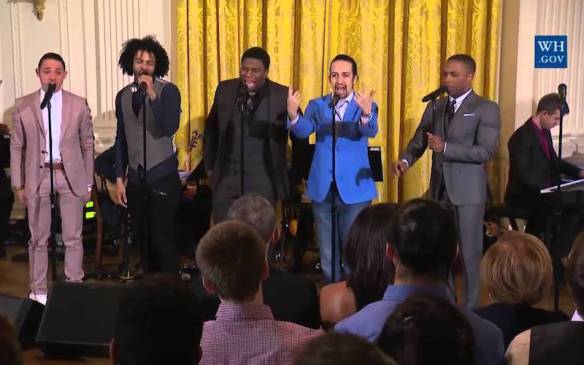
Does any of this sound familiar? It certainly went unmentioned at the White House, where a custom performance of Hamilton was held for the Obamas. The livestreamed presidential Hamilton spectacular at one point featured Obama and Miranda performing historically-themed freestyle rap in the Rose Garden.

The Obamas have been supporters of Hamilton since its embryonic days as the “Hamilton Mixtape song cycle.” By the time the fully-fledged musical arrived in Washington, Michelle Obama called it the “best piece of art in any form that I have ever seen in my life,” raising disquieting questions about the level of cultural exposure offered in the Princeton undergraduate curriculum.

In introducing the White House performance, Barack Obama gave an effusive speech worthy of the BuzzFeed Hamilton Slack:

[Miranda] identified a quintessentially American story in the character of Hamilton — a striving immigrant who escaped poverty, made his way to the New World, climbed to the top by sheer force of will and pluck and determination… And in the Hamilton that Lin-Manuel and his incredible cast and crew bring to life — a man who is “just like his country, young, scrappy, and hungry” — we recognize the improbable story of America, and the spirit that has sustained our nation for over 240 years… In this telling, rap is the language of revolution. Hip-hop is the backbeat. … And with a cast as diverse as America itself, including the outstandingly talented women — (applause) — the show reminds us that this nation was built by more than just a few great men — and that it is an inheritance that belongs to all of us.

Strangely enough, President Obama failed to mention anything Alexander Hamilton actually did during his long career in American politics, perhaps because the Obama Administration’s unwavering support of free trade and the tariff-easing Trans-Pacific Partnership goes against everything Hamilton believed. Instead, Obama’s Hamilton speech stresses just two takeaways from the musical: that America is a place where the poor (through “sheer force of will” and little else) can rise to prominence, and that Hamilton has diversity in it. (Plus it contains hip-hop, an edgy, up-and-coming genre with only 37 years of mainstream exposure.)

The Obamas were not the only members of the political establishment to come down with a ghastly case of Hamiltonmania. Nearly every figure in D.C. has apparently been to see the show, in many cases being invited for a warm backstage schmooze with Miranda. Biden saw it. Mitt Romney saw it. The Bush daughters saw it. Rahm Emanuel saw it the day after the Chicago teachers’ strike over budget cuts and school closures. Hillary Clinton went to see the musical in the evening after having been interviewed by the FBI in the morning. The Clinton campaign has also been fundraising by hawking Hamilton tickets; for $100,000 you can watch a performance alongside Clinton herself.

Unsurprisingly, the New York Times reports that “conservatives were particularly smitten” with Hamilton. “Fabulous show,” tweeted Rupert Murdoch, calling it “historically accurate.” Obama concluded that “I’m pretty sure this is the only thing that Dick Cheney and I have agreed on—during my entire political career.” (That is, of course, false. Other points of agreement include drone strikes, Guantanamo, the NSA, and mass deportation.)

The conservative-liberal D.C. consensus on Hamilton makes perfect sense. The musical flatters both right and left sensibilities. Conservatives get to see their beloved Founding Fathers exonerated for their horrendous crimes, and liberals get to have nationalism packaged in a feel-good multicultural form. The more troubling questions about the country’s origins are instantly vanished, as an era built on racist forced labor is transformed into a colorful, culturally progressive, and politically unobjectionable extravaganza.

As the director of the Hamilton theater said, “It has liberated a lot of people who might feel ambivalent about the American experiment to feel patriotic.” “Ambivalence,” here, means being bothered by the country’s collective idol-worship of men who participated in the slave trade, one of the greatest crimes in human history. To be “liberated” from this means never having to think about it.

In that respect, Hamilton probably is the “musical of the Obama era,” as The New Yorker called it. Contemporary progressivism has come to mean papering over material inequality with representational diversity. The president will continue to expand the national security state at the same rate as his predecessor, but at least he will be black. Predatory lending will drain the wealth from African American communities, but the board of Goldman Sachs will have several black members. Inequality will be rampant and worsening, but the 1% will at least “look like America.” The actual racial injustices of our time will continue unabated, but the power structure will be diversified so that nobody feels quite so bad about it. Hamilton is simply this tendency’s cultural-historical equivalent; instead of worrying ourselves about the brutal origins of the American state, and the lasting economic effects of those early inequities, we can simply turn the Founding Fathers black and enjoy the show.

Kings George I and II of England could barely speak intelligible English and spent more time dealing with their own failed sons than ruling the Empire —but they gave patronage to Handel. Ludwig II of Bavaria was believed to be insane and went into debt compulsively building castles — but he gave patronage to Wagner. Barack Obama deported more immigrants than any other president and expanded the drone program in order to kill almost 3,500 people — but he gave patronage to a neoliberal nerdcore musical. God bless this great land.

Related Article:

 The Hardest Politics to Catch: Lin-Manuel Comes to Puerto Rico

‘Stop Drinking the Kool-Aid, America: Political Fiction in an Age of Televised Lies’

20120527040549-stop-drinking-kool-aid

By John W. Whitehead

Source: A Government of Wolves

“We’ve got to face it. Politics have entered a new stage, the television stage. Instead of long-winded public debates, the people want capsule slogans—‘Time for a change’—‘The mess in Washington’—‘More bang for a buck’—punch lines and glamour.”— A Face in the Crowd (1957)

Politics is entertainment.

It is a heavily scripted, tightly choreographed, star-studded, ratings-driven, mass-marketed, costly exercise in how to sell a product—in this case, a presidential candidate—to dazzled consumers who will choose image over substance almost every time.

This year’s presidential election, much like every other election in recent years, is what historian Daniel Boorstin referred to as a “pseudo-event”: manufactured, contrived, confected and devoid of any intrinsic value save the value of being advertised. It is the end result of a culture that is moving away from substance toward sensationalism in an era of mass media.

As author Noam Chomsky rightly observed, “It is important to bear in mind that political campaigns are designed by the same people who sell toothpaste and cars.” In other words, we’re being sold a carefully crafted product by a monied elite who are masters in the art of making the public believe that they need exactly what is being sold to them, whether it’s the latest high-tech gadget, the hottest toy, or the most charismatic politician.

Tune into a political convention and you will find yourself being sucked into an alternate reality so glossy, star-studded, emotionally charged and entertaining as to make you forget that you live in a police state. The elaborate stage show, the costumes, the actors, the screenplay, the lighting, the music, the drama: all carefully calibrated to appeal to the public’s need for bread and circuses, diversion and entertainment, and pomp and circumstance.

Politics is a reality show, America’s favorite form of entertainment, dominated by money and profit, imagery and spin, hype and personality and guaranteed to ensure that nothing in the way of real truth reaches the populace.

After all, who cares about police shootings, drone killings, SWAT team raids, asset forfeiture schemes, private prisons, school-to-prison pipelines, overcriminalization, censorship or any of the other evils that plague our nation when you can listen to the croonings of Paul Simon, laugh along with Sarah Silverman, and get misty-eyed over the First Lady’s vision of progress in America.

But make no mistake: Americans only think they’re choosing the next president.

In truth, however, they’re engaging in the illusion of participation culminating in the reassurance ritual of voting. It’s just another Blue Pill, a manufactured reality conjured up by the matrix in order to keep the populace compliant and convinced that their vote counts and that they still have some influence over the political process.

Stop drinking the Kool-Aid, America.

The nation is drowning in debt, crippled by a slowing economy, overrun by militarized police, swarming with surveillance, besieged by endless wars and a military industrial complex intent on starting new ones, and riddled with corrupt politicians at every level of government. All the while, we’re arguing over which corporate puppet will be given the honor of stealing our money, invading our privacy, abusing our trust, undermining our freedoms, and shackling us with debt and misery for years to come.

Nothing taking place on Election Day will alleviate the suffering of the American people.

The government as we have come to know it—corrupt, bloated and controlled by big-money corporations, lobbyists and special interest groups—will remain unchanged. And “we the people”—overtaxed, overpoliced, overburdened by big government, underrepresented by those who should speak for us and blissfully ignorant of the prison walls closing in on us—will continue to trudge along a path of misery.

With roughly 22 lobbyists per Congressman, corporate greed will continue to call the shots in the nation’s capital, while our elected representatives will grow richer and the people poorer. And elections will continue to be driven by war chests and corporate benefactors rather than such values as honesty, integrity and public service. Just consider: it’s estimated that more than $5 billion will be spent on the elections this year, yet not a dime of that money will actually help the average American in their day-to-day struggles to just get by.

And the military industrial complex will continue to bleed us dry. Since 2001 Americans have spent $10.5 million every hour for numerous foreign military occupations, including in Iraq and Afghanistan. There’s also the $2.2 million spent every hour on maintaining the United States’ nuclear stockpile, and the $35,000 spent every hour to produce and maintain our collection of Tomahawk missiles. And then there’s the money the government exports to other countries to support their arsenals, at the cost of $1.61 million every hour for the American taxpayers.

Then again, when faced with the grim, seemingly hopeless reality of the American police state, it’s understandable why Americans might opt for escapism. “Humankind cannot bear too much reality,” T. S. Eliot once said. Perhaps that is one reason we are so drawn to the unreality of the American political experience: it is spectacle and fiction and farce all rolled up into one glossy dose of escapism.

Frankly, escapism or not, Americans should be mad as hell.

Many of our politicians live like kings. Chauffeured around in limousines, flying in private jets and eating gourmet meals, all paid for by the American taxpayer, they are far removed from those they represent. Such a luxurious lifestyle makes it difficult to identify with the “little guy”—the roofers, plumbers and blue-collar workers who live from paycheck to paycheck and keep the country running with their hard-earned dollars and the sweat of their brows.

Conveniently, politicians only seem to remember their constituents in the months leading up to an election, and yet “we the people” continue to take the abuse, the neglect, the corruption and the lies. We make excuses for the shoddy treatment, we cover up for them when they cheat on us, and we keep hoping that if we just stick with them long enough, eventually they’ll treat us right.

People get the government they deserve.

No matter who wins the presidential election come November, it’s a sure bet that the losers will be the American people.

As political science professor Gene Sharp notes in starker terms, “Dictators are not in the business of allowing elections that could remove them from their thrones.” As I make clear in my book Battlefield America: The War on the American People, the Establishment—the shadow government and its corporate partners that really run the show, pull the strings and dictate the policies, no matter who occupies the Oval Office—are not going to allow anyone to take office who will unravel their power structures. Those who have attempted to do so in the past have been effectively put out of commission.

So what is the solution to this blatant display of imperial elitism disguising itself as a populist exercise in representative government?

Stop playing the game. Stop supporting the system. Stop defending the insanity. Just stop.

Washington thrives on money, so stop giving them your money. Stop throwing your hard-earned dollars away on politicians and Super PACs who view you as nothing more than a means to an end. There are countless worthy grassroots organizations and nonprofits working in your community to address real needs like injustice, poverty, homelessness, etc. Support them and you’ll see change you really can believe in in your own backyard.

Politicians depend on votes, so stop giving them your vote unless they have a proven track record of listening to their constituents, abiding by their wishes and working hard to earn and keep their trust.

Stop buying into the lie that your vote matters. Your vote doesn’t elect a president. Despite the fact that there are 218 million eligible voters in this country (only half of whom actually vote), it is the electoral college, made up of 538 individuals handpicked by the candidates’ respective parties, that actually selects the next president. The only thing you’re accomplishing by taking part in the “reassurance ritual” of voting is sustaining the illusion that we have a democratic republic. What we have is a dictatorship, or as political scientists Martin Gilens and Benjamin Page more accurately term it, we are suffering from an “economic élite domination.”

A healthy, representative government is hard work. It takes a citizenry that is informed about the issues, educated about how the government operates, and willing to make the sacrifices necessary to stay involved, whether that means forgoing Monday night football in order to attend a city council meeting or risking arrest by picketing in front of a politician’s office.

It takes a citizenry willing to do more than grouse and complain. We must act—and act responsibly—keeping in mind that the duties of citizenship extend beyond the act of voting.

Most of all, it takes a citizenry that cares enough to get mad and get active. As Howard Beale declares in the 1976 film Network:

“I want you to get up right now, sit up, go to your windows, open them and stick your head out and yell, ‘I’m as mad as hell and I’m not going to take this anymore.’ Things have got to change. But first, you’ve gotta get mad!…You’ve got to say, ‘I’m as mad as hell, and I’m not going to take this anymore!’ Then we’ll figure out what to do about the depression and the inflation and the oil crisis. But first get up out of your chairs, open the window, stick your head out, and yell, and say it.”


Wikileaks Emails Bring New Attention to Hillary Victory Fund “Money Laundering” Charges

index

By Pam Martens and Russ Martens

Source: Wall Street on Parade

The problem with conspiracy theorists is that, quite frequently, the theorists lack adequate imagination. That seems to be the case when it comes to the Democratic National Committee’s behind-the-scenes machinations to muscle Hillary Clinton into the White House while plotting against her main challenger, Bernie Sanders. That conclusion stems from the trove of 20,000 DNC emails dumped into the public sphere by Wikileaks last Friday.

The leaked emails have cost Debbie Wasserman Schultz her job as Chair of the DNC but other top DNC officials captured in devious plots against Sanders in the email exchanges still have their jobs – or at least no official firings have been announced. This makes the conspiracies seem more like a DNC business model.

The DNC’s own charter demands that it treat all Democratic primary candidates fairly and impartially, but top DNC officials made a mockery of that mandate. In addition to conjuring up ways to smear Clinton challenger Bernie Sanders during the primary battles, the leaked emails show a coordinated effort to cover up what the Sanders camp called “money laundering” between the Hillary Victory Fund and the DNC.

Despite the fact that the Sanders campaign had no such active arrangement with the DNC, the DNC agreed to participate in the Hillary Victory Fund, a joint fundraising committee that sluiced money to both Hillary’s main candidate committee, Hillary for America, as well as into the DNC. To a much tinier degree, funds also went to dozens of separate State Democratic committees.

On May 2 of this year, the Sanders campaign released a statement charging Clinton with “looting funds meant for the state parties to skirt fundraising limits on her presidential campaign,” and exploiting “the rules in ways that let her high-dollar donors like Alice Walton of Wal-Mart fame and the actor George Clooney and his super-rich Hollywood friends skirt legal limits on campaign contributions.”

Despite Clinton’s promise to rein in tax dodges by hedge funds, Wall Street On Parade reported in April that major hedge fund titans were also big donors to the Hillary Victory Fund. We wrote at the time:

“Federal Election Commission records show that S. Donald Sussman, founder of hedge fund Paloma Partners, gave $343,400 to the Hillary Victory Fund while also donating $2.5 million to Priorities USA, the Super Pac supporting Hillary. Hedge Fund billionaire George Soros donated $343,400 to the Hillary Victory Fund while sluicing a whopping $7 million into Priorities USA to enhance Hillary’s efforts to move into the Oval Office.”

Today, reporters Ken Vogel and Isaac Arnsdorf of Politico have provided significant new details from the leaked emails to show how the DNC worked behind the scenes to control the media’s handling of revelations involving the Hillary Victory Fund.

Vogel was criticized by some media outlets when the Wikileaks emails revealed he had allowed a DNC official to review one of his articles critical of the joint fundraising operation prior to publication. Erik Wemple of the Washington Post has provided some necessary clarity to that issue here.

The Clinton camp and the DNC had attempted publicly to defend the joint fundraising operation as providing critical help to State Committees in order to help down-ticket candidates. But today, Vogel and Arnsdorf report the following:

“Between the creation of the victory fund in September and the end of last month, the fund had brought in $142 million, the lion’s share of which — 44 percent — has wound up in the coffers of the DNC ($24.4 million) and Hillary for America ($37.6 million), according to a POLITICO analysis of FEC filings. By comparison, the analysis found that the state parties have kept less than $800,000 of all the cash brought in by the committee — or only 0.56 percent.”

Vogel and Arnsdorf also detail how the DNC attempted to stonewall reporters on the topic, writing:

“The emails show the officials agreeing to withhold information from reporters about the Hillary Victory Fund’s allocation formula, working to align their stories about when — or if — the DNC had begun funding coordinated campaign committees with the states.”

The Politico reporters also note that Hillary Clinton’s campaign attorney, Marc Elias of law firm Perkins Coie, also appears in a Wikileaks email suggesting media strategy to the DNC:

“ ‘The DNC should push back DIRECTLY at Sanders and say that what he is saying is false and harmful to the Democratic party,’ Marc Elias, an attorney who advises the DNC and the Clinton campaign, wrote in an email to DNC officials. [DNC] CEO Amy Dacey responded ‘I do think there is too much of this narrative out there — I also worry since they are emailing to their list (which has overlap with ours!)’

“In another email, Miranda, the [DNC] communications director, suggested that the campaign tell other journalists seeking to follow POLITICO’s story that “Politico got it wrong.” But the rest of his email failed to indicate any errors in POLITICO’s story, nor did the DNC or the Clinton campaign seek a correction.”

Politico’s latest revelations build on the allegations in the class action lawsuit that has been filed against the DNC and Wasserman Schultz by Sanders’ supporters. One document submitted in that lawsuit came from a previous hack of the DNC server by an individual known as Guccifer 2.0. That document shows that even after Bernie Sanders had announced he was entering the race on April 30, 2015, the DNC was brainstorming on how it could advance Hillary Clinton to the top of the ticket. The memo is described as follows in the lawsuit:

“Among the documents released by Guccifer 2.0 on June 15th is a two-page Microsoft Word file with a ‘Confidential’ watermark that appears to be a memorandum written to the Democratic National Committee regarding ‘2016 GOP presidential candidates’ and dated May 26, 2015. A true and correct copy of this document (hereinafter, ‘DNC Memo’) is attached as Exhibit 1. The DNC Memo presents, ‘a suggested strategy for positioning and public messaging around the 2016 Republican presidential field.’ It states that, ‘Our goals in the coming months will be to frame the Republican field and the eventual nominee early and to provide a contrast between the GOP field and HRC.’ [HRC means Hillary Rodham Clinton.] The DNC Memo also advises that the DNC, ‘[u]se specific hits to muddy the waters around ethics, transparency and campaign finance attacks on HRC.’ In order to ‘muddy the waters’ around Clinton’s perceived vulnerabilities, the DNC Memo suggests ‘several different methods’ of attack including: (a) ‘[w]orking through the DNC’ to ‘utilize reporters’ and create stories in the media ‘with no fingerprints’; (b) ‘prep[ping]’ reporters for interviews with GOP candidates and having off-the-record conversations with them; (c) making use of social media attacks; and (d) using the DNC to ‘insert our messaging’ into Republican-favorable press.” [Read the full memorandum here.]

The response to all of this from Hillary Clinton has further enraged Sanders’ supporters. After the emails were leaked and written about in the media over the weekend, Hillary Clinton made Wasserman Schultz the honorary chairperson of her 50-state program and President Obama praised Wasserman Schultz in a statement that can only be described as bizarre, given the contents of the leaked emails. Obama said on Sunday:

“For the last eight years, Chairwoman Debbie Wasserman Schultz has had my back. This afternoon, I called her to let her know that I am grateful. Her leadership of the DNC has meant that we had someone who brought Democrats together not just for my re-election campaign, but for accomplishing the shared goals we have had for our country.”

Apparently, missing from those “shared goals” is allowing a fair primary process within the Democratic party or a challenge to the political machine that controls Washington.


Related Article: IRS Will Investigate Clinton Foundation ‘Pay-to-Play’ Corruption Accusations

The Corporate Liberal in America

hillary-clinton-winking-AP-640x480

By Jason Hirthler

Source: CounterPunch

“I have almost reached the regrettable conclusion that the Negro’s greatest stumbling block in his stride toward freedom is not the White Citizen’s Counciler or the Ku Klux Klanner, but the white moderate, who is more devoted to ‘order’ than to justice.”

— Martin Luther King, Jr., Letter from a Birmingham Jail

Whether seated in Congress or exiting a voting booth, a corporate liberal is someone who supports anything progressive that does not challenge corporate power. In practice, this means corporate liberals will fight for progressive identity politics. If it has to do with race, sexual orientation, and gender, it generally doesn’t challenge corporate power. Major corporations support progressive positions on those issues, too. Corporate liberals march for gay rights and the larger LGBTQ community itself. They support feminism. They support reproductive rights. They support African-American protests against police brutality—up to the point where they become threatening to the establishment. (Bill Clinton did initiate the prison industrial complex that unduly incarcerates huge numbers of minorities.)

This support is all to the good. Tremendous progress has been made by popular protest of the devastating prejudices that have for years denied individual rights. But when their elected Democrats undermine economic justice, promote imperial warfare, and refuse to seriously address climate change, corporate liberals just look the other way. As Joe Clifford noted in his piece on Bernie Sanders, being a corporate liberal also means rejecting, “…a ban on fracking, a proposal to oppose TPP, the $15 per hour minimum wage proposal, a call for single-payer health care, and a statement of opposition to the illegal Israeli occupation.” These proposals, courageously put forward by James Zogby, Bill Mckibben, Cornell West and the rest of the Sanders contingent at the recent Democratic Platform Committee meeting in Washington, were all struck down. In a beautiful expression of moral courage, West refused to back the platform in its final iteration, saying,

“[If] we can’t say a word about [Trans-Pacific Partnership], if we can’t talk about Medicare for all explicitly, if the greatest prophetic voice dealing with impending ecological catastrophe can hardly win a vote and if we can’t even acknowledge occupation as something that’s real in the lives of a slice of humanity … it just seems to me there’s no way in good conscience I can say take it to the next stage.”

Yada Yada Yada

Words like these have no effect on the corporate liberal. If there’s a centimeter’s difference between their Democratic platform and the diseased corpus of Republican anarchism, the corporate conscience is salved. A corporate liberal is the one that puts “occupation” in quotes. A corporate liberal never makes the perfect the enemy of the good. A corporate liberal believes in reform, in humanitarian warfare, in the responsibility to protect, and in The New York Times front page. A corporate liberal supports all of this, though reform may be glacial, though good wars may slay millions, though interventions may undermine sovereignty, and though The Times may be rife with half-truth. It makes no difference, so long as reform is better than rollback, Barack’s slaughter is numerically less than Dubya’s, and The Washington Post is marginally more truthful than FOX News. As long as you can trust Erin Burnett more than Bill O’Reilly, it makes no difference that we will move further and further to the right, picking up steam until we barrel straight into corporate fascism. So long as the corporate liberal sits to the left of the patrician publican, he has some claim on the progressive mandate. Or so he says. Yet the best way to repel fascism, and realize that progressive mandate, is by joining a movement headed left, rather than a party moving right.

Nothing Forbidden

As Alan Nasser elucidates, there is nothing intolerable in the lesser evilism of the corporate liberal. He will endure—or more likely, watch others endure—intolerable realities while maintaining the unblinking rectitude of the blind ideologue. Author Chris Hedges writes that capitalism is “plunging us into a state of neo-feudalism, perpetual war, ecological disaster, and a dystopian nightmare.” But this, too, is not intolerable. We must accept it in order to ensure that the real nightmare—whomever happens to be running on the Republican ticket—is barred from the White House forever.

We must tolerate whatever Democrats do because they are better than Republicans. Even if that means, as it surely has and surely will, for all the identity groups corporate liberals support, a deteriorating quality of life. Lower incomes, higher unemployment. Bigger debts, bullshit jobs. Higher infant mortality, higher heart disease. More inequality, less social support. Less social support, more incarceration. More suicide, more alcoholism, more drug abuse, more debt, more stress, more unhappiness. And, if one is aware enough, the consciousness of having—perhaps unwittingly at the time—for more slaughter of brown people abroad, and the deliberate aggression against nuclear powers that will raise the prospect of nuclear extermination for millions. The Democrats have no such mandate, but the corporate liberal gives them the power to pretend they do. These are the wages of neoliberalism and imperialism, enabled by the logic of the lesser evil.

Like Dr. King, Karl Marx understood the major threat was not the fanatic on the fringe, but the moderate in the middle. The real threat is not the extremist, who will burn out by necessity if not already burned down by the moderate herd. It is the moderate herd that threatens to permit the intolerable through gradualism. Incremental genocide. Slow-motion regime change. The soft coup. The generational heist of millions of working class jobs. The decade-long liquidation of working class home equity. The century-long evisceration of labor rights. The hidden decades of disinformation campaigns that conflate freedom with free markets. Marx said, “Our task is that of ruthless criticism, and much more against ostensible friends than against open enemies.” He understood what King did, which is part of the reason why they are two of the most revolutionary figures of the last couple of centuries of Western civilization.

Too Much to Lose

Corporate liberals rehearse Manichean pieties about good and evil locked in a dualistic embrace, fighting to the death. There are no third parties in this vision. It is a necessary dualism. Hence the occasional need to undermine democracy to save it, as Hillary’s campaign demonstrated through repeated voting irregularities and financial chicanery engineered through her DNC front. It’s just simpler that way. For a political party of millionaires backed by billionaires, it just doesn’t do to disturb the status quo, rock the boat, upset the apple cart, shake the foundations, incite protest, disturb our creature comforts, move us out of our comfort zone, spark rebellion, overthrow the system, or change the world.

Is lesser evilism an elaborate rationale for preserving the status quo? Lenin said you can’t make a revolution in white gloves, and there are plenty of corporate liberals paying lip service to progress while glad-handing its well-heeled antagonists. That is why, in the end, corporate liberals are anti-revolutionaries. They would rather save capitalism than endure a potentially messy transition to socialism. Leave the revolution to Universal Studios and stubble-cheeked Third World rebels in hand-knitted berets. Social reforms in capitalist countries seem to happen like they did in South Africa, where identity politics achieve astounding successes, and calls for economic justice are swallowed up in the celebratory din. This is because corporate power cares deeply about economic power, but couldn’t care less about your sexual identity. For corporations—even if the executive board morally supports it—the gay community is ultimately another target market, a rich source of disposable income to be mined.

The least oppressed in any electorate always seem to be the greatest obstacle to change. Always willing to put justice on layaway. Always arguing for incrementalism, which strikes me as a luxury of the leisure class. Social progress will have little impact on them anyway, but paying lip service to its values will burnish their reputation. The discomfiting appearance of Bernie Sanders disturbed the polished script rehearsed by the Hillary camp for years. It was her turn, the first female president, upholding the rights of the vulnerable and achieving hard-won incremental gains through patience, hard work, and political acumen. For a moment, the Hillary faithful looked harried, wrong-footed, and exposed to the will of the mob. But now that the dodgy primaries are done, and Bernie has scampered back to the warmth of the herd, we can return to the language of compromise and the lesser evil. Had Bernie broke with the party he refused to technically join for 40 years, joined Jill Stein on the Green ticket, garnered support from voices like Kshama Sawant and movements like Socialist Alternative and Black Lives Matter, he could have founded a serious alternative to the mercenary duopoly. But he fell for the ruse of internal reform. But not everyone does. King continued in his Birmingham letter to discuss the white moderate, saying he was the one,

“… who prefers a negative peace which is the absence of tension to a positive peace which is the presence of justice; who constantly says: “I agree with you in the goal you seek, but I cannot agree with your methods of direct action”; who paternalistically believes he can set the timetable for another man’s freedom; who lives by a mythical concept of time and who constantly advises the Negro to wait for a “more convenient season.” Shallow understanding from people of good will is more frustrating than absolute misunderstanding from people of ill will. Lukewarm acceptance is much more bewildering than outright rejection.”

Sound familiar? King’s white moderate and Marx’s ostensible friend is our corporate liberal. Same spin, different decade. The corporate liberal is an embodiment of the idea that political parties are the graveyards of movements. Hedges himself wrote a book called, “Death of the Liberal Class” five years ago. It should’ve been the elegy before the interment of the Democratic Party as a serious option in electoral politics. Yet here we are, about to anoint another corporate liberal to the highest seat in the land. In that case, consider this article yet another epitaph awaiting its headstone. Let’s hope it’s not a long wait. Voices like Sawant’s and the momentum of movements like BLM give us reason to think it won’t be.

Jason Hirthler is a veteran of the communications industry and author of The Sins of Empire: Unmasking American Imperialism. He lives in New York City and can be reached at jasonhirthler@gmail.com.

Latest Guccifer 2.0 Leak Reaffirms Primaries Were Rigged for Clinton

 DEM_2016_Clinton.JPEG-19e1f_c0-266-3500-2306_s885x516

And, of course, a dodgy DNC blames Russian hackers

By Michael Sainato

Source: Observer

On July 18, hacker Guccifer 2.0 released a new batch of documents obtained from DNC servers. Among the files given exclusively to The Hill is a DNC memo to Clinton political operatives on March 24, 2015—before she formally announced her candidacy—outlining how to legally solicit pro-Clinton super-PACs. “The memo was sent to political consultant John Podesta, now Clinton’s campaign chairman; Clinton fundraising guru Dennis Cheng; and campaign manager Robby Mook,” reported The Hill.

The memo is just one of several documents released by Guccifer 2.0 proving the Democratic National Committee rigged the system for Clinton. Before the primaries began, DNC strategies were developed with Clinton in mind as the presidential nominee. The leak affirms claims by Bernie Sanders’ supporters that the Democratic primaries were not an election, but rather a coronation for Hillary Clinton.

Because many of the documents implicate mainstream media outlets in their complacency to adhere to the DNC’s strategy, the Guccifer 2.0 hacks have gone largely unreported. Some of the documents even unveil how the Clinton campaign fed specific stories to the media in order to boost their political agenda.In May 2015, The Intercept alluded to similar strategies, when it discovered that a CNN op-ed published under Atlanta Mayor Kasim Reed’s name had actually been written by a Clinton lobbyist, edited by a Clinton super-PAC, and sent directly to CNN from the super-PAC. In June, Daily Beast reporter Olivia Nuzzi tweeted that she might lend some credence to the Bernie Bros narrative if the Clinton Campaign hadn’t pitched her Bernie Bros stories to write. In refusing to cover how the DNC and the Clinton campaign united, mainstream media has rewarded corruption.

Instead of confirming or denying the validity of the documents, the DNC has reverberated the same tired excuse, claiming Russian hackers are responsible: “Our experts are confident in their assessment that the Russian government hackers were the actors responsible for the breach detected in April and we believe that the subsequent release and the claims around it may be a part of a disinformation campaign by the Russians. We’ve deployed the recommended.”

While the DNC and Clinton campaign have called for party unityClinton has continued the politically-expedient tactic of adopting several of Sanders’ popular ideas. Even though Clinton claimed to support a constitutional amendment to overturn Citizen’s United, she has profited off of the decision in the past—receiving millions of dollars from super-PACs and wealthy billionaires, including George Soros, James Simons and Haim Saban. Her highly-publicized support to overturn Citizens United comes shortly after Sanders’ formal endorsement for Clinton resulted in a wave of backlash and resentment against Clinton—rather than the increase in favorability her campaign had hoped to generate.

Although Hillary Clinton’s coronation may have widespread Establishment support, the Democratic Party has disenfranchised millions of voters—hurting Democrats’ chances not only in the upcoming general election, but for years to come.