The Richest Sociopath in the World

By John Rachel

Source: Dissident Voice

Obviously the above pie chart is a put-on. It is well-documented that working conditions for most employees of Amazon are  abysmaldehumanizing, bordering on abuse we normally associate with slavery.

Moreover, the median employee’s salary under Jeff Bezos’ imperial lordship is $28,446. No one working as a regular there has paid off their credit cards and is driving to work in a Mercedes. 

Jeff Bezos is referred to as The Richest Man in the World and his personal fortune, while growing by $191,000 each minute, is currently estimated at $168 billion.

So …

$28,446 vs. $168,000,000,000? While I can acknowledge the simple math, I find the contrast of such numbers on a gut level difficult to grasp.

To get a handle on such inequality, let’s try approaching it from different angles.

One way to put the disparity into perspective is to recognize it takes Bezos just under 9 seconds to earn what Amazon’s median worker does in an entire year.

Another is to recognize that for a worker to go through Jeff Bezos’ current personal fortune — and, of course, it continues mounting at accelerating levels as I write this — at his/her current median annual income of $28,446 per year, WOULD TAKE 5,905,927 YEARS! That’s close to 6 million years!

For Jeff Bezos himself to go through his current $168 billion, assuming his earnings stopped dead this very moment — which as you and I know they won’t — SPENDING $1,000,000 A DAY, would take NEARLY 460 years. Yes, even spending $1 million a day, in the year 2475 he’d still have plenty of cash, tens of million of dollars mad money. We can feel confident that he wouldn’t be foraging through the dumpster behind 7-11. 

Now, further consider that while the $28,446 median salary is above the national poverty line for a single individual if that person is the sole breadwinner for a family of four, it is marginally above it, which is why many Amazon employees must rely on government assistance to keep from starving.

As well as calculation, I did some speculation — a simple exercise in imagination.

Apparently Bezos’ wealth generating machine is raking it in so fast, he’s currently making $11.5 million per hour … every hour … 24 hours a day … seven days a week. $11,500,000 per hour! 

So here’s what I was picturing in my mind’s eye … 

If for 40 hours of the 168 hours in a week, Bezos were willing to scrape by on a mere $5,840,000 per hour, he could give every one of his 566,000 Amazon employees a $10 per hour raise. Of course, the remaining 128 hours in each week, Bezos could continue earning his normal $11.5 million per hour, not having to share any of it with the pathetic slobs who work for him.

Rhetorical question: Does Jeff Bezos have any concept of what that $10 per hour increase would mean to his employees? 

I’m not going to even suggest here I’m offering this for Bezos to entertain. There are so many advantages to him both as a putative member of the human race and the employer of over a half million workers — advantages that are so OBVIOUS — if they haven’t occurred to him up until now, then his brain functions in ways beyond my understanding. For one thing, he could point to his new fig leaf of “generosity” and ask people to stop calling him a selfish prick. Second, Amazon employees I’m sure would respond to his largesse with greater company loyalty and increased tolerance for his onerous working conditions. He’d still be the richest SOB on the block and could mock the pauperish Bill Gates and Warren Buffett as pitiable wannabees.

Consider …

The most poorly paid Amazon employee now makes $12 per hour. The $10 per hour raise I proposed would boost those $12 per hour workers right up there with Costco employees, who make an average of $21 per hour. And with the across-the-board $10 per hour increase, Bezos’ higher paid employees would be earning among the finest wages in the world provided by a major corporation. 

And by golly, there’s a plus side to the plus side …

Bezos’s bold and gracious gesture would result in a public relations coup of cosmic proportions! Amazon would no longer be demonized — well, not quite as much — by us bleeding-heart lefties as a capitalistic scourge and one-way ticket to Hell for the future of mankind, even if its environmental record is appalling and its business model generally the stuff of steroid-laced neo-feudalism.

Granted, Bezos would have to do some belt-tightening. He’d have to watch his pennies but could probably manage it, eh? Maybe he could skip a couple meals and do some of his own weeding at his estate. After all, after lavishing the $10 per hour raise on all of his employees, he’d only be pulling in $1,705,600,000 per week. I know I know! Like me you’re probably getting all teary-eyed for the poor guy.

Let me get to the extremely anti-climactic conclusion of this lament qua analysis.

Since nothing will change until the system itself changes, meaning the one in place now that creates, incentivizes, and lionizes the obscenely wealthy — reference current holder of the Office of President of the United States of America — I can only recommend this …

We have been labeling Jeff Bezos as ‘The Richest Man in the World’. Yet, quite honestly I don’t personally know any human, man or woman, who behaves like this gluttonous chunk of self-indulgent meat. It actually makes me nauseous to think we’re members of the same species.

Thus, from now on let’s use the correct terminology. Let’s call Jeff Bezos what he really is: the Richest Sociopath in the World.

We could probably order bumper stickers to help correct the record … from Amazon, of course.

Five Ways to Curb the Power of Corporations and Billionaires

These six men own as much wealth as half the world’s population

By Jeremy Lent

Source: Patterns of Meaning

We need to rein in the destructive power of corporations and billionaires before it’s too late. These five ideas would do that, while leaving global capitalism intact. Ultimately, only a complete transformation of our economic system will save our future, but these proposals could set changes in motion that might eventually take us there.

Transnational corporations have become the dominant force directing our world. Humanity is accelerating toward a precipice of overconsumption, and the large transnationals are the primary agents driving us there. We’re rapidly losing the earth’s forestsanimalsinsectsfish, even the topsoil we require to grow our crops. The earth is becoming denuded of its bounty as every living system ­is ransacked for resources—not to mention the looming emergency of climate breakdown. As a result, twenty thousand scientists have recently issued a public warning to humanity, while prominent academics consider the collapse of civilization this century to be a serious threat.

Changes in our personal consumption patterns are important, but are ultimately inconsequential compared with the impact of the transnationals that have come to dominate our global economic and political system. Of the world’s hundred largest economies, sixty-nine are now corporations. Political parties in many of our so-called democracies are funded in large part by billionaires, while government cabinet positions are staffed by corporate executives. International bodies setting global policy are infiltrated by corporate agents so successful at entrenching corporate power that even those governments that still prioritize their people’s needs can no longer make autonomous decisions without risking crippling lawsuits from the transnationals whose interests they threaten. Meanwhile, countries and cities compete with each other to beg their corporate overlords for investment dollars, even it means undermining public services and legal protections for their own populations.

Environmental groups, recognizing where ultimate power resides, try to pressure corporations to improve practices through the threat of public shaming, with some appreciable results. However, these attempts are necessarily constrained by the very structure of big corporations, which exist to enrich their shareholders regardless of the consequences. The common goal of corporations around the world is to monetize human activity and what’s left of nature’s abundance as rapidly and efficiently as possible. The overriding purpose of the world’s powerful institutional force is thus directly at odds with a flourishing earth or a viable future for humanity.

Having spent the first part of my career in the heart of the capitalist system, consulting to major international banks and corporations, I developed a sense of the underlying forces that direct the centers of financial power. These ideas are my distillation of what I believe could be effective levers for humanity to take back some control from the increasing hegemony of corporations and billionaires.

If we are to avoid disaster, our global economic system with its gaping inequities and deranged consumption will eventually need to dismantled and replaced by one based on life-affirming principles rather than wealth maximization. These suggestions, even in aggregate, wouldn’t do that. They represent mere tweaks in a system that ultimately needs to be completely transformed. But like a modest trim tab that helps redirect an ocean liner, perhaps they could begin to curb the destructive force of transnationals and redirect their enormous power toward a more sustainable path.

1. Triple bottom line required for corporate charters

A fundamental reason for the rapacious behavior of transnational corporations is their drive to maximize shareholder value above anything else. While there is no explicit requirement for this in the standard corporate charter, a century of case law has entrenched this principle into the behavior of large corporations to the point that is has become the de facto standard of operation. As a result, if corporations were people, they would be considered psychopaths, utterly devoid of any caring for the harm they cause in the pursuit of their goals.

It is easier, however, to change a corporation’s values than those of a human psychopath. All you need to do is change the legal basis of their charter. Instead of pursuing shareholder interests alone, they could be re-chartered with the explicit purpose of achieving a triple bottom line of social and environmental outcomes as well as financial—sometimes known as the “triple Ps” of people, planet, and profit.

This alternative corporate value system is already available through chartering as a benefit corporation or certifying as a B-Corp, and has been adopted by over 2,000 corporations in over fifty countries around the world—including several multibillion-dollar transnationals.  My proposal is that, instead of being a voluntary step taken by a select few, this would be a requirement for all corporations above a certain size.

Overnight, the intrinsic character of the corporation would be transformed. Currently, CEOs and corporate boards are faced with continual pressure to grow their earnings at all cost. If they chose to make a humane decision, such as not to exploit a copper mine because of the consequent pollution, they could expect to be sued by shareholders, and possibly acquired by a more ruthless competitor. However, if they were legally required to achieve a triple bottom line, they would weigh up decisions in a more balanced way, as a rational person might. With the board responsible for all three bottom lines, they would have to consider the risk of being sued if they caused excessive pollution, or if they were callous to the needs of the communities where their plants were located.

Currently, large corporations boast of their corporate social responsibility departments that are supposed to care about issues such as employment practices of their suppliers, sustainability of their raw materials, environmental impact of their packaging, gender balance and ethnic diversity in the workplace, and investments in local communities. Suddenly, they would have to stop paying mere lip service to these issues and take them as seriously as marketing costs, revenue growth and distribution channels—the things that CEOs actually worry about when they go home at night.

2. Charter renewal required every five years

Changing the corporate charter requirement might not, however, be enough by itself to halt the relentless pursuit of profits by large transnationals. After all, executive pay packages consist of dollars rather than goodwill, and those dollars are linked directly to the share price, which is driven by shareholders’ expectation of financial returns. If they could get away with it, they might continue their rapacious practices, while trying harder to look like they’re meeting the other two bottom lines.

That’s the reason for my second proposal, which is to require that corporations, which currently enjoy what’s known legally as a “perpetual existence,” get their charters renewed every five years. If they failed to meet pre-established criteria on their two non-financial bottom lines, they would not be permitted to continue in business. Currently, if a company can’t meet its financial obligations, it’s forced into Chapter 11 bankruptcy proceedings and the value of its stock generally tanks to zero. Under my proposal, executives would also have to consider the risk of declaring “social bankruptcy” or “environmental bankruptcy” as they made their business decisions.

As in currently regulated industries such as banking, the final step of losing their charter would not have to be immediate. If a corporation failed to meet its basic parameters, it could be given a warning, with a time period set to fix things. However, the mere threat of this happening would lead corporate executives to make sure they were well above the criteria required to keep their charter.

Corporations are, of course, highly adept at using their financial resources to influence regulatory bodies through bribes and other mechanisms. To avoid this, panel members responsible to renew the charter would be representatives of the communities and ecosystems covered in the company’s scope of operations. Their task would be to weigh up the findings of experienced independent auditors on the company’s performance. To minimize corruption, the panel could be chosen by a process of random selection called sortition, just a like a trial jury is chosen in our legal system.

3. Tax stock trades based on the length of the holding period

Powerful as they are, even corporations have their masters: their shareholders. But don’t think of the typical shareholder as a Warren Buffet type, sitting back in his leather armchair perusing his holdings. Instead, corporate stocks are subject to the frenetic activity of financial markets, where split-second computer algorithms govern much of the trading. Investment firms spend hundreds of millions of dollars enhancing their computing networks to shave as little as three milliseconds off the timing of their trades. The hyper liquidity of global markets means that investors are obsessed with short-term market trends, which leads corporate CEOs, forever anxious about their stock price, to focus their time horizon on the next quarterly earnings report. Financial valuations apply discount rates to future earnings, which means that an investment paying off thirty years in the future can be worth as little as five percent of its future payoff in the present. Under these conditions, why would any CEO care about the state of the planet—or even their company—thirty years from now?

During the 2016 US election campaign, Bernie Sanders proposed a Financial Transaction Tax to pay for free college tuition, setting the rate at 0.1% of the transaction. In Europe, discussions are under way to apply a similar EU-wide tax. My proposal increases the tax rate by orders of magnitude, and differentiates based on the length of the stock holding. For example, the tax rate might look like this:

  • 10% if the stock is held less than a day
  • 5% if less than a year
  • 3% if less than 10 years
  • 1% if less than 20 years
  • Zero if more than 20 years

The effects of this single step would be enormous. The financial services industry would be transformed overnight. High frequency stock trading and same-day traders would disappear. The short-term orientation of the stock market would be replaced by carefully considered long-term investment decisions. A typical mutual fund, which in the US currently turns over its portfolio at the rate of 130% a year, could no longer afford to do so, and would have to change its investment decision-making based on sustainable returns. The tax could be waived for individuals experiencing a life-changing event or for simple hedging techniques where, for example, farmers need to lock in the price of their produce at a future time.

The result would be a massive shift away from destructive extractive industries and toward sustainable businesses. For example, the fossil fuel industry is recognized to be vastly overvalued as a result of its “unburnable carbon”: the amount of fossil fuels in the ground that can never be burned if the world is to keep climate change below the 2° rise agreed at COP21 in Paris. A recent study estimates the overvaluation as high as $4 trillion. Investors, however, play a game of musical chairs, hoping they won’t be the ones left holding the stranded assets. This proposed transaction fee would incent them to dump fossil fuel investments immediately for opportunities in renewable energy with longer-term payoffs.

4. Cap on billionaire’s assets over $5 billion

As corporations have taken increasing control of the global system, they have catapulted founding shareholders and their heirs to previously unimaginable pinnacles of wealth.  The combined wealth of the world’s 2,754 billionaires is now $9.2 trillion, an amount that has doubled in the past six years, and increased tenfold since the beginning of this century. The magnitude of this wealth is difficult to conceive. The top six billionaires own as much as the lower half of the entire world’s population. Taken together, the world’s billionaires would represent the third largest economy in the world, behind only China and the United States, with wealth equivalent to the GDP of Germany and Japan combined.

There is no legitimate rationale for this outrageous concentration of such wealth in a few individuals. The argument that the founders of Microsoft, Amazon, or Facebook deserve such excessive wealth is no more valid than the belief of the ancient Egyptians in the divinity of their Pharaoh, or the Medieval notion of the divine right of kings. Mark Zuckerberg, aged 33, currently owns over $70 billion. If someone had singlehandedly miniaturized the transistor, developed the logic for computer code, invented the PC, and come up with the internet, then maybe they’d deserve having close to that amount as a reward for the value they created. But all Zuckerberg did was figure out a way to connect people up in a network that became a bit more popular than other networks, and because of the internet’s scale effects, he was the lucky one who hit the jackpot. Zuckerberg merely took advantage of all the other infrastructure work that led to the internet, painstakingly pieced together by millions of people over decades, which has been the real value creator for the world.

In response to this excess, my proposal is to cap billionaires’ wealth at, say, $5 billion. It’s an arbitrary amount, still obscenely high and presumably more than enough for those who argue that people should receive ample financial rewards for success. Beyond a certain level of wealth, however, what drives these people is power and prestige. This could be tapped by requiring them to donate their excess wealth to a trust over which they could retain some influence.

Such a trust, however, would need to have some strict criteria. While the billionaire could influence the trust’s priorities, he would not have control over its activities. The current Bill and Melinda Gates Foundation, for example, while a step in the right direction, is under the total control of the Gateses and Warren Buffet. The foundation set up with much fanfare by Mark Zuckerberg is viewed by experts as little more than a fancy tax dodge.

Each trust would need to avoid interference in a country’s political system and be dedicated to life-affirming activities, the scope of which could be based, for example, on the principles of the Earth Charter, a framework for building a just, sustainable and peaceful global society endorsed by over 6,000 organizations.

The positive impact that these trillions of dollars could have on human and natural welfare would be prodigious. Imagine a country the size of Germany and Japan combined dedicated entirely to serving human and natural flourishing. It would have the resources to end extreme poverty, increase regenerative agriculture to over a billion acres worldwide, educate hundreds of millions of girlsthrough the Global South, disseminate up to a billion clean cookstoves, and much, much more.

The billionaires of the world, meanwhile, would continue to enjoy enormous wealth, and when they jet to Davos to hobnob with other luminaries for the annual World Economic Forum, they could finally have something worthwhile to boast about.

5. Declare a crime of ecocide at the International Criminal Court

Even with all these constraints, the powers of transnational corporations would remain enormous, and there would still be times when, through willful negligence or intentional bad faith, corporate action causes massive environmental damage. A UN study, which remained unpublished, found that the world’s largest companies had caused over $2 trillion of environmental damage, which would cost a third of their overall profits if they were forced to pay for it. Because of their extensive political influence, even their most damaging activities go unpunished. This leads to my final proposal: to declare a crime of ecocide at the International Criminal Court (ICC).

The ICC is an independent judicial body set up by international treaty, the Rome Statute, in 2002 to prosecute war crimes, genocides, and crimes against humanity. While it continues to face serious challenges to its enforcement powers, it has had the effect of putting tyrants everywhere on notice that they can no longer act with impunity. If ecocide—the loss, destruction, or severe damage of an ecosystem—were declared a crime by the ICC, this could have a similarly daunting effect on those corporate tyrants who currently know they can get away with devastating the world’s “sacrifice zones” where they are pillaging the earth’s resources for profit.

There is a campaign, Eradicating Ecocide, already under way to make this happen. A model law has been drafted, and an Earth Protectors Trust Fund has been set up to permit common people everywhere to become legal Earth protectors. If a two-thirds majority of the Rome Statute signatories were to approve this as an amendment, it would become enforceable globally. Suddenly, corporate boards and CEOs everywhere would realize they are no longer above the law.

*                                   *                                   *                                   *                                    *

There is a strange paradox to consider about these proposals.  One the one hand, notice how limited they are in scope. Even if they were all implemented overnight, the global system would not be overturned. People would still go to work and get paid, food would still be on the shelves of the grocery store, the same governments would still be in power, and the internet would still work. The gaping structural inequities of our current world order would continue unabated, and we’d still be consuming far more than our planet can sustain. Ultimately, we need a complete transformation of our global system if our civilization is to survive intact through this century.

On the other hand, it doesn’t take a political genius to realize that these ideas are so far from mainstream thinking that they have virtually no chance to be adopted any time soon. They would be considered too radical for even the most progressive mainstream politician to endorse. What does this tell us about our current political dialogue? To me, it suggests that our conversations are too severely constrained by what we’re “allowed” to think in terms of how our system works. We need to cast our gaze outside the norms that our billionaire-controlled mainstream media permits us to consider.

Imagine a world where these ideas (or others like them) began to be seriously entertained. How would they even be enforced? The only way corporations could be brought to heel, or billionaires compelled to give up their excess billions, would be a concerted effort led by the United States in conjunction with the European Union, and joined by the preponderance of other countries.

This, of course, could only happen if grassroots demand for these ideas spread so powerfully that politicians had to take notice. This is not such an unrealistic scenario, given the worldwide disavowal of the dominant capitalist model: most Europeans have a higher opinion of socialism than capitalism, and even in the US, the overwhelming majority see big business as unethical and unfair.

Then, there is the potential “trim tab” effect of adopting these ideas. Even though these proposals alone wouldn’t fundamentally transform our system in the way that’s needed, they might set changes in motion that could eventually take us there. There may be other ideas more effective than these, and of course each proposal contains within it complications that would need to be worked out carefully. However, my hope is that these ideas invite a new mode of political dialogue, along with a recognition that even in the darkest times, realistic pathways exist toward a thriving future for humanity and the natural world.

When the Occupy movement failed to achieve its initial promise, many people pointed to its lack of specific demands as a reason for its demise. If and when the next radical grassroots movement emerges, which may be sooner than you expect, let’s make sure they have an array of ideas such as these in their quiver to focus public opinion on actual political deliverables.

There are very few people who really want to see our civilization collapse. If these proposals eventually did get implemented, perhaps even the executives of the transnational corporations might sleep better at night, knowing that they can become part of the solution rather than a force of destruction.


Jeremy Lent is author of The Patterning Instinct: A Cultural History of Humanity’s Search for Meaning, which investigates how different cultures have made sense of the universe and how their underlying values have changed the course of history. He is founder of the nonprofit Liology Institute, dedicated to fostering a sustainable worldview. For more information visit jeremylent.com.

Big Pharma and the Rise of Gangster Capitalism

By Charles Hugh Smith

Source: Of Two Minds

$8 per vial in competing developed-world nations and $38,892 in the U.S. That says it all.

Thanks to decades of gangster films, we all know how gangster capitalism works: the cost of “protection” goes up whenever the gangster wants to increase revenues, any competition is snuffed out, and “customer demand” is jacked up by any means available– addiction, for example.

This perfectly describes the pharmaceutical industry and every other cartel in America. You might have read about the price increase in Acthar gel, a medication to treat Infantile Spasms. (via J.F., M.D., who alerted me to the repricing of this medication from $40 in 2001 to the current price of $38,892.)

The compound first received approval in 1950, and various branded versions have been approved in recent years. Let’s be clear: this medication did not require billions of dollars in research and development, or decades of testing to obtain FDA approval; it’s been approved for use for the past 68 years.

Yes, you read that correctly: a medication that’s been in use for 68 years went from $40 a dose in 2001 to $38,892 today. Don’t you love the pricing? Not a round 38 grand, but $38,892. You gotta love these gangsters!

There’s another related term to describe this form of capitalism: racketeering.That’s what mobsters do–operate rackets.

The Big Pharma racket enriches a number of gangs practicing gangster capitalism: the drug companies themselves, of course, but some doctors are profiting from the racket, and so are pharmaceutical lobbyists:

Study highlights role of doctor conflicts of interest in Medicare spending on Mallinckrodt drug Acthar Study published in JAMA indicates nearly 90 percent of doctors prescribing HP Acthar Gel took payments from drug’s manufacturer.

Here are the money quotes:

In 2014 Mallinckrodt raised the price of Acthar further to $34,000. The Federal Trade Commission and attorneys general from five states sued Mallinckrodt for anti-competitive behavior with regard to the acquisition of Synacthen Depot and the monopolistic pricing of Acthar, and in January 2017 the company settled, agreeing to pay $100 million and to license Synacthen Depot to a competitor. According to Kaiser Health News, Mallinckrodt responded by increasing its Congressional lobbying to $610,000, and its contributions to Congress members to $44,000, in the first quarter of 2017.

As an off-patent pharmaceutical, a similar drug, differing in formulation, available in Europe, made by a different manufacturer, sells for $8 per vial.

So a medication to treat infants costs $8 per vial in Europe and $38,892 in the U.S. Don’t you just love gangster capitalism to death? Because death and suffering is the gangsters’ ultimate threat: pay up or die.

Here’s another example of Big Pharma gangster capitalism at work: Insulin Drug Price Inflation: Racketeering or Perverse Competition?

Don’t you wish you had a racket where you could raise prices by 10% a year like clockwork, or triple the price of your “product” every decade?

Pfizer just raised prices on 100 medications:

The increases are effective as of July 1. In most cases, the increases are just over 9%, which is in line with the annual 10% price hikes adopted by most drug companies. Putting that number in context, core inflation printed at 2% last week.

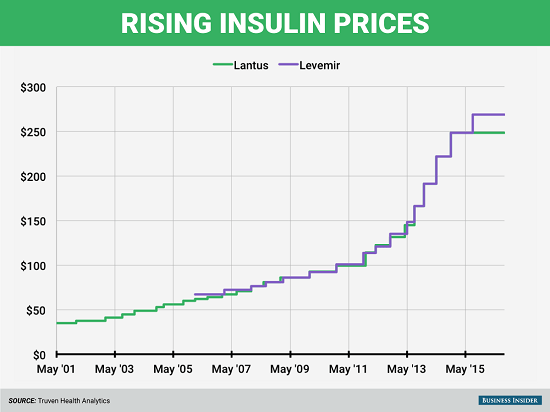
Here’s a chart of the net result of gangster capitalism:

Gangster capitalism is the new model of “growth” in America, the model used by every cartel from higher education to Pentagon contractors. Eliminate actual competition, raise prices in lockstep with other cartel members, lobby the government to pay your extortionist prices, and threaten any resisters with severe consequences.

Try resisting your local government’s property tax increases to cover insiders’ pensions and healthcare benefits: it’s always “for the children,” of course, and if you don’t pay up, we’ll just auction off your house.

There’s no difference between that and being told you’re gonna be wearing concrete overshoes if you don’t comply.

The U.S. economy is nothing more than an exploitive jumble of rackets, insider plundering and gangster capitalism. $8 per vial competing developed-world nations and $38,892 in the U.S. That says it all.

Humanity’s ‘Dirty Little Secret’: Starving, Enslaving, Raping, Torturing and Killing our Children

© UNICEF/UN0126672/Brown
A drawing by a Rohingya boy reveals the horrific experiences he endured while fleeing from Myanmar to Bangladesh, October 2017.

By Robert J. Burrowes

In a recent article titled ‘Challenges for Resolving Complex Conflicts’, I pointed out four conflict configurations that are paid little attention by conflict theorists.

In this article, I would like to discuss a fifth conflict configuration that is effectively ignored by conflict theorists (and virtually everyone else). This conflict is undoubtedly the most fundamental conflict in human society, because it generates all of the violence humans perpetrate and experience, and yet it is utterly invisible to almost everyone.

I have previously described this conflict as ‘the adult war on children’. It is indeed humanity’s ‘dirty little secret’.

Let me illustrate and explain the nature and extent of this secret war. And what we can do about it.

Every day, according to some estimates, human adults kill 50,000 of our children. The true figure is probably significantly higher. We kill children in wars. See, for example, ‘Scourging Yemen’. We kill them with drones. We kill them in our homes and on the street. We shoot them at school.

We also kill children in vast numbers by starving them to death, depriving them of clean drinking water, denying them medicines – see, for example, ‘Malaria is alive and well and killing more than 3000 African children every day’ – or forcing them to live in a polluted environment, particularly in parts of Africa, Asia and Central/South America. Why? Because we use military violence to maintain an ‘economic’ system that allocates resources for military weapons, as well as corporate profits for the wealthy, instead of resources for living.

We also execute children in sacrificial killings after kidnapping them. We even breed children to sell as a ‘cash crop’ for sexual violation, child pornography (‘kiddie porn’) and the filming of ‘snuff’ movies (in which children are killed during the filming), torture and satanic sacrifice. And these are just some of the manifestations of the violence against children that have been happening for centuries or, in some cases, millennia. On these points, see the video evidence presented at the recent Judicial Commission of Inquiry into Human Trafficking and Child Sex Abuse organized by the International Tribunal for Natural Justice.

The opening statement by Chief Counsel Robert David Steele refers to an estimated eight million children trafficked annually – with 600,000-800,000 of these children (excluding both those bred within the USA without birth certificates and those imported without documentation) in the United States alone – and mentions such practices as ritual torture and ritual murder as well as training dogs to rape children and toddlers. He mentions the range of organizations involved from Oxfam and the Boy Scouts of America to ‘child-service’ agencies and police forces as well as various United Nations organizations, where pedophiles (those who prey on children) rise through the ranks to exercise enormous control. He also points out that many of the children bred or kidnapped into this system usually last about two years before dying (often after being raped several times each hour for some of that time) or being killed outright. He also mentions (with evidence provided in other video presentations) the forced removal of body organs from children of Falun Gong practitioners in China.

Steele, who is a former CIA operations officer, also points out that the 1,000 US military bases around the world are ‘not there for national defense; they are there to serve as lilypads for the smuggling of guns, gold, cash, drugs and small children’. The obvious and clear inference to be drawn from his statement is that the US military is heavily involved in child trafficking (as well as its well-known involvement in drug and weapons trafficking, for example), which means that vast numbers of US military personnel know about it too. And do nothing.

The compelling testimony at the Commission of Inquiry of survivor/perpetrator Ronald Bernard will give you a clear sense of the deep elite engagement (that is, the 8,000-8,500 ‘elite’ individuals running central banks, governments, secret service agencies, multinational corporations, terrorist organizations and churches) in the extraordinary violence inflicted on children, with children illegally trafficked internationally along with women, weapons, drugs, currencies, gold and wildlife.

In a particularly poignant series of moments during the interview, after he has revealed some of the staggering violence he suffered as a child at the hands of his father and the Church, Bernard specifically refers to the fact that the people engaged in these practices are terrified (and ‘serving the monster of greed’) and that, during his time as a financial entrepreneur, he was working with people who understood him as he understood them: individuals who were suffering enormously from the violence they had suffered as children themselves and who are now so full of hatred that they want to destroy life, human and otherwise. In short: they enjoy and celebrate killing people and destroying the Earth as a direct response to the violence they each suffered as a child.

There are more video testimonies by survivors, expert witnesses, research scholars in the field and others on the International Tribunal for Natural Justice website and if you want to read scholarly books documenting aspects of this staggering violence against children then see, for example, ‘Childhunters: Requiem of a Child-killer’ and ‘Epidemic: America’s Trade in Child Rape’.

For further accounts of the systematic exploitation, rape, torture and murder of children over a lengthy period, which focuses on Canada’s indigenous peoples, Rev. Kevin Annett’s evocative report ‘Hidden from History: The Canadian Holocaust – The Untold Story of the Genocide of Aboriginal Peoples by Church and State in Canada’, and his books ‘Unrelenting’ and ‘Murder by Decree: The Crime of Genocide in Canada’ use eyewitness testimonies and archival documentation to provide ‘an uncensored record of the planned extermination of indigenous children in Canada’s murderous “Indian residential schools”’ from 1889 to 1996.

Apart from what happened in the Indian Residential Schools during this period, however, the books also offer extensive evidence documenting the ongoing perpetration of genocide, including child rape, torture and killing, against Canada’s indigenous peoples by its government, the Royal Canadian Mounted Police and the Catholic, Anglican and United Churches since the 19th century. Sadly, there is plenty more in Kevin’s various books and on the website of the International Tribunal into Crimes of Church and State which also explain the long-standing involvement of the Vatican in these genocidal crimes against children.

Of course, Canada is not alone in its unrelenting violence against indigenous children (and indigenous peoples generally). The United States and Australia, among many others, also have long records of savagery in destroying the lives of indigenous children, fundamentally by taking their land and destroying their culture, traditional livelihoods and spirituality. And when indigenous people do not simply abandon their traditional way of being and adopt the dominant model, they are blamed and persecuted even more savagely, as the record clearly demonstrates.

Moreover, institutional violence against children is not limited to the contexts and settings mentioned above. In the recently conducted Royal Commission into Institutional Responses to Child Sexual Abuse undertaken in Australia, childcare services, schools, health and allied services, youth detention, residential care and contemporary out-of-home services, religious activities, family and youth support services, supported accommodation, sporting, recreational and club activities, youth employment, and the military forces were all identified as providing contexts for perpetrating violence against children.

Over half of the survivors suffered sexual violation in an institution managed by a religious organization such as places of worship and for religious instruction, missions, religious schools, orphanages, residential homes, recreational clubs, youth groups, and welfare services. Another one-third of survivors suffered the violence in an institution under government management such as a school, an out-of-home care service, a youth detention centre or at a health service centre. The remaining 10% suffered violence in a private organization such as a child care centre, a medical practice or clinic, a music or dance school, an independent school, a yoga ashram or a sports club, a non-government or not-for-profit organization.

Needless to say, the failure to respond to any of this violence for the past century by any of the institutions ‘responsible’ for monitoring, oversight and criminal justice, such as the police, law enforcement and agencies responsible for public prosecution, clearly demonstrates that mechanisms theoretically designed to protect children (and adults) do not function when those same institutions are complicit in the violence and are, in any case, designed to defend elite interests (not ‘ordinary’ people and children). Hence, of course, this issue was not even investigated by the Commission because it was excluded from the terms of reference!

Separately from those children we kill or violate every day in the ways briefly described above, we traffic many others into sexual slavery – such as those trafficked (sometimes by their parents) into prostitution to service the sex tourism industry in countries such as Thailand, Cambodia, the Dominican Republic, the Philippines and India – we kidnap others to terrorize them into becoming child soldiers with 46 countries using them according to Child Soldiers International, we force others to work as slave laborers, in horrific conditions, in fields, factories and mines (and buy the cheap products of their exploited labor as our latest ‘bargain’) with Human Rights Watch reporting over 70,000,000 children, including many who aren’t even, technically-speaking, slaves, working in ‘hazardous conditions’ – see ‘Child Labor’ – and we condemn millions to live in poverty, homelessness and misery because national governments, despite rhetoric to the contrary, place either negligible or no value on children apart from, in some cases, as future wage slaves in the workforce.

We also condemn millions of children, such as those in Palestine, Tibet, Western Sahara and West Papua, to live under military occupation, where many are routinely imprisoned, shot or killed.

In addition, while fighting wars we cause many children to be born with grotesque genetic deformities because we use horrific weapons, like those with depleted uranium, on their parents. See ‘“Falluja Babies” and Depleted Uranium: America’s Toxic Legacy in Iraq’ and ‘Depleted uranium used by US forces blamed for birth defects and cancer in Iraq’.

In other cases, we cause children shockingly debilitating injuries, if they are not killed outright, by using conventional, biological and chemical weapons on them directly. See ‘Summary of historical attacks using chemical or biological weapons’.

But war also destroys housing and other infrastructure forcing millions of children to become internally displaced or refugees in another country (often without a living parent), causing ongoing trauma. Worldwide, one child out of every 200 is a refugee, whether through war or poverty, environmental or climate disruption. See ‘50mn children displaced by war & poverty worldwide’.

We also inflict violence on children in many other forms, ranging from ‘ordinary’ domestic violence to genital mutilation, with UNICEF calculating that 200 million girls and young women in 30 countries on three continents have been mutilated. See ‘Female genital mutilation/cutting’.

And we deny children a free choice (even those who supposedly live in a ‘democracy’) and imprison vast numbers of them in school in the delusional belief that this is good for them. See ‘Do We Want School or Education?’ Whatever other damage that school does, it certainly helps to create the next generation of child-destroyers. And, in many countries, we just imprison children in our jails. After all, the legal system is no more than an elite tool to control ‘ordinary’ people while shielding the elite from accountability for their grotesque violence against us all. See ‘The Rule of Law: Unjust and Violent’.

While almost trivial by comparison with the violence identified above, the perversity of many multinational corporations in destroying our children’s health is graphically illustrated in the film ‘Global Junk Food’. In Europe, food manufacturers have signed up to ‘responsibility pledges’, promising not to add sugar, preservatives, artificial colours or flavours to their products and to not target children.

However, the developing world is not in Europe so these ‘responsibility pledges’ obviously do not apply and corporations such as Coca-Cola, McDonald’s, Kentucky Fried Chicken and Domino’s Pizza sell their junk food in developing countries (with the video above showcasing Brazil and India) loaded with excess oil, salt and sugar and even using fake cheese.

The well-documented report reveals corporations like these to be nothing more than drug dealers, selling toxic food to ill-informed victims that deliver a lifetime of diabetes and obesity to huge numbers of children. So, just as weapons corporations derive their profits from killing children (and adults), junk food corporations derive their profits from destroying the health of children (and adults). Of course, the medical industry, rather than campaigning vigorously against this outrage, prefers to profit from it too by offering ‘treatments’, including the surgical removal of fat, which offer nothing more than temporary but very profitable ‘relief’.

But this is far from representing the only active involvement of the medical industry in the extraordinary violence we inflict on children. For example, western children and many others are rarely spared a plethora of vaccinations which systematically destroy a child’s immune system, thus making their health ongoingly vulnerable to later assaults on their well-being. For a taste of the vast literature on this subject, see ‘Clinical features in patients with long-lasting macrophagic myofasciitis’, ‘Vaccines: Who’s Allergic To Thimerosal (Mercury), Raise Your Hand’ and ‘Vaccine Free Health’.

And before we leave the subject of food too far behind, it should be noted that just because the junk food sold in Europe and some other western countries has less fat, salt, sugar, preservatives and artificial colors and flavours in it, this does not mean that it is healthy. It still has various combinations of added fat, salt, sugar, preservatives and artificial colors and flavours in it.

Separately from this: don’t forget that virtually all parents are systematically poisoning their children by feeding them food grown by the corporate agribusiness giants which is heavily depleted of nutrients and laced with poisons such as glyphosate. For a taste of the vast literature, see ‘The hidden truth about glyphosate EXPOSED, according to undeniable scientific evidence’. Of course, in many countries we are also forcing our children to drink fluoridated water to the detriment of their health too. See Research Exposes How our Water is Making us Depressed, Sick: Fluoridated water is much to blame’.

Obviously, organically/biodynamically grown food, healthily prepared, and unfluoridated water are not health priorities for their children, according to most parents.

As our ultimate act of violence against all children, we are destroying their future. See ‘Killing the Biosphere to Fast-track Human Extinction’.

So how do we do all of this?

Very easily, actually. It works like this.

Perpetrators of violence learn their craft in childhood. If you inflict violence on a child, they learn to inflict violence on others. The child rapist and ritual child killer suffered violence as a child. The terrorist suffered violence as a child. The political leader who wages war suffered violence as a child. The man who inflicts violence on women suffered violence as a child. The corporate executive who exploits working class people and/or those who live in Africa, Asia or Central/South America suffered violence as a child. The racist and religious bigot suffered violence as a child. The soldier who kills in war suffered violence as a child. The individual who perpetrates violence in the home, in the schoolyard or on the street suffered violence as a child. The parent who inflicts violence on their own children suffered violence as a child.

So if we want to end violence, exploitation, ecological destruction and war, then we must finally admit our ‘dirty little secret’ and end our longest and greatest war: the adult war on children. And here is an incentive: if we do not tackle the fundamental cause of violence, then our combined and unrelenting efforts to tackle all of its other symptoms must ultimately fail. And extinction at our own hand is inevitable.

How can I claim that violence against children is the fundamental cause of all other violence? Consider this. There is universal acceptance that behavior is shaped by childhood experience. If it was not, we would not put such effort into education and other efforts to ‘socialize’ children to fit into society. And this is why many psychologists have argued that exposure to war toys and violent video games shapes attitudes and behaviors in relation to violence.

But it is far more complex than these trivialities suggest and, strange though it may seem, it is not just the ‘visible’ violence (such as hitting, screaming at and sexually abusing) that we normally label ‘violence’ that causes the main damage, although this is extremely damaging. The largest component of damage arises from the ‘invisible’ and ‘utterly invisible’ violence that we adults unconsciously inflict on children during the ordinary course of the day. Tragically, the bulk of this violence occurs in the family home and at school. See Why Violence? and Fearless Psychology and Fearful Psychology: Principles and Practice.

So what is ‘invisible’ violence? It is the ‘little things’ we do every day, partly because we are just ‘too busy’. For example, when we do not allow time to listen to, and value, a child’s thoughts and feelings, the child learns to not listen to themSelf thus destroying their internal communication system. When we do not let a child say what they want (or ignore them when they do), the child develops communication and behavioral dysfunctionalities as they keep trying to meet their own needs (which, as a basic survival strategy, they are genetically programmed to do).

When we blame, condemn, insult, mock, embarrass, shame, humiliate, taunt, goad, guilt-trip, deceive, lie to, bribe, blackmail, moralize with and/or judge a child, we both undermine their sense of Self-worth and teach them to blame, condemn, insult, mock, embarrass, shame, humiliate, taunt, goad, guilt-trip, deceive, lie, bribe, blackmail, moralize and/or judge.

The fundamental outcome of being bombarded throughout their childhood by this ‘invisible’ violence is that the child is utterly overwhelmed by feelings of fear, pain, anger and sadness (among many others). However, mothers, fathers, teachers, religious figures and other adults also actively interfere with the expression of these feelings and the behavioral responses that are naturally generated by them and it is this ‘utterly invisible’ violence that explains why the dysfunctional behavioral outcomes actually occur.

For example, by ignoring a child when they express their feelings, by comforting, reassuring or distracting a child when they express their feelings, by laughing at or ridiculing their feelings, by terrorizing a child into not expressing their feelings (e.g. by screaming at them when they cry or get angry), and/or by violently controlling a behavior that is generated by their feelings (e.g. by hitting them, restraining them or locking them into a room), the child has no choice but to unconsciously suppress their awareness of these feelings.

However, once a child has been terrorized into suppressing their awareness of their feelings (rather than being allowed to have their feelings and to act on them) the child has also unconsciously suppressed their awareness of the reality that caused these feelings. This has many outcomes that are disastrous for the individual, for society and for nature because the individual will now easily suppress their awareness of the feelings that would tell them how to act most functionally in any given circumstance and they will progressively acquire a phenomenal variety of dysfunctional behaviors, including some that are violent towards themself, others and/or the Earth.

From the above, it should also now be apparent that punishment should never be used. ‘Punishment’, of course, is one of the words we use to obscure our awareness of the fact that we are using violence. Violence, even when we label it ‘punishment’, scares children and adults alike and cannot elicit a functional behavioural response. See ‘Punishment is Violent and Counterproductive’.

If someone behaves dysfunctionally, they need to be listened to, deeply, so that they can start to become consciously aware of the feelings (which will always include fear and, often, terror) that drove the dysfunctional behavior in the first place. They then need to feel and express these feelings (including any anger) in a safe way. Only then will behavioral change in the direction of functionality be possible. See ‘Nisteling: The Art of Deep Listening’.

‘But these adult behaviors you have described don’t seem that bad. Can the outcome be as disastrous as you claim?’ you might ask. The problem is that there are hundreds of these ‘ordinary’, everyday behaviors that destroy the Selfhood of the child. It is ‘death by a thousand cuts’ and most children simply do not survive as Self-aware individuals. And why do we do this? We do it so that each child will fit into our model of ‘the perfect citizen’: that is, obedient and hardworking student, reliable and pliant employee/soldier, and submissive law-abiding citizen. In other words: a slave.

Of course, once we destroy the Selfhood of a child, it has many flow-on effects. For example, once you terrorize a child into accepting certain information about themself, other people or the state of the world, the child becomes unconsciously fearful of dealing with new information, especially if this information is contradictory to what they have been terrorized into believing. As a result, the child will unconsciously dismiss new information out of hand.

In short, the child has been terrorized in such a way that they are no longer capable of thinking critically or even learning (or their learning capacity is seriously diminished by excluding any information that is not a simple extension of what they already ‘know’). If you imagine any of the bigots you know, you are imagining someone who is utterly terrified. But it’s not just the bigots; virtually all people are affected in this manner making them incapable of responding adequately to new (or even important) information. This is one explanation why many people are ‘climate deniers’ and most others do nothing in response to the climate catastrophe.

Of course, each person’s experience of violence during childhood is unique and this is why each perpetrator becomes violent in their own particular combination of ways.

But if you want to understand the core psychology of all perpetrators of violence, it is important to understand that, as a result of the extraordinary violence they each suffered during childhood, they are now (unconsciously) utterly terrified, full of self-hatred and personally powerless, among another 20 psychological characteristics. You can read a brief outline of these characteristics and how they are acquired on pages 12-16 of Why Violence?’

As should now be clear, the central point in understanding violence is that it is psychological in origin and hence any effective response must enable both the perpetrator’s and the victim’s suppressed feelings (which will include enormous fear about, and rage at, the violence they have suffered) to be safely expressed. As mentioned above, for an explanation of what is required, see ‘Nisteling: The Art of Deep Listening’.

Unfortunately, this nisteling cannot be provided by a psychiatrist or psychologist whose training is based on a delusionary understanding of how the human mind functions. See ‘Defeating the Violence of Psychiatry’ and ‘Psychiatry: Science or Fraud? The professor’s trick that exposed the ongoing Psychiatry racket…’ Nisteling will enable those who have suffered from psychological trauma to heal fully and completely, but it will take time.

So if we want to end violence (including the starvation, trafficking, rape, torture and killing of children), exploitation, ecological destruction and war, then we must tackle the fundamental cause. Primarily, this means giving everyone, child and adult alike, all of the space they need to feel, deeply, what they want to do, and to then let them do it (or to have the feelings they naturally have if they are prevented from doing so). See ‘Putting Feelings First’. In the short term, this will have some dysfunctional outcomes. But it will lead to an infinitely better overall outcome than the system of emotional suppression, control and punishment which has generated the incredibly violent world in which we now find ourselves.

This all sounds pretty unpalatable doesn’t it? So each of us has a choice. We can suppress our awareness of what is unpalatable, as we have been terrorized into doing as a child, or we can feel the various feelings that we have in response to this information and then ponder (personal and collective) ways forward.

If feelings are felt and expressed then our responses can be shaped by the conscious and integrated functioning of thoughts and feelings, as evolution intended, and we can plan intelligently. The alternative is to have our unconscious fear controlling our thinking and deluding us that we are acting rationally.

It is time to end the most fundamental conflict that is destroying human society from within – the adult war on children – so that we can more effectively tackle all of the other violence that emerges from this cause too.

So what do we do?

Let me briefly reiterate.

If you are willing, you can make the commitment outlined in ‘My Promise to Children’. If you need to do some healing of your own to be able to nurture children in this way, then consider the information provided in the article ‘Putting Feelings First’.

In addition, you are also welcome to consider participating in ‘The Flame Tree Project to Save Life on Earth’ which maps out a fifteen-year strategy for creating a peaceful, just and sustainable world community so that all children (and everyone else) has an ecologically viable planet on which to live.

You might also consider supporting or even working with organizations like Destiny Rescue, which works to rescue children trafficked into prostitution, or any of the many advocacy organizations associated with the network of End Child Prostitution and Trafficking.

But for the plethora of other manifestations of violence against children identified above, you might consider using Gandhian nonviolent strategy in any context of particular concern to you. See Nonviolent Campaign Strategy or Nonviolent Defense/Liberation Strategy. And, if you like, you can join the worldwide movement to end all violence by signing online ‘The People’s Charter to Create a Nonviolent World’.

In summary: Each one of us has an important choice. We can acknowledge the painful truth that we inflict enormous violence on our children (which then manifests in a myriad complex ways) and respond powerfully to that truth. Or we can keep deluding ourselves and continue to observe, powerlessly, as the violence in our world proliferates until human beings are extinct.

If you want a child who is nonviolent, truthful, compassionate, considerate, patient, thoughtful, respectful, generous, loving of themself and others, trustworthy, honest, dignified, determined, courageous, powerful and who lives out their own unique destiny, then the child must be treated with – and experience – nonviolence, truth, compassion, consideration, patience, thoughtfulness, respect, generosity, love, trust, honesty, dignity, determination, courage, power and, ideally, live in a world that prioritizes nurturing the unique destiny of each child.

Alternatively, if you want a child to turn out like the perpetrators of violence described above, to be powerless to respond effectively to the crises in our world, or to even just turn out to be an appalling parent, then inflict violence – visible, ‘invisible’ and ‘utterly invisible’ – on them during their childhood.

Tragically, with only the rarest of exceptions, human adults are too terrified to truly love, nurture and defend our children from the avalanche of violence that is unleashed on them at the moment of birth.


Biodata: Robert J. Burrowes has a lifetime commitment to understanding and ending human violence. He has done extensive research since 1966 in an effort to understand why human beings are violent and has been a nonviolent activist since 1981. He is the author of Why Violence? His email address is flametree@riseup.net and his website is here.

Robert J. Burrowes
P.O. Box 68
Daylesford, Victoria 3460
Australia

Email: flametree@riseup.net

Websites:
Nonviolence Charter
Flame Tree Project to Save Life on Earth
‘Why Violence?’
Feelings First
Nonviolent Campaign Strategy
Nonviolent Defense/Liberation Strategy
Anita: Songs of Nonviolence
Robert Burrowes
Global Nonviolence Network

500 years is long enough! Human Depravity in the Congo

By Robert J. Burrowes

I would like to tell you something about human depravity and illustrate just how widespread it is among those we often regard as ‘responsible’. I am going to use the Democratic Republic of the Congo as my example.

As I illustrate and explain what has happened to the Congo and its people during the past 500 years, I invite you to consider my essential point: Human depravity has no limit unless people like you (hopefully) and me take some responsibility for ending it. Depravity, barbarity and violent exploitation will not end otherwise because major international organizations (such as the UN), national governments and corporations all benefit from it and are almost invariably led by individuals too cowardly to act on the truth.

The Congo

Prior to 1482, the area of central Africa now known as the Democratic Republic of the Congo was part of the Kingdom of the Kongo. It was populated by some of the greatest civilizations in human history.

Slavery

However, in that fateful year of 1482, the mouth of the Congo river, which flows into the Atlantic Ocean, became known to Europeans when the Portuguese explorer Diogo Cao claimed he ‘discovered’ it. By the 1530s, more than five thousand slaves a year (many from inland regions of the Kongo) were being transported to distant lands, mostly in the Americas. Hence, as documented by Adam Hothschild, the Congo was first exploited by Europeans during the Atlantic slave trade. See King Leopold’s Ghost: A Story of Greed, Terror, and Heroism in Colonial Africa.

Despite the horrific depredations of the militarized slave trade and all of its ancillary activities, including Christian priests spreading ‘Christianity’ while raping their captive slave girls, the Kingdoms of the Kongo were able to defend and maintain themselves to a large degree for another 400 years by virtue of their long-standing systems of effective governance. As noted by Chancellor Williams’ in his epic study The Destruction of Black Civilization: Great Issues of a Race from 4500 B.C. to 2000 A.D. the Kingdoms of the Congo prior to 1885 – including Kuba under Shyaam the Great and the Matamba Kingdom under Ngola Kambolo – were a cradle of culture, democracy and exceptional achievement with none more effective than the remarkable Queen (of Ndongo and Matamba), warrior and diplomat Nzinga in the 17th century.

But the ruthless military onslaught of the Europeans never abated. In fact, it continually expanded with ever-greater military firepower applied to the task of conquering Africa. In 1884 European powers met in Germany to finally divide ‘this magnificent African cake’, precipitating what is sometimes called ‘the scramble for Africa’ but is more accurately described as ‘the scramble to finally control and exploit Africa and Africans completely’.

Colonization

One outcome of the Berlin Conference was that the great perpetrator of genocide – King Leopold II of Belgium – with the active and critical support of the United States, seized violent control of a vast swathe of central Africa in the Congo Basin and turned it into a Belgian colony. In Leopold’s rapacious pursuit of rubber, gold, diamonds, mahogany and ivory, 10 million African men, women and children had been slaughtered and many Africans mutilated (by limb amputation, for example) by the time he died in 1909. His brutality and savagery have been documented by Adam Hochschild in the book King Leopold’s Ghost: A Story of Greed, Terror, and Heroism in Colonial Africa which reveals the magnitude of human suffering that this one man, unopposed in any significant way by his fellow Belgians or anyone else, was responsible for inflicting on Africa.

If you want to spend a few moments in touch with the horror of what some human beings do to other human beings, then I invite you to look at the sample photos of what Leopold did in ‘his’ colony in the Congo. See ‘“A Nightmare In Heaven” – Why Nobody Is Talking About The Holocaust in Congo’.

Now if you were hoping that the situation in the Congo improved with the death of the monster Leopold, your hope is in vain.

The shocking reality is that the unmitigated horror inflicted on the Congolese people has barely improved since Leopold’s time. The Congo remained under Belgian control during World War I during which more than 300,000 Congolese were forced to fight against other Africans from the neighboring German colony of Ruanda-Urundi. During World War II when Nazi Germany captured Belgium, the Congo financed the Belgian government in exile.

Throughout these decades, the Belgian government forced millions of Congolese into mines and fields using a system of ‘mandatory cultivation’ that forced people to grow cash crops for export, even as they starved on their own land.

It was also during the colonial period that the United States acquired a strategic stake in the enormous natural wealth of the Congo without, of course, any benefit to the Congolese people. This included its use of uranium from a Congolese mine (subsequently closed in 1960) to manufacture the first nuclear weapons: those used to destroy Hiroshima and Nagasaki. See ‘Patrice Lumumba: the most important assassination of the 20th century’.

Independence then Dictatorship

By 1960, the Congolese people had risen up to overthrow nearly a century of slavery and Belgian rule. Patrice Lumumba became the first Prime Minister of the new nation and he quickly set about breaking the yoke of Belgian influence and allied the Congo with Russia at the height of the Cold War.

But the victory of the Congolese people over their European and US overlords was shortlived: Patrice Lumumba was assassinated in a United States-sponsored coup in 1961 with the US and other western imperial powers (and a compliant United Nations) repeating a long-standing and ongoing historical pattern of preventing an incredibly wealthy country from determining its own future and using its resources for the benefit of its own people. See ‘Patrice Lumumba: the most important assassination of the 20th century’.

So, following a well-worn modus operandi, an agent in the form of (Army Chief of Staff, Colonel) Mobutu Sese Seko was used to overthrow Lumumba’s government. Lumumba himself was captured and tortured for three weeks before being assassinated by firing squad. The new dictator Mobutu, compliant to western interests, then waged all-out war in the country, publicly executing members of the pro-Lumumba revolution in spectacles witnessed by tens of thousands of people. By 1970, nearly all potential threats to his authority had been smashed. See ‘“A Nightmare In Heaven” – Why Nobody Is Talking About The Holocaust in Congo’.

Mobutu would rape the Congo (renamed Zaire for some time) with the blessing of the west  – robbing the nation of around $2billion – from 1965 to 1997. During this period, the Congo got more than $1.5 billion in US economic and military aid in return for which US multinational corporations increased their share of the Congo’s abundant minerals. ‘Washington justified its hold on the Congo with the pretext of anti-Communism but its real interests were strategic and economic.’ See ‘Congo: The Western Heart of Darkness’.

Invasion

Eventually, however, Mobutu’s increasingly hostile rhetoric toward his white overlords caused the west to seek another proxy. So, ostensibly in retaliation against Hutu rebels from the Rwandan genocide of 1994 – who fled into eastern Congo after Paul Kagame’s (Tutsi) Rwanda Patriotic Army invaded Rwanda from Uganda to end the genocide – in October 1996 Rwanda’s now-dictator Kagame, ‘who was trained in intelligence at Fort Leavenworth in the United States, invaded the Congo with the help of the Clinton Administration’ and Uganda. By May 1997 the invading forces had removed Mobutu and installed the new (more compliant) choice for dictator, Laurent Kabila.

Relations between Kabila and Kagame quickly soured, however, and Kabila expelled the Rwandans and Ugandans from the Congo in July 1998. However, the Rwandans and Ugandans reinvaded in August establishing an occupation force in eastern Congo. Angola, Zimbabwe and Namibia sent their armies to support Kabila and Burundi joined the Rwandans and Ugandans. Thus began ‘Africa’s First World War’ involving seven armies and lasting until 2003. It eventually killed six million people – most of them civilians – and further devastated a country crushed by more than a century of Western domination, with Rwanda and Uganda establishing themselves as conduits for illegally taking strategic minerals out of the Congo. See ‘Congo: The Western Heart of Darkness’.

During the periods under Mobutu and Kabila, the Congo became the concentration camp capital of the world and the rape capital as well. ‘No woman in the path of the violence was spared. 7 year olds were raped by government troops in public. Pregnant women were disemboweled. Genital mutilation was commonplace, as was forced incest and cannibalism. The crimes were never punished, and never will be.’

Laurent Kabila maintained the status quo until he was killed by his bodyguard in 2001. Since then, his son and the current President Joseph Kabila has held power in violation of the Constitution. ‘He has murdered protesters and opposition party members, and has continued to obey the will of the west while his people endure unspeakable hells.’

Corporate and State Exploitation

While countries such as Belgium, Canada, France, Germany, the Netherlands, South Korea, Switzerland and the UK are heavily involved one way or another (with other countries, such as Australia, somewhat less so), US corporations make a vast range of hitech products including microchips, cell phones and semiconductors using conflict minerals taken from the Congo . This makes ‘companies like Intel, Apple, HP, and IBM culpable for funding the militias that control the mines’. See ‘“A Nightmare In Heaven” – Why Nobody Is Talking About The Holocaust in Congo’.

But many companies are benefitting. For example, a 2002 report by the United Nations listed a ‘sample’ of 34 companies based in Europe and Asia that are importing minerals from the Congo via, in this case, Rwanda. The UN Report commented: ‘Illegal exploitation of the mineral and forest resources of the Democratic Republic of the Congo is taking place at an alarming rate. Two phases can be distinguished: mass-scale looting and the systematic and systemic exploitation of resources’. The mass-scale looting occurred during the initial phase of the invasion of the Congo by Rwanda, Uganda and Burundi when stockpiles of minerals, coffee, wood, livestock and money in the conquered territory were either taken to the invading countries or exported to international markets by their military forces or nationals. The subsequent systematic and systemic exploitation required planning and organization involving key military commanders, businessmen and government structures; it was clearly illegal. See ‘Report of the Panel of Experts on the Illegal Exploitation of Natural Resources and other Forms of Wealth of the Democratic Republic of the Congo’.

For some insight into other issues making exploitation of the Congo possible but which are usually paid less attention – such as the roles of mercenaries, weapons dealers, US military training of particular rebel groups and the secret airline flights among key locations in the smuggling operations of conflict minerals – see the research of Keith Harmon Snow and David Barouski: ‘Behind the numbers: Untold Suffering in the Congo’ and Merchants of Death: Exposing Corporate-Financed Holocaust in Africa; White Collar War Crimes, Black African Fall Guys.

Has there been any official attempt to rein in this corporate exploitation?

A little. For example, the Obama-era US Dodd-Frank Financial Reform Act of 2010 shone a spotlight on supply chains, pressuring companies to determine the origin of minerals used in their products and invest in removing conflict minerals from their supply chain. This resulted in some US corporations, conscious of the public relations implications of being linked to murderous warlords and child labor, complying with the Act. So, a small step in the right direction it seemed. See ‘The Impact of Dodd-Frank and Conflict Minerals Reforms on Eastern Congo’s Conflict’ and ‘Congo mines no longer in grip of warlords and militias, says report’.

In 2011, given that legally-binding human rights provisions, if applied, should have offered adequate protections already, the United Nations rather powerlessly formulated the non-binding ‘Guiding Principles on Business and Human Rights’.

And in 2015, the European Union also made a half-hearted attempt when it decided that smelters and refiners based in the 28-nation bloc be asked to certify that their imports were conflict-free on a voluntary basis! See ‘EU lawmakers to limit import of conflict minerals’.

However, following the election of Donald Trump as US President, in April 2017 ‘the U.S. Securities and Exchange Commission suspended key provisions of its “conflict minerals” rule’. Trump is also seeking to undo the Obama-era financial regulations, once again opening the door to the unimpeded trade in blood minerals by US corporations. See ‘“A Nightmare In Heaven” – Why Nobody Is Talking About The Holocaust in Congo’ and ‘Trump Moves to Roll Back Obama-Era Financial Regulations’.

Today

Despite its corrupt exploitation for more than 500 years, the Congo still has vast natural resources (including rainforests) and mineral wealth. Its untapped deposits of minerals are estimated to be worth in excess of $US24 trillion. Yes, that’s right: $US24trillion. With a host of rare strategic minerals – including cobalt, coltan, gold and diamonds – as well as copper, zinc, tin and tungsten critical to the manufacture of hitech electronic products ranging from aircraft and vehicles to computers and mobile phones, violent and morally destitute western governments and corporations are not about to let the Congo decide its own future and devote its resources to the people of this African country. This, of course, despite the international community paying lip service to a plethora of ‘human rights’ treaties.

Hence, violent conflict, including ongoing war, over the exploitation of these resources, including the smuggling of ‘conflict minerals’ – such as gold, coltan and cassiterite (the latter two ores of tantalum and tin, respectively), and diamonds – will ensure that the people of the Congo continue to be denied what many of those in western countries take for granted: the right to life benefiting from the exploitation of ‘their’ natural resources.

In essence then, since 1885 European and US governments, together with their corporations and African collaborators, have inflicted phenomenal ongoing atrocities on the peoples of the Congo as they exploit the vast resources of the country for the benefit of non-Congolese people.

But, you might wonder, European colonizers inflicted phenomenal violence on the indigenous peoples in all of their colonies – whether in Africa, Asia, Central and South America, the Caribbean or Oceania – so is their legacy in the Congo any worse?

Well, according to the The Pan-African Alliance, just since colonization in 1885, at least 25 million Congolese men, women and children have been slaughtered by white slave traders, missionaries, colonists, corporations and governments (both the governments of foreign-installed Congolese dictators and imperial powers). ‘Yet barely a mention is made of the holocaust that rages in the heart of Africa.’ Why? Because ‘the economy of the entire world rests on the back of the Congo.’ See ‘“A Nightmare In Heaven” – Why Nobody Is Talking About The Holocaust in Congo’.

So what is happening now?

In a sentence: The latest manifestation of the violence and exploitation that has been happening since 1482 when that Portuguese explorer ‘discovered’ the mouth of the Congo River. The latest generation of European and American genocidal exploiters, and their latter-day cronies, is busy stealing what they can from the Congo. Of course, as illustrated above, having installed the ruthless dictator of their choosing to ensure that foreign interests are protected, the weapon of choice is the corporation and non-existent legal or other effective controls in the era of ‘free trade’.

The provinces of North and South Kivu in the eastern Congo are filled with mines of cassiterite, wolframite, coltan and gold. Much mining is done by locals eking out a living using Artisanal and Small-Scale Mining (ASM); that is, mining by hand, sometimes with rudimentary tools. Some of these miners sell their product via local agents to Congolese military commanders who smuggle it out of the country, usually via Rwanda, Uganda or Burundi, and use the proceeds to enrich themselves.

Another report on South Kivu by Global Witness in 2016 – see ‘River of Gold’ and ‘Illegal gold trade in Congo still benefiting armed groups, foreign companies’ – documented evidence of the corrupt links between government authorities, foreign corporations (in this case, Kun Hou Mining of China) and the military, which results in the gold dredged from the Ulindi River in South Kivu being illegally smuggled out of the country, with much of it ending up with Alfa Gold Corp in Dubai. The unconcealed nature of this corruption and the obvious lack of enforcement of weak Congolese law is a powerful disincentive for corporations to engage in ‘due diligence’ when conducting their own mining operations in the Congo.

In contrast, in the south of the Congo in the former province of Katanga, Amnesty International and Afrewatch researchers tracked sacks of cobalt ore that had been mined by artisanal miners in Kolwezi to the local market where the mineral ore is sold. From this point, the material was smelted by one of the large companies in Kolwezi, such as Congo Dongfang Mining International SARL (CDM), which is a smelter and fully-owned subsidiary of Zhejiang Huayou Cobalt Company Ltd (Huayou Cobalt) in China, one of the world’s largest manufacturers of cobalt products. Once smelted, the material is typically exported from the Congo to China via a port in South Africa. See ‘“This is what We Die for”: Human Rights Abuses in the Democratic Republic of the Congo Power the Global Trade in Cobalt’.

In its 2009 report ‘“Faced with a gun, what can you do?” War and the Militarisation of Mining in Eastern Congo’ examining the link between foreign corporate activity in the Congo and the military violence, Global Witness raised questions about the involvement of nearly 240 companies spanning the mineral, metal and technology industries. It specifically identified four main European companies as open buyers in this illegal trade: Thailand Smelting and Refining Corp. (owned by British Amalgamated Metal Corp.), British Afrimex, Belgian Trademet and Traxys. It also questioned the role of other companies further down the manufacturing chain, including prominent electronics companies Hewlett-Packard, Nokia, Dell and Motorola (a list to which Microsoft and Samsung should have been added as well). Even though they may be acting ‘legally’, Global Witness criticized their lack of due diligence and transparency standards at every level of their supply chain. See ‘First Blood Diamonds, Now Blood Computers?’

Of course, as you no doubt expect, some of the world’s largest corporate miners are in the Congo. These include Glencore (Switzerland) and Freeport-McMoRan (USA). But there are another 20 or more mining corporations in the Congo too, including Mawson West Limited (Australia), Forrest Group International (Belgium), Anvil Mining (Canada), Randgold Resources (UK) and AngloGold Ashanti (South Africa).

Needless to say, despite beautifully worded ‘corporate responsibility statements’ by whatever name, the record rarely goes even remotely close to resembling the rhetoric. Take Glencore’s lovely statement on ‘safety’ in the Congo: ‘Ask Glencore: Democratic Republic of the Congo’. Unfortunately, this didn’t prevent the 2016 accident at a Congolese mine that one newspaper reported in the following terms: ‘Glencore’s efforts to reduce fatalities among its staff have suffered a setback with the announcement that the death toll from an accident at a Congolese mine has risen to seven.’ See ‘Glencore reports seven dead in mining accident’.

Or consider the Belgian Forrest Group International’s wonderful ‘Community Services’ program, supposedly developing projects ‘in the areas of education, health, early childhood care, culture, sport, infrastructure and the environment. The FORREST GROUP has been investing on the African continent since 1922. Its longevity is the fruit of a vision of the role a company should have, namely the duty to be a positive player in the society in which it operates. The investments of the Group share a common core of values which include, as a priority, objectives of stability and long-term prospects.’

Regrettably, the Forrest Group website and public relations documents make no mention of the company’s illegal demolition, without notice, of hundreds of homes of people who lived in the long-standing village of Kawama, inconveniently close to the Forrest Group’s Luiswishi Mine, on 24 and 25 November 2009. People were left homeless and many lost their livelihoods as a direct consequence. Of course, the demolitions constitute forced evictions, which are illegal under international human rights law.

Fortunately, given the obvious oversight of the Forrest Group in failing to mention it, the demolitions have been thoroughly documented by Amnesty International in its report ‘Bulldozed – How a Mining Company Buried the Truth about Forced Evictions in the Democratic Republic of the Congo’ and the satellite photographs acquired by the American Academy for the Advancement of Science have been published as well. See Satellite imagery assessment of forced relocations near the Luiswishi Mine.

Needless to say, it is difficult for Congolese villagers to feel they have any ‘stability and long-term prospects’, as the Forrest Group’s ‘Community Services’ statement puts it, when their homes and livelihoods have been destroyed. Are company chairman George A. Forrest and its CEO Malta David Forrest and their family delusional? Or just so familiar with being violently ruthless in their exploitation of the Congo and its people, that it doesn’t even occur to them that there might be less violent ways of resolving any local conflicts?

Tragically, of course, fatal industrial accidents and housing demolition are only two of the many abuses inflicted on mining labourers, including (illegal) child labourers, and families in the Congo where workers are not even provided with the most basic ‘safety equipment’ – work clothes, helmets, gloves, boots and facemasks – let alone a safe working environment (including guidance on the safe handling of toxic substances) or a fair wage, reasonable working hours, holidays, sick leave or superannuation.

Even where laws exist, such as the Congo’s Child Protection Code (2009) which provides for ‘free and compulsory primary education for all children’, laws are often simply ignored (without legal consequence). Although, it should also be noted, in the Congo there is no such thing as ‘free education’ despite the law. Consequently, plenty of children do not attend school and work full time, others attend school but work out of school hours. There is no effective system to remove children from child labour (which is well documented). Even for adults, there is no effective labour inspection system. Most artisanal mining takes places in unauthorized mining areas ‘where the government is doing next to nothing to regulate the safety and labour conditions in which the miners work’. See ‘“This is what We Die for”: Human Rights Abuses in the Democratic Republic of the Congo Power the Global Trade in Cobalt’.

In addition, as noted above, given its need for minerals to manufacture the hitech products it makes, including those for western corporations, China is deeply engaged in mining strategic minerals in the Congo too. See ‘China plays long game on cobalt and electric batteries’.

Based on the Chinese notion of ‘respect’ – which includes the ‘principle’ of noninterference in each other’s internal affairs – the Chinese dictatorship is content to ignore the dictatorship of the Congo and its many corrupt and violent practices, even if its investment often has more beneficial outcomes for ordinary Congolese than does western ‘investment’. Moreover, China is not going to disrupt and destabilize the Congo in the way that the United States and European countries have done for so long. See ‘China’s Congo Plan’ and ‘China vs. the US: The Struggle for Central Africa and the Congo’.

Having noted the above, however, there is plenty of evidence of corrupt Chinese business practice in the extraction and sale of strategic minerals in the Congo, including that documented in the above-mentioned Global Witness report. See ‘River of Gold’.

Moreover, Chinese involvement is not limited to its direct engagement in mining such as gold dredging of the Ulindi River. A vital source of the mineral cobalt is that which is mined by artisanal miners. As part of a recent detailed investigation, Amnesty International had researchers follow cobalt mined by artisanal miners from where it was mined to a market at Musompo, where minerals are traded. The report summarised what happens:

‘Independent traders at Musompo – most of them Chinese – buy the ore, regardless of where it has come from or how it has been mined. In turn, these traders sell the ore on to larger companies in the DRC which process and export it. One of the largest companies at the centre of this trade is Congo Dongfang Mining International (CDM). CDM is a 100% owned subsidiary of China-based Zhejiang Huayou Cobalt Company Ltd (Huayou Cobalt), one of the world’s largest manufacturers of cobalt products. Operating in the DRC since 2006, CDM buys cobalt from traders, who buy directly from the miners. CDM then smelts the ore at its plant in the DRC before exporting it to China. There, Huayou Cobalt further smelts and sells the processed cobalt to battery component manufacturers in China and South Korea. In turn, these companies sell to battery manufacturers, which then sell on to well-known consumer brands.

‘Using public records, including investor documents and statements published on company websites, researchers identified battery component manufacturers who were listed as sourcing processed ore from Huayou Cobalt. They then went on to trace companies who were listed as customers of the battery component manufacturers, in order to establish how the cobalt ends up in consumer products. In seeking to understand how this international supply chain works, as well as to ask questions about each company’s due diligence policy, Amnesty International wrote to Huayou Cobalt and 25 other companies in China, Germany, Japan, South Korea, Taiwan, UK, and the USA. These companies include some of the world’s largest and best known consumer electronics companies, including Apple Inc., Dell, HP Inc. (formerly Hewlett-Packard Company), Huawei, Lenovo (Motorola), LG, Microsoft Corporation, Samsung, Sony and Vodafone, as well as vehicle manufacturers like Daimler AG, Volkswagen and Chinese firm BYD. Their replies are detailed in the report’s Annex.’ See ‘“This is what We Die for”: Human Rights Abuses in the Democratic Republic of the Congo Power the Global Trade in Cobalt’.

As backdrop to the problems mentioned above, it is worth pointing out that keeping the country under military siege is useful to many parties, internal and foreign. Over the past 20 years of violent conflict, control of these valuable mineral resources has been a lucrative way for warring parties to finance their violence – that is, buying the products of western weapons corporations – and to promote the chaotic circumstances that make minimal accountability and maximum profit easiest. The Global Witness report ‘Faced with a gun, what can you do?’ cited above followed the supply chain of these minerals from warring parties to middlemen to international buyers: people happy to profit from the sale of ‘blood minerals’ to corporations which, in turn, are happy to buy them cheaply to manufacture their highly profitable hitech products.

Moreover, according to the Global Witness report, although the Congolese army and rebel groups – such as the Democratic Forces for the Liberation of Rwanda (FDLR), a rebel force opposed to the Rwandan government that has taken refuge in the Congo since the 1994 Rwanda genocide – have been warring on opposite sides for years, they are collaborators in the mining effort, at times providing each other with road and airport access and even sharing their spoils. Researchers say they found evidence that the mineral trade is much more extensive and profitable than previously suspected: one Congolese government official reported that at least 90% of all gold exports from the country were undeclared. And the report charges that the failure of foreign governments to crack down on illicit mining and trade has undercut development endeavors supposedly undertaken by the international community in the war-torn region.

Social and Environmental Costs

Of course, against this background of preoccupation with the militarized exploitation of mineral resources for vast profit, ordinary Congolese people suffer extraordinary ongoing violence. Apart from the abuses mentioned above, four women are raped every five minutes in the Congo, according to a study done in May 2011. ‘These nationwide estimates of the incidence of rape are 26 times higher than the 15,000 conflict-related cases confirmed by the United Nations for the DRC in 2010’. Despite the country having the highest number of UN peacekeeping forces in the world – where the United Nations Organization Stabilization Mission in the Democratic Republic of the Congo (MONUSCO) has operated since the turn of the century – the level of sexual violence soldiers have perpetrated against women is staggering. ‘Currently, there is still much violence in the region, as well as an overwhelming amount of highly strategic mass rape.’ See ‘Conflict Profile: Democratic Republic of Congo’.

Unsurprisingly, given the international community’s complete indifference, despite rhetoric to the contrary, to the plight of Congolese people, it is not just Congolese soldiers who are responsible for the rapes. UN ‘peacekeepers’ are perpetrators too. See ‘Peacekeepers gone wild: How much more abuse will the UN ignore in Congo?’

And the Congo is a violently dangerous place for children as well with, for example, Child Soldiers International reporting that with a variety of national and foreign armed groups and forces operating in the country for over 20 years, the majority of fighting forces have recruited and used children, and most still exploit boys and girls today with girls forced to become girl soldiers but to perform a variety of other sexual and ‘domestic’ roles too. See Child Soldiers International. Of course, child labour is completely out of control with many impoverished families utterly dependent on it for survival.

In addition, many Congolese also end up as refugees in neighbouring countries or as internally displaced people in their own country.

As you would expect, it is not just human beings who suffer. With rebel soldiers (such as the Rwanda-backed M23), miners and poachers endlessly plundering inadequately protected national parks and other wild places for their resources, illegal mining is rampant, over-fishing a chronic problem, illegal logging (and other destruction such as charcoal burning for cooking) of rainforests is completely out of control in some places, poaching of hippopotamuses, elephants, chimpanzees and okapi for ivory and bushmeat is unrelenting (often despite laws against hunting with guns), and wildlife trafficking of iconic species (including the increasingly rare mountain gorilla) simply beyond the concern of most people.

The Congolese natural environment – including the UNESCO World Heritage sites at Virunga National Park and the Okapi Wildlife Reserve, together with their park rangers – and the indigenous peoples such as the Mbuti (‘pygmies’) who live in them, are under siege. In addition to the ongoing mining, smaller corporations that can’t compete with the majors, such as Soco, want to explore and drill for oil. For a taste of the reading on all this, see ‘Virunga National Park Ranger Killed in DRC Ambush’, ‘The struggle to save the “Congolese unicorn”’, ‘Meet the First Female Rangers to Guard One of World’s Deadliest Parks’

and ‘The Battle for Africa’s Oldest National Park’.

If you would like to watch a video about some of what is happening in the Congo, either of these videos will give you an unpleasant taste: ‘Crisis In The Congo: Uncovering The Truth’ and ‘Conflict Minerals, Rebels and Child Soldiers in Congo’.

Resisting the Violence

So what is happening to resist this violence and exploitation? Despite the horror, as always, some incredible people are working to end it.

Some Congolese activists resist the military dictatorship of Joseph Kabila, despite the enormous risks of doing so. See, for example, ‘Release the Congolese activists still in jail for planning peaceful demonstrations’.

Some visionary Congolese continue devoting their efforts, in phenomenally difficult circumstances including lack of funding, to building a society where ordinary Congolese people have the chance to create a meaningful life for themselves. Two individuals and organizations who particularly inspire me are based in Goma in eastern Congo where the fighting is worst.

The Association de Jeunes Visionnaires pour le Développement du Congo, headed by Leon Simweragi, is a youth peace group that works to rehabilitate child soldiers as well as offer meaningful opportunities for the sustainable involvement of young people in matters that affect their lives and those of their community.

And Christophe Nyambatsi Mutaka is the key figure at the Groupe Martin Luther King that promotes active nonviolence, human rights and peace. Christophe’s group particularly works on reducing sexual and other violence against women.

There are also solidarity groups, based in the West, that work to draw attention to the nightmare happening in the Congo. These include Friends of the Congo that works to inform people and agitate for change and groups like Child Soldiers International mentioned above.

If you would like to better understand the depravity of those individuals in the Congo (starting with the dictator Joseph Kabila but including all those officials, bureaucrats and soldiers) who enable, participate in or ignore the violence and exploitation; the presidents and prime ministers of western governments who ignore exploitation, by their locally-based corporations, of the Congo; the heads of multinational corporations that exploit the Congo – such as Anthony Hayward (Chair of Glencore), Richard Adkerson (CEO of Freeport-McMoRan), George A. Forrest and Malta David Forrest (Chair and CEO respectively of Forrest Group International), Christopher L Coleman (Chair of Randgold Resources) and Srinivasan Venkatakrishnan (CEO of AngloGold Ashanti) – as well as those individuals in international organizations such as the UN (starting with Secretary-General António Guterres) and the EU (headed by Jean-Claude Juncker, President of the European Commission), who ignore, provoke, support and/or profit from this violence and exploitation, you will find the document ‘Why Violence?’ and the website ‘Feelings First’ instructive.

Whether passively or actively complicit, each of these depraved individuals (along with other individuals within the global elite) does little or nothing to draw attention to, let alone work to profoundly change, the situation in the Congo which denies most Congolese the right to a meaningful life in any enlightened sense of these words.

If you would like to help, you can do so by supporting the efforts of the individual activists and solidarity organizations indicated above or those like them.

You might also like to sign the online pledge of The Peoples Charter to Create a Nonviolent World which references the Congo among many other examples of violence around the world.

And if you would like to support efforts to remove the dictatorship of Joseph Kabila and/or get corrupt foreign governments, corporations and organizations out of the Congo, you can do so by planning and implementing or supporting a nonviolent strategy that is designed to achieve one or more of these objectives. See Nonviolent Defense/Liberation Strategy.

If you are still reading this article and you feel the way I do about this ongoing atrocity, then I invite you to participate, one way or another, in ending it.

For more than 500 years, the Congo has been brutalized by the extraordinary violence inflicted by those who have treated the country as a resource – for slaves, rubber, timber, wildlife and minerals – to be exploited.

This will only end when enough of us commit ourselves to acting on the basis that 500 years is long enough. Liberate the Congo!


Biodata: Robert J. Burrowes has a lifetime commitment to understanding and ending human violence. He has done extensive research since 1966 in an effort to understand why human beings are violent and has been a nonviolent activist since 1981. He is the author of Why Violence? His email address is flametree@riseup.net and his website is here.

Robert J. Burrowes
P.O. Box 68
Daylesford, Victoria 3460
Australia

Email: flametree@riseup.net

Websites:
Nonviolence Charter
Flame Tree Project to Save Life on Earth
‘Why Violence?’
Feelings First
Nonviolent Campaign Strategy
Nonviolent Defense/Liberation Strategy
Anita: Songs of Nonviolence
Robert Burrowes
Global Nonviolence Network

US Technological Transformations and the Narcotic-Fueled Genocide of American Workers

By James Petras

Source: The Unz Review

Introduction

During his recent visit to New Hampshire on 3/20/18, President Trump declared once again that the US is facing a ‘drug epidemic’. This time he advocated the death penalty for criminal drug dealers as the solution to a national crisis that has killed over 1 million Americans since the 1990’s (when the blockbuster prescription opiate Oxycontin was first released on the market). Trump promised that the Justice Department would develop the most severe penalties for criminal drug traffickers, by which he meant foreigners. He argued that his proposed “Wall” (between the Mexican- US border) would cut the flow of drugs responsible for the ongoing addiction of millions of US citizens – as though the prescription opiate addiction epidemic resulted from a foreign invasion, and not corporate decisions from Big Pharma.

President Trump’s claim that 116 ‘drug deaths’ occur every day (42,000 a year) is a major underestimate. In 2017, alone over 64,000 drug overdose deaths were reported in official statistics (with many unreported cases signed off as natural or undetermined, especially in counties too poor to afford autopsies and expensive forensic toxicology). Another 4 million Americans, at least, are currently addicted to opioids and at risk for overdose.

In comparative terms, more American workers have been killed or devastated by narcotics (mostly via prescription) in 2017 alone, than in the entire decade of the Vietnam War with its 58,000 dead and 500,000 wounded. In 2017, 40,000 Americans died in motor vehicle accidents and another 39,000 by gun violence – and these statistics are not broken down to include vehicular accidents due to drug intoxication or gun violence over drugs. Prescription or illegal opiates, alone or mixed with other sedative drugs, like Valium, or alcohol, are the most prominent and preventable cause of premature death in the United States today.

This pattern is unique to the United States, where the irresponsible medical prescription of highly addicting narcotics has been the primary portal of entry into the degrading life of addiction for millions. Despite President Trump’s claims, the addiction crisis is not a product of urban Afro-American street dealers or Mexican narco-traffickers: This uniquely American crisis has been created and fueled by billionaire-owned US pharmaceutical corporations, which produced, distributed and wildly profited from legal narcotics. They were aided by the irresponsible prescription practice of tens of thousands of doctors and other ‘providers’ who introduced millions of vulnerable patients to the world of narcotic dependency – including youngsters with sports injuries and workers with job-related pain. These are physicians and medical providers who rarely stopped to examine their own responsibility, even when their otherwise healthy patients overdosed or were destroyed by addiction. It is especially outrageous that doctors and ‘Big Pharma’ worked hand in hand for over 20 years to create this epidemic, enjoying wild profits and almost total legal immunity. Few have dared to openly question their irresponsibility and greed. In the poorest and most vulnerable areas of this country, the most irresponsible and unaccountable incompetence has replaced real medical care and created a health care apartheid.

The Federal Drug Enforcement Agency (FDA) and the Drug Enforcement Agency (DEA) have protected the corporate drug traffickers and ensured the manicured and cultured narco-bosses the highest rates of return on their products. These polished pushers have their names engraved on the walls of museums and opera houses around the country.

The majority of Presidential, Federal, State and municipal candidates from both major parties have received millions of dollars in electoral campaign funds from these huge legal narcotic manufacturers and distributors, as well as from physicians and other representative of the ‘pain-treatment industry’. Over the past decades, politicians have openly or secretly opposed or weakened legislation designed to address this crisis.

Why not just ask President Trump to direct his Justice Department to impose the death penalty on the board of directors of the big corporate narcotic manufacturers or distributors or on the CEOs of major ‘pain clinics’ or on the owners of local rural ‘health centers’ that drove the villagers of West Virginia into their life-destroying downward spirals?

When will the DEA finally storm the medical centers to arrest the over-prescribing ‘providers’ of narcotics and benzodiazepine tranquilizers (a very common deadly combination)?

When will the SWAT teams seize the vacation homes of the CEOs of major US hospitals where the convenient and fake ideology of promising a ‘pain-free’ experience (‘make it Zero on the Pain Scale’) led to the generalized promotion of highly addicting narcotics for minor injuries, arthritic pain, or chronic back discomfort due to work or obesity? Responsible alternatives existed and were used in the rest of the world – largely untouched by this prescription-fueled crisis.

No doubt what President Trump has in mind is something else: the expulsion of Latin American workers under the pretext of going after the drug dealers and the even more massive incarceration of petty street dealers in the African American community.

Trump will then turn to further monitoring and arresting small-scale American marijuana farmers, who earn a basic income from growing a product that many believe is safe, non-addicting, and significantly reduces demand for dangerous narcotics.

As ugly as this all seems, the complicity of the political, economic and the medical elite in exponentially spreading deadly narcotics among the poor, working class and downwardly mobile middle class, points to a deeper and more sinister policy goal: the systematic elimination of millions of American workers made redundant in the new economy. This is a ‘gentler genocide’, where millions of workers die prematurely seeking an escape from pain as they have been replaced by a new technology and a new ideology: Robots, artificial intelligence and digitalization have rendered them disposable, while the out-sourcing of work to low paid overseas laborers and immigrants have guaranteed unimaginable profits for the elite decision makers.

This highly profitable process, benefiting the political, pharmaceutical, financial, police and judicial elites, conveniently blames the victims, a significant proportion of whom come from the poor and working class in this country, including white rural and small town addicts, especially youth, stuck at minimum wage jobs with no prospects of a decent future – injured construction workers, 15% of whom abuse prescription narcotics for work-related injuries, as well as the marginalized petty drug dealers from the urban slums and desperate Latino immigrants forced to accommodate the cartels. These people have little rights and are easily monitored, incarcerated, expelled and just written-off in one-line obituaries.

The narcotic-fueled genocide had grown out of a calculated corporate strategy meant to cull and subdue a huge population of potentially restive marginalized workers and their families, blaming the overdosing victims for their own ‘irresponsible’ choices, their reliance on prescription opiates, their lack of access to competent medical care, and their untimely deaths as though this were all a collective suicide as the great nation marches forward.

The higher the death toll among marginalized Americans, the greater the reliance on political distractions and racist deceptions. President Trump loudly blames street-level retail distributors, while ignoring the links between tax-exempt mega-billionaires who have profited from the shortened life-expectancies of addicted workers (scores of billions of dollars already saved in future pension and health care expenses) and the millions fired for addiction and denied jobless benefits and treatment. Trump has yet to even mention the actions of the legal pharma-medical industry that set this in motion.

Meanwhile, the Democratic Party leaders denounce the worker-victims of addiction and their communities as ‘irresponsible and racist’, for having believed the populist rhetoric of candidate Trump. Trump’s most intense rural areas of support coincided with areas of the worst opioid addiction and suicide rates. Trump’s rival, Hillary Clinton wrote off scores of millions of vulnerable Americans as ‘deplorables’ and never once addressed the addiction crisis that grew exponentially during her husband’s administration.

Since the implementation of NAFTA during the 1990’s, scores of millions of American workers have been relegated to unstable, low paid jobs, deprived of health benefits and subject to grueling work, prone to physical and mental injuries. Workplace injuries set the stage for the prescription narcotic crisis. Even worse, today workers are constantly distracted by electronic gadgets at the workplace, with their orders from above arriving digitally. These highly profitable gadgets have created enormous distractions and contributed to workplace death and injuries. The plaything of choice for the masses, the I-phone, has added to the addiction crisis, by increasing the rate of injury. This mind-numbing distraction, produced abroad at incredible profit, has played an unexplored role in the increase in premature death in the US.

The corporate narcotic elites, like the ultra-cultured Sackler clan owners of Perdue Pharmaceuticals, and their allies in the finance sector, support the diverse ideological distractions fashioned by their politician pawns: Eager to please her donor-owners, Hillary Clinton and the Democrats blame the working class for their backwardness and genetic propensity to addiction and degradation. Meanwhile, President Trump and the Republicans blame ‘outside’ suppliers and distributors including Mexican narco-cartels, illegal immigrant traffickers, black urban street dealers and now point to overseas Chinese fentanyl labs – as though the entire crisis came from the outside. Trump’s approach flies in the face of the unquestionable source of most narcotic addiction in the US: Irresponsible prescribing of highly addicting legal narcotics.

No other industrialized country is experiencing this scale of addiction and pre-mature death. No other industrialized country relies on a private, for-profit, unregulated system of delivering medical care to its citizens. Only the US.

Both elite political parties avoid the basic issue of the long-term, large-scale structural imperatives underlying the transformation of the US work places. They refuse to address the marginalization of tens of millions of American workers and their families, made disposable by corporate economic and political decisions.

The US corporate elite are completely incapable of developing, let alone favoring, any policy that addresses the needs of millions of surplus office and factory workers and their family members replaced by new technology and ‘global’ economic policies. The American financial and political elite is not about to support an economic, political and cultural ‘GI’ bill to save the scores of millions shoved to the wayside in their rush to obscene wealth and power.

The unstated, but clearly implemented, ‘final solution’ is a Social Darwinian policy of active and passive neglect, the unleashing of profitable prescription narcotics into the population of vulnerable disposable workers, offering them a convenient, painless way out – the opioid solution to the over-population problem of redundant rural and small town ‘Helots’. The political elite’s willing complicity with Big Pharma, the medical profession, the financial oligarchs and the prison-industrial complex has transformed the country in many ways. Shortened lives and depopulation of rural and small town communities translates into lower demand for public services, such as schools, health care, pensions and housing. This is guaranteeing a greater concentration of national wealth in the hands of a tiny elite. The financial press has openly celebrated the projected decrease in pension liabilities as a result of the drop in worker life expectancy.

The ongoing mass genocide by opioids may have started to arouse popular discontent among working people who do not want to continue dying young and miserable! Social services and child protective services for the millions of orphaned or abandoned children of this crisis have been demanding real policies. Unfortunately, the usual platitudes and failed policies prevail. Drug education and ‘opioid addiction treatment’ programs (currently among the largest expense in some union health plans) are pointless Band-Aids when confronted by the larger policy decisions fuelling this crisis. Nevertheless, thousands of health care professionals are beginning to resist corporate pressure to prescribe cheap opioids – and fight for more expensive, but less dangerous, alternative for addressing their patients’ pain. Even if all medical providers stopped over-prescribing narcotics today, there are still millions of addicts already created by past practice, who seek the most deadly street drugs, like fentanyl, to feed their addiction.

Politicians now publicly denounce ‘Big Pharma’, while privately winking at the lobbyists and accepting millions from their ‘donor-owners’.

Public critics in the corporate media are quick to condemn the workers’ susceptibility to narcotic addiction but not the underlying causative imperatives of global capitalism.

Mainstream academics celebrate corporate technological advances with occasional neo-Malthusian warnings about the dangers of millions of redundant workers, while ignoring the profit-driven role of narcotics in reducing the social threat of excess workers!

Finally the role of an elite and respected profession must be re-evaluated in a historic context: In the 1930’s German doctors helped develop an ideology of ‘racial hygiene’ and a technology to demonize and eliminate millions of human beings deemed redundant and inferior, through overwork in slave camps, starvation and active genocide – serving the ambitions of Nazi expansionism and deriving significant profit for select individuals and corporations. US physicians and the broader medical community have less consciously assisted in the ongoing ‘culling of the herd’ of American laborers and rural residents rendered superfluous and undesirable by the decisions of a global oligarchy increasingly unwilling to share public wealth with its masses. There are similarities.

Once prosperous, industrial cities and towns, as well as rural villages, in the US have seen marked declines in populations and a premature death crisis among those who remain.

This must be reversed.


Ecuador Endangered

By John Seed

The tropical Andes of Ecuador are at the top of the world list of biodiversity hotspots in terms of vertebrate species, endemic vertebrates, and endemic plants. Ecuador has more orchid and hummingbird species than Brazil, which is 32 times larger, and more diversity than the entire USA.

In the last year, the Ecuadorean government has quietly granted mining concessions to over 1.7 million hectares (4.25 million acres) of forest reserves and indigenous territories. These were awarded to transnational corporations in closed-door deals without public knowledge or consent.

This is in direct violation of Ecuadorean law and international treaties, and will decimate headwater ecosystems and biodiversity hotspots of global significance. However, Ecuadorean groups think there is little chance of stopping the concessions using the law unless there is a groundswell of opposition from Ecuadorean society and strong expressions of international concern.

The Vice President of Ecuador, who acted as Coordinating Director for the office of ‘Strategic Sectors’, which promoted and negotiated these concessions, was jailed for 6 years for corruption. However, this has not stopped the huge giveaway of pristine land to mining companies.

From the cloud forests in the Andes to the indigenous territories in the headwaters of the Amazon, the Ecuadorean government has covertly granted these mining concessions to multinational mining companies from China, Australia, Canada, and Chile, amongst others.

The first country in the world to get the rights of Nature or Pachamama written into its constitution is now ignoring that commitment.

They’ve been here before. In the 80’s and 90’s Chevron-Texaco dumped 18 billion gallons of crude oil there in the biggest rainforest petroleum spill in history. This poisoned the water of tens of thousands of people and has done irreparable damage to ecosystems.

Now 14% of the country has been concessioned to mining interests. This includes a million hectares of indigenous land, half of all the territories of the Shuar in the Amazon and three-quarters of the territory of the Awa in the Andes.

Please sign the petition and contribute to the crowdfund which will help Ecuadorean civil society’s campaign to have these concessions rescinded.

As founder and director of the Rainforest Information Centre (RIC), I’ve had a long history of involvement with Ecuador’s rainforests.

Back in the late ‘80’s our volunteers initiated numerous projects in the country and one of these, the creation of the Los Cedros Biological Reserve was helped with a substantial grant from the Australian Government aid agency, AusAID. Los Cedros lies within the Tropical Andes Hotspot, in the country’s northwest. Los Cedros consists of nearly 7000 hectares of premontane and lower montane wet tropical and cloud forest teeming with rare, endangered and endemic species and is a crucial southern buffer zone for the quarter-million hectare Cotocachi-Cayapas Ecological Reserve. Little wonder that scientists from around the world rallied to the defense of Los Cedros.

In 2016 a press release from a Canadian mining company alerted us to the fact that they had somehow acquired a mining concession over Los Cedros! We hired a couple of Ecuadorean researchers and it slowly dawned on us that Los Cedros was only one of 41 “Bosques Protectores” (protected forests) which had been secretly concessioned. For example, nearly all of the 311,500 hectare Bosque Protector “Kutuku-Shaimi”, where 5000 Shuar families live, has been concessioned. In November 2017, RIC published a report by Bitty Roy, Professor of Ecology from Oregon State University and her co-workers, mapping the full extent of the horror that is being planned.

Although many of these concessions are for exploration, the mining industry anticipates an eightfold growth in investment to $8 billion by 2021 due to a “revised regulatory framework” much to the jubilation of the mining companies. Granting mineral concessions in reserves means that these reserves aren’t actually protected any longer as, if profitable deposits are found, the reserves will be mined and destroyed.

In Ecuador, civil society is mobilising and has asked their recently elected government to prohibit industrial mining “in water sources and water recharge areas, in the national system of protected areas, in special areas for conservation, in protected forests and fragile ecosystems”.

The indigenous peoples have been fighting against mining inside Ecuador for over a decade. Governments have persecuted more than 200 indigenous activists using the countries anti-terrorism laws to hand out stiff prison sentences to indigenous people who openly speak out against the destruction of their territories.

Fortunately, the new government has signalled an openness to hear indigenous and civil society’s concerns, not expressed by the previous administration.

In December 2017, a large delegation of indigenous people marched on Quito and President Moreno promised no NEW oil and mining concessions, and on 31 January 2018, Ecuador’s Mining Minister resigned a few days after Indigenous and environmental groups demanded he step down during a demonstration. On 31 January, The Confederation of Indigenous Nationalities of Ecuador, CONAIE, announced their support for the platform shared by the rest of civil society involved in the anti-mining work. Then on 15 February CONAIE called on the government to “declare Ecuador free of industrial metal-mining”, a somewhat more radical demand than that of the rest of civil society.

But we will need a huge international outcry to rescind the existing concessions: many billions of dollars of mining company profits versus some of the most biologically diverse ecosystems on Earth and the hundreds of local communities and indigenous peoples who depend on them.

PLEASE SIGN THE PETITION TO SUPPORT THEIR DEMANDS.

From 2006, under the Correa-Glas administration, Ecuador contracted record levels of external debt for highway and hydroelectric dam infrastructure to subsidize mining. Foreign investments were guaranteed by a corporate friendly international arbitration system, facilitated by the World Bank which had earlier set the stage for the current calamity by funding mineralogical surveys of national parks and other protected areas and advising the administration on dismantling of laws and regulations protecting the environment.

After 2008, when Ecuador defaulted on $3.2 billion worth of its national debt, it borrowed $15 billion from China, to be paid back in the form of oil and mineral exports. These deals have been fraught with corruption. Underselling, bribery and the laundering of money via offshore accounts are routine practice in the Ecuadorean business class, and the Chinese companies who now hold concessions over vast tracts of Ecuadorean land are no cleaner. Before leaving office Correa-Glas removed much of the regulation that had been holding the mining industry in check. And the corruption goes much deeper than mere bribes.

The lure of mining is a deadly mirage. The impacts of large-scale open pit mining within rainforest watersheds include mass deforestation, erosion, the contamination of water sources by toxins such as lead and arsenic, and desertification. A lush rainforest transforms into an arid wasteland incapable of sustaining either ecosystems or human beings.

Without a huge outcry both within Ecuador and around the world, the biological gems and pristine rivers and streams will be destroyed.

But it doesn’t have to be this way. Civil society needs an open conversation with the state. Ecuador has enormous potential to develop its economy based on renewable energy and its rich biodiversity can support a large ecotourism industry. In 2010 Costa Rica banned open-pit mining, and today has socioeconomic indicators better than Ecuador’s. Costa Rica also provides a ‘Payment for Ecosystem Services’ to landholders, and through this scheme has actually increased its rainforest area (from 20% to just over 50%).

Ecuador’s society and government must explore how an economy based on the sustainable use of pristine water sources, the country’s incomparable forests, and other natural resources is superior to an economy based on short term extraction leaving behind a despoiled and impoverished landscape. For example, studies by Earth Economics in the Intag region of Ecuador (where some of the new mining concessions are located) show that ecosystem services and sustainable development would offer a better economic solution let alone ecological and social.

The Rainforest Information Centre is launching a CROWDFUND to support Ecuadorean NGO’s to mobilise and to mount a publicity and education campaign and to help advance a dialogue throughout Ecuador and beyond: ‘Extractivism, economic diversification and prospects for sustainable development in Ecuador’.

We have set the crowdfund target at A$15,000 and Paul Gilding, ex-CEO of Greenpeace International is getting the ball rolling with an offer to match all donations $ for $ so that every $ that you donate will be matched by Paul. Donations are tax-deductible in Australia and the US.

When you sign the PETITION you will reach not just to the President of Ecuador and his cabinet. The petition is also addressed to the other actors who have set the stage for this calamity, being:

  • The World Bank who funded a project which collected geochemical data from 3.6 million hectares of Western Ecuador including seven national protected areas and dozens of forest reserves thus doing the groundwork for the mining industry.
  • The international governments and NGO’s who funded the creation and upkeep of these Bosques Protectores and indigenous reserves and other protected sites and who now need to persuade Ecuador to prevent their good work from being undone.
  • The governments of the countries whose mining companies are preparing this devastation.

Australian senator Lee Rhiannon (who was part of helping us create Los Cedros 30 years ago) wrote to the Canadian Environment Minister on our behalf and the Canadian Embassy has expressed concern about the bad name Cornerstone is giving the other Canadian mining projects. They have asked us for a meeting to discuss the reports of bad business practices by the company. Likewise, the Chinese government is beginning to develop some guidance which will come into effect in March 2018. We are lobbying the Australian government to put pressure on BHP, Solgold and other Australian companies preparing to mine protected forests and indigenous reserves in Ecuador.

Visit Ecuador Endangered for more links to the history and causes of Ecuador’s mining crisis. There you will find research, detailed reports and news updates. Contact information can be found for those wanting to be involved in the campaign, which is being run entirely by volunteers. To let the Ecuadorean Government, World Bank and mining companies know you want them to invest in a sustainable future for all, a petition can be found here.


Please join, follow and share this campaign on Social Media.


Biodata: John Seed is the founder and director of the Rainforest Information Centre in Australia. He has been campaigning to save the world’s rainforests since the 1970s.


FOR PRINT MEDIA: A LONGER VERSION OF THIS ARTICLE REPLETE WITH HYPERLINKS MAY BE FOUND AT www.rainforestinfo.org.au/forests/ecuador/article.htm

Profit Maximization is Easy: Invest in Violence

By Robert J. Burrowes

For those of us committed to systematically reducing and, one day, ending human violence, it is vital to understand what is causing and driving it so that effective strategies can be developed for dealing with violence in its myriad contexts. For an understanding of the fundamental cause of violence, see ‘Why Violence?’

However, while we can tackle violence at its source by each of us making and implementing ‘My Promise to Children’, the widespread violence in our world is driven by just one factor: fear or, more accurately, terror. And I am not talking about jihadist terror or even the terror caused by US warmaking. Let me explain, starting from the beginning.

The person who is fearless has no use for violence and has no trouble achieving their goals, including their own defence, without it. But fearlessness is a state that few humans would claim. Hence violence is rampant.

Moreover, once someone is afraid, they will be less likely to perceive the truth behind the delusions with which they are presented. They will also be less able to access and rely on other mental functions, such as conscience and intelligence, to decide their course of action in any context. Worse still, the range of their possible responses to perceived threats will be extremely limited. And they will be more easily mobilised to support or even participate in violence, in the delusional belief that this will make them safe.

For reasons such as these, it is useful for political and corporate elites to keep us in a state of fear: social control is much easier in this context. But so is profit maximization. And the most profitable enterprise on the planet is violence. In essence then: more violence leads to more fear making it easier to gain greater social control to inflict more violence…. And starting early, by terrorizing children, is the most efficient way to initiate and maintain this cycle. See ‘Why Violence?’ and ‘Fearless Psychology and Fearful Psychology: Principles and Practice’.

So, for example, if you think the massive number of police killings of innocent civilians in the United States – see ‘Killed by Police’ and ‘The Counted: People killed by police in the US’ – is a problem, you are not considering it from the perspective of maintaining elite social control and maximizing corporate profit. Police killings of innocent civilians is just one (necessary) part of the formula for maintaining control and maximising profit.

This is because if you want to make a lot of money in this world, then killing or exploiting fellow human beings and destroying the natural world are the three most lucrative business enterprises on the planet. And we are now very good at it, as the record shows, with the planetary death toll from violence and exploitation now well over 100,000 human beings each day, 200 species driven to extinction each day and ecological destruction so advanced that the end of all life (not just human life) on Earth is postulated to occur within decades, if not sooner, depending on the scenario. See, for example, ‘The End of Being: Abrupt Climate Change One of Many Ecological Crises Threatening to Collapse the Biosphere’.

So what forms does this violence take? Here is a daily accounting.

Corporate capitalist control of national economies, held in place by military violence, kills vast numbers of people (nearly one million each week) by starving them to death in Africa, Asia and Central/South America. This is because this ‘economic’ system is designed and managed to allocate resources for military weapons and corporate profits for the wealthy, instead of resources for living.

Wars kill, wound and incapacitate a substantial number of civilians, mostly women and children, as do genocidal assaults, on a daily basis, in countries all over the planet. Wars also kill some soldiers and mercenaries.

Apart from those people we kill every day, we sell many women and children into sexual slavery, we kidnap children to terrorise them into becoming child soldiers and force men, women and children to work as slave labourers, in horrific conditions, in fields and factories (and buy the cheap products of their exploited labour as our latest ‘bargain’).

We condemn millions of people to live in poverty, homelessness and misery, even in industrialized countries where the refugees of western-instigated wars and climate-destroying policies are often treated with contempt. We cause many children to be born with grotesque genetic deformities because we use horrific weapons, like those with depleted uranium, on their parents. We also inflict violence on women and children in many other forms, ranging from ‘ordinary’ domestic violence to genital mutilation.

We ensnare and imprison vast numbers of people in the police-legal-prison complex. See ‘The Rule of Law: Unjust and Violent’. We pay the pharmaceutical industry and its handmaiden, psychiatry, to destroy our minds with drugs and electro-shocking. See ‘Defeating the Violence of Psychiatry’. We imprison vast numbers of children in school in the delusional belief that this is good for them. See ‘Do We Want School or Education?’ And we kill or otherwise exploit animals, mostly for human consumption, in numbers so vast the death toll is probably beyond calculation.

We also engage in an endless assault on the Earth’s biosphere. Apart from the phenomenal damage done to the environment and climate by military violence: we emit gases and pollutants to heat and destroy the atmosphere and destroy its oxygen content. We cut down and burn rainforests. We cut down mangroves and woodlands and pave grasslands. We poison the soil with herbicides and pesticides. We pollute the waterways and oceans with everything from carbon and nitrogenous fertilizers to plastic, as well as the radioactive contamination from Fukushima. And delude ourselves that our token gestures to remedy this destruction constitutes ‘conservation’.

So if you are seeking work, whether as a recent graduate or long-term unemployed person, then the most readily available form of work, where you will undoubtedly be exploited as well, is a government bureaucracy or large corporation that inflicts violence on life itself. Whether it is the military, the police, legal or prison system, a weapons, fossil fuel, banking, pharmaceutical, media, mining, agricultural, logging, food or water corporation, a farm that exploits animals or even a retail outlet that sells poisonous, processed and often genetically-mutilated substances under the label ‘food’ – see ‘Defeating the Violence in Our Food and Medicine’ – you will have many options to help add to the profits of those corporations and government ‘services’ that exist to inflict violence on you, your family and every other living being that shares this biosphere.

Tragically, genuinely ethical employment is a rarity because most industries, even those that seem benign like the education, finance, information technology and electronics industries, usually end up providing skilled personnel, finance, services or components that are used to inflict violence. And other industries such as those in insurance and superannuation, like the corporate banks, usually invest in violence (such as the military and fossil fuel industries): it is the most profitable.

So while many government bureaucracies and corporate industries exist to inflict violence, in one form or another, they can only do so because we are too scared to insist on seeking out ethical employment. In the end, we will take a job as a teacher, corporate journalist or pharmaceutical drug pusher, serve junk food, work in a bank, join the police or military, work in the legal system, assemble a weapons component… rather than ask ourselves the frightening questions ‘Is this nonviolent? Is this ethical? Does it enhance life?’

And yes, I know about structural violence and the way it limits options and opportunities for those of particular classes, races, genders…. But if ordinary people like us don’t consider moral issues and make moral choices, why should governments and corporations?

Moral choices? you might ask in confusion. In this day and age? Well, it might seem old-fashioned but, in fact, while most of us have been drawn along by the events in our life to make choices based on such considerations as self-interest, personal gain and ‘financial security’, there is a deeper path. Remember Gandhi? ‘True morality consists not in following the beaten track, but in finding the true path for ourselves, and fearlessly following it.’

Strange words they no doubt sound in this world where our attention is endlessly taken by all of those high-tech devices. But Gandhi’s words remind us that there is something deeper in life that the violence we have suffered throughout our lives has taken from us. The courage to be ourselves and to seek our own unique destiny.

Do you have this courage? To be yourself, rather than a cog in someone else’s machine? To refuse to submit to the violence that surrounds and overwhelms us on a daily basis?

If you are inclined to ponder these questions, you might also consider making moral choices that work systematically to end the violence in our world: consider participating in ‘The Flame Tree Project to Save Life on Earth’, signing the online pledge of ‘The People’s Charter to Create a Nonviolent World’ and/or helping to develop and implement an effective strategy to resist one or the other of the many threats to our survival using the strategic framework explained in Nonviolent Campaign Strategy.

Of course, these choices aren’t for everyone. As Gandhi observed: ‘Cowards can never be moral.’


Biodata: Robert J. Burrowes has a lifetime commitment to understanding and ending human violence. He has done extensive research since 1966 in an effort to understand why human beings are violent and has been a nonviolent activist since 1981. He is the author of ‘Why Violence?’ His email address is flametree@riseup.net and his website is here.

Robert J. Burrowes P.O. Box 68 Daylesford Victoria 3460 Australia

Email: flametree@riseup.net

Websites:
http://thepeoplesnonviolencecharter.wordpress.com (Nonviolence Charter)
http://tinyurl.com/flametree (Flame Tree Project to Save Life on Earth)
http://tinyurl.com/whyviolence (‘Why Violence?’)
https://nonviolentstrategy.wordpress.com/ (Nonviolent Campaign Strategy)
https://nonviolentliberationstrategy.wordpress.com/ (Nonviolent Defense/Liberation Strategy)
http://anitamckone.wordpress.com (Anita: Songs of Nonviolence)
http://robertjburrowes.wordpress.com (Robert)
https://globalnonviolencenetwork.wordpress.com/ (Global Nonviolence Network)