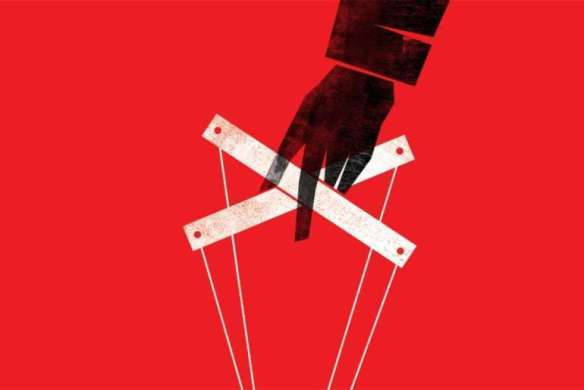
Power Is An Illusion, Control Is A Facade

By Brandon Smith

Source: Alt-Market.us

This past year in numerous countries the public is being bombarded with lessons in power and control that have been forgotten for generations. I think the majority of westerners in particular have long believed themselves “safe” from totalitarian government, from collectivist micro-management and from communistic cultism. They thought we had moved beyond the nightmares of the 20th century. They thought that the “new world” was going to be more Utopian, and that freedom would grace us naturally along with technological progress.

Sure, in the back of everyone’s subconscious there is the fear that the good times are an illusion and that dystopia is just behind a thin veneer of economic stability and false optimism, but most people do not really think such catastrophes will happen in their lifetime. We are now in the midst of a deliberately over-hyped pandemic, strict national lockdowns, civil unrest, riots, aggressive tech censorship, intrusive government censorship, unprecedented corporate and treasury debt, stagflationary central bank stimulus and the collapse of massive financial bubbles. Yet, I still don’t get the impression that many in the public really grasp the extent of the danger; they still believe that the situation is going to heal itself without any effort or much sacrifice on their part.

This is the first lesson of power: Entire societies can be easily influenced when they suffer from delusions that the bad times will be fleeting, and that governments will keep them safe no matter what.

It is a historically proven pattern that governments tend to CREATE problems instead of solving them, and this is because the power dynamic of government never changes. The politicians we “vote” for are not in control, rather, the elites who fund their campaigns and who permeate their cabinets are in control. Political representatives come and go, but the establishment elites never leave. Therefore, the problems our society faces will remain; they are a direct result of the subversive and perpetual power structure that serves the interest of a select minority rather than the public. The decline of our society into tyranny will not stop until this power structure and the people behind it are erased.

This would actually be a simple thing to achieve if enough people were to accept the truth and take action. The elites, the globalists, the establishment, the “new world order”, whatever you want to call this organization of power mongers, is but a collection of mostly weak and feeble psychopaths and parasites. They are completely out in the open; they proudly proclaim their affiliations and intentions on a regular basis through their host institutions, from the Council on Foreign Relations to Tavistock to Bilderberg to the World Economic Forum, the IMF, the Bank for International Settlements, the Ford Foundation, the Rockefeller Foundation, the Open Society Foundation, etc. There is very little that is hidden about these people anymore.

But, it is also a sad reality that most people have to hit rock bottom before they embrace the idea that they cannot rely on the corrupt system to save them from harm. And as long as they continue to have blind faith that the system will self correct, they will never act. The elites operate in the open with impunity because they know that human beings are more likely to seek out help from the system than they are to fix a problem for themselves. If someone was to switch off that single mass fantasy, the elites would be gone tomorrow.

The second lesson of power is that perception of consent creates legitimate consent. To put it another way – When people believe that their peers and neighbors have accepted a certain level of tyranny, they too will often accept it so that they don’t stand out or draw attention to themselves as “aberrant”. People seeking power only need to create the illusion of mass consent. Even when the majority of people are against them, the perception of compliance can sometimes overwhelm logic.

Control is usually achieved passively without force. Sometimes you don’t even need the threat of force; sometimes you only need to inspire a fear of standing out among the crowd.

For example, the pandemic has been used the past six months as a tool for creating such a narrative. Mask wearing “rules” are particularly insidious as they conjure illusions of compliance and submission. “Everyone” is wearing a mask, therefore everyone must support medical tyranny. Mask wearing is a complete farce when it comes to the actual science of virology and viral spread. The CDC still does not recommend cloth masks to their own employees and only allows them to use N95 filtered masks. A recent and censored Danish study confirms the reality that masks are mostly useless.

Strictly enforced cloth mask rules have done nothing to stop renewed spikes in infections in multiple countries and US states. The fact that in many places masks are required OUTDOORS despite endless scientific evidence showing that UV light and open air kills microorganisms including viruses shows that the lockdown response has nothing to do with science or saving lives. It is about control.

We can take all logical factors into account, but, for a lot of people, if they see others wearing masks they too will wear a mask simply because they are afraid to be judged by what they perceive to be the majority. The reality is that a majority of people are wearing the masks grudgingly, and they would take them off tomorrow if they knew other people would do the same.

This is why the mainstream media pushes mask wearing propaganda everyday, 24/7. News journalists stand on street corners or in open air parks and wear masks on camera. Politicians wear masks even when on camera in their own homes. Celebrities and companies try to sell the idea that mask wearing is “cool”. Hey, if you don’t wear a mask you could be putting hundreds or thousands of other people at risk and killing their grandmas, right?

The masks do nothing. They achieve nothing in terms of stopping the virus spread or saving lives. This is a fact made obvious by the very infection numbers the establishment holds up as a rationale for the masks. But if the establishment elites through propaganda can convince you to wear a mask everyday, then this opens the door to them dictating many other aspects of your life. The masks are just a gateway into more destructive mandates.

The solution to this type of tyranny is to stop caring what other people think, especially when the facts are on your side. In the town where I live, the vast majority of people have said no to the mask restrictions. If someone wants to wear a mask because they believe it will protect them, that’s fine. But, no one is going to tell us we have to wear them “for our own good”. That said, even if I was the ONLY person not wearing a mask around town, I would not care if it bothered others. Your credo has to be “try and force me to wear a mask, and watch what happens…”

The third lesson of power is that force only leads to control if you respond with submission. A group of people can beat you or even kill you, but they can’t force you to comply if you do not fear for your own life.

I find that the use of force by tyrants is predicated on the assumption that the people they are seeking to control will not fight back effectively. As soon as people do fight back effectively, the tyrant is shocked. Most tyrants rise to power, not because they have won multiple battles and subdued their opponents, but because they never had to fight in the first place. Or, they win a handful of easy battles, often staged to look more victorious than they really were, and then use those mediocre wins as a means to terrify all future opposition into not fighting. The tyrants start to believe their own lies and presume their own invincibility.

Predators do not seek out hard targets, they seek out weak targets. The solution to tyrants is for the hard targets to seek them out and strike them in the midst of their confidence. When predators get hit back they have a habit of running away.

But, this requires people who do not live in fear of what might happen when they fight back. The concept of sacrificing comfort (or much worse) can’t be an issue. Fear fades away when a person fights for something more than himself. It’s not always about personal survival, sometimes it’s about the survival of future generations, or the survival of a set of principles. As that fear disappears, so does the illusion of control that tyrants rely on.

The fourth lesson of power is that ideals either stem from human conscience, or they do not. And if they do not, then they are not ideals worth adopting or fighting over. The conscience of the average person is not as ambiguous and changeable as the establishment would like you to believe. A lion’s share of human beings operate on a certain set of inherent morals and principles that are universally shared; they do not need to be taught these principles, they are born knowing them. If these rules were not ingrained into our psyches our species would have self destructed thousands of years ago.

Establishment elites would like you to believe that all ideals are a product of environment, and that those who control the environment control the morals of the people by extension. This is a lie. Values such as freedom exist even in the most oppressive environments, and people seek it out even when the risk is overwhelming. Empathy is also inherent for most of us, but a certain percentage of people are born without the capacity for it. The REAL fight in the middle of any power struggle is the fight between those who are born with conscience, values and empathy, and those who are born without these grounding characteristics.

Psychopathic tyrants desperately want to prove that all other people are just as devoid of humanity and soul as they are. They want to prove that the voice of conscience that guides us is a mask we wear to pretend that we are not evil at our core. Control comes from the fallacy that we are dependent on our environments to tell us who we are as individuals. Control comes from the notion that morals are relative, and that principles are social constructs.

Conscience is inherent, but it is also a choice. You have the free will to listen to it, or ignore it. If a tyrant can convince you to ignore the voice of your own conscience then the only other guide in life is your environment. And, if that tyrant dominates every aspect of your environment, then he now has the power to rewrite your moral code, at least temporarily. You can be made to do terrible things you would not otherwise do, or support destructive causes and ideologies you would not otherwise support.

The ultimate totalitarian power is the power to make people forget their own inner voice. The ultimate tool against evil is to listen to that voice and to not be afraid of the supposed consequences.

The question of the facade of power is about to become the defining question of our epoch as the elitist establishment accelerates their agenda for greater centralized control of our lives. The truth they do not want you to understand is that they have no power. They have nothing. We could defy their mandates anytime we wish. We could do away with them tomorrow if we wanted. They are of no use to humanity, they serve no valuable purpose. They only seek to feed like vampires on the masses and fulfill their deranged fantasies of conquest. Sooner or later they will have to be dealt with – The sooner the better.

The Political Value of Psychedelics

By Dr. James Cooke

Source: Reality Sandwich

Psychedelics and Politics

Psychedelics are political.  Their use in the 1960s had a political impact that is still being felt today, and their widespread banning was driven by political motives.  But how can a class of chemicals consistently impact our opinions of how we organize and relate to each other?  Psychedelics can affect the brains of individuals in ways that produce consistent insights.  These insights have direct relevance for our individual and collective wellbeing, and can point the way towards political change that would benefit us all.

The 1960s

The LSD-fuelled hippie movement was instrumental in the origins of the modern ecological awareness in politics that is so widespread today.  It helped birth modern anti-war peace movements and the practice of living in sustainable, eco-friendly communes.  What is it about the time we live in and the effects of psychedelic substances that result in their producing this kind of change in political thinking?  To understand this, we have to not only consider how psychedelics act in the brain, but we also have to understand both the unusual situation humans have found themselves in since the advent of civilization and the psychology that gave rise to it.

The Human Animal

We live in an unusual time.  For approximately 97% of human existence our species lived close to nature in small social groups.  Like other animals, evolution programmed us with a survival instinct and fear of death.  This fear incentivized us to control the world around us in order to make us feel safe.  Unlike other animals, however, we succeeded in dominating nature.  Thanks to our capacity for language and our dexterous hands that were freed up by our walking upright, it became possible for us to create culture and technology.  The preservation of knowledge from generation to generation that comes with language allowed for greater and greater control of the world around us.  Eventually we found ourselves in complex civilizations, a very long way from home.

The Price of Progress

This way of being that led to the relentless growth of civilizations is characterized by a particular kind of psychology, one that is governed by fear.  Sacrificing one’s happiness today in order to prepare for tomorrow can often make sense, but being consistently emotionally hijacked by fear without realising it can lead to a lot of unnecessary suffering.  This is true for individuals suffering with trauma and it’s true for our species as a whole.  In such a situation, there is the loss of the ability to find peace and wellbeing in the present.  We desperately look towards the future in the hope that if we just keep pushing forwards we will find a way out of our situation, not realizing that this way of being in itself is the problem.  The result is that, while we may no longer be routinely at risk of being eaten by predators, we are suffering from an epidemic of disorders of alienation, such as addiction, anxiety and depression.

The Fear Trap

Why do we continue to do this?  One reason is that we are naturally fearful creatures.  It makes sense that we would have evolved to sacrifice our wellbeing today in order to ensure our survival tomorrow.  Evolution is about staying alive, it’s not about being happy.  Another reason is that evolution has endowed us with incredible coping mechanisms.  We can be living in agony but, if we see now no other option, our capacity for language allows us to tell ourselves a story about why our situation is actually fine.  It is by taking these stories to be more real than our felt conscious experiences that we manage to repress our anguish.

Civilization and Control

Beyond the individual, there are other dynamics that keep us trapped in the game of “progress” at the expense of our wellbeing.  Once agriculture had been invented it became possible to generate surplus food, paving the way for a minority of individuals to hoard resources.  This made it possible for wealthy individuals to coerce the majority into doing their bidding as they had something that they needed for their very survival.  The ability of humans to live in stories has also been crucial in perpetuating this control.  Our ability to rationalize and normalize our experiences made it possible for each generation to grow up believing that this situation was correct or right in some way, instead of seeing how they are being exploited.

Deep Ecology

It wasn’t always this way.  Prior to the hierarchical arrangements of control that define civilization, humans throughout the world routinely explored their being part of the natural world through religious and spiritual practices.  Psychedelic plant medicines were widely used in order to explore our interconnectedness with the natural world.  The Norwegian philosopher Arne Næss coined the term “deep ecology” to refer to the non-hierarchical principles of interdependence and interconnectedness that are deeper than a superficial concern for the environment.  Ecology in this sense can apply equally to the natural world, to social arrangements or even to the contents of your own mind.

Ecology vs. Hierarchy

While the systems of control that define “civilized” states typically separate and atomize people so they can be used to generate wealth for others, human communities centred around ecological and spiritual principles are based on collaboration and the valuing of individual and collective wellbeing.  Psychedelics promote these ecological and spiritual perspectives, making them a threat to dominating systems of control.

Psychedelics and the Wisdom of Ecology

How do psychedelics promote ecological thinking?  In the brain of the individual, psychedelics can temporarily topple the hierarchical, control-based modes of thought that usually dominate our minds.  As is well attested to in Buddhist philosophy, it is these modes of thought that are responsible for the majority of our suffering.  With these structures of control dissolved, what’s revealed is a sense of interconnection and a more harmonious way of being.  This experience can produce insight into the wisdom of ecological principles such as openness, collaboration and naturalness as opposed to the controlling, atomizing and artificial arrangements that currently dominate society.  As our well-being as social primates depends on the community as a whole, it only follows that their relevance of these insights would extend beyond the individual to those who have an impact on us in society.

Hippies, Peace, Communes and the Environment

LSD use in the 60s pushed the brains of a generation in the direction of ecological thinking.  Many young people who might otherwise have unquestioningly fought in the Vietnam war suddenly saw their situation afresh, the propaganda of their home country replaced with a vision of a world of collective collaboration rather than one of conflict and domination.  The suicidal logic of ecological destruction was also laid bare, the narrative of progress through the domination of nature seemingly nothing more than an excuse for the powerful to line their pockets, a project that would soon take the earth and all of us with it.  A critical mass of young people came to similar conclusions and the hippie movement was born.

Science and Psychedelic Personality Change

Modern science is now mapping how psychedelics change people’s political opinions.  A study published in 2017 found that the number of times people use a psychedelic and the strength of their most powerful ego-dissolving experience correlate with increased nature relatedness, openness and reduced authoritarian thinking [1].  These aspects of the personality all reflect this movement towards greater ecological thinking.

The Psychology of Control

Without the benefit of psychedelics to help us travel in the direction of ecological thinking and greater wellbeing, many get trapped in coping mechanisms of control.  The traumatic nature of existence pushes some to move in the opposite direction, disowning their capacity for empathy and connection and reaffirming their sense of separation.  This process can result in disorders of the ego such as narcissism, sociopathy and psychopathy, all characterized by a lack of empathy and a delusionally high opinion of oneself.  We currently live in a system crafted to suit such personality types.  The coping mechanisms emerge in response to severe trauma early in life, when the child is learning how to connect with the world around them.  Investment in the ego and lack of concern for others is a pathology that can help such people cope with this powerful trauma.  It also represents the psychological dynamic that keeps society sick and blocks collective healing through the widespread adoption of the ecological perspective.

The Key Roadblock to Change

Society only consists of individuals interacting.  As a result, our political crises largely originate in the internal crises of individuals.  The collective trauma carried by the human race is passed on generation after generation.  A critical amount of narcissistic behaviour results in a society based around the separation and atomization of individuals, as well as around domination and control, of the environment and each other.  The extent to which our fellow humans are unconsciously trapped in narcissistic coping mechanisms is the extent to which our species will be trapped in its current mode of domination, control and suffering.

Psychedelic Medicine and the Healing of Collective Trauma

Psychedelic medicine holds the promise of moving culture in the direction of trauma healing and deep ecological thinking that is necessary to save our species and the planet from ecological destruction.  The main challenge will be how we engage with those at the other end of the spectrum, the narcissists and psychopaths so affected by trauma that they will defend their protective systems of domination at all costs. Psychedelic medicine may be able to reach some but perhaps the single greatest impact of psychedelics in years to come will be moving the public conversation toward a greater awareness of how the dynamics of trauma have deranged our world.  The creation of a global ecological culture that centers around trauma healing, emotional wellbeing and an awareness of the psychology of narcissism is the only hope our species and planet has for survival, and psychedelics are perhaps the most powerful tool we have in making this culture a reality.


References:

Nour MM, Evans L, Carhart-Harris RL. Psychedelics, Personality and Political Perspectives. J Psychoactive Drugs. 2017;49(3):182-191. doi:10.1080/02791072.2017.1312643

Inside the Submissive Void

Propaganda, Censorship, Power, & Control

By Greg Maybury

Source: OffGuardian

Nothing appears more surprising to those who consider human affairs with a philosophical eye, than the easiness with which the many are governed by the few; and the implicit submission, with which men resign their own sentiments and passions to those of their rulers.
David Hume, “Of the First Principles of Government”, 1768

The use of propaganda and censorship is more frequently associated with totalitarian, corrupt and/or despotic regimes, not our purported democracies in the West. Yet the history of how western governments and their ever-vigilant overlords in the media, financial and business spheres have controlled the political narrative of the time via these means is a long, storied and ruinous one, going back well before 1914.

Along with serving the contemporaneous political objectives of its perpetrators as contrived, such activities often continue to inform our understanding, and cement our interpretation, of history.

If as the saying goes, “history repeats itself”, we need look no further as to the main reason why. In this wide ranging ‘safari’ into the disinformation, myth-making, fake news wilderness—aka The Big Shill—Greg Maybury concludes that “It’s the narrative, stupid!”

Controlling the Proles

The following yarn may be apocryphal, but either way the ‘moral of the fable’ should serve our narrative well. The story goes like this: sometime during the height of the Cold War a group of American journalists were hosting a visit to the U.S. of some of their Soviet counterparts.

After allowing their visitors some time to soak up the media zeitgeist stateside, most of the Americans expected their guests to express unbridled envy at the professional liberties they enjoyed in the Land of the Free Press.

One of the Russian scribes was indeed compelled to express his unabashed ‘admiration’ to his hosts…in particular, for the “far superior quality” of American “propaganda”. Now it’s fair to say his hosts were taken aback by what was at best a backhanded compliment.

After some collegial ‘piss-taking’ about the stereotypes associated with Western “press freedom” versus those of the controlled media in the Soviet system, one of the Americans called on their Russian colleague to explain what he meant. In fractured English, he replied with the following:

It’s very simple. In Soviet Union, we don’t believe our propaganda. In America, you actually believe yours!”

As highly amusing as this anecdote is, it masks a disturbing reality — the Russian journo’s jibe doesn’t simply remain true now; that ‘belief’ has become even more delusional, farcical, and above all, dangerous.

One suspects that Russian journos today would think much the same.

And in few cases has the “delusional”, “farcical”, and “dangerous” nature of this conviction been more evident than with the West’s continued provocations of Russia, with “Skripalgate” in Old Blighty (see here, and here), and “Russia-Gate” stateside (see here, here, and here) being prime, though far from the only, exemplars we might point to.

Of course just recently we were all subjected to the ludicrous dog n’ pony show that was the much-touted London “media freedom” conference, organised under the auspices of the so-called Media Freedom Coalition (MFC), a UK/Canadian ‘initiative’.

As the name suggested, this was the establishment’s lip-service effort to be seen to be supporting or ‘defending’ media freedom, and initiating strategies and frameworks for the ‘protection’ of journalists. Lofty stuff to be sure. For my part I can’t recall another recent event that so unabashedly embraced the Orwellian playbook, absent any hint of irony or embarrassment from the parties involved.

To illustrate, after noting that ‘the world is becoming a more hostile place’ for journalists, the MFC website then righteously intones: [they] face dangers beyond warzones and extremism, including increasing intolerance to independent reporting, populism, rampant corruption, crime, and the breakdown of law and order…’

The cynic might be tempted to add: ‘And that’s just in our Western democracies!’

And who can forget the fatuous “integrity initiative” that preceded it, whose lofty ambitions aimed to ‘defend democracy against disinformation’? This is elite code for limiting free speech, already happening at a rate of knots, with the powers that be ‘setting up new perimeters’ online and offline.

The prevailing efforts by a range of people to make it a crime to criticise Israel or boycott the country is arguably the most insidious, egregious example. As well, the attempts by the MSM to designate genuine, independent analysis by alternative media as “fake news” is another one.

Such is the sophistication and ubiquity of the narrative control techniques used today—afforded increasingly by ‘computational propaganda’ via automated scripts, hacking, botnets, troll farms, and algorithms and the like, along with the barely veiled censorship and information gatekeeping practised by Google and Facebook and other tech behemoths — it’s become one of the most troubling aspects of the technological/social media revolution. (See also here, here, here, and here.)

Notably, the MFC conference came and went after organisers saw fit to exclude legitimate Russian news outlets RT and Sputnik, an ideological ‘fashion statement’ thoroughly at odds with the purported premise upon which it was instigated.

Moreover, there was little mention of the ‘elephant in the room’ Julian Assange—the person who embodies foremost the disconnect between the practice and the preaching of Western media freedom, to say little of underscoring the irony, self-serving opportunism, and double standards that frequently attend any mainstream debate about what it actually means.

Put bluntly, “media freedom” in the West is, increasingly, ‘more honoured in the breach than in the observance’, with the London confab all about keeping up appearances to the contrary. This was an event conceived of by soulless, demented, establishment shills, ‘…full of sound and fury, signifying nothing’.

The surreal spectacle though must have induced cognitive dissonance even amongst the pundits, and many head-shaking moments for Assange supporters and genuine truth-seekers alike.

As for Wikileaks and Assange himself, it’s worth noting the attitude of the national security state toward him. After accusing Assange of being a “narcissist”, “fraud”, and “a coward”, and labelling WikiLeaks a “hostile intelligence service”, Secretary of State Mike Pompeo declared he [Assange] was “>eager to do the bidding of Russia and other American adversaries.”

Either way, his comments can be taken as more or less representative of Beltway and broader Western opinion, including in my own country Australia. Along with noting that official Washington’s hatred of Assange ‘borders on rabid’, Ted Carpenter offered the following:

[Assange] symbolises a crucial fight over freedom of the press and the ability of journalists to expose government misconduct without fear of prosecution. Unfortunately, a disturbing number of “establishment” journalists in the United States seem willing—indeed, eager—to throw him to the government wolves.’

Lapdogs for the Government

Here was, of course, another surreal spectacle, this time courtesy of one of the Deep State’s most dangerous, reviled, and divisive figures, a notable protagonist in the Russia-Gate conspiracy, and America’s most senior diplomat no less.

Not only is it difficult to accept that the former CIA Director actually believes what he is saying, well might we ask, “Who can believe Mike Pompeo?”

And here’s also someone whose manifest cynicism, hypocrisy, and chutzpah would embarrass the much-derided scribes and Pharisees of Biblical days.

We have Pompeo on record recently in a rare moment of honesty admitting – whilst laughing his ample ass off, as if recalling some “Boy’s Own Adventure” from his misspent youth with a bunch of his mates down at the local pub – that under his watch as CIA Director:

…We lied, cheated, we stole…we had entire training courses.’

It may have been one of the few times in his wretched existence that Pompeo didn’t speak with a forked tongue.

At all events, his candour aside, we can assume safely that this reactionary, monomaniacal, Christian Zionist ‘end-timer’ passed all the Company’s “training courses” with flying colours.

According to Matthew Rosenberg of the New York Times, all this did not stop Pompeo however from name-checking Wikileaks when it served his own interests. Back in 2016 at the height of the election campaign, he had ‘no compunction…about pointing people toward emails stolen* by Russian hackers from the Democratic National Committee and then posted by WikiLeaks.”

[NOTE: Rosenberg’s omission of the word “allegedly”—as in “emails allegedly stolen”—is a dead giveaway of bias on his part (a journalistic Freudian slip perhaps?), with his employer being one of those MSM marques leading the charge with the “Russian Collusion” ‘story’. For a more insightful view of the source of these emails and the skullduggery and thuggery that attended Russia-Gate, readers are encouraged to check this out.]

And this is of course The Company we’re talking about, whose past and present relationship with the media might be summed up in two words: Operation Mockingbird (OpMock). Anyone vaguely familiar with the well-documented Grand Deception that was OpMock, arguably the CIA’s most enduring, insidious, and successful psy-ops gambit, will know what we’re talking about. (See here, here, here, and here.) At its most basic, this operation was all about propaganda and censorship, usually operating in tandem to ensure all the bases are covered.

After opining that the MSM is ‘totally infiltrated’ by the CIA and various other agencies, for his part former NSA whistleblower William Binney recently added, ‘When it comes to national security, the media only talk about what the administration wants you to hear, and basically suppress any other statements about what’s going on that the administration does not want get public. The media is basically the lapdogs for the government.’

Even the redoubtable William Casey, Ronald Reagan’s CIA Director back in the day was reported to have said something along the following lines:

We know our disinformation program is complete when almost everything the American public believes is false.’

In order to provide a broader and deeper perspective, we should now consider the views of a few others on the subjects at hand, along with some history. In a 2013 piece musing on the modern significance of the practice, my compatriot John Pilger ecalled a time when he met Leni Riefenstahl back in 70s and asked her about her films that ‘glorified the Nazis’.

Using groundbreaking camera and lighting techniques, Riefenstahl produced a documentary that mesmerized Germans; as Pilger noted, her Triumph of the Will ‘cast Adolf Hitler’s spell’. She told the veteran Aussie journalist the “messages” of her films were dependent not on “orders from above”, but on the “submissive void” of the public.

All in all, Riefenstahl produced arguably for the rest of the world the most compelling historical footage of mass hysteria, blind obedience, nationalistic fervour, and existential menace, all key ingredients in anyone’s totalitarian nightmare. That it also impressed a lot of very powerful, high profile people in the West on both sides of the pond is also axiomatic: These included bankers, financiers, industrialists, and sundry business elites without whose support Hitler might’ve at best ended up a footnote in the historical record after the ill-fated beer-hall putsch. (See here, and here.)

Triumph” apparently still resonates today. To the surprise of few one imagines, such was the impact of the filmas casually revealed in the excellent 2018 Alexis Bloom documentary Divide and Conquer: The Story of Roger Ailesit elicited no small amount of admiration from arguably the single most influential propagandist of recent times.

[Readers might wish to check out Russell Crowe’s recent portrayal of Ailes in Stan’s mini-series The Loudest Voice, in my view one the best performances of the man’s career.]

In a recent piece unambiguously titled “Propaganda Is The Root Of All Our Problems”, my other compatriot Caitlin Johnstone also had a few things to say about the subject, echoing Orwell when she observed it was all about “controlling the narrative”.

Though I’d suggest the greater “root” problem is our easy propensity to ignore this reality, pretend it doesn’t or won’t affect us, or reject it as conspiratorial nonsense, in this, of course, she’s correct. As she cogently observes,

I write about this stuff for a living, and even I don’t have the time or energy to write…about every single narrative control tool that the US-centralised empire has been implementing into its arsenal. There are too damn many of them emerging too damn fast, because they’re just that damn crucial for maintaining existing power structures.’

The Discreet Use of Censorship and Uniformed Men

It is hardly surprising that those who hold power should seek to control the words and language people use’ said Canadian author John Ralston Saul in his 1993 book Voltaire’s Bastards–the Dictatorship of Reason in the West.

Fittingly, in a discussion encompassing amongst other things history, language, power, and dissent, he opined, ‘Determining how individuals communicate is’…an objective which represents for the power elites ‘the best chance’ [they] have to control what people think. This translates as: The more control ‘we’ have over what the proles think, the more ‘we’ can reduce the inherent risk for elites in democracy.

Clumsy men’, Saul went on to say, ‘try to do this through power and fear. Heavy-handed men running heavy-handed systems attempt the same thing through police-enforced censorship. The more sophisticated the elites, the more they concentrate on creating intellectual systems which control expression through the communications structures. These systems require only the discreet use of censorship and uniformed men.’

In other words, along with assuming it is their right to take it in the first place, ‘those who take power will always try to change the established language’, presumably to better facilitate their hold on it and/or legitimise their claim to it.

For Oliver Boyd-Barrett, democratic theory presupposes a public communications infrastructure that facilitates the free and open exchange of ideas.’ Yet for the author of the recently published RussiaGate and Propaganda: Disinformation in the Age of Social Media, ‘No such infrastructure exists.’

The mainstream media he says, is ‘owned and controlled by a small number of large, multi-media and multi-industrial conglomerates’ that lie at the very heart of US oligopoly capitalism and much of whose advertising revenue and content is furnished from other conglomerates:

The inability of mainstream media to sustain an information environment that can encompass histories, perspectives and vocabularies that are free of the shackles of US plutocratic self-regard is also well documented.’

Of course the word “inability” suggests the MSM view themselves as having some responsibility for maintaining such an egalitarian news and information environment. They don’t of course, and in truth, probably never really have! A better word would be “unwilling”, or even “refusal”. The corporate media all but epitomise the “plutocratic self-regard” that is characteristic of “oligopoly capitalism”.

Indeed, the MSM collectively functions as advertising, public relations/lobbying entities for Big Corp, in addition to acting as its Praetorian bodyguard, protecting their secrets, crimes, and lies from exposure. Like all other companies they are beholden to their shareholders (profits before truth and people), most of whom it can safely be assumed are no strangers to “self-regard”, and could care less about “histories, perspectives and vocabularies” that run counter to their own interests.

It was Aussie social scientist Alex Carey who pioneered the study of nationalism, corporatism, and moreso for our purposes herein, the management (read: manipulation) of public opinion, though all three have important links (a story for another time). For Carey, the following conclusion was inescapable: ‘It is arguable that the success of business propaganda in persuading us, for so long, that we are free from propaganda is one of the most significant propaganda achievements of the twentieth century.’ This former farmer from Western Australia became one of the world’s acknowledged experts on propaganda and the manipulation of the truth.

Prior to embarking on his academic career, Carey was a successful sheep grazier. By all accounts, he was a first-class judge of the animal from which he made his early living, leaving one to ponder if this expertise gave him a unique insight into his main area of research!

In any event, Carey in time sold the farm and travelled to the U.K. to study psychology, apparently a long-time ambition. From the late fifties until his death in 1988, he was a senior lecturer in psychology and industrial relations at the Sydney-based University of New South Wales, with his research being lauded by such luminaries as Noam Chomsky and John Pilger, both of whom have had a thing or three to say over the years about The Big Shill. In fact such was his admiration, Pilger described him as “a second Orwell”, which in anyone’s lingo is a big call.

Carey unfortunately died in 1988, interestingly the year that his more famous contemporaries Edward Herman and Chomsky’s book Manufacturing Consent: The Political Economy of the Mass Media was published, the authors notably dedicating their book to him.

Though much of his work remained unpublished at the time of his death, a book of Carey’s essays – Taking the Risk Out of Democracy: Corporate Propaganda Versus Freedom and Liberty — was published posthumously in 1997. It remains a seminal work.

In fact, for anyone with an interest in how public opinion is moulded and our perceptions are managed and manipulated, in whose interests they are done so and to what end, it is as essential reading as any of the work of other more famous names. This tome came complete with a foreword by Chomsky, so enamoured was the latter of Carey’s work.

For Carey, the three “most significant developments” in the political economy of the twentieth century were:

  1. the growth of democracy
  2. the growth of corporate power; and
  3. the growth of propaganda as a means of protecting corporate power against democracy.

Carey’s main focus was on the following:

  1. advertising and publicity devoted to the creation of artificial wants;
  2. the public relations and propaganda industry whose principal goal is the diversion to meaningless pursuits and control of the public mind; and
  3. the degree to which academia and the professions are under assault from private power determined to narrow the spectrum of thinkable (sic) thought.

For Carey, it is an axiom of conventional wisdom that the use of propaganda as a means of social and ideological control is ‘distinctive’ of totalitarian regimes. Yet as he stresses: the most minimal exercise of common sense would suggest a different view: that propaganda is likely to play at least as important a part in democratic societies (where the existing distribution of power and privilege is vulnerable to quite limited changes in popular opinion) as in authoritarian societies (where it is not).’ In this context, ‘conventional wisdom” becomes conventional ignorance; as for “common sense”, maybe not so much.

The purpose of this propaganda barrage, as Sharon Bader has noted, has been to convince as many people as possible that it is in their interests to relinquish their own power as workers, consumers, and citizens, and forego their democratic right to restrain and regulate business activity. As a result the political agenda is now…confined to policies aimed at furthering business interests.’ 

An extreme example of this view playing itself right under our noses and over decades was the cruel fiction of the “trickle down effect” (TDE)—aka the ‘rising tide that would lift all yachts’—of Reaganomics. One of several mantras that defined Reagan’s overarching political shtick, the TDE was by any measure, decidedly more a torrent than a trickle, and said “torrent” was going up not down. This reality as we now know was not in Reagan’s glossy economic brochure to be sure, and it may have been because the Gipper confused his prepositions and verbs.

Yet as the GFC of 2008 amply demonstrated, it culminated in a free-for all, dog eat dog, anything goes, everyman for himself form of cannibal (or anarcho) capitalism — an updated, much improved version of the no-holds-barred mercenary mercantilism much reminiscent of the Gilded Age and the Robber Barons who ‘infested’ it, only one that doesn’t just eat its young, it eats itself!

Making the World Safe for Plutocracy

In the increasingly dysfunctional, one-sided political economy we inhabit then, whether it’s widgets or wars or anything in between, few people realise the degree to which our opinions, perceptions, emotions, and views are shaped and manipulated by propaganda (and its similarly ‘evil twin’ censorship,) its most adept practitioners, and those elite, institutional, political, and corporate entities that seek out their expertise.

It is now just over a hundred years since the practice of propaganda took a giant leap forward, then in the service of persuading palpably reluctant Americans that the war raging in Europe at the time was their war as well.

This was at a time when Americans had just voted their then-president Woodrow Wilson back into office for a second term, a victory largely achieved on the back of the promise he’d “keep us out of the War.” Americans were very much in what was one of their most isolationist phases, and so Wilson’s promise resonated with them.

But over time they were convinced of the need to become involved by a distinctly different appeal to their political sensibilities. This “appeal” also dampened the isolationist mood, one which it has to be said was not embraced by most of the political, banking, and business elites of the time, most of whom stood to lose big-time if the Germans won, and/or who were already profiting or benefitting from the business of war.

For a president who “kept us out of the war”, this wasn’t going to be an easy ‘pitch’. In order to sell the war the president established the Committee on Public Information (aka the Creel Committee) for the purposes of publicising the rationale for the war and from there, garnering support for it from the general public.

Enter Edward Bernays, the nephew of Sigmund Freud, who’s generally considered to be the father of modern public relations. In his film Rule from the Shadows: The Psychology of Power, Aaron Hawkins says Bernays was influenced by people such as Gustave le Bon, Walter Lippman, and Wilfred Trotter, as much, if not moreso, than his famous uncle.

Either way, Bernays ‘combined their perspectives and synthesised them into an applied science’, which he then ‘branded’ “public relations”.

For its part the Creel committee struggled with its brief from the off; but Bernays worked with them to persuade Americans their involvement in the war was justified—indeed necessary—and to that end he devised the brilliantly inane slogan, “making the world safe for democracy”.

Thus was born arguably the first great propaganda catch-phrases of the modern era, and certainly one of the most portentous. The following sums up Bernays’s unabashed mindset:

The conscious, intelligent manipulation of the organised habits and opinions of the masses is an important element in democratic society. Those who manipulate this unseen mechanism of society constitute an invisible government which is the true ruling power of our country.’

The rest is history (sort of), with Americans becoming more willing to not just support the war effort but encouraged to view the Germans and their allies as evil brutes threatening democracy and freedom and the ‘American way of life’, however that might’ve been viewed then. From a geopolitical and historical perspective, it was an asinine premise of course, but nonetheless an extraordinary example of how a few well chosen words tapped into the collective psyche of a country that was decidedly opposed to any U.S involvement in the war and turned that mindset completely on its head.

[S]aving the world for democracy’ (or some ‘cover version’ thereof) has since become America’s positioning statement, ‘patriotic’ rallying cry, and the “Get-out-of-Jail Free” card for its war and its white collar criminal clique.

At all events it was by any measure, a stroke of genius on Bernays’s part; by appealing to people’s basic fears and desires, he could engineer consent on a mass scale. It goes without saying it changed the course of history in more ways than one. That the U.S. is to this day still using a not dissimilar meme to justify its “foreign entanglements” is testament to both its utility and durability.

The reality as we now know was markedly different of course. They have almost always been about power, empire, control, hegemony, resources, wealth, opportunity, profit, dispossession, keeping existing capitalist structures intact and well-defended, and crushing dissent and opposition.

The Bewildered Herd

It is instructive to note that the template for ‘manufacturing consent’ for war had already been forged by the British. And the Europeans did not ‘sleepwalk’ like some “bewildered herd’ into this conflagration.

For twenty years prior to the outbreak of the war in 1914, the then stewards of the British Empire had been diligently preparing the ground for what they viewed as a preordained clash with their rivals for empire the Germans.

To begin with, contrary to the opinion of the general populace over one hundred years later, it was not the much touted German aggression and militarism, nor their undoubted imperial ambitions, which precipitated its outbreak. The stewards of the British Empire were not about to let the Teutonic upstarts chow down on their imperial lunch as it were, and set about unilaterally and preemptively crushing Germany and with it any ambitions it had for creating its own imperial domain in competition with the Empire upon which Ol’ Sol never set.

The “Great War” is worth noting here for other reasons. As documented so by Jim Macgregor and Gerry Docherty in their two books covering the period from 1890-1920, we learn much about propaganda, which attest to its extraordinary power, in particular its power to distort reality en masse in enduring and subversive ways.

In reality, the only thing “great” about World War One was the degree to which the masses fighting for Britain were conned via propaganda and censorship into believing this war was necessary, and the way the official narrative of the war was sustained for posterity via the very same means.  “Great” maybe, but not in a good way!

In these seminal tomes—World War One Hidden History: The Secret Origins of the First World War and its follow-up Prolonging the Agony: How the Anglo-American Establishment Deliberately Extended WWI by Three-And-A-Half YearsMacgregor and Docherty provide a masterclass for us all of the power of propaganda in the service of firstly inciting, then deliberately sustaining a major war.

The horrendous carnage and destruction that resulted from it was of course unprecedented, the global effects of which linger on now well over one hundred years later.

Such was the enduring power of the propaganda that today most folks would have great difficulty in accepting the following; this is a short summary of historical realities revealed by Macgregor and Docherty that are at complete odds with the official narrative, the political discourse, and the school textbooks:

  1. It was Great Britain (supported by France and Russia) and not Germany who was the principal aggressor in the events and actions that let to the outbreak of war;
  2. The British had for twenty years prior to 1914 viewed Germany as its most dangerous economic and imperial rival, and fully anticipated that a war was inevitable;
  3. In the U.K. and the U.S., various factions worked feverishly to ensure the war went on for as long as possible, and scuttled peacemaking efforts from the off;
  4. key truths about this most consequential of geopolitical conflicts have been concealed for well over one hundred years, with no sign the official record will change;
  5. very powerful forces (incl. a future US president) amongst U.S. political, media, and economic elites conspired to eventually convince an otherwise unwilling populace in America that U.S. entry onto the war was necessary;
  6. those same forces and many similar groups in the U.K. and Europe engaged in everything from war profiteering, destruction/forging of war records, false-flag ops, treason, conspiracy to wage aggressive war, and direct efforts to prolong the war by any means necessary, many of which will rock folks to their very core.

But peace was not on the agenda. When, by 1916, the military failures were so embarrassing and costly, some key players in the British government were willing to talk about peace. This could not be tolerated. The potential peacemakers had to be thrown under the bus. The unelected European leaders had one common bond: They would fight Germany until she was crushed.

Prolonging the Agony details how this secret cabal organised to this end the change of government without a single vote being cast. David Lloyd George was promoted to prime minister in Britain and Georges Clemenceau made prime minister in France. A new government, an inner-elite war cabinet thrust the Secret Elite leader, Lord Alfred Milner into power at the very inner-core of the decision-makers in British politics.

Democracy? They had no truck with democracy. The voting public had no say. The men entrusted with the task would keep going till the end and their place-men were backed by the media and the money-power, in Britain, France and America.

Propaganda Always Wins

But just as the pioneering adherents of propaganda back in the day might never have dreamt how sophisticated and all-encompassing the practice would become, nor would the citizenry at large have anticipated the extent to which the industry has facilitated an entrenched, rapacious plutocracy at the expense of our economic opportunity, our financial and material security, our physical, social and cultural environment, our values and attitudes, and increasingly, our basic democratic rights and freedoms.

We now live in the Age of the Big Shill—cocooned in a submissive void no less—an era where nothing can be taken on face value yet where time and attention constraints (to name just a few) force us to do so; [where] few people in public life can be taken at their word; where unchallenged perceptions become accepted reality; where ‘open-book’ history is now incontrovertible not-negotiable, upon pain of imprisonment fact; where education is about uniformity, function, form and conformity, all in the service of imposed neo-liberal ideologies embracing then prioritising individual—albeit dubious—freedoms.

More broadly, it’s the “Roger Ailes” of this world—acting on behalf of the power elites who after all are their paymasters—who create the intellectual systems which control expression through the communications structures, whilst ensuring…these systems require only ‘the discreet use of censorship and uniformed men.’

They are the shapers and moulders of the discourse that passes for the accepted lingua franca of the increasingly globalised, interconnected, corporatised political economy of the planet. Throughout this process they ‘will always try to change the established language.’

And we can no longer rely on our elected representatives to honestly represent us and our interests. Whether this decision making is taking place inside or outside the legislative process, these processes are well and truly in the grip of the banks and financial institutions and transnational organisations. In whose interests are they going to be more concerned with?

We saw this all just after the Global Financial Crisis (GFC) when the very people who brought the system to the brink, made billions off the dodge for their banks and millions for themselves, bankrupted hundreds of thousands of American families, were called upon by the U.S. government to fix up the mess, and to all intents given a blank cheque to so do.

That the U.S. is at even greater risk now of economic implosion is something few serious pundits would dispute, and a testament to the effectiveness of the snow-job perpetrated upon Americans regarding the causes, the impact, and the implications of the 2008 meltdown going forward.

In most cases, one accepts almost by definition such disconnects (read: hidden agendas) are the rule rather than the exception, hence the multi-billion foundation—and global reach and impact—of the propaganda business. This in itself is a key indicator as to why organisations place so much importance on this aspect of managing their affairs.

At the very least, once corporations saw how the psychology of persuasion could be leveraged to manipulate consumers and politicians saw the same with the citizenry and even its own workers, the growth of the industry was assured.

As Riefenstahl noted during her chinwag with Pilger after he asked if those embracing the “submissive void” included the liberal, educated bourgeoisie? “Everyone,” she said.

By way of underscoring her point, she added enigmatically: ‘Propaganda always wins…if you allow it’.

Surgical Totalitarianism

By Dan Corjescu

Source: Dissident Voice

You don’t have to control everything to be in total control.

In the modern world this seeming paradox is a systemic reality.

In the past, classic totalitarian governments sought to literally control every aspect of biopower.

As it turned out, this was a very inefficient and self-defeating way to maintain and increase scientific knowledge and technology, capital accumulation, and total effective power over the long term.

Modern totalitarian arrangements are far more culturally efficacious, superficially unobtrusive, stylistically democratic, and, most importantly, surgically precise.

In addition, modern totalitarian elites not only demand de facto control over society as such, but they also desire, as part of their inner ideological ethos, the exercise of that power to reproduce itself under maximum conditions of ease, pleasure, and comfort. Thus, the creation and maintenance of a consumerist society both materially and ideologically aids in the reproduction of neo-totalitarian power.

A consumerist society is to a large extent a self regulating mechanism for the constant pursuit of public spectacle and private stimulation. The senses and general life instincts are caught in a web of the pursuance of small pleasures. In this way, pleasure itself becomes an insidiously saccharine form of domination. Yet, from time to time, consumerist relations must be guided, reinforced, and given new goals and reflationary impetus from above.

The political structure in modern, surgical totalitarianism is set up in such a way as to give the appearance of active participation, psychological inclusion, and periodic mass mobilization. However, all consequential decision-making takes place behind this fraudulent structure and represents the true “commanding heights” of power. The political superstructure serves, at best, as perennial decoy and public delusion.

The modern “commanding heights” of power require massive amounts of data. It is through the acquisition, manipulation, and active forward interpretation of information that surgical totalitarianism is able to pick and choose its battles. At its most extreme, new “realities” are creatively and cynically constructed from its daily catch of strategic knowledge. The goal is always the same: distract, delude, deflate any possible challenge to the system through active suppression, co-optation (the preferred method), and, or, complete elimination.

In this way, any possible threats can be foreseen relatively far in advance and organizational strategies can be conceived for either their containment and/or elimination. The surgical nature of these methods allows for the relative negative freedom of civil society to generally evolve and reproduce itself in partial self-awareness in so far as it continues to demonstrate no substantive subversive tendencies to liquidate either the material reality and/or ideological superstructure of its own dependency on neo-totalitarian forms of power.

In the end, the system presents itself as perversely elegant, efficient, self-perpetuating, and, even, on a physical level, pleasant.

All bodily pleasures are on offer. Entertainment becomes incarceration. All is seemingly permitted while nothing is truly allowed. Power is diaphanous as it is all consuming. Critical dissent is tolerated because the mechanisms of mass blindness are secure.

It would be and has been a crucial mistake for Marxists of all kinds to think that capitalism is the root cause of the modern day pursuit of total power. On the contrary, surgical totalitarianism utilizes capitalism as just another source of power but not its ultimate ground. Power precedes capitalism. Hierarchy encodes the means and forces of production no matter what they are just as hierarchy projects a self-sustaining superstructure to deceive and deflect its potential challengers. Capitalism is but a modern day tool of hierarchical power. The real enemy is not capital but surreptitious hierarchy.

The true source of this state of affairs is the lust for control under any societal forms. Its origins are without doubt evolutionary. Aristotle famously defined human beings as “Zoon Politikon” or “social animal”. Yes, we are indeed social. But the “Zoon” or animal part of that equation warps that sociality into the insatiable desire to control and to dominate others. Ultimately, the Hobbesian origins of mankind from an age long state of “nastiness and brutishness” is, in part, to blame that man persists in being as a wolf to other men: Homo homini lupus est.

Thinking about American Totalitarianism

By Dan Corjescu

Source: CounterPunch

Totalitarianism evolves.

Yet what remains the same through time is the attempt at total control.

Today, control is veiled not overt.

Control weaves its way both totally and surgically into our everyday lives.

Totally, in the master narrative it weaves about “living in a democracy”.

Today, no one lives in a true democracy.

Elections, parties, political personalities are all fraudulent constructions hiding real power.

The media and the entertainment industry are focused on creating a consumerist-nationalist imaginary where shopping and waving the flag are effective daily remedies to ward off any uncomfortable existential doubts.

Both business and the nation still reign in the hearts and minds of millions as the “true Gods”.

The revolution of the “multitude” is far, far away.

Empire, American Empire, is neither setting, fading, or waning. On the contrary, its tentacles stretch throughout every conceivable path and production of biopower.

The expansion of American power that began in earnest after the Great War has continued unabated.

The world is more American now than it has ever been.

Surgically, America through its unrivaled mastery of technology, organization, and capital can pick and choose the actors and actions it wills to manipulate or eliminate.

American global networks of surveillance and suppression have grown and deepened. The threat of world revolution and terror are convenient stories to both mobilize and mesmerize the multitude.

A Hitler and/or a Bin-Laden will always conveniently appear when needed.

Consumption, in all its forms, is the only ideology and it is highly effective since it is based on basic biological processes. The pleasure centers of the brain have lent themselves to the construction of a life of bodily gratification. Thus the ideological celebration of the body has become the new ideological prison of the mind. Nietzsche’s “last man” is the middling subject of our present day totalitarianism.

The majority live their lives dedicated to the pursuit of pleasure and are of no threat or consequence. They are “well adjusted” to the “eternal” run of things. Those who are less so, can be easily handled with marginalization, demonization, psychiatry, and if all else fails, surreptitious elimination.

What are the ultimate goals of power? Its naked reproduction. Power is its own justification. The members may change, but the goal of power’s eternal maintenance remains the same.

Yes, we are allowed to talk, read, go to church, temple, or mosque and even demonstrate but any true chance at deviation from the total control of a society blinded by physical bliss and intoxicated by triumphant and progressivist narratives is precluded from the beginning.

Yet, in the end, change will come. But it will be a change that will serve the interests of those for whom total power is the ultimate aim. The world’s inherent fluidity will run and be directed through their rigid hands.

Don’t Worry – Everything is Not Under Control

dailyroutine

By Zen Gardner

Source: ZenGardner.com

What a farce. Telling everyone “everything is under control” is perhaps the most dulling and disempowering phrase ever uttered.

My fascination with language just keeps expanding. I love looking at expressions, words, colloquialisms, so-called “sayings” and the like with fresh awakened eyes. I can’t help it. The supposed, accepted and unconscious meanings of these imposed “expressions” are what direct our minds and turn our attention.

So much of what we’ve been handed down is contorted, manipulated and eventually nestled in the collective mindset to twist our hearts away from simple truth.

How many times has this expression been used to bring seeming comfort to someone; “Don’t worry, everything’s under control.” Really? What control? Who’s controlling what? And why?

So often this is used to imply some powerful force is behind everything directing what’s going on. Remind you of anything? Yes – religion, hierarchy, and social, political and economic so-called “controllers”. How debilitating can you get when it comes right down to it, playing on people’s insecurity and lack of conscious awareness?

“It’s under control” is comforting to people? It’s the picture of personal disempowerment!

External Control? Or Creative Freedom!

Sure, there is a wonderful creative Source we are all intrinsically part of, but it’s not “controlling” anything in a living, expanding Universe with beings of all sorts with free will and self determination in an alive multidimensional environment. If anything, this Creative impetus is tearing down control systems that attempt to foist themselves on its process, put there either by conscious intent or the manifestation of hardening mindsets in the social fabric.

Earth processes attest to this, as well as our spectacular expanding and ever changing Universe. Nature itself is alive with new sprouts of life in the animal, plant and mineral worlds, never mind other realms of existence.

Look at earthquakes and volcanoes, or the sun and astral influences. As much as some try to analyze or predict major events that affect earth that still brings no control, only a measure of preparedness on rare occasion. And that type of insecurity is good for us. It’s humbling and keeps us in check.

This process is what the awakening is all about!

While some earth changes may be exacerbated by human activity, the big stuff is way out of our control. Thankfully. That’s what makes life life, and also why the insane would-be captivators of humanity and its planet work so feverishly in their mad pursuits to try to control natural processes. Control is their yardstick and without it they have no temporal security or power, which to them equates some weird form of normalcy or equilibrium.

How upside down can you get.

Be it geoengineering our climate, genetically modifying the natural progression of life forms, or attempting to install artificial intelligence to run their soulless programs, these maniacs are desperate for control in every shape and form. Why? They cannot meld or harmonize with what’s natural since their psychopathic, demonic intentions have nothing to gain, all while the rest of us thrive on being part of the fantastic empowering natural processes of Creation Itself.

Therein lies the rub. Quite apparently we’re in a world of conflicts of interest. That’s our current playing field, if you will. Or won’t. It’s just the way it is.

Let Go Into Conscious Anarchy

I like the anarchy approach. Anarchy is an example of another twisted word. It’s doesn’t mean putting a society into deliberate chaotic destruction, it means living without hierarchical control mechanisms. Something most groomed humans are scared spitless of thanks to generations of social programming.

You mean to tell me if we didn’t have so-called “government” that everything would fall apart? Baloney. People are resourceful and essentially responsible, at least their inner nature is, that hasn’t been perverted by all of this programming to the contrary. That very dependence on external control systems is what the hierarchy is literally banking on which is why the repeated memes of fear of scarcity or personal security.

There’s plenty for everybody. All we need to do is work together locally and share with other communities in a range of sizes and distances. Real commerce in loving cooperation, not the regulated systems that have been foisted upon us. We’ve been weaned from personal responsibility into a system of statist dependence, like someone who’s stopped using their muscles and is dependent on some mass produced contraption for their mobility when there’s nothing wrong with them at all.

They just need to exercise their innate capabilities.

Just because people have become spiritually atrophied in large numbers doesn’t mean that’s the way it’s supposed to be. Exactly like waking up, it’s time to arise and use the magnificent body of capabilities we’ve all been given, and let go of these false crutches and systems of hierarchy and walk into life and live!

Epilogue

That false assurance that everything’s under control by external forces as if we individually have virtually none has got to go. Being comforting in times of stress and turmoil is one thing, but propping people up with some external dependence reinforcement is fundamentally wrong.

It’s time to be conscious – in our words, our thoughts and our actions.

It’s really not that difficult. The main thing you’ll confront is ignorant, unenlightened opposition from those who’ve grown deeply accustomed to this dependency programming, as if it’s some form of respect for the “great ones” who rule them.

It’s very deep and will take time to overcome for most. But remaining in that conscious space, no matter what ridicule or obstacles assail you, is the very solution we each are longing for.

It begins with each of us. Standing our ground and then moving forward in conscious, loving action.

Do it. Bravely. The time for humanity to arise is now.

Much love, be well, and fully empowered,

Zen

ZenGardner.com