Censoring Alex Jones

By Dmitry Orlov

Source: Club Orlov

Something happened recently that made me feel like a bit of an endangered species. A set of transnational internet companies, including Google, Facebook, Apple and several others, all synchronously removed content belonging to infowars.com, which is run by Alex Jones. Such synchronicity is a sure sign of conspiracy—something that Alex Jones harps on a lot.

I once appeared on a radio show run by Alex Jones, and he did manage to boil down what I had to say to “the USA is going to collapse like the USSR did,” which is pretty good, considering how poorly we managed to connect, having so little in common. He is a conservative and a libertarian whereas I think that conservatives don’t exist in the US. What have they “conserved” lately—other than the right to bear small arms? As far as libertarianism, I consider proper historical libertarianism as a strain of socialism while its American cooptation is just plain funny: these ones remain libertarian only until they need the services of an ambulance or a fire engine, at which point they turn socialist. To boot, American libertarians like Ayn Rand, who to me was a relentlessly bad writer full of faulty thinking. However, I find her useful as a litmus test for mediocre minds.

Moreover, Jones is political while I remain convinced that national politics in the US is a waste of time. It has been statistically proven that the US is not a democracy: popular will has precisely zero effect on public policy. It doesn’t matter who is president; the difference is a matter of style. Trump is a bull in a China shop while Clinton would have been a deer in the headlights. The result is the same: the US is bankrupt and its empire is over.

There is also the mismatch of genre between Jones and me. I am first of all an experimenter and an essayist, and to me personal experience and literary form are vitally important, while Jones is light on research and happy to work with hearsay, and is rather hackneyed and repetitive, but has the right instincts for a rabble-rouser. He harkens from a long American tradition of itinerant preachers spouting jeremiads, thumping the bible and hurling fire and brimstone. His content is secular, but his rhetorical techniques are revivalist. He is preachy, screechy and emotional. There is some carnival cryer in his cultural makeup as well, and he is not above peddling some survivalist/prepper snake oil

That said, we share certain important similarities. Neither of us is part of the official narrative that is endlessly being hammered home by US mass media with increasingly poor results. Thinking Americans are just not gullible enough any more. Jones has exploited this gullibility shortfall in the general public for all it’s worth by going after every conspiracy theory out there, while I am just like you—gullible. Sure, a few Arab tourists armed with box cutters destroyed three steel skyscrapers by flying two aluminum planes into them. Do your own math, but that’s just 2/3 of a plane per skyscraper—ought to be enough, right? Jet fuel, which burns at 800° to 1500°F, melted steel columns. (Steel melts at 2750°F.) Two aluminum cans packed with kerosene, meat and luggage destroyed three steel structures. I find this explanation perfectly satisfactory; do you? If you need to know more, it’s easy to find out, but don’t wait on me because, being so gullible, I am perfectly satisfied.

Jones and I are also different in that he is hugely popular whereas I am popular enough for me and generally lacking in worldly ambition. I enjoy writing, my readers enjoy what I write, and everyone is happy except the kids, because while I am writing I am not playing with them. But Jones is becoming huge—popular enough to displace mass media, which is continuously losing mind share. In part, that is its own fault: how long do they think they can they go on flogging the dead horses of “Russian collusion” and “Russian meddling” before people start shaking their heads and walking away? In part, the verbal diarrhea that we hear on CNN or read on nytimes.com is intended as a smokescreen because the truth has become toxic to the interests of those who are in charge mass media in the US. I will delve into this subject further on Thursday. The political decision to censor Jones was a sign of desperation: the verbal diarrhea is not working, and so it’s time for Plan B, which is simply to scream “Shut up!” as loudly as possible.

Due to his huge and burgeoning popularity (which these latest attacks on him have actually served to enhance) Jones is a huge target, whereas I am but a tiny one. Still, first they came for Alex Jones, and then they may very well come for me, and so the time to start paying attention and pushing back is now. These internet entities—Google, Facebook, Apple, Google Podcast, Spotify, iHeartRadio, MailChimp, Disqus, LinkedIn, Flickr, Pinterest and several others—have no more right to censor him than does your phone company to screen your calls for you or to determine whose number you should be allowed to dial. What was done to Jones was blatantly illegal under both US and international law, and while these companies don’t have much to fear in the US, where they are politically protected, they have a great deal more to fear internationally.

Jones did not, as far as anyone can tell, violate the terms of use of any of these internet services, yet they shut him down. In the public discussions that preceded this event, including in the US Congress, terms such as “hate speech” and “inciting violence” were thrown about. These terms are defined sufficiently vaguely to make them useful for arbitrarily throwing at one’s enemies while one’s friends are granted full immunity, all in an entirely context-free, fact-free manner. For example, two years ago on PBS the following exchange took place between the former acting CIA director Michael Morell and Charlie Rose:

Morell: “We need to make the Russians pay a price in Syria.”
Rose: “We make them pay the price by killing Russians?”
Morell: “Yeah.”

The context and the facts are: the Russians were in Syria by official invitation from the internationally recognized Syrian government to defeat terrorists and foreign mercenaries and to reestablish Syria’s control over its sovereign territory. The US forces weren’t doing much of anything helpful in Syria, but whatever it was, it was illegal: they were an invading force. And here is Morrell proposing that we kill Russian troops who are fighting terrorists, just to send a message. If that’s not “inciting violence,” it is really difficult to imagine what would be. And yet a full two years after this outrage PBS remains on the air; what gives?

Spurious claims of “hate speech” and “inciting violence” aside, what happened is that an order to shut down Jones was issued from Washington, DC. In response an impressively large group of transnational internet companies saluted and marched off to carry out the order, thereby making it perfectly obvious who they work for. And that is likely to become a big problem for them.

First, these transnational companies are allowed to provide services around the world based on international law. Article 19 of the Universal Declaration of Human Rights defends the right to freedom of opinion and expression: “Everyone has the right to freedom of opinion and expression; this right includes freedom to hold opinions without interference and to seek, receive and impart information and ideas through any media and regardless of frontiers.” Jones should sue the US and the companies that censored him in the European Court of Human rights in Strasbourg, France and seek redress both against entities within the US government which issued the illegal order (to be ferreted out in the course of discovery) and against the transnational companies that carried it out.

Second, these transnational companies operate around the world based on local law which in many cases prevents them from acting as agents of foreign governments without first registering as such. If Google and Facebook execute orders issued by the US government, then they are acting not as businesses but as clandestine representatives of a foreign power. Being recognized as such would significantly curtail these companies’ international reach, growth potential and valuations.

And since Google, Facebook and Apple are public companies committed to the pursuit of shareholder value, it would be time for their shareholders to get involved and replace the management teams. After all, what would be more profitable for them: illegally conspiring with the US government while becoming pariahs and losing the world market, or scrupulously maintaining arm’s-length relationships with all governments while working to uphold international law? There is still the opportunity for them to defuse the whole situation: call it a mistake, restore the services, compensate Jones for lost revenue and promise to never do it again.

NYT: Don’t Be Progressive, Be a ‘Liberal’

By Jim Naureckas

Source: FAIR

A New York Times op-ed by political scientist (and former Bob Kerrey aide) Greg Weiner (7/13/18) may well be the New York Times–iest op-ed ever.

Its ostensible subject is why Democrats should call themselves “liberals” and not “progressives.” But in making that case, it hits most of the main points of the New York Times‘ ideology—one that has guided the paper since the late 19th century.

First and foremost, it’s a defense of the status quo. “The basic premise of liberal politics,” Weiner writes, “is the capacity of government to do good, especially in ameliorating economic ills.” But not too much good, mind you:  “A liberal can believe that government can do more good or less,” he stresses. Weiner draws a contrast with progressives: “Where liberalism seeks to ameliorate economic ills, progressivism’s goal is to eradicate them.”

So Lyndon Johnson’s Great Society is cited negatively as an example of “a progressive effort to remake society by eradicating poverty’s causes”—in the process supporting  “community action” and  financing the “political activism”—presented without explanation as a self-evident evil.  The explanation, presumably, is that the poor should remain passive as they remain poor, gratefully accepting the handouts that “alleviate” their plight, as “cutting checks,” as Weiner puts it, is “something government does competently.”

Coupled with this anxiety about “eradicating poverty’s causes” is the confident assurance that the truth is always somewhere in the middle. “Unlike liberalism, progressivism is intrinsically opposed to conservation,” Weiner warns:

Nothing structurally impedes compromise between conservatives, who hold that the accumulated wisdom of tradition is a better guide than the hypercharged rationality of the present, and liberals, because both philosophies exist on a spectrum.

Conservatives make better partners for liberals than progressives, because “one can debate how much to conserve.” But you can’t debate how much to progress, apparently: “Progressivism is inherently hostile to moderation because progress is an unmitigated good.”

In other words: Equality and justice, sure, but let’s not rush into things, is the “liberal’s” advice. He endorses “policies [that] develop gradually and command wide consensus—at least under normal circumstances.” (Progressives have an unnerving desire to “depress the accelerator.”)

Something that doesn’t change is the right wing of the left’s attraction to redbaiting. Weiner praises “the Cold War liberal who stood for social amelioration and against Soviet Communism,” a figure who “was often maligned by progressives.” Without coming out and accusing progressives of Stalinism, he describes progressives’ response to critics as “a passive-aggressive form of re-education,” one that “supersedes the rights of its opponents.” The example he gives of this is the “progressive indifference to the rights of those who oppose progressive policies in areas like sexual liberation”—an odd arena to cite, since the main “rights” that opponents of “sexual liberation” have demanded in recent years are the “right” of small businesses to discriminate against gay customers and the “right” to check the chromosome status of people who use public restrooms.


You can send a message to the New York Times at letters@nytimes.com  (Twitter:@NYTimes). Please remember that respectful communication is the most effective.

Three Paths

By Erik Lindberg

Source: Resilience

To have lost the godlike conceit that we may do what we will, and not to have acquired a homely zest for doing what we can, shows a grandeur of temper which cannot be objected to in the abstract, for it denotes a mind that, though disappointed, foreswears compromise.  But, if congenial to philosophy, it is apt to be dangerous to the commonwealth.  –Thomas Hardy

We have the choice of three paths into the future.  But choice is probably not the right word, for historical change is, at its most orderly, the result of action and reaction and reaction to that.  The word paths may in the same way be too tidy, for we are more likely to go crashing into the thickets than to follow the marked and warn paths that inhabit our imagination.

But here, in this brief exercise, I’m thinking about moral and cognitive maps and the way we might direct our ideals.   Perhaps, then, I may be forgiven these simplifications.  I am not making predictions about how the future might actually unfold; rather, I’m imagining the directions towards which we might cast our highest aspirations.

1) The Arc of History Bends towards Progress

Path 1 might be called the Liberal[i] Choice.  It follows the idea that a just and secure global order requires basic equality among all humans and all nations.  But equality is only a half of it: as important as the ideal of equality to the Liberal vision is the way equality might be achieved—namely by way of economic growth and increased overall wealth, which (the Liberal half-assumes and half-hopes) will be spread more equitably in the coming decades, allowing the impoverished to increase their standard of living faster than the already-prosperous will.  The Liberal vision imagines that Western and industrialized standards of living might be spread across the globe so that all people might enjoy electricity, paved roads, internet connection, urban anonymity, and (almost as human right) relief from the most difficult aspects of manual labor or subsistence farming, with the opportunity to become educated and free from the limiting prejudices of traditional societies.  It sees mobility, individualism, and choice as the hallmarks of this just and equitable society[ii], and imagines humanity becoming more cosmopolitan, tolerant, and secular, while earning its daily bread through endeavors deemed creative according to middle class values.[iii]

Liberals sometimes appreciate the link between economic growth or growing overall prosperity, on the one hand, and a tolerant and cosmopolitan global order, on the other.  This link is more implied than discussed (though it is also sometimes difficult to find policy makers discussing anything but economic growth).   But Liberals are mistaken to assume, as they often do, that education, mobility, and secular tolerance (along with the embrace of “free markets” and the cultivation of an entrepreneurial spirit) have themselves created economic growth and growing prosperity, and are wrong to imagine (as they do in a vague and image-filled sort of way) that Africa, Asia, and South America might join the Euro-American prosperous middle class once they free themselves from the train of ancient and venerable prejudices[iv] that stunt their progress.  Western prosperity, after all, is not a pretty thing if you look into it too much.

Liberals are likewise mistaken to believe that tolerance or peacefulness is a simple state of mind, or that they might be projected effectively with bumper-stickers, protest signs, and earth-tone sweaters, or that a Clinton regime would have somehow been less bloody than a Trump one, or, cum Sanders, that our unparalleled levels of consumption (i.e. prosperity) does not in fact require a menacing global military presence in addition to the manipulations of a multi-billion dollar marketing industry.  Peace does not come from virtuous mental states; it is instead the product of a delicate sociological balance that is absent in many parts of the world and that is disappearing in traditionally Liberal nations—and often for reasons that Liberals are hard-pressed to explain except by declaring that we need more Liberalism and its states of mind, backed by vague and increasingly incoherent policy objectives.  The tepid enthusiasm for the center left (in the U.S. last autumn or in France today[v]) may be a symptom of its incoherent and increasingly implausible vision.

2.  Power Realism[vi]

As I write these words, geo-political analysts are envisioning Russia and the United States on the verge of a new cold war.  Perhaps.  Regardless of how heated it becomes, the nature of this new East-West opposition, especially when compared to the previous one, is well worth noting.  Not only has the past ideological divide mainly disappeared, we might instead be struck by the way these global rivals are coming to resemble each other.  Never mind the possible scandals and whatever is at their root, the arrival of Trump represents what might hyperbolically be called Russianization of the U.S.  Like Putin, after all, Trump does not operate according to a myth of emancipation, but only according to the pursuit of national power.  Trump may not share Putin’s understanding that the source of power lies in resources (but perhaps he does), but his actions and his economic assumptions seem to concur with this view, as does the operating outlook that statecraft should work to corner as many remaining resources as possible.[vii]

Meanwhile, the rise of Trump and Trumpism in the U.S., as well as similar movements and sentiments in Western Europe, should in fact be attributed to the failure of the Liberal path and the decline of global economic growth—the end of one version of the “delicate sociological balance,” and the only version most of us can imagine (that gap in imagination is why I write).  Long term stagnation and the end of expansive bourgeois hope have worked to weaponize the “me first” attitude: under a neo-Liberal world order, self-interest was supposed to lead to a rising tide, but Power Realists have little need for any such benevolent apologia.  Now harnessed by belligerent nationalists, this attitude of economic competition is more and more likely to accept wide-scale inequality and is instead concerned to be on the winning side of a winner-take-all competition over the world’s remaining resources and comparative advantages.[viii]

To put this last point in another way, relatively few people have, at least until very recently, been willing to openly and consciously embrace the me-first belief-system of Power Realism, absent any accompanying narrative of emancipation.  But most of the West’s middle-class has long wanted, expected, and demanded in a way that effectively “chooses” a path of Power Realism and the international bullying it requires–far sooner, at least, than it would veer towards a lowering of any such demand and expectations.

Dead Ends

Liberals and Power Realists equally see the dead-end that the opposing path leads to.  But both are equally blind to, or at least resignedly sanguine about, the dead-end that their own path leads to.  Liberals correctly understand that the widespread global inequality that Power Realists appear ready to tolerate will lead to permanent war and conflict and perpetual assaults on national security by those left behind.

Meanwhile, Power Realists seem to understand[ix]  or sense (though they don’t openly articulate it in public) that the Liberal vision of 3% economic growth into perpetuity is a farce and a fantasy, and that the whole world will never live like we in Europe or America do.[x]  Our way of life may in fact depend, in the end, on the walls and borders that Liberals decry on “moral” grounds.  Insularity and defensiveness may be the required dispensation, as we choose our way of life over global equality.  Power Realists also intuit that most Liberals can be turned into Power Realists under increasingly common economic conditions.  The mere loss of expansive prospects is enough to turn many an Obama supporter into a Trump supporter.   Minor economic decline, even the absence of economic expansion, was all that it took.  Except for those prepared to blaze a new trail into uninhabited ideological wilds, Path 1 usually leads to Path 2 with the onset of only moderate duress.  Liberals mistakenly believe that hate is a prime driver[xi] of inequality or discrimination, and that it might be purged from the heart with an enlightened dose of Liberal hope.  This may occasionally be true, but hate is more the symptom and might inflict itself on anyone who has suffered repeated humiliations or degradation—or even the mere loss of unquestioned privilege.

Our current political conflicts, both domestic and international, can therefore be largely attributed to our adherence to these two merging paths—especially if we take into account our destabilized climate and resulting droughts in places like Syria and Somalia, in addition to all the other ways nations and peoples jostle for power and advantage.  Climate chaos and the resulting political chaos will be the most notable legacy of Liberal growth and the Power Realism that has begun to cruelly manage it.[xii]

Political conflicts are almost always presented as a battle of ideals (as with the American choice of freedom over tyranny during WWII[xiii]) with the implied presumption that we might choose peace and equality as discrete policies or national values, unconnected from our economic and consumptive being- in-the-world.  According to this battle of ideals, then, one side sees the world divided between a coalition of enlightenment, empathy, tolerance, and inclusion, opposed to uninformed bigotry and short-sighted selfishness.  As a bumper sticker I saw the other day smugly put it, “I think, therefore I’m Liberal.”  The other side sees a line dividing steadfast, uncompromising faithfulness and resolve from naïve and undiscerning acceptance and compromise, a line between strength and weakness, between realism and soft-headed idealism.

But our current global change and conflicts are better understood with concepts drawn from sociology or anthropology than from self-reassuring talking-points.   A stable social order requires what we might refer to as consent or “buy in,” perhaps a lessening of the inevitable tension between civilization and its discontents into a stable détente.  During the short Pax Americana, this consent has been purchased with the promise of expanding prospects for all, fueled by an economy that devoured its own resource base in a way that renders its continuation impossible.  The Liberal order replaced social bonds with growing possibility,[xiv] and required for its maintenance the fulfilled promise that every year would provide more and that every generation could expect distinct material improvements. [xv] This order had no plan for material contraction or the onset of limits, other than to declare in the face of reality that there are no limits to growth.

This lack of a plan for stasis, let alone degrowth, might explain the demise of what so many Liberals believed to be the arc of history.  We maintain our acquisitive and competitive values and the primacy of individual liberty.  But in the absence of the growth and opportunity that purchased consent, trust horizons shrink and we see a turn towards group identity (as an alternative to participation in some imaginary global civilization) and begin an openly hostile scramble for remaining pockets of wealth and privilege (in the absence of the promise that everyone might have more forever).  Globalist buy-in has no dependable currency.

Picture global conflict not as the fight between liberals and conservatives, between the enlightened and the ignorant, between moderates and fundamentalists.  Picture, instead, penniless children with their noses pressed against the candy store window, while entitled brats stuff their pockets full of unearned loot.[xvi]  Forget ideals and instead imagine repeated humiliation, envy, and frustration, broken promises and abortive ideals.  It is not some obscure “ideology of hate” or an unexplained failure of moderate pro-Western policies according to which the explosive vest is strapped on.  Nor can we explain as simple sexism the way Donald Trump’s gropings (and so much else) were so widely forgiven.  Far stronger than we tend to accept is the desire for purpose and belonging, and the desperate (and sometimes violent) search for renewed social bonds when the limitless world of boundless and bondless expansion flounders on the shoals of a finite planet.  We once lived in a world when there was little disbelief in face of the comforting contradiction that we might all somehow “get ahead.”  Now it is clear that only a few can actually do so.  It is this realization that creates nationalism, Brexit, right wing populism, hatred of immigrants, or “America First.”

3. A Third Way

The Liberal Dream is dying because the planet was never infinite and our potential never limitless–not because some bad-guy ignoramuses somehow got the upper hand.  A social order could never be maintained for long by the promise of more every year, while the tide can only rise so high before it washes all good fortune away.  The most direct and facile, yet brutal and likely, antithesis of Liberal Growthism is personified by Trump, Putin, or Le Pen today, Hitler, Mussolini and Franco in years past,[xvii] and can only lead to war and repression.[xviii]  Such rulers are what arise at the onset of Liberalism’s decline.  But they offer no real solution, only a quick reordering of hope and expectation into anger and hate—an ordering nonetheless.  Intoxicated by the thrill of an arms race, Power Realists ignore the fact that the oppression and forceful repression of at least half the world’s population is unsustainable, and that the immiseration it spreads will eventually inflict us all.  Liberals know this and are aghast at the rise of these values.  But they, in turn, are all too ready to ignore the fact that Liberal hope requires unsustainable growth and insulate themselves from the realization that our global climate crisis was not caused by nationalism or the greed of someone else.  It was caused by this same growth, which continues to demand levels of goods and services that are bringing our ecological systems to the point of collapse.

There is of course a third choice—one that is simple yet mainly unthinkable.  It sees with heart stopping clarity the dead-end towards which the other two paths lead and has math, science, and even hard-headed economic analysis[xix] on its side, not to mention a pretty solid interpretation of most of the world’s major religions.  But it is a choice that few appear prepared to adopt, even entertain.  It accepts the view that a secure and stable global order must be a relatively egalitarian one—that, according to one idiom, all God’s children deserve a fair share of the Earth’s bounty.  It understands that the 5% of the global population that the United States accounts for cannot continue to use a quarter or a fifth of the world’s energy and natural resources while emitting a similar proportion of carbon dioxide.

And here is where this path parts ways from any of the views normally deemed fit for polite company: for it does not believe that the rest of the world should be brought to our level; that would be ecological suicide.  For if the whole world were to live like Americans we would need an additional four to six Earth’s to supply the required energy and natural resources, and to absorb our terrible waste.  A transition to wind and solar power does not substantially change this equation, nor do all the most far-flung efficiencies that anyone might realistically imagine.

The path according upon which humanity has a chance to find a just and sustainable world requires what is unthinkable yet mathematically impeachable and morally imperative: that we in America and Europe live more like African villagers, Indian subsistence farmers, and South American peasants.[xx]  They must become our models for the triumph of human dignity and justice, not to mention sustainability.  We, who have the appearance, at least, of a choice, must choose this sort of radical simplicity, embrace the hard work and the community interdependence, and abandon dreams that we might live without limits and be or do anything we can imagine (that godlike conceit was forged under the illusion that we have an infinite universe at our disposal[xxi]).

This will never happen you say.  It is unrealistic.  People will never give up privilege unless they have to.[xxii]  Congratulations: you have just chosen Path 2.  But true enough, I can’t disagree, this skepticism is probably warranted, especially if the limits of human aspiration are to be pragmatic and strategic, if you can’t hope beyond the current political parties and already established life-paths for middle class people.  For there is no clear path from where we are to a world of radically simple sustainability, except the one paved with cataclysmic violence and bloodshed, in which we will eventually be forcefully taken to our knees.[xxiii]

But we might still stand up and declare, “this is the right path, this is what I support, this is where I will throw my energy.”  There is no reason why we must continue to choose Path 1 or Path 2, or accept it–no reason why we must continue to pretend that our way of life or our side of the ideological divide (give or take a few ideological tweaks) is just and sustainable.  There is no reason why we should continue to give our consent to the maintenance of either growth or inequality.   Let us openly and loudly declare our commitment to our own eventual material poverty, and in this declaration find moral and spiritual wealth.  Let us begin to proclaim the unthinkable and think it every day.


[i] By Liberals I mean philosophical Liberals, which has generally included many who are considered political conservatives.  Ronald Reagan was as much a Liberal as Bernie Sanders.  Donald Trump, however, may not be a Liberal.

[ii] To borrow Chris Smaje’s term, Liberals are “solutionist” when it comes to freedom and choice, unable to see that there are in it advantages and disadvantages, payoffs and collateral damage.

[iii] Where apps are “creative” but managing erosion on a hardscrabble farm is not.

[iv] And accept that loan from the IMF along with the accompanying “restructuring” and “reforms.

[v] Does anyone really embrace the vision of a Clinton or a Macron?  Or is it just a safe alternative to the alternative?

[vi] I am not suggesting that “Power Realists” are across the board more “realistic.”

[vii]http://www.resilience.org/stories/2017-01-24/donald-trump-and-economic-growth-a-brief-interregnum-on-growthism/

[viii] http://www.resilience.org/stories/2017-01-24/donald-trump-and-economic-growth-a-brief-interregnum-on-growthism/

[ix] I’m completely not sure about this.  Power Realists may be as Growthist as neo-liberals and certainly trumpet the ideals of economic growth.  But their rise, I would assert without much qualification, has been made possible by the ending of growth and their policies are suited to the end of a Growthist order.

[x] It is with some weariness that I feel compelled to provide evidence for this conclusion.   Either the idea that the Earth can provide enough resources for the rest of the world to live like us, or the idea that exponential growth remains a viable plan for the future, on their own, belie any mathematical conclusions. But the Liberal vision requires both.  A true Liberal paradise would require that we maintain 3% or so economic growth in the industrialized world, while the “developing” world grows even faster to catch up.  The main reason that this can’t work is, simply, that growth is tantamount to mass genocide followed by mass suicide.  For despite ballyhooed efficiencies and alleged “decoupling” no one has figured out to create more stuff for more people without using more natural resources.  There is no way to lift a 400 ton passenger airplane off the ground with a small ecological footprint or provide everyone with one-hundred horsepower personal transportation without making the planet unlivable.  If everyone were to live like Americans, we would require about 6 times the current amount of things like rubber, oil, timber, concrete, and iron ore.  Meanwhile 3% economic growth—the amount most Liberal economists believe is necessary to maintain our delicate sociological balance—means that the size of the economy (and the amount of natural resources it requires) will double every 23 years.  That means in 56 years, the natural resource requirements would be quadruple the current level.  This is not a viable path into the future.  These resources simply don’t exist, and attempting to squeeze them out of our planet would make it unlivable.  Past and current attempts may already have.  No wonder so many pro-growth technophiles look to outer space as the solution to humanity’s alleged need for growth—which begs the very basic existential question of why so many humans see this as a better plan than the unthinkable one I suggest below.  I review some of the fundamental problems of economic growth in http://www.resilience.org/stories/2017-02-22/economic-growth-a-primer/

[xi] What Jacques Derrida would have referred to as a “transcendental signifier,” a thing-in-itself, something that just is, which, like “evil,” not only needs no further explanation, but in fact shuns it.

[xii] As Michael Klare has recently noted more people are on the brink of starvation now than at any time since WWII.  http://www.resilience.org/stories/2017-04-21/climate-change-genocide/

[xiii] This “choice” is far better described with that word, and with the notion of “ideals,” than anything we encounter today.  However, the clean narrative of good vs evil has nevertheless been simplified, with the relation of national interests to resources and empire being erased from the picture, or perhaps overshadowed by the atrocities.

[xiv] http://www.resilience.org/stories/2017-01-17/the-growthist-self-growthism-part-3/

[xv] http://www.resilience.org/stories/2016-01-11/a-geo-physis-of-freedom/

[xvi] And then picture these same entitled brats with their noses pressed up against another window on some other day.

[xvii] As the US Joint Forces Command concluded in 2010, “A severe energy crunch is inevitable without a massive expansion of production and refining capacity. While it is difficult to predict precisely what economic, political, and strategic effects such a shortfall might produce, it surely would reduce the prospects for growth in both the developing and developed worlds. Such an economic slowdown would exacerbate other unresolved tensions, push fragile and failing states further down the path toward collapse, and perhaps have serious economic impact on both China and India. At best, it would lead to periods of harsh economic adjustment. To what extent conservation measures, investments in alternative energy production, and efforts to expand petroleum production from tar sands and shale would mitigate such a period of adjustment is difficult to predict. One should not forget that the Great Depression spawned a number of totalitarian regimes that sought economic prosperity for their nations by ruthless conquest.”  https://fas.org/man/eprint/joe2010.pdf, p.22 (emphasis added).

[xviii] Someone like Reagan is of great historical interest, what with his attempt to create a synthesis of the two, reflected in his soaring rhetoric, but paid for with massive debt and the strategic use of populist hate.

[xix] I am not, of course, referring to most mainstream economic analysis.  Economics as a discipline has been charged mainly with the task of figuring out how to grow the economy regardless of the consequences or the possibility.  By “hard-headed” I am thinking of the few economists who have escaped this Growthist ideology and follow what Charles Hall and Kent Klitgaard refer to as “biophysical economics.”

[xx] This point has been made most poignantly by Chris Smaje.  If you haven’t been reading his work, start now.  It’s among the most interesting in the “deep sustainability” world.  I need to further note that this current essay was motivated by Chris’s “Article 51” where he writes: “I’ve been accused before of irresponsibly wishing to lower the standard of living in the wealthier countries to the level of common misery experienced by humankind in general in relation to my remarks on immigration. On reflection, I’m happy to embrace that accusation, if I’m allowed a few extra lines of defence. I embrace it because, well, what’s the alternative? Historically, capitalist ideology has justified itself with aqueous metaphors of downward trickling and upwardly rising tides that benefit all. It’s become clear that these are mirages. So the argument against a fair global spread of economic resources then boils down essentially to the devil take the hindmost. I can’t justify that to myself ethically, and in any case I think that road leads to a still deeper mire of global misery.”  http://www.resilience.org/stories/2017-03-28/article-51/

Smaje consistently condenses complicated issues into digestible form without sacrificing the complexity.  I’m trying to recondense some of his thoughts—or my take on them—into my own idiom and may be justly accused of adding little to what he has already said.

[xxi] It’s a nice sentiment, and it’s everywhere.  The prevailing “moral” of 90% of the movies currently made for 5 year olds is that they can be who or whatever they want, if they only follow their dreams and “be themselves.”  I get where this is coming from, and can glimpse the cost of abandoning this fiction.  But we need to start considering the fact that it just isn’t true, and certainly can’t be, at least as currently understood, for 6 or 7 or 8 billion people.  It might be possible, for a while, for half a billion or so.  And then they are likely to kick and scream and pout when the promise turns out to have been false.

[xxii] And the ecological limits of the world will never appear to us as a “have to,” even though they most certainly are.

[xxiii] There are of course brave pioneers who have beaten a track in this direction—ones like Jim Merkel.  But the problem of a whole-society or whole-system transition has yet to be solved.

Corbyn Teaches Us to Embrace the Change We Need

By Kevin Zeese and Margaret Flowers

Source: The Unz Review

The shocking election result in the United Kingdom – the Conservatives losing their majority and the creation of a hung Parliament; and Jeremy Corbyn being more successful than any recent Labor candidate – cutting a 20 point Theresa May lead down to a near tie – gives hope to many that the global shift to the right, fueled by the failures of governments to meet the basic needs of their population and growing economic insecurity, may be ending.

Corbyn is a lifelong activist whose message and actions have been consistent. He presented a platform directed at ending austerity and the wealth divide and was openly anti-war. There are a lot of lessons for the Labor Party in the UK from this election but there are also lessons for people in the United States. We review what happened and consider the possibilities for creating transformative change in the United States.

The Corbyn Campaign Results

The Corbyn campaign showed that a political leader urging a radical progressive transformative agenda can succeed. Many in his own party, the neo-liberal pro-war Blairites, claimed Corbyn could not win, tried to remove him from leadership, and sabotaged and refused to assist his campaign.

Corbyn showed he could win the leadership of the UK in the future, maybe sooner than later. While Theresa May is in the process of forming a minority government with a small radical conservative party from Northern Ireland, there has already been a backlash, mass petitions and protests against it and UK history has shown in similar circumstances that the second place finisher, may, in the end form the government. Corbyn is taking bold and radical actions. He is preparing to present a Queen’s speech in which he will say that he and his party are “ready to serve” and will continue to push his program through Parliament. He is calling on other parties to defeat the government in Parliament.

Corbyn did better than any recent Labor leader. Jonathan Cook, a British political commentator, writes in “The Facts Proving Corbyn’s Election Triumph” that Corbyn received 41 percent of the vote against May’s 44 percent. This was a big improvement in Labor’s share of seats, the largest increase since 1945. Cook points out that Corbyn won more votes than “Ed Miliband, Gordon Brown and Neil Kinnock, who were among those that, sometimes noisily, opposed his leadership of the party.” Even Tony Blair does not look all that good compared to Corbyn, Cook recounts:

“Here are the figures for Blair’s three wins. He got a 36 per cent share of the vote in 2005 – much less than Corbyn. He received a 41 per cent of the vote – about the same as Corbyn – in 2001. And Blair’s landslide victory in 1997 was secured on 43 per cent of the vote, just two percentage points ahead of Corbyn last night.

“In short, Corbyn has proved himself the most popular Labour leader with the electorate in more than 40 years, apart from Blair’s landslide victory in 1997.”

Bhaskar Sunkara, the founding editor of Jacobin, writes that Corbyn was not only campaigning against the Tories and Theresa May, but battling his own party – yet he still “won”:

“This is the first election Labour has won seats in since 1997, and the party got its largest share of the vote since 2005 — all while closing a twenty-four point deficit. Since Corbyn assumed leadership in late 2015, he has survived attack after attack from his own party, culminating in a failed coup attempt against him. As Labour leader he was unable to rely on his parliamentary colleagues or his party staff. The small team around him was bombarded with hostile internal leaks and misinformation, and an unprecedented media smear campaign.

“Every elite interest in the United Kingdom tried to knock down Jeremy Corbyn, but still he stands.”

The Blairites were taught a lesson by Corbyn. Many of his harshest critics are now changing their tune and embracing Corbyn. Hopefully they will join in creating a party in Corbyn’s image – a party for the many, not the few. Corbyn has rebuilt the mass base of Labor. The party is now the largest in Europe with half a million members. It is time for the “leaders” of Labor to follow the lead of the people and of Jeremy Corbyn.

What can we learn regarding US politics?

Sunkara argues Corbyn demonstrated that a winning campaign strategy is “to offer hopes and dreams to people, not just fear and diminished expectations.” In current US terms that means it is insufficient just to oppose Trump, a positive vision for the future that shows what a candidate and party stand for is needed, e.g. it is not just enough to defend the failing Affordable Care Act and oppose the Republican’s American Health Care Act, you must stand for something positive: National Improved Medicare for All. This is one example of many.

Sunkara provides more detail:

“Labour’s surge confirms what the Left has long argued: people like an honest defense of public goods. Labour’s manifesto was sweeping — its most socialist in decades. It was a straightforward document, calling for nationalization of key utilities, access to education, housing, and health services for all, and measures to redistribute income from corporations and the rich to ordinary people.

“£6.3 billion into primary schools, the protection of pensions, free tuition, public housing construction — it was clear what Labour would do for British workers. The plan was attacked in the press for its old-fashioned simplicity — “for the many, not the few” — but it resonated with popular desires, with a view of fairness that seemed elementary to millions.

“The Labour left remembered that you don’t win by tacking to an imaginary center — you win by letting people know you feel their anger and giving them a constructive end to channel it towards. ‘We demand the full fruits of our labor,’ the party’s election video said it all.”

Corbyn showed how important it is to have the correct analysis on foreign policy. Twice during the campaign, the UK was hit by a terrorist attack. Corbyn responded by telling the truth: part of the reason for terrorism is the UK foreign policy, especially in Libya. He also opposed the use of nuclear weapons. The Conservatives thought these anti-war positions would hurt Corbyn, instead they helped.

This is even more true in the United States with the never ending wars the country is fighting. But, the unspeakable in the United States, as Paul Street calls it, is acknowledging that terrorism is conducted by the US. This taboo subject makes it hard for people to understand that the US is constantly committing acts of terrorism around the world, which lead to predictable blow back from US militarism, regime change and war. No elected official will tell these obvious truths, which the people of the United States would instinctively understand if they were voiced.

Although the U.S. is often portrayed as a ‘center-right’ nation and progressives are called extremists, the reality is that there is majority support for a progressive agenda. There is a developing national consensus in the United States for transformational change, and Bernie Sanders articulated some of that consensus, at least on domestic issues, in his run for president, but the problem is that U.S. elections are manipulated by the elites in power who make sure that their interests are represented by the winner

Sunkara ends his article on Corbyn saying “Also, Bernie Sanders would have won.” We do not know what would have happened in a Trump-Sanders election. The closest example may be McGovern’s 1972 campaign against Nixon which he lost in a landslide. In that campaign, the Democrats deserted their candidate, even the AFL-CIO and big unions did not support McGovern and Nixon demonized him in the media. Would Clinton-Democrats have stood with Sanders or would they have sabotaged him like the party did to McGovern?

A key to Corbyn’s success was retail politics. The population of the UK is 65 million, compared to the US population of 321 million. Retail politics can work in the UK, while in the US paid media advertising drives the campaign, which means money often determines the outcome. This gives great power to big business interests, and while it can be overcome, it is a steep hill to climb.

Despite their significant losses, the Democrats are still controlled by Clinton-Obama Wall Street and war neo-liberals as we saw in the recent DNC chair election where Clinton protégé, Tom Perez, was elected. We are not optimistic that the US can apply the Corbyn model within the Democratic Party because it has been a party representing the oligarchs from its origins as the party of plantation slave-owners.

The duopoly parties that represent Wall Street, war and empire will not allow voices that represent “the many, not the few” to participate in US elections. They shut them out whether they run as an insurgent inside a party, as people learned from the mistreatment of Bernie Sanders by the DNC, or if they run outside of the two parties. The bi-partisans make independent party runs nearly impossible with unfair ballot access laws, barriers to voter registration, secret vote counting on unverifiable election machines, exclusion from the debates and exclusion by the corporate media, who are in cahoots with the bi-partisans.

It Comes Down to Building An Independent Mass Political Movement

We live in a mirage democracy with managed elections, as we describe in the article “Fighting for A Legitimate Democracy By and For the People,” on the long history of wealth dominating politics in the U.S.

Historically, transformations have occurred because of mass social movements demanding change and participating in elections through independent parties that have grown out of a movement with candidates from the movement (Corbyn has been involved in every anti-war movement, anti-apartheid, anti-austerity, pro-peace and human rights movements among others). Showing mass electoral support, even without winning, has resulted in significant changes – union rights, women’s voting rights, the eight-hour workday – indeed the New Deal came out of third party platforms. It is important to resist the duopoly parties in order to get to the root of the problems we face; as Patrick Walker explains, the “grassroots resistance must oppose Democrats as well as Trump.”

A broad and diverse social movement whose demands are articulated by an independent party platform has forced one of the two parties to capitulate to the movement or disappear. That still seems to be the most likely path to real change for the US.

Corbyn teaches that we should embrace the radical transformational change that is needed, whether in elections or as a movement, to inspire people to take action and shift the realm of the possible. The people thirst for change as their economic situation becomes more insecure. There needs to be a movement that addresses that insecurity through a human rights lens, or else the insecurity will be channeled towards hatred and violence.

The key first step is to show the many, we are with them; that we are listening and acting consistent with their beliefs. Taking this correct first step, lights the path ahead of us.


Kevin Zeese and Margaret Flowers co-direct Popular Resistance.


Related Article: The Breaking of the Corporate Media Monopoly

Isms, Schisms and Post-Political Correctness

img_2330

By rahkyt

Source: MAR

I grew up in the 70s and came of age in the 80s. Pre-political correctness. Which means I’ve never been interested in glossing over what people really think with some false veneer of civility that obscures more than it reveals.

In my experience, that is dangerous.

I’ve experienced extreme forms of racism in my life. Have been called nigger countless times. Have been in physical fights in neighborhoods and on playgrounds. Heckled racially by entire classrooms in Oklahoma and Illinois in the 70s. Was on a diverse basketball team coming from a diverse, military school district and among the first live black people entire towns had ever seen in Washington State in HS. In the 80s.

I’ve been the first black American in university departments of Geography; subjected to drive-by racism, debates and arguments in the 90s during the fabled Flame Wars.  As a result of these experiences,  I’ve had to fight ignorance on the streets, in the classroom, boardroom and the academy, and I ain’t trying to pretend this world ain’t what it is in no way, shape or form.

I’d much rather someone hate to my face. Honestly.
Glaring at me through machines while working at an automobile factory, shooting at me with their index finger while racing me on a highway through Houston, giving me and my sometimes white girlfriends the evil eye in different cities and states in this beautiful, dangerous country of ours.

Don’t get me wrong.

All these folks were and are not just conservatives. There are liberal racists too, who prefer the “color-blindness” of white privilege and who couch their distaste in socioeconomic and cultural terms. Who hate rap and certain kinds of dances and call them degradations of culture and music, who hold stereotypes about and bemoan the situation of the inner-cities while proselytizing the prison-industrial complex and the welfare-state because “blacks and browns and reds can’t take care of themselves” and need a paternal, Eurocentric social system to take care of them.

There are many other examples of how ideological liberalism and conservatism are two sides of the same supremacy coin. The difference between them is in the intention. The intention to exclude or include.

Political correctness as an exercise in potentiality was high-minded in intention, low-brow in execution, demanding compliance and cooptation of individual experience and knowledge. While it’s aspirations toward a higher and more inclusive society during the era of the culture wars were laudable, the resentment and ignorance its cultural deployment bred are well in evidence now. It further exacerbated the divide between moderate whites, which has affected blacks and browns and reds in predictable ways.

Big “T” Truth always trumps little “t” truth.

Societal truths are subordinate to universal Truths. One such relevant comparison is the reality of the human race versus the perception of multiple races. Words are power. Rhetoric has created the reality we live in right now, where people believe in a black race, a white race, a yellow race. Where people generalize and stigmatize groups in order to maintain their political and economic supremacy.

This is a human problem, one of segregation rather than holism. A problem that cannot be “fixed” at the level of rhetoric. A problem that can be alleviated only through experiential learning. When dealing with the subconscious structures of societal and cultural indoctrination, surface attempts at changing the way that people act, talk and think can only be successful if people are open to learning in the first place. Religious and social stigmas based upon the inherent polarity of black versus white, good versus evil, affect too many at a level they are not aware of, which bounds thought, words and actions, constricting potentiality only to the limited known universe of responses.

So political correctness as a “soft” public policy was doomed from the start. Because people keep it real even when they don’t. Tone and silence speak as loudly as words. Body language, expressions and eyes reveal deeper communications.

We should rejoice in this new, collective choice to say what we mean and mean what we say. It makes things clearer and simpler. People no longer have to attempt to decode key words and dog whistle phrases. And ignorance can be confronted directly at its illogical roots.

Cognitive dissonance is an effective force for change and seeding the consciousness fields of our virtual and immediate physical environments should be the goal of our communication strategies. Telling and showing the truth, sharing it wIth those on the cusp of knowing, who will share it with their networks, remains a valid modality for effective engagement.

The Truth holds power.

It overcomes lies by virtual of its resonant and cohesive essence and compliance with logic and nature law. Resting in the Truth makes political correctness unnecessary. We should not bemoan the end of a false narrative that hid more than it revealed.

Claiming Truth is claiming the power of your convictions and this power is what Is rising now within multitudes intent upon continuing this Great Experiment and perfecting this union no matter what it takes.

Each word you write, each article and video you share is another volley in service of a diverse and inclusive America and world. Don’t back down, don’t give up and continue to shift hearts and minds. Every, single soul counts. Your loved ones, your family and friends are your responsibility.

We are indeed our sisters’ and brothers’ keepers. Because, in the end, we are all One. And what we think, say and do affects others far beyond our most fantastic speculations.

Why Do “Progressives” Like War?

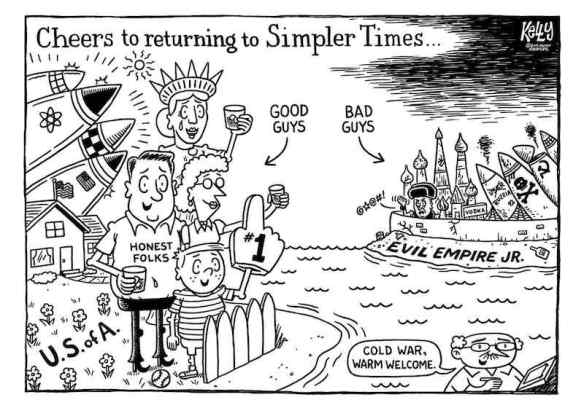
kelly-cold-war

By Philip Giraldi

Source: Unz Review

Liberals are supposed to be antiwar, right? I went to college in the 1960s, when students nationwide were rising up in opposition to the Vietnam War. I was a Young Republican back then and supported the war through sheer ignorance and dislike of the sanctimoniousness of the protesters, some of whom were surely making their way to Canada to live in exile on daddy’s money while I was on a bus going to Fort Leonard Wood for basic combat training. I can’t even claim that I had some grudging respect for the antiwar crowd because I didn’t, but I did believe that at least some of them who were not being motivated by being personally afraid of getting hurt were actually sincere in their opposition to the awful things that were happening in Southeast Asia.

As I look around now, however, I see something quite different. The lefties I knew in college are now part of the Establishment and generally speaking are retired limousine liberals. And they now call themselves progressives, of course, because it sounds more educated and sends a better message, implying as it does that troglodytic conservatives are anti-progress. But they also have done a flip on the issue of war and peace. In its most recent incarnation some of this might be attributed to a desperate desire to relate to the Hillary Clinton campaign with its bellicosity towards Russia, Syria and Iran, but I suspect that the inclination to identify enemies goes much deeper than that, back as far as the Bill Clinton Administration with its sanctions on Iraq and the Balkan adventure, which resulted in hundreds of thousands of deaths and the creation of a terror-narco state in the heart of Europe. And more recently we have seen the Obama meddling in Libya, Yemen and Syria in so called humanitarian interventions which have turned out to be largely fraudulent. Yes, under the Obama Dems it was “responsibility to protect time” (r2p) and all the world trembled as the drones were let loose.

Last Friday I started to read an op-ed in The Washington Post by David Ignatius that blew me away. It began “President Trump confronts complicated problems as the investigation widens into Russia’s attack on our political system.” It then proceeded to lay out the case for an “aggressive Russia” in the terms that have been repeated ad nauseam in the mainstream media. And it was, of course, lacking in any evidence, as if the opinions of coopted journalists and the highly politicized senior officials in the intelligence community should be regarded as sacrosanct. These are, not coincidentally, the same people who have reportedly recently been working together to undercut the White House by leaking and then reporting highly sensitive transcripts of phone calls with Russian officials.

Ignatius is well plugged into the national security community and inclined to be hawkish but he is also a typical Post politically correct progressive on most issues. So here was your typical liberal asserting something in a dangerous fashion that has not been demonstrated and might be completely untrue. Russia is attacking “our political system!” And The Post is not alone in accepting that Russia is trying to subvert and ultimately overthrow our republic. Reporting from The New York Times and on television news makes the same assumption whenever they discuss Russia, leading to what some critics have described as mounting American ‘hysteria’ relating to anything coming out of Moscow.

Rachel Maddow is another favorite of mine when it comes to talking real humanitarian feel good stuff out one side of her mouth while beating the drum for war from the other side. In a bravura performance on January 26th she roundly chastised Russia and its president Vladimir Putin. Rachel, who freaked out completely when Donald Trump was elected, is now keen to demonstrate that Trump has been corrupted by Russia and is now controlled out of the Kremlin. She described Trump’s lord and master Putin as an “intense little man” who murders his opponents before going into the whole “Trump stole the election with the aid of Moscow” saga, supporting sanctions on Russia and multiple investigations to get to the bottom of “Putin’s attacks on our democracy.” Per Maddow, Russia is the heart of darkness and, by way of Trump, has succeeded in exercising control over key elements in the new administration.

Unfortunately, people in the media like Ignatius and Maddow are not alone. Their willingness to sell a specific political line that carries with it a risk of nuclear war as fact, even when they know it is not, has been part of the fear-mongering engaged in by Democratic Party loyalists and many others on the left. Their intention is to “get Trump” whatever it takes, which opens the door to some truly dangerous maneuvering that could have awful consequences if the drumbeat and military buildup against Russia continues, leading Putin to decide that his country is being threatened and backed into a corner. Moscow has indicated that it would not hesitate use nuclear weapons if it is being confronted militarily and facing defeat.

The current wave of Russophobia is much more dangerous than the random depiction of foreigners in negative terms that has long bedeviled a certain type of American know-nothing politics. Apart from the progressive antipathy towards Putin personally, there is a virulent strain of anti-Russian sentiment among some self-styled conservatives in congress, best exemplified by Senators John McCain and Lindsey Graham. Graham has recently said “2017 is going to be a year of kicking Russia in the ass in Congress.”

It is my belief that many in the National Security State have convinced themselves that Russia is indeed a major threat against the United States and not because it is a nuclear armed power that can strike the U.S. That appreciation, should, if anything constitute a good reason to work hard to maintain cordial relations rather than not, but it is seemingly ignored by everyone but Donald Trump.

No, the new brand of Russophobia derives from the belief that Moscow is “interfering” in places like Syria and Ukraine. Plus, it is a friend of Iran. That perception derives from the consensus view among liberals and conservatives alike that the U.S. sphere of influence encompasses the entire globe as well as the particularly progressive conceit that Washington should serve to “protect” anyone threatened at any time by anyone else, which provides a convenient pretext for military interventions that are euphemistically described as “peace missions.”

There might be a certain cynicism in many who hate Russia as having a powerful enemy also keeps the cash flowing from the treasuring into the pockets of the beneficiaries of the military industrial congressional complex, but my real fear is that, having been brainwashed for the past ten years, many government officials are actually sincere in their loathing of Moscow and all its works. Recent opinion polls suggest that that kind of thinking is popular among Americans, but it actually makes no sense. Though involvement by Moscow in the Middle East and Eastern Europe is undeniable, calling it a threat against U.S. vital interests is more than a bit of a stretch as Russia’s actual ability to make trouble is limited. It has exactly one overseas military facility, in Syria, while the U.S. has more than 800, and its economy and military budget are tiny compared to that of the United States. In fact, it is Washington that is most guilty of intervening globally and destabilizing entire regions, not Moscow, and when Donald Trump said in an interview that when it came to killing the U.S. was not so innocent it was a gross understatement.

Ironically, pursuing a reset with Russia is one of the things that Trump actually gets right but the new left won’t give him a break because they reflexively hate him for not embracing the usual progressive bromides that they believe are supposed to go with being antiwar. Other Moscow trashing comes from the John McCain camp which demonizes Russia because warmongers always need an enemy and McCain has never found a war he couldn’t support. It would be a tragedy for the United States if both the left and enough of the right were to join forces to limit Trump’s options on dealing with Moscow, thereby enabling an escalating conflict that could have tragic consequences for all parties.

How Pure is Your Hate?

trump-obama

By Paul Street

Source: CounterPunch

Fellow workers and citizens, how pure is your hatred? It’s easy to hate on openly authoritarian, loathsome, right-wing political personalities and institutions like Ronald Reagan, George W. Bush, Donald Trump, the Koch brothers, Paul Ryan, the Republican Party, the Heritage Foundation, the American Enterprise Institute, Breitbart News, and FOX News. There’s no serious mystery over what those malicious people and entities are about: the ever upward distribution of wealth and power.

The bigger tests are supposedly liberal and progressive personalities and institutions like Barack Obama, the Clintons, Nancy Pelosi, the Democratic Party, George Soros, the Brookings Institution, the Center for American Progress, the “Public” Broadcasting System (“P”BS), the Washington Post, MSNBC, and the New York Times.

These people and organizations are no less committed than the nation’s more transparently right-wing counterparts to the nation’s unelected deep state dictatorships of money, empire, and white-supremacy, but their allegiance and service to the nation’s reigning oppression structures and ideologies is cloaked by outwardly multicultural, liberal, and even progressive concern for the poor and nonwhite.

“What’s the Something Much Better?”

I was reminded of this distinction for the five thousandth time last Thursday while watching Council of Foreign Relations (CFR) member and PBS NewsHour host Judy Woodruff interview the longtime Senior Obama Advisor and intimate Obama family mentor and confidant Valerie Jarrett.

Read the following passage from the interview last week and then tell me, please, to quote  Alexander Cockburn, “is your hate pure?”

Judy Woodruff, CFR and “P”BS:  Just last night, the United States Senate took another step toward repeal of Obamacare, the Affordable Care Act. There was a budget vote, which is going to lead to other steps, which will lead to repeal. Just yesterday, the president-elect called Obamacare a complete and total disaster.

Valerie Jarrett, White House: I think it’s very easy to say repeal and replace, but we have been encouraging the Republicans, since the president first started embarking on this effort, to put in place a plan for affordable care to come up with their best ideas. And they have had, what, 50, 60 votes to repeal, and not a single replacement plan. So…

Woodruff: Well, they say that’s what they’re going to do. They’re going to get rid of what’s there now and replace it with something much better.

Jarrett: Well, what’s the something much better? That’s my question. That’s the question the president has been asking for eight years right now. So, if there is a something better, let’s hear it. What’s the secret?

Obama, 2003: “What I’d Like to See”

After this exchange, Woodruff moved off the health care topic, with no follow up. That was a statement in itself.  Surely any reasonably informed “public” media journalist would be aware that national Canadian-style single-payer health insurance – Improved Medicare for All – has long been backed by most Americans.  Such a journalist would know that single-payer would provide comprehensive coverage to all the nation’s many millions of uninsured and under-insured while retaining free choice in doctor selection and being the most cost-effective way to go thanks to the elimination of private for-profit insurance corporations’ parasitic control over the system.

A knowledgeable “public” journalist might even know that then state senator Barack Obama endorsed single payer on these very grounds as late as the summer of 2003, when he said the following to the Illinois AFL-CIO:

“I happen to be a proponent of a single payer universal health care program I see no reason why the United States of America, the wealthiest country in the history of the world, spending 14 percent of its Gross National Product on health care cannot provide basic health insurance to everybody. And that’s what Jim is talking about when he says everybody in, nobody out. A single payer health care plan, a universal health care plan. And that’s what I’d like to see.”

Obama would quickly drop those sentiments in the interest of getting campaign backing from the nation’s giant insurance and drug companies and their Wall Street investors on his path to the U.S. Senate and the presidency.

Right after he entered the White House Obama set up a health care reform task force chock full of big insurance company representatives.  Not one of the more than 80 U.S. House of Representative members who had endorsed single payer – not even the veteran Black Congressman John Conyers, author of a House single payer bill – was invited to participate.

A Sicko Game

The outcome was the so-called Affordable Care Act (later dubbed “Obamacare”), a complicated and corporatist bill based on a Republican plan drawn up by the right-wing Heritage Foundation.  Since it left the price- and premium-gouging and profit-taking power of the big insurance and drug syndicates intact, the ACA condemned a vast swath of the nation to continuing inadequate and unaffordable coverage – this while the right-wing noise machine has absurdly railed against “socialized health care.”

Along the way, the new neoliberal president played a sicko (yes, Michael Moore) game to sell his Heritage Foundation bill, promising citizens that his plan would include a public option while having already traded that policy away to get for-profit hospitals to back the ACA. As Miles Moguiescu reported on Huffington Post and as the New York Times confirmed,  “Obama made a backroom deal…with the for-profit hospital lobby that he would make sure there would be no national public option in the final health reform legislation…Even while President Obama was saying that he thought a public option was a good idea and encouraging supporters to believe his healthcare plan would include one,” Moguiescu noted, “he had promised for-profit hospital lobbyists that there would be no public option in the final bill.”

We can be certain that the veteran agent of neoliberal mendacity Valerie Jarrett advised Obama to take this deeply duplicitous path.

The Memory Hole

It’s quite remarkable how completely the dominant “mainstream” media-politics culture manages to throw majority-supported social-democratic policy proposals down George Orwell’s memory hole.

Listening to the Woodruff-Jarrett conversation, you’d think Bernie Sanders had never spoken to giant and enthusiastic crowds on behalf of single payer last year.

You’d think Conyers had never drafted single-payer legislation backed by a considerable number of U.S. Congressman.

You’d think that Canada and most of the industrialized world had never successfully implemented a widely popular nation-wide systems of universal governmental health insurance.

You’d think single-payer didn’t have millions of citizen backers – including many thousands of doctors and National Nurses United – from coast to coast.

You wouldn’t imagine that even Donald Trump has mused that single-payer might be the best way to fund health insurance for all.

So, if there is a something better, let’s hear it. What’s the secret?”

Unreal.

It reminds me of Hillary Clinton’s response as head of newly elected U.S. President Bill Clinton’s health care task force when Dr. David Himmelstien, the head of Physicians for a National Health Program, told her about the incredible possibilities of a comprehensive, single payer “Canadian style” health plan, supported by more than two-thirds of the U.S. public and certified by the Congressional Budget Office as “the most cost-effective plan on offer.”

“David,” Hillary (Michael Moore’s heart throb) commented with fading patience before sending him away in 1993, “tell me something interesting.”

That’s right: tell me something interesting.

Along with the big insurance companies the Clintons deceptively railed against, the co-presidents Bill and Hill decided from the start to exclude the popular health care alternative – single payer – from the national health care “discussion.”  What she advanced instead of the system that bored her was a hopelessly complex and secretly developed program called “managed competition.” Interesting. Obama would have more success with his Heritage Foundation-developed update in 2009 and 2010.

And they wonder why Trump won.

Paul Street’s latest book is They Rule: The 1% v. Democracy (Paradigm, 2014)

A Universal Basic Income Is The Bipartisan Solution To Poverty We’ve Been Waiting For

 Molly Crabapple Basic Income Banner

What if the government simply paid everyone enough so that no one was poor? It’s an insane idea that’s gaining an unlikely alliance of supporters.

By Ben Schiller

Source: FastCoexist.com

There’s a simple way to end poverty: the government just gives everyone enough money, so nobody is poor. No ifs, buts, conditions, or tests. Everyone gets the minimum they need to survive, even if they already have plenty.

This, in essence, is “universal minimum income” or “guaranteed basic income”—where, instead of multiple income assistance programs, we have just one: a single payment to all citizens, regardless of background, gender, or race. It’s a policy idea that sounds crazy at first, but actually begins to make sense when you consider some recent trends.

The first is that work isn’t what it used to be. Many people now struggle through a 50-hour week and still don’t have enough to live on. There are many reasons for this—including the heartlessness of employers and the weakness of unions—but it’s a fact. Work no longer pays. The wages of most American workers have stagnated or declined since the 1970s. About 25% of workers (including 40% of those in restaurants and food service) now need public assistance to top up what they earn.

The second: it’s likely to get worse. Robots already do many menial tasks. In the future, they’ll do more sophisticated jobs as well. A study last year from Carl Frey and Michael Osborne at Oxford University found that 47% of jobs are at risk of computerization over the next two decades. That includes positions in transport and logistics, office and administration, sales and construction, and even law, financial services and medicine. Of course, it’s possible that people who lose their jobs will find others. But it’s also feasible we’re approaching an era when there will simply be less to do.

The third is that traditional welfare is both not what it used to be and not very efficient. The value of welfare for families with children is now well below what it was in the 1990s, for example. The move towards means-testing, workfare—which was signed into law by Bill Clinton in 1996—and other forms of conditionality have killed the universal benefit. And not just in the U.S. It’s now rare anywhere in the world that people get a check without having to do something in return. Whatever the rights and wrongs of this, that makes the income assistance system more complicated and expensive to manage. Up to up to 10% of the income assistance budget now goes to administrating its distribution.

For these reasons and others, the idea of a basic income for everyone is becoming increasingly popular. There has been a flurry of reports and papers about it recently, and, unusually, the idea has advocates across the political spectrum.

The libertarian right likes basic income because it hates bureaucracy and thinks people should be responsible for themselves. Rather than giving out food stamps and health care (which are in-kind services), it thinks people should get cash, because cash is fungible and you do what you like with it.

The left likes basic income because it thinks society is unequal and basic income is redistributive. It evens up the playing field for people who haven’t had good opportunities in life by establishing a floor under the poorest. The “precariat” goes from being perpetually insecure to knowing it has something to live on. That, in turn, should raise well-being and produce more productive citizens.

The technology elite, like Netscape’s Marc Andreessen, also likes the idea. “As a VC, I like the fact that a lot of the political establishment is ignoring or dismissing this idea,” Albert Wenger, of Union Square Ventures, told a TED audience recently, “because what we see in startups is that the most powerful innovative ideas are ones truly dismissed by the incumbents.” A minimum income would allow us to “embrace automation rather than be afraid of it” and let more of us participate in the era of “digital abundance,” he says.

The exact details of basic income still need to be worked out, but it might work something like this: Instead of welfare payments, subsidies for health care, and tax credits for the working poor, we would take that money and use it to cover a single payment that would give someone the chance to live reasonably. Switzerland recently held an (unsuccessful) is planning to hold a referendum on a basic income this year, though no date is set. The proposed amount is $2,800 per month.

But would it actually work? The evidence from actual experiments is limited, though it’s more positive than not. A pilot in the 1970s in Manitoba, Canada, showed that a “Mincome” not only ended poverty but also reduced hospital visits and raised high-school completion rates. There seemed to be a community-affirming effect, which showed itself in people making use of free public services more responsibly.

Meanwhile, there were eight “negative income tax” trials in the U.S. in the ’70s, where people received payments and the government clawed back most of it in taxes based on your other income. The results for those trials was more mixed. They reduced poverty, but people also worked slightly less than normal. To some, this is the major drawback of basic income: it could make people lazier than they would otherwise be. That would certainly be a problem, though it’s questionable whether, in the future, there will be as much employment anyway. The age of robots and artificial intelligence seems likely to hollow out many jobs, perhaps changing how we view notions of laziness and productivity altogether.

Experiments outside the U.S. have been more encouraging. One in Namibia cut poverty from 76% to 37%, increased non-subsidized incomes, raised education and health standards, and cut crime levels. Another involving 6,000 people in India paid people $7 month—about a third of subsistence levels. It, too, proved successful.

“The important thing is to create a floor on which people can start building some security. If the economic situation allows, you can gradually increase the income to where it meets subsistence,” says Guy Standing, a professor of development studies at the School of Oriental and African Studies, in London, who was involved with the pilot. “Even that modest amount had incredible effects on people’s savings, economic status, health, in children going to school, in the acquisition of items like school shoes, so people felt in control of their lives. The amount of work people were doing increased as well.”

Given the gridlock in Congress, it’s unlikely we’ll see basic income here for a while. Though the idea has supporters in both left and right-leaning think-tanks, it’s doubtful actual politicians could agree to redesign much of the federal government if they can’t agree on much else. But the idea could take off in poorer countries that have more of a blank slate and suffer from less polarization. Perhaps we’ll re-import the concept one day once the developing world has perfected it?