A False Agenda for Humanity

By Julian Rose

Source: Waking Times

Humanity has, for millennia, been led down the road of an entirely false agenda. So much so, that every aspect of society is almost the precise reverse of what it should be.

Just a glimmer of awareness reveals that the true potential of the majority of mankind remains locked away, unable to exert any influence on the course of events on our planet.

Given the scale of this imprisonment, it becomes apparent that the world has been moving on a trajectory invented and directed by a false intelligence, whose interests are diametrically opposed to the intelligence of natural planetary consciousness.

I use the word ‘intelligence’ because its hard to find the right word to describe that which is very clever, but lacks the ability to feel love or compassion; and is often ruthless without ever showing emotion. Intelligence should have a more human ring to it, but the word has been hijacked by the spying networks: the CIA, FBI, MI5 for example, all call themselves ‘intelligence agencies’. Not exactly warm-blooded institutions!

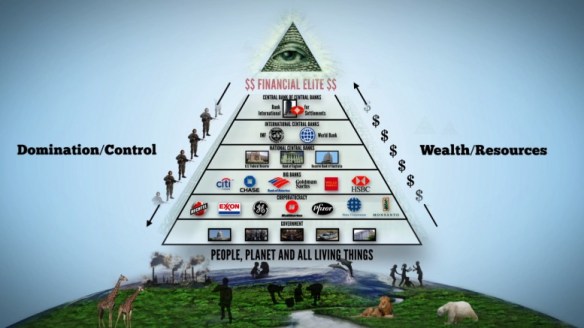
Within the hierarchies of banks, corporations, the military, governments, the media and various global trading organizations, one will find a plethora of quasi-humans in line to get their hands onto the levers of the central control system. The top-down pyramid which steers the daily agenda for millions of mortals caught-up in the 9 to 5 treadmill. Yet, those climbing the employment ladder within these same institutions, more often than not lack any awareness of what is going on above their heads.

We should consider the following question: at exactly what point within this typical corporate pyramid, does the ordinary mortal metamorphose into the ranks of the subhuman control master? Which floor serves as the subtle switch-point where the 9 to 5 worker ‘just doing a job’ shifts into a dedicated trainee in the art of ‘power over the people’ management?

I am not proposing to answer this, as it is a largely hypothetical question; but I suggest that the process whereby the false agenda for humanity is able to be maintained, year in year out, relies heavily on the unquestioning cooperation of those who, at some point, change their identity – or have their identity changed – from just ordinary workers to corporate clones. In other words those who see the world entirely through the lens of the corporation they work for.

The renowned social psychiatrist/psychologist Dr Erich Fromm, in his last major thesis ‘The Anatomy of Human Destructiveness’ traces the decline of the sentient human at the hands of a ‘corporate intelligence’ which is specifically designed to dehumanize those climbing up its ranks. So that by the time they reach the top, such people have become robotic, in virtually every action they undertake.

Here lies the mechanism whereby the human becomes less than human; the less than human becomes inhuman; and the inhuman becomes a biological robotic clone and proponent of Transhumanist Artificial Intelligence – which takes the false agenda for humanity ever nearer to its ultimate goal.

Perhaps not ultimate, but far enough to ensure that humanity as we know it, is superseded by another form of ‘intelligence’ that has nothing to do with nature or the exigence expressed in natural human emotions of love, joy, pain and sorrow.

Cyborgian artificial intelligence is just that: artificial. Art put in reverse so as to eliminate the godly, the beautiful, the spontaneous – all that which gives expression to what it really means to be human.

But consider the fact that it is people suffering these type of symptoms who are in the driving seat of world affairs; running governments, banks and technocratic institutions like the European Union. The mentality is that of a corporate trained control freak – and the greater the power on hand, the greater the ego fueled top-down control manipulation becomes.

The structural design of the neoliberal/neoconservative capitalist Leviathon is not an accident. It is a deliberate formula for the entrapment of mankind. One which puts into reverse – and thereby completely distorts – the true hierarchical themes of nature and the cosmos. In just the same way as Hitler inverted and reversed the design of the original swastika, an ancient peace symbol from Southern India, into a twisted symbol of war.

The symbols that adorn all top-end corporate chains and industries, follow this same pattern. They are nearly all based upon ancient archetypal forms. Forms that symbolized man’s desire to give expression to the powers of nature, as well as the cosmic influences that were mythologized into gods and pantheistic forces of power and influence. Symbols that expressed higher aspirations of bygone civilisations.

The big-chiefs of corporate globalization adorn their high-rise totems and plush office suites with the very same symbols, but what do they stand for now?

Quite simply, a crassly materialistic paradigm which has usurped the nature gods of old; declaring itself the new ‘supreme force’ to which mankind must go on its knees in unquestionoing obeisance.

And, as we know, the majority of mankind has been complicit in fulfilling this role, ensuring a self-inflicted avenue of slavery and passive acceptance of the role assigned by the prevailing status quo.

Indeed, there appears to be no end to the butchery and bullying in the cause of keeping the Leviathan rolling forward. The US military – backed by its European ‘allies’ – ranges the planet in support of the ceaseless profligate mining of valuable minerals, to make the fuels that fill the tanks of Big Pharma, Big Agro, Big Army and Big Business. While the public, rather than rising up against mammon, appear to be paralyzed by the spectacle, unable to imagine anything less destructively domineering that might take its place.

I used the words “appear to be” because there is, of course, another emergent energy that tells another story. That breaks through the deception that man is nothing more than a psychopathetic instrument in the hands of all dominant, aggressive and less than human oppressors.

It is not just ‘any’ other energy. It is the long-buried – and steadily more volcanic – energy of liberated spirit. A revivified spirit which is finding its way back into the arteries of an ever-growing number of ex hostages of the status quo, as well as new arrivals on this planet.

Everyday this spirit is gaining further momentum and a stronger equilibrium. Cracks in the false agenda are widening; the confidence of its perpetrators is wavering; the old power base is leaking.

Chinks of light glitter amongst the darkness; the sense of an upwardly rising change is in the air, counteracting the stench of stagnation and decline.

What is this?

We ‘the people’ have arrived at a critical point in this apocalyptic epoch, finding out that we are possessed of power we never knew we had; starting to believe in a Self we never knew we cradled; hearing a voice we never could hear before. Finding in each other, sources of mutual support, not just a shackled fellow prisoner.

As this process grows, so the false agenda is further revealed for what it is, and its chief perpetrators are exposed ever more clearly for what they are. The seemingly inexorable drive towards a cybernetic future, or one populated and run by gender-bent, micro-chipped mock-humans, is being infiltrated by warm-blooded, nature loving true humans. Trees are being planted where concrete was once the only landscape.

We are learning that where our thoughts go – energy follows. And that if these thoughts are full of creativity and life, so will our lives also be. We are learning that we can take charge of our destinies after all. That, at any moment, we could dispense with the false reality of the top down centralized command system, and be free to start our own version of reality. One informed by our love of Truth – a determination to act on this truth – and a growing aspiration to Be rather than to have.


Julian Rose is an early pioneer of UK organic farming, a writer, actor and international activist.

Alex Schlegel on Imagination, the Brain and ‘the Mental Workspace’

By Rob Hopkins

Source: Resilience

What happens in the brain when we’re being imaginative?  Neuroscientists are moving away from the idea of what’s called ‘localisationism’ (the idea that each capacity of the brain is linked to a particular ‘area’ of the brain) towards the idea that what’s more important is to identify the networks that fire in order to enable particular activities or insights.  Alex Schlegel is a cognitive neuroscientist, which he describes as being about “trying to understand how the structure and function of the brain creates the mind and the consciousness we experience and everything that makes us human, like imagination”.

He recently co-published fascinating research entitled “Network structure and dynamics of the mental workspace” which appeared in Proceedings of the National Academy of Sciences, which identified what the authors called “the mental workspace”, the network that fires in the brain when we are being imaginative.  I spoke to Alex via Skype, and started by asking him to explain what the mental workspace is [here is the podcast of our full conversation, an edited transcript appears below].

This is maybe just a product of the historical moment we’re in with cognitive neuroscience researching, that most of neuroscience research, I think I would say even now, is still focused on finding where is the neuro correlate of some function?  Where does language happen?  Where does vision happen?  Where does memory happen?  Those kinds of things.

It was very easy to ask those questions when fRMI came around, because we could stick someone in the scanner and have them do one task, and do a control test, and then do the real test, and see what part of the brain lights up, in one case rather than the other.  Those very well controlled reductionist kinds of paradigms behind these very clean blobs where something happens in one case versus the other.  I think that led a lot to the story of one place in the brain for every function and we just have to map out those places.

But in reality, the brain is a complex system.  It works in a real world which is a complex environment, and in any kind of real behaviour that we engage in, the entire brain is going to be involved in one way or the other.  Especially when you start to get into these more complex abilities that are very hard to reduce to this highly controlled A versus B kind of thing.

To really understand the behaviour itself, like imagination, it’s not that surprising that it’s going to be a complex, multi-network kind of phenomenon. I think why we were able to show that is maybe primarily because the techniques are advancing in the field and we’re starting to figure out how to look at these behaviours in a more realistic way. One of the big limitations of cognitive neuroscience research right now, because of fMRI, because of the techniques we’ve had, is that we tend of think of behaviour as activating, or not activating the brain.

When we’re doing analyses of brain activity, we’re looking for areas that become more active than another. This is changing a lot in the last few years, but at least for the first fifteen, twenty years, that was one of the only ways we would look at brain activity. So it simplistically thinks of the brain as of some other organ where it’s either buzzing, or it’s not buzzing, or it’s buzzing, or it’s not buzzing, or if it buzzes, the language happens. But really the brain is a complex computational system.

It’s doing complex computations and information processing and that’s not something you’re really going to see if you’re just looking for, in a large area, increased versus decreased activity. When we start to be able to look at the brain more in terms of the information that is processing, and where we can see information, how we can see communication between different areas, then you can start to look at things like imagination, or mental workspace, in a more complex light.

So how does that idea sit alongside the ideas firstly of the ‘Default Network’, which is often linked to creativity and imagination as well, and also to the idea that the hippocampus is the area that is essential to a healthy, functioning imagination?  Do those three ideas just fit seamlessly together, or are they heading off in different directions?

I can give you my opinion, that’s not very well founded in any kind of data, but this is something that we’ve talked about a lot in the lab.  I have a suspicion that actually we had been thinking about how to test for a while.  So the Default Mode Network was first seen as this network that would become more active in between tasks.  So when we’re doing an fRMI experiment what we’ll usually do is you’ll have some period where you’re doing the task, and then there’s a period where you’re just resting, so you can get the baseline brain activity when you’re not doing anything.  And this was a surprising result, is that actually during rest periods, some areas of the brain become more active.  And, you know, “Oh wow, it’s a surprise, the person’s not just sitting there blankly doing nothing.”  The brain doesn’t just totally deactivate.  They’re doing other stuff during those blank periods where there’s no stimulus on the screen.

From my personal experience, what you do in those rest periods is you daydream.  Your mind wanders.  You think about what you’re going to do afterwards, or stuff that’s happened during the day.  There’s a lot of research since then to back that up.  It seems to be this kind of network that’s highly involved in daydreaming like behaviour, or social imagination, those kinds of things.

My opinion, or my suspicion, is that this is illustrating how our term ‘imagination’ really encompasses a lot of different things.  When you try to lump it under this one term, this one mega term, you’re going to be missing out on a lot of the complexity, or subtlety.  So what I suspect is going on is that there’s this more like daydreaming mode of control over your inner space, where you’re not really consciously, volitionally, directing yourself to have certain experiences.  There’s a default control network that’s more taking over the daydreaming.

When I daydream I’m not trying to think about anything, it’s just letting the thoughts come.  That’s maybe part of what imagination is, but a very important part of imagination is you trying to imagine things, trying to direct yourself, thinking, “Well, what is the relationship between these two things?  Or “how can I build community?””  Or something like that.  In that case you’re taking active volitional control over these systems.  So that would be my suspicion of what’s going on.

How the results we found would differ from default mode network is that in our study we would show people some stimulus (see below) and we would say, “Rotate this 90 degrees clockwise”, so they had this fairly difficult task that they had to do and it was effortful.  This more frontal parietal network probably took over then.  And you see that a lot in other studies.  Our frontal parietal, I think they sometimes call it like an Executive Attention Network, that directs when you’re consciously trying to engage in some tests, that takes over, and if you’re not doing anything, the default mode network takes over.

So they’re both different manifestations of the imagination?  Like an active and a more passive, less conscious version?  They’re two versions of the same thing, in a sense?

Yeah, I would think that.  It fits well with what I’ve seen.  There have been studies that show that they’re in some ways antagonistic or mutually inhibiting, the default mode network and this executive attention network…

It’s like oil or water, it’s one or the other?  Or Ying and Yang, as I’ve read in some papers?

Right, but a simple way of describing these that people often resort to is that the Executive Attention Network is designed for attention to the outside world, and the Default Mode Network is attention to the inner space.  Where I would disagree with that, or suggest that that’s not the case, is that I think a better way to classify it would be that executive attention is more of this volitionally driven attention, which is usually associated with attention to the outside world.  And default mode network is more – I don’t know how to describe it exactly, but it’s more of this daydreaming network.  But the point is that your executive volitional attention can be driven to the inner space just as much as it can be driven to the outside world.

Is the mental space network the same kind of network that would be firing in people as when they’re thinking about the future and trying to be imaginative about how the future could be?

Yeah, I would think so.  I think an important difference, or an important additional part that you might start to see if you’re thinking about imagining the future, is that practically most of the time when you’re imagining the future, you’re thinking about people, and social groups, and how to navigate those kinds of dynamics.

So I would guess that then you would get added into the mix all the social processing networks that we have.  That’s actually another thing that we’re thinking about how to look at, is that practically a big chunk of human cognition is spent thinking about your relationship with other people, and how to navigate that.  There’s a good argument to be made that that kind of complex processing space was one of the main drivers of us becoming who we are.  Because social cognition is some of the most complex cognition we do, trying to imagine what somebody’s thinking by looking at their facial expression, or imagine how do I resolve a conflict between these two people who are fighting.  Things like that.

We do have very specialised regions and networks in the brain that have evolved to do that kind of processing.  So yeah, it’s a very interesting question.  That how would these other mental workspace areas, at least that we looked at, that had nothing to do with it, you know, it’s like, “Here’s this abstract shape.  What does it look like if you flip it horizontally here”, things like that.  How would they interact with these socially evolved areas?  It’s a very interesting question.

A lot of the research that I’ve been looking at is about how when people are in states of trauma, or when people grow up in states of fear, that the hippocampus visibly shrinks and that cells are burnt out in the hippocampus, and that people become less able to imagine the future.  People get stuck in the present, and it’s one of the indicators, particularly with post-traumatic stress, is that inability to look forward, and inability to imagine a future.  Do you have any knowledge of, or any speculation about, what happens to the mental workspace when people are in states of trauma or when people are in states of fear?

Definitely no data, only speculation.  As with anything real and interesting involving humans, it’s going to be incredibly complex.  So it would be very difficult, and may be impossible to distil it down to simple understandable things that are happening in the brain, but what I would guess is that, in people that are in stressful situations, and experiencing trauma, you tend to focus – like you were hinting at – you tend to focus on present.  What’s there immediately?  How do I survive this day?

You don’t tend to think much about planning for the future.  Synthesising everything that’s happened to you in the past, you just react in the moment because you don’t know what the next moments are going to be like.  It’s no more cognitive load that you can deal with because of all the stress you have.  So I would guess that for one you’re not really synthesising or processing your experiences into something brought to bear on decisions in the future as much.

And you’re not exercising those muscles of planning far into the future.  So just like any other muscle in the body, if you don’t practice the skills, and you don’t use various parts of your brain, they’re going to atrophy.  They’re not going to develop in the way that they would if you did use them.  In that sense it seems perfectly understandable and not that surprising that these areas and these networks that we found associated with these kinds of activities of projecting oneself in the future, or imaging that things don’t exist, in people for whatever reason aren’t doing that kind of thing regularly in their lives, they’re not going to be developed as much as they would from people that were happy and healthy and imaginative.

The paper that Kyung Hee Kim published in 2010, ‘The Creativity Crisis’ suggested that we might be seeing a decline in our collective imagination.  Do you have any thoughts on why that might be, or what might be some of the processes at work here?

I could speculate a couple of things.  The first thing that pops to mind obviously is education.  How we think about the educational system, how we train children.  And I don’t know about 1990 in particular but definitely starting in 1999 when we became test-crazed, that would be a very obvious culprit.

One thing to think about with the Torrance test and pretty much all tests, these standardised tests of creativity that we use, is that one of the major components that determines the outcome on the test is this divergent thinking idea.  How many ideas can you come up with?  So this has, I think, fairly detrimentally become one of the working definitions we have in psychology research of creativity, is “how much?”  And not really focusing on quality so much, and just using how many ideas you can think of as a stand in for how creative someone is.

The Torrance Test is better because it does get into other dimensions as well, but still some of the major dimensions determining the score are fluency, when you’re doing these drawings, how many components are there in the drawing?  That kind of thing.  So for instance if there were educational trends starting in the 1990s and continuing to now that were leading people to try to converge rather than diverge – you know, “What’s the one right answer?” versus, “What are lots of possible answers?” – then that could definitely lead to these changes we’ve been seeing in the tests.

Even if that were the case though, is that really a problem? Obviously we want people to be able to think of lots of possibilities but if it’s just, for instance, people who have been brought up in an educational system where they’ve been taking standardised tests all the time, and they’re trying to figure out which of the four bubbles is the right one to fill in, then that could just be a habit they’ve developed that carries over to these tests.  I don’t know exactly.

Another idea that maybe would be related to this is we’re definitely much less idle than we were in the past.  I guess we lament all the time how overscheduled kids are.  They go from soccer practice to band practice to art class, to blah, blah, blah, blah, trying to fill up their resume for college or whatever.  So if somebody is just constantly buzzing, busy, not really just stopping and daydreaming, and throwing rocks in creeks or whatever, then that’s again, it’s a habit they’re not going to have developed and they’re not going to be able to use as well.

This idleness, or giving up control to the Default Mode Network maybe, if you will, letting those ideas come in, exploring possibilities, those are things that I think often come out of boredom. And if you’re never bored, you’re never really letting those processes happen.  So that would be another thing to think about.

So if somebody is less imaginative, is that because that when the mental workspace fires, it’s including less places, or that it’s joining them up less vigorously? I don’t have all the terminology.  It all fires, but it fires to less places?  Or it fires less strongly to all those different places?

I think it would be basically everything, to give you a terrible answer.  For instance, this is where we’re really getting at how imagination is a very, very complex process that we’re distilling to a single word, and it’s really thousands of parts to come together.

For instance, if you can imagine visual experiences more or less vividly, then that’s going to play a role.  Somebody who can have very vivid mental images of things is going to probably have an easier time recombining things than somebody who really struggles to form a visual image.  Or on the flip side, there’s a lot of circumstantial evidence that people tend to go to one end or another of being very visual people, and I consider myself on those…  When I think, I tend to think a lot in terms of visual representations.  So it’s very easy for me to do the kinds of tasks that I ask subjects to do, where you know, “Here’s this weird random shape, what would it look like if it was rotated 90 degrees?”

Some people have a really hard time doing that kind of stuff though.  They’ve very smart people, but they’re just terrible at mentally manipulating images.  But if you have them think about other things, like more verbal kinds of verbal logical representations, they’re really good at that.  So even trying to talk about the mental workspace network as one static network of areas in the brain is probably not true, or probably not accurate because different people will have different connections, or different parts of it will be more active than others.

When I’m trying to mentally imagine things, for some people like me, that might involve mental or visual images, and that’s the way I think about it, but for other people it might involve much more the language areas of the brain, exercising that language network in a more mental way.  And that might lead to strengths for some people versus others, and vice versa, depending on what kinds of tests you’re trying to do, or whether you’re a verbal person that’s being forced to try to do something visual, or vice versa.

So given that these networks are involved are these complex information processing systems, there’s any number of ways where they can differ or fail, or become strengthened or become atrophied.

One of the questions I’ve asked everybody that I’ve interviewed has been if you had been elected last year as the President on a platform of ‘Make America Imaginative Again’, if you had thought actually one of the most important things we need is to have young people have a society that really cherishes the imagination, an education system where people come out really fired up and passionate, what might be some of the things you would do in your first 100 days in office?

First 100 days?  Well I think the real solutions are things that are more like 20 year solutions.  So you can start at a 100 days I guess but you definitely won’t solve it in 100 days.  For me it all comes down to how we choose to educate people.  I come at this all from a perspective of the US education system, so one thing is that we don’t view a teacher as a profession really, in the same way that we do as a medical doctor, or a lawyer.

I would say we need the equivalent training and residencies and professional degrees for teachers that we would have with anything else that’s as important a profession as teaching is.  Obviously we shouldn’t be focused on tests in the way that we are.  If you teach tests, and you teach to the kind of competencies a child should achieve by fifth grade, you’re going to be ignoring all the things that are hard to measure, for one thing, like imagination, creativity, curiosity.  How do you evaluate whether a kid’s curious?  I don’t know.

One of the changes I would want to see is that we trust more that the outcomes that we want will come rather than need to see them happen, because if you need to see a result, then you’ll only focus the things that you can see.   And for a lot of what education really does, it’s very hard to measure it in any reliable way.  If your goal is create a society of people that are civically engaged, that are curious, that are creative, compassionate, that’s all stuff that you just have to set up a system to do that, and hope that the outcome you measure will be the society you create, basically.  So that it frees you to focus on those things, and not focus on maths skills, reading skills, that kind of thing.

So in the first 100 days, what do you do? I don’t know. One concrete thing you could do is try to reorganise the teacher training system to make it more professionally aligned.

Like they have in Finland, where teachers are basically trained to Masters level, and then there’s no testing in schools of teachers.  They are then just empowered to teach, and they have the most amount of play and the shortest school hours of any country in Europe, and they constantly gain the best results and the brightest students.

Maybe that would be the first thing we could do, just copy Scandinavia.

Love and Let Love: Overcoming Egocentric Love

By Gary Z. McGee

Source: The Mind Unleashed

“Love could be labeled poison and we’d drink it anyway.” ~Atticus

Love is a tricky subject. It’s multifaceted, both subjectively and objectively. It’s both lost and found within the complex folds of our unique mind-body-spirit dynamic. It’s both a spiraling in and a spiral out. We all know the “feeling” of love, but we can’t seem to describe it to each other. But boy do we try: in poetry, in song, in dance, in bed. Even in art.

Unfortunately, the predominant love paradigm in our culture is egocentric, ownership-based love. We live in a world where relationships are mostly based upon materialism, ownership and immediate gratification. It’s almost like we’re conditioned to consume to the point that we “consume” each other. Even the words we use toward each other imply ownership.

It’s sad. But no condition is insurmountable. We can recondition ourselves to form healthy relationships based upon respect, honesty, and trust. We can update the love paradigm into one of soul-centric, relationship-based love. But first we need to recognize each other as opposite sides of the same being. Our yin-yang dynamic is more dynamic than we tend to allow it to be.

The thing is, our language is dreadfully inadequate to do the concept of love any justice. There are over seven-billion people on the planet and we each have a different psycho-physiological reaction to any given stimuli, however minute that difference. And with abstract stimuli such as Love, Consciousness, and God, that difference is magnified.

The fact is: we each have our own definition for the concept of love (ego), but that definition is written in a language older than words (soul). So how do we understand this language? Simply put: mindfulness. More complexly put: we must become aware of what our mind-body-spirit is telling us, and then be honest about that information regarding our relationships. And poetically put: “You only have to let the soft animal of your body love what it loves.” ~Mary Oliver

The ability to love (vulnerability):

“Vulnerability is not knowing victory or defeat, it’s understanding the necessity of both; it’s engaging. It’s being all in.” ~Brene Brown

Our ability to love another person is predetermined by our ability to love ourselves. Similar to the airplane-crash-landing analogy, “Always put the mask on yourself before assisting someone who may be less capable,” we must put the Mask of Love on ourselves before loving someone who may or may not be capable of authentic love.

The irony is that we must first learn self-love to understand that egocentric love isn’t the healthiest way to love. We must first love our ego in order to transform it into an ego that isn’t just in love with itself. An ego that isn’t loved tends to become self-serving and egocentric (codependent or merely independent), but an ego that is loved tends to become self-actualized and soul-centric (interdependent).

An ego that has learned interdependence through self-love is more likely to love authentically. It is more likely to be vulnerable with another ego. And vulnerability is the key to loving greatly. It’s the secret of deep authenticity. A crucial aspect of self-actualized love, as opposed to egocentric love, is to allow ourselves to be vulnerable so that we may be astonished by love, taken aback by it, in awe of it. As the great Rumi once said, “Close your eyes. Fall in love. Stay there.”

The ability to let others love (freedom):

“The only way of loving a person is to love them without hope.” ~Walter Benjamin

Have you ever caught yourself saying this, regarding love and relationships? “I just don’t want to get hurt.” Or heard someone else say it? We hear people say this, and we nod in empathy, followed by an understanding pat on the back, or a sympathetic hug.

But, wait a minute! Who ever said getting hurt wasn’t a part of love? Are not pain and love two sides of the same coin? If we love something deeply enough, does it not hurt when we lose it? The thing is, the ability to love another person takes an enormous act of courage. And if we are genuinely allowing ourselves to love another person, then we must open ourselves up to the possibility of being hurt. This is what it means to be vulnerable. If we’re not “all in,” then what’s the point of trying?

Pain should not be avoided at the expense of love. Love should be embraced at the risk of pain. Indeed.

If we’ve already learned to love ourselves, which we should have taken care of before attempting to love another person anyway, then insecurities be damned! It’s time to go for it. It’s time to move all in. Rejection happens. But if we don’t at least give it a shot, and that means getting vulnerable and laying our insecurities out on the table like a bad hand of poker, then we’ll never know if it could have been something magical or not.

A relationship is actually two uniquely different people who have gone from being independent dancers to becoming an interdependent dance. This is the beauty of romantic, soul-centric love. It becomes a dance. But, and here’s the rub, the dance can only be enjoyable if both parties are free to dance… or not.

This is where it gets difficult: allowing our partner to love the way they need to love. This sounds simple enough, but it is deceivingly simple. Because we might not like the way they love. It requires good communication skills, brutal honesty, and an exemplary trust in the other dancer.

One of the biggest assumptions we make about love is imagining that the other person loves the same way that we do. In other words, we assume that what the other person means by love means the same thing that we mean by it. But this simply cannot be true if we are genuinely allowing the other person to be an individual with their own unique tastes and opinions.

Letting our lover love the way they need to love is just as much a part of the dance as our unique way of loving is. But we must be honest, first with ourselves and then with our partners. Sometimes this honesty will hurt, but pain is necessary for growth. And if a relationship is what we’re trying to grow, then pain is par for the course.

If the way another person loves doesn’t jive with the way that you love, then the dance either needs to end or it needs to take on a new form. If this sounds counter-intuitive, that’s because it is. As the great Victor Hugo cryptically stated, “Love is never stronger than when it is completely unreasonable.”

The ability to let love go (compersion):

Everything we love is well-arranged dust.” ~Atticus

The ability to let love go is our ability to let go of our ego’s attachment to it.

Falling in love is both very easy and very difficult. It is easy when we are coming from a place of non-attachment and interdependence; when we’re allowing all things to mysteriously and majestically flow. But it is difficult when we are coming from a place of attachment and codependence, and we’re rigidly trying to control everything. It’s the difference between being Love, and vainly trying to pigeonhole love into the box of our expectation.

As Stephen Levine profoundly stated, “True love has no object. Many speak of their unconditional love for another. Unconditional love is the experience of being. You cannot unconditionally love someone. You can only be unconditional love. It is not a dualistic emotion. It is a sense of oneness with all that is. The experience of love arises when we surrender our separateness into the universal. It is a feeling of unity. You don’t love another, you are another.”

When we let love go, we’re not letting go of Love itself –not at all. We are letting go of the ego aspect of love. We’re letting go of the attachment, the need to cling. It’s not like we let go of love and then forget about it. No, it’s more like we are saying goodbye. Like proud parents who are sad that their child has left home, but are happy for their growth and open to the possibility of their return.

Love itself is never abandoned, nor is it forgotten. Only the needy, codependent, ego side of love that’s filled with unhealthy expectations and cultural predispositions about the way love should be is abandoned. Authentic love lasts forever, despite us, and even in spite of our egos. The more we let love go, the more we realize that we never owned it in the first place. It was never a thing that could be owned. It could only ever have been free, or it was never really love at all.

So, let’s learn to be Love in the face of expectation. Let’s be Love despite the love that thinks it needs validation. Let’s be Love even when others cannot. That is the heart of both compersion and forgiveness… Love, let others love, and then let go of your ego’s attachment to love. Do this, again and again, in a kind of loving life-death-rebirth process, and the ability of soul-centric, self-actualized love will not elude you.

Sacred Agency

By Kingsley L. Dennis

Source: Reality Sandwich

The following essay was originally published on KingsleyDennis.com


Transcendence is the only real alternative to extinction.

—Václav Havel, Independence Hall, Philadelphia, July 4, 1994

We are cosmologizing the human.

—Henryk Skolimowski, The Participatory Mind


Human consciousness has been on a long journey. Our awareness has shifted from the earlier archaic, animistic mode; to the religious and scientific; and then later to an industrial, mechanistic consciousness. Our ancestors did not live in the same world as we live in now, nor would they have exhibited the same kind of consciousness as we currently do. Consciousness is not a fixed phenomenon or static expression—it changes alongside the flows and fluxes of history, time, and environment.

An integral mode of consciousness began to emerge after the successive industrial revolutions that adapted a “machine style” perspective of control, power, and efficiency; and which eventually propelled global society toward excessive consumption and accelerated growth. This integral consciousness emerged parallel to a new era of technological innovation. That is, a consciousness that reflects dynamics of connection and communication across condensed time and space.

It can be said that we have gone from worshipping faith, then objective knowledge, to finally arriving at an understanding that everything depends upon the subjective self. Throughout this whole journey, like the hero that traverses through the underworld, we have ventured far in search of a mode of being – a state of consciousness and awareness – that can benefit us. A place of conscious self-awareness, which may be termed as sacred, has been present within humanity from the very beginning. It never went away – only we went away. This situation is similar to the behavior of individuals as observed by psychologist Abraham Maslow. Maslow noted how people step back from doing something important, believing others will do it instead. Somewhere along the way we made an internal agreement to stay back and not to overestimate our abilities. It appears that too many of us for too long have avoided being ‘fully human’ and content to remain as ‘only human.’

Regardless of how we may articulate it, the sacred presence within humanity cannot be denied as it is an expression of the evolutionary impulse. As such, it does not stop at transitional stages but is compelled to push toward ever higher states and degrees of consciousness. We are in the hands of a force that we can barely recognize. Throughout the long journey of our development human beings have been deeply involved in this sacred unfolding (for want of a better expression). What this means is that the transcendental yearning to go beyond one’s present state persists in each of us. All of this, our very humanism, should be an inherent part of our cultural mythology. Or at least should influence how we understand and perceive our reality.

Our experience of reality is never pure, but always mediated through consciousness in its various states of reception. The myths we hold as an individual, a culture, and as a collective species reflects our own state of mind. Unfortunately, humanity has for far too long considered itself separate from the cosmos. We feel as if exiled upon a dead planet somewhere upon the fringes of our galaxy. If we do not fully know ourselves it may be because our cultural myths (our narratives) place us within a cosmically isolated reality. To be truly integrated we must recognize that we participate not only upon the planet but also within a grander mythology. In other words, we should accept our responsibility as having sacred agency. After all, the history of human civilization is the history of ourselves as change agents.


Sacred Agency

The philosopher Karl Jaspers referred to the period from 800–200 BCE as the Axial Age. It was a time that, according to Jaspers, similar expressions of new thinking appeared in Persia, India, China, and the Western world. He indicated also that the Axial Age represented an in-between period, where old certainties had lost their validity and new ones were yet to emerge. The new religions that arose in this time—Hinduism, Buddhism, Confucianism, Taoism, and monotheism—influenced new thinking in terms of individuality, identity, and the human condition. These new emerging religions helped to catalyze new forms of thinking and expressions of human consciousness. And yet, over time, we have seen how they were not wholly successful in establishing permanent developmental change.

Social thinker Duane Elgin has referred to our present time as the Second Axial Age in that religions of separation are being replaced by a new spirit of communion. Elgin says that the world is moving into a spiritual communion and empathic connection with a living cosmos. Maybe we are in need of being reminded that there is nowhere else to go when the cosmos already exists within us. This empathic consciousness that Elgin speaks of can be related to the emerging integral consciousness that reflects our increased interconnectivity through our global networks. This connects with our innate, fundamental drive to seek out communion and coherence. A mode of human consciousness that seeks coherence is itself a reflection of a universal natural order. In other words, it is a self-referencing feedback loop. And so now allow me to speculate.

My suggestion is that a purpose for sentient human life upon this planet is as a driver toward establishing a coherent planetary consciousness. In other words, to act as a channel to ‘bring in’ – i.e., receive consciousness – from the consciousness field and to manifest it specifically (that is, to project it) within our earthly reality. There is a correlation here with Aurobindo’s concept of the Supermind/Overmind, in that a form of higher consciousness can be made immanent upon the material plane. Aurobindo referred to this as human evolution moving towards a suprarational or spiritual age that exhibits an intuitive or Gnostic mode of consciousness.

The finer channeling of the consciousness field would require the adequate preparation of human receptivity. That is, our minds and even perhaps our nervous system would need to be sufficiently prepared in order to successfully actualize this potential. By raising localized aspects of human consciousness through individual perceptions and awareness we may better increase the coherence of consciousness amongst the whole—a form of collective transcendence through species consciousness. And this can be made tangible by local agents – i.e., each one of us – becoming aware and conscious in everyday acts of right thinking, right behavior, and right being. It is a mode of sensitive and balanced consciousness that comes only with considerable effort and discipline. This discipline forms part of the developmental awakening within each individual, and which then influences our perceptions and life experiences.

As such, we can come to recognize that we are no longer either isolated individuals or an inarticulate mass. We are localized consciousness acting through aware individuals who consciously seek to connect, collaborate, and care about the future. Each one of us, as localized consciousness, is a reflection of the grander nonlocal consciousness. And in this way each one of us is also a reflection of the other. No individual lives within a shell separated from everybody else, but each is connected to all through our conscious humanity.

What we are seeing emerge across the world is the early stirrings of a planetary civilization; one that is driving toward diversity and coherence. And as we connect and share our thoughts, ideas, and visions we will be helping to strengthen the signal or reception of consciousness and thus the bringing in of the grander cosmic consciousness. A planetary consciousness spread across the Earth may not only be a real possibility, it may very well be a fundamental cosmic purpose.


Human Purpose in the Sacred Order

Recent scientific discoveries indicate that our reality is coded from beyond cosmic space-time; and as such our reality behaves in a way consistent with what we know as a holographic projection. That is, the totality of our reality is in-formed from a deep consciousness beyond it. The known cosmos thus acts as a nonlocal consciousness field, of which sentient life forms as localized manifestations. It has been inferred through various religious and sacred texts, and various wisdom traditions, that the universe (material reality) came into being as a way for its source to ‘know itself.’ This is reminiscent of ‘know thyself,’ the famous maxim from the Oracle of Delphi. Or, in modern language, we can say that we are the eyes through which the cosmos contemplates itself.

Self-consciousness is generally attributed to those sentient organisms at a high peak of mental development. Self-reflection is one of the prized attributes of self-consciousness. Furthermore, self-realization is something we credit to each attained individual consciousness. A realization of the self is part of the path of human actualization. It is a path in which purpose and meaning are core drivers and potentials. Human beings – or we could say human becomings – are naturally driven by a longing, a purpose, and this signifies a connection with a sacred impulse. In our times human civilization has shifted into an unprecedented era of self-actualization. The psychologist Abraham Maslow, who originated a scale of self-actualization, recognized that one of the characteristics of self-actualizers is that they have far less doubt about what is right and wrong than normal people do, and they act upon this inner knowing.

As we further speculate, what would self-realization upon a greater scale be like? That is, self-realization as a planetary consciousness? Or as a galactic consciousness? What would a fully realized and self-conscious cosmic consciousness operating through all of its localized manifestations be like? This would constitute a state of coherent self-aware consciousness beyond our imagination. We can only speculate, or internally gaze upon the possibility.

As a recap then, human consciousness is a localized expression of the greater nonlocal consciousness field. As sentient beings we receive aspects of this consciousness that pervades our space-time. We are animated by it, and we then manifest this through our own minds and human cultures. Our individual expressions of consciousness also reflect back into the greater nonlocal consciousness field. The greater our individual perceptions and conscious realization, the greater the total realization of the entire holographic field consciousness (as if in a feedback loop). To put it another way, cosmic consciousness is ‘in-formed’ through the emerging awareness of each of its conscious subparts, or components. The art of the sacred then is that we each have a role in bringing the unfinished world into existence through conscious participation.

As each one of us wakes up (to use a common metaphor) the cosmic net shines that little bit brighter. If enough individual consciousnesses awake upon this planet we may catalyze a localized planetary field into collective conscious awareness. In this case, we are each a conscious agent of cosmic realization and immanence. We each have an obligation in our existence on this planet to raise our individual, localized expressions of consciousness. In doing so, we both infect and inspire others in our lives to raise theirs, as well as reflecting back our conscious contribution into the cosmic consciousness. In this way, we can act as both citizens of the cosmos as well as caretakers for the sacred order.

We have now arrived at a place where we can recognize and accept that our reality is not a static affair but an active, fluid realm that makes demands upon us. And in knowing this we are compelled to embrace the obligations and responsibilities that come with this role. We are on a path of completion – of conscious completion and communion – which is the eternal path of the sacred. Through this sacred journey of completion we connect and commune with everything else in our reality, and beyond. As human beings we have been tasked with this sacred endeavor. We can become aware of our creative contribution to reality and this can give us meaning and purpose. Perhaps this will finally provide us with our place in the cosmos. And how can we walk this path?

We can take this journey through our small acts of conscious awareness – our thoughts, attitudes, behavior, and our everyday actions. Upon the next level, our social changes and emerging technologies may form part of this process, establishing an extended mind and empathic embrace across the face of the earth. Magic is alive; magic never died. Everything is ultimately a technology of the soul; and all magic, all science, and all human expression is a part of this soulful technology. And with each step forward we move closer to soulful communion with a grand conscious and sacred order.

The sacred impulse animates the expression of consciousness at the individual, collective, and planetary level. And one day we may witness a grand awakening, unprecedented upon this planet, and this may very well be the purpose for sentient life, as conscious agents of the sacred order. This is likely to be more reality than fantasy. The hidden treasure that is at the very core of our existence wishes to be known – for us to know ourselves – by our individual journeys of self-realization.  We are not alone. A great planetary future awaits us, as a great treasure that wishes for communion. Welcome to the new story.


Truth has to appear only once, in a single mind, for it to be impossible for anything ever to prevent it from spreading universally and setting everything ablaze.

—Teilhard de Chardin, The Heart of Matter

Food for the Moon

By rahkyt

Source: Sacred Space in Time

I don’t know how to say this politely: you are part of a remorseless, psychopathic system that circumscribes your very thought processes and forms your every opinion and belief.

This system of thought, action and being envelops you like air and you can’t see it, feel it or hear it. And yet, you do see it, feel it and hear it every day because it is in your mind as it is in the mind of every person around you.

This system is designed to cull your energy through work and play, to foster its own continuation by way of your personal energetic production. And the production of every, single soul around you. its stability is dependent upon your ignorance.

Because once you become aware of it, you begin to see it everywhere. As it has always been everywhere. Been everything. It notices your awakened state and actively seeks to lull you back to sleep or, failing in that, destroying you utterly and erasing every true sign of your existence from its collective memory.

Once you choose knowledge, you are done. Once you choose truth, you are finished.

It is best to go on ahead and believe you’re dead from that very instant like the ancient Samurais of Japan used to do, for the sake of your own psychological stability moving forward.

Because move forward you must. We must. There is work to do and little time to do it. There are dragons to slay, literally, and they have been awaiting your arrival for millennia.

And now that the time of prophecy and projection is finally upon us, as those awakened souls kindle the flames of love within others and that collective and mighty roar signals the onset of the conflagration of the Ages, your options are reduced to the potentialities of the moment. The Now.

You are brought from the heights of abstract psychological and mental confabulation to the pressing, survivalist instincts that instruct you on how to make it through this moment. And the next. And the one after that.

Don’t worry. There’s no time for wasted energy. You will know what to do.

Your spirit has been preparing for this time for eternity. When the moments of your engagement arrives, you will step the steps predestined, say the words preordained and do the things you were preconceived to do.

And that is just how its going to be. So don’t waste anymore time on worry or regret. The system and its people don’t give a damn about you. Or any of us.

We’re only sustenance. Food for the moon. And Saturn, of course.


3 Characteristics of a True Political Awakening

By Sigmund Fraud

Source: Waking Times

History is written by the winners, or so they say, but there is an agreed upon version of our story that is taught to us in school and reinforced in everyday life by the media and government propagandists. Coasting through life haphazardly believing in this standardized version of reality is a form of consciousness, a contemporary way of relating to a world where the individual is consumed by the group, and truth becomes evermore out of reach.

The typical level of political awareness in our society is fairly basic, simplified and incomplete, but it serves as a functional trap for the mind and the imagination, pigeon-holing individuals into a conformist. This psychological trap preys upon two basic human traits: conservatism and progressivism. And because these traits are biologically hardwired into the human psyche, they are exploited as a fissure to create disharmony and division amongst the public.

Many people only rise to a level of political consciousness which allows them to understand their predisposition to one or the other of these traits. Awareness often ends here, with extreme devotion to one side of the publicized political spectrum.

The truth is that human societies have always needed an even distribution of people with each of these ideological tendencies in order to achieve a balance between our need for external and internal control, protection and care. Political awakening involves rising above the prescribed psychology of division, into a position of appreciation of the qualities which unite us all.

This idea is enumerated in the following three characteristics of true political awakening.

Trust in the Statist System Collapses

To continue to trust and support a consistently abusive master is often referred to as Stockholm Syndrome. When a person experiences a true and deep political awakening, it is not longer possible to excuse any of the crushing affronts to human rights and human dignity that are intrinsic to state power.

State power is historically abusive. The manipulation of our money supply, endless wars, wasting of public resources, corruption, permitting the destruction of the natural world, terrorizing citizens with abusive police and punitive tax codes, and limiting prosperity with regulatory overkill are all standard operating procedure for the state.

In a statist world, the awakening individual is tasked with the challenge of seeing through all of this in order to free the mind and see the greater possibilities for freedom and cooperation in the human story.

So-Called Leaders Are Seen as Puppets of Division

Watching the pendulum of public opinion and discourse swing violently back and forth between the merits of two political parties is comical once you’ve recognized just how predictable and destructive it is. We are goaded into engaging in the divisiveness, encouraged by the rhetoric of the political establishment.

It is our unity they fear most. Falling into the trap of politically dogmatic ideological fortifications is more dangerous to our society than just about anything else, and the truly politically awake fly above the argumentative mentality of those who are trapped in the two-party paradigm.

The Recognition that Politics is Heavily Influenced by Powerful Forces

If politics is the arena of government, and government is clearly influenced by corporate interests, intelligence agencies and deep state operators, and supranational organizations, then it makes no sense to pretend that we have power in the political system.  It makes no sense to pretend as though politicians are acting in the true interest of actual people. It makes no sense to pretend that we can save ourselves by calling on members of the state to represent us in their corrupt scene.

It is commonly known that politicians are beholden to special interests, and while they never talk openly about this influence, so many people carry on with the charade that politicians can wield  power over these organization, for the benefit of the plebs. They cannot, for these forces are beyond their control. The politically awakened understand that the plots against humanity extend way beyond the political scene.

Final Thoughts

Unity is the one thing that any political elite has always feared the most. Without smashing down the perceived barriers in contemporary political consciousness we can only expect our society to become more fractured, chaotic and dangerous. Trust in that which deceives and harms us is simply not possible for the truly politically awakened.

A New Concept of Consciousness

By Ervin Laszlo

Source: Reality Sandwich

The following is excerpted from The Intelligence of the Cosmos by Ervin Laszlo, published by Inner Traditions.

What about mind? If the world is vibration, is also mind and consciousness a form of vibration? Or on the contrary, are all vibrations, the observed world, a manifestation of mind?

Although it is true that when all is said and done all we know is our consciousness, it is also true that we do not know our own consciousness, not to mention the consciousness of anyone else. We do not know what consciousness really is or how it is related to the brain. Since our consciousness is the basis of our identity, we do not know who we really are. Are we a body that generates the stream of sensations we call consciousness, or are we a consciousness associated with a body that displays it? Do we have consciousness, or are we consciousness? Consciousness could be a kind of illusion, a set of sensations produced by the workings of our brain. But it could also be that our body is a vehicle, a transmitter of a consciousness that is the basic reality of the world. The world could be material, and mind could be an illusion. Or the world could be consciousness, and the materiality of the world could be the illusion.

Both of these possibilities have been explored in the history of philosophy, and today we are a step closer than before to understanding which of them is true. There are important insights emerging at the expanding frontiers where physical science joins consciousness research.

On the basis of a growing series of observations and experiments, a new consensus is emerging. It is that “my” consciousness is not just my consciousness, meaning the consciousness produced by my brain, any more than a program transmitted over the air would be a program produced by my TV set. Just like a program broadcast over the air continues to exist when my TV set is turned off, my consciousness continues to exist when my brain is turned off.

Consciousness is a real element in the real world. The brain and body do not produce it; they display it. And it does not cease when life in the body does. Consciousness is a reflection, a projection, a manifestation of the intelligence that “in-forms” the world.

Mystics and shamans have known that this is true for millennia, and artists and spiritual people know it to this day. Its rediscovery at the leading edge of science augurs a profound shift in our view of the world. It overcomes the answer the now outdated materialist science gives to the question regarding the nature of mind: the answer according to which consciousness is an epiphenomenon, a product or by-product of the workings of the brain. In that case, the brain would be like an electricity-generating turbine. The turbine is material, while the current it generates is not (or not strictly) material. In the same way, the brain could be material, even if the consciousness it generates proves to be something that is not quite material.

On first sight, this makes good sense. On a second look, however, the materialist concept encounters major problems. First, a conceptual problem. How could a material brain give rise to a truly immaterial stream of sensations? How could anything that is material produce anything immaterial? In modern consciousness research this is known as the “hard problem.” It has no reasonable answer. As researchers point out, we do not have the slightest idea how “matter” could produce “mind.” One is a measurable entity with properties such as hardness, extension, force, and the like, and the other is an ineffable series of sensations with no definite location in space and an ephemeral presence in time.

Fortunately, the hard problem does not need to be solved: it is not a real problem. There is another possibility: mind is a real element in the real world and is not produced by the brain; it is manifested and displayed by the brain.


Mind beyond Brain: Evidence for a New Concept of Consciousness

If mind is a real element in the real world only manifested rather than produced by the brain, it can also exist without the brain. There is evidence that mind does exist on occasion beyond the brain: surprisingly, conscious experience seems possible in the absence of a functioning brain. There are cases—the near-death experience (NDE) is the paradigm case—where consciousness persists when brain function is impaired, or even halted.

Thousands of observations and experiments show that people whose brain stopped working but then regained normal functioning can experience consciousness during the time they are without a functioning brain. This cannot be accounted for on the premises of the production theory: if there is no working brain, there cannot be consciousness. Yet there are cases of consciousness appearing beyond the living and working brain, and some of these cases are not easy to dismiss as mere imagination.

A striking NDE was recounted by a young woman named Pamela. Hers has been just one among scores of NDEs;* it is cited here to illustrate that such experiences exist, and can be documented.

*For a more extensive sampling see Ervin Laszlo with Anthony Peake from The ­Immortal Mind (Rochester, Vt.: Inner Traditions, 2014).

Pamela died on May 29, 2010, at the age of fifty-three. But for hours she was effectively dead on the operating table nineteen years earlier. Her near-demise was induced by a surgical team attempting to remove an aneurism in her brain stem.

After the operation, when her brain and body returned to normal functioning, Pamela described in detail what had taken place in the operating theater. She recalled among other things the music that was playing (“Hotel California” by the Eagles). She described a whole series of conversations among the medical team. She reported having watched the opening of her skull by the surgeon from a position above him and described in detail the “Midas Rex” ­bone-cutting device and the distinct sound it made.

About ninety minutes into the operation, she saw her body from the outside and felt herself being pulled out of it and into a tunnel of light. And she heard the bone saw activate, even though there were specially designed speakers in each of her ears that shut out all external sounds. The speakers themselves were broadcasting audible clicks in order to confirm that there was no activity in her brain stem. Moreover, she had been given a general anesthetic that should have assured that she was fully unconscious. Pamela should not have been able either to see or to hear anything.

It appears that consciousness is not, or not entirely, tied to the living brain. In addition to NDEs, there are cases in which consciousness is detached from the brain in regard to its location. In these cases consciousness originates above the eyes and the head, or near the ceiling, or above the roof. These are the out-of-body experiences: OBEs.

There are OBEs where congenitally blind people have visual awareness. They describe their surroundings in considerable detail and with remarkable accuracy. What the blind experience is not restored eyesight, because they are aware of things that are shielded from their eyes or are beyond the range of normal eyesight. Consciousness researcher Kenneth Ring called these experiences “transcendental awareness.”

Visual awareness in the blind joins a growing repertory of experiences collected and researched by Stanislav Grof: “transcendental ­experiences.” As Grof found, these beyond-the-brain and ­beyond-here-and-now experiences are widespread—more widespread than anyone would have suspected even a few years ago.

There are also reports of ADEs, after-death experiences. Thousands of psychic mediums claim to have channeled the conscious experience of deceased people, and some of these reports are not easy to dismiss as mere imagination. One of the most robust of these reports has come from Bertrand Russell, the renowned English philosopher. Lord Russell was a skeptic, an outspoken debunker of esoteric phenomena, including the survival of the mind or soul beyond the body. He once wrote, “I believe that when I die I shall rot, and nothing of my ego will survive.” Yet after he died he conveyed the following message to the medium Rosemary Brown.

You may not believe that it is I, Bertrand Arthur William Russell, who am saying these things, and perhaps there is no conclusive proof that I can offer through this somewhat restrictive medium. Those with an ear to hear may catch the echo of my voice in my phrases, the tenor of my tongue in my tautology; those who do not wish to hear will no doubt conjure up a whole table of tricks to disprove my retrospective rhetoric.

. . . After breathing my last breath in my mortal body, I found myself in some sort of extension of existence that held no parallel as far as I could estimate, in the material dimension I had recently experienced. I observed that I was occupying a body predominantly bearing similarities to the physical one I had vacated forever; but this new body in which I now resided seemed virtually weightless and very volatile, and able to move in any direction with the minimum of effort. I began to think I was dreaming and would awaken all too soon in that old world, of which I had become somewhat weary to find myself imprisoned once more in that ageing form which encased a brain that had waxed weary also and did not always want to think when I wanted to think. . . .

Several times in my life [Lord Russell continued] I had thought I was about to die; several times I had resigned myself with the best will that I could muster to ceasing to be. The idea of B.R. no longer inhabiting the world did not trouble me unduly. Befitting, I thought, to give the chap (myself) a decent burial and let him be. Now here I was, still the same I, with the capacities to think and observe sharpened to an incredible degree. I felt earth-life suddenly seemed very unreal almost as it had never happened. It took me quite a long while to understand that feeling until I realized at last that matter is certainly illusory although it does exist in actuality; the material world seemed now nothing more than a seething, changing, restless sea of indeterminable density and volume.

This report “from beyond” appears hardly credible, were it not that it is supported by other ADEs. One of the most striking and difficult to dismiss of these ADEs is the case of a deceased chess grand master who played a game with a living grand master.*

*For details see Laszlo with Peake, The Immortal Mind.

Wolfgang Eisenbeiss, an amateur chess player, engaged the medium Robert Rollans to transmit the moves of a game to be played with Viktor Korchnoi, the world’s third-ranking grand master. His ­opponent was to be a player whom Rollans was to find in his trance state. Eisenbeiss gave Rollans a list of deceased grand masters and asked him to contact them and ask who would be willing to play. Rollans entered his state of trance and did so. On June 15, 1985, the former grand master Geza Maroczy responded and said that he was available. Maroczy was the third-ranking grand master in the year 1900. He was born in 1870 and died in 1951 at the age of eighty-one. Rollans reported that Maroczy responded to his invitation as follows.

I will be at your disposal in this peculiar game of chess for two reasons. First, because I also want to do something to aid mankind ­living on Earth to become convinced that death does not end everything, but instead the mind is separated from the physical body and comes up to us in a new world, where individual life continues to manifest itself in a new unknown dimension. Second, being a Hungarian patriot, I want to guide the eyes of the world into the direction of my beloved Hungary.

Korchnoi and Maroczy began a game that was frequently interrupted due to Korchnoi’s poor health and numerous travels. It lasted seven years and eight months. Speaking through Robert Rollans, Maroczy gave his moves in the standard form: for example, “5. A3 – Bxc3+”; Korchnoi gave his own moves to Rollans in the same form, but by ordinary communication. Every move was analyzed and recorded. It turned out that the game was played at the grand-master level and that it exhibited the style for which Maroczy was famous. It ended on February 11, 1993, when at move forty-eight Maroczy resigned. Subsequent analysis showed that it was a wise decision: five moves later Korchnoi would have achieved checkmate.

In this case the medium Rollans channeled information he did not possess in his ordinary state of consciousness. And this information was so expert and precise that it is extremely unlikely that any person Rollans could have contacted would have possessed it.

There are also firsthand testimonies of consciousness without a functioning brain. The well-known Harvard neurosurgeon Eben Alexander, who was just as insistently skeptical about consciousness beyond the brain as Lord Russell had been, gave a detailed account of his conscious experience during the seven days he spent in deep coma. In the condition in which he found himself, conscious experience, he previously said, is completely excluded. Yet his experience—which he described in detail in several articles and three bestselling books—was so clear and convincing that it has changed his mind. Consciousness, he is now claiming, can exist beyond the brain.

The above-cited cases illustrate that there is remarkable, and on occasion remarkably robust, evidence that consciousness is not confined to the living brain. Although this evidence is widespread, it is not widely known. There are still people, including scientists, who refuse to take cognizance of it. This is not surprising, given that the evidence is anomalous for the dominant world concept. Those who strongly disbelieve that such phenomena exist, not only refuse to consider evidence to the contrary, they often fail to perceive evidence to the contrary.

Nonetheless, the view that consciousness is a fundamental element in the world is gaining recognition. The Manifesto of the Summit on Post-Materialist Science, Spirituality and Society (Tucson, Arizona, 2015) declared: “Mind represents an aspect of reality as primordial as the physical world. Mind is fundamental in the universe, i.e., it cannot be derived from matter and reduced to anything more
basic.”

Blade Runner And The Synthetic Panopticon

Truth Is Always An Open Question

By James Curcio

Source: Modern Mythology

This Is Only A Model

We are living in alternate realities. In one reality people see Trump’s incessant lying, and no one in power seeming to doing anything to stop it. Others see him as battling the deep state. Some see Brexit as a blind idiot kamikaze mission, while others see it as fighting back the evils of globalism. These are not equivalent claims, but they are both claims, narratives that claim to represent the way things are, and that’s what I’d like to examine here.

“All things are subject to interpretation, whichever interpretation prevails is a function of power and not truth.” — Nietzsche

Note that this aphorism doesn’t say “there is no truth,” nor does it question whether we all ultimately inhabit a single reality, only that whichever interpretation of the truth prevails is a function of power. Truth relies on an accurate or corresponding representation of reality. In this sense, we can talk of them singularly. But we only have our narratives and experiences with which to evaluate what that is.

And what is power? That demands at least an article in itself, but a popular 1984 quote lays the heart of what it’s purpose is: more of itself.

We know what no one ever seizes power with the intention of relinquishing it. Power is not a means; it is an end. One does not establish a dictatorship in order to safeguard a revolution; one makes the revolution in order to establish the dictatorship. The object of persecution is persecution. The object of torture is torture. The object of power is power.

This interpretation of social dynamics doesn’t contest the legitimacy of the scientific method, iteratively approaching closer approximations of truth (a model) distilled from reality, through experimentation. In fact, this premise was presented by Stephen Hawking and Leonard Mlodinow in their 2010 book, The Grand Design.

Model-dependent realism is a view of scientific inquiry that focuses on the role of scientific models of phenomena. It claims reality should be interpreted based upon these models, and where several models overlap in describing a particular subject, multiple, equally valid, realities exist. It claims that it is meaningless to talk about the “true reality” of a model as we can never be absolutely certain of anything. The only meaningful thing is the usefulness of the model.

However, social dynamics aren’t exactly like physics, either. Not being able to recognize the difference between the ideal (an appeal for rationality, consistent methodology, and balance), vs. how people actually engage with interpreting it is a serious problem. And got to catch up. Fast.

In other words, the appeal for truth — whether CNN’s recent “this is an apple” advertisement, or Fox New’s old “fair and balanced” — itself enters into the marketplace of ideas. Or perhaps a more apt metaphor is a battlefield, especially when we consider the amount of capital, technology and labor that states, corporations, and billionaires can throw at furthering their personal agendas.

Cognitive biases, innate responses like tribalism, the myopia of fear, etc. are all being leveraged via media, all around us, all the time. This includes all forms of media, since it’s all digital narrative building of a collective sort. Myth making, even. That’s the real point, and it seems to be drowned out across the spectrum. We’re all too familiar now with the ideas of dis/information wars, but all of them are fundamentally a contest over who gets to define the narrative. If we recognize that this is fundamentally about power, do we also recognize that it operates on dynamics that have absolutely nothing to do with our dearly held moral values?

An assumption some may draw from this is that vested interests have distorted reality; therefore there is no reality. However, that obviously isn’t quite right, either. What obscures clear thinking on this is that reality essentially has two meanings: the “state of things as they are”, which makes no assurances of what that state is, and the question of if things exist at all. The first poses an epistemological framework, the latter, an ontological one.

The former we might consider the social-linguistic definition. That shouldn’t be conflated with the absolute existence of a thing. No, it can only speak to the identity and meaning that we apply to what we’re given.


The Hierarchy of Reality

This may seem like a tangent, but consider the Turing test:

The Turing test, developed by Alan Turing in 1950, is a test of a machine’s ability to exhibit intelligent behavior equivalent to, or indistinguishable from, that of a human. Turing proposed that a human evaluator would judge natural language conversations between a human and a machine designed to generate human-like responses. … If the evaluator cannot reliably tell the machine from the human, the machine is said to have passed the test.

In other words, the appearance of sentience is all we ever get. An AI that behaves as if conscious is, from the outside, precisely the same as a conscious agent. If we appear to be having a conversation, then so we are. But does that prove we’re real in some definitive sense? No. Again, we are being presented with the social-linguistic layer of reality, that speaks to perceptions.

The relevance here to society is to be found within Blade Runner, which of course takes a great deal of inspiration in its core mythos from the problems posed by the Turing test. The world presented there is a hierarchy of power based on perceived degree of reality.

There is, within this, the implications of Benthamite Utilitarianism, and Foucault’s later elaboration on those ideas: that we may consider the world based on externalities that are socially determined rather than based on our internal experience. This seems in some sense precisely the opposite of “lived experience,” which seeks to situate our internal experience as the center of our concerns.

This directly enters into Blade Runner 2049, for instance, Joi, who seems the lowest on the hierarchy of reality, is seen as a pure surface, and all but K seem to question whether she has any lived experience at all. Mariette observes to K, “Oh I see, you don’t like real girls,” and later to Joi, “I‘ve been inside you. Not so much there as you think.”

Of course, this question is always open, one must always be judged “sufficiently real.”

Another example of this dilemma can be found in a current medical crisis. As many Americans know, we have something of an opiate epidemic in the United States. Although there is no end of debate over why this is the case, for doctors concerned about liability and patients concerned about being in pain for the rest of their lives, much of the politics boils away.

The problem comes down to the nature of pain itself. We may exhibit external signs of pain, but some patients will present with those more or less, for various cultural, personal, and even biological reasons. So the appearance of pain or lack of it is little use, when trying to determine whether a patient is “drug seeking.” Even if we test the biological response of different patients who are experiencing pain, we find that it is very difficult to tell. This is especially true with those who experience chronic pain. For instance, blood pressure often rises when you’re in pain, but higher blood pressure isn’t proof, and one must also ask what the baseline is. All of this calls to mind the lie-detector style tests used in the first Blade Runner movie to assess the reality of the subject, from the outside in.

Patient reporting was seen as the golden standard for pain level diagnosis during the years that doctors were ostensibly over-prescribing. But this too is no better than asking a Replicant whether they’re “real” or not. What we’re left with is a dependence on trust of people’s own stories about their lived experience, but of course, people can also lie. It comes down to a matter of faith and trust, and those are commonly in short supply.

This outside-in valuation is also the basis for what has recently come to be called — with some contention — neoliberal capitalism.

… it [Utilitarianism] presupposes a very concrete theory of nature as well as human nature: an understanding of human beings not as unique, irreplaceable beings — as neighbors, friends, or members of a community oriented toward justice and fairness — but rather as nameless, faceless, calculating, hedonistic, atomistic units. Alongside of this it understands nature and the natural world of plants, animals, trees, oceans and mountains not as intrinsic goods in themselves, but merely as ‘things’ that have only human use-value.

This gives us a clue to understanding why utilitarianism is so attractive to a modern bureaucratized, consumerist culture that is prepared to uphold profit maximization over human health, environmental safety, clean water and nutritious food. In other words, utilitarianism is widely embraced precisely because it replaces the living, breathing, emotional and experiencing human being with the human as pleasure or profit maximizing machine; it prizes the quick technical fix over the difficult task of understanding the human condition; it valorizes thoughtless calculation over thoughtful ethical discernment and practical wisdom. — CounterPunch

So Blade Runner presents an acceleration of the myths many of us already apply to the world around us, one which is deeply suspicious of our ability to find singular truth, or maybe more aptly, to avoid inflicting our power fantasies, needs and fears upon one another, forever.


The Authority of Authorship

When we engage with narratives online, in the press, in the media, we need to remain constantly aware that it is presenting a view of the world, and it is a view which in many ways is likely to be self-serving. There is, at the same time, an invisible architecture at work underneath the ways the world is re-presented to us, and this composes one of the fundamental anxieties that Baudrillard presented in Simulacra and Simulation. We cannot always discern even our own motives, or the reasons why we feel that one thing is more true than another when truly sufficient evidence has not been provided. Because interpretations of truth are malleable. And there has never been a mass-surveillance, mass-behavioral and linguistic analysis machine like the Internet.

It is easy for us to apply this sort of cynicism towards our presumptive ideological enemies, but will always remain more difficult to apply that same consideration to narratives that immediately go, “ah, this seems true!” Again, truth is always a claim, which must be proven — and never finally.

All authority that seeks to stop this process and say “put no others before me” are plays at power. Even within our own minds and hearts this is true.

We mustn’t forget that.