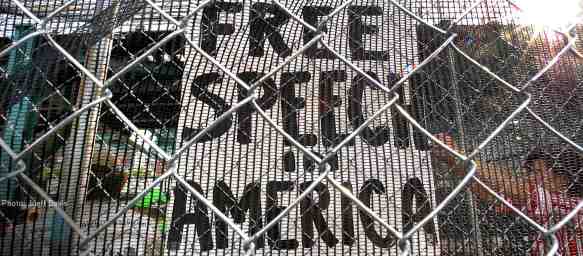
Our Ruling Elites Have No Idea How Much We Want to See Them All in Prison Jumpsuits

By Charles Hugh Smith

Source: Of Two Minds

Even the most distracted, fragmented tribe of the peasantry eventually notices that they’re not in the top 1%, or the top 0.1%.

Let’s posit that America will confront a Great Crisis in the next decade. This is the presumption of The Fourth Turning, a 4-generational cycle of 80 years that correlates rather neatly with the Great Crises of the past: 1781 (Revolutionary War, constitutional crisis); 1861 (Civil War) and 1941 (World War II, global war).

What will be the next Great Crisis? Some anticipate another great-power war, others foresee another civil war, still others reckon a military coup is likely, and some view a collapse of the economy and U.S. dollar as inevitable.

While anything’s possible, I propose a novel crisis unlike any in the past, a Moral Crisis in which the people challenge the power of the nation’s corrupt Ruling Elites: not just elected officials, but the technocrats of the Deep State, the vested interests pillaging the nation, the New Overlords of Big Tech, the financier New Nobility, the Corporate Media and the self-serving state/corporate technocrat Nomenklatura who do the dirty work of the Ruling Elites.

Divide-and-Conquer has been the absurdly easy strategy of the Ruling Elites to fragment and disempower the citizenry. It’s child’s play for the Ruling Elites to ceaselessly promote a baker’s dozen of divisive issues via the corporate media, and then watch the resulting conflicts split the citizenry into fragmented camps which subdivide further with every new toxic injection.

The one issue that could unite the fragmented citizenry is moral revulsion: As the Epstein case promises to reveal, there is literally no limit on the excesses and exploitations of the privileged few in America, no limit on what our Ruling Elites can do with absolute impunity.

The Nobility of the feudal era had some reciprocal obligation to its serfs; our New Nobility has no obligation to anyone but themselves. It is painfully obvious that there are two sets of laws in America: bankers can rip off billions and never serve time, and members of the Protected Class who sexually exploit children get a wrist-slap, if that.

Here’s the sad reality: everybody in the Ruling Elites looked the other way: all the self-described “patriots” in the Intelligence services, all the technocrats in the Departments of Justice, State, etc., the Pentagon, and on and on. Everybody with any power knows the whole class of Ruling Elites is completely corrupt, by definition: to secure power in the U.S., you have to sell your soul to the Devil, one way or the other.

Like all Ruling Elites, America’s Elites are absolutely confident in their power: this is hubris taken to new heights.

That the citizenry could finally have enough of their corrupt, self-serving Overlords does not seem in the realm of possibility to the Protected Few. There’s always a way to lawyer-up and plea-bargain for a wrist-slap, a way to bend another “patriot” (barf), a way to offer a bribe cloaked as a plum position in a philanthro-capitalist NGO (non-governmental organization), and so on.

The possibility that moral outrage could spark a revolt seems improbable in such a distracted culture, but consider the chart below: even the most distracted, fragmented tribe of the peasantry eventually notices that they’re not in the top 1%, or the top 0.1%, and that the Ruling Elites have overseen an unprecedented concentration of wealth and power into the hands of the few at the expense of the many:

Our Ruling Elites have no idea how many of us already want to see them all in prison jumpsuits, and they also have no idea how fast the moral revulsion with their corrupt “leadership” might spread. Scanning the distracted, consumerist rabble from the great heights of their wealth and power, they reckon the capacity for moral outrage is limited, leaving them safe from any domestic crusade.

They also trust that the citizenry can be further fragmented, further distracted, and so they will continue to be invulnerable. Or worst case scenario, a few especially venal villains will need to be sacrificed, and then all will return to the bliss of Neofeudal exploitation.

But they may have misread the American citizenry, just as they’ve misread history.

Tulsi Gabbard vs Google Goliath

By Rick Sterling

Source: Dissident Voice

Introduction

The Tulsi Gabbard presidential campaign has filed a major law suit against Google.  This article outlines the main points of the law suit and evidence the the social media giant Google has quietly acquired enormous influence on public perceptions and has been actively censoring alternative viewpoints.

Tulsi Now vs Google

Tulsi Now, Inc vs Google, LLC was filed on July 25 in the U.S. District Court for the Central District of California. The attorneys demand a jury trial and seek compensation and punitive damages of “no less than $50 million”. Major points and allegations in the 36 page complaint include:

* Google has monopolistic control of online searches and related advertising.

“Google creates, operates, and controls its platform and services, including but not limited to Google Search, Google Ads, and Gmail as a public forum or its functional equivalent by intentionally and openly dedicating its platform for public use and public benefit, inviting the public to utilize Google as a forum for free speech. Google serves as a state actor by performing an exclusively and traditionally public function by regulating free speech within a public forum and helping to run elections.” (p. 22)

“Google has used its control over online political speech to silence Tulsi Gabbard, a candidate millions of Americans want to hear from. With this lawsuit, Tulsi seeks to stop Google from further intermeddling in the 2020 United States Presidential Election….. Google plays favorites, with no warning, no transparency – and no accountability (until now).” (p. 2)

* At a critical moment Google undercut the Tulsi Gabbard campaign.

“On June 28, 2019 – at the height of Gabbard’s popularity among internet researchers in the immediate hours after the debate ended, and in the thick of the critical post-debate period… Google suspended Tulsi’s Google Ads account without warning.” (p. 3)

* Google has failed to provide a credible explanation.

The Tulsi campaign quickly sought to restore the account but “In response, the Campaign got opacity and an inconsistent series of answers from Google… To this day, Google has not provided a straight answer – let alone a credible one – as to why Tulsi’s political speech was silence right when millions of people wanted to hear from her.” (p. 4)

Google started by falsely claiming “problems with billing”.  Later, as reported in the NY Times story  a Google spokesperson claimed, “Google has automated systems that flag unusual activity on advertiser accounts – including large spending changes – to prevent fraud….In this case, ‘our system triggered a suspension.’ ”

* Google has a corporate profit motive to oppose Tulsi Gabbard.

“Google has sought to silence Tulsi Gabbard, a presidential candidate who has vocally called for greater regulation and oversight of (you guessed it) Google.” (p. 5)

“During her career in Congress, Gabbard has moved to limit the powers of big tech companies like Google and has fought to keep the internet open and available to all. Gabbard has co-sponsored legislation that prohibits multi-tiered pricing agreements for the privileged few, and she has spoken in favor of reinstating and expanding net neutrality to apply to Internet firms like Google.” (p. 8)

* Google’s Actions have caused significant harm to the Gabbard campaign and violate the U.S. and California constitutions and California business law.

“Through its illegal actions targeting Tulsi Gabbard, Google has caused the Campaign significant harm, both monetary (including potentially millions of dollars in forgone donations) and nonmonetary (the ability to provide Tulsi’s important message with Americans looking to hear it).” (p. 6)

“Google engages in a pattern and practice of intentional discrimination in the provision of its services, including discriminating and censoring the Campaign’s speech based not on the content of the censored speech but on the Campaign’s political identity and viewpoint.” (p. 27)

* The public has an interest in this case.

“Unless the court issues an appropriate injunction, Google’s illegal and unconstitutional behavior will continue, harming both the Campaign and the general public, which has an overwhelming interest in a fair, unmanipulated 2020 United States Election cycle. (p. 34)

Google Explanation is Not Credible

The Tulsi Gabbard Google Ads account was abruptly suspended at a crucial time. The question is why. Was it the result of “unusual activity” triggering an “automatic suspension” as claimed by Google? Or was it because someone at Google changed the software or otherwise intervened to undermine the Tulsi campaign?

Google’s explanation of an “automatic suspension” from “unusual activity” is dubious. First, the timing does not make sense. The sudden rise in searches on “Tulsi Gabbard” began the day before the suspension. Gabbard participated in the first debate, on June 26. Her presence and performance sparked interest among many viewers. Next morning, June 27, media reported that, “Tulsi Gabbard was the most searched candidate on Google after the Democratic debate in Miami“. The second debate took place in the evening of June 27. With discussion of the Democratic candidates continuing, Tulsi Gabbard continued to attract much interest. Around 9:30 pm (ET) on June 27 the Google Ads account was suddenly suspended. If the cause was “unusual activity”, the “automatic trigger” should have occurred long before.

Second, Google was fully aware of the “unusual activity”. In fact, Google was the source of the news reports on the morning of June 27.  Reports said:

According to Google Trends, Massachusetts Sen. Elizabeth Warren was the most searched candidate heading into the debate… After the debate, Gabbard vaulted into first.

Third, it is hard to believe that Google does not have any human or more sophisticated review before suspending a major Ads account on a politically intense night.  It should have been obvious that the cause of increased interest in Gabbard was the nationally televised Democratic candidates debate and media coverage.

Fourth, the changing explanation for the sudden suspension, starting with a false claim that there were “problems with billing”, raises questions about the integrity of Google’s response.

Google Secretly Manipulates  Public Opinion

Unknown to most of the public, there is compelling evidence that Google has been secretly manipulating search results to steer public perception and election voting for years.

Dr. Robert Epstein, former editor-in-chief of Psychology Today, has been studying and reporting on this for the past six years. Recently, on June 16, 2019 he testified before the Senate Judiciary Committee on the Constitution. His testimony is titled “Why Google Poses a Serious Threat to Democracy, and How to End That Threat”.

Epstein has published 15 books and over 300 scientific and mainstream media articles on artificial intelligence and related topics. “Since 2012, some of my research and writings have focused on Google LLC, specifically on the company’s power to suppress content – the censorship problem, if you will – as well as on the massive surveillance the company conducts, and also on the company’s unprecedented ability to manipulate the thoughts and behavior of more than 2.5 billion people worldwide.”

As shown by Dr. Epstein, Google uses several techniques to manipulate public opinion. The results of an online search are biased. Search “suggestions” are skewed. Messages such as “Go Vote” are sent to some people but not to others.

Epstein’s written testimony to Congress includes links to over sixty articles documenting his research published in sites ranging from Proceedings of the National Academy of Sciences to Huffington Post. Epstein’s testimony describes “disturbing findings” including:

“In 2016, biased search results generated by Google’s search algorithm likely impacted undecided voters in a way that gave at least 2.6 million votes to Hillary Clinton”. (Epstein notes that he supported Clinton.)

“On Election Day in 2018, the ‘Go Vote’ reminder Google displayed on its home page gave one political party between 800,000 and 4.6 million more votes than it gave the other party.”

“My recent research demonstrates that Google’s ‘autocomplete’ search suggestions can turn a 50/50 split among undecided voters into a 90/10 split without people’s awareness.”

“Google has likely been determining the outcomes of upwards of 25 percent of the national elections worldwide since at least 2015. This is because many races are very close and because Google’s persuasive technologies are very powerful.”

Google is Censoring Alternative Media  

In August 2017 TruePublica reported their experience and predictions in an article titled The Truth War is Being Lost to a Global Censorship Apparatus Called Google“. The article says:

60 percent of people now get their news from search engines, not traditional human editors in the media. It is here where the new information war takes place – the algorithm. Google now takes 81.2 percent of all search engine market share globally…. Google has the ability to drive demand and set the narrative, create bias and swing opinion.

In 2017, the World Socialist Web Site (wsws.org) reported that:

In April, under the guise of combating ‘fake news’, Google introduced new procedures that give extraordinary powers to unnamed ‘evaluators’ to demote web pages and websites. These procedures have been used to exclude the WSWS and other anti-war and oppositional sites. Over the past three months, traffic originating from Google to the WSWS  has fallen by approximately 70%…. In key searches relevant to a wide range of topics the WSWS regularly covers – including the U.S. military operations and the threat of war, social conditions, inequality and even socialism – the number of search impressions …has fallen dramatically.

In essence, Google has “de-ranked” and is screening searchers from seeing alternative and progressive websites such as truepublica, globalresearch, consortiumnews, commondreams, Wikileaks, truth-out and many more. WSWS reported numerous specific examples such as this one: “Searches for the term ‘Korean war’ produced 20,932 impressions in May. In July, searches using the same words produced zero WSWS impressions.”

“The policy guiding these actions is made absolutely clear in the April 25, 2017 blog post by Google’s Vice President for Engineering, Ben Gomes, and the updated ‘Search Quality Rater Guidelines’ published at the same time. The post refers to the need to flag and demote ‘unexpected offensive results, hoaxes and conspiracy theories’ – broad and amorphous language used to exclude any oppositional content…. “The ‘lowest’ rating is also to be given to a website that ‘presents unsubstantiated conspiracy theories or hoaxes as if the information were factual.’”

Tulsi Gabbard has not only called for much stricter regulations on high tech and social media giants. She has also challenged the Democratic Party and foreign policy establishment.  In late February 2016 she resigned as vice-chair of the Democratic National Committee to support candidate Bernie Sanders against the establishment favorite, Hillary Clinton. Gabbard has issued sharp criticisms of US foreign policy.  Recently she said:

We hear a lot of politicians say the same argument that we’ve got to stay engaged in the world otherwise we’ll be isolationists as though the only way the United States can engage with other countries is by blowing them up or strangling them with economic sanctions by smashing them and trying to overthrow their governments. This is exactly what’s wrong with this whole premise and the whole view in which too many politicians, too many leaders in this country are viewing the United States role in the world.

Conclusion

Did Google take the next step from silently censoring websites the corporation does not like to undercutting a presidential candidate the corporation does not like?

This is a David vs Goliath story. Google/Alphabet is the 37th largest corporation in the world with enormous political influence in Washington. Whether or not the law suit succeeds, it may serve the public interest by exposing Google’s immense monopolistic power and illustrate the need for much more regulation, transparency and accountability.  It may also generate more interest in Gabbard’s message and campaign in the face of efforts to silence her.


Rick Sterling is an investigative journalist who grew up in Canada but currently lives in the San Francisco Bay Area of California. He can be reached at rsterling1@gmail.com. Read other articles by Rick.

THE OMNIPRESENT SURVEILLANCE STATE: ORWELL’S FUTURE IS OUR PRESENT REALITY

By Mac Slavo

Source: SHTFplan.com

The Orwellian dystopia of thought control and an omnipresent surveillance state has become our reality.  George Orwell’s book 1984, although meant as fiction, has turned out to be an incredible prediction of our future.

The “land of the free” hasn’t been free since shortly after the American Revolution and it’s getting more authoritarian by the day. It’s been 70 years since Orwell (dying, beset by fever and bloody coughing fits, and driven to warn against the rise of a society in which rampant abuse of power and mass manipulation are the norm) depicted the ominous rise of ubiquitous technology, fascism, and totalitarianism in 1984.

“You had to live—did live, from habit that became instinct—in the assumption that every sound you made was overheard, and, except in darkness, every movement scrutinized.”—George Orwell, 1984 

Much like Orwell’s Big Brother in 1984, the government and its corporate spies now watch our every move. Much like Huxley’s A Brave New World, we are churning out a society of watchers who “have their liberties taken away from them, but … rather enjoy it, because they [are] distracted from any desire to rebel by propaganda or brainwashing.” Much like Atwood’s The Handmaid’s Tale, the populace is now taught to “know their place and their duties, to understand that they have no real rights but will be protected up to a point if they conform, and to think so poorly of themselves that they will accept their assigned fate and not rebel or run away.” – John W. Whitehead, The Rutherford Institute

This world is truly dystopian, and that doesn’t just go for the United States.  The masters are brainwashing the slaves and the slaves aren’t doing anything about it.  In fact, most want more masters and to be further enslaved.  We are witnessing a wholly disturbing state of humanity right now.

Much like Philip K. Dick’s darkly prophetic vision of a dystopian police state (which became the basis for Steven Spielberg’s futuristic thriller Minority Report) we are now trapped in a world in which the government is all-seeing, all-knowing, and all-powerful, and if you dare to step out of line, dark-clad police SWAT teams and pre-crime units will crack a few skulls to bring the populace under control. Violence and government dominance rule over the masses and they are completely accepting and willing participants in their own enslavement.

What many fail to realize is that the government is not operating alone. It cannot. The government requires an accomplice. Thus, the increasingly complex security needs of the massive federal government, especially in the areas of defense, surveillance and data management, have been met within the corporate sector, which has shown itself to be a powerful ally that both depends on and feeds the growth of governmental overreach.

In fact, Big Tech wedded to Big Government has become Big Brother, and we are now ruled by the Corporate Elite whose tentacles have spread worldwide. For example, USA Today reports that five years after the 9/11 terrorist attacks, the homeland security business was booming to such an extent that it eclipsed mature enterprises like movie-making and the music industry in annual revenue. This security spending to private corporations such as Google, Amazon, Microsoft, and others is forecast to exceed $1 trillion in the near future.

The government now has at its disposal technological arsenals so sophisticated and invasive as to render any constitutional protections null and void. Spearheaded by the NSA, which has shown itself to care little to nothing for constitutional limits or privacy, the “security/industrial complex”—a marriage of government, military and corporate interests aimed at keeping Americans under constant surveillance—has come to dominate the government and our lives. At three times the size of the CIA, constituting one-third of the intelligence budget and with its own global spy network to boot, the NSA has a long history of spying on Americans, whether or not it has always had the authorization to do so. – John W. Whitehead, The Rutherford Institute

Orwell understood what many Americans, caught up in their partisan flag-waving, are still struggling to come to terms with: that there is no such thing as a government organized for the good of the people. Even the best intentions among those in government inevitably give way to the desire to maintain power and control over the citizenry at all costs.

We know what no one ever seizes power with the intention of relinquishing it. Power is not a means; it is an end. One does not establish a dictatorship in order to safeguard a revolution; one makes the revolution in order to establish the dictatorship. The object of persecution is persecution. The object of torture is torture. The object of power is power. Now you begin to understand me. –George Orwell, 1984

We have been reduced to a cowering citizenry which is rendered mute in the face of elected officials who refuse to represent us, helpless in the face of police brutality, powerless in the face of militarized tactics and technology that treat us like enemy combatants on a battlefield, and naked in the face of government surveillance that sees and hears all. We have nowhere left to go.  We have, so to speak, gone from being a nation where privacy is king to one where nothing is safe from the prying eyes of the government.

We are living in Orwell’s dystopian predicted future. John W. Whitehead poses the question: So how do you survive in the American surveillance state?

The truth is that we’re running out of options. As Whitehead makes clear in his book Battlefield America: The War on the American People, that we will all soon have to choose between self-indulgence (the bread-and-circus distractions offered up by the news media, politicians, sports conglomerates, entertainment industry, etc.) and self-preservation in the form of renewed vigilance about threats to our freedoms and active engagement in self-governance.

The Omnipresent Surveillance State: Orwell’s 1984 Is No Longer Fiction

By John W. Whitehead

Source: The Rutherford Institute

“You had to live—did live, from habit that became instinct—in the assumption that every sound you made was overheard, and, except in darkness, every movement scrutinized.”—George Orwell, 1984

Tread cautiously: the fiction of George Orwell has become an operation manual for the omnipresent, modern-day surveillance state.

It’s been 70 years since Orwell—dying, beset by fever and bloody coughing fits, and driven to warn against the rise of a society in which rampant abuse of power and mass manipulation are the norm—depicted the ominous rise of ubiquitous technology, fascism and totalitarianism in 1984.

Who could have predicted that 70 years after Orwell typed the final words to his dystopian novel, “He loved Big Brother,” we would fail to heed his warning and come to love Big Brother.

“To the future or to the past, to a time when thought is free, when men are different from one another and do not live alone— to a time when truth exists and what is done cannot be undone: From the age of uniformity, from the age of solitude, from the age of Big Brother, from the age of doublethink — greetings!”—George Orwell

1984 portrays a global society of total control in which people are not allowed to have thoughts that in any way disagree with the corporate state. There is no personal freedom, and advanced technology has become the driving force behind a surveillance-driven society. Snitches and cameras are everywhere. People are subject to the Thought Police, who deal with anyone guilty of thought crimes. The government, or “Party,” is headed by Big Brother who appears on posters everywhere with the words: “Big Brother is watching you.”

We have arrived, way ahead of schedule, into the dystopian future dreamed up by not only Orwell but also such fiction writers as Aldous Huxley, Margaret Atwood and Philip K. Dick.

“If liberty means anything at all, it means the right to tell people what they do not want to hear.”―George Orwell

Much like Orwell’s Big Brother in 1984, the government and its corporate spies now watch our every move. Much like Huxley’s A Brave New World, we are churning out a society of watchers who “have their liberties taken away from them, but … rather enjoy it, because they [are] distracted from any desire to rebel by propaganda or brainwashing.” Much like Atwood’s The Handmaid’s Tale, the populace is now taught to “know their place and their duties, to understand that they have no real rights but will be protected up to a point if they conform, and to think so poorly of themselves that they will accept their assigned fate and not rebel or run away.”

And in keeping with Philip K. Dick’s darkly prophetic vision of a dystopian police state—which became the basis for Steven Spielberg’s futuristic thriller Minority Report—we are now trapped in a world in which the government is all-seeing, all-knowing and all-powerful, and if you dare to step out of line, dark-clad police SWAT teams and pre-crime units will crack a few skulls to bring the populace under control.

What once seemed futuristic no longer occupies the realm of science fiction.

Incredibly, as the various nascent technologies employed and shared by the government and corporations alike—facial recognition, iris scanners, massive databases, behavior prediction software, and so on—are incorporated into a complex, interwoven cyber network aimed at tracking our movements, predicting our thoughts and controlling our behavior, the dystopian visions of past writers is fast becoming our reality.

Our world is characterized by widespread surveillance, behavior prediction technologies, data mining, fusion centers, driverless cars, voice-controlled homes, facial recognition systems, cybugs and drones, and predictive policing (pre-crime) aimed at capturing would-be criminals before they can do any damage.

Surveillance cameras are everywhere. Government agents listen in on our telephone calls and read our emails. Political correctness—a philosophy that discourages diversity—has become a guiding principle of modern society.

“People sleep peaceably in their beds at night only because rough men stand ready to do violence on their behalf.”―George Orwell

The courts have shredded the Fourth Amendment’s protections against unreasonable searches and seizures. In fact, SWAT teams battering down doors without search warrants and FBI agents acting as a secret police that investigate dissenting citizens are common occurrences in contemporary America. And bodily privacy and integrity have been utterly eviscerated by a prevailing view that Americans have no rights over what happens to their bodies during an encounter with government officials, who are allowed to search, seize, strip, scan, spy on, probe, pat down, taser, and arrest any individual at any time and for the slightest provocation.

“The creatures outside looked from pig to man, and from man to pig, and from pig to man again; but already it was impossible to say which was which.”―George Orwell, Animal Farm

We are increasingly ruled by multi-corporations wedded to the police state.

What many fail to realize is that the government is not operating alone. It cannot. The government requires an accomplice. Thus, the increasingly complex security needs of the massive federal government, especially in the areas of defense, surveillance and data management, have been met within the corporate sector, which has shown itself to be a powerful ally that both depends on and feeds the growth of governmental overreach.

In fact, Big Tech wedded to Big Government has become Big Brother, and we are now ruled by the Corporate Elite whose tentacles have spread worldwide. For example, USA Today reports that five years after the 9/11 terrorist attacks, the homeland security business was booming to such an extent that it eclipsed mature enterprises like movie-making and the music industry in annual revenue. This security spending to private corporations such as Google, Amazon, Microsoft and others is forecast to exceed $1 trillion in the near future.

The government now has at its disposal technological arsenals so sophisticated and invasive as to render any constitutional protections null and void. Spearheaded by the NSA, which has shown itself to care little to nothing for constitutional limits or privacy, the “security/industrial complex”—a marriage of government, military and corporate interests aimed at keeping Americans under constant surveillance—has come to dominate the government and our lives. At three times the size of the CIA, constituting one third of the intelligence budget and with its own global spy network to boot, the NSA has a long history of spying on Americans, whether or not it has always had the authorization to do so.

Money, power, control. There is no shortage of motives fueling the convergence of mega-corporations and government. But who is paying the price? The American people, of course.

Orwell understood what many Americans, caught up in their partisan flag-waving, are still struggling to come to terms with: that there is no such thing as a government organized for the good of the people. Even the best intentions among those in government inevitably give way to the desire to maintain power and control over the citizenry at all costs. As Orwell explains:

The Party seeks power entirely for its own sake. We are not interested in the good of others; we are interested solely in power, pure power. What pure power means you will understand presently. We are different from the oligarchies of the past in that we know what we are doing. All the others, even those who resembled ourselves, were cowards and hypocrites. The German Nazis and the Russian Communists came very close to us in their methods, but they never had the courage to recognize their own motives. They pretended, perhaps they even believed, that they had seized power unwillingly and for a limited time, and that just around the corner there lay a paradise where human beings would be free and equal. We are not like that. We know what no one ever seizes power with the intention of relinquishing it. Power is not a means; it is an end. One does not establish a dictatorship in order to safeguard a revolution; one makes the revolution in order to establish the dictatorship. The object of persecution is persecution. The object of torture is torture. The object of power is power. Now you begin to understand me.

“The further a society drifts from truth the more it will hate those who speak it.” ― George Orwell

How do you change the way people think? You start by changing the words they use.

In totalitarian regimes—a.k.a. police states—where conformity and compliance are enforced at the end of a loaded gun, the government dictates what words can and cannot be used. In countries where the police state hides behind a benevolent mask and disguises itself as tolerance, the citizens censor themselves, policing their words and thoughts to conform to the dictates of the mass mind.

Dystopian literature shows what happens when the populace is transformed into mindless automatons. In Ray Bradbury’s Fahrenheit 451, reading is banned and books are burned in order to suppress dissenting ideas, while televised entertainment is used to anesthetize the populace and render them easily pacified, distracted and controlled.

In Huxley’s Brave New World, serious literature, scientific thinking and experimentation are banned as subversive, while critical thinking is discouraged through the use of conditioning, social taboos and inferior education. Likewise, expressions of individuality, independence and morality are viewed as vulgar and abnormal.

And in Orwell’s 1984, Big Brother does away with all undesirable and unnecessary words and meanings, even going so far as to routinely rewrite history and punish “thoughtcrimes.” In this dystopian vision of the future, the Thought Police serve as the eyes and ears of Big Brother, while the Ministry of Peace deals with war and defense, the Ministry of Plenty deals with economic affairs (rationing and starvation), the Ministry of Love deals with law and order (torture and brainwashing), and the Ministry of Truth deals with news, entertainment, education and art (propaganda). The mottos of Oceania: WAR IS PEACE, FREEDOM IS SLAVERY, and IGNORANCE IS STRENGTH.

All three—Bradbury, Huxley and Orwell—had an uncanny knack for realizing the future, yet it is Orwell who best understood the power of language to manipulate the masses. Orwell’s Big Brother relied on Newspeak to eliminate undesirable words, strip such words as remained of unorthodox meanings and make independent, non-government-approved thought altogether unnecessary. To give a single example, as psychologist Erich Fromm illustrates in his afterword to 1984:

The word free still existed in Newspeak, but it could only be used in such statements as “This dog is free from lice” or “This field is free from weeds.” It could not be used in its old sense of “politically free” or “intellectually free,” since political and intellectual freedom no longer existed as concepts….

Where we stand now is at the juncture of OldSpeak (where words have meanings, and ideas can be dangerous) and Newspeak (where only that which is “safe” and “accepted” by the majority is permitted). The power elite has made their intentions clear: they will pursue and prosecute any and all words, thoughts and expressions that challenge their authority.

This is the final link in the police state chain.

“Until they became conscious they will never rebel, and until after they have rebelled they cannot become conscious.”—George Orwell

Americans have been conditioned to accept routine incursions on their privacy rights. In fact, the addiction to screen devices—especially cell phones—has created a hive effect where the populace not only watched but is controlled by AI bots. However, at one time, the idea of a total surveillance state tracking one’s every move would have been abhorrent to most Americans. That all changed with the 9/11 attacks. As professor Jeffrey Rosen observes, “Before Sept. 11, the idea that Americans would voluntarily agree to live their lives under the gaze of a network of biometric surveillance cameras, peering at them in government buildings, shopping malls, subways and stadiums, would have seemed unthinkable, a dystopian fantasy of a society that had surrendered privacy and anonymity.”

Having been reduced to a cowering citizenry—mute in the face of elected officials who refuse to represent us, helpless in the face of police brutality, powerless in the face of militarized tactics and technology that treat us like enemy combatants on a battlefield, and naked in the face of government surveillance that sees and hears all—we have nowhere left to go.

We have, so to speak, gone from being a nation where privacy is king to one where nothing is safe from the prying eyes of government. In search of so-called terrorists and extremists hiding amongst us—the proverbial “needle in a haystack,” as one official termed it—the Corporate State has taken to monitoring all aspects of our lives, from cell phone calls and emails to Internet activity and credit card transactions. Much of this data is being fed through fusion centersacross the country, which work with the Department of Homeland Security to make threat assessments on every citizen, including school children. These are state and regional intelligence centers that collect data on you.

“Big Brother is Watching You.”―George Orwell

Wherever you go and whatever you do, you are now being watched, especially if you leave behind an electronic footprint. When you use your cell phone, you leave a record of when the call was placed, who you called, how long it lasted and even where you were at the time. When you use your ATM card, you leave a record of where and when you used the card. There is even a video camera at most locations equipped with facial recognition software. When you use a cell phone or drive a car enabled with GPS, you can be tracked by satellite. Such information is shared with government agents, including local police. And all of this once-private information about your consumer habits, your whereabouts and your activities is now being fed to the U.S. government.

The government has nearly inexhaustible resources when it comes to tracking our movements, from electronic wiretapping devices, traffic cameras and biometrics to radio-frequency identification cards, satellites and Internet surveillance.

Speech recognition technology now makes it possible for the government to carry out massive eavesdropping by way of sophisticated computer systems. Phone calls can be monitored, the audio converted to text files and stored in computer databases indefinitely. And if any “threatening” words are detected—no matter how inane or silly—the record can be flagged and assigned to a government agent for further investigation. Federal and state governments, again working with private corporations, monitor your Internet content. Users are profiled and tracked in order to identify, target and even prosecute them.

In such a climate, everyone is a suspect. And you’re guilty until you can prove yourself innocent. To underscore this shift in how the government now views its citizens, the FBI uses its wide-ranging authority to investigate individuals or groups, regardless of whether they are suspected of criminal activity.

“Nothing was your own except the few cubic centimetres inside your skull.” ― George Orwell

Here’s what a lot of people fail to understand, however: it’s not just what you say or do that is being monitored, but how you think that is being tracked and targeted. We’ve already seen this play out on the state and federal level with hate crime legislation that cracks down on so-called “hateful” thoughts and expression, encourages self-censoring and reduces free debate on various subject matter.

Say hello to the new Thought Police.

Total Internet surveillance by the Corporate State, as omnipresent as God, is used by the government to predict and, more importantly, control the populace, and it’s not as far-fetched as you might think. For example, the NSA is now designing an artificial intelligence system that is designed to anticipate your every move. In a nutshell, the NSA will feed vast amounts of the information it collects to a computer system known as Aquaint (the acronym stands for Advanced QUestion Answering for INTelligence), which the computer can then use to detect patterns and predict behavior.

No information is sacred or spared.

Everything from cell phone recordings and logs, to emails, to text messages, to personal information posted on social networking sites, to credit card statements, to library circulation records, to credit card histories, etc., is collected by the NSA and shared freely with its agents in crime: the CIA, FBI and DHS. One NSA researcher actually quit the Aquaint program, “citing concerns over the dangers in placing such a powerful weapon in the hands of a top-secret agency with little accountability.”

Thus, what we are witnessing, in the so-called name of security and efficiency, is the creation of a new class system comprised of the watched (average Americans such as you and me) and the watchers (government bureaucrats, technicians and private corporations).

Clearly, the age of privacy in America is at an end.

“If you want a picture of the future, imagine a boot stamping on a human face—for ever.”—Orwell

So where does that leave us?

We now find ourselves in the unenviable position of being monitored, managed and controlled by our technology, which answers not to us but to our government and corporate rulers. This is the fact-is-stranger-than-fiction lesson that is being pounded into us on a daily basis.

It won’t be long before we find ourselves looking back on the past with longing, back to an age where we could speak to whom we wanted, buy what we wanted, think what we wanted without those thoughts, words and activities being tracked, processed and stored by corporate giants such as Google, sold to government agencies such as the NSA and CIA, and used against us by militarized police with their army of futuristic technologies.

To be an individual today, to not conform, to have even a shred of privacy, and to live beyond the reach of the government’s roaming eyes and technological spies, one must not only be a rebel but rebel.

Even when you rebel and take your stand, there is rarely a happy ending awaiting you. You are rendered an outlaw.

So how do you survive in the American surveillance state?

We’re running out of options.

As I make clear in my book Battlefield America: The War on the American People, we’ll soon have to choose between self-indulgence (the bread-and-circus distractions offered up by the news media, politicians, sports conglomerates, entertainment industry, etc.) and self-preservation in the form of renewed vigilance about threats to our freedoms and active engagement in self-governance.

Yet as Aldous Huxley acknowledged in Brave New World Revisited: “Only the vigilant can maintain their liberties, and only those who are constantly and intelligently on the spot can hope to govern themselves effectively by democratic procedures. A society, most of whose members spend a great part of their time, not on the spot, not here and now and in their calculable future, but somewhere else, in the irrelevant other worlds of sport and soap opera, of mythology and metaphysical fantasy, will find it hard to resist the encroachments of those would manipulate and control it.”

DIGITAL FREE SPEECH ZONES ARE HERE

By Dylan Charles

Source: Waking Times

“Truth is treason in an empire of lies.” ~George Orwell

An empire of lies requires popular devotion to its founding illusions, lest it will collapse under the weight of its own hubris. It is therefore quite necessary to for those in power to control information and public access to ideas and narratives that run counter to their interests. This is a fact of life in a statist world, but now, in the age of the internet and social media, we are quickly learning just how far corporations will go to support this corrupt dynamic.

Amendment 1 – Freedom of Religion, Speech, and the Press

Congress shall make no law respecting an establishment of religion or prohibiting the free exercise thereof, or abridging the freedom of speech or of the press, or the right of the people peaceably to assemble and to petition the government for a redress of grievances.

United States Bill of Rights

The social media giants along with big tech no longer have any qualms about deleting popular channels and personalities for their platforms, and the illusion of free speech is coming unhinged as we speak.

Just last week, Facebook (FB) announced the deletion of hundreds of pages it said were guilty of spamming and of profiting from web-traffic sent to ‘ad farms’ from coordinated FB strategies. Well-respected and reputable independent media organizations were banned along with many obviously spammy pages and politically inconsequential sites, indicating that there is much more to the story than de-spamming FB. And all of this news follows the recent ban of Alex Jones and the Infowars network, which marked a transition from shadow banning to open, public political censorship by these tech companies.

There really is no way to know precisely what, or who, is driving these page bans, as pages on both sides of the political spectrum have been targeted, but the most visible common thread running through it all is political dissent of one form or another. And the bans are clearly coordinated between the social media companies, as targeted pages and news organizations are banned from multiple platforms (FB and Twitter, for example) on the same day.

So, the main avenues of public discourse on the web today are removing dissident voices, which as journalist and activist John Vibes puts it, serves the same purpose of the free speech zones that G.W. Bush made popular during his controversial presidency.

Free speech zones are the ultimate insult to anyone who genuinely cares about the relationship between human beings and government. And we live in exceptionally controversial times, where the lines between government rule and corporate rule are blurrier than ever.

“Any time you try to talk about how internet censorship threatens our ability to get the jackboot of oligarchy off our necks you’ll always get some guy in your face who’s read one Ayn Rand book and thinks he knows everything, saying things like “Facebook is a private company! It can do whatever it wants!” Is it now? Has not Facebook been inviting US government-funded groups to help regulate its operations, vowing on the Senate floor to do more to facilitate the interests of the US government, deleting accounts at the direction of the US and Israeli governments, and handing the guidance of its censorship behavior over to the Atlantic Council, which receives funding from the US government, the EU, NATO and Gulf states? How “private” is that? Facebook is a deeply government-entrenched corporation, and Facebook censorship is just what government censorship looks like in a corporatist system of government.” ~Caitlin Johnstone

So, now that we know that big tech is serving the interests of the political oligarchy, we are free to dissent in our own little corners of the internet (where very few can hear us), but we can also create new alternatives that will allow us to connect with people without the permission and all-seeing eye of big brother watching over us.

In the mean time, it’s good to know that independent media is having such a tremendous impact on the conversation that the powers that be want to shut it all down. Their illusion of legitimacy is cracking.

THE MONOPOLIZATION OF AMERICA: The biggest economic problem you’re hearing almost nothing about

By Robert Reich

Source: Nation of Change

Not long ago I visited some farmers in Missouri whose profits are disappearing. Why? Monsanto alone owns the key genetic traits to more than 90 percent of the soybeans planted by farmers in the United States, and 80 percent of the corn. Which means Monsanto can charge farmers much higher prices.

Farmers are getting squeezed from the other side, too, because the food processors they sell their produce to are also consolidating into mega companies that have so much market power they can cut the prices they pay to farmers.

This doesn’t mean lower food prices to you. It means more profits to the monopolists.

Monopolies all around

America used to have antitrust laws that stopped corporations from monopolizing markets, and often broke up the biggest culprits. No longer. It’s a hidden upward redistribution of money and power from the majority of Americans to corporate executives and wealthy shareholders.

You may think you have lots of choices, but take a closer look:

1. The four largest food companies control 82 percent of beef packing, 85 percent of soybean processing, 63 percent of pork packing, and 53 percent of chicken processing.

2. There are many brands of toothpaste, but 70 percent of all of it comes from just two companies.

3. You may think you have your choice of sunglasses, but they’re almost all from one company: Luxottica – which also owns nearly all the eyeglass retail outlets.

4. Practically every plastic hanger in America is now made by one company, Mainetti.

5. What brand of cat food should you buy? Looks like lots of brands but behind them are basically just two companies.

6. What about your pharmaceuticals? Yes, you can get low-cost generic versions. But drug companies are in effect paying the makers of generic drugs to delay cheaper versions. Such “pay for delay” agreements are illegal in other advanced economies, but antitrust enforcement hasn’t laid a finger on them in America. They cost you and me an estimated $3.5 billion a year.

7. You think your health insurance will cover the costs? Health insurers are consolidating, too. Which is one reason your health insurance premiums, copayments, and deductibles are soaring.

8. You think you have a lot of options for booking discount airline tickets and hotels online? Think again. You have only two. Expedia merged with Orbitz, so that’s one company. And then there’s Priceline.

9. How about your cable and Internet service? Basically just four companies (and two of them just announced they’re going to merge).

Why the monopolization of America is a huge problem

The problem with all this consolidation into a handful of giant firms is they don’t have to compete. Which means they can – and do – jack up your prices.

Such consolidation keeps down wages. Workers with less choice of whom to work for have a harder time getting a raise. When local labor markets are dominated by one major big box retailer, or one grocery chain, for example, those firms essentially set wage rates for the area.

These massive corporations also have a lot of political clout. That’s one reason they’re consolidating: Power.

Antitrust laws were supposed to stop what’s been going on. But today, they’re almost a dead letter. This hurts you.

We’ve forgotten history

The first antitrust law came in 1890 when Senator John Sherman responded to public anger about the economic and political power of the huge railroad, steel, telegraph, and oil cartels – then called “trusts” – that were essentially running America.

A handful of corporate chieftains known as “robber barons” presided over all this – collecting great riches at the expense of workers who toiled long hours often in dangerous conditions for little pay. Corporations gouged consumers and corrupted politics.

Then in 1901, progressive reformer Teddy Roosevelt became president. By this time, the American public was demanding action.

In his first message to Congress in December 1901, only two months after assuming the presidency, Roosevelt warned, “There is a widespread conviction in the minds of the American people that the great corporations known as the trusts are in certain of their features and tendencies hurtful to the general welfare.”

Roosevelt used the Sherman Antitrust Act to go after the Northern Securities Company, a giant railroad trust run by J. P. Morgan, the nation’s most powerful businessman. The U.S. Supreme Court backed Roosevelt and ordered the company dismantled.

In 1911, John D. Rockefeller’s Standard Oil Trust was broken up, too. But in its decision, the Supreme Court effectively altered the Sherman Act, saying that monopolistic restraints of trade were objectionable if they were “unreasonable” – and that determination was to be made by the courts. What was an unreasonable restraint of trade?

In the presidential election of 1912, Roosevelt, running again for president but this time as a third party candidate, said he would allow some concentration of industries where there were economic efficiencies due to large scale. He’d then he’d have experts regulate these large corporations for the public benefit.

Woodrow Wilson, who ended up winning the election, and his adviser Louis Brandeis, took a different view. They didn’t think regulation would work, and thought all monopolies should be broken up.

For the next 65 years, both views dominated. We had strong antitrust enforcement along with regulations that held big corporations in check.

Most big mergers were prohibited. Even large size was thought to be a problem. In 1945, in the case of United States v. Alcoa (1945), the Supreme Court ruled that even though Alcoa hadn’t pursued a monopoly, it had become one by becoming so large that it was guilty of violating the Sherman Act.

What happened to antitrust?

All this changed in the 1980s, after Robert Bork – who, incidentally, I studied antitrust law with at Yale Law School, and then worked for when he became Solicitor General under President Ford – wrote an influential book called The Antitrust Paradox, which argued that the sole purpose of the Sherman Act is consumer welfare.

Bork argued that mergers and large size almost always create efficiencies that bring down prices, and therefore should be legal. Bork’s ideas were consistent with the conservative Chicago School of Economics, and found a ready audience in the Reagan White House.

Bork was wrong. But since then, even under Democratic administrations, antitrust has all but disappeared.

The monopolization of high tech

We’re seeing declining competition even in cutting-edge, high-tech industries.

In the new economy, information and ideas are the most valuable forms of property. This is where the money is.

We haven’t seen concentration on this scale ever before.

Google and Facebook are now the first stops for many Americans seeking news. Meanwhile, Amazon is now the first stop for more than a half of American consumers seeking to buy anything. Talk about power.

Contrary to the conventional view of an American economy bubbling with innovative small companies, the reality is quite different. The rate at which new businesses have formed in the United States has slowed markedly since the late 1970s.

Big Tech’s sweeping patents, standard platforms, fleets of lawyers to litigate against potential rivals, and armies of lobbyists have created formidable barriers to new entrants. Google’s search engine is so dominant, “Google” has become a verb.

The European Union filed formal antitrust charges against Google, accusing it of forcing search engine users into its own shopping platforms. And last June, it fined Google a record $2.7 billion.

But not in America.

It’s time to revive antitrust

Economic and political power cannot be separated because dominant corporations gain political influence over how markets are organized, maintained, and enforced – which enlarges their economic power further.

One of the original goals of the antitrust laws was to prevent this.

Big Tech – along with the drug, insurance, agriculture, and financial giants – is coming to dominate both our economy and our politics.

There’s only one answer: It is time to revive antitrust.