How the Government is Manipulating America’s Youth

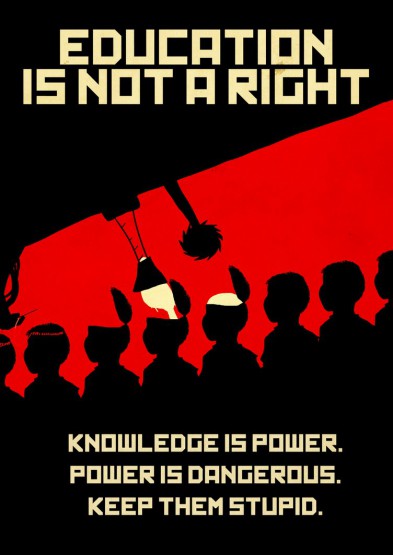
anti_public_education_propaganda_by_8manderz8-d5xz1cj

By Ryan Christian

Source: Waking Times

Few would disagree that this country’s school system is, at best, behind the times; at worst, stifling unique perspectives and creativity, and effectively the future. With all that we have discovered about the way the mind works, and how each child learns in their own specific way, in their own time, it should be clear to all that each child has a special unique way of seeing the world that should be celebrated instead of suppressed or controlled. Yet our school system continues to use standardized testing and conformation techniques designed to mold each distinct and thriving individual into yet another perfectly conformed subservient consumer.

To some, this may seem outlandish, because why would the government desire to stifle the growing minds of its people and force what could be the next Einstein, the next Michelangelo or Bob Dylan to see the world their way; the next outside the box thinker who breaks the mold and leads this struggling society toward salvation? Why would they desire to take that potential “mold-breaker” and place them squarely back inside the box, destined for life in retail sales, or something else as benign and in service of the Empire’s “greater good?”

There are many answers that could be given to that question, yet the ultimate end-goal is always control. A docile, unified populace, all conformed and aligned in their perspectives, is much easier to manipulate toward a specific agenda than those such as independent journalists or other critical thinkers who will question the choices of the nation’s leaders, as was the hope of the founding fathers when envisioning the American republic that never came to pass. The success of the nation is something no doubt desired by the majority of Americans, but not at the deceptive and forceful expense of our children’s creativity; their future.

Make no mistake, true innovation has always come from those pushing the boundaries; those widely considered “crazy” by the masses, until it is realized that they were trailblazers, creators, true pioneers of the human mind and what it could be capable of. Sadly, this realization all to often happens after one is long dead, and those who once chose to cast stones, now enjoy the fruits of their struggles.

Today’s school system effectively puts an end to any such “unauthorized” thinking. It dictates how each child thinks, acts and sees the world, and it is very much by design. The government has made no secret about the fact that they consider one of their largest problems to be “conspiracy theorists” or what some are actively attempting to label the “Alt-Right” despite the fact that much of the alternative media no longer identifies with any of their faux political parties. It has even gone as far as to label “bloggers” or independent journalists such as Luke Rudkowski from We Are Change, as “domestic terrorists,” for simply exercising his constitutional rights, and providing the American people with the Truth about this country’s less than honorable foreign policy.

Even if one disagrees with his perspective of the truth, it is still his right as an American to speak out. Yet in today’s police state, the Truth can be a very dangerous thing, and that is made all the more clear with every attempt to cast doubt on what the rest of the world now knows to be true; to cast doubt on anyone spreading that Truth. Those choosing to seek answers for the people in this society of questions, should be the embodiment of what this country used to stand for, and what is now a word that has been so diluted and overused that is has largely lost its meaning in today’s America: freedom.

It is all too easy to put the issue of our failing school system on the back-burner, while this country ‘s news feed is dominated with police shootings, the US government’s ISIS boogeyman, and a circus of an election that has become a world-wide laughingstock. Yet it is important to realize that this is the next generation of Americans that are being carefully constructed like some kind of “build-your-own-American” program. Much of what is seen in the news could very well be designed to keep everyone focused elsewhere while the nation’s youth is programmed to compliance.

As unsettling as it might be to consider that one’s government might be conducting such a sinister operation, two things must be considered: First, is that this country has a very clearly documented history of conducting exactly this type of mind-altering control experimentation on those willing and unwilling alike; it’s just that we like to think that the worst of our checkered past is somehow from a different America that we have grown away from. Yet sadly, deep down, most know that is not the case. Secondly, many of those conducting such invasive experiments, to some degree, have convinced themselves that what they are doing is for the greater good of the American people. The question we all must ask ourselves, is at what point did this arbitrary idea of the “greater good” begin to supersede our rights as Americans, and as human beings?


Ryan Cristian is the author of website, The Last American Vagabond.

Resistance is Fertile: The Art of Having No Masters

518d2cb7d767433a327846150d5be280

By Gary ‘Z’ McGee

Source: Waking Times

“You don’t become completely free by just avoiding being a slave; you also need to avoid becoming a master.” ~Naseem Nicholas Taleb

In the midst of a hyper-violent culture blinded by the statist agenda of control, militarized cops brainwashed by the statist notion of law and order, and a bloated military with the monopoly on power through tyranny, it’s difficult for the would-be-resister to live with any confidence that their freedom will not be compromised by the violent thugs in power or by the indoctrinated statists that represent the majority.

Difficult time to be free. Made even more difficult because of the level of psychosocial statist programming causing the majority to believe that everything is okay as long as they keep voting. Caught up in their hyper-realities, going through the motions of being an abstraction of an abstraction, the ignorant statists are convinced that everything is just fine, that the authority of the state is necessary, that the militarization of the police will help keep them protected, that an obese, money-sucking, terrorist-generating military will somehow make them more secure. What is this, 1984? What’s next? War is peace? Freedom is slavery? Ignorance is strength? Sadly, in some ways, we’re already there.

The problem with statism is that everything seems okay inside the bubble, but the bubble is always about to burst. Statism is slavery by consent. It hoodwinks people into enjoying their servitude. It (brain)washes out logic and reasoning through nationalism and patriotism, thus scrambling the ignorant statist’s brain into exploitable soup. Bombarded by state-engineered symbols that the statist marries their fragile ego to, statism is by far the most dangerous religion. Made all the more dangerous because people are born and bred into being statists and cannot even imagine thinking outside its box.

But resistance is not futile. It only seems that way because we are surrounded by the Goliath that is the state. No, on a long enough timeline, resistance is fruitful. Resistance always has, and always will, lead to human flourishing. It might not always be pretty, but resistance to any and all standing orders (manmade laws), is the key to a healthy, sustainable, and progressive evolution for our species.

The art of having no masters is perfecting the science of resistance. But resistance isn’t fairytale romantic. It’s not pretend confliction. It takes effort. It takes perseverance. It takes counterintuitive ruthless compassion, usually in the face of those you care about. Definitely not for the faint of heart. But, then again, having a faint heart is for statists who imagine they need a master, not for anarchists who know they need only master themselves. Yes, resistance is fertile but, more than anything, it’s courageous, uncomfortable, and dangerous.

Let’s break it down…

Resistance is Courageous

“I’d rather attempt to do something great and fail than to attempt to do nothing and succeed.” ~Robert H. Schuller

The art of having no masters cannot be rationalized until one has the audacity to question things as they are. As Chomsky famously stated, “The general population doesn’t even know what’s happening, and it doesn’t even know that it doesn’t know.” Indeed. Until the individual stands up and dares to jut his/her head above the sea of status quo conformity, they will continue to be ruled. But being ruled, or not, is always a state of mind. Until the individual has the audacity to change their state of mind to self-rule despite those who seek to rule them, their “soft slavery” will continue.

Statism is the epitome of soft slavery. Statists are like house slaves. There just happen to be a lot more of them, and the “house” is the state. As long as the house slave (statist) doesn’t disobey the house master (the state), they live relatively comfortable and secure lives. All their needs are met. Except, of course, the need for freedom and self-ownership.

Thus, it takes a particular flavor of courage to rise above the comfort and security in order to actualize self-mastery. The statist who merely goes along with the state’s agenda, attempts nothing great, and succeeds. The anarchist who rises above the washed-out conformity of it all, attempts something great and, though he may fail, he at least gains self-authority and takes his first steps toward self-mastery and perfecting the art of having no masters.

Resistance is Uncomfortable

“To live by the dice or accept death with confidence requires a consummate self-possession, which is the essence of character. No one becomes a hero staying at home, going to the office, or attending church.” ~Michael Dirda

The art of having no masters is not a pleasant art. It is in all ways disruptive. It is completely unsettling. Much cognitive dissonance must be successfully navigated. And there are always setbacks. Because the art of having no masters means having the courage to (at least attempt to) master the individual self, despite those who seek to rule the individual’s self, it is never comfortable. Though one can glean much comfort out of owning oneself, it’s never easy. Especially in a world that thinks everything should be owned.

One is constantly outnumbered. Whether it’s the giant goliath of the state itself or the tiny goliath of the inured statist, it can be painfully and awkwardly uncomfortable. But resisting those who would rule you was never meant to be comfortable. As Brene’ Brown stated, “You can have courage or you can have comfort, but you can’t have both.”

Indeed. Those seeking to perfect the art of having no masters must embrace the discomfort that comes with rocking the boat. It’s a double-edged sword, for sure. On the one side is sweet freedom, but on the other side is taking the painful responsibility for that freedom. But the genuinely autonomous, the authentic seekers of freedom, the true anarchists, will always choose to stab themselves with that double-edged sword, no matter how uncomfortable or painful it might be. Thereby taking the next step toward self-mastery and further perfecting the art of having no masters.

Resistance is Dangerous

“The Matrix is a system, Neo. That system is our enemy. But when you’re inside, you look around, what do you see? Businessmen, teachers, lawyers, and carpenters; the very minds of the people we are trying to save. You have to understand, most of these people are not ready to be unplugged. And many of them are so inured, so hopelessly dependent upon the system, they will fight to protect it.” ~Morpheus, The Matrix

If resistance is dangerous, then the art of having no masters is doubly dangerous. Especially in a world where the majority of the people are dead-set on having masters. In a world where the majority are convinced they need a queen, or a king, or a president, it makes it problematic for those who are seeking to take responsibility for their own power and who are teaching self-leadership. It’s dangerous because people are afraid of what they don’t understand. And the majority of people simply cannot understand a world without rulers and masters. Talk about not being able to think outside the box, let alone the Matrix.

Everyone wants to give their power to an authority, never stopping to think that authority should be themselves. Everyone wants to be Neo, but nobody wants to take responsibility for their own power. Sure, give credit where credit is due (as Neo did with Morpheus), for true leadership is an honorable thing indeed, but not to the extent that your freedom is discredited and your power is taken away. Self-empowerment is the key to unlocking the door of having no masters. And it leads to authentic leadership.

With all these people giving up their power, in Stockholm-syndrome-esque proportions, it makes it difficult for the would-be self-master to work on his/her self-mastery. But work on it they should. We need more leaders who are able to resist. We need more courageous individuals who are not afraid of getting uncomfortable or facing the danger of being right when the majority of people are wrong. We need more self-empowered individuals seeking to empower others, despite a world that’s attempting to take that power away. We need more trailblazers who are not afraid to spearhead self-authority straight through the heart of state-authority. We need leaders who have the audacity to teach self-leadership and self-rule through self-empowerment, despite the state which only seeks to rule by the illusion of authority through the overreach of violent power.

In short: we need more people who care about life to resist those who do not, because life is freedom and freedom is life. That is the heart and soul of the art of having no masters. As Derrick Jensen said, “We are the governors as well as the governed. This means that all of us who care about life need to force accountability onto those who do not.”

Cutting the Cords of Empire: The Spectacle of US Elections

the-powers-that-be-deep-state

By William Hawes

Source: Global Research

“The more powerful the class, the more it claims not to exist.” -Guy Debord, The Society of the Spectacle

It’s almost time for our quadrennial political distraction, masquerading as the US presidential election. As opposed to previous elections, this one feels quite different. Even with Obama/Romney in 2012, important, basic economic issues were discussed, health care reform was questioned, and foreign policy was given its due.

However, this time, the spectacle of the personalities seems to dominate the conversation: Mrs. Clinton is somehow on a feminist crusade, an inspiration for women everywhere. Going unmentioned are her irredeemable backers, such as the genocidal Henry Kissinger and Madeleine Albright. As for Trump, his version of America is as naïve, narrow-minded, and delusional as a Leave It to Beaver episode, or a Captain America comic book. In the background, the monstrosity of global capitalism goes unquestioned, and the cries from victims of US institutional racism and structural violence go unheard.

Global warming, broad economic policy, and nuanced foreign policy are simply too much to ask of these candidates. Their stupidity knows no end; their corruption and depravity know no bounds, and many of both of their supporters, as well as media, political, and corporate backers and sycophants can be considered “deplorable”. Many supporters of the two-party system do not bother to think about the damage either potential president would do to people outside the US. Many backers of Trump and Clinton have little to no basic knowledge of world cultures and history.

What are the cords that connect us to these “leaders”, to our American Empire? They are the same ones that the Industrial Revolution, the basis of our civilization, has implanted in each of us since birth, as Alvin Toffler explains in The Third Wave. As our social world became modeled on the factory floors developed in the 18th and 19th centuries, a set of unspoken principles were ironed out, and transferred to the political, social, and economic realms. (1)  As we shall see, these principles spread unchecked, and have infiltrated political discourse and social hierarchies. Toffler identifies these implicit rules as:

1) Standardization: Industry, production, and factory life revolved around endless loops and inputs of metals, fabrics, coal, oil, and specialized parts for trains, cars, etc. The simplification and standard mechanical parts used were mirrored and reflected in the culture at large: eventually, markets, the media, radio and TV, and even great art and literature succumbed to commoditization and homogenization. We now have mass marketing, public relations, and “electioneering”, where our duopoly controls all branches of government.

2) Specialization: With the explosion in the fields of science and engineering, specialized techniques were taught to develop, invent, and maintain mechanical and electric equipment. Yet again, this philosophy infected the general society:  only bureaucrats are able to work in the halls of power, only industrial experts are able to administer federal agencies, creating the disgraceful revolving door phenomena in Washington.

3) Synchronization: As more people flocked into cities with gleaming promises of steady, factory jobs, time and punctuality became of prime importance. Punching timecards and meeting quotas were necessary: there was no room for leeway, as assembly lines demanded strict timelines. The time demands of labor leaked into white-collar work as well: in banking and finance, railroads, time zones, and office jobs, advanced scheduling became the norm. Eventually, synchronization of the political system gained traction, and the imperial system came to resemble a deathly machine, marching in time to bloody footsteps: military, immoral diplomacy and ideology, and industry worked together to lord over Latin America with the Monroe Doctrine, annihilate Native Americans using Manifest Destiny, even as today, the excuse of the “War on Terror” is used to exterminate entire populations in Afghanistan, Iraq, Syria, Libya, and elsewhere.

4) Concentration: Think of the vast oil and coal stored underground for millions of years, only to be strip-mined, taken up by rigs, and transported by rail and tanker into vast refineries: concentration of energy. Further, every class of people became absorbed and intensified in the industrial system: workers into factories, children into schools, mentally ill into institutions, finance concentrated into New York, London, and Paris. Mega-mergers of corporations: today, it is the Apple, Google, Shell, and BP’s of the world who have coffers of blood money held tidily in banks throughout the world. Further, the concentration of technocrats who we supposedly need to run our societies: in the West, the military-industrialists, just as the Soviets were once told the nomenklatura was necessary.

5) Maximization: Firms were encouraged to grow as large as possible, and expand into as many fields as possible. Companies in Japan in the mid-twentieth century would actually have workers sing of the glory and greatness of their employer. Today, 62 people have the same wealth as half the world’s population. This is concentration and maximizing at its most obscene. Of course, you won’t hear Clinton, Trump, or anyone in Washington talking about this. Maximizing GDP, corporate profits, fossil fuel use, and flexing imperial muscle is what the Feds do best.

6) Centralization: Connected to the first five rules of empire stated above, centralizing power, wealth, and using knowledge for private gain is required to uphold the industrial state. Taxation, subsidies for industry, political debates via the sham Committee on Presidential Debates, the backroom shenanigans of the DNC and RNC, and cloak and dagger lobbying and bribery now dominate our system of government. Further, the Leviathan of state-sanctioned violence now lords over the world from the Pentagon and NATO, and the centralization of information runs through fiber-optic cables straight to the infernal, yet temperature-controlled offices of the CIA and NSA.

The elections have adopted all the patterns of the industrial, imperial state: we have standardized TV, scripted questions, airbrushed candidates, and childlike debates. We’ve seen specialized tactics of gerrymandering, vote-rigging, PR bullshit, and strategists whose careers accomplish nothing for the public good. We all know of the synchronization of Wall Street, defense and oil companies. The concentration of power in the hands of the few hardly needs mention: here’s the study by Princeton and Northwestern professors who conclude that the US is an oligarchy, not a democracy. We’ve witnessed the maximization of endless primaries, debates, press conferences, and town-hall meetings ad infinitum. The centralization of political ideology (triangulation in Clintonite terms, Machiavellian to a rational person) and the limitations of discourse that our candidates display are all too clear.

These are the iron chains holding us down, shackling us in Plato’s cave: our candidates are figureheads, shadows on the wall; they are puppets of the super-elite. The central position they carve out in the mainstream is really a pit, an abyss: one that we all find ourselves in, as we continue to vote for those who don’t fight for our interests.

The two best options for this election seem to be: voting for Jill Stein, or boycotting the election, as Joel Hirschhorn advocates. As for our obscene election cycles, I believe Zach de la Rocha summed it up best:

  A spectacle monopolized

The camera’s eyes on choice disguised

Was it cast for the mass who burn and toil?

Or for vultures who thirst for blood and oil?

William Hawes is a writer specializing in politics and environmental issues. His articles have appeared online at Global Research, Counterpunch, Dissident Voice, The World Financial Review, Gods & Radicals, and Countercurrents. He is author of the e-book Planetary Vision: Essays on Freedom and EmpireYou can reach him at wilhawes@gmail.com

Notes:

1.) Alvin Toffler. The Third Wave. Bantam, 1980. p. 46-60.


Can We Please Get Rid of the Pledge?

112congress_tx700

By Mike Whitney

Source: CounterPunch

The Pledge of Allegiance is not an expression of patriotism. It is a loyalty oath that one normally associates with totalitarian regimes. People who love freedom, should be appalled by the idea our children are being coerced to stand and declare their support for the state. This is the worst form of indoctrination and it is completely anathema to the principals articulated in the US Constitution and the Bill of Rights. I cannot imagine outspoken libertarians like Thomas Jefferson or Tom Paine ever proclaiming their loyalty to the state when they correctly saw the state as the greatest threat to individual freedom. Which it is.

Now I know that many people think the Pledge is simply an affirmation of their respect for the flag, their love for the country, and their gratitude to the men and women who fought in America’s wars. But that’s not what it is. The Pledge is an attempt to impose conformity on the masses and compel them to click their heels and proclaim their devotion to the Fatherland. That’s not how it’s supposed to work in a democracy. In a democracy, the representatives of the state are supposed to pledge their loyalty to the people and to the laws that protect them. That’s the correct relationship between the state and the people. The Pledge turns that whole concept on its head.

Now I’d have no problem if our schoolchildren recited the Preamble to the Declaration of Independence before class every day:

“We hold these truths to be self-evident, that all men are created equal, that they are endowed by their Creator with certain unalienable Rights, that among these are Life, Liberty and the pursuit of Happiness.

That to secure these rights, Governments are instituted among Men, deriving their just powers from the consent of the governed, That whenever any Form of Government becomes destructive of these ends, it is the Right of the People to alter or to abolish it, and to institute new Government, laying its foundation on such principles and organizing its powers in such form, as to them shall seem most likely to effect their Safety and Happiness.”

That’s great stuff, unfortunately, the people who run this country would never allow it. They’d never allow our kids to recite an incendiary, revolutionary document like that every day for fear it would incite violence against the state. What they want is “good Germans”, not revolutionaries, not freedom-loving populists, and not well-informed, critical thinking individuals who can see through the sham of their jingoistic propaganda. They want people who are going to follow the rules, do what they’re told, fight the wars, and perform their worktime drudgery for 30 or 40 years until they’re carted off to the glue factory. That’s what they want. Reciting the Pledge fits perfectly with this dumbed-down version of permanent indentured servitude. It provides the ideological foundation for bovine acquiescence to the demands of the state and the crooks who run it behind the tri-color banner.

The fact that institutions like the Pledge are never challenged in a public format, points to deeper problems with the media and the way our kids are being educated. And while I don’t have time to talk about that now, it makes me wonder where are the people to question these silly recitations that undermine democracy and personal liberty? Why are their voices never heard?

I can’t answer that, but when I see the state deliberately eviscerating habeas corpus and locking away terror suspects for life with no evidence, no witnesses, no due process, no presumption of innocence, no way to defend themselves or claim their innocence in a court of law or before a jury of their peers–when I see the US state assuming the same unchecked, tyrannical powers as all of the dictatorships that went before them– I grow increasingly concerned that this lack of critical thinking is costing the country quite dearly. We are on the verge of losing what-little democracy we have left because people are incapable of looking around and asking ‘what the hell is going on?’

Pulling your head out of the sand and asking questions is not a sign of disloyalty. It’s a sign of intelligence, the kind of intelligence this country needs to stop the bloody wars and get back on track.

So next time you’re in a situation where you’re asked to stand up and recite the pledge, just pause for a minute and ask yourself what it really means. Is it really an expression of “love of country” or a is it a vacuous and demeaning exercise in nationalism that should be done away with ASAP?

I’d say, it’s the latter.


MIKE WHITNEY lives in Washington state. He is a contributor to Hopeless: Barack Obama and the Politics of Illusion (AK Press). Hopeless is also available in a Kindle edition. He can be reached at fergiewhitney@msn.com.

Related Article: The Truth About the Pledge of Allegiance: Indoctrination & Obedience

Related Videos:

Your Awakening Counts More Than Your Vote

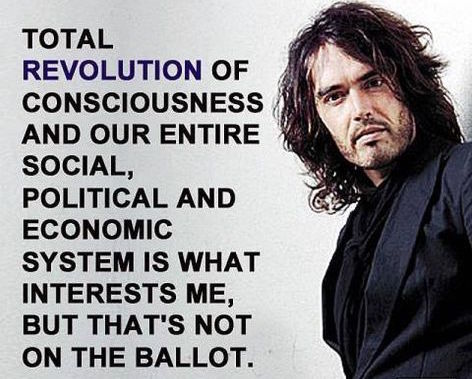
russell-brand-total-revolution-of-consciousness

By Dylan Charles

Source: Waking Times

We live in a world where illusions are held in higher esteem than verifiable truth. This is no accident, as the individual has for decades now been on the receiving end of social engineering programs, advanced political and corporate propaganda, fear programming and outright mind control.

The sum total of all this mass conditioning has been to convince otherwise good-natured and hard-working people to participate in their own enslavement and to willingly acquiesce to the ever-increasing rules, invasions of privacy, taxations, permissions and control schemes of a government and world elite who have long since left public interest in the dust.

The American dream is a mythic idea that was supposedly founded on the principle that public oversight of government is possible thanks to an electoral process which would give an informed citizenry the opportunity to replace undesirable politicians with better ones. Government itself, though, is a brutish and violent force that has time and again proven absolutely wild, reckless and untamable. It has never has obeyed its own laws, policies or regulations, and world history is a bloodstained chronicle of man’s failure to control himself when given power in the form of government.

Just as you cannot stop the tides from rising and falling, you cannot stop government from decaying into tyranny, especially so by following its very own rules and by participating in its token rituals.

This is truth, yet the illusion of so-called ‘democracy’ persists, seeming to grip people ever more feverishly with each passing election season. Even in the face of overt election fraud, party infighting, delegate rigging and widespread disenfranchisement. And so here we are again, facing the embarrassing spectacle of choosing between two undesirables when we all know the game is rigged.

For the powers the be, though, the repeating four-year cycle of presidential politics is the most effective device for keeping the masses high on the illusion of self-governance. It force feeds us on a regular schedule the false narrative that we the people can vote to reign in the power and corruption of the oligarchy of deep state, private and corporate influences that truly control the direction of this nation.

In this light, the purpose of national politics is not to perpetuate self-governance for the benefit of the common person, but rather to eat up personal energy and resources in order to suck the individual into a quagmire of false hope and endless patience with outrage after outrage. It is to make ineffectual action feel like action to the people being most screwed over by the corruption of the elite.

Sure, this may sound negative, cynical or apathetic to those who are over-invested emotionally in this game, but in order to move beyond the insanity of doing the same thing again and again while expecting different results, it’s imperative to be deadly honest about how this program works to enslave us, not to free us. Once we can think beyond the peer pressure, neighbor-hating, and mindless outrage that marks each election cycle, we make ourselves available to the possibility of real change. And real change always begins from within, and never forced from without.

There is no political leader who can make you stand fearlessly in this complex and dangerous world.There is no candidate that can give you the freedom that comes with a healthy mind and body. There is no political ruler who can manifest true and lasting happiness for you. There is no politician who can ensure that you enjoy the experience of your life everyday, under any and all circumstances. And there is no president that can empower you to be the best possible version of yourself so that you may give your best to others.

All of these qualities are vastly more critical to personal, community and planetary renewal than whichever new figurehead is selected to be the perceived front man of a morbidly corrupt American government.

The most effective way to change the world around you is to first focus on and create more value in yourself. This is why your awakening counts far more than your vote does. 

Fascism, American style

fascism1

By John W. Whitehead

Source: Intrepid Report

“If we define an American fascist as one who in case of conflict puts money and power ahead of human beings, then there are undoubtedly several million fascists in the United States.”―Henry A. Wallace, 33rd Vice President of the United States

This is an indictment of every politician who has ever sold us out for the sake of money and power, it is a condemnation of every politician who has ever lied to us in order to advance their careers, and it is a denunciation of every political shill who has sacrificed our freedoms on the altar of Corporate America.

They’re all fascists.

If Donald Trump is a fascist—as nearly half of Americans surveyed believe—then so is every other politician in office or running for office in America who has ever prioritized money and power over human beings.

Truly, apart from Trump’s virulently bombastic comments and his metaphorical willingness to spit in the wind in order to garner media coverage and notoriety, how is he any more of a fascist than Hillary Clinton and the millions she has amassed from the financial sector?

How is Trump any more of a fascist than Barack Obama, whose willingness to march in lockstep with the military industrial complex has resulted in endless wars, covert drone strikes that have killed hundreds of civilians abroad, and militarized police who have killed thousands of American citizens here at home?

How is Trump any more of a fascist than Congress, the majority of whom are millionaires and who are more inclined to do the bidding of their corporate sponsors and benefactors, all the while remaining deaf to their less affluent constituents?

For that matter, how is Trump any more of a fascist than the Supreme Court whose decisions in recent years have been characterized most often by an abject deference to government authority, military and corporate interests?

Writing for the New York Times in 1944, Vice President Henry A. Wallace noted that “American fascists are most easily recognized by their deliberate perversion of truth and fact. Their newspapers and propaganda carefully cultivate every fissure of disunity, every crack in the common front against fascism. They use every opportunity to impugn democracy. They use isolationism as a slogan to conceal their own selfish imperialism. They cultivate hate and distrust . . .”

As Wallace concluded, American fascists are not pro-Constitution:

They are patriotic in time of war because it is to their interest to be so, but in time of peace they follow power and the dollar wherever they may lead . . . They claim to be super-patriots, but they would destroy every liberty guaranteed by the Constitution. They demand free enterprise, but are the spokesmen for monopoly and vested interest. Their final objective toward which all their deceit is directed is to capture political power so that, using the power of the state and the power of the market simultaneously, they may keep the common man in eternal subjection.

We are being played for fools. Again.

The United States of America, that dream of what a democratic republic ought to be, has become the Fascist States of America. We have moved beyond the era of representative government and entered a new age. You can call it the age of authoritarianism. Or fascism. Or oligarchy. Or the American police state.

Whatever label you want to put on it, the end result is the same.

Driven by our fears, we have entered into a corporate-controlled, militaristic state where all citizens are suspects, security trumps freedom, and the U.S. government does not represent the majority of American citizens but instead is ruled by the rich and powerful.

Any semblance of constitutional government that we might still enjoy today is a mere shadow, a mockery of what the founders envisioned. Constitutional government today—much like the farcical circus that purports to be the presidential election—is a sham, a hoax, an elaborate ruse maintained by the powers-that-be to mollify us into believing that we still have a say in the workings of our government. We do not.

Shortly after World War II, historian William L. Shirer predicted that America may be the first country in which fascism comes to power through democratic elections.

Former presidential advisor Bertram Gross also warned that we would not recognize fascism when it took over:

Anyone looking for black shirts, mass parties, or men on horseback will miss the telltale clues of creeping fascism . . . In America, it would be supermodern and multi-ethnic—as American as Madison Avenue, executive luncheons, credit cards, and apple pie. It would be fascism with a smile. As a warning against its cosmetic facade, subtle manipulation, and velvet gloves, I call it friendly fascism. What scares me most is its subtle appeal.

They were both right.

However, what we failed to realize is that the fascist coup took place long ago. It was that subtle and that incremental.

We are now ruled by the velvet-gloved, technologically savvy, militarized iron fist of what Gross termed “friendly fascism” or fascism with a smile. Having studied Shirer and Gross, tracked the rise of fascism in past regimes, and assimilated the necessary ingredients for a fascist state, I can attest to the fact—as I document in my book Battlefield America: The War on the American People—that the parallels to modern America are impossible to ignore.

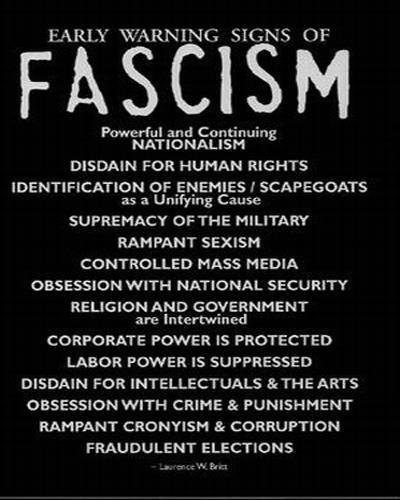
Under fascism, the government:

  • is managed by a powerful leader (even if he or she assumes office by way of the electoral process)
  • assumes it is not restrained in its power (this is authoritarianism, which eventually evolves into totalitarianism)
  • ostensibly operates under a capitalist system while being undergirded by an immense bureaucracy
  • emits powerful and continuing expressions of nationalism through its politicians
  • has an obsession with national security while constantly invoking terrifying internal and external enemies
  • establishes a domestic and invasive surveillance system and develops a paramilitary force that is not answerable to the citizenry
  • and its various agencies (federal, state, and local) develop an obsession with crime and punishment (this is overcriminalization)
  • becomes increasingly centralized while aligning closely with corporate powers to control all aspects of the country’s social, economic, military, and governmental structures
  • uses militarism as a center point of its economic and taxing structure
  • and is increasingly imperialistic in order to maintain the military-industrial corporate forces.

Compare that to America today where, as economist Jeffrey Tucker rightly observes, “every industry is regulated. Every profession is classified and organized. Every good or service is taxed. Endless debt accumulation is preserved. Immense doesn’t begin to describe the bureaucracy. Military preparedness never stops, and war with some evil foreign foe, remains a daily prospect.”

Fascism thrives by hiding behind the entertainment spectacle that is partisan politics. As Tucker points out, “It’s incorrect to call fascism either right wing or left wing. It is both and neither . . . fascism does not seek to overthrow institutions like commercial establishments, family, religious centers, and civic traditions. It seeks to control them . . . it preserves most of what people hold dear but promises to improve economic, social, and cultural life through unifying their operations under government control.”

In this way, American-style fascism is deceptively appealing.

It appears friendly.

The news media covers the entertainment and political trivia. The basic forms of government remain intact. The legislators remain in session. There are elections.

Consent of the governed, however, no longer applies. Actual control has finally passed to the oligarchic elite controlling the government behind the scenes.

Yet the most crucial ingredient for fascism to succeed in America is that the majority of the people would have to agree that it’s not only expedient but necessary for the government to assume greater powers in order to keep them safe and secure, whether it’s by militarizing the police, stripping them of basic constitutional rights, criminalizing virtually every form of behavior, or spying on their communications, movements and transactions.

Sound familiar?

When you really drill down to what the various presidential candidates believe about the issues that will impact the future of our freedoms long-term—war, surveillance, civil liberties—you’ll find that most of them support the government’s position, which, conveniently enough, profits the corporate sector.

This is not freedom.

It is despotism, which Gross refers to as “faceless oligarchs [who] sit at command posts of a corporate-government complex that has been slowly evolving over many decades.” Gross explains:

In efforts to enlarge their own powers and privileges, they are willing to have others suffer the intended or unintended consequences of their institutional or personal greed. For Americans, these consequences include chronic inflation, recurring recession, open and hidden unemployment, the poisoning of air, water, soil and bodies, and, more important, the subversion of our constitution. More broadly, consequences include widespread intervention in international politics through economic manipulation, covert action, or military invasion . . .

It is, in Gross’ words, “pretended patriots who desecrate the American flag by waving it while waiving the law”:

I see at present members of the Establishment or people on its fringes who, in the name of Americanism, betray the interests of most Americans by fomenting militarism, applauding rat-race individualism, protecting undeserved privilege, or stirring up nationalistic and ethnic hatreds.

It is, concludes Gross, Big Business and Big Government in bed together:

In this present, many highly intelligent people look with but one eye and see only one part of the emerging Leviathan. From the right, we are warned against the danger of state capitalism or state socialism, in which Big Business is dominated by Big Government. From the left, we hear that the future danger (or present reality) is monopoly capitalism, with finance capitalists dominating the state. I am prepared to offer a cheer and a half for each view; together, they make enough sense for a full three cheers.Big Business and Big Government have been learning how to live in bed together and despite arguments between them, enjoy the cohabitation. Who may be on top at any particular moment is a minor matter—and in any case can be determined only by those with privileged access to a well-positioned keyhole.

When the votes have all been counted, “we the people” will be the losers.

The joke will be on us. Whether we ever realize it not, the enemy is not across party lines, as they would have us believe. It has us surrounded on all sides.

Even so, we’re not yet defeated.

We could still overcome our oppressors if we cared enough to join forces and launch a militant nonviolent revolution—a people’s revolution that starts locally and trickles upwards—but that will take some doing.

It will mean turning our backs on the political jousting contests taking place on the national stage and rejecting their appointed jesters as false prophets. It will mean not allowing ourselves to be corralled like cattle and branded with political labels that have no meaning anymore. It will mean recognizing that all the evils that surround us today—endless wars, drone strikes, invasive surveillance, militarized police, poverty, asset forfeiture schemes, overcriminalization, etc.—were not of our making but came about as a way to control and profit from us.

It will mean “voting with our feet” through sustained, mass civil disobedience. As journalist Chris Hedges points out, “There were once radicals in America, people who held fast to moral imperatives. They fought for the oppressed because it was right, not because it was easy or practical. They were willing to accept the state persecution that comes with open defiance. They had the courage of their convictions. They were not afraid.”

Ultimately, it will mean refusing to be divided, one against each other, as Democrats versus Republicans, and instead uniting behind the only distinction that has ever mattered: “we the people” against tyranny.


Constitutional attorney and author John W. Whitehead is founder and president of The Rutherford Institute. His new book “The Freedom Wars” (TRI Press) is available online at www.amazon.com. Whitehead can be contacted at johnw@rutherford.org. Information about The Rutherford Institute is available at www.rutherford.org.


The Age of Authoritarianism: Government of the Politicians, by the Military, for the Corporations

what-corporate-america-wants

By John W. Whitehead

Source: The Rutherford Institute

“I was astonished, bewildered. This was America, a country where, whatever its faults, people could speak, write, assemble, demonstrate without fear. It was in the Constitution, the Bill of Rights. We were a democracy… But I knew it wasn’t a dream; there was a painful lump on the side of my head… The state and its police were not neutral referees in a society of contending interests. They were on the side of the rich and powerful. Free speech? Try it and the police will be there with their horses, their clubs, their guns, to stop you. From that moment on, I was no longer a liberal, a believer in the self-correcting character of American democracy. I was a radical, believing that something fundamental was wrong in this country—not just the existence of poverty amidst great wealth, not just the horrible treatment of black people, but something rotten at the root. The situation required not just a new president or new laws, but an uprooting of the old order, the introduction of a new kind of society—cooperative, peaceful, egalitarian.” ― Historian Howard Zinn

America is at a crossroads.

History may show that from this point forward, we will have left behind any semblance of constitutional government and entered into a militaristic state where all citizens are suspects and security trumps freedom.

Certainly, this is a time when government officials operate off their own inscrutable, self-serving playbook with little in the way of checks and balances, while American citizens are subjected to all manner of indignities and violations with little hope of defending themselves.

As I make clear in my book Battlefield America: The War on the American People, we have moved beyond the era of representative government and entered a new age—the age of authoritarianism. Even with its constantly shifting terrain, this topsy-turvy travesty of law and government has become America’s new normal.

Don’t believe me?

Let me take you on a brief guided tour, but prepare yourself. The landscape is particularly disheartening to anyone who remembers what America used to be.

The Executive Branch: Whether it’s the Obama administration’s war on whistleblowers, the systematic surveillance of journalists and regular citizens, the continued operation of Guantanamo Bay, or the occupation of Afghanistan, Barack Obama has surpassed his predecessors in terms of his abuse of the Constitution and the rule of law. President Obama, like many of his predecessors, has routinely disregarded the Constitution when it has suited his purposes, operating largely above the law and behind a veil of secrecy, executive orders and specious legal justifications. Rest assured that no matter who wins this next presidential election, very little will change. The policies of the American police state will continue.

The Legislative Branch:  It is not overstating matters to say that Congress may well be the most self-serving, semi-corrupt institution in America. Abuses of office run the gamut from elected representatives neglecting their constituencies to engaging in self-serving practices, including the misuse of eminent domain, earmarking hundreds of millions of dollars in federal contracting in return for personal gain and campaign contributions, having inappropriate ties to lobbyist groups and incorrectly or incompletely disclosing financial information. Pork barrel spending, hastily passed legislation, partisan bickering, a skewed work ethic, graft and moral turpitude have all contributed to the public’s increasing dissatisfaction with congressional leadership. No wonder 86 percent of Americans disapprove of the job Congress is doing.

The Judicial Branch: The Supreme Court was intended to be an institution established to intervene and protect the people against the government and its agents when they overstep their bounds. Yet through their deference to police power, preference for security over freedom, and evisceration of our most basic rights for the sake of order and expediency, the justices of the United States Supreme Court have become the guardians of the American police state in which we now live. As a result, sound judgment and justice have largely taken a back seat to legalism, statism and elitism, while preserving the rights of the people has been deprioritized and made to play second fiddle to both governmental and corporate interests.

Shadow Government: America’s next president will inherit more than a bitterly divided nation teetering on the brink of financial catastrophe when he or she assumes office. He or she will also inherit a shadow government, one that is fully operational and staffed by unelected officials who are, in essence, running the country. Referred to as the Deep State, this shadow government is comprised of unelected government bureaucrats, corporations, contractors, paper-pushers, and button-pushers who are actually calling the shots behind the scenes right now.

Law Enforcement: By and large the term “law enforcement” encompasses all agents within a militarized police state, including the military, local police, and the various agencies such as the Secret Service, FBI, CIA, NSA, etc. Having been given the green light to probe, poke, pinch, taser, search, seize, strip and generally manhandle anyone they see fit in almost any circumstance, all with the general blessing of the courts, America’s law enforcement officials, no longer mere servants of the people entrusted with keeping the peace but now extensions of the military, are part of an elite ruling class dependent on keeping the masses corralled, under control, and treated like suspects and enemies rather than citizens. In the latest move to insulate police from charges of misconduct, Virginia lawmakers are considering legislation to keep police officers’ names secret, ostensibly creating secret police forces.

A Suspect Surveillance Society: Every dystopian sci-fi film we’ve ever seen is suddenly converging into this present moment in a dangerous trifecta between science, technology and a government that wants to be all-seeing, all-knowing and all-powerful. By tapping into your phone lines and cell phone communications, the government knows what you say. By uploading all of your emails, opening your mail, and reading your Facebook posts and text messages, the government knows what you write. By monitoring your movements with the use of license plate readers, surveillance cameras and other tracking devices, the government knows where you go. By churning through all of the detritus of your life—what you read, where you go, what you say—the government can predict what you will do. By mapping the synapses in your brain, scientists—and in turn, the government—will soon know what you remember. And by accessing your DNA, the government will soon know everything else about you that they don’t already know: your family chart, your ancestry, what you look like, your health history, your inclination to follow orders or chart your own course, etc. Consequently, in the face of DNA evidence that places us at the scene of a crime, behavior sensing technology that interprets our body temperature and facial tics as suspicious, and government surveillance devices that cross-check our biometricslicense plates and DNA against a growing database of unsolved crimes and potential criminals, we are no longer “innocent until proven guilty.”

Military Empire: America’s endless global wars and burgeoning military empire—funded by taxpayer dollars—have depleted our resources, over-extended our military and increased our similarities to the Roman Empire and its eventual demise. The U.S. now operates approximately 800 military bases in foreign countries around the globe at an annual cost of at least $156 billion. The consequences of financing a global military presence are dire. In fact, David Walker, former comptroller general of the U.S., believes there are “striking similarities” between America’s current situation and the factors that contributed to the fall of Rome, including “declining moral values and political civility at home, an over-confident and over-extended military in foreign lands and fiscal irresponsibility by the central government.”

I haven’t even touched on the corporate state, the military industrial complex, SWAT team raids, invasive surveillance technology, zero tolerance policies in the schools, overcriminalization, or privatized prisons, to name just a few, but what I have touched on should be enough to show that the landscape of our freedoms has already changed dramatically from what it once was and will no doubt continue to deteriorate unless Americans can find a way to wrest back control of their government and reclaim their freedoms.

That brings me to the final and most important factor in bringing about America’s shift into authoritarianism: “we the people.” We are the government. Thus, if the government has become a tyrannical agency, it is because we have allowed it to happen, either through our inaction or our blind trust.

Essentially, there are four camps of thought among the citizenry when it comes to holding the government accountable. Which camp you fall into says a lot about your view of government—or, at least, your view of whichever administration happens to be in power at the time.

In the first camp are those who trust the government to do the right thing, despite the government’s repeated failures in this department. In the second camp are those who not only don’t trust the government but think the government is out to get them. In the third camp are those who see government neither as an angel nor a devil, but merely as an entity that needs to be controlled, or as Thomas Jefferson phrased it, bound “down from mischief with the chains of the Constitution.”

Then there’s the fourth camp, comprised of individuals who pay little to no attention to the workings of government, so much so that they barely vote, let alone know who’s in office. Easily entertained, easily distracted, easily led, these are the ones who make the government’s job far easier than it should be.

It is easy to be diverted, distracted and amused by the antics of the presidential candidates, the pomp and circumstance of awards shows, athletic events, and entertainment news, and the feel-good evangelism that passes for religion today. What is far more difficult to face up to is the reality of life in America, where unemployment, poverty, inequality, injustice and violence by government agents are increasingly norms.

The powers-that-be want us to remain divided, alienated from each other based on our politics, our bank accounts, our religion, our race and our value systems. Yet as George Orwell observed, “The real division is not between conservatives and revolutionaries but between authoritarians and libertarians.”

The only distinction that matters anymore is where you stand in the American police state. In other words, you’re either part of the problem or part of the solution.

Neoliberalism, Austerity, and Authoritarianism

pnac-criminals-2-1

By Riad Azar

Source: New Politics

Ask anyone what neoliberalism means and they’ll tell you it’s an economic system that corresponds to a particular economic philosophy. But any real-world economic system has a corresponding political system to promote and sustain it. Milton Friedman, who has become known as the father of neoliberal thinking, claims in his text Capitalism and Freedom that “the role of the government … is t o do something that the market cannot do for itself, namely, to determine, arbitrate, and enforce the rules of the game.”* While neoliberalism’s advocates like to claim that the political system that corresponds to their economic preference is a democratic, minimal state, in practice, the neoliberal state has demonstrated quite the opposite tendency.

This essay will begin by sketching out the core tenets of neoliberal theory, tracing its history from the classical liberal tradition of the Enlightenment. I will then present some hypotheses on how relations between the neoliberal state and society operate, contrasting the state theories of Ralph Miliband and Nicos Poulantzas to create a framework that shows how the neoliberal state is a product and enforcer of anti-democratic practices. I will argue that the implementation of neoliberal economic policy, and the subsequent evolution of the neoliberal state, has historically been completed through anti-democratic methods. Further, in an effort to produce social relations that are more favorable to the accumulation of capital, austerity is employed as a tool to move further toward a market society, creating a larger, more interventionist state and promoting authoritarianism.

Neoliberalism in Theory

The term neoliberal is often convoluted, confused, and misinterpreted, especially in the American context where the center-left Democratic Party has traditionally held the title of liberal. The original liberals, or classical liberals as they are usually called, were those Enlightenment-era thinkers of Western European origin who desired to limit the authority of the feudal state and defended individual rights by restricting the power of the state, the crown, the nobility, and the church. The “neo” prefix serves as a romantic symbol, an attempt at establishing a (sometimes forced) common ground with historical figures like Adam Smith and the classical liberals, who challenged the tendencies of the monarchy to interfere in the economy for its own gain, producing inefficiency. Neoliberal economic thinkers are famously known for deriding government intervention in the economy, precisely because they trace their foundation to a period when markets were seen not just as a source of better economic outcomes, but as a weapon to challenge concentrated political power.

This revamping of liberalism appeared in the twentieth century at a time when its proponents believed they were facing a similar struggle against the expanded state apparatuses of Europe—communist, social-democratic, and fascist. Friedrich Hayek, whose text The Road to Serfdom, published in 1944, is arguably the most celebrated of the neoliberal canon, sought to show how government interference in the economy forms the basis of fascist and other totalitarian regimes, contrary to the then widely accepted notion that it was capitalist crisis that had produced fascism in Europe. For Hayek, the strong state, whether in the form of fascism, Soviet communism, or the creeping socialism of the British Labour Party, was to be eschewed.

If neoliberalism springs from a desire to combat the growing power and influence of the state, how is it that neoliberalism has produced not only a very robust state apparatus, but, as I will argue, an authoritarian one? The answer is that neoliberalism in practice has been quite different from its theory.

The Necessities of the State
in Neoliberal Theory

As David Harvey points out in A Brief History of Neoliberalism, the neoliberals’ economic ideals suffer from inevitable contradictions that require a state structure to regulate them. The first of these contradictions revolves around the role of law to ensure the individual’s superiority over the collective in the form of private ownership rights and intellectual property rights (patents and copyrights). A judicial system is necessary to designate and regulate the interaction between private actors on the market. While intimations of the regulatory state can be seen in this formulation, it is hardly anything controversial. Only the most extreme of laissez-faire economic thinkers would not acknowledge the requirement of a state structure that creates the space for and regulates contracts.

The second contradiction derives from the elites’ historical ambivalence regarding democracy and mass participation. If the people were free to make decisions about their lives democratically, surely the first thing they would do is interfere with the property rights of the elite, posing an existential threat to the neoliberal experiment. Whether these popular aspirations take the form of drives towards unionization, progressive taxation, or pushing for social policies that require the redistribution of resources, the minimal state cannot be so minimal that it is unable to respond to and crush the democratic demands of citizens. After all, as pointed out in the first contradiction, the neoliberal state exists in theory to guarantee the rights of the individual over the demands of a majority. Therefore, a system must be put in place that protects against the “wrong” decisions of a public that is supposed to buy, sell, act, and choose freely.

Two Levels of Authoritarianism

Any method that seeks to subvert the democratic demands of citizens, whether through force, coercion, or social engineering, is authoritarian. I argue here that the neoliberal state is authoritarian in two distinct but related forms. First, the historical imposition of neoliberalism on nation-states is the result of anti-democratic forces. Second, the maintenance of neoliberalism requires a market society achieved through a transformation in civil society. For this transformation to take place, welfare states must be slimmed down by austerity policies in order to turn over to the market potentially lucrative sectors of the social economy (in health care, education, social security, and so on). Public resources must become privatized; the public good must be produced by private initiative. Neoliberal economic policy can only function with a state that encourages its growth by actively shaping society in its own image, and austerity is the tool to push for that transformation. While the subversion of democracy is clearly authoritarian, the drive towards a market society and the social engineering necessary to maintain that society are further expressions of the de facto authoritarianism of neoliberalism and the neoliberal state.

Austerity traditionally has been defined as the economic policies surrounding deficit cutting. When public debt runs too high, according to the theory, the accounts must be balanced by cutting spending and raising taxes. It is important to look past the theory to see the results of austerity in practice and understand austerity as a social-historical force. To do this, one must define austerity from the perspective of its victims. Pablo Iglesias, leader of the Podemos party in Spain, in his February 17 appearance on the Democracy Now! show, did just that by arguing that austerity is when people are forced out of their homes, when social services do not work, when public schools lack resources, when countries do not have sovereignty and become the colonies of financial powers. He closes by saying that austerity is the end of democracy, because without democratic control of the economy, there is no democracy.

The State and Society

The nature of how the state affects society has been a contentious topic within left traditions. Most notably, the debate between Ralph Miliband and Nicos Poulantzas that took place in the pages of the New Left Review in the early 1970s refreshed the study of the state. Miliband, in his The State in Capitalist Society, stressed an instrumentalist position, arguing that the reproduction of capitalism in society is due to the socialization of the ruling class in the tradition of capitalist dogma. As a large proportion of those who dominate the state and control its levers come from an elite education (he was writing from the perspective of British politics in the mid-twentieth century), it’s no surprise that they believe their theories to be correct and just, while the state they run serves the interests of capital. The writings of Poulantzas, in particular Political Power and Social Classes, argued a structuralist position strongly influenced by the thought of Louis Althusser. He claimed that the relation between the ruling class and the state was an objective relation, meaning that the coincidence of bourgeois ideology with the ideology of the state was a matter of how the system itself is organized. Their two state theories, the former arguing that the state is an instrument of the ruling class and the latter arguing that the state is the objective result of the capitalist system, shed light on the differences in conceptualizing not only the capitalist state, but how the state relates to and is legitimized by society. Is the market society a result of policies implemented by individuals in power who are trained in a particular neoliberal tradition, or an objective outcome of capitalist social relations that are the superstructural product of a system?

What could arguably be the genius of neoliberalism is the way in which it takes these two approaches to state theory and blends them. On the one hand, for Miliband, the neoliberal state is the extension of ruling-class free-market ideology, propagated by government bureaucrats, military officials, and technocrats who can speak no other language than that of the privileged status of capital and who hold the belief that they are serving the greater good. On the other hand, as Poulantzas suggested, neoliberalism needs to ensure its own survival by bending civil society, political institutions, and democracy to its will.

A state that so blatantly puts the rights and needs of one small class of citizens over others cannot be installed without a struggle. And further analysis shows us that once neoliberal regimes come into power, a certain degree of social engineering and coercion are necessary in order to guarantee the submission of the population and ensure the smooth accumulation of capital. In what follows, I would like to lay out how neoliberal austerity regimes were installed, and also draw on hypotheses of how they are maintained. However, as each socio-political system is unique in its history, culture, norms, and traditions, the manifestation and maintenance of the neoliberal state differs depending on whether we are talking about core countries or peripheral ones, to use the terminology of World Systems Theory. The common denominator is the empowering of elites over the masses with the assistance of international forces through military action or financial coercion—a globalized dialectic of ruling classes.

Peripheral Neoliberal States

In the periphery, those countries that have been dominated by colonial and neocolonial developed countries, economic and political trends beginning in the 1970s show that neoliberalism has been installed by the use of force. The Latin American experience demonstrates how neoliberalism was established through military operations and coups d’état. In Chile, the democratically elected president Salvador Allende was overthrown and the U.S.-backed dictatorship of Augusto Pinochet proceeded to crush labor unions and popular movements, privatizing a chunk of the public sector. When Pinochet stepped down, initiating a transition to democracy, he left behind the constitution that he had signed and put in place after the coup. Demands to chip away at this “constitution of the dictatorship,” as it is referred to in Chile, are present in Chilean social movements, most recently the student movements seeking to reform the deeply unequal private higher education system. The reforms that were the bedrock of a reactionary counter-revolution in the country were brought about through force, violence, and physical coercion as seen in the torture and systematic repression of the regime’s opponents.

The maintenance of such a regime could only be guaranteed through the dissolution of civil society to ensure that all avenues of dissent were illegal. Political representation in the National Congress was impossible because it was dissolved as civil liberties were proscribed. Organizations of a civil society, including unions, political parties, and groups set up by the Catholic Church to tend to the needs of the families of the disappeared, were treated as opposition organizations and were forbidden. It is estimated that tens of thousands of Chileans were tortured, while up to 200,000 were exiled, shocking the population into submission through fear. The laws regulating dissent were so strict that when the plebiscite was held to transition to democracy, special arrangements needed to be made to allow political groups the ability to organize and campaign, an attempt to reinvigorate a minimal civic culture in the country.

While Chile was the first and one of the main examples of the growth of neoliberalism, it has been far from unique. Economic “shock therapy” has become central to U.S. foreign policy, from Argentina in 1976 to the reintegration of post-communist states into the global capitalist economy. A quick comparison between countries listed as “not-free” by Freedom House and those that employ free-market neoliberal policies stresses this point. From Kazakhstan and Azerbaijan in Central Asia, to the crisis-ridden state of Mexico, and the neoliberal reforms of dictators in the Middle East and North Africa, the notion that capitalism and democracy form a symbiotic relationship and support each other has been debunked. The dissolution of civil society goes hand in hand with the imposition of a neoliberal state through violence, in order to ensure that threats to the state’s activities remain unchallenged.

Core Neoliberal States

In core countries, meanwhile, austerity and authoritarianism follow a different pattern. There, neoliberal political systems have been created through financial coercion and are held hostage by financial interests due to the economic “necessities” created by bankruptcies and budget deficits. The test in this case is New York City, where the consequences of the depression of 1974-75 run deep. Kim Moody, in From Welfare State to Real Estate, traces the political and economic alliance that took advantage of social pressures from deindustrialization, white flight, and global economic crisis to implement the reforms that would give rise to a complete transformation of the city’s social fabric. His analysis shows how a united business elite was able to thwart the democratic interests of the city’s working classes by using the budget, the deficit, and financial coercion to rein in what they saw as an unsustainable welfare state. A crisis regime was put in place representing a business class unified in its desire to reshape the social democratic polity of New York City, using the city government to achieve this transformation. What began as a move by bankers to shut the city out of the bond market evolved by 1975 into the establishment of the Emergency Financial Control Board, which set its sights on imposing tuition on the City University of New York system, increasing the fares for mass transit, and limiting welfare payments. It’s a story that has become all too familiar in the twenty-first century and a tactic that is being replayed in other cities, states, and nations.

Given the history of uninterrupted constitutional rule in the United States, the installation of neoliberalism requires the engineering of society through the transformation of institutions. By giving the market the freedom to determine when wages will be lowered, when jobs will be shed, and when communities will be destroyed, while simultaneously dismantling social welfare programs to increase the market’s authority, a social crisis is produced that requires a police force to maintain order. This relationship has inspired the work of sociologist Loïc Wacquant for two decades. Combining a Marxist materialist approach to observe the socio-economic conditions that have influenced the growth of the American penal system with a Durkheimian symbolic perspective, which stresses how the prison serves as a symbol of disciplining power, his work Punishing the Poor argues that the expansion of correctional facilities should be seen as correlated with the rise of the neoliberal state. He notes how “welfare reform” corresponded with the expansion of the imprisoned population, signaling a shift in how contemporary neoliberal society treats the most vulnerable among us. This means that not only do prisons and jails serve as the place to physically keep those who have been convicted of criminal behavior, but they also serve as an alternative source of labor-power harvesting. The Thirteenth Amendment to the U.S. Constitution explicitly allows penal labor, and while this has historically been organized by state-run corporations such as UNICOR, recent legislation allows the private sector to tap into the penal labor pool. Meant as an alternative to outsourcing, this practice is referred to as “smart-sourcing” (see http://www.unicor.gov/services/contact_helpdesk/).

The consequences of neoliberal reform and the penal society in the United States are related in more ways than one. While prisons are filled with those who have been affected by the welfare-to-workfare policies and war-on-drugs-era sentencing laws of the 1980s and 1990s, prisons are also an example of the process of privatizing government institutions and insuring that those institutions create profit for private investors, making the neoliberal state an agent in this wealth redistribution. The process of regulatory capture, where special interests are able to control the agencies that are supposed to be regulating them in the public interest, illustrates this point. While the market dictates the scope of what is possible for state institutions that are beholden to government funding, the market also creates the conditions, during periods of financial crisis, that lead to the bankrupting of state institutions through austerity measures and the privatization of these public assets.

Europe has also been subjected to the establishment of neoliberalism through financial coercion; however, the European case presents us with an instance of unprecedented democratic subversion on behalf of international capital. This is not to say that the establishment of neoliberalism has been imposed from the outside with no domestic encouragement, but rather that Europe presents us with a particular case of an alliance between the bourgeoisie of individual European nation-states and their counterparts in international institutions such as the European Union (EU) and the European Central Bank (ECB). The rise of the political party Syriza in Greece and the election of Alexis Tsipras as prime minister, while nurturing a cautious hope, has also shown the extent to which the democratic aspirations of the citizens of Greece are sabotaged for the benefit of financial interests represented by the European Commission, the ECB, and the International Monetary Fund. The sovereignty of European countries is being attacked by advocates of neoliberalism under the guise of EU and ECB policy. In Italy, the technocratic government of Mario Monti was appointed without an election following the resignation of Silvio Berlusconi. Meanwhile in Ireland, the ECB held the democratically elected government in a stranglehold by attaching a series of austerity conditions to any bailout agreement. In practice, democratic demands must be made within the tight parameters that have been established by bankers, making a mockery of democracy itself.

The manifestation and maintenance of neoliberalism in Europe can be understood through the changing notions of citizenship in European countries. While at one time the citizenry was the sole constituency, a new group has evolved that claims dominance over the nation-state: creditors. According to the German political economist Wolfgang Streeck, in his work Buying Time: The Crisis of Democratic Capitalism, the growth of creditors has placed a strain on the state, allowing unelected and anti-democratic authorities to regulate how the state handles its relations with its citizens, and defining the nature of state-society relations. The introduction of this “constituency” of opposing interests into the political equation holds the polity of Europe within a loop. On the one hand, the government is supposed to be representative of the people, while on the other, international forces are recognized as citizens and therefore claim a voice in how the government conducts its business. While the neoliberal state was imposed through financial coercion, it is maintained through the creation of new political constituencies.

Conclusion

By blending the state theories of Miliband and Poulantzas, we are able to see the neoliberal state in a multidimensional form. It is not solely the result of the decisions of those in power, but also a complex system that constructs its own acquiescence. The neoliberal state is a qualitatively distinct form of the capitalist state. Its authoritarianism is present not only in its unquestioned defense of the interests of capital, but also in the way that it actively seeks to shape society to be more favorable to its goals. Peripheral countries have borne the burden of this violence as their position within the world system is secondary and practically dispensable. Core countries require a much more skilled intervention through the introduction of reforms and the transformation of institutions to solidify obedience in the form of the market society. Austerity, understood as a social-historical force, is the tool of the neoliberal state to subvert democracy and promote authoritarianism.