Saturday Matinee: M.C. Escher: Journey to Infinity

By Matt Zoller Seitz

Source: RogerEbert.com

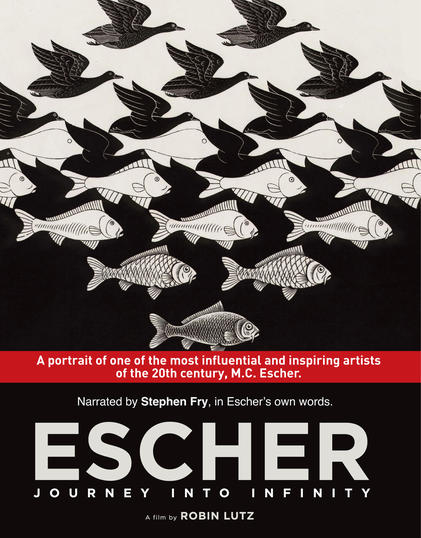
Documentaries about visual artists tend to be so boringly conceived—talk about the life, show a picture, talk about the life, show another picture—that you may not realize what you’ve been missing until you see one as excellent as “M.C. Escher: Journey to Infinity.” 

Written and directed by Robin Lutz, this is a rare feature that takes the trouble not just to understand its subject and communicate his significance, but find ways to show us, visually, how his style evolved, and the principles behind that evolution. 

The tale begins with the standard-issue “This is a movie about a great artist, here are a few summary details abut his life and art,” with some landscape and architecture shots and images of Escher’s work. Then it becomes increasingly daring and fanciful, yet always remaining in service to the M.C. Escher, the Dutch draftsman and printmaker whose art became internationally famous during the post-World War II era. 

Escher was a rare artist who managed to combine his influences into something genuinely new. His work is a geometric/mathematical surrealist vision of the objectively perceivable world, but also a subjective interior, evoking ancient Arabic-North African graphics; the Salvador Dali-Pablo Picasso-Georges Braque anti-realist sensibilities of the ’20s and ’30s, and computer models that would not become popular until decades after Escher’s own experiments. 

Lutz and his collaborators, including a team of graphic designers and animators, make Escher’s art come to life in surprising and amusing ways, from having one of his trademark salamanders appear in an otherwise “realistic” frame and travel across increasingly “unreal” panoramas until we’re in an Escher print, to re-imagining intricately patterned Escher artworks so that we seem to glide along them, or into them/through them. This happens slowly enough so that we can appreciate how deftly the artist translated negative space into positive space, in ways that made the distinction seem arbitrary: for instance, the black spaces between joined silhouettes of lizards or amphibians might become black birds with white spaces between them, then go back again. Or people and animals might move along one stretch of diagonal stairs and jump to another, seeming to go upside down or sideways, in defiance of gravity, emphasizing the brain-teasing techniques Escher perfected.

Lutz and his team have found a cinematic analogy for the movement of the eye over static pictorial art reproduced in a book or hanging on a museum wall. The movie is especially good at evoking that “wow” moment when you realize that a thing you were looking at has turned into another thing. It’s explaining the magic trick without ruining the magic, a magic trick of a different sort. 

This approach is so dazzling that one wishes the filmmakers had pushed it a bit further, deploying it even more often, or in more and subtler variations—perhaps figuring out a way to have the film itself flip back on itself structurally at key points, or end precisely where it started, so that the project itself seemed to have no beginning or end. (There’s a hint of this, but not much more.)

Musician Graham Nash, a devotee of Escher who contacted him late in his life, says Escher dismissed the idea that he was an artist. Throughout the movie, we hear Escher align himself with scientists and mathematicians, often trashing his own skills as a representational draftsman and speaking of his heroes and colleagues with awe. 

This isn’t to say that Escher was down on himself at all times, or that that he entirely rejected the notion he was making art. Escher’s letters, performed in voice-over by actor Stephen Fry, make it clear that he challenged himself to improve his abilities and expand his vision and grew irritable when stuck in a groove. And yet there was always a sense—particularly once Escher hit his forties and realized he was indeed a global phenomenon—that a “real” artist wouldn’t be as entertaining. This is the world’s misconception, not Escher’s, but it’s still a shame that he let himself feel diminished by it. There’s power and profundity in Escher’s art, yet the puzzle-box aspect is what pulls you into it. 

The movie makes a case that we should talk about Escher the way we talk about one of his inspirations, Johann Sebastian Bach, who like Escher was clever as well as substantive. Escher earned the comparison. Why do we resist it? Perhaps there’s still something in us, even this late into human development, that worries that if you’re having fun, it can’t be art. Escher struggled with that misconception, too, right up to the end.  

Watch M.C. Escher: Journey to Infinity on Kanopy here: https://www.kanopy.com/product/mc-escher-journey-infinity

Tears in Rain: ‘Blade Runner’ and Philip K. Dick’s Legacy in Film

Blade Runner, and the work of Philip K. Dick, continues to find its way into our cinemas and minds. How did the visions of a paranoid loner become the most relevant science fiction of our time?

By Sean Bell

Source: PopMatters

You are an unusual man, Mr. Asher,” the cop beside him said. “Crazy or not, whatever it is that has gone wrong with you, you are one of a kind.”– Philip K. Dick, Flow My Tears, The Policeman Said.
“I’ve seen things you people wouldn’t believe…”
— Roy Batty, Blade Runner.

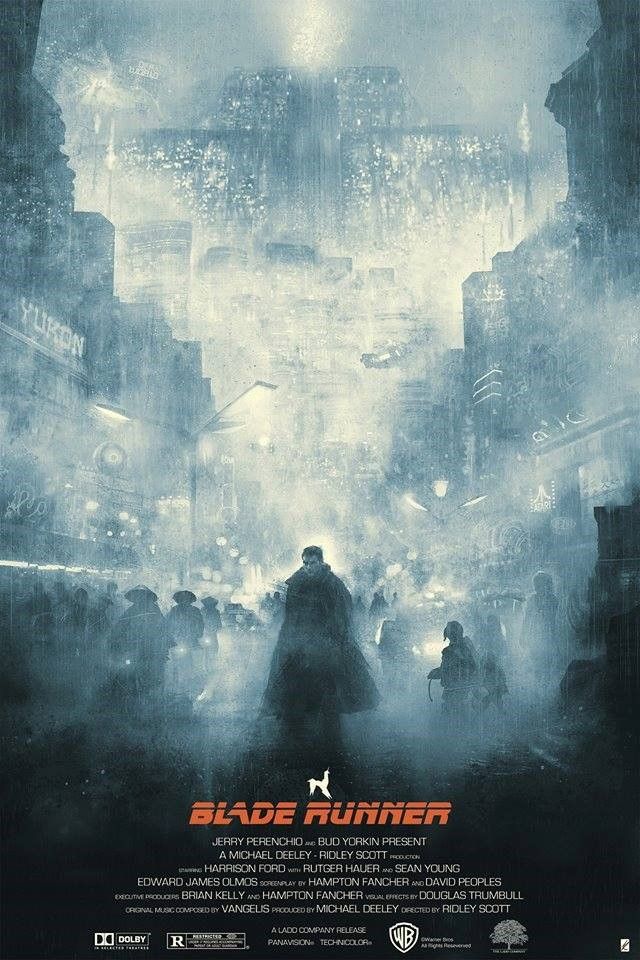
Los Angeles, 2019. The script simply reads: “Ext. Hades – Dusk”. Chemical flame bursts into the perpetual, post-nuclear Los Angeles gloom from skyscraping smokestacks, rising out of an industrial landscape Hieronymus Bosch might have envisaged. Flying cars flit through the darkness like fireflies. The camera moves slowly over impossible architecture with the immensity and decaying grandeur of ancient Egypt; a phantasmagorical megalopolis strung with necklaces of neon. The music rises.

The last war is over and nobody won. The Earth is living on borrowed time. Science has destroyed all boundaries between the real and unreal except those we choose to impose. Policemen are murderers, androids are lovers, nobody can be trusted, and everybody dies. Welcome back to the world of Blade Runner. Every time we return, it becomes more recognisable. Perhaps we never left.

Santa Ana, 1981. By now, Philip K. Dick — author, religious visionary and possible schizophrenic, who once said “You would have to kill me and prop me up in the seat of my car with a smile painted on my face to get me to go near Hollywood” — has read and approved the shooting script for Blade Runner by Hampton Fancher and David Peoples, as well as viewed a test reel of the movie’s groundbreaking special effects. In an effusive letter to Jeff Walker, the man in charge of the film’s marketing. Dick makes his prophetic opinion clear.

“Let me sum it up this way,” he wrote. “Science fiction has slowly and ineluctably settled into a monotonous death: it has become inbred, derivative, stale. Suddenly you people come in, some of the greatest talents currently in existence, and now we have a new life, a new start. As for my own role in the BLADE RUNNER project, I can only say that I did not know that a work of mine or a set of ideas of mine could be escalated into such stunning dimensions. My life and creative work are justified and completed by BLADE RUNNER… It will prove invincible.” (‘Letter to Jeff Walker regarding Blade Runner on Philip K Dick.com)

Dick, with a writer’s knack, chose the right words. Blade Runner has survived everything that could be thrown at it, including its initial critical reception, successive unsatisfactory edits, and dilution by both the science fiction genre and the film industry, which would plagiarise its vision with varying degrees of shamelessness for the next three decades. Yet nothing has been able to replicate its unique synthesis of elements, melding equal parts noir, action, romance, cyberpunk, dystopia and a meditation on what it means to be human. Whether praised or disparaged, ignored or overexposed, it has seen off all critics and challengers. Blade Runner‘s invincibility endures.

Unfortunately, the inimitable artistic fortitude of Ridley Scott‘s best work also allowed Hollywood to practice its favourite hobby of missing the point. The novels (or rather, in the film industry netherworld, ‘properties’) of Philip K. Dick — a writer largely unappreciated in his own lifetime who, at his lowest, claimed he he could not afford the late fee for a library book and infamously sustained himself on horse meat from a local pet store — have become highly prized and sought-after by studios eager to import intelligent ideas, rather than go through the hassle of conceiving their own. In the (twisted) spirit of Dick’s short story “We Can Remember It For You Wholesale“, no need for originality, we can develop it for you wholesale.

Question the nature of identity with Colin Farrell’s Douglas Quaid /Hauser as he flees the futuristic gunfire in the remake of Len Wiseman’s Total Recall (2012, an adaptation of an adaptation, as it were). Consider the limitations of free will with Tom Cruise’s Chief John Anderton (a well-known fan of unstable science fiction writers) in Steven Spielberg’s Minority Report (2012) while wondering how short he really is. Watch Jon Woo’s Paycheck (2003) and wonder how much Ben Affleck is actually being paid to appear in this piece of shit.

The names change, but the formula remains the same. Each summer, there must be blockbusters, and to fill the gaps in between the explosions with the barest bones of a Phil Dick story is, to the studio mindset, to buy instant, ready-made philosophical depth and artistic worth. Just add CGI!

Improbably, with 11 films based on his work and more in the pipeline, Dick has become the most adapted science fiction author in cinema history… And I’m not sure that’s a good thing.

“It’s a film about whether or not you can have a meaningful relationship with your toaster.” — Harrison Ford on Blade Runner in an interview with The Washington Post, 11 September 1992

That Scott is a director second only to George Lucas in his determination to tinker with a bygone masterwork until it meets his ultimate, exacting satisfaction (at last count, there are seven different versions of Blade Runner floating around the ether, finally culminating in Scott’s so-called ‘final cut’ in 2007), when a startling new interpretation of the film appeared online this June to wild acclaim, he had nothing to do with it. Instead, it was the work of the artist Anders Ramsell, who painstakingly recreated every frame of the movie’s opening 13 minutes with 3,285 gorgeous, haunting, impressionistic watercolours.

Dick, with a writer’s knack, chose the right words. Blade Runner has survived everything that could be thrown at it, including its initial critical reception, successive unsatisfactory edits, and dilution by both the science fiction genre and the film industry, which would plagiarise its vision with varying degrees of shamelessness for the next three decades. Yet nothing has been able to replicate its unique synthesis of elements, melding equal parts noir, action, romance, cyberpunk, dystopia and a meditation on what it means to be human. Whether praised or disparaged, ignored or overexposed, it has seen off all critics and challengers. Blade Runner‘s invincibility endures.

Unfortunately, the inimitable artistic fortitude of Ridley Scott‘s best work also allowed Hollywood to practice its favourite hobby of missing the point. The novels (or rather, in the film industry netherworld, ‘properties’) of Philip K. Dick — a writer largely unappreciated in his own lifetime who, at his lowest, claimed he he could not afford the late fee for a library book and infamously sustained himself on horse meat from a local pet store — have become highly prized and sought-after by studios eager to import intelligent ideas, rather than go through the hassle of conceiving their own. In the (twisted) spirit of Dick’s short story “We Can Remember It For You Wholesale“, no need for originality, we can develop it for you wholesale.

Question the nature of identity with Colin Farrell’s Douglas Quaid /Hauser as he flees the futuristic gunfire in the remake of Len Wiseman’s Total Recall (2012, an adaptation of an adaptation, as it were). Consider the limitations of free will with Tom Cruise’s Chief John Anderton (a well-known fan of unstable science fiction writers) in Steven Spielberg’s Minority Report (2012) while wondering how short he really is. Watch Jon Woo’s Paycheck (2003) and wonder how much Ben Affleck is actually being paid to appear in this piece of shit.

The names change, but the formula remains the same. Each summer, there must be blockbusters, and to fill the gaps in between the explosions with the barest bones of a Phil Dick story is, to the studio mindset, to buy instant, ready-made philosophical depth and artistic worth. Just add CGI!

Improbably, with 11 films based on his work and more in the pipeline, Dick has become the most adapted science fiction author in cinema history… And I’m not sure that’s a good thing.

“It’s a film about whether or not you can have a meaningful relationship with your toaster.” — Harrison Ford on Blade Runner in an interview with The Washington Post, 11 September 1992

That Scott is a director second only to George Lucas in his determination to tinker with a bygone masterwork until it meets his ultimate, exacting satisfaction (at last count, there are seven different versions of Blade Runner floating around the ether, finally culminating in Scott’s so-called ‘final cut’ in 2007), when a startling new interpretation of the film appeared online this June to wild acclaim, he had nothing to do with it. Instead, it was the work of the artist Anders Ramsell, who painstakingly recreated every frame of the movie’s opening 13 minutes with 3,285 gorgeous, haunting, impressionistic watercolours.

The painting technique employed to create this effect is known as aquarelle, which also acts as a sly commentary on Blade Runner‘s repeatedly-rejiggered legacy: because of its transparency, with aquarelle nothing can be painted over — once a mistake has been made, it has to be lived with. But as I watched what Ramsell called his ‘paraphrase’ of the movie, the familiar scenes and faces and voices emerging from the flickering, sensuous wash of colour, it seemed all the more appropriate. Other than Derek Jarman’s Caravaggio, I can think of no other film that so looks like a painting without paint — a piece of art that evokes other art, and yet remains entirely itself.

This is all a long way of saying that Blade Runner is beautiful, in almost every way possible. This has, ridiculously, sometimes been described as being to its detriment: Roger Ebert, one of the film’s more famous naysayers, wrote in a contemporary review in the Chicago Sun-Times that “It looks fabulous… but it is thin in its human story,” (11 September 1992) an oddly myopic remark to make about a parable on the nature of humanity. True, Blade Runner has an embarrassment of style, but never at the expense of substance, much like the best examples of the Cinema du look movement, which was just emerging in French cinema at the time of Blade Runner‘s release. Indeed, in appearance and atmosphere, Blade Runner is so distinct that it changed the aesthetic of science fiction, and new subgenres have since been invented simply to describe it — ‘future noir’, coined by the critic and filmmaker Paul M. Sammon, being the most enduring.

To those who have yet to experience the film, I wonder what to say that has not been said elsewhere. Based on Philip K. Dick’s 1968 novel Do Androids Dream of Electric Sheep?, Blade Runner somehow manages to be simultaneously the truest adaptation of Dick’s work yet produced — in spirit, if not plot — and also the freest in its interpretation of the material.

The central premise remains in both book and film; Rick Deckard (Harrison Ford), halfway between policeman and bounty hunter, makes his living by tracking and killing androids that are almost entirely indistinguishable from humans, living amongst us under false identities. The supposed test for distinguishing real from unreal humans is that of empathy, but as Deckard methodically adds to his ‘artificial’ bodycount, he begins to question who is really the unemotional machine.

Blade Runner dumps much of the novel’s narrative furniture — Scott justified this to Dick by saying: “You know you’re so dense, mate, that by page 32, there’s about 17 storylines” — in a way that, in almost any other adaptation, would be considered sacrilege. Most noticeably, in the novel, Deckard is trapped in a barely functional marriage, while in the movie, Harrison Ford’s laconic protagonist is the classic bachelor gumshoe.

Also prominent in the book are ‘Mercerism’, the religion based around its followers’ empathy for a man whom others were throwing rocks at, and the ‘Mood Organ’, the household device which stimulates any mood the user wishes to experience, and which much of the population now depends on in order to face another bleak, post-apocalyptic day — two tragicomic creations typical of Dick, but too wry to fit with the Blade Runner‘s overall tone. Despite such changes, Dick’s reading of the screenplay convinced him that this film could express his ideas in a way he had not thought possible.

The production could hardly be called smooth. Even before its release, troubling rumours had begun circulating, and as Paul M Sammon wrote ,”by the time BR (Blade Runner) officially completed principle photography in July on 1981, the gossip has become more specific — BR‘s workload had been horrendous, its shooting conditions miserable, and its director, difficult. Moreover, the whispers went, BR’s moneymen were unhappy, its leading man had clashed with his director, and the crew had been near revolt.” Some of these stories were indeed true, but one should bear in mind that movie moneymen are nearly always unhappy, and Harrison Ford will always be the man who told George Lucas that “you can type this shit, but you sure as hell can’t say it.”

Paranoia Runs Through Blade Runner Like a Knife Edge

When Blade Runner was first released, the reviews ran from lukewarm to underwhelmed to baffled, a fact that many critics have been doing their best to forget in the intervening years, polishing the film’s legend in a frantic effort to make up for missing the boat first time round. Considered today, in our gleaming plastic future of bad credit and worse politics, where we are reliant not on humanised robots but dehumanising gadgets, and where much of the movie’s retro-futurism appears as quaint as it does prescient, what is left to say about Blade Runner?

Should I recite the plaudits that have become ritualistic? Should I point out the Roy Batty’s (Rutger Hauer) ‘tears in rain’ monologue is among the most moving and eloquent ever written or performed? Or that Vangelis revolutionised jazz, electronic music and film scoring simultaneously in one of the best soundtracks ever composed? Is it really necessary to highlight the acting of all involved; Harrison Ford as one of the best soulful detectives to grace noir of any kind, an understated and heartbreaking Sean Young (as Rachael), a dangerous but innocent Daryl Hannah (as Pris), or Rutger Hauer’s mixture of the psychotic and the Shakespearean? Do I need to praise the costumes, the set design, or the script which balances so many themes, so many hidden or implied meanings, with such grace and economy?

Well, yes. You want a criticism of Blade Runner? I would’ve liked more of Edward James Olmos’ Gaff. He’s cool. I also want Deckard’s coat.

But we need to be reminded of these things, every now and again, as each new generation discovers the film afresh, and especially when the next logical question becomes: how did Blade Runner get it so right, more so than any other adaptation of Dick’s work since? What did it understand that they did not? To try and answer that, we have to go back to the source.

“Phil acknowledged that his talk sometimes sounded like “religious nonsense & occult nonsense” — but somewhere in it all was the truth. And he would never find it. God himself had assured him of that.” — Lawrence Sutin, Divine Invasions: A Life of Philip K. Dick.

In 2000, at the one and only Disinfo Con — a friendly gathering of millennial deviants concerning all things ‘counterculture’ — Grant Morrison, a writer who could arguably be counted as one of Dick’s prodigious bastard literary offspring, opened his keynote speech marvelling at the fact he spent his youth reading Robert Anton Wilson and now, all these years later, “we’re standing here, we’re talking about this shit and it’s real.”

Fans of Philip K. Dick have been feeling like that since at least the ’70s, when the dark realities on the other side of the Drug Revolution and the true possibilities of an all-powerful Nixonian surveillance state were becoming painfully apparent. Then as now, we use Dick’s paranoia to express our own.

Dick once commented that, with the making of Blade Runner, what had once been a private world that only he inhabited was now open to all; they would live in its murky depths, just as he did every day. At first, one might think that a paranoid and delusional visionary — and I use the word in its most literal sense — would want nothing more than for others to see and experience what he does. But perhaps Dick didn’t want anyone in his world. Maybe he didn’t think his world should be suffered by anyone else.

The fantastic, tortured mind of Philip K. Dick has been discussed, analysed and treated like an object of supreme curiosity since his death in 1982 (a few months shy of Blade Runner‘s release) and before. He had eked out an impoverished existence writing science fiction since the ’50s, when it was less a genre than a ghetto, and could only make a living by producing at a furious pace which he fuelled with huge amounts of amphetamines, at one point producing 12 novels over the course of two years.

But Dick was ever a seeker of truth, which made him, strangely, something of an oddity in science fiction. Within these novels, beneath the aliens and spaceships, moon colonies and interstellar wars, was arguably the best satire being done in science fiction on American life outside of Kurt Vonnegut‘s oeuvre, the philosophical undertones and untrammelled, often gothic imagination of which called to mind Jorge Luis Borges more than Isaac Asimov. The uniting thread that runs through his work — and, eventually, his life — is the notion that reality, as we know it, is fundamentally untrustworthy.

As the ’60s wore on, Dick’s involvement with the drug culture increased, adding a psychedelic aspect to both his ever-evolving philosophy and his ever-present paranoia. In 1971, Dick experienced a defining moment: his home was broken into, his safe blown open, and many of his personal papers burglerized. He never discovered who was responsible, though he had many suspects — local drug addicts, Black Panthers, the police, the FBI, the Soviets, or any of these, pretending to be one of the others.

The effect it left on Dick was to give him proof, unexplained and terrifying, that his paranoia was somehow justified. There had been comfort in simply telling himself he was crazy. But after years of grappling with his mental health, someone, it seemed, truly was out to get him.

“I mean,” he told the Aquarian magazine in a 1974 interview, “it’s a very frightening thing when the head of a police department tells you that you better leave the county because you have enemies, and you don’t know who these enemies are or why you’ve incurred their wrath.”

When one is peripherally aware of one’s own tenuous psychological condition (which we must be, we tell ourselves, if we have any hope of overcoming it), the uninitiated cannot imagine the sheer anguish, the self-doubt, the fear that follows when you know you cannot trust your own mind, and you cannot trust anyone to help you. The luckiest paranoids are also egotists, or better yet, megalomaniacs; they face the lurking forces of imagined persecution with a defiant roar or a knowing smirk.

Dick, on the other hand, was a sensitive, fragile, frightened soul, as well as a possible undiagnosed schizophrenic. His subsequent religious experiences — a series of hallucinations in which a beam of pink light connected him with a “transcendentally rational mind” — may have been his brain’s attempt to soothe his paranoia, or merely the next stage of his mental instability. In either case, as always, it provided inspiration for another novel.

Critics and biographers often talk about Dick’s paranoia and delusions like they were shocking fashion statements or extreme political opinions — just another interesting aspect to the bizarro image of a literary titan. What they don’t say, although the evidence is all around us, is that Dick’s paranoia is ours, as well. Ours may not have such colourful outlets or dramatic results, but we shall always carry our paranoia with us. It cannot be blotted out. There will forever be dark fears lurking in the deeper pools of our mind about our untrustworthy friends, co-workers, policemen, criminals, the FBI, the CIA, the Communists, the aliens, or God himself… and beyond. Existence will always be open to question, forever taunting us with its uncertainty. We can’t trust reality, but we have to live there.

This paranoia runs through Blade Runner like a knife edge. You cannot trust others, or yourself. You cannot trust your memories, your past, or your future. The entire world may be against you, even if it doesn’t appear to be. Then again, you don’t have to like it.

The heroes and villains of Blade Runner do not like, or accept, the oppression of the paranoid worldview. Deckard fights a series of seemingly impossible battles, even against what he thought was true, and finds romance where it should be impossible. Roy Batty, the leader of the renegade replicants, fights against death itself, seeking to extend and outlive his designer-mandated expiration date. The inhuman fights to become human, so humans must prove their humanity. This is the message at Blade Runner‘s core, and it has never been replicated.

Near the end of Dick’s 1976 novel Radio Free Albemuth, the protagonist, an author surrogate for Dick who also writes pulp science fiction, is faced by a gloating representative of the government conspiracy that the writer has become entangled with, who coolly informs him they will continue to put out books under his name — lurid trash scattered with a few of the author’s trademark concepts to keep it recognisable for his fans, but encoded with non-too-subtle propaganda messages designed to keep its readers afraid and unenlightened.

At our most cynical, it’s sometimes difficult not to think of Hollywood the same way: trading on Dick’s name and style and core ideas, but discarding the message and the mind behind them.

Authors often have to face a string of misfires and misinterpretations before their work gets the cinematic treatment it deserves; Dick, on the other hand, got a masterpiece on the first go. And it remains ours to enjoy: Blade Runner, as Dick wrote, is invincible.

Maybe it’s finally time for Hollywood to leave the legacy of Philip K. Dick at the local bookstore, where it belongs.

“What matters to me is the writing, the act of manufacturing the novel, because while I am doing it, at that particular moment, I am in the world I am writing about. It is real to me, completely and utterly. Then, when I’m finished, and I have to stop, withdraw from that world forever — that destroys me… I promise myself: I will never write another novel. I will never again imagine people from whom I will eventually be cut off. I tell myself this… and, secretly and cautiously, I begin another book.” — Philip K. Dick, “Notes Made Late At Night By A Weary SF Writer”, 1968.

The End of Reality?

By Edward Curtin

Source: Behind the Curtain

In 1888,  the year before he went insane, Friedrich Nietzsche wrote the following in Twilight of the Idols:

We have got rid of the real world: what world is left?  The apparent world perhaps? … But no!  Along with the real world we’ve done away with the apparent world as well.

So, if you feel you also may be going insane in the present climate of digital screen life, where real is unreal but realer than real, the apparent is cryptic, and up is down, true is false, and what you see you don’t, it has a history.  One hundred and thirty-two years ago, Nietzsche added that “something extraordinarily nasty and evil is about to make its debut.”  We know it did, and the bloody butcher’s bench known as the twentieth century was the result. Nihilism stepped onto center stage and has been the star of the show ever since, straight through to 2020.  Roberto Calasso puts it this way in Literature and the Gods:

Here we are, announces Nietzsche, and it would be hard not to hear a mocking ring in his voice.  We thought we were living in a world where the fog had lifted, a disenchanted, ascertainable, verifiable world.  And instead everything has gone back to being a ‘fable’ again.  How are we to get our bearings … This is the paralysis, the peculiar uncertainty of modern times, a paralysis that all since have experienced.

Obviously, we haven’t gotten our bearings.  We are far more adrift today on a stormy electronic sea where the analogical circle of life has been replaced by the digital, and “truths” like numbers click into place continuously to lead us in wrong, algorithm-controlled directions. The trap is almost closed.

Of course, Nietzsche did not have the Internet, but he lived at the dawn of the electric era, when space-time transformations were occurring at a rapid pace.  Inventions such as photography, the phonograph, the telephone, electricity, etc. were contracting space and time and a disembodied “reality” was being born.  With today’s Internet and digital screen life, the baby is full-grown and completely disembodied.  It does nothing but look at its image that is looking back into a lifeless void, whose lost gaze can’t figure out what it’s seeing.

Take, for example, the phonograph, invented by Thomas Edison in 1878.  If you could record a person’s voice, and if that person died, were you then listening to the voice of a living person or one who was dead?  If the person whose voice was recorded was alive and was miles away, you had also compressed earthly space. The phonograph suppressed absence, conjured ghosts, and seemed to overcome time and death as it captured the flow of time in sound.  It allowed a disembodied human voice to inhabit a machine, an early example of downloading.

“Two ruling ambitions in modern technology,” writes John Durham Peters in his wonderful book, Speaking into the Air, “appear in the phonograph: the creation of artificial life and the conjuring of the dead.”

Many people started to hear voices, and these people were not called deluded. Soon, with the arrival of cinema, they would see ghosts as well.  Today, speaking ghosts are everywhere, hiding in hand-held devices. It’s Halloween all year round as we are surrounded by electronic zombies in a screen culture.

This technological annihilation of space and time that was happening at a frenetic pace was the material background to Nietzsche’s thought.  His philosophical and epistemological analyses emerged from German intellectual life of his time as well, where theologians and philosophers were discovering that knowledge was relative and had to be understood in situ, i.e., within its historical and social place or context.

Without going into abstruse philosophical issues here, suffice it to say, Nietzsche was suggesting that not only was God dead because people killed him, but that knowledge was a fiction that changed over time and was a human construction.  All knowledge, not just science, had to be taken “as if” it were true.  This was a consoling mental trick but falsely reassuring, for most people could not accept this, since “knowledge” was a protection racket from pain and insanity. It still is. In other words, not only had people murdered God, but they had slain absolutes as well. This left them in the lurch, not knowing if what they knew and believed were really true, or sort of true – maybe, perhaps. The worm of uncertainty had entered modern thought through modern thought.

While the average person did not delve into these revolutionary ideas, they did, through the inventions that were entering their lives, and the news about Darwin, science, religion, etc., realize, however vaguely, that something very strange and dramatic was under way. Life was passing from substance to shadow because of human ingenuity.

It is similar to what so many feel today: that reality and truth are moving beyond their grasp as technological forces that they voluntarily embrace push everyday life towards some spectral denouement.  An inhuman, trans-human, on-line electronic life where everything is a parody of everything that preceded it, like an Andy Warhol copy of a copy of a Campbell’s soup can with a canned mocking laugh track that keeps repeating itself.  All this follows from the nineteenth century relativization of knowledge, or what at least was taken as such, for to say all knowledge is relative is an absolute statement.  That contradiction goes to the heart of our present dilemma.

This old feeling of lostness is perhaps best summarized in a few lines from Mathew Arnold’s 19th century poem, “Dover Beach”:

The Sea of Faith
Was once, too, at the full, and round earth’s shore
Lay like the folds of a bright girdle furled.
But now I only hear
Its melancholy, long, withdrawing roar,
Retreating, to the breath
Of the night-wind, down the vast edges drear
And naked shingles of the world.

But that was then.  Today, the Joker’s sardonic laughter would suffice.

***

I am sitting outside as I write, sipping a glass of wine before dinner.  Although New England fall weather is approaching, a nasty mosquito is buzzing around my head.  I hear it.  I am in killer mode since these bastards love to bite me.  This is real life.  If I went into the house and connected to the Internet on the computer screen – news, social media, anything – I would be entering another dimension.  Screen life, not real life. The society of the spectacle. No real mosquitoes, no wine, no trees swaying in the evening breeze.

In his novel, The Sun Also Rises, written between Nietzsche’s time and now, Ernest Hemingway, a man who surely lived in the physical world, writes of how Robert Cohn, the boxing champion from Princeton University, wants Jake Barnes, the book’s protagonist, to take a trip with him to South America.  As they sit and talk in Paris, Barnes says no, and tells Cohn, “All countries look just like the moving pictures.”

Whether Hemingway was being ironic or not, or simply visionary, I don’t know.  For in the 1920s, before passports and widespread tourism, there were many places you could only see if you traveled to them and they would never appear in moving pictures, while today there is almost no place that is not available to view beforehand on the internet or television.  So why go anywhere if you’ve already seen it all on a screen? Why travel to nowhere or to where you have already been?  Déjà vu all over again, as Yogi Berra put it and everyone laughed.  Now the laugh is on us.

***

This is neither an argument nor a story.  It’s real.  I am trying to get my bearings in a disorienting situation. Call it a compass, a weather-vane, a prayer.  You can call me Al or Ishmael.  Call me crazy.  Perhaps this writing is just an “as if.”

***

About fifteen years ago, I was teaching at a college where most communication was done via email.  I was, as they say, out of the loop since I didn’t do email. I was often asked why I didn’t, and I would repeatedly reply, like Melville’s Bartleby, because “I prefer not to.”  Finally, in order to keep my job, I succumbed and with the laptop computer they provided me, I went “on-line.”  There were 6,954.7 emails in my in-box from the past three years.  In those three years, I had performed all my duties scrupulously and hadn’t missed a beat.  Someone showed me how to delete the emails, which I did without reading any, but I had entered the labyrinth. I went electronic.  My reality changed. I am still searching for Ariadne’s thread.

***

But I am not yet a machine and refuse the invitation to become one.  It’s a very insistent invitation, almost an order.  Neil Postman (Oh such a rich surname!) sums it up well in Technopoly: The Surrender of Culture to Technology:

The fundamental metaphorical message of the computer, in short, is that we are machines – thinking machines, to be sure, but machines nonetheless.  It is for this reason that the computer is the quintessential, incomparable, near perfect machine for Technopoly.  It subordinates the claims of our nature, our biology, our emotions, our spirituality.  The computer claims sovereignty over the whole range of human experience, and supports its claim by showing that it ‘thinks’ better than we can…John McCarthy, the inventor of the term ‘artificial intelligence’…claims that ‘even machines as simple as thermostats can be said to have beliefs…What is significant about this response is that it has redefined the meaning of the word ‘belief’ … rejects the view that humans have internal states of mind that are the foundation of belief and argues instead that ‘belief’ means only what someone or something does … rejects the idea that the mind is a biological phenomenon … In other words, what we have here is a case of metaphor gone mad.

Postman wrote that in 1992, before the computer and the internet became ubiquitous and longer before on-line living had become de rigueur – before it was being shoved down our throats as it is today under the cover of COVID-19.

There is little doubt that we are being pushed to embrace what Klaus Schwab, the Executive Chairman of the World Economic Forum (WEF), calls COVID-19:The Great Reset, that involves a total acceptance of the electronic, on-line life.  On-line learning, on-line news, on-line everything – only an idiot (from Greek, idiotes, a private person who pays not attention to public affairs) would fail to see what is being promoted.  And who controls the electronic life and internet?  Not you, not I, but the powers that be, the intelligence agencies and the power elites. Goodbye  body, goodbye blood – “I don’t think we should ever shake hands ever again, to be honest with you,” said Dr. Anthony Fauci, the director of the National Institute of Allergy and Infectious Diseases (NIAID) in support of human estrangement.

Peter Koenig, one of the most astute investigators of this propaganda effort, puts it this way:

The panacea of the future will be crowned by the Pearl of the Fourth Industrialization – Artificial intelligence (AI). It will be made possible by a 5G electromagnetic field, allowing the Internet of Things (IoT). Schwab and Malleret [Schwab’s co-author] won’t say, beware, there is opposition. 5G could still be blocked. The 5G existence and further development is necessary for surveillance and control of humanity, by digitizing everything, including human identity and money.

It will be so simple, no more cash, just electronic, digital money – that is way beyond the control of the owner, the truthful earner of the money, as it can be accessed by the Global Government and withheld and / or used for pressuring misbehaving citizens into obeying the norms imposed from above. You don’t behave according to our norms, no money to buy food, shelter and health services, we let you starve. No more travel. No more attending public events. You’ll be put gradually in your own solitary confinement. The dictatorial and tyrannical global commandeering by digital control of everything is the essence of the 4th Age of Industrialization – highly promoted by the WEF’s Great Reset.

***

Like everything, of course, this push to place life under the aegis of cyberspace has a history, one that deifies the machine and attempts to convince people that they too are machines without existential freedom.  Thus the ongoing meme pumped out for the past three decades has been that we are controlled by our brains and that the brain is a computer and vice versa. Brain research has received massive government funding. Drugs have been offered as the solution to every human problem. So-called diseases and disorders have been created through the Diagnostic and Statistical Manual of  Mental Disorders (DSM) and matched to pharmaceutical drugs (or the revers) for scandalous profits. And the mind has been reduced to a figment of deluded  imaginations. People are machines; that’s the story, marvelous machines.  They have no freedom.

If one wishes an example of techno-fascism, there is one from the art world. Back in the 1920s and 1930s there was an art movement known as Futurism.  Its leader proponent was an Italian Fascist, friend of Mussolini, Filippo Tommaso Marinetti.  The futurists claimed that all life revolves around the machine, that the machine was god, that it was beyond human control and had to be obeyed.  They extolled war and speed and claimed that humans were no more significant than stones.  Patriotism, militarism, strength, method, and the kingdom of experts were their blueprint for a corporate fascist state.  The human eye and mind would be re-educated to automatically obey the machine’s dictates.

Now we have cyberspace, digital machines, and the internet, an exponential extension of the machine world of the 1930s and the rise of Mussolini, Fascism, and Hitler.  That this online world is being pushed as the new and future normal by trans-national elite forces should not be surprising.  If human communication becomes primarily digitally controlled on-line and on screens, those who control the machines will have achieved the most powerful means of mind control ever invented. That will be MKULTRA on a vast scale.  Surveillance will be complete.

Yes, there are places on the internet where truth is and will be told, such as this site where you are reading this; but as we can see from today’s growing censorship across the web, those power elites and intelligence forces who  control the companies that do their bidding will narrow the options for dissenting voices. Such censorship starts slowly, and then when one looks again, it is a fait accompli. The frog in the pan of slowly heating cold water never realizes it is being killed until it is too late. Free speech is now being strangled. Censorship is widespread.

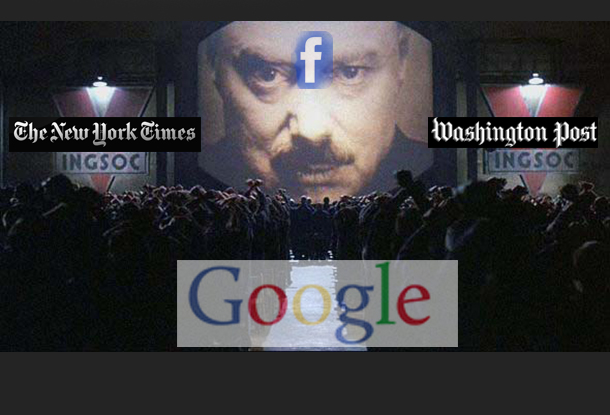
The purpose of so much internet propaganda is to confuse, obsess, depress, and then repress the population. The overlords accomplish this by the “peculiar linking together of opposites – knowledge with ignorance, cynicism with fanaticism – [which] is one of the chief distinguishing marks of Oceanic society,” writes Orwell in Nineteen Eighty-Four.  “The official ideology abounds with contradictions even where there is no practical reason for them.”  One look into one’s life will suffice to see how the overlords have set people against each other.  It’s a classic tactic.  Divide and conquer. Trump vs. Biden, Democrats vs. Republicans, whites vs. blacks, liberals vs. conservatives. Pure mind games. Contradictions every day to create social disorientation.  Orwell describes Doublethink as follows:

Doublethink means the power of holding two contradictory beliefs in one’s mind simultaneously, and accepting both of them.  The Party intellectual knows in which direction his memories must be altered; he therefore knows he is playing tricks with reality; but by the exercise of doublethink he also satisfies himself that reality is not violated.  The process has to be conscious, or it would not be carried out with sufficient precision, but it also has to be unconscious, or it would bring with it a feeling of falsity and hence of guilt…To tell deliberate lies while genuinely believing them, to forget any fact that has become inconvenient, and then, when it becomes necessary again, to draw it back from oblivion for just as long as it is needed, to deny the existence of objective reality and all the while to take account of the reality which one denies – all this is indispensably necessary…If one is to rule, and to continue ruling, one must be able to dislocate the sense of reality. [author’s emphasis]

Nietzsche said that along with the real world we have done away with the apparent as well.  Digital online life has accomplished that.  It has allowed the rulers – through the media who are the magicians who serve them – to create counterfeit news and doctored videos at will, to present diametrically opposed points of view within the same paragraph, and to push breaking news items so fast that no one half-way sane could keep up with their magic shows. Nietzsche obviously didn’t foresee this technology, but he sensed the madness that the relativity of knowledge and the technology of his day would usher in.

***

The popular 1990s term “Information Superhighway,” meaning the internet and all digital telecommunications, was the perfect term to describe this lunacy. Get on that highway and go as fast as you can while trying to catch the meaning of all the information flashing past you as you speed to nowhere.  For not only does censorship, propaganda, disinformation, mixed messages, and contradictions line the road you are traveling, but contextless information overload is so heavy that even if you were stopped in a traffic jam, there is too much information to comprehend.  And if you think this Superhighway is a freeway, think again, for the cost is high. No one puts out their hand and asks you to pay up; but the more you travel down this road you’ll notice you are missing a bit of flesh here and some blood there.  And without a speed pass, you are considered road kill.

To make matters much worse, they say we need 5G to go much faster.

Paul Virilio, who has devoted himself to the study of speed (dromology), puts it this way in Open Sky:

The speed of the new optoelectronic and electroacoustic milieu becomes the final void (the void of the quick), a vacuum that no longer depends on the interval between places or things and so on the world’s very extension, but on the interface of an instantaneous transmission of remote appearances, on a geographic and geometric retention in which all volume, all relief vanishes.

***

And yet I don’t have a simple answer to the internet dilemma. You are reading it on-line and I am posting it there.  It is very convenient and quick. And yet…and yet….

Can we just walk away from it?  Maybe.  Perhaps like those few who, in Ursula K. Le Guin’s excruciating story, “The Ones Who Walk Away From Omelas,” we may decide the price for our conveniences and so-called happiness is too high and that there are hidden victims that this techno-scientific “progress” creates beneath its veneer of efficiency.  Others, us, our children, all children, who are reaching out not for speed and machines, but for the human touch that the on-line propagandists hope to destroy.  In Le Guin’s story, the price nearly all the citizens of Omelas are willing to pay for their happiness and comfort is the imprisonment of a single child.  Perhaps we should consider what we are doing to all the world’s children and their futures.

My friend Gary recently sent me this letter.  I believe it sums up what many people feel. There is a vast hunger for reality and truth. The analog life. How to live it – the question hangs in the air as the artificial intelligence/digital controllers try to reduce us to machines.

Although apparently it isn’t clear if Twain ever said this, it’s still a great quote:  (“If you don’t read the newspaper, you’re uninformed.  If you do, you’re misinformed.”)  To which “amen” is the only appropriate response.

I continue to daily stay abreast of events through the web, and these days much of what passed for “progressive media” simply regurgitates the covid madness as if it had been delivered on stone tablets – rather than by the same MSM that lie to us daily about literally ANYTHING of any importance.

There are days I wonder “why” I continue to bother to follow the unfolding madness as if it made some “difference.”  I could certainly play guitar more, and I might even get it together to write a few pieces on the nature of our collective madness, for which I have studiously assembled copious notes.  I really don’t need any more information or examples – I think I have things covered on that front.

Instead I find myself daily doing the little dance we’re all familiar with – uncomfortable with being “uninformed” – yet at almost every turn finding myself being routinely – “misinformed” – and so having to sift through the endless debris to have any chance at developing any coherent understanding of the world.

So yes, I totally get the draw of just saying to hell with the internet.  After years of shifting through the endless propaganda operations our generation has been subject too, I have no doubt you and I see through most the nonsense for what it is before we even have the proof in hand.  Once the rose-colored glasses of ‘American exceptionalism’ are off, one can almost sense and see through the lies in real time even as they are being uttered.

Reading Gary’s words reminded me of those of the Trappist monk Thomas Merton’s definition of the Unspeakable:

It is the void that contradicts everything that is spoken even before the words are said, the void that gets into the language of public and official declarations at the very moment when they are pronounced, and makes them ring dead with the hollowness of the abyss.  It is the void out of which Eichmann drew the punctilious exactitude of his obedience…

Yes, real time, real life – as we do our little dances.

Can we do our little dances and preserve reality?  I’m not sure.

Why We Need Dystopian Fiction Now More Than Ever

By August Cole and P.W. Singer

Source: Slate

It hits you every so often.

When you when you tug on a face mask to go pick up food for your family.

When you witness the powerless suffer casual violence by a man with a sneer.

When you see riot police surround the Lincoln Memorial and protesters snatched off the streets by masked soldiers in unmarked cars.

And when you realize that it is all being watched by an unblinking eye of A.I. surveillance.

At times, it feels like we are living in a real-world version of dystopia. The strange outcome, though, is that it means we need dystopian fiction now more than ever, to help us sort and even make it through it.

You’d think with everything going on, now would be the last time to escape to a world of darkness. And yet books, including those of awful imagined worlds, are in deep demand.
Some of it has been a return to old classics. In a period of disease and lockdowns lasting for weeks, booksellers report the seeming irony that Albert Camus’ The Plague and Gabriel García Márquez’s One Hundred Years of Solitude have seen renewed demand. And some of it has been escaping into new worlds, as with Divergent author Veronica Roth taking readers into another post-apocalypse with her new novel Chosen Ones. People have even been willing to enter imagined worlds that seem not too far away, such as Lawrence Wright’s best-selling pandemic thriller The End of October.

Yet the value of the genre is as much in education as entertainment. It can elucidate dangers, serving the role of warning and even preparation. Think of the recent resonance of Margaret Atwood’s 1985 Handmaid’s Tale and its 2020 sequel The Testaments or the revival of interest in It Can’t Happen Here by Sinclair Lewis in 1935. These are finely written works, not as indulgences, but as a pure expression of the idea that to be forewarned is to be forearmed. Even Susan Collins’ Hunger Games prequel, The Ballad of Songbirds and Snakes, might be interpreted in that light, showing how authoritarian rule can originate through the manipulations of an ambitious striver.

Our personal corner of this dark market is the meld of imagination with research. For our book Burn-In: A Novel of the Real Robotic Revolution, we chose the setting of not a far-off imagined world like Panem or Gilead, but Washington, D.C., just around the corner. What happens as Silicon Valley’s visions of utopia hits our real, and very divided, country? What plays out in politics, business, and even family life as our economy is rewired by AI and automation? Yet to make our scenario more haunting, we back up everything that happens in it with 27 pages of endnotes.

When the scarier elements from an imagined world come to life in the real one, however, there is no gleeful “I told you so.” When the novel coronavirus accelerated the more widespread roll out of the robots, remote work, job automation, and AI surveillance projected in our book, we certainly weren’t happy. All it meant was that all the tough dilemmas that our characters face would come quicker for all of us. What was perhaps most disturbing of the last few weeks, though, were when some of the most dystopian scenes we had painted of a future Washington, D.C., also came true, from our book’s scene of riot police deployed around the Lincoln Memorial to the militarized fence thrown up around the White House being put exactly where we had it in Burn-In.

Yet what makes dystopian fiction different is that its creators are oddly optimists at heart, as we are. These works are not about prediction, but prevention. The stories warn of just how far things can go if action isn’t taken, wrapped in a package that is far more impactful than a white paper or PowerPoint. Indeed, research shows that narrative, the oldest communication technology of all, holds more sway over both the public and policymakers than even the “most canonical academic sources.” Our minds can’t help but connect to the “synthetic environment” that our fictional heroes and villains experience, living part of our lives through theirs, even if imagined.

Most importantly, though, the dark worlds are only the setting. The stories are really about the agency of the people in them. And that is perhaps the true value of the dystopian fiction. These stories are not about what those characters experience so much as how they act. At the heart of every story of darkness is a story of perseverance.

As we face our own difficult journeys through the reality of 2020, it is perhaps that lesson which is most important of all.

Masked, Homeless, and Desolate

By Edward Curtin

Source: Off-Guardian

Personality is persona, a mask…The mask is magic…Larva means mask; or ghost…it also means mad, a case of demoniacal possession.”
Norman O. Brown, Love’s Body

Walk the streets in the United States and many countries these days and you will see streaming crowds of people possessed by demons, masked and anonymous, whose eyes look like vacuums, staring into space or out of empty sockets like the dead, afraid of their own ghosts. Fear and obedience oozes from them. Death walks the streets with people on leashes in lockstep.

That they have been the victims of a long-planned propaganda campaign to use an invisible virus to frighten them into submission and shut down the world’s economy for the global elites is beyond their ken. This is so even when the facts are there to prove otherwise.

It is a clear case, as Peter Koenig tells Michel Chossudovsky in this must-see interview, that is not a conspiracy theory but a blatant factual plan spelled out in the 2010 Rockefeller Report, the October 18, 2019 Event 201, and Agenda 21, among other places.

Who can wake the sleepwalkers up in this cowardly new world where culture and politics collude to create and exploit ignorance?

Fifty-five years ago on, July 20, 1965, Bob Dylan released his song “Like a Rolling Stone.” It arrived like a rocking jolt into the placid pop musical culture of the day. It was not about wanting to hold someone’s hand or cry in the chapel. It wasn’t mumbo-jumbo like “Wooly Bully,” the number one hit. It wasn’t like the pop pap that dominates today’s music scene. It wasn’t Woody Guthrie in slow time.

It beat you up. It attacked. It confronted you. Maybe, if you were alive then, you thought Dylan was kidding you. You thought wrong. Bitching about his going electric was a dodge. He was addressing all of us, including himself.

Still is. But who wants to hear his recent “Murder Most Foul” and read Dylan’s scathing lyrics about the assassination of JFK, the killing that started the slow decay that has resulted in such masked madness. “And please, Don’t Let Me Be Misunderstood,” he tells us in capital letters for emphasis. Exactly what all the mainstream media have done, of course, and not by accident.

There are no alibis.

“How does it feel/To be on your own/with no direction home/A complete unknown/Like a rolling stone?”

It was in the mid-1960s when confidence in knowing where home was and how to get there disappeared into thin air. If you left mommy and daddy, could you ever get back from where you were going? Who had the directions?

Absolutes were melting and relativity was widespread. Life was wild and the CIA was planning to make it wilder and more confusing with the introduction of LSD on a vast scale. MKUltra was expanding its scope. Operation Mockingbird was singing so many tunes that heads were spinning, as planned.

The national security state killers were in the saddle, having already murdered President Kennedy and Malcolm X as they sharpened their knives for many more to come. The peace candidate, Lyndon Baines Johnson, had been elected nine months earlier with 61.1% of the popular vote and went immediately to work secretly expanding the war against Vietnam. War as an invisible virus. Who knew?

Who, but a small anti-war contingent, wanted to know?

War takes different forms, and the will to ignorance and historical amnesia endure. War is a disease. Disease is weaponized for war. In 1968 Richard Nixon was elected on a “secret plan” to end the Vietnam War and then ramped it up to monstrous proportions, only to be reelected in 1972 by carrying 49 out of 50 states.

Who wants to know now? The historian Howard Zinn once said correctly that this country’s greatest problem wasn’t disobedience but obedience.

What’s behind the masks? The lockstep?

On the same day that Dylan released “Like a Rolling Stone,” Secretary of Defense Robert McNamara, just back from a “fact-finding” trip to Vietnam, recommended to LBJ that U.S. troop levels in Vietnam be increased to 175,000 and that the U.S. should increase its bombing of North Vietnam dramatically.

This was the same McNamara who, in October 1963, had agreed with JFK when he signed NSAM 263 calling for the withdrawal of 1,000 military personnel from Vietnam by the end of 1963 and the remainder by the end of 1965. One of the moves that got Kennedy’s head blown open.

Poor McNamara, the fog of war must have clouded his conscience, confused the poor boy, just like Secretary of State Colin Powell holding up that vile vial of “anthrax” at the United Nations on February 5, 2003 and lying to the world about weapons of mass destruction in Iraq.

Powell recently said, “I knew I didn’t have any choice. He’s the President.” How “painful,” to use his word, it must have been for the poor guy, lying so that so many Iraqis could be slaughtered. Of course, he had no choice. These war criminals all wear masks. And have no choice.

Masks, or demonic possession, or both. You?

Also in that fateful year 1965, far out of sight and out of mind for most Americans, the CIA planned and assisted in the slaughter of more than a million Indonesians, led by their man, General Suharto. This led to the coup against President Sukarno, who two years earlier had been on good terms with JFK as they worked to solve the interrelated issues of Indonesia and Vietnam. Their meeting planned for early 1964 was cancelled in Dallas on November 22, 1963.

And the politicians and media luminaries came out in their masks and told the public that communists everywhere were out to get them.

It’s tough being on your own. It hurts to think too much. Or think for yourself, at least. To obey an authority higher than your bosses. “I was tricked” is some sort of mantra, is it not?

You never turned around to see the frowns on the jugglers and the clowns
When they all did tricks for you

Dylan was lost and disgusted when he wrote the song. His own music sickened him, which, for an artist, means he sickened himself. He had just returned from a tour of England and was sick of people telling him how much they loved his music when he didn’t. He needed to change.

What else is the point of art but change? If you’re dead, or afraid of getting dead, you aren’t going to change. You’re stuck. Stuck is dead. Why wear a mask if you know who you are?

Knowledge, or more accurately, pseudo-knowledge or mainstream media lies, is a tomb “the mystery tramp” sold to us, a place to hide to avoid pain and guilt.

I have read more books than anyone I know. It sickens me.
I know too much. That sickens me.
I sicken myself. All the news sickens me.
I know so much no one believes me.
As Francesco Serpico once told me: “It’s all lies.”
Of course. Dylan and Serpico are blood brothers.
Only art tells the truth. Real art.

Not bullshit pop art. Some say “Like a Rolling Stone” is about Edie Sedgwick, “the girl of the year” in 1965 and one of Andy Warhol’s superstars. Perhaps to a degree it is, but it’s far more than that. It’s about us.

Poor Edie was poisoned by her wealthy family at a young age and barely had a chance. She was an extreme example of a rather common American story. People poisoned in the cradle. Thinking of her got me thinking of Andy Warhol, the death obsessed hoarder, the guy who called his studio “The Factory” in a conscious or unconscious revelation of his art and persona, his wigs and masks and the hold he has had on American culture all these years. Isn’t he the ultimate celebrity?

Warhol once took my photo on a deserted street. His and my secret but this is the truth. West 47th Street on an early Sunday morning, 1980. I guess he thought he was doing art or collecting images for his museum of dead heads. When I asked him why, he said I had an interesting face.

I told him he did too, rather transparent and creepy, but I didn’t want to capture him. He was a ghost with a camera, a face like a death mask, trying to capture a bit of life. I told him I didn’t give him permission to shoot me, but he turned and walked away into the morning mist. The shooters always just walk away in pseudo-innocence.

I then went down the street to the Gotham Book Mart that was my destination and asked James Joyce why he had written “The Dead,” and Joyce, secretive as ever, quoted himself, “Ed,” he said, “Think you’re escaping and run into yourself. Longest way round is the shortest way home.” Now that was direction.

Only those who know how to play and be guided by intuition are able to escape the living tomb of so-called knowledge; what Dylan called, lifelessness. But that was from “Desolation Row,” released as the closing track of Highway 61 Revisited on August 30, 1965. The only acoustic song on the album. Slow it down to make the point another way. “Like a Rolling Stone” was the opening track.

Do you feel all alone or part of a masked gang roaming the streets incognito? Miss and Mr. Lonely, does that mask help? How do you feel?

Desolation means very lonely. From Latin, de, completely, solare, lonely.

Does that mask help? Do you feel alone together now, one of the crowd?

Do you really want to know about desolation row? It’s here. It was here in 1965, too. Only the true lonely know how it feels to really be all alone.

The Umbrella People, those who some call the deep state or secret government under whose protection all the politicians work, say they want to protect us all from death and disease. They are lying bastards who’ve gotten so many to imitate their masked ways. They can only sing a mockingbird’s song.

Listen to real singers. Dylan has arched the years, as true artists do. Who has paid close attention to what he said this year about the assassination of President Kennedy in his song, “Murder Most Foul”? Or were many caught up in the propaganda surrounding corona virus, and rather than contemplating his indictment of the U.S. government and its media accomplices, were they contemplating their navels to see if a virus had secreted itself in there. Viruses lurk everywhere, they say, and the corporate media made certain to circulate a vaccine about the truth in Dylan’s song. This is normal operating procedure.

We are still on Desolation Row.

“Take Off the Masks.” That was the title of a book by Rev. Malcolm Boyd that I reviewed long ago. He was a gay priest who decided that his mask was a lie. He came out into the light of truth. He had guts.

It is time for everyone to take off the masks. Escape from Desolation Row by seeing what’s going on behind our backs.
Listen to Dylan, long ago – today:

At midnight all the agents
And the superhuman crew
Come out and round up everyone
That knows more than they do
And they bring them to the factory
Where their heart attack machine
Is strapped across their shoulders
And then the kerosene
Is brought down from the castles
By insurance men who go
Check to see that nobody is escaping
To Desolation Row
Praise be to Nero’s Neptune
The Titanic sails at dawn
Everybody’s shouting
“Which side are you on?”


What is the soul if not a better version of ourselves?

By John Cottingham

Source: aeon

What is the point of gaining the whole world if you lose your soul? Today, far fewer people are likely to catch the scriptural echoes of this question than would have been the case 50 years ago. But the question retains its urgency. We might not quite know what we mean by the soul any more, but intuitively we grasp what is meant by the loss in question – the kind of moral disorientation and collapse where what is true and good slips from sight, and we find we have wasted our lives on some specious gain that is ultimately worthless.

It used to be thought that science and technology would gain us the world. But it now looks as though they are allowing us to destroy it. The fault lies not with scientific knowledge itself, which is among humanity’s finest achievements, but with our greed and short-sightedness in exploiting that knowledge. There’s a real danger we might end up with the worst of all possible scenarios – we’ve lost the world, and lost our souls as well.

But what is the soul? The modern scientific impulse is to dispense with supposedly occult or ‘spooky’ notions such as souls and spirits, and to understand ourselves instead as wholly and completely part of the natural world, existing and operating through the same physical, chemical and biological processes that we find anywhere else in the environment.

We need not deny the value of the scientific perspective. But there are many aspects of human experience that cannot adequately be captured in the impersonal, quantitatively based terminology of scientific enquiry. The concept of the soul might not be part of the language of science; but we immediately recognise and respond to what is meant in poetry, novels and ordinary speech, when the term ‘soul’ is used in that it alerts us to certain powerful and transformative experiences that give meaning to our lives. Such experiences include the joy that arises from loving another human being, or the exaltation when we surrender to the beauty of a great artistic or musical work, or, as in William Wordsworth’s poem ‘Tintern Abbey’ (1798), the ‘serene and blessed mood’ where we feel at one with the natural world around us.

Such precious experiences depend on certain characteristic human sensibilities that we would not wish to lose at any price. In using the term ‘soul’ to refer to them, we don’t have to think of ourselves as ghostly immaterial substances. We can think of ‘soul’ as referring, instead, to a set of attributes ­­– of cognition, feeling and reflective awareness – that might depend on the biological processes that underpin them, and yet enable us to enter a world of meaning and value that transcends our biological nature.

Entering this world requires distinctively human qualities of thought and rationality. But we’re not abstract intellects, detached from the physical world, contemplating it and manipulating it from a distance. To realise what makes us most fully human, we need to pay attention to the richness and depth of the emotional responses that connect us to the world. Bringing our emotional lives into harmony with our rationally chosen goals and projects is a vital part of the healing and integration of the human soul.

In his richly evocative book The Hungry Soul (1994), the American author Leon Kass argues that all our human activities, even seemingly mundane ones, such as gathering around a table to eat, can play their part in the overall ‘perfecting of our nature’. In the more recent book Places of the Soul (3rd ed, 2014), the ecologically minded architect Christopher Day speaks of the need for humans to live, and to design and build their dwellings, in ways that harmonise with the shapes and rhythms of the natural world, providing nourishment for our deepest needs and longings.

The language of ‘soul’ found here and in many other contexts, ancient and modern, speaks ultimately of the human longing for transcendence. The object of this yearning is not well-captured in the abstract language of theological doctrine or philosophical theory. It is best approached through praxis, or how that theory is enacted. Traditional spiritual practices – the often simple acts of devotion and commitment found in rites of passage marking the birth or death of a loved one, say, or such rituals as the giving and receiving of rings – provide a powerful vehicle for the expression of such longings. Part of their power and resonance is that they operate on many levels, reaching deeper layers of moral, emotional and spiritual response than can be accessed by the intellect alone.

The search for ways to express the longing for a deeper meaning in our lives seems to be an ineradicable part of our nature, whether we identify as religious believers or not. If we were content to structure our lives wholly within a fixed and unquestioned set of parameters, we would cease to be truly human. There is something within us that is always reaching forward, that refuses to rest content with the utilitarian routines of our daily existence, and yearns for something not yet achieved that will bring healing and completion.

Not least, the idea of the soul is bound up with our search for identity or selfhood. The French philosopher René Descartes, writing in 1637, spoke of ‘this me, that is to say the soul by which I am what I am’. He went on to argue that this soul is something entirely nonphysical, but there are now very few people, given our modern knowledge of the brain and its workings, who would wish to follow him here. But even if we reject Descartes’s immaterialist account of the soul, each of us retains a strong sense of ‘this me’, this self that makes me what I am. We are all engaged in the task of trying to understand the ‘soul’ in this sense.

But this core self that we seek to understand, and whose growth and maturity we seek to foster in ourselves and encourage in others, is not a static or closed phenomenon. Each of us is on a journey, to grow and to learn, and to reach towards the best that we can become. So the terminology of ‘soul’ is not just descriptive, but is what philosophers sometimes call ‘normative’: using the language of ‘soul’ alerts us not just to the way we happen to be at present, but to the better selves we have it in our power to become.

To say we have a soul is partly to say that we humans, despite all our flaws, are fundamentally oriented towards the good. We yearn to rise above the waste and futility that can so easily drag us down and, in the transformative human experiences and practices we call ‘spiritual’, we glimpse something of transcendent value and importance that draws us forward. In responding to this call, we aim to realise our true selves, the selves we were meant to be. This is what the search for the soul amounts to; and it is here, if there is a meaning to human life, that such meaning must be sought.

Saturday Matinee: First Reformed

Synopsis by A24

Reverend Ernst Toller (Ethan Hawke) is a solitary, middle-aged parish pastor at a small Dutch Reform church in upstate New York on the cusp of celebrating its 250th anniversary. Once a stop on the Underground Railroad, the church is now a tourist attraction catering to a dwindling congregation, eclipsed by its nearby parent church, Abundant Life, with its state-of-the-art facilities and 5,000-strong flock. When a pregnant parishioner (Amanda Seyfried) asks Reverend Toller to counsel her husband, a radical environmentalist, the clergyman finds himself plunged into his own tormented past, and equally despairing future, until he finds redemption in an act of grandiose violence. From writer-director Paul Schrader (Taxi Driver; American Gigolo; Affliction) comes a gripping thriller about a crisis of faith that is at once personal, political, and planetary.

Watch the full film on Kanopy.

How To Defeat The Empire

By Caitlin Johnstone

Source: CaitlinJohnstone.com

One of the biggest and most consistent challenges of my young career so far has been finding ways to talk about solutions to our predicament in a way that people will truly hear. I talk about these solutions constantly, and some readers definitely get it, but others will see me going on and on about a grassroots revolution against the establishment narrative control machine and then say “Okay, but what do we do?” or “You talk about problems but never offer any solutions!”

Part of the difficulty is that I don’t talk much about the old attempts at solutions we’ve already tried that people have been conditioned to listen for. I don’t endorse politicians, I don’t advocate starting a new political party, I don’t support violent revolution, I don’t say that capitalism contains the seeds of its own destruction and the proletariat will inevitably rise up against the bourgeoisie, and in general I don’t put much stock in the idea that our political systems are in and of themselves sufficient for addressing our biggest problems in any meaningful way.

What I do advocate, over and over and over again in as many different ways as I can come up with, is a decentralized guerrilla psywar against the institutions which enable the powerful to manipulate the way ordinary people think, act and vote.

I talk about narrative and propaganda all the time because they are the root of all our problems. As long as the plutocrat-controlled media are able to manufacture consent for the status quo upon which those plutocrats built their respective empires, there will never be the possibility of a successful revolution. People will never rebel against a system while they’re being successfully propagandized not to. It will never, ever happen.

Most people who want drastic systematic changes to the way power operates in our society utterly fail to take this into account. Most of them are aware to some extent that establishment propaganda is happening, but they fail to fully appreciate its effects, its power, and the fact that it’s continually getting more and more sophisticated. They continue to talk about the need for a particular political movement, for this or that new government policy, or even for a full-fledged revolution, without ever turning and squarely focusing on the elephant in the room that none of these things will ever happen as long as most people are successfully propagandized into being uninterested in making them happen.

It’s like trying to light a fire without first finding a solution to the problem that you’re standing under pouring rain. Certainly we can all agree that a fire is sorely needed because it’s cold and wet and miserable out here, but we’re never going to get one going while the kindling is getting soaked and we can’t even get a match lit. The first order of business must necessarily be to find a way to protect our fire-starting area from the downpour of establishment propaganda.

A decentralized guerrilla psywar against the propaganda machine is the best solution to this problem.

By psywar I mean a grassroots psychological war against the establishment propaganda machine with the goal of weakening public trust in pro-empire narratives. People only believe sources of information that they trust, and propaganda cannot operate without belief. Right now trust in the mass media is at an all-time low while our ability to network and share information is at an all-time high. Our psywar is fought with the goal of using our unprecedented ability to circulate information to continue to kill public trust in the mass media, not with lies and propaganda, but with truth. If we can expose journalistic malpractice and the glaring plot holes in establishment narratives about things like war, Julian Assange, Russia etc, we will make the mass media look less trustworthy.

By decentralized I mean we should each take responsibility for weakening public trust in the propaganda machine in our own way, rather than depending on centralized groups and organizations. The more centralized an operation is, the easier it is for establishment manipulators to infiltrate and undermine it. This doesn’t mean that organizing is bad, it just means a successful grassroots psywar won’t depend on it. If we’re each watching for opportunities to weaken public trust in the official narrative makers on our own personal time and in our own unique way using videos, blogs, tweets, art, paper literature, conversations and demonstrations, we’ll be far more effective.

By guerrilla I mean constantly attacking different fronts in different ways, never staying with the same line of attack for long enough to allow the propagandists to develop a counter-narrative. If they build up particularly strong armor around one area, put it aside and expose their lies on an entirely different front. The propagandists are lying constantly, so there is never any shortage of soft targets. The only consistency should be in attacking the propaganda machine as visibly as possible.

As far as how to go about that attack, my best answer is that I’m leading by example here. I’m only ever doing the thing that I advocate, so if you want to know what I think we should all do, just watch what I do. I’m only ever using my own unique set of skills, knowledge and assets to attack the narrative control engine at whatever points I perceive to be the most vulnerable on a given day.

So do what I do, but keep in mind that each individual must sort out the particulars for themselves. We’ve each got our own strengths and abilities that we bring to the psywar: some of us are funny, some are artistic, some are really good at putting together information and presenting it in a particular format, some are good at finding and boosting other people’s high-quality attacks. Everyone brings something to the table. The important thing is to do whatever will draw the most public interest and attention to what you’re doing. Don’t shy away from speaking loud and shining bright.

It isn’t necessary to come up with your own complete How It Is narrative of exactly what is happening in our world right now; with the current degree of disinformation and government opacity that’s too difficult to do with any degree of completion anyway. All you need to do is wake people up in as many ways as possible to the fact that they’re being manipulated and deceived. Every newly opened pair of eyes makes a difference, and anything you can do to help facilitate that is energy well spent.

Without an effective propaganda machine, the empire cannot rule. Once we’ve crippled public trust in that machine, we’ll exist in a very different world already, and the next step will present itself from there. Until then, the attack on establishment propaganda should be our foremost priority.