And the Beat Goes On: Mega-rich get richer. Society Crumbles

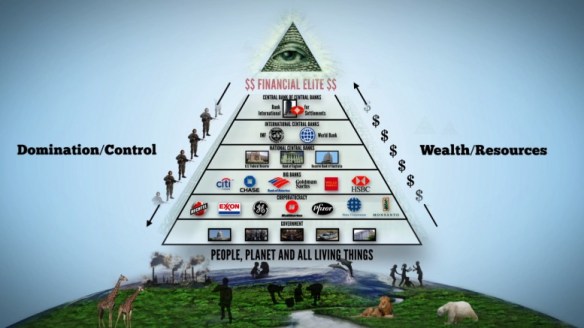
FollowTheMoney-Bank-Pyramid

By Robert De Filippis

(OpEdNews.com)

While most of us have been taking our kids to Little League games, betting on the Super Bowl, taking an occasional vacation and waiting for the American Dream to become a reality, we haven’t noticed something important happening all around us. Society has been crumbling at the edges for the last several decades.

This is not to say that lots of human beings haven’t already experienced the early stages of this societal disintegration. But they tend to be the people at the margins. People without a voice. People whose interests are not understood, let alone represented in the great debates of our times.

Think of the Mideast. Think ISIS here. Think of terrorism. Terrorists don’t attack us because of our freedoms. They attack out of desperation. Out of a frustration that comes with no future, and a feeling of impotence in the face of the continued economic violence committed in the name of corporate profits and greed. Corporations protected by the most powerful military in the history of the world. Ours!

Is it any mystery why we have over six hundred military installations in other countries around the world? We’re not under threat from anyone, but our corporation’s interests in those countries must be protected while they rape them of their labor and natural resources.

History is written by the victors and the popular public narratives are circumscribed by those whose interests they serve and not those who suffer. At the core of this phenomenon is complicity. A subconscious complicity made up of an ultra-resistant trifecta of human thinking — greed, ignorance, and certainty.

Greed now normalized has made the great American dream indistinguishable from having basic financial security to making everyone a billionaire-in-waiting. An inability to distinguish fact from opinion leads the wave of ignorance that engulfs us. Our arrogance disguised as fervent patriotism defends our ignorance and allows us to reject the knowledge we need to save ourselves.

Our generalized confusion of what constitutes a fact allows an individual’s certainty to form a resistance similar to the bacterial infections that threaten to make modern antibiotics useless. It continues to evolve. “If I can’t figure out who’s lying, I’ll believe the one who confirms my point of view. Of that I’m certain.”

Until we learn that having our beliefs validated by a media being paid to manipulate us for political gain, society will continue to disintegrate for larger and larger groups of people.

Seems like a stretch, I know. But think about how we’ve become polarized. How we are so sure of our positions that we just can’t have a conversation with those from the other side. The very conversation we need to have to figure out how we’re being duped. Then think about how our politicians use the greed, ignorance and certainty on both sides to work us up into an emotional lather. And finally, how they ignore our interests while they do the bidding of their owners keeping us distracted with our petty differences with each other.

This will come to an end. There will either be a major social revolution at the least or outright raw violence at the worst. As the authority structures lose the willing conformance of the masses, all that’s left to police them is force. And at some point – like is beginning now — the response will be violence in return. Think of the proliferation of guns in America. Think of people shooting police.

It doesn’t take much discernment to see that corporate structures are highly sophisticated mechanisms for funneling money upwards. That government collusion protects the interests of the owners of capital at the expense of the employees, customers, the general public. And the military protects their international interests.

The largest wealth producer in the world is the financial industry that simply makes money from money and produces nothing. It serves no interests but its own. Yes, some of us fortunate to have salvaged what’s left of our life savings after repeated financial crashes still enjoy the crumbs from the tables of the elite. I do mean crumbs.

Do the math. At the current rate of the upward movement of wealth, there is no other outcome but final disaster. The top 1/10th of 1 percent — not 1 percent — but 1/10th of 1 percent in America owns almost as much wealth as the bottom 90 percent in America, and it gets worse as you leave our shores.

At this rate, the world will eventually consist of gated enclaves of the mega-wealthy guarded by elite corps of paid mercenaries surrounded by billions of impoverished people.

This trajectory has increased dramatically for the last several decades. More and more of the world’s wealth is pouring into the coffers of the mega-rich. This is a zero sum game. When the masses have no wealth left, the game will be over. No matter how powerful the wealthy are, no matter how much wealth they possess, the game will be over.

The American Dream is Dead

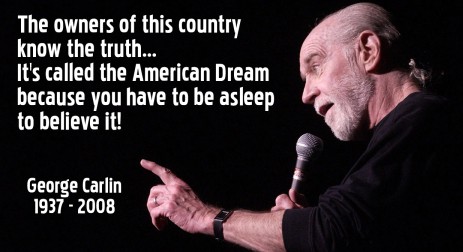
george-carlin-american-dream

By Dustin Meyer

Source: The Evolutionary Mind

To say the American Dream is Dead couldn’t be more true. The American people as a whole are ignorant. They grow up believing that there is a perfect lifestyle in which they will get once they get older and “pay their dues”. Unfortunately this is very far from wrong, the system is corrupt and is against anyone who thinks this way. Simply put, there is no American dream.

What is it? The American Dream, at least as I knew it was where you would live an ideal life, work a 9-5 job, have a house with a white picket fence, a yard, car, and a dog. More in a modern sense, it is getting rich and famous, owning a huge house, fancy car, having all the fanciest clothes and things. This is why it had been dying but not why it is dead. People are greedy, they want more and more, and forget to appreciate the simple life they have. Some people don’t even have their lives anymore, and yet so many people take theirs for granted.

Pop culture can be given much of the credit due to the skewing of the American dream. Since the people are influenced by anything and everything, they will believe any message conveyed to them. Music and film are the main mediums where this is, but a huge culprit is the news and daytime television. Also, unfortunately people are losing their individualism, which is leading to them falling more into this hole in which you cannot escape, you just aren’t you anymore once you’ve given in.

But a big question is why do I say it is dead? Well, the system in general is against us. The gap between rich and poor is expanding exponentially each and every day. The odds are not in the average person’s favor. People are working until they are 60+ years old and barely being able to retire, and with that work, most aren’t in executive type jobs. For the small business owner, you have huge corporations that are destroying your chances to even provide for your family. So why is it dead? Opening you eyes will show you.

People have to stand up, to realize that something is wrong. With this upcoming election (being quite possibly the worst election/selection of candidates’ ever.) we have to fight for the people. No matter who is in office no one will ever fight for you, unless you do. The people are for the people, we have a choice to change. The change must happen!

Mobility, Meritocracy and Other Myths

justice-fish


By Kevin Carson

Source: Center for a Stateless Society

At the American Enterprise Institute, Mark Perry (“Yes, America’s middle class has been disappearing… into higher income groups,” Dec. 17) justifies the shrinking middle class and growing economic inequality by citing the finding of a recent Pew Institute study that of the 11% shrinkage in the American middle class, 7% have gone to the top and only 4% to the bottom.

First, movement between strata doesn’t legitimize stratification if the structure itself is illegitimate. Meritocracy is a legitimizing myth created to distract people from the question of whether the system of power those meritocratic functionaries serve is just. As Chris Dillow, an unorthodox British Marxist economist, observed (“Beyond social mobility,” Stumbling and Mumbling, Dec. 19):

“Imagine a dictator were to imprison his people, but offer guard jobs to those who passed exams, and well-paid sinecures to those who did especially well. We’d have social mobility — even meritocracy and equality of opportunity. But we wouldn’t have justice, freedom or a good society. They all require that the prisons be torn down.”

Also note that what’s called the “upper class” in the study includes not only the super-rich rentier classes and people in the C-Suites with million-dollar salaries, but also most of the larger managerial stratum. There’s a good reason this stratum has expanded from 14% to 21% of the general population. As David Gordon argued in Fat and Mean, it was the neoliberal decision in the ’70s to cap real hourly wages and shift a greater share of income upwards to rentiers and cowboy CEOs that resulted in increasing internal authoritarianism in the corporation and a need for a larger class of overseers to monitor the (understandably) increasingly disgruntled work force.

And despite the increased income of the managerial classes, the great bulk of them are still salaried employees whose income depends on the ongoing approval of their superiors. That 14-21% of the population is more or less what Orwell, in 1984, called the “middle” stratum (represented in the story by the Inner Party to which Winston and Julia belonged). Here’s how Orwell described the same general type in the corporate England of his day in another novel, Coming Up for Air:  “in every one of those little stucco boxes there’s some poor bastard who’s never free except when he’s fast asleep…”

Not only do these people continue to collect their managerial salary at the good pleasure of the senior oligarchs of the corporate hierarchy, but to even have a shot at that management pay in the first place they’ve got to put themselves in a position of student debt peonage that will likely eat up a major part of that increased income for years (along with a mortgage that means they’ll really be renting their house from the bank into old age). Add to that the long hours middle management types have to work coupled with the endless bureaucratic toadyism and sycophancy required of them, and the ongoing precarity of their position.

Getting back to the issue of legitimacy, there’s also the fact that the functions exercised by most of these managerial types are illegitimate and would be unnecessary absent an exploitative class society. They are, in anarchist anthropologist David Graeber’s famous phrase, “b***s*** jobs.” They exist because the American state, in league with corporate capital, has cartelized the economy under the control of bureaucratic hierarchies many times larger than the point of declining returns in efficiency, and because the authoritarian nature of those hierarchies and the rent-seeking nature of their management creates a conflict of interest that necessitates intensified surveillance and control.

The late Joe Bageant aptly described the nature of the work these people perform: “The empire needs… about 20-25% of its population… to administrate and perpetuate itself — through lawyers, insurance managers, financial managers, college teachers, media managers, scientists, bureaucrats, managers of all types and many other professions and semi-professions.”

When workers own the firm and manage their own work, as in the recuperated enterprises of Argentina, not only can workers be trusted to use their own superior knowledge of the work process but what little coordinating costs remain are a small fraction of U.S. corporate administrative costs. In fact eliminating all those management salaries solved the unit costs problem at one stroke.

The upper quintile is growing in size and income because all the value created by actual productive workers in the lower quintiles gets extracted by those at the top. When the top classes rob everybody else, they need a lot more guard labor to keep their stolen loot secure.

And whether or not there’s been an increase in the real income of the lower four strata, production workers’ loss of control over the work force and increased precarity is even worse than that of those middle managers in the top 21%. Whether for production workers or middle management, stress correlates directly with powerlessness.

We don’t need meritocracy. We need justice.

Your Awakening Counts More Than Your Vote

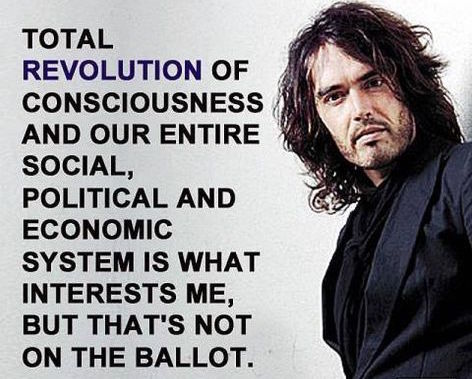
russell-brand-total-revolution-of-consciousness

By Dylan Charles

Source: Waking Times

We live in a world where illusions are held in higher esteem than verifiable truth. This is no accident, as the individual has for decades now been on the receiving end of social engineering programs, advanced political and corporate propaganda, fear programming and outright mind control.

The sum total of all this mass conditioning has been to convince otherwise good-natured and hard-working people to participate in their own enslavement and to willingly acquiesce to the ever-increasing rules, invasions of privacy, taxations, permissions and control schemes of a government and world elite who have long since left public interest in the dust.

The American dream is a mythic idea that was supposedly founded on the principle that public oversight of government is possible thanks to an electoral process which would give an informed citizenry the opportunity to replace undesirable politicians with better ones. Government itself, though, is a brutish and violent force that has time and again proven absolutely wild, reckless and untamable. It has never has obeyed its own laws, policies or regulations, and world history is a bloodstained chronicle of man’s failure to control himself when given power in the form of government.

Just as you cannot stop the tides from rising and falling, you cannot stop government from decaying into tyranny, especially so by following its very own rules and by participating in its token rituals.

This is truth, yet the illusion of so-called ‘democracy’ persists, seeming to grip people ever more feverishly with each passing election season. Even in the face of overt election fraud, party infighting, delegate rigging and widespread disenfranchisement. And so here we are again, facing the embarrassing spectacle of choosing between two undesirables when we all know the game is rigged.

For the powers the be, though, the repeating four-year cycle of presidential politics is the most effective device for keeping the masses high on the illusion of self-governance. It force feeds us on a regular schedule the false narrative that we the people can vote to reign in the power and corruption of the oligarchy of deep state, private and corporate influences that truly control the direction of this nation.

In this light, the purpose of national politics is not to perpetuate self-governance for the benefit of the common person, but rather to eat up personal energy and resources in order to suck the individual into a quagmire of false hope and endless patience with outrage after outrage. It is to make ineffectual action feel like action to the people being most screwed over by the corruption of the elite.

Sure, this may sound negative, cynical or apathetic to those who are over-invested emotionally in this game, but in order to move beyond the insanity of doing the same thing again and again while expecting different results, it’s imperative to be deadly honest about how this program works to enslave us, not to free us. Once we can think beyond the peer pressure, neighbor-hating, and mindless outrage that marks each election cycle, we make ourselves available to the possibility of real change. And real change always begins from within, and never forced from without.

There is no political leader who can make you stand fearlessly in this complex and dangerous world.There is no candidate that can give you the freedom that comes with a healthy mind and body. There is no political ruler who can manifest true and lasting happiness for you. There is no politician who can ensure that you enjoy the experience of your life everyday, under any and all circumstances. And there is no president that can empower you to be the best possible version of yourself so that you may give your best to others.

All of these qualities are vastly more critical to personal, community and planetary renewal than whichever new figurehead is selected to be the perceived front man of a morbidly corrupt American government.

The most effective way to change the world around you is to first focus on and create more value in yourself. This is why your awakening counts far more than your vote does. 

The 1% Versus the 99%: Realignment, Repression or Revolution

640px-Standard_oil_octopus_loc_color

Wealth Inequality Is Putting the US on Course for a Showdown

By Klaus Marre

Source: WhoWhatWhy.org

The richest 20 Americans now own as much wealth as the country’s poorest 152 million people combined.

That is just one of the findings of noted inequality scholar and author Chuck Collins’s most recent report, “Billionaire Bonanza, The Forbes 400 and the Rest of Us.”

In a wide-ranging interview, which will be available in its entirety as a podcast tomorrow, Collins likened the current situation to the “Gilded Age,” the time just before the turn of the 20th century, when there was a similar accumulation of wealth at the top and political power was concentrated in the hands of a few rich men.

And Americans are slowly realizing that the extreme accumulation of wealth at the very top is hurting their own prospects.  But grassroots efforts to redress economic inequality must contend with the political power that comes with great wealth.

This is an unstable situation. With pressure building for change but potent forces stacked against it, there are only three options, Collins told WhoWhatWhy: “Realignment, revolution or repression.”

Rules Rigged, and the Rich Get Richer

Back in the Gilded Age, the country managed to convert the pressure that was building from the bottom up into meaningful changes that resulted in a realignment of political power and the rise of the middle class. Those gains, however, are now being reversed. In fact, a new report found that, for the first time in decades, the middle class no longer constitutes the economic majority in the United States.

The shift toward increasing inequality began in the 1970s. At that time, Collins says (and research shows), “we stopped being an economy in which most people grew together” and instead became a “society that is dramatically pulled apart.”

Wages have now been stagnant for three decades and the median wealth of Americans has actually declined since 1990. At the same time, the rich have gotten richer. A lot richer.

Like the Great Depression in the early 1930s, the economic crisis of 2008 has been a wake-up call for the country. Polls historically have shown that people are indifferent to great wealth as long as they feel the rules are fair and that they at least have the option of moving up the ladder. But for many, the latest crash is changing that perception.

“In the economic meltdown of 2008, people realized the rules are rigged, that the big financial industry people … are tipping the scale in their favor,” Collins said. This has led to a perception that upward mobility in America is stalled — a perception supported by statistical data.

Collins believes that this sentiment has helped boost the candidacies of presidential hopefuls as diverse as Donald Trump and Bernie Sanders.

The collapsing middle class, including groups like recent college students whose prospects are blighted by crushing debt burdens, represents an “angry and mobilized constituency.” These are the people whose dissatisfactions are articulated by populists like Trump.

At the other end of the spectrum, the success of self-avowed “democratic socialist” Sanders shows how fluid the situation is. Collins pointed out that the Vermont senator has been saying the same things for 30 years — but only now are they resonating with a larger proportion of the electorate.

Collins pointed out that Sanders is the only major candidate who does not need a billionaire bankrolling his primary campaign to do well in the polls.

One bloc of voters who can cause a tectonic shift in the near future are millennials, many of whom are resentful of the obstacles they face in pursuing the American dream while paying off their college loans. With 40 million households shouldering a burden of $1.2 trillion in college debt, Collins believes that if this segment of the population were to organize, they could force significant change.

“Otherwise, the machinery of inequality will just keep chugging along as it currently is and it will get more concentrated,” Collins said. In any case, all of the ingredients are there for a major political realignment.

“We’re headed for a showdown.”

[audio http://www.whowhatwhy.org/files/Chuck%20Collins%20WWW%20Final.mp3 ]

http://www.whowhatwhy.org/files/Chuck%20Collins%20WWW%20Final.mp3

The lottery and social despair in America

1fab0b8ba5546a67810419e62958f0cc

By Andre Damon

Source: WSWS.org

This mania, so generally condemned, has never been properly studied. No one has realized that it is the opium of the poor. Did not the lottery, the mightiest fairy in the world, work up magical hopes? The roll of the roulette wheel that made the gamblers glimpse masses of gold and delights did not last longer than a lightning flash; whereas the lottery spread the magnificent blaze of lightning over five whole days. Where is the social force today that, for forty sous, can make you happy for five days and bestow on you—at least in fancy—all the delights that civilization holds?

Balzac, La Rabouilleuse, 1842

The jackpot in the US Powerball lottery has hit $800 million, since there were no winners in Wednesday’s drawing. In the current round, which began on December 2, over 431 million tickets have been sold, a figure substantially larger than America’s population.

Go into any corner store in America and you will see workers of every age and race waiting in line to buy lottery tickets. With the current round, the lines are longer than ever. Americans spend over $70 billion on lottery tickets each year. In West Virginia, America’s second-poorest state, the average person spent $658.46 on lottery tickets last year.

Powerball players pick six random numbers when they purchase their tickets, with a certain percentage of sales going to the jackpot. If no winning ticket is sold, the jackpot rolls over to the next round.

The totals for the Mega Millions and Powerball national lotteries have been growing every year. This year’s jackpot has eclipsed 2012’s record of $656.5 million, the $390 million payout in 2007 and the $363 million prize in 2000. The jackpots have grown in direct proportion to ticket sales.

State-run gambling programs such as Powerball have been promoted by Democrats and Republicans alike as a solution to state budget shortfalls, even as the politicians slash taxes on corporations and wealthy individuals and gut social programs. From the standpoint of government revenue, lotteries and casinos are nothing more than a back-door regressive tax, soaking up money from the poor in proportion to the growth of social misery.

The boom in lotteries is global. Lottery sales grew 9.9 percent worldwide in 2014, after growing 4.9 percent in 2013.

Psychology Professor Kate Sweeny has noted that lottery sales grow when people feel a lack of control over their lives, particularly over their economic condition. “That feeling of self-control is very important to psychological well-being,” Sweeny says.

There is ample reason for American workers to feel they have no control over their lives. According a recent survey by Bankrate.com, more than half of Americans do not have enough cash to cover an unexpected expense of $500 or more—roughly the price of four name-brand tires.

Some 62 percent of Americans have savings of less than $1,000, and 21 percent do not have any savings at all. Most Americans are one medical emergency or one spell of unemployment from financial ruin.

For all the talk about “economic recovery” by the White House, the real financial state of most American households is far worse than before the 2008 financial crisis and recession. As of 2013, Americans were almost 40 percent poorer than they were in 2007, according to a recent survey by the Pew Research Center. While a large portion of the decline in household wealth is attributable to the collapse of the housing bubble, falling wages and chronic mass unemployment have played major roles.

The yearly income of a typical US household dropped by a massive 12 percent, or $6,400, in the six years between 2007 and 2013, according to the Federal Reserve’s latest survey of consumer finances. A large share of this decline has taken place during the so-called recovery presided over by the Obama administration.

In addition to becoming poorer, America has become much more economically polarized. According to a separate Pew survey, for the first time in more than four decades “middle-income households” no longer constitute the majority of American society. Instead, the majority of households are either low- or high-income. Pew called its findings “a demographic shift that could signal a tipping point” in American society.

“Is the lottery the new American dream?” asked USA Today, commenting on this month’s Powerball jackpot. The observation is truer than the authors intended. For American workers, achieving the “American Dream” of a stable job and one’s own home is becoming increasingly unrealizable.

Following more than 10 million foreclosures during the financial crisis, America’s home ownership rate has hit the lowest level in two decades, and for young households, the rate of home ownership is the lowest it has been since the 1960s.

For the tens of millions of America’s poor, and the more than 100 million on the threshold of poverty, the dream of winning the lottery has replaced the “American Dream” of living a decent life. A lottery ticket is a chance to escape to a fantasy world where money is not a constant, nagging worry, where one is not insulted and bullied at a low-wage job by bosses whose pay is matched only by their incompetence. The lottery is, as Balzac aptly described it, the “opium of the poor.”

Using the same phrase to describe religion, Marx noted that the “illusory happiness of the people” provided by the solace of religion is, in fact, a silent protest and distorted “demand for their real happiness.” It is the intolerable social conditions that compel masses of people to seek consolation in a lottery ticket that will propel them into revolutionary struggles.

The Dying Americans

1365203033_2628_auschwitz

By Chad Hill

Source: The Hipcrime Vocab

I’ve often used the term “the final solution for the working class,” in reference to the current American policy towards its vast intercoastal peasantry who, for reasons of circumstance or inclination, do not subject themselves to the decade or so of wildly expensive education that qualifies them for the remaining jobs on offer. It may be a reflection of my readership that I haven’t received any pushback. As someone who is in that same working class, I can clearly see what is happening around me, and I’m not alone. David J. Blacker, in his book, The Falling Rate of Learning and the Neoliberal Endgame, also broached the subject of eliminationism, going so far as to study the German holocaust literature of the 1930’s which calmly and rationally discussed how to deal with the problem of getting rid of the millions of excess people whom the elites determined were “undesirable” in the brave new world they were creating.

After last week, it’s hard to argue that this is hyperbole. The news that America’s white working class between the ages of 45-65 has dramatically falling life expectancy, alone against nearly the entire world, received a surprising (to me) bit of coverage. When I first read it, I assumed it would be just another footnote story that I would write about here, but would be ignored everywhere else. But it received a surprising amount of coverage: even Paul Krugman wrote about it. I suspect a large part of that was due to the fact that it was research by the most recent economics “Nobel” laureate Angus Deaton and his wife, so it was harder to ignore than if it had been from some unknown researcher.

Often times you hear about a “dieoff” due to our situation. I think this study confirms beyond a doubt that the dieoff is already happening. Yet, consider that, before this study became popularized, you would have never heard about it in the mainstream press. Still doubt the collapse is real?

It’s not people dying in the streets, though, unlike some of the more feverish TEOTWAKI peak oil predictions. From the research, elevated levels of suicide and drug abuse are the prime culprits. It’s the million little deaths that go unnoticed in the obituary columns of decaying communities all across this formerly prosperous nation. Someone overdosed in a back alley. Or a meth lab exploded. Or maybe they were killed in a car accident, or decapitated while driving their motorcycle too fast. Or they were shot by police. Or they are dying of liver failure by age 40. Or, increasingly, they are ground down slowly by the many chronic diseases such as diabetes that are symptomatic of the chronic stress and horrid (yet highly profitable) junk food diet of most Americans. It’s a dieoff all right, but it’s never framed as such. You can see it all around you: the overcrowded jails filled with unemployed people, the overcrowded hospitals filled with sick, obese people, the folks standing on the medians and freeway offramps with cardboard signs and living their cars, all while the media just goes on reporting about spectator sports and celebrity gossip as though nothing bad is happening. Ignorance really is bliss.

The obvious analogy here is Russia after the fall of the Soviet Union, as many people writing about the study have pointed out: The Dying Russians (New York Review of Books). But there was no “collapse” of the United States. Or was there? Instead, we’re told by the media and politicians that everything in every way is getting better and better for everyone. Just look at the latest iPhone! Television screens are huge! Even the very poor have indoor plumbing! And you can Google anything you like, so what are you complaining about, loser?

Everything is famed as personal failure, thus the dieoff is just a million stories of individual failure with no overall pattern. Nothing to see here, more along. Study and “work hard” (whatever that means), and you’ll be okay. Certainly that fear is behind the epidemic of overwork, presenteeism and grinding hours of unpaid overtime Americans are putting in at work in the hope of not being next. It’s like being the model prisoner in a concentration camp, though. Ask the turkeys this month if being a good turkey had any effect on their ultimate fate. The Parable of the Happy Turkey (Global Guerrillas)

Up until now, Americans have been happy turkeys. Thus, they cannot comprehend what is happening to them. In America it is taken for granted that the ultimate locus of control is on the individual, and that there is no such thing as society. That belief has been heavily promoted over the past thirty years, along with the “create your own reality” and other assorted positive thinking nonsense (thanks Oprah!), and I think we can see why.

And since we see this always as personal failure and are not allowed to see it as systemic failure, the poor and formerly middle classes take it out on themselves instead of the system. After all, America is the land of opportunity; if you don’t “make it’ (whatever that means), you have no one to blame but yourself! Of course it is not true; the musical chairs job market and winner-take-all economy means that only a tiny number of people even have a shot at the middle class anymore, and a lot of that is due to geography, pre-existing social connections and luck.

They don’t have to kill you if they can get you to kill yourself.

And although framed as a tragedy, I wonder if to some extent this behavior on the part of working class males is a logical response to living in the kind of society that the United States has become. In a society that has no use for them anymore and where they have no sense of purpose and no hope for the future, it seems like suicide is a rational response. After a certain age, you realize that you have been sorted to the “losers” pile. If you live in the vast suburban flatland of Middle America, you likely live in a decrepit house somewhere in the anonymous miasma of strip-mall suburbia, buy disposable plastic crap made in China from baleful fluorescent-lit Dollar Stores, drive an older model pickup truck or SUV with a bad muffler and bad brakes over potholed streets and under rusty bridges, while all the jobs around you aside from the hospital and the university (which are mainly female-staffed) are minimum wage, dead-end jobs where you have to smile and wear a uniform. You realize you’re never going to meet the girl of your dreams since hypergamy is still baked into female mating choice, despite what some feminists claim. You realize you will never get that that great job that will allow you to be upwardly mobile and live in relative ease and comfort, and life is a bitter, hard struggle relieved only by the occasional joint and video games. Or you’re divorced and paying child support to your former wife who’s managed to keep herself presentable enough to hook up with one of the few remaining alpha-males, and half your income goes to support the kids you never see. Or your deadbeat loser children have been working multiple McJobs and living in the basement for years with no hope of even affording a one-bedroom apartment, and between them and the wife you never speak to anymore, you can’t even get into your own damn bathroom. You realize that, like most Americans, you will never afford to retire and will have to work your boring, dead-end job under your asshole supervisor until you literally drop dead. So why wait?

I mean, who wouldn’t kill themselves or anesthetize themselves with drugs and booze in an environment like this?

I once read an online commenter say that the rich are the beta testers for the lifestyles we will all be living in the future (and thus no restraints must be put on their wealth accumulation if we are to experience that future). But that commenter had it wrong. Rather, it is the poor–those living on less than a few dollars a day; those who live in ghettos marred by gangs and drug abuse; those with their heat, water, and streetlights turned off, who are the beta testers for the lifestyles that most of us will be “enjoying” in the near future. As William Gibson said, the future is already here, just not evenly distributed.

Given the above, I can’t help but think of the “Rat Park” experiment. Rats in a cage, when given  a choice between water and drugs, would overdose themselves to death on the drugs, neglecting even basic self-maintenance. But a cage is a boring, repetitive, stressful environment for a rat, so you might expect the animals to anesthetize themselves with whatever was on offer. But rats living in an environment specifically designed to be pleasant and give the rats what they needed to thrive did not overdose themselves to death; they preferred healthier behaviors instead. It’s worth noting that most of the drugs we use today have been known for hundreds or even thousands of years, but were not abused by the native peoples who discovered them. That is reserved for modern, “advanced” societies. The Rat Park experiment (io9)

I once wrote that if you wanted to intentionally design a social environment to drive a primate insane, you would develop something pretty much identical to modern-day America (advertising, chronic stress, inequality, separation from nature and each other, boring, repetitive work, constant surveillance, and on and on…). It’s pretty obvious how Rat Park parallels life in twenty-first century America with its ubiquitous television, concentration-camp schools complete with metal detectors, freeways and cul-de-sacs and landscapes of Applebees™ and Walmarts; along with a steady diet of Pizza Hut and Taco Bell. It’s hardly an environment designed for human flourishing, is it? Rather, it is designed to maximize “economic growth” at all costs. The results of that experiment are as plain to see as they are predictable.

Most people who are still relatively comfortable are content to write off the people who are living in deprived circumstances among them right now, especially in the United States where so many of those poor are African-American. But more and more, whites are experiencing what they had previously dismissed as “black problems” due to their racist attitudes: the hopelessness and despair, the unemployment, the sociological pathologies; the drug abuse, divorces, domestic violence, youth gangs and so on. It’s not race, it’s environment, as Rat Park showed. Given a certain environment, an animal–any animal–will behave a certain way. Its totally predictable. We know this, but why do we pretend it is not true? Instead we reliably chalk it all up to “the Cult of Personal Failure.”

But this leads to an even larger question, one that gets to the heart of our modern predicament. We have to ask ourselves, what kind of society are we creating where so many people see death as preferable to living in such a society? In what kind of a society do people see life as so miserable that they prefer to kill themsleves, either slowly or immediately?  That is, why is this the end result of hundreds of years of supposed “progress?”

Fundamentally, how do you feel about this society? Do you feel good about this society? Do you feel good about the school-to-prison pipeline? Do you feel good that there are more prisoners than small yeoman farmers? Do you feel good that it is a felony to show us how our food is produced? Do you feel good about students mortgaging their future for jobs that won’t exist by the time the bill comes due? Do you feel good about hospitals treating chronic diseases taking the place of farming and making things as basis of the America’s rural economies? Do you feel good about police armed with body armor and and tear gas? Do you feel good about wall-to-wall advertising preying on our weakness and insecurities? Do you feel good about the atmosphere of incessant adversarial competition against everyone else for the shrinking pool of jobs on offer which pay enough to afford rent?

If so, why?

This puts a crimp on the Panglossian “everything in every way is getting better for everyone,” rhetoric that you hear so often in the media. What I find amusing is that this rhetoric used to come from the Left–that the welfare state would eliminate poverty, racism, that everything was under control and circles of cooperation would get larger and larger, and so on. But now, I mostly hear the Panglossian rhetoric coming primarily from the Right, whose preferred God is the unregulated “free” market. It’s in the Right-wing propaganda now that I constantly hear how wonderful everything is, and that those who are complaining are either delusional misfits or just jealous. Here is a prime example from the Right-wing National Review:

Good news abroad, and good news at home: In 1990, there were 2,245 murders in New York City. That number has fallen by 85 percent. Murders are down, often dramatically, in cities across the country. The overall rate of violent crime has fallen by about half in recent decades. U.S. manufacturing output per worker trebled from 1975 to 2005, and our total manufacturing output continues to climb. Despite the no-knowthings [sic] who go around complaining that “we don’t make things here anymore,” the United States continues to make the very best of almost everything and, thanks to our relatively free-trading ways, to consume the best of everything, too. General-price inflation, the bane of the U.S. economy for some decades, is hardly to be seen. Flexible and effective institutions helped ensure that we weathered one of the worst financial crises of modern times with surprisingly little disruption in the wider economy. Despite politicians who would usurp our rights, our courts keep reliably saying that the First Amendment and the Second Amendment pretty much mean what they say. I just filled up my car for $1.78 a gallon.

 The world isn’t ending.

The world is healthier, wealthier, and less hungry mainly because of the efforts of millions of unknown investors, entrepreneurs, farmers, workers, bankers, etc., all working without any central coordinating authority….There is much left to do: We have unsustainable fiscal situations in the Western welfare states, irreconcilable Islamist fanatics originating in points east but spread around the world, environmental challenges, and that tenth of the human race that still needs lifting out of hardcore poverty. But we have achieved a remarkable thing in that unless we mess things up really badly, in 50 years we’ll be having to explain to our grandchildren what a famine was, how it came to be that millions of people died every year for want of clean water — and they will look at us incredulously, wondering what it must have been like to live in the caveman times of the early 21st century.

Liberal Democracy and Free Markets, Take a Bow (National Review) Or better yet, strap on flight suit and hang up a “Mission Accomplished” banner.

Yes, for the folks on the Right, it truly is a Golden Age. There are a few flaws in the ointment like those pesky welfare states and all that but, hey, gas is cheap! Can’t you just feel the bright, shiny future ahead? Here’s a another sampling from The Wall Street Journal:

The trajectory of the world doesn’t justify this pessimism. People are living longer on every continent. They’re doing less arduous, backbreaking work. Natural disasters are killing fewer people. Fewer crops are failing. Some 100,000 people are being lifted out of poverty every day, according to World Bank data.

Life is also getting better in the U.S., on multiple measures, but the survey found that 55% of Americans think the “rich get richer” and the “poor get poorer” under capitalism. Sixty-five percent agree that most big businesses have “dodged taxes, damaged the environment or bought special favors from politicians,” and 58% want restrictions on the import of manufactured goods.

Has the World Lost Faith in Capitalism? (WSJ) Silly people, how dare they “lose faith!” Once we stamp out every last vestige of “socialism” we can restore that faith.

So what’s going on here? Listening to the Right, one gets the appearance that things have never been better, and that people are just totally irrational and determined to complain no matter how good they have it, despite voluminous scientific literature portraying optimism bias as the default cognitive condition for most people.

I think it stems from two areas – the Neoliberal experiment has clearly been an unmitigated disaster, so the literature constantly has to portray a rosy picture for those still living in the elite ideological bubble by cherry-picking data: Cheer – Inequality is Falling Globally!! (and similar nonsense) (Pieria). It’s much like the “happy peasant” literature that prevailed on the eve of the French Revolution and during early Industrialism to convince upper-class readers that their efforts were actually for the good of all, not just themselves; it’s just that the feckless peasants were too short-sighted to realize it. The elites, for some reason, have a need to believe, despite all the evidence to the contrary, that the free-market fundamentalism they subscribe to is making everyone–not just them–better off. Perhaps it is a remedy for cognitive dissonance and a guilty conscience.

The second agenda might be to cover up the agenda of eliminationism referred to above.
Going back to the original topic, it’s fairly clear that getting rid of the lower classes is, as The Joker put it in The Dark Knight, “all part of the plan.”

Now that might seem a bit paranoid, but consider this – the governors of many states are withdrawing basic social protections for their poorest citizens, and actually paying for the priviliege! Here’ Kevin Drum:

…the states that refuse to expand Medicaid are denying health care to the needy and paying about $2 billion for the privilege. Try to comprehend the kind of people who do this. 

The residents of every state pay taxes to fund Obamacare, whether they like it or not. Residents of the states that refuse to expand Medicaid are paying about $50 billion in Obamacare taxes each year, and about $20 billion of that is for Medicaid expansion. Instead of flowing back into their states, this money is going straight to Washington DC, never to be seen again. So they’re willing to let $20 billion go down a black hole and pay $2 billion extra in order to prevent Obamacare from helping the needy. It’s hard to fathom, isn’t it?

Red States Spent $2 Billion in 2015 to Screw the Poor (Mother Jones)

Last week, McClatchy documented the unnecessary pain being inflicted on red state residents by their elected Republican representatives…Roughly 260 million Americans (roughly 85 percent) already have health insurance provided by their employers, the government or through individual policies they purchased. In places like Oregon, Colorado, New York, California and other, mostly Democratic states, governors and state legislators accepted the expansion of Medicaid to provide free health insurance for those earning up to 138 percent of the federal poverty (FPL). For those earning between 138 and 400 percent of the FPL, the Affordable Care Act’s subsidies will help them purchase insurance in the private market. But in the states where Republicans said “no” to the expansion of Medicaid, the picture is much different. As the AP explained the coverage gap:

Nearly 2 in 3 uninsured people who would qualify for health coverage under an expansion of Medicaid live in states which won’t broaden the program or have not yet decided on expansion.

The resulting Republican body count is staggering. Thanks to the GOP’s rejection of Medicaid expansion, 1.3 million people in Texas, 1 million in Florida, 534,000 in Georgia and 267,000 in Missouri will be ensnared in the coverage gap.

Health Insurance “Coverage Gap” Coming To A Red State Near You (Crooks and Liars)

That’s right, Republican governors are blowing a hole in their budget just to remove social protections for the poor. Often times, “unaffordability” is cited as a justification, but clearly this is not at work here. It’s pure ideology. But what is that ideology? Here’s more detail:

American conservatives for the past several decades have shown a remarkable hostility to poor people in our country. The recent effort to slash the SNAP food stamp program in the House; the astounding refusal of 26 Republican governors to expand Medicaid coverage in their states — depriving millions of poor people from access to Medicaid health coverage; and the general legislative indifference to a rising poverty rate in the United States — all this suggests something beyond ideology or neglect.

The indifference to low-income and uninsured people in their states of conservative governors and legislators in Texas, Florida, and other states is almost incomprehensible. Here is a piece in Bustle that reviews some of the facts about expanding Medicaid coverage:

In total, 26 states have rejected the expansion, including the state of Mississippi, which has the highest rate of uninsured poor people in the country. Sixty-eight percent of uninsured single mothers live in the states that rejected the expansion, as do 60 percent of the nation’s uninsured working poor.

These attitudes and legislative efforts didn’t begin yesterday. They extend back at least to the Reagan administration in the early 1980s…

Most shameful, many would feel, is the attempt to reduce food assistance in a time of rising poverty and deprivation. It’s hard to see how a government or party could justify taking food assistance away from hungry adults and children, especially in a time of rising poverty. And yet this is precisely the effort we have witnessed in the past several months in revisions to the farm bill in the House of Representatives. In a recent post Dave Johnson debunks the myths and falsehoods underlying conservative attacks on the food stamp program in the House revision of the farm bill.

This tenor of our politics indicates an overt hostility and animus towards poor people. How is it possible to explain this part of contemporary politics on the right? What can account for this persistent and unblinking hostility towards poor people?

Why a war on poor people? (Understanding Society)

Let’s restate this to be clear to make sure the point is not lost: these states are willing to lose money in order to make sure their poor die quicker. Clear enough? And we’re not even talking about things like the outright cold-blooded murder of the homeless by police, the breaking up of homeless encampments, the mass incarceration, and return of debtors’ prisons, and so on. It’s expensive to be poor in  America. We do everything by the Matthew Effect from jobs to education, and wonder why class mobility is nonexistent. Yet we’re still told that everyone wants to be an American, that it’s the land of opportunity, and that things have literally never been better.

Thrown in jail for being poor: the booming for-profit probation industry (Guardian)

Much of the well-funded efforts of plutocrats and their allies has been to repeal the Affordable Care Act (which was designed by Right-wing think tanks), not to reform it or replace it with something more effective, but to return to the predatory status quo ante. Now, businessmen may be greedy, short-sighted and sociopathic, but they are not stupid. They surely know that the American System is wildly more expensive than any other place on earth, but they are willing to lose billions of dollars in profit just to make sure people don’t get health care! Think about that. A European friend said to me once that he didn’t understand why American businesses seemed to want sick, insecure employees who either don’t have access to health care, or are worried about going broke trying to pay for it. It seemed totally irrational to him. But it’s only irrational if you don’t understand the underlying ideology of eliminationism. Some societies actually want to kill off their own people, as Nazi Germany and other tragic examples have shown.

And it’s of a piece with the withdrawal of mass education that Blacker documents in his book. The elites are disinvesting from society in every way because they just don’t need us anymore. And their propaganda mills are dedicated to making sure the blame is squarely placed on individuals so that we will internalize learned helplessness which has prevented any effective resistance. Or their mills are insisting that it’s just not happening, and everybody is really better off, as we saw above, except for a few churlish losers who have no one to blame but themselves (and are probably looking for a handout).

Who turned my blue state red? (NYT). A great explanation of America’s crab mentality.

I’ve featured the analogy of horses that some economists use before. Human beings may have found other jobs (which is debatable), but the population of horses just went down in line with the work that was available for them to do. I think it’s obvious that this is a good analogy for what’s happening.

…Similarly, one could just as easily have said, a century ago, that: “Fundamental economic principles will continue to operate. Scarcities will still be with us…. Most horses will still have useful tasks to perform, even in an economy where the capacities of power sources and automation have increased considerably…”

Yet demand for the labor of horses today is vastly less than it was a century ago, even though horses are extremely strong, fast, capable and intelligent animals. “Peak horse” in the U.S. came in the 1910s, I believe. After that there was no economic incentive to keep the horse population of America from declining sharply, as at the margin the horse was not worth its feed and care. And in a marginal-cost pricing world, in which humans are no longer the only plausible source of Turing-level cybernetic control mechanisms, what will happen to those who do not own property should the same come to be true, at the margin, of the human? What would “peak human” look like? Or–a related but somewhat different possibility–even “peak male”?

Technological Progress Anxiety: Thinking About “Peak Horse” and the Possibility of “Peak Human” (Brad DeLong)

Off to the glue factory with the middle class, then. As long as it’s kept diffuse enough, it will never be picked up on; “Work Makes You Free” hangs in the air over our heads instead of over the entry gates. Perhaps we should just inscribe it on the Gateway Arch.

So, all told, the self-destructive habits of the middle-aged white poor are hardly irrational. Rather, it seems to be to be the most rational response to the type of world we’ve created. The only question is, why do so many of us apparently want to stay on this path?

On the Meaning of “Middle Class” and the State of the Middle Class

and_wearing_shoes_middle_class_k_750725

By Dr. Nicholas Partyka

Source: The Hampton Institute

When politicians talk, one of the recurring themes about which they spew platitudes is the economy. It would be the subject of another essay to unpack what is meant by “the economy” when politicians and other capitalist elements use that term. This aside, in discussing the economy there is a phrase that politicians use with such alacrity that it has become trite. This phrase is, “middle class”. Politicians, pundits, and social commentators deploy this term in many contexts, but almost always appealing to its ubiquity of membership, critical role in democracy, and moral virtue in their speeches. These constant references to the middle class in the popular political discourse have rendered this term impenetrably vague. If we listen to politicians then one would be led to believe that most Americans are members of this middle class, whose health and prosperity the politicians never tire of proclaiming as their highest priority. Speeches are one thing, reality another. Let us interrogate this concept of the “middle class”, and see what to make of this notion that plays such a prominent role in American political discourse on the economy.

With an election year looming, and a Presidential election at that, with their seemingly always lengthening election cycle, the phrase “middle class” will only be heard more and more frequently from now until after November 2016. The President’s recent invocation of the phrase “middle class economics” is only the latest salvo between the two dominant capitalist political parties, as they try to position themselves in the public’s mind as the true defender of – the almost apotheosized- middle class. Candidates and their supporters will be arguing more and more vigorously about which party, or which policies, will do more to help this middle class. About the only thing that candidates from both parties will agree on is that the middle class is in trouble, and that economic policies should be designed which maximally promote the welfare of this class. The two major political parties in this country have divergent views about what kinds of policies best aid this alleged middle class. However, both parties are attempting to win votes by claiming to be champions of the middle class, a class with which a great many Americans still continue to identify themselves.

We’re going to explore two distinct, but interrelated questions in what follows. First, we’ll want to know, Who and how many, people are middle class? Second, we’ll want to ask, What does it mean to be middle class? The answers to these questions will likely have to be made relative to particular societies at particular times; though some generalization is possible. To begin we’ll look at what it has meant historically to be middle class. Then we’ll look more in depth into the meaning of being middle class in the contemporary American context. What we will find is a great deal more confusion and ambiguity about this notion of a “middle class”. So much so that we should start to wonder if this notion retains any usefulness.
The Middle Classes, Historically

For most of history being middle class simply meant occupying, however tenuously, a social status that was between that of a slave and that of a noble. Basically, the middle class was composed of everyone who was not technically a chattel slave, and lacking the noble pedigree of a true aristocrat. In most societies of the ancient world this simple definition would indeed make most people middle class. However, this understanding glosses over the highly variegated nature of socio-economic positions possible between technical chattel slavery and blue-blooded nobility. For instance, debt bondage and serfdom, both forms of un-free labour, would not cause one to be dropped from the middle class on this accounting. For example, in the ancient world slaves were often employed as overseers, that is in a management capacity. It would not have been uncommon for slave overseers to sometimes direct the labour of technically free men.

We can see in certain socio-political cleavages that splits have occurred in many contexts between the lower ranks of these middle classes and the higher elements of this class. Middle classes have struggled against entrenched aristocracy and nobility at many points in history for social advancement and political inclusion. However, almost always, in the critical moment, the higher elements of these middle classes would betray the interests of the lower elements, whose bodies, blood and ballots had been used to gain them inclusion. Marx would come to call these “higher elements” of the middle classes petit-bourgeoisie, signifying the much greater material, and indeed much more importantly, aspirational affinity with the bourgeoisie than the proletariat.

Two examples will suffice here. In ancient Greece we see the demos, or “the people” engaging in political struggle for inclusion in the political life of the polis. But who is this demos? First, Greeks used the word demos in two distinct ways. In one sense, we might call the wide sense, it meant the whole citizen body of city-state in general. In the narrow sense, on the other hand, the demos meant the ‘common people’, the ‘lower classes’, the aporoi, the propertyless. This group included a very wide range of socio-economic and political situations, and certainly contained an upper and lower group. The main cleavage within the ranks of the demos is between the better off elements and those struggling to get by. It goes without saying that slaves would not be counted among the demos. Those who are struggling are more, or in worst case entirely, dependent on others for their livelihood. The Greeks called Thetes and Banausoi. The former we might call day-labourers or wage earners, the latter we could translate loosely as artisans. These were the lowest two of Solon’s five social classes, and while not slaves, were subject to various kinds of forced labour. Though some artisans and merchants could be quite wealthy, most were not. Most merchants, as opposed to retailers, though were likely to be foreigners, and thus not eligible for citizenship.

When we focus on the internal political conflicts of the Greek polis of the Classical period (roughly the 5th and 4th centuries BC), what we see is a struggle over citizenship, that is over access to political participation in government. While the socio-economic and political realities of the ancient world are complex, in the main the conflicts were between an urban middle class of mainly artisans and middling farmers on the one hand, and the traditional land-owning oligarchy which monopolized political power on the other.[1] The political struggles over demokratia in this period revolved mainly around whether or not the banausoi and thetes should be given citizenship rights. Chiefly important among the rights of citizens were the right to vote in the Assembly, to hold public office, the serve as a juror in the dikasteria, to bring matters before the courts; at Athens in particular, citizens would be entitled to receive a share in any disbursement of the polis‘s dividends from the proceeds of the Laurium silver mines.

The demos was the main agent of social change in the ancient Greek polis, the traditional aristocracy certainly saw it this way. They saw “middle class” elements as being too politically ambitious, which is in part why they deploy the term pejoratively. By “middle class elements” the traditional aristocracy would have lumped together both very wealthy artisans, and much more humble enterprises, all of whom were united in not being aristocrats by blood lineage. Wealthy merchants and artisans might themselves employ slaves both for carrying out production, as well as the overseeing of this work, but they lacked the “best” kind of background. This made them unsuitable for political participation in the eyes of established elites. Smaller artisans and merchants, who didn’t have exorbitant wealth to recommend them, would have been thought only the more unsuited to political life.

All of the main institutions of Classical Greek demokratia were devices designed to help poor and working-class free men defend themselves from the depredations of their richer counterparts. Rule by majority vote in an Assembly, ekklesia, open to all citizens; freedom of speech, parrhesia, in the assembly; large popular courts of law, dikasteria, composed of fellow citizens; rule of law, isonomia, as passed by the Assembly and administered in the courts; the belief that political power should be scrutinized, subject to euthyna, are all practices that helped the aporoi defend their highly precarious social position from the predatory behavior of wealthy citizens. As one eminent scholar describes, “Since the majority of citizens everywhere owned little or no property, the propertied class complained that demokratia was the rule of demos in the narrower sense and in effect the domination of the poor over the rich.”[2]

In the ancient Greek polis political participation was usually restricted to those native adult men who could meet a certain property qualification. In the main, in order to be a citizen one had to possess enough wealth to afford to outfit themselves with the hoplite panopoly. This was the complete set of armaments associated with the heavy armed infantry. If one could afford to buy one’s own armor, and afford the leisure time to learn to fight as part of a phalanx formation, then one was considered worthy to participate in the political life of the polis. The idea being that if one was wealthy enough to afford the hoplite panopoly then one had enough of a stake in the success and survival of the polis to be entitled to a role in the government of the city-state. Those “old money” and nouveau riche aristocrats who were wealthy enough could afford to outfit themselves with horses as well as more ornate armor and weapons, and thus the traditional prestige associated with the cavalry. The question of democracy in the ancient Greek world, was thus a struggle over the inclusion of those who could not afford the traditional citizenship qualification based on the connection of wealth and military service, and who because they were not slaves could make legitimate claims to be entitled to such inclusion.

Renaissance Italy serves as another great example. In the rise of the classic northern Italian city-state podestaral form of communal government there was employed in the popular political discourse a term, the popolo. Loosely translated, it means the people. However, once again we’ll see that this notion of the people actually covers over a major divergence within between well-off members and working-class members. As one scholar claims, “When, therefore, the long and venomous struggle broke out between the popolo (the “people”) and the nobility, the popular movement drew its force and numbers from the middle classes, not from the poor, the day labourers, or the unskilled”.[3]

The political conflict in 13th century northern Italian city-states was, much like in the ancient Greek world, fundamentally about participation. Beginning in the 12th century, a political conflict between church and secular authorities saw the rise of communal governments in all the major Renaissance city-states in northern Italy. At the time, this form of government was identified with the self-government of local magnates and aristocrats instead of more alien authorities imposed by church leaders in Rome. In this early phase of commune government, “The nobility dominated the consulate, manipulated the general assembly, and ruled the city, except where the emperor successfully intervened, as at Vicenza, Siena, and Volterra, or where the political power of the Bishop persisted.”[4]

It was against this restricted form of government that the political forces of the popolo were arrayed in the 13th century. By organizing for combat against the military forces of the nobility, the popolo was able to seize power in the commune and change the structure of commune government, in that it was able to secure more participation for those in its ranks; or more correctly, some of those in its ranks. The popolo, much like the demos, was a class composed of better off artisans, tradesman, merchants, et cetera. It was a class of persons who had to work for a living, that is they had to do physical labour themselves to achieve their subsistence. These people were free, in that they were not slaves or serfs, but were not aristocrats, they did not possess the right kind of lineage. Political participation was at this time still restricted to those who did have the proper kind of aristocratic genealogy.

Much as in the case of the ancient Greek world, the main political cleavage in the Renaissance northern Italian city-state between the popolo and nobilitas largely concerned the way individuals made a living. Nobles owned large landed estates, and derived their wealth and status from being able to control the labour of others, i.e. vassals and serfs. Those who were not aristocrats could be wealthy, could own land, but typically had to work themselves. That is, the typical member of the popolo could not control the labour of others to the same extent that a noble could. The political conflicts of the 13th century were not simplistic conflicts between land owners and merchants, the reality was much more complicated than that.

Both popolo and nobilitas would be distinguished from a day-labourer in that they would be considered independent in the right sort of way, they would be considered the people who had real freedom. What distinguishes the position of the poorest classes is that they are dependent on others for their livelihood. Thus, for example, the serf is dependent on the lord, the tenant farmer on the land-owner, and the day-labourer on the employer who pays him. These kinds of people would have been considered not really free in the right way, especially politically. Though all God’s children would have been understood to be free, some were not considered free enough to be worthy of inclusion in government.

In what would become an unfortunate recurring tendency, once the leading – i.e. the wealthiest- elements in the “middle class”, the popolo, achieved inclusion in communal government, they allied with the old aristocracy and turned against the lower, more ‘middling’ elements in the popolo to suppress their continued agitations for further liberalization of political participation. Thus, as one scholar puts it,

“Up to about the middle of the thirteenth century, it was in the interest of bankers and -long-distance traders to batter the entrenched communal oligarchy with an eye to loosening the political monopoly of the old consular families, mostly of noble lineage… But after about 1250 or 1260, having fully achieved their aims and in fact now menaced by the political ambitions of the middle classes, they broke with the popolo, thereby dividing and undermining the popular movement”.[5]

With the erosion of nobility and its traditional privileges across Europe and North America from the 17th century onward, as well as the formal abolition of chattel slavery in these societies, this traditional understanding of middle classes is not sufficient for the world we inhabit. Being neither a slave nor a noble will not help many locate their social position in contemporary societies, when these societies do not formally legally recognize slavery or nobility. As capitalism remade societies across western Europe and North America in this same period, it reshaped the nature of the classes that composed those societies. Thus, a new way to understand what the middle-class is will be needed.
The Idea of the Middle Class in Post-WWII America

There are some who are reluctant to define the middle class using income measurements. The alternative proposed by many of these critics is a more aspirational definition based on consumption. This definition is based on both the level and the kind of consumption desired by individuals who aspire to be middle-class, ie. who desire to live what is deemed a middle-class lifestyle. Most of the essential features of this conception of the middle class are derived from the experience of Americans post WWII. The vast pool of purchasing power accumulated by US citizens during the war led in the post-war period to rising standards of living for a wide swath of the population. The patterns of consumption, the norms and values, of what we today consider definitional of the middle class in America were originated to a large extent in this period.

It was in this period that the idea of the “American Dream”, as it is currently understood, originates. This post-war vision of increasingly wealthy Americans achieving higher material standards of living is the well-spring of many of the elements of middle-class-ness that we take for granted. The conception of middle-class-ness as consisting of things like widespread home ownership, ownership of a motor vehicle or vehicles, stable long-term employment, ability to send children to college, take a family vacation, et cetera, was born during this era.

If we try to understand the middle class this way, we should investigate what the patterns of consumption for a middle-class individual, or family, today requires in terms of income, and how many Americans actually possess the financial means to afford this lifestyle. According to one recent report, it was estimated that a middle-class “American dream” lifestyle would cost $130,000 a year for a family of four.[6] The median income for individual income-earners in the US in 2013 was around $52,000, not even half of that estimated cost. According to a 2010 study by the Commerce Department only a family with two income-earners in the 75th percentile or above could afford the middle-class lifestyle described in the previous report. [7] According to data from a 2014 report by the Congressional Research Service only around 20% of American household could afford this price tag of a “middle-class” lifestyle.

If one takes only the items listed as “essential” in the report cited in the previous paragraph the total cost of a middle-class lifestyle, which is still above the current median income. This accounting clearly leaves out other important expenses, like taxes, that one will incur, as well as makes impossible any expenditure on important items like savings, and recreation. Now, of course food prices change, and fuel prices change, and these effect how wealthy consumers feel, as decreases in food and fuel costs can be transferred to increase consumption of “extras” like college savings for children, or family vacations. One should also note that this report categorized cell phone and internet expenditure as an “extra”. In today’s world these things are properly considered more akin to utilities, they are essentials for living.

Clearly, the level of income needed for achievement of a characteristically middle-class, or “American dream”, lifestyle is out of reach for a great many individuals and families. This is likely part of why the percentage of those identifying themselves as lower-class, or lower-middle class in recent surveys has increased.[8] Indeed, even a family with two income-earners, in the 25th percentile only has an income about equivalent to the median. Meanwhile, as of 2010, an individual income-earner in the 50th percentile only made around $25,000. The rising costs of college, the continued stagnation of wages – especially at the lowest ends of the labour market – as well as the reductions in employer-based pension and benefit programs for most workers have a contributed to making the mid-twentieth century American vision of middle-class existence more and more out of reach for large swaths of Americans.

The post-war American experience, if put in proper context, is the product of a historically unprecedented epoch. According to the research presented by Thomas Piketty in his book Capital in the Twenty-First Century, the middle part of the twentieth century was the only time in the last 300 years that his law of capital (r>g) was reversed.[9] This was a special period in which the growth rate exceeded the return to capital, and thus workers received increasing wages, and increasing purchasing power. It was in this historically unique period that the main expectations, norms, values, and status symbols of modern American “middle-class” lifestyle were born.

If we look the heyday of the American middle class in the 1950s and 1960s what we see is a transformation of American society born of a historical accident. Piketty’s research demonstrates that income inequality in the US basically plateaued over these decades, after decreasing sharply during the period from 1913-1945, that is the period of the World Wars and the Great Depression. What the French call “les trente glorieuses”, and others have called a pax Americana, was the direct result of the tumult of the wars and economic crises of the first half of the twentieth century. Workers in the western world generally experienced a boom, in that they experienced rising living standards, wages, and benefits. In Europe these benefits often took the form of national programs, while in America they were largely employer-based; healthcare and retirement are good examples. It was in this environment of rising levels of access to material consumption that the dominant aspects of the outlook of the middle class in America took shape.

Without the devastating effects of two world wars and an economic depression of immense scale, governments, especially in the US, would not have made the concessions that they did to workers, to organized labour in particular. The need to secure consistent, reliable production of vital war supplies, which might be disrupted by labour agitation, inclined the US government to enter the fray of industrial warfare on the side of workers during the First World War; at least to the extent required to ensure production for war. The Great Depression was an important cause of the establishment of the main pillars of the American welfare system in the 1930s. Labour unions achieved even greater privileges during the Second World War, as the leadership of organized labour organizations were increasingly co-opted by the corporate interests they were supposed to oppose. As a result of the need to take sometimes drastic measures to fight two wars and a titanic economic depression the US government enacted policies which resulted in a reduction in income inequality. This reduction in inequality combined with rising levels of material consumption, due to workers increased ability to bargain collectively with the support of the legal apparatus of the state, define this unprecedented period in economic history.
Middle Class Confusion

Clarification about the meaning of “middle class” is especially important because Americans seem to be confused about this notion of “middle class”, about who is in it, and what it means to be in it. It is a well-know and, much commented on, phenomenon in American political culture that almost everyone tends to perceive themselves as “middle-class”. What makes this fact interesting, and thus worthy of the decades of commentary and analysis it has received, is the startling economic inequality that coexists with this perception.

Though the rates of self-identification with being middle-class have varied over time, a healthy portion of Americans still identify as being middle class. Even now, after decades of erosion in the position of workers due to stagnating wages, reductions in benefits, cuts to social programs and education, increasing international competition, and the shifting of various kinds of work to the global south and other peripheral economies, as well as more recently the effects of the 2008 financial crisis, 44% of people surveyed in one recent survey self-identified as being middle-class. [10] Indeed this figure has fallen over the years of the Great Recession, self-identification as middle-class fell from 53% in 2008, to 49% in 2012, and then to 44% in 2014. Thus, even in bad times, as a great many people are still struggling, a great many people continue to perceive themselves as middle-class.

There is no one universally accepted way to define the middle-class. Perhaps this is part of the reason why politicians are able to make so much political hay with it. This is also part of how it is possible for a great many rather wealthy see themselves as middle-class at the same time as many of the working poor. It is also part of how many super-wealthy individuals come to perceive others less wealthy than themselves, though still obscenely wealthy, as ‘merely’ middle-class.[11] This lack of a consensus about a definition is certainly one of the reasons there is so much confusion about the middle-class, and who belongs to it, and how one belongs to it.

Conventionally, the middle is understood as everyone in the second, third, and fourth income quintiles. Basically, everyone who is not in the top-fifth or the bottom-fifth of income earners is defined as middle-class. In America today this definition of middle-class is roughly equivalent to those earning between $30,000 and $80,000 a year.[12] This is quite a large middle-class. One might think that it is rather too large. Indeed, how can one assimilate the experiences of an individual, or even more a family, living on $30,000 to one making $80,000? One could, I think quite properly, say that these two sets of experiences are so incommensurable materially as to make them awkward members of a common middle-class. Let us note in this connection that the federal government defines the poverty threshold for a family of four as a bit less than $24,000 a year. So, it would seem hard to think the experiences of family living on about 25% more than the poverty level would be anything like those of a family making more than two and a half times that amount.

That this conception is too wide to be very useful, and for the reasons I alluded to, is admitted by the fact that, at least colloquially, we have adopted the distinctions between ‘upper’ and ‘lower’ middle class. This distinction testifies to the difference in material position of individuals, or families, in the upper and lower ends of the middle. The lifestyle, the patterns of consumption, level of access to opportunity, and much else, varies so much between these groups that the distinction suggests itself, and is so patently apparent that no one questions its propriety.

Perhaps then we should narrow our definition of middle-class to only the third income quintile. This understanding of middle-class would include those making roughly $40,000 to $65,000. Even the top end of this range would still be half of what one estimate suggests a middle-class lifestyle would cost. Moreover, only about 15% of income earners would count as middle-class on this way of understanding the middle class. [13] This fact would certainly seem inconsistent with the widespread perception that the middle-class is the numerically largest class. Even if we expand back to our original range of $30-80,000, only about 40% of income earners would be middle-class. While this figure has the virtue of appearing to match up quite closely with the level of self-reported identification as being middle-class, it suffers from the vagueness we noted above. The upper limit of the 4th income quintile is north of $100,000. I do not think it is a stretch to say the material circumstances of a “middle-class” family making anywhere from the median to the upper limit has much in common with those families earning closer to the lower threshold of “middle class”.

By several ways of trying to understand the middle class we come up with results that fall short of matching our expectations and common perceptions. We seem to end up with either an unhelpfully expansive notion of the middle-class that encompasses individuals and families with greatly divergent material circumstances. Or, one ends up with a more precise statistical conception of the middle class, but wherein fewer persons are understood to be middle-class than commonly report being so in surveys. Part of explaining this confusion about the middle-class is the fact that Americans are either unaware or deeply confused about the nature of the distribution of wealth in this country. Many people report feeling like they are middle-class, but only as a result of ignorance or confusion about the nature of wealth inequality in America. Indeed, it would be crazy to deny that part of one’s perception of class position is the relative position of others. Were more Americans aware of the real nature of the distribution of wealth they would likely feel less middle-class, and more lower-class. According to the results of one recent research study, a representative sample of Americans reported thinking that the share of total income possessed by the middle class in America, i.e. the second through fourth income quintiles, was just north of 40%. Respondents also reported thinking the third income quintile alone possesses over 10% of total national wealth. In fact, the real share possessed by the first through fourth income quintiles combined is less than 20%, and the third quintile alone possesses closer to 5% than greater than the 10% that was reported.[14]

Another important aspect of the explanation for why there is so much confusion about the middle class is the confusion individuals face given their precarious position in the socio-economic hierarchy. Given how much inequality has risen over the last few decades there has been an increase in the perception that the post-war American middle-class lifestyle is out of reach for a great many hard-working people. Rising inequality combined with the effects of a calamitous financial crises, followed by years of recession, caused many to report falling in social class. The youngest cohort especially was hard hit, with now 49% reporting being in the lower or lower-middle class. It also caused many who identify as middle-class to feel this status increasingly precarious. Indeed, according to a Pew Research study from 2014 almost as many Americans reported being lower-class as middle-class, and the spread between the two was a mere 4%.[15]
The Working Class

We have seen now that this notion of the “middle class” is highly problematic. When we attempt a rational accounting of it, what we find is that our social reality confounds many of the expectations that most Americans have when they talk about the middle class. We find that though many Americans report in surveys that they are middle-class, the middle class is small, and shrinking. Once we distinguish upper from lower in the middle class, the true middle is really a small part of the income spectrum. One cannot get too far below the median income for one to be more lower class than middle class, nor can one get too far above without becoming upper-middle, or even elite. For instance, $100,000 in income would put one at the upper limit of the fourth income quintile, while an income at or above $150,000 would place one among the top 10% of income-earners. One cannot thus get too far beyond the $80,000 average income of the fourth income quintile without ending up less middle class than upper class.

If we judge belonging to the middle class as a function of ability to consume, then again we find that the traditional middle-class lifestyle ideal is increasingly out of reach for large swaths of the American population. What we see now is that we need a new way to think about class, about the socio-economic positions that people occupy and how these are best described. Getting a handle on what class one belongs to is important, especially in these election cycles, as appeals for votes are made to members of the various social classes that compose the electorate. How is one to know which kind of candidate or policy to vote for if one does not know what candidates or policies will advance their interests? And how is one to know what will advance one’s interests if one does know have an accurate understanding of their own socio-economic reality?

Rather than muddle on with this vague notion of a middle class, we should substitute a new understanding of class and class relations. This understanding of class should emphasize the role that working conditions play in determining socio-economic position, or class. This understanding will of course have much overlap with the dominant income-based understanding. For indeed, working conditions and wage rates are often highly correlated in market economies, that is, typically the lower the pay the worse the working conditions (in one form or another) and vice versa. When we take the kinds of jobs people work into account, the picture that emerges is one which demonstrates the importance of thinking in terms of a working class rather than a middle class. When we start putting working conditions in the forefront of our conception of social class we gain a much accurate, and explanatory conception of class.

One example that helps demonstrate this need for an understanding of class based on working conditions is the practice of “flex-time”. In the upper end of the labour market this concept is instantiated by programs that allow workers to do their work on their own schedule, freeing workers of the need to always be in the office during the traditional working day. This allows workers to achieve a better work-life balance, by having more flexibility with the time they need to devote to work. On the lower end of the labour market flex-time typically takes the form of on-call forms of scheduling. This is an extension of the logic of the “just-in-time” inventory management systems that have come to dominate manufacturing industries, and applied to the labour force of a variety of businesses, but especially retail firms. The idea, in both cases, is to only have as much as it needed of both on hand at any one time, so as to free up capital from unnecessary investment in extra stock or extra labour.
Conclusion

Have middle classes existed in history, yes. Did a middle class exist in the US during the middle part of the twentieth century, yes. However, in both cases these answers must be qualified, if the nuance of reality is not to be lost. Yet, in appending these qualifications we change the nature of the answers, and thus must come to see the original answer as importantly flawed. In both cases we find the reality of the middle class(es) does not match up with our modern expectations and perceptions about the middle class. In the first case, one might be subject to various forms of un-free labour despite still being technically not a slave, and thus free but by no means rich, or even independent. In the latter case, we find that this ideal of the middle class was quite restricted, and the alleged golden age of its reign was certainly not seen as such by the many marginalized groups of that era. We also see that its very existence occurs because of the confluence of historical circumstances that would be near impossible to re-create.

The idea of being “middle class” is also a source of confusion when compared to modern thinking about the middle class, and its role in society. Indeed, much of the meaning of being “middle class” has always involved poor people, those who work for wages for a living, aping the consumption trends of their ‘social betters’. Thus, even while during the classic 19th century hay-day of industrialization the middle class, ie. the petit bourgeoisie, was fairly small it nonetheless transmitted its social norms, consumption patterns, taste in art and décor, to those below them on the social ladder. It was not this middling class, but rather the working class, the proletariat, whose consumption, aping the middle class above them, drove the rise of a “middle class society”. This process of transmittal of social norms, values, and patterns of consumption is eloquently detailed by Thorsten Veblen in his Theory of the Leisure Class.

Today, this notion of the middle class, a remnant of the mid-century post-war Pax Americana, stands in the way of proper thinking about the role of class in society and the role of class in individuals’ lives. We need to be free of this notion if we’re going to able to correctly perceive how class works, and how it has changed. Remember that this notion of the middle class in post-war America was built on stable, long-term employment, with benefits, and pension plans, that paid enough to own a home, buy a car, household appliances, vacations, college educations, and more. In today’s economy these kinds of employment features of increasingly harder to come by for increasingly large segments of the labour market.

What one finds is that as automation increases, and as services increasingly dominate over production, more and more workers are forced into ever more precarious forms of employment. These tenuous relationships serve employers desire for flexibility, ie. ability to (re)move capital quickly, but increase burdens on working class people; especially on their time. Instead of thinking of themselves as “middle class”, these workers should more correctly perceive themselves to be part of what Guy Standing calls the Precariat[16]. The Precariat is already a class in-itself, but the ideology of the middle class in the US prevents it to a great extent from developing into a class for-itself. Opposed to this class is what Standing calls the Salariat, that is, the minority of a firms’ workers who are central to operations. These are core workers who typically earn a salary, have benefits, sick time, vacation days, and many of the other trappings of the fabled American middle class lifestyle.

Politicians will continue to talk in speeches, interviews, and the like about a middle class that supposedly exists in America, and how they will do the most to help it, typically by enacting the policies that will allow it to flourish. From what we have seen here working class people should no longer be duped into thinking that those politicians are addressing them. The rhetoric that dominates our politics simply does not match the reality of the contemporary economy, in particular the labour market. When we adopt a more appropriate view of class we see an economy characterized not by a broad-based and prosperous middle class, but rather by increasing inequality. We see a labour market where trends in job conditions and benefits very much resemble those in real wages. When we adopt a different view of class we see a very different answer to the question, Is there a middle class in America? No, not in a way that matches the mid-century American ideal.

Notes

[1] For a thorough analysis of the political and social conflict in the ancient Greek world see, G.E.M. de Ste. Croix’s The Class Struggle in the Ancient Greek World. 1981. Cornell University Press, 1998.

[2] De Ste. Croix 1998, 284

[3] Martines, Lauro. Power and Imagination; City-States in Renaissance Italy. 1979. Vintage Books, 1980; 40.

[4] Martines 1980, 29.

[5] Martines 1980, 61

[9] In Piketty’s equation (r) = after tax rate of return to capital, and (g) = the rate of growth of per capita income, a proxy for economic growth. For further information about Piketty’s research see my review of his book for The Hampton Institute.

[16] See his book, The Precariat: The New Dangerous Class. Bloomsbury Academic; 2011.