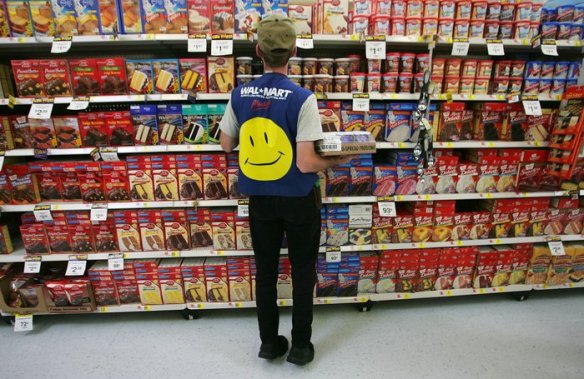
Seeking Happiness Beyond Neo-Liberal Consumerism

(Photo by Chris Hondros/Getty Images)

By Graham Peebles

Source: Dissident Voice

Irrespective of nationality, religion, race, or gender; whether stinking rich, desperately poor, or somewhere in between, happiness is the one thing everyone is seeking – consciously or not.

The architects of the socio-economic system in which we live have devised a system that promises to satisfy this yearning. But instead of building a society at ease with itself, full of peaceful, happy people, collective discontent is fed, resulting in a range of mental health issues, and in some cases, suicide.

Happiness, according to the duplicitous devotees of Neo-Liberalism, is to be found in the homogenous shopping centers of the world, the sterile holiday resorts and brash casinos. In things, in products and services that stimulate and excite: Happiness in this perverse paradigm has been replaced by pleasure, love exchanged for desire, choice substituted for freedom.

Echoes of happiness

Happiness that lasts is what we yearn for, not a transient state in which one feels the tingle of happiness for a moment or so, only to see it evaporate as the source of our happiness loses its appeal, or is exhausted — the holiday comes to an end, a relationship breaks up, the gamble doesn’t pay off, a new I-Phone or handbag hits the high street making the old one redundant etc., etc. We sense that a state of lasting happiness is possible but know not where it is or how to find it. The mistake commonly made, and one we are constantly encouraged to make, is to search for happiness within the sensory world where all experiences, pleasant or unpleasant, are facile and transient. The inevitable consequence of such shallow encounters with happiness is discontent and frustration.

Despite being repeatedly confronted with disappointment, instead of refraining from this never-ending quest, the searcher becomes increasingly desperate; a new relationship may be sought, a change of job or new home, more shopping outings, dinners planned, alcohol and drugs taken and so on into the darker reaches of sensory satisfaction and hedonistic indulgence.

Of course, it is important to enjoy life, and, yes, something resembling happiness is experienced on these excursions, but it is a happiness dependent on something, other people, and on certain elements being in place: take these away and the “happiness” very quickly evaporates. Such happiness is a mere echo of ‘True Happiness’, and one that carries with it conflict, fear and anxiety; this taste of happiness, functioning via the desire principle and the medium of the senses is relentlessly stoked by the exponents of neo-liberal idealism.

The success of their divisive project; i.e., profitability, growth, development, progress, call it what you will, is totally contingent on consumerism and the act of consuming relies on, and is the result of, perpetual desire. To their utter shame, despite having a responsibility to create the conditions in which ‘True Happiness’, can be experienced, most, if not all governments collude with corporate man/woman to promote the unhealthy, materialistic values that are the source of unhappiness.

Desire is constantly agitated through advertising, television, film and print media; fantastical, sentimental, idealized images, of not just where happiness lies, but what love looks like, are pumped around the world every minute of every day. The aim of this extravagant pantomime is to manipulate people into believing they need the stuff that the corporate-state is selling in order to be happy. But happiness cannot be found within the world of sensations, pleasure yes, but not happiness, and pleasure will never fill the internal void that exists and is perpetuated through this movement into materiality. Pleasure is not happiness, nor does it bring lasting happiness, at best it creates a false sense of relief from unhappiness and inner conflict, a momentary escape before dissatisfaction and desire bubble up again.

Cycles of discontent

Nothing but discontent is to be found within this endless cycle of desire, temporary satisfaction, and continued longing. It is an insatiable, inherently painful pattern that moves the ‘Seeker of Happiness’ further and further away from the treasure he or she is searching for, creating disharmony and conflict, for the individual and society. Add to this polluted landscape competition and inequality and a cocktail of division and chaos emerges: Competition between individuals and nations separates and divides, working against humanity’s natural inclination towards cooperation, sharing and tolerance; qualities that were crucial in the survival of early man.

Competition fosters ideas of superiority and inferiority, and together with conformity, an image of ‘success’ and ‘failure’, of beauty, and what it means to be a man or a woman, particularly a young man or young, is projected and thrust into the minds of everyone from birth. One of the effects of this is the tendency towards comparison, leading to personal dissatisfaction (with myriad symptoms from self-harming to addiction and depression), and the desire, or pressure, to conform to the presented ideal.

At the root of these interconnected patterns of discontent and misery, lies desire. Desire not just for pleasure, but desire for things to be other than they are; it is this constant movement of desire that creates unhappiness and deep dissatisfaction. If desire is the obstacle to happiness, then all desire needs to be negated, including the desire for happiness. Perhaps the question to be addressed then is not what will bring lasting happiness, but how to be free of unhappiness and discontent.

In ancient Greece, where life was hard and happiness was widely believed to be reserved for those rare individuals whom the Gods favoured, Socrates (470 BC – 399 BC) proposed that happiness could be attained by everyone by controlling their hedonistic desires, turning their attention towards the soul and by living a moral life. His view finds its root in the teachings of the Buddha, who, almost 100 years earlier had made clear in the Second Noble Truth, that far from bringing happiness, desire is, in fact, the cause of all suffering, and further, that freedom from suffering and unhappiness is brought about when desire is overcome.

True Happiness is an aspect of our natural self. It will not be found within the world of pleasure and material satisfaction, comfort and indulgence. It is an inherent part of who and what we are, and in principle at least, the possibility of unshakable happiness exists for everyone, everywhere, irrespective of circumstances.

10 Life Lessons I Learned as a Psychiatric Nurse – and Patient

By Cortland Pfeffer

Source: Wake Up World

Over the past 25 years, I have been immersed in the mental health and addiction system as a patient, later as staff, as a Registered Nurse (RN), and eventually as a supervisor. My time in the mental health system officially began at age 17 when I was first hospitalized in a psychiatric unit. This preceded further hospitalizations, a number of treatment episodes for alcoholism/addiction, along with multiple stints of incarceration in jails. Eventually, through this experience, I was able to embrace recovery and ultimately gain employment at some of these same facilities in which I was treated.

Often I am asked about how I went from being a psychiatric patient and homeless drug addict to being a registered nurse and a supervisor at some of these facilities. While there is no magical answer to that question, there certainly have been some valuable life lessons learned along the way. These are 10 of the life lessons I have learned over time, which allowed me to continue on this journey.

1. If you are naturally different than the majority, you will be labeled.

It is our nature to want to try to fit in with the tribe. It can be lonely when you feel like you are different from other people. When you are not like the majority, others will notice this and try to get you to fit in to this box of normality. But defining “normal” is an impossible task. It is defined as conforming to a standard. However, this standard changes with different cultures and time periods. What was once normal, is now insane. Today we clearly live in an insane society – one in which we favor materialism over that of our fellow man; one in which there is more public uproar over a sporting event than the humanitarian crisis in Aleppo. To be “normal” in this type of society would actually make one insane. Yet, when you don’t follow the mold of a brainwashed culture you get labeled as different.

This can be quite destructive as Erich Fromm points out in his 1941 book “Escape from Freedom” as he highlights how people are drawn to authority as it is safer to go along with the pack than to think independently.

We go along with the societal norms for harmony, acceptance, and belonging – which are also innate human desires. Each human has a desire to feel a sense of community and purpose. However, when we go along with the group – even when it is violates our personal beliefs just for acceptance – it causes us to believe that something is wrong with us for thinking differently.

Solomon Asch tested human’s conformity in an experiment in 1951. Over the 12 critical trials approximately 75% of participants conformed at least once; and 25% of participants never conformed. In the control condition, the participants were asked to write down the correct match between the lines without sharing their answers with the group. The results showed that the participants were very accurate, giving the correct answers 98-percent of the time. This is one of many studies that show most people will go along with a crowd, even if it is not what they believe. So what happens if the tribe has decided that there is something “wrong” with you? Science will show that most of us will go along with that.

However this is a mistake. Take a look at the bell curve, which is used to show “normality distribution.” The bell curve is used in many areas of life and can be used here. In many bell curves, you see that 95-percent are within two deviations from the mean, or average. On the very end you will always see 5-percent of people. They are at the extreme end and do not fall inside the box of “normal.” It doesn’t make you bad to be outside the norm, and it also doesn’t make you crazy or sick. In fact, I would argue that those on the extreme ends are the ones that have changed the world.

For example, Mahatma Gandhi did not fit inside that box. The “norm” of his time was to accept the British imperialism in his home country of India. He saw the injustices and spent his life trying to free his people from oppression. He was imprisoned and survived many assassination attempts (although one finally killed him). Likewise, Martin Luther King Jr. also saw the injustices of African-Americans were facing in the United States and stood up to the oppression. They both went against the norms, were labeled, judged, and eventually lost their lives for speaking against the status quo. They both ended up dead, but years later we realized they were speaking the truth against an insane society.

Other people’s labels of you are just that — other people’s labels. It is out of fear and ignorance. Do not adapt to other people’s expectations. The world needs people of all sorts. We need diversity.

If you closely take a look at the criteria for someone who is gifted versus someone who has ADHD, Bipolar, Aspergers, and many other mental health diagnosis you will see that they are almost identical. So whether you are called bipolar or gifted doesn’t depend on you, but rather on the so-called expert assessing your life. It is all about perception and none of it matters. All that matters is that you are your most authentic and true version of yourself.

2. We as a society create mental health and addiction.

There have been numerous studies that have exposed the fact that trauma as a child leads to neural chemistry changes in your brain. Childhood trauma has been called the smoking of mental health. The same way smoking can cause or invoke many physical diseases, childhood trauma and maltreatment does the equivalent for mental health and addiction.

There are higher relapse rates for hypertension and heart disease than there are for addiction and mental health. However, we often treat the addict like they are a bad person or making bad choices. So we are taking someone who has been traumatized and often did not receive treatment for their trauma and we punish them by locking them up. This creates more shame, exasperating the trauma and causing the cycle to repeat itself. Additionally, the patient is not going to be readily willing to seek help in the first place due to the aforementioned shame.

What if we had a cancer drug that works 10-percent of the time and made people sicker? We would throw the drug away! However if a treatment center has a 10-percent success rate for addiction or mental health they’re considered successful. What other business could be 10-percent successful and would continue to exist?

The addiction and mental health industry continue to grow, despite this complete lack of success. There are extremely high rates of recidivism in these fields. Speaking from personal experience, more often than not the patients get sicker while in treatment.

The staff then blames this lack of success on the patient. They point fingers and say that the patient “was not ready” or that they have “poor insight.” The site that failed to provide adequate treatment blames the victim and takes no responsibility for their failure.

This system only continues because too many people are making too much money off keeping people sick. The staff tends to be undertrained, under-qualified, and lack any meaningful or diverse life experience. They are trained to believe that their patients are bad people that are making bad choices instead of a sick person who has been traumatized. This obviously results in receiving much different treatment.

Now there are some absolutely wonderful people in this field. That is a fact. However, in general there is an overall lack of humanity and compassion in the way this population has been treated. We are the most incarcerating society in the history of mankind and most of these prisoners are there for harmless drug offenses.  Due to this influx of incarcerations, we have created for-profit prisons which rely on mass incarcerations for profit. They set up contracts with governments to guarantee high occupancy rates and spend millions of dollars lobbying to congress to make tougher prison laws to ensure they stay profitable. In turn, members of congress then hold stock in these private prisons – meaning that the people that make the laws are making money off the laws they sign into action.

We are locking up people who have a disease to profit the rich. Punishment does not work for this disease – it never has and it never will. If it did work, we would not have a this astronomical recidivism rate in jails for drug offenses.

3. Be true to who you are.

We run from who we truly are because we are told to by our environment. We are told that it is not okay to be our true self from the time we are young and we begin to believe it to be true. We spend our whole lives living for other people and living based on other people’s expectations. We eventually lose ourselves and create a false persona (or false self) – This is what I refer to as “The Mask”.

The longer we wear the mask, the more we forget who we are underneath. We start to think that we are our masks – the character that we present to the world for acceptance. As this continues, we grow to dislike our mask because it is not our true self. This leads to depression, self-hate, or even suicidal ideation. We think we hate ourselves, but in reality we hate this false self that we have created. When we go against our own nature, it will always create depression.

If you have forgotten who you are, it’s easy to remember. You know the truth by how you feel. If you want to remember what that feeling is like, simply go do something that is pure, genuine, and has good intentions and see how that feels. If you can do something for somebody that can never repay you, you will remember this feeling – that is the feeling you are seeking.

Some of us may not even know who we really are because we’ve been wearing this mask for so long. In that case you get to explore and try new things. You get to discover who you truly are and what makes your soul feel alive. This can be viewed as an obstacle or an opportunity. You can now try everything – writing, dancing, singing, etc. – try anything you desire and you will find your true self in the process.

You will find out who you were, before the world told you who you were supposed to be.

This concept can be frightening, especially if we have become too accustomed to the mask. Some will do anything and everything to put the mask back on for safety, security, and possibly they are benefiting from pretending to be their false self. Although, in the long run it will create more inner dissent.

The world needs you to be you. Your true self fits into the world exactly how it should. When we go against this, we are robbing humanity of the gifts our true selves possess. Albert Einstein said, “great spirits have always encountered violent opposition from mediocre minds.”

It can be scary to finally be yourself. You will likely start feeling rejected and you will lose some people. But those are the people that you want to lose. You will also gain people in your lives – the ones that love the true you and not the false you.

This is a change that is painful and it causes most people to go back into their false self (ore put their mask back on). However, this is an essential struggle that you will encounter on your way. It will turn your world upside down and your relationships will change.  But as the old saying goes, “it is better to be hated for who you are than to be loved for who you are not.”

You are only doing a smidgen of what you are capable of doing by being your true self. You have no idea what you’re capable of until you embrace who you are and you will be blown away by the results.

4. Fear destroys us; and makes others money.

When we are not ourselves, then our lives are being lived and based on fear. When we are always afraid, it is from remembering pain or trauma. Just like any animal, when we are afraid we will hide. We live in a society in which many people benefit of us being afraid.

We are evolutionarily programmed to remember the negative experiences at a much higher rate, more clearly and more intensely, than positive experiences.

Many businesses profit off of our fear. The news gets higher ratings when they show fights, violence, and all the things that are wrong with the world. So that is what they show and that is what we see. They are not showing a true representation of the world, but a sample size that spreads fear and increases ratings. This is paid for by commercial advertisements that spend millions of dollars by spreading fear into your mind in an effort to buy their product. They will tell you might get bitten by a snake, so you need to buy a fence to keep the snakes out. They tell you to buy material items to fit into society or you will be left out and not included. When the fear does not go away, we continue to consume more. And it never goes away until we realize that we are being played.

“If tomorrow, women woke up and decided they really liked their bodies, just think how many industries would go out of business?” – Dr. Gail Dines

Our insane society has created these masks and then they profit off these masks they created. Then you are labeled as insane if you don’t want to wear your mask anymore. Because when we take off our masks, they lose business.

What goes into your brain will affect your subconscious mind. If you feed it with fear, it will seek fear. If you feed it with love, it will find love. The opposite of living in fear is living with love. Love is the antidote to fear.

When you live with love, you will be faced resistance from those still guided by fear. But remember, in the end, throughout history, every single time love always wins. There may be a time it seems this is not true. But it becomes a crucial point in your recovery when you decide to choose love over fear if you are going to succeed. Every person going through a true recovery will come to this stage and it is scary, it is lonely, and it is supposed to be. It takes immense strength to love when everything inside of you tells you to run away. Once you make it through this stage, you have reached a turning point and the mask begins to crumble.

5. Love, acceptance, and truly listening is far more powerful than any advice you can ever give someone.

We have all seen someone struggling and we want to fix it. Usually we want to fix it the way we would fix it for ourselves if we were in the same struggle. We tend to go in and tell people how to change. Although well-intentioned, when we do this, we begin to lose them. Everyone is different, and every recovery is different. Every mask is unique, and therefore every mask removal must be unique.

Relationships are the single most important thing to someone going through a recovery. You can have the cure for them, but if they do not trust you, they will not hear it. They do not care how much you know, until they know how much you care.

Accepting people for who they are and where they are at in their life will go further than any piece of advice you can ever give them. Giving someone love and a hug when everybody else is kicking them is what I call “psychological life support.”

I had two people that did this for me and they saved my life. Not those who criticized me and tried to force me into treatment. It was those who offered unconditional love and acceptance who kept me alive. Unconditional, meaning without conditions/judgments, but just loving them and accepting them in their entirety with no desire to change or point out their flaws. When I was ready to change, I went to the same people because I had gained their trust.

Relationships come first. If you cannot build a relationship, a trusting relationship, then you will only do damage. I believe many staff in this field are well-intentioned, however they make these problems much worse and the patients get much sicker simply because there is a lack of acceptance, love, and an overabundance of advice giving and fixing.

Trust me, if there was an easy-fix, the person would have already done so. In rushing to fix a person, you are sending the message that they are incompetent and could not think of this on their own. A broken person doesn’t need to be fixed, they need to be loved, then they are able to heal themselves.

When I say listening, I mean being present completely with that person. This means not checking your phone, not looking at the clock, and not even thinking about anything else. This is referred to as active listening. The ten people I think are the best in this field all do this. They make the person they are with feel like they are the most important person on earth in that moment. When the person can feel heard, the magic begins.

6. Embrace your struggles, they are gifts.

When I see a patient walking around a treatment center saying “everything is fine,” “everything is ok,” or “I’m doing great,” this becomes a giant red flag. You should be struggling. Muscles do not grow without struggle and the same goes for our soul.

Since we were young, we were trained to believe that admitting to a struggle is a sign of weakness, but in fact it is a great strength. We are all going through a struggle. We should be working on the thing that is the most difficult for us for optimum growth. The thing that you are most scared to do is probably the thing that is most essential to your recovery.

If you are in pain, if you are crying, if you are scared, then you are growing. If you are questioning why you are there, or why you are going through this, or questioning your own sanity, then you are growing. If you are angry, if you are tense, if you are isolating, then you are growing.

If there is no struggle, there is no growth. If there is no growth, there is no recovery.

Everything in my life in which I thought would be my demise, ended up being the very best things in the long run. We see a small portion of the big picture and act like that’s the reality, when it’s not. We must trust the process and trust in the bigger picture. Without the illusion, there would be no enlightenment.

There will come a time that you will think this is not worth it and feel like giving up. This means you are getting close to breaking through. We usually give up right before the miracle happens.

There is not one magical moment where you reach some mountaintop. It usually takes two steps forward, followed by one step back. It is a continuous, non-linear process. It is like a newborn baby deer trying to learn to walk. Their feet are wobbly and they fall down often. Falling down is not the issue, it is the learning process that makes you stronger and not having shame about the fall. It is about being around people that do not judge the fall.

The only way through the pain you have is to deal with it. There are many things we have hidden inside ourselves through the years because of fear and using the mask. Sometimes it may be for years, or decades, but all things eventually rise to the surface and all your pain is revealed. But that is the only way that it can be healed is for it to come to the surface. It cannot be healed when it is buried.

Let the storm come. After the storm comes the rainbow.

“Life isn’t about waiting for the storm to pass; it’s learning to dance in the rain.” – Vivian Greene

7. Our subconscious is what drives us.

We have two parts of our mind – the conscious and the subconscious. The conscious is all of which we are aware. The subconscious is the part that we are not aware, but all the millions of things we process daily and store away.

Our brain cannot tell if what is in our subconscious is true or not. It takes everything in as fact. It is like a hard drive that receives commands and stores everything as fact. It is built by other people and society – parents, siblings, teachers, television, pop culture, advertisements, etc. If we grow up being told that we are “bad,” our subconscious processes it to be true.

Everything is a perception and not reality. However, as different things start to play out in our conscious mind, then the subconscious files come to the surface to back it up as “evidence.” This creates stronger files in our subconscious mind. These files in our subconscious mind are what drives us; not what we are consciously aware.

As young children and even as adolescents, our brains are flooded with gray matter. This is the part of our brain that can be molded and create the person we are to become. This is what shapes the subconscious mind which will determine what drives us for a lifetime. If someone is told they are bad, lazy, incompetent, then they will be driven by this. If someone deals with pain, torture, trauma, and abandonment, they will be drive by this as well.

The good news is we can change the subconscious mind by implanting new messages. It is flexible, but it takes time, practice and patience.

Additionally, some of us will be more affected than others by these messages. Some people are naturally more sensitive, more prone to trauma,  and more prone to take things too personally.

We are all born with an innate temperament that lasts our entire lives. That would be like if a couple people were eating a pizza. One person takes a bite and it tastes lukewarm to them; but the other person burns their mouth and complains as to how hot it is. The others would not believe it to be true.  However when it comes to emotions, we can’t see anything, the scars or burns are invisible. So we are told that it is not real and our emotions are crazy, in which we believe to be true. This only further pushes our true selves down and creates more negative self-talk which creates files in the subconscious.

This leads to the most sensitive, warm, kind people in our society being invalidated and told they are “babies” for feeling and caring more than most. We tell them that they are not right when inside they are going through a trauma.

But if a young boy acts out in anger instead of crying, that is more acceptable in our society. That is one form of a mask that is created and is prevalent among young men. Then with this mask, and all masks, comes depression from not being your true self from going against nature.

That’s the inner voice, it is the subconscious.  It is strong but it may not even be true. The only way to combat this is to start telling yourself positive things (affirmations), surround yourself with positivity, changing your perceptions of the world (cognitive behavioral therapy), focus on the positive things in life (gratitude). This starts to build more positive files in your subconscious which drives you out of despair and into a positive direction.

We all are born pure, and with nothing but love in our hearts. This is often taken from some of us by a combination of temperament, environment, society, and trauma. We eventually believe that we are not good at our core. But we are. We can change our subconscious by what goes into our brain daily. This takes persistence and daily practice, and it is hard when we are used to thinking negatively about ourselves. However, this out of everything is probably the key to sustained long-term recovery- dealing with that inner voice and changing our thoughts.  It will seem foreign at first to say “I’m a good person.” If you are going to make it, you have to start doing on a daily basis. You can replace those files just like your body replaces every cell in the body every seven years. Soon those old files will be gone and the new positive files will be your subconscious.

8. Who you surround yourself with is one of the most important decisions you will make.

I have heard many wise people say that we are the average of the five people we spend the most time with. As I said above, that directly affects our subconscious and what we think of ourselves.

I remember years ago my oldest daughter enrolled in a private school. Everyone in the school was Catholic and she came home and believed in her inner core that the entire world was Catholic. She cried about it at night that she was different because she did not go up to get the fake bread at their ceremonies. Similarly, if you are around five people that smoke pot and you do not smoke pot, then you are the weirdo for not smoking pot. However, if you are with five people that do not smoke pot and you do, then you are considered strange for smoking pot.

At the end of the day, if you are around negativity — eg. those who consider you strange or different — it will eventually influence you.

Now some negativity can be good if you’re an overly positive person and turn a blind eye to all negativity because that is also unrealistic and can actually benefit the person. Also, being angry can help mobilize and motivate you to change. People who are totally happy and content at all times are never the ones that change the world – see Martin Luther King Jr. and Gandhi. It is those that are healthy discontents that create change.

On the flip side, if you only are surrounded by negativity it will suck the life out of you. Likewise if you are around a bunch of people who believe that you are a bad person, be that your family, friends, or relatives, then that’s going to creep right back into your subconscious and you creep right back into old patterns. Soon you believe that pattern as real.

You cannot do this alone. It took many others to help us put the mask on, and it will take others to help remove the mask as well. I came across five amazing people that helped change my life and save it.

Part of recovering is making the effort to be true to yourself. Once you can do this, you will find yourself in others. You start to see that all of life is a synchronicity. You will suddenly be around people who can help you and you have to be willing to accept help and make yourself vulnerable. If you cannot expose yourself and be vulnerable to these good people, then you will fall.

Vulnerability allows others to lift the mask.

You have to start all over sometimes; that may even mean leaving your family and lifelong friends. It is terrifying, but you will find new people that embrace your true self, whereas your friends and family have only got to know your mask and are not ready for your true self. You’ll find that people who you thought were close friends really were not; and people who you thought were not your friends actually were. You find out everybody’s true character when you go through this. It’s a gift in that way as well. Someone you may not have associated with five years ago, you’ll love them when you are your true self. This just means that the transformation is happening.

9. You must learn to truly love yourself or you will not make it.

I wrote earlier about being your true self and that is completely different from loving your true self. There is a reason we wear these masks and have these false selves. It is because we think that at our core, we are not OK. Then we start to be ourselves, but also seek to make changes. We have to 100-percent, truly, genuinely love our true self and embrace it or we will eventually slip back on our masks.

This is the often overlooked Steps Six and Seven of the 12-Steps. We are removing the parts of ourselves that are not true and keeping those that are. However, we get confused at this point because we feel that part of ourselves is flawed.

But, that is impossible! Every single person is perfect at their core. You do not have any flaws. That is a lie created by society. Every person is perfect and once you find your true self you will see this to be true.

Which is why, when you are finally being yourself you are likely going to be mocked, ridiculed, and teased. It begins to seem much easier to revert back to old ways (the mask). It is hard when you have run your whole life and been afraid. Then you start to be yourself and people start teasing you or pushing you away. You must realize that this has nothing to do with you and has everything to do with them. If somebody loves you that usually has more to do with them than you; and if somebody hates you that has more to do with them than you.

I remember when I had to have a psychological test done, I had to have my four closest people fill out a form and I figured it would all be the same answers that they gave. I got four completely different forms with four completely different sets of answers. Others love us based on their perception of us or they hate us based on their perception of us, none of this is reality – but it is reality to them.

What matters is what we think of ourselves. If we love ourselves, we will glow and other people will be drawn to us and some will be drawn away from us.

“The ego says, ‘Once everything falls into place, I’ll find peace.’ The spirit says, ‘Find your peace, and then everything will fall into place.’” – Marianne Williamson

10. Whatever you do, if you do it with love in your heart as your intention, you cannot go wrong.

The world is full of opinions. Everyone has the answers. You can’t do this, or you shouldn’t do that. People can show you evidence about why they are right and why you are wrong. Everyone will tell you how to handle your recovery and how to handle every situation in life. When we are listening to other people instead of our true selves, we are going against our own truth and against our own nature.

There is no right and wrong. We used to think smoking was okay for you and doctors advertised it. We used to think the world was flat. We used to think Columbus discovered America. There is no truth, there is only perception. You must do what your true inner self believes. Your mask is unique so your mask’s removal is going to be unique. The one thing that is common for all mask removals is connection and love. Science and studies have found out that we are breathing the same air that people breathed in and breathed out thousands of years ago. The air we breathe is composed of mainly nitrogen, gas, and oxygen gas. Very little is lost in space, and only occasionally is there a new source of carbon or oxygen introduced into this planet. So every breath you take has atoms that have been here for billions of years.

There was a computer program set up in various spots around the world. It would shoot off random numbers, there was no pattern ever seen for years. This is called a Random Number Generator. However when the September 11th attacks happened, or other moments that human consciousness became coherent, things changed. For instance, in the case of a severe tragedy in which all humans are thinking about similar things and having similar emotions, all the numbers become structured and organized. They show an unpredictable sequence of ones and zeroes. The odds of this happening by chance is one in a trillion. How is this possible?

Every single thing you can see around you — the rocks, the birds, and the trees — all are comprised of the same atoms. They are just expressed differently — yet intricately interconnected. Whatever you do and whatever decisions you make, if you do it with love as your motive and if your intentions are pure with love you cannot be wrong. So know your intentions and know your truth and embrace it. You were born with a light that others have tried to dim with a mask, let your light shine again and take your mask off. Humanity needs the gift that your true self possess.

Taking the Mask Off: Destroying the Stigmatic Barriers of Mental Health and Addiction Using a Spiritual Solution

Taking the Mask Off” is the new book by Cortland Pfeffer and Irwin Ozborne. Cortland Pfeffer spent years as a patient in psychiatric hospitals, treatment centers, and jails before becoming a registered nurse and working in the same facilities. Based on his experience, this story is told from both sides of the desk. It offers a unique and valuable perspective into mental health and addiction, revealing the problems with the psychiatric industry while also providing the solution – one that brings together science, spirituality, philosophy, and personal experience.

“Taking the Mask Off: Destroying the Stigmatic Barriers of Mental Health and Addiction Using a Spiritual Solution” is available on Amazon, and Balboa Press.

4 Theses on Depression and Radical Praxis

wip-draft-of-the-prison-of-the-mind-by-blacksmiley

By Sophie Monk and Joni Cohen

Source: The Fifth Column

Depression is political. As mental health service funding is steadily cut and suicide and substance abuse statistics rise, it is becoming increasingly obvious that depression is a condition of the political situation under which we live. In a UK context, austerity has mobilised a technique of responsibilisation functioning at every level of society to justify the catastrophic fallout of the regime, from healthcare to unemployment. Mark Fisher has written resonantly in his essay Good for Nothing about how as a generation we suffer from a kind of collective imposter syndrome, convinced simultaneously of our complete lack of worth and that any recognition of our worth is mistakenly given. And yet the message constantly reinforced by the ruling classes is that the class system our parents were born into and lived through has dissolved, making way for a world of frictionless social mobility, where the only blockages to success are from within ourselves. We are stuck in a tragic cycle of unfulfillable desires produced by capital; we are “a population that has all its life been sent the message that it is good for nothing [and] is simultaneously told that it can do anything it wants to do.”

And so we find ourselves in a situation where a huge majority of the people we know and love are engaged in fraught attempts to cope with chronic and severe depression. This community to which we refer also tends to understand itself as engaged in an antagonistic relationship with capital, the state, and other forms of social power. Taking Fisher’s key propositions on both how it feels to be depressed and where depression comes from as our reference points, we want to formulate an understanding of the relationship between depression and radical praxis that can be directly applied within our organising communities.

1. Depression can and does affect our capacities to give to struggle and each other.

For those of us who suffer from depression, organising can be hard. It is also inevitable that once struggle reaches a certain fever pitch, violence and traumatic backlash follows, and we become painfully aware of the manifold ways in which we are policed, surveilled and disciplined. At this point, continuing to fulfil one’s action points, attend regular meetings, and put oneself through further confrontations with the state can feel as impossible as going to the job centre, or turning up at your 9 to 5. It’s a basic point, but the important thing to acknowledge here is that depression is incapacitating, and that we must learn to live within our capacities or risk worsening our conditions.

2. Medication has the potential to both pacify and galvanise us.

According to a report by the Health and Social Care Information Centre, the number of anti-depressants prescribed to people in England doubled between 2006 and 2016. While so many of us share this experience of medicating with prescription drugs, it is astonishing how little we actually talk about the ways in which this chemical intervention affects our bodies, emotions, and even our struggle.

There exists a dogma on the left that anti-depressants form part of a technique of politico-pharmacological control invested in the mass suppression of the negative and antagonistic affect necessary for struggle or revolution. In other words, psychiatry is thought to play a role in pacifying the masses, chemically inducing consent and tolerance of our conditions.

We believe this approach fundamentally ignores many important aspects of being on anti-depressant medication, and also misinterprets the affects required by anti-capitalist struggle. Certainly, the experiences of chronic fatigue and a general restricting of the range and intensity of emotional experience can lead us to invest less of ourselves in revolutionary politics. But the demand for radicals to always be immediately and fully emotionally present in anti-capitalist struggle is strangely purist and misses the key point that, at times, a reprieve from the highs and lows of depression can actually provide us with the emotional distance required to participate at all. To share from our own personal experiences: while physical confrontation with the police has in the past quickly become unbearably traumatic and overwhelming, the dulling of the senses by SSRIs has in actual fact proved advantageous to dealing strategically with situations as they escalate. This represents a possibility of a weaponisation of the collective depression that we suffer; using the medication that we require because of our conditions, to in fact enable us to struggle against those conditions. We should develop a more nuanced thinking of pharmaceuticals and resist conflating them entirely with the grimy fingers of corporate power.

3. Mental illness is a relation between individual pathology and social conditions.

This article is first and foremost a set of propositions for how to approach radical anti-capitalist praxis in an age of mass depression. And yet, these notes are not the first of their kind, but emerge from and in response to a long melancholic tradition of understanding mental illness. This Adornoian approach, which Rosi Braidotti has attributed to the “melancholy brigade”, forecloses the possibility of joy in struggle, arguing instead for the nobility of depression, figuring depression as a state of enlightenment akin to accessing the radical truth of one’s lived conditions, rather than a state that is induced by them, with the possibility of amelioration.

We want to move away from this anti-psychiatric position and instead embrace a paradigm of mental illness that acknowledges the relation between individual pathology and social conditions. Depression often feels like a terrible, unmoveable weight, pushing down, crushing the air out of us – a literally depressing sensation. But this is not to say that there are not different techniques for coping and managing its effects, nor that we shouldn’t endeavour to find them. To take this point a step further, we want to argue that it is the responsibility of radical communities to foster ecologies of care in which both the dictates of formal psychiatry and the anti-psychiatric melancholy brigade are circumvented. In practice this may look like the setting up of medication cooperatives and voluntary crisis teams, as well as collectively enjoying social activities and downtime, which is fundamental to the reproduction of our struggle.

4. We need to re-structure our organising practices to not only accommodate but deal therapeutically with mental illness.

Mental illness accessibility strategies in political organising, insofar as they are implemented at all, follow a logic of an add-on, as opposed to a fundamental restructuring of the way we organise. We drop out of organising for periods of time, take breaks to heal, and this is finally being accepted as valid and needed. But nonetheless it is expected that the activism machine will keep on ticking along without us and its progress must remain unhindered by the mental illness that its participants suffer. This logic fundamentally misunderstands the role that depression can and should play in our radical praxis. We need to recognise that mental illness is not simply the state that prevents us from struggling effectively, but rather is the position and condition from which we collectively struggle. Struggle doesn’t happen in a stratum of health that we intermittently drop out of into a nether world and eventually (hopefully) return to, but struggle must be located within the realm of illness. We must transform our organising to be such that it aims at therapeutic goals simultaneous to and embedded in its more traditionally political goals. Organising must be self-sustaining and as such must be a life-producing and therapeutic praxis that incorporates depression rather than abjecting it.

Something Is Happening

collapse-era

By William Hawes

Source: Gods & Radicals

SOMETHING IS HAPPENING HERE, but you don’t know what it is: Do you? No one knows, really, as this something is still evolving. As we look back to 2016, though, it is abundantly clear that history has awoken from its slumber. We’ve had a couple events in the West last year: Brexit and Trump.

Politically-charged, dynamic events (as Alain Badiou might define them) have been rare in the West since the fall of the Berlin Wall and the disintegration of the USSR. Capitalism made it seem as if neoliberalism was winning in the 1990s, even as the US wantonly murdered in Iraq and took perverse pleasure in helping to dismember Yugoslavia, among other things.

In fact, one could argue there have only been four notable Western political events in the post-Cold War era: the 9/11 attacks, the 2003 protests against the Iraq War, the 2008 banking crisis and following protest movements of 2011 (Occupy and 15-M Movement), and the populist, anger-driven aforementioned events of 2016.

You see, authentic, spontaneous political events (in the form of uprisings or popular revolts against the elite) are a no-no in the West. History is supposed to have ended, remember? Max Weber called this the Iron Cage, and for good reason.

Now, though, the meaninglessness and rootlessness of our lives trapped inside the cage have become too obvious to ignore, for most of us. As each day passes, our political discourse glosses over how lazy, ignorant, mean-spirited, and numb our society has become. We import luxuries from all over the globe, but can’t be bothered to cook or grow our own food, assemble our own electronics, expand renewable energy projects, provide clean water to inner cities, organize high-speed transport, or educate our youth without drowning them in debt, etc.

So, many have lashed out against the system, and our more vulnerable members of society, in anger, defiance, out of sheer ignorance. Could it be because, deep down, we know how helpless, sheltered, and out-of-touch our society is, compared to the rest of the world? What are the root causes of this disintegration of public discourse?

One cause is our utter dependency on the capitalist system to clothe, feed, and shelter us. What we used to inherit from our mothers and fathers, important agricultural knowledge, artisanal and cultural wisdom, a sense of place and belonging, have all been traded in for money, the privilege to be exploited by capitalism, toiling in jobs that alienate us from ourselves, families, the Earth. Paper bills and electronic bank accounts are a pitiful substitute for self-reliance. This loss, this grief, isn’t allowed to be expressed in public. Logical positivism tells us that progress will prevail, the future will be better than the past, and anyone who thinks otherwise must be some sort of Luddite.

Since real income has fallen and social services have been slashed in the last 40-plus years, many have seen their loved ones’ lives cut short (lack of access to health care and quality food and produce, air and water pollution), their dreams defiled (steady jobs gone, factories shuttered), their entertainment homogenized and dangerous (sports mania has become normalized, “Go Team!”, alcohol, painkiller, and opiate addiction is rampant), their hopes for the future shattered (community and public space swallowed by corporations).

There are those, as well, still too plugged into the system (both Trump and Clinton voters), too attached to their gadgets, to the hum of their slave-labor appliances, to the glow emanating from their screens. They will cry incessantly about the turning away of Muslims from flights, but there is only silence for the millions killed abroad by the US war machine. Mainstream liberals are just as likely as the meanest, most selfish conservatives to fall prey to emotional pleas, demagoguery, and pathetic attempts to see themselves as victims in this Age of Anger.

The urge to resort to the myth of a righteous, homogenous, “pure” social group, to denigrate the other, is strong in such dire, despondent situations. In America, though, material poverty cannot be said to be the only, or even the main causal factor, behind this return of nativism and tribalism. Rather, it is undoubtedly a spiritual malaise that has swept over the West. Ever since the rise of the Industrial Revolution, it has been technology which has provided the underlying weltanschauung for our culture. Sprouting from this, an inhuman and Earth-destroying morality has formed. Jacques Ellul explains:

“A principal characteristic of technique … is its refusal to tolerate moral judgments. It is absolutely independent of them and eliminates them from its domain. Technique never observes the distinction between moral and immoral use. It tends on the contrary, to create a completely independent technical morality.” (1)

Thus, Western society, through the use of mass-produced electronics and disseminated in what some call our “Information Age”, has now seemingly accelerated the pace of change and ecological destruction beyond the scope of any group or nation which could possibly control it. We are then confronted with the thought that only an economic collapse or series of natural disasters could possibly provide the impetus for revolutionary change to occur. This only leaves us feeling helpless, depressed, and passive in the face of government oppression and capitalist exploitation.

Not only that, but capitalism has quite literally dulled our senses and disconnected us from our source of being, planet Earth. Don’t believe me? Read this amazing paper on how Polynesian wayfinders discovered islands thousands of miles apart without any modern technology. This is part of what Morris Berman means by Coming to our Senses. To re-establish our unity with nature, the Western notion of an ego-driven, domineering and reductionist search for truth, meaning, and creativity must be thrown out. Here, Berman invokes Simone Weil:

“‘decreate’ yourself in order to create the work, as God (Weil says) diminished Himself in order to create the world. It would be more accurate to say that you don’t create the work, but rather you step out of the way and let it happen.” (2)

This isn’t really discussed among wide swaths of leftists, the social-justice crowd, or with mainstream liberals. It’s anathema to a materialistic, dead world where freedom has been traded for comforting lies, money has been substituted for the ability to provide for ourselves and our communities, and the abundance and resiliency (truly a miracle!) of the Earth is taken for granted as we chase our next fix for consumer goods, our next chance for drugs or gadgets to dim our perception.

What you’re not supposed to say in public, of course, is that our world is falling apart, and we are doing nothing to stop it. The reactions are too raw, the reality too grim, even as we know, for example, that 10% or more of the total species on Earth will be gone by 2050.

Yet we can do something: there is an opening now in political discourse which has been previously denied to us. The Republican and Democratic parties have thoroughly delegitimized themselves by offering up Trump and Clinton as their figureheads: these were widely considered the most widely disliked candidates in recent memory, if not the history of our republic. There is room for Libertarians, Greens, and Socialists to gain power: yet only if they avoid their own regrettable sectarianism, organize, and promote an inclusive, broad-based platform.

To do so, citizens will have to gain some perspective on their lives. A slow pace of life needs to be seen as a virtue, not a sin: many on the right and left are quick to denounce the hedonism of the jet-setting, parasitic globalists, the Davos men; yet refuse to see their own lifestyles and actions as smaller examples of such outlandish consumption.

If we are open to life and our environment as part of a greater whole, an unfathomable mystery, we can refuse our culture’s siren songs of death, misery, and destruction. While modern technology can be useful if reined in by an Earth-conscious, responsible morality, some things are better left unknown, undiscovered, if it risks destroying the Earth in order to find the answer. Rather than running a cost/benefit analysis to determine the land’s worth, some aspects of the planet and the universe are better Left Sacred.

Also, acknowledging our mortality, and accepting the basic fact that death could come for you at any moment, can liberate our souls and propel them to unimaginable heights. Joe Crookston explains this quite well:

“And then when I turn dry and brown
I’ll lay me down to rest
I’ll turn myself around again
As part of an eagle’s nest
And when that eagle learns to fly
I’ll flutter from that tree
I’ll turn myself around again
As part of the mystery”


Notes:
1.) Ellul, Jacques. The Technological Society. Vintage Books, 1964. p. 97.
2.) Berman, Morris. Coming to Our Senses: Body and Spirit in the Hidden History of the West. Simon & Schuster, 1989. p. 337


William Hawes is a writer specializing in politics and environmental issues. His articles have appeared online at Global Research, Countercurrents, Dissident Voice, The World Financial Review, Gods & Radicals, and Counterpunch. He is author of the ebook Planetary Vision: Essays on Freedom and Empire. You can reach him at wilhawes@gmail.com

SMARTPHONES, SOCIAL MEDIA AND SLEEP: THE INVISIBLE DANGERS OF OUR 24/7 CULTURE

cell-phone-addiction

By Martijn Schirp

Source: High Existence

If there is one book to read about our addictions to work, phones, consumption, and the current state of capitalism, it’s 24/7: Late Capitalism and the Ends of Sleep by Jonathan Crary, a professor of Modern Art & Theory at Columbia University. Crary argues that sleep is a standing affront to capitalism and while that seems grim, it highlights the very real dark sides of always having glowing LED screens clutched in our hands.

Technology has ushered us into a 24/7 state: we live in a world that never stops producing and is infinitely connected. We have digital worlds in our pockets, and we carry our phones and screens everywhere, feeding our dopamine addictions when we’re bored or lonely, cradling us before bed with endless scrolls of news and waking us up with notifications and emails.

The barrier between work and home life has disappeared, and most professionals are able to and choose to continue working all hours of the day in an increasingly competitive, winner-take-all environment.

Most of our time then, is either spent working or consuming (the upside of working so much is money, which is then used to consume): food, drugs, shopping, films, Youtube videos, Instagram feeds, news articles, updates from friends — even socializing-time has been reduced to a passive “Netflix & Chill”.

There are now very few significant interludes of human existence (with the colossal expectation of sleep) that have not been penetrated and taken over as work time, consumption time, or marketing time.

The social-world and the work-world are both digitized, which makes it increasingly difficult to distinguish between the two, and beyond the pop-ups and video ads, individuals have become their own marketers. Building a “personal brand” as a living is not uncommon.

It is only recently that the elaboration, the modeling of one’s personal and social identity, has been reorganized to conform to the uninterrupted operation of markets, information networks, and other systems. A 24/7 environment has the semblance of a social world, but it is actually a non-social model of machinic performance and a suspension of living that does not disclose the human cost required to sustain its effectiveness.

The average North American adult “now sleeps approximately six and a half hours a night, an erosion from eight hours a generation ago, and down from ten hours in the early twentieth century,” and what suffers most from this lack of sleep is our innate ability to dream. Most people tend to forget or don’t even think about their dreams, much less their extraordinary ability to control them. What is frightening about this is the prevalent attitude of accepting the current state of reality as it is:

The idea of technological change as quasi-autonomous, driven by some process of autopoiesis or self-organization, allows many aspects of contemporary social reality to be accepted as necessary, unalterable circumstances, akin to facts of nature. In the false placement of today’s most visible products and devices within an explanatory lineage that includes the wheel, the pointed arch, moveable type, and so forth, there is a concealment of the most important techniques invented in the last 150 years: the various systems for the management and control of human beings.

What may be the most important fact to remember: Nothing must be as it is. Here are a three ways to escape the never-ending 24/7 state:

Unplug Your Phone & Plug Into Your Imagination

Break your cell phone habit. The dopamine addiction is real. I keep my phone in a Faraday pouch, which blocks signals to my phone and keeps me to my rule of no cell phone or screen use one hour prior to sleeping and one hour after waking.

As “visual and auditory ‘content’ is most often ephemeral, interchangeable material that in addition to its commodity status, circulates to habituate and validate one’s immersion in the exigences of twenty-first-century capitalism,” it is important to focus on the power of our own imagination. The hierarchal and algorithm-driven fields of social media and newsfeeds tend to serve us things we already know or like, and keep us wanting.

Instead, we can explore the limitless field of our imagination. Write down your dreams in the morning and use them as a vehicle for self-exploration, or venture into lucid dreaming to manifest your own desires or to explore creative pursuits. And yet for most of us, when walking, during our daily commute, even sitting on the toilet or in any moment where it’s just us and our thoughts, we turn to our cell phones for comfort, to fill the silence:

One of the forms of disempowerment within 24/7 environments is the incapacitation of daydream or of any mode of absent-minded introspection that would otherwise occur in intervals of slow or vacant time.

Even when socializing with friends, it’s a common habit to check our phones again and again. I’ve found that when one person does this, it enables others:if I see someone sitting across from me at a dinner checking their Instagram feed, I’ll feel less guilty about doing the same. Make it can stop with you — turn off your phone.

Reevaluate Your Drug Habits & Addictions

Beyond digital dopamine, are you addicted to caffeine, sugar, alcohol, adderall, cocaine, Ambien, Lexapro, vicodin, etc., etc.? We live in a self-selecting society, where some drugs are perfectly acceptable as long as they are prescribed by a doctor and other drugs are deemed dangerous. I used to babysit for an eight-year-old who was fed Ritalin daily for his ADHD, and then at night, had to take a tranquilizer to help him fall asleep. He was speedballing throughout his childhood, and I’ve met others who had the same experience only to question the impact of these drugs on their personality and life-path.

There is a multiplication of the physical or psychological states for which new drugs are developed and then promoted as effective and obligatory treatments. As with digital devices and services, there is a fabrication of pseudo-necessities, or deficiencies for which new commodities are essential solutions… Over the last two decades, a growing range of emotional states have been increasingly pathologized in order to create vast new markets for previously unneeded products. The fluctuating textures of human affect and emotion that are only imprecisely suggested by the notions of shyness, anxiety, variable sexual desire, distraction, or sadness have been falsely converted into medical disorders to be targeted by hugely profitable drugs. Of the many links between the use of psychotropic drugs and communication devices, one is their parallel products of forms of social compliance.

Ritalin, adderall (and cocaine) not only make the takers compliant but fueled to tackle the 24/7 lifestyle, deadening empathy, increasing competitiveness and perhaps is linked to “destructive delusions about performance and self-aggrandizement”.

While methamphetamines are regularly fed to children, psychedelic drugs tend to be demonized as extreme and dangerous. Yet, refreshingly, there are organizations now like the Multidisciplinary Association of Psychedelic Studies (MAPS) and other studies looking into how psychedelics can not only treat addictions, anxiety, and disorders, but also how psychedelics can expand consciousness and leave lasting personality changes for the better.

Find Your Passion & Connect With Real Life Communities

Crary argues that “whatever remaining pockets of everyday life are not directed toward quantitative or acquisitive ends, or cannot be adapted to telematic participation, tend to deteriorate in esteem and desirability.” Our tendency to tie our social worth to digital networks takes the saying “if a tree falls in a forest and nobody is around to hear it, does it make a sound?” and turns it into “if you do something fun and meaningful and don’t post it to social media, does it matter?”

But those meaningful moments in real life do matter, as does having a strong community to participate in. After all, addictions are a result mostly of isolation and bad environments:

As stated earlier: it is much easier to fold to the insidious trap of looking at your cell phone or constantly working if the person across from you does so first. Find your passion beyond the screen. Find your source of dopamine, what drives you, what engages you and makes you want to get up every day.

Finding a real community centered around a meaningful activity can help tremendously. For me, rock climbing is a meditative activity that requires focus and attention, and is anchored in a community of people who are invested in your success as much as they are in their own. The nature of the sport is so individual because each person is unique; climbing is a niche that carves out time for people to participate in life without any social rules and concepts of winning over another. Climbing outdoors is a way to be connected to nature and to just hang out with friends.

I just returned from a week in New York City, the city that never sleeps, the capitol of the 24/7 world, and it took me two weeks just to be able to find the time to sit down and write this. It is not easy to accept the bleak claims in Crary’s book because it would be admitting our own addictions and how we play into this non-stop state. It’s just as hard to look away from our screens, but you can. Tonight, don’t put your phone or laptop into “sleep mode” — turn them off, and pay attention to your own dreams.

Further Study:


24/7: Late Capitalism and the Ends of Sleep
 by Jonathan Crary

24/7: Late Capitalism and the Ends of Sleep explores some of the ruinous consequences of the expanding non-stop processes of twenty-first-century capitalism. The marketplace now operates through every hour of the clock, pushing us into constant activity and eroding forms of community and political expression, damaging the fabric of everyday life.

Everything You Think You Know About Addiction is Wrong: Smashing the Drug War Paradigm

war-on-drugs

By Matt Agorist

Source: The Free Thought Project

“Overwhelming evidence points to not just the failure of the drug control regime to attain its stated goals but also the horrific unintended consequences of punitive and prohibitionist laws and policies,” states a study, published by the Global Commission on Drug Policy (GCDP).

“A new and improved global drug control regime is needed that better protects the health and safety of individuals and communities around the world,”
 the report says. “Harsh measures grounded in repressive ideologies must be replaced by more humane and effective policies shaped by scientific evidence, public health principles and human rights standards.”

This sudden onset of logic by political bodies across the globe is likely due to the realization of the cruel and inhumane way governments deal with addiction. Arbitrary substances are deemed “illegal” and then anyone caught in possession of those substances is then kidnapped and locked in a cage, or even killed.

The fact that this barbaric and downright immoral practice has been going on for so long speaks to the sheer ignorance of the state and its dependence upon violence to solve society’s ills.

The good news is that the drug war’s days are numbered, especially seeing that it’s reached the White House, and they are taking action, even if it is symbolic. Evidence of this is everywhere. States are defying the federal government and refusing to lock people in cages for marijuana. Colorado and Washington served as a catalyst in a seemingly exponential awakening to the government’s immoral war.

Following suit were Oregon, D.C., and Alaska. Medical marijuana initiatives are becoming a constant part of legislative debates nationwide. We’ve even seen bills that would not only completely legalize marijuana but deregulate it entirely, like corn.

As more and more states refuse to kidnap and cage marijuana users, the drug war will continue to implode.

Knowledge is a key role in this battle against addiction tyranny and investigative journalist Johann Hari, has some vital information to share. In a recent TEDx talk, Hari smashes the paradigm of the war on drugs.

What really causes addiction — to everything from cocaine to smart-phones? And how can we overcome it? Johann Hari has seen our current methods fail firsthand, as he has watched loved ones struggle to manage their addictions. He started to wonder why we treat addicts the way we do — and if there might be a better way. As he shares in this deeply personal talk, his questions took him around the world, and unearthed some surprising and hopeful ways of thinking about an age-old problem.

The Root of Support for the Drug War

war-on-drugs

By Laurence M. Vance

Source: The Future of Freedom Foundation

Although many states have legalized the use of marijuana for medical purposes, some states have decriminalized the possession of certain amounts of marijuana, and four states (Alaska, Colorado, Oregon, and Washington) have legalized the recreational use of marijuana, bipartisan support for the drug war throughout the United States continues unabated and unquestioned.

Why?

Why do so many Americans think that the property of other Americans should be confiscated, and that some of their fellow Americans should be fined, arrested, put on probation, subject to no-knock SWAT team raids, be treated as criminals, or locked in a cage for growing, manufacturing, processing, buying, selling, distributing, “trafficking in,” using, or possessing some substance the government doesn’t approve of?

Why do so many Americans support a war on drugs that

  • unnecessarily makes criminals out of otherwise law-abiding Americans, clogs the judicial system with noncrimes, and expands the prison population with nonviolent offenders;
  • violates the Constitution, the principle of federalism, and increases the size and scope of government;
  • has utterly failed to prevent drug use, reduce drug abuse, or end drug overdoses;
  • fosters violence, corrupts law enforcement, and militarizes the police;
  • hinders legitimate pain management, hampers the treatment of debilitating diseases, and turns doctors into criminals;
  • destroys personal and financial privacy, and negates personal responsibility and accountability;
  • has been unsuccessful in keeping drugs out of the hands of addicts, teenagers, and convicts;
  • assaults individual liberty, private property, and the free market; or
  • wastes billions of taxpayer dollars and has financial and human costs that far exceed any of its supposed benefits?

I see a number of reasons that Americans in general support a government war on the mind-altering and mood-altering substances we refer to as drugs.

For some the reason is history. As far as many Americans are concerned, drugs have always been illegal and should therefore always remain so. It is simply unthinkable that it should be any other way. Yet, for the first half of our nation’s history there were no prohibitions against anyone’s possessing or using any drug.

For some the reason is society. The use of marijuana — for medical reasons or not — is still viewed negatively. And of course the use of other drugs such as cocaine, LSD, and heroin is disparaged even more. There is almost universal support for the drug war among all facets of society: engineers, teachers, preachers, physicians, clerks, accountants, secretaries, and housewives. But, of course, it doesn’t follow that because a majority of society supports something the power of government should be used against those who don’t.

For some the reason is political. The war on drugs enjoys widespread bipartisan support. Liberals, conservatives, Democrats, Republicans, moderates, populists, progressives, centrists, Tea Partiers — they all generally support government prohibition of certain drugs. The drug war is never an issue in any congressional primary or general election. As long as their party or their political group supports the drug war, most Americans will follow suit. The decision to use drugs should be an ethical, religious, medical, or moral decision, not a political decision.

For some the reason is religion. Support for the drug war can be found across the religious spectrum, encompassing Christians and Jews, Protestants and Catholics, liberals and conservatives, fundamentalists and progressives, and Trinitarians and Unitarians. Yet, there is no ethical precept in any religion that should lead anyone to believe that it is the job of government to prohibit, prevent, regulate, restrict, or otherwise control any substance that any adult desires to ingest of his own free will.

For some the reason is morality. Because, some assert, it is immoral to alter one’s mind or mood with illegal drugs, the government should ban the use of these substances. Do drug warriors likewise believe that it is immoral to alter one’s mind or mood with alcohol? If not, then they are woefully inconsistent in their proscription; if so, then they are woefully inconsistent in their prescription.

Dangers and vices

For some the reason is safety. Because it can be dangerous to use illicit drugs, some think the government should ban them. Yet there is no question that smoking marijuana is less dangerous than drinking alcohol. Alcohol abuse is a factor in many drownings; home, pedestrian, car, and boating accidents; and fires. How many drug warriors propose that the government ban alcohol? There are plenty of things that are much more dangerous than using illicit drugs: skydiving, bungee jumping, coal mining, boxing, mountain climbing, cliff diving, drag racing — even crossing the street at a busy intersection. According to the Journal of Forensic Sciences, there are more than 28,000 chainsaw-related injuries annually in the United States. Shouldn’t governments across the country declare war on chainsaws?

For some the reason is vice. Using drugs is said to be a vice like gambling, profanity, drunkenness, using pornography, and prostitution. But as only the latter is actually banned outright by the government, arguments for government action against select drugs are extremely weak. And what about the vices of pride, envy, wrath, sloth, avarice, gluttony, and lust? Why don’t drug warriors advocate government action against them? Vices in 2014 are still as the 19th-century political philosopher Lysander Spooner explained:

Vices are those acts by which a man harms himself or his property. Crimes are those acts by which one man harms the person or property of another. Vices are simply the errors which a man makes in his search after his own happiness. Unlike crimes, they imply no malice toward others, and no interference with their persons or property.

For some the reason is health. The use of mind-altering and mood-altering substances is said to be unhealthy. The federal government classifies marijuana as a Schedule I drug with “no currently accepted medical use in treatment in the United States.” But even if drugs such as marijuana don’t provide benefits for certain diseases and medical conditions, they are certainly not nearly as deadly as the drugs administered by physicians that kill thousands of Americans every year, the drugs that cause thousands of hospital patients every year to have adverse reactions, and nonsteroidal anti-inflammatory drugs such as aspirin that kill thousands every year. The most unhealthy drug is alcohol, which is a contributing factor in many cases of cancer, mental illness, fetal abnormalities, and cirrhosis of the liver. Alcohol abuse is one of the leading causes of premature deaths in the United States. There is no question that smoking marijuana is less dangerous than smoking tobacco. Common sense would dictate that it is tobacco that should be banned, not marijuana. And of course, the greatest health threat Americans face is obesity, not illegal drugs.

For some the reason is addiction. Certain drugs should be illegal, we are told, because they are addictive. The federal government says that marijuana “has a high potential for abuse.” But is that because it is addictive or because some people just want to get high? Legal drugs prescribed by physicians are certainly just as addictive as any drugs that are illegal. And of course, pornography, smoking, gambling, sex, shopping, and eating can be addictive. Drug warriors are very selective about which addictive behaviors deserve government action.

For some the reason is irrationality. Although every bad thing that could be said about drugs could also be said about alcohol, some drug warriors hold the irrational belief that drugs are just different from alcohol. Why? Because they just are.

For all, the reason is government. I believe the root of support for the drug war is simply this: trust in government. Unnecessary, irrational, and naive trust in government.

What’s so disturbing is that nowhere does the Constitution authorize the federal government to intrude itself into the personal eating, drinking, or smoking habits of Americans or concern itself with the nature and quantity of any substance Americans want to ingest. The Constitution is supposed to be the foundation of American government. The federal government is not supposed to have the authority to do anything unless it is included in the limited, enumerated powers granted to it in the Constitution. Yet some of the ardent enthusiasts of the Constitution are some of the most rabid drug warriors.

The war on drugs is a war on individual liberty, private property, limited government, the Constitution, American taxpayers, personal responsibility, the free market, and a free society that has ruined more lives than drugs themselves.

Every facet of government that contributes in some way to the monstrous evil that is the war on drugs should be dismembered, root and branch, and cast to the four winds.

This article was originally published in the January 2015 edition of Future of Freedom.

Saturday Matinee: Gridlock’d

627

“Gridlock’d” (1997) is a film most people remember for featuring one of Tupac Shakur’s last starring roles (he was murdered in a shooting just two months after its completion). While Tupac’s performance as Spoon, a level-headed but drug-addicted jazz musician, is impressive and possibly his best, often overlooked are contributions of co-star Tim Roth and actor/writer/first-time director Vondie Curtis Hall. Roth stars as Stretch, Spoon’s impulsive and slightly deranged partner in addiction and music. Both Shakur and Roth inhabit their roles with a sense of authenticity, humanity, and charisma, giving their potentially pathetic characters believable chemistry and a likeable comic edge. The film kicks off when the third member of their jazz combo, Cookie, played by Thandie Newton, has an overdose, compelling the others to go on a quixotic quest seeking treatment for their addiction. Unfortunately for our protagonists the Detroit healthcare system is a bureaucratic maze seemingly designed to thwart their efforts. Odds of their success are decreased further when they’re targeted by cops and gangsters.

Detroit-born Vondie Curtis Hall does an excellent job balancing the script’s gritty realism and dark outlook with comedy and wit. Visually, the film is stylish without looking too glamorous or grim, and he keeps moments of humor and suspense well-paced. Hall is also suitably menacing as gangster D-Reper. Director John Sayles, who previously worked with Hall on the film “Passion Fish”, makes a cameo appearance as one of the cops. Hall hasn’t yet made another film on par with the quality of Gridlock’d, but he continues to do much acting and directing work for television.

As strong as Hall’s directorial debut is, it wouldn’t be as emotionally involving and memorable were it not for Tupac Shakur’s presence. Like his character in Gridlock’d, Tupac was at the time seeking a new beginning; a new creative direction. The fact that his life was tragically cut short can’t help but add a sense of poignancy and dramatic weight to his role and the entire film.