15 Questions That Are More Useful Than “What Presidential Candidate Should Americans Vote For?”

By Caitlin Johnstone

Source: CaitlinJohnstone.com

People keep asking me to weigh in on the US presidential race and its candidates, which is what always happens whenever there’s a US presidential race on because media saturation makes it so central in the minds of Americans it’s often the main issue they want to talk about, even if they’re fairly aware.

I really don’t have anything to say about who Americans should vote for, other to repeat what I’ve said already about the fact that you can’t vote your way out of a mess you never voted yourself into in the first place.

But what I can do instead is offer my American friends some questions to ask that would probably be much more helpful to them and their nation than the question “Which presidential candidate should we vote for?”

Here are 15 such questions:

1. Why does nothing change no matter who we vote for?

2. Why does US foreign policy always continue along the same trajectory regardless of the president’s party or platform?

3. What keeps our voting population split right down the middle into two political factions of equal size, with neither side ever gaining enough of a majority to democratically change society in any meaningful way?

4. Why does the stalemate described in #3 always seem to benefit the rich, the powerful, and the war-horny?

5. Why is it that the most consequential US government policies like plutocratic influence, privatization, globalization, ecocidal capitalism and nuclear brinkmanship are never on the ballot? Why do these things keep happening, against our interests, without our ever voting for them or electing anyone who campaigned on the pledge to enact them?

6. If our federal government’s behavior never changes no matter who we elect, could it be that there are other bodies involved in government policy-setting whom we did not elect, and who remain in positions of influence regardless of the comings and goings of our official elected government?

7. If the above is the case, then who is it? Who’s really calling the shots in this country?

8. Could it be that everything we’ve been told about our country, our government, our political processes and our world is untrue?

9. If so, what are the implications of the fact that our schools and our media have been feeding us lies since we were small?

10. What forces would be responsible for keeping all these lies flowing throughout our society? What might keep an ostensibly free press spinning more or less the same lies throughout the western world day after day, year after year, generation after generation?

11. Is it possible that our entire electoral system is a sham designed to give the public the illusion of control so that they’ll let oligarchs and empire managers run the country undisturbed?

12. If the electoral system is a sham, then how do we enact the changes we so desperately need?

13. Is it possible that there are other ways to effect change in the United States which don’t involve casting a pretend vote in a fake election?

14. Could it be that those other means of forcing change are precisely what the charade of casting pretend votes in fake elections is meant to divert us from?

15. Should we perhaps spend less energy bickering about who should get sworn into the White House a year and a half from now, and more energy examining other possible avenues toward advancing meaningful change?

Your Efforts Make A Difference, And We Can Win This Thing

By Caitlin Johnstone

Source: CaitlinJohnstone.com

We can win this thing and create a healthy, harmonious world, and the work each of us does to help bring this about makes a real difference. The more I observe and learn about human behavior, the more convinced of this I become.

Let me explain.

Every positive change in human behavior is always preceded by an expansion of consciousness. This is true whether you’re talking about positive behavioral changes in an individual or in a collective.

By “expansion of consciousness” I mean an increase in awareness — someone or a group of someones becoming more aware of something than they previously were:

  • Someone gaining a new perspective on the forces within themselves which drive them to seek out dysfunctional relationships.
  • An addict becoming more conscious of the inner dynamics that compel them to use.
  • A victim of abuse realizing that abuse is happening, and that a better life is possible, and that they deserve it.
  • A community becoming aware that their clergy have been sexually abusing children.
  • The US civil rights movement making Americans more aware of the injustice and destructiveness of racism.
  • Increased literacy and a greater ability to distribute the written word giving society a greater hunger for freedom and democracy and less tolerance for overt tyranny.
  • Etc.

Conditions don’t get better until the forces which give rise to them are clearly seen and understood. This movement from the darkness of unconsciousness into the light of awareness can create the illusion that things are getting worse, because they turn up so much ugliness.

After the 1955 lynching of Emmett Till, his mother made the decision to hold an open-casket funeral to expose the world to the cruelty that black Americans were being subjected to by showing his mutilated body to the public. In that moment it looked like the world was being made more ugly, because an ugliness that had previously gone unseen by many people was being published in papers across the country. But it was later said that “The open-coffin funeral held by Mamie Till Bradley exposed the world to more than her son Emmett Till’s bloated, mutilated body. Her decision focused attention on not only American racism and the barbarism of lynching but also the limitations and vulnerabilities of American democracy.”

Similarly, the dawn of the internet has turned up a tremendous amount of ugliness and cruelty that had previously gone unseen and unknown to most people. This can lead to the mistaken impression that the internet itself is making people more cruel and ugly than they previously were, but it isn’t. It’s just turning up humanity’s longstanding inner demons that had previously functioned solely in the dark.

It looks ugly, it moves in a sloppy, clumsy, two-steps-forward-one-step-back shamble, but human consciousness is undeniably expanding. We’re getting so much better at sharing ideas and information with each other that we’ve arguably changed more as a species in the last thirty years than we did in the previous thirty centuries. We might outwardly look similar to the way we looked in our grandparents’ time, but billions of human brains connected to each other through the internet is something that is wildly unprecedented in the entire history of our species. Nothing like this has ever happened before.

So humanity is indisputably becoming more conscious, as awkward and sloppy as our situation looks right now. We’re becoming more and more aware of the problems our species faces, and our rulers are having to do more and more work to pull the wool over our eyes and keep us marching in a way that is convenient to them.

Police brutality. The abuses of Israeli apartheid. The agony of poverty. The ravages of ecocide. The ways we’ve been deceived and manipulated by the mass media. People are becoming more and more aware of these things than they used to be, because the truth about them is suddenly vastly more visible now than it previously was.

And what’s exciting is that we all have the ability to participate in, and facilitate, this expansion of consciousness. We each have the ability to help humanity become more conscious in our own small way, thereby bringing us that much closer to a positive shift in our collective behavior.

Anything you can do to help make humanity a little more aware of the abusive nature of the systems which drive the problems we now face makes a difference, even if it’s a difference as small as making one single person a little bit more aware of one specific aspect of the tyranny we’re being subjected to. It doesn’t make a huge difference, but it does make a difference. And as long as it makes the slightest bit of difference, it is worth doing, because a lot of slight differences adds up to a massive difference. And there are a whole lot of people who have the ability to do this.

What this means is that we each have the ability to directly and meaningfully participate in the creation of a healthy world, because we are each able to directly and meaningfully advance the only factor that ever leads to positive changes in human behavior. We can do this through the new technologies which have expanded humanity’s ability to share ideas and information like videos, blogs, podcasts, tweets and memes, and we can do this through older means like holding demonstrations, creating art, distributing literature, writing messages on walls, and just having conversations.

Anything you can do to help people become more aware of injustice, abuses, propaganda and tyranny, whether in your own community or in the world, makes a difference. Does this mean you will single-handedly save the day like the protagonist in a Hollywood movie? No. That’s not how real change happens, and it never has been. Real change is the result of sustained efforts of many, many people whose individual actions could never achieve much on their own.

I think the protagonist-driven storytelling models humanity uses in its legends, folk tales, novels and films often plays an unwholesome role in distorting people’s expectations about the efficaciousness of their own individual actions. Those storytelling models are designed to appeal to the human ego, which gets a tremendous amount of energy and attention in this particular slice of spacetime, but they are not accurate representations of the way real change actually happens in real life. In real life, change happens because a great many people put their shoulders up against the change that was needed and shoved in the required direction.

So that’s what we can all do: we can all lean our shoulders into the expansion of human consciousness and shove. Spread awareness of what’s going on in the world, make people more aware that we’re all being deceived and manipulated at mass scale, and help people to see that a better world is possible. The more people open their eyes to what’s happening, the more shoulders there are to help join in our collective shove toward consciousness.

Ultimately what we’re looking at is humanity’s journey toward becoming a conscious species. One that’s no longer driven by unconscious animal impulses and the flailings of illusory egoic constructs in our psyches, and is instead driven by a lucid perception of reality and a desire for the greater good of all beings.

We can all play a role in this achievement, both by expanding our own consciousness as far as it can go by bringing clarity to our own minds, our own worldviews and our own inner processes, and by helping others to become more aware of the world around them. It won’t often unfold in a way that is elegant and linear and egoically pleasing, but it will unfold. And if it unfolds enough, positive change becomes inevitable.

THE BATTLE AGAINST BEWITCHMENT: UPSETTING SETTLED MINDS

By Gary Z McGee

Source: Waking Times

“Philosophical thinking that doesn’t do violence to one’s settled mind is no philosophical thinking at all.” ~Rebecca Goldstein

Comfort zones are a curious thing. So warm and secure. So safe and reassuring. So satisfying and certain. Beliefs have a similar effect on us. Especially the core beliefs that we take for granted. But beliefs are comfort zones with reinforced invulnerability; or, at least, the illusion of it.

Such reinforcements are like prison bars that most of us are not even aware of. We’re so completely indoctrinated, so utterly pre-programmed, that we don’t even know that we don’t know that we’ve been conditioned to blindly believe in something simply because enough people convinced us it was true.

The problem with reinforced comfort zones is that there is no growth. A regular comfort zone, you can stretch. A reinforced comfort zone, you’re usually not even aware it needs to be stretched. A regular comfort zone allows for trial and error, it allows for questioning, and so there is at least potential for self-improvement and self-overcoming. But a reinforced comfort zone does not allow for trial and error. It doesn’t allow for “blasphemous” questioning, because it is taken for granted as already perfect or “simply the way it is.”

Regular comfort zones can be healthy, giving us a safe haven, a place where we can heal and lick our wounds. But reinforced comfort zones are unnecessary safety nets based upon fear (of God, the Unknown, Death) placation, and self-pity. It’s a place where cognitive dissonance rules and any notion of attempting to think outside the box is met with: You simply need to have faith in the “box”.

The Battle Against Bewitchment:

Philosophy is a battle against the bewitchment of our intelligence by means of language.” ~Ludwig Wittgenstein

Self-Inflicted Philosophy is at the forefront of the battle against bewitchment. Self-inflicted philosophy is about upsetting settled minds. It’s about toppling the reinforced comfort zones of blind belief. It’s about flattening the “box” that everyone talks a big game about thinking outside of but when it really comes down to it, they cling to the “box” out of fear of the unknown or out of faith in what they believe they know.

Foremost, self-inflicted philosophy is about questioning the self to the nth degree through self-interrogation. But you can only get so far in such questioning before you are met with the reinforced comfort zone of a blind belief. So, self-inflicted philosophy is also about questioning the layer-upon-layer of cultural, political, and religious indoctrination that led to that reinforced comfort zone to begin with.

When you don the cloak of a self-inflicted philosopher, no belief, no matter how true it may seem, is off the hook for being questioned with ruthless skepticism and unwavering circumspection. In the battle against bewitchment, the destruction of a belief, no matter how powerful, is mere collateral damage to the Occam’s razor of universal truth. Hell, even “universal truth” is not beyond questioning.

When you don the cloak of a self-inflicted philosopher, the concept of belief is nixed from your interpretation of the universe. There is no place for belief here, only thought, only deep inquiry, only imaginative curiosity. You replace all usage of “belief” or “believe” with “thought” or “think”. You don’t believe that you certainly exist, you “think” that you “probably” exist. But you could be wrong. So you remain circumspect, for even your interpretation of your own existence could be an illusion, no matter how “true” it may feel.

There will be those who will say, “You are merely believing that you don’t believe.” But that is patently false, because you are not “believing” in non-belief, you are “thinking/inquiring/imagining” through non-belief, with the understanding, the flexibility that your thinking “could” be wrong. And that’s the rub: it is much easier to alter a thought than a belief. It is almost impossible to alter a belief. You are more likely to question a thought than you are a belief. And so, rather than get trapped in a reinforced comfort zone, you stay ahead of the curve by thinking rather than believing, and then by questioning what you think so that you don’t accidentally begin to believe it.

In the spirit of upsetting settled minds, you don’t believe in having an unsettled mind, you think that having an unsettled mind is more productive, more progressive, and more open-minded than having a settled mind (an unquestioning belief). You realize that belief in general is counterproductive, because you understand that the human mind is a delusion-generator rather than a truth-generator. It pumps out delusions like a spider pumps out webs. But, unlike the spider, it tends to get caught in them. Thereby, you understand that the only window to truth is through a questioning, circumspect, and a skeptical mindset, rather than through an unquestioning, dogmatic, and certain mindset.

The only solution to a delusion-generator is a question-generator. Luckily, the human brain is both. As a self-inflicted philosopher, you don’t believe that this is certainly true; rather, you think that this is probably true. And you’re willing to question everything to “prove” it. Indeed, you’ve transformed Descartes’ “I think therefore I am” into I think, therefore I question.

Tapping into the question-generator:

“It is far better to grasp the universe as it really is than to persist in delusion, however satisfying and reassuring.” ~Carl Sagan

The problem with the human brain is that is never knows when it has been duped by a delusion, so it is almost always better to not believe anything just in case it’s a delusion. A kind of reverse Pascal’s Wager. It’s almost always better to, as Aristotle suggested, “entertain a thought without accepting it.” Just take it all into consideration and let it pass through the sieve of probability. Then, whatever doesn’t insult your soul, think about it, dissect it, inquire about it. Be curious about it. Just don’t make the mistake of believing it.

You are more likely to grasp the universe “as it really is” by questioning it than by believing it. You don’t believe the universe is certainly a certain way; rather, you think the universe may be a certain way, but you’re willing to question further so as to get you closer to the way the universe “really is”. If you cling to a particular belief of how the universe is, then you block yourself from ever getting closer to the universe “as it really is.” Better to simply not have a belief in the first place. Better to simply think and keep the motor running on the question-generator so as to keep the delusion-generator in check.

The opposite of belief is neither disbelief nor doubt, but clarity of a thought. Without beliefs reinforcing the comfort zone, you are liberated to stretch it. You are clear enough to think outside it, you are courageous enough to question it. When the reinforcements fall away, the comfort zone becomes a sacred rather than stagnant place. It is free to grow through self-improvement rather than remain stuck in self-reassurance. Indeed, without beliefs cluttering the mindset, you’re finally able to drop the “set” and move into “mind.”

Free of the “mindset” of a settled mind, you move into the mindfulness of a questioning mind. You become a walking, talking, question-generator, able to consistently counter-balance the delusion-generator of the human condition. You’re ahead of the curve, surfing Aslam’s Infinite Circle on the surfboard of Occam’s razor. In absolute awe over the beautiful unfolding of an ultimately unknowable universe. On the edge of your own curiosity, questioning all “answers” countering all beliefs, elusive of all delusions. You’re a self-inflicted philosopher, and not even God is safe from your ruthless inquiry.

Being a Radical Has Led Me to Sometimes Live a Double Life

Is that a good thing?

By Mickey Z.

Source: Dissident Voice

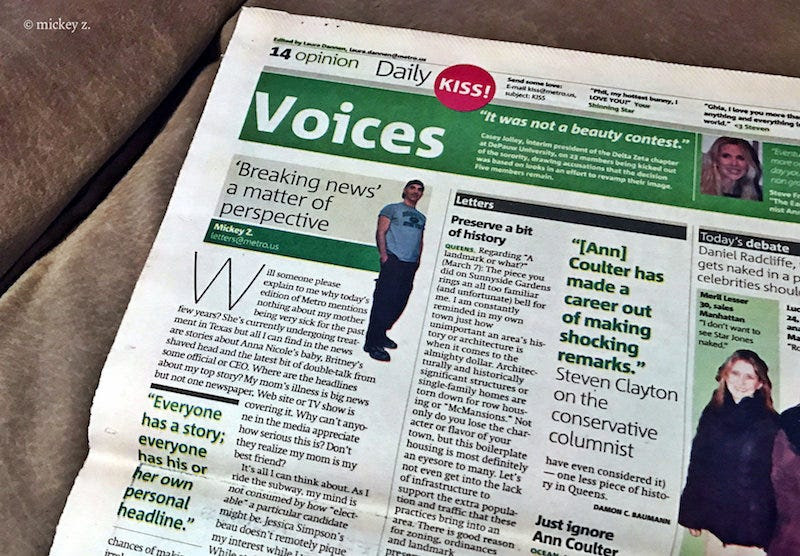
Throughout the 2000s, you’d find me regularly riding NYC’s subways during the very early morning hours — specifically from Queens into Manhattan — to work with personal training clients in gyms. In fact, right up to the plandemic, I was still training a couple of clients in their homes.

On those subway rides, I’d sometimes grab a copy of Metro — one of NYC’s free newspapers delivering a daily dose of corporate media propaganda. However, there was a brief period of time when Metro would allow some subversive voices into the mix. That included yours truly.

From about 2004 to 2007, Metro went through a phase of paying edgy freelancers so I jumped in with both feet. This even included an author photo shoot!

Thus, for a couple of years, my decidedly non-mainstream perspective — and my decidedly non-mainstream photo (wearing a “dumpster diving team” t-shirt, no less) — were on display for millions of New Yorkers to peruse during their morning ride to work or school (see image up top).

As someone who can remember when newspaper columnists held sway in my hometown, let me tell you, it was pretty cool to be jammed into a crowded subway car next to someone reading my latest article.

I’ll never know how many New Yorkers read my Metro columns. To the best of my knowledge, none of my affluent clients saw my column or photo (probably because none of them would ever ride the subway).

Over the years, I did make a select few clients aware of my double life (a couple have even bought my books and attended my talks). But, since many of them were wealthy and mainstream, I typically chose not to divulge anything about my radical writing.

As a result, I sometimes found myself making up elaborate fabrications to account for why I wouldn’t be around for a day or two when, for example, I just so happened to be heading up to MIT to lecture on US foreign policy in 2003.

Yep, this high school grad addressed a huge audience there on the topic of Henry Kissinger and the 1973 Chilean coup on a Monday night… and by Wednesday morning, was back in the gym — working with dumbbells (insert rimshot here).

Looking back now, I ponder my strategy of keeping a big part of myself a secret in the name of maintaining personal trainer income. Why was I so sure that wealthy capitalists would shun me and maybe fire me as their trainer if they encountered my radical mindset?

Perhaps a better question: What did it do to me emotionally to hide something that’s always been very important to me?

I contemplate questions like this now because, well… it’s never too late. I may not have affluent gym clients anymore. But, in Covid-era NYC, I have plenty of others around whom I could start speaking far more openly.

After all, it’s not like I can’t point to cases from the 2000s when my double life was exposed and things went well.

For example, I trained three high-powered lawyers at their high-powered law firm’s gym. This arrangement required me to check in with the doorman — or was he a concierge? (It’s funny to me that I might insult a concierge by calling him a doorman.) Anyway, doormen display one of three basic behavior patterns towards personal trainers.

The first and most common is indifference (we’re used to that). Secondly, they relate to us as fellow blue-collar common people saddled with the same fate: serving the well-heeled. Lastly, in a futile attempt to align themselves with a winner, some doormen openly look down their noses at us.

This was definitely the case at the law firm until a certain concierge saw my handsome face staring back at him from the pages of Metro.

The guy was completely flabbergasted when he read a little something of mine called “Re-Examining Rumsfeld’s Ratio” (which talked about, among other things, the United States unselfconsciously using “Apache” helicopters to quell “ethnic cleansing”).

A political junkie, the concierge now saw me as an “expert” and fell all over himself to shake my hand and introduce himself.

My new best friend could not get enough of me and it became the new norm for him to quiz me about current events before and after my training sessions.

One morning, as I was passing through the lobby, he called me over and pulled out a legal pad. Believe it or not, he had written a page or two of notes to remember all the things he wanted to ask me!

Yeah, just another tricky day in the life of a muscular militant… 

In 2001-2, I worked evenings in a corporate gym (cue the shame and self-loathing) in midtown Manhattan. One night, I was wearing a Yankees t-shirt with the name “Justice” emblazoned on the back (for former Yank David Justice).

A woman named Mary, probably in her late 60s, asked me if I was a Yankee fan. I told her my real reason for wearing the shirt was all about the word “justice.” She smiled and declared that justice was a “noble idea.”

I braced myself for the inevitable “we need to show those towel heads some justice,” (remember, this was early post-9/11 NYC) but instead, Mary told me — albeit in a stage whisper — she was soon going to DC to march against the impending US invasion of Iraq.

After this confession, Mary looked genuinely nervous. Her facial expression seemed to ask: Have I gone too far? In my best French Resistance voice, I reassured her: “Don’t worry, I’m with you.”

After that, we’d talk each and every time she’d come to work out. The corporation eventually phased out its gym facility but just before my last day, I saw Mary and complimented her on how hard she’d been training.

She leaned close to me and whispered: “When the revolution comes, I’ll be ready.”

As for me, my next revolution is to be even more open and transparent about my “controversial” stances. No more hiding.

After all, “a truthful witness saves lives.”

“Facing Clear Evidence of Peril” in a Country of Lies

By Edward Curtin

Source: Behind the Curtain

“In my seventy-plus years from 1946 to now, the chorus of fear-mongering bullshit has never ceased – only grown louder. The joke is on us. Ha Ha Ha.”

– Oliver Stone, Chasing the Light

Perhaps silence is the best response to the endless cavalcade of official lies that is United States history. The Internet and digital technology have allowed those lies to increase exponentially in number and frequency with the result that people’s minds have become like 7-Eleven stores, open 24/7 for snack-crap “news.”

But once you become conscious that it’s lies night and day, it sets your head aswirl and plunges your soul into depths of despair.  You are tempted to retreat from such knowledge and talk of trees and trivia.  But you are ashamed of your country.  It’s hard to laugh.  You feel you are drowning.  You flounder and gasp for air.  You look around and wonder why most people are able to go their merry ways believing the lies and whistling in the dark.  Junk news nation, indeed.

Yes, there are alternative voices who tell the truth, but their audiences and monetary support are very small or non-existent compared to the corporate mainstream media and those who shout and scream across the Internet as they take in a lot of money from naive followers. The recent revelations about Alex Jones’s wealth probably don’t bother his diehard fans, but they should.  Likewise, the funding sources for websites and writers of various persuasions are important to know, for they reveal possible biases in their work.  Snake oil salesmen are commonplace, and there are many naive customers lining up for their wares.

Wealth and power are the main drivers of the media chicanery that has captured so many minds. Writers, of course, should be fairly paid for their work, but in this Internet age, most are not.  As with the movies and book publishing, the income gap between the big names – the celebrity stars – and less well-known writers, even if their work is excellent, is huge.

Some sites and writers make a lot of money, but who they are is a guessing game.  No one’s talking.  Some regularly tell their readers that if they don’t receive enough contributions, they will be unable to continue to write or publish, even when the sites do not pay their contributors.  Whether this is good marketing or income-by-threat is up for grabs.  Whichever it is, it seems to work, as far as I can tell, for these writers and websites don’t disappear.

Money is the dirty secret of all news and commentary.  To paraphrase someone: It is very difficult to get truth from writers whose income is dependent on pleasing those who fund them.

You may have noticed how many former military officers, CIA agents, mainstream journalists, pharmaceutical company executives, and sundry other government and corporate bigwigs appear in the mainstream and alternative media to support or oppose government policies.  The mainstream ones doing the propaganda they always did, while the alternative ones appear as converts to the dissident faith.  No one ever explains how and by whom these people are financed or how their lucrative pensions affect their consciences.  “Former” is a funny word.  Ha Ha Ha.

Confidence “men” come in all shapes and sizes with no one talking money.

So let me fess up.  I received about $200 in support last year for edwardcurtin.com, my website.  Nothing before that and not a cent over the last 5-6 years for many hundreds of articles that have appeared very widely across the Internet.  Before the Internet, publications paid for work, mine and others.  Not now, at least for me.  How much money writers are receiving, and who is supporting their sites, is a taboo subject.

So I am thinking about selling mugs at my site with my name and mug shot on them and a line of supplements that will increase one’s testosterone and estrogen in equal measure to make sure no one takes offense in this era of delicate feelings.  Ha Ha Ha.  Yes, the joke is on us.  I identify as a man since I am one.  Don’t be offended.

Jokes aside, as Leonard Cohen sang:

“Oh, like a bird on the wire
Like a drunk in a midnight choir
I have tried in my way to be free”

If you are stubborn enough and have the good fortune to find inspiration from those brave dissidents who have gone before us and those who continue to lead us on, you realize silence is betrayal and that you must speak, even if all seems hopeless at times. Even when no one is paying you, or maybe more accurately, because no one is paying you. Even though it is hopeless, even though it isn’t.  This is another secret.  There are many.

It’s been twenty years since the U.S. brutally invaded Iraq.  When George W. Bush, at a staged pseudo-event in Cincinnati on October 7, 2002, as he set Americans up for the invasion of Iraq in March 2003, said, “Facing clear evidence of peril, we cannot wait for the final proof, the smoking gun, that could come in the form of a mushroom cloud,” no one laughed him out of the house.  His claim was simply an evil joke that was reported as truth.  It was all predictable, blatant deception.  And the media played along with such an absurdity, which is their job and what they always do.  I pointed it out at the time in a newspaper column, but who listened to a hick writer in a regional newspaper.

Iraq obviously had no nuclear weapons or the slightest capability to deliver even a firecracker on the U.S.  But the mainstream media, Senator Joe Biden, politicians galore, celebrities like Oprah Winfrey with her guest, the eventually disgraced Judith Miller of the New York Times, the despicable Tony Blair, et al., all supported Bush’s blatant lies.  Soon Colin Powell, the “hero” of George H. W. Bush’s 1991 made-for-TV Gulf War of aggression against Iraq, would do his Pinocchio act at the United Nations and the U.S. military was off to get Saddam Hussein, Osama bin Laden’s evil twin, both the latest Hitlers until Vladimir Putin replaced them.  I guess I skipped some others such as Muammar Gaddafi and Bashar Al-Assad.  New Hitlers proliferate so fast it’s hard to keep track of them.  Ha Ha Ha.  The joke is on us.

As everyone knows, or should, more than a million Iraqis died because of George W. Bush, but how many cared?  How many cared when once Bush was gone, Barack Obama, aided and abetted by the cackling Hilary Clinton, destroyed Libya and ignited the war against Syria?  You want examples?  There are too many to name here.  But let it be said these lies span all American administrations, whether it’s Bill Clinton continuously bombing Iraq and Serbia through Trump bombing Syria and Somalia, up to the present day with Biden attacking Russia via Ukraine, etc.  All these presidents are liars, but their followers treat them otherwise.  Biden says Jimmy Carter asked him to deliver his eulogy.  What does that tell you?  Shall we laugh?  Sing?

On the clear understanding
That this kind of thing can happen
Shall we laugh?
Shall we laugh?
Shall we laugh?

Shall we laugh harder if I mention the Covid-19 propaganda and all those writers who have failed to even address it, as they have failed to question 9/11 and other obvious official lies?  Is it not evident that if they did so, their money flows might dry up?  Here and no further is a widespread rule, for they must adhere to the boundaries imposed by “responsible thought” and the “no go” zones with which they tie their own hands in order to keep their wallets full.

If you are lucky, as I was, when you are young you discover how fearful of free thought and how corrupt our institutional authorities are.  You don’t spend decades feasting off the spoils of those institutions only to “wake up” once you have made your name and secured your fortune, which seems to be the way of so many wise luminaries of the Internet Age who are either trying to ease their consciences as they get ready to kick the bucket or are perhaps putting us on.

When I was twenty-four years-old, I accepted my first teaching job at a small Catholic college where I taught theology.  I had been trained in the latest and best scholarly work of the most renown international theologians.  Rather than indoctrinating my students with rote learning, I taught them to read widely and think deeply in the tradition of a liberal arts education.  To seek out the best scholarship.

But doing so became quickly apparent to the college and Church authorities who were stuck in the inquisitorial age of obedience or else and no thinking allowed.   Although my students loved my courses and felt freed up for the first time to think about their spiritual lives, I was hounded to correct my heretical teaching, which of course I refused to do.

At one point when I was at lunch in the cafeteria, a nun who was a professor, stole my brief case with my notes and left the cafeteria.  One of my students saw her do this and chased her into the ladies’ room where the nun hid in a stall.  The nun kept flushing the toilet to scare the student away, but the student wouldn’t let her out until she returned the briefcase.  Ha Ha Ha.  It sounds funny to recount but was an example of my experience at this college.  Someone vandalized my office door and ripped down anti-war posters that were on it.  I was gone from that college soon thereafter.  It taught me a lot.  Obey or else.

Heresy: The Latin word is from Greek hairesis, a taking or choosing for oneself, a choice.

At another teaching job a year or so later, I had a more chilling experience.  I was known as an anti-war activist, a conscientious objector from the Marines, etc., and one day, a late Friday afternoon when few were around, an administrator asked to meet me on a deserted stairwell where he proceeded in hushed tones to try to convince me to join him in Army Intelligence to spy on others.  He said I would be perfect for the job since I was known as an anti-war dissident.  I told him to fuck off, but I was shocked by his double life and his request.

I have since learned that this guy the spy was not an anomaly, for government confidence men are widespread.

I’ve had many other such early experiences for which I am very grateful, even though when I was fired from jobs and lost income it was traumatic at the time.  By my thirtieth year, I knew the system was corrupt to its core and subsequent experience has only ratified that conclusion.  I got the joke.

I recount these incidents not because my experiences are singular and I’m special, for others have suffered the same youthful fate.  But such good fortune can fortify you for life or break your spirit.  If the former, you don’t wait to retire to push back against all the lies or regret your past.  You find that it’s all good and life has set you on the heretic’s path of freedom and choice. You realize that what you went through is absolutely nothing compared to people around the world who have and continue to suffer at the hands of the U.S. military industrial complex.  You realize your experiences are trivial in the larger scope of things and that your government’s conduct is beyond condemnation.  It is an abomination.  You feel ashamed to live in a land where killing is a game.

The sociologist Peter Berger puts it well in his little classic, Invitation to Sociology, when he discusses experiences that lead to seeing through the play-acting nature of social life:

Experiences such as these may lead to a sudden reversal in one’s view of society – from an awe-inspiring vision of an edifice made of massive granite to the picture of a toy-house precariously put together with papier mâché. While such metamorphosis may be disturbing to people who have hitherto had great confidence in the stability and rightness of society, it can also have a very liberating effect on those more inclined to look upon the latter as a giant sitting on top of them, and not necessarily a friendly giant at that. It is reassuring to discover that the giant is afflicted with a nervous tick.

Notice the giant George W. Bush’s clicking eyes as he delivers his “facing clear evidence of peril” lies for the invasion of Iraq.  He and his presidential good friends are cardboard cartoon characters whose eyes reveal their evil intentions.  “It’s a Barnum and Bailey world/Just as phony as it can be,” but it would all fall to pieces if it weren’t for you and me failing to see through all the bad actors, not just presidents but the whole cast of characters that populate the Spectacle of news and opinion.

The Russians are coming!  Ha Ha Ha.  Yes, Oliver, the joke’s on us.

But it’s not really funny, except in the most sardonic and dark way, for we now do really face clear evidence of peril as a result of Biden and his crazy predecessors who have run U.S. foreign policy for so long. They have brought us to the edge of nuclear war with Russia by surrounding Russia with NATO bases and nuclear weapons, while doing the same to China.

Bertolt Brecht was right in his poem “To Those Born After”:

Truly I live in dark times!

Frank speech is naïve. A smooth forehead

Suggests insensitivity. The man who laughs

Has simply not yet heard

The terrible news.

What kind of times are these, when

To talk about trees is almost a crime

Because it implies silence about so many horrors?

When the man over there calmly crossing the street

Is already perhaps beyond the reach of his friends

Who are in need?

Arguments Against Despair

By David Edwards

Source: Media Lens

Eliot Jacobson is a retired professor of mathematics and computer science who regularly appears on our Twitter feed discussing the climate crisis. He sends tweets under the grim title, ‘Your “moment of doom” for the day’. These channel the latest news on rapidly rising carbon emissions and temperatures, catastrophic examples of extreme weather, and so on. It’s depressing fare, and Jacobson is candid about the level of anguish he feels:

‘I woke up feeling angry at about 2:30 AM this morning.

‘It’s easy to find something wrong with just about anything I look at. It’s all projection. I’ve been writing and deleting Tweets, but I still feel angry.

‘I’m angry that there’s very little I can do and there’s no way out.’

In a blog post, he wrote:

‘This sadness is so overwhelming, so all-consuming, that it takes my breath away. The things I do to cope with the weight of it all are mere distractions from this sadness. Volunteer for a few hours, then sadness. Go for a walk, then sadness. Listen to music, read, visit websites, then sadness. Visit with friends or family, then sadness. Sadness returns every time I have a moment to reflect on the predicament of the present moment.’

I’m no stranger to this emotional roller-coaster. 1988 was the big year for me, when NASA scientist James Hansen told the world we were heading for disaster. I had no difficulty believing him.

It seemed inconceivable to me that the profit motive driving global industry could be restrained, let alone reversed, in time. I was then working as a marketing manager for British Telecom in the West End of London where I set up a Green Initiatives Group. Small changes were made, but they were just window dressing – deeper changes impacting profit were completely unthinkable. It seemed obvious to me that this fundamentalist corporate resistance must, sooner or later, lead to disaster.

I first protested for action on climate change with Friends of the Earth on the streets of central London in October 1989. I was 27 when I started campaigning; I’m now 61. I’ve thought a lot, worried a lot, talked a lot, read a lot, and written a lot about these issues for three and a half decades, more than half my life.

It seems absolutely incredible to me – by which I mean it seems something that I honestly would not have believed was possible – that what seemed like an urgent crisis to me in the late 1980s can still seem like ‘hype’, a ‘liberal tax scam’, an ‘oligarch plot’ and ‘bourgeois hysteria’ to large numbers of people in 2023. In the 1980s, we said things would change when there were ‘bodies in the streets’ – but the bodies are all around us now, and there is still no sign of meaningful change.

I say all this to make clear that I am in no way complacent about, or indifferent to, the looming climate catastrophe (it seems absurd to even describe it as ‘looming’). My comments below are not intended to detract from the vital need to take immediate action; they are addressed to the despair that I know many people, like Jacobson, are feeling.

You, Me And The Mysterium Tremendum

After everything I have myself suffered, it seems to me that we have two main tasks at the present time: first, to do everything in our power to avert the terrifying crisis threatening us with extinction. Second, to do everything we can to transform the fear and suffering of our predicament into love and bliss.

The first of these is new. The second may sound preposterous, even annoying, but it has actually always been the great human task.

Many activists devoted to action, to change, despise the very idea that our own happiness should be any kind of concern. The suggestion is dismissed as self-indulgent ‘navel gazing’. We have to dispense with all such ‘sentimentality’ and focus on ‘hard politics’. We have to plunge into the darkness of realpolitik and fight for our lives. It’s going to be bruising, to hurt – forget all kitten-cuddling ideas about ‘love’ and feeling good. And how on earth can you feel ‘bliss’ when the world is falling apart? Such nonsense!

As so often, the anger is rooted in fear – the fear that such concerns will divert energy and attention away from what really matters. The counter-argument is that not giving a damn about personal feelings, about our needs as human beings in this short life, is actually one of the key factors that got us into this fine mess in the first place. (See my Cogitation: ‘Our Indifference To Ourselves’ – Beyond The ‘Virtue’ Of Self-Sacrifice – Parts 1 and 2)

Just as I can’t understand how so many people can fail to see the truth of the existential crisis we’re facing, I can’t understand how people can feel so absolutely certain about the significance, the meaning, of this crisis that they fall into absolute despair.

First of all, we need to remember that despair is a function of mind; it is not something mandated by Existence. As Thoreau noted, we have a choice:

‘However mean your life is, meet it and live it; do not shun it and call it hard names.’ (Thoreau, ‘Walden’, Oxford University Press, 1997, p.292)

This has been as true for everyone in human history facing death from illness, starvation, genocide, as it is for all of us now, facing extinction.

I find the universe so mysterious, so fundamentally Unknown, and even Unknowable, that I cannot establish a solid base of existential certainty that allows me to be confidently desperate about even this situation.

Of course, climate collapse is terrible for us – I don’t want to die, you don’t want to die; we don’t want so-called human ‘civilisation’ to disappear. But we all do have to die and the deeper significance of even a disaster on this scale is fundamentally unknown.

We are a miniscule part of billions of years of existence involving 200 billion galaxies each containing 200 billion stars, and who knows how many planets, swirling over distances that completely defy imagination – all of it emerging out of the mysterium tremendum, the how and why of Existence (we can’t say Creation; we don’t even know if it has a beginning or an end).

This immensity of space and time has led to this moment that stands before us. Here we are! Everything in this cosmos has led us here. We can’t just blame politicians, corporate executives and their journalistic enablers – the universe made them as they are and this is what the universe has given us to deal with.

Who are we to break down in despair as if we were certain about the final meaning of what is happening? What do we really know about anything? Do we really know enough to find a solid position from which we can cast judgement even on the extinction of human life, or even of all life, on this planet? 

In November, spiritual writer Steve Taylor posted a poem, ‘Being Watched by The Moon’, on Facebook. Taylor wrote of our cosmic near neighbour:

‘Then I noticed a look of concern on her face.

There was a glint of disapproval, a hint of dismay

in her gaze, as it followed me home

as if she was witnessing an accident, or a crime.

Had I done something wrong? I wondered.

Had I injured or offended someone?

Had I gone astray, and lost the meaning of my life?

But then I looked closer, and realised:

she wasn’t just watching me.

She was watching the whole world.’

A glint of ‘concern’, ‘disapproval’ and ‘dismay’, as if ‘witnessing an accident, or a crime’? Is this really the most likely reaction of the Moon? After all, she has seen a lot – she’s around 4.5 billion years old, about the same age as the Earth. Human beings have been around for just 2.8 million years, and in our problematic modern form for just 200,000 years. The Sun formed about 4.6 billion years ago from an enormous molecular cloud that gave birth to numerous other stars. Our star has about 5 billion years of life left; she’s in her prime. The universe itself is about 13.8 billion years old – at least in this cycle, if it is a cycle. We don’t know where all this comes from, what it means, what lies at the base of it all. 

Worst case scenarios suggest that human-induced climate change might devastate most animal and plant species to such an extent that it could take five million years for life to recover. But 5 million years is a blink of the cosmic eye to old-timers like the Moon, Earth and Sun whose memories stretch back, not millions, but billions of years. And if things don’t work out here post-climate collapse, maybe they’ll go better among the billions and billions of stars out there – that’s a lot of stars, a lot of possibility. From this perspective, one might surmise that human despair at the prospect of human extinction is one more manifestation of an egotism that causes us to vastly overestimate our own importance.

Might it alter our despairing perspective to consider that the enlightened mystics might be right in declaring that, not just plants and animals, but the entire universe is alive? We think life arises miraculously, ‘accidentally’ (what on earth does that mean?), Lazarus-like, from dead matter. But atoms are pretty lively phenomena; they are whizzing flea circuses of jumping sub-atomic particles, quantum waves and other forms of energy. Might we one day conclude that what we call life arises from these subtler forms of life? Is energy in some sense life?

And might our despair be leavened by the possibility, as mystics also insist, that, not just human beings, but the entire cosmos is conscious? What would it mean, if it turns out that even rocks are consciousness in a kind of coma; that evolution is ultimately a process of consciousness awakening from the slumber (not the death) of matter?

If everything is alive and everything is conscious, then even human beings are unable to inflict any real damage – a manifestation of eternal life rises and falls, comes and goes, but the ocean of living consciousness continues completely unharmed.

The universe seems to consist of objects, of material ‘things’. But that is not all: these rocks, animals, planets and stars appear in the something that is no-thing that we call space. Likewise, our awareness also provides an internal space in which sense perceptions, thoughts and emotions can appear and be known. We assume the universe is material and yet awareness seems non-material, seems entirely other than that which is material. Is it possible that external space and the internal space of awareness are related? Could they actually be the same phenomenon? We tend to see our internal space as an epiphenomenon of the brain, but is external space an epiphenomenon of matter?

Could the mystics even be right when they insist that awareness evolves in the universe by moving from ageing bodies to new ones? Westerners find this a childishly obvious example of wishful thinking. But does that make it untrue? Do we imagine that Buddha, Bodhidharma, Nagarjuna, Lao tse and all other enlightened humans were inventing when they made this claim over and over again? Could they even be right in arguing that consciousness moves from old, exhausted planets to fresh, new planets better suited to the continued evolution of consciousness?

If that sounds ludicrous, is it any crazier than the idea that the universe suddenly emerged from nothingness – nothing, nothing, nothing, then, Bang! – or that it has somehow always existed? These appear to be the only two possibilities, and yet both seem totally nonsensical to us. If the only logical possibilities seem impossible, how can we so confidently root our despair in our clearly inadequate human capacity for logic?

Satchitananda

I controversially suggested our task was to find bliss in the face of looming extinction. Is that possible? Is it moral even to try in the face of so much suffering?

Seasoned meditators tell us that the mysterious awareness perceiving these words is inherently blissful. Not just pleasurable, mind you – ecstatic. We are told the bliss is already there, is always there; that it is the very nature of awareness. The idea is captured in the Sanskrit epithet ‘satchitananda’, or ‘reality, consciousness, bliss’ – existence is aware and awareness is blissful.

This sounds counter-intuitive standing at a bus stop on a rainy Monday morning commute to work. We are here, we are aware, thank you very much, and we are emphatically not beaming with delight.

There are two possible explanations for this contradiction: either all the enlightened mystics were talking nonsense, or we are not in fact here, not in fact aware, and are therefore not able to experience the bliss that is here.

But if we’re not here, where on earth are we?

We are physically here, of course, but our minds are not in the present; they are in the past and in the future. Because the past and future do not exist, because they are mere ideas in the mind, when we are thinking we are absent; we are not truly here.

There are times when I sit in meditation for an hour when thoughts finally drop away; thoughts by which I am otherwise unceasingly plagued by day and night (dreams are thinking in pictures). When thoughts drop away, even for a moment, something very subtle, but very powerful slips through. In my experience, it emerges like a wispy strand of pink candy floss spinning out from some completely unknown depth and melting into my heart (my ‘dantian’ and ‘lower dantian’, in the terminology of Qigong). The melting is experienced as a sweetness, a delight, that glows with unconditional love for everyone and everything.

It is clear, sitting alone in a room, that this loving bliss is uncaused. I may have been as miserable as sin about the state of the world before slumping down to watch my thoughts and feelings – nothing in my world has objectively changed in that hour. In fact, as all the mystics insist, this loving delight has not been caused; it has simply been unveiled, revealed.

Thought is the veil. This is why we can’t feel the bliss of existence: it is hidden from us by layer upon layer of thought, rather like the multiple layers of cloud that typically greet solemn holidaymakers returning to Britain.

Human beings are the only animal that can become lost in the unreal world of mentation. All the virtuous, politically correct and well-intentioned thought by which we have always hoped to make the world a better place – the whole, misguided 17th and 18th century dream of the European ‘Enlightenment’ – has combined with all other thoughts to form an almost impenetrable barrier between us and the real source of civilisation, of personal and global salvation, within us.

The truth is that we have destroyed our planet and become almost completely estranged from the inherent bliss of being because we have sought civilisation and happiness in our heads. In reality, true civilisation – not the ability to build machines to pyrrhically ‘conquer’ nature, other animals and humans – is found when we transcend thought and connect deeply and often with our hearts.

‘The Best People In The World’ – Actual Human Civilisation

The very idea of technological ‘progress’ implies some kind of ‘Manifest Destiny’. It is our ‘destiny’ – the natural path of any ‘advanced’ civilisation on any planet – to develop ever more powerful technology, that we might one day voyage across the cosmic ocean just as we once voyaged across the water and air of our home planet.

But this may be wrong. It may be that the right option is to journey inwards in an exploration of being, of consciousness, to an unimagined brave new world of love and bliss.

Perhaps we don’t hear anything from highly technological ‘civilisations’ out there in the cosmos because the whole effort is a suicidal wrong turn that leads to near-instant decline and extinction. The cosmos may nevertheless be teeming with genuinely civilised beings who have gone in a very different direction.

After all, even on our planet, there have been examples of authentically civilised humans – people who live in their hearts rather than in their heads, who are free of our obsessive thinking. They appear to have rooted their daily lives in the kind of love and bliss that we in the West can only find in meditation.

In his book, ‘The Conquest of Paradise’, writer and ecologist Kirkpatrick Sale described the low-tech, Taino society encountered by the Spanish conquistadors in 1492:

‘So little a part did violence play in their system that they seem, remarkably, to have been a society without war (at least we know of no war music or signals or artifacts, and no evidence of intertribal combats) and even without overt conflict (Las Casas reports that no Spaniard ever saw two Tainos fighting).’ (Kirkpatrick Sale, ‘The Conquest of Paradise’, Papermac, 1992, p.99)

But the lack of violence was only one aspect of the Tainos’ towering civilisation:

‘And here we come to what was obviously the Tainos’ outstanding cultural achievement, a proficiency in the social arts that led those who first met them to comment unfailingly on their friendliness, their warmth, their openness, and above all – so striking to those of an acquisitive culture – their generosity.’ (p.99)

Even Admiral Cristobal Colon (‘Christopher Columbus’ in old money), the man who brought death and disaster to the lives of the Taino, recorded in his journal:

‘They are the best people in the world and above all the gentlest. They became so much our friends that it was a marvel… They traded and gave everything they had, with good will.’ (pp.99-100)

He continued:

‘I sent the ship’s boat ashore for water, and they very willingly showed my people where the water was, and they themselves carried the full barrels to the boat, and took great delight in pleasing us. They are very gentle and without knowledge of what is evil; nor do they murder or steal.’

Colon added:

‘They love their neighbours as themselves, and they have the sweetest talk in the world, and are gentle and always laughing.’ (p.100)

Sale wrote poignantly:

‘It is to be regretted that the Admiral, unable to see past their nakedness, as it were, knew not the real virtues of the people he confronted. For the Tainos’ lives were in many ways as idyllic as their surroundings, into which they fit with such skill and comfort. They were well fed and well housed, without poverty or serious disease. They enjoyed considerable leisure, given over to dancing, singing, ballgames, and sex, and expressed themselves artistically in basketry, woodworking, pottery, and jewellery. They lived in general harmony and peace, without greed or covetousness or theft.’ (pp.100-101)

American geographical scholar Carl Sauer concluded:

‘…the tropical idyll of the accounts of Columbus… was largely true’. (p.101)

The Tainos were human beings who lived in their hearts, not in their heads. They had no august universities packed with thinkers, philosophers and other half-crazed intellectuals; no 24/7 outpourings of media pollution – they lived in the bliss of awareness unclouded by obsessive thought.

As for us! By painful contrast, in his book, ‘Impact of Western Man’, historian William Woodruff commented on the society from which Colon had sailed:

‘No civilization prior to the European had occasion to believe in the systematic material progress of the whole human race; no civilization placed such stress upon the quantity rather than the quality of life; no civilization drove itself so relentlessly to an ever-receding goal; no civilization was so passion-charged to replace what is with what could be; no civilization had striven as the West has done to direct the world according to its will; no civilization has known so few moments of peace and tranquillity.’ (Sale, ibid, p.91, my emphasis)

To live in the head, to sacrifice the moment for the future, to prioritise the ‘serious’, ‘important’ work of the greedy, plotting mind over the bliss of the heart is to build a self-destructive, doomed version of fake ‘civilisation’.

Or consider the experience of the Mexican anthropologist Miguel Covarrubias on visiting the island of Bali in 1938. Covarrubias wrote:

‘No other race gives the impression of living in such close touch with nature, creates such a complete feeling of harmony between the people and the surroundings… The Balinese belong in their environment in the same way that a humming-bird or an orchid belongs in a Central American jungle.’ (Miguel Covarrubias, ‘Island of Bali’, KPI, 1986, p.11)

Covarrubias added:

‘A man is assisted by his neighbours in every task he cannot perform alone; they help him willingly and as a matter of duty, not expecting any reward other than the knowledge that, were they in his case, he would help in the same manner’. (p.14)

The result, Covarrubias wrote, was a village system which operated as ‘a closely unified organism in which the communal policy is harmony and cooperation – a system that works to everybody’s advantage’. (p.15)

In the late 1990s, I worked with the Swedish ecologist and activist Helena Norberg-Hodge who lived for many years among the people of Ladakh on the Tibetan plateau of Northern India. In her book ‘Ancient Futures’, Norberg-Hodge wrote of how she was bewildered by the strange fact that the Ladakhis were always smiling:

‘At first I couldn’t believe that the Ladakhis could be as happy as they appeared. It took me a long time to accept that the smiles I saw were real. Then, in my second year there, while at a wedding, I sat back and observed the guests enjoying themselves. Suddenly I heard myself saying, “Aha, they really are that happy”. Only then did I recognize that I had been walking around with cultural blinders on, convinced that the Ladakhis could not be as happy as they seemed. Hidden behind the jokes and laughter had to be the same frustration, jealousy, and inadequacy as in my own society. In fact, without knowing it, I had been assuming that there were no significant cultural differences in the human potential for happiness. It was a surprise for me to realize that I had been making such unconscious assumptions, and as a result I think I became more open to experiencing what was really there.’ (Helena Norberg-Hodge, ‘Ancient Futures – Learning From Ladakh,’ Sierra, 1992, p.84)

As amongst the Tainos, fighting in traditional Ladakhi society was unknown, disputes were settled quickly and peaceably, and when one person had a problem the entire community did its best to help:

‘In traditional Ladakh, aggression of any sort is exceptionally rare: rare enough to say that it is virtually non-existent… Even arguments are rare. I have hardly ever seen anything more than mild disagreement in the traditional villages—certainly nothing compared with what you find in the West.’ (p.46)

Norberg-Hodge concluded:

‘I have never met people who seem so healthy emotionally, so secure, as the Ladakhis.’ (p.85)

These societies that seem so ‘primitive’ and ‘uncivilised’ to goal-oriented, power-obsessed, head-trapped Europeans, were actually exemplars of authentic human civilisation.

I am not suggesting that we can become like the Tainos, Balinese and Ladakhis. If we are too high-tech primitive to save ourselves from climate disaster, we can obviously not hope to create that kind of paradise on earth.

What I am suggesting, though, is that the existence of these societies powerfully supports the contention of the mystics: that awareness unclouded by obsessive thinking is indeed in the nature of bliss and love. I am suggesting that such low-tech civilisations may exist in abundance, undetected, on other planets that will of course continue to thrive no matter what happens on our planet. I am also suggesting that you and I can create a little patch of this paradise in our own hearts.

Perhaps in our world as it is, genuinely civilised, loving societies are doomed to be destroyed by brutal, head-trapped, Western-style societies. But you and I still have the freedom, even in the face of this wider brutality, even in the face of environmental catastrophe, to live a life overflowing with love and bliss. Maybe that is all that is possible for us, and maybe that is enough. 

Rage Against The War Machine: What Rage? ‘When Will They Ever Learn?’

By Robert J. Burrowes

In his iconic 1950s anti-war hit song ‘Where Have All the Flowers Gone?’, Pete Seeger posed the eternal question about war: ‘when will they ever learn?’ Of course, Seeger’s question was primarily directed at those individuals who choose to participate in the fighting. But it might equally have been directed at those in the ‘anti-war’ movement.

A few years later in 1963, Native Canadian Buffy Sainte-Marie penned the equally iconic ‘Universal Soldier’ to draw attention to ‘individual responsibility’ for war.

The question ‘Why war?’ has troubled human beings for millennia and individuals of conscience have long resisted it, sometimes paying a heavy price for doing so. And back in 1932, two of humanity’s giants – Albert Einstein and Sigmund Freud – grappled with the question, exchanging letters on the subject.

See ‘Why War?’

Beyond war, a great deal of effort has gone into understanding conflict and violence, including their structural and cultural components, and I have noted some of these efforts, including my own, in a wide range of documents such as these:

‘Why Violence?’,

‘Comforting a Baby is Violent’,

‘The War to End War 100 Years On: An Evaluation and Reorientation of our Resistance to War’ and

‘Einstein and Freud’s ‘Why War?’

Revisited: Why Anti-War Efforts Go Nowhere’.

Four things fundamentally missing from all previous efforts to halt a particular war or to end war generally, however, are these:

  1. a serious effort to understand the dysfunctional psychology, and what causes it, that drives human violence generally,
  2. a serious effort to analyse war as a system of power: Who is causing it, why and how? (This is important because understanding how power works in the world system as well as who, precisely, is driving what is happening, why, and how they are doing it are crucial prerequisites for developing an effective strategy to resist, or end, war.)
  3. a sophisticated nonviolent strategy based on this understanding and analysis that is thoughtfully designed to address each of the foundational components of war, and
  4. sufficient courageous people committed to implementing this strategy by participating in it themselves and mobilizing others to do so too.

Consequently, to say that anti-war efforts lack sophistication is to put it mildly in the extreme. As the very long history of ‘anti-war’ struggle clearly demonstrates.

And so it was listening to the anti-war speeches delivered in Washington DC at the Rage Against the War Machine rally on 19 February 2023. You can watch whole or abridged versions of these speeches here: Rage Against the War Machine.

Rage might give a person power in some contexts but, in itself, rage has zero strategic value. And are these people really feeling ‘rage’ about the ongoing war all over the planet or even the war in Ukraine? And acting on it? Of course not. Even if they were, as mentioned ‘rage’ is no substitute for acting powerfully (that is, strategically) to end war.

Moreover, there is a simple reason for this. Most anti-war activists do not feel rage against the war machine for the simple reason that they are terrified of it.

And this fear incapacitates them, leaving most anti-war activists too scared to seriously commit themselves to doing what is necessary to end war. Again, as the record demonstrates.

Hence, they complain powerlessly, rather than analysing, devising strategy and then acting powerfully knowing that their actions will contribute to the long-term struggle to end war once and for all.

So let me go back a step and analyze why the anti-war movement is so frightened and powerless and why it cannot learn from its own history of failure.

Why do most people complain?

In essence, this happens because when they were children, their parents interfered with their emotional expression which, in turn, stifled those innate behaviors bestowed by evolution to ensure that the baby, and later the child and then adult, acted to have their needs met. Usually by a young age, the child will learn to complain powerlessly when they do not get what they want. But complaining, rather than acting, does not meet their needs.

Thus, just as the child, endlessly thwarted by a parent who ignores the child’s genuine needs and then ignores their pleas to have these addressed, is trapped in the mode of complaining, most activists never learn that the role of politicians is to ignore them too. Of course, the value in this for those who genuinely wield power in society and whose aim is to facilitate perpetual war to achieve a variety of Elite ends (notably including the ongoing consolidation of Elite power and the maximization of corporate profits by financing both sides in any war) is that efforts of this nature, such as public protests against ‘government policies’ absorb and dissipate dissent, as intended.

And so it was on 19 February 2023 when a list of anti-war speakers echoed the eternal cries of powerlessness at one of the latest manifestations of an anti-war street protest:

‘Enough is enough! We demand change! Do the right thing! Implement ceasefire in Ukraine!’ See ‘Twenty Years after the Start of the War in Iraq, People Around the World are still Raging Against the War Machine’.

Einstein and Freud’s ‘Why War?’ Revisited: Why Anti-War Efforts Go Nowhere

Really?

As even former US Secretary of State Alexander Haig once noted about a massive anti-war demonstration: ‘Let them march all they want, as long as they continue to pay their taxes.’ See Alexander Haig. As a four-star general, Haig, not regarded as the most intelligent Secretary of State in US history, certainly understood that tactical choice is a question of strategy. Most activists have no idea.

So What Must We Do to End War?

Earlier in this article I identified four elements missing from the anti-war movement’s efforts. Let me restate them and offer my own learning in relation to these points.

  1. a serious effort to understand the dysfunctional psychology, and what causes it, that drives human violence generally.

As the final stage of more than four decades investigating the cause of violence, I spent 14 years living in seclusion with Anita McKone. You can read what I learned in the document ‘Why Violence?’, in which I explain the destructive impact of the ‘visible’, ‘invisible’ and ‘utterly invisible’ violence that adults relentlessly inflict on children – resulting in the bulk of the adult human population being unconsciously terrified, self-hating and powerless, with Anita’s description of our process in:

‘Fearless Psychology and Fearful Psychology: Principles and Practice’.

If you like, you can also read other articles I have written such as

‘The Psychology of Projection in Conflict’ and

‘Challenges for Resolving Complex Conflicts’.

  1. a serious effort to analyse war as a system of power: Who is causing it, why and how? This is important because understanding how power works in the world system as well as who, precisely, is driving what is happening, why, and how they are doing it are crucial prerequisites for developing an effective strategy to resist, or end, war.

I made considerable effort to explain this as part of a wider study identifying the Global Elite and how its power is exercised in the world system. This included explaining why the Elite has a vested interest in ensuring that war continues. For more than 200 years, members of this Elite have carefully facilitated the precipitation of war and then profited immensely from financing both sides in any war of significance as well as the rebuilding of infrastructure and the care of injured soldiers in its aftermath. Hence, preparations for war, the conduct of war and the rebuilding/healing necessary post-war is the most profitable economic venture, by far, conducted on Planet Earth and it greatly enriches Elite families, such as the Rothschilds and Rockefellers, as well as their agents.

See Historical Analysis of the Global Elite: Ransacking the World Economy Until ‘You’ll Own Nothing.’

  1. a nonviolent strategy based on this understanding and analysis that is thoughtfully designed to address each of the foundational components of war.

First, this requires a completely different approach to parenting if we want to raise powerfully nonviolent children.

See ‘My Promise to Children’ and

‘Do We Want School or Education?’

And given that strategy has long been a passion of mine and nonviolent strategy particularly, I investigated this thoroughly when I wrote The Strategy of Nonviolent Defense: A Gandhian Approach.

But for the simplest explanation of nonviolent strategy to end war, you can read it on this website starting with the list of ‘Strategic Goals for Ending War’.

  1. sufficient courageous people committed to implementing this strategy by participating in it themselves and mobilizing others to do so too. This is important because nonviolent activism to end war has a price, measured in jail terms, adverse psychological assessments from people intent on stopping you, and a myriad other penalties depending on the legal jurisdiction in which the activist operates.

But if the antiwar activist is not willing to pay the price of their nonviolent activism, then the victims of wars in other places will pay the price of war with their lives.

Clearly, identifying sufficient courageous people is a primary challenge and the obvious shortage of courageous and tenacious people committed to strategically resisting war is just another outcome of our violently dysfunctional parenting of children mentioned in the first point above.

So if we are going to mobilize sufficient people willing to act powerfully over an extended period to resist all of those foundational elements that make war possible, we must profoundly alter our parenting model to produce powerful children and offer adults a chance to heal from the violence they suffered as children as well.

See ‘Putting Feelings First’ and ‘Nisteling: The Art of Deep Listening’.

Otherwise we are condemned to watch people speak against war and march up and down in ‘anti-war’ rallies (or employ other tactics devoid of strategic impact) until the world is blown up.

An Obvious Criticism

An obvious criticism of the approach I have outlined above is that it is ‘too slow’. It offers no quick solution to deal with the immediacy of the threat we face at the current moment with the proxy war being fought by the US and NATO through Ukraine against Russia which includes the risk of the war ‘going nuclear’.

See ‘The Dire Significance of Putin’s Feb 21 Speech’.

And I am well aware of the many calls for negotiations on the one hand – see, for example, ‘The Ukraine War: Think Deeper Or We Shall All Lose’ – and long-standing US war-fighting policy on the other as routinely explained in a plethora of US Government ‘defense strategy’ documents.

See, for example, ‘2022 National Defense Strategy of The United States of America’ and a thoughtful discussion of US nuclear strategy by Professor Michel Chossudovsky in

‘“Preemptive Nuclear War”: The Historic Battle for Peace and Democracy. A Third World War Threatens the Future of Humanity’.

I am also aware of calls, such as that by Scott Ritter, for US anti-war activists to focus on nuclear arms control as the highest priority for now.

See ‘Scott Ritter on the War Machine and the Future of the Antiwar Movement’.

And other perspectives and proposals besides.

But the obvious response to the ‘too slow’ criticism of my longer-term proposals above is simple: The result of the current crisis is so far beyond the existing anti-war movement to realistically influence, it is laughable. And so, in my view – which is consistent with my research into, and analysis of, what has transpired historically:

see Historical Analysis of the Global Elite: Ransacking the World Economy Until ‘You’ll Own Nothing.’ – the war will most probably end when Russia has defeated the Ukrainian state but only after the war has been dragged on for as long as it can be conducted profitably, from an Elite perspective.

And while there is undoubtedly considerable risk of the war ‘going nuclear’ through policy or strategic miscalculation – see ‘Stanislav Petrov, “The Man Who Saved The World,” Dies At 77’ – accident – see Command and Control – or rogue local ‘initiative’, the Elite will ‘gamble’ against these possibilities while (presumably) constraining it at policy level, as has most likely occurred throughout the nuclear age.

Insane? Of course, it is insane. See ‘The Global Elite is Insane Revisited’. It’s just that, in my view, there is nothing new to observe here: Just repetition of what we have seen before, which includes being taken to the brink of nuclear war and relying on ‘unknown factors’ – including, but not exclusively, background control by the Elite – to avoid it.

Conclusion

War is brutal. The Elite perpetuates war endlessly to capture control of people and resources to maintain the existing system of world power and make monumental profits. It will not be stopped because we make fine speeches, chant anti-war slogans at rallies or call for negotiations.

The human world is a system of power. And we need to understand how that system of power works to understand, and change, the world. This applies particularly when dealing with systems, structures and processes at the heart of Elite power, such as economics and war.

But underlying even this we need to understand the psychology of human violence because this also enables us to understand why the Elite controls world affairs to precipitate war (among a vast range of other violent and exploitative outcomes) as well as why ‘ordinary’ people fight in wars and the vast bulk of people who identify as ‘anti-war’ are so powerless.

In essence, war will be ended by analysing and understanding what makes it all happen and taking action intelligently, courageously and tenaciously to change what makes it possible; that is, by resisting in strategically appropriate ways the foundational components on which the entire system of war is built.

And given the ultimate foundation of the war system is our violent parenting model that renders virtually all humans into a state of fearful submission to violence, we haven’t even started the long journey to end war yet.

Nevertheless, while my own lifetime of effort has failed to remedy anything significant about the war system, out of love for my uncles, great uncles and humanity generally – see ‘Who Am I?’ – I continue to focus my own attention on undermining its foundations as documented above. It is slow, ‘unrewarding’ work in the short term.

But my hope is that some future generations of humans, assuming we effectively resist a myriad of current and future threats notably including the vast range of threats we all face at the hands of the Elite now – see ‘We Are Being Smashed Politically, Economically, Medically and Technologically by the Elite’s “Great Reset”: Why? How Do We Fight Back Effectively?’ – will live in a world without violence and war.

Obviously, given the precarious state of the world in many respects, a tremendous amount of intelligent, strategically-oriented action will be needed for this hope to be realized.

Biodata: Robert J. Burrowes has a lifetime commitment to understanding and ending human violence. He has done extensive research since 1966 in an effort to understand why human beings are violent and has been a nonviolent activist since 1981. He is the author of ‘Why Violence?’ http://tinyurl.com/whyviolence His email address is flametree@riseup.net and his website is here. http://robertjburrowes.wordpress.com

It Is The Mass Media’s Job To Help Suppress Anti-War Movements

By Caitlin Johnstone

Source: CaitlinJohnstone.com

In a new article titled “European antiwar protests gain strength as NATO’s Ukraine proxy war escalates,” The Grayzone’s Stavroula Pabst and Max Blumenthal document the many large demonstrations that have been occurring in France, the UK, Germany, Greece, Spain, the Czech Republic, Austria, Belgium and elsewhere opposing the western empire’s brinkmanship with Russia and proxy warfare in Ukraine.

Pabst and Blumenthal conclude their report with a denouncement of the way the western media have either been ignoring or sneering at these protests while actively cheerleading smaller demonstrations in support of arming Ukraine.

“When Western media has not ignored Europe’s antiwar protest wave altogether, its coverage has alternated between dismissive and contemptuous,” they write. “German state broadcaster Deutsche Welle sneeringly characterized the February 25 demonstration in Berlin as ‘naive’ while providing glowing coverage to smaller shows of support for the war by the Ukrainian diaspora. The New York Times, for its part, mentioned the European protests in just a single generic line buried in an article on minuscule anti-Putin protests held by Russian emigres.”

This bias is of course blatantly propagandistic, which won’t surprise anyone who understands that the mainstream western media exist first and foremost to administer propaganda on behalf of the US-centralized empire. And chief among their propaganda duties is to suppress the emergence of a genuine peace movement.

As we’ve discussed previously, it has never in human history been more urgent to have a massive, forceful protest movement in opposition to the empire’s rapidly accelerating trajectory toward a global conflict against Russia and China. Other peace movements have arisen in the past in response to horrific wars which would go on to claim millions of lives, but a world war in the Atomic Age could easily wind up killing billions, and must never be allowed to happen.

And yet the public is not treating this unparalleled threat with the urgency it deserves. A few protests here and there is great, but it’s not nearly enough. And the reason the people have not answered the call is because the mass media have been successfully propagandizing them into accepting the continuous escalations toward world war that we’ve been seeing.

People aren’t going to protest what their government is doing if they believe that what their government is doing is appropriate, and the only reason so many people believe what their government is doing with regard to Russia and China is appropriate is because they have been propagandized into thinking so.

The mass media are not telling the public about the many well documented western provocations which led to the war in Ukraine and sabotaged peace at every turn; they’re just telling everyone that Putin invaded because he’s an evil Hitler sequel who loves killing and hates freedom. The mass media are not telling the public about the way the US empire has been encircling China with war machinery in ways it would never permit itself to be encircled while deliberately staging incendiary provocations in Taiwan; they’re just telling everyone that China is run by evil warmongering tyrants. The mass media are not reminding the public that after the fall of the Soviet Union the US empire espoused a doctrine asserting that the rise of any foreign superpower must be prevented at all cost; they’re letting that agenda fade into the memory hole.

Because people believe Russia and China are the sole aggressors and the US and its allies are only responding defensively to those unprovoked aggressions, they don’t see the need for a mass protest movement against their own governments. If you tell the average coastal American liberal that you’re holding a protest about the war in Ukraine, they’re going to assume you mean you’re protesting against Putin, and they’ll look at you strangely if you tell them you’re actually protesting your own government’s aggressions.

The narrative that Russia and China are acting with unprovoked aggression actually prevents peace, because if your government isn’t doing anything to make things worse, then there’s nothing it can change about its own behavior to make things better. But of course there is a massive, massive amount that the western power alliance can change about its own behavior with regard to Russia and China that would greatly improve matters. Instead of working to subordinate the entire planet to the will of Washington and its drivers, they can work toward de-escalation, diplomacy and detente.

We’re not going to get de-escalation, diplomacy and detente unless the people use the power of their numbers to demand those things, and the people are not going to use the power of their numbers to demand those things as long as they are successfully propagandized not to. This means propaganda is the ultimate problem that needs to be addressed. Ordinary people can only address it by waking the public up to the fact that the political/media class are lying to them about what’s happening with Russia and China, using whatever means we have access to.

So that’s what we need to do. We need to fight the imperial disinformation campaign using information. Tell people the truth using every medium available to us to sow distrust in the imperial propaganda machine, because propaganda only works if you don’t know it’s happening to you.

Our rulers are always babbling about how they’re fighting an “information war” against enemy nations, but in reality they’re fighting an information war against normal westerners like us. So we must fight back. We need to cripple public trust in the propaganda machine and begin awakening one another from our propaganda-induced sleep, so that we can begin organizing against the horrific end they are driving us toward.