
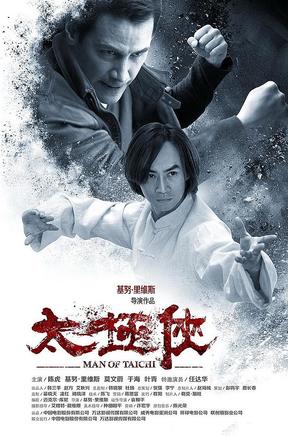
Saturday Matinee: Man of Tai Chi

By Sheila O’Malley

Source: RogerEbert.com

Keanu Reeves has a mixture of stilted awkwardness and gangly grace that is uniquely his own, and that makes him an often strange, disaffected presence. This can either work or not work. His line readings are sometimes baffling. But his simple sense of truth and touching trust in the material (whatever it may be) is one of the reasons his career has lasted so long. There isn’t a ton of ego in his work. It’s refreshing.

“Man of Tai Chi”, Reeves’ feature film directorial debut, has the same sometimes-awkward blend that Reeves brings to the table as an actor. The film is super serious (as befitting the martial arts genre, where everything is a matter of life or death), with moments of strange stilted dialogue (also par for the course) and scene after scene of thrilling physical combat, filmed with grace and certainty and no small amount of awe for the athletes involved.

Tiger Chen, a stuntman in the two “Matrix” sequels, plays the eponymous character, also named “Tiger Chen”. He is a devoted practitioner of the ancient art of tai chi, working with a master named Yang (Yu Hai) in a beautiful temple. For his day job, Tiger works as a delivery boy, driving packages around the city, and flirting with a receptionist at one of his regular stop-offs. He lives with his parents. He does not have ambition to “do anything” with tai chi, because the rules underlying his apprenticeship with Master Yang say that those who practice tai chi do not do so for money, glory, or even to win. But during a public competition, his undeniable skill brings him to the attention of a mysterious individual named Donaka Mark (Reeves). Donaka lives in a cold man-cave of a penthouse, furnished in black leather and chrome. He strolls around barefoot on shiny black marble floors, he speaks only in terse commands. He has a security detail working for him that would rival the NSA’s. He reaches out to Tiger, offering him a security job, when in reality it is a recruitment for a deadly underground fighting ring.Tiger is flown to an undisclosed location, put into an empty grey room with a mirror on one wall, as he waits to see what will happen. A female voice commands: “Fight”, and from out of nowhere an opponent grabs Tiger from behind. Tiger is then engaged in a fight for his life in that grey room with the big mirror, and it is an Alice-through-the-looking-glass moment which will bear fruit through the rest of the film: Like Alice, Tiger is catapulted from one strange experience to the next. The normal rules of regular life no longer apply.

Donaka, of course, is watching through that mirror. That first fight is a test. Tiger passes, but it is only the first of many. Donaka’s fight club is run like a cult, where essential information about the nature of the organization is withheld from the participants until they are too deeply embroiled to get out. Tiger finds himself back in that grey room again and again, fighting increasingly vicious and skilled opponents. To what purpose? What is it all for?

The money Donaka offers is substantial. When Master Yang’s temple is slated for demolition unless money can be raised for necessary repairs, Tiger caves. And so the sacred temple is now being financed by someone who has betrayed the underlying principles taught there, a terrible irony. Tiger Chen, a superb athlete (to watch him is to go slack-jawed in wonder and appreciation), is also a terrific actor, going believably from sweet open kid to cold lean killer with a haunted aspect. “Man of Tai Chi” takes place in a deeply moral universe where our choices have spiritual implications.

Tiger Chen, a stuntman in the two “Matrix” sequels, plays the eponymous character, also named “Tiger Chen”. He is a devoted practitioner of the ancient art of tai chi, working with a master named Yang (Yu Hai) in a beautiful temple. For his day job, Tiger works as a delivery boy, driving packages around the city, and flirting with a receptionist at one of his regular stop-offs. He lives with his parents. He does not have ambition to “do anything” with tai chi, because the rules underlying his apprenticeship with Master Yang say that those who practice tai chi do not do so for money, glory, or even to win. But during a public competition, his undeniable skill brings him to the attention of a mysterious individual named Donaka Mark (Reeves). Donaka lives in a cold man-cave of a penthouse, furnished in black leather and chrome. He strolls around barefoot on shiny black marble floors, he speaks only in terse commands. He has a security detail working for him that would rival the NSA’s. He reaches out to Tiger, offering him a security job, when in reality it is a recruitment for a deadly underground fighting ring.Tiger is flown to an undisclosed location, put into an empty grey room with a mirror on one wall, as he waits to see what will happen. A female voice commands: “Fight”, and from out of nowhere an opponent grabs Tiger from behind. Tiger is then engaged in a fight for his life in that grey room with the big mirror, and it is an Alice-through-the-looking-glass moment which will bear fruit through the rest of the film: Like Alice, Tiger is catapulted from one strange experience to the next. The normal rules of regular life no longer apply.Donaka, of course, is watching through that mirror. That first fight is a test. Tiger passes, but it is only the first of many. Donaka’s fight club is run like a cult, where essential information about the nature of the organization is withheld from the participants until they are too deeply embroiled to get out. Tiger finds himself back in that grey room again and again, fighting increasingly vicious and skilled opponents. To what purpose? What is it all for?

The money Donaka offers is substantial. When Master Yang’s temple is slated for demolition unless money can be raised for necessary repairs, Tiger caves. And so the sacred temple is now being financed by someone who has betrayed the underlying principles taught there, a terrible irony. Tiger Chen, a superb athlete (to watch him is to go slack-jawed in wonder and appreciation), is also a terrific actor, going believably from sweet open kid to cold lean killer with a haunted aspect. “Man of Tai Chi” takes place in a deeply moral universe where our choices have spiritual implications.

The fighting ring is illegal. The cops (one in particular) close in on Donaka, who remains elusive and omniscient. Donaka understands that tai chi is not the usual fare in the martial arts underground, and he gets off on the fact that Tiger has sold out. That’s the turn-on, the power trip. Reeves isn’t in the film all that much, and there are a couple of extremely stiff scenes of dialogue, but he does get a very impressive fight scene with Tiger near the end. This is Tiger Chen’s picture all the way. You watch him transform, and you watch his soul go dark.

CinematographercElliot Davis films the fight scenes with thrilling immediacy: lots of long takes, so you realize you are actually seeing these guys actually do this, as opposed to watching something pieced together later in the editing room. The camera circles and rises and pulls back, moving horizontally and vertically with the movements of each fight. The filming is intuitive and visceral. There’s one masterpiece of a scene that takes place in a hidden night club floating in the bowels of a cargo ship in Hong Kong harbor. The setting is surreal: the circular stage painted with psychedelic dizzying swirls and the circular tables surrounding said stage, not to mention the bored elegant silent crowd, is reminiscent of the midnight theatre scene in David Lynch’s “Mulholland Drive” or the freaky tiered nightclub in Josef von Sternberg’s “Shanghai Gesture”. Each fight gets more dangerous. The stakes rise. Death is the only possible outcome. Reeves approaches the genre with respect and passion. “Man of Tai Chi” is hugely entertaining.


How Israel deployed an intelligence deception to justify killing scientist Mohsen Fakhrizadeh

By Gareth Porter

Source: The Grayzone

Israel’s Mossad has spent years on a propaganda campaign aimed at convincing the world Iran possessed a nuclear weapons program – and legitimizing its assassinations of Iranian academics.

The Israeli assassination of Iranian defense official Mohsen Fakhrizadeh is being treated as a triumph of Israeli intelligence, with ubiquitous references in the New York Times and other major media outlets to the killing of “Iran’s top nuclear scientist”. In fact, Israel’s Mossad intelligence agency eliminated Fakhrizadeh, a defense official, despite the knowledge that its public depiction of him as the key architect of an Iranian nuclear weapons program was a deception.

For years, US media outlets have portrayed Fakhrizadeh as Iran’s equivalent to J. Robert Oppenheimer, marketing him to the public as the mastermind behind an Iranian version of the Manhattan Project. This image was developed primarily through a carefully constructed Israeli disinformation operation based on documents that displayed signs of fabrication.

Birth of a Mossad propaganda operation

The origin of the Mossad propaganda operation on Fakhrizadeh lies in the early 1990’s, when the US and Israel first developed suspicions of Iranian ambitions to develop a nuclear weapon. U.S., British, German and Israeli intelligence analysts had intercepted telexes from Sharif University about various “dual use” technologies — those that could be exploited in a nuclear program but also be applied for non-nuclear use.

Many of the telexes contained the number of an organization called Physics Research Center that operated under the watch of Iran’s Defense Ministry. The CIA and its allied intelligence agencies interpreted those intercepts as evidence that the Iranian military was running its own nuclear program, and thus that Iran was covertly seeking a nuclear weapons capability.

During the first term of the George W. Bush administration, the notorious militarist and Likud ally John Bolton took charge of Iran policy, prompting the CIA to issue an estimate concluding for the first time that Iran had initiated a nuclear weapons program. Israel’s Mossad apparently saw Washington’s new posture as a green light to set into motion a black propaganda campaign to dramatize and personalize the secret Iranian nuclear weapons program that was presumed to exist.

Between 2003 and 2004, Mossad produced a large cache of alleged Iranian documents depicting efforts to mate a nuclear weapon with Iran’s Shahab-3 missile and a bench system to convert uranium.

The Mossad files contained multiple tell-tale signs of forgery. For example, the reentry vehicle depicted in the drawings had already been abandoned by 2002 – before these drawings were supposedly created, according to the documents themselves – in favor of a design that looked entirely different and which was first shown in an August 2004 test. So whoever was responsible for the drawings was clearly unaware of the single most important Defense Ministry decision affecting the future of Iran’s missile deterrent.

The CIA never revealed who spirited the documents out of Iran or how. However, former senior German Foreign Office official Karsten Voigt explained to this reporter in 2013 that the German intelligence agency, the BND, had been furnished with the collection by an occasional source whom the intel chiefs considered less than credible.

And who was this source? According to Voigt, he belonged to the Mujahedeen e-Khalq (MEK), the exile Iranian cult which had fought for Saddam’s Iraqi forces against Iran during the eight-year war and by the early 1990s was passing information and propaganda that Mossad did not want to have attributed to itself.

Painting Fakrhizadeh as nuclear mastermind

Those Mossad documents identified Mohsen Fakhrizadeh as the manager of a supposedly top-secret Iranian project called the “AMAD Plan.” In reality, Fakhrizadeh was an Islamic Revolutionary Guard Corps officer and official in the Ministry of Defense Armed Forces Logistics (MODAFL), who also taught Physics at Imam Hussein University in Tehran.

To implicate him as a nuclear project mastermind, the collection of Mossad documents featured a directive supposedly signed by Fakhrizadeh. But since no one outside Iran had ever seen the previously obscure official’s signature, and given the lack of effort to show any official government markings on the documents, there was little to prevent Mossad from forging it.

In their 2012 history of Israel’s intelligence service, “Mossad: The Greatest Missions of the Israeli Secret Service”, Michael Bar-Zohar and Nisham Mishal pointed to Mossad as the culprit behind the appearance of the supposed Iranian nuclear documents. The writers recounted how Mossad gathered the personal information on Fakhrizadeh that was later released to the public through the MEK, including his passport number and his home telephone number.

“This abundance of detail and means of transmission,” Bar-Zohar and Mishal wrote, “leads one to believe that… ‘a certain secret service’ ever suspected by the West of pursuing its own agenda, painstakingly collected these facts and figures about the Iranian scientist and passed them on to the Iranian resistance [MEK].”

The documents also fingered Fakhrizadeh as the former head of the Physics Research Centre, thus deceptively linking him to the procurement efforts for “dual use” nuclear items in 1990-91 that were well known to CIA and other intelligence agencies. That accusation was reflected in the 2006 United Nations Security Council Resolution 1747 listing Iranian officials responsible for nuclear and missile proliferation in Iran. In the UN resolution, Fakhrizadeh was identified as a “[s]enior MODAFL scientist and former head of the Physics Research Centre (PHRC).”

But the Israeli identification of Fakhrizadeh as the head of the PHRC was proven to be a lie. Iran turned over extensive documentation to the IAEA in late 2004 or early 2005 on the PHRC and the procurement telexes, and the documents — which the IAEA did not challenge — showing that a professor at Sharif University of Technology in Tehran named Sayyed Abbas Shahmoradi-Zavari had headed the PHRC from its inception in 1989 until it closed in 1998.

Further, the documents provided to the IAEA revealed that the dual-use technology that Shahmoradi-Zavari helped the university procure through his PHRC connections was actually intended for the university faculty’s own teaching and research. In at least one case, the IAEA personnel found one “dual-use” item had been procured by the university.

These facts should have put an end to the Mossad-created myth of Fakrizadeh as the head of a vast underground nuclear weapons program. But the IAEA never revealed Shamoradi-Zavari’s name, and therefore avoided having to acknowledge that the documents the agency had embraced as genuine had misled the world about Fakhrizadeh.

It was not until 2012 that David Albright, the director of Washington-based Institute for Science and International Security, acknowledged that Shahmoradi-Zavari — not Fakhrizadeh — had been the head of the Physics Research Center – although he avoided admitting that the IAEA had relied on documents that turned out be false.

Revving up the propaganda 

The Mossad got busy again after the CIA’s November 2007 assessment that Iran had ceased work on nuclear weapons. Determined to neutralize the political impact of that finding, the Israelis apparently began work on a new batch of Iranian top secret documents. This time, however, the Israelis provided the documents directly to the IAEA in late 2009, as then-IAEA Director General Mohamed ElBaradei revealed in his memoirs.

The documents supposedly revealed Iranian defense ministry activities related to nuclear weapons after the cessation of such work that the CIA. One of those documents, leaked to the London Times in December 2009, purported to be a 2007 letter from Fakhrizadeh as the chairman of an organization presiding over nuclear weapons work. But as ElBaradei recalled, the IAEA’s technical experts “raised numerous questions about the documents’ authenticity….”

Even the CIA and some European intelligence analysts were skeptical about the authenticity of the Fakhrizadeh document. Although it had been circulating among the intelligence agencies for months, even the normally unquestioning New York Times reported that the CIA had not authenticated it.  Former CIA counterterrorism official Philip Giraldi, who had maintained contacts with active agency personnel, told this reporter CIA analysts regarded the document as a forgery.

A pattern of assassinations justified by disinformation

The killing of Fakhrizadeh was not the first time Mossad bumped off an Iranian it had baselessly accused of playing a leading role in a weapons program. In July 2011, someone working for Mossad — apparently an MEK member — gunned down a 35-year old engineering student named Darioush Rezaeinejad and wounded his wife in front of a kindergarten in Tehran.

The young man was targeted on the basis of nothing more than the research he had conducted on high-voltage switches and his publication of a scholarly paper about his scholarship. The abstract of the professional paper Rezaienejad had published made it clear that his work involved what is called “explosive pulsed power” involved in high-power lasers, high-power microwave sources and other commercial applications.

A few days after the assassination of Rezaienejad, however, an official of an unnamed “member state” provided Associated Press reporter George Jahn the abstract of Rezaienejad’s paper, successfully persuading Jahn that it “appeared to back” the claim that he had been “working on a key component in setting off the explosives needed to trigger a nuclear warhead.”

Then, in September 2011, the Israelis provided Jahn with an “intelligence summary” advancing the ludicrous claim that Rezaeinejad was not an electrical engineering specialist at all, but rather a “physicist” who had worked for the Ministry of Defense on various aspects of nuclear weapons.

The deployment of absurd assertions backed by paper-thin evidence to justify the cold-blooded murder of a young electrical engineer with no record of nuclear weapons involvement illuminated a Mossad modus operandi that has reappeared in the case of Fakhrizadeh: Israeli intelligence simply gins up a narrative centered around fictional ties to a nonexistent nuclear weapons program. It then watches as the Western press uncritically disseminates the propaganda to the public, establishing the political space for cold-blooded assassinations in broad daylight.

A Killing in Iran: Who Gains From Yet Another Assassination?

By Philip Giraldi

Source: Strategic Culture Foundation

It is not often that one can agree with the pronouncements made by former Central Intelligence Agency (CIA) Director John Brennan, but his tweeted comment on the killing of Iranian scientist Mohsen Fakhrizadeh suggesting that the incident “…was a criminal act & highly reckless. It risks lethal retaliation & a new round of regional conflict. Iranian leaders would be wise to wait for the return of responsible American leadership on the global stage & to resist the urge to respond against perceived culprits” was both restrained and reasonable. Or it was at least so until sentence two, which was clearly intended to attack Donald Trump and praise the incoming Joe Biden administration, which Brennan just might be seeking to join.

Bearing in mind that John Brennan was the guiding hand behind President Barack Obama’s kill lists of Americans who were marked for death by drone it is difficult to understand what moral high ground he seeks to occupy in the slaying of Fakhrizadeh. Brennan, who was a leading critic of Trump and who may have led the clandestine effort to undermine his election and term in office, subsequently found himself in an exchange of tweets with Republican Senator from Texas Ted Cruz which degenerated into a trading of insults. Cruz responded “It’s bizarre to see a former head of the CIA consistently side with Iranian zealots who chant ‘Death to America.’ And reflexively condemn Israel. Does Joe Biden agree?” This produced a riposte by Brennan that “It is typical for you to mischaracterize my comment. Your lawless attitude & simple-minded approach to serious national security matters demonstrate that you are unworthy to represent the good people of Texas.”

The assassination of Fakhrizadeh, the “father of Iran’s nuclear program,” took place on a road near the town of Absard to the east of Tehran. According to initial accounts, the Iranian scientist, who has long been targeted by name and in public fora by Israel, was traveling in an SUV together with his wife plus bodyguards and a driver. Initial reports suggested that there was a Nissan truck parked on the opposite side of the road loaded with what appeared to be wood, though it may have turned out that the wood was concealing a bomb which may have been triggered by a signal from a surveillance satellite. The bomb was detonated to disable Fakhrizadeh’s vehicle before an attack on the car by five or six gunmen with automatic weapons who had emerged from a vehicle following the SUV began, again according to initial reports, including reporting by eye witnesses. The Iranian official news agency FARS is now claiming, however, that the attack was carried out by a remote controlled machine gun concealed on the truck, which subsequently exploded, and no human attackers were involved. It is presumed that the bodyguards and driver were killed in the exchange. Fakhrizadeh was badly wounded and died in hospital shortly thereafter. Photos of the SUV reveal shattered windows, blood streaks, and numerous bullet holes as well as other damage from what may have been the bomb.

Iranian news agencies are now reporting that at least one of the attackers has been arrested, and if that is true he will surely be made to talk regarding what he knows. They are also reporting that two of the assailants were killed in the exchange with the bodyguards, which, if true, means they will possibly be identified. Clearly, the attack was well planned, was able to employ considerable resources, and was based on intelligence that would be very hard to obtain, particularly as the Iranian government was taking steps to protect Fakhrizadeh, to include details of his travels.

The killing comes just two weeks after intelligence officials confirmed that Al Qaeda’s second-highest leader Abdullah Ahmed Abdullah was shot dead together with his daughter by alleged Israeli supplied assassins on a motorcycle on August 7th. The hit was reportedly carried out at the request of the United States based on Abdullah’s claimed involvement in the 1998 deadly attacks on two U.S. Embassies in East Africa. The claim that Iran has been harboring al-Qaeda is already being used by the Trump White House to justify increased pressure on Iran and it might possibly even serve as part of a casus belli.

The two assassinations are not linked except perhaps in terms of sending a message to high level Iranians that they are not safe even in their own country even when they are given bodyguards. The claim that Fakhrizadeh was in charge of a secret Iranian weapons program, made regularly by Israel and the U.S., is not generally believed by most authorities. Iran is a signatory to the Nuclear Non-Proliferation Treaty, which nuclear armed Israel is not, and its facilities are subject to regular unannounced inspections.

Likewise, the killing of Qods Force commander General Qassem Soleimani in January in a U.S. drone attack was intended more regarding sending a message concerning possible consequences of reckless behavior than it was about actually killing one man. Whatever programs Fakrizadeh and Soleimani were involved in will continue without them. Nevertheless, assassination of Iranians linked to the country’s former and current nuclear program has been Israeli policy since 2010. As many as a dozen Iranian scientists and technicians reportedly have been killed. So-called “targeted killings” have been a regular feature of Israel’s “national defense” strategy. In addition to the Iranians, at least seventy Palestinians have been assassinated.

Though Israel has clearly ordered the assassinations, it is generally believed that the actual preparation for the attacks have been carried out by Mojahedin e Khalq or MEK, a Marxist cult that came into prominence at the time of the Iranian revolution against the Shah. It is generally regarded as a terrorist group that once was virulently anti-American and killed a number of U.S. officials. MEK is a curious hybrid creature in any event in that it pretends to be an alternative government option for Iran even though it is despised by nearly all Iranians. At the same time, it is greatly loved by the Washington Establishment which would like to see the Mullahs deposed and replaced by something more amenable to western and Israeli worldviews.

MEK is run like a cult by its leader Maryam Rajavi, with a number of rules that restrict and control the behavior of its members. One commentary likens membership in MEK to a modern-day equivalent of slavery. The group currently operates out of a secretive, heavily guarded 84-acre compound in Albania that is covertly supported by the United States, as well as through a “political wing” front office in Paris, where it refers to itself as the National Council of Resistance of Iran.

MEK, which is financially supported by Saudi Arabia, stages events in the United States in Europe where it generously pays politicians like John Bolton, Rudy Giuliani and Elaine Chao to make fifteen-minute speeches praising the organization and everything it does. It’s paying of inside the Beltway power brokers proved so successful that it was removed from the State Department terrorist list in 2012 by Hillary Clinton even though it had killed Americans in the 1970s. MEK also finds favor in Washington because it is used by Israel as a resource for anti-Iranian terrorism acts currently, including assassinations carried out in Tehran. Israel, in fact, directs most terrorist acts carried out by MEK inside Iran.

So those are the players and, at first glance, one might reasonably come to the Ockham’s razor conclusion, i.e. that Israel ordered MEK to kill Fakhrizadeh, an order which was then executed. But that would be to ignore some of the politics currently playing out in Washington. First of all, Israel would not have carried out the high-level assassination without the consent of the White House. Indeed, U.S. intelligence resources might well have played a key role in locating the Iranian scientist. Second, the Trump Administration has clearly adopted a policy of “maximum pressure” against Iran, which has included strangling the country’s economy through sanctions, condoning Israeli attacks in Syria and elsewhere, and destabilizing moves, to include assassinations, designed to make the nation’s leadership both vulnerable and nervous. It is the application of an Israeli strategic doctrine referred to as “Campaigns Between Wars,” meaning constant aggression to erode an enemy’s ability to fight without actually crossing a line that would start a shooting war.

A direct role by the Trump Administration in the assassination should not be ruled out as it is clearly seeking to harden Iranian antipathy towards any new comprehensive arms control or nuclear agreement with the incoming Biden team. Trump himself reportedly raised the possibility of bombing Iran earlier this month, though he was talked out of it by his national security team, but the Israeli Army meanwhile is on alert in case of an American attack. There are confirmed reports that B-52 bombers, capable of deploying the 30,000 pound penetrator bombs that can destroy targets deep underground, have been sent to the Middle East, presumably to Qatar where the U.S. has its principal airbase in the region. They would presumably be used against Iran’s main nuclear development site at Natanz.

Israel is in a strong position right now. Iran has significant military resources to respond to the killing, including the drones and missiles it developed and used in September 2019 to devastate the state-owned Saudi Aramco oil processing facilities at Abqaiq and Khurais in eastern Saudi Arabia. But if it does react robustly to the assassination and sparks a conflict that inevitably would include the United States, it would be a war that Bibi Netanyahu has long sought, destroying Iran at what he hopes would be minimal cost to Israel. If Iran does not respond, Israel will no doubt push the White House to be even more aggressive in its remaining time in office while hardliners within Iran will also demand an end to any agreements with western powers. Taken together, that would make sure that any attempt by the Biden administration to engage diplomatically with Iran would fail. The ultimate provocation by the United States would, of course, be to bomb Iran’s nuclear facilities. Unthinkable? Perhaps, but perhaps not. The Israeli newspaper Haaretz is already reporting that “U.S. President Donald Trump has more than a month before he leaves the White House, and on his way out he could set the world on fire. In starting this conflagration, it seems as though he plans to strike every match in the box. Standing beside him, Prime Minister Benjamin Netanyahu would be more than happy to lend him a lighter.”

Are Americans Rational?

By Dmitry Orlov

Source: Club Orlov

I’ve been holding back on commenting on current events because they are far too silly. At this point it is safe to say that the elections in the US have been thoroughly botched and that, no matter who is ultimately chosen as president for the next four years, enough questions will remain in the minds of enough people to thoroughly delegitimize the national leadership in the eyes of at least half the country.

Just this morning I got a missive from Paul Craig Roberts containing the following bullet points:

• Joe Biden’s Twitter account has 20 million followers. Trump’s Twitter account has 88.8 million followers.

• Joe Biden’s Facebook account has 7.78 million followers. Trump’s Facebook account has 34.72 million followers. How likely is it that a person with four to five times the following of his rival lost the election?

• Joe Biden, declared by the biased presstitutes to be president by landslide, gave a Thanksgiving Day message and only 1,000 people watched his live statement. Where is the enthusiasm?

• Trump’s campaign appearances were heavily attended and that Biden’s were avoided. Somehow a candidate who could not draw supporters to his campaign appearances won the presidency.

• Despite Biden’s total failure to animate voters during the presidential campaign, he received 15 million more votes than Barack Obama did in his 2012 re-election.

• Biden won despite underperforming Hillary Clinton’s 2016 vote in every urban US county, but outperformed Clinton in Democrat-controlled Detroit, Milwaukee, Atlanta, and Philadelphia, the precise cities where the most obvious and most blatant electoral fraud was committed.

• Biden won despite receiving a record low share of the Democrat primary vote compared to Trump’s share of the Republican primary vote.

• Biden won despite Trump bettering his 2016 vote by ten million votes and Trump’s record support from minority voters.

• Biden won despite losing the bellwether counties that have always predicted the election outcome and the bellwether states of Ohio and Florida.

• Biden won in Georgia, a completely red state with a red governor and legislature both House and Senate. Somehow a red state voted for a blue president.

• Biden won despite the Democrats losing representation in the House.

• In Pennsylvania 47 memory cards containing more than 50,000 votes are missing.

• Pennsylvania 1.8 million ballots were mailed out to voters, but 2.5 million mail-in ballots were counted.

Roberts is a Republican and therefore believes that the Democrats stole the election. A Democrat, once it turns out that Trump won after all, would believe the opposite. But that makes no difference because, as I keep repeating, the US is not a democracy and it doesn’t matter who is its president.

It is not a democracy because the vast majority of votes—all Democratic votes in Republican states and all Republican votes in Democratic states—are simply thrown away. That’s roughly half the electorate who have no chance of making their vote count in the state where they live. Of course, they could move to a different state, in which case their vote would be thrown away for the opposite reason—lost as part of a superfluously large majority.

This is easy enough to explain to any rational person—but not to the vast majority of Americans, for whom such logic goes in one ear and comes out the other. In short, they are not rational. Worse than that, their leaders are not rational either. This brings us to the second point—that it doesn’t matter who is president.

Trump keeps talking about making America great—by bringing manufacturing back from China. Except that the opposite has happened over the past four years: China’s industrial production has continued to grow (although more slowly than before) while in the US it has continued to decline. Nor is is there any reason at all to think that this is going to change over the next four years.

Biden keeps talking about America continuing as the leader of the free world—except that America is no longer the leader of much of anything and there is no reason to think that anything can be done to reverse this slide. Thus, no matter who becomes (or remains) president, the US administration will continue to wallow in nostalgia while steadfastly refusing to admit defeat.

This defeat has multiple elements. First, the shale oil gamble is over. Drilling rates have collapsed, many shale oil companies are bankrupt, and US oil production is set to plummet from over 12 million barrels per day at its peak to around 5 million by next June (according to Art Berman, whose opinion I trust). After that point the US will once again become a major oil importer, and since no other swing producers are available this will drive up oil prices, perhaps beyond the previous all-time record of $150/barrel, resulting in a US oil import bill of half a trillion dollars a year. But it is doubtful whether that much extra oil can be produced at almost any price.

Second, national bankruptcy is looming ever closer. The federal government now overspends its revenues by a factor of two or more, meaning that for every dollar of federal revenue it borrows and spends at least two. Previously, despite its already ridiculous size and exponential growth rate, US federal debt could be given an appearance of legitimacy because enough foreign buyers could be found for it; but this is no longer the case. And so this debt is looking less and less legitimate because it is being monetized—simply printed into existence—as the Federal Reserve degenerates into a pure pyramid scheme.

Third, the US dollar (along with some other currencies to which it is tied) is poised on the edge of a hyperinflationary wipe-out. In an effort to shore up the economy a great deal of money has been unleashed into the economy and it went chasing after stocks, keeping it from triggering hyperinflation. Thus we have the truly bizarre combination of a record-high stock market along with record-high bankruptcies, foreclosures and evictions. At some point confidence in the stock market will evaporate and all of this notional money will go chasing after anything that isn’t made of paper (with the possible exception of toilet paper). Much of this notional money will evaporate as people liquidate their stock holdings, but enough will remain to result in hoarding and hyperinflation. The US dollar will devalue internationally and the US will lose access to imports.

Fourth, the US has lost its lead militarily, definitely to Russia and possibly to China and Iran. Its major military asset is its aircraft carrier fleet, which is by now completely useless because it can be destroyed using conventional weapons from a safe stand-off distance which is greater than the reach of its aircraft. Consequently, it cannot be deployed close enough to an enemy shore to make its aircraft useful. US military bases, hundreds of which are scattered all over the globe, but mostly clustered along Russia’s and China’s borders, are also useless militarily, as demonstrated by Iran’s rocket attacks against two of them in Iraq. In short, the entire US military is by now more of a liability than an asset—likely to draw the US into a military confrontation which it cannot win.

Now, do you hear these points discussed in the national media, in the course of the election campaign or otherwise? Do these points come up at all in conversations with colleagues, neighbors, friends and family? Are these topics of discussion in high school civics classes? (Wait, what high school civics classes?) No? And yet they are real, and their consequences are at this point unavoidable, and refusing to acknowledge them will only exacerbate their effects.

Collapse is bad enough when you and everyone around you can acknowledge it. But if everyone from the president (pick either one) to the lowliest convenience store clerk is incapable of accepting it as real and thinking through some of the immediate consequences, that makes it much, much worse. I refuse to accept any of the responsibility for this dreadful state of affairs; I’ve been doing all I can to warn people for a decade and a half now. It is now pointless for me to issue any more warnings. All I can do now is watch the inevitable unfold.

Power Is An Illusion, Control Is A Facade

By Brandon Smith

Source: Alt-Market.us

This past year in numerous countries the public is being bombarded with lessons in power and control that have been forgotten for generations. I think the majority of westerners in particular have long believed themselves “safe” from totalitarian government, from collectivist micro-management and from communistic cultism. They thought we had moved beyond the nightmares of the 20th century. They thought that the “new world” was going to be more Utopian, and that freedom would grace us naturally along with technological progress.

Sure, in the back of everyone’s subconscious there is the fear that the good times are an illusion and that dystopia is just behind a thin veneer of economic stability and false optimism, but most people do not really think such catastrophes will happen in their lifetime. We are now in the midst of a deliberately over-hyped pandemic, strict national lockdowns, civil unrest, riots, aggressive tech censorship, intrusive government censorship, unprecedented corporate and treasury debt, stagflationary central bank stimulus and the collapse of massive financial bubbles. Yet, I still don’t get the impression that many in the public really grasp the extent of the danger; they still believe that the situation is going to heal itself without any effort or much sacrifice on their part.

This is the first lesson of power: Entire societies can be easily influenced when they suffer from delusions that the bad times will be fleeting, and that governments will keep them safe no matter what.

It is a historically proven pattern that governments tend to CREATE problems instead of solving them, and this is because the power dynamic of government never changes. The politicians we “vote” for are not in control, rather, the elites who fund their campaigns and who permeate their cabinets are in control. Political representatives come and go, but the establishment elites never leave. Therefore, the problems our society faces will remain; they are a direct result of the subversive and perpetual power structure that serves the interest of a select minority rather than the public. The decline of our society into tyranny will not stop until this power structure and the people behind it are erased.

This would actually be a simple thing to achieve if enough people were to accept the truth and take action. The elites, the globalists, the establishment, the “new world order”, whatever you want to call this organization of power mongers, is but a collection of mostly weak and feeble psychopaths and parasites. They are completely out in the open; they proudly proclaim their affiliations and intentions on a regular basis through their host institutions, from the Council on Foreign Relations to Tavistock to Bilderberg to the World Economic Forum, the IMF, the Bank for International Settlements, the Ford Foundation, the Rockefeller Foundation, the Open Society Foundation, etc. There is very little that is hidden about these people anymore.

But, it is also a sad reality that most people have to hit rock bottom before they embrace the idea that they cannot rely on the corrupt system to save them from harm. And as long as they continue to have blind faith that the system will self correct, they will never act. The elites operate in the open with impunity because they know that human beings are more likely to seek out help from the system than they are to fix a problem for themselves. If someone was to switch off that single mass fantasy, the elites would be gone tomorrow.

The second lesson of power is that perception of consent creates legitimate consent. To put it another way – When people believe that their peers and neighbors have accepted a certain level of tyranny, they too will often accept it so that they don’t stand out or draw attention to themselves as “aberrant”. People seeking power only need to create the illusion of mass consent. Even when the majority of people are against them, the perception of compliance can sometimes overwhelm logic.

Control is usually achieved passively without force. Sometimes you don’t even need the threat of force; sometimes you only need to inspire a fear of standing out among the crowd.

For example, the pandemic has been used the past six months as a tool for creating such a narrative. Mask wearing “rules” are particularly insidious as they conjure illusions of compliance and submission. “Everyone” is wearing a mask, therefore everyone must support medical tyranny. Mask wearing is a complete farce when it comes to the actual science of virology and viral spread. The CDC still does not recommend cloth masks to their own employees and only allows them to use N95 filtered masks. A recent and censored Danish study confirms the reality that masks are mostly useless.

Strictly enforced cloth mask rules have done nothing to stop renewed spikes in infections in multiple countries and US states. The fact that in many places masks are required OUTDOORS despite endless scientific evidence showing that UV light and open air kills microorganisms including viruses shows that the lockdown response has nothing to do with science or saving lives. It is about control.

We can take all logical factors into account, but, for a lot of people, if they see others wearing masks they too will wear a mask simply because they are afraid to be judged by what they perceive to be the majority. The reality is that a majority of people are wearing the masks grudgingly, and they would take them off tomorrow if they knew other people would do the same.

This is why the mainstream media pushes mask wearing propaganda everyday, 24/7. News journalists stand on street corners or in open air parks and wear masks on camera. Politicians wear masks even when on camera in their own homes. Celebrities and companies try to sell the idea that mask wearing is “cool”. Hey, if you don’t wear a mask you could be putting hundreds or thousands of other people at risk and killing their grandmas, right?

The masks do nothing. They achieve nothing in terms of stopping the virus spread or saving lives. This is a fact made obvious by the very infection numbers the establishment holds up as a rationale for the masks. But if the establishment elites through propaganda can convince you to wear a mask everyday, then this opens the door to them dictating many other aspects of your life. The masks are just a gateway into more destructive mandates.

The solution to this type of tyranny is to stop caring what other people think, especially when the facts are on your side. In the town where I live, the vast majority of people have said no to the mask restrictions. If someone wants to wear a mask because they believe it will protect them, that’s fine. But, no one is going to tell us we have to wear them “for our own good”. That said, even if I was the ONLY person not wearing a mask around town, I would not care if it bothered others. Your credo has to be “try and force me to wear a mask, and watch what happens…”

The third lesson of power is that force only leads to control if you respond with submission. A group of people can beat you or even kill you, but they can’t force you to comply if you do not fear for your own life.

I find that the use of force by tyrants is predicated on the assumption that the people they are seeking to control will not fight back effectively. As soon as people do fight back effectively, the tyrant is shocked. Most tyrants rise to power, not because they have won multiple battles and subdued their opponents, but because they never had to fight in the first place. Or, they win a handful of easy battles, often staged to look more victorious than they really were, and then use those mediocre wins as a means to terrify all future opposition into not fighting. The tyrants start to believe their own lies and presume their own invincibility.

Predators do not seek out hard targets, they seek out weak targets. The solution to tyrants is for the hard targets to seek them out and strike them in the midst of their confidence. When predators get hit back they have a habit of running away.

But, this requires people who do not live in fear of what might happen when they fight back. The concept of sacrificing comfort (or much worse) can’t be an issue. Fear fades away when a person fights for something more than himself. It’s not always about personal survival, sometimes it’s about the survival of future generations, or the survival of a set of principles. As that fear disappears, so does the illusion of control that tyrants rely on.

The fourth lesson of power is that ideals either stem from human conscience, or they do not. And if they do not, then they are not ideals worth adopting or fighting over. The conscience of the average person is not as ambiguous and changeable as the establishment would like you to believe. A lion’s share of human beings operate on a certain set of inherent morals and principles that are universally shared; they do not need to be taught these principles, they are born knowing them. If these rules were not ingrained into our psyches our species would have self destructed thousands of years ago.

Establishment elites would like you to believe that all ideals are a product of environment, and that those who control the environment control the morals of the people by extension. This is a lie. Values such as freedom exist even in the most oppressive environments, and people seek it out even when the risk is overwhelming. Empathy is also inherent for most of us, but a certain percentage of people are born without the capacity for it. The REAL fight in the middle of any power struggle is the fight between those who are born with conscience, values and empathy, and those who are born without these grounding characteristics.

Psychopathic tyrants desperately want to prove that all other people are just as devoid of humanity and soul as they are. They want to prove that the voice of conscience that guides us is a mask we wear to pretend that we are not evil at our core. Control comes from the fallacy that we are dependent on our environments to tell us who we are as individuals. Control comes from the notion that morals are relative, and that principles are social constructs.

Conscience is inherent, but it is also a choice. You have the free will to listen to it, or ignore it. If a tyrant can convince you to ignore the voice of your own conscience then the only other guide in life is your environment. And, if that tyrant dominates every aspect of your environment, then he now has the power to rewrite your moral code, at least temporarily. You can be made to do terrible things you would not otherwise do, or support destructive causes and ideologies you would not otherwise support.

The ultimate totalitarian power is the power to make people forget their own inner voice. The ultimate tool against evil is to listen to that voice and to not be afraid of the supposed consequences.

The question of the facade of power is about to become the defining question of our epoch as the elitist establishment accelerates their agenda for greater centralized control of our lives. The truth they do not want you to understand is that they have no power. They have nothing. We could defy their mandates anytime we wish. We could do away with them tomorrow if we wanted. They are of no use to humanity, they serve no valuable purpose. They only seek to feed like vampires on the masses and fulfill their deranged fantasies of conquest. Sooner or later they will have to be dealt with – The sooner the better.

Oligarchic Imperialism Is The New Dominant World Religion

By Caitlin Johnstone

Source: CaitlinJohnstone.com

I was just watching a gaggle of blue-checkmarked narrative managers attack progressive commentators Katie Halper and Briahna Joy Gray on Twitter for platforming antiwar journalist Rania Khalek on the grounds that Khalek is an “Assadist”, which is imperialist for “someone who opposes western imperialism in Syria”.

At no point do any of these narrative managers bother to address the actual things these women were discussing together or why anything Khalek was saying in their video conference was wrong. They do not feel the need to do such a thing, because they have this label, “Assadist”, which they can pin on one of the speakers and thereby reject one hundred percent of her work and one hundred percent of the people who give her a platform from which to speak. They feel no need to address the arguments, because they have a label which they all agree means they can completely un-person someone who opposes western regime change agendas in a specific region.

There are many such labels that are used to exclude people from positions of influence and power for simply disagreeing with the official doctrine of status quo oligarchic imperialism in any way. “Assadist” is one of them; it allows someone to be completely marginalized from platforms of significant influence without anyone ever needing to admit that they’re simply depriving anyone of a platform who criticized the way the US power alliance used proxy armies and propaganda campaigns in a campaign to topple Damascus. “Kremlin asset” is another, as are “conspiracy theorist”, “tankie”, or “[insert imperialism-targeted leader] apologist”.

In reality, these labels are interchangeable with the word “heretic”. They mean “Someone who disagrees with the mainstream consensus religion of oligarchic imperialism”.

In ages past people would be excluded from positions of influence and power if they did not belong to the dominant religion in that place and time. If you were a Jew living in the Holy Roman Empire, for example, the door would be closed to you from ever holding a position of power or influence over the mainstream population. In the same exact way, those who do not espouse the mainstream orthodoxy of continual military expansionism and status quo politics are cut off from major positions in politics and media using the modern-day equivalent of the “heathen” label. It’s a very old dynamic adapted for a new world.

Oligarchic imperialism is the new dominant world religion. It is the scripture that everyone reads from. It is what shapes our culture. It is what holy wars are fought over and acts of terrorism committed for. It’s what power is built around. It’s what you’re branded a heretic for rejecting. It’s just as fake as any other religion, just as crafted toward the advantage of the powerful as any other religion, and just as dependent upon blind faith in insubstantial narratives as any other religion. But it lets its adherents feel smug and superior to people who believe in those primitive older religions.

Adherents of the old dominant religion used to read the Bible; adherents of the new dominant religion read The New York Times. Adherents of the old dominant religion used to go to church on Sunday; adherents of the new dominant religion go to Hollywood movies. Adherents of the old dominant religion fought in the crusades; adherents of the new dominant religion kill families with drones and Tomahawk missiles overseas. Adherents of the old dominant religion used to burn heretics at the stake; adherents of the new dominant religion imprison journalists and deplatform “Assadists”, “Putin apologists” and “conspiracy theorists” so their ideas don’t infect the rest of the flock.

These labels exist because if mainstream platforms admitted that they refuse access to literally anyone who disagrees with status quo oligarchic imperialism, they would have to admit that they are not the objective arbiters of absolute reality they portray themselves as being, but are in fact propagandists for a very specific belief system. That they are not tasked with the responsibility of reporting the news, but with promoting the doctrine of the new dominant world religion. That they aren’t news reporters, but high priests.

Religion isn’t disappearing, it has just changed its form. The world has become too small for widespread belief in omnipotent deities creating the universe in six days and controlling all our affairs, so now people tell new fairy tales about a liberal world order which must be preserved by a beneficent superpower and its allies. In reality it is nothing other than propaganda for a murderous, tyrannical theocratic empire, of just the sort once presided over by Rome.

Western imperialism is worse than every single issue the mass media are screaming in your face about on any given day. It is without exaggeration worse than 100 percent of those issues. If people could really grasp the horrific nature of imperial warmongering, the wars would be forced to end. It is the job of the imperial high priests to prevent this from happening, which is why they use dismissive labels to marginalize anyone who might be inclined to remind you of this.

In a murderous, tyrannical theocratic empire, the only sane position to hold is that of heresy and apostasy. Hopefully one day mankind will open its eyes to reality and require no blind faith in any artificial belief constructs of any kind.

Generation Numb: How Losing My Phone Exposed Me to the Pain of My Peers

This terrible void of which everyone stays pleasantly unobservant is the unofficial sickness of Gen Z.

By Ben Scheer

Source: ScheerPost

I hadn’t planned to give up my smartphone. After all, I was starting my sophomore year of college and I had not met a single adult who lives without one and definitely no other 19-year-old. If you haven’t noticed, it is part of the culture. A few weeks into the semester, I forgot my phone (a Google Pixel 2, for all you phone nerds) in the backseat of an Uber on my way back from shopping off campus. This would lead to an opening to consider a break from the phone and everything that comes with it.

I remember feeling frustrated at myself for being so absentminded and immediately rushed to track it down, anxiously calling the driver from a friend’s phone. While I listened to the open ringing on the line I began to think about this one technology’s central role in my life.

That gateway to other worlds.

Over the next few days I continued to hope my phone would come back to me and also thought further into its role in my relationships. I felt how hindering it was in communicating with the people I love.

How it had required me to be always ready to pluck it from my pocket, pull my focus and as a result, never be truly present. I saw in that reflection the possibility for healthier relationships, less dependent on constant digital connection.

More free, less reliant.

Sure, there were a thousand things that would be made more challenging and tedious, but it would be worth it if I could be more present for my own life.

Days later, after I had given up hope of seeing it again, I used a friend’s phone to call my dad to tell him.

“I will get you another one, what kind do you want?” was the first thing he said.

“Actually I think I’m good,” I responded, to his surprise. “I can write you and my mom by email. If we want to talk, I can call you from my computer.”

Quickly, I started to feel the change. My mood and habits became clearer; I felt happier, more grounded, less looming anxiety, feeling more alone and with myself, more conscious of my space and those in it.

Being alone led to more opportunities for reflection and boredom. I felt calmer, and my walking and pace of day actually slowed down. It is hard to describe how it changed the patterns in my brain but I could feel it readjusting, as it does if you spend a week in the woods or on a beach. One thing I felt was that my days were longer and more connected from one moment to the next.

I also became more aware of the moods and feelings of others around me and was suddenly terrified to see how dependent my peers were on all their screens, and, looking back just a bit, how consumed I, too, had been.

Something else bubbled up from my unconscious: My expectations of college differed from what I was seeing. Between talking to older relatives and seeing college life on TV and in the movies, I was expecting a . . . BIT MORE JOY! Young souls, free minds, positive energy, community. I was seeking some bright spark in the people around me, yet all too often what I saw was dull, void, distractible, unthinking, unfeeling people enveloped in the world of their screens instead of being in community and conversing with the people around them.

Yes, that is harsh. It is also what I see.

So much lost human potential.

I want something or someone to blame, but maybe what I should really be blaming is myself for expecting something else. The truth is, though, I feel right in blaming the phones.

It has been over a year since I gave up my smartphone, but I remember vividly when looking at my phone for hours a day seemed normal to me. I was content to stare at the screen for hours, doing the same thing: Watching mildly entertaining videos or mashing game buttons, swiping on Tinder, scrolling on IG, surfing memes and YouTube videos. In many ways, it’s a drug too good to give up, seemingly a harmless drug, but no. We have opened Pandora’s box of marvels and there is no way to close it now.

We are continually wanting what we do not yet have, an innate motivation amplified and rerouted by capitalism’s hyperdrive marketing engines. A good fix for this constant yearning, or any discomfort is to drown it out with distractions. Feeling an uncontrollable emotion? Existential itch? Low-grade anxiety? No problem: Try scrolling on the social of your choice for a bit, trust me, it takes the edge off.

Trauma or poverty, pain or loneliness, all manner of worry, we have a cure! Or at least the emotional response can be staved off long enough for you to find the next thing to click.

This terrible void of which  everyone stays pleasantly unobservant is a part of me as well, the unofficial sickness of my generation. (COVID-19 will be the official one, memorialized in our virtual yearbooks.) This hole, this pit, that is created from not knowing one’s self, not trusting one’s self, or not allowing feelings. So distracted that these insecurities that we act on every day are a mystery. That you cannot see how fundamentally OK everything actually is because you have music constantly in your ear and a fear that, in silence, your own thoughts would be too scary. The sickening thought that your true feelings for someone were no more than an act of comfort-seeking desperation and that “love” is a lifesaver from yourself.

I can’t blame anyone though. The distractions surround us, they surround the people we are with. The collective unfeeling is so great, so vast, it cracked me open, actually made me cry often once I allowed myself to experience it. I felt like I was losing my footing in the world in which I had grown up. Disconnected from my past and unsure of where we were going.

(Side note: If you haven’t yet watched The Social Dilemma, go do that, it’s worth it.)

Walking into a small college class to see no one looking at each other or chatting, the blank vacant stares. The soft glow. It felt … confusing? Why were so many interesting young people ignoring one another? What was a classroom like before these tools were available and allowed everywhere? Why were the screens so celebrated?

Then my confusion grew, and from it rage and pain. These emotions danced together, fueled me and crushed me. I saw, for the first time, the real power that the phones held. Yes, a power we had given them, but a power nonetheless. The power to keep people who were 500 miles apart tethered to one another, or keep people sitting right next to each other brutally apart.

Who can I blame? It is just the world I have been born into, and the technology- and profit-driven changes are coming faster every year. We live in the future with brain equivalents in our pockets and a web that contains all of our collective knowledge but reveals the worst of what we are and so little of the love we contain and of which we are capable.

Is the internet a good idea? Are phones good for humans? These are not questions we have answered or even barely thought to ask in the mainstream of our culture. Of course they are, what else could they be? Progress! Faster communication! More knowledge! More speed! More fun! We will all be more efficient and entertained, and from that we will live better lives.

NO! Stop, slow down. Please. These gadgets, these everywhere-anytime screens, are ruining the minds of the people who have been mesmerized since they were only little children.

To clarify: not ruining, in that people are made stupid (although it definitely does not help develop our attention span), but rather ruining our emotional capacity and spiritual selves. And these limits fetter us as we are already so strained by the pain we are able to see through our little windows; we don’t have a moment to feel, to feel our own pain, or that of our friends.

Or, for that matter, the pain of the world, or the impact of our constant consumption, or where all this STUFF comes from and where it ends up, or the pain of our history and centuries of exploitation of other humans and nature from which all this wealth originally was derived.

Being human is objectively great. We can use language and words to describe how we feel. We can feel the sun on our face and take in the taste of a thousand foods, dance to every song. Feel great pain and great happiness. Yet, all the time I see this discomfort, unrest and fear in my most distracted friends. It is coming from the disconnection from what they are feeling, a disconnection from being.

This is the worst theft of modern-day, first-world life: the theft of being present.

The phones and distractions and speed create this disconnection from the simple fact that you are actually OK, better then OK — you are alive and can feel and that is a gift to cherish.

Worse than the days of sadness are the days of not feeling anything. Some people are depressed not because anything is wrong but because they are numb to their feelings, too distracted and avoidant to feel them; avoidant, and scared of what might happen if they let themselves feel.

Try this: Really study those you love, let their face become new to you, again, and become fascinated in the way they move. Feel the wonder of being with another human.

After more than a year without a smartphone, I am more hopeful than I was in those first few months. Not to say that everything is all right, far from it. Here in the United States our technology has allowed for multiple realities to coexist alongside one another and I don’t see a clear path out of that problem. Distraction and narrow self-interest prevent us from seeing and grappling with the apocalyptic future climate change can bring in a much shorter time frame than even most globally aware people are willing to accept.

However, I do know that change is a constant and I am healed by looking past my own lifetime and by all the simple beauties of life and living. In the end, these technologies do NOT define us. We can work together to change how we coexist.


Postscript: For those who are interested in also letting go of your smartphone, I would recommend downgrading to a flip-phone or phone of a similar level. I now walk around the world with a thick, red brick through which I can communicate with my work and family in case of emergencies.