What is the Big Lesson of the UK ‘Brexit’ Vote for Americans? It Was Done With Paper Ballots

UKandUSvoting.preview

Voting in the UK is done on paper ballots, as her in the ‘Brexit’ referendum. In the US many vote on easily hacked computers that leave no paper trail.

By Dave Lindorff

Source: This Can’t Be Happening

The decision by a majority of UK voters to reject membership in the European Union in Wednesday’s hotly-contested referendum has been a devastating defeat for the corporatist domination of the European political and economic scene. It throws the corporate duopoly in the UK into turmoil, and also has the EU bureaucrats and the banking elite in Brussels and the financial capitals of Europe in a panic, lest other countries’ voters, as in Spain and Italy, or even France and the Netherlands, decide to follow suit. (Spain has a national election tomorrow which could be heavily influenced by the British referendum outcome, since if the united left wins, it could eventually lead to Spain’s exit from the EU.)

But for the US, which is not a party to the EU, there is also a huge lesson: ‘Brexit,’ despite being opposed by the political establishment — Conservative and Labor — and by the corporate elite of London’s City, the financial capital of Europe, won this vote. And the reason the opponents of UK membership in the EU were able to win against all that powerful opposition, has, in no small part, to do with the fact that all the voting was done on paper ballots.

Compare that to the US, where voting, for the vast majority of people, is done on machines, in many cases electronic machines that leave no paper trail of individual votes, or even of vote totals per machine. We are always hearing reports of faulty — or hacked — machines that are “flipping” votes, so that someone can cast a vote for a Democratic candidate or party slate and see it switched to Republican, reports of entire tallies for a day’s voting being simply lost, machines that don’t work, forcing would be voters to wait for hours to vote on a limited number of machines that supposedly are working, limited polling places because county or city governments claim they can’s afford to buy an adequate number of machines, a shortage of paper ballots when machines fail, etc.

The list of excuses goes on and on. And why, one might ask, does America vote by electronic machines instead of on readily verifiable paper ballots? The only possible reason is pressure from the corporate media, whose sole interest in our elections is the “horse race” leading to a meaningless competition to get the results out first. Why should it matter though, if you think about it, whether we learn the results of an election an hour or two after the voting ends, or the next day, or even several days after the voting? Why, in fact, do we allow news organizations like AP or the New York Times to “call” elections based on faulty algorithms that are based on extrapolations of early counts in specific targeted voting districts?

Most recently, we witnessed the outrage of AP calling the Democratic national presidential primary for Hillary Clinton the morning that California and six other states totaling 15% of the total delegate count in the nation were holding primaries and then announcing the victory in California that evening when less than half of the votes cast had actually been counted (the rest were paper ballots — both mailed-in ones, and over a million “provisional” ballots that were given to voters who had registered close to election day, and whose registrations had not been provided in time to local voting district officials. As those votes are counted — and they are still being counted today, some two and a half weeks after the voting! — it is becoming clear that far from a rout by Hillary Clinton, the vote between Clinton and Sanders was very close, as will be the delegate count for each candidate.

A number of analysts have pointed out that there is serious evidence of vote rigging in the Democratic primary in favor of Clinton, with most of the states that she won outside of the deep South which had electronic voting machines having exit polls that showed Sanders should have won. There is no way to check those votes, however, because the machines don’t have a paper trail.

And that’s not all. The primary, like elections in prior years, has been rife with other examples of interfering with the right of Americans to cast their votes. There was massive voter suppression in New York’s Democratic primary, for example, with entire neighborhoods in Brooklyn and other jurisdictions — all of them likely to have favored Bernie Sanders — finding that their voter registration records had been wiped, making them ineligible to vote. Other venues, in New York and other states, found that people who had registered as Democrats were recorded as “independents,” making them, in closed-primary states, ineligible to vote in the primaries.

The list of such abuses and frauds goes on and on and, like the many examples of voter suppression by both Republican and Democratic governments in the past, make it clear that voting in the US is as corrupted as it is in many third-world countries where elections are understood to be only for show.

The lesson of Britain’s ‘Brexit’ referendum, like the hotly contested presidential election I witnessed and covered in Taiwan in 2004, both of which contests were conducted using paper ballots, and the latter which was subjected to a recount that returned an almost identical result after tons of paper and millions of ballots were painstakingly inspected and hand-counted all over again, is that democracy can only work if voting is scrupulously honest and absolutely verifiable. On both those counts the US fails miserably, meaning that besides all the other problems that make American democracy a joke — the grotesquely biased (and inane) media coverage, the widespread voter apathy and ignorance, a stultifying two-party political system that limits candidate choices to two virtually identical candidates and to two political positions that only differ in meaningless, but emotionally powerful ways, and a campaign-funding system that in reality is nothing but legalized bribery — American voters cannot really expect their votes to be honestly counted in the end.

If a referendum like ‘Brexit’ were to be held in a US-type electoral system, involving a major issue affecting powerful economic interests, it would have predictably failed. Of this there is little or no doubt. What in the ’60s we called “The System” would simply not have allowed opponents of EU membership to win.


Related Article: Freedom Rider: The Good News of Brexit

Hacker Leaks Secret DNC Master Files on Hillary Clinton & Foundation

shutterstock_251313145-650

Long before Clinton declared candidacy, the DNC researched her “vulnerabilities”—including speaking fees, private jets, and high-rolling Clinton Foundation donors

By Nika Knight

Source: CommonDreams.org

The anonymous hacker calling themselves Guccifer 2.0 released a second trove of internal documents from Democratic National Committee (DNC) servers on Tuesday, including a hefty 113-page file titled “Hillary Clinton Master Doc” that includes research the party performed on behalf of Clinton’s candidacy—months before she declared an intention to run.

The documents reveal that the DNC was particularly worried about Clinton’s speaking fees, her book advance, and her somewhat exacting luxury travel requirements for appearances.

As the Daily Beast summarized:

Several documents leaked […] show that DNC researchers, whose annotated notes can still be seen in the electronic files, looked for the tiniest potential infraction or questionable item in Clinton’s travel expenses, for instance, asking why one trip from New York to Washington, D.C., aboard a Bank of America jet cost just $45.75, an amount that a researcher called “weirdly low.”

A whole section in the “Master Doc” is devoted to questions and criticism about the money Clinton made from her book advance, book tour, and her public speeches, which generally ran around $250,000 per appearance and required the host to provide first-class travel and accommodations. In Clinton’s defense, the DNC cites articles stressing that fees went to the Clinton Foundation, and characterizing the work that the former secretary did in her private life not as an attempt to enrich herself, but to benefit her and her husband’s charitable work.

Also in the dossier were documents gathered by the DNC related to Clinton’s sky-high speaking fees, including an email from her booking agency that contradicts Clinton’s defense that she merely accepted “what they offered” when she was paid over $200,000 per speech—a claim that reporters have previously critiqued.

As journalist Shaun King observed on Twitter:

[tweet https://twitter.com/ShaunKing/status/745444019556081664 ]

The Smoking Gun notes the other amenities Clinton required in her speaking contracts:

In addition to a “standard” $225,000 fee, Clinton required a “chartered roundtrip private jet” that needed to be a Gulfstream 450 or a larger aircraft. Depending on its outfitting, the Gulfstream jet, which costs upwards of $40 million, can seat 19 passengers and “sleeps up to six.” Clinton’s contract also stipulated that speech hosts had to pay for separate first class or business airfare for three of her aides.

As for lodging, Clinton required “a presidential suite” and up to “three (3) adjoining or contiguous rooms for her travel aides” and up to two extra rooms for advance staff. The host was also responsible for the Clinton travel party’s ground transportation, meals, and “phone charges/cell phones.”

Additionally, the host also had to pay “a flat fee of $1000” for a stenographer to create “an immediate transcript of Secretary Clinton’s remarks.” The contract adds, however, “We will be unable to share a copy of the transcript following the event.”

Moreover, the DNC appeared particularly worried about the “vulnerabilities” of the Clinton Foundation, such as its acceptance of million-dollar plus donations from private corporations and foreign governments, its veiled finances, and its record in Haiti.

One file (pdf) titled “Clinton Foundation Donors $25K+” documents the high-rolling donors to the Clinton Foundation, including the Kingdom of Saudi Arabia (in the $10-$25 million column), the Saudi Arabian construction magnate Sheikh Mohammed H. Al-Amoudi ($5-$10 million), Barclays Capital ($1-$5 million), ExxonMobil ($1-$5 million), and Chevron ($500,000-$1 million), among many other private corporations—including healthcare, oil and gas, and media giants—and foreign governments.

In a master file called “Clinton Foundation Master Doc,” DNC researchers appear to have gathered reporting spanning years on the “vulnerabilities” of the Clinton Foundation’s record and finances, revealing a particular point of anxiety for the party:

The documents, most of which appear to be dated from the spring of 2015, reveal a party entirely focused on propping up its establishment candidate, critics contend, while failing to support or even predict the success of outsider candidate Bernie Sanders.

Indeed, much of the “opposition research” on other Democratic candidates focused on Lincoln Chafee, Martin O’Malley, Jim Webb, and even Vice President Joe Biden, who never declared an intention to run.

Some argue that these leaks lend more weight to accusations that the primary was “rigged” in favor of the former secretary of state.

And whoever Guccifer 2.0 may be, they appear to be taking a more active role in the leaks—saying they’re now willing to speak to the press via Twitter—supporting whistleblower Edward Snowden’s statement that such hacktivists are “now demonstrating intent—and capability—to influence elections.”

Related Article: Judicial Watch: New Clinton Emails Produced by State Department; Clinton Email Shows She Was Concerned About Records (6.27.16)

Saturday Matinee: The Nostalgist

4244

From TheNostalgistFilm.com :

SYNOPSIS

With properly tuned ImmerSyst eyes™ & ears™ the futuristic city of Vanille can look and sound like a paradise. But the life of a father and his son threatens to disintegrate when the father’s Immersyst begins to fail. Desperate to avoid facing his own traumatic reality, the man must venture into a city where violence and danger brew beneath a veneer of beautiful illusion.

THE PROJECT

The Nostalgist is a science fiction short film project based on Daniel H Wilson‘s short story of the same name. The Year’s Best Science Fiction: 2009 Finalist, the story was first published on Tor.com in July 2009 and is also available for download from major e-book retailers.

The short film version was developed by Wonder Room Productions, a London-based film production company formed by writer/director/producer Giacomo Cimini (City in the Sky) and producers Tommaso Colognese and Pietro Greppi. The team assembled a crew of highly skilled professionals and a cast led by Lambert Wilson (Of Gods and Men, The Matrix Reloaded) and Samuel Joslin (Paddington, The Impossible), and shot a short film version in early 2013, adapted and directed by Cimini.

The short was completed in May 2014 after an extensive period of VFX and post-production, headed by Milan and London-based post-production and VFX house Inky Mind, with key expertise in CG character creation provided by Barcelona-based MinimoVFX, and extensive compositing work provided by London based NOSEAMS VFX.

VFX artist Giacomo Bargellesi additionally joined Wonder Room as a partner and co-producer and provided further overall VFX supervision for the company, heading up the 2D compositing work.

The substantial post-production costs were covered thanks to the participation of Wonder Room’s VFX partners as well as the completion of a successful Kickstarter campaign, which raised a total of £32,800 from 460 backers.

The Nostalgist received its festival premiere at the Palm Springs Short Fest in June 2014, where it was awarded the runner-up prize for live-action short above 15 minutes, and it has since screened at a number of festivals, including the Giffoni Film Festival in Italy, where it was awarded the first prize as Best Short Film in the Generator 18+ (fiction) section.

Sanders Supporters Vindicated: Proof DNC Used Media to Rig Election for Hillary


Hillary-Clinton-shadows-Getty

By Claire Bernish

(AntiMedia)

While Bernie Sanders’ supporters and independent media outlets have exhaustively pointed out that corporate media’s fatuous prattling over Hillary Clinton likely tipped the elections in her favor, we now have solid proof — leaked emails show the DNC colluded with mainstream outlets to heavily favor Clinton.

“Our goals in the coming months will be to frame the Republican field and the eventual nominee early and to provide a contrast between the GOP field and HRC,” reads an email dated May 26, 2015, referencing the former secretary of state by her initials, posted by “Guccifer 2.0” — after the Romanian hacker who allegedly accessed Clinton’s private email server multiple times.

One of the strategies listed for “positioning and public messaging” states, “Use specific hits to muddy the waters around ethics, transparency and campaign finance attacks on HRC.”

https://twitter.com/MatthewKick/status/743418063937220608

As the mainstream largely directed attention to the hack of the Democratic National Committee’s strategy to oppose Donald Trump, this collusion to steer the narrative in Hillary’s favor appears to have gone unnoticed, as US Uncut reported. But this series of leaked emails show a meticulously plotted coordination between DNC narratives touting Clinton, rather than Sanders, as if she had been the presumptive nominee from the outset — precisely as activists and fair elections advocates had suspected.

Under the heading “Tactics,” the document states, “Working with the DNC and allied groups, we will use several different methods to land these attacks” — including, under the subheading, “Reporter Outreach”:

“Working through the DNC and others, we should use background briefings, prep with reporters for interviews with GOP candidates, off-the-record conversations and oppo pitches to help pitch stories with no fingerprints and utilize reporters to drive a message.” And under “Bracketing Events,” the email states: “Both the DNC and outside groups are looking to do events and press surrounding Republican events to insert our messaging into their press and to force them to answer questions around key issues.”

https://twitter.com/WNC4Bernie/status/743420416295763968

Most revealing in this particular document is its conclusion, which reads, in part, “Our goal is to use this conversation to answer the questions who do we want to run against and how best to leverage other candidates to maneuver them into the right place.

Guccifer 2.0 also leaked a two-page list titled “HRC election plans,” which, as US Uncut noted, includes a talking point that later appeared word for word in Clinton’s video announcement of her bid to run for president:

“Americans have fought their way back from tough economic times but the deck is still stacked for those at the top.”

Not only does this show a carefully-orchestrated spoonfeeding of vapid Clinton-isms to the ostensibly unsuspecting public, the irony of the former First Lady pontificating on ‘stacked decks’ for the elite bears a startling degree of hypocrisy in this context.

Prior to the release of these hacked documents, an analysis of election coverage by Neal Gabler, published in Truthout, evidenced startling favoritism for Clinton by the mainstream media throughout the 2016 election season thus far. While not entirely overt, the media’s fondness for Hillary often comprised propagandic semantic gymnastics to avoid showing Sanders in a rosy light.

Even as Sanders experienced growing success, the media downplayed its extent through comparisons with Trump — characterizing the two as ‘outsider’ candidates — thus creating a psychological parallel between the Vermont senator’s popularity and the demagoguery of the contentious billionaire.

Eventually, as Sanders continued to experience success despite a veritable media blackout, a few mainstream outlets resorted to outright hostility to achieve a pro-Clinton message. As Anti-Media previously reported, Newsweek’s Kurt Eichenwald published a scathing hit piece on not only Sanders, but his supporters, titled “Get Control, Senator Sanders, or Get Out.

“So, Senator Sanders,” Eichenwald patronizingly penned, “either get control of what is becoming your increasingly unhinged cult, or get out of the race.”

To say the corporate, mainstream media has been complicit in a coordinated effort to grant Hillary the nomination would be an egregious understatement of reality. Though irate voters and journalists with actual integrity across the country immediately called out the Associated Press’ premature announcement Clinton had won the nomination as farce, it’s clear — particularly with these leaked emails — that had been the end game from the outset.

US Uncut reported neither the DNC nor the Clinton campaign returned request for comment.

DNC chair Debbie Wasserman Schultz’ even rebuffed claims Sanders had not received fair treatment in the press during an April interview with the Daily Show’s Trevor Noah:

“You know, as powerful as that makes me feel, I’m not doing a very good job of rigging the outcome, or … blocking anyone from being able to get their message out.”

Evidence, however, would beg to differ.


Leaked list of Clinton Donors (h/t to Zero Hedge):

hillary donors 1_0

hillary donors 2_0

Related Video:

A Universal Basic Income Is The Bipartisan Solution To Poverty We’ve Been Waiting For

 Molly Crabapple Basic Income Banner

What if the government simply paid everyone enough so that no one was poor? It’s an insane idea that’s gaining an unlikely alliance of supporters.

By Ben Schiller

Source: FastCoexist.com

There’s a simple way to end poverty: the government just gives everyone enough money, so nobody is poor. No ifs, buts, conditions, or tests. Everyone gets the minimum they need to survive, even if they already have plenty.

This, in essence, is “universal minimum income” or “guaranteed basic income”—where, instead of multiple income assistance programs, we have just one: a single payment to all citizens, regardless of background, gender, or race. It’s a policy idea that sounds crazy at first, but actually begins to make sense when you consider some recent trends.

The first is that work isn’t what it used to be. Many people now struggle through a 50-hour week and still don’t have enough to live on. There are many reasons for this—including the heartlessness of employers and the weakness of unions—but it’s a fact. Work no longer pays. The wages of most American workers have stagnated or declined since the 1970s. About 25% of workers (including 40% of those in restaurants and food service) now need public assistance to top up what they earn.

The second: it’s likely to get worse. Robots already do many menial tasks. In the future, they’ll do more sophisticated jobs as well. A study last year from Carl Frey and Michael Osborne at Oxford University found that 47% of jobs are at risk of computerization over the next two decades. That includes positions in transport and logistics, office and administration, sales and construction, and even law, financial services and medicine. Of course, it’s possible that people who lose their jobs will find others. But it’s also feasible we’re approaching an era when there will simply be less to do.

The third is that traditional welfare is both not what it used to be and not very efficient. The value of welfare for families with children is now well below what it was in the 1990s, for example. The move towards means-testing, workfare—which was signed into law by Bill Clinton in 1996—and other forms of conditionality have killed the universal benefit. And not just in the U.S. It’s now rare anywhere in the world that people get a check without having to do something in return. Whatever the rights and wrongs of this, that makes the income assistance system more complicated and expensive to manage. Up to up to 10% of the income assistance budget now goes to administrating its distribution.

For these reasons and others, the idea of a basic income for everyone is becoming increasingly popular. There has been a flurry of reports and papers about it recently, and, unusually, the idea has advocates across the political spectrum.

The libertarian right likes basic income because it hates bureaucracy and thinks people should be responsible for themselves. Rather than giving out food stamps and health care (which are in-kind services), it thinks people should get cash, because cash is fungible and you do what you like with it.

The left likes basic income because it thinks society is unequal and basic income is redistributive. It evens up the playing field for people who haven’t had good opportunities in life by establishing a floor under the poorest. The “precariat” goes from being perpetually insecure to knowing it has something to live on. That, in turn, should raise well-being and produce more productive citizens.

The technology elite, like Netscape’s Marc Andreessen, also likes the idea. “As a VC, I like the fact that a lot of the political establishment is ignoring or dismissing this idea,” Albert Wenger, of Union Square Ventures, told a TED audience recently, “because what we see in startups is that the most powerful innovative ideas are ones truly dismissed by the incumbents.” A minimum income would allow us to “embrace automation rather than be afraid of it” and let more of us participate in the era of “digital abundance,” he says.

The exact details of basic income still need to be worked out, but it might work something like this: Instead of welfare payments, subsidies for health care, and tax credits for the working poor, we would take that money and use it to cover a single payment that would give someone the chance to live reasonably. Switzerland recently held an (unsuccessful) is planning to hold a referendum on a basic income this year, though no date is set. The proposed amount is $2,800 per month.

But would it actually work? The evidence from actual experiments is limited, though it’s more positive than not. A pilot in the 1970s in Manitoba, Canada, showed that a “Mincome” not only ended poverty but also reduced hospital visits and raised high-school completion rates. There seemed to be a community-affirming effect, which showed itself in people making use of free public services more responsibly.

Meanwhile, there were eight “negative income tax” trials in the U.S. in the ’70s, where people received payments and the government clawed back most of it in taxes based on your other income. The results for those trials was more mixed. They reduced poverty, but people also worked slightly less than normal. To some, this is the major drawback of basic income: it could make people lazier than they would otherwise be. That would certainly be a problem, though it’s questionable whether, in the future, there will be as much employment anyway. The age of robots and artificial intelligence seems likely to hollow out many jobs, perhaps changing how we view notions of laziness and productivity altogether.

Experiments outside the U.S. have been more encouraging. One in Namibia cut poverty from 76% to 37%, increased non-subsidized incomes, raised education and health standards, and cut crime levels. Another involving 6,000 people in India paid people $7 month—about a third of subsistence levels. It, too, proved successful.

“The important thing is to create a floor on which people can start building some security. If the economic situation allows, you can gradually increase the income to where it meets subsistence,” says Guy Standing, a professor of development studies at the School of Oriental and African Studies, in London, who was involved with the pilot. “Even that modest amount had incredible effects on people’s savings, economic status, health, in children going to school, in the acquisition of items like school shoes, so people felt in control of their lives. The amount of work people were doing increased as well.”

Given the gridlock in Congress, it’s unlikely we’ll see basic income here for a while. Though the idea has supporters in both left and right-leaning think-tanks, it’s doubtful actual politicians could agree to redesign much of the federal government if they can’t agree on much else. But the idea could take off in poorer countries that have more of a blank slate and suffer from less polarization. Perhaps we’ll re-import the concept one day once the developing world has perfected it?

Clinton Does Best Where Voting Machines Flunk Hacking Tests: Hillary Clinton vs. Bernie Sanders Election Fraud Allegations

1015636467

By Doug Johnson Hatlem

Source: CounterPunch

At the end of the climactic scene (8 minutes) in HBO’s Emmy nominated Hacking Democracy (2006), a Leon County, Florida Election official breaks down in tears. “There are people out there who are giving their lives just to try to make our elections secure,” she says. “And these vendors are lying and saying everything is alright.” Hundreds of jurisdictions throughout the United States are using voting machines or vote tabulators that have flunked security tests. Those jurisdictions by and large are where former Secretary of State Hillary Clinton is substantially outperforming the first full wave of exit polling in her contest against Senator Bernie Sanders.

CounterPunch has interviewed hackers, academics, exit pollsters, and elections officials and workers in multiple states for this series taking election fraud allegations seriously. The tearful breakdown in Hacking Democracy is not surprising. There is a well-beyond remarkable gap between what security experts and academics say about the vulnerability of voting machines and the confidence elections experts and academics, media outlets, and elections officials place in those same machines.

In Leon County, Bev Harris’ Black Box Voting team had just demonstrated a simple hack of an AccuVote tabulator for bubble-marked paper ballots. Ion Sancho, Leon County’s Supervisor of Elections, also fights back tears in the Hacking Democracy clip: “I would have certified this election as a true and accurate result of a vote.” Sancho adds, “The vendors are driving the process of voting technology in the United States.”

In 2010, and this reminder will pain those of you who can remember when Nate Silver’s outfit did real data journalism rather than primarily yay-Clinton boo-Trump punditry, a FiveThirtyEight column argued that hacking was one of two possibilities for statistical anomalies in a Democratic Senate primary in South Carolina: “B. Somebody with access to software and machines engineered a very devious manipulation of the vote returns.”

Joshua Holland’s column in The Nation “debunking” claims of election fraud benefiting Clinton rests its case on a simple proposition: why would Clinton need to cheat when she was winning anyway? Apparently, Mr. Holland has never heard of an obscure American politician named Richard Nixon.

More importantly, entering the South Carolina primary, the pledged delegate count was 52-51. CNN’s poll two weeks out projected an 18 point Clinton win. Ann Selzer, the best pollster in the United States, projected a 22 point Clinton win. RealClearPolitics’ polling average projected a 27.5% win. FiveThirtyEight was much bolder in projecting a 38.3% Clinton win. The early full exit poll said Clinton had won by 36%, pretty close to FiveThirtyEight’s call. Tellingly, white people in that exit poll went for Sanders 58-42. But the final results said Clinton won by 47.5%, an 11.5% exit polling miss. And the exit polls had to adjust their initial figures to a 53-47 Clinton win with white Democrats in South Carolina.

Three days after South Carolina’s primary, Clinton seriously outperformed her exit polling projections again in a bunch of states on Super Tuesday, including Massachusetts where she went from a projected 6.6% loss to a 1.4% win. Super Tuesday set the narrative that Sanders had no chance of beating Clinton in pledged delegates.

Correlating Exit Polling Misses and Bad Machines

Let’s be clear: yes, correlation does not equal causality. What strong correlation does do, however, is set the agenda for reasonable investigation. Mocking fraud claims where there is a strong correlative case and actual evidence of potential vote tampering in places like Arizona, New York, and Chicago is precisely the kind of thing that has seen confidence in media outlets plummet to an all-time low. Just 6% of people in the U.S., about the same number as for Congress, have high confidence that media are unbiased and accurate.

Meanwhile, according to a September 2015 study (.pdf) by the Brennan Center for Justice at New York University’s School of Law, South Carolina uses all machines more than ten years old. In fact, drawing on the source of the Brennan Center report over at Verified Voting, South Carolina uses provably hackable voting machines without a verified paper trail. Virtually all counties in South Carolina use two machines in particular – Electronic Systems and Software’s (ES&S) iVotronic, a touch screen voting machine without a paper trail, and ES&S’s Model 100, used to tabulate absentee and provisional ballots.

Kim Zetter, the best reporter on hacking and computer security at Wired Magazine, delved into the Brennan Center report with an article entitled “The Dismal State of America’s Decade-Old Voting Machines.” Zetter noted that in 2002, after the Bush v. Gore disaster, Congress passed the Help America Vote Act (HAVA) with billions of dollars available for counties throughout the U.S. to upgrade to new voting machines. Zetter then hits the critical point for discussion of election fraud allegations in the Democratic presidential primary:

But many of the machines installed then, which are still in use today, were never properly vetted—the initial voting standards and testing processes turned out to be highly flawed—and ultimately introduced new problems in the form of insecure software code and design.

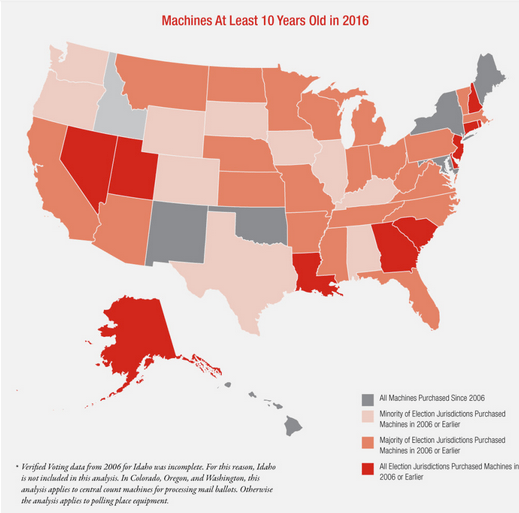
Things are dismal, yes, but they are not evenly so. As this map from the Brennan Center report shows, there are just a few states that are as bad off as South Carolina (all machines ten years old or greater). But there are also just as few states that are relatively well off with all machines newer than ten years old.

state-by-state-10-year-old-voting-machines

Of the nine places where the exit polling has missed by more than 7% (South Carolina, Alabama, Georgia, Massachusetts, Tennessee, Texas, Mississippi, Ohio, New York), two-thirds are states where all or the majority of election jurisdictions are using machines ten years old or greater. For these six states the average initial exit polling miss is a whopping 9.98%. From my column on exit polling misses last week, the average exit polling miss in Clinton’s favor is 5.1%. For the three states (Oklahoma, New York, Maryland) for which there is polling and for which all election jurisdictions use machines less than ten years old (gray in the map), the average is just a 1.67% miss in Clinton’s favor. Now take note, this 1.67% average includes New York with its huge miss in Clinton’s favor. Alabama is also worth looking at, with a minority of jurisdictions having machines more than ten years old, because I have been using an “Alabama Test” to see whether theories for the exit polling misses make sense.

I put figures like this to exit pollster and Executive Vice President of Edison Research Joe Lenski for question 10, which I’d previously left out of the published version of the interview I completed with him. I wanted to know whether the gap in exit polling misses raised any red flags. Here was Lenski’s reply:

The reliability of vote equipment is a true concern but I don’t see any evidence how the concentration of older voting machines in certain states would have affected either candidate more than the other.  There are many examples of vote count errors.  Here is a link reporting a recent vote count error in the Michigan primary that inflated Ted Cruz’s vote by 3000 votes  http://uselectionatlas.org/WEBLOGS/dave/ .  These types of errors are discovered all the time but there is no evidence that these are anything more than mistakes by local election officials – not a systematic attempt to affect a single candidate’s vote totals.  This reminds me of theories after the 2008 New Hampshire Democratic Primary based upon the fact that Hillary Clinton did better in towns with voting machines while Barack Obama did better in towns that voted on paper.  That was simply an artifact of the demographics in New Hampshire of the towns that had voting machines versus those that voted on paper.  Again the states with older voting machines in 2016 may just be the same states with demographics that favored Hillary Clinton over Bernie Sanders.

But again, as I argued last Wednesday, the demographics by state and other proposed reasons for exit polling misses do not actually add up. Big misses have happened in the South, in Massachusetts, and also in Ohio where Sanders otherwise did quite well in the Midwest. Nor do age or early voting patterns predict exit polling misses. Still, what is most remarkable about Lenski’s statement is that he is one of the few non-tech experts we spoke with who recognized that the “reliability of voting equipment is a true concern.”

None of the three elections academics I spoke with for last Wednesday’s piece appeared to be familiar with the Brennan Center report on aging and vulnerable machines, and Antonio Gonzalez, an exit polling expert and Latino voter registration guru who called for parties not to seat Arizona’s delegations in last Thursday’s piece, seemed a bit floored when I presented him with question ten from my interview with Lenski. “Oh,” he said, “I thought Congress was supposed to have taken care of that with HAVA.” HAVA, as noted earlier, offered money from 2002 to 2006 for states to upgrade to the then latest and greatest voting technology.

At this point we should take a look at the proven flaws in four very old and hackable machines in particular. These machines or similar elderly and vulnerable machines are in use in almost all places where Clinton outperforms exit polling most substantially. Because I am taking evidence and counter-evidence seriously, we will also look at the machines used in New York City, which are not quite so old (about six or seven years). While those machines, ES&S’s DS200, have had several problems over the years of the type suggested by Lenski, they also have not verifiably flunked independent security tests, so far as I know.

AccuVote (TS, OS, TSX models)

AccuVote technology is among the worst of the worst. This is the Diebold technology hacked in the Hacking Democracy clip. It is more than ten years old, can be hacked in such a way that even those models (OS, TSX) with a paper trail can be tricked, and it is in use throughout Georgia (12.2% miss) and in more than 300 counties or other election jurisdictions in more than 20 states.

AVC Edge and Edge II  (from my column on Chicago Friday)

The AVC Edge and Edge II (with paper trail) were provably hacked by a “Red Team” from UC Santa Barbara hired by the State of California in 2008. Jim Allen, spokesman for the Chicago Board of Elections, called and emailed to complain after my article last Friday. He dismissed the suggestion that Edge II could be hacked because of the paper trail. Not only is this laughable since his team engaged in a wildly inaccurate audit of the paper trail from the Chicago Democratic primary, but Allen apparently failed to click on the linkregarding the UCSB Red Team test that I included in the article. The first paragraph of that article notes that Edge machines, “even those with a so-called Voter Verified Paper Trail” can be successfully hacked by a single person. AVC Edge machines are in use without a paper trail throughout Louisiana (where there were no exit polls but where Clinton seriously outperformed her pre-election day polling average) and in more than 130 counties in various other states.

Model 100 (from ES&S)

Model 100 also badly flunked (.pdf) the California “Red Team” test in 2008. Like the other machines in this list, it is hackable in a way that spreads virally to other machines in the same network. Hundreds of jurisdictions still use Model 100 to tabulate votes, including especially Wayne County (Detroit), 27 counties in Ohio, 9 counties in Tennessee, 78 counties in Texas, and many more that match very well with where Clinton has outperformed exit polls.

iVotronic (ES&S)

iVotronic machines are touchscreen voting machines, many without a paper trail. iVotronic machines flunked a University of Pennsylvania test in 2007 and are the precise machines in question in the previous suspicious Democratic primary results in South Carolina in 2010. They continue to be used throughout South Carolina (no paper trail) and in hundreds of counties in states where Clinton has suspiciously overperformed exit polling.

DS200

DS200 machines have had a wide variety of malfunctioning problems, particularly in New York City, but those problems can and mostly have been addressed in places like New York City by retraining poll workers to check immediately whether each voters’ vote was counted and then offering a new chance to vote if necessary. As stated, the DS200 has not been provably hacked so far as I know. Newer machines of this sort were put into use just this year in Maryland where the overall exit polling missed in Sanders favor, for once, but by just 0.6 points. Still, the votes in Baltimore County have now been decertifiedbecause, among other things, there were more votes than voters who checked in at the polls. In Maryland, the DS200 machines are all networked to a statewide system for tabulating votes quickly. Networking, however, is not required, and my best information suggests that networking is not how the DS200 is used in New York City. Instead, precinct workers pull the results off the machine at the end of the voting day and relay them to county headquarters, according to my discussions with a poll worker from Brooklyn.

What About the Exceptions to This Correlation?

But we also would have to deal with where there are exceptions to this strong correlation between hackable machines and Clinton beating the exit polling badly. Here’s where my conversation with a particular veteran hacker comes into play. I chatted securely with a long-time member of Anonymous whom I’ll call the King of SciAm (not the handle they use publicly or privately). The King of SciAm has long worked with the Telecommix branch of Anonymous. Telecommix rose to fame when Hosni Mubarak cut off internet access in Egypt during the Arab Spring uprising. Telecommix found work-arounds via dial-up internet to keep information from activists on the ground flowing out of Egypt. As a general rule, Telecommix does not take part in Anonymous leaks or website shutdowns and defacements, but they made an exception to that rule early in this campaign cycle. Telecommix members defaced Donald Trump’s website with a tribute to Jon Stewart upon his retirement. The New Yorker’s Alex Koppleman called it the “classiest website hack ever,” a compliment the King of SciAm relishes.

The King of SciAm emphasized to me that, if hired to hack an election (which they would never do), the first thing they would do would be to figure out the best way to leave no trace: “we’d target the network packets or their headwater.” The key idea being for “a hack to survive the security audit trail after the vote is certified.” Furthermore, “we would likely try to target the thing most likely to get it’s logs wiped first – so – whatever it plugs into to move the data. Are the voting machines in use network connected?”

The King of SciAm told me that targeting old, provably hackable machines is “not an unfair theory,” but “you asked how (if we did these sort of things) we would do them.” The problem, they noted, “is that any change to the voting machine operating system or driver stack will likely be found in the security auditor’s rotation pretty quickly. This is because once the machines are down (end of election day) – they are no longer accessible to revert any source code changes or wipe any logs that said you were there, unless you’ve written STUXnet – in which case you wouldn’t be targeting the booth machines either.”

The King of SciAm was not at all surprised that sloppy hackers may be targeting older machines in places like South Carolina and Chicago, nor that elections officials were cluelessly trusting those machines and not even properly following procedures that could catch a less sophisticated hack.

So if, instead of targeting the DS200 in New York, hackers had targeted further upstream in the voting ecosystem, how would you catch it? The King of SciAm noted that you would have to use some procedure to “match 100% of the data, not 5%,” as in Chicago.

To do this, you would need to use a methodology much more like that used in the FiveThirtyEight article on irregularities in the South Carolina 2010 primary election. There, FiveThirtyEight referred to a Benford’s law test on precinct level results. That test showed an “unusual, non-random pattern in the precinct-level results suggest[ing] tampering, or at least machine malfunction, perhaps at the highest level.”

Intriguingly, after I began this series on election fraud allegations, a reader who would like to remain anonymous, emailed to point out similar irregularities in New York’s Democratic primary this year:

Results for Kings County and Bronx county [show] deviation from perfect 60-40 and 70-30 results was the same 0.035% The increase in votes in Kings (Brooklyn) from 2008 is incredible, almost a perfect 10%. Not only that but that’s where over a 100,000 voters lost their right to vote. Another 20,000 votes in Kings would mean almost a 20% increase which would be amazing compared to other counties that experienced decreases or mild increases. 

Furthermore, the overall results in New York, as announced on election night, deviated from a perfect 58-42 split “by 0.005345%. That’s 97 votes out of over 1.8 million.” Will FiveThirtyEight apply a Benford’s law test to 2016 primary results? Not a chance. They have boosted Clinton throughout and are already quite embarrassed by how badly they missed on the GOP side with Donald Trump.

But what about our test? The “Alabama Test.” What’s good for the goose is good for the gander. Alabama only has a minority of jurisdictions using old, provably hackable machines. Is that a weak correlation for the theory that in most places sloppy hackers targeted old, provably vulnerable machines while apparently more sophisticated hackers would have had to have been involved with targeting New York’s results as well as registration switching operations in a wide variety of states?

Taking a look at Alabama on a county level gives us a fairly strong answer. Most of Alabama’s counties also use hand cast ballots tabulated by the DS200, but a minority use Model 100, one of our flunked election machines. Three of the flunked Model 100 counties, however, are three of the four biggest counties in Alabama (Jefferson, Mobile, and Montgomery) and accounted for around 40% of the vote for Democrats in Alabama. Clinton won by a 64.2% spread in Jefferson, by 66.5% in Mobile, and by a stunning 73.4% in Montgomery. What happened in Madison, the one county of the top four by population that votes using the DS200 model? Clinton won by just a 38.5% spread! In fact, Clinton did not make it to 80% of the vote in any of the top twelve counties by population except for those three counties using Model 100 to tabulate votes.

And controlling for factors like African American voters or wealth does not account for this phenomenon. Take for instance Mobile where the population is 35.3% black versus a 24.6% black population in Madison County. A 10% difference in black population does not account for a 28% difference in the Clinton-Sanders spread. What’s more, if you compare Mobile to a very similar county in North Carolina (where the exit polls did not really miss), you see something similarly telling.

Cumberland County, NC is very comparative to Mobile, Alabama. They have similar populations, similar numbers of black residents (with Cumberland slightly higher at 37.6% African American), very similar per capita income figures, and both counties had about 35,000 Democratic voters. Clinton won Cumberland by 32.8%, very close to the Madison County (DS200 model) results and about half the percentage spread Clinton saw in Mobile (Model 100).

Of the theories we have so far for why exit polling missed in Alabama by a huge 14%, the only theory that provides a reasonable explanation is vote tabulating machine tampering. Now, perhaps someone else will come up with a non-fraudulent exit polling miss theory that passes the Alabama Test and explains other states as well. Such a theory cannot be about early voting (Alabama had none) and over-projecting young voters (there were very few according to exit polls of Alabama).

Until someone comes up with such a workable theory, election fraud benefiting Hillary Clinton to the tune of a 120 to 150 pledged delegate difference, is the best explanation we have. People wanting to prove this theory should be suing for a technologically sophisticated and independent review of results and the voting results’ entire computer ecosystems in places like Ohio, South Carolina, Alabama, Boston, Chicago, New York, and many others.

Part 1: Taking Election Fraud Allegations Seriously
Part 2: Debunking Some Election Fraud Allegations
Part 3: In-depth Report on Exit Polling and Election Fraud Allegations
An Interview With Lead Edison Exit Pollster Joe Lenski
Part 4: Purged, Hacked, Switched
Part 5: Chicago Election Official Admits “Numbers Didn’t Match”

Doug Johnson Hatlem is best known for his work as a street pastor and advocate with Toronto’s homeless population from 2005-2013. He is now a film producer and free-lance writer based in Chicago.

68 Monsanto-Owned Companies To Boycott

9hamburg_germany

(Editor’s Note:  Tomorrow marks the 4th annual international March Against Monsanto. Whether or not you participate, you can take action in solidarity all year round by refusing to buy products from the companies listed below.)

Monsanto Company Inc. is a well-known, American-owned, multinational agrochemical and agricultural biotechnology corporation. It has been a leading force behind the widespread use of genetically modified seeds, the production of GM food products, and the development and application of associated chemicals.

Specifically, Monsanto’s infamous contribution has been Roundup, a glyphosate-based herbicide that is promoted as safe and harmless to humans, but is believed by a multitude of experts to be quite the opposite. While the company’s GMO seeds are advertised as requiring a reduced use of pesticides, this has been exposed as a false claim. The company also previously produced such evils as the insecticide DDT, PCBs, Agent Orange, aspartame and bovine growth hormone.

All of these chemicals are considered by many to be a threat to global ecosystems, water safety and biodiversity. The residues of Roundup, which remain in genetically modified foods, are believed to cause many dangerous effects to human health, including the death of embryonic cells and extreme damage to the intestinal microbiome.

These foods are ubiquitous, with soy, maize, corn, sorghum, canola, alfalfa and cotton being largely contaminated with Roundup. In a world of modern processed foods, a surprising majority of ingredient lists contain at least one of these items. Many forward-thinking companies and restaurants are now excluding GMOs from their product offerings.

Even more upsetting is that the processed foods containing GMOs are often targeted toward children. Check out this link for a video of Daniel Bissonnette, a nine-year-old Canadian boy who asks why children in particular are subjected to the most toxic food by our society.

Tami Monroe Canal, founder of the worldwide March Against Monsanto movement, sums up the issue by saying, “Monsanto’s predatory business and corporate agricultural practices threatens [this] generation’s health, fertility and longevity.”

Here is the list of companies and brands that are either owned by Monsanto, or are known to use genetically modified seeds sold by Monsanto:

  • Aunt Jemima
  • Aurora Foods
  • Banquet
  • Best Foods
  • Betty Crocker
  • Bisquick
  • Cadbury
  • Campbell’s
  • Capri Sun
  • Carnation
  • Chef Boyardee
  • Coca-Cola
  • ConAgra Foods
  • Delicious Brands cookies
  • Duncan Hines
  • Famous Amos
  • Flowers Industries
  • Frito Lay
  • General Mills
  • Green Giant
  • Healthy Choice
  • Heinz
  • Hellmann’s
  • Hershey
  • Holsum
  • Hormel
  • Hungry Jack
  • Hunt’s
  • Interstate Bakeries
  • Jiffy
  • KC Masterpiece
  • Keebler
  • Kellogg’s
  • Kid Cuisine
  • Knorr
  • Kool-Aid
  • Kraft
  • Lean Cuisine
  • Lipton
  • Loma Linda Foods
  • Marie Callender’s
  • Minute Maid
  • MorningStar Farms
  • Mrs. Butterworth’s
  • Nabisco
  • Nature Valley
  • Nestlé
  • Ocean Spray
  • Ore-Ida
  • Orville Redenbacher’s
  • Pepperidge Farm
  • Pepsi
  • Philip Morris
  • Pillsbury
  • Pop Secret
  • Post cereals
  • PowerBar brand
  • Prego
  • Pringles
  • Procter & Gamble
  • Quaker
  • Ragú
  • Rice-A-Roni & Pasta Roni
  • Schweppes
  • Weight Watchers Smart Ones
  • Stouffer’s
  • Tombstone frozen pizza
  • Totino’s
  • Uncle Ben’s
  • Unilever
  • V8

So what is a concerned consumer to do? We recommend getting on the organic train, and staying there. Certified USDA organic products do not contain GMOs and are therefore safe for consumption. However, certain processed organic foods may still be owned by Monsanto. That’s why it’s even more important to buy local, seasonal organic produce and free-range, pastured animal products from small brands that you know and trust. Anything that comes in a box, bag, can or package is better left alone.

If you do choose to buy packaged foods, try using an app such as Buycott, which is able to determine the “family tree” of a company and let you know if it is associated with Monsanto. Then you can pop that product back on the shelf and choose a different one. Boycotting these companies and brands will strengthen the force against the dangerous agricultural practices they are promoting.

We encourage you to join the movement against Monsanto and say “NO!” to everything it represents by boycotting these products. Learn more about anti-GMO efforts here.

3 Signs Corporate Work Culture Has Become Toxic to the Human Spirit

Playtime-2

(Editor’s note: There are of course countless more signs of the toxicity of our culture, but the three mentioned in the article are significant ones.)

By Sigmund Fraud

Source: Waking Times

Feeling trapped on the corporate ladder? You’re not alone… our work culture has become uncaring, toxic and rather dangerous to our well-being. 

Everybody seems to be working harder and harder these days, but genuinely happy people are hard to come by, even amongst those who actually have decent jobs. The truth is, very few people are fit and able to succeed under the current status quo of living to work, and more of us than ever are slipping behind in a corporate culture that is becoming increasingly toxic and impossible to endure.

Suspended in ‘survival mode,’ the individual is really not doing well in this environment. But, corporations are doing well, and have grown to have an enormous impact on our lives, even affecting how we educate our children, programming them with the ambition to grow up to become human resources just like everyone else.

Our society hasn’t always been so dominated by the corporate model, as it is today, though. In just the last 150 years or so, the corporation has become more pervasive and influential than the church and most political parties have ever been. Now, human relationships, commerce, and organized human endeavor are monopolized under the corporate model, making financial profit, rather than truer virtues, the primary driver of the vast bulk of daily human activity.

Is dedication to the corporate work model serving us well?

So many people hate their jobs and work only for the weekends… then they go nuts in 48-hour orgies of convenience and excess in order to ferociously attempt to reclaim their lives for themselves. Were human beings meant to live this way? 

Who feels it knows it, and in order for the world to change, individuals must first have good reason to love their own lives. The corporate work trap is holding far too many good people in bondage, side-lining them from being change-makers in a needy world.

Here are 3 signs the corporate work culture has become toxic to the human spirit and that it must be abandoned.

1.) The culture of over-work and over-competition is driving us crazy and turning us against each other. 

Entry into the corporate worker-bee culture is about being selected, and the education system grooms children and young adults to work for and think in terms of being evaluated, tested, judged and ranked against friends and peers who are subdivided by age, gender and aptitude.

The aim is to be chosen, so early on we are taught to be selectable. We learn to follow the leader, follow the rules, fall in line, and to do our best to be the best at whatever else everyone else is doing.

In order to prosper in the corporate work scene, value must be proven, again and again, and the sense of urgent competition never stops.

To make ourselves always available for this level of participation, we’ve been programmed to sacrifice our most valuable asset, time. The important roles in life, such as caregiving to the young and old (those who don’t work), are snowed under, giving us less and less room to be human and throwing us further and further out of alignment with the natural rhythms of life.

Bad work culture is everyone’s problem, for men just as much as for women. It’s a problem for working parents, not just working mothers. For working children who need time to take care of their own parents, not just working daughters. For anyone who does not have the luxury of a full-time lead parent or caregiver at home.” [Anne-Marie Slaughter]

2.) The corporate work culture is socially engineering us to conform to a wasteful, meaningless consumer lifestyle. 

We are several generations deep into the greatest mass social engineering project ever initiated against human beings. A true and vast global cultural revolution. Enforced on us with mis-education, brainwashing, peer-pressure, propaganda, economics, regulations, ordinances, laws, and the seizure of personal time, our culture has been deliberately transformed into a consumer wasteland by the empires of media, advertising and business.

Colonized by television and mass media, the modern mind has been weened on the illusion that happiness is external and can be purchased. Kept as far as possible from personal development and spiritual growth, we are now expected to be total consumers of media and of stuff, always in pursuit of endless growth and instant gratification.

“We’ve been led into a culture that has been engineered to leave us tired, hungry for indulgence, willing to pay a lot for convenience and entertainment, and most importantly, vaguely dissatisfied with our lives so that we continue wanting things we don’t have. We buy so much because it always seems like something is still missing.

Western economies, particularly that of the United States, have been built in a very calculated manner on gratification, addiction, and unnecessary spending. We spend to cheer ourselves up, to reward ourselves, to celebrate, to fix problems, to elevate our status, and to alleviate boredom.” [David Cain]

Which is why we work so hard… because working gives us the freedom to consume… which is what we are supposed to be doing. We fit in when we work to consume to obey. And we’ve been trained to believe that fitting in matters.

“The perfect customer is dissatisfied but hopeful, uninterested in serious personal development, highly habituated to the television, working full-time, earning a fair amount, indulging during their free time, and somehow just getting by. Is this you?”  [David Cain]

3.) The corporate work model has become the contemporary slave management program for a world ruled by fiat money masters. 

What we are told to believe is prosperity, is really just an elegant trap, an illusion. And at the very top of this pyramid of lies is the dark secret as to why we all have to work so hard in order to experience life on planet earth.

At its very core, the world economy is based on a rigged fiat monetary system that is explicitly designed to create and perpetuate debt slavery, both personal and public. The dollar is a private enterprise, privately owned by a select few people who create money for the rest of us and get paid like gods to do so.

For every dollar that is put into play in this world, a dollar plus interest is then owed to the people who own the money. The more we do, the deeper in debt we go. It’s guaranteed. At present, more money is owed to the money masters than is actually in circulation. This is bondage, it is servitude, and it is slavery.

It’s also the secret which has allowed the 1% to become the 1%, and why income equality between workers and plantation owners is so outrageous.

We don’t have time to resist any of this in any meaningful way, because we’re struggling to make it work in the corporate world, jockeying against each other for illusory wealth and prestige on a playing field created by criminals. The further we go down this road, the more control these people are given over our lives, and the more intrusive they are permitted to be.

The hamster wheel won’t stop until we have honest money.


Final Thoughts

So, we know that the corporate culture as is doesn’t serve us well, so we must then ask ourselves what we do wish for our lives to be like. Do we really need to buy into all that is being offered here?

The movement for change is growing, and avenues for expressing yourself outside of this system are growing along side of our awareness of just how ridiculous and toxic the corporate work culture has become.

Life is all possibility and our highest potential awaits us, although, before we can fully realize it, we’ll have to break through the crusty fog of wrongfully imposed culture and fully activate our imagination, creativity and courage.