3 Signs Corporate Work Culture Has Become Toxic to the Human Spirit

Playtime-2

(Editor’s note: There are of course countless more signs of the toxicity of our culture, but the three mentioned in the article are significant ones.)

By Sigmund Fraud

Source: Waking Times

Feeling trapped on the corporate ladder? You’re not alone… our work culture has become uncaring, toxic and rather dangerous to our well-being. 

Everybody seems to be working harder and harder these days, but genuinely happy people are hard to come by, even amongst those who actually have decent jobs. The truth is, very few people are fit and able to succeed under the current status quo of living to work, and more of us than ever are slipping behind in a corporate culture that is becoming increasingly toxic and impossible to endure.

Suspended in ‘survival mode,’ the individual is really not doing well in this environment. But, corporations are doing well, and have grown to have an enormous impact on our lives, even affecting how we educate our children, programming them with the ambition to grow up to become human resources just like everyone else.

Our society hasn’t always been so dominated by the corporate model, as it is today, though. In just the last 150 years or so, the corporation has become more pervasive and influential than the church and most political parties have ever been. Now, human relationships, commerce, and organized human endeavor are monopolized under the corporate model, making financial profit, rather than truer virtues, the primary driver of the vast bulk of daily human activity.

Is dedication to the corporate work model serving us well?

So many people hate their jobs and work only for the weekends… then they go nuts in 48-hour orgies of convenience and excess in order to ferociously attempt to reclaim their lives for themselves. Were human beings meant to live this way? 

Who feels it knows it, and in order for the world to change, individuals must first have good reason to love their own lives. The corporate work trap is holding far too many good people in bondage, side-lining them from being change-makers in a needy world.

Here are 3 signs the corporate work culture has become toxic to the human spirit and that it must be abandoned.

1.) The culture of over-work and over-competition is driving us crazy and turning us against each other. 

Entry into the corporate worker-bee culture is about being selected, and the education system grooms children and young adults to work for and think in terms of being evaluated, tested, judged and ranked against friends and peers who are subdivided by age, gender and aptitude.

The aim is to be chosen, so early on we are taught to be selectable. We learn to follow the leader, follow the rules, fall in line, and to do our best to be the best at whatever else everyone else is doing.

In order to prosper in the corporate work scene, value must be proven, again and again, and the sense of urgent competition never stops.

To make ourselves always available for this level of participation, we’ve been programmed to sacrifice our most valuable asset, time. The important roles in life, such as caregiving to the young and old (those who don’t work), are snowed under, giving us less and less room to be human and throwing us further and further out of alignment with the natural rhythms of life.

Bad work culture is everyone’s problem, for men just as much as for women. It’s a problem for working parents, not just working mothers. For working children who need time to take care of their own parents, not just working daughters. For anyone who does not have the luxury of a full-time lead parent or caregiver at home.” [Anne-Marie Slaughter]

2.) The corporate work culture is socially engineering us to conform to a wasteful, meaningless consumer lifestyle. 

We are several generations deep into the greatest mass social engineering project ever initiated against human beings. A true and vast global cultural revolution. Enforced on us with mis-education, brainwashing, peer-pressure, propaganda, economics, regulations, ordinances, laws, and the seizure of personal time, our culture has been deliberately transformed into a consumer wasteland by the empires of media, advertising and business.

Colonized by television and mass media, the modern mind has been weened on the illusion that happiness is external and can be purchased. Kept as far as possible from personal development and spiritual growth, we are now expected to be total consumers of media and of stuff, always in pursuit of endless growth and instant gratification.

“We’ve been led into a culture that has been engineered to leave us tired, hungry for indulgence, willing to pay a lot for convenience and entertainment, and most importantly, vaguely dissatisfied with our lives so that we continue wanting things we don’t have. We buy so much because it always seems like something is still missing.

Western economies, particularly that of the United States, have been built in a very calculated manner on gratification, addiction, and unnecessary spending. We spend to cheer ourselves up, to reward ourselves, to celebrate, to fix problems, to elevate our status, and to alleviate boredom.” [David Cain]

Which is why we work so hard… because working gives us the freedom to consume… which is what we are supposed to be doing. We fit in when we work to consume to obey. And we’ve been trained to believe that fitting in matters.

“The perfect customer is dissatisfied but hopeful, uninterested in serious personal development, highly habituated to the television, working full-time, earning a fair amount, indulging during their free time, and somehow just getting by. Is this you?”  [David Cain]

3.) The corporate work model has become the contemporary slave management program for a world ruled by fiat money masters. 

What we are told to believe is prosperity, is really just an elegant trap, an illusion. And at the very top of this pyramid of lies is the dark secret as to why we all have to work so hard in order to experience life on planet earth.

At its very core, the world economy is based on a rigged fiat monetary system that is explicitly designed to create and perpetuate debt slavery, both personal and public. The dollar is a private enterprise, privately owned by a select few people who create money for the rest of us and get paid like gods to do so.

For every dollar that is put into play in this world, a dollar plus interest is then owed to the people who own the money. The more we do, the deeper in debt we go. It’s guaranteed. At present, more money is owed to the money masters than is actually in circulation. This is bondage, it is servitude, and it is slavery.

It’s also the secret which has allowed the 1% to become the 1%, and why income equality between workers and plantation owners is so outrageous.

We don’t have time to resist any of this in any meaningful way, because we’re struggling to make it work in the corporate world, jockeying against each other for illusory wealth and prestige on a playing field created by criminals. The further we go down this road, the more control these people are given over our lives, and the more intrusive they are permitted to be.

The hamster wheel won’t stop until we have honest money.


Final Thoughts

So, we know that the corporate culture as is doesn’t serve us well, so we must then ask ourselves what we do wish for our lives to be like. Do we really need to buy into all that is being offered here?

The movement for change is growing, and avenues for expressing yourself outside of this system are growing along side of our awareness of just how ridiculous and toxic the corporate work culture has become.

Life is all possibility and our highest potential awaits us, although, before we can fully realize it, we’ll have to break through the crusty fog of wrongfully imposed culture and fully activate our imagination, creativity and courage.

A Crisis of the Heart

AAEAAQAAAAAAAANZAAAAJDE2ODFkMTY5LTcyYTktNGIwMi1iMDUxLWQ5MzA4ZDQ3OWU4ZA

By rahkyt

Source: Sacred Space in Time

The loss of life for any reason is always to be commiserated with and in instances of collective horror such as the terrorist attacks that have recently beset the West, the heart of oceanic humanity breaks a bit more.

With that said, our social media feeds become filled with national colors and heartful memes in solidarity with members of the human family hit by unthinkable tragedy. It is right to do so. But it is also right to understand that tragedies are occurring all around us, in our own nations as well as others, every single day.  Middle-aged whites in the US are killing themselves with drugs and alcohol and poor eating habits at a rate never seen before. They are hopeless and despairing as the American dream fades. Blacks remain mired in the same hopelessness caused by the same reasons, economic and social, with the added addition of racism and eugenic tactics centuries in the formation. Native Americans on Reservations continue to experience the effects of genocide, a program running in the collective American consciousness since this nation’s inception. The deaths add up and fade into consciousness as the background cries of the disillusioned and dehumanized.

Inhumanity reigns and the statistics state that people have been growing less and less compassionate toward each other for decades in this nation. These computers and smart phones draw us together but also tear us apart, the virtual world is as real as the real one. People spend hours per day jacked into the matrix, seamlessly moving between one and the other. Death by texting is on the rise,  porn increases objectification and consumer culture further consolidates the banality of social interaction and heart-based intimacy.

These realities indicate a crisis of the soul. Of the heart. When we are upset and outraged about one group of people but care nothing for others, something is very wrong. When there is compassion for those whom we might share something in common with and lack of compassion for those with whom we do not, there is a division of the heart, a dehumanization that speaks to the pervasivity of mainstream media programming of the mind.

Perhaps those who say humanity cannot change are right. Perhaps this is the best we can do. But perhaps it is also true that by consciously examining the memes and events and seeking to understand the issues at levels beyond those trumpeted in the mainstream we will come to realize that we have more in common with the Oppressed everywhere than the privileged so many of us wish to join in their glass mansions and private retreats. It is in the experience of self as seen through the eyes of others and experienced in the visceral engagement of souls on an eternal journey that true empathy and compassion are known.

When life ends, all that matters is the love. The love we give and the love we receive. The divisions dissipate. Living as if each one of us was from Beirut, or Paris, or Chicago, or Kenyan, every, single, day, and sharing our portion of love is how the dogs of war are banished. How the flames of hate are extinguished. The source is never what we are told and the cause goes back so far in the past that the effect is shrouded in mystery.

Share this outpouring of love with the world. Feel the pain of all those sacrificed on the alters of political and economic gain. Those next door, down the street, in the next city and state, and even across the nation. We must stand in solidarity with those who’ve made the ultimate sacrifice, but the war is not just between nations and ideologies. The war is within each of us. Every, single day.

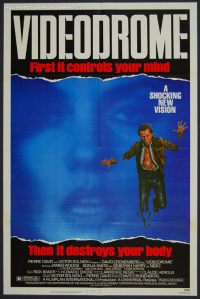
David Cronenberg’s Videodrome Was a Technology Prophecy

videodrome_one_sheet_movie_poster_l

Editor’s note: Since today marks director David Cronenberg’s 73rd birthday, it’s a good time to appreciate one of his greatest and most notorious works. Though my favorite of his remains the distinctly PKD-like eXistenZ, a close runner up is the cult classic Videodrome, which the following analysis reappraises in the context of contemporary social media-fixated culture.

By Nathan Jurgenson

Source: Omni Reboot

David Cronenberg’s vision of technology as the “new flesh” in Videodrome isn’t so shocking anymore.

Videodrome is the best movie ever made about Facebook.

What felt “vaguely futuristic” about it in 1983 is prescient today: technology and media are ever more intimate, personal, embodied, an interpenetration that David Cronenberg’s film graphically explores.
Videodrome offers a long-needed correction to how we collectively view and talk about technology. As the anti-Matrix, Videodrome understood that media is not some separate space, but something which burrows into mind and flesh. The present has a funny habit of catching up with David Cronenberg.
Still, Videodrome is deeply of its time and place. It’s set in Toronto, where Cronenberg was born and studied at the same time as University of Toronto superstar media theorist Marshall McLuhan, who coined the phrase “the medium is the message.” Beyond McLuhan’s reputation, Toronto was also known as a wired city; among other things, it was an early adopter of cable television.
In suit, Videodrome follows a Toronto cable television president, Max Renn (James Woods). He becomes involved with a radio psychiatrist named Nikki Brand (Debbie Harry, of Blondie fame), who reminds us of popular criticisms of television culture: we want to be stimulated until we’re desensitized, becoming (at best) apolitical zombies and (at worst) amoral monsters. Television signal saturates this film. The satellite dishes, screens, playback devices, and general aesthetics of analogue video are on glorious, geeked-out display. Although Videodrome’s operating metaphor is television, this film can be understood as being a fable about media in general. And what seemed possible with television in 1983 seems obvious today with social media.
Over the course of the film, Max comes to know a “media prophet” named Professor Brian O’Blivion—an obvious homage to Marshall McLuhan. O’Blivion builds a “Cathode Ray Mission,” named after the television set component which shoots electrons and creates images. The Cathode Ray Mission gives the destitute a chance to watch television in order to “patch them back into the world’s mixing board,” akin to McLuhan’s notion of media creating a “global village,” premised on the idea that media and technology, together, form the social fabric. O’Blivion goes on to monologue, “The television screen is the retina of the mind’s eye. Therefore, the television screen is part of the physical structure of the brain. Therefore, whatever appears on the television screen appears as raw experience for those who watch it. Therefore, television is reality; and reality is less than television.”
This is Videodrome’s philosophy. It’s the opposite of The Matrix’s reading of Baudrillard’s theories of simulation, and it goes completely against the common understanding of the Web as “virtual,” of the so-called “offline” as “real.” O’blivion would agree when I claim that “it is wrong to say ‘IRL’ to mean offline: Facebook is real life.”
This logic—that the Web is some other place we visit, a “cyber” space, something “virtual” and hence unreal—is what I call “digital dualism” and I think it’s dead wrong. Instead, we need a far more synthetic understanding of technology and society, media and bodies, physicality and information as perpetually enmeshed and co-determining. If The Matrix is the film of digital dualism, Videodrome is its synthetic and augmented opponent.
As P.J. Rey illustrates, fictional Web-spatiality is the favorite digital dualist plot device. Yet more than fiction books and films, what has come to dominate much of our cultural mythology around the Web is the idea that we are trading “real” communication for something simply mechanical: that real friendship, sex, thinking, and whatever else lazy op-ed writers can imagine are being replaced by merely simulated experiences. The non-coincidental byproduct of inventing the notion of a “cyber” space is the simultaneous invention of “the real,” the “IRL,” the offline space that is more human, deep, and true. Where The Matrix’s green lines of code or Neal Stephenson’s 3D Metaverse may have been the sci-fi milieu of the 1990s, the idea of a natural “offline” world is today’s preferred fiction.
Alternatively, what makes Videodrome, and Cronenberg’s oeuvre in general, so useful for understanding social media is their fundamental assumption that there is nothing “natural” about the body. Cronenberg’s trademark flavor of body-horror is highly posthuman: boundaries are pushed and queered, first through medical technologies in Shivers , Rabid , The Brood , and Scanners , then through media technology in Videodrome  and eXistenZ , then, most notoriously, in The Fly, where the human and animal merge. If The Matrix is René Descartes, Videodrome is Donna Haraway.
Cronenberg’s characters are consistent with Haraway’s theory of the cyborg: not the half-robot with the shifty laser eye, but you and me. In the film, the goal is never to remove the videodrome signal that is augmenting the body, but to reprogram it. To direct it. As Haraway famously wrote, “I’d rather be a cyborg than a goddess.” “Natural” was never a real option anyways.
Max Renn is especially good at finding the real in the so-called “virtual” because he is equally good at seeing virtuality in the “real.” From the beginning, he understands that much of everyday life is a massive media event devoid of meaning. The old flesh is tired, used up, and toxic. The world is filled with a suffering assuaged only by glowing television screens. As the film progresses, the real and unreal blur, making each seem hyperbolic: hallucinations become tangible, while the tangible drips with a surrealism that’s gritty, jumpy, dirty, erotic, and violent—closer to Spring Breakers than The Wizard of Oz. As such, Cronenberg’s universe is always a little sticky: an unease which begs the nightmares to come true, so that we at least know what’s real.
Videodrome’s depiction of techno-body synthesis is, to be sure, intense; Cronenberg has the unusual talent of making violent, disgusting, and erotic things seem even more so. The technology is veiny and lubed. It breaths and moans; after watching the film, I want to cut my phone open just to see if it will bleed. Fittingly, the film was originally titled “Network of Blood,” which is precisely how we should understand social media, as a technology not just of wires and circuits, but of bodies and politics. There’s nothing anti-human about technology: the smartphone that you rub and take to bed is a technology of flesh. Information penetrates the body in increasingly more intimate ways.
This synthesis of the physical and the digital is mirrored in the film’s soundtrack, too. In his book on Videodrome’s production, Tim Lucas calls Howard Shore’s score “bio-electronic” because it was written, programmed into a synthesizer, and played back on a computer in a recording studio while live strings played along. Early in the film, the score is mostly those strings, but as time passes the electronic synthesizers creep up in the mix, forming the bio-electronic synthesis.
The most fitting example of techno-human union in Videodrome is the famous scene of Max inserting his head into a breathing, moaning, begging video screen; somewhere between erotic and hilarious, media and humanity coalesce. There isn’t a person and then an avatar, a real world and then an Internet. They’re merged. As theorists like Katherine Hayles have long taught, technology, society, and the self have always been intertwined. Videodrome knows this, and it shows us with that headfirst dive into the screen—to say nothing of media being inserted directly into a vaginal opening in Max’s stomach, or the gun growing into his hand.

Thirty years after its release, Videodrome remains the most powerful fictional representation of technology-self synthesis. This merger wasn’t invented with the Internet, or even television. Humans and technology have always been co-implicated. We often forget this when talking about the Web, selling ourselves instead a naive picture of defined “virtual” spaces which somehow lack the components of “real” reality. This is why The Matrix and “cyberspace” have long outworn their welcome as a frame for understanding the Internet. It should be of no surprise that body horror is as useful for understanding social media as cyberpunk.

Fukushima@5

radioaktivitaet-fukushima-ia

(Source: Fairewinds.org)

Modern ghost towns, abandoned houses, and far stretching roads lined with plastic bags of radioactive garbage have replaced the once bustling neighborhoods and cities of the Fukushima Prefecture. Formerly home to thousands, the massive release of radiation has forced residents to evacuate their beautiful homeland, leaving the land they love behind without knowing whether or not they may ever return without putting their lives at risk. Join the Fairewinds Crew and ask yourself this: With 99 operating atomic power reactors generating electricity in the U.S., what’s so different about your home, your town, your state that what happened to Fukushima couldn’t happen to you and your family?

Many Japanese and millions of Americans are currently living in the shadow of atomic reactors, plutonium reprocessing plants, and atomic waste dumps. It will be five years in March since the triple meltdown at Fukushima Daiichi began and the Japanese public and people around the world continue to search for the truth about nuclear risk and honest answers to their energy future. Fukushima@5 exposes the truth of the ongoing atomic devastation caused by the nuclear meltdown at Fukushima Daiichi.

Related Podcast: Project Censored 03.08.16

The Mad Violence of Casino Capitalism

AmericanRoulette

By

Source: Counterpunch

American society is morally bankrupt and politically broken, and its vision of the future appears utterly dystopian. As the United States descends into the dark abyss of an updated form of totalitarianism, the unimaginable has become imaginable in that it has become possible not only to foresee the death of the essential principles of constitutional democracy, but also the birth of what Hannah Arendt once called the horror of dark times. The politics of terror, a culture of fear, and the spectacle of violence dominate America’s cultural apparatuses and legitimate the ongoing militarization of public life and American society.

Unchecked corporate power and a massive commodification, infantilization, and depoliticization of the polity have become the totalitarian benchmarks defining American society. In part, this is due to the emergence of a brutal modern-day capitalism, or what some might call neoliberalism. This form of neoliberal capitalism is a particularly savage, cruel, and exploitative regime of oppression in which not only are the social contract, civil liberties and the commons under siege, but also the very notion of the political, if not the planet itself. The dystopian moment facing the United States, if not most of the globe, can be summed up in Fred Jameson’s contention “that it is easier to imagine the end of the world than to imagine the end of capitalism.” He goes on to say that “We can now revise that and witness the attempt to imagine capitalism by way of imagining the end of the world.”1

One way of understanding Jameson’s comment is through the ideological and affective spaces in which the neoliberal subject is produced and market-driven ideologies are normalized. Capitalism has made a virtue out of self-interest and the pursuit of material wealth and in doing so has created a culture of shattered dreams and a landscape filled with “Broken highways, bankrupt cities, collapsing bridges, failed schools, the unemployed, the underpaid and the uninsured: all suggest a collective failure of will. These shortcomings are so endemic that we no longer know how to talk about what is wrong, much less set about repairing it.”[i]

Yet, there is a growing recognition that casino capitalism is driven by a kind of mad violence and form of self-sabotage and that if it does not come to an end what we will experience in all probability is the destruction of human life and the planet itself. Certainly, more recent scientific reports on the threat of ecological disaster from researchers at the University of Washington, NASA, and the Intergovernmental Panel on Climate Change reinforce this dystopian possibility.2 The undermining of public trust and public values has now given way to a market-driven discourse that produces a society that has lost any sense of democratic vision and social purpose and in doing so resorts to state terrorism, the criminalization of social problems, and culture of cruelty. Institutions that were once defined to protect and enhance human life now function largely to punish and maim.

As Michael Yates points out throughout this book, capitalism is devoid of any sense of social responsibility and is driven by an unchecked desire to accumulate capital at all costs. As power becomes global and politics remains local, ruling elites no longer make political concessions to workers or any other group that they either exploit or consider disposable.

Security and crisis have become the new passwords for imposing a culture of fear and for imposing what Giorgio Agamben has called a permanent state of exception and a technology of government repression.[ii] A constant appeal to a state of crisis becomes the new normal for arming the police, curtailing civil liberties, expanding the punishing state, criminalizing everyday behavior, and supressing dissent. Fear now drives the major narratives that define the United States and give rise to dominant forms of power free from any sense of moral and political conviction, if not accountability.

In the midst of this dystopian nightmare, there is the deepening abyss of inequality, one that not only separates the rich from the poor, but also increasingly relegates the middle and working classes to the ranks of the precariat. Concentrations of wealth and income generate power for the financial elite and unchecked misery for most people, a fear/insecurity industry, and a growing number of social pathologies.

Michael Yates in The Great Inequality provides a road map for both understanding the registers that produce inequality as well as the magnitude of the problems it poses across a range of commanding spheres extending from health care and the political realm to the environment and education. At the same time, he exposes the myths that buttress the ideology of inequality. These include an unchecked belief in boundless economic growth, the notion that inequality is chosen freely by individuals in the market place, and the assumption that consumption is the road to happiness. Unlike a range of recent books on inequality, Yates goes beyond exposing the mechanisms that drive inequality and the panoply of commanding institutions that support it. He also provides a number of strategies that challenge the deep concentrations of wealth and power while delivering a number of formative proposals that are crucial for nurturing a radical imagination and the social movements necessary to struggle for a society that no longer equates capitalism with democracy.

As Yates makes clear throughout this book, money now engulfs everything in this new age of disposability. Moreover, when coupled with a weakening of movements to counter the generated power of capitalists, the result has been a startling increase in the influence of predatory capitalism, along with inequities in wealth, income, power, and opportunity. Such power breeds more than anti-democratic tendencies, it also imposes constraints, rules, and prohibitions on the 99 percent whose choices are increasingly limited to merely trying to survive. Capitalists are no longer willing to compromise and have expanded their use of power to dominate economic, political, and social life. For Yates, it is all the more crucial to understand how power works under the reign of global capitalism in order to grasp the magnitude of inequality, the myriad of factors that produce it, and what might be done to change it.

Accompanying the rise of a savage form of capitalism and the ever-expanding security state is the emergence of new technologies and spaces of control. One consequence is that labor power is increasing produced by machines and robotic technologies which serve to create “a large pool of more or less unemployed people.” Moreover, as new technologies produce massive pools of unused labor, it also is being used as a repressive tool for collecting “unlimited biometric and genetic information of all of its citizens.”[iii]

The ongoing attack on the working class is matched by new measures of repression and surveillance. This new weaponized face of capitalism is particularly ominous given the rise of the punishing state and the transformation of the United States from a democracy in progress to a fully developed authoritarian society.   Every act of protest is now tainted, labeled by the government and mainstream media as either treasonous or viewed as a potential act of terrorism. For example, animal rights activists are put on the terrorist list. Whistleblowers such as Edward Snowden are painted as traitors. Members of the Black Lives Matter movement are put under surveillance,[iv] all electronic communication is now subject to government spying, and academics who criticize government policy are denied tenure or worse.

Under neoliberalism, public space is increasingly converted into private space undermining those sphere necessary for developing a viable sense of social responsibility, while also serving to transform citizenship into mostly an act of consumption. Under such circumstances, the notion of crisis is used both to legitimate a system of economic terrorism as well as to accentuate an increasing process of depoliticization. Within this fog of market induced paralysis, language is subject to the laws of capitalism, reduced to a commodity, and subject to the “tyranny of the moment….emaciated, impoverished, vulgarized and squeezed out of the meanings it was resumed to carry.”[v]

As the latest stage of predatory capitalism, neoliberalism is part of a broader economic and political project of restoring class power and consolidating the rapid concentration of capital, particularly financial capital.[vi] As a political project it includes “the deregulation of finance, privatization of public services, elimination and curtailment of social welfare programs, open attacks on unions, and routine violations of labor laws.”[vii] As an ideology, it casts all dimensions of life in terms of market rationality, construes profit making as the arbiter and essence of democracy, consuming as the only operable form of citizenship, and upholds the irrational belief that the market can both solve all problems and serve as a model for structuring all social relations. As a mode of governance, it produces identities, subjects, and ways of life driven by a survival-of-the fittest-ethic, grounded in the idea of the free, possessive individual, and committed to the right of ruling groups and institutions to exercise power removed from matters of ethics and social costs. As a policy and political project, it is wedded to the privatization of public services, the dismantling of the connection of private issues and public problems, the selling off of state functions, liberalization of trade in goods and capital investment, the eradication of government regulation of financial institutions and corporations, the destruction of the welfare state and unions, and the endless marketization and commodification of society.

Nothing engenders the wrath of conservatives more than the existence of the government providing a universal safety net, especially one that works, such as either Medicare or Social Security. As Yates points out, government is viewed by capitalists as an institution that gets in the way of capital. One result is a weakening of social programs and provisions. As Paul Krugman observes regarding the ongoing conservative attacks on Medicare, “The real reason conservatives want to do away with Medicare has always been political: It’s the very idea of the government providing a universal safety net that they hate, and they hate it even more when such programs are successful.”[viii] In opposition to Krugman and other liberal economists, Michael Yates argues rightly in this book that the issue is not simply preserving Medicare but eliminating the predatory system that disavows equality of wealth, power, opportunity, and health care for everyone.

Neoliberalism has put an enormous effort into creating a commanding cultural apparatus and public pedagogy in which individuals can only view themselves as consumers, embrace freedom as the right to participate in the market, and supplant issues of social responsibility for an unchecked embrace of individualism and the belief that all social relation be judged according to how they further one’s individual needs and self-interests. Matters of mutual caring, respect, and compassion for the other have given way to the limiting orbits of privatization and unrestrained self-interest, just as it is has become increasingly difficult to translate private troubles into larger social, economic, and political considerations. One consequence is that it has become more difficult for people to debate and question neoliberal hegemony and the widespread misery it produces for young people, the poor, middle class, workers, and other segments of society– now considered disposable under neoliberal regimes which are governed by a survival-of-the fittest ethos, largely imposed by the ruling economic and political elite. Unable to make their voices heard and lacking any viable representation in the process makes clear the degree to which the American public, in particular, are suffering under a democratic deficit producing a profound dissatisfaction that does not always translate into an understanding of how neoliberal capitalism has destroyed democracy or what it might mean to understand and challenge its diverse apparatuses of persuasion and power. Clearly, the surge of popularity behind the presidential candidacy of a buffoon such as Donald Trump testifies to both a deep seated desire for change and the forms it can take when emotion replaces reason and any viable analysis of capitalism and its effects seem to be absent from a popular sensibility.

What Michael Yates makes clear in this incisive book on inequality is that democratic values, commitments, integrity, and struggles are under assault from a wide range of sites in an age of intensified violence and disposability. Throughout the book he weaves a set of narratives and critiques in which he lays bare the anti-democratic tendencies that are on display in a growing age of lawlessness and disposability. He not only makes clear that inequality is not good for the economy, social bonds, the environment, politics, and democracy, Yates also argues that capitalism in the current historical moment is marked by an age that thrives on racism, xenophobia, the purported existence of an alleged culture of criminality, and a massive system of inequality that affects all aspects of society. Worth repeating is that at the center of this book, unlike so many others tackling inequality, is an attempt to map a number of modalities that give shape and purpose to widespread disparities in wealth and income, including the underlying forces behind inequality, how it works to secure class power, how it undermines almost every viable foundation needed for a sustainable democracy, and what it might mean to develop a plan of action to produce the radical imagination and corresponding modes of agency and practice that can think and act outside of the reformist politics of capitalism.

Unlike so many other economists such as Paul Krugman and Joseph Stiglitz who address the issue of inequality, Yates refuses the argument that the system is simply out of whack and can be fixed. Nor does he believe that capitalism can be described only in terms of economic structures. Capitalism is both a symbolic pathological economy that produces particular dispositions, values, and identities as well as oppressive institutional apparatuses and economic structures. Yates goes even further arguing that capitalism is not only about authoritarian ideologies and structures, it is also about the crisis of ideas, agency, and the failure of people to react to the suffering of others and to the conditions of their own oppression. Neoliberal capitalism has no language for human suffering, moral evaluation, and social responsibility. Instead, it creates a survival-of-the fittest ethos buttressed by a discourse that is morally insensitive, sadistic, cannibalistic, and displays a hatred of those whose labor cannot be exploited, do not buy into the consumerist ethic, or are considered other by virtue of their race, class, and ethnicity. Neoliberalism is the discourse of shadow games, committed to highlighting corporate power and making invisible the suffering of others, all the while leaving those considered disposable in the dark to fend for themselves.

Yates makes visible not only the economic constraints that bear down on the poor and disposable in the neoliberal age of precarity, he also narrates the voices, conditions, hardships and suffering workers have to endure in a variety of occupations ranging from automobile workers and cruise ship workers to those who work in restaurants and as harvester on farms. He provides a number of invaluable statistics that chart the injuries of class and race under capitalism but rather than tell a story with only statistics and mind boggling data, he also provides stories that give flesh to the statistics that mark a new historical conjuncture and a wide range of hardships that render work for most people hell and produce what has been called the hidden injuries of class. Much of what he writes is informed by a decade long research trip across the United States in which he attempted to see first-hand what the effects of capitalism have been on peoples’ lives, the environment, work, unions, and other crucial spheres that inform everyday life. His keen eye is particularly riveting as he describes his teaming up with Cesar Chavez and the United Farm Workers in the 1970s and his growing disappointment with a union that increasingly betrayed its own principles.

For Yates, the capitalist system is corrupt, malicious, and needs to be replaced. Capitalism leaves no room for the language of justice, the social, or, for that matter, democracy itself. In fact, one of its major attributes is to hide its effects of power, racial injustice, militarized state violence, domestic terrorism, and new forms of disposability, especially regarding those marginalized by class and race. The grotesque inequalities produced by capitalism are too powerful, deeply rooted in the social and economic fabric, and unamenable to liberal reforms.  Class disparities constitute a machinery of social death, a kind of zombie-like machine that drains life out of most of the population poisoning both existing and future generations.

The politics of disposability has gone mainstream as more and more individuals and groups are now considered surplus and vulnerable, consigned to zones of abandonment, surveillance, and incarceration. At one level, the expansive politics of disposability can be seen in the rising numbers of homeless, the growing army of debt-ridden students, the increasingly harsh treatment of immigrants, the racism that fuels the school-to-prison pipeline, and the growing attack on public servants. On another level, the politics of disposability has produced a culture of lawlessness and cruelty evident by the increasing rollback of voting rights, the war waged against women’s reproductive rights, laws that discriminate against gays, the rise of the surveillance state, and the growing militarization of local police forces. Yates argues convincingly that there is a desperate need for a new language for politics, solidarity, shared responsibilities, and democracy itself. Yates sees in the now largely departed Occupy Movement an example of a movement that used a new discourse and set of slogans to highlight inequality, make class inequities visible, and to showcase the workings of power in the hands of the financial elite. For Yates, Occupy provided a strategy that can be and is being emulated by a number of groups, especially those emerging in the black community in opposition to police violence. Such a strategy begins by asking what a real democracy looks like and how does it compare to the current society in which we live. One precondition for individual and social agency is that the horizons for change must transcend the parameters of the existing society, and the future must be configured in such a way as to not mimic the present.

What is remarkable about The Great Inequality is that Yates does not simply provide a critique of capitalism in its old and new forms, he also provides a discourse of possibility developed around a number of suggested policies and practices designed to not reform capitalism but to abolish it. This is a book that follows in the manner of Dr. Martin Luther King’s call to break the silence. In it Yates functions as a moral witness in reporting on the hardships and suffering produced by grotesque forms of inequality. As such, he reveals the dark threats that capitalism in its ruthlessly updated versions poses to the planet. Yet, his narrative is never far from either hope or a sense that there is a larger public for whom his testimony matters and that such a public is capable of collective resistance. The Great Inequality also serves to enliven the ethical imagination, and speak out for those populations now considered outcast and voiceless. Yates provides a furious reading of inequality and the larger structure of capitalism. In doing so he exhibits a keen and incisive intellect along with a welcomed sense of righteous fury.

Notes.

[i] Tony Judt, Ill Fares the Land, (New York, N.Y.: The Penguin Press, 2010), p. 12.

[ii] Giorgio Agamben, “The Security State and a theory of destituent power,” Philosophers for Change, (February 25, 2014). Online:

The security state and a theory of destituent power

[iii] Ibid., Agamben, “The Security State and a theory of destituent power,”

[iv] George Joseph, “Exclusive: feds regularly monitored black lives matter since ferguson,” Intercept (July 24, 2015). Online: https://firstlook.org/theintercept/2015/07/24/documents-show-department-homeland-security-monitoring-black-lives-matter-since-ferguson/; Deirdre Fulton, “Exposed: Big Brother Targets Black Lives:Government spying can be an ‘effective way to chill protest movements,’ warns Center for Constitutional Rights,” CommonDreams (July 24, 2015). Online: http://www.commondreams.org/news/2015/07/24/exposed-big-brother-targets-black-lives

[v] Zygmunt Bauman and Leonidas Donskis, Moral Blindness: The loss of Sensitivity in Liquid Modernity, (Cambridge, UK: Polity Press, 2013), p. 46.

[vi] I have taken up the issue of neoliberalism extensively in Henry A. Giroux, Against the Terror of Neoliberalism (Boulder: Paradigm, 2008) . See also, David Harvey, A Brief History of Neoliberalism (New York: Oxford University Press, 2007); Manfred B. Steger and Ravi K. Roy, Neoliberalism: A Very Short Introduction (New York: Oxford University Press, 2010); Gerad Dumenil and Dominique Levy, The Crisis of Neoliberalism (Cambridge: Harvard University Press, 2011). Henry A. Giroux, Twilight of the Social (Boulder: Paradigm, 2013); Henry A. Giroux, and in Against the Violence of Organized Forgetting: Beyond America’s Disimagination Machine (San Francisco: City Lights, 2014);

Wendy Brown, Undoing the Demos: Neoliberalism’s Stealth Revolution (Cambridge: Zone Books 2015).

[vii] Michael D. Yates, “Occupy Wall Street and the Significance of Political Slogans,” Counterpunch, (February 27, 2013). Online:http://www.counterpunch.org/2013/02/27/occupy-wall-street-and-the-significance-of-political-slogans/

[viii] Paul Krugman, “Zombies Against Medicare,” New York Times (July 27, 2015). Online: http://www.nytimes.com/2015/07/27/opinion/zombies-against-medicare.html?_r=0

This essay is excerpted from the introduction to The Great Inequality by Michael D. Yates.

Henry A. Giroux currently holds the McMaster University Chair for Scholarship in the Public Interest in the English and Cultural Studies Department and a Distinguished Visiting Professorship at Ryerson University. His most recent books are America’s Education Deficit and the War on Youth (Monthly Review Press, 2013) and Neoliberalism’s War on Higher Education (Haymarket Press, 2014). His web site is www.henryagiroux.com.

Abandoning the Ship of Fools: Postmodernist and Wildist Responses to Civilization

220px-Narrenschiff_(1549)

By Jeriah Bowser

Source: The Hampton Institute

Once upon a time there was a people who lived with the Sea; living in connection, intimacy, and harmony with their aquatic environment for a very long time. Then one day a dangerous and powerful man had a bold idea. He thought that if he could build a Ship to sail over the Sea, he might find a better world to live in, a Paradise. He had a hard time convincing others that this Paradise was something to pursue, however, so in order to accomplish this he had to enslave lots of other sea-people to make the voyage possible. The sea-people, under threat of violence and death, built a large ship out of dead plant and animal people, stocked the ship with supplies, and took their place at the oars of the slave-galley. This great Ship then sailed away from the sea-people’s ancestral homeland and headed into the great unknown. After a long time at sea, the slaves forgot they were slaves. As they adapted to their new life of labor and hardship aboard the Ship, they forgot what life was like as sea-people and began identifying with the Ship and its mission. As they forgot how to live on their own away from the Ship, their survival and happiness became inextricably bound up with the Ship and the Captain, until they no longer saw themselves as slaves at all, but as willing participants onboard this fantastic adventure. Their language, culture, rituals, and mythology transformed to reflect their new way of life. They now worshipped the Captain and Paradise Gods as they saw themselves fundamentally separated from the Sea and its ways. The Captain created laws and morals with which to guide correct behavior aboard the Ship. They created rituals for themselves which gave them context for their roles on the Ship and gave meaning to their lives of labor and struggle. They lost all contact with their former ways of being and understanding the world. They were truly unanchored in the world; the Ship being their only reference point for Truth and Deception, Meaning and Nihilism, Beauty and Ugliness, Community and Individuality, Pleasure and Suffering, Sacredness and Profanity.

After a while, some of the slaves felt uncomfortable with what they perceived as unjust treatment aboard the Ship. They were tired of being beaten and starved and worked to death and wanted a better life. But instead of abandoning the Ship, they simply asked for more participation. The slaves had forgotten what life was like before the voyage, they couldn’t imagine living without the Ship and the Captain. They had begun identifying with the Ship and its mission so much that they wanted an equal role in participating.They were tired of just rowing and thought that the Navigator’s job might be fun, along with some of the other jobs on board the Ship that were usually reserved for the Captain’s friends. When this discontent reached a certain point, there would be mutinies where the slaves would demand equal access to the Ship, they demanded equal rights. The Captain, being a shrewd man, would listen to their requests and grant them greater access to the Ship. He even let some of the slaves take the wheel for a few minutes on special occasions; it was always a great spectacle when a slave would be called up from the galleys to the captain’s chair for a few minutes, turning the wheel this way and that, grinning idiotically as a rush of power, purpose, and meaning rushed through the slave until their turn was up and they were sent back down to the galleys. The hope of getting a turn at the wheel inspired much enthusiasm and loyalty to the project. Of course, no-one, not even the Captain perhaps, knew that the wheel had been broken for a long time now – it was merely a symbol. Even if the wheel did work, the Ocean current the Ship was now in was much too strong to break out of with a mere wheel turn. The Ship was now caught in a force much larger than itself, it had started on a voyage which it now had no control over.

One day, a few of the more clever slaves got together and started whispering to each other about some things that seemed strange about the whole affair. They couldn’t really put their finger on exactly what was wrong, they just felt that… something was wrong, so they began poking around and investigating. Some of these clever slaves had access to navigation equipment and, after much calculation, discovered that not only was the wheel broken, but the Ship was caught in a huge ocean current that was going in a giant circle and heading nowhere which meant that… there was no Paradise. This was very troubling news. Another member shared that he had discovered a mask with the Captain’s face on it – it seemed that the all-powerful Captain was a mere puppet. Was he in hiding? Was he still alive? Who had killed him? Was he ever real? These were even more troubling discoveries. A few others gained access to the forbidden areas of the Ship: the secret rooms and cellars where the Ships records were stored. As they began exploring the dark and musty belly of the Ship, they discovered that the Ship itself was starting to sink – water was slowly leaking in through the rotting hull and pulling the Great Ship down. Terrified and angry at having been lied to, they decided to try and jettison from the Ship as quickly as possible. They tore apart a section of a storeroom and, using the lumber and tools from the Ship, made a small dinghy together. They launched their dinghy one dark and stormy night, and spent a long time celebrating and high-fiving each other, full of self-congratulatory exhilaration at having escaped the fate of the other slaves. What they didn’t yet realize, however, was that they were caught in the same current as the Mother-Ship. They were headed for the same fate, they had no bearings in the great Sea, no ability to change their course even if they did know where they were, and their dinghy (having been made of the same tools and materials as the Mother-Ship) was already starting to rot and leak.
*****************
The mythology of the Ship of Fools is very old, it is first attributed to Plato, a 4th century BCE Greek philosopher. He used the Ship as an analogy for the fragility and irrationality of a democratic society, as only a strong Captain (a rigidly Rational and authoritarian political system) could maintain order and keep the Ship on course. Some have translated Plato’s metaphor (as well as the remainder of the Republic) as a work of psychology a well, as we mustn’t allow the chaos of our irrational desires and whims (the passengers) distract us or drown out the one voice of Reason (the Captain) in our heads. [1] Various philosophers and writers have since used this metaphor as a literary device and point of philosophical inquiry. Michel Foucault, a 20th century French postmodernist, used the story as a reference point in his book, “Madness and Civilization,” where he explored the history of the social construction of mental illness. In Foucault’s book, he talks about the mythological and historical legacy of the legend and discovered that there were indeed floating insane asylums – the “Narrenschiffs” – which carried those deemed insane from port to port in Europe, particularly in Germany, in the early 15th century. These floating asylums were eventually retired in favor of prison-like insane asylums, which eventually became our mental hospitals.[2] Sebastian Brant, a late-fifteenth century German theologian, used the mythology of the Ship of Fools as a satirical device as he mocked politicians, academics, and various prophets of Modernism during his time.[3] Ted Kaczynski used the Ship of Fools as a metaphor for industrial capitalism in order to critique the role that leftism/reformism plays in distracting and co-opting dissent, and his essay on the topic is considered to be Ted’s most coherent and accessible work.[4] In Max Horkheimer and Theodore Adorno’s landmark 1947 book, “Dialectic of Enlightenment,” they explore this myth by working from Homer’s epic poem, “The Odyssey.” Horkheimer and Adorno portray the epic story of Odysseus as a metaphor for humanity’s journey away from wildness and into civilization. [5]

Since my first introduction to this myth, I felt that it was heavy with archetypal symbolism which begged to be explored. I searched for an explanation which would satisfy my curiosity, but found none that sufficed. It looks like this task has fallen to me.

The Ocean is steeped in archetypal symbolism, most of it revolving around the theme of wildness, as it is the largest and most inaccessible wilderness on our planet. Jung described the Ocean as the very embodiment of the unconscious, with our consciousness a tiny island in the midst of it. [6] While every corner of land on our planet has been thoroughly mapped, every animal or plant we come across has been catalogued and placed on an evolutionary tree, and every “resource” depleted for human consumption, the Ocean still remains vast, mysterious, and elusive from the greedy hands of Science and Progress. The Sea still holds its own against those who would colonize it, although it is slowly being killed despite its resistance. As such, the Ocean holds great symbolism as our unconscious shadow side, our repressed hidden instincts and urges, the dark and dangerous animal that lies in us all.

In my retelling of the Ship of Fools, the Ocean also represents our ancestral homeland, as (according to evolutionary biologists) mammals came from the Ocean and I believe a part of us still recognizes that. I feel it when I stand on a beach and find myself staring out into the vast wild ancestral homeland of my species. I also made the Ocean our home because having a land-destination brings up to possibility of a destination and a potential rescue, it dangles the carrot of Paradise out in front of the Ship. No, there is no land, no destination, no possibility of a safe landing, there will be no survivors washing ashore. There is just more Ocean everywhere you look, more wildness, there is no escaping it. This also brings up the point that there never was a destination in the first place, just an inevitable return and release to wildness.

The Ship is an excellent metaphor for Civilization, as it is the great technological project that carries us to Paradise. Although I found scant mentions of ships in Jungian symbolism (not that I am an authority on Jung), the few mentions of it I did find present the Ship as the Animus (male quality) to the Anima (feminine quality) of the Sea. Therefore, ships refer to the Ego-consciousness and masculine energy, as these man-made floating islands rise above and ride on top of the vast feminine unconscious that is the Sea.[7] Trying my hand at depth psychology, I find that it also represents Technology, as a Ship is a piece of advanced technology which requires division of labor, slavery, private property, objectification, and anthropocentrism to exist. The presence of a slave-galley requires all of those ideas to become systemic and normalized, as well as the ever-present but invisible social violence of civilization which keeps the slaves rowing. A ship is made of dead trees, tar, rope, metal hardware, cloth sails, etc. It is a floating human container made of tree corpses, a vessel built out of and predicated on death. This technological vessel of death allows us to float a few feet above the reality of wildness, allowing us to act like the Ocean isn’t there while we go about our business aboard the floating Machine. It is literally a manufactured barrier between us and the cold, dark, mysterious reality of the Ocean. But no Ship is infinite. No matter what materials they are made out of, they will eventually succumb to the law of return: wood will eventually rot, metal will eventually rust, and fiberglass will eventually break down. The thin barrier between us and wildness will eventually erode; our model of infinite growth on a finite planet will have to face reality sooner or later.

The cultural transition of the slaves into willing participants represents the process of domestication. This is also known as trauma-bonding, colonization, or the Stockholm syndrome. When an animal becomes totally dependent on their domesticators for survival, approval, meaning, and validation, we begin to identify with our oppressors, releasing our hatred/resistance towards them and accepting their needs, beliefs, and desires as our own. [8] This takes place on many levels, and when a culture has become domesticated enough we will begin adapting our language, symbols, mythology, and rituals to correspond to our new reality. The old ways of understanding the world no longer make sense in a new world of separation, trauma, and domination. Mythology is a means of situating oneself within a community, a way of deriving meaning from a seemingly chaotic and uncontrollable reality. Ritual is a way of initiating one into and reaffirming cultural mythology. In the civilized world, our rituals reflect our mythology perfectly: we participate in self-destructive, dangerous, and meaningless rites of passage such as gang initiations, getting drunk, graduating high school, getting our driver’s license, or having sex, and our initiation societies are those which inculcate us further into Empire: academia, military, business, and street gangs invite us in, given us our identities, give us a role within a community, and use us until they are done with us and they find another young person desperate for meaning and purpose in their life. Aboard the Ship, we completely lose our bearings to reality as we are swept away into the future. All of our symbols reflect those of the Ship: we understand ourselves and the world around us only through the medium of Ship language and culture. We forget that another way of being in the world ever existed or even could exist.

The Captain represents God, Morality, Modernism, Science, and Objective Truth. The Captain is whatever or whomever currently holds Truth and Power. Of course, there actually is no Captain, nor was there ever, but that doesn’t stop everyone onboard from emphatically believing in his existence and striving to live their lives in ways that are acceptable to the Great Captain. His presence in this story is important for two reasons. One, it is important to realize that domestication is never a voluntary activity. That is, it is always done through oppression, violence, and Trauma. The slaves did not join this Ship voluntarily, they were forced into it – civilization is predicated on violent domination and slavery. Two, the Captain represents the ever-present specter of Morality/Truth/Power within civilized cultures. The Captain may have never existed, or he may have died a long time ago. It makes no difference to domesticated people, for once he has colonized us we reserve a special place for Him in our heads: He is always watching, and any infraction of His rules brings swift judgment from above in the form of conscience/guilt.

The slave revolts that take place aboard the Ship are the central focus of Kaczynski’s version of the story, as he was focused on exposing leftism/reformism as ultimately futile within the larger context of the Ship’s course. Conversations on “rights” or “equality” always take place within the larger context of civilization. “Granting Rights” is a legal term, it uses the language of Power, it means granting a person or a living thing a privileged position within the hierarchical structure of Power; it does not mean destroying the power structure. The critics of Wildism will point out that this itself is a privileged position: we must not care about the injustices of oppressed groups of people in order to take such a dismissive stand. This entirely misses the point. Do I want cops to be able to kill black people whenever they want? Do I want men to able to assault women whenever they want? Of course not. Leftism acts as a co-opting tool, it obfuscates power by playing with symbols. Police brutality in the US did not end with “racial equality,” because equality in this context means giving people with darker skin equal access to systems of oppressive power. I don’t want white cops killing anybody and I don’t want black cops killing anybody. I don’t want men assaulting anybody and I don’t want women assaulting anybody. I don’t want Latino lawyers or women presidents, I don’t think giving historically oppressed people an opportunity to share in oppression is progress at all… but of course it is Progress. Leftism serves as a safety-valve for cultural resistance. When the pressure gets a bit high, oppressed cultures can let off steam by participating in symbolic protests or fighting for equality, so long as they don’t actually challenge the dominant narrative, as long as they never question or challenge Civilization or Progress. Now, that doesn’t mean that resistance is always leftist/reformist, it just means that resistance to domination/oppression/domestication often gets subverted into some bullshit political agenda that challenges nothing and changes nothing.

The instances of slaves taking the wheel is of course a metaphor for the political system in general, as the entire puppet show is a complete distraction and has no bearing on the course of the Ship. The wheel has been broken for a long time, and even if a group of people genuinely tried to fix the wheel and steer the Ship somewhere else, they would find themselves trapped in the Ocean current. We are caught up in forces way beyond our comprehension or control. Civilization is experiencing massive overshoot, and the planet simply cannot continue supporting this way of being. But the wheel still sits there, tempting us to try and do something, fix something, if we can just be creative and committed enough… but even this great symbol of Hope and Progress will go down with the Ship.

The clever slaves represent the postmodernists – those who, having investigated the Ship and its Captain, have figured out that we have been duped, and are therefore trying to escape by jettisoning from the Mother-Ship. A noble effort, for sure, but ultimately doomed because they never looked past the Ship itself to see what lies beneath. Their survival craft is built with the same materials as the Mother-Ship, the postmodernists have not let go of any of the pillars of civilization but have instead tried to re-imagine them through language games and attempts at subjective Truth. Except for a thoroughly consistent rejection of Power and Objective Truth, the rest of the pillars of civilization remain present throughout much postmodern work: Anthropocentrism, Androcentrism, Progress, Atomization, Dualism, Hierarchy… the gang’s all here, sometimes questioned but never examined to their origins and then rejected. The postmodernists went all the way to the cellar of the Ship, but they stopped at the hull. They never tried to look past the thin barrier of death that lay between them and wildness, they never questioned what was on the other side, they simply took the Ship as an unfortunate but necessary reality and tried to rebuild a new Ship from some spare materials. Those clever slaves found themselves again stranded in the middle of nowhere in a rotting and leaking dinghy, this time without even the reassuring lies of Objective Truth to comfort them. They are truly a sorry lot. With no cultural mythology, context, or ritual to guide them, without connection, they are aimlessly and meaninglessly floating next to the Mother-Ship, caught in a current of impending destruction, in an Ocean of terrifying wildness.

Postmodernism has failed to provide meaning or connection primarily because it begins its search for meaning within the confines of civilization. Any course or book on Western philosophy begins with the Ancient Greeks: the Pre-Socratics. They call this period of time “Premodernism” and proceed from there, accepting the words and thoughts of these thoroughly domesticated humans as somehow representing our origins as humans. Postmodernism accepts radical disconnection/domestication/Trauma as a given, fast-forwards 8000 years, and then wonders why we are so disconnected/domesticated/Traumatized today.

Postmodernists ask a lot of really good questions; they relentlessly critique and question Power and Objective Truth, and they understand that Modernism has failed us miserably. However, they offer nothing better! In fact, one could make the argument that telling a thoroughly domesticated/traumatized person that Truth is subjective is almost a cruel joke; without context for understanding subjective experience, without connection, subjective Truth is terrifying and overwhelming. It is no favor to tell a civilized person that their entire framework for understanding reality is false, you leave them stranded on a leaky dinghy in the Ocean, with no context for how to find meaning in the universe, no guidance for situating themselves within their human and biotic communities, no advice for restoring connection and returning to wildness.

To return to the Ship metaphor, what other option is there? What are the anti-modernists, the anarcho-primitivists, the rewilders, and Wildists doing? Well, we are either actively sabotaging the Ship by attempting to burn it down and drilling holes in the hull, or we are literally jumping Ship – actively seeking a return to wildness and embracing the dark icy chill of the unknown. We know that the wheel of political change is a joke, there is no Paradise, the Captain is a lying sadistic tyrant (who doesn’t actually exist), the postmodernist dinghy is doomed to failure, and to stay aboard the Ship is to go down with it… so we are done with the whole thing. This does not mean that we will escape any of the consequences of civilization or that we will somehow survive the impending collapse of the Ship and the rise of Wildness, it simply means that we are done rowing and believing in the Ship, in Paradise, in the Captain, or in any false hope of rescue. Like the postmodernists, we emphatically reject any notion of Objective Truth, but our rejection is grounded in the context of relationship and connection. Our growing connection to the wildness both inside and outside of us orients us as we abandon Ship, as we allow the great terrifying, wild mystery of the Ocean consume us, destroy us, heal us, and take us home.

Notes


[1] “Republic: Book Six” – Plato

[2] “Madness and Civilization” – Michel Foucault (1964)

[3] “Ship of Fools” – Sebastian Brant (1494)

[5] “Dialectic of Enlightenment” – Max Horkheimer and Theodore Adorno (1944)

[6] “The Portable Jung” – C.G. Jung, edited by Joseph Campbell (1976)

[7] “The Archetypes and the Collective Unconscious” – C.G. Jung (1981)

[8] Frantz Fanon has explored this phenomenon of trauma-bonding, or colonization, exhaustively.I cannot more highly recommend his works for those interested in exploring the impacts of domestication on humans.


The Age of Authoritarianism: Government of the Politicians, by the Military, for the Corporations

what-corporate-america-wants

By John W. Whitehead

Source: The Rutherford Institute

“I was astonished, bewildered. This was America, a country where, whatever its faults, people could speak, write, assemble, demonstrate without fear. It was in the Constitution, the Bill of Rights. We were a democracy… But I knew it wasn’t a dream; there was a painful lump on the side of my head… The state and its police were not neutral referees in a society of contending interests. They were on the side of the rich and powerful. Free speech? Try it and the police will be there with their horses, their clubs, their guns, to stop you. From that moment on, I was no longer a liberal, a believer in the self-correcting character of American democracy. I was a radical, believing that something fundamental was wrong in this country—not just the existence of poverty amidst great wealth, not just the horrible treatment of black people, but something rotten at the root. The situation required not just a new president or new laws, but an uprooting of the old order, the introduction of a new kind of society—cooperative, peaceful, egalitarian.” ― Historian Howard Zinn

America is at a crossroads.

History may show that from this point forward, we will have left behind any semblance of constitutional government and entered into a militaristic state where all citizens are suspects and security trumps freedom.

Certainly, this is a time when government officials operate off their own inscrutable, self-serving playbook with little in the way of checks and balances, while American citizens are subjected to all manner of indignities and violations with little hope of defending themselves.

As I make clear in my book Battlefield America: The War on the American People, we have moved beyond the era of representative government and entered a new age—the age of authoritarianism. Even with its constantly shifting terrain, this topsy-turvy travesty of law and government has become America’s new normal.

Don’t believe me?

Let me take you on a brief guided tour, but prepare yourself. The landscape is particularly disheartening to anyone who remembers what America used to be.

The Executive Branch: Whether it’s the Obama administration’s war on whistleblowers, the systematic surveillance of journalists and regular citizens, the continued operation of Guantanamo Bay, or the occupation of Afghanistan, Barack Obama has surpassed his predecessors in terms of his abuse of the Constitution and the rule of law. President Obama, like many of his predecessors, has routinely disregarded the Constitution when it has suited his purposes, operating largely above the law and behind a veil of secrecy, executive orders and specious legal justifications. Rest assured that no matter who wins this next presidential election, very little will change. The policies of the American police state will continue.

The Legislative Branch:  It is not overstating matters to say that Congress may well be the most self-serving, semi-corrupt institution in America. Abuses of office run the gamut from elected representatives neglecting their constituencies to engaging in self-serving practices, including the misuse of eminent domain, earmarking hundreds of millions of dollars in federal contracting in return for personal gain and campaign contributions, having inappropriate ties to lobbyist groups and incorrectly or incompletely disclosing financial information. Pork barrel spending, hastily passed legislation, partisan bickering, a skewed work ethic, graft and moral turpitude have all contributed to the public’s increasing dissatisfaction with congressional leadership. No wonder 86 percent of Americans disapprove of the job Congress is doing.

The Judicial Branch: The Supreme Court was intended to be an institution established to intervene and protect the people against the government and its agents when they overstep their bounds. Yet through their deference to police power, preference for security over freedom, and evisceration of our most basic rights for the sake of order and expediency, the justices of the United States Supreme Court have become the guardians of the American police state in which we now live. As a result, sound judgment and justice have largely taken a back seat to legalism, statism and elitism, while preserving the rights of the people has been deprioritized and made to play second fiddle to both governmental and corporate interests.

Shadow Government: America’s next president will inherit more than a bitterly divided nation teetering on the brink of financial catastrophe when he or she assumes office. He or she will also inherit a shadow government, one that is fully operational and staffed by unelected officials who are, in essence, running the country. Referred to as the Deep State, this shadow government is comprised of unelected government bureaucrats, corporations, contractors, paper-pushers, and button-pushers who are actually calling the shots behind the scenes right now.

Law Enforcement: By and large the term “law enforcement” encompasses all agents within a militarized police state, including the military, local police, and the various agencies such as the Secret Service, FBI, CIA, NSA, etc. Having been given the green light to probe, poke, pinch, taser, search, seize, strip and generally manhandle anyone they see fit in almost any circumstance, all with the general blessing of the courts, America’s law enforcement officials, no longer mere servants of the people entrusted with keeping the peace but now extensions of the military, are part of an elite ruling class dependent on keeping the masses corralled, under control, and treated like suspects and enemies rather than citizens. In the latest move to insulate police from charges of misconduct, Virginia lawmakers are considering legislation to keep police officers’ names secret, ostensibly creating secret police forces.

A Suspect Surveillance Society: Every dystopian sci-fi film we’ve ever seen is suddenly converging into this present moment in a dangerous trifecta between science, technology and a government that wants to be all-seeing, all-knowing and all-powerful. By tapping into your phone lines and cell phone communications, the government knows what you say. By uploading all of your emails, opening your mail, and reading your Facebook posts and text messages, the government knows what you write. By monitoring your movements with the use of license plate readers, surveillance cameras and other tracking devices, the government knows where you go. By churning through all of the detritus of your life—what you read, where you go, what you say—the government can predict what you will do. By mapping the synapses in your brain, scientists—and in turn, the government—will soon know what you remember. And by accessing your DNA, the government will soon know everything else about you that they don’t already know: your family chart, your ancestry, what you look like, your health history, your inclination to follow orders or chart your own course, etc. Consequently, in the face of DNA evidence that places us at the scene of a crime, behavior sensing technology that interprets our body temperature and facial tics as suspicious, and government surveillance devices that cross-check our biometricslicense plates and DNA against a growing database of unsolved crimes and potential criminals, we are no longer “innocent until proven guilty.”

Military Empire: America’s endless global wars and burgeoning military empire—funded by taxpayer dollars—have depleted our resources, over-extended our military and increased our similarities to the Roman Empire and its eventual demise. The U.S. now operates approximately 800 military bases in foreign countries around the globe at an annual cost of at least $156 billion. The consequences of financing a global military presence are dire. In fact, David Walker, former comptroller general of the U.S., believes there are “striking similarities” between America’s current situation and the factors that contributed to the fall of Rome, including “declining moral values and political civility at home, an over-confident and over-extended military in foreign lands and fiscal irresponsibility by the central government.”

I haven’t even touched on the corporate state, the military industrial complex, SWAT team raids, invasive surveillance technology, zero tolerance policies in the schools, overcriminalization, or privatized prisons, to name just a few, but what I have touched on should be enough to show that the landscape of our freedoms has already changed dramatically from what it once was and will no doubt continue to deteriorate unless Americans can find a way to wrest back control of their government and reclaim their freedoms.

That brings me to the final and most important factor in bringing about America’s shift into authoritarianism: “we the people.” We are the government. Thus, if the government has become a tyrannical agency, it is because we have allowed it to happen, either through our inaction or our blind trust.

Essentially, there are four camps of thought among the citizenry when it comes to holding the government accountable. Which camp you fall into says a lot about your view of government—or, at least, your view of whichever administration happens to be in power at the time.

In the first camp are those who trust the government to do the right thing, despite the government’s repeated failures in this department. In the second camp are those who not only don’t trust the government but think the government is out to get them. In the third camp are those who see government neither as an angel nor a devil, but merely as an entity that needs to be controlled, or as Thomas Jefferson phrased it, bound “down from mischief with the chains of the Constitution.”

Then there’s the fourth camp, comprised of individuals who pay little to no attention to the workings of government, so much so that they barely vote, let alone know who’s in office. Easily entertained, easily distracted, easily led, these are the ones who make the government’s job far easier than it should be.

It is easy to be diverted, distracted and amused by the antics of the presidential candidates, the pomp and circumstance of awards shows, athletic events, and entertainment news, and the feel-good evangelism that passes for religion today. What is far more difficult to face up to is the reality of life in America, where unemployment, poverty, inequality, injustice and violence by government agents are increasingly norms.

The powers-that-be want us to remain divided, alienated from each other based on our politics, our bank accounts, our religion, our race and our value systems. Yet as George Orwell observed, “The real division is not between conservatives and revolutionaries but between authoritarians and libertarians.”

The only distinction that matters anymore is where you stand in the American police state. In other words, you’re either part of the problem or part of the solution.

Forget Techno-Optimism: We Can’t Innovate Our Way Out of Inequality

thediplomat_2015-07-10_09-53-42-386x255

By Chris Lehmann

Source: In These Times

Toward the end of his 250-page hymn to digital-age innovation, The Industries of the Future, Alec Ross pauses to offer a rare cautionary note. Silicon Valley may have incubated all the wonders and conveniences one can imagine—and oh, so many more! But for the international business elites looking to remake their emerging market economies in the Valley’s gleaming, khaki-clad image, there’s some bad news: It can no longer be done. A “decades-long head start” has granted too great a competitive advantage to the charmed peninsula along the Northern California coast.

Not to worry, though! On-the-make tech globalists can still make a go of it, provided they’re prepared to embrace “specific cultural and labor market characteristics that can contradict both a society’s norms and the more controlling impulses of government leaders.”

Stripped of the vague and glowing techno-babble, this is a prescription for good old-fashioned neoliberal market discipline. Everywhere Ross looks across the radically transformed world of digital commerce, the benign logic of market triumphalism wins the day. When Terry Gou—the Taiwanese CEO of Foxconn, the vast Chinese electronics sweatshop that doubles as an incubator for worker suicides—plans to eliminate the headache of supervising an unstable human workforce by replacing it with “the first fully automated plant” in manufacturing history, why, he’s simply “responding to pure market forces”: i.e., an increase in Chinese wages that cuts into Foxconn’s ridiculously broad profit margins. And you and I might see the so-called sharing economy as a means to casualize service workers into nonunion, benefit-free gigs that transfer economic value on a massive scale to a rentier class of Silicon Valley app marketers. But bouncy New Economy cheerleaders like Ross see “a way of making a market out of anything, and a microentrepreneur out of anyone.”

When confronted with the spiraling of income inequality in the digital age, Ross, like countless other prophets of better living through software, sagely counsels that “rapid progress often comes with greater instability.” Sure, the “wealthy generally benefit over the short term,” but remember, kids: “Innovations have the potential to become cheaper over time and spread throughout the greater population.”

Ross first stormed into political prominence as an architect of Barack Obama’s “technology and innovation plan” during his 2008 presidential campaign, and he has spent four years captaining his own charmed, closed circle of tech triumphalism as the White House’s “senior advisor for innovation” under Secretary of State Hillary Clinton. This renders The Industries of the Future something more than another breathless, Tom Friedman-style tour of the wonderments being hatched in startups, trade confabs and gadget factories. Ross’ book is also a tech-policy playbook for the likely Democratic presidential nominee, who has spared no effort in soliciting the policy input—and landing the campaign donations—of the Silicon Valley mogul set. As such, it should give any Hillary-curious supporter of economic justice considerable pause.

To be sure, Ross raises some vague concerns about how, for example, the runaway growth of the sharing economy drains workers of job security, healthcare benefits, pensions and the like. He avers that “as the sharing economy grows … the safety net needs to grow with it,” but, much like his politically savvy boss, he offers nothing in the way of policy specifics besides the inarguable yet unactionable truism that if the sharing economy “generates enormous amounts of wealth for the platform owners, then the platform owners can and should help pay for added costs to society.”

The larger point for Ross, in any event, is that the innovative megafirms of tomorrow will come to spontaneously serve the public good. Not to mention that many IPO investors “are pension funds,” Ross coos, which “manage the retirement funds for people in the working class like teachers, police officers, and other civil servants.” Never mind, of course, that the neoliberal logic of the Uber model means that we’re creating a workforce that’s unlikely ever to come within shouting distance of a pension benefit again.

This kind of terminal Silicon Valley myopia also accounts for the vast economic and political blindspots that continually undermine Ross’ relentlessly chipper TED patter. To take just one instructive instance, in a book that devotes considerable real estate to the innovations of “fintech” (the streamlining of global digital currency exchanges and investment transactions) nowhere does the author acknowledge the pivotal role that tech-savvy Wall Street analysts—the “quants” as they’re known in Street argot—played in stoking the early-aughts housing bubble that led to the near-meltdown of the global economy.

That’s because it’s an axiomatic faith for this brand of techno-prophecy that innovation can never actually make anything worse—in just the same fashion that the quants were insisting, right up until the end, that there could never be a downturn in the national housing market. If this is the kind of wisdom Hillary Clinton relied on to promote her global innovation agenda at the State Department, one shudders to think of how it might run riot through the White House come next January.

Related Video: