Manufacturing Panic: Social Engineering, Domination and Control

By S.C. Hickman

Source: Techno Occulture

In the 21st century, the social engineering of dread and longing have evolved into a bio-political arena of terror and a psycho-political culture of internalized domination. The globally deployed technology of the spectacle transforms to a creative panic industry, the pacification of the self and the silencing of multitudes. With no visible alternatives to universal pancapitalism there seems to be no need for payoffs for the disenchanted, no necessity to bribe the dissenting segments of the population and no incentive to grant extension of freedoms.1

Instead of peddling hope and visions of mutually shared commonwealth, authority is maintained by the production of synthetic fear and the need to secure property against some other. Deimos and Phobos, the gods of panic, angst and terror dominate the omni-directional realm of geo-psychological strategies in an asymmetric world war against invisible enemies without qualities. Market concentrations benefit neo-feudal power structures that know how to use access to media, private security and intelligence services to advance their interests. Austerity, power, and impersonal anonymity interface with a world replete with vast global migrations, desperation, and panic victims who willingly comply and give up liberties for shared security. An Orwellian world of competing agencies, wars, famines, and pestilence drive the panic cities of current criminal elements to traffic in sex, drugs, and war.

Private oligarchic networks of finance and business cartels cultivate relations to governmental entities controlling state agencies and military units. Media narratives and public relations strategies transform synthetic fear into advantages that produce windfalls of power and profit. This theater of fear is a skillful interplay of compartmentalized information units, privatized command centers, loyal officials and gatekeepers as well as professional Special Forces. Technocommercial Black-Ops programs that infiltrate both governmental and public spheres through experimental use of technics and pharmakon in collusion with DARPA and other shadow or Deep State agencies across the globe provide a base infrastructure for a 21st century society of control. Productions of artificial angst call for scenarios of counter-terrorist theater rehearsals and paramilitary actors as well as the professional staging of scapegoats and dupes. The dark networks draw on privatized intelligence units, so called “asteroids”, business entities which provide cover for compartmentalized operations.2

Space was formerly known as heaven and manned space flight from earth could be understood as mechanical equivalent to an ascent to divinity. Johannes Kepler suspected paradise to be located on the moon and Konstantin Tsiolkowsky, the Russian pioneer of modern rocket science, saw manned space flight as a freeway to the supernatural. In his novel “Gravity’s Rainbow” Thomas Pynchon contemplates the ambiguous interrelations between sex, rockets and magic.

Jack Parsons, a key figure in American rocketry, lost his reputation and security clearance in obsessive pursuit of occult rituals and sexual mumbo-jumbo before he diffused into space in a lab explosion in 1952. A crater on the dark side of the moon is named in memory of Parsons, a tribute to the shady cofounder of the famed Jet Propulsion Laboratory (JPL). The 19th century spiritualist pseudoscience of a world of ghosts and occult belief in spirits, a complex adaptation to modernity, has morphed into 20th century sciences. From social theories and “optimization” of the workplace, from operations research to scientific communication and applied psychology, many genres of academic disciplines and the influence business are rooted in the twilight zone of the netherworlds.

When Norbert Wiener, who developed his work on cybernetics from ballistics research, writes that “Communication and control belong to the essence of man’s inner life, even as they belong to his life in society” he evokes the ancient art of assessing the human personality and exploiting motivations. Developed out of clandestine mind control programs in the 1960’s, the methodical application of Personality Assessment Systems became standard operating procedure in business and intelligence. Systems of discipline and control which took shape in the 19th century on the basis of earlier procedures have mutated into new and aggressive forms, beyond simplistic theories of state and sovereignty. In the past, the science of power branched into the twin vectors of political control and control of the self.

In the 21st century the technologies of material control and subjective internalization are in a process of converging. The traditional twin operations, with which the authorities aim to win the hearts and minds, the binding maneuvers of law enforcement and the dazzling illusionist control of the imagination, are transforming into each other. Not unlike werewolves using the powers of the moon for a violent metamorphosis, contemporary agencies of power turn into shape shifters and fluctuating modes of dominance. Star Wars technology shape-shifts into applications of creative industries, into the domain of desire, imagination and mediated lunacy.

Technologies of individualization bound to controllable identities and the global machinery of homogenization are superimposing to a double-bind of contemporary power structures. The renaissance heretic Giordano Bruno anticipates these developments in his visionary treatise “De Vinculis in Genere” – a general account of bonding – on operational phantasms and the libidinal manipulation of the human spirit. The disputatious philosopher of an infinite universe, beyond his unique investigation into the imaginary and the persuasion of masses and the individual, also challenged the ontological separation between the spheres of the heavens and the sublunary world of his time.

Today, in a technological marriage of heaven and earth, there is a full spectrum military entertainment fusion of global conflict management. A strategic analysis of the enforced colonization of space and mind will certainly provide a more comprehensive understanding of the parameters of life and death on planet Earth. The extraterrestrial highway in the United States, is near the zone 51, a top secret area of the American army. In this zone “black projects” subjected to the secrecy defense are carried out. In 1994 a Congressional subcommittee revealed that up to 500,000 Americans were endangered by secret defense related tests between 1940 and 1974. They included covert experiments with radioactive materials, mustard gas, LSD, and biological agents.3

Disneyland and the global media sightings of men on the moon are exemplary for the universal power of imagination management and the spectacle. Receptiveness for the spectacle is deeply embedded in human desires for excitement, stimulation, knowledge acquisition and the construction of self esteem. Largely based on the biocybernetic exploitation of human response mechanisms that influence emotion, excitement and thrill, the technological spectacle in its play with danger and disorientation is rooted in the biology of ancient neural patterns. But its arena has been dramatically extended through technology. The machinery of the spectacle generates affect by triggering failures of orientation and control. This can be loss of physical balance, a rollercoaster ride or cognitive dissonance. The intensity of affect is directly correlated with the depth of disorientation and the more that vital human response structures are touched, the deeper the effect. Contextual parameters of relatively secure environments allow appreciating these disorientations as hedonistic experiences instead of discomfort and panic. These mechanisms trigger delight and numinous experiences, moving and enthusing audiences.

Aldous Huxley once remarked that there are two kinds of propaganda— rational propaganda in favor of action that is consonant with the enlightened self-interest of those who make it and those to whom it is addressed, and non-rational propaganda that is not consonant with anybody’s enlightened self-interest, but is dictated by, and appeals to, passion. 4

In the years and decades ahead both invasive and non-invasive technologies will enslave the uneducated masses, luring them with technologies of delight or fear to do the bidding of the Oligarchs without little or any resistance since for the most part people will willingly give up there freedoms for comfort, security, and happiness. Of course not all will give into such notions, nor condone the power of persuasion through both extrinsic propaganda and public relations, nor intrinsically through technological pharmakon or invasive forms of implants or nanobots. But these resistant anti-bodies will like any virus be hunted down and annihilated in a society that will have become a unified fascist enclave, a mindless world of automated machines both inorganic and organic. For in the end there will be no barriers between them, only the merger and enhancement of their twined potentials. This is the dark truth-condition of our future… can we stop it?


  1. Konrad Becker, Hypno Politics, Hyper State Control, Law Entrainment and the Symbolic Order. Center for Cognitive Liberty (2015)
  2. Lofgren, Mike. The Deep State: The Fall of the Constitution and the Rise of a Shadow Government. Penguin Books (January 5, 2016); Englehardt, Tom. Shadow Government: Surveillance, Secret Wars, and a Global Security State in a Single-Superpower World. Haymarket Books (September 15, 2014)
  3. Valentine, Douglas. The CIA as Organized Crime: How Illegal Operations Corrupt America and the World. Clarity Press (December 31, 2016)
  4. Huxley, Aldous. Brave New World Revisited. Harper Perennial; Reprint edition (July 1, 2014)
Kafka Warned Us

By

Source: CounterPunch

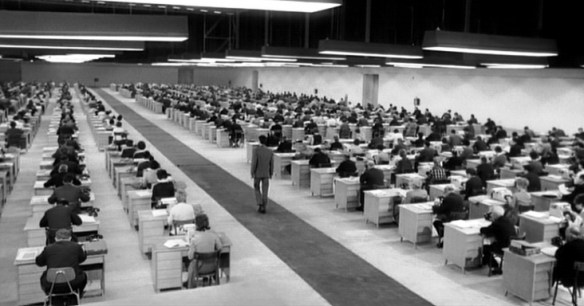
Kafka’s The Trial can be read in retrospect as a prelude to the Twentieth/Twenty-First century. Although probably not written as prophecy, Kafka’s short unfinished book nevertheless provides a road map to the terrors of the current Surveillance State.

As readers of CounterPunch are all too familiar, modern man, as a single individual, is at the mercy of the modern state and those who, lurking in semi-secrecy, direct it.

Kafka’s The Trial superbly conveys the unease of our current existential situation.

Early one morning, The Trial’s main protagonist, Joseph K, awakes to find that, totally unexpectedly, he has been arrested. Throughout the book he endeavors to find the reason for his arrest without any definite success.

However, what he does discover is a vast semi-secret bureaucracy/organizaton whose inner workings and outward displays of power and decision making remain opaque at best.

Initally, Joseph K, believes that he lives in a “Rechtsstaat” (a state where the rule of law is respected) and thus where it is expected that all civilized norms and laws are upheld.

Yet, he soon comes to see that he has lived in a state of fundamental error and illusion about the true nature of his existence.

What appeared to him as a well ordered and just state is, all of a sudden, revealed to be a capricious omnipotent octopus capable of strangling (in this case literally) anyone deemed to be, for whatever reason, expendable.

All law is suspended or, at least, made a mockery of. All that remains are the inner, turgid demands of power.

Joseph K. is convinced of his innocence. But his conviction is no match for the monolithic power that stands against him. He is eventually crushed, if not by his enemy’s repetitive legal machinations, then by his fatalistic far-reaching administrative power.

In the end, the “Organization” which Joseph K has confronted is almighty and can be controlled by neither appeals to law, logic, or custom. In this, modern man is in a similar situation.

He stands, at any moment, beneath the mercy of a gigantic machinery that, if it wills, can almost casually set into motion his utter annihilation. The devastation and erasure of ones past, present, and future self is an ever-present possible function of the modern state. Advances in technology and organization make such a function all the more easier.

How to combat this greatest threat to humankind’s liberty will make the difference of whether or not future generations live in a world of securely grounded freedom or if they will succumb “like a dog” to the increasingly totalitarian powers of what we call today: the Surveillance State.

The War on Social Media is Being Stepped Up

By Jonathan Cook

Source: Dissident Voice

A really social media, one where we can freely express ourselves and where we alone control the content, is the problem. It must be stopped at all costs.

First, it was “fake news”: the suggestion that social media is uniquely damaging to democracy, rather than the corporately owned media that feeds us constant lies, including the egregious deception that WMD existed in Iraq, and selects self-serving political priorities, such as that Russia’s Vladimir Putin is the biggest threat to the planet’s safety (Donald Trump and climate breakdown are far bigger threats right now).

The latest concern is “trolling”. The UK’s Electoral Commission wants to ban people from voting over bad online etiquette. How will “trolling” be defined? We don’t know yet, but you can be sure it won’t encompass someone like Tony Blair, who trolled some 40 million British voters, then ignored their views, to take us into an illegal war.

Behind the scenes, social media platforms are advanced on creating new algorithms that will increasingly hide dissenting sites from view for all but the most committed to finding them.

These are the first shots in a coming war for control of the internet. Don’t be fooled by arguments that fake news and trolls are to be found on social media. Of course, they are. That is the price one pays for democratic platforms. There will always be people who prefer abuse or mischief over rational discussion and good manners.

But the panic about fake news and trolling is not driven by a sudden concern about media deception and misinformation. That has always been with us. It is about who gets to decide what is real and fake, and who gets to be abusive. It is – and always has been – about power.

Once, not long ago, the only media choice you had was to select your source of propaganda: the Sun, Telegraph, Guardian, New York Times, USA Today, National Enquirer, BBC, CNN etc. If you read a paper and felt strongly enough, you could write a letter to the editor. The paper decided whether you would be one of a dozen people whose views got aired that day on the letters page. That was what “media” meant.

There were no websites, talk-backs, below the line commentaries, blogs, Facebook or Twitter. It was a one-way process. The corporate media told you what was happening, and you listened. There was a consensus only because it had been manufactured through omission.

Now that consensus is breaking down. Certainly, the freedom to speak and think has gone to our heads. It can lead us in all kinds of directions, good and bad, as we try to use these newly discovered muscles like a baby learning to crawl.

The corporate media, and the political class they serve, hate this development. We do not have long. We need to defy the evolutionary process, moving from toddlers to teenagers and adults in record time.

Do not mistake the political and media elite for doting parents, concerned with our welfare. They are not trying to help us get on feet and walk. They want us back in our cribs, gurgling and cooing.

Are Facebook and Google the New Colonial Powers?

By Charles Hugh Smith

Source: Of Two Minds

To qualify as colonial powers, Facebook and Google must effectively limit the choices and power of users, and punish or coerce those who question or resist their power.

I was struck by a phrase from a recent essay on advertising and social media, You Are the Product: As Taplin points out, that remark ‘unwittingly revealed a previously unspoken truth: Facebook and Google are the new colonial powers.’

As you’ve no doubt noticed, the dominance of Facebook and Google in online advertising is now “in the news” for a variety of reasons: the possibility that agents of other governments influenced U.S. elections with media buys on Facebook; anti-trust concerns; the potential for these advert-tech giants to effectively silence legitimate online voices under the guise of limiting “fake news”, and of course, the ongoing issues of click fraud and the underperformance of digital ads.

The phrase that captures this broad narrative is: When an online service is free, you’re not the customer. You’re the product.

In other words, if you’re not paying for the service or content, then your information (harvested by Google, Facebook, et al.), your time online (i.e. your attention, a.k.a. eyeballs) and the content you create and post for free (videos of your cute cat, etc.) are the products being sold to advertisers at a premium.

The characterization of the two dominant digital-advert giants as new colonial powers is interesting on a number of fronts. To get a handle on a few of the issues, I recommend reading these two essays:

A Serf on Google’s Farm

Lost Context: How Did We End Up Here?

And watching this video on the archiving of digital information on individuals–including meta-data, that is, data about your behaviors, transactions, posts, etc. that have been scrubbed of your identity markers (name, account numbers, etc.)

Haunted by Data – Maciej Ceglowski (via GFB)

The key dynamics of colonialism for the residents are 1) a lack of choice and 2) a lack of power: the colonial power imposes a regime, either formally or informally, that limits the choices enjoyed by residents and limits their power to bypass or replace the colonial regime.

In the classic Plantation Economy of overt colonialism–a topic I’ve discussed numerous times here–residents are stripped of any options other than working on the plantation and buying their goods at the plantation store. This coercion need not be direct; the colonial regime can strip residents of choice and power by making it impossible to live without cash, for example, and then providing one source of paid work: the plantation.

Once cash is necessary to live, then credit is introduced–but only if you buy at the company store.

I’ve also written extensively about the Neo-Colonial Model in which corporations and banks bring the colonial model of exploitation to the home country, stripmining the domestic populace via dependence on credit.

Welcome to Neocolonialism, Exploited Peasants! (October 21, 2016)

Greece and the Endgame of the Neocolonial Model of Exploitation (February 19, 2015)

The E.U., Neofeudalism and the Neocolonial-Financialization Model (May 24, 2012)

This model is also used in the developing world, where it has replaced the old overt form of Colonialism with the new and improved credit-based version.

To qualify as colonial powers, Facebook and Google must effectively limit the choices and power of users, and punish or coerce those who question or resist their power. As the dominant corporations in search, social media and digital advertising, Facebook and Google limit the options of users simply by being essential due to their dominance.

As for punishing users–the potential to do so is what’s worrying observers. The cover for silencing or banning critics is opaque: non-compliance with guidelines. So who’s to say that users who criticized or questioned the policies of Facebook and Google aren’t silenced along with click-fraudsters, “fake news” purveyors, etc.? Who gets silenced is completely up to the companies, and there is no recourse to the corporation’s opaque judgment.

The Orwellian possibilities are real enough.

Here’s a look at the digital advert market:

And the dominance of Google/Facebook:

US Seeks to Monopolize Cyberwarfare

By Ulson Gunnar

Source: New Eastern Outlook

The use of information to enhance martial power goes back to the beginning of human civilization itself, where propaganda and psychological warfare went hand-in-hand with slings, arrows, swords and shields.

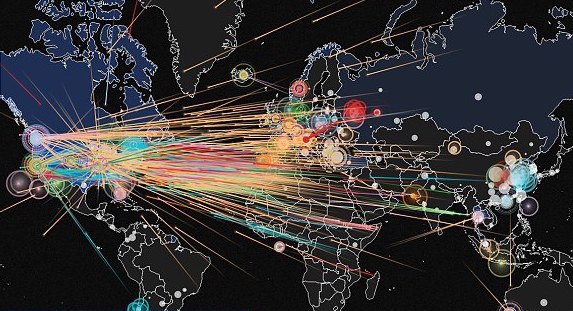
The most recent iteration of this takes the form of social media and cyberwarfare where tools are being developed and deployed to influence populations at home and abroad, to manipulate political processes of foreign states and even tap into and exploit global economic forces.

In the beginning of the 21st century, the United States held an uncontested monopoly over the tools of cyberwarfare. Today, this is changing quickly, presenting an increasingly balanced cyberscape where nations are able to defend themselves on near parity with America’s ability to attack them.

To reassert America’s control over information and the technology used to broker it, Jared Cohen, current Google employee and former US State Department staff, has proposed a US-created and dominated “international” framework regarding cyberconflict.

His op-ed in the New York Times titled, “How to Prevent a Cyberwar,” begins by admitting the very pretext the US is using to expand its control over cyberwarfare is baseless, noting that “specifics of Russia’s interference in the 2016 America election remain unclear.”

Regardless, Cohen continues by laying out a plan for reasserting American control over cyberwarfare anyway, by claiming:

Cyberweapons won’t go away and their spread can’t be controlled. Instead, as we’ve done for other destructive technologies, the world needs to establish a set of principles to determine the proper conduct of governments regarding cyberconflict. They would dictate how to properly attribute cyberattacks, so that we know with confidence who is responsible, and they would guide how countries should respond.

Cohen, unsurprisingly, nominates the US to lead and direct these efforts:

The United States is uniquely positioned to lead this effort and point the world toward a goal of an enforceable cyberwarfare treaty. Many of the institutions that would be instrumental in informing these principles are based in the United States, including research universities and the technology industry. Part of this effort would involve leading by example, and the United States can and should establish itself as a defender of a free and open internet everywhere.

Cohen never explains how this US-dominated framework will differ from existing “international” frameworks regarding conventional warfare the US regularly abuses to justify a growing collection of devastating conflicts it is waging worldwide.

And as has been repeatedly documented, the United States’ definition of a “free and open internet everywhere” is an Internet dominated by US tech companies seeking to enhance and expand US interests globally.

Cohen ironically notes that:

Cyberweapons have already been used by governments to interfere with elections, steal billions of dollars, harm critical infrastructure, censor the press, manipulate public conversations about crucial issues and harass dissidents and journalists. The intensity of cyberconflict around the world is increasing, and the tools are becoming cheaper and more readily available.

Indeed, cyberweapons have already been used, primarily by the United States.

Jared Cohen himself was directly involved in joint operations between Google, Facebook, the US State Department and a number of other US tech and media enterprises which before and during 2011 set the stage for the so-called “Arab Spring.”

It included the training, funding and equipping of activists years ahead of the the uprisings as well as active participation in the uprisings themselves, including providing assistance to both protesters and militants everywhere from Libya to Syria in overthrowing governments targeted by Washington for regime change.

One such tool used in these efforts was described in a UK Independent article titled, “Google planned to help Syrian rebels bring down Assad regime, leaked Hillary Clinton emails claim,” which would report that:

An interactive tool created by Google was designed to encourage Syrian rebels and help bring down the Assad regime, Hillary Clinton’s leaked emails have reportedly revealed.

By tracking and mapping defections within the Syrian leadership, it was reportedly designed to encourage more people to defect and ‘give confidence’ to the rebel opposition.

The article would continue, mentioning Jared Cohen by name:

The email detailing Google’s defection tracker purportedly came from Jared Cohen, a Clinton advisor until 2010 and now-President of Jigsaw, formerly known as Google Ideas, the company’s New York-based policy think tank.

In a July 2012 email to members of Clinton’s team, which the WikiLeaks release alleges was later forwarded to the Secretary of State herself, Cohen reportedly said: “My team is planning to launch a tool on Sunday that will publicly track and map the defections in Syria and which parts of the government they are coming from.”

Would Cohen’s more recently proposed “framework” have prevented the United States’ use of these cyberweapons against sovereign states to undermine sociopolitical stability, overturn entire governments and plunge them into enduring chaos many still remain in 6 years later? Most likely not.

What Cohen and the interests he represents are truly concerned with is that nations are now not only able to recognize, prepare for and defend against US cyberwarfare, they may be capable of retaliating against the US.

Cohen’s proposal for an international framework to govern cyberwarfare simply seeks to define it in terms that leaves the US with both an uncontested monopoly over cyberwarfare as well as the means to wield it globally with absolute impunity.

It would be not unlike current “international” frameworks used to govern conflicts between nations which the US has used to justify an expansive, global campaign of extraterritorial war stretching from North Africa to Central Asia and beyond.

Such frameworks have become enablers of injustice, not a deterrence to it.

As nations from Iran to North Korea are discovering, the only true means of defending oneself from foreign military aggression is creating a plausible deterrence to dissuade foreign nations from attacking. This is done by creating a price for attacking and invading that is higher than the perceived benefits of doing so.

Nations like Russia and China have already achieved this balance with the United States in terms of conventional and nuclear warfare, and have now nearly established a similar deterrence in terms of cyber and information warfare. For the rest of the world, developing cyberdefense is not as costly as conventional military or nuclear arsenals, making cyberwarfare a corner of the battlefield unlikely to be monopolized by the US as it had done at the turn of the century.

Ensuring that no single nation ever has the opportunity to abuse such a monopoly again means exposing and confronting efforts by those like Google’s Jared Cohen and his proposal for an “international framework” for cyberwarfare that resembles the same sort of enabling the United Nations provides the US in terms of proliferating conventional conflicts across the globe.

The Complexity of Cultural Evolution

By Joe Brewer

Source: Resilience

What does the ecological crisis have in common with global poverty? How does politics relate to economics? The study of history? The changing landscape of technology, arts, and culture? Why is there not a coherent School of Social Sciences that brings themes like these together in one place? Answers can only be found by synthesizing two of the most important areas of scientific work in the last 150 years — in the fields of evolutionary studies and complexity science.

All of the most interesting and important topics of concern in the world today (How does consciousness work? What is the human mind? Is it possible to restore health to deteriorated ecosystems? Can we create political systems that promote widespread health and well-being?) involve vast networks of relationships interacting with each other — what are called complex adaptive systems in the lingo of complexity science.

Familiar examples include things like the weather with its inherent unpredictability or a market economy that has no central locus of control. The thing that makes a system “complex” is that patterns arise through the interactions that are not reducible to its constituent parts. You cannot explain the weather simply by describing what water molecules or solar radiation on their own are capable of doing. Neither can you explain an economy by describing how individuals engage in barter or exchange if they happen to be in a market-based society.

Importantly, complex adaptive systems are always far from equilibrium. They are not static. And the only way to make sense of their behavior is to computationally model how the various parts interact with each other dynamically — which leads to the importance of evolution. Emphasis on the word adaptive in complex adaptive systems gives an inkling of Charles Darwin’s Theory of Natural Selection, where the biological traits of an organism that happen to be adaptive in its environment tend to occur more frequently than traits that are not adaptive.

Over time (since living systems are also dynamic), the evolutionary pathway for biology is traced by the intersections of adaptive fitness in environments that might be changing quickly or slowly. All biological systems are complex (they have many interacting parts with emergent phenomena that are not reducible) and they are adaptive (as natural selection plays out in changing environments).

So what does this say about cultural evolution? How can we apply this basic finding from biology to the study of history and economics, politics, and environmental management? Well it turns out that researchers who study cultural evolution — and there are now nearly 2,000 of them in the newly formed Cultural Evolution Society that I was tasked to help create — have brought the mathematical toolkit used in complexity science to the study of cultural change in human and non-human species.

The earliest inklings of this synthesis go back to a debate a century ago when foundations were being laid for the study of population genetics. At that time, statisticians were actively grappling with questions about how to account for genetic variation in biological organisms without the use of digital computers. They developed accounting systems for biological traits that matured continuously through the early-to-mid 20th Century.

In the late 1970’s and early 80’s, there was a group of cultural evolution researchers who translated these statistical tools for the distinct mechanisms of “selection” that play out for behavioral repertoires and other cultural phenomena in human and non-human cultures. Among them were Luigi Cavalli-Sforza and Marcus Feldman at Stanford, Peter J. Richerson at UC-Davis, and Robert Boyd of Arizona State University. These efforts culminated in the publishing of Cultural Transmission and Evolution: A Quantitative Approach in 1981 and Culture and the Evolutionary Process in 1988.

It was during this same time period that the field of complexity research was getting underway — with the multidisciplinary Santa Fe Institute being established in 1984 to explore the mathematical patterns of complex adaptive systems across many domains of study. They organized workshops and symposia on economics, ecology, urban studies, epidemiology, and more to discover how complex systems evolve and change using the mathematical tools of fractal geometry, network science, differential equations, and computational methods.

As I have written elsewhere, the time is urgently upon us to synthesize and apply what is known about complexity and evolution. The fate of humanity literally depends on our ability to do this. In a time of unprecedented exponential change, we must learn to manage complex systems as they evolve in real time.

We need to firstly understand that cultural systems evolve according to Darwinian principles. The interested reader can find many books explaining why this is the case. Here are a few to get you started:

This is a mere sampling — there are now hundreds of books on cultural evolutionary studies that one can dive into. Important for this article is to note that (i) the field of cultural evolution is quite mature at this point in time; (ii) it has advanced rapidly since incorporating mathematical tools used in the study of complexity; and (iii)the world is in flux with tremendous need for this body of knowledge to be brought to bear on our global challenges in the 21st Century.

This is the work of culture design.

The most pressing challenges in the world have foundational cultural components. Global warming arose from the false illusions of human separation from nature and the perception of endless bounty for natural resources at the beginning of the industrial era. Terrorism is cultivated in landscapes where people feel deep-seated anxiety and economic desperation — which arise from particular models of colonial (or post-colonial) exploitation that have unique cultural histories.

Similarly, the spread of rugged individualism as a cultural construct treats human beings as if they are separate from their communities, inherently selfish, and venerable for engaging in psychopathic behaviors like wealth hoarding. In each case, the real state of power is culture and the only viable solutions involve the intentional management of cultural evolutionary change.

But we cannot even start to think this way if we don’t recognize how human cultures operate as complex systems. Only by learning to see that emergent patterns arise through the interactions of constituent parts will we begin to discern how evolutionary change is taking us closer to planetary-scale collapse — and that design practices will be needed that make use of what is now known from cultural evolutionary studies.

Onward, fellow humans.

End-times for humanity


Humanity is more technologically powerful than ever before, and yet we feel ourselves to be increasingly fragile. Why?

By Claire Colebrook

Source: Aeon

The end of the world is a growth industry. You can almost feel Armageddon in the air: from survivalist and ‘prepper’ websites (survivopedia.com, doomandbloom.net, prepforshtf.com) to new academic disciplines (‘disaster studies’, ‘Anthropocene studies’, ‘extinction studies’), human vulnerability is in vogue.

The panic isn’t merely about civilisational threats, but existential ones. Beyond doomsday proclamations about mass extinction, climate change, viral pandemics, global systemic collapse and resource depletion, we seem to be seized by an anxiety about losing the qualities that make us human. Social media, we’re told, threatens our capacity for empathy and genuine connection. Then there’s the disaster porn and apocalyptic cinema, in which zombies, vampires, genetic mutants, artificial intelligence and alien invaders are oh-so-nearly human that they cast doubt on the value and essence of the category itself.

How did we arrive at this moment in history, in which humanity is more technologically powerful than ever before, and yet we feel ourselves to be increasingly fragile? The answer lies in the long history of how we’ve understood the quintessence of ‘the human’, and the way this category has fortified itself by feeding on the fantasy of its own collapse. Fears about the frailty of human wisdom go back at least as far as Ancient Greece and the fable of Plato’s cave, in which humans are held captive and can only glimpse the shadows of true forms flickering on the stone walls. We prisoners struggle to turn towards the light and see the source (or truth) of images, and we resist doing so. In another Platonic dialogue, the Phaedrus, Socrates worries that the very medium of knowledge – writing – might discourage us from memorising and thinking for ourselves. It’s as though the faculty of reason that defines us is also something we’re constantly in danger of losing, and even tend to avoid.

This paradoxical logic of loss – in which we value that which we’re at the greatest risk of forsaking – is at work in how we’re dealing with our current predicament. It’s only by confronting how close we are to destruction that we might finally do something; it’s only by embracing the vulnerability of humanity itself that we have any hope of establishing a just future. Or so say the sages of pop culture, political theory and contemporary philosophy. Ecological destruction is what will finally force us to act on the violence of capitalism, according to Naomi Klein in This Changes Everything: Capitalism vs the Climate (2014). The philosopher Martha Nussbaum has long argued that an attempt to secure humans from fragility and vulnerability explains the origins of political hierarchies from Plato to the present; it is only if we appreciate our own precarious bodily life, and the emotions and fears that attach to being human animals, that we can understand and overcome racism, sexism and other irrational hatreds. Disorder and potential destruction are actually opportunities to become more robust, argues Nassim Nicholas Taleb in Antifragile (2012) – and in Thank You for Being Late (2016), the New York Times’ columnist Thomas Friedman claims that the current, overwhelming ‘age of accelerations’ is an opportunity to take a pause. Meanwhile, Oxford University’s Future of Humanity Institute pursues research focused on avoiding existential catastrophes, at the same time as working on technological maturity and ‘superintelligence’.

It’s here that one can discern a tight knit between fragility and virility. ‘Humanity’ is a hardened concept, but a brittle one. History suggests that the more we define ‘the human’ as a subject of intellect, mastery and progress – the more ‘we’ insist on global unity under the umbrella of a supposedly universal kinship – the less possible it becomes to imagine any other mode of existence as human. The apocalypse is typically depicted as humanity reduced to mere life, fragile, exposed to all forms of exploitation and the arbitrary exercise of power. But these dystopian future scenarios are nothing worse than the conditions in which most humans live as their day-to-day reality. By ‘end of the world’, we usually mean the end of our world. What we don’t tend to ask is who gets included in the ‘we’, what it cost to attain our world, and whether we were entitled to such a world in the first place.

Stories about the end of time have a long history, from biblical eschatology to medieval plague narratives. But our fear of a peculiarly ‘human’ apocalypse really begins with the 18th-century Enlightenment. This was the intellectual birthplace of the modern notion of ‘humanity’, a community of fellow beings united by shared endowments of reason and rights. This humanist ideal continues to inform progressive activism and democratic discourse to this day. However, it’s worth taking a moment to go back to René Descartes’s earlier declaration of ‘I think, therefore I am’, and ask how it was possible for an isolated self to detach their person from the world, and devote writing, reading and persuasion to the task of defending an isolated and pure ego. Or fast-forward a few centuries to 1792, and consider how Mary Wollstonecraft had the time to read about the rights of man, and then demand the rights of woman.

The novelist Amitav Ghosh provides a compelling answer in his study of global warming, The Great Derangement (2017). Colonisation, empire and climate change are inextricably intertwined as practices, he says. The resources of what would become the Third World were crucial in creating the comfortable middle-class existences of the modern era, but those resources could not be made available to all: ‘the patterns of life that modernity engenders can only be practised by a small minority … Every family in the world cannot have two cars, a washing machine and a refrigerator – not because of technical or economic limitations but because humanity would asphyxiate in the process.’

Ghosh disputes one crucial aspect of the story of humanity: that it should involve increasing progress and inclusion until we all reap the benefits. But I’d add a further strand to this dissenting narrative: the Enlightenment conception of rights, freedom and the pursuit of happiness simply wouldn’t have been imaginable if the West had not enjoyed a leisured ease and technological sophistication that allowed for an increasingly liberal middle class. The affirmation of basic human freedoms could become widespread moral concerns only because modern humans were increasingly comfortable at a material level – in large part thanks to the economic benefits afforded by the conquest, colonisation and enslavement of others. So it wasn’t possible to be against slavery and servitude (in the literal and immediate sense) until large portions of the globe had been subjected to the industries of energy-extraction. The rights due to ‘us all’, then, relied on ignoring the fact that these favourable conditions had been purchased at the expense of the lives of other humans and non-humans. A truly universal entitlement to security, dignity and rights came about only because the beneficiaries of ‘humanity’ had secured their own comfort and status by rendering those they deemed less than human even more fragile.

What’s interesting about the emergence of this 18th-century humanism isn’t only that it required a prior history of the abjection it later rejected. It’s also that the idea of ‘humanity’ continued to have an ongoing relation to that same abjection. After living off the wealth extracted from the bodies and territories of ‘others’, Western thought began to extend the category of ‘humanity’ to capture more and more of these once-excluded individuals, via abolitionism, women’s suffrage and movements to expand the franchise. In a strange way these shifts resemble the pronouncements of today’s tech billionaires, who, having extracted unimaginable amounts of value from the mechanics of global capitalism, are now calling for Universal Basic Income to offset the impacts of automation and artificial intelligence. Mastery can afford to correct itself only from a position of leisured ease, after all.

But there’s a twist. While everyone’s ‘humanity’ had become inherent and unalienable, certain people still got to be more fully ‘realised’ as humans than others. As the circle of humanity grew to capture the vulnerable, the risk that ‘we’ would slip back into a semi-human or non-human state seemed more present than before – and so justified demands for an ever more elevated and robust conception of ‘the human’.

One can see this dynamic at work in the 18th-century discussions about slavery. By then the practice itself had become morally repugnant, not only because it dehumanised slaves, but because the very possibility of enslavement – of some humans not realising their potential as rational subjects – was considered pernicious for humanity as a whole. In A Vindication of the Rights of Woman (1792), for example, Wollstonecraft compared women to slaves, but insisted that slavery would allow no one to be a true master. ‘We’ are all rendered more brutal and base by enslaving others, she said. ‘[Women] may be convenient slaves,’ Wollstonecraft wrote, ‘but slavery will have its constant effect, degrading the master and the abject dependent.’

These statements assumed that an entitlement to freedom was the natural condition of the ‘human’, and that real slavery and servitude were no longer genuine threats to ‘us’. When Jean-Jacques Rousseau argued in The Social Contract (1762) that ‘man is born free, and everywhere he is in chains’, he was certainly not most concerned about those who were literally in chains; likewise William Blake’s notion of ‘mind-forg’d manacles’ implies that the true horror is not physical entrapment but a capacity to enslave oneself by failing to think. It’s thus at the very moment of abolition, when slavery is reduced to a mere symbol of fragility, that it becomes a condition that imperils the potency of humanity from within.

I’m certainly not suggesting that there is something natural or inevitable about slavery. What I’m arguing is that the very writers who argued against slavery, who argued that slavery was not fitting for humans in their very nature, nevertheless saw the unnatural and monstrous potential for slavery as far too proximate to humans in their proper state. Yet rather than adopt a benevolence towards the world in light of this vulnerability in oneself, the opposite has tended to be the case. It is because humans can fail to reach their rational potential and be ‘everywhere in chains’ that they must ever more vigilantly secure their future. ‘Humanity’ was to be cherished and protected precisely because it was so precariously elevated above mere life. The risk of debasement to ‘the human’ turned into a force that solidified and extended the category itself. And so slavery was not conceived as a historical condition for some humans, subjected by ruthless, inhuman and overpowering others; it was an ongoing insider threat, a spectre of fragility that has justified the drive for power.

How different are the stories we tell ourselves today? Movies are an interesting barometer of the cultural mood. In the 1970s, cinematic disaster tales routinely featured parochial horrors such as shipwrecks (The Poseidon Adventure, 1972), burning skyscrapers (The Towering Inferno, 1974), and man-eating sharks (Jaws, 1975). Now, they concern the whole of humanity. What threatens us today are not localised incidents, but humans. The wasteland of Interstellar (2014) is one of resource depletion following human over-consumption; the world reduced to enslaved existence in Elysium (2013) is a result of species-bifurcation, as some humans seize the only resources left, while those left on Earth enjoy a life of indentured labour. That the world will end (soon) seems to be so much a part of the cultural imagination that we entertain ourselves by imagining how, not whether, it will play out.

But if you look closely, you’ll see that most ‘end of the world’ narratives end up becoming ‘save the world’ narratives. Popular culture might heighten the scale and intensity of catastrophe, but it does so with the payoff of a more robust and final triumph. Interstellar pits the frontier spirit of space exploration over a miserly and merely survivalist bureaucracy, culminating with a retired astronaut risking it all to save the world. Even the desolate cinematic version (2009) of Cormac McCarthy’s novel The Road (2006) concludes with a young boy joining a family. The most reduced, enslaved, depleted and lifeless terrains are still opportunities for ‘humanity’ to confront the possibility of non-existence in order to achieve a more resilient future.

Such films hint at a desire for new ways of being. In Avatar (2009), a militaristic and plundering West invades the moon Pandora in order to mine ‘unobtanium’; they are ultimately thwarted by the indigenous Na’vi, whose attitude to nature is not one of acquisition but of symbiotic harmony. Native ecological wisdom and attunement is what ultimately leads to victory over the instrumental reason of the self-interested invaders. In Mad Max: Fury Road (2015), a resource-depleted future world is controlled by a rapacious, parasitic, and wasteful elite. But salvation comes from the revolutionary return of a group of ecologically attuned and other-directed women, all blessed with a mythic wisdom that enables ultimate triumph over the violent self-interest of the literally blood-sucking tyrant family. These stories rely on quasi-indigenous and feminist images of community to offer alternatives to Western hyper-extraction; both resolve their disaster narratives with the triumph of intuitive and holistic modes of existence over imperialism and militarism. They not only depict the post-post-apocalyptic future in joyous terms, but do so by appealing to a more benevolent and ecologically attuned humanity.

These films whisper: take a second glance at the present, and what looks like a desperate situation might actually be an occasion for enhancement. The very world that appears to be at the brink of destruction is really a world of opportunity. Once again, the self-declared universal humanity of the Enlightenment – that same humanity that enslaved and colonised on the grounds that ‘we’ would all benefit from the march of reason and progress – has started to appear as both fragile and capable of ethical redemption. It’s our own weakness, we seem to say, that endows humanity with a right to ultimate mastery.

What contemporary post-apocalyptic culture fears isn’t the end of ‘the world’ so much as the end of ‘a world’ – the rich, white, leisured, affluent one. Western lifestyles are reliant on what the French philosopher Bruno Latour has referred to as a ‘slowly built set of irreversibilities’, requiring the rest of the world to live in conditions that ‘humanity’ regards as unliveable. And nothing could be more precarious than a species that contracts itself to a small portion of the Earth, draws its resources from elsewhere, transfers its waste and violence, and then declares that its mode of existence is humanity as such.

To define humanity as such by this specific form of humanity is to see the end of that humanity as the end of the world. If everything that defines ‘us’ relies upon such a complex, exploitative and appropriative mode of existence, then of course any diminution of this hyper-humanity is deemed to be an apocalyptic event. ‘We’ have lost our world of security, we seem to be telling ourselves, and will soon be living like all those peoples on whom we have relied to bear the true cost of what it means for ‘us’ to be ‘human’.

The lesson that I take from this analysis is that the ethical direction of fragility must be reversed. The more invulnerable and resilient humanity insists on trying to become, the more vulnerable it must necessarily be. But rather than looking at the apocalypse as an inhuman horror show that might befall ‘us’, we should recognise that what presents itself as ‘humanity’ has always outsourced its fragility to others. ‘We’ have experienced an epoch of universal ‘human’ benevolence, a globe of justice and security as an aspiration for all, only by intensifying and generating utterly fragile modes of life for other humans. So the supposedly galvanising catastrophes that should prompt ‘us’ to secure our stability are not only things that many humans have already lived through, but perhaps shouldn’t be excluded from how we imagine our own future.

This is why contemporary disaster scenarios still depict a world and humans, but this world is not ‘the world’, and the humans who are left are not ‘humanity’. The ‘we’ of humanity, the ‘we’ that imagines itself to be blessed with favourable conditions that ought to extend to all, is actually the most fragile of historical events. If today ‘humanity’ has started to express a sense of unprecedented fragility, this is not because a life of precarious, exposed and vulnerable existence has suddenly and accidentally interrupted a history of stability. Rather, it reveals that the thing calling itself ‘humanity’ is better seen as a hiatus and an intensification of an essential and transcendental fragility.

Google Censors Block Access to CounterPunch and Other Progressive Sites

By

Source: CounterPunch

The U.S. government, and the information technology companies which collaborate with it, is moving fully into the camp of governments which relentlessly utilize the internet to collect users online data, monitor their activities, and control what they can see and do.

First, there was – and is – the NSA, National Security Agency of the U.S., which collects the emails, phone records, social media data, and more from millions of U.S. citizens and the people of the world.  Software companies like Google cooperated silently by providing NSA access to its users until Edward Snowden made this odious system public.

Now Google, at the behest of its friends in Washington, is actively censoring – essentially blocking access to – any websites which seek to warn American workers of the ongoing effort to further attack their incomes, social services, and life conditions by the U.S. central government, and which seek to warn against the impending warfare between U.S.-led Nato and other forces against countries like Iran, Russia, and China, which have in no way threatened the U.S. state or its people

Under its new so-called anti-fake-news program, Google algorithms have in the past few months moved socialist, anti-war, and progressive websites from previously prominent positions in Google searches to positions up to 50 search result pages from the first page, essentially removing them from the search results any searcher will see. Counterpunch, World Socialsit Website, Democracy Now, American Civil liberties Union, Wikileaks are just a few of the websites which have experienced severe reductions in their returns from Google searches.  World Socialist Website, to cite just one example, has experienced a 67% drop in its returns from Google since the new policy was announced.

This conversion of Google into a Censorship engine is not a trivial development.   Google searches are currently a primary means by which workers and other members of the public seek information about their lives and their world.  Every effort must be made to combat this serious infringement on the basic rights of freedom of speech and freedom of press.

World Socialist Website, the hardest hit victim of this e-censorship, is attempting to mobilize public opinion, and other effected websites, in a broad campaign against Google censorship.   More information on the censorship, including detailed numbers can be found in articles here.

It is imperative that working class people struggle for truly democratic use of the internet, beginning with total freedom to view a wide range of topics, not just those which Google – and Washington – think Americans and the world should be able to see.