Virtual Beauty, Virtual Freedom, Virtual Love: Is the Metaverse Our Future?

By Robert J. Burrowes

When is the last time you were outside in the morning to experience a glorious dawn? Or sat watching the sun set across the ocean horizon?

How do you feel when you touch the skin of someone you love? A grandparent, parent, lover or child?

Have you ever seen a spider’s web full of morning dew, or after the rain, when the sun is shining through the droplets in the web to reveal the flashing diamonds, sapphires, rubies and emeralds hidden within?

Have you ever stood in a natural environment – a beach, desert, rainforest… – far from a city and noticed that strange and subtle feeling of freedom tremor through your body?

Have you ever marveled at the breath of wind that cools your face on a hot Summer’s day? Or been intoxicated by the smell of blossom in Spring?

Have you gaped in wonder at the birth of new life: a chick pecking out of its shell, a seed germinating or a baby being born?

Or paused to ponder the sheer magic of being alive yourself?

Or do you find life in the real physical world too constricting, painful, frightening and demanding: something from which you seek to escape, with some distraction or another (work, television, sport, a novel, a drug…), as often as you can?

Well, very soon now, we are promised, you will be able to escape reality far more effectively than those primitive means of distraction made possible previously. And far more effectively than even the outcomes promised in those dystopian novels.

So the fundamental questions we must ask ourselves are simple: Do you want real life, with all of the pains, sorrows, fear and fury that go along with beauty, freedom and love? Or do you believe what they tell us and want everything unpleasant to go away? Permanently. And to live in delusion thereafter, given synthetic versions of all of the pleasant feelings and experiences described above?

Remember the dialogue between the Savage and Mustapha Mond during the closing stages of Aldous Huxley’s dystopian novel Brave New World?

‘But I don’t want comfort. I want God, I want poetry, I want real danger, I want freedom, I want goodness. I want sin.’

‘In fact,’ said Mustapha Mond, ‘you’re claiming the right to be unhappy.’

‘All right then,’ said the Savage defiantly, ‘I’m claiming the right to be unhappy.’

‘Not to mention the right to grow old and ugly and impotent; the right to have syphilis and cancer; the right to have too little to eat; the right to be lousy; the right to live in constant apprehension of what may
happen to-morrow; the right to catch typhoid; the right to be tortured by unspeakable pains of every kind.’

There was a long silence.

‘I claim them all,’ said the Savage at last.

Well, after nearly one hundred years, the dystopian future described by Huxley is almost upon us and, if we are to defeat it, we need a lot more ‘savages’ willing to forego the promised ‘comforts’.

Because if those who see themselves as our global masters get their way, we are about to enter a virtual world that will become more complete by the day and from which there will be no escape.

The Metaverse

Based on many years of effort, the World Economic Forum (WEF) has recently launched its plan to create our new all-digital world, called the ‘metaverse’. See ‘Defining and Building the Metaverse’.

So if you find natural phenomena – ranging from rainforests, beaches and weather variations to ill-health, danger and unhappiness – annoying, you will soon be able to escape them, compliments of the metaverse. Or so we are promised. And you won’t be troubled by anything resembling what might be called ‘free will’ either. You will be content to do as you are told, even more than you are content to do already. See ‘Terrified of Freedom: Why Most Human Beings are Embracing the Global Elite’s Technotyranny’.

After all, your mind will no longer be your own. And while the usual descriptions, written by elite agents, fail to mention it, a quick flash of metaverse-induced fear will make sure that you comply, whatever you are required to do. The point is this: You won’t be escaping all of those unpleasant feelings after all. They can just be used to control you more directly, to fulfill an elite-determined purpose. But that is a fact they are not advertising.

In their iconic hit song ‘In the Year 2525’, written in 1964 by Rick Evans and later recorded by he and Denny Zager to become a No.1. hit around the world in 1969, Evans captured key elements of what is already upon us somewhat ahead of the schedule mapped out in the song.

[Chorus 2]
In the year 3535
Ain’t gonna need to tell the truth, tell no lies
Everything you think, do, and say
Is in the pills you took today

[Chorus 3]
In the year 4545
Ain’t gonna need your teeth, won’t need your eyes
You won’t find a thing to chew
Nobody’s gonna look at you

[Chorus 4]
In the year 5555
Your arms are hanging limp at your sides
Your legs got nothing to do
Some machine’s doing that for you

[Chorus 5]
In the year 6565
Ain’t gonna need no husband, won’t need no wife
You’ll pick your sons, pick your daughters too
From the bottom of a long glass tube
Whoa-oh-oh

So what is the Metaverse?

According to the WEF: ‘The metaverse is a future persistent and interconnected virtual environment where social and economic elements mirror reality. Users can interact with it and each other simultaneously across devices and immersive technologies while engaging with digital assets and property.’ See ‘Defining and Building the Metaverse’.

Moreover, ‘if technologists are right that 2022 will separate thinkers from builders, then last years’ technical advances will produce this year’s first steps towards making the metaverse a reality….

‘But from the perspective of the human experience, one development stands out above all others: extended reality (XR) technologies. These include virtual reality (VR), augmented reality (AR), and brain-computer interfaces (BCI), which together position themselves as the next computing platforms in their own right.’

Nevertheless, it is clear that a precise definition of the term ‘metaverse’ (for a start: is it a product, service, place or moment in time?), upon which there is broad agreement even among those who routinely use the term, is yet to emerge. See ‘3 technologies that will shape the future of the metaverse – and the human experience’.

Having written that, here is one definition elaborated in the article above that reveals just how far some of those heavily involved in this work have become disconnected from any sense of themselves and, hence, reality: ‘Specifically, the metaverse is the moment at which our digital lives – our online identities, experiences, relationships, and assets – become more meaningful to us than our physical lives.’ The original quotation can be read here: ‘Spheres of Self: Performativity and Parasociality in the Metaverse’.

And, as Cathy Li describes it, the metaverse is ‘most useful as a lens through which to view ongoing digital transformation. The belief is that virtual worlds, incorporating connected devices, blockchain and other tech, will be so commonplace that the metaverse will become an extension of reality itself.’ See ‘Who will govern the metaverse?

Let me reiterate two points from the paragraphs immediately above: ‘our digital lives… become more meaningful to us than our physical lives.’ And ‘the metaverse will become an extension of reality itself.’

Really?

While statements such as these reveal the breathtaking level of insanity that underpins this entire enterprise – see ‘The Global Elite is Insane Revisited’ – it does not mean that we are not under enormous threat. Just as vast arsenals of nuclear weapons, by some insane ‘logic’, are supposed to provide us with ‘security’ while actually threatening the existence of all life on Earth, the metaverse is part of a substantial package of measures that will reduce human life to one not worth living.

Why? Well, as noted by authors such as Tom Valovic: The metaverse is one element in the path to implementing technocratic governance over all of humanity.

‘As Planet Earth and our physical world continue to experience massive biospheric degradation and disruption, the elites that are now in many cases pulling the strings of governance at the country level are heading for the exit doors. Elon Musk and Jeff Bezos are exploring the realm of space and Musk has a Mars mission planned. Globally oriented elites… looked out for themselves which is what they do best….

‘Paralleling the notion of space flight as a form of existential escapism is the metaverse. So what if our cities are crumbling, infrastructures falling apart, and the biosphere is seriously degrading? So what if our wasteful consumer-driven lifestyle has created unprecedented levels of pollution so extensive that it’s now the number one cause of health problems globally? No problem… we’ll just kick back and don our Meta headsets (or worse get a brain implant) and escape into an artificially fabricated world that lets us turn our back on the massive ecological and environmental problems we now face.’ See ‘Why We Should Reject Mark Zuckerberg’s Dehumanizing Vision of a “Metaverse”’.

‘Education’ in the Metaverse

Of course, the metaverse is deeply interwoven with other components of their plan, such as those in relation to what they call ‘education’, which is more accurately described as the process by which young transhuman slaves are programmed to perform their function in the technocratic economy that is being imposed upon us. Of course, ‘education’ sounds better than ‘virtual programming of young transhuman slaves’ so, in the interests of not raising obvious concerns, the word ‘education’ has been used.

As noted by Dr. Michael Nevradakis, discussions on this subject at the recent gathering of the World Economic Forum emphasized the importance of virtual reality (VR) and artificial intelligence (AI) technologies with participants touting the purported educational and economic benefits that would derive from use of these technologies in the classroom by helping, according to Dr. Ali Saeed Bin Harmal Al Dhaheri & Dr. Mohamad Ali Hamade, to ‘increase accessibility, enhance quality and improve the affordability of education globally’. See ‘Experiential learning and VR will reshape the future of education’.

However, as Nevradakis also noted, these discussions had ‘little to say about the need to protect children’s data or digital identities – or, for that matter, providing the types of early-life experiences children require as part of their socialization.’ See ‘Future of Education? WEF’s Vision – Heavy on Virtual Reality and AI Technologies, Light on Privacy Concerns’.

Of course, there is no need for concern about the ‘early-life experiences’ of those young transhumans who are being programmed for decades of servitude prior to being terminated when they are no longer functional.

Beyond claimed educational and economic benefits, however, some authors argue that digitalizing education can play a role in easing pressures on the environment and climate. How so? Nevradakis again: ‘Indeed, the WEF said the use of “textbooks, notebooks and pencils as critical learning tools” is on the way out, due to “environmental pressures and COP26 goals (from the 2021 United Nations Climate Change Conference),” which “will drive the digitalizing of education streams.”’ See ‘Future of Education? WEF’s Vision – Heavy on Virtual Reality and AI Technologies, Light on Privacy Concerns’

But it is clearly delusional to suggest that the use of textbooks, notebooks and pencils has greater adverse impact on the environment and climate than the environmental cost and climate impact of producing sophisticated technology for each student. And despite claims of ‘improved affordability’ it is equally delusional to ignore the economic and social cost, for example, to the child ‘laborers’ in the Congo working in appalling conditions to extract strategic minerals to produce this technology. See ‘Humanity’s “Dirty Little Secret”: Starving, Enslaving, Raping, Torturing and Killing our Children’.

Besides, as touched on below, education is already a monstrous experience, destroying the Selfhood of the child so that they become submissively obedient. Removing the bulk of education’s remaining social component by technologizing it can only make it even worse.

Babies in the Metaverse

Then again, maybe ‘children’ will no longer be put through school. It simply won’t be necessary because children, for transhuman slaves at least, will no longer exist.

By 2070, the metaverse will offer you virtual babies, ‘environmentally-friendly digital children’, according to UK artificial intelligence (AI) expert Catriona Campbell. ‘Parents will see and interact with their offspring through next-generation AR [augmented reality] glasses and haptic gloves.’ The latter devices enable users to experience ‘a realistic sense of touch when handling virtual or holographic objects’. As a bonus, these children take up no space, cost nothing to feed and remain healthy, if that is what you want, for as long as they are programmed to ‘live’. A subscription might cost as little as $25 each month.

And if this seems like a monumental leap out of reality to you, Campbell also believes that ‘within 50 years technology will have advanced to such an extent that babies which exist in the metaverse are indistinct from those in the real world…. As the metaverse evolves, I can see virtual children becoming an accepted and fully embraced part of society in much of the developed world.’ See ‘“Virtual babies” who grow up in real time will be commonplace by 2070, expert predicts’.

That’s right, Campbell is claiming that ‘within 50 years… babies which exist in the metaverse are indistinct from those in the real world’! Pause a moment. How does that sound to you?

Just in case you cannot wait, you are welcome to start using early versions now. See, for example, Virtual Baby, Adopt a Virtual Baby and My Virtual Child.

Oh, and by the way, you won’t be having sex either, whether for reproductive purposes or otherwise. You will prefer virtual sex. See ‘Sex And Pornography Aim To Strike Gold In The Metaverse’.

Critiquing the Metaverse

Beyond the criticisms already noted above, there are a great many other criticisms of the metaverse and the role it will play in the overall elite program being implemented under what the WEF calls its ‘Great Reset’. This comprehensive program will transform human society and human life for those people left alive after the eugenics component has been fully implemented. See ‘The Final Battle for Humanity: It is “Now or Never” in the Long War Against Homo Sapiens’.

If you like, you can read a little more about what the masters of this metaverse intend for us, as well as critiques of it, by authors such as these.

Derrick Broze: While some people ‘may not intend for The Metaverse to become an all encompassing reality that supersedes physical reality, for the Zuckerbergs, Microsofts, and WEFs of the world, that is exactly what they intend for The Metaverse…. For the billionaire class and their puppet organizations, such as the WEF and the United Nations, the Metaverse offers up the potential to commandeer all life into digital prisons where the people can be charged for services and products in the digital realm…. With the people of the world safely tucked into their digital beds, the Technocrats could complete their total takeover of natural resources, the economy, and humanity itself.’ See ‘The Great Narrative And The Metaverse, Part 2: Will The Metaverse End Human Freedom?

Dr. Michael Nevradakis: ‘Who will govern the “metaverse”?… According to the WEF, “real-world governance models” represent one possible option for metaverse governance. However, far from referring to constitutionally defined institutions of governance, with checks and balances, the WEF cites Facebook’s “Oversight Board” as an example of such a “real-world governance model.”’ See ‘WEF Launches “Metaverse” Initiative, Predicts Digital Lives Will Become “More Meaningful to Us Than Our Physical Lives”’.

But an earlier World Economic Forum report from its Global Redesign Initiative was more blunt: ‘The report postulates that a globalized world is best managed by a coalition of multinational corporations, governments (including through the UN system) and select civil society organizations (CSOs).’ See Sustainable Development Goals and Human Rights p. 209, citing ‘Everybody’s Business: Strengthening International Cooperation in a More Interdependent World’.

So if you believe that you and I are destined to have a say in the metaverse that is unfolding, you would be wise to keep investigating. Elite proposals are invariably very distant from the type of governance models usually considered by ‘ordinary’ people in a multiplicity of contexts, where the emphasis is on facilitating widespread grassroots participation, not rule by technocrats.

You can read considerably more about what our technocratic overlords have in mind – including the existing trade in such things as virtual real estate, virtual clothing and virtual art – and what is wrong with it, in the articles on the metaverse published by Patrick Wood on ‘Technocracy News & Trends’: ‘Metaverse’. And there is more in articles such as these: ‘The Top 10 Creepiest and Most Dystopian Things Pushed by the World Economic Forum (WEF)’ and ‘How Our Lives Could Soon Look”: The World Economic Forum Posts An Insane Dystopian Video’.

And here’s another simple issue to ponder. Remember how I mentioned above that a quick flash of metaverse-induced fear would ensure that you complied with an elite-determined directive, how does the idea of eating bugs, processed sewage and human flesh appeal? Well, given that your mind will no longer be your own, what appeals now, or doesn’t, will be irrelevant once the metaverse is determining how you perceive things. See ‘Canadian Company Pledges To Produce TWO BILLION BUGS Per Year For Human Consumption’ and ‘Will You Eat Cultured Meat Grown From Human Cells?’

You will eat ‘Soylent Green’ because that is what the program tells you.

So why are people embracing the Metaverse?

In a recent article in which he described taking his son to watch a film through 3D glasses, Charles Eisenstein noted ‘The on-screen reality was so vivid, stimulating and intense that it made the real world seem boring by comparison.’ See ‘Transhumanism and the Metaverse’.

How can this happen?

Because we terrorize our children into submissive obedience, devoid of the unique and powerful individual Self they were gifted by evolution at birth. See ‘Why Violence?’,‘Fearless Psychology and Fearful Psychology: Principles and Practice’and ‘Do We Want School or Education?’ Why? Essentially to keep them performing tasks that bore them senseless throughout their school and working life.

Fundamentally, this terrorization works because it compels our children into suppressing awareness of how they feel. As a result, only the most intense experiences register emotionally: The capacity to experience a subtle feeling has been lost. And without this capacity, they cannot develop into the powerful, courageous Self-willed individuals that evolution intended. They are human relics. Ready and willing to be turned into a transhuman slave in the unconscious hope they will be finally able to experience, in the metaverse, what was taken from them in the real world as a child.

But they won’t get that experience, even in the metaverse. It is not what the elite has in mind for us.

Resisting the Metaverse

Of course, the metaverse is just one feature of the Global Elite agenda that is being imposed upon us. And it is not enough to resist individual features of the ‘Great Reset’ program. We must strategically resist its most fundamental elements so that the entire agenda is defeated.

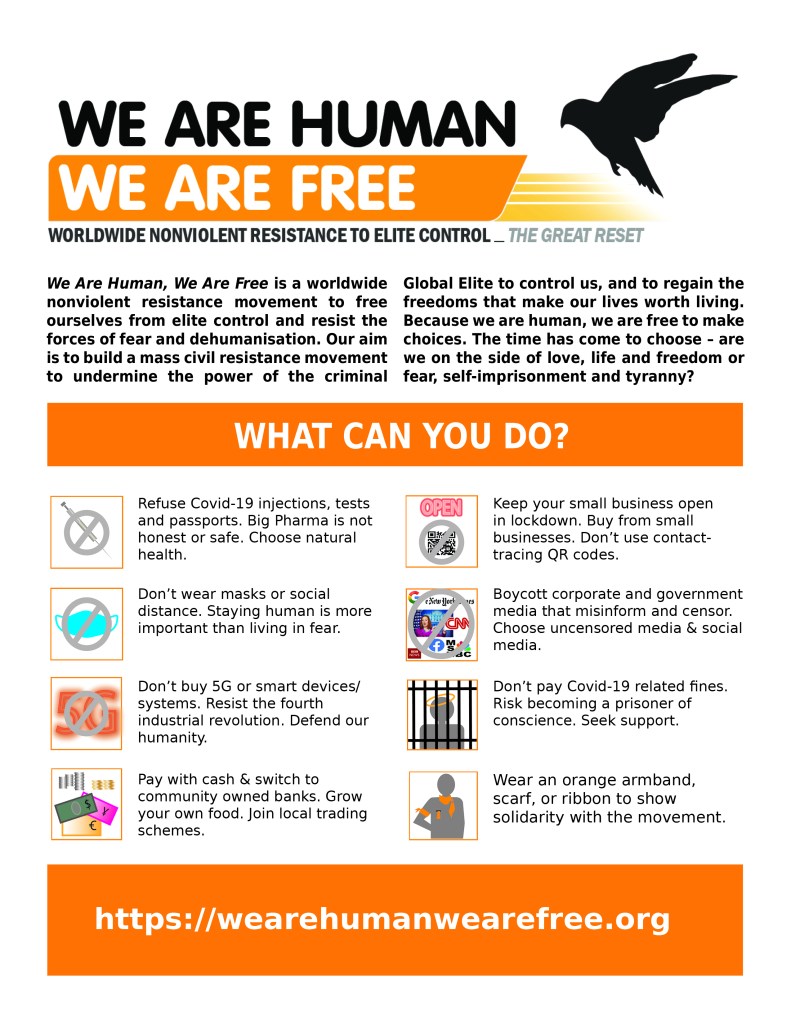
If you are inclined to join those strategically resisting the ‘Great Reset’ and its related agendas, you are welcome to participate in the ‘We Are Human, We Are Free’  campaign which identifies a list of 30 strategic goals for doing so.

In addition and more simply, you can download a one-page flyer that identifies a short series of crucial nonviolent actions that anyone can take. This flyer, now available in 17 languages (Czech, Danish, Dutch, English, Finnish, French, German, Greek, Hebrew, Hungarian, Italian, Polish, Romanian, Russian, Serbian, Spanish & Slovak) with more languages in the pipeline, can be downloaded from here: ‘The 7 Days Campaign to Resist the Great Reset’.

If strategically resisting the ‘Great Reset’ (and related agendas) appeals to you, consider joining the ‘We Are Human, We Are Free’ Telegram group (with a link accessible from the website).

And if you want a child who is powerfully able to perceive the dysfunctional lure of the metaverse, and is able to join you in resisting it, consider making ‘My Promise to Children’.

CONCLUSION

So, for just a little longer, the choice is yours.

You can live your life with all its challenges and problems, joys and achievements. Or you can live the virtual life that someone else programmed for you, including whatever comes with it that they didn’t tell you about.

In short, like Neo in the film ‘The Matrix’, you have a choice. You can choose the Blue Pill and proceed to live in a synthesized, fictional, computer-generated world. Or you take the Red Pill and, in this case, join the fight with those of us determined to defend the real world and avert descent into the metaverse.

But you must make that choice while you still have free will.

So you must make that choice soon.

Biodata: Robert J. Burrowes has a lifetime commitment to understanding and ending human violence. He has done extensive research since 1966 in an effort to understand why human beings are violent and has been a nonviolent activist since 1981. He is the author of ‘Why Violence?’ His email address is flametree@riseup.net and his website is here.
The Cult of Globalism: The Great Reset and its ‘Final Solution’ for Useless People

By Timothy Alexander Guzman

Source: Silent Crow News

The idea of the Great Reset derives from the New World Order which is still alive in the minds of the establishment or who we can call the globalists from people like Henry Kissinger to the current US president, Joe Biden.  Of course there are many others on the top levels of the pyramid whose ideas range from establishing a police state, to implanting microchips the day we are born to track and trace us, to depopulating the planet.  I know it all sounds insane but that’s what the globalists have planned for us for a very long time.  Klaus Schwab’s protégé, Yuval Noah Harari, is an Israeli born intellectual who authored a popular bestseller titled ‘Sapiens: A Brief History of Humankind’ and is also a professor of history at the Hebrew University of Jerusalem.  Harari once asked a disturbing question, “what to do with all these useless people?”  Harari is an intelligent man, there is no doubt about that, but his intelligence has led him to the level of insanity.  Harari is an influential member of the World Economic Forum (WEF) who supports the idea of creating a dystopian society managed by a handful of globalists who will rule over every human being on earth from the day they are born.  According to Harari, planet earth is overpopulated:    

Again, I think the biggest question in maybe in economics and politics of the coming decades will be what to do with all these useless people? The problem is more boredom and how what to do with them and how will they find some sense of meaning in life, when they are basically meaningless, worthless?

My best guess, at present is a combination of drugs and computer games as a solution for [most]. It’s already happening…In under different titles, different headings you see more and more people spending more and more time or solving the inner problems with the drugs and computer games both legal drugs and illegal drugs…

They also want people to stay home connected to the Metaverse world, a virtual reality simulation and at the same time get them addicted to all sorts of drugs.  The kind of world they are trying to create for us is pure lunacy.  Wired, a monthly magazine describes the metaverses as a combination of the digital and physical worlds that creates a virtual reality as in the Hollywood film, ‘Ready Player One,’ The article ‘What is the Metaverse, Exactly?’  answers that question, “Broadly speaking, the technologies companies refer to when they talk about “the metaverse” can include virtual reality—characterized by persistent virtual worlds that continue to exist even when you’re not playing—as well as augmented reality that combines aspects of the digital and physical worlds.”                              

Many other Hollywood films that are based on virtual reality in the future includes Jumanji, Source Code, The Matrix, Total Recall, Inception, and many others.  The globalists want you to believe that a dystopic society is in the works for us, but no worries, you will be completely happy at least according to Klaus Schwab.  In my opinion, the notion that the human species will be living their lives through virtual reality is far-fetched, it’s an illusion that will take decades even centuries to accomplish and that would only happen if we allowed it to happen.  Harari is saying that under a scientific, technocratic world order, the state will be your sole provider for everything, so basically, he says that families are not needed in this new world they are creating for us, in other words, having a family will be a thing of the past:

After millions of years of evolution suddenly within 200 years the family and the intimate community break, that they collapse most of the roles filled by the family for thousands and tens of thousands of years are transferred very quickly to new networks provided by the state and the market, you don’t need children, you can have a pension fund, you don’t need somebody to take care of you, you don’t need neighbors and sisters or brothers to take care of you if you’re sick, the state takes care of you, the states provide you with police, with education, with help with everything

Listen to Harari’s own words in this video:


The World in Crisis: A Stakeholder Economy, the Green Agenda and Covid-19    

Rahm Emanuel worked for US presidents Bill Clinton and Barack Obama under various titles, but one quote he will always be remembered for was when he said “you never let a serious crisis go to waste. And what I mean by that it’s an opportunity to do things you think you could not do before.” That is exactly what happened under the Covid-19 global health emergency.  Klaus Schwab, who is the original founder, and executive chairman of the WEF published an article that outlines three basic components of the Great Reset titled Now is the Time for a ‘Great Reset, in the first component, they would help steer or “improve coordination (for example, in tax, regulatory, and fiscal policy), upgrade trade arrangements, and create the conditions for a “stakeholder economy.”  How would this work? There are more than 195 countries in the world meaning that all these countries would have to establish a “unified” tax, regulatory and fiscal policy, all in sync, all with the same laws and that would be impossible even if they tried because all countries have different tax systems, different economies and cultures and that will not change because of a handful of globalists with outlandish ideas of a unified financial system they want to control for their own benefit.  It’s a ridicules idea.  In fact, more countries today are more open to imposing less taxes and regulations to attract foreign investments to grow their economies, so the WEF ‘s recommendations will never work, in fact its dead-on arrival. 

Then there is the looming financial crisis that can ultimately force the world into a Federal Reserve Bank “Digital Currency” known as central bank digital currencies (CBDCs) that will be tracked by the government on how you spend your money.  What can go wrong with this idea?  If in any case, you are not politically aligned with a particular party or refuse an experimental injection, then the government may block your transactions.  In other words, they can literally control when and how you spend your money and that is something most people will not accept.  An article published by Stefan Gleason who is an investor, political strategist, and grassroots activist wrote an interesting analysis last year for fxstreet.com titled ‘The Great Reset is Coming for the Currency’ asks what will be the next major issue for a Global Reset? “As the Great Reset proceeds from globalist think tanks and technology billionaires to allied media elites, governments, schools, and Woke corporations, what will be “reset” next?  The next reset will most likely take place in the financial sector as “Supporters of the World Economic Forum’s all-encompassing Great Reset agenda are eyeing BIG changes for the global monetary system.”  Biden’s Treasury Secretary and former Federal Reserve Chair, Janet Yellen wants to end the use of various cryptocurrencies and have the International Monetary Fund (IMF) issue CBDC’s.  “Yellen derided Bitcoin as “an extremely inefficient way to conduct transactions” because “the amount of energy consumed in processing those transactions is staggering.”  Gleason says that Yellen and her colleagues are planning to have the public use digitized tokens issued by the central bank.  The bottom line is that “They just want to make sure those digits are issued and controlled by governments and central banks.” 

The best way to avoid the Federal Reserve bank’s control over your finances is to own gold, silver, and other safe-haven assets.  “Anyone who is concerned about the prospect of being herded into a new digital currency regime should make it a high priority to own tangible money that exists outside the financial system.”  Gleason makes the case for owning gold and silver, “No technology or government mandate can change the fact that gold and silver have universally recognized, inflation-resistant value.”  At some point, the public will reject the Federal Reserve and its ‘digital currency’ if they can avoid it.  However, the best way to bypass CBDC’s in the future is to buy gold, silver, and other metals that that can maintain value and become resistant to inflationary pressures.  An important note to consider is that all US silver coins that were produced before 1964 were minted with 90% silver and 10% copper, so keep an eye on your pocket-change just in case you come across some silver coins with value. 

The second component “would ensure that investments advance shared goals, such as equality and sustainability. Here, the large-scale spending programs that many governments are implementing represent a major opportunity for progress.”  Which means that governments will be required to print an unlimited money supply to support their agenda that will eventually lead to inflationary pressures which can devastate their respective economies.  “Here, the large-scale spending programs that many governments are implementing represent a major opportunity for progress. The European Commission, for one, has unveiled plans for a €750 billion ($826 billion) recovery fund. The US, China, and Japan also have ambitious economic-stimulus plans.”  They are pushing for an expensive Green Agenda which is part of Joe Biden’s Build Back Better plan to reduce greenhouse gas emissions that will change how the world operates when it comes to using traditional energy resources such as coal, oil, and natural gas:

Rather than using these funds, as well as investments from private entities and pension funds, to fill cracks in the old system, we should use them to create a new one that is more resilient, equitable, and sustainable in the long run. This means, for example, building “green” urban infrastructure and creating incentives for industries to improve their track record on environmental, social, and governance (ESG) metrics

Last year, Forbes magazine published Why Biden’s Climate Agenda Is Falling Apart’ which does explain how the Green Agenda is an expensive and unreliable scheme:

The vast majority of human beings want high rather than low economic growth, and so politicians ultimately choose policies that make energy cheap, not expensive.

And the limitations of weather-dependent renewables are more visible than ever. If California’s large wind energy project is built, it will provide less than half of the energy of California’s Diablo Canyon nuclear plant Newsom is planning to close in 2025, and it will be unreliable. During the heatwave-driven blackouts last summer, there was little wind in California or other Western states, meaning we can’t count on wind energy when we need it most. 

In other words, the Democrats’ climate change and renewable energy agenda is rapidly falling apart, and the reasons have far more to do with physics than with politics

Schwab proposes that the third component is basically the innovations that will lead to centralized control of the world’s health policies by the World Health Organization (WHO) However, the innovations began the moment  WHO officials declared a global Public Health Emergency more than 2 years ago.  Schwab mentioned the ‘Fourth Industrial Revolution’ which is described on the World Economic Forum’s website as a new system that “shapes new policies and strategies in areas such as artificial intelligence, blockchain and digital assets, the internet of things or autonomous vehicles, and enables agile implementation and iteration via its fast-growing network of national and sub-national centres.” Regarding Covid-19 or any other declared public health emergency in the future, the new system will be able “to support the public good, especially by addressing health and social challenges. During the COVID-19 crisis, companies, universities, and others have joined forces to develop diagnostics, therapeutics, and possible vaccines; establish testing centers; create mechanisms for tracing infections; and deliver telemedicine.”

However, there was a unified response put forward by a several nations including Brazil, India, Russia, China, Iran, South Africa, Malaysia and the practically the entire continent of Africa that rejected a pandemic treaty developed by the World Health Organization.  They all agreed that the treaty would allow authorities from the WHO to gain control of their health policies bypassing their rights as sovereign nations.  As the spirit of Tanzania’s late President, John Magufuli lives on, Reuters published the positive move on behalf of the African continent Africa objects to U.S. push to reform health rules at WHO assembly regarding Africa’s 47 nations who rejected the treaty “African countries raised an objection on Tuesday to a U.S.-led proposal to reform the International Health Regulations (IHR), a move delegates say might prevent passage at the World Health Organization’s annual assembly.”  The treaty brought forward by the WHO and the US government was technically defeated which is a positive outcome considering what’s at stake:

If Africa continues to withhold support, it could block one of the only concrete reforms expected from the meeting, fraying hopes that members will unite on reforms to strengthen the U.N. health agency’s rules as it seeks a central role for itself in global health policy.

The IHR set out WHO members’ legally binding obligations around outbreaks. The United States has proposed 13 IHR reforms which seek to authorise the deployment of expert teams to contamination sites and the creation of a new compliance committee to monitor implementation of the rules.

But the African group expressed reservations about even this narrow change, saying all reforms should be tackled together as part of a “holistic package” at a later stage

Western powers along with top level WHO officials will try to persuade or blackmail sovereign nations who originally rejected the IHR treaty to reverse their decision with a new modified version in hopes of centralized control of any future pandemic, but the current decision made by those nations who rejected the treaty is welcoming news indeed.   

Just imagine the concept of a group of mostly unelected bureaucrats with the power to oversee a centralized control grid to rule over a global pandemic is Orwellian, in fact, the Great Reset kind of reminds me of the 1973 classic Hollywood film, Soylent Green with Charlton Heston based on the 1966 science fiction novel ‘Make Room! Make Room! by Harry Harrison based on a dystopian society.  The story is about a police investigation into the murder of a wealthy businessman while the world is experiencing a slow death from “greenhouse gases” that produced a variety of problems for humanity including overpopulation, pollution, poverty, crime, and the concept of enforced euthanasia by the state. 

Soylent Green is an example of what a deranged group of globalists or in this case, government bureaucrats would do to humanity if we did nothing to stop them.  In the film, Detective Thorn (played by Charlton Heston) warned his colleague Chief Hatcher (Brock Peters) “The ocean’s dying! Plankton’s dying! It’s people – Soylent Green is made out of people! They’re making our food out of people! Next thing they’ll be breeding us like cattle for food! You’ve gotta tell them, you’ve gotta tell them!” Although Soylent Green is obviously fictional, it’s a metaphor on how far globalists will be willing to go so that their agenda of world control and depopulation can succeed.  In the film, the state strongly encouraged and even facilitated suicide which turned the people into food for the remaining population.  It sounds insane but reading about the agenda of the Great Reset of you ‘owning nothing and being happy is the start of something more sinister in our future.  I am not saying that they will try to turn people into food in the future, but they are certainly trying to push forward other outrages solutions to feed the world such as the possibility of people eating insects to survive.  I wish this was a joke, but it’s not. 

Globalists are calling for the world’s population to be completely vaccinated with their Covid-19 experimental injections, in other words, they want total control over the world’s healthcare policies to enforce the use of facemasks and endless vaccination schemes through government-imposed mandates on the population although Covid-19 experimental injections are injuring and even killing thousands of people around the world.  Globalist plotters began their plan of action to implement their vaccine mandates as soon as the Public Health Emergency was announced, but there were governments who rejected the idea from the start.  On December 3rd, 2020, Brazil’s Minister of Foreign Affairs Ernesto Araujo clearly rejected the World Economic Forum’s Great Reset agenda by addressing the United Nations (UN) special session on COVID-19 by saying that “Those who dislike freedom always try to benefit from moments of crisis to preach the curtailing of freedom. Let’s not fall for that trap” In his conclusion, Araujo clearly states what is Brazil’s position on the idea of the Great Reset:

Fundamental freedoms are not an ideology. Human dignity requires freedom as much as it requires health and economic opportunities.  Those who dislike freedom always try to benefit from moments of crisis to preach the curtailing of freedom. Let’s not fall for that trap.  Totalitarian social control is not the remedy for any crisis. Let’s not make democracy and freedom one more victim of COVID-19

Is the World Ready to Embrace the Great Reset?  

In the geopolitical spectrum, globalists are set on punishing sovereign countries who do not obey a rules-based order under the Great Reset agenda in partnership with the US-NATO alliance leading the world to some form of conflict or regime change against Russia, China, Iran, Belarus, Syria, Venezuela, Nicaragua, Cuba, and any other nation who wants to remain sovereign at all costs. There are many who are vehemently opposed to such an idea, for example, on January 27th, 2021, Russian President Vladimir Putin spoke at the World Economic Forum (WEF) and basically rejected the idea of the Great Reset and gave a reasonable idea of humanity working together to achieve a prosperous future for all with “calls for inclusive growth and for creating decent standards of living for everyone are regularly made at various international forums. This is how it should be, and this is an absolutely correct view of our joint efforts” and that “It is clear that the world cannot continue creating an economy that will only benefit a million people, or even the golden billion. This is a destructive precept. This model is unbalanced by default.” Putin’s perception of the Great Reset or a unipolar world order is correct because it is destined for failure since the world is a complex place where nations have distinct cultures and history.  Putin questions how nations would respond to a Great Reset with a rules-based order run by an elite group of psychopaths that expect a harmonious transition from all nations who are willing to comply:

We are open to the broadest international cooperation, while achieving our national goals, and we are confident that cooperation on matters of the global socioeconomic agenda would have a positive influence on the overall atmosphere in global affairs, and that interdependence in addressing acute current problems would also increase mutual trust which is particularly important and particularly topical today.

Obviously, the era linked with attempts to build a centralized and unipolar world order has ended. To be honest, this era did not even begin. A mere attempt was made in this direction, but this, too, is now history. The essence of this monopoly ran counter to our civilization’s cultural and historical diversity.

The reality is such that really different development centers with their distinctive models, political systems and public institutions have taken shape in the world. Today, it is very important to create mechanisms for harmonizing their interests to prevent the diversity and natural competition of the development poles from triggering anarchy and a series of protracted conflicts

The rejection of the Great Reset and its associated global institutions and industries such as the WHO, NATO and Big Pharma is a step in the right direction and the globalists are in panic.  Brazil, Russia, the continent of Africa and others are proving that the Great Reset or that century’s old idea of a New World Order has become a failed project.  Some people might disagree with my analysis because many are pessimistic about their future because they believe that a Great Reset is inevitable, that there is no escape from it because it seems that things are getting out of control with ongoing wars, coming food shortages and a growing danger of a global medical tyranny.  However, I do believe that we are in the early stages of a great awakening, not a rules-based order managed by a group of globalists despite the endless propaganda on how the Great Reset will make the planet a better place for all of us.   

People and certain governments are awakening to the fact that a group of globalists are working against them on every level, and they are starting to fight back.  We do not want to be ruled by a centralized power telling us what to do or how to think.  The concept of the Great Reset has failed in many ways, but there is still work to do. 

Never give up, never allow a group of influential globalists whether they are billionaires or bankers, government bureaucrats or special interest groups, resist this ideology of a unipolar world order.  We can win this war, there is still time, I believe that we will prevail if we just don’t comply with their goal of them trying to control us, the useless people.  

The Age of Discord

By Charles Hugh Smith

Source: Of Two Minds

It’s very difficult to find common ground that supports cooperation in the disintegrative stage of scarcities, rising prices, catastrophically centralized power and social discord.

Today’s topic echoes Peter Turchin’s 2016 book, Ages of Discord, which I have often referenced in blog posts.

I’ll also discuss two other books I’ve often referenced, Global Crisis: War, Climate Change and Catastrophe in the Seventeenth Century by Geoffrey Parker and The Great Wave: Price Revolutions and the Rhythm of History by David Hackett Fischer.

Turchin proposes repeating cycles of history of social integration (people finding reasons to cooperate) and disintegration (people finding reasons to not cooperate).

Clearly, we’re in a disintegrative stage.

Fischer proposed a repeating cycle of history in which humans expand their numbers and economy to consume all available resources.

Once all the low-hanging fruit has been consumed, scarcities arise, pushing prices above what commoners can afford, and the result is economic stagnation and social/political revolution.

Either humans exploit a new energy source at scale to provide for the larger population and higher consumption per person, or the population and consumption decline to fit available resources.

Parker covers the mutually reinforcing climate, political, social and economic crises of the 17th century. A long cycle of cold, wet summers reduced crop yields, leading to hunger and strife.

Parker also identifies another cause of the tumultuous, war-plagued 1600s: political leaders had consolidated too much power, enabling them to pursue disastrous wars without any restraint from competing domestic social-political interests.

Clearly, we’re in Fischer’s stage of overshoot and resource scarcity and Parker’s extremes of centralized power free to pursue catastrophic wars of choice.

In the 1600s, those launching wars reckoned a clean, decisive victory was within easy reach. In every case, the wars dragged on inconclusively or generated even wider conflicts.

In the end, all the wars were settled diplomatically, not by military victory. The military gains were nil while the destruction was widespread and devastating.

Fischer details how poorly humans respond to scarcity and higher prices, also known as inflation or more. accurately, as the decline in purchasing power of money and labor. As scarcities and higher prices take their toll, society unravels: crime and social disorder accelerate.

What we’re seeing in real time is a “circle the wagons” mentality of weeding out everyone but the True Believers in every movement. Litmus tests are handy for this test: answer wrong on any question and you’re cast out: heretic!

It’s not enough to tick one “progressive” or “conservative” box; you have to tick them all or you’re a heretic who cannot be trusted. If you leave one box unticked, you might untick a few more in the days ahead.

This puts pressure on everyone to declare their loyalty to the “party” even if the loyalty is just for show. This dishonesty pleases those demanding every box be ticked but this forced loyalty creates an illusion of solidarity that unravels under pressure.

Officials vie to offer pledges of loyalty to Chinese President Xi Jinping ahead of 20th Party Congress

Exacerbating this is social media, which rewards those promoting the most extreme and divisive positions and deranges the populace by substituting recognition online, which encourages disintegration, for real-world engagement, which encourages moderation and cooperation.

Online, it’s easy to be all-or-nothing: there should be no restrictions on social media, or we should just pull the plug and shut the whole mess down.

In the real world, these are knotty, nuanced problems. The Founding Fathers would not have tolerated sedition under the guise of free speech. The social order can only be maintained if every participant adheres to standards of civility and the common good.

When put under stress, humans harden their positions as a defensive measure. They become more argumentative and less tolerant, more strident in insisting that the One True Thing is the answer to our problems.

This leads to magical thinking, for example, that we can replace hydrocarbons with fusion or wind and solar. When the physical and cost limits of minerals are presented as impassable obstacles, people respond with denial: there must be a way to keep everything the same.

Humans have an easy time expanding their population and consumption per person and a hard time consuming less.

It’s very difficult to find common ground that supports cooperation in the disintegrative stage of scarcities, rising prices, catastrophically centralized power and social discord.

This requires accepting that we can cooperate with people on one issue even though all the other boxes of our group/party/movement are left unticked.

History suggests the disintegrative stage will run its course and consumption will realign with available resources one way or another, and the best we can do is preserve our own sanity, community and willingness to nurture small patches of common ground that support productive cooperation.

Declare Your Independence from Tyranny, America

By John W. Whitehead & Nisha Whitehead

Source: The Rutherford Institute

Imagine living in a country where armed soldiers crash through doors to arrest and imprison citizens merely for criticizing government officials.

Imagine that in this very same country, you’re watched all the time, and if you look even a little bit suspicious, the police stop and frisk you or pull you over to search you on the off chance you’re doing something illegal.

Keep in mind that if you have a firearm of any kind (or anything that resembled a firearm) while in this country, it may get you arrested and, in some circumstances, shot by police.

If you’re thinking this sounds like America today, you wouldn’t be far wrong.

However, the scenario described above took place more than 200 years ago, when American colonists suffered under Great Britain’s version of an early police state. It was only when the colonists finally got fed up with being silenced, censored, searched, frisked, threatened, and arrested that they finally revolted against the tyrant’s fetters.

No document better states their grievances than the Declaration of Independence, drafted by Thomas Jefferson.

A document seething with outrage over a government which had betrayed its citizens, the Declaration of Independence was signed on July 4, 1776, by 56 men who laid everything on the line, pledged it all—“our Lives, our Fortunes, and our sacred Honor”—because they believed in a radical idea: that all people are created to be free.

Labeled traitors, these men were charged with treason, a crime punishable by death. For some, their acts of rebellion would cost them their homes and their fortunes. For others, it would be the ultimate price—their lives.

Yet even knowing the heavy price they might have to pay, these men dared to speak up when silence could not be tolerated. Even after they had won their independence from Great Britain, these new Americans worked to ensure that the rights they had risked their lives to secure would remain secure for future generations.

The result: our Bill of Rights, the first ten amendments to the Constitution.

Imagine the shock and outrage these 56 men would feel were they to discover that 246 years later, the government they had risked their lives to create has been transformed into a militaristic police state in which exercising one’s freedoms—at a minimum, merely questioning a government agent—is often viewed as a flagrant act of defiance.

In fact, had the Declaration of Independence been written today, it would have rendered its signers extremists or terrorists, resulting in them being placed on a government watch list, targeted for surveillance of their activities and correspondence, and potentially arrested, held indefinitely, stripped of their rights and labeled enemy combatants.

Read the Declaration of Independence again, and ask yourself if the list of complaints tallied by Jefferson don’t bear a startling resemblance to the abuses “we the people” are suffering at the hands of the American police state.

Here’s what the Declaration of Independence might look and sound like if it were written in the modern vernacular:

There comes a time when a populace must stand united and say “enough is enough” to the government’s abuses, even if it means getting rid of the political parties in power.

Believing that “we the people” have a natural and divine right to direct our own lives, here are truths about the power of the people and how we arrived at the decision to sever our ties to the government:

All people are created equal.

All people possess certain innate rights that no government or agency or individual can take away from them. Among these are the right to Life, Liberty and the pursuit of Happiness.

The government’s job is to protect the people’s innate rights to Life, Liberty and the pursuit of Happiness. The government’s power comes from the will of the people.

Whenever any government abuses its power, it is the right of the people to alter or abolish that government and replace it with a new government that will respect and protect the rights of the people.

It is not wise to get rid of a government for minor transgressions. In fact, as history has shown, people resist change and are inclined to suffer all manner of abuses to which they have become accustomed.

However, when the people have been subjected to repeated abuses and power grabs, carried out with the purpose of establishing a tyrannical government, people have a right and duty to do away with that tyrannical government and to replace it with a new government that will protect and preserve their innate rights for their future wellbeing.

This is exactly the state of affairs we are under suffering under right now, which is why it is necessary that we change this imperial system of government.

The history of the present Imperial Government is a history of repeated abuses and power grabs, carried out with the intention of establishing absolute tyranny over the country.

To prove this, consider the following:

The government has, through its own negligence and arrogance, refused to adopt urgent and necessary laws for the good of the people.

The government has threatened to hold up critical laws unless the people agree to relinquish their right to be fully represented in the Legislature.

In order to expand its power and bring about compliance with its dictates, the government has made it nearly impossible for the people to make their views and needs heard by their representatives.

The government has repeatedly suppressed protests arising in response to its actions.

The government has obstructed justice by refusing to appoint judges who respect the Constitution and has instead made the courts march in lockstep with the government’s dictates.

The government has allowed its agents to harass the people, steal from them, jail them and even execute them.

The government has directed militarized government agents—a.k.a., a standing army—to police domestic affairs in peacetime.

The government has turned the country into a militarized police state.

The government has conspired to undermine the rule of law and the constitution in order to expand its own powers.

The government has allowed its militarized police to invade our homes and inflict violence on homeowners.

The government has failed to hold its agents accountable for wrongdoing and murder under the guise of “qualified immunity.”

The government has jeopardized our international trade agreements.

The government has overtaxed us without our permission.

The government has denied us due process and the right to a fair trial.

The government has engaged in extraordinary rendition.

The government has continued to expand its military empire in collusion with its corporate partners-in-crime and occupy foreign nations.

The government has eroded fundamental legal protections and destabilized the structure of government.

The government has not only declared its federal powers superior to those of the states but has also asserted its sovereign power over the rights of “we the people.”

The government has ceased to protect the people and instead waged domestic war against the people.

The government has plundered our seas, ravaged our coasts, and destroyed the lives of the people.

The government has employed private contractors and mercenaries to carry out acts of death, desolation and tyranny, totally unworthy of a civilized nation.

The government through its political propaganda has pitted its citizens against each other.

The government has stirred up civil unrest and laid the groundwork for martial law.

Repeatedly, we have asked the government to cease its abuses. Each time, the government has responded with more abuse.

An Imperial Ruler who acts like a tyrant is not fit to govern a free people.

We have repeatedly sounded the alarm to our fellow citizens about the government’s abuses. We have warned them about the government’s power grabs. We have appealed to their sense of justice. We have reminded them of our common bonds.

They have rejected our plea for justice and brotherhood. They are equally at fault for the injustices being carried out by the government.

Thus, for the reasons mentioned above, we the people of the united States of America declare ourselves free from the chains of an abusive government. Relying on God’s protection, we pledge to stand by this Declaration of Independence with our lives, our fortunes and our honor.

In the 246 years since early Americans first declared and eventually won their independence from Great Britain, “we the people” have managed to work ourselves right back under the tyrant’s thumb.

Only this time, the tyrant is one of our own making: the American Police State.

The abuses meted out by an imperial government and endured by the American people have not ended. They have merely evolved.

“We the people” are still being robbed blind by a government of thieves.

We are still being taken advantage of by a government of scoundrels, idiots and monsters.

We are still being locked up by a government of greedy jailers.

We are still being spied on by a government of Peeping Toms.

We are still being ravaged by a government of ruffians, rapists and killers.

We are still being forced to surrender our freedoms—and those of our children—to a government of extortionists, money launderers and corporate pirates.

And we are still being held at gunpoint by a government of soldiers: a standing army in the form of a militarized police.

Given the fact that we are a relatively young nation, it hasn’t taken very long for an authoritarian regime to creep into power.

Unfortunately, the bipartisan coup that laid siege to our nation did not happen overnight.

It snuck in under our radar, hiding behind the guise of national security, the war on drugs, the war on terror, the war on immigration, political correctness, hate crimes and a host of other official-sounding programs aimed at expanding the government’s power at the expense of individual freedoms.

The building blocks for the bleak future we’re just now getting a foretaste of—police shootings of unarmed citizens, profit-driven prisons, weapons of compliance, a wall-to-wall surveillance state, pre-crime programs, a suspect society, school-to-prison pipelines, militarized police, overcriminalization, SWAT team raids, endless wars, etc.—were put in place by government officials we trusted to look out for our best interests.

As I make clear in my book Battlefield America: The War on the American People and in its fictional counterpart The Erik Blair Diaries, the problems we are facing will not be fixed overnight: that is the grim reality with which we must contend.

Yet that does not mean we should give up or give in or tune out. What we need to do is declare our independence from the tyranny of the American police state.

Saturday Matinee: Lo and Behold

Lo and Behold, Reveries of the Connected World

A bold and multidimensional documentary about the glories and the drawbacks of the Internet.

By Frederic and Mary Ann Brussat

Source: Spirituality & Practice

Werner Herzog is an inimitable documentary filmmaker whose curiosity, wonder and awe for the mysteries and eccentricities of our world is unbounded. One of the hallmarks of his work is his unmistakable voice-overs (with a distinctive German accent) which serve as the narrative threads holding the materials together. Here are five of his most recent documentaries which illustrate the diversity of themes that interest him:

  • Cave of Forgotten Dreams: A 3-D tour of the Chauvet Cave which houses art that is 30,000 years old.
  • Encounters at the End of the World: A visually stunning documentary about the scientists, dreamers, adventurers, philosophers, and creatures of Antarctica.
  • Grizzly Man: A mesmerizing documentary about a young man obsessed with grizzly bears in the Alaskan wilderness.
  • Into the Abyss: A daring examination of capital punishment filled with small and humble human touches.
  • Wheel of Time: An exotic look at a Buddhist ritual held in Bodh Gay, India, and Graz, Austria in 2002 that attracted thousands of pilgrims.

In Lo and Behold, Reveries of the Connected World, Herzog tackles the complex, controversial, and mysterious Internet. He refers to this technological tool as “one of the greatest revolutions” in human history. This bold and multidimensional film is divided into 10 chapters:

  • The Early Days
  • The Glory of the Net
  • The Dark Side
  • Life without the Net
  • The End of the Net
  • Earthly Invaders
  • Internet on Mars
  • Artificial Intelligence
  • The Internet of Me
  • The Future

Here you will discover a breadth of material that ranges from the very serious to the extremely quirky and odd. Herzog begins with a terse history of the Internet’s beginnings at U.C.L.A. during the 1960s. Leonard Kleinrock, a professor of computer science, takes us into the “holy room” where the first Internet computer remains. He recalls his feelings when a message was transmitted from this computer to the Stanford Research Institute on October 29, 1969. Programmers were on the phone confirming that the login was happening. Stanford replied that they had received the “L” and the “o.” Then its computer crashed. So the first Internet message was “Lo.” This documentary chronicles what happened beyond that.

Danny Hillis, another scientist, reminisces about a time when all the users of this technology could be identified in one directory. Now, he states, the global directory would be 72 miles thick. Another statistic which stands out is: “Today, about 3.2 billion people use the internet around the world.” Herzog chimes in that CDs containing a single day’s worth of global data would stretch “to Mars and back.”

Here are some observations made in interviews with computer and robot specialists, hackers, technicians, programmers, gamers, and professors.

  • Elon Musk, the entrepreneur behind Telsa, is now interested in colonizing Mars; he also reflects on cyberwarfare or other earth catastrophes.
  • Kevin Mitnick, a legendary hacker, reveals the mayhem and the mischief that can take place by those who can get into large computer systems; cyberwarfare now puts smaller states on the same level as larger ones.
  • Joydeep Biswas, an engineer who has put together a robotic soccer team, shows how they work together and even reveals his favorite robot player.
  • Sebastian Thrun, an online-learning pioneer, notes that self-driving cars can all learn from the collective experiences of other cars and their mistakes, unlike human drivers.

Also included is an account of abusive cyber behavior ending with a mother calling the Internet “a work of the Devil” after pictures of her dead child were widely circulated online. Herzog talks with several persons who are sensitive to electromagnetic waves and get radiation sickness; they now live in an isolated area totally off the grid. A segment on video-game addicts reveals that many of them have completely stopped being present to the real world; some have developed blood clots in their legs after sitting so long at their computers. Astronomers explain that a large solar flare, which has not happened in many years, could disrupt Internet communication worldwide, affecting all the food supply, water and other systems supporting modern life.

In a telling scene, we see a group of Buddhist monks standing in front of a city skyline and the question is posed, “Have the monks stopped meditating?” We see that they are not bowing their heads in prayer or meditation. All of them are totally focused on their cell phones. Herzog quotes a startling statistic: There will be 31 billion devices connected to the Internet by 2020.

A famous New Yorker cartoon by Peter Steiner shows two dogs by a computer. The caption reads: “On the Internet, nobody knows you’re a dog.” It’s good for a laugh, and it’s also a reminder that Internet technology is raising many spiritual questions. Who are you? Where do you really live? And who are your companions? Don’t miss this thought-provoking documentary!

Wokeness is a Product of Neoliberalism

Why don’t more people make this connection?

By Chad C. Mulligan

Source: The Hipcrime Vocab Substack

One thing I haven’t seen people point out anywhere else is how much the current atmosphere of “wokeness” is an outcome of neoliberalism.

Let me explain.

There was a lot of analysis written about neoliberalism back in the 1990s when it was still a relatively new phenomenon, having only been enshrined as the dominant economic paradigm in the 1980s. Now that neoliberalism has become simply the water in which we swim and the horizon upon which we gaze, we don’t even notice it anymore. The idea that there could be other ways to organize the economy and society has completely vanished from the discourse even on the nominal “Left”—so utterly complete has been its intellectual victory.

I can’t recall all the books and articles I read during that time, but a couple of standouts were One Market Under God by Thomas Frank and No Logo by Naomi Klein. Frank’s The Baffler magazine published a lot of good articles about neoliberalism back in those days, and Klein’s subsequent The Shock Doctrine is indispensable for understanding how neoliberalism took over the world.

One of the things that those analyses pointed out was the fact that neoliberalism derided governments as universally incompetent and inefficient and argued that only market competition could distribute goods and services effectively.

Furthermore, those markets had to be global in scope and free from “interference,” which was broadly defined as anything that hindered profit maximization including worker and environmental protections. This, in theory, would lead to ideal outcomes—or at least as close to ideal as they could be in a world of inherent scarcity.

As a corollary of this, neoliberals argued that democratic politics—the idea that citizens could express their wishes and desires via their elected representatives—was a hopelessly naive and outdated notion in the age of globalism. Rather, they argued that people’s preferences and desires would be more accurately reflected by how people spent their money in “free and open” markets. People’s spending patterns—aggregated and allocated by markets—would therefore be a better agent of social change than ineffective political action according to neoliberal theory1.

The One Big Market under neoliberalism, therefore, was seen not just a method for coordinating economic activities and allocating goods and services, but as the highest expression of people’s fundamental valuesWe were now expected to change the world thru shopping. As a result of this, you were expected to be an “ethical consumer.” You were exhorted to “spend your values.” Markets, neoliberals argued—and not popularly elected governments—were the true expression of the democratic will. As our choices at the voting booth began to narrow and seem more and more alike, we were told to vote with your dollar!

Here’s a concrete, real-world example. If you were concerned about dolphins being ensnared and killed in fishing nets used to dredge the ocean for tuna, the solution was not to ban the practice. No, the solution was to spend ethically on products labeled “dolphin safe.” Since consumers would express their preferences via buying dolphin safe tuna instead of the ones not so labeled, eventually the Invisible Hand of the Market would cause this practice to die out without a single government regulation. Similarly, if you wanted to support sustainable farming practices, you would spend preferentially on products labeled “organic” rather than the alternatives.

So in the neoliberal world view, the best way to bring about positive social change was by individuals spending their money in markets. That’s why in a modern shopping center you see all kinds of labels festooned on every conceivable product proclaiming how it is “responsibly sourced,” or how environmentally-friendly it is, or how the package is biodegradable, or how the farmers were fairly compensated, or whatever. You never saw that in the 1960s or 1970s—this change was ushered in by neoliberalism.

Now when you went to the grocery store it was no longer just to buy groceries—you had the obligation to save the world! (As if your life wasn’t stressful enough with the ever-longer working hours that were also the result of neoliberalism). A recurring theme of those analyses I read back in the day was the replacement of citizens with consumers.

(Of course, what’s to stop corporations from slapping any old claim onto their products? How can shoppers evaluate these claims? How can they possibly know what’s accurate and what’s not? Into this void stepped literally hundreds of different (private) certification agencies to try and make sure that these labels accurately reflected what they claimed. Thus, in the effort to avoid regulating markets, neoliberalism actually caused a proliferation of far more regulations and regulatory agencies than ever before. And often these privatized agencies have nonexistent oversight, poor standards and lax enforcement).

Another fundamental aspect of neoliberalism was the notion that competition would bring about ideal social outcomes. Therefore competition, neoliberals argued, had to be introduced into absolutely every aspect of human affairs. In this regard, neoliberalism a was really not just about economics, but was rather a radical totalitarian vision for remaking human society.

This extended even to social issues. For example, the philosophy behind “school choice” came from the notion that the problem with public schools was the lack of free market competition because schools were a state-owned monopoly. State-owned monopolies are the greatest possible evil under neoliberalism because they are not subject to market competition. By unleashing “choice,” schools would be forced to compete for students just like businesses compete for customers. This would make public education better, the thinking went, by eliminating bad schools and teachers and creating “lean and mean” educational institutions.

Even environmentalism has been colonized by neoliberalism. Instead of limiting the emission of fossil fuels, for example, new and exotic markets would be established so that polluters could trade opaque “carbon credits” in order to theoretically allocate pollution the same way we allocate any other resource under neoliberalism. This also demonstrates how neoliberalism is not anti-regulation or “small government” as is often portrayed, since creating these kinds of artificial markets takes massive amounts of government regulation and bureaucracy.

As this all-encompassing philosophy gradually took over the world, social protections were dismantled, regulations were abolished, and untrammeled, cutthroat competition was unleashed in every arena of life.

But it was Karl Polanyi who pointed out that such a vision of turning over society to anarchic markets with no protections and no refuge from its capricious dictates would lead to the “demolition of society.” No one could long withstand the never-ending whipsaws and bullwhips of “pure”relentless market competition—not consumers, not workers, and not even the businesses themselves! That’s why its has never existed, he said, and cannot exist.

So what actually happened in the real world due to unleashing this radical philosophy was an unprecedented wave of mergers, acquisitions, and consolidations in every sector of the economy, enabled by high finance (which was also “unleashed” thanks to neoliberalism).

You see, competition is expensive. It is also highly inefficientIt’s much more effective for parties to cooperate than to compete. That’s just game theory 101. It’s true of human affairs just as it is in nature. That’s why you see cooperation everywhere throughout the animal kingdom as Peter Kropotkin pointed out long ago. Any species where every single member was perennially locked in existential competition with every other member of the species would quickly die out, he said. Even where competition does exist in nature, it is in very limited in scope and in circumscribed contexts like mate choice.

Competition is also inherently unstable. You can’t just have an endless tournament going on forever and ever as free market theory depicts. Eventually there has to be a winner. Again, this is simply game theory 101. You can observe this everywhere you look.

So the current wave of consolidations and mergers in every sector of the economy can be seen as the logical outcome of neoliberal philosophy when applied to the real world as opposed to the world depicted in economic textbooks and think-tank policy papers. Want to know why the entire economy is dominated by a handful of mega-monopolies these days? That’s the reason why.

But getting back to our initial topic, here’s the point that’s absolutely critical: as a result of this neoliberal transformation, corporations had to portray themselves as agents of positive social change.

Read that again. And again and again and again until it sinks in.

This is what has lead to the rise of the modern “socially conscious” corporation and to so-called “woke capitalism.”

Think about it. Back in the pre-neoliberal 1960s, did any company bend over backwards to convey what it believed about absolutely anything? About any social issue whatsoever? No, because corporations weren’t expected to do that. Corporations were widely seen as anonymous entities devoid of values designed to make money by producing the goods and services consumers wanted. Back in the 1960’s—an era of rapid social change—no one cared about what IBM, Boeing, McDonalds, DuPont, General Electric, Coca Cola, General Motors, Prudential, Chevron, or any other big corporation thought about anything, much less the prevailing social issues of the day. That’s what politics was for! Businesses were expected to make money, full stop. Besides, how could a corporation really “think” anything? A corporation is a faceless bureaucratic enterprise composed of hundreds, or even thousands of individuals, each with their own personal set of values and beliefs. The very idea that a corporation could “believe” anything would have been seen as preposterous and absurd back then.

Spending money in “free” markets has subsequently become the only acceptable form of social protest or fomenting change under globalized neoliberalism—and not, for example, people banding together in popular movements to advocate for a better world. Government and politics have become passé and irrelevant—or so we’re told by those in charge. The sole option you have as a lone individual in the face of this relentless onslaught is to become an ethical consumer—in other words, to “spend your values.” Therefore, in order to meet this solemn obligation, you have to be sure that when you hand your money over to a corporation, that corporation reflects your values! That is a fundamental tenet of neoliberalism and its emphasis on markets—and not governments—as the highest arbiter of social values and preferences.

Yet very few commentators on the (fake) Left and the (pseudo) populist Right seem to grasp this. Instead they just shake their fists and rage.

So in order to get their hands on those precious “ethical” dollars, faceless bureaucratic corporations have to fashion themselves as “socially responsible.” As “ethical.” As being “positive change agents.” To that end they have launched wave after wave of PR campaigns designed to proclaim just how ethical and virtuous they are, from Amazon to Dove to Gillette, and every other big business has to follow suit.

Consider, for instance, those Dove advertisements that promised to let plus-size women believe they were beautiful—and publicly paraded them in their bras and panties in a commercial for cellulite-reducing cream. Or the Heineken “Worlds Apart” ad that showed people of disparate backgrounds and races coming together (eventually) over the beer. Or—to bring things back to the strategic positioning of carbonated sugar water as a proto-revolutionary product—the (thankfully short-lived) Kendall Jenner Pepsi spot that portrayed the soda as the means to bring Occupy-style protesters back into a grateful posture of consumer-abundance connoisseurship…

Believe in Something (The Baffler)

This also ties in with the “doing well by doing good” ethos of philanthropic capitalism as described by Anand Giridharadas in his book, Winners Take All. Once again, elected governments and politicians are portrayed as hopelessly inept and incompetent (sense a pattern?). In place of governments installed by the will of the people, therefore, “social entrepreneurs” will step into the void and solve the most pressing social problems of the day—and make a killing $$$ by doing so. This is portrayed as a “win-win” scenario in the media, which is owned and controlled by those same rich people (the fact that every single social problem seems to be getting exponentially worse has not deterred this policy approach in the slightest).

So if you wonder where all that cloying, patronizing Silicon Valley bullshit about “changing the world” and “making the world a better place” comes from—that’s where it comes from. It’s basically a form of neofeudalism in practice.

So the end result of all this is that under neoliberalism corporations are now obligated to portray themselves as ethical and moral in order to attract precious consumer dollars. Hence the rise of the modern “woke” corporation expressing it’s opinion on absolutely every hot-button issue of the day—from Black Lives Matter, to gay marriage, to the abortion debate, to transgender rights, to sexual harassment, to gun control, to multiculturalism, to whatever contentious wedge issue the political Right will dream up next.

And whether you like it or not, the people who tend to earn the most under globalized, technocratic monopoly capitalism really do strongly support cosmopolitan values like diversity, tolerance and inclusiveness. And since we are obligated to “spend our values” under neoliberalism, corporations have to cater to them—and to make sure that everyone knows about it. Thus they have to “officially” support things like Black Lives Matter. They have to speak out against discrimination against gay and transgender people. They have to be “antiracist.” They have to extol “empowering women and girls.” All because they need to attract the kinds of people who “spend their values,” and those values are more likely to be socially liberal for the kinds of people that corporations want to attract both as employees and consumers. That’s just the reality, and it’s not likely to change anytime soon.

And even though conservatives may not like it, socially regressive people and reactionaries tend to be poorer and less educated overall—and hence are less desirable as workers and consumers. That’s also just how it is. Therefore, corporations are “woke” based on a cynical, self-interested calculation of what will net them the most consumer dollars under neoliberal capitalism, and no amount of conservative grousing is going to change that. As a result, reactionaries and authoritarians are increasingly turning to politics to force their values upon people which they can’t enforce via the kinds of free market choices that they believe should dictate every other aspect of life.

When it became clear that the NFL supporters—largely white, male, and older—were outnumbered by the corporation’s brand loyalists—more diverse and younger—Nike went ahead and now even claims that it inaugurated the campaign because it believes that Kaepernick “is one of the most inspirational athletes of his generation.”

Believe in Something (The Baffler)

Of course, if we had a healthy and functioning political system none of this would be necessary. And it follows that if neoliberalism had not become the dominant social and economic paradigm of the twenty-first century there would be no such thing as “woke” capitalism in the first place.

So it’s truly amusing to watch the political Right rage to the heavens at the result of their own economic philosophy being applied in practice.

It’s also funny that, to my knowledge, no one appears to have made this connection. After all, why did corporations only relatively recently (i.e. after the 1990s) begin virtue signalling at every opportunity? It’s not just because everyone suddenly became “based” at approximately the same time. It’s the economic system, stupid!

Of course, it’s a win-win situation for political conservatives since they now have something to permanently complain about to rally people to their side, even though they are still just as pro-wealth and anti-worker as ever, and even though they still fervently believe in the most toxic tenets of neoliberalism (such as its contempt for democratically elected governments and its antipathy toward regulations and constraining the rich in any way). That’s the natural result of gutting civil society in favor of apotheosizing an all-powerful Market.

Of course, the bad news is that the end result of neoliberalism will probably be the rise of a twenty-first century form of fascist authoritarianism based on what I’m seeing in the media and across the political spectrum these days.

In conclusion, I find all of these “culture war” topics utterly inane and ridiculous (despite all the money you can make by endlessly bellyaching about them on Sub$tack). In a country where many citizens can’t even access basic health care, homelessness is endemic and rising, higher education is unaffordable, crime and suicide are rampant, people are mired in debt, wages have stagnated and mass shootings occur on a weekly basis2, I find it hard to get worked up over “wokeness” and “cancel culture.” And, as many besides me have pointed out, the idea that this cynical virtue signalling by mega-corporations means that they are in any way “left-of-center” by any reasonable definition of that term is absurd. After all, we’re talking about some of the most vile, sociopathic billionaires since the Gilded Age and some of the most brutal working conditions since the era of George Pullman. And the saddest thing is, we’ll never be able to unite to stop them since—thanks to neoliberalism—we will be kept perennially at each other’s throats while they continue to Tweet from their luxury yachts, penthouses, villas, and private jets about diversity and inclusiveness for ever and ever.

1 A good book about this is Undoing the Demos: Neoliberalism’s Stealth Revolution by Wendy Brown. Here’s an interview with the author.

2 It’s worth noting that I wrote this post before the latest massacre in Texas.

Everything Is a Weapon: The U.S. Government Is Waging Psychological Warfare on the Nation

By John W. Whitehead & Nisha Whitehead

Source: The Rutherford Institute

Have you ever wondered who’s pulling the strings? … Anything we touch is a weapon. We can deceive, persuade, change, influence, inspire. We come in many forms. We are everywhere.”— U.S. Army Psychological Operations recruitment video

The U.S. government is waging psychological warfare on the American people.

No, this is not a conspiracy theory.

Psychological warfare, according to the Rand Corporation, “involves the planned use of propaganda and other psychological operations to influence the opinions, emotions, attitudes, and behavior of opposition groups.”

For years now, the government has been bombarding the citizenry with propaganda campaigns and psychological operations aimed at keeping us compliant, easily controlled and supportive of the police state’s various efforts abroad and domestically.

The government is so confident in its Orwellian powers of manipulation that it’s taken to bragging about them. Just recently, for example, the U.S. Army’s 4th Psychological Operations Group, the branch of the military responsible for psychological warfare, released a recruiting video that touts its efforts to pull the strings, turn everything they touch into a weapon, be everywhere, deceive, persuade, change, influence, and inspire.

This is the danger that lurks in plain sight.

Of the many weapons in the government’s vast arsenal, psychological warfare may be the most devastating in terms of the long-term consequences.

As the military journal Task and Purpose explains, “Psychological warfare is all about influencing governments, people of power, and everyday citizens… PSYOP soldiers’ key missions are to influence ‘emotions, notices, reasoning, and behavior of foreign governments and citizens,’ ‘deliberately deceive’ enemy forces, advise governments, and provide communications for disaster relief and rescue efforts.”

Yet don’t be fooled into thinking these psyops (psychological operations) campaigns are only aimed at foreign enemies. The government has made clear in word and deed that “we the people” are domestic enemies to be targeted, tracked, manipulated, micromanaged, surveilled, viewed as suspects, and treated as if our fundamental rights are mere privileges that can be easily discarded.

Aided and abetted by technological advances and scientific experimentation, the government has been subjecting the American people to “apple-pie propaganda” for the better part of the last century.

Consider some of the ways in which the government continues to wage psychological warfare on a largely unsuspecting citizenry.

Weaponizing violence. With alarming regularity, the nation continues to be subjected to spates of violence that terrorizes the public, destabilizes the country’s ecosystem, and gives the government greater justifications to crack down, lock down, and institute even more authoritarian policies for the so-called sake of national security without many objections from the citizenry.

Weaponizing surveillance, pre-crime and pre-thought campaigns. Surveillance, digital stalking and the data mining of the American people add up to a society in which there’s little room for indiscretions, imperfections, or acts of independence. When the government sees all and knows all and has an abundance of laws to render even the most seemingly upstanding citizen a criminal and lawbreaker, then the old adage that you’ve got nothing to worry about if you’ve got nothing to hide no longer applies. Add pre-crime programs into the mix with government agencies and corporations working in tandem to determine who is a potential danger and spin a sticky spider-web of threat assessments, behavioral sensing warnings, flagged “words,” and “suspicious” activity reports using automated eyes and ears, social media, behavior sensing software, and citizen spies, and you having the makings for a perfect dystopian nightmare. The government’s war on crime has now veered into the realm of social media and technological entrapment, with government agents adopting fake social media identities and AI-created profile pictures in order to surveil, target and capture potential suspects.

Weaponizing digital currencies, social media scores and censorship. Tech giants, working with the government, have been meting out their own version of social justice by way of digital tyranny and corporate censorship, muzzling whomever they want, whenever they want, on whatever pretext they want in the absence of any real due process, review or appeal. Unfortunately, digital censorship is just the beginning. Digital currencies (which can be used as “a tool for government surveillance of citizens and control over their financial transactions”), combined with social media scores and surveillance capitalism create a litmus test to determine who is worthy enough to be part of society and punish individuals for moral lapses and social transgressions (and reward them for adhering to government-sanctioned behavior). In China, millions of individuals and businesses, blacklisted as “unworthy” based on social media credit scores that grade them based on whether they are “good” citizens, have been banned from accessing financial markets, buying real estate or travelling by air or train.

Weaponizing compliance. Even the most well-intentioned government law or program can be—and has been—perverted, corrupted and used to advance illegitimate purposes once profit and power are added to the equation. The war on terror, the war on drugs, the war on COVID-19, the war on illegal immigration, asset forfeiture schemes, road safety schemes, school safety schemes, eminent domain: all of these programs started out as legitimate responses to pressing concerns and have since become weapons of compliance and control in the police state’s hands.

Weaponizing entertainment. For the past century, the Department of Defense’s Entertainment Media Office has provided Hollywood with equipment, personnel and technical expertise at taxpayer expense. In exchange, the military industrial complex has gotten a starring role in such blockbusters as Top Gun and its rebooted sequel Top Gun: Maverick, which translates to free advertising for the war hawks, recruitment of foot soldiers for the military empire, patriotic fervor by the taxpayers who have to foot the bill for the nation’s endless wars, and Hollywood visionaries working to churn out dystopian thrillers that make the war machine appear relevant, heroic and necessary. As Elmer Davis, a CBS broadcaster who was appointed the head of the Office of War Information, observed, “The easiest way to inject a propaganda idea into most people’s minds is to let it go through the medium of an entertainment picture when they do not realize that they are being propagandized.”

Weaponizing behavioral science and nudging. Apart from the overt dangers posed by a government that feels justified and empowered to spy on its people and use its ever-expanding arsenal of weapons and technology to monitor and control them, there’s also the covert dangers associated with a government empowered to use these same technologies to influence behaviors en masse and control the populace. In fact, it was President Obama who issued an executive order directing federal agencies to use “behavioral science” methods to minimize bureaucracy and influence the way people respond to government programs. It’s a short hop, skip and a jump from a behavioral program that tries to influence how people respond to paperwork to a government program that tries to shape the public’s views about other, more consequential matters. Thus, increasingly, governments around the world—including in the United States—are relying on “nudge units” to steer citizens in the direction the powers-that-be want them to go, while preserving the appearance of free will.

Weaponizing desensitization campaigns aimed at lulling us into a false sense of security. The events of recent years—the invasive surveillance, the extremism reports, the civil unrest, the protests, the shootings, the bombings, the military exercises and active shooter drills, the lockdowns, the color-coded alerts and threat assessments, the fusion centers, the transformation of local police into extensions of the military, the distribution of military equipment and weapons to local police forces, the government databases containing the names of dissidents and potential troublemakers—have conspired to acclimate the populace to accept a police state willingly, even gratefully.

Weaponizing fear and paranoia. The language of fear is spoken effectively by politicians on both sides of the aisle, shouted by media pundits from their cable TV pulpits, marketed by corporations, and codified into bureaucratic laws that do little to make our lives safer or more secure. Fear, as history shows, is the method most often used by politicians to increase the power of government and control a populace, dividing the people into factions, and persuading them to see each other as the enemy. This Machiavellian scheme has so ensnared the nation that few Americans even realize they are being manipulated into adopting an “us” against “them” mindset. Instead, fueled with fear and loathing for phantom opponents, they agree to pour millions of dollars and resources into political elections, militarized police, spy technology and endless wars, hoping for a guarantee of safety that never comes. All the while, those in power—bought and paid for by lobbyists and corporations—move their costly agendas forward, and “we the suckers” get saddled with the tax bills and subjected to pat downs, police raids and round-the-clock surveillance.

Weaponizing genetics. Not only does fear grease the wheels of the transition to fascism by cultivating fearful, controlled, pacified, cowed citizens, but it also embeds itself in our very DNA so that we pass on our fear and compliance to our offspring. It’s called epigenetic inheritance, the transmission through DNA of traumatic experiences. For example, neuroscientists observed that fear can travel through generations of mice DNA. As The Washington Post reports, “Studies on humans suggest that children and grandchildren may have felt the epigenetic impact of such traumatic events such as famine, the Holocaust and the Sept. 11, 2001, terrorist attacks.”

Weaponizing the future. With greater frequency, the government has been issuing warnings about the dire need to prepare for the dystopian future that awaits us. For instance, the Pentagon training video, “Megacities: Urban Future, the Emerging Complexity,” predicts that by 2030 (coincidentally, the same year that society begins to achieve singularity with the metaverse) the military would be called on to use armed forces to solve future domestic political and social problems. What they’re really talking about is martial law, packaged as a well-meaning and overriding concern for the nation’s security. The chilling five-minute training video paints an ominous picture of the future bedeviled by “criminal networks,” “substandard infrastructure,” “religious and ethnic tensions,” “impoverishment, slums,” “open landfills, over-burdened sewers,” a “growing mass of unemployed,” and an urban landscape in which the prosperous economic elite must be protected from the impoverishment of the have nots. “We the people” are the have-nots.

The end goal of these mind control campaigns—packaged in the guise of the greater good—is to see how far the American people will allow the government to go in re-shaping the country in the image of a totalitarian police state.

The facts speak for themselves.

Whatever else it may be—a danger, a menace, a threat—the U.S. government is certainly not looking out for our best interests, nor is it in any way a friend to freedom.

When the government views itself as superior to the citizenry, when it no longer operates for the benefit of the people, when the people are no longer able to peacefully reform their government, when government officials cease to act like public servants, when elected officials no longer represent the will of the people, when the government routinely violates the rights of the people and perpetrates more violence against the citizenry than the criminal class, when government spending is unaccountable and unaccounted for, when the judiciary act as courts of order rather than justice, and when the government is no longer bound by the laws of the Constitution, then you no longer have a government “of the people, by the people and for the people.”

What we have is a government of wolves.

Our backs are against the proverbial wall.

“We the people”—who think, who reason, who take a stand, who resist, who demand to be treated with dignity and care, who believe in freedom and justice for all—have become undervalued citizens of a totalitarian state that views people as expendable once they have outgrown their usefulness to the State.

Brace yourselves.

As I make clear in my book Battlefield America: The War on the American People and in its fictional counterpart The Erik Blair Diaries, “we the people” have become enemies of the Deep State.

THE SOUL OF TODAY: THE SPIRIT AS THE SIGN OF THE TIMES

By Kingsley L. Dennis

Source: Waking Times

“If we do not develop within ourselves this deeply rooted feeling that there is something higher than ourselves, we shall never find the strength to evolve to something higher.” ~Rudolf Steiner

Humanity is passing through a difficult phase in its development, and of concern is the potential risk of being plunged into deeper states of materialism and automatism. These two states are often in cooperation together, for the deeper we become embedded in material forces then the greater are the influences that can make us act without conscious thought or intention. It can also be said that there are certain forces, or agents, in this current time that are pushing for greater immersion into materialism in order to paralyze or prevent humanity’s spiritual development. In this regard, even the notion of anything ‘spiritual’ has come to be either ridiculed, diluted into commercialism, or hijacked into pseudo-spiritual forms (such as corporate retreats and online guruism).

It is important that we now cast a critical eye upon the state of human society and the nature of our times. This is not to criticize but to draw attention – to be aware of its aspects – as if to shine a light upon it. It is necessary to look beyond the ‘scenery of external affairs.’

For those people caught up within the external civilization of the moment, with its impacts, distractions, and stimulations, it is difficult to acknowledge the existence of knowledge and perceptual understanding that lies beyond the conditioned senses. Yet it must also be said that now is the time for people to live, and be guided, more in accordance with inner, or esoteric, principles than ever before. It is this connection with one’s inner life that brings greater awareness onto external events. And without this awareness, this degree of perceptive insight, then we allow greater concentrations of power to be wielded in the hands of the few, who will exercise this control over the masses in a negative way. What is necessary is awareness and intention emerging through each individualized person. It is this state of individualization, as opposed to group/mass behaviour, that marks the correct stage of human development for these times.

Taking the work of Austrian thinker/mystic Rudolf Steiner, the state of human perception and awareness can be recognized as relating to three soul stages: sentient, intellect-mind, and consciousness. Within the stage of sentient soul (i), the human being lives primarily within the world of the senses. They are drawn into their passions, desires, and are easily manoeuvred or manipulated into following trends, politics, and mass movements. These people form the majority, are swayed by the media, and are the general masses that move with the machinations of the mob.

They are influenced by the ‘influencers,’ convinced by the consensus narrative, and swim in the mainstream. The second stage, that of the intellect-mind soul (ii), represents the person of the intellect who strives to free themselves from the rash impulses of the senses. They are aware of these tendencies yet steer themselves by rational thinking. They also attempt to keep their feelings under check and express their heart’s desire through critical engagement. At the same time, this rational ordering often allies such people with conservatism, dogma, ideologies and a sense of righteousness. As they can manipulate others, so too can they be manipulated by their own allegiance to fixed systems. They can be blinded by ideals and uncritical of their own weaknesses.

Such people can appear exceedingly clever whilst lacking humanity. Broadly speaking, such people fill the ranks of the political and leadership organizations. And the third stage, that of the consciousness soul (iii) has yet to fully emerge within the current epoch. It is this stage that deals with the formation of the aware individual who is not easily influenced or swayed by the emotional-psychological masses, and the strategies employed for these persuasions.

The phase of individualization within humankind was, and continues to be, a necessary step to release the human being from the previous mode of group consciousness. The egoistic self was required in this transference into individualization. Yet the danger now is that this operational ego grows beyond its function and becomes a dominant aspect of the human being. Acting and striving from the egoistic self is what leads to the imbalance and inequality of the world. The stage of individualization is bound up with increased egoism, yet this is a necessary relationship to reach the depths of self-realization. It becomes troublesome when the ego, instead of leading to inner growth, gets projected externally and becomes the major aspect of the outward personality.

This can lead to stunted inner growth and continued external ego projection. The extremity of this is when a person sinks back into group consciousness and seeks security within a group environment. This can lead to cultic tendencies, as well as nationalism and other ideological and religious groupings. Part of the polarity tension in world affairs has been the pull between the dominant egoists and the group mentality masses. However, it can also be recognized that this stage of growth has to be lived and experienced in order to be moved through. The strains and stresses increase when people seem incapable, or are disallowed, from moving beyond this stage of human development. In this case, the person remains at the level of the lower ‘I’, which is a mass phenomenon and below that of full individualization.

The lower self becomes the dominant expression of the personality, and this can literally run amok, getting entangled in passions, persuasions, disagreements, and disputes. The worst case of affairs is when societies establish structures, systems, and forms of management that cater to this lower stage of human development. People are then caught in a loop, where the base behaviours of this lower individualization are sustained and supported, deliberately creating a civilization of stagnation and stunted growth. The task here is for people to take the direction of their life into their own hands.

The human being must establish an intention to develop their aligned individualization for it seems that there are forces opposed to this human evolvement. For this reason, it is now essential that a perceptive state of consciousness (referred to in Steiner terminology as the consciousness soul) is allowed to emerge among those people receptive and prepared for this. The consciousness soul can be said to elicit higher morals and values within the individual. This requires also that the person has an inner freedom and the ability to perceive and act beyond the confines of social conditioning. This is a form of perceptual thinking as opposed to programmed thinking. The human being has it in their power to transform themselves whilst participating in active life. In fact, life provides friction for the transformational process. And this transformation takes place in the innermost self, which later can be projected outwards into life. It is not enough to affect correct behaviour if the inner life is stunted (as is the case with so many people, especially those most visible upon the world stage). As Rudolf Steiner put it:

‘For every human being bears a higher man within himself besides what we may call the work-a-day man. This higher man remains hidden until he is awakened. And each human being can himself alone awaken this higher being within himself. As long as this higher being is not awakened, the higher faculties slumbering in every human being, and leading to supersensible knowledge, will remain concealed.’[1]

Steiner also considered entropic forces (what some would call ‘evil’ or de-evolutionary forces) as a necessary part of human development. Such forces create the friction that fuels potential development, such as the friction between the road and the tyre helps create the movement of the car. To a degree, such forces are unavoidable in physical existence. All development is a matter of stages, and each stage must be reached before attempting the move to another. Where is humanity at this current scale of development, we may wonder?

Each person must decide for themselves how they wish to live life. It can be said that a person who is ignorant of this decision, or who negates making such a decision, is more likely to fall under the sway of entropic forces, for it is these forces that target/attract the unaware or lazy souls. This recognition should encourage us to make perceptive choices in life. In every sphere of human life – whether social, cultural, or political – there are forces in operation that represent spheres of activity of greater magnitude than most people are able to realize. There are ‘universal forces’ that have been in contention – in motion – for a very long time. As for human beings, all motion, all movement, requires effort. That the many are unaware of this, only places more emphasis upon the responsibility of the few who are aware. This has always been the case and is likely to remain so for the time ahead.

The inner impulse towards working for the greater good of humanity – the ‘macrocosmic good’ – comes out of genuine understanding and not general emotions or mass psychology. It is also the responsibility for such aware individuals to gain an understanding, a level of perspective, for perceiving the events of our time. It is this understanding of forces behind events at face value that helps in the growth of the consciousness soul. Just as we can recognize there are occult forces in play in the physical realm, so too does this suggest that there are forces operable beyond the physical domain. To not acknowledge this is the same as seeing the branches of a tree swaying in the wind and to consider that the branches are moving of their own accord and under their own volition. It is a fundamental error to mistake secondary phenomena for primary causes. And when a person acts out of limited understanding, there is the potential to serve not the good but ultimately the contrary. In terms of entropic forces (my term for ‘evil’), they cannot be banished for they form a part of existence; rather, they are to be transmuted into good for them to be overcome. And this is the task of our times, the task for the spiritual soul of today.

What is needed is a re-cognition and refocusing upon metaphysical realities. Rudolf Steiner stated that if all human beings were to decide that they did not want higher development, then this potential for development would come to an end. It is therefore the responsibility of those with awareness, and inner cognition, to maintain within humankind the urge for inner evolvement. The present task for responsibly aware people today is to seek out that knowledge which comprehends not only world forces but the primary causes of events in this phenomenal, physical realm. In doing so, the person is able to raise themselves beyond petty inclinations and selfish, egoistic behaviour. This is not a denial of physical reality but rather a strengthened recognition of the primary realm of spirit.

To conclude, it can be said that there are forces coming through into this realm that humanity has limited knowledge or experience of. This is not something to be afraid of, for these forces are a part of humanity itself. We-You-I are part of the same consciousness, only that material existence – the physical life – has split, divided, and splintered these aspects. Humanity, for the most part in recent times, has been living as if a partial existence – a semi-existence – for it has been cut-off from recognition of its Source and the greater field of consciousness. The planet Earth, as well as other planets in the solar system, are entering a new alignment where it shall be easier for these correspondences to be made. That this age was coming has been known for a long time by other groupings that have power and influence within human civilization.

For this reason, these groupings have come together to create conditions across the planet – physical, mental, psychical – that would attempt to halt the emergence of greater perceptive consciousness. The attempts being made across the planet are for the realization of anesthetizing certain aspects of the human being so that it is less receptive to ‘spiritual’ or metaphysical truths and their correspondences. In other words, humanity is being further cut-off from its inherent connection to developmental impulses. Yet this approach has only a limited range of success. Humanity’s faculties can only be ‘blinded’ for so long. Evolutionary, developmental forces are far more powerful than supposed by these planetary power groups. At the same time, we need to recognize that events of world history are symptoms of the occurrences on the metaphysical level of reality, where primary, non-material aspects have their existence. These essential, primary phenomena have their impulses that come into being within the physical world of secondary phenomena. For most of humankind, these primary aspects are the unknowables.

It is time to become receptive to the forces available to us so that as a human being we can be of assistance rather than ignorant or, worse still, a hindrance. For those people capable of developing their understanding and receptivity to such impulses, it is time to begin the journey to know of the unknowables.