Prisons Without Walls: We’re All Inmates in the American Police State

they-live

By John W. Whitehead

Source: The Rutherford Institute

“It is perfectly possible for a man to be out of prison and yet not free—to be under no physical constraint and yet be a psychological captive, compelled to think, feel and act as the representatives of the national state, or of some private interest within the nation wants him to think, feel and act. . . . To him the walls of his prison are invisible and he believes himself to be free.”—Aldous Huxley, A Brave New World Revisited

Free worlders” is prison slang for those who are not incarcerated behind prison walls.  Supposedly, those fortunate souls live in the “free world.” However, appearances can be deceiving.

“As I got closer to retiring from the Federal Bureau of Prisons,” writes former prison employee Marlon Brock, “it began to dawn on me that the security practices we used in the prison system were being implemented outside those walls.” In fact, if Brock is right, then we “free worlders” do live in a prison—albeit, one without visible walls.

In federal prisons, cameras are everywhere in order to maintain “security” and keep track of the prisoners. Likewise, the “free world” is populated with video surveillance and tracking devices. From surveillance cameras in stores and street corners to license plate readers (with the ability to log some 1,800 license plates per hour) on police cars, our movements are being tracked virtually everywhere. With this increasing use of iris scanners and facial recognition software—which drones are equipped with—there would seem to be nowhere to hide.

Detection and confiscation of weapons (or whatever the warden deems “dangerous”) in prison is routine. The inmates must be disarmed. Pat downs, checkpoints, and random searches are second nature in ferreting out contraband.

Sound familiar?

Metal detectors are now in virtually all government buildings. There are the TSA scanning devices and metal detectors we all have to go through in airports. Police road blocks and checkpoints are used to perform warrantless searches for contraband. Those searched at road blocks can be searched for contraband regardless of their objections—just like in prison. And there are federal road blocks on American roads in the southwestern United States. Many of them are permanent and located up to 100 miles from the border.

Stop and frisk searches are taking place daily across the country. Some of them even involve anal and/or vaginal searches. In fact, the U.S. Supreme Court has approved strip searches even if you are arrested for a misdemeanor—such as a traffic stop. Just like a prison inmate.

Prison officials open, search and read every piece of mail sent to inmates. This is true of those who reside outside prison walls, as well. In fact, “the United States Postal Service uses a ‘Mail Isolation Control and Tracking Program’ to create a permanent record of who is corresponding with each other via snail mail.” Believe it or not, each piece of physical mail received by the Postal Service is photographed and stored in a database. Approximately 160 billion pieces of mail sent out by average Americans are recorded each year and the police and other government agents have access to this information.

Prison officials also monitor outgoing phone calls made by inmates. This is similar to what the NSA, the telecommunication corporation, and various government agencies do continually to American citizens. The NSA also downloads our text messages, emails, Facebook posts, and so on while watching everything we do.

Then there are the crowd control tactics: helmets, face shields, batons, knee guards, tear gas, wedge formations, half steps, full steps, pinning tactics, armored vehicles, and assault weapons. Most of these phrases are associated with prison crowd control because they were perfected by prisons.

Finally, when a prison has its daily operations disturbed, often times it results in a lockdown. What we saw with the “free world” lockdowns following the 2013 Boston Marathon bombing and the melees in Ferguson, Missouri and Baltimore, Maryland, mirror a federal prison lockdown.

These are just some of the similarities between the worlds inhabited by locked-up inmates and those of us who roam about in the so-called “free world.”

Is there any real difference?

To those of us who see the prison that’s being erected around us, it’s a bit easier to realize what’s coming up ahead, and it’s not pretty. However, and this must be emphasized, what most Americans perceive as life in the United States of America is a far cry from reality. Real agendas and real power are always hidden.

As Author Frantz Fanon notes, “Sometimes people hold a core belief that is very strong. When they are presented with evidence that works against that belief, the new evidence cannot be accepted. It would create a feeling that is extremely uncomfortable, called cognitive dissonance. And because it is so important to protect the core belief, they will rationalize, ignore and even deny anything that doesn’t fit in with the core belief.”

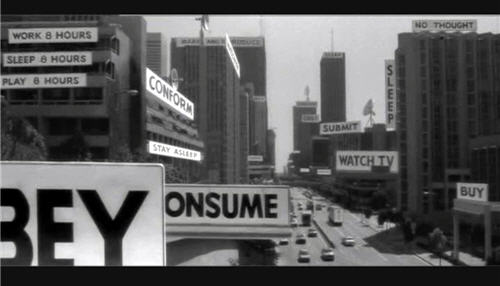
This state of denial and rejection of reality is the essential plot of John Carpenter’s 1988 film They Live, where a group of down-and-out homeless men discover that people have been, in effect, so hypnotized by media distractions that they do not see their prison environment and the real nature of those who control them—that is, an oligarchic elite.

Caught up in subliminal messages such as “obey” and “conform,” among others, beamed out of television and various electronic devices, billboards, and the like, people are unaware of the elite controlling their lives. As such, they exist, as media analyst Marshall McLuhan once wrote, in “prisons without walls.” And of course, any resistance is met with police aggression.

A key moment in the film occurs when John Nada, a homeless drifter, notices something strange about people hanging about a church near the homeless settlement where he lives. Nada decides to investigate. Entering the church, he sees graffiti on a door: They live, We sleep. Nada overhears two men, obviously resisters, talking about “robbing banks” and “manufacturing Hoffman lenses until we’re blue in the face.” Moments later, one of the resisters catches Nada fumbling in the church and tells him “it’s the revolution.” When Nada nervously backs off, the resister assures him, “You’ll be back.”

Rummaging through a box, Nada discovers a handful of cheap-looking sunglasses, referred to earlier as Hoffman lenses. Grabbing a pair and exiting the church, he starts walking down a busy urban street.

Sliding the sunglasses on his face, Nada is shocked to see a society bombarded and controlled on every side by subliminal messages beamed at them from every direction. Billboards are transformed into authoritative messages: a bikini-clad woman in one ad is replaced with the words “MARRY AND REPRODUCE.” Magazine racks scream “CONSUME” and “OBEY.” A wad of dollar bills in a vendor’s hand proclaims, “THIS IS YOUR GOD.”

What’s even more disturbing than the hidden messages, however, are the ghoulish-looking creatures—the elite—who appear human until viewed them through the lens of truth.

This is the subtle message of They Live, an apt analogy of our own distorted vision of life in the American police state. These things are in plain sight, but from the time we are born until the time we die, we are indoctrinated into believing that those who rule us do it for our good. The truth, far different, is that those who rule us don’t really see us as human beings with dignity and worth. They see us as if “we’re livestock.”

It’s only once Nada’s eyes have been opened that he is able to see the truth: “Maybe they’ve always been with us,” he says. “Maybe they love it—seeing us hate each other, watching us kill each other, feeding on our own cold f**in’ hearts.” Nada, disillusioned and fed up with the lies and distortions, is finally ready to fight back. “I got news for them. Gonna be hell to pay. Cause I ain’t daddy’s little boy no more.”

What about you?

As I point out in my book Battlefield America: The War on the American People, the warning signs have been cautioning us for decades. Oblivious to what lies ahead, most have ignored the obvious. We’ve been manipulated into believing that if we continue to consume, obey, and have faith, things will work out. But that’s never been true of emerging regimes. And by the time we feel the hammer coming down upon us, it will be too late.

As Rod Serling warned:

All the Dachaus must remain standing. The Dachaus, the Belsens, the Buchenwalds, the Auschwitzes—all of them. They must remain standing because they are a monument to a moment in time when some men decided to turn the earth into a graveyard, into it they shoveled all of their reason, their logic, their knowledge, but worst of all their conscience. And the moment we forget this, the moment we cease to be haunted by its remembrance. Then we become the grave diggers.

The message: stay alert.

Take the warning signs seriously. And take action because the paths to destruction are well disguised by those in control.

This is the lesson of history.

Catching Up With the Unabomber. When Does the End Justify the Means?

220px-Unabomberforpresident

By Brian Whitney

Source: Disinfo.com

The Unabomber, known as Ted Kaczynski, was not a fan of technology. To expose the world to his anti-technology philosophy, from the years 1978 to 1995, Kaczynski sent 16 bombs to universities and airlines, killing three people and injuring 23, before he was eventually caught and sent to prison. He remains there today. At one time, he was possibly the most famous criminal in the world.

He said of technology’s role:

The system does not and cannot exist to satisfy human needs. Instead, it is human behavior that has to be modified to fit the needs of the system. It is the fault of technology, because the system is guided not by ideology but by technical necessity.

In his essay Industrial Society and Its Future, Kaczynski argued that while his bombings were “a bit” extreme, they were quite necessary to attract attention to the loss of human freedom caused by modern technology. His book Technological Slavery: The Collected Writings of Theodore J. Kaczynski, a.k.a. “The Unabomber” breaks all of his philosophies down for those of us that just know him through corporate news stations.

Was the Unabomber crazy, or just so sane he was blowing our minds?

I talked to David Skrbina, confidant of Kaczynski, and philosophy professor at the University of Michigan. Skrbina wrote the intro to Technological Slavery.

Can you tell me a bit about how you and Kaczynski began to communicate? Are you still in touch with him today?

Back in 2003, I began work on a new course at the University of Michigan: Philosophy of Technology. Surprisingly, such a course had never been offered before, at any of our campuses. I wanted to remedy that deficiency.

I then began to pull together recent and relevant material for the course, focusing on critical approaches to technology. These, to me, were more insightful and more interesting, and were notably under-analyzed among current philosophers of technology. Most of them are either neutral toward modern technology, or positively embrace it, or accept its presence resignedly. As I found out, very few philosophers of the past four decades adopted anything like a critical stance. This, for me, was highly revealing.

Anyway, I was well aware of Kaczynski’s manifesto, “Industrial society and its future,” which was published in late 1995 at the height of the Unabomber mania. I was very impressed with its analysis, even though most of the ideas were not new to me (many were reiterations of arguments by Jacques Ellul, for example—see his 1964 book The Technological Society). But the manifesto was clear and concise, and made a compelling argument.

After Kaczynski was arrested in 1996, and after a year-long trial process, he was stashed away in a super-max prison in Colorado. The media then decided that, in essence, the story was over. Case closed. No need to cover Kaczynski or his troubling ideas ever again.

By 2003, I suspected he was still actively researching and writing, but I had heard nothing of substance about him in years. So I decided to write to him personally, hoping to get some follow-up material that might be useful in my new course. Fortunately, he replied. That began a long string of letters, all on the problem of technology. To date, I’ve received something over 100 letters from him.

Most of the letters occurred in the few years prior to, and just after, the publication of Technological Slavery. Several of his more important and detailed replies to me were included in that book—about 100 pages worth.

We’ve had less occasion to communicate in the past couple years. My most recent letter from him was in late 2014.

You have said that his ideas “threaten to undermine the power structure of our technological order. And since the system’s defenders are unable to defeat the ideas, they choose to attack the man who wrote them.” Can you expand on that?

The present military and economic power of the US government, and governments everywhere, rests on advanced technology. Governments, by their very nature, function to manipulate and coerce people—both their own citizens, and any other non-citizens whom they declare to be of interest. Governments have a monopoly on force, and this force is manifest through technological structures and systems.

Therefore, all governments—and in fact anyone who would seek to exert power in the world—must embrace modern technology. American government, at all levels, is deeply pro-tech. So too are our corporations, universities, and other organized institutions. Technology is literally their life-blood. They couldn’t oppose it in any substantial way without committing virtual suicide.

So when a Ted Kaczynski comes along and reminds everyone of the inherent and potentially catastrophic problems involved with modern technology, “the system” doesn’t want you to hear it. It will do everything possible to distort or censor such discussion. As you may recall, during the final years of the Unabomber episode, there was very little—astonishingly little—discussion of the actual ideas of the manifesto. Now and then, little passages would be quoted in the newspapers, but that was it; no follow-up, no discussion, no analysis.

Basically, the system’s defenders had no counterarguments. The data, empirical observation, and common sense all were on the side of Kaczynski. There was no rational case to be made against him.

The only option for the defenders was an ad hominem attack: to portray Kaczynski as a sick murderer, a crazed loner, and so on. That was the only way to ‘discredit’ his ideas. Of course, as we know, the ad hominem tactic is a logical fallacy. Kaczynski’s personal situation, his mental state, or even his extreme actions, have precisely zero bearing on the strength of his arguments.

The system’s biggest fear was—and still is—that people will believe that he was right. People might begin, in ways small or large, to withdraw from, or to undermine, the technological basis of society. This cuts to the heart of the system. It poses a fundamental threat, to which the system has few options, apart from on-going propaganda efforts, or brute force.

What do you think of the fact that when our government, or any figure in authority such as a police officer, kills in the name of the established belief system, it is thought of as just. But when a guy like Kaczynski kills in the name of his belief system, he is thought of as a deranged psychopath?

As I mentioned, governmental authorities have a monopoly on force. Whenever they use it, it is, almost by definition, ‘right.’ Granted, police can be convicted of ‘excessive force.’ But such cases, as we know, are very rare. And militaries can never be so convicted.

At best, if the public is truly appalled by some lethal action of our police or military, they may vote in a more ‘pacifist’ administration. But even that rarely works. People were disgusted by the war-monger George W. Bush, and so they voted in the “anti-war” Obama. Ironically, he continued on with much the same killing. And through foreign aid and UN votes, Obama continues to support and defend murderous regimes around the world. So much for pacifism.

Let’s keep in mind: Kaczynski killed three people. This was tragic and regrettable, but still, it was just three people. American police kill that many citizens every other day, on average. The same with Obama’s drone operators. Technology kills many times that number, every day—even every hour. Let’s keep things in perspective.

Kaczynski killed in order to gain the notoriety necessary to get the manifesto into the public eye. And it worked. When it was published, the Washington Post sold something like 1.2 million copies that day—still a record. He devised a plan, executed it, and thereby caused millions of people to contemplate the problem of technology in a way they never had before.

Does the end justify the means? It’s too early to tell. If Kaczynski’s actions ultimately have some effect on averting technological disaster, there will be no doubt: his actions were justified. They may yet save millions of lives, not to mention much of the natural world. Time will tell.

You recently wrote a book, The Metaphysics of Technology. Can you tell us a little about that?

Sure. In thinking about the problem of technology, it struck me that there was very little philosophical analysis about what, exactly, technology is. We’ve had many action plans, ranging from tepid and mild (think Sherry Turkle), to Bill Joy’s thesis of “relinquishment” of key technologies, to Kaczynski’s total revolution. But if we don’t really understand what we’re dealing with, our actions are likely to be misguided and ineffectual. In short, we need a true metaphysics of technology.

On my view, technology advances with a tremendous, autonomous power. Humans are the implementers of this power, but we can’t really guide it and we certainly can’t stop it. In effect, it functions as a law of nature. It advances with an evolutionary force, and that’s why we are heading toward disaster.

I see technology much as the ancient Greeks did—as a combination of two potent entities, Technê and Logos (hence ‘techno-logy’). For them, these were quasi-divine forces. Logos was the guiding intelligence behind all order in the universe. Technê was the process by which all things—manmade and otherwise—came into being. These were not mere mythology; they were rational conclusions regarding the operation of the cosmos.

Like the Greeks, I argue that technê is a universal process. All order in the universe is a form of technê. Hence my coining of the term ‘Pantechnikon’—the universe as an orderly construction, manifesting a kind of intelligence, or Logos. Our modern, human technology is on a continuum with all order in the universe. (Harvard astrophysicist Eric Chaisson has argued for precisely the same point, incidentally; see his 2006 book Epic of Evolution.)

The net effect of all this is not good news for us. Technology is like a wave moving through the Earth, and the universe. For a long while, we were at the peak of that wave. Now we’re on the downside. Technology is rapidly heading toward true autonomy. Our opportunity to slow or redirect it is rapidly vanishing. If technology achieves true autonomy—we can take Kurzweil’s singularity date of 2045 as a rough guide—then it’s game over for us. We will likely either become more or less enslaved, or else wiped out. And then technology will continue on its merry way without us.

This is not mere speculation on my part, incidentally. Within the past year, Stephen Hawking, Elon Musk, and Bill Gates have all come out with related concerns. They don’t understand the metaphysics behind it, but they’re seeing the same trend.

How has your experience communicating with Kaczynski changed you as a person and as a philosopher?

As a philosopher, not that much. Kaczynski generally avoids philosophy and metaphysics, preferring practical issues. In a sense, we are operating on different planes, even as we are working on the same problem.

As a person, I have a greater understanding of the basis for the ‘extreme’ actions that he took. It’s not often in life that you get a chance to communicate with someone with such a total commitment to their cause. It’s impressive.

Also, the media treatment of his whole case has been enlightening. When his book, Technological Slavery, came out in 2010, I expected that there would be at least some media coverage. But there was none. The most famous “American terrorist” publishes a complete book from a super-max prison—and it’s not news? Seriously? Compare this topic to the garbage shown on our national evening news programs, and it’s a joke. NPR, 60 Minutes, Wired magazine, etc.—all decided it wasn’t newsworthy. Very telling.

One last thing: Expect to hear from Kaczynski again soon. His second book is nearing completion. The provisional title is “Anti-Tech Revolution: Why and How.” But don’t look for it on your evening news.

Things are not as simplistic as you think.


Buy Technological Slavery, by Ted Kaczynski, and The Metaphysics of Technology by David Skrbina. Kaczynski does not profit from his book.

Brian Whitney’s latest book is Raping the Gods.

Related articles: Ted and the CIA Part 1 & 2 by David Kaczynski

http://blog.timesunion.com/kaczynski/ted-and-the-cia-part-1/271/

http://blog.timesunion.com/kaczynski/ted-and-the-cia-part-2/285/

The Internet Doesn’t Exist

history

By Jacob Silverman

Source: The Baffler

The Internet has been very busy. In just the last week, Caitlyn Jenner broke the Internet, but she also united it. The FCC made war on the Internet. The Internet shamed a couple. The Internet had a dark side, Nikki Finke was barred from the Internet, the Supreme Court made the Internet less safe for women, the Internet named a famous fetus, the Internet did stuff with a superhero movie, and the Internet changed. A girl also won the Internet, Jack White had a difficult history with the Internet, and the Internet “shafted” a Canadian journalist.

“The Internet” is the universal straw man, a hero or villain for every occasion. The Internet, the Internet, the Internet—this decentralized communications network has long been granted a proper noun and practically a degree of sentience. Yet few people talk about “the Telephone” as if it were some person or place, though perhaps they once did. This eagerness to grant the Internet some degree of autonomy—to make it into an actor, an entity—stems in part from its apparent abstraction. Where does all this information come from? As Ray Bradbury famously said, “To hell with you and to hell with the Internet. It’s distracting. It’s meaningless; it’s not real. It’s in the air somewhere.”

Bradbury wasn’t just slipping into kneejerk techno-fear. He was also guilty of the same fallacy that crops up again and again in digital journalism: the assumption that the Internet is some monolithic mass, a discrete population or interest group. “It’s distracting,” Bradbury said, without specifying what “it” was.

But in another, more important way, Bradbury was absolutely right: the Internet doesn’t exist.

A couple years ago, Rachel Law, a grad student at Parsons at the time, had this to say: “The ‘Internet’ does not exist. Instead, it is many overlapping filter bubbles which selectively curate us into data objects to be consumed and purchased by advertisers.” As she also said, a bit less academically, “Browsing is now determined by your consumer profile and what you see, hear and the feeds you receive are tailored from your friends’ lists, emails, online purchases, etc.”

What we call the Internet—and what web writers so lazily draw on for their work—is less a hive mind or a throng or a gathering place and more a personalized set of online maneuvers guided by algorithmic recommendations. When we look at our browser windows, we see our own particular interests, social networks, and purchasing histories scrambled up to stare back at us. But because we haven’t found a shared discourse to talk about this complex arrangement of competing influences and relationships, we reach for a term to contain it all. Enter “the Internet.”

The Internet is a linguistic trope but also an ideology and even a business plan. If your job is to create content out of (mostly) nothing, then you can always turn to something/someone that “the Internet” is mad or excited about. And you don’t have to worry about alienating readers because “the Internet” is so general, so vast and all-encompassing, that it always has room. This form of writing is widely adaptable. Now it’s common to see stories where “Facebook” or “Twitter” stands in for the Internet, offering approval or judgment on the latest viral schlock. Choose your (anec)data carefully, and Twitter can tell any story you want.

We fall back on “the Internet” because it gives us a rhetorical life raft to hang onto amidst an overwhelming tide of information or a piece of sardonic shorthand to utter with a wink and a grimace, much like “never read the comments.” It also reflects a strange irony about today’s culture: despite being highly distributed, and despite offering an outlet for every subculture and niche interest and political quirk, what we think of the Internet often does feel rather uniform and monolithic.

This impression is partly based in fact; the tech and media industries are currently undergoing a kind of recentralization, exemplified by the rise of massive platforms like Facebook and recent mega-deals, such as Verizon buying AOL or Charter Communications (who?) snapping up Time Warner Cable. Attention is increasingly being manipulated and auctioned off by a handful of big conglomerates. The relegation of Twitter to also-ran in the social media sweepstakes—the loser to Facebook in the rush to industry monopoly—also reflects this centralization. That a company with hundreds of millions of users can seem like a failure only shows how bad the market is at apportioning value. (But there I go falling into abstractions again—as if there is anything called “the market.”)

“The Internet” is easy, a convenient reference point and an essential concept for web journalists tasked with surfacing monetizable content from this great informational morass. Digital culture, or writing about “what people are talking about on the Internet,” is considered its own beat now. But in the same way that someone born in the 1980s might not think of himself as a millennial—an arbitrary distinction crafted by demographers and marketers—a user of an online service is not necessarily from, or part of, the Internet. Even some of the subcultures often held up as part of the Internet are mostly notional. Is “Black Twitter” a specific, homogenous entity, as it’s so often described in news coverage? Or is it more something that people do, a set of social relations acted out by varying groups of mostly black Twitter users?

The more we write about what takes place online as if it occurred in some other world, the more we fail to relate this communication system, and everything that happens through it, to the society around us. To understand the Internet, we have to destroy it as an idea.

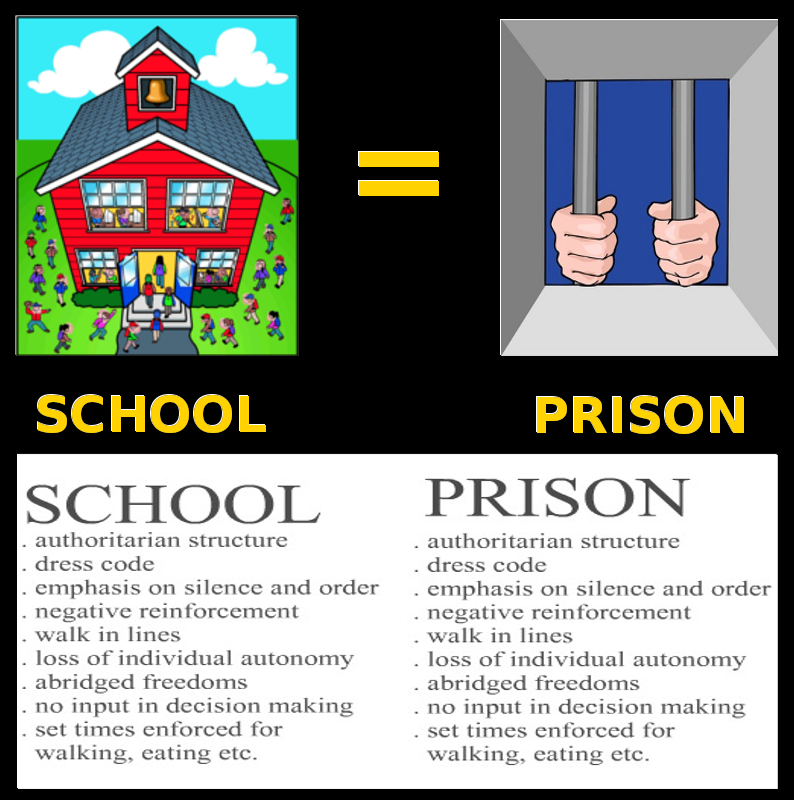
Public School Students Are the New Inmates in the American Police State

school_is_prison_by_twarrior-d4atw5g

By John W. Whitehead

Source: The Rutherford Institute

In the American police state, you’re either a prisoner (shackled, controlled, monitored, ordered about, limited in what you can do and say, your life not your own) or a prison bureaucrat (police officer, judge, jailer, spy, profiteer, etc.).

When you’re a child in the American police state, life is that much worse.

Microcosms of the police state, America’s public schools contain almost every aspect of the militarized, intolerant, senseless, overcriminalized, legalistic, surveillance-riddled, totalitarian landscape that plagues those of us on the “outside.”

From the moment a child enters one of the nation’s 98,000 public schools to the moment she graduates, she will be exposed to a steady diet of draconian zero tolerance policies that criminalize childish behavior, overreaching anti-bullying statutes that criminalize speech, school resource officers (police) tasked with disciplining and/or arresting so-called “disorderly” students, standardized testing that emphasizes rote answers over critical thinking, politically correct mindsets that teach young people to censor themselves and those around them, and extensive biometric and surveillance systems that, coupled with the rest, acclimate young people to a world in which they have no freedom of thought, speech or movement.

If your child is fortunate enough to survive his encounter with the public schools, you should count yourself fortunate.

Most students are not so lucky.

By the time the average young person in America finishes their public school education, nearly one out of every three of them will have been arrested.

More than 3 million students are suspended or expelled from schools every year, often for minor misbehavior, such as “disruptive behavior” or “insubordination.”

For instance, a Virginia sixth grader, the son of two school teachers and a member of the school’s gifted program, was suspended for a year after school officials found a leaf (likely a maple leaf) in his backpack that they suspected was marijuana. Despite the fact that the leaf in question was not marijuana (a fact that officials knew almost immediately), the 11-year-old was still kicked out of school, charged with marijuana possession in juvenile court, enrolled in an alternative school away from his friends, subjected to twice-daily searches for drugs, and forced to be evaluated for substance abuse problems.

Under similarly misguided school zero tolerance policies, students have been suspended for bringing to school household spices such as oregano, breath mints, birth control pills and powdered sugar. Look-alike weapons (toy guns—even Lego-sized ones, hand-drawn pictures of guns, pencils twirled in a “threatening” manner, imaginary bows and arrows, even fingers positioned like guns) can also get a student kicked out.

Acts of kindness, concern or basic manners can also result in suspensions. One 13-year-old was given detention for exposing the school to “liability” by sharing his lunch with a hungry friend. A third grader was suspended for shaving her head in sympathy for a friend who had lost her hair to chemotherapy. And then there was the high school senior who was suspended for saying “bless you” after a fellow classmate sneezed.

Unfortunately, these incidents are indicative of a nationwide phenomenon in which children are treated like suspects and criminals, especially within the public schools.

When you bring the police into the picture, after-school detention and visits to the principal’s office are transformed into punishments such as misdemeanor tickets, juvenile court, handcuffs, tasers and even prison terms.

More and more, police are “stepping in to deal with minor rulebreaking—sagging pants, disrespectful comments, brief physical skirmishes. What previously might have resulted in a detention or a visit to the principal’s office was replaced with excruciating pain and temporary blindness, often followed by a trip to the courthouse.”

Thanks to a combination of media hype, political pandering and financial incentives, the use of armed police officers to patrol school hallways has risen dramatically in the years since the Columbine school shooting.

Funded by government grants, these school resource officers have become de facto wardens in the elementary, middle and high schools, doling out their own brand of justice to the so-called “criminals” in their midst with the help of tasers, pepperspray, batons and brute force.

Now advocates for such harsh police tactics and weaponry will tell you that school safety should be our first priority lest we find ourselves with another Sandy Hook. What they will not tell you is that such shootings are rare. As one congressional report found, the schools are, generally speaking, safe places for children.

In their zeal to crack down on guns and lock down the schools, these cheerleaders for police state tactics in the schools might also fail to mention the lucrative, multi-million dollar deals being cut with military contractors such as Taser International to equip these school cops with tasers, tanks, rifles and $100,000 shooting detection systems.

Indeed, the transformation of hometown police departments into extensions of the military has been mirrored in the public schools, where school police have been gifted with high-powered M16 rifles, MRAP armored vehicles, grenade launchers, and other military gear. One Texas school district even boasts its own 12-member SWAT team.

As if it weren’t bad enough that the nation’s schools have come to resemble prisons—complete with surveillance cameras, metal detectors, drug-sniffing dogs, random locker searches and active shooter drills—the government is also contracting with private prisons to lock up young people for behavior that once would have merited a stern lecture. Nearly 40 percent of those young people who are arrested will serve time in a private prison, where the emphasis is on making profits for large megacorporations above all else.

Young people have become easy targets for the private prison industry. For instance, two Pennsylvania judges made headlines when it was revealed that they had been conspiring with two businessmen in a $2.6 million “kids for cash” scandal that resulted in more than 2500 children being found guilty and jailed in for-profit private prisons.

It has been said that America’s schools are the training ground for future generations. Yet as I point out in my book Battlefield America: The War on the American People, instead of raising up a generation of freedom fighters, however, we seem to be busy churning out newly minted citizens of the American police state who are being taught the hard way what it means to comply, fear and march in lockstep with the government’s dictates.

The lesson is this: you not only get what you pay for, but you reap what you sow.

If you want a nation of criminals, treat the citizenry like criminals.

If you want young people who grow up seeing themselves as prisoners, run the schools like prisons.

But if you want to raise up a generation of freedom fighters, who will actually operate with justice, fairness, accountability and equality towards each other and their government, then run the schools like freedom forums. Remove the metal detectors and surveillance cameras, re-assign the cops elsewhere, and start treating our nation’s young people like citizens of a republic and not inmates in a police state.


The Asshole Factory

index

Our economy doesn’t make stuff anymore. So what does it make?

By Umair Haque

Source: Medium

My good friend Mara has not one but two graduate degrees. From fine, storied universities. Surprise, surprise: the only “job” she was able to find was at a retail store.

Hey—it’s only minimum wage, but at least she’s working, right? And at a major-league, blue-chip company, An American icon; an institution; a name every man, woman, and child in this country knows; an historic company that rings of the American Dream the world over, besides. Surely, if nothing else, it’s a start.

Perhaps you’re right. Maybe it isn’t the start she always dreamed of…but at least it is one. If so…then awaits her at the finish?

What is Mara’s job like? Her sales figures are monitored…by the microsecond. By hidden cameras and mics. They listen to her every word; they capture her every movement; that track and stalk her as if she were an animal; or a prisoner; or both. She’s jacked into a headset that literally barks algorithmic, programmed “orders” at her, parroting her own “performance” back to her, telling her how she compares with quotas calculated…down to the second…for all the hundreds of items in the store…which recites “influence and manipulation techniques” to her…to use on unsuspecting customers…that sound suspiciously like psychological warfare. It’s as if the NSA was following you around……and it was stuck in your head…telling you what an inadequate failure you were…psychologically waterboarding you…all day long…every day for the rest of your life.

Mara’s boss sits in the back. Monitoring all twelve, or fifteen, or twenty people that work in the store. On a set of screens. Half camera displays, half spreadsheets; numbers blinking in real-time. Glued to it like a zombie. Chewing slowly with her mouth open. Jacked into a headset. A drone-pilot… piloting a fleet of human drones…pressure-selling disposable mass-made shit…as if it were luxury yachts…through robo-programmed info-warfare…like zombies…to other zombies…who look stunned…like they just got laser blasted, cluster-bombed, shock-and-awed…

WTF?

It’s bananas. The whole scene is like a maximum-security mental asylum designed by sadomasochists in a sci-fi movie. If Jeffrey Dahmer, Rasputin, and Michael Bay designed a “store” together, they couldn’t do any better. Her “job” will begin to drive her crazy—paranoid, depressed, deluded—in a matter of years if she continues doing it. No human psyche can bear that kind of relentless, systematic abuse.

Now. Note what all the technology and bureaucracy that wonderful, noble company has invested hundreds of millions in doesn’t ask her to do. Learn. Think. Reflect. Teach. Inspire. Lead. Connect. Imagine. Create. Grow. Dream. Actually…serve customers. Heaven forbid. It just beats her over the head, over and over again, three times a minute, every twenty seconds, with how much she hasn’t sold; hasn’t made; hasn’t produced. For her shitty .0003% commission. According to the quota that’s been set for her. By her boss. For his boss. For their boss. And so on all the way up the food chain.

See my point? Mara’s job isn’t to benefit customers. It isn’t to educate, understand, listen to, or even to chat with them. It isn’t to stop them from buying what they don’t want; to help them find what they might need; to match them with the right stuff. Nope. It’s merely to push more and more and more and more shit at them…faster, meaner, and dumber than any sane person would think is humanly possible…using advanced military technology and techniques… programmed to abuse her…so she can wage advanced psychological warfare…on her customers. And they were just suckers, gaping maws, fools, marks. And be yelled at…by a robot…if she doesn’t.

Really? This is the best our economy can do? To take the stuff of 21st century warfare and use them them to…rack up the profit? To turn a bright young woman with two grad degrees…into a Superprofitable Human Weapon of Mass Consumption…a half-crazed algorithmically-programmed asshole…a human drone…so even bigger, actually crazy assholes…can get super-rich…by slinging entire supertankers full of junk…at people getting poorer at four thousand percent interest a year…by using drones and bots to wage psy-warfare against them…so they’re conned into buying too much?

The economy doesn’t make stuff anymore. That much you know. So what does it make?

It makes assholes.

The Great Enterprise of this age is the Asshole Industry.

And that’s not just a tragedy. It is something approaching the moral equivalent of a crime. For it demolishes human potential in precisely the same way as locking someone innocent up, and throwing away the key.

Consider Mara again. Who in Christ’s name would design such an inhuman system? Whose sick joke of an idea is a “store” like that? What do you even call it? Because it’s surely not a “store”.

Only a monstrous asshole of the highest order could assemble such a demonically vampiric bullshit machine to prey on…everyone. Customers, managers, workers alike. Such a carefully sophisticated engine of human misery; of finessed cruelty; all to rake in a few extra pennies an hour, at the expense of dignity, intelligence, creativity, commitment, fairness, craft, service, sovereignty…sanity.

The store is an Asshole Factory.

Allow me to explain.

What happens to Mara when she’s “doing her job”? Think about it for a second. She turns into precisely the kind of asshole that the heartless dweebs who thought up this infernal torture-machine no doubt already are. Not because she wants to. But because she has to.

That’s exactly what the store was designed to do. Turn everyone into the same kind of asshole as the assholes that made it, run it, and benefit from it…want everyone to be.

The store is an Asshole Factory.

Our world is now full of Asshole Factories. That’s what the stores, offices, industrial parks, skyscrapers, malls, low-rise blocks, gleaming headquarters, whimsically designed corporate campuses, really are.

It’s the grand endeavor of today. We don’t make stuff anymore. We make assholes. The Great Enterprise of this age is the Asshole Industry.

Consider, for a moment, my tiny hypothesis.

Have you noticed, lately, that people seem to be more, well, assholish…than before? That everywhere you go, people seem to be meaner, nastier, dumber, angrier, more brutish?

Why?

It is the last and greatest industry left in an economy that has been impoverished, emptied, hollowed out, drained.

The Great Enterprise of the Age of Stagnation is the wholesale manufacture not of great, world-shaking, ground-breaking ideas, inventions, concerns…but of bigger and bigger assholes.

The chain-store; the mall; the hypermarket. The corporation; the firm; the partnership. B-school; law school; med school. The boardroom; the backroom; the trading floor.

These are, by and large, Asshole Factories. They don’t make people. Capable of great things. Who create and build and touch and soar. They make assholes.

They are designed to disinfect us of our fragility. To cleanse us of our flaws. To disinfect us of weakness. Love, grace, mercy, longing, forgiveness, passion, truth, nobility, dreams. Their objective is to stamp all that out; to eradicate it; to erase it. To replace it with calculation, ruthlessness, self-concern; gluttony; cruelty; anxiety, despair. By using the most sophisticated technology ever made to subjugate, oppress, and goad us into being little torturers ourselves.

And in so doing, they emotionally sterilize us. They psychically traumatize us. They intellectually castrate us. They socially neuter us. They cheat us of greatness. That is how they turn us into assholes.

They are designed to deprive us into depriving everyone else of the lives we could and have, at our highest and truest and noblest.

The assholes haven’t just taken our incomes, our savings, our careers, our educations. They’ve taken something far more precious; something priceless. It is our lives—the full, true lives we should be living—that have been taken from us. And in the gaping void where the lives we should be living are, the assholes have deftly inserted carbon copies of…themselves.

When you think about it that way…is it any wonder that society seems to be stuck? That the economy seems headed into oblivion? That life for so pretty much anyone under the age of 35 and/or worth less than $20 million or so appears to be going…nowhere?

Remember my friend Mara? She’s probably being piloted like a drone…yelled at by a bot…three times a minute…into waging advanced techniques of psycho-war…designed to traumatize prisoners…over and over and over again…right this very second…

Until she’s cleansed. Perfect. Flawless. Pure. Another gleaming, brand-new asshole, rolling proudly off the assembly line of the Asshole Factory.

We’re obedient constructivists. Pragmatists. Rationalists. So you probably want to know: what can we do about it?

It’s pretty simple.

Don’t be an asshole. Remember the Asshole Factories? Here’s a secret: they’re churning out assholes by the millions. And so should you bravely decide to be an asshole, what you’ll really be is just another interchangeable, forgettable, rapidly depreciating commodity.

So who should you be?

Be yourself. The person you were meant to be. Whether you believe in heaven or the inferno, freedom or fate, the simple fact is: each and every one of us was put here to be something greater than Just Another Asshole stealing pennies from his neighbors to pay off Even Bigger Assholes.

So let me say it again. Don’t be an asshole. Be yourself. The miracle of being that you were meant to be. A person that, consumed with passion, seared with happiness, aglow with meaning, brings forth all that is great, noble, and true in the world, and so, with love, mercy, and wisdom, lifts every life that you meet into the light.

Thank you and goodbye.

Jade Helm, Terrorist Attacks, Surveillance and Other Fairy Tales for a Gullible Nation

TerrorAlert

By John W. Whitehead

Source: The Rutherford Institute

“Strange how paranoia can link up with reality now and then.” ― Philip K. Dick, A Scanner Darkly

Once upon a time, there was a nation of people who believed everything they were told by their government.

When terrorists attacked the country, and government officials claimed to have been caught by surprise, the people believed them. And when the government passed massive laws aimed at locking down the nation and opening the door to total government surveillance, the people believed it was done merely to keep them safe. The few who disagreed were labeled traitors.

When the government waged costly preemptive wars on foreign countries, insisting it was necessary to protect the nation, the citizens believed it. And when the government brought the weapons and tactics of war home to use against the populace, claiming it was just a way to recycle old equipment, the people believed that too. The few who disagreed were labeled unpatriotic.

When the government spied on its own citizens, claiming they were looking for terrorists hiding among them, the people believed it. And when the government began tracking the citizenry’s movements, monitoring their spending, snooping on their social media, and surveying their habits—supposedly in an effort to make their lives more efficient—the people believed that, too. The few who disagreed were labeled paranoid.

When the government let private companies take over the prison industry and agreed to keep the jails full, justifying it as a cost-saving measure, the people believed them. And when the government started arresting and jailing people for minor infractions, claiming the only way to keep communities safe was to be tough on crime, the people believed that too. The few who disagreed were labeled soft on crime.

When the government hired crisis actors to take part in disaster drills, never alerting the public to which “disasters” were staged, the people genuinely believed they were under attack. And when the government insisted it needed greater powers to prevent such attacks from happening again, the people believed that too. The few who disagreed were told to shut up or leave the country.

Finally, the government started carrying out covert military drills around the country, insisting they were necessary to train the troops for foreign combat, and most of the people believed them. The few who disagreed, warning that perhaps all was not what it seemed, were dismissed as conspiracy theorists and quacks.

By the time the government locked down the nation, using local police and the military to impose martial law, there was no one left in doubt of the government’s true motives—total control and domination—but there was also no one left to fight back.

Now every fable has a moral, and the moral of this story is to beware of anyone who urges you to ignore your better instincts and trust the government.

In other words, if it looks like trouble and it smells like trouble, you can bet there’s trouble afoot.

For instance, while there is certainly no shortage of foul-smelling government activities taking place right now, the one giving off the greatest stench is Jade Helm 15. This covert, multi-agency, multi-state, eight-week military training exercise is set to take place from July 15 through Sept. 15 in states across the American Southwest.

According to official government sources, “Jade Helm: Mastering the Human Domain” is a planned military exercise that will test and practice unconventional warfare including, but not limited to, guerrilla warfare, subversion, sabotage, intelligence activities, and unconventional assisted recovery. The training exercise will take place in seven different southwestern states: California, New Mexico, Colorado, Arizona, Texas, Utah and Nevada.

U.S. Army Special Operations Command will primarily lead this interagency training program but the Navy Seals, Air Force Special Operations, Marine Special Operations Command, Marine Expeditionary Units, 82nd Airborne Division, and other interagency partners will also be involved. Approximately 1,200 troops are expected to participate in these exercises.

The training is known as Realistic Military Training because it will be conducted outside of federal property. The exercises are going to be carried out on both public and private land, with the military reportedly asking permission of local authorities and landowners prior to land usage. The military map listing the locations that will host the exercise shows Texas, Utah, and the southern part of California as “hostile territory.” According to U.S. officials, these three areas are marked as hostile to simulate environments where American troops are viewed as the enemy. The other areas on the map are marked as permissive, uncertain (leaning friendly), or uncertain (leaning hostile).

Military officials claim that the southwestern states were chosen because this exercise requires large areas of undeveloped land as well as access to towns and population hubs. These states purportedly also provide a climate and terrain that is similar to that of potential areas of combat for the United States, particularly Iraq, Iran and Syria.

Now the mainstream media has happily regurgitated the government’s official explanation about Jade Helm. However, there is a growing concern among those who are not overly worried about being labeled conspiratorialists or paranoid that the government is using Jade Helm as a cover to institute martial law, bring about total population control, or carry out greater surveillance on the citizenry.

In the first camp are those who fear that Jade Helm will usher in martial law. These individuals believe that by designating the two traditionally conservative and Republican-dominated states, Utah and Texas, as hostile territory, while more Democratic states like Colorado and California are marked as friendly, the military plans to infiltrate the states with large numbers of gun owners and attempt to disarm them.

Adding fuel to the fire is the mysterious and sudden temporary closures of five Walmart stores in Texas, California, Oklahoma and Florida, two of which are located near Jade Helm training sites. Those in this camp contend that the military is planning to use the Walmart stores as processing facilities for Americans once martial law is enacted.

Pointing to the mission’s official title, “Jade Helm: Mastering the Human Domain,” there is a second camp that fears that the military exercises are merely a means to an end—namely total population control—by allowing the military to discern between friendly civilians and hostiles. This concern is reinforced by military documents stating that a major portion of Jade Helm training will be about blending in with civilians, understanding how to work with civilians, using these civilians to find enemy combatants, and then neutralizing the target.

In this way, the United States military is effectively using psychological warfare to learn how people function and how to control them.

As a study written by military personnel states, mastering the human domain, also known as identity processes, means “use of enhanced capabilities to identify and classify the human domain; to determine whether they are adversarial, friendly, neutral, or unknown.” The study later states that identity processes can be used to “manage local populations during major combat, stability, and humanitarian assistance and/or disaster relief operations.”

While the military has promised that the work they are doing is aimed for use overseas, we have seen first-hand how quickly the military’s weapons and tactics used overseas are brought home to be used against the populace. In fact, some of the nation’s evolutionary psychologists, demographers, sociologists, historians and anthropologists have been working with the Department of Defense’s Minerva Initiative to master the human domain. This security research includes “Understanding the Origin, Characteristics, and Implications of Mass Political Movements” at the University of Washington and “Who Does Not Become a Terrorist and Why?” at the Naval Academy Post Graduate School. Both studies focus on Americans and the different movements and patterns that the government can track to ensure “safety and security.”

The Department of Homeland Security (DHS) is also working to infiltrate churches across the country to establish a Christian Emergency Network, carry out emergency training exercises to prevent and prepare for disasters (active shooter drills and natural disaster preparedness), and foster two-way information sharing, while at the same time instituting a media blackout of their activities. As the DHS continues to establish itself within churches, a growing number of churches are adopting facial recognition systems to survey their congregations, identify and track who attends their events, and target individuals for financial contributions or further monitoring. As the partnership between churches and the DHS grows, their facial recognition databases may be shared with the federal government, if that is not already happening.

Finally, there is the third camp which fears that Jade Helm is merely the first of many exercises to be incorporated into regular American life so that the government can watch, study, and better understand how to control the masses. Certainly, psychological control techniques could be used in the future to halt protests and ensure that the nation runs “smoothly.”

It remains to be seen whether Jade Helm 15 proves to be a thinly veiled military plot to take over the country (one lifted straight out of director John Frankenheimer’s 1964 political thriller Seven Days in May), turn the population into automatons and psychological experiments, or is merely a “routine” exercise for troops, albeit a blatantly intimidating flexing of the military’s muscles.

However, as I point out in my book Battlefield America: The War on the American People, the problem arises when you add Jade Helm to the list of other troubling developments that have taken place over the past 30 years or more: the expansion of the military industrial complex and its influence in Washington DC, the rampant surveillance, the corporate-funded elections and revolving door between lobbyists and elected officials, the militarized police, the loss of our freedoms, the injustice of the courts, the privatized prisons, the school lockdowns, the roadside strip searches, the military drills on domestic soil, the fusion centers and the simultaneous fusing of every branch of law enforcement (federal, state and local), the stockpiling of ammunition by various government agencies, the active shooter drills that are indistinguishable from actual crises, the economy flirting with near collapse, the growing social unrest, the socio-psychological experiments being carried out by government agencies, etc.

Suddenly, the overall picture seems that much more sinister. Clearly, there’s a larger agenda at work here, and it’s one the American people had better clue into before it’s too late to do anything about it.

Call me paranoid, but I think we’d better take James Madison’s advice and “take alarm at the first experiment on our liberties.”


Numbered Man – An Analysis of The Prisoner (1967)

index

An excellent analysis from Jay Dyer of one of the best television series created so far, imho.

On the Unasked Question of Morality in Police Shootings of Black Bodies

15713475938_299bf78d0b

By Dr. Jason Michael Williams

Source: The Hampton Institute

In the past year much has happened regarding police shootings of Black bodies, and the majority of these shootings go unpunished. They go unpunished due to defensive statements such as, “I followed procedure” or “I feared for my life”. Nevertheless, these two quintessential defense statements are disproportionately applied to instances where Blacks are killed by police, yet as a society the United States does or says very little to contextualize the impact such defensive statements have on our collective consciousness and morality. However, it should be noted that this silence is deliberate, historical, and quintessentially American. Thus, morality, to many on the margins, is nonexistent at the foundation of the criminal justice system and many of the laws that govern society specifically laws that disproportionately target the poor.

There is a social-historical pathology attached to the ways in which the American public responds to the killing of Black bodies. Just as police officers claim fear today, so did white mobs during Jim Crow. Black men were hunted and killed countless times out of so-called fear due to often false allegations of rape, murder, and a myriad of other unreasonable accusations. Black women were often murdered for trivial reasons too. Nevertheless, these false and unreasonable accusations were justifiable to the American public whose barbarity knew no measures when directed at Black bodies. This pathology exists today, in the hearts and minds of many mainstreamers who dare utter “#AllLivesMatter”, as if to suppose that the murdering of Black bodies is somehow contemporary. Some mainstreamers have considered #BlackLivesMatter as a form of reverse racism. Thus arguing that the statement is somehow exclusive to other people who are killed, but this is, of course, a testament to the lack of critical thinking and historical intelligence writ large in America.

In modern society, this pathology is played out most vividly via the tumultuous relationship between Blacks and police officers. There had been countless murders of Black citizens by police, and yet many of them have been legally justified-that is, these cases have gone through the investigative processes of so-called fact-finding and rendered permissible. However, every so often, there are cases that wreck the consciousness of even the greatest conformers to the social order. For example, the case of Eric Garner, to many Americans of all colors was a prima facie case of wrongdoing, and yet the officer involved in Mr. Garner’s death faced no punishment. Another case in Cleveland where two Black bodies were shot 137 times by police officers has too failed to accomplish moral justice. Cleveland police officer, Michael Brelo cried as he heard his verdict of not-guilty. Brelo was accused of firing 49 shots of which 15 were shot while on the hood of the victims’ car. In clear opposition to an increasingly irritated public regarding police brutality, Judge John P. O’Donnell uttered, “I will not sacrifice him to a public frustrated by historical mistreatment at the hands of other officers.” If the judge were truly neutral to the concerns of the irritated public, such a reckless and defining statement would not have been made.

Nevertheless, the Judge’s rationale coexists with the feelings of many throughout the country. Whether one is scrolling through social media commentary, internet articles or watching mainstream media, the mainstream narrative is quite clear: Black lives don’t matter! And the insistence of this reality is cemented each time a Black is immorally murdered by the state. These ceremonial constants have caused many people throughout the nation to lose faith in the American justice system, including mainstreamers. Although Judge O’Donnell in the Cleveland case believed that the evidence was not solid to convict Officer Brelo, like the Garner case, many feel discontent. This discontentment is the proper manifestation of people realizing that justice in America isn’t always the moral outcome, a concept that a true justice system would strive to achieve. In fact, when “fact-finding” exist within an adversarial system easily corrupted by extralegal factors (race, gender, wealth, power, etc.), justice will undoubtedly fail those who aren’t privy to the game. Thus, American justice isn’t always about siding with moral rights, but rather it often swings on the side of barbarity and injustice as it falsely masquerades as one of the world’s most advanced and civilized systems.

The countless cases of police officers walking free from killing American citizens who happen to be Black is a testament to the limitations of American justice. Black lives don’t matter. As a result, demonstrators of late have continued to take to the streets against the immorality of American justice. They have continued to expose lady justice for the two-faced symbolism that she represents, as the global community pays witness. For these courageous individuals, the legality of justice and the majoritarian trickery invested in trying fact does not seem to fit within a moralistic frame. To these people, lives were unjustly lost, and police officers can get away with murder for simply stating what White men were able to hide behind since slavery: Fear of a Black body.

The Black lives matter movement at best should force the public to question the purpose of the criminal justice system seriously, and whether or not the processes that are currently embraced serve the interest of justice. The subjective citizenship of Black Americans should be the next topic of discussion. For instance, are Blacks to be treated as human beings, citizens, and, therefore, worthy of the right to live, breathe, and seek justice? These are key discussions that must begin to happen if justice is to be taken seriously in America. This conversation should also be raw, wide-reaching, and aided by both historical and contemporary facts. Certain acts of “justice” should be studied as violence. For example, the deliberate mass incarceration of minorities and poor people is, in fact, violence. Mass incarceration breaks up families (much like how slavery did), predisposes people to crime, destroys communities (politically, economically, and ecologically) thus pushing these spaces further beyond the margins, and render most to a life of poverty and outcast. The effects of so-called justice seem to perpetuate further inequality. In a real democracy, the state would not engage in such violence.

Furthermore, the creation of immoral laws like the war on drugs that create the contexts for Michael Browns are inhumane and violent. Such laws are neither safe for its targets (predominantly Black and Brown although now increasingly White) nor police officers. Also, the over policing of the poor is violent and extremely telling for a nation that considers itself a democracy. Over policing is violent, repressive, and undemocratic, as it mandates surveillance for the bottom and liberty for those at the top. While many people advocate for community policing in America’s ghettos, such arguments should be met with extreme caution, as community policing furthers the paternalistic mindset that the poor must be governed. Meanwhile, there are zero discussions regarding the need for community policing or surveillance programs on Wall Street or within other corporate spaces that are obviously privileged against the criminal justice system. These basic statements are more than enough for a conversation to be had on the purpose of the criminal justice system. Who does it serve? Who is most affected by it? What are the collateral consequences? Is a system of violence capable of delivering justice? Is the system morally bankrupt? Does there need to be a revolution regarding the criminal justice system?