The Troika of Tyranny: The Imperialist Project in Latin America and Its Epigones

By Roger Harris

Source: CounterPunch

Cuba, Nicaragua, and Venezuela are today threatened by US imperialism. The first salvo of the modern Age of Imperialism started back in 1898 when the US seized Cuba along with Puerto Rico and the Philippines in the Spanish-American War.

The Age of Imperialism, as Lenin observed, is characterized by the competition of the various imperial powers for dominance. That inter-imperialist rivalry led to World War I. Lenin called those putative socialists who supported their own national imperialist projects “social imperialists.” Social imperialism is a tendency that is socialist in name and imperialist in deed. Imperialism and its social imperialist minions are still with us today.

US Emerges as the World’s Hegemon

The United States emerged after World War II as the leading imperialist power. With the implosion of the Socialist Bloc around 1991, US hegemony became even more consolidated. Today the US is the undisputed world’s hegemon.

Hegemony means to rule but even more so to dominate. As the world’s hegemon, the US will not tolerate neutral parties, let alone hostile ones. As articulated in the Bush Doctrine, the US will try to asphyxiate any nascent counter-hegemonic project, no matter how insignificant.

In the Caribbean, for instance, the US snuffed out the leftist government of Grenada in 1983 in what was code named Operation Urgent Fury. Grenada has a population smaller than Vacaville, California.

The only powers that the world’s hegemon will tolerate are junior partners such as Colombia in Latin America. The junior partner must accept a neoliberal economic regime designed to serve the interests of capital. Structural adjustment of the economy is demanded such that the neoliberal “reforms” become irreversible; so that you can’t put the toothpaste back in the tube.

Colombia recently joined NATO, putting that junior partner’s military under direct interaction with the Pentagon bypassing its civilian government. The US has seven military bases in Colombia in order to project – in the words of the US government – “full spectrum” military dominance in the Latin American theatre.

Needless-to-say, no Colombian military bases are in the US. Nor does any other country have military bases on US soil. The world’s hegemon has some 1000 foreign military bases. Even the most sycophantic of the US’s junior partners, Great Britain, is militarily occupied by 10,000 US troops.

The US is clear on its enemies list. On November 1, US National Security Advisor John Bolton, speaking in Miami, labelled Venezuela, Nicaragua, and Cuba the “troika of tyranny.” He described a “triangle of terror stretching from Havana to Caracas to Managua.”

Venezuela, Nicaragua, and Cuba are targeted by US imperialism because they pose what might be called the “threat of a good example;” that is, an alternative to the neoliberal world order.

These countries are suffering attacks from the imperialists because of the things they have done right, not for their flaws. They are attempting to make a more inclusive society for women, people of color, and the poor; to have a state that, instead of serving the rich and powerful, has a special option for working people, because these are the people most in need of social assistance.

Sanctions: The Economic War against Venezuela, Nicaragua, and Cuba

The US imperialist rhetoric is backed with action. In 2015, US President Obama declared Venezuela an “extraordinary threat to US security” and imposed sanctions. These sanctions have been extended and deepened by the Trump administration. The US has likewise subjected Cuba to sanctions in a seamless bipartisan policy of both Republicans and Democrats for over half a century. Now the US is the process of imposing sanctions on Nicaragua.

Unilateral sanctions, such as those imposed by the US, are illegal under the charters of both the UN and the Organization of American States, because they are a form of collective punishment targeting the people.

The US sanctions are designed to make life so miserable for the masses of people that they will reject their democratically elected government. Yet in Venezuela, those most adversely affected by the sanctions are the most militantly in support of their President Nicolás Maduro.

Consequently, the Trump administration is also floating the option of military intervention against Venezuela. The recently elected rightwing leaders Bolsonaro in Brazil and Duque in Colombia, representing the two powerful states on the western and southern borders of Venezuela, are colluding with the hegemon of the north.

The inside-the-beltway human rights organizations, such as Human Rights Watch, fail to condemn these illegal and immoral sanctions. They lament the human suffering caused by the sanctions, all the while supporting the imposition of the sanctions. Nor do they raise their voices against military intervention, perhaps the gravest of all crimes against humanity.

Liberal establishments such as the advocacy group Washington Office on Latin America (WOLA) try to distinguish themselves from hardline imperialists by opposing a military invasion in Venezuela while calling for yet more effective and punishing sanctions. In effect, they play the role of the good cop, providing a liberal cover for interference in the internal affairs of Latin American nations.

These billionaire-funded NGOs have a revolving-door staffing arrangement with the US government. So it is not surprising that they will reflect Washington’s foreign policies initiatives.

But why do some organizations claiming to be leftist so unerringly echo the imperialists, taking such umbrage over Venezuela, Cuba, and Nicaragua while ignoring far greater problems in, say, Mexico, Colombia, and Honduras, which are US client states?

Most Progressive Country in Central America Targeted

Let’s take Nicaragua. A year ago, the polling organization Latinobarómetro, found the approval rating of Nicaraguans for their democracy to be the highest in Central America and second highest in Latin America.

Daniel Ortega had won the Nicaraguan presidency in 2006 with a 38% plurality, in 2011 with 63%, and 72.5% in 2016. The Organization of American States officially observed and certified the vote. Polls indicated Ortega was perhaps the most popular head of state in the entire western hemisphere. As longtime Nicaraguan solidarity activist Chuck Kaufman noted, “Dictators don’t win fair elections by growing margins.”

Nicaragua is a member of theanti-imperialist Bolivarian Alliance for the Peoples of Our America with Cuba, Venezuela, Bolivia, and some Caribbean states. Speaking at the UN, the Nicaraguan foreign minister had the temerity to catalogue the many transgressions of what Martin Luther King called “the greatest purveyor of violence in the world” and express Nicaragua’s opposition.

These are reasons enough for a progressive alternative such as Nicaragua to curry the enmity of the US. The enigma is why those claiming to be leftists would target a country that had:

+ Second highest economic growth rates and the most stable economy in Central America.

+ Only country in the region producing 90% of the food it consumes.

+ Poverty and extreme poverty halved; country with the greatest reduction of extreme poverty.

+ Reached the UN Millennium Development Goal of cutting malnutrition by half.

+ Nicaraguans enjoyed free basic healthcare and education.

+ Illiteracy had been virtually eliminated, down from 36% in 2006 when Ortega took office.

+ Average economic growth of 5.2% for the past 5 years (IMF and the World Bank).

+ Safest country in Central America (UN Development Program) with one of the lowest crime rates in Latin America.

+ Highest level of gender equality in the Americas (World Economic Forum Global Gender Gap Report 2017).

+ Did not contribute to the migrant exodus to the US, unlike neighboring Honduras, El Salvador, and Guatemala.

+ Unlike its neighbors, kept out the drug cartels and pioneered community policing.

In April of this year, all of this was threatened. The US had poured millions of dollars into “democracy promotion” programs, a euphemism for regime change operations. Suddenly and unexpectedly, a cabal of the reactionary Catholic Church hierarchy, conservative business associations, remnants of the US-sponsored Contras, and students from private universities attempted a coup.

Former members of Ortega’s Sandinista Party, who had long ago splintered off into political oblivion and drifted to the right, became effective propogandists for the opposition. Through inciting violence and the skillful use of disinformation in a concerted social media barrage, they attempted to achieve by extra-legal means what they could not achieve democratically.

Imperialism with a Happy Face

We who live in the “belly of the beast” are constantly bombarded by the corporate media, framing the issues (e.g., “humanitarian bombing). Some leftish groups and individuals pick up these signals, amplify, and rebroadcast them. While they may genuinely believe what they are promulgating, there are also rewards such as funding,media coverage, hobnobbing with prominent US politicians, and winning awards for abhorring the excesses of imperialism while accepting its premises.

Today’s organizations that are socialist in name and imperialist in deed echo the imperial demand that the state leaders of the progressive movements in Latin America “must go” and legitimize the rationale that such leaders must be “dictators.”

They try to differentiate their position from the imperialists by proffering a mythic movement, which will create a triumphant socialist alternative that fits their particular sect’s line: chavismo without Maduro in Venezuela, sandinismo without Ortega in Nicaragua, and the Cuban Revolution without the Cuban Communist Party in Cuba.

The political reality in Latin America is that a rightwing offensive is attacking standing left-leaning governments. President George W. Bush was right: “Either you are with us, or you are with the terrorists.” There is no utopian third way. Each of us has to determine who are the real terrorists, as the juggernaut of US imperialism rolls out a neoliberal world order.

Chaos: The New Imperialist Game Plan

For now, the coup in Nicaragua has been averted. Had it succeeded, chaos would have reigned. As even the most ardent apologists for the opposition admit, the only organized force in the opposition was the US-sponsored rightwing which would have instigated a reign of terror against the Sandinista base.

The US would prefer to install stable rightwing client states or even military dictatorships. But if neither can be achieved, chaos is the preferred alternative. Libya, where rival warlords contest for power and slaves are openly bartered on the street, is the model coming to Latin America.

Chaos is the new imperialist game plan, especially for Bolton’s so-called troika of tyranny. The imperialists understand that the progressive social movements in Venezuela, Nicaragua, and Cuba are too popular and entrenched to be eradicated by a mere change of personnel in the presidential palace. Much more drastic means are envisioned; means that would make the bloody aftermath of the US-backed Pinochet coup in 1973 in Chile pale by comparison.

In Venezuela, for example, the opposition might well have won the May 2018 presidential election given the dire economic situation caused in large part by the US sanctions. The opposition split between a moderate wing that was willing to engage in electoral struggle and a hard-right wing that advocated a violent takeover and jailing the chavistas.

When Venezuelan President Maduro rejected the US demand to call off the elections and resign, he was labelled a dictator by Washington. And when moderate Henri Falcon ran in the Venezuelan presidential race on a platform of a complete neoliberal transition, Washington, instead of rejoicing, threatened sanctions against him for running. The US belligerently floated a military option for Venezuela, stiffened the suffocating sanctions, and tipped the balance within the Venezuelan opposition to the radical right.

The US is not about to allow Venezuela a soft landing. Their intent is to exterminate the contagion of progressive social programs and international policy that has been the legacy of nearly two decades chavismo. Likewise, for Cuba and Nicaragua. We should also add Bolivia in the crosshairs of the empire.

We’ve seen what Pax Americana has meant for the Middle East. The same imperial playbook is being implemented in Latin America. Solidarity with the progressive social movements and their governments in Latin America is needed, especially when their defeat would mean chaos.

The Forgotten Legacy of George H.W. Bush That the Media Won’t Tell You About

By John Liberty

Source: The Mind Unleashed

On Friday November 30th, former President George H.W. Bush passed away at the age of ninety four, according to a statement released by his friends and family.

While the establishment celebrates the life of the former president and Americans line up to mourn their fallen leader, the facts that are being reported in the mainstream media are far different than the legacy he is leaving behind.

The Early Years

George Herbert Walker Bush was born on June 12, 1924 in Massachusetts to Prescott Sheldon Bush and Dorothy (Walker) Bush. Shortly after his birth, the family moved to Connecticut where he began his formal education at Greenwich Country Day School. At the age of eighteen, Bush joined the U.S. Navy.

During his tenure in the Navy, Bush was stationed with Torpedo Squadron 51 aboard the USS San Jacinto. On August 1, 1944 his unit launched an operation against the Japanese in the Bonin Islands. On September 2, 1944, Bush’s aircraft was downed leading to the death of eight Navy airmen, leaving Bush as the lone survivor. The episode later became known as the Chichijima incident and led to the future president being hailed as a war hero.

Political Career

Upon graduating from Yale, Bush began his career in politics and was elected chairman of the Harris County, Texas Republican Party in 1963. Three years later, Bush was elected to the US House of Representatives, marking the beginning of a meteoric rise which resulted in him being named director of the Central Intelligence Agency in 1976.

While Bush served less than a year as the head of the CIA, he was caught destroying evidence of US war crimes. As reported by MuckRock,

“Declassified records recently unearthed in CREST show the CIA waffled on a promise to obey the law in destroying records of Agency’s illegal activities and wrongdoing.”

Four years after serving as the director of the CIA, George H.W. Bush was elected as the 43rd Vice President of the United States. Serving under former President Ronald Reagan, Bush kept a low profile and avoided making any key policy decisions or criticisms of the Reagan administration, but attended a large number of ceremonies and public events.

In 1988, Bush was elected president defeating Michael Dukakis of Massachusetts. Within his first year in office, Bush’s approval ratings began to slip due to his inability to deal with Panamanian leader Manuel Noriega. Bush responded by deciding to invade Panama, and on December 20,1989 he deployed 25,000 troops to the tiny nation. Bush justified the invasion— code named operation just cause— on the grounds of national security. The president mislead the country by claiming Noriega had threatened the US, a claim which turned out to be untrue. After two weeks the conflict ended, resulting in the deaths of twenty American soldiers and as many as 2,000 Panamanians.

Less than a year after the invasion of Panama, Bush once again found himself responding to another foreign policy debacle. On August 2, 1990 Iraqi leader Saddam Hussein began an invasion of nearby Kuwait. In response, President Bush and the American media used the testimony of a 15-year-old Kuwaiti girl, known only by her first name of Nayirah to justify US intervention in Kuwait. However, Nayirah was later discovered to be the daughter of a U.S. ambassador, who was being coaxed by military psychological operations specialists.

In 1991, Bush gave his infamous ‘New World Order’ speech, which many people believe signaled the beginning of the PNAC plan also known as the Project For a New American Century.

Life After Politics

After leaving office in 1993, George H.W. Bush retired with his wife Barbara and built a home in a community near Houston, Texas.  Though retired, the former president would still face controversy. Last year, during the height of the #MeToo movement, at least five women women claimed they were abused by the former president. In an interview with Time Magazine, a woman named Roslyn Corrigan claimed Bush sexually assaulted her in 2003 when she was only 16-years-old. At least five more women have accused Bush of sexual assault, including an unnamed Michigan woman who came forward claiming the former president groped her in 1992 at a campaign event. Actress Heather Lind also stated, in a now deleted Instagram post, that Bush groped her during a photo-op in 2014.

Perhaps, instead of blindly praising a documented criminal, Americans should consider asking themselves what other crimes the US government and the media are covering up for the former president.

Why Are so Few Americans Able to Get Ahead?

By Charles Hugh Smith

Source: Of Two Minds

Our entire economy is characterized by cartel rentier skims, central-bank goosed asset bubbles and stagnating earned income for the bottom 90%.

Despite the rah-rah about the “ownership society” and the best economy ever, the sobering reality is very few Americans are able to get ahead, i.e. build real financial security via meaningful, secure assets which can be passed on to their children.

As I’ve often discussed here, only the top 10% of American households are getting ahead in both income and wealth, and most of the gains of these 12 million households are concentrated in the top 1% (1.2 million households). (see wealth chart below).

Why are so few Americans able to get ahead? there are three core reasons:

1. Earnings (wages and salaries) have not kept up with the rising cost of living.

2. The gains have flowed to capital, which is mostly owned by the top 10%, rather than to labor ((wages and salaries).

3. Our financialized economy incentivizes cartels and other rentier skims, i.e. structures that raise costs but don’t provide any additional value for the additional costs.

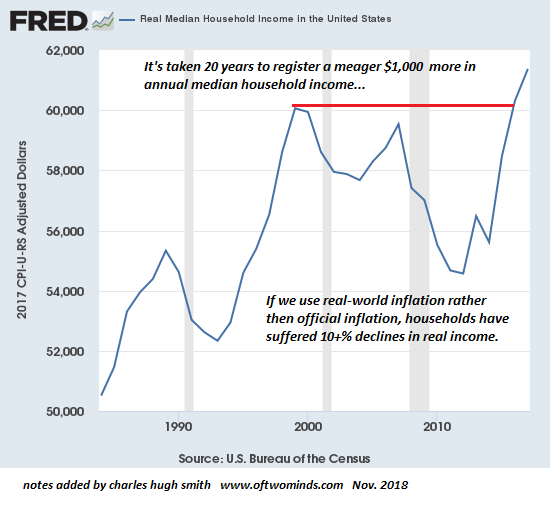
It’s instructive to compare today’s household with households a few generations ago. As recently as the early 1970s, 45 years ago, it was still possible for a single fulltime-earner to support the household and buy a home, which in 1973 cost around $30,000 (median house price, as per the St. Louis FRED database).

As recently as 20 years ago, in 1998, the median house price in the U.S. was about $150,000— still within reach of many two-earner households, even those with average jobs.

As the chart below shows, real median household income has only recently exceeded the 1998 level— and only by a meager $1,000 annually. If we use real-world inflation rather than the under-estimated official inflation, real income has plummeted by 10% or more in the past 20 years.

This reality is reflected in a new study of wages in Silicon Valley, which we might assume would keep up due to the higher value of the region’s output. The study found the wages of the bottom 90% declined when adjusted for inflation by as much as 14% over the past 20 years:

“The just-released report showed that wages for 90 percent of Silicon Valley workers (all levels of workers except for the top 10 percent)are lower now than they were 20 years ago, after adjusting for inflation. That’s in stark contrast to the 74 percent increase in overall per capita economic output in the Valley from 2001 to 2017.”

source: Why Silicon Valley Income Inequality Is Just a Preview of What’s to Come for the Rest of the U.S.

Meanwhile, the median house price has more than doubled to $325,000 while median household income has stagnated. Please note this price is not adjusted for inflation, like the median income chart. But if we take nominal household income in 1998 (around $40,000 annually) and compare it to nominal household income now in 2018 (around $60,000), that’s a 50% increase–far below the more than doubling of house prices.

To raise stagnant incomes, the Federal Reserve and other central banks have attempted to generate a wealth effect by boosting the valuations of risk-on assets such as stocks, bonds and commercial real estate. But the Fed et al. overlooked the fact that the vast majority of these assets are owned by the top 10%–and as noted above, the ownership of the top 10% is concentrated in the top 1% and .1%.

As a result, the vast majority of the wealth effect capital gains have flowed to the top 1%:

Lastly, the cartel structure of the U.S. economy has raised costs while providing no additional value. One example is higher education, a cartel that issues diplomas with diminishing economic value that now cost a fortune, a reality reflected in this chart of student loan debt, which simply didn’t exist a generation ago:

Our entire economy is characterized by cartel rentier skims, central-bank goosed asset bubbles and stagnating earned income for the bottom 90%. Given these realities, the bottom 90% are left with few pathways to get ahead in terms of financial security and building secure family wealth.


America Is on the Brink of a Nervous Breakdown

By John W. Whitehead

Source: The Rutherford Institute

“As nightfall does not come at once, neither does oppression. In both instances, there is a twilight when everything remains seemingly unchanged. And it is in such twilight that we all must be most aware of change in the air – however slight – lest we become unwitting victims of the darkness.” ― Supreme Court Justice William O. Douglas

Yet another shooting.

Yet another smear of ugliness, hatred and violence.

Yet another ratcheting up of the calls for the government to clamp down on the citizenry by imposing more costly security measures without any real benefit, more militarized police, more surveillance, more widespread mental health screening of the general population, more threat assessments and behavioral sensing warnings, more gun control measures, more surveillance cameras with facial recognition capabilities, more “See Something, Say Something” programs aimed at turning Americans into snitches and spies, more metal detectors and whole-body imaging devices at so-called soft targets, more roaming squads of militarized police empowered to do more stop-and-frisk searches, more fusion centers to centralize and disseminate information to law enforcement agencies, and more government monitoring of what Americans say and do, where they go, what they buy and how they spend their time.

All of these measures play into the government’s hands.

All of these measures add up to more government power, less real security and far less freedom.

As we have learned the hard way, the phantom promise of safety in exchange for restricted or regulated liberty is a false, misguided doctrine that has no basis in the truth.

Things are falling apart.

When things start to fall apart or implode, ask yourself: who stands to benefit?

In most cases, it’s the government that stands to benefit by amassing greater powers at the citizenry’s expense.

Unfortunately, the government’s answer to civil unrest and societal violence, as always, will lead us further down the road we’ve travelled since 9/11 towards totalitarianism and away from freedom.

With alarming regularity, the nation is being subjected to a spate of violence that not only terrorizes the public but also destabilizes the country’s fragile ecosystem, and gives the government greater justifications to crack down, lock down, and institute even more authoritarian policies for the so-called sake of national security without many objections from the citizenry.

Clearly, America is being pushed to the brink of a national nervous breakdown.

This breakdown—triggered by polarizing circus politics, media-fed mass hysteria, racism, classism, xenophobia, militarization and militainment (the selling of war and violence as entertainment), a sense of hopelessness and powerlessness in the face of growing government corruption and brutality, and a growing economic divide that has much of the population struggling to get by—is manifesting itself in madness, mayhem and an utter disregard for the very principles and liberties that have kept us out of the clutches of totalitarianism for so long.

Yet there is a method to this madness.

Remember, authoritarian regimes begin with incremental steps. Overcriminalization, surveillance of innocent citizens, imprisonment for nonviolent—victimless—crimes, etc. Bit by bit, the citizenry finds its freedoms being curtailed and undermined for the sake of national security. And slowly the populace begins to submit.

No one speaks up for those being targeted.

No one resists these minor acts of oppression.

No one recognizes the indoctrination into tyranny for what it is.

Historically this failure to speak truth to power has resulted in whole populations being conditioned to tolerate unspoken cruelty toward their fellow human beings, a bystander syndrome in which people remain silent and disengaged—mere onlookers—in the face of abject horrors and injustice.

Time has insulated us from the violence perpetrated by past regimes in their pursuit of power: the crucifixion and slaughter of innocents by the Romans, the torture of the Inquisition, the atrocities of the Nazis, the butchery of the Fascists, the bloodshed by the Communists, and the cold-blooded war machines run by the military industrial complex.

We can disassociate from such violence.

We can convince ourselves that we are somehow different from the victims of government abuse.

We can continue to spout empty campaign rhetoric about how great America is, despite the evidence to the contrary.

We can avoid responsibility for holding the government accountable.

We can zip our lips and bind our hands and shut our eyes.

In other words, we can continue to exist in a state of denial.

Whatever we do or don’t do, it won’t change the facts: the nation is imploding, and our republic is being pushed ever closer to martial law.

As Vann R. Newkirk II writes for the Atlantic:

Trumpism demands that violence be solved by local militarization: increased security at schools, the arming of teachers, and now, the adoption of guns in places intended quite literally to be sanctuaries from the scourges of the world. Taken altogether, what Trumpism seems to intend is the creation—or perhaps the expansion—of the machinery of a police state

In facing what appears to be a rising tide of violence—a tide that Trump himself elevates and encourages—the prescription of arms merely capitulates to the demands of that bloodshed. The purpose of political violence and terrorism is not necessarily to eliminate or even always to create body counts, but to disempower people, to spread the contagion of fear, to splinter communities into self-preserving bunkers, and to invalidate the very idea that a common destiny is even possible. Mandates to arm people accelerate this process. They inherently promote the idea that society cannot reduce the global level of harm, and promote the authoritarian impulses of people seeking order.

Where Newkirk misses the point is by placing the blame squarely on the Trump Administration.

This shift towards totalitarianism and martial law started long before Trump, set in motion by powers-that-be that see the government as a means to an end: power and profit.

As Paul Craig Roberts, former Assistant Secretary of the Treasury, recognized years ago, “Adolf Hitler is alive and well in the United States, and he is fast rising to power.”

Roberts was not comparing Trump to Hitler, as so many today are wont to do.

Rather, he was comparing the American Police State to the Nazi Third Reich, which is a far more apt comparison.

After all, U.S. government agencies—the FBI, CIA and the military—have fully embraced many of the Nazi’s well-honed policing tactics and have used them repeatedly against American citizens for years now.

Indeed, with every passing day, the United States government borrows yet another leaf from Nazi Germany’s playbook: Secret police. Secret courts. Secret government agencies. Surveillance. Censorship. Intimidation. Harassment. Torture. Brutality. Widespread corruption. Entrapment. Indoctrination. Indefinite detention.

These are not tactics used by constitutional republics, where the rule of law and the rights of the citizenry reign supreme. Rather, they are the hallmarks of authoritarian regimes, where the only law that counts comes in the form of heavy-handed, unilateral dictates from a supreme ruler who uses a secret police to control the populace.

The empowerment of the Gestapo, Germany’s secret police, tracked with the rise of the Nazi regime in much the same way that the rise of the American police state corresponds to the decline of freedom in America.

How did the Gestapo become the terror of the Third Reich?

It did so by creating a sophisticated surveillance and law enforcement system that relied for its success on the cooperation of the military, the police, the intelligence community, neighborhood watchdogs, government workers for the post office and railroads, ordinary civil servants, and a nation of snitches inclined to report “rumors, deviant behavior, or even just loose talk.”

In other words, ordinary citizens working with government agents helped create the monster that became Nazi Germany. Writing for the New York Times, Barry Ewen paints a particularly chilling portrait of how an entire nation becomes complicit in its own downfall by looking the other way:

In what may be his most provocative statement, [author Eric A.] Johnson says that ‘‘most Germans may not even have realized until very late in the war, if ever, that they were living in a vile dictatorship.’’ This is not to say that they were unaware of the Holocaust; Johnson demonstrates that millions of Germans must have known at least some of the truth. But, he concludes, ‘‘a tacit Faustian bargain was struck between the regime and the citizenry.’’ The government looked the other way when petty crimes were being committed. Ordinary Germans looked the other way when Jews were being rounded up and murdered; they abetted one of the greatest crimes of the 20th century not through active collaboration but through passivity, denial and indifference.

Much like the German people, “we the people” have become passive, polarized, gullible, easily manipulated, and lacking in critical thinking skills.  Distracted by entertainment spectacles, politics and screen devices, we too are complicit, silent partners in creating a police state similar to the terror practiced by former regimes.

Can the Fourth Reich happen here?

It’s already happening right under our noses. Much like the German people, “we the people” are all too inclined to “look the other way.”

In our state of passivity, denial and indifference, here are some of the looming problems we’re ignoring:

Our government is massively in debt. Currently, the national debt is somewhere in the vicinity of $21 trillion. Approximately half of our debt is owned by foreign countries, namely China, Japan and Saudi Arabia.

Our education system is abysmal. Despite the fact that we spend more than most of the world on education, we rank 36th in the world when it comes to math, reading and science, far below most of our Asian counterparts. Even so, we continue to insist on standardized programs such as Common Core, which teach students to be test-takers rather than thinkers.

Our homes provide little protection against government intrusions. Police agencies, already empowered to crash through your door if they suspect you’re up to no good, now have radar devices that allow them to “see” through the walls of our homes.

Our prisons, housing the largest number of inmates in the world and still growing, have become money-making enterprises for private corporations that rely on the inmates for cheap labor.

We are no longer a representative republic. The U.S. has become a corporate oligarchy. As a recent academic survey indicates, our elected officials, especially those in the nation’s capital, represent the interests of the rich and powerful rather than the average citizen.

We’ve got the most expensive, least effective health care system in the world compared to other western, industrialized nations.

The air pollution levels are dangerously high for almost half of the U.S. population, putting Americans at greater risk of premature death, aggravated asthma, difficulty breathing and future cardiovascular problems.

Despite outlandish amounts of money being spent on the nation’s “infrastructure,” there are more than 63,000 bridges—one out of every 10 bridges in the country—in urgent need of repair. Some of these bridges are used 250 million times a day by trucks, school buses, passenger cars and other vehicles.

Americans know little to nothing about their rights or how the government is supposed to operate. This includes educators and politicians. For example, 27 percent of elected officials cannot name even one right or freedom guaranteed by the First Amendment, while 54 percent do not know the Constitution gives Congress the power to declare war.

Nearly one out of every three American children live in poverty, ranking us among the worst in the developed world.

Patrolled by police, our schools have become little more than quasi-prisons in which kids as young as age 4 are being handcuffed for “acting up,” subjected to body searches and lockdowns, and suspended for childish behavior.

We’re no longer innocent until proven guilty.  In our present surveillance state, that burden of proof has now been shifted so that we are all suspects to be spied on, searched, scanned, frisked, monitored, tracked and treated as if we’re potentially guilty of some wrongdoing.

Parents, no longer viewed as having an inherent right to raise their children as they see fit, are increasingly being arrested for letting their kids walk to the playground alone, or play outside alone. Similarly, parents who challenge a doctor’s finding or request a second opinion regarding their children’s health care needs are being charged with medical child abuse and, in a growing number of cases, losing custody of their children to the government.

Private property means little at a time when SWAT teams and other government agents can invade your home, break down your doors, kill your dog, wound or kill you, damage your furnishings and terrorize your family. Likewise, if government officials can fine and arrest you for growing vegetables in your front yard, praying with friends in your living room, installing solar panels on your roof, and raising chickens in your backyard, you’re no longer the owner of your property.

Court rulings undermining the Fourth Amendment and justifying invasive strip searches have left us powerless against police empowered to forcefully draw our blood, forcibly take our DNA, strip search us, and probe us intimately. Accounts are on the rise of individuals—men and women alike—being subjected to what is essentially government-sanctioned rape by police in the course of “routine” traffic stops.

Americans can no longer rely on the courts to mete out justice. The courts were established to intervene and protect the people against the government and its agents when they overstep their bounds. Yet the courts increasingly march in lockstep with the police state, while concerning themselves primarily with advancing the government’s agenda, no matter how unjust or unconstitutional.

Americans have no protection against police abuse. It is no longer unusual to hear about incidents in which police shoot unarmed individuals first and ask questions later. What is increasingly common, however, is the news that the officers involved in these incidents get off with little more than a slap on the hands.

If there is any absolute maxim by which the federal government seems to operate, it is that the American taxpayer always gets ripped off. This is true, whether you’re talking about taxpayers being forced to fund high-priced weaponry that will be used against us, endless wars that do little for our safety or our freedoms, or bloated government agencies such as the National Security Agency with its secret budgets, covert agendas and clandestine activities. Rubbing salt in the wound, even monetary awards in lawsuits against government officials who are found guilty of wrongdoing are paid with taxpayer funds.

Americans are powerless in the face of militarized police. In early America, government agents were not permitted to enter one’s home without permission or in a deceitful manner. And citizens could resist arrest when a police officer tried to restrain them without proper justification or a warrant. Daring to dispute a warrant with a police official today who is armed with high-tech military weapons would be nothing short of suicidal. Moreover, as police forces across the country continue to be transformed into extensions of the military, Americans are finding their once-peaceful communities transformed into military outposts, complete with tanks, weaponry, and other equipment designed for the battlefield.

Now these are not problems that you can just throw money at, as most politicians are inclined to do.

These are problems that will continue to plague our nation—and be conveniently ignored by politicians—unless and until Americans wake up to the fact that we’re the only ones who can change things.

We’re caught in a vicious cycle right now between terror and fear and distraction and hate and partisan politics and an inescapable longing for a time when life was simpler and people were kinder and the government was less of a monster.

Our prolonged exposure to the American police state is not helping.

As always, the solution to most problems must start locally, in our homes, in our neighborhoods, and in our communities.

We’ve got to refrain from the toxic us vs. them rhetoric that is consuming the nation.

We’ve got to work harder to build bridges, instead of burning them to the ground.

We’ve got to learn to stop bottling up dissent and disagreeable ideas and learn how to work through our disagreements without violence.

We’ve got to de-militarize our police and lower the levels of violence here and abroad, whether it’s violence we export to other countries, violence we glorify in entertainment, or violence we revel in when it’s leveled at our so-called enemies, politically or otherwise.

For starters, we’ll need to actually pay attention to what’s going on around us, and I don’t mean by turning on the TV news. That will get you nowhere. It’s a mere distraction from what is really going on. In other words, if you’re watching, that means you’re not doing. It’s time to get active.

Pay attention to what your local city councils are enacting.

Pay attention to what your school officials are teaching and not teaching.

Pay attention to whom your elected officials are giving access and currying favor.

Most of all, stop acting like it really matters whether you vote for a Republican or Democrat, because in the grand scheme of things, it really doesn’t.

While you’re at it, start acting like citizens who expect the government to work for them, rather than the other way around. While that bloated beast called the federal government may not listen to you without a great deal of activism and effort brought to bear, you can have a great—and more immediate—impact on your local governing bodies.

This will mean gathering together with your friends and neighbors and, for example, forcing your local city council to start opposing state and federal programs that are ripping you off. And if need be, your local city council can refuse to abide by the dictates that continue to flow from Washington, DC. In other words, nullify everything the government does that is illegitimate, egregious or blatantly unconstitutional.

Finally, remember that when you strip away all of the things that serve to divide us, we’re no different underneath: we all bleed red, and we all suffer when violence becomes the government’s calling card.

As I make clear in my book Battlefield America: The War on the American People, the oppression and injustice—be it in the form of shootings, surveillance, fines, asset forfeiture, prison terms, roadside searches, and so on—will come to all of us eventually unless we do something to stop it now.

Unless we can learn to live together as brothers and sisters and fellow citizens, we will perish as tools and prisoners of the American police state.

Written in History: The Death of America’s Hyper-Power Fantasy

By Martin Sieff

Source: Strategic Culture Foundation

In 1987, Paul Kennedy, a British professor of history at Yale University, unleashed a political and intellectual firestorm with the publication of his great (677-page) book, “The Rise and Fall of the Great Powers.” Kennedy produced a magisterial overview of the competition for global power over the past 500 years from 1500 AD to the present.

Kennedy proposed the thesis that any power that achieved, imagined it had achieved or sought to achieve and maintain a dominant hyper-power role of global dominance was doomed to lose it and then rapidly decline in overall power, wealth, prosperity and influence.

Kennedy argued – with a wealth of detail drawn from different nations over his vast period of half a millennium – that the very attempt to achieve and maintain such power forced every nation that attempted it into a ruinous pattern of strategic overstretch.

This demanded every major global empire in their turn to devote ruinously far too many economic resources to unproductive military power and ever more costly global commitments and conflicts.

The more ambitious the commitments, the quicker came military defeat, economic ruin and national collapse, Kennedy documented.

Kennedy published his book however at exactly the wrong moment for its abundantly documented conclusions and arguments to be taken seriously in the United States. The Cold War was just ending. The heroic actions of the Russian people in rejecting communism and leading in the dismantling of the Soviet Union were being misinterpreted as an eternal and lasting victory for the United States and for the forces of free market capitalism and minimum government regulation.

Kennedy was therefore subjected to a furious firestorm of abuse, especially from the emerging neoconservatives who under President George W Bush succeeded in imposing their reckless policies on nations across the Middle East and Eurasia. Kennedy, unlike his enraged critics was a gracious and tolerant gentleman as well as great scholar and took the firestorm in his stride.

Now more than 30 years after Kennedy published his great work, we can see how prescient, wise and visionary it truly was.

In 2016 President Donald Trump was elected on a platform of dealing with domestic crises raging from economic ruin and impoverishment to an out of control drug and opioid abuse epidemic and the collapse of law and order across the long US land border with Mexico.

That outcome provided telling testimony to the previous US policies of wasting at least $2 trillion on entirely unsuccessful nation-building and government-toppling projects ranging from Iraq to Afghanistan and since extended into such nations as Ukraine, Syria, and Libya

All the national pathologies of bankruptcy, exhaustion, decline and ever spreading human misery that Kennedy in his book traced in previous empires can now be clearly delineated in the policies of the post-Cold War United States.

The bottom line lesson to be drawn from Kennedy’s great book that so outraged neoconservatives at the time was a simple and stunning clear one: Unipolar Moments are just that and nothing more. They last for moments not ages.

Instead, the very attempt to maintain a unipolar moment of apparent global supremacy by any power automatically instead will raise up a host of challenges to that power that will rapidly exhaust and then doom it.

Kennedy traced this process of inexorable over – commitment and decline in 17th century Habsburg Spain. He followed it again in 18th century Bourbon France. He documented it once more in the rise, pride and inevitable fall of the British Empire and in the rash German attempts to create dominant global empires in both world wars of the 20th century.

A generation before Kennedy published his great work, British historian Correlli Barnett, focusing only on the British Empire, published in 1972 his own classic “The Collapse of British Power.” Barnett focused on a one, single unipolar moment – the 1920s and 1930s when the British ruling class, like their American successors today imagined that they were the divinely-appointed global policeman charged by Providence with maintaining their own conceptions of right and wrong over the whole world.

The British at least were reluctantly forced to cede independence to their vast global territories. It is doubtful whether the American people will be so lucky: The US Deep State establishment and their tame, unthinking media puppets remain blindly committed to inflexible expansion, conflict and strategic gambling with the peace and even survival of the world.

Thirty years after his magnum opus was published, Paul Kennedy’s message of warning remains unheeded. America’s Unipolar Moment is long since dead and gone. America’s pretensions to rule supreme as the world’s unchallenged hyper-power have become a dangerous and unsustainable fantasy.

A wakening to sanity is long overdue and the hour is late: National catastrophe can be the only other outcome.

America’s Social Depression Is Accelerating

By Charles Hugh Smith

Source: Of Two Minds

We need to value honesty above optimism. Once we can speak honestly, there is a foundation for optimism.

Beneath the rah-rah statistics of “the greatest economy ever,” the social depression is accelerating. The mainstream is reluctantly waking up to the future of the American Dream: downward mobility for all but the top 10% of households. A 2015 Atlantic article fleshed out the zeitgeist with survey data that suggests the Great Middle Class/Nouveau Proletariat is also waking up to a future of downward mobility: The Downsizing of the American DreamPeople used to believe they would someday move on up in the world. Now they’re more concerned with just holding on to what they have.

I have been digging into the financial and social realities of what it takes to be middle class in today’s economy for years: Are You Really Middle Class?

The reality is that the middle class has been reduced to the sliver just below the top 5%–if we use the standards of the prosperous 1960s as a baseline.

The downward mobility isn’t just financial–it’s a decline in political power, control of one’s work and income-producing assets. This article reminds us of what the middle class once represented: What Middle Class? How bourgeois America is getting recast as a proletariat.

The costs of trying to maintain a toehold in the upper-middle class are illuminated in these recent articles on health and healthcare–both part of the downward mobility:

Health Care Slavery and Overwork

How a toxic workplace could, literally, destroy your health

We’re afraid our work is killing us, and we are right

This reappraisal of the American Dream is also triggering a reappraisal of the middle class in the decades of widespread prosperity: The Myth of the Middle Class: Have Most Americans Always Been Poor?

Downward mobility excels in creating and distributing what I term social defeat: In my lexicon, social defeat is a spectrum of anxiety, insecurity, chronic stress, powerlessness, and fear of declining social status.

Downward mobility and social defeat lead to social depression. Here are the conditions that characterize social depression:

1. High expectations of endless rising prosperity have been instilled in generations of citizens as a birthright.

2. Part-time and unemployed people are marginalized, not just financially but socially.

3. Widening income/wealth disparity as those in the top 10% pull away from the shrinking middle class.

4. A systemic decline in social/economic mobility as it becomes increasingly difficult to move from dependence on the state (welfare) or one’s parents to financial independence.

5. A widening disconnect between higher education and employment: a college/university degree no longer guarantees a stable, good-paying job.

6. A failure in the Status Quo institutions and mainstream media to recognize social recession as a reality.

7. A systemic failure of imagination within state and private-sector institutions on how to address social recession issues.

8. The abandonment of middle class aspirations by the generations ensnared by the social recession: young people no longer aspire to (or cannot afford) consumerist status symbols such as luxury autos or homeownership.

9. A generational abandonment of marriage, families and independent households as these are no longer affordable to those with part-time or unstable employment, i.e. what I have termed (following Jeremy Rifkin) the end of work.

10. A loss of hope in the young generations as a result of the above conditions.

The rising tide of collective anger arising from social depression is visible in many places: road rage, violent street clashes between groups seething for a fight, the destruction of friendships for holding the “incorrect” ideological views, and so on. I Think We Can Safely Say The American Culture War Has Been Taken As Far As It Can Go.

A coarsening of the entire social order is increasingly visible: The Age of Rudeness.

Depressive thoughts (and the emotions they generate) tend to be self-reinforcing, and this is why it’s so difficult to break out of depression once in its grip.

One part of the healing process is to expose the sources of anger that we are repressing. As psychiatrist Karen Horney explained in her 1950 masterwork, Neurosis and Human Growth: The Struggle Towards Self-Realization, anger at ourselves sometimes arises from our failure to live up to the many “shoulds” we’ve internalized, and the idealized track we’ve laid out for ourselves and our lives.

The recent article, The American Dream Is Killing Us does a good job of explaining how our failure to obtain the expected rewards of “doing all the right things”(getting a college degree, working hard, etc.) breeds resentment and despair.

Since we did the “right things,” the system “should” deliver the financial rewards and security we expected. This systemic failure to deliver the promised rewards is eroding social mobility and the social contract while generating frustration, anger, etc.

We are increasingly angry at the system, but we reserve some anger for ourselves, because the mass-media trumpets how well the economy is doing and how some people are doing extremely well. Naturally, we wonder, why them and not us? The failure is thus internalized.

One response to this sense that the system no longer works as advertised is to seek the relative comfort of echo chambers–places we can go to hear confirmation that this systemic stagnation is the opposing political party’s fault.

We don’t just self-sort ourselves into political “tribes” online– we are congregating in increasingly segregated communities and states:.

Americans are moving to communities that align more with their politics. Liberals are moving to liberal areas, and conservatives are moving to conservative communities. It’s been going on for decades. When Jimmy Carter was elected in 1976, 26.8% of Americans lived in landslide counties; that is counties where the president won or lost by 20% of the vote.

By 2004, 48.3% of the population lived in these counties. This trend continues to worsen. As Americans move to their preferred geographic bubbles, they face less exposure to opposing viewpoints, and their own opinions become more extreme. This trend is at the heart of why politics have become so polarizing in America.

We’re self-sorting at every level. Because of this, Americans are only going to grow more extreme in their beliefs, and see people on the other side of the political spectrum as more alien.”

Part of the American Exceptionalism we hear so much about is a can-do optimism: set your mind to it and everything is possible.

The failure to prosper as anticipated is generating a range of negative emotions that are “un-American”: complaining that you didn’t get a high-paying secure job despite having a college degree (or advanced degree) sounds like sour-grapes: the message is you didn’t work hard enough, you didn’t get the right diploma, etc.

It can’t be the system that’s failed, right? I discuss this in my book Why Our Status Quo Failed and Is Beyond Reform: the top 10% who are benefiting mightily dominate politics and the media, and their assumption is: the system is working great for me, so it must be working for everyone. That’s the implicit narrative parroted by status quo mouthpieces.

The inability to express our despair and anger generates depression. Some people will redouble their efforts, others will seek to lay the blame on “the other” (some external group) and others will give up. What few people will do is look at the sources of systemic injustice.

Perhaps we need a national dialog about declining expectations, rising inequality and the failure of the status quo that avoids the blame-game and the internalization trap (i.e. it’s your own fault you’re not well-off).

We need ways to express our resentment, anger, despair, etc. that are directed at the source, the complex system we inhabit, not “the other.” We need to value honesty above optimism. Once we can speak honestly, there is a foundation for optimism.

THE IMPORTANCE OF ALTERNATIVE MEDIA

By John Scales Avery

Source: Blacklisted News

The superficiality of today’s television

Social critic Neil Postman contrasted the futures predicted in Nineteen Eighty-Four and Brave New World in the foreword of his 1985 book “Amusing Ourselves to Death”.

He wrote:

“What Orwell feared were those who would ban books. What Huxley feared was that there would be no reason to ban a book, for there would be no one who wanted to read one. Orwell feared those who would deprive us of information. Huxley feared those who would give us so much that we would be reduced to passivity and egotism. Orwell feared that the truth would be concealed from us. Huxley feared the truth would be drowned in a sea of irrelevance.”

Neil Postman’s book, “Amusing Ourselves To Death; or Public Discourse in an Age of Show Business” (1985), had its origins at the Frankfurt Book Fair, where Postman was invited to join a panel discussing George Orwell’s “Nineteen Eighty-Four”. Postman said that our present situation was better predicted by Huxley’s “Brave New World”. Today, he maintained it is not fear that bars us from truth. Instead, truth is drowned in distractions and the pursuit of pleasure, by the public’s addiction to amusement.

Postman sees television as the modern equivalent of Huxley’s pleasure-inducing drug, soma, and he maintains that that television, as a medium, is intrinsically superficial and unable to discuss serious issues. Looking at television as it is today, one must agree with him.

The wealth and power of the establishment

The media are a battleground where reformers struggle for attention, but are defeated with great regularity by the wealth and power of the establishment. This is a tragedy because today there is an urgent need to make public opinion aware of the serious problems facing civilization, and the steps that are needed to solve these problems. The mass media could potentially be a great force for public education, but in general their role is not only unhelpful – it is often negative. War and conflict are blatantly advertised by television and newspapers.

Newspapers and war

There is a true story about the powerful newspaper owner William Randolph Hearst that illustrates the relationship between the mass media and the institution of war: When an explosion sank the American warship USS Maine in the harbor of Havana, Hearst anticipated (and desired) that the incident would lead to war between the United States and Spain. He therefore sent his best illustrator, Fredrick Remington, to Havana to produce drawings of the scene. After a few days in Havana, Remington cabled to Hearst, “All’s quiet here. There will be no war.” Hearst cabled back, “You supply the pictures. I’ll supply the war.” Hearst was true to his words. His newspapers inflamed American public opinion to such an extent that the Spanish-American War became inevitable. During the course of the war, Hearst sold many newspapers, and Remington many drawings. From this story one might almost conclude that newspapers thrive on war, while war thrives on newspapers.

Before the advent of widely-read newspapers, European wars tended to be fought by mercenary soldiers, recruited from the lowest ranks of society, and motivated by financial considerations. The emotions of the population were not aroused by such limited and decorous wars. However, the French Revolution and the power of newspapers changed this situation, and war became a total phenomenon that involved emotions. The media were able to mobilize on a huge scale the communal defense mechanism that Konrad Lorenz called “militant enthusiasm” – self-sacrifice for the defense of the tribe. It did not escape the notice of politicians that control of the media is the key to political power in the modern world. For example, Hitler was extremely conscious of the force of propaganda, and it became one of his favorite instruments for exerting power.

With the advent of radio and television, the influence of the mass media became still greater. Today, state-controlled or money-controlled newspapers, radio and television are widely used by the power elite to manipulate public opinion. This is true in most countries of the world, even in those that pride themselves on allowing freedom of speech. For example, during the US-led invasion of Iraq in 2003, the official version of events was broadcast by CNN, and criticism of the invasion was almost absent from their transmissions.

The mass media and our present crisis

Today we are faced with the task of creating a new global ethic in which loyalty to family, religion and nation will be supplemented by a higher loyalty to humanity as a whole. In case of conflicts, loyalty to humanity as a whole must take precedence. In addition, our present culture of violence must be replaced by a culture of peace. To achieve these essential goals, we urgently need the cooperation of the mass media.

The predicament of humanity today has been called “a race between education and catastrophe”: Human emotions have not changed much during the last 40,000 years. Human nature still contains an element of tribalism to which nationalistic politicians successfully appeal. The completely sovereign nation-state is still the basis of our global political system. The danger in this situation is due to the fact that modern science has given the human race incredibly destructive weapons. Because of these weapons, the tribal tendencies in human nature and the politically fragmented structure of our world have both become dangerous anachronisms.

After the tragedies of Hiroshima and Nagasaki, Albert Einstein said, “The unleashed power of the atom has changed everything except our way of thinking, and thus we drift towards unparalleled catastrophes.” We have to learn to think in a new way. Will we learn this in time to prevent disaster? When we consider the almost miraculous power of our modern electronic media, we can be optimistic. Cannot our marvelous global communication network be used to change anachronistic ways of thought and anachronistic social and political institutions in time, so that the system will not self-destruct as science and technology revolutionize our world? If they were properly used, our instantaneous global communications could give us hope.

The success of our species is built on cultural evolution, the central element of which is cooperation. Thus human nature has two sides, tribal emotions are present, but they are balanced by the human genius for cooperation. The case of Scandinavia – once war-torn, now cooperative – shows that education is able to bring out either the kind and cooperative side of human nature, or the xenophobic and violent side. Which of these shall it be? It is up to our educational systems to decide, and the mass media are an extremely important part of education. Hence the great responsibility that is now in the hands of the media.

How do the mass media fulfill this life-or-death responsibility? Do they give us insight? No, they give us pop music. Do they give us an understanding of the sweep of evolution and history? No, they give us sport. Do they give us an understanding of need for strengthening the United Nations, and the ways that it could be strengthened? No, they give us sitcoms and soap operas. Do they give us unbiased news? No, they give us news that has been edited to conform with the interests of the military-industrial complex and other powerful lobbies. Do they present us with the need for a just system of international law that acts on individuals? On the whole, the subject is neglected. Do they tell of of the essentially genocidal nature of nuclear weapons, and the urgent need for their complete abolition? No, they give us programs about gardening and making food.

A consumer who subscribes to the “package” of broadcasts sold by a cable company can often search through all 100 or so channels without finding a single program that offers insight into the various problems that are facing the world today. What the viewer finds instead is a mixture of pro-establishment propaganda and entertainment. Meanwhile the neglected global problems are becoming progressively more severe. In general, the mass media behave as though their role is to prevent the peoples of the world from joining hands and working to change the world and to save it from thermonuclear and environmental catastrophes. The television viewer sits slumped in a chair, passive, isolated, disempowered and stupefied. The future of the world hangs in the balance, the fate of children and grandchildren hang in the balance, but the television viewer feels no impulse to work actively to change the world or to save it. The Roman emperors gave their people bread and circuses to numb them into political inactivity. The modern mass media seem to be playing a similar role.

Our duty to future generations

The future of human civilization is endangered both by the threat of thermonuclear war and by the threat of catastrophic climate change. It is not only humans that are threatened, but also the other organisms with which we share the gift of life. We must also consider the threat of a global famine of extremely large proportions, when the end of the fossil fuel era, combined with the effects of climate change, reduce our ability to support a growing global population.

We live at a critical moment of history. Our duty to future generations is clear: We must achieve a steady-state economic system. We must restore democracy in our own countries when it has been replaced by oligarchy. We must decrease economic inequality both between nations and within nations. We must break the power of corporate greed. We must leave fossil fuels in the ground. We must stabilize and ultimately reduce the global population. We must eliminate the institution of war; and we must develop new ethics to match our advanced technology, ethics in which narrow selfishness, short-sightedness and nationalism will be replaced by loyalty to humanity as a whole, combined with respect for nature.

Inaction is not an option. We have to act with courage and dedication, even if the odds are against success, because the stakes are so high.

The mass media could mobilize us to action, but they have failed in their duty.

Our educational systems could also wake us up and make us act, but they too has failed us. The battle to save the earth from human greed and folly has to be fought in the alternative media.

The alternative media, and all who work with them deserve both our gratitude and our financial support. They alone, can correct the distorted and incomplete picture of the world that we obtain from the mass media. They alone can show us the path to a future in which our children, grandchildren, and all future generations can survive.


A book discussing the importance of alternative media can be freely downloaded and circulated from this address:

http://eacpe.org/app/wp-content/uploads/2018/10/Searching-for-truth-by-John-Scales-Avery.pdf

More freely downloadable books and articles on  other global problems can be found on the following link:

http://eacpe.org/about-john-scales-avery/

Multi-Billion Dollar Giveaway to Amazon

By Stephen Lendman

Source: StephanLendman.org

Seattle-based Amazon is like corporate predator Walmart, exploiting communities, along with harming local businesses and workers for maximum productivity and profits.

The company’s $100 billion dollar CEO Jeff Bezos didn’t get super-rich by being worker and community friendly – just the opposite, the way all Western corporate giants operate and most others, power, profits, and crushing competition their priorities.

That’s what predatory capitalism is all about – benefitting from harmful practices, polar opposite the way many, maybe most, locally owned and run small enterprises.

A London Guardian investigation revealed “numerous cases of Amazon workers being treated in ways that leave them homeless, unable to work or bereft of income after workplace accidents.”

One worker’s experience is similar to countless others, saying Amazon “cost me my home. They screwed me over and over, and I go days without eating.”

This “case is one of numerous reports from Amazon workers of being improperly treated after an avoidable work injury,” the Guardian explained, adding:

“Amazon’s warehouses were listed on the National Council for Occupational Safety and Health’s ‘dirty dozen’ list of most dangerous places to work in the United States in April 2018.”

“The company made the list due to its pattern of unsafe working conditions and its focus on productivity and efficiency over the safety and livelihood of its employees.”

“Amazon’s emphasis on fulfilling a high demand of orders has resulted in unsafe working conditions for its warehouse employees.”

Numerous workers “succumb to the fatigue and exhaustion of the fulfillment center work environment and quit before getting injured.”

The company lied claiming it prioritizes worker safety, expressing “pr(ide)” in its shameful record, causing enormous harm to countless numbers of workers at its fulfillment centers.

On November 13, Amazon announced two new headquarters locations, besides its current Seattle one.

Additional ones will be in suburban Washington’s Arlington, Virginia’s Crystal City and Queens, NY Long Island City.

An astonishing 238 US cities competed for what the company calls its HQ2. In January, 20 finalists were chosen for its second headquarters –  19 in America, Toronto the only one abroad.

Up for grabs is about 50,000 promised jobs and around a $5 billion investment. Whenever a corporate headquarters is sought,  cities and regions compete by offering companies huge tax breaks and other benefits – at the expense of small local businesses and cuts in public services.

For ordinary people, having major operations like Amazon, Walmart, and other corporate predators in communities is more of a curse than benefit.

Economics Professor Edward Glaeser said the downside of competition for companies like Amazon is it “become(s) a contest for throwing cash at the giant(s).”

The same thing goes on when professional sports teams consider moving to a new city, or the International Federation Association Football (FIFA) World Cup and International Olympic Committee (IOC) select locations for future events.

New stadiums become fields of schemes, not dreams, ordinary people in chosen areas harmed so super-wealthy ones can benefit hugely.

New York City won the bidding for one of two Amazon HQ2 locations by throwing $2.1 in tax incentives at the company – money badly needed for public education, affordable housing, and other vital public services lost to benefit Amazon.

The company’s move to NYC will cost area taxpayers around $61,000 for each of 25,000 promised jobs – double the per capita $32,000 for Virginia residents for the same number of promised jobs, according to Bloomberg, adding:

Amazon’s presence in these cities will likely “exacerbate the already fragile public transportation system and clogged roadways, and raise housing prices.”

Arlington, VA won its bid by offering Amazon $573 million in tax breaks and other benefits.

Locating one of two HQ2 locations there is related to the company’s pursuit of a $10 billion Defense Department cloud-computing contract it’s the front-runner to get.

In summer 2014, it got a $600 million Amazon Web Services cloud-computing contract for the CIA, linking the company and its Washington Post subsidiary to Langley, the broadsheet serving as its mouthpiece.

Bezos has a disturbing history currying favor with national security officials. Winning a major Defense Department contract will assure the company serves its interests along with the US intelligence community’s – at the expense of world peace, stability, and rights of ordinary people everywhere.

City officials betray their residents by throwing enormous amounts of money at deep-pocketed corporate giants to lure them to their areas – well able to defray the cost of expansion and conducting business operations without government handouts.

Yet it’s been the American way for time immemorial – Washington, states and cities financing enterprises from the earliest days of the republic.

The more concentrated business gets, the more power companies have over government – doing their bidding at the expense of ordinary people nationwide.

Amazon’s HQ2 is one of countless other examples of the same dirty business – getting enormous amounts of public money diverted from the general welfare.