Luddism and Economic Ideology

ludd1

Source: the HipCrime Vocab

Smithsonian Magazine has a very good feature on the Luddites, well worth a read. There are many elements you just don’t read in many economic histories; for example, the 40-hour work week was not brought down from the mountaintop by Moses and inscribed in stone tablets, despite what you may have heard elsewhere:

At the turn of 1800, the textile industry in the United Kingdom was an economic juggernaut that employed the vast majority of workers in the North. Working from home, weavers produced stockings using frames, while cotton-spinners created yarn. “Croppers” would take large sheets of woven wool fabric and trim the rough surface off, making it smooth to the touch.

These workers had great control over when and how they worked—and plenty of leisure. “The year was chequered with holidays, wakes, and fairs; it was not one dull round of labor,” as the stocking-maker William Gardiner noted gaily at the time. Indeed, some “seldom worked more than three days a week.” Not only was the weekend a holiday, but they took Monday off too, celebrating it as a drunken “St. Monday.”

Croppers in particular were a force to be reckoned with. They were well-off—their pay was three times that of stocking-makers—and their work required them to pass heavy cropping tools across the wool, making them muscular, brawny men who were fiercely independent. In the textile world, the croppers were, as one observer noted at the time, “notoriously the least manageable of any persons employed.”

The introduction of machinery in cloth manufacture did not make these people’s lives better. In fact, it made them a lot worse:

“They [the merchant class] were obsessed with keeping their factories going, so they were introducing machines wherever they might help,” says Jenny Uglow, a historian and author of In These Times: Living in Britain Through Napoleon’s Wars, 1793-1815.

The workers were livid. Factory work was miserable, with brutal 14-hour days that left workers—as one doctor noted—“stunted, enfeebled, and depraved.” Stocking-weavers were particularly incensed at the move toward cut-ups. It produced stockings of such low quality that they were “pregnant with the seeds of its own destruction,” as one hosier put it: Pretty soon people wouldn’t buy any stockings if they were this shoddy. Poverty rose as wages plummeted.

Yes, you read that right- the introduction of “labor-saving” technology made the amount these people worked increase dramatically. It also made their work much, much more unpleasant. It transferred control to a smaller circle of wealthy people and took it away from the workers themselves. It made the rich richer, increased poverty, and tore society apart.

But more technology is always good, right?

And since history is written by the victors, “Luddite” is a term now inextricably wound up with the knee-jerk rejection of new technology. But the Luddites weren’t opposed to new technology at all! What they were fighting against was the economic conditions that took away their autonomy and turned them into mendicants in their own country:

The workers tried bargaining. They weren’t opposed to machinery, they said, if the profits from increased productivity were shared. The croppers suggested taxing cloth to make a fund for those unemployed by machines. Others argued that industrialists should introduce machinery more gradually, to allow workers more time to adapt to new trades.

The plight of the unemployed workers even attracted the attention of Charlotte Brontë, who wrote them into her novel Shirley. “The throes of a sort of moral earthquake,” she noted, “were felt heaving under the hills of the northern counties.”

[…]

At heart, the fight was not really about technology. The Luddites were happy to use machinery—indeed, weavers had used smaller frames for decades. What galled them was the new logic of industrial capitalism, where the productivity gains from new technology enriched only the machines’ owners and weren’t shared with the workers.

In fact, the Luddites actually spared the machines that were used by employers who treated workers fairly. Funny how you never hear that in most popular descriptions of the Luddite revolt:

The Luddites were often careful to spare employers who they felt dealt fairly. During one attack, Luddites broke into a house and destroyed four frames—but left two intact after determining that their owner hadn’t lowered wages for his weavers. (Some masters began posting signs on their machines, hoping to avoid destruction: “This Frame Is Making Full Fashioned Work, at the Full Price.”)

Unlike today, labor actually fought back against these attempts to destroy their way of life:

As a form of economic protest, machine-breaking wasn’t new. There were probably 35 examples of it in the previous 100 years, as the author Kirkpatrick Sale found in his seminal history Rebels Against the Future. But the Luddites, well-organized and tactical, brought a ruthless efficiency to the technique: Barely a few days went by without another attack, and they were soon breaking at least 175 machines per month. Within months they had destroyed probably 800, worth £25,000—the equivalent of $1.97 million, today.

Rather than the “natural course” of free-market economics, once again it was government intervention, including brutal state violence, that made modern capitalism possible:

Parliament was now fully awakened, and began a ferocious crackdown. In March 1812, politicians passed a law that handed out the death penalty for anyone “destroying or injuring any Stocking or Lace Frames, or other Machines or Engines used in the Framework knitted Manufactory.” Meanwhile, London flooded the Luddite counties with 14,000 soldiers.

By winter of 1812, the government was winning. Informants and sleuthing finally tracked down the identities of a few dozen Luddites. Over a span of 15 months, 24 Luddites were hanged publicly, often after hasty trials, including a 16-year-old who cried out to his mother on the gallows, “thinking that she had the power to save him.” Another two dozen were sent to prison and 51 were sentenced to be shipped off to Australia.

But wait, isn’t capitalism all about “freedom and liberty?” Freedom and liberty for some, I guess.

The problem, then as now, was not technology itself, but the economic relations that it unfolded against. What I found most interesting is that even back then, the emerging pseudoscience of economics was used to justify the harsh treatment of the workers and the bottomless greed of capitalists, in particular the “sacred text” of modern Neoclassical economics, Adam Smith’s The Wealth of Nations:

For the Luddites, “there was the concept of a ‘fair profit,’” says Adrian Randall, the author of Before the Luddites. In the past, the master would take a fair profit, but now he adds, “the industrial capitalist is someone who is seeking more and more of their share of the profit that they’re making.” Workers thought wages should be protected with minimum-wage laws. Industrialists didn’t: They’d been reading up on laissez-faire economic theory in Adam Smith’s The Wealth of Nations, published a few decades earlier.

“The writings of Dr. Adam Smith have altered the opinion, of the polished part of society,” as the author of a minimum wage proposal at the time noted. Now, the wealthy believed that attempting to regulate wages “would be as absurd as an attempt to regulate the winds.”

It seems as though nothing’s really changed. Using economic “science” to justify social inequality and private ownership goes back to the very beginnings of the Market.

When Robots Take All of Our Jobs, Remember the Luddites (Smithsonian Magazine). Smithsonian wrote about this before, see also: What the Luddites Really Fought Against

As the above history shows, there is nothing “natural” or normal about extreme busyness and brutally long working hours. It is entirely an artificial creation:

A nice post at the HBR blog…describes how being busy is now celebrated as a symbol of high status. This is not natural. Marshall Sahlins has shown that in hunter-gather societies (which were the human condition for nine-tenths of our existence) people typically worked for only around 20 hours a week. In pre-industrial societies, work was task-oriented; people did as much as necessary and then stopped. Max Weber wrote:

“Man does not “by nature” wish to earn more and more money, but simply to live as he is accustomed to live and to earn as much as is necessary for that purpose. Wherever modern capitalism has begun its work of increasing the productivity of human labour by increasing its intensity, it has encountered the immensely stubborn resistance of this leading trait of pre-capitalistic labour. (The Protestant Ethic and the Spirit of Capitalism, p24”

The backward-bending supply curve of labour was normal.

E.P. Thompson has described how pre-industrial working hours were irregular, with Mondays usually taken as holidays. He, and writers such as Sidney Pollard and Stephen Marglin, have shown how the working day as we know it was imposed by ruthless discipline, reinforced by Christian moralists. (There’s a clue in the title of Weber’s book). Marglin quotes Andrew Ure, author of The Philosophy of Manufacturers in 1835:

The main difficulty [faced by Richard Arkwright] did not, to my apprehension, lie so much in the invention of a proper mechanism for drawing out and twisting cotton into a continuous thread, as in…training human beings to renounce their desultory habits of work and to identify themselves with the unvarying regularity of the complex automation. To devise and administer a successful code of factory discipline, suited to the necessities of factory diligence, was the Herculean enterprise, the noble achievement of Arkwright…It required, in fact, a man of a Napoleon nerve and ambition to subdue the refractory tempers of workpeople accustomed to irregular paroxysms of diligence.”

Today, though, such external discipline is no longer so necessary because many of us – more so in the UK and US than elsewhere – have internalized the capitalist imperative that we work long hours, …Which just vindicates a point made by Bertrand Russell back in 1932:

“The conception of duty, speaking historically, has been a means used by the holders of power to induce others to live for the interests of their masters rather than for their own.”

Against busyness (Stumbling and Mumbling)

Honestly, the five-day workweek is outmoded and ridiculous. It’s more of a babysitting operation for adults than anything else. It’s a silly as arguing that we need over two decades of formal education in order to do our jobs.

I was reminded of this over the holidays. In the U.S. we get virtually no time off from our jobs, unlike most other countries (East Asia might be an exception). But Christmas/New Year’s is a rare exception, and we have several four-day weeks in a row (without pay for some of us, of course). Those weeks are so much more pleasant, and I would even say productive, than the rest of the year. Every year at this time I think to myself, “Why isn’t every week a four-day workweek?” Some places do have such an arrangement, but they justify it by four long, ten-hour days. I don’t know about you, but towards the end of ten hours in a row of “work” I doubt anyone’s accomplishing much of anything. Is 32 hours a week really not enough to keep society functioning in the twenty-first century?

Not only that, but many people use whatever little vacation they do have in order to take the whole time period at the end of the year off. This is typical in Europe, but rarer here. In any case, while going to work I noticed that there was hardly any traffic. The roads were empty. There were plenty of seats on the bus. The streets and sidewalks were empty. There was no waiting in the restaurants and cafes. There was plenty of room for everything. There was a laid-back feeling everywhere. It was so pleasant. I couldn’t help but think to myself, “why isn’t every week like this?” If more people could stay home and work less, it very well could be. Instead we’re trapped on a treadmill. Working less would actually pay dividends in terms of reduced traffic, less crowding, less pollution, and better health outcomes due to less stress and more time to exercise.

There’s also a simple logic problem at work here. If we say the 40-hour week is inviolable and set-in-stone for the rest of time, and we do not wish to increase the problem of unemployment, then literally no labor-saving technology will ever save labor! We might as well dispense with the creation of any labor-saving technology, since by the above logic, it cannot save labor. You could equivocate and say that it frees us from doing “lower” level work and allows us to do “higher” level work, as when ditch diggers become factory workers, or something. That may have been a valid argument a hundred years ago, but in an age when most of us are low-paid service workers or useless paper-pushers, it’s pretty hard to make that case with any seriousness anymore.

***

I often refer to economics as a religion, with its practitioners as priests. So it’s interesting to read that in other contexts. This is from Chris Dillow’s blog, where the above passage about work was taken:

The social power, i.e. the multiplied productive force”, wrote Marx, appears to people “not as their own united power but as an alien force existing outside them, of the origin and end of which they are ignorant, which they thus cannot control.”

I was reminded of this by a fine passage in The Econocracy in which the authors show that “the economy” in the sense we now know it is a relatively recent invention and that economists claim to be experts capable of understanding this alien force:

“As increasing areas of political and social life are colonized by economic language and logic, the vast majority of citizens face the struggle of making informed democratic choices in a language they have never been taught. (p19)”

This leads to the sort of alienation which Marx described. This is summed up by respondents to a You Gov survey cited by Earle, Moran and Ward-Perkins, who said; “Economics is out of my hands so there is no point discussing it.”

In one important sense such an attitude is absurd. Every time you decide what to buy, or how much to save, or what job to do or how long to work, economics is in your hands and you are making an economic decision.

This suggests to me two different conceptions of what economics is. In one conception – that of Earle, Moran and Ward-Perkins – economists claim to be a priestly elite who understand “the economy”. As Alasdair MacIntyre said, such a claim functions as a demand for power and wealth:

“Civil servants and managers alike [he might have added economists-CD] justify themselves and their claims to authority, power and money by invoking their own competence as scientific managers (After Virtue, p 86).”

There is, though, a second conception of what economists should do. Rather than exploit alienation for their own advantage, we should help people mitigate it…

Economists in an alienated society (Stumbling and Mumbling)

This makes a point I often refer to – this depiction of “The Economy” as some of “natural” force that we have no control over, subject to its own inexorable logic. We saw above how the writings of Adam Smith provided the ideological justification for the wealthy merchants to screw over the workers. It cemented the perception that the economy was just a natural force with its own internal logic that could no more be regulated than could the wind or the tides. And over the course of several hundred years, we have intentionally designed our politcal institutions such that government cannot “interfere” in the “natural workings” of the economy. Doing so would only make all of us worse off, or so goes the argument.

There is a telling passage in this column by Noah Smith:

…Even now, when economic models have become far more complex than anything in [Milton] Friedman’s time, economists still go back to Friedman’s theory as a mental touchstone — a fundamental intuition that guides the way they make their models. My first macroeconomics professor believed in it deeply and instinctively, and would even bring it up in department seminars.

Unfortunately, intuition based on incorrect theories can lead us astray. Economists have known for a while that this theory doesn’t fit the facts. When people get a windfall, they tend to spend some of it immediately. So economists have tried to patch up Friedman’s theory, using a couple of plausible fixes….

Milton Friedman’s Cherished Theory Is Laid to Rest (Bloomberg)

Yes, you read that right, economists knew for a long time that a particular theory did not accord with the observed facts, but they didn’t discard it because it was necessary for the complex mathematical models that they use to supposedly describe reality. Rather, instead of discarding it, they tried to “patch it up,” because it told them what they wanted to hear. Note how his economics professor “believed deeply” in the theory, much as how people believe in the Good Book.

Nice “science” you got there.

That methodology ought to tell you everything you need to know about economic “science.” One wonders how many other approaches economists take that such thinking applies to.

Friedman was, of course, the author of “Capitalism and Freedom,” which as we saw above, is quite an ironic title. Friedman’s skill was coming up with ideas that the rich wanted hear, and then coming up with the requisite economic “logic” to justify them, from deregulation, to privatization, to globalization, to the elimination of minimum wages and suppression of unions. His most famous idea was that the sole purpose of a firm is to make money for its shareholders, and all other responsibilities were ‘unethical.’ The resulting “libertarian” economics was promoted tirelessly, including a series on PBS, by wealthy organizations and right-wing think-tanks with bottomless funding, as it still is today (along with its even more extreme cousin, “Austrian” economics). One thing the Luddites did not have to contend with was the power of the media to shape society, one reason why such revolts would be unthinkable today (along with the panopticon police states constructed by capitalist regimes beginning with Great Britain— “freedom” indeed!).

Smith himself has written about what he calls 101-ism:

We all know basically what 101ism says. Markets are efficient. Firms are competitive. Partial-equilibrium supply and demand describes most things. Demand curves slope down and supply curves slope up. Only one curve shifts at a time. No curve is particularly inelastic or elastic; all are somewhere in the middle (straight lines with slopes of 1 and -1 on a blackboard). Etc.

Note that 101 classes don’t necessarily teach that these things are true! I would guess that most do not. Almost all 101 classes teach about elasticity, and give examples with perfectly elastic and perfectly inelastic supply and demand curves. Most teach about market failures and monopolies. Most at least mention general equilibrium.

But for some reason, people seem to come away from 101 classes thinking that the cases that are the easiest to draw on the board are – God only knows why – the benchmark cases.

101ism (Noahpinion)

But the best criticism I’ve read lately is from James Kwak who has written an entire book on the subject: Economism: Bad Economics and the Rise of Inequality. He’s written several posts on the topic, but this post is a good introduction to the concept. Basically, he argues that modern economics allows policies that benefit the rich at the expense of the rest of society to masquerade as objective “scientific” truths thanks to the misapplication of economic ideology. As we saw above ,that goes back to very beginnings of “free market” economics in the nineteenth century:

In policy debates and public relations campaigns…what you are … likely to hear is that a minimum wage must increase unemployment—because that’s what the model says. This conviction that the world must behave the way it does on the blackboard is what I call economism. This style of thinking is influential because it is clear and logical, reducing complex issues to simple, pseudo-mathematical axioms. But it is not simply an innocent mistake made by inattentive undergraduates. Economism is Economics 101 transformed into an ideology—an ideology that is particularly persuasive because it poses as a neutral means of understanding the world.

In the case of low-skilled labor, it’s clear who benefits from a low minimum wage: the restaurant and hotel industries. In their PR campaigns, however, these corporations can hardly come out and say they like their labor as cheap as possible. Instead, armed with the logic of supply and demand, they argue that raising the minimum wage will only increase unemployment and poverty. Similarly, megabanks argue that regulating derivatives will starve the real economy of capital; multinational manufacturing companies argue that new trade agreements will benefit everyone; and the wealthy argue that lower taxes will increase savings and investment, unleashing economic growth.

In each case, economism allows a private interest to pretend that its preferred policies will really benefit society as a whole.The usual result is to increase inequality or to legitimize the widening gulf between rich and poor in contemporary society.

Economics 101, Economism, and Our New Gilded Age (The Baseline Scenario)

All of the above reinforces a couple of points I often like to make:

1.) Capitalism was a creation of government from day one. There is nothing “natural” or “free” about markets.

2.) It is sustained by a particular ideology which poses as a science but is anything but.

These is no fundamental reason we need to work 40 hours a week. There is no reason we have to go into debt just to get a job. There is no benefit to the extreme wealth inequality; it’s not due to any sort of “merit.” And on and on. Economic “logic” is destroying society along with the natural world and preventing any adaptive response to these crises. But its power over the hearts and minds of society seems to be unassailable, at least until it all falls apart.

An Open Letter to People with ‘Mental Health’ Issues

Robert J. Burrowes

As ‘mental health’ issues gain more attention, sympathetic and
otherwise, in a wide variety of contexts and countries around the world,
the opportunity for inaccurate perceptions of what causes these issues,
and how to treat them, are likewise expanded.

So if you or someone you know is supposed to have a ‘mental illness’
such as anxiety, depression, schizophrenia, obsessive-compulsive
disorder (OCD), bipolar disorder, anorexia nervosa or post-traumatic
stress disorder (PTSD), I would like to give you the opportunity to
consider an explanation and a way forward that you are unlikely to have
come across.

My first suggestion is that you ignore any label that you have been
given. These labels are an inaccurate and unhelpful way of labeling the
appropriate, diverse and complex emotional responses that a normal human
being will have to emotionally disturbing events. It is inaccurate
because words such as these imply a ‘disorder’ that a normal individual
should not have in response to emotionally challenging events in their
life and it is unhelpful because the term suggests that many different
individuals are having the same (dysfunctional) response.

Human beings have a brilliantly diverse and complex array of emotions
and hence potential emotional responses as a result of the evolutionary
pressures that shaped the emergence of hominids over millions of years.
An extraordinary emotional capacity is one of the defining features of
our humanity and, I would argue, far more important than any other
feature such as our intellectual capacity.

Our emotions or, more simply, our feelings play the central role in
determining our behaviour in any given circumstance. Whatever we do, we
are responding to our feelings. If we are doing what we want to do, we
are doing what we feel like doing. If we are not doing what we feel like
doing, it is because our fear has been triggered sufficiently to
override feelings that would otherwise have us doing something more
functional and enjoyable. Regrettably, human ‘socialization’ (that is,
terrorization) plays heavily on our fear during childhood in order to
turn us into obedient slaves in the forms of student, worker/soldier and
citizen. And this happens irrespective of our level of intelligence. For
a full explanation, see ‘Why Violence?

Unfortunately, once our fear has been utilized to suppress our awareness
of how we genuinely feel and what we want to do – which is sometimes
euphemistically referred to as ’emotional regulation’ – we are no longer
able to access these feelings readily and we live our lives
unconsciously and powerlessly submitting to the will of those we fear
and the institutions they control. But the price for doing so is that
our lives are no longer our own.

As a unique individual who has experienced the ongoing violent trauma
virtually all of us experience during childhood you have found yourself
experiencing a level of emotional response that is very appropriate
given your experience but which is both exacerbated and complicated by
the sudden release of feelings that you had been suppressing since
childhood (and which you are probably being told are inappropriate now).

The fear you feel (probably labeled ‘anxiety’, ‘nervousness’ or
something else) in particular (and perhaps virtually all) contexts is
also triggering the monumental fear (of your parents, teachers,
religious figures and other adults) that you were scared into
suppressing as a child.

The anger you feel about how you were treated and/or what happened to
others (perhaps siblings) you know is merely the peak of the volcano of
anger that you have been keeping the lid on since childhood.

The sadness you feel about what has happened to you and perhaps others
you know is only the tip of the iceberg of sadness you have been
suppressing all of your life.

The guilt, shame, embarrassment… you feel, perhaps about those you let
down or for some other reason, is only the latest addition to the guilt
and other feelings you have been suppressing since childhood.

Do you think I am wrong? Then consider this. Were you ever allowed to
show your fear as a child (and to act on it)? Were you allowed to cry
freely and openly? Were you allowed to get angry (at being ‘done over’
or in defense of yourself)? As often as you needed? Or were you
endlessly admonished and, one way or another, terrorized into behaving
blandly (with ‘acceptable’ feelings like love and happiness tolerated in
particular doses and circumstances).

So if you want to deal powerfully with all of the emotional responses
that are causing your so-called ‘mental illness’, here is my suggestion.
Focus on feeling each and all of your feelings. If you wake from a
nightmare, deliberately and consciously focus on the imagery in the
nightmare while you feel just how terrified you are. Focus on this
feeling for as long as you can. It will be horrendous and will take
enormous courage. But, after a time, it will start to fade and you will
feel some relief. When your fear arises again, in any context, pay
conscious attention to it. You have been suppressing it all of your
life; it just wants to be heard and felt so that you can let it go
forever.

If you feel angry, instead of trying to suppress it, harming yourself or
harming someone else (perhaps, even, someone you love), express your
anger fully and completely but in a safe way. How? Here are some
suggestions but you will need to decide what will work best for you. Get
an axe and chop wood (thinking about utterly destroying who/what is
making you angry: parents, teachers, religious figures, politicians,
military officers…) until your anger has been vented. Or smash a bat or
racquet into a mattress or cushion. Or scream (into a pillow if noise is
an issue). Or punch a punching bag. If you feel angry you need to exert
enormous physical effort to adequately express it. This might require
several hours for any one session and you might need to do a great many
sessions. Remember, you need to work off a lifetime of anger! If you can
set up a safe space for your regular anger sessions, do so. Whatever you
do, however, don’t waste your time saying or writing ‘I feel angry…’.
And don’t waste a moment of your life in an ‘anger management’ course.
Anger, like all emotions, needs to be expressed, not ‘managed’ (that is,
suppressed).

Another reason why it is important that you express your anger as I have
just suggested is because you will often discover afterwards that you
are projecting your anger. Projection is another of the creative ways
that your mind can use to give you a lead back to some of your
suppressed feelings. Projection occurs, for example, when it feels like
you are angry with your spouse for something she/he has done but, once
you fully express the feelings, you realize that, in fact, while your
spouse did something that unintentionally triggered your anger, most of
the anger is actually about someone or something from your childhood.
You cannot discover the source of the projection without fully
expressing the feelings first. Many people who routinely abuse their
spouse and/or children are trapped in a projection which is why their
anger cannot lead to greater self-awareness. People often project their
fear and sadness too: phobias are the result of projected fear, for
example, while sad films enable some people to access their suppressed
sadness.

If you feel sad or anxious or ashamed or guilty or in pain or despairing
or obsessive or depressed or hopeless or compulsive or self-hating or
humiliated or anything else, just let yourself feel it, deeply. And let
it manifest in its own way: cry (if that is what happens when you feel
sad), shake (if that is what happens when you feel scared), feel guilty
or hopeless, feel horrible or …. Deliberately. Consciously. For as long
as it lasts or for as long as you are able to do at the time.

If you feel a sensation in your body, such as muscle tension or a pain
or a sense of contamination, focus on where you feel it and how it
feels. Eventually, after feeling the feelings from this sensation (which
might take very many sessions), you will discover why the sensation
originated and learn what it is trying to teach you.

If you feel suicidal it will often be because you are unconsciously
suppressing another shocking feeling that feels beyond your courage to
feel consciously, such as the feeling of self-hatred for something
shameful you have done, and suicide will seem the best way out. The
suicidal feeling might also arise out a sense of hopelessness or a
desire for release from enormous emotional and/or physical pain. Suicide
is an option that no-one should ever take from you, and I would never do
so, but I gently encourage you to focus on any suicidal feeling in the
belief that the underlying feeling – self-hatred, pain or something else
– will eventually be relieved and the urge to destroy yourself will pass
allowing you to keep traveling the journey of healing.

At this point, I should add that consciously focusing on feeling
physical pain (as a result of injuries or otherwise) is an important
element of any comprehensive healing strategy too.

As you have realized by now, this process of feeling isn’t necessarily
fun and my suggestion runs directly counter to our ‘feel good’ culture
which emphasizes ‘positive’ feelings while teaching you to suppress
‘negative’ ones. However, feeling your suppressed feelings will be,
ultimately, liberating and will progressively restore you to a life of
authenticity: a superior version of the life of dignity, honour and
courage that you once had (or should have had).

If new symptoms arise as you travel your healing journey and even if
these involve difficult feelings, it will usually be a sign that you are
making solid progress in uncovering the original sources of your
emotional ‘ill-health’. These symptoms, if any, simply provide another
opportunity for you to focus on how you feel. Take advantage of them
until they fade so that you learn what they are teaching you.

Another suggestion I have is to alter your diet to the consumption of
organically-grown, vegetarian whole (unprocessed) food so that your
brain gets the nutrition it needs to heal and function well. This also
means that you should discontinue using any drugs that are supposed to
suppress your awareness of your anxiety, depression, OCD, PTSD…
particularly given that psychiatric drugs might generate new symptoms,
worsen your existing symptoms and/or even cause brain damage. If you are
addicted (whether to psychiatric drugs, alcohol or illicit drugs), you
might consider consulting a natural health practitioner (such as a
homeopath or naturopath) who is familiar with assisting people to
withdraw from drugs and to detoxify their bodies, or consider buying the
Charlotte Gerson book ‘Healing the Gerson Way: Defeating Cancer and
other Chronic Diseases’ so that you can undertake Gerson Therapy at home to eliminate all of your physical drug addictions. Alternatively, you might consult the ‘Mad in America‘ website for other methods on how to safely and easily break your addictions.

In addition, I strongly encourage you to discontinue seeing all of those
psychiatrists, psychologists, psychotherapists, counsellors and doctors
(unless they qualify as specified below) who are more terrified of the
natural expression of your feelings than are you (and probably only
offer time-limited sessions). See ‘Defeating the Violence of
Psychiatry‘. You need to feel all of your feelings which have been an appropriate emotional
response to the terror of your childhood. It is feeling our feelings
that allows us to move on from violence and trauma to lead a meaningful
life. Evolution is not stupid even if many of its human products have,
indeed, been stupefied.

If you are lucky enough to know someone (relative, friend or
professional) who feels capable of listening to you while you talk about
violent/traumatic experiences (and thus enable your feelings to surface
more readily) and you trust them to do so, I encourage you to take
advantage of the listening. Ideally, this should happen on a daily basis
with each session lasting for as long as you need it.

Talk about your experiences (or don’t talk if you find this difficult)
but spend time focusing on how you feel about these experiences. Choose
an unpleasant memory from your past and focus on the feelings – sadness,
fear, anger, shame, guilt… – that arise as you talk and then think about
that memory. Keep replaying the memory as often as it feels productive
to do so, until the feelings attached to that memory have all been
felt/expressed and the memory is no longer difficult to contemplate. If
the feelings attached to a particular memory feel too horrible for you
to feel now, choose a memory with feelings that feel manageable and
tackle them first. The more horrible memories will wait until you feel
capable of feeling them because the courage you need to feel your worst
fears will gradually accumulate.

The listener should listen in silence (even if you are not speaking)
and, if capable of doing so, occasionally reflect any of your feelings
they can hear ‘beneath’ the words you are speaking; for example, ‘You
sound scared of your mother/father’ or ‘You sound angry that your
teacher forced you to do something against your will’. If the reflection
is accurate, keep focusing on how you feel by imagining what is bringing
up the feeling. If you feel like crying, then cry. If you need to get
angry, do so in the way that works for you (as mentioned above). And so
on. You are the only one who can interpret your feelings, nightmares,
dreams and other emotional experiences and you should ask any listener
to let you do so. Discourage any listener from reassuring or advising
you; deal with the reality of how you feel, finally, and discover your
own way forward. For more detail, see ‘Nisteling: The Art of Deep
Listening‘.

If you don’t know anyone who can listen without being triggered into
feelings of their own (because they are scared by what happened to
you/them) then you are better off listening to yourself. That means
having regular sessions, preferably on a daily basis, in a safe space
you have created when you allow yourself to deliberately focus on
traumatic experiences and to feel each and all of the feelings,
sometimes in combination, that arise when you do. It will sometimes mean
that you need to abandon what you are doing because something triggers a
sudden rush of feelings that demand your attention immediately. Not very
convenient I know, but neither were your traumatic experiences as a
child.

If you want more information about the process I have described above,
see Anita McKone ‘Fearless Psychology and Fearful Psychology: Principles
and Practice‘.

How long will it take? For many of you it will take a very long time,
perhaps several years of regular sessions. I would like to tell you
otherwise but you have been lied to far too often already – there are no
quick fixes to the emotional trauma you are suffering – and I won’t
insult you by doing so again. Having said ‘it will take a very long
time’, I will add that every individual has a unique healing journey
and, whatever the difficult feelings involved, each session of feeling
is a session of healing – which might reveal an important insight about
your life – and will take you one step closer to gaining a life free of
mental ill-health and full of emotional power.

In essence, it is vastly superior strategy to provide yourself with a
safe space in which your feelings can arise naturally so that you can
feel and express them, safely and completely, rather than endlessly try
to suppress them (but have them manifest ‘out of control’ anyway).

If you have a spouse or child who has been traumatized by your
behaviour, the information in this article is equally valid for them
too. In fact, it is useful information for any person because,
tragically, we were all terrorized during childhood.

Obviously, I haven’t dealt with every issue – like ‘How do I recover
from my emotional devastation when I need to work?’ or ‘How do I recover
emotionally if I have difficult physical injuries too?’ – so I am going
to have to trust you to work out answers to any unanswered questions. I
am just explaining how you can emotionally restore yourself.

Finally, if your life experience generally leaves you inclined to
believe that humans can do better than inflict mass violence on each
other in attempts to ‘resolve’ their conflicts, then you might consider
signing online ‘The People’s Charter to Create a Nonviolent World‘.

In conclusion, I want to summarize your options, which are the options
open to any human. You stand at the fork of two paths. The first path is
the one that takes you further along the journey that you are traveling,
offering you more of what you have now.

The second path, outlined above, offers you a long journey of difficult,
frightening and painful emotional healing – with regular periods of
relief and rewarding insights about your life – which will, if traveled,
lead you to a vastly superior version of your old life.

The third path, which will only open to you once you have traveled the
second path for a considerable time, will provide an encounter with ever
deeper layers of suppressed fear, sadness, pain, anger, shame, guilt,
anxiety, dread, humiliation, self-hatred … terror, fury … until its end
many years later (although your capacity to cope with such horror will
be steadily growing all of the time). At the end of this third path,
should you choose to travel it and once your final layer of suppressed
terror has been felt, you will become the person that evolution intended
you to be on the day you were born.


Biodata: Robert J. Burrowes has a lifetime commitment to understanding
and ending human violence. He has done extensive research since 1966 in
an effort to understand why human beings are violent and has been a
nonviolent activist since 1981. He is the author of ‘Why Violence?
His email address is flametree@riseup.net
and his website is at http://robertjburrowes.wordpress.com


Robert J. Burrowes
P.O. Box 68
Daylesford
Victoria 3460
Australia
Email: flametree@riseup.net

Websites:
Nonviolence Charter
Flame Tree Project to Save Life on Earth
‘Why Violence?’
Nonviolent Campaign Strategy
Nonviolent Defense/Liberation Strategy
Anita: Songs of Nonviolence
Robert Burrowes
Global Nonviolence Network

Saturday Matinee: Obsolete

Source: Truthstream Media

The Future Doesn’t Need Us… Or So We’ve Been Told. With the rise of technology and the real-time pressures of an online, global economy, humans will have to be very clever – and very careful – not to be left behind by the future. From the perspective of those in charge, human labor is losing its value, and people are becoming a liability. This documentary reveals the real motivation behind the secretive effort to reduce the population and bring resource use into strict, centralized control. Could it be that the biggest threat we face isn’t just automation and robots destroying jobs, but the larger sense that humans could become obsolete altogether? *Please watch and share!* Link to film: http://amzn.to/2f69Ocr

Gaslighting: State Mind Control and Abusive Narcissism

By Vanessa Beeley

Source: 21st Century Wire

Exceptionalism: the condition of being different from the norm; also:  a theory expounding the exceptionalism especially of a nation or region.

There are many theories surrounding the origin of American exceptionalism. The most popular in US folklore, being that it describes America’s unique character as a “free” nation founded on democratic ideals and civil liberties. The Declaration of Independence from British colonial rule is the foundation of this theory and has persevered throughout the often violent history of the US since its birth as a free nation.

Over time, exceptionalism has come to represent superiority in the minds and hearts of Americans. Belief in their economic, military and ideological supremacy is what has motivated successive US governments to invest in shaping the world in their superior image with little or no regard for the destruction left in the wake of their exceptional hegemony.

In considering itself, exceptional, the US has extricated itself from any legal obligation to adhere to either International law or even the common moral laws that should govern Humanity.  The US has become exceptionally lawless and authoritarian particularly in its intolerant neo-colonialist foreign policy.  The colonized have become the colonialists, concealing their brutal savagery behind a veneer of missionary zeal that they are converting the world to their form of exceptionalist Utopia.

Such is the media & marketing apparatus that supports this superiority complex, the majority of US congress exist within its echo chamber and are willing victims of its indoctrination. The power of the propaganda vortex pulls them in and then radiates outwards, infecting all in its path.  Self-extraction from this oligarchical perspective is perceived as a revolutionary act that challenges the core of US security so exceptionalism becomes the modus vivendi.

Just as Israel considers itself ‘the chosen people’ from a religious perspective, the US considers itself the chosen nation to impose its version of Democratic reform and capitalist hegemony the world over. One can see why Israel and the US make such symbiotic bedfellows.

“The fatal war for humanity is the war with Russia and China toward which Washington is driving the US and Washington’s NATO and Asian puppet states.  The bigotry of the US power elite is rooted in its self-righteous doctrine that stipulates America as the “indispensable country” ~ Paul Craig Roberts: Washington Drives the World Towards War.

So why do the American people accept US criminal hegemony, domestic and foreign brutal tyranny & neo-colonialist blood-letting with scant protest? Why do the European vassal states not rise up against this authoritarian regime that flaunts international law and drags its NATO allies down the path to complete lawlessness and diplomatic ignominy?

What is Gaslighting?

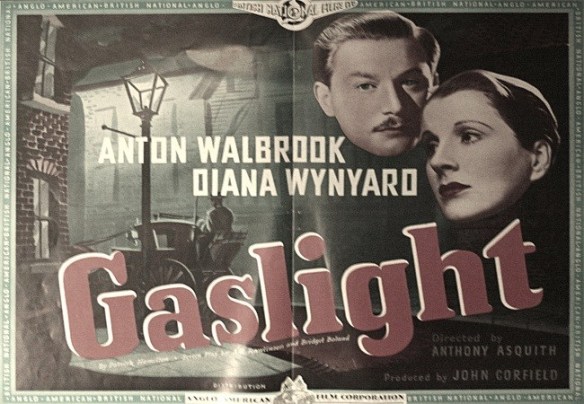
The psychological term “Gaslighting” comes from a 1944 Hollywood classic movie called Gaslight.  Gaslighting describes the abuse employed by a narcissist to instil in their victim’s mind, an extreme anxiety and confusion to the extent where they no longer have faith in their own powers of logic, reason and judgement. These gaslighting techniques were adopted by central intelligence agencies in the US and Europe as part of their psychological warfare methods, used primarily during torture or interrogation.

Gaslighting as an abuser’s modus operandi, involves, specifically, the withholding of factual information and its replacement with false or fictional information designed to confuse and disorientate. This subtle and Machiavellian process eventually undermines the mental stability of its victims reducing them to such a depth of insecurity and identity crisis that they become entirely dependent upon their abuser for their sense of reality and even identity.

Gaslighting involves a step by step psychological process to manipulate and destabilize its victim.  It is built up over time and consists of repetitive information feeds that enter the victim’s subconscious over a period of time, until it is fully registered on the subconscious “hard disk” and cannot be overridden by the conscious floppy disk.  Put more simply, it is brainwashing.

Overall, the main reason for gaslighting is to create a dynamic where the abuser has complete control over their victim so that they are so weak that they are very easy to manipulate.” ~ Alex Myles

Three Stages of Gaslighting: Stage One

The first stage depends upon trust in the integrity and unimpeachable intentions of the abuser, a state of reliance that has been engendered by the abuser’s artful self-promotion and ingratiating propaganda.  Once this trust is gained, the abuser will begin to subtly undermine it, creating situations and environments where the victim will begin to doubt their own judgement.  Eventually the victim will rely entirely upon the abuser to alleviate their uncertainty and to restore their sense of reality which is in fact that of the abuser.

Stage Two

The second stage, defence, is a process by which the abuser isolates the victim, not only from their own sense of identity but from the validation of their peers.  They are made to feel that their opinion is worthless, discredited, down-right weird.  In political circles they would be labelled a conspiracy theorist, a dissident, a terror apologist.  As a consequence, the victim will withdraw from society and cease to express themselves for fear of ridicule, judgement or punishment.

This stage can also be compared to Stockholm Syndrome where a hostage or captive is reduced,by psychological mind games, back to infantile dependency upon their captor.  Narcissistic abuse bonds the victim to the aggressor via trauma.  Stockholm Syndrome bonds the victim to the aggressor via regression to an infantile state where the abuser/aggressor becomes the “parent” who will rescue the victim from imminent annihilation.  Both methods tap into the victim’s survival mechanisms to gain and maintain control.

Stage Three

The final stage is depression.  A life under the tyrannical rule of a narcissist drives the victim into a state of extreme confusion.  They are stripped of dignity & self-reliance.  They, ultimately exist in an information vacuum which is only filled by that which the abuser deems suitable or relevant.  This can eventually invoke symptoms of PTSD [Post Traumatic Stress Disorder]. Flashbacks, constant apprehension, hyper vigilance, mind paralysis, rage and even violence.  The process is complete and the victim has been reduced to a willing accomplice in the abusers creation of a very distorted reality.

Exceptionalism or Narcissism?

We are currently seeing the transformation of US exceptionalism into an abusive Narcissism.

The gargantuan apparatus of mind bending and controlling is being put into hyper drive by the ruling elite.  We are inundated with propaganda that challenges our sense of reality but only after being “tenderized” by the fear factor.  Fear of “terror”, fear of war, fear of financial insecurity, fear of gun violence, fear of our own shadow.  Once we are suitably quaking in our boots, in comes the rendition of reality that relieves our anxiety.  If we challenge this version of events we are labelled a conspiracy theorist, a threat to security. We are hounded, discredited, slandered and ridiculed.  We are isolated and threatened.

Wars are started in the same way.  Despite the hindsight that should enable us to see it coming, the process swings into motion with resounding success. The ubiquitous dictator, the oligarch who threatens to destroy all that the US and her allies represent which of course is, freedom, equality & civil liberty all wrapped up in the Democracy shiny paper and tied with the exceptionalist ribbon.

Next the false flag to engender fear, terror and to foment sectarian strife. The support of a “legitimate” organic, indigenous “revolution” conveniently emerging in tandem with US ambitions for imposing their model of governance upon a target nation. The arming of “freedom fighters”, the securing of mercenary additions to these manufactured proxy forces.  All this is sold in the name of freedom and democracy to a public that is already in a state of anxiety and insecurity, lacking in judgement or insight into any other reality but that of their “abuser”.

The NGO Complex Deployment

Finally, the Humanitarians are deployed.  The forces for “good”, the vanguard of integrity and ethical intervention.  The power that offers all lost souls a stake-holding in the salvation of sovereign nations that have lost their way and need rescuing.  A balm for a damaged soul, to know they can leave their doubts and fears in such trustworthy hands as HRW, Amnesty International, they can assuage their deep sense of guilt at the suffering being endured by the people of far flung nations because they can depend upon the NGOs to provide absolution with minimal effort on their part.  They don’t realise that NGOs are an integral part of their abuser’s apparatus, operating on the leash of neo-colonialist financing and influence.  NGOs provide the optic through which the abuser will allow the victim to perceive their world and once absorbed into this flawed prism the victim’s own cognitive dissonance will ensure they do not attempt a jail break.

In this state of oppressed consciousness the victim accepts what they are told.  They accept that the US can sell cluster bombs to Saudi Arabia that obliterate human beings and lay waste to essential civilian infrastructure in Yemen.  They accept that the US financially, ideologically & militarily supports the illegal state of Israel and provides the arsenal of experimental weapons that maim and mutilate children and civilians on a scale that is unimaginable.  They accept that a crippling blockade of the already impoverished and starving nation of Yemen is “necessary” to resolve the issues of sectarian divisions that only exist in the minds of their Congressional abusers.

The majority of Americans accept mass murder under the pretext of the right to protect, because their ability to form rational and reasoned opinions has been engineered out of them.  This is now the definition of US exceptionalism.  It is their ability to manipulate the world into accepting their lawlessness and global hegemony agenda.  In seeking to impose its own image upon our world the US has drifted so far from its founding principles, one wonders how they will ever return to them.  They have employed a recognised form of torture to ensure capitulation to their mission of world domination which entails the mental, physical and spiritual torture of target civilian populations.

In conclusion, the US has indeed achieved exceptionalism.  The US has become an exceptional global executioner and persecutor of Humanity.  Imperialism is a euphemism for the depths of abuse the US is inflicting upon the people of this world.

Our only hope is to break the cycle of abuse with empathy for the victim and with appreciation for the years of brainwashing that precedes their agonizing passive-aggressive apathy towards crimes being committed in “their name”.

This was an email I received recently from one courageous young American girl whose epiphany is testament to the resilience and survival instinct of the human spirit.

My name is Caroline and I am a 22 year old US citizen. I only fairly recently discovered the truth about Empire/NATO’s activities in Syria and Libya and so many other countries (thanks to writers like Andre Vltchek, Cory Morningstar, Forrest Palmer). I am sickened when I remember that I signed some of those Avaaz petitions and I feel horrified at knowing that I have Syrian and Libyan blood on my hands. I want to believe that I’m not “really” guilty because I really thought (as I had been told) that I was not doing something bad at the time, but still, what I did contributed to the suffering of those people and I want to do something to atone in at least some small way, even though I probably can’t “make up” for what I did or erase my crime.

If it’s not too much trouble, could you please tell me what you think I should do, if there is anything?” 

She deserves an answer…


***

Author Vanessa Beeley is a contributor to 21WIRE, and since 2011, she has spent most of her time in the Middle East reporting on events there – as a independent researcher, writer, photographer and peace activist. She is also a member of the Steering Committee of the Syria Solidarity Movement, and a volunteer with the Global Campaign to Return to Palestine. See more of her work at her blog The Wall Will Fall.


Related Podcast:

Life-Hacks of the Poor and Aimless

horrible-life-hacks-19

On negotiating the false idols of neoliberal self-care

By Laurie Penny

Source: The Baffler

Late capitalism is like your love life: it looks a lot less bleak through an Instagram filter. The slow collapse of the social contract is the backdrop for a modern mania for clean eating, healthy living, personal productivity, and “radical self-love”—the insistence that, in spite of all evidence to the contrary, we can achieve a meaningful existence by maintaining a positive outlook, following our bliss, and doing a few hamstring stretches as the planet burns. The more frightening the economic outlook and the more floodwaters rise, the more the public conversation is turning toward individual fulfillment as if in a desperate attempt to make us feel like we still have some control over our lives.

Coca-Cola encourages us to “choose happiness.” Politicians take time out from building careers in the debris of democracy to remind us of the importance of regular exercise. Lifestyle bloggers insist to hundreds of thousands of followers that freedom looks like a white woman practicing yoga alone on a beach. One such image (on the @selflovemantras Instagram) informs us that “the deeper the self love, the richer you are.” That’s a charming sentiment, but landlords are not currently collecting rent in self-love.

Can all this positive thinking be actively harmful? Carl Cederström and André Spicer, authors of The Wellness Syndrome, certainly think so, arguing that obsessive ritualization of self-care comes at the expense of collective engagement, collapsing every social problem into a personal quest for the good life. “Wellness,” they declare, “has become an ideology.”

There is an obvious political dimension to the claim that wellbeing, with the right attitude, can be produced spontaneously. Months after being elected leader of the most right-wing government in recent British history, yogurt-featured erstwhile PR man David Cameron launched an ill-fated “happiness agenda.” The scheme may have been better received if the former prime minister were not simultaneously engaged in decimating health care, welfare, and higher education—the very social structures that make life manageable for ordinary British people. As part of Cameron’s changes to the welfare system, unemployment was rebranded as a psychological disorder. According to a study in the Medical Humanities journal, in the teeth of the longest and deepest recession in living memory, the jobless were encouraged to treat their “psychological resistance” to work by way of obligatory courses that encouraged them to adopt a jollier attitude toward their own immiseration. They were harangued with motivational text messages telling them to “smile at life” and that “success is the only option.”

This mode of coercion has been adopted by employers, too, as Cederström and Spicer note. Zero-hour-contract laborers in an Amazon warehouse, “although they are in a precarious situation . . . are required to hide these feelings and project a confident, upbeat, employable self.” All of which begs the question: Who exactly are we being well for?

The well-being ideology is a symptom of a broader political disease. The rigors of both work and worklessness, the colonization of every public space by private money, the precarity of daily living, and the growing impossibility of building any sort of community maroon each of us in our lonely struggle to survive. We are supposed to believe that we can only work to improve our lives on that same individual level. Chris Maisano concludes that while “the appeal of individualistic and therapeutic approaches to the problems of our time is not difficult to apprehend . . . it is only through the creation of solidarities that rebuild confidence in our collective capacity to change the world that their grip can be broken.”

The isolating ideology of wellness works against this sort of social change in two important ways. First, it persuades all us that if we are sick, sad, and exhausted, the problem isn’t one of economics. There is no structural imbalance, according to this view—there is only individual maladaption, requiring an individual response. The lexis of abuse and gas-lighting is appropriate here: if you are miserable or angry because your life is a constant struggle against privation or prejudice, the problem is always and only with you. Society is not mad, or messed up: you are.

Secondly, it prevents us from even considering a broader, more collective reaction to the crises of work, poverty, and injustice. That’s the logic exposed by personal productivity gurus like Mark Fritz, who tells us, in The Truth About Getting Things Done, that:

The biggest barrier to achieving the success you have defined for your life is never anyone else or the circumstances you encounter. Your biggest barrier is almost always you. . . . Dr Maxwell Maltz, author of Psycho-Cybernetics [ETA: sounds legit to me!], put it best when he said, “Within you right now is the power to do things you never dreamed possible. This power becomes available to you as soon as you can change your beliefs.

This, of course, is a cyclopean lie—but it’s a seductive one nonetheless. It would be nice to believe that all it takes to change your life is to repeat some affirmations and buy a planner, just as it was once comforting for many of us to trust that the hardships of this plane of existence would be rewarded by an eternity of bliss in heaven. There is a reason that the rituals of well-being and self-care are followed with the precision of a cult (do this and you will be saved; do this and you will be safe): It is a practice of faith. It’s worth remembering that Marx’s description of religion as the opiate of the masses is often misinterpreted—opium, at the time when Marx was writing, was not just known as an addictive drug, but as a painkiller, a solace when the work of survival became unbearable.

With the language of self-care and well-being almost entirely colonized by the political right, it is not surprising that progressives, liberals, and left-wing groups have begun to fetishize a species of abject hopelessness. Positive thinking has become deeply unfashionable. The American punk kids I know describe it, disparagingly, as “posi.” The British ones, of course, describe it as “American.” Whatever you call it, it feels a lot like giving in.

In a scintillating essay at Open Democracy, activist Chloe King writes that

changing your attitude is not going to change or help to dismantle structural injustice and a failed and unsustainable economic model which serves only the elite rich of this world, and exploits the rest of us, particularly the working class and those living in poverty. As far as I am concerned positive thinking will fucking ruin your life. “Just think positive” is a precursor to “it gets better,” and the hard reality is it is only going to get much, much worse for our most vulnerable.

There is truth here. What is also true, however, is that the young people I know who are, in general, the very worst at taking basic care of themselves as individuals—the people whose problem is not that they don’t drink enough asparagus water, but that they don’t drink enough of anything that isn’t day-old wine from a foil bag—are those who went through the student and Occupy uprisings of 2010–2012 and experienced, briefly, what it meant to live a different sort of life. What it meant to be part of a community with common goals of which mutual aid and support were not the least. What it meant to experience that sudden, brief respite from individual striving and build a prefigurative society together. The lonely work of taking basic care of yourself as you wait for the world to change is a poor substitute. When you’re washed up and burned out from putting your body on the line to fight the state, it’s especially galling to be told to share a smile and eat more whole grains.

When modernity teaches us to loathe ourselves and then sells us quick fixes for despair, we can be forgiven for balking at the cash register. Anxious millennials now seem to have a choice between desperate narcissism and crushing misery. Which is better? The question is not rhetorical. On the one hand, Instagram happiness gurus make me want to drown myself in a kale smoothie. On the other, I’m sick and tired of seeing the most brilliant people I know, the fighters and artists and mad radical thinkers whose lives’ work might actually improve the world, treat themselves and each other in ludicrously awful ways with the excuse, implicit or explicit, that any other approach to life is counterrevolutionary.

Some of the left critique of self-care as a neoliberal conspiracy has to do with dismissing the work that women and queer people do to survive. “I have heard feminism be dismissed as a form of self-indulgence,” writes Professor Sara Ahmed of Goldsmiths, University of London. So have I. I’ve heard men on the left write off anti-sexist, anti-racist politics as hopelessly individualistic, whilst also refusing to do the basic work of self-care and mutual care that keeps hope alive and health possible, because that work is women’s work, undignified in comparison to watching your life fall apart while you wait for the revolution or for some girl to pick up the pieces, whichever comes first.

The left has a special talent for counterproductive, theory-enabled wallowing. “Neoliberalism sweeps up too much when all forms of self-care become symptoms of neo-liberalism,” writes Ahmed. “When feminist, queer, and anti-racist work that involves sharing our feelings, our hurt and grief, recognizing that power gets right to the bone, is called neo-liberalism, we have to hear what is not being heard. . . . A world against you can be experienced as your body turning against you. You might be worn down, worn out, by what you are required to take in.”

It is at this point that I confess to you that I’ve been doing yoga for two years and it’s changed my life to an extent that I almost resent. I have trained myself, through dedicated practice on and off the mat, to find enough inner strength not to burst out laughing when the instructor ends the class by declaring “let the light in me honor the light in you.” The instructor is a very nice person who smiles all the time like a drunk kindergarten teacher and could probably kill me with her abs alone, so I have refrained from informing her that the light in me is sometimes a government building on fire.

Downward-facing dog is not a radical position. Nonetheless, that particular asana is among a few small concessions I make to self-care while I wait for the end of patriarchy and the destruction of the money system. Overpriced charcoal health drinks aren’t good for liberating anything except your wallet and your colon in short succession, but walks in the park are free, so I occasionally go out in the sunshine and try to soak up a bit of Vitamin D without worrying about skin cancer, melting ice-caps, and millions of people drowning in Bangladesh. I no longer subsist entirely on chicken nuggets, cigarettes, and spite. I sometimes take a day off, because it became apparent that the revolution was not being driven any faster by my being sick and sad all the time. Late Capitalism is as good an excuse of any for not getting out of bed, but huddling under the covers worrying about Donald Trump is a very inefficient way of sticking it to the man.

The problem with self-love as we currently understand it is in our view of love itself, defined, too simply and too often, as an extraordinary feeling that we respond to with hearts and flowers and fantasy, ritual consumption and affectless passion. Modernity would have us mooning after ourselves like heartsick, slightly creepy teenagers, taking selfies and telling ourselves how special and perfect we are. This is not real self-love, no more than a catcaller loves the woman whose backside he’s loudly admiring in the street.

The harder, duller work of self-care is about the everyday, impossible effort of getting up and getting through your life in a world that would prefer you cowed and compliant. A world whose abusive logic wants you to see no structural problems, but only problems with yourself, or with those more marginalized and vulnerable than you are. Real love, the kind that soothes and lasts, is not a feeling, but a verb, an action. It’s about what you do for another person over the course of days and weeks and years, the work put in to care and cathexis. That’s the kind of love we’re terribly bad at giving ourselves, especially on the left.

The broader left could learn a great deal from the queer community, which has long taken the attitude that caring for oneself and one’s friends in a world of prejudice is not an optional part of the struggle—in many ways, it is the struggle. Writer and trans icon Kate Bornstein’s rule number one is “Do whatever it takes to make your life more worth living. Just don’t be mean.” It’s more than likely that one of the reasons that the trans and queer communities continue to make such gains in culture, despite a violent backlash, is the broad recognition that self-care, mutual aid, and gentle support can be tools of resistance, too. After the Orlando massacre, LGBTQ people across the world started posting selfies under the hashtag #queerselflove. In the midst of the horror, the public mourning, and the fear, queer people of all ages and backgrounds across the world engaged in some light-hearted celebration of ourselves, of one another.

The ideology of wellbeing may be exploitative, and the tendency of the left to fetishize despair is understandable, but it is not acceptable—and if we waste energy hating ourselves, nothing’s ever going to change. If hope is too hard to manage, the least we can do is take basic care of ourselves. On my greyest days, I remind myself of the words of the poet and activist Audre Lorde, who knew a thing or two about survival in an inhuman world, and wrote that self care “is not self-indulgence—it is self-preservation, and that is an act of political warfare.”

Reality and its enemies

By Lawrence Davidson

Source: Intrepid Report

There is an ongoing reality that is destroying hundreds of thousands of lives in the Middle East. And though most Americans are ignorant of the fact, and many of those who should be in the know would deny it, the suffering flows directly from decisions taken by Washington over the last 27 years.

Some of the facts of the matter have just been presented by the first Global Conflict Medicine Congress held at the American University of Beirut (AUB) earlier this month (11–14 May 2017). It has drawn attention to two dire consequences of the war policies Americans have carried on in the region: cancer-causing munition material and drug-resistant bacteria.

Cancer-causing munition material: Materials such as tungsten and mercury are found in the casing of penetrating bombs used in the first and second Gulf wars. These have had long-term effects on survivors, especially those who have been wounded by these munitions. Iraqi-trained and Harvard-educated Dr. Omar Dewachi, a medical anthropologist at AUB fears that “the base line of cancers [appearing in those exposed to these materials] has become very aggressive. . . . When a young woman of 30, with no family history of cancer, has two different primary cancers—in the breast and in the oesophagus—you have to ask what is happening.” To this can be added that doctors are now “overwhelmed by the sheer number of [war] wounded patients in the Middle East.”

Drug-resistant bacteria: According to Glasgow-trained Professor Ghassan Abu-Sittah, head of plastic and reconstructive surgery at AUB Medical Center, drug resistance was not a problem during the Iran-Iraq War of 1980–1988. However, after the fiasco of Iraq’s invasion of Kuwait, things began to change. In the period after 1990, Iraq suffered under a vicious sanctions regime imposed by the United Nations at U.S. insistence. During the next 12 years “Iraqis were allowed to use only three antibiotics” and bacterial resistance quickly evolved.

Those resistant bacteria spread throughout the region, particularly after the American invasion of the country in 2003. Today, according to a Medecins Sans Frontieres analysis, “multidrug resistant [MDR] bacteria now accounts for most war wound infections across the Middle East, yet most medical facilities in the region do not even have the laboratory capacity to diagnose MDR, leading to significant delays and clinical mismanagement of festering wounds.”

Insofar as these developments go, it is not that there aren’t contributing factors stemming from local causes such as factual fighting. However, the major triggers for these horrors were set in motion in Washington. As far as I know, no American holding a senior official post has ever accepted any responsibility for this ongoing suffering.

Hiding reality

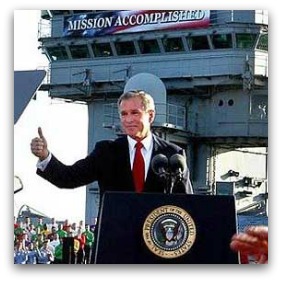
As the cancers and untreatable infections grow in number in the Middle East, there is here in the United States a distressing effort to rehabilitate George W. Bush—the American president whose decisions and policies contributed mightily to this ongoing disaster. It is this Bush who launched the unjustified 2003 invasion of Iraq and thereby—to use the words of the Arab League—“opened the gates of hell.” His rehabilitation effort began in earnest in April 2013, and coincided with the opening of his presidential library.

In an interview given at that time, Bush set the stage for his second coming with an act of self-exoneration. He said he remained “comfortable with the decision making process” that led to the invasion of Iraq—the one that saw him fudging the intelligence when it did not tell him what he wanted to hear—and so also “comfortable” with the ultimate determination to launch the invasion. “There’s no need to defend myself. I did what I did and ultimately history will judge.”

The frivolous assertion that “history will judge” is often used by people of suspect character. “History” stands for a vague future time. Its alleged inevitable coming allows the protagonist to fantasize about achieving personal glory unchallenged by present, usually significant, ethical concerns.

Those seeking George W. Bush’s rehabilitation now like to contrast him to Donald Trump. One imagines they thereby hope to present him as a “moderate” Republican. They claim that Bush was and is really a very smart and analytical fellow rather than the simpleton most of us suspect him to be. In other words, despite launching an unnecessary and subsequently catastrophic war, he was never as ignorant and dangerous as Trump. He and his supporters also depict him as a great defender of a free press, again in contrast to Donald Trump. However, when he was president, Bush described the media as an aider and abettor of the nation’s enemies. This certainly can be read as a position that parallels Trump’s description of the media as the “enemy of the American people.”

But all of this is part of a public relations campaign and speaks to the power of reputation remodeling—the creation of a facade that hides reality. In order to do this you have to “control the evidence”—in this case by ignoring it. In this endeavor George W. Bush and his boosters have the cooperation of much of the mainstream media.

No sweat here: the press has done this before. Except for the odd editorial the mainstream media also contributed to Richard Nixon’s rehabilitation back in the mid-1980s. These sorts of sleights-of-hand are only possible against the background of pervasive public ignorance.

Closed information environments

Local happenings are open to relatively close investigation. We usually have a more or less accurate understanding of the local context in which events play out, and this allows for the possibility of making a critical judgment. As we move further away, both in space and time, information becomes less reliable, if for no other reason than it comes to us through the auspices of others who may or may not know what they are talking about.

As a society, we have little or no knowledge of the context for foreign events, and thus it is easy for those reporting on them to apply filters according to any number of criteria. What we are left with is news that is customized—stories designed to fit pre-existing political or ideological biases. In this way millions upon millions of minds are restricted to closed information environments on subjects which often touch on, among other important topics, war and its consequences.

So what is likely to be more influential with the locally oriented American public: George W. Bush’s rehabilitated image reported on repeatedly in the nation’s mainstream media, or the foreign-based, horror-strewn consequences of his deeds reported upon infrequently?

This dilemma is not uniquely American, nor is it original to our time. However, its dangerous consequences are a very good argument against the ubiquitous ignorance that allows political criminals to be rehabilitated even as their crimes condemn others to continuing suffering. If reputation remodelers can do this for George W. Bush, then there is little doubt that someday it will be done for Donald Trump. Life, so full of suffering, is also full of such absurdities.


Dr. Davidson has done extensive research and published in the areas of American perceptions of the Middle East, and Islamic Fundamentalism. His two latest publications are “Islamic Fundamentalism” (Greenwood Press, 1998) and “America’s Palestine: Popular and Official Perceptions from Balfour to Israeli Statehood” (University Press of Florida, 2001). He has published thirteen articles on various aspects of American perceptions of the Middle East. Dr. Davidson holds a BA from Rutgers, an MA from Georgetown University and a Ph.D. in history from the University of Alberta.

A dystopia in real time

By Dave Lefcourt

Source: OpEdNews.com

Let’s come straight out with it, to the US government, We the People are the enemy.

If you’ve read John W. Whitehead [1] regularly you’re already aware of that.

The tell-tale sign: surveillance camera’s seemingly everywhere. On most street intersections, photo enforced streets, roads by all schools, airports, railway stations, toll roads and all commercial stores.

Then there’s the ubiquitous, “If you see something, say something” heard in Metro subway stations, airports and railway stations. It’s portrayed as a necessary given for our “safety and protection” make us fearful of would be terrorists and other bad guys out to harm us.

But really ALL meant for the authorities to keep close tabs on us everywhere. Combined with electronic surveillance of our cell phones and computers-whether on or off-and the NSA pretty much has us under its constant surveillance.

Of course it’s all against the 4th Amendments strictures against “unreasonable searches and seizures” and without “probable cause” making it all illegal. Yet most Americans apparently don’t care taking the foolish “I haven’t done anything wrong so why worry about it” mantra.

It appears the public has been so propagandized and indoctrinated, they’ve accepted these illegal surveillance intrusions into their everyday lives.

But think about it: If the public absolutely objected to their governments spying on them these illegal intrusions could be severely curtailed, limited only to court ordered warrants for specific instances of suspected criminal activities-as legally specified in the Constitution.

The reason the government has become so paranoid of the people? They know we’re the many and they’re the few and if our police and military realized they were protecting and defending the indefensible, against the Constitution they’ve sworn to uphold, against all enemies, foreign and domestic, the party would all be over.

And that necessary “revolution” returning the government to and for the people could soon be realized.

Then all our illegal wars and occupations ended, the military downsized to defend only against an imminent attack, the billions spent on unnecessary defense industry weaponry eliminated, nuclear weapons eliminated and peace in the world realized.

So our government knows its biggest enemy is its own people, not terrorists, Russia, China, Iran or North Korea.

It’s us, you and me they’re really afraid of. That’s why they take the measures they do. Why they infiltrate peaceful protests and demonstrations with agent provocateurs who initiate violence giving the authorities the pretext to interfere and shut it down. It’s how “Occupy” was shut down in 2011 with government authorities acting in coordination nationwide.

It’s why the National Guard was called out to intervene in the summer of 2014 after police shot an unarmed Michael Brown in the streets of Ferguson, MO. when citizen protests erupted.

Now protests at political conventions are cordoned off far from the convention sites fearing a repeat of the protests and demonstrations at the 1968 Democratic convention.

It’s also why the military draft was eliminated specifically to get a compliant, all volunteer army of draft age men and women who were a significant part of those 1968 protests.

All governments propagandize and indoctrinate its people. In the US it starts with standing to recite the “Pledge of Allegiance” in our schools, the standing for the “Star Spangled Banner”, saluting the flag, belief in our “supposed” free elections, extolling the military as our “heroes”, the Navy a “force for good”, military flyovers at professional athletic events, spotlighting service men and women in the stands eliciting a standing ovation, playing “America the Beautiful” during the 7th inning stretch.

It’s all part of the indoctrination process.

When this past season professional quarterback Colin Kaepernick was ostracized refusing to stand for the national anthem before an NFL game he was condemned in the MSM as un-American, ungrateful and a traitor to his country. Though what he did was not illegal and protected under the Constitution.

Standing for and singing the national anthem is voluntary and not required. But long standing tradition has made it “appear” as required behavior.

It’s hard to know whether Americans are the most propagandized people ever. We certainly are obedient and compliant people accepting illegal government intrusions and generally accepting the governments explanations (propaganda?) of all significant national and international incidents.

It’s almost certain the government knows with a population generally compliant to its strictures it can and will do anything with impunity knowing it will not be held accountable for its actions.

That’s why “official” Washington represents the most dangerous, rogue state entity in the world and seen by most people worldwide as the primary threat to peace in the world.

Yet to most Americans we’re the beacon on the hill embracing freedom and democracy.

In America “official” lies have been taken on a whole new meaning, become the natural order of things; a dystopia in real time.

[1] John W. Whitehead, “Battlefield America: The War on the American People” and “A Government of Wolves: The Emerging American Police State”

Accelerating Capital: Completed Nihilism and The Indebted Man


By S.C. Hickman

Source: Southern Nights

In his book Data Trash (1993), Arthur Kroker writes that in the field of digital acceleration, more information means less meaning, because meaning slows info circulation. In the sphere of the digital economy, the faster information circulates, the faster value is accumulated. But meaning slows down this process, as meaning needs time to be produced and to be elaborated and understood. So the acceleration of the info-flow implies the elimination of meaning.

—Franco Berardi, And: Phenomenology of the End

The pursuit of profit is the engine of Capital, accumulation is its outcome. Profit is from the Latin profectus, meaning  “advance, increase, success, progress,” out of which the need to benefit or provide income derived. This sense that progress and success drive the need for profit, that the goal of capitalism is this abstract movement toward increasing and advancing one’s success in the world has always been at the heart of the competitive spirit. To compete or strive against others for the foremost place, this sense of the competitive spirit that has been with us at least since the first Greek Olympics. The term itself “compete” is etymologically to enter or be put in rivalry with an other,” from Middle French compéter “be in rivalry with” (14c.), or directly from Late Latin competere “strive in common,” in classical Latin “to come together, agree, to be qualified,” later, “strive together,” from com “with, together” (com-) + petere “to strive, seek, fall upon, rush at, attack”.  A sense of violent taking and war against all comers for the top prize, the best or foremost place in the Sun.

As Berardi reminds us in the old industrial economy described by Marx, the goal of production was already the valorization of capital, through the extraction of surplus- -value from labour. But, in order to produce value, the capitalist was still obliged to exchange useful things, so he was obliged to produce cars and books and bread.

When the referent is cancelled, when profit is made possible by the mere circulation of money, the production of cars, books and bread become superfluous. The accumulation of abstract value is made possible through the subjection of human beings to debt, and through predation on existing resources. The destruction of the real world starts from this emancipation of valorization from the production of useful things, and from the self-replication of value in the financial field. The emancipation of value from the referent leads to the destruction of the existing world. This is exactly what is happening under the cover of the so-called financial crisis, which is not a crisis at all, but the transition to the self-referential financial capitalism. (A: 125-126)

Financial capitalism is no longer the pursuit of profit in the Greek or Latin sense I described. No longer is there a sense of the old value of the pursuit of excellence or an ill-defined sense of virtue. Rather there is no value at all in the outward sense, but rather value has itself lost its luster and only the sheer accumulation of abstract value in the form of debt remains. But what is debt? What exactly is this debt economy of financial capitalism. And, most of all, how does the spirit of capitalism in itself bring about the death of meaning (i.e., nihilism). If as many suspect we are in the moment when Capital is completing this process of nihilism, what does that entail for humanity?

As Berardi said in a recent essay,

The colonization of time has been a fundamental issue in the modern history of capitalist development: the anthropological mutation that capitalism produced in the human mind and in daily life has, above all, transformed the perception of time. But we are now leaping into the unknown—digital technologies have enabled absolute acceleration, and the short-circuiting of attention time. As info-workers are exposed to a growing mass of stimuli that cannot be dealt with according to the intensive modalities of pleasure and knowledge, acceleration leads to an impoverishment of experience. More information, less meaning. More information, less pleasure.

This sense that there is a connection between time, language, and capitalism that is playing out the endgame of nihilism in our generation is foremost in this equation. At the forefront of this is the notion of debt, and that we are entering an era of a new Guilt Culture based on an infinite and unpayable debt. A future imploding into a black hole of guilt and shame that will leave us and our planet bankrupt and without sense or value.

I’ve written of debt in other essays: here and here in which I follow Deleuze and Guattari down the rabbit hole. Alberto Toscano in an excellent essay on Maurizio Lazzarato’s book The Making of the Indebted Man talks of the indebted this way:

Artificially kept alive until they repay outstanding debts, they stalk the landscape of commodity refuse, scavenging, salvaging, recycling to shave off infinitesimal portions of their liabilities, living-dead labour both unproductive and profitable. Telescoping hi-tech financial expropriation and the lo-tech labour in the breakers yards of global capital, the indeadted embody a moment in which subjection to capitalist imperatives subsumes life to the point that it trespasses into death…2

Thanatropic capitalism feeding off the living dead, the zombies of a system that has become total predation on human life and the planet.

In Anti-Oedipus Deleuze and Guattari explain their sense of our current debt regimes:

Society is not exchangist, the socious is inscriptive: not exchanging but marking bodies, which are part of the earth. We have seen that the regime of debt is the unit of alliance, and alliance is representation itself. It is alliance that codes the flows of desire and that, by means of debt, creates for man a memory of words (paroles). It is alliance that represses the great, intense, mute filiative memory, the germinal influx as the representative of the noncoded flows of desire capable of submerging everything. It is debt that articulates the alliances with the filiations that have become extended, in order to form and to forge a system in extension (representation) based on the repression of nocturnal intensities. The alliance-debt answers to what Nietzsche described as humanity’s prehistoric labor: the use of the cruelest mnemotechnics, in naked flesh, to impose a memory of words founded on the ancient biocosmic memory. That is why it is so important to see debt as a direct consequence of the primitive inscription process, instead of making it – and the inscriptions themselves – into an indirect means of universal exchange. (p. 185)

For Deleuze and Guattari it is Nietzsche’s On the Genealogy of Morals that teaches us the truth of debt. In fact it was Nietzsche, and Nietzsche alone who provided the first hint of a theory that the “primitive socious” was inherently a “problem of inscription, of coding, of marking…” (p. 190). As they’ll state it:

Man must constitute himself through repression of the intense germinal influx, the great biocosmic memory that threatens to deluge every attempt at collectivity. But at the same time, how is a new memory to be created for man – a collective memory of the spoken word and of alliances that declines alliances with the extended filiations, that endows him with faculties of resonance and retention, of selection and detachment, and that effects this way of coding the flow of desire as a condition of the socious? The answer is simple – debt – open, mobile, and finite blocks of debt: the extraordinary composite of the spoken voice, the marked body, and the enjoying eye.” (AO: 190)

This sense that in financial capitalism is enforcing a cruel mimetic experiment of instilling and inscribing the Word of Capital upon the body socious; and, that we have reverted to the primitive tattooing systems by inscribing of the social body through the cruelest measures, imposing the harshest words of power over the flesh and blood of millions of indebted humans to suck every last ounce of desire from their zombie lives. This is the outcome of our completed nihilism. Capital as a machine of death and consumption, feeding off the desires of the indebted. If capitalism is defined by social production that passes through axioms of abstract quantities, flows of money and labor that are the real relations of alliance and filiation, rather than codes. Codes have become private matters, searches for meaning. This split between production and reproduction constitutes a very particular affective relation as well, which Deleuze and Guattari summarize as, “the age of cynicism, accompanied by a strange piety. These two affects, cynicism and piety, correspond to the division of social production and reproduction. In the first, in the axioms of capital, we have a social order that reproduces itself without meaning or code. Axioms merely set up a relation between two quantities, a flow of labor and a flow of money. One does believe in, or justify, the rate at which labor is exchanged for money—it simply is. Cynicism is an affect attuned to the indifference of the axioms that produce and reproduce social life, the recognition that the flows of the market mean nothing, have no justification, than their brute effectivity. (AO)

As Nietzsche would say,

All the stupidity and the arbitrariness of the laws, all the pain of initiations, the whole perverse apparatus of repression and education, the red-hot irons, and the atrocious procedures have only this meaning: to breed man, to mark him in his flesh, to render him capable of alliance, to form him within the debtor-credit relation, which both sides turns out to be a matter of memory – a memory straining toward the future. (On the Genealogy of Morals, p. 190)

This sense of debt binding us to a system of mnemonics and cruelty, an organized and ritualistic memory system based on marking and pain – inscription of the collective socious as a system of obligation and guilt, debt and the endless deferral of payment into the future. The ancestors require sacrifice and payment, blood and guts. Alliances against this filiation must be formed, struggles against the dead, defensive gestures: the infinite deferral of debt beyond the vampirism of the dead. This whole triangular process of voice – inscription – eye becomes in our time the “spectacle of punishment”: “as primitive justice, territorial representation has foreseen everything” (p. 191).

Even while we are punished and inscribed, ritually sacrificed to the modern Moloch and his retinue of High Priests and Financiers, the Oligarchs of the World we discover that Capital no longer needs to produce visible commodities, no longer needs to produce useful goods for its wage slaves, it can now bypass us, bypass our needs, our desires, our dreams for its own infinite and digital accelerated world of pure circulation and profit. As Berardi attests,

In the sphere of the financial economy, the acceleration of financial circulation and valorization imply the elimination of the concrete usefulness of products (no matter if material or immaterial, industrial or semiotic). The process of realization of capital, namely the exchange of goods with money, was obviously slowing the pace of monetary accumulation. The virtual technology has created the possibility of skipping this slow passage through concrete meaningful useful goods. (A: 126)

Invisible, immaterial, the new financial economy runs at the speed of light in an absolute timeworld, where profit is based on the virtual circulation of abstract value (not even money, but algorithms, electronic impulses) that has been accelerated and sped up to the point of totally escaping the possibility of human understanding and— obviously—of political control.(A: 126)

Value does not emerge from a physical relationship between work and things, but rather from infinite self-replication of virtual exchanges of nothing with nothing, whose outcome is more money. Digital abstraction leads to the virtualization of the physical act of meeting, and the manipulation of things. These new levels of abstraction do not only concern the labour process, they tend to encompass every space of social life. Therefore, digitalization and financialization are transforming the very fabric of the social body, and inducing mutations in it. (A: 127)

Berardi tells us to look at the reality of debt, look at the awful effects of submission, impoverishment and exploitation that debt is provoking in the body of society. Debt is a weapon against social autonomy, a transformation of money into a blackmail. Young people are obliged to borrow money from the bank in order to pay for their studies, as the public system of education has been destroyed by the Neoliberal fanatics, and private school is costing more and more. As soon as they come out from the university they have to start paying back their debt, and they are obliged to accept any kind of precarious job, and to suffer any kind of blackmail. (A: 128)

For such creatures the future can only be bleak and full of misery and endless years of untold grief as they strive to pay their debt. Many forgo such a Sisyphean project and commit suicide. Others mentally and spiritual die inside and live out the remainder of their lives as zombies under this terrible debt system. In our time whole nations have been blackmailed into this system of debt as we ponder the EU. This same process has already happened to much of the Third World nations for years under a predatory capitalism well documented by Naomi Kline in The Shock Doctrine among other works of like caliber.

Commenting on this dark scenario Berardi says “Money, which was supposed to be the measure of value, has been turned into a tool for psychic and social subjugation. The metaphysical debt is linking money, language and guilt. Debt is guilt, and as guilt it is entering the domain of unconscious, and shapes language according to structures of power and submission.” (A: 128)

The notion that our age old systems of power and coercion have migrated into the digital age and brought about a new guilt culture to subdue and channel the desires of nations into the profit bins of a minority of Oligarchs seems ludicrous at first glance as if this were some nefarious planned and intentional affair. But is it? Is anyone or anything behind such a sinister system of slavery and control? Is this a conspiracy of madness against the human species? Berardi will liken this process not to some power behind the scenes, but rather to the inherent power of language itself and how we for two hundred years have obliterated the hold language had on the referent:

This process of de-referentialization of language—emancipation of the linguistic sign from the referent—which has been the mark of poetic and artistic experimentation with language during the twentieth century, shows an interesting similarity with the transformation in the relation between economy and monetary exchange.

On August 15, 1971, President Nixon announced dramatic changes in economic policy. Particularly he ended the Bretton Woods international monetary system. The Bretton Woods system, created at the end of World War II, involved fixed exchange rates with the US dollar as the key currency—but also a role for gold linked to the dollar at $35/ounce. The system began to falter in the ‘60s because of an excess of dollars flowing out of the US which foreign central banks had to absorb. All of this was ended unilaterally by Nixon’s decision. After a brief attempt to create a modified fixed exchange rate system, the world moved to flexible rates.

Breaking the Bretton Woods’s agreements, the American President declared that the dollar has no referent, and its value is decided by an act of language. This was the starting point of the long lasting process of financialization of the economy, based on the emancipation of the financial dynamic from any conventional standard and from any economic reality. The Neoliberal offensive started in that very moment of arbitrary assertion of the value of the dollar outside the conventional standard. The neoliberal school of the Chicago Boys said “money is creating reality” like the Symbolist poets had said: “words are creating reality”. (A: 128-130)

Words had lost touch with their referent, the natural world and environment within which we all live and have our habitus. The disappearance of the natural and the virtualization of language produced the effects we see in the world today. We are the product of a process that undermined the ancient metaphysical systems of the world that guided primitive, feudal and early modern societies. In our bid to overcome the religious and metaphysical systems that held us in their clutches we also lost the world, our world. We lost the natural in life and ourselves, lost touch with the signs that kept us anchored to the natural environment that our brain had been tied to for sex and survival from the beginnings of the human. We ourselves in our bid to transcend the animal and inhuman in ourselves became non-human. We have brought upon ourselves the semantic apocalypse we see all around us. This is the guilt we bare and the debt we will have to pay, not the tributary debt to those few dark controllers who seek to lord it over us.

It was Jean Baudrillard who wrote in the Symbolic Exchange and Death, where he announces that the economy has abandoned the old law of determination of value, and that the referent for linguistic and economic exchange was dissolved:

“The reality principle coincided with a determinate phase of the law of value. Today the entire system is fluctuating in indeterminacy, all of reality absorbed by the hyperreality of the code and of simulation. It is now a principle of simulation, and not of reality, that regulates social life. The finalities have disappeared; we are now engendered by models… The entire strategy of the system lies in this hyperreality of floating values. It is the same for money and theory as for the unconscious. Value rules according to an ungraspable order: the generation of models, the indefinite chaining of simulation.” (Baudrillard 1976)

We have become mere simulacra of our former selves, simulated creatures in a simulated world. Bound and ensnared in a world of debt, controlled by an algorithmic system of digital hypersystems we live out our lives under the guilt of a system we ourselves helped create. We have no one to blame but ourselves. We know this. We deny this. We seek solace in escape and fantasy worlds of mediatainment that even further suck dry our desires and channel our hopes and dreams into a fantasia of tomorrows that will never come.

For Deleuze & Guattari this primitive system of memory and pain will enter the stage of religion as a debt to be paid ending in the death of Christ as the payer of all debts; and, yet, it will not end there, for debt can never be repaid, so it forms the kernel of the modern State: “the new machine, and the new apparatus of repression” (AO: 192). This system of endless debt: “that finds itself taken into an immense machinery that renders the debt infinite and no longer forms anything but one and the same crushing fate: the aim now is to preclude pessimistically, once and for all, the prospect of discharge; the aim now is to make the glance recoil disconsolately from an iron impossibility. The Earth becomes a madhouse.” (AO: 192)


  1. Berardi, Franco “Bifo”. And: Phenomenology of the End. Semiotext(e) (November 6, 2015) (A) (Page 126).
  2. Toscano, Alberto. Alien Mediations: Critical Remarks on The Making of the Indebted Man. The New Reader #1, 2017