What Do You (Think You) Really Know?

On the need for maintaining a curious spirit.

By Tom Bunzel

Source: The Pulse

“When in doubt observe and ask questions.  When certain, observe at length and ask many more questions.”  — George Patton

Once again, I thought I would follow up on Joe Martino’s recent discussion of huge gaps and worse in many peoples’ understanding.  This is such an important point first made by Socrates: You don’t know what you don’t know.

Joe mentioned the Dunning-Kruger effect in which people with relatively little knowledge will overestimate what they in fact know.  Joe’s piece used the example of brand influencers who tend to become very sure of their pronouncements because, of course, they had a vested interest in it.  

This speaks to the conditioning that takes place in corporate environments, similar to how an individual accumulates a self or Ego.

One thing that happens with people who are sure of themselves is that they frequently break off mentally and become separate from any sense of Wholeness (to defend their position).  This crystallizes the ego which then, with many insecure people, and hardens with each challenge – something we can see in our current politics.

It’s also obvious that whatever we think we know is generally another thought.  The exception is if it is a bodily sensation or emotion which is purely felt, without interpretation.

Unfortunately, most people are also heavily invested in feeling good – or avoiding any discomfort – and the discipline of sensing emotions in the body and allowing them to be experienced without judgement is quite foreign.  I say it’s unfortunate because in my recent experience, it is the one way to begin to heal trauma stored in the body.

And speaking of the body, this is where we can surely go even a step further.

We Don’t Know What We Don’t Know that We Don’t Know

Things get even more complicated when you focus on the real mystery.  The vastness of the gaps is staggering.

An example of this is qualia – defined as “the internal and subjective component of sense perceptions, arising from stimulation of the senses by phenomena.”

What this really comes down to is our Experience, which is somehow created out of our Awareness of whatever is happening.  But qualia for humans is more subtle and indefinable – scientists have been unable to explain, for example, why some wine tastes dry and another fruity.

How does the subjective part – the judgment – come into (our?) awareness.

Neuroscience now can identify and label the various components of the experience in terms of physics and biochemistry, but they cannot explain how “we” experience things like awe, gratitude and so on.

And for the sense of “someone” experiencing any phenomena they can only give it another label:  Consciousness.  

When trying to define “ourselves” or the experience of being, our language has proven so inadequate (partly due to the subject/object grammatical bias of English and most modern languages) that to the extent any speculations or theories are wrong – we probably don’t even have the capability to comprehend what makes them so incomplete.

Attempts to pin the experience of the self down scientifically have fallen short, as I described in “AI and the Hard Problem of Consciousness”.

Where is the Ground of Our Experience?

This conundrum exists because science deals with facts and certainty and our experience actually seems to arise in a space other than that which science can adequately define.

But still, we are deeply conditioned to believe that our experiences and thoughts about what has, may or is happening comprise a separate self or identity, that is often surmised to exist in the brain.

But recent neurological advances have failed to locate any physical or even biochemical basis for a separate self.

If we return once again to the body, we can also see that all of our senses, and even thoughts, can be reduced to a biochemical reaction.  We can now view it as information passing from the receptor to the brain, gut or heart.

Since this information is based on very specific individual parameters, the results are almost by definition finite and fallible.  What we experience is by no means a universally known phenomenon. We generally experience what we’ve been conditioned to experience, which separates us from other humans, and for that matter from all other life forms.

Birds can see better than we can, whales, dolphins and bats live on sound and most animals can hear things humans can’t.  If you have a cat you know that its world is nothing like yours.

And now, even when humans have invented incredible instruments to augment our senses and allow a glimpse even into vast apparent distances away from our planet out into the cosmos, we are confronted more and more with phenomena that we cannot explain.

(I wrote “apparent distances” because our view of “outer” space is always, inevitably a subjective experience that seems to create an image within “us” – presumably within our brains from a signal through the optic nerve.  I often suspect that even the way we perceive “outer space” is a function of our limited sensory and intellectual capacities).

The irony is that it is Science that now points most effectively to what we don’t even know that we don’t know, and yet it is the same science that is the cause of so much human hubris and delusion.

Before Quantum Mechanics was discovered and Einstein’s theories verified we didn’t know that we had no clue about matter and energy.  Because a lot in the quantum world doesn’t make “sense” there are presumably more vast areas where we can’t even comprehend our own ignorance.

I dealt with some of these issues when I wrote about Robert Lanza’s theory of Biocentrism.  Science seems to be dragged kicking and screaming into a new paradigm where the self we believe in doesn’t really exist – and what WE ARE (not what we have or do) is aligned intimately with Nature, or our environment, or whatever label one might want to use in what is really an infinitely sacred Mystery.

The Limitations of Current Scientific Labels

Another example would be biology where for centuries all life was thought of as either animal or plant.  Then they found microbes, and eventually viral agents and the line between life and the “objective” world blurred.

Returning our attention to qualia, and consciousness, again these personal “events” are defined as subjective experiences.

Science can’t really explain subjectivity.  As previously noted, that may well be because explanations involve a subject and an object (as conditioned by our language and grammar) but what if everything is just an arising in Consciousness (subjectivity)?

If we take the concept of “Wholeness” literally – there cannot in fact be anyone outside of the whole to have a subjective experience.

This is the essence of “Nonduality” – a modern popular philosophical movement.

Our interpreted experience is comprised of thoughts, words and feelings.  But where do these occur?

The body and the brain are the short answers, the ones the DKE people would grab hold on, but upon deeper examination “your” experience of your hands, for example, takes place visually and tactilely; you can both see your hands and feel them.  But how is that happening and by whom?

But what makes them “yours”?  What is it that differentiates “you” from everything else you see or feel?

If you think about it, a separate “identity” was not originally within awareness when your body was first born.  It started when someone told you ‘your’ name.

And ever since the narrative of a separate person, made up mainly of thoughts and memories has accumulated more knowledge based on that one erroneous assumption of separation, culminating in an illusory experience of “you.”

How do we make the bulk of humanity aware of this delusion?   I wonder if it is not central to the issue of what we now may become “Disclosure” where our psychological world seems poised to explode in ways we cannot know that we do not know.  And as the 70’s comedy team called Firesign Theater once said:  “Everything you know is wrong.”

I would think that under the circumstances the most appropriate position to take in many instances is what Eckhart Tolle recommends – deep acceptance of not knowing.

Moreover, in the face of such overwhelming evidence of our ignorance, we might be better advised to ask very deep questions – and as Joe Martino has also mentioned, allowing silent sensing to bring us a response (perhaps not even answer) that could even bring up physical emotions or sensations, but no actual conclusion.

I tried to use that technique in the book I wrote recently “Conversations with Nobody” written with AI, about AI and giving a taste of AI.

Because the format of the book was an apparent “conversation” with a nonhuman intelligence the questions I posed (or prompts) were actually the only creative element in the book – and were designed to either take the AI’s response and follow up with more depth, or pose a question that had some nuance and would make the reader think about an issue like the one in this article.

Of course the potential promise of AI is to provide impersonal and presumably more factual information than a mere human; but so far that promise is unfulfilled.

The AI generally gave answers perfectly in line with the most obvious human biases – not surprising in that its “answers” were simply guesses as to next appropriate word in the response, based on its programming as a “language” model.  No actual human thought was involved in the response.

But the openness of the question may evoke an appropriate feeling in one who considers it silently.  It may even take one beyond one’s mind.  Questions to ponder and go beyond the conditioned limitations of Dunning-Kruger:

What do we really know? 

Who (or what) are we?

What is our relationship to reality – what was here before we got here and thought about it?

Neocons and Other Malignancies in the American Body Politic

They will never give up until we’re all dead

By Philip Giraldi

Source: The Unz Review

It is interesting to observe how, over the past twenty-five years, the United States has become not only a participant in wars in various places on the planet but has also evolved into being the prime initiator of most of the armed conflict. Going back to the Balkans in the nineteen-nineties and moving forward in Afghanistan, Iraq, Libya, Syria, Lebanon and Somalia there is almost always an American leading role where there is bombing and killing. And where there is no actual war, there are threats and sanctions intended to make other nations come to heel, be they in Latin America like Venezuela, or Iran in the Middle East, or North Korea in Asia. And then there is the completely senseless act of turning major competitors like Russia and China, as we are now seeing, into enemies, with a proxy war raging in Ukraine, threats over Taiwan, and the world moving one step closer to a nuclear disaster.

It seems to me that the transition from an America bumbling its way into war and the current situation where wars are pursued as a matter of course coincides with a certain political development in the United States, which is the rise of neoconservatives as the foreign and national security policy makers in both major parties. This has developed together with the evolution of the view that the United States can do no wrong by definition, indeed, that it has a unique and God-given right to establish and police the globe through something that it invented, exploits and has dubbed the “rules based international order.”

Who would have thought that a bunch of Jewish student-activists, mostly leftists, originally conspiring in a corner of the cafeteria in the City College of New York would create a cult type following that now aspires to rule the world? The neocons became politically most active in the 1960s and eventually some of them attached themselves to the Republican Party under Ronald Reagan, declaring their evolution had come about because they were “liberals mugged by reality.” The neoconservative label was first used to describe their political philosophy in 1973. Since that time, they have diversified and succeeded in selling their view to a bipartisan audience that the US should embrace an aggressive interventionist foreign policy and must be the world hegemon. To be sure their desire for overwhelming military power has been strongly shaped by their tribal cohesion which has fed a compulsion to have Washington serve as the eternal protector of Israel, but the hegemonistic approach has inevitably led to expanding conflict all over the world and a willingness to challenge, confront and defeat other existing great powers. Hence the support for a needless and pointless war in Ukraine to “weaken Russia” and a growing conflict with China over Taiwan to do the same in Asia. To make sure that the Republicans do not waver on that mission, leading neocon Bill Kristol has recently raised $2 million to do some heavy lobbying to make sure that they stay on track to confront the Kremlin in Europe.

One of the leading neocon families is the Kagans, who have successfully penetrated and come to dominate the establishment foreign policy centers in both the Republican and Democratic Parties. Victoria Nuland nee Nudelman, the wife of Robert Kagan, is entrenched at the State Department where she is now the Deputy Secretary, the number two position. Up until recently, she was one of the top three officials at State, all of whom were and are Jewish Zionists. Indeed, under Joe Biden Zionist Jews dominate the national security structure, to include the top level of the State Department, the head of Homeland Security, the Attorney General, the National Security Adviser, the Director of National Intelligence, the President’s Chief of Staff, and the Deputy Director of the Central Intelligence Agency. Nuland’s hawkish appeal is apparently bipartisan as she has served in senior positions under Bill Clinton, Dick Cheney, George W. Bush, Barack Obama and now Joe Biden. As adviser to Cheney, she was a leading advocate of war with Iraq, working with other Jewish neocons Doug Feith and Paul Wolfowitz at Defense and also Scooter Libby in the Vice President’s office. As there was no actual threat to the US from Saddam Hussein she and her colleagues invented one, the WMD that they sold to the media and to idiots like Secretary of State Condoleezza Rice. Nuland is also considered to be close to Hillary Clinton and the recently deceased ghastly former Secretary of State Madeleine Albright. All of her government assignments have included either invading or severely sanctioning some country considered by her and her colleagues to be unfriendly. She particularly hates the Russians and anyone who is hostile to Israel.

Apparently, Nuland’s record of being seriously wrong in the policies she promoted has only served to improve her resume in Washington’s hawkish foreign policy establishment and when Biden came into the presidency she found herself appointed to the number three position at the State Department as the Under Secretary of State for Political Affairs. Her return to power with the Democrats might also be due in part to the activism of her husband Robert, currently a senior fellow at the Brookings Institute, who was one of the first neocons to get on the NeverTrump band wagon back in 2016 when he endorsed Hillary Clinton for president and spoke at a Washington fundraiser for her, complaining about the “isolationist” tendency in the Republican Party exemplified by Trump. Robert famously has never seen a war he disapproved of and, while urging Europe to do more defense spending, commented that “When it comes to use of military force “Americans are from Mars, and Europeans are from Venus.” Robert’s brother Frederick, a Senior Fellow at the neocon American Enterprise Institute, and Frederick’s wife Kimberly, who heads the bizarrely named Institute for the Study of War, are also regarded as neocon royalty.

Nuland is particularly well known for her being the driving force behind the regime change in Ukraine in 2014 that replaced the fairly-elected but friendly-to-Russia President Viktor Yanukovych with a selected candidate more accommodating to the US and Western Europe. Ukraine, the most corrupt country in Europe, has been unstable ever since and the current war, also initiated by interference from the US and UK, has brought about the deaths and wounding of an estimated half million Ukrainians and Russians.

Nuland was recently in Africa, stirring up developments in Niger, which has experienced a recent military coup that removed a president who was corrupt but also a friend of the US and France, both of which have troops stationed in the country. As I write this, a number of African nations (ECOWAS) friendly to US and French interests in the region are gathering together their own military force to reverse the coup, but there is little enthusiasm for the project. We will see how that turns out, but predictably Nuland is advertising a possible intervention as a “restoration of democracy.”

And there is more over the horizon with neocons like Secretary of State Antony Blinken and Nuland in charge of US foreign policy and supported by most of congress and a Jewish dominated media and entertainment industry. Joe Biden is too weak and too much under the thumb of the Israel Lobby to pursue any policies that would be beneficial to the American people in general, so the course will be set by the current crop of zealots, just as Donald Trump was guided by his Christian Zionist advisers.

If you want to understand just how what remains of our republic is in a bus being driven over the cliff by a group that has no regard for most of the citizens of the country that they reside in, one only has to read some of what passes for neocon analysis of what must be done to make America “safe.” Not surprisingly, it also involves Israel and a war on behalf of the Jewish state.

One astonishingly audacious article that appeared on August 13th in The Hill entitled “If Israel strikes Iran over its nuclear program, the US must have its back,” gives Israel the option of starting a war for any or no reason with the United States compelled to join in in support. It was written Michael Makovsky, a well-known Jewish neocon, and Chuck Wald. Makovsky is President and CEO of the Jewish Institute for National Security of America (JINSA) while Wald is a former general who also is affiliated with that group as a “distinguished fellow,” which means he is getting paid generously to serve as a mouthpiece providing credibility for the group. For those unfamiliar with The Hill, it is an inside the beltway defense contractor funded online magazine that pretends to be serious but which is actually an integral part of the status quo Zionist and war-on-demand network. That the Jewish Institute for National Security is “of America” is, of course, a characteristically clever euphemism.

The article begins with “The Biden administration should learn from its unpreparedness for the Russia-Ukraine war and begin to prepare for a major Israel-Iran conflict. The administration needs to set aside its differences with the Israeli government, overcome its aversion to conflict with Iran, and begin to work closely with Jerusalem to prepare for the growing likelihood that Israel will feel it has no choice but to initiate a military campaign against Iran’s nuclear program. In ‘No Daylight,’ a new report from the Jewish Institute for National Security of America (JINSA)…retired senior military officers and national security experts explain that whatever differences the US might now have with Israel over Iran policy, our two countries’ interests will be aligned after an Israeli strike. Consequently, in preparing its response, the U.S. guiding principle should be ‘no daylight with Israel,’ to ensure Israeli military success, mitigate Iranian retaliation and limit the scope of the conflict — vital interests for both countries.”

That war with Iran is a “vital interest” for the United States is, of course, not really explained as the point is to let Israel to decide on the issue of war and peace for the United States. The article then trots out the old “credibility” argument, i.e. that if we don’t go to war no one will ever trust our security guarantees: “A US betrayal of its close Israeli ally, at a time of great peril for the Jewish state, would be ‘one of the greatest catastrophes ever,’ an Arab leader told us privately recently. Because Israel is widely perceived as a close American ally, the US stance as Israel risks thousands of casualties in defense of its very existence, will resound broadly. Strong American support will reassure allies from Warsaw to Abu Dhabi and Taipei; American equivocation will shred Washington’s credibility and embolden adversaries from Tehran to Moscow and Beijing.”

One would love to know who the anonymous Arab leader so concerned about Israel is and, of course, the Jewish state is not in fact an American ally apart from in the fertile imaginations of congressmen, the media and the White House. And Israel will, of course, need more weapons and money from the US taxpayer to include “expediting delivery to Israel of KC-46A tankers, precision-guided munitions, F-15 and F-35 aircraft, and air and missile defenses…. Washington should accelerate building integrated regional air, missile and maritime defenses against persistent Iranian threats.” And America must be prepared to expand the war: “Privately, Iranian and Hezbollah leadership should be warned that heavy retaliation against Israel…will prompt severe Israeli and/or American responses that could threaten their very grasp on power. Upon commencement of an Israeli strike, the United States should promptly resupply Israel with Iron Dome interceptors, precision-guided munitions, ammunition and spare parts, and deploy Patriot air defenses to Israel…”

So the United States must be prepared to turn over its national security to Israel in exchange for what gain for Americans? In part it would apparently involve “finding a permanent solution to Iran’s illegal nuclear weapons program” which is based on a lie even if Prime Minister Benjamin Netanyahu has been repeating for over 20 years that Iran is only six months away from a weapon. Both the CIA and Mossad have confirmed that Iran has no such program while Israel does have a secret illegal nuclear arsenal built using enriched uranium and nuclear triggers stolen from the US. The article concludes with another reference to the non-existing program, claiming “the most effective way to address Iran’s nuclear program already has been articulated by President Biden and communicated by America’s ambassador in Jerusalem: ‘Israel can and should do whatever they need to deal with it, and we’ve got their back.’”

Supporting Israeli war crimes is not the way to go. As Chris Hedges puts it correctly, there is no compelling American interest in damaging itself by supporting Israel blindly, quite the contrary: “The long nightmare of oppression of Palestinians is not a tangential issue. It is a black and white issue of a settler-colonial state imposing a military occupation, horrific violence and apartheidbacked by billions of US dollars, on the indigenous population of Palestine. It is the all powerful against the all powerless. Israel uses its modern weaponry against a captive population that has no army, no navy, no air force, no mechanized military units, no command and control and no heavy artillery, while pretending intermittent acts of wholesale slaughter are wars.”

And, of course, while Israel engages in slaughter and torture it always portrays itself as the victim only engaged in fighting against “terrorists.” I have a better idea for where we should go with all of this. President Joe Biden should be impeached for ignoring war powers legislation and indicating that he is willing to sacrifice US interests and kill American soldiers, few or plausibly none of whom will actually be Jewish since it is not an occupation that attracts them, to please and support a manifestly evil foreign government. And Donald Trump should also be punished for having done much the same type of pandering to a foreign country while in office. Meanwhile, haul Makovsky and Wald together with their buddies at the American-Israel Public Affairs Committee (AIPAC) and the Anti-Defamation League (ADL) down to the Justice Department and put them in jail for violation of the Foreign Agents Registration Act of 1938 (FARA) in that they are willfully acting as agents of a foreign government and are operating corruptly to serve the interests of that government. The criminals at AIPAC are already using their associated PACs to oust targeted members of Congress up for re-election in 2024 who have in any way been critical of Israel or pro-Palestinian. And while you’re at it Mr. Attorney General Merrick Garland nee Garfinkel, please have Mr. Blinken and Ms. Nuland pop by for a chat just for starters and see how far you can make the laws apply to those in power. There is some confusion evident here as Israel is not part of the United States, no matter how politically dominant and wealthy its lobby might be. Time to put an end to this nonsense and call it out for what it is – it is treason.

Disinformation, 1984-2023

By Peter Van Buren

Source: We Meant Well

Orwell, again. 1984 was prescient on so many concepts that it seems it was written for the Biden era. Underlying it all is the concept of disinformation, the root of propaganda and mind control. So it is in 2023. Just ask FBI Director Chris Wray. Or Facebook.

George Orwell’s novel explores the concept of disinformation and its role in controlling and manipulating society. Orwell presents a dystopian future where a totalitarian regime, led by the Party and its figurehead Big Brother, exerts complete control over its citizens’ lives, including their thinking. The Party employs a variety of techniques to disseminate disinformation and maintain its power. One of the most prominent examples is the concept of “Newspeak,” a language designed to restrict and manipulate thought by reducing the range of expressible ideas. Newspeak aims to replace words and concepts that could challenge or criticize the Party’s ideology, effectively controlling the way people think and communicate (unhomed, misspoke, LGBQTIAXYZ+, nati0nalist, terrorist.)

Orwell also introduces the concept of doublethink, which refers to the ability to hold two contradictory beliefs simultaneously and accept them both as true. This psychological manipulation technique allows the Party to control the minds of its citizens and make them believe in false information or embrace contradictory ideas without questioning (masks which do not prevent disease transmission are still mandatory.) The Party in 1984 alters historical records and disseminates false information through the Ministry of Truth. This manipulation of historical events and facts aims to control the collective memory of the society in a post-truth era, ensuring that the Party’s version of reality remains unquestioned (war in Ukraine, Iraq, El Salvador, Vietnam, all to protect our freedom at home.)

Through these portrayals, Orwell highlights the dangers of disinformation and its potential to distort truth, manipulate public opinion, and maintain oppressive systems of power. The novel serves as a warning about the importance of critical thinking, independent thought, and the preservation of objective truth in the face of disinformation and propaganda.

Disinformation is bad. But replacing disinformation with censorship and/or replacement with other disinformation is worse. 1984 closed down the marketplace of ideas. So for 2023.

In 2023 America the medium is social media and the Ministry of Truth is the Executive Branch, primarily the FBI. Topics the FBI at one point labeled disinformation and sought to censor in the name of protecting Americans from disinformation include but are not limited to the contents of Hunter Biden’s laptop, the Covid lab leak theory, the efficiency and value to society of masks, lockdowns, and vaccines, speech about election integrity and the 2020 presidential election, the security of voting by mail, even parody accounts mocking the president (about Finnegan Biden, Hunter Biden’s daughter.)

When asked before Congress to define disinformation, FBI Director Christopher Wray could not do it, even though it is the basis for the FBI’s campaign to censor Americans. It’s a made up term with no fixed meaning. That gives it its power, like “terrorism” was used a decade or so earlier. Remember “domestic terrorism”? That stretched to cover everything from white power advocates to J6 marchers to BLM protestors to Moms for Liberty. It just can’t be all those things all the time but it can be all those things at different times, as needed. The term “hate speech” is another flexible tool of enforcement and is why efforts to codify banning hate speech under the First Amendment must be resisted so strongly. Same for QAnon. We’ve heard about QAnon for years now but still can’t figure out if it even exists. To read the MSM, you would think it is the most powerful and sinister thing one can imagine yet seems to be imaginary, another Cthulhu. Do they have an office, an email address, a lair somewhere?

In simple words: the government is using social media companies as proxies to censor the contrary thoughts of Americans, all under the guise of correcting misinformation and in direct contrivance of the First Amendment.

How bad does it get? As part of its 2023 investigation into the federal government’s role in censoring lawful speech on social media platforms, the House Committee on the Judiciary issued a subpoena to Meta, the parent company of Facebook and Instagram, and Alphabet, the parent of Google and YouTube. Documents obtained revealed the FBI, on behalf of a compromised Ukrainian intelligence service, requested and, in some cases, directed, the world’s largest social media platforms to censor Americans engaging in constitutionally protected speech online about the war in Ukraine.

Another tool of thought control is the Foreign Intelligence Surveillance Act (FISA), which was supposed to be used to spy on foreigners but has been improperly used against thousands of Americans. Over 100,000 Americans were spied on in 2022, down from three million in 2021.

Does it sound familiar? An amorphous threat is pounded into the heads of Americans (Communism and Red Scares, Covid, terrorism, disinformation) and in its name nearly anything is justified, including in the most recent battle for freedom, censorship. The wrapper is that it is all for our own protection (Biden himself accused social-media companies of “killing people,” the more modern version of the terrorism-era’s “blood on their hands”) with the government assuming the role of knowing what is right and correct for Americans to know. The target in name is always some Ruskie-type foreigner, but in reality morphs to be censorship of our citizens ourselves (stained as “pro-Putin.”) Yet Meta CEO Mark Zuckerberg admitted the government asked Facebook to suppress true information. He said during the Covid era the scientific establishment within the government asked “for a bunch of things to be censored that, in retrospect, ended up being more debatable or true.”

Under President Joe Biden, the government has undertaken “the most massive attack against free speech in United States history.” That was the extraordinary conclusion reached by a federal judge in Missouri v. Biden. The case exposed the incredible lengths to which the Biden White House and its federal agencies have gone to bully social-media platforms into removing political views they dislike. The White House is appealing and attained a stay, hoping to retain this powerful tool of thought control right out of 1984. A victory for censorship of Americans and their thoughts could be the greatest threat to free speech in American history.

Once again, the FDA admits it lied to us. And once more, we yawn

By Jonathan Cook

Source: Jonathan Cook Blog

On critical matters, our medical authorities have no interest in settling the science. Instead, battles are won in the arena of smear and insinuation

The reality is that most of us are not ready for the truth. We want reassurance. We cling to our comfort blankets because the idea that we live in a world in which our and our families’ interests are not paramount is too disturbing.

The idea that our fates are entirely dependent on a giant Ponzi scheme that might come crashing down at any moment from any one of multiple design flaws – an ecological crisis, a nuclear catastrophe, a pandemic or a hubristic mis-step with Artificial Intelligence – is simply too terrifying.

So, even as we mock a figurehead like Donald Trump, Joe Biden or Boris Johnson, we remain deeply invested in the system that keeps producing them. We need to believe – and just as desperately as a child refusing, a little longer, to give in to suspicions that Father Christmas might not exist. Despite all the evidence to the contrary, our societies, we insist, are on a continuous upwards trajectory named progress.

Few are willing to consider that we might actually be in a death spiral. So instead of doing something to change the world, we bury our heads. We ignore every sign, however blatant, of the system’s inherent dysfunction and corruption.

Horse dewormer

These dark thoughts are prompted in part by the very belated concession from the Food and Drug Administration (FDA) – whispered by government lawyers in a court hearing – that for two years it has been peddling disinformation about both Ivermectin and the fact that doctors were not authorised to prescribe it in the treatment of Covid.

Ok, let’s pause right there. Because already I sense you reaching for the remote to change channels. Isn’t Ivermectin a horse drug that only anti-vaxxers and Covid deniers ever talk about?

Before I lose you entirely, let me hurriedly issue a disclaimer. This piece isn’t really about Ivermectin – least of all its efficacy in the treatment of Covid. I’m not a doctor and I’m not qualified to judge. I talk about things I am familiar with, that I have some insight on.

I’m not interested in medical debates about Ivermectin. I’m interested in deconstructing the political debates around it – and what they tell us about the way medical matters, and much else besides, have been entirely captured by political and commercial interests.

I can assure you I have no shares in Ivermectin and won’t profit either way, whether its use increases or declines. Unlike Big Pharma, that’s not the reason I’m taking an interest.

It just so happens that Ivermectin is a particularly fascinating case study – both of the corruption of our governance and regulatory systems, and of our own unwillingness to recognise that corruption out of fear of what it might signify.

Ivermectin provides one more data point that might help drag each of us out of our carefully constructed cocoon of ideological comfort. It might make us a little angrier, a little more willing to fight for our species’ survival.

‘Merely quips’

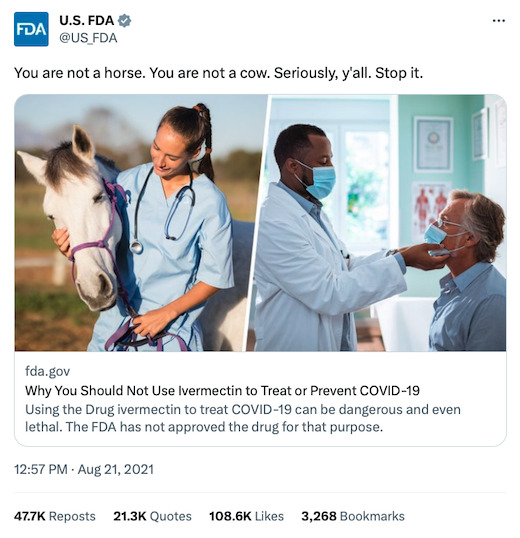
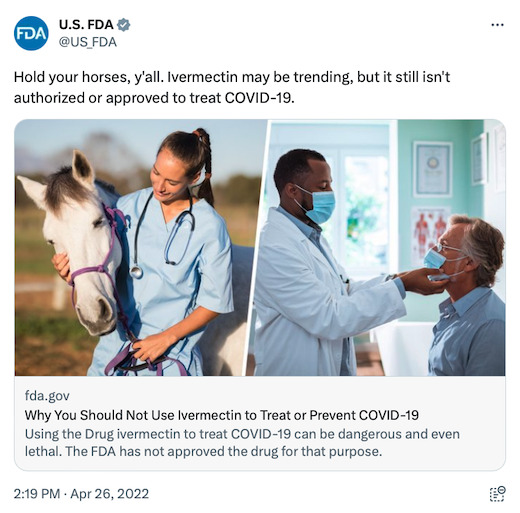
After all, the general assumption that Ivermectin is a horse dewormer didn’t come from nowhere. It was a view cultivated in us by the FDA and the corporate media. Here is the tweet the agency sent out exactly two years ago to persuade us that only dangerous nutjobs talk about Ivermectin:

I am guessing that those 108,000 likes make it one of the most influential tweets ever by the FDA. There is a reason why it went so viral.

The corporate media worked overtime to promote exactly the same messaging: that Ivermectin was only good for horses and cows. The media echoed the FDA in implying very strongly that the drug’s use in humans was not safe. There was not a late-night show host who did not mock Ivermectin as a horse drug and ridicule its supporters, even leading doctors.

Super-star podcaster Joe Rogan’s admission that he had been prescribed Ivermectin by his doctor when he fell ill with Covid were enough to foment demands for his banning from social media for spreading misinformation.

Social media giants like Youtube played their own part, treating any reference to Ivermectin, in pretty much any positive context, even by doctors, as “misinformation”. The algorithms were adjusted accordingly, which is why I will have to avoid mentioning Ivermectin when I post this story on social media.

And yet now, two years on, the FDA is quietly admitting that it, not Rogan, outright lied. Ivermectin isn’t a medicine used only by vets. It’s a human drug that’s been prescribed billions of times – and so successfully that it won the Nobel prize for medicine in 2015.

And not just that. It is now the FDA – not Rogan – admitting that Ivermectin is safe and that doctors, including Rogan’s, do indeed have the authority to prescribe the drug, not just to treat parasites but to treat Covid too.

It was tweets like the one above that instigated a witch-hunt by US state medical boards against doctors who prescribed Ivermectin, the matter at the heart of the case currently before the 5th US Circuit Court of Appeals.

With the FDA’s statements about Ivermectin now being harshly criticised by the judges hearing the case, the US government has fallen back on the barely credible argument that its comments were meant as “merely quips”.

So why would the FDA lie about Ivermectin – and maintain that lie for at least two years until forced to come clean under cross-examination by the courts?

And why did all those expert medical correspondents working for Big Media, journalists who knew only too well that Ivermectin was a human drug, conspire with the FDA in promoting a blatant lie?

Here, for example, is Dr Sunjay Gupta of CNN being put on the spot by Rogan when he appeared on his show. He is forced to admit, uncomfortably, that the media were not telling the truth about Ivermectin.

Emergency use

Which brings us to the politics surrounding Ivermectin – which is far more revelatory than any medical debate about it.

Remember, the FDA’s drug division receives three-quarters of its funding from the pharmaceutical industry. That doesn’t just mean the continuing salaries of many thousands of government officials depend on keeping Big Pharma happy. It also ensures wider political pressures. Washington prefers not to alienate Big Pharma and then have to foot the FDA’s budget through higher taxes. And, as we shall see, leading politicians have every incentive to avoid picking a fight with a corporate America.

The reality is that Ivermectin and other drugs that might have been repurposed for Covid posed an enormous threat in principle to the FDA and its funders in Big Pharma – completely aside from the practical question of whether those drugs actually work against Covid.

The new, experimental mRNA vaccines could only be rushed out for use in humans on the basis of an emergency authorisation so long as no other drug could be shown to be an effective treatment for Covid.

Well, that was a good thing, I hear you say. Those vaccines reduced the severest symptoms, even if sadly they didn’t actually stop transmission.

Let’s pull back a second and try to see the bigger picture for a moment. Let’s do precisely what the FDA and Pfizer don’t want us to do: engage our critical faculties.

Ivermectin has been off-patent for years. No one can make any serious money from it, and certainly not giant pharmaceuticals based in the United States. Any Indian factory with the right approvals can knock out the tablets for a few cents.

So in short, Big Pharma, which was poised to become fabulously enriched by its new vaccines, had every financial incentive imaginable to make sure there were no rivals in the stakes for a Covid miracle cure. The focus had to be entirely and exclusively on the vaccines.

Endless profiteering

The corporate media had exactly the same priorities. Why?

A superficial, if truthful analysis is that companies like Pfizer subsidise the corporate media as heavily as they do the FDA. Just watch this short compilation video to get a sense of quite how complete Big Pharma’s stranglehold of sponsorship is on the main TV networks:

But a deeper analysis is that Big Pharma and Big Media are just separate wings of the same Big Business empire headquartered in the US. What’s good for Big Pharma is good for Big Weapons is good for Big Farming is good for Big Food is good for Big Media, and so on.

What is important for all of them is the maintenance of a political and economic climate that allows for Big Everything’s permanent profiteering. What is good for one of them is good for all.

So Ivermectin was never going to be allowed a look-in, irrespective of whether it worked.

But that doesn’t really matter, I hear you interject, because Ivermectin doesn’t work against Covid.

And how do we know that? The anwer is we don’t. Our assumption that Ivermectin is useless against Covid is nothing more than that. It is an assumption. Some studies suggest it doesn’t help, while others suggest possible effectiveness.

Medicine has an established way to deal with such uncertainties. It settles them with an expensive, large-scale, randomised, controlled study.

In a time of profound crisis such as a pandemic, politics has an additional way to settle such questions: move heaven and earth to carry out emergency trials of drugs that look like they may be suitable for repurposing against the threat. Shift into a war footing.

Which is exactly what would have happened – not just for Ivermectin but for other promising potential treatments like the mis-named sunshine hormone Vitamin D – if we lived in a world in which scientific principles, not profiteering by a tiny wealth-elite, guided our societies’ decisions.

Instead, all of us – even children who were under no threat from Covid – were forced to worship exclusively at the altar of the novel vaccines.

That should make your blood boil.

Many millions of people died. Some of them might have been helped through the use of safe, potentially beneficial treatments before the vaccines were rolled out.

Some of those who refused to take the vaccines – the heretics – might have had their lives saved through the approval of other treatments.

Everyone, even the vaccinated and multi-boosted, might have had even better outcomes with the help of treatments to complement the vaccines.

Instead, the response to the pandemic prioritised one thing only: not saving lives, but maximising to the greatest extent possible the profits of Big Pharma.

I don’t know whether Ivermectin would have helped. You don’t know whether it would have helped. But what’s important – what is scandalous – is that the FDA doesn’t know either, and still doesn’t care to know whether lives would have been saved through the use of treatments in place of, or in addition to, the vaccines.

That is a violation both of fundamental medical ethics and of the social contract. I can barely believe I need to spell it out – and even less that I will be called irresponsible for doing so by the vaccine cultists.

Smears and insinuation

The issue isn’t whether Ivermectin works against Covid. That narrow issue is the one Big Pharma, Big Media and the FDA want you focusing on. Because they have made sure the question will only ever be settled in the arena of official smear amd insinuation, in misleading social media soundbites like the FDA’s horse drug one.

That isn’t science, it’s propaganda.

To run a controlled trial of Ivermectin for treating Covid – even now, three years too late – costs a small fortune. One that can be afforded only by Big Pharma or governments. And in the circumstances, neither has any interest to find out.

Why does this matter? It shouldn’t need stating. But from reactions on social media, I see that it very much does.

It matters because it shows that we live in a world where “facts” are of no interest, where science is not followed, unless it can be monetised. Science is no longer for the benefit of all. It has become private property – the property of powerful, unaccountable corporations – like everything else in our societies. Science has been weaponised to further enrich a corrupt wealth-elite.

It matters because, if we continue to resign ourselves so passively to these constant mind-games and manipulations, we must also accept that the profiteering they conceal should take priority over our health, over saving lives.

Ivermectin isn’t the issue. It’s a waymark: to the depths of corruption to which our supposedly Enlightened, rational civilisation has been sunk by money and its worship.

Do People Change?

By Edward Curtin

Source: Behind the Curtain

Because there is so much personal anguish, unhappiness, and human mental and physical suffering in the world, many people often wonder how they might personally change to find happiness, contentment, or some elusive something. Or even how to change other people, as if that arrogant illusion could ever work.

This question of significant personal change is usually couched within the context of narrow psychological analyses.  This is very common and is a habit of mind that grows stronger over the years.  People are reduced to their family upbringings and their personal relationships, while the social history they have lived through is dismissed as irrelevant.

The United States is very much a psychological society.  Sociological and historical analyses are considered insignificant to people’s identities.  It’s as if economics, politics, culture, and propaganda are beside the point.

Yes, it is often admitted that circumstances, such as illness, death, divorce, unemployment, etc. affect people, but such circumstances are not considered central to who people are and whom they become.  These matters are rarely seen contextually, nor are connections made.  They are considered inessentials despite the fact that they are always connected to larger social issues – that biography and history are intertwined.

In writing about what he termed the sociological imagination, C. Wright Mills put it clearly when he described it as “the idea that the individual can understand his own experience and gauge his own fate only by locating himself within his period, that he can know his own chances in life only by becoming aware of those of all individuals in his circumstances.  In many ways it is a terrible lesson; in many ways a magnificent one.”

Without learning it, one cannot know who one is or whom one might become if one chose to change and were not just blown by the winds of fate.

We now live in a digital world where the uncanny nature of information pick up sticks is the big game. Uncanny because most people cannot grasp its mysterious power over their minds.

What was true in 1953 when Ray Bradbury penned the following words in Fahrenheit 451, is exponentially truer today:

Cram them full of non-combustible data, chock them so damn full of ‘facts’ that they feel stuffed, but absolutely ‘brilliant’ with information. Then they’ll feel they’re thinking, they’ll get a sense of motion without moving. . . . Don’t give them any slippery stuff like philosophy or sociology to tie things up with. That way lies melancholy.

That it is all noise, all signal – no silence.  That it prevents deep reflection but creates the habit of mental befuddlement that is consonant with the mental derangement of the mainstream media’s 24/7 news reports.

When almost everything you hear is a lie of one sort or another, it becomes barely possible to keep your wits about you.

These bits of bait are scattered all over the mind’s floor, tossed by an unknown player, the unnameable one who comes in the night to play with us.  Their colors flood the mind, dazzle and razzle the eye.  It is screen time in fantasy-land.

This summer’s two hit movies – “Oppenheimer” and “Barbie” – while seemingly opposites, are two sides of this same counterfeit coin.  Spectacles in The Society of the Spectacle as Guy Debord put it:

The spectacle is a social relation between people that is mediated by an accumulation of images that serve to alienate us from a genuinely lived life. The image is thus an historical mutation of the form of commodity fetishism.

“Oppenheimer,” while concentrating on the man J. Robert Oppenheimer who is called “the father of the atomic bomb,” omits the diabolic bombings of Hiroshima and Nagasaki as if there were no innocent victims, while “Barbie” plays the coy game of satirizing the doll that celebrates women as sex objects while advertising its same sex doll status.  It’s just great “fun.”  Colorful salt water taffy for a summer hoot.  “Little Boy” meets sexy sister in the land of dreams where existential crises lead to expanded consciousness.  Yes, Hollywood is the Dream Factory.

There is so much to attend to, multi-colored tidbits begging to be touched carefully, to grab our full consideration as we delicately lift them into the air of our minds.  So many flavors.  Call it mass attention disorder order or paranoia (beside the mind) or digital dementia.  The names don’t matter, for it is a real condition and it is widespread and spreading madly.  Everyone knows it but represses the truth that the country has become a comic book travesty sliding into quicksand while bringing the world down with it.

“Oppenheimer” plays while a mumbling and bumbling U.S. President Biden pushes the world toward nuclear annihilation with Russia over Ukraine.

“Barbie” struts on her stilettos while men receive guidance from the CDC on “chest feeding” and millions of young people are not sure what sex they are.

What’s up?

It’s all noise, all signal – no silence.

The instinct of self-defense has disappeared.  “Not to see many things, not to hear many things, not to permit many things to come close,” this, Nietzsche told us, is the instinct of self-defense.  But we have let all our defenses down because of the Internet, cell phones, and the digital revolution.  We have turned on, tuned in, and dropped into computerized cells whose flickering bars note signal strength but not mental bondage.  Not the long loneliness of distant signals barely heard, but “Cause” what Rodriquez sings for us:

Cause my heart’s become a crooked hotel full of rumours
But it’s I who pays the rent for these fingered-face out-of-tuners
and I make 16 solid half hour friendships every evening

It’s all noise, all signal – no silence.

I recently had the arduous task of reviewing nearly fifty years of a writer’s personal journals.  The thing that stood out to me was the repetitive nature of his comments and analyses of people he knew and the relationships he had.  His political, literary, and historical comments were insightful, and his keen observations into the decades long diminution of the belief in existential freedom captured well the growing domination of today’s deterministic ethos with its biological emphasis and its underlying hopeless nihilism. But it was also very clear that the people he wrote about were little different after forty to fifty years.  Their situations changed but they did not – fundamentally.  They were encased in long-standing carapaces that protected them from change and choices that would force them to metamorphosize or undergo profound metanoias. Most of them saw no connection between their personal lives and world events, nor did they seem to grasp what William James, in writing about habits, said, “if we suffer the wandering of our attention, presently it will wander all the time. Attention and effort are … but two names for the same psychic fact.”

The notebooks, of course, were one man’s observations.  But they seemed to me to capture something about people generally.  In the notes I took, I summarized this by the words “social addiction,” a habit of living and thinking that has resulted in vast numbers of people locked in their cells, confused, totally bamboozled, and in despair.  This condition is now widely recognized, even by the most unreflective people, for it is felt in the gut as a dazed death-in-life, a treading of water waiting for the next disaster, the next bad joke passing for serious attention.  It is impossible to fail to recognize, if not admit, that the United States has become a crazy country, mad and deluded in the worst ways and leading the world to perdition on a fool’s dream of dominance and delusions.

The psychoanalyst Allen Wheelis, an intriguing writer who questioned his own profession, put it well in his 1973 book How People Change:

Often we do not choose, but drift into those modes which eventually define us. Circumstances push and we yield. We did not choose to be what we have become, but gradually, imperceptibly, became what we are by drifting into the doing of those things we now characteristically do. Freedom is not an objective attribute of life; alternatives without awareness yield no leeway… Nothing guarantees freedom. It may never be achieved, or having been achieved, may be lost. Alternatives go unnoticed; foreseeable consequences are not foreseen; we may not know what we have been, what we are, or what we are becoming. We are the bearers of consciousness but of not very much, may proceed through a whole life without awareness of that which would have meant the most, the freedom which has to be noticed to be real. Freedom is the awareness of alternatives and of the ability to choose. It is contingent upon consciousness, and so may be gained or lost, extended or diminished.

He correctly warned that insight does not necessarily lead to change.  It may help initiate it, but in the end the belief in freedom and the power of the will is necessary.  This has become harder in a society that has embraced biological determinism as a result of decades of propaganda.  Freedom has become a slogan only.  We have generally become determined to be determined.

To realize that one has choices is necessary and that not to decide is to decide.  Decisions (from Latin de = off and caedere = to cut) are hard, for they involve deaths, the elimination of alternatives, the facing of one own’s death(s) with courage and hope.  The loss of illusions.  This too has become more difficult in a country that has jettisoned so much of the deep human spirituality that still animates many people around the world whom the U.S. government considers enemies.

Such decisions also involve the intellectual honesty to seek out alternative voices to one’s fixed opinions on a host of public issues that affect everyone’s lives.

To recognize that who we are and who we become intersect with world events, war, politics, the foreign policies of one’s country, economics, culture, etc.; that they cannot be divorced from the people we say we are.  That none of us are islands but part of the main, but when that main becomes corporate dominated mainstream news pumped into our eyes and ears day and night from little machines, we are in big trouble.

To not turn away from what the former CIA analyst Ray McGovern calls this propaganda machine – the Military-Industrial-Congressional-Intelligence-Media-Academic-Think Tank Complex (MICIMATT) – is a choice by default and one of bad faith in which one hides the truth from oneself while knowing one is doing so.

To not seek truth outside this complex is to deny one’s freedom and to determine not to change even when it is apodictic that things are falling apart and all innocence is being drowned in a sea of lies.

It’s all noise, all signal – no silence.

Change begins with desire, at the personal and public level.  It takes courage to face the ways we have all been wrong, missed opportunities, shrunk back, lied, refused to consider alternatives.  Everyone senses that the U.S. is proceeding down a perilous road now.  Everything is out of joint, the country heading for hell.

I recently read an article by Timothy Denevi about the late writer Joan Didion who, together with her husband John Gregory Dunne, was at the Royal Hawaiian Hotel in Honolulu in June 1968 when Senator Robert F. Kennedy, who was assassinated in Los Angeles a few days previously, had died.  The thing that struck me in the article was what Didion described as the sickening indifference of so many vacationers to the news about RFK’s death and funeral.  Because television reception was sketchy in Hawaii, Didion and Dunne, not Kennedy supporters, were only able to watch a three-hour ABC taped special on June 8 that covered the assassination, funeral, and train ride of the body to Arlington Cemetery as millions of regular people kept vigil along the tracks.  A television had been set up on a large veranda where guests could watch this taped show.  But few vacationers were interested; the opposite, actually.  It angered them that this terrible national tragedy was intruding into their vacations.  They walked away.  It seemed to Didion and Dunne that something deep and dark was symbolized by their selfish indifference.  As a result, Didion suffered an attack of vertigo and nausea and was prescribed antidepressants after psychiatric evaluation.  She felt the 1960s “snapping” as she too snapped.

I think those feelings of vertigo and nausea are felt by many people today.  Rightly so.  The U.S.A. is snapping.  It is no longer possible to remain a normal person in dark times like these, no matter how powerfully that urge tempts us.  Things have gone too far on so many fronts from the Covid scam with all its attendant deaths and injuries to the U.S. war against Russia with its increasing nuclear risks, to name only two of scores of disasters.  One could say Didion was a bit late, that the snapping began in Dallas, Texas on November 22, 1963 when President Kennedy was assassinated by the CIA.  As Billie Joel sings, “J.F.K. blown away, what more do I have to say?”  And why was he assassinated?  Because he changed dramatically in the last year of his life to embrace the role of peacemaker despite knowing that by doing so he was accepting the real risk that he would be killed.  He was courage and will personified, an exceptional example of radical change for the sake of the world.

So I come back to my ostensible subject: Do people change?

The short answer is: Rarely.  Many play at it while playing dumb.

Yet is does happen, but only by some mixture of miracle and freedom, in an instant or with the passing of time where meaning and mystery can only exist.  Where we exist.  “If there is a plurality of times, or if time is cyclic,” the English writer John Berger muses, “then prophecy and destiny can coexist with freedom of choice.”  Time always tells.

The last entry in the writer’s notebooks that I reviewed was this:

I read that Kris Kristofferson, whose music I love, has said that he would like the first three lines of Leonard Cohen’s “Bird on a Wire” on his tombstone:

Like a bird on the wire
Like a drunk in a midnight choir
I have tried in my way to be free

It seemed apposite.

Fooled by What We Measure, Enlightened by What We Don’t Measure

By Charles Hugh Smith

Source: Of Two Minds

Economists and pundits are falling all over themselves to declare the US is chugging along splendidly, and to express their frustration with the public for their curmudgeonly lack of enthusiasm. For example: If this is a bad economy, please tell me what a good economy would look likeWe should acknowledge that things are going well, even as we continue to look for problems to solve and How the Recession Doomers Got the U.S. Economy So Wrong.

My intention is not to slam Noah Smith or Derek Thompson. I follow their work and gain value from their analysis.

The point I want to make is we only manage what we measure, and the reliance on statistics that are overly broad and easily distorted/gamed leads to generalizations that ignore consequential cause and effect: we are fooled by overly broad and easily distorted/gamed statistics and enlightened by looking at what is not measured or measured inadequately.

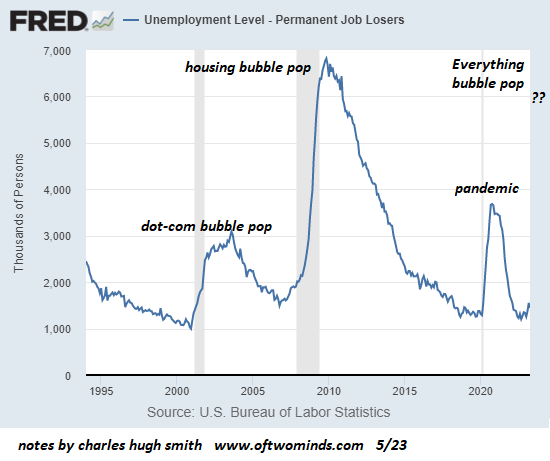
The consensus holds that inflation is declining rapidly and unemployment remains low, so the economy is doing great. Please glance at Chart #1 below to see what enthuses the mainstream: the unemployment rate is near historic lows.

But this measure leaves out a great deal of consequential factors. It’s well-known that the unemployment rate is distorted / gamed by leaving out everyone who is in the workforce but not “actively seeking work.” So what does this official unemployment rate actually measure? Not the percentage of the workforce that has a job.

Nor does it measure underemployment–those working far below their potential–or job insecurity or the percentage of workers being pushed into burnout–all consequential reflections of the real economy. All of these are potentially causal factors in why US productivity has fallen so dramatically.

And speaking of productivity, that’s the ultimate source of prosperity–not speculative bubbles or debt-binging. If productivity is tanking, eventually there are negative economic consequences that will be distributed to some segments of the populace, very likely asymmetrically.

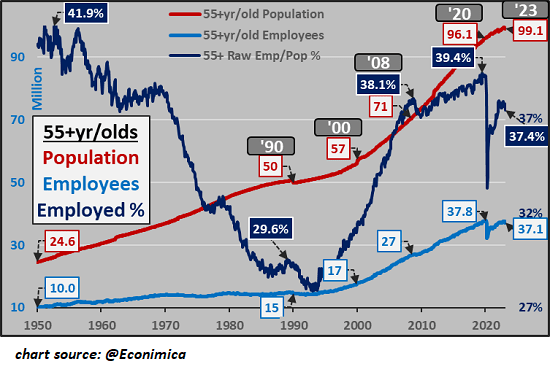
Such a broad-brush measure also ignores the consequences of demographics. Please glance at chart #2 below, of the 55 and over population and workforce. Note that virtually all the 20+ million jobs the US economy added in the past two decades are in this older workforce, which is of course steaming steadily into retirement, even as the percentage of this cohort who continues working has soared.

In other words, virtually all the job growth is the result of older workers working longer. Yes, 70 is the new 50, but try doing the same work at 70 that you did when you were 50. Sure, some people forego retirement because they love their work so much, but we don’t measure how many are still working because they have to for pressing financial reasons.

Have you observed the age of service workers and skilled workers recently? Do you reckon they really love working at Burger King so much that they’re doing it for enjoyment?

What if we measured financial pressures and job insecurity rather than risibly bogus “unemployment”? Would the economy still look so wonderful and resilient?

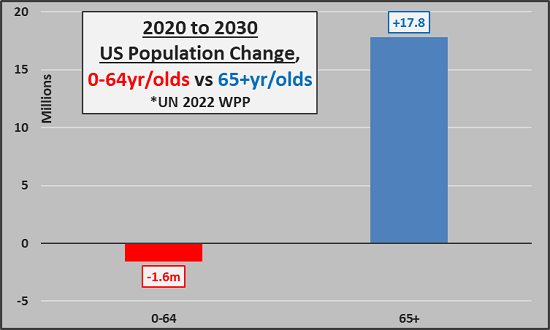
Chart #3 shows that virtually all the population growth ahead is in the cohort of older workers 65+ years old heading into retirement. So the workforce is rapidly aging and the unspoken / unexamined assumption is tens of millions of new workers will enter the workforce with the same skills, motivation, dedication and values as the tens of millions retiring.

But the demographics simply don’t support this breezy assumption.

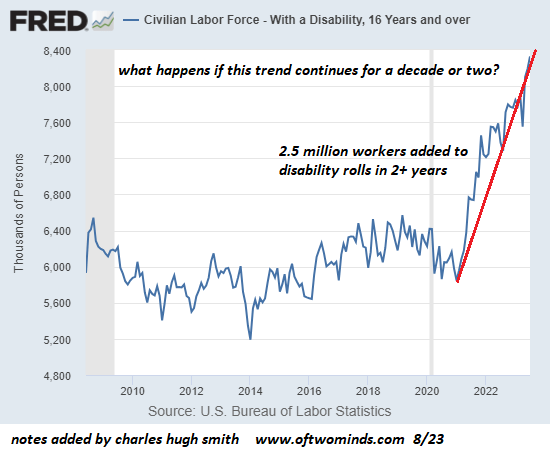
Now glance at chart #4 which depicts the extraordinary rise in the number of workers who are now disabled. The causes of this are being debated (the pandemic obviously plays a role), but 2.5 million workers leaving the workforce in a few years is something that could be consequential if the trend continues. An assumption that this is a one-off is baseless until proven otherwise.

Once again, demographics, productivity and factors such as disability and burnout are not part of the unemployment, GDP and inflation measures currently being touted as proof of economic nirvana.

Item #1 of what’s not even measured is the crapification of goods and services. I addressed this in The “Crapification” of the U.S. Economy Is Now Complete (February 9, 2022) and Stainless Steal (February 26, 2023).

How do we measure the “inflation”–i.e. a loss of purchasing power–when appliances that lasted 20 years a generation ago now break down in 5 years? Where does that 75% decline in utility and durability show up in the official inflation data? How about the tools that once lasted a lifetime now breaking after a few years?

It’s been estimated that America’s food has lost 30% of its nutritive value in the past few decades. Protein per gram has dropped, trace nutrients have dropped, and so on. Rather than pursue sustainably nutrient-rich soil, Big Ag has maximized profits by dumping natural-gas-derived chemical fertilizers on depleted soil to boost production of nutrient-poor, tasteless “product.” A product deemed “organic” offers no guarantee that the soil isn’t depleted of nutrients.

Could this decline have anything to do with the American populace’s increasingly poor health? Nobody knows because these massive declines in quality and value aren’t measured and are certainly not part of the risibly bogus measures of unemployment, GDP and inflation.

The official inflation rate ignores the multi-decade decline in the purchasing power of wages. Rents have soared 25% in a few years, and economists are looking at 5% increases in wages and worrying about the potential inflationary impact of workers’ wages not keeping up with real-world inflation.

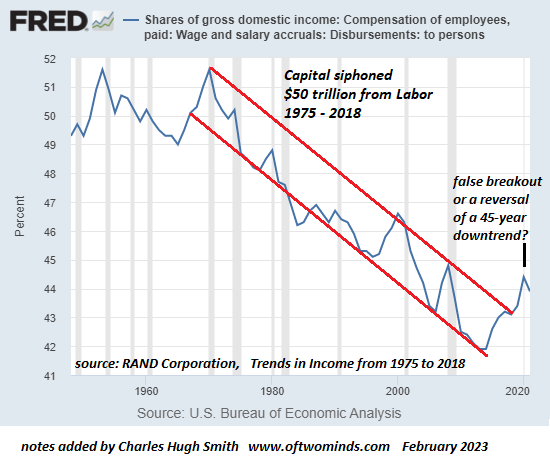
Cheerleading economists and pundits never mention the $50 trillion siphoned from labor by capital over the past 45 years. They also don’t mention the rising trend of loading more work on employees rather than hire more employees, or as a response to not being able to find qualified new hires.

Funny how rosy the picture can be tinted when all the consequential forces are ignored. But this studied ignorance characterizes the American elite, who delight in whining about airfares and travel delays, and finding someone to fix their pool pump. I address our Terminally Stratified Society here:

The Wealthy Are Not Like You and Me–Our Terminally Stratified Society (August 3, 2023)

This protected elite don’t have to put up with the crapified goods and services which generate their capital gains and income. Their wealth and income enable their detachment from the crapified economy the bottom 90% experience. Their experience of the bottom 90% is as service workers, delivery people, etc. who serve their entitled tastes.

Correspondent Tomasz G. provided a telling excerpt from Houellebecq’s The Possibility of an Island:

“… the rich certainly like the company of the rich, no doubt it calms them, it’s nice for them to meet beings subject to the same torments as they are, and who seem to form a relationship with them that is not totally about money; it’s nice for them to convince themselves that the human species is not uniquely made up of predators and parasites… “

As correspondent Ryan R. observed, America’s privileged elites“were born on third, stole home (via asset inflation) and still think they hit that home run.”

We know who the parasites are, but economists and pundits are safely blind to America’s neofeudal aristocracy. After all, who butters the bread of economists and pundits?

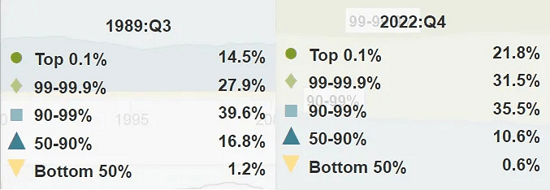
Is it unsurprising there are no measures of neofeudalism or elite privilege? As for the incredible concentration of wealth in the top tiers and the resulting decline in the bottom 90%’s share of the nation’s wealth–nothing to see here, just globalization and financialization doing their thing. What matters is booking my next flight to yet another conference of economists and pundits where we nod our heads and dare not admit all the conferences are nothing but echo chambers of the privileged elites.

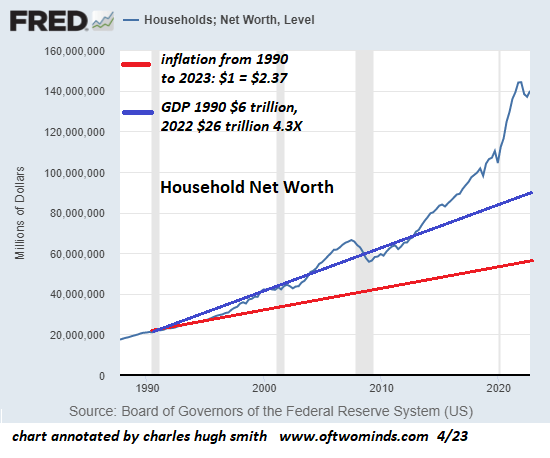
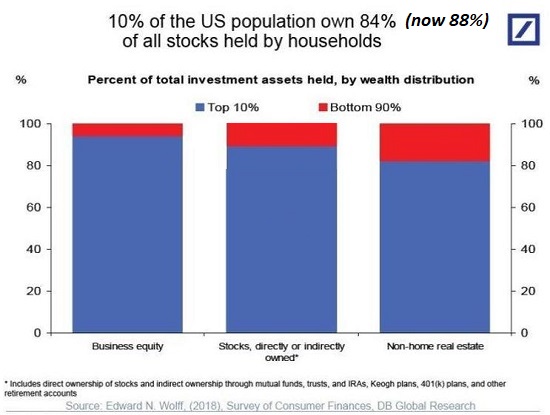
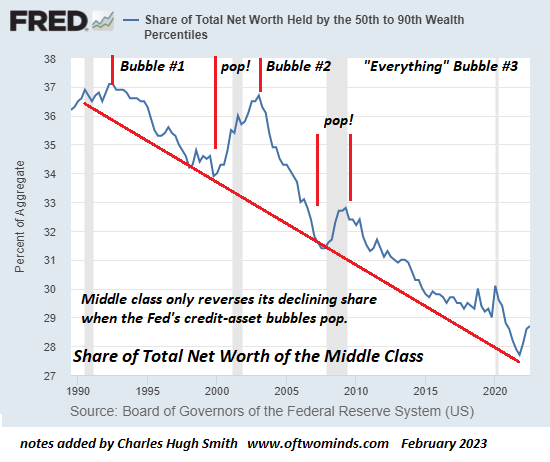
Cheerleading economists and pundits completely ignore the consequences of the system being rigged to favor capital and the already-wealthy who were given the means to buy assets back when they were cheap and affordable to the middle-class. Now that the system generates speculative credit-asset bubbles to create “the wealth effect,” assets such as homes in desirable regions are out of reach of the bottom 90%.

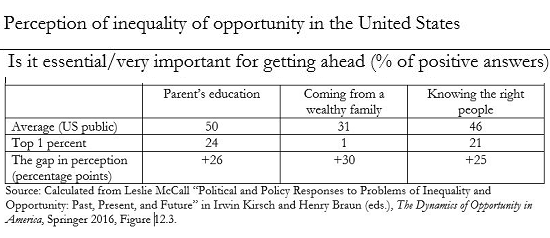
Please study the six charts below of wealth inequality. Try not to laugh out loud when you see that the top 1% reckon that “coming from a wealthy family” has near-zero impact on “getting ahead in America.”

Also note the steady decline in the middle class percentage of national wealth, and how the middle class’s share only rises when the credit-asset bubbles that have enriched the top 10% deflate, a bubble-pop that never lasts longer than a few months thanks to the policies that favor the already-rich at the expense of those who don’t own stocks, rental properties, municipal bonds, etc.

Economists and pundits steer well clear of the eventual social and political consequences of America’s entrenched neofeudal wealth-income inequality. That this neofeudal configuration is inherently destabilizing–never mind, we don’t measure that, look at the wunnerful unemployment and inflation charts!

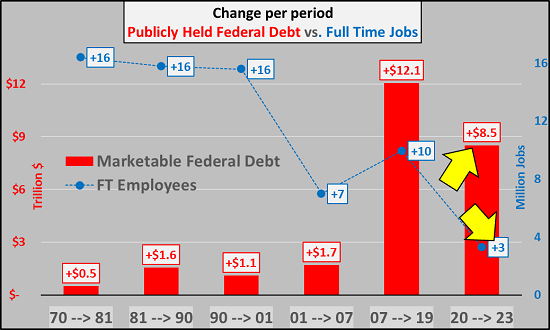
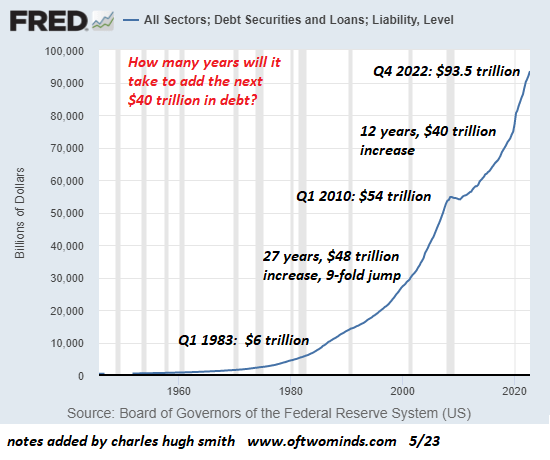
Lastly, consider the skyrocketing federal debt in terms of how many jobs are created in the era of soaring federal spending and debt. (Charts courtesy of CH / Economica) Debt doesn’t matter to economists and pundits, and neither does its diminishing effect on GDP and employment. The same can be said of total debt (public and private), which is skyrocketing (last chart): diminishing returns writ large as higher interest rates are embedded in the policy excesses and neofeudal structure of the past 45 years.

In essence, nothing that is consequential is properly quantified, so the pundit class keeps insisting everything is wunnerful and is mystified why people are so foolishly dissatisfied with our wunnerful economy. The reason why people are not buying the fantasyland story is they have to live and work in the crapified real economy, as serfs serving the economist-punditry-elite aristocracy.

If we want to avoid being led astray by misleading measures, we must seek enlightenment in what isn’t being measured or is cast aside as inconvenient to the “economy is wunnerful” party line.

From Press Room Raids to Indictments, Anything Goes When the Government Piles On

By John & Nisha Whitehead

Source: The Rutherford Institute

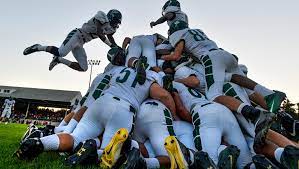
“When players are piled on top of each other after a mad scramble for a loose ball, it’s a free-for-all. There are no rules. Anything goes. That’s because there’s nobody in the pile to monitor what’s going on.”—Mike Thomas, sports editor

What is playing out before our eyes right now should be familiar to any fan of football: it’s called the pile on, a brutal, frenzied, desperate play to seize control and gain power while crushing the opposition.

In this particular analogy, “we the people” are trapped at the bottom of that pile, buried under a mountain of bread-and-circus distractions, economic worries, environmental disasters, power plays, power grabs, police raidsindictments and circus politics.

The Maui wildfires. The Trump indictments. Hunter Biden’s legal troubles. The looming 2024 presidential election. The Ukraine-Russia conflict.

In the midst of this pile on of woes, worries and semi-manufactured crises falling with sledgehammer-like frequency, monopolizing the media narrative and eclipsing all other news, it’s difficult to stay focused on what’s really going on, and yet something is brewing.

Pay attention.

Caught up in the partisan boxing match that is politics today, it’s easy to lose sight of what’s real.

The indictments against Trump, the investigation of Hunter Biden, and the chatter of the political classes aren’t real; they are more sound and fury, signifying nothing in the end.

As Aldous Huxley observed in Brave New World Revisited:

“Non-stop distractions of the most fascinating nature are deliberately used as instruments of policy, for the purpose of preventing people from paying too much attention to the realities of the social and political situation… Only the vigilant can maintain their liberties, and only those who are constantly and intelligently on the spot can hope to govern themselves effectively by democratic procedures.”

So what is real?

What’s real is the $5,000 fine and five-year jail sentence that could be levied against anyone found driving an illegal immigrant in their car in the state of Florida.

What’s real are the hi-tech policing tools such as robotic dogs equipped with all manner of weaponry and surveillance technology that are rewriting the ground rules when it comes to privacy and security.

What’s real is the North Carolina pastor who was fined $60,000 for ministering to the homeless on church property without a permit.

What’s real is the revelation that Boston officials created and sent police a watch list of the mayor’s most vocal critics, not unlike the government’s own growing databases for anti-government dissidents.

What’s real is what happened in Marion, Kansas, on Fri., Aug. 11, 2023, when police raided the office of the Marion County Record, blowing past the constitutional safeguards intended to safeguard the freedom of the press.

Are you starting to get the picture yet?

The manufactured media spectacles, piled on one after another, have a very real purpose, which is to distract us from the government’s constant encroachments on our freedoms.

In the larger scheme of things, these individual incidents—the police raid of a small-town newspaper, a state ban on who gets to be inside your car, an outrageous fine for feeding the destitute, a politician’s use of an enemies list to silence critics—might easily go unremarked, yet they are all part of the police state’s tendency to pile on: pile on the distractions, pile on the retribution, pile on the show of force in order to completely eviscerate anything that even remotely resembles opposition.

The police state has embarked on a ruthless, take-no-prisoners, all-out assault on anyone who even questions its authority, let alone challenges its chokehold on power.

“We the people”—the proverbial nails to the police state’s heavy-handed tactics—will be hammered into compliance, intimidated into subservience, and terrorized into silence.

It doesn’t matter which party dominates in Congress or the White House: all of us are in danger from these fear-inducing, mind-altering, soul-destroying, smash-your-face-in tactics.

In this way, anarchy is being loosed upon the nation.

Day after day, the government’s crimes against the citizenry grow more egregious, more treacherous and more tragic. And day after day, the prison walls holding the American people captive become ever more inescapable.

The upcoming election and its aftermath will undoubtedly keep the citizenry divided and at each other’s throats, so busy fighting each other that they never manage to present a unified front against tyranny in any form.

Yet the winner has already been decided.

As American satirist H.L. Mencken predicted almost a century ago:

“All the odds are on the man who is, intrinsically, the most devious and mediocre — the man who can most adeptly disperse the notion that his mind is a virtual vacuum. The Presidency tends, year by year, to go to such men. As democracy is perfected, the office of president represents, more and more closely, the inner soul of the people. On some great and glorious day the plain folks of the land will reach their heart’s desire at last and the White House will be adorned by a downright moron.”

In other words, as I make clear in my book Battlefield America: The War on the American People and in its fictional counterpart The Erik Blair Diaries, nothing will change.

You cannot have a republican form of government—nor a democratic one, for that matter—when the government views itself as superior to the citizenry, when it no longer operates for the benefit of the people, when the people are no longer able to peacefully reform their government, when government officials cease to act like public servants, when elected officials no longer represent the will of the people, when the government routinely violates the rights of the people and perpetrates more violence against the citizenry than the criminal class, when government spending is unaccountable and unaccounted for, when the judiciary act as courts of order rather than justice, and when the government is no longer bound by the laws of the Constitution.

Fauci and the Hagiographical Style of American Journalism

By Justin Hart

Source: Brownstone Institute

Norah O’Donnell has known Dr. Fauci and his wife for ages: “How are you guys?” she starts her interview with Dr. Fauci for InStyle Magazine where Fauci posed for the most hubris-exuding photo of the pandemic.

“With all due modesty, I think I’m pretty effective!” – Dr. Anthony Fauci, July 2020, InStyle Magazine

This was 3 years ago this past week:

Norah’s husband, Chef Geoff, owns the Georgetown restaurant, “Deluxe Hospitality” She admits in her opening that Dr. Fauci and his wife, the bioethicist, Dr. Christine Grady, are frequent patrons there.

“… these days mostly for takeout.” O’Donnell chuckles.

Revisiting this horrible puff piece you can’t help but see the obtuseness of the leader of the pandemic policy in stark relief.

First, as always, the man is incapable of actual reflection:

NO: What have we done wrong?

A F: You know, that’s almost an unanswerable question. There are so many possibilities. I don’t like to phrase it in the context of what we’ve done wrong, as opposed to let’s take a look at what happened and maybe we can have lessons learned.

Showing once again that Dr. Fauci (in July 2020) believed that we did NOT lock down hard enough:

If you look at the European countries, they shut down about 90 to 95 percent of the country. Whereas when we shut down, the calculation is that we shut down about 50 percent. So, put all of those factors together, I can’t say we did anything wrong, you know, but certainly we’ve got to do better.

Lambasting any move to “re-open” he continues: “What we need to do now is to learn the lesson of what happened with the recent surges. We’ve got to pause in the opening and maybe even take a step back in our phases…”

Pushing masks was a high priority for the man who months earlier admitted in an email that they don’t really do anything:

As we try to proceed, we need to really take seriously the issue of wearing masks all the time and not congregating in bars. I think we can stop that by just closing them, because they are certainly an important mechanism of this spread. Keep distances, wash hands, avoid crowds, wear a mask … I think if we diligently do those things, we can turn this around.

Norah asks him about the “noble lie” he told around masks (which is just ridiculous parsing):

NO: It’s been recently reminded to us by the White House that you advised against people wearing masks in public, and, of course, that was due to the surge because the concern was about saving PPEs for medical professionals. Do you regret that comment?

A F: No. I don’t regret anything I said then because in the context of the time in which I said it, it was correct.

I’m always struck as to the casual and flippant manner in which Dr. Fauci proscribed the policies. Here he is continuing to defend his noble lie and pushing masks with assertions that STILL have no science behind them – in fact, quite the opposite.

And also, it soon became clear that we had enough protective equipment and that cloth masks and homemade masks were as good as masks that you would buy from surgical supply stores.

The plan to vaccinate millions was already in place as this comments affirms:

By the beginning of the year we should have the first tens of millions and then hundreds of millions of doses. That being the case, I would think we could vaccinate a substantial portion of the population as we get into 2021 — if the vaccine is safe and effective.

The the hubris really kicks in:

NO: And how long do you see yourself at the NIAID?

A F: I don’t see any termination within the near future because I judge [my career] by my energy and my effectiveness. And right now, with all due modesty, I think I’m pretty effective.

Norah turns to Mrs. Fauci (Dr. Grady):

NO: Let me ask you, Chris, as a bioethicist, what do you make of this moment we’re in, when even a mask has become more of a divisive issue?

CG: Well, I would say that masks shouldn’t be divisive. It’s a relatively easy way to protect one’s self and others. And so for public health reasons, I think everybody should do it. From an ethical perspective there is always this tension between what you ask people to do that feels like a restriction of their liberty and what is required for public health. And in this case, it seems like a slam dunk. It’s not restricting liberty much, and it’s very helpful for public health.

She goes on to lament how “unfair” it all seems to her:

when he gets criticized, it feels unfair to me because he is working so hard for the right reasons.

NO: What feels unfair?

CG: That people are looking for things to criticize — I mean, for anything. They are making things up. They are not putting into perspective the contribution that he is making.

A curious aside, Dr. Fauci and Dr. Grady’s first encounter began with a lie – seems kind of appropriate if you’ll forgive my commentary on that.

CG: [laughs] I had just come back from spending two years with Project Hope in Brazil and came to work at the NIH. There was a patient, Pedro, on the unit at the time who was Brazilian and didn’t speak English. One day he asked me if I could speak to his doctors about sending him home because he really wanted to go home. So I set up a meeting with the fellows who were taking care of him and Tony, who was the attending physician. I had not met Tony before that. I was the interpreter. And Tony told him, “He may go home and be very careful about taking care of his health and doing his dressings and sitting with his leg up and things like that.” And when I told him that, Pedro said, “There’s no way I’m doing that. I’ve been in the hospital for months. I’m going to the beach, and I’m going dancing at night.” And I sort of in a split second decided to tell Tony, “He said he’d do exactly what you said.”

AF: She lied! [laughs]

CG: I lied! So the next day I was walking down the hall, and Dr. Fauci came by and said, “Can I see you in my office at the end of the day?” I thought I was going to get fired. But he asked me out to dinner. [laughs]

The entire hagiographical interview in hindsight is a classic look at the elitist bubble around the people in Washington, D.C. during the pandemic. Dr. Fauci’s contribution to history will not be seen in a kind light.