What We Threw Away

By Patrick Armstrong

Source: Strategic Culture Foundation

Forty years ago I was quite impressed by the books of Jean François Revel in which he argued that The West was pretty much doomed because it was messy and indecisive. On the other hand, the communist world was decisive, centrally controlled, had a goal in mind and was patient and cunning in achieving that goal (the communisation of the planet, of course). They pushed on all fronts, where the West woke up and pulled itself together enough to push back, the communists recoiled, but the advance continued elsewhere. And so, bit by bit, the world became redder. These were, as I recall, the principal arguments of The Totalitarian Temptation (1977) and How Democracies Perish (1983). And there were plenty of other people bemoaning the fact that the inchoate Western democracies were frittering away valuable time.

And then, suddenly, the Warsaw Pact and the USSR fall apart and essentially took communism into the grave with them. The West was left standing. Still argumentative, inchoate, indecisive and all the rest of it but – and this is my point – still existing when the other was dead. And come to think of it, we’d outlasted that other stainless-steel perfection of centrally directed will and power, Nazi Germany. And there had been plenty of people in the 1930s who thought that, between communism and nazism, the West was doomed. This set me to thinking that Revel and the others had missed something in their analysis.

We outlived them. We survived, they didn’t. And that what I wondered about – there must be something in the West’s way of doing things that led to survival and something in the nazi or communist systems that led to death. I thought some more and the analogy that occurred to me is that there are many kinds of trees. Big ones, little ones, in-between sized ones. Some live in the wet, others in the dry, others half drowned by the sea and so on. There is in fact, a tree, or several trees, for almost any conceivable environmental condition. And therefore, there will always be trees. Why? Because instead of one Perfect Tree, there is a multitude of different trees. And of fishes, beetles, birds and so on. Nature is pluralistic: many many solutions for every imaginable situation and the ability to change to meet new challenges. Arnold Toynbee called this “challenge and response”; a society responds to a challenge: a good response and it survives to meet the next challenge, a bad response and it fades away.

Could this be the clue? Nazism and communism had One Big Answer for every question. That answer worked for a time until it met some questions it couldn’t answer and down it went. To grossly oversimplify things: the nazis loved force and they went to war with everybody, but you can’t win against everybody else, although you may do well for a while; a hammer and a sickle do not really mentally equip you for life in the later twentieth century; “a road to a blind alley” as Putin called it. Grossly simplified to be sure. If you prefer, ideological societies can only function inside the ontological assumptions of that ideology. But no ideology is any more than a small subset of boundless reality.

So what do we (or, sadly I have to ask, did we) have in the West? I think the three fundamental freedoms in the West are free speech, free politics and free enterprise. Looking at these through the lens of pluralism, they are pluralism of thought, pluralism of power and pluralism of action. Remember that the question I was trying to answer was why did the West survive? I wasn’t asking who’s better, more ideal, more moral; just why is one still around and the other two not? To me the answer was the same thing that allows us to be certain there will still be trees and beetles around in the future – pluralism: lots of different trees and beetles.

Take free speech or pluralism of thought. Everybody’s different, everybody has different ideas, insights, points of view. Let’s assume that, for some issue, mine is the winning idea today. But tomorrow you may have a better solution for the problem that appears tomorrow. If I suppressed you (“no man no problem”, as Stalin used to say) or otherwise prohibited your irrelevant (today) but relevant (tomorrow) idea, we would be in trouble tomorrow and less likely to survive until the next day. So, since we don’t know what tomorrow’s problems are, it’s best to let everybody think his thoughts because who can say whose ideas will be winners tomorrow? The same argument can be made for the other two pluralisms/freedoms. And so, by practising pluralism of thought, power and action, a society improves its chances of survival. That’s all: survival. But that was the question I asked myself in the first place.

So, to my mind, that was the great secret that communism’s fall had revealed – social or national survivability is best assured by pluralism of thought, power and action. So, in all humility, we should have understood that and proclaimed it. And, of course, the essence of pluralism is that you are free to be, and should be, yourself. All nations should be themselves: Russians should be Russian, Hungarians Hungarian and so on. Who can say who will have the next good idea? Who is so wise that he can direct his neighbour’s life? That to me was what should have been done and, had that been the message the West had preached, I think we’d all be better off today.

What instead? We had the fatuous proclaiming of “values”: we had ’em and they didn’t. All over the West stuffed shirts got up in parliaments to boast of “our values”. How we got them no one knew. Did God hand them out to some people but not to others? Russians, too lazy or shiftless or something, having missed the ceremony? Had they mysteriously grown in some national soil over long time? A relict of ancient Saxon customs that only their descendants could inherit? The product of centuries of learning? And what is a “value” anyway? A practical guide to action or a virtue that you either have or don’t? Was it something innate or something learned? Could they get these values? Could they be taught? But, whatever, we had ’em and they didn’t; we were virtuous, they weren’t. And there was another tiresome thing about this, especially when, as it often was, the values were given the adjective “European”. Franco, Hitler, Marx, Engels, Mussolini, Robespierre, Napoleon, Quisling and all the rest of them were Europeans. Every single one of them based his ideas and political views on sources deeply rooted in European thought and experience. And, for certain, had it not been for the Soviets and the Anglosphere, the “European values” Eurocrats and their flunkeys would have been boasting about today would have involved a lot more leather, jackboots and stiff-armed salutes. The whole enterprise resembled something from the movie Idiocracy: “Brawndo has what plants crave because plants crave what Brawndo has“. It was weirdly fascinating to watch.

Our “values” and our “virtue” entitled us to rule the world. We were licensed to do just about anything because we had “what plants crave”. And so triumphalist arrogance and complacent ignorance combined with the West’s monopoly of exportable brutal power. And so it went. An unexamined conceit, frighteningly widespread, became the justification, and cover, for less noble actions.

But some responses to challenges are not so successful and we must ask what has become of our boasted “values” today? Well, we’re still free to speak our minds. Not of course if it’s hate speech or fake news; who could defend that? And not, certainly, to offend anyone’s safe space. And you’d probably better not say anything in Russian. Political freedom? Not entirely gone I suppose, in those little corners not already bought up by lobbyists. And it would certainly be wrong to question anything said or done by “those brave men and women who put their life on the line for our safety”. Free enterprise of course still flourishes. In whatever tiny spaces a few gigantic and well-connected corporations have not yet got to.

Altogether, we can’t be very happy with the state of pluralism in the West. And if I’m correct that pluralism is the key to survival, how much longer do we have?

So who did win the Cold War in the end?

Why We’re Blind to the System Destroying Us

By Jonathan Cook

Source: Information Clearing House

I rarely use this blog to tell readers what they should believe. Rather I try to indicate why it might be wise to distrust, at least without very good evidence, what those in power tell us we should believe.

We have well-known sayings about power: “Knowledge is power”, and “Power tends to corrupt, while absolute power tends to corrupt absolutely.” These aphorisms resonate because they say something true about how we experience the world. People who have power – even very limited power they hold on licence from someone else – tend to abuse it, sometimes subtly and unconsciously, and sometimes overtly and wilfully.

If we are reasonably self-aware, we can sense the tendency in ourselves to exploit to our advantage whatever power we enjoy, whether it is in our dealings with a spouse, our children, a friend, an employee, or just by the general use of our status to get ahead.

This isn’t usually done maliciously or even consciously. By definition, the hardest thing to recognise are our own psychological, emotional and mental blind spots – and the biggest, at least for those born with class, gender or race privileges, is realising that these too are forms of power.

Nonetheless, these are all minor forms of power compared to the power wielded collectively by the structures that dominate our societies: the financial sector, the corporations, the media, the political class, and the security services.

But strangely most of us are much readier to concede the corrupting influence of the relatively small power of individuals than we are the rottenness of vastly more powerful institutions and structures. We blame the school teacher or the politician for abusing his or her power, while showing a reluctance to do the same about either the education or political systems in which they have to operate.

Similarly, we are happier identifying the excessive personal power of a Rupert Murdoch than we are the immense power of the corporate empire behind him and on which his personal wealth and success depend.

And beyond this, we struggle most of all to detect the structural and ideological framework underpinning or cohering all these discrete examples of power.

Narrative control

It is relatively easy to understand that your line manager is abusing his power, because he has so little of it. His power is visible to you because it relates only to you and the small group of people around you.

It is a little harder, but not too difficult, to identify the abusive policies of your firm – the low pay, cuts in overtime, attacks on union representation.

It is more difficult to see the corrupt power of large institutions, aside occasionally from the corruption of senior figures within those institutions, such as a Robert Maxwell or a Richard Nixon.

But it is all but impossible to appreciate the corrupt nature of the entire system. And the reason is right there in those aphorisms: absolute power depends on absolute control over knowledge, which in turn necessitates absolute corruption. If that were not the case, we wouldn’t be dealing with serious power – as should be obvious, if we pause to think about it.

Real power in our societies derives from that which is necessarily hard to see – structures, ideology and narratives – not individuals. Any Murdoch or Trump can be felled, though being loyal acolytes of the power-system they rarely are, should they threaten the necessary maintenance of power by these interconnected institutions, these structures.

The current neoliberal elite who effectively rule the planet have reached as close to absolute power as any elite in human history. And because they have near-absolute power, they have a near-absolute control of the official narratives about our societies and our “enemies”, those who stand in their way to global domination.

No questions about Skripals

One needs only to look at the narrative about the two men, caught on CCTV cameras, who have recently been accused by our political and media class of using a chemical agent to try to murder Sergei Skripal and his daughter Yulia back in March.

I don’t claim to know whether Alexander Petrov and Ruslan Boshirov work for the Russian security services, or whether they were dispatched by Vladimir Putin on a mission to Salisbury to kill the Skripals.

What is clear, however, is that the British intelligence services have been feeding the British corporate media a self-serving, drip-drip narrative from the outset – and that the media have shown precisely no interest at any point in testing any part of this narrative or even questioning it. They have been entirely passive, which means their readers – us – have been entirely passive too.

That there are questions about the narrative to be raised is obvious if you turn away from the compliant corporate media and seek out the views of an independent-minded, one-time insider such as Craig Murray.

A former British ambassador, Murray is asking questions that may prove to be pertinent or not. But at this stage, when all we have to rely on is what the intelligence services are selectively providing, these kinds of doubts should be driving the inquiries of any serious journalist covering the story. But as is so often the case, not only are these questions not being raised or investigated, but anyone like Murray who thinks critically – who assumes that the powerful will seek to promote their interests and avoid accountability – is instantly dismissed as a conspiracy theorist or in Putin’s pocket.

That is no meaningful kind of critique. Many of the questions that have been raised – like why there are so many gaps in the CCTV record of the movements of both the Skripals and the two assumed assassins – could be answered if there was an interest in doing so. The evasion and the smears simply suggest that power intends to remain unaccountable, that it is keeping itself concealed, that the narrative is more important than the truth.

And that is reason enough to move from questioning the narrative to distrusting it.

Ripples on a lake

Journalists typically have a passive relationship to power, in stark contrast to their image as tenacious watchdog. But more fundamental than control over narrative is the ideology that guides these narratives.  Ideology ensures the power-system is invisible not only to us, those who are abused and exploited by it, but also to those who benefit from it.

It is precisely because power resides in structures and ideology, rather than individuals, that it is so hard to see. And the power-structures themselves are made yet more difficult to identify because the narratives created about our societies are designed to conceal those structures and ideology – where real power resides – by focusing instead on individuals.

That is why our newspapers and TV shows are full of stories about personalities – celebrities, royalty, criminals, politicians. They are made visible so that we do not notice the ideological structures we live inside that are supposed to remain invisible.

News and entertainment are the ripples on a lake, not the lake itself. But the ripples could not exist without the lake that forms and shapes them.

Up against the screen

If this sounds like hyperbole, let’s stand back from our particular ideological system – neoliberalism – and consider earlier ideological systems in the hope that they offer some perspective. At the moment, we are like someone standing right up against an IMAX screen, so close that we cannot see that there is a screen or even guess that there is a complete picture. All we see are moving colours and pixels. Maybe we can briefly infer a mouth, the wheel of a vehicle, a gun.

Before neoliberalism there were other systems of rule. There was, for example, feudalism that appropriated a communal resource – land – exclusively for an aristocracy. It exploited the masses by forcing them to toil on the land for a pittance to generate the wealth that supported castles, a clergy, manor houses, art collections and armies. For several centuries the power of this tiny elite went largely unquestioned.

But then a class of entrepreneurs emerged, challenging the landed artistocracy with a new means of industrialised production. They built factories and took advantage of scales of economy that slightly widened the circle of privilege, creating a middle class. That elite, and the middle-class that enjoyed crumbs from their master’s table, lived off the exploitation of children in work houses and the labour of a new urban poor in slum housing.

These eras were systematically corrupt, enabling the elites of those times to extend and entrench their power. Each elite produced justifications to placate the masses who were being exploited, to brainwash them into believing the system existed as part of a natural order or even for their benefit. The aristocracy relied on a divine right of kings, the capitalist class on the guiding hand of the free market and bogus claims of equality of opportunity.

In another hundred years, if we still exist as a species, our system will look no less corrupt – probably more so – than its predecessors.

Neoliberalism, late-stage capitalism, plutocratic rule by corporations – whatever you wish to call it – has allowed a tiny elite to stash away more wealth and accrue more power than any feudal monarch could ever have dreamt of. And because of the global reach of this elite, its corruption is more endemic, more complete, more destructive than any ever known to mankind.

A foreign policy elite can destroy the world several times over with nuclear weapons. A globalised corporate elite is filling the oceans with the debris from our consumption, chopping down the forest-lungs of our planet for palm-oil plantations so we can satisfy our craving for biscuits and cake. And our media and intelligence services are jointly crafting a narrative of bogeymen and James Bond villains – both in Hollywood movies, and in our news programmes – to make us fearful and pliable.

Assumptions of inevitability

Most of us abuse our own small-power thoughtlessly, even self-righteously. We tell ourselves that we gave the kids a “good spanking” because they were naughty, rather than because we established with them early on a power relationship that confusingly taught them that the use of force and coercion came with a parental stamp of approval.

Those in greater power – from minions in the media to executives of major corporations – are no different. They are as incapable of questioning the ideology and the narrative – how inevitable and “right” our neoliberal system is – as the rest of us. But they play a vital part in maintaining and entrenching that system nonetheless.

David Cromwell and David Edwards of Media Lens have provided two analogies – in the context of the media – that help explain how it is possible for individuals and groups to assist and enforce systems of power without having any conscious intention to do so, and without being aware that they are contributing to something harmful. Without, in short, being aware that they are conspiring in the system.

The first:

When a shoal of fish instantly changes direction, it looks for all the world as though the movement was synchronised by some guiding hand. Journalists – all trained and selected for obedience by media all seeking to maximise profits within state-capitalist society – tend to respond to events in the same way.

The second:

Place a square wooden framework on a flat surface and pour into it a stream of ball bearings, marbles, or other round objects. Some of the balls may bounce out, but many will form a layer within the wooden framework; others will then find a place atop this first layer. In this way, the flow of ball bearings steadily builds new layers that inevitably produce a pyramid-style shape. This experiment is used to demonstrate how near-perfect crystalline structures such as snowflakes arise in nature without conscious design.

The system – whether feudalism, capitalism, neoliberalism – emerges out of the real-world circumstances of those seeking power most ruthlessly. In a time when the key resource was land, a class emerged justifying why it should have exclusive rights to control that land and the labour needed to make it productive. When industrial processes developed, a class emerged demanding that it had proprietary rights to those processes and to the labour needed to make them productive.

Our place in the pyramid

In these situations, we need to draw on something like Darwin’s evolutionary “survival of the fittest” principle. Those few who are most hungry for power, those with least empathy, will rise to the top of the pyramid, finding themselves best-placed to exploit the people below. They will rationalise this exploitation as a divine right, or as evidence of their inherently superior skills, or as proof of the efficiency of the market.

And below them, like the layers of ball bearings, will be those who can help them maintain and expand their power: those who have the skills, education and socialisation to increase profits and sell brands.

All of this should be obvious, even non-controversial. It fits what we experience of our small-power lives. Does bigger power operate differently? After all, if those at the top of the power-pyramid were not hungry for power, even psychopathic in its pursuit, if they were caring and humane, worried primarily about the wellbeing of their workforce and the planet, they would be social workers and environmental activists, not CEOs of media empires and arms manufacturers.

And yet, base your political thinking on what should be truisms, articulate a worldview that distrusts those with the most power because they are the most capable of – and committed to – misusing it, and you will be derided. You will be called a conspiracy theorist, dismissed as deluded. You will be accused of wearing a tinfoil hat, of sour grapes, of being anti-American, a social warrior, paranoid, an Israel-hater or anti-semitic, pro-Putin, pro-Assad, a Marxist.

None of this should surprise us either. Because power – not just the people in the system, but the system itself – will use whatever tools it has to protect itself. It is easier to deride critics as unhinged, especially when you control the media, the politicians and the education system, than it is to provide a counter-argument.

In fact, it is vital to prevent any argument or real debate from taking place. Because the moment we think about the arguments, weigh them, use our critical faculties, there is a real danger that the scales will fall from our eyes. There is a real threat that we will move back from the screen, and see the whole picture.

Can we see the complete picture of the Skripal poisoning in Salisbury; or the US election that led to Trump being declared president; or the revolution in Ukraine; or the causes and trajectory of fighting in Syria, and before it Libya and Iraq; or the campaign to discredit Jeremy Corbyn as leader of the Labour party; or the true implications of the banking crisis a decade ago?

Profit, not ethics

Just as a feudal elite was driven not by ethics but by the pursuit of power and wealth through the control of land; just as early capitalists were driven not by ethics but by the pursuit of power and wealth through the control of mechanisation; so neoliberalism is driven not by ethics but the pursuit of power and wealth through the control of the planet.

The only truth we can know is that the western power-elite is determined to finish the task of making its power fully global, expanding it from near-absolute to absolute. It cares nothing for you or your grand-children. It is a cold-calculating system, not a friend or neighbour. It lives for the instant gratification of wealth accumulation, not concern about the planet’s fate tomorrow.

And because of that it is structurally bound to undermine or discredit anyone, any group, any state that stands in the way of achieving its absolute dominion.

If that is not the thought we hold uppermost in our minds as we listen to a politician, read a newspaper, watch a film or TV show, absorb an ad, or engage on social media, then we are sleepwalking into a future the most powerful, the most ruthless, the least caring have designed for us.

Step back, and take a look at the whole screen. And decide whether this is really the future you wish for your grand-children.


Gandhi’s Despair and the Struggle for Truth and Love

By Robert J. Burrowes

‘When I despair, I remember that all through history the ways of truth and love have always won. There have been tyrants, and murderers, and for a time they can seem invincible, but in the end they always fall. Think of it – always.’ M.K. Gandhi

As we remember Gandhi Jayanti on 2 October, the Mahatma’s 149th birthday and the International Day of Nonviolence, there is plenty of room for despair.

Never before has the Earth and its many inhabitants been under siege as they are now, more than 100 years after Gandhi started warning us of the predicament in which we are embroiled and presenting his strategy for addressing it before it spiraled out of control.

Whether it is the threat of nuclear war, the ongoing wars in many parts of the world and particularly the Middle East, the multiple and synergistic threats to the global environment or the ongoing climate catastrophe, the Earth is under assault on all fronts and its precious lifeforms (human and otherwise) are being killed outright in vast numbers and driven to extinction at the rate of 200 species daily. And the evidence is rapidly accumulating that humans themselves will be extinct by 2026 as well. See ‘Human Extinction by 2026? A Last Ditch Strategy to Fight for Human Survival’.

Moreover, unlike the tyrants to which Gandhi was referring, the current ‘tyrant’ is a global elite that has acquired extraordinary power to kill and destroy as they pursue their insane compulsion to accumulate and control resources at the expense of life. See ‘The Global Elite is Insane Revisited’.

So are we to give up in despair? To quit without a fight? Or even delude ourselves that nothing needs to be done? Obviously, these were not ways that Gandhi would contemplate because, as noted in his words cited above: ‘the ways of truth and love have always won’. Although, as Gandhi did not bother to add: we must struggle, relentlessly, to ensure that truth and love prevail.

And, fortunately, there are many people around the world who agree with him.

Tackling the pervasive violence in our world requires a comprehensive strategy involving many campaigns focused on a wide range of peace, justice and environmental issues, and substantial mobilization. There is no single or simple path. Let me tell you about some of the people engaged in this effort and the nature of their commitment, together with what connects their involvement.

Remarkable activist and progressive journalist Abby Martin, based in the USA, was formerly creator and presenter of the investigative news program ‘Breaking the Set’ and is now creator and presenter of its successor program ‘The Empire Files’. With the support of her fine team, Abby researches and presents reports from ‘inside history’s biggest empire… recording a world shaped by war & inequality’ so that the truth is exposed for all to see. Abby, who is also an artist, interviews a wide range of people from ‘ordinary’ activists to progressive intellectuals to political leaders to penetrate the veil of obscurity cast by the global elite’s corporate media. You can watch Abby’s terrific programs, providing insight into how our incredibly violent world works, on her website ‘The Empire Files’. You can also read about the latest attack on her work and how you can help in the article ‘US Sanctions Shut Down “The Empire Files” with Abby Martin’. Keep fighting Abby! We are with you all the way.

Ina Curic in Romania writes illustrated children’s books designed to teach children a variety of lessons for living an empowered, socially and environmentally conscious life. Her book Queen Rain, King Wind: The Practice of Heart Gardening was published in May and Anagrania’s Challenge: Turning Conflict into Opportunity has just been published. Anagrania’s Challenge is a beautifully created story that offers clear and simple guidance on three subjects vital to our shared future on Earth: what we need to be ourselves, what we need to be healthy, and that acceptance of uniqueness and creatively dealing with conflict are essential if we are to live together and celebrate the benefits and advantages of our differences. If you are looking for children’s books that promote nonviolent living and conflict resolution, you will have trouble finding better books than those by Ina. You can read about Ina, as well as how to obtain her books, on her website Imagine Creatively.

Pakistani Canadian Dr. Mahboob A. Khawaja is a scholar who writes searing critiques of international relations exposing the deep conflicts driving global events. Two of his recent articles are ‘World Affairs and Insanity as Entertainment: Are We at the End of Human Morality?’ and ‘Mankind Must Know: The UNO and Global Leaders are a Menace to Peace and Problem-Solving’.

Moreover, in support of his son Momin, a computer science graduate and IT entrepreneur, who has been unjustly imprisoned since 2004 on terrorism charges (and facing a sentence of life plus 24 years), Mahboob has created a website to raise awareness of Momin’s struggle for justice and freedom, and organized a petition for those who wish to express their support for him.

Edith Rubinstein in Belgium is definitely an ‘activist senior’. Now 86 and in a center of recuperation following a severe depression and bout of unconsciousness earlier this year, Edith still has her computer and continues her work as an activist. ‘Because I am an activist since a very long time, a feminist, a woman in Black, and I translated free Ecofeminism from Maria Mies and Vandana Shiva…. Since many years, I have translated alternative articles and finally it made me sick.’ In fact, Edith admits, ‘I am completely “abnormal”. Somebody who feels bad to live in a world where hundreds of thousand people are killed or die … because they have nothing to eat anymore and nobody seems to care…. I feel very bad to live in this kind of world. Yes, terrible what is happening in the Congo! But unfortunately it is not the only case. And I am very scandalized by the behavior of the Western World!!!!’

Zakia Haddouch in Morocco continues to report the extraordinarily difficult circumstances of people in that country as she and other activists continue their various struggles to bring some semblance of justice to Moroccan affairs. One prominent issue is the ongoing debate in relation to ‘the forced military service (for both young female and male subjects and I don’t say citizens). It was lately decreed by the king.’ Another struggle is taking place in the wake of the death of Mohcine Fikri on 28 October 2016, who was crushed to death in a rubbish truck trying to recover merchandise confiscated by a policeman. Following this event, Hirak (literally ‘The Movement’) was born and it quickly mobilized widespread support for its vigorous protests. While most of Hirak’s concerns are about local issues, it draws upon a national repertory of nonviolent actions fueled by the experiences of activists around the country. Between October 2016 and May 2017, and faced with social unrest of an unprecedented vitality which increasingly challenged him personally, Mohamed VI remained silent. However, when Hirak leader Nasser Zefzazi – who has never failed to stress nonviolence and advocate self-restraint – interrupted a sermon on 26 May 2017 in which an imam claimed the social movement was tantamount to a ‘fratricidal struggle or even civil war within Islam’, the government took this pretext to clamp down on Hirak. Many activists were jailed – over 200 so far – and demonstrations are now systematically broken up. Zefzazi was among those arrested (on 29 May 2017) and, along with other members of Hirak, subsequently jailed for 20 years. The repression has nipped in the bud any hopes for resolving the crisis quickly. But this doesn’t mean that Zakia and other activists have been intimidated into silence or inaction.

Daniel Dalai reports modestly about his visionary initiative Earthgardens in Guatemala. Earthgardens provides opportunities for girls to realize and practice their inherent leadership potential, particularly as part of Eco-Teams in preserving natural biodiversity. ‘More and more 3rd world governments are proving to be a colossal waste of money as corrupt politicians get rich without addressing local needs. The Sembradores’ model of Girl Power is gaining acceptance as people realize girls are more efficient, more concerned, and less corruptible in solving the simple problems of local needs. Clean water, cheap electricity, food production, and tourist development are urgent needs in many parts of the globe. You may become a volunteer working with children or an Eco-Team assessor in Latin America or Africa.’ Please contact Kate Teggins <earthgardens@outlook.com> The beautiful Earthgardens website has just been updated and the stunning photos alone will tell you much about what these remarkable girls are doing. See Earthgardens.

Young Nigerian Idowu Jawando has been reflecting deeply on the shocking state of our world and his own role in fixing that. ‘Over here in Lagos civilization advances steadily with all its domination and exploitation, squeezing the juice out of all of us. But yet here and there, traces of a smile, the fragrance of love releases its perfume… things seem bearable for a while. The big question on my mind is this: Can civilization be deconstructed? A part of me thinks: Yes of course, it is the actions of individuals that create this world, these same individuals also have the power to take everything down. But how about the police, the armies, the nuclear weapons and what-have you? Things are the way they are because of force. And most especially the threat of starvation too. It forces us into activities and relationships not of our choosing. Civilization uses and discards the people, over and over, squeezing them like lemons.

‘Will the global leaders who are driven to this insane struggle for power and profit suddenly grow a compassionate nature, one that has no doubt been lost a long time ago? You and I know they won’t. With all the disasters that go on, we still see them stripping the earth bare of its life, still forcing people into precarious situations. We find ourselves at a quandary. I personally find myself in a very stifling situation, but I try my best not to let it define, instead I study it as one would study a dangerous toy….

‘Indeed I have found that tenderness impacts strength and courage in others, this is something I have seen in my own existence. But can one be tender to an oppressor? I guess if there was a mass refusal of this world and all its mechanisms, there will be a lot of headway. Such a situation in my own thinking, won’t be one of making demands to any government, but collectively and individually deciding how we want to live our beautiful mortal lives and what we want the world around us to reflect: the ugliness of mindless profit-seeking or co-creative play with earthly life.

‘Many just go through life unquestioningly, accepting the state of things as normal; as well, the walls that prevent us from truly connecting with one another, is one major obstacle. The education, religious systems only encourage people to be followers, never masters of themselves…. I will keep thinking about this. I realize it might take my whole life and then more, to tackle the evils of the world. But it would please me if I am moving inch by inch and encouraging others to do the same. The torch of freedom must never be extinguished. But must pass from generation to generation.’

Each of the inspiring individuals mentioned above is a signatory of The Peoples Charter to Create a Nonviolent World. If you feel inclined to join this worldwide movement to end violence in all of its manifestations, you are welcome to sign the Charter pledge too.

Like those individuals mentioned above, signatories of the Nonviolence Charter come from a diverse range of backgrounds. They live all over the world (in 105 countries). They represent a wide range of genders, races, religions, classes and abilities. And they work on a phenomenal variety of issues with an increasing number recognizing the need to work on ending violence against children. As Gandhi noted:

‘If we are to reach real peace in this world and if we are to carry on a real war against war, we shall have to begin with children.’

This requires us to understand the cause of violence, including violence against children – see Why Violence?’ and Fearless Psychology and Fearful Psychology: Principles and Practice – and to consider making ‘My Promise to Children’. In some cases, it means undertaking the personal healing necessary to nurture children powerfully. See ‘Putting Feelings First’.

Recognizing, as Gandhi put it, that ‘Earth provides enough to satisfy every [person’s] needs, but not every [person’s] greed’, others are tackling the full range of environmental and climate challenges by participating in The Flame Tree Project to Save Life on Earth.

And given the elite insanity that drives violence in many contexts, still other signatories are engaged in nonviolent struggles – see Nonviolent Campaign Strategy – or national liberation struggles – see Nonviolent Defense/Liberation Strategy – to tackle violence in these contexts.

So if you are inclined to ponder the meaning of Gandhi’s life, you just need to picture a man dressed simply in khadi, walking to the sea to collect salt in defiance of the law of the British occupying power.

The Reverend Martin Luther King Jr. once noted: ‘The enemy is violence.’ But for Gandhi: ‘The enemy is fear.’

This is because it is fear that drives violence but also fear that prevents us responding strategically and nonviolently to the violence in our world. As Gandhi observed: ‘You may never know what results come of your actions, but if you do nothing there will be no results.’

So as humans are beckoned to extinction within the next few years, Gandhi would remind us that ‘The future depends on what we do in the present.’

What will you do?


Biodata: Robert J. Burrowes has a lifetime commitment to understanding and ending human violence. He has done extensive research since 1966 in an effort to understand why human beings are violent and has been a nonviolent activist since 1981. He is the author of ‘Why Violence?’ http://tinyurl.com/whyviolence His email address is flametree@riseup.net and his website is here. http://robertjburrowes.wordpress.com

Robert J. Burrowes
P.O. Box 68
Daylesford, Victoria 3460
Australia

Email: flametree@riseup.net

Websites:
Nonviolence Charter
Flame Tree Project to Save Life on Earth
‘Why Violence?’
Feelings First
Nonviolent Campaign Strategy
Nonviolent Defense/Liberation Strategy
Anita: Songs of Nonviolence
Robert Burrowes
Global Nonviolence Network

The Battle for Our Minds

By Patrick Lawrence

Source: Consortium News

After reading The New York Times piece “The Plot to Subvert an Election” I put the paper down with a single question.

Why, after two years of allegations, indictments, and claims to proof of this, that, and the other did the newspaper of record—well, once the newspaper of record—see any need to publish such a piece? My answer is simple: The orthodox account of Russia-gate has not taken hold: It has failed in its effort to establish a consensus of certainty among Americans. My conclusion matches this observation: The orthodox narrative is never going to achieve this objective. There are too many holes in it.

“The information age is actually a media age,” John Pilger, the noted British–Australian journalist, remarked during a symposium four years ago, when the Ukraine crisis was at its peak. “We have war by media; censorship by media; demonology by media; retribution by media; diversion by media—a surreal assembly line of obedient clichés and false assumptions.” Pilger revisited the theme in a piece last week on Consortium News, arguing that once-tolerated, dissenting opinion has in recent years “regressed into a metaphoric underground.”

There are battlefields in Syria, Ukraine, Yemen, and elsewhere, but perhaps the most consequential battle now being fought is for our minds.

Those who dispense with honest intellectual inquiry, healthy skepticism of all media, and an insistence that assertions require supporting evidence should not win this war. The Times piece by Scott Shane and Mark Mazzetti—two of the paper’s top-tier reporters—is a case in point: If the Russia-gate narrative were so widely accepted as their report purports, there would have been no need to publish such a piece at this late date.

Many orthodox narratives are widely accepted however among a public that is not always paying attention. The public too often participates in the manufactured consent. Usually it take years for the truth to be widely understood. Sometimes it comes when the U.S. admits it decades later, such as the role of the CIA in the coups in Iran and Chile. Other times it comes through admissions by former U.S. officials, such as former Defense Secretary Robert McNamara about the Vietnam War.

Even Recent Narratives are Fraying

There are more recent examples of official narratives quickly fraying if not starting to fall apart, though Establishment media continues to push them.

For instance, there are serious doubts about who was responsible for alleged chemical weapons attacks in Syria. The most significant was in Eastern Ghouta in August 2013 followed by attacks in Khan Sheikhoun (April 2017) and Douma (April 2018).

The corporate media accounts of each of these attacks have been countered with persuasive evidence against the prevailing view that the government of Bashar al–Assad was to blame. It has been provided journalists (Seymour Hersh ), a scientist (Theodore Postol ), and on-the-ground correspondents and local witnesses. These reports are subject to further verification. But by no means do official narratives stand without challenge.

There is also the case of Malaysian Flight MH–17, shot down over Ukrainian territory in June 2014. The official report, issued a year later, concluded that the plane was downed by Ukrainian rebels using a Russian-supplied missile. The report was faulty from the first: Investigators never visited the site , some evidence was based on a report produced by Bellingcat , an open-source web site affiliated with the vigorously anti–Russian Atlantic Council, and Ukraine was given the right to approve the report before it was issued.

Last week the Russian military disclosed evidence that serial numbers found in the debris at the MH–17 crash site indicate the missile that downed the plane was produced at a Soviet military-production plant in 1986 owned by Ukraine. Let us see further verification of this evidence (although I seriously doubt any Western correspondent will seek any). The official report of 2015 noted the serial numbers, so we know they are authentic, but it did not use them to trace the missile’s provenance.

There is also the seriously muddled case of the poisoning of the Skripals in Britain.  Why hasn’t the Western media dug into this story rather than accept at face value the pronouncements of the British government?

A month ago I lamented the damage Russia-gate has done to many of our most important institutions, the press not least among them. What is the corporate media thinking? That once President Trump is dumped, all will return to normal and professional standards will be restored? One can also argue the reverse: that adversarial journalism has returned to the White House beat largely out of personal animus towards Trump and that it will disappear again once a more “normal” president is in office.

As Pilger put it, “This is a seismic shift, with journalists policing the new ‘groupthink,’ as [Robert] Parry called it, dispensing myths and distractions, pursuing its enemies.”

In other words, Establishment journalism has shifted far afield from its traditional ideals of non-partisan, objective reporting and is instead vying for your mind to enlist it in its agenda to promote American interests abroad or one party or the other at home.

We can’t let them get away with it. Our minds are our own.

The Richest Sociopath in the World

By John Rachel

Source: Dissident Voice

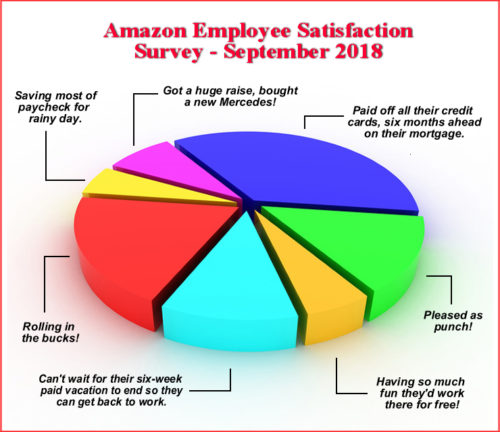
Obviously the above pie chart is a put-on. It is well-documented that working conditions for most employees of Amazon are  abysmaldehumanizing, bordering on abuse we normally associate with slavery.

Moreover, the median employee’s salary under Jeff Bezos’ imperial lordship is $28,446. No one working as a regular there has paid off their credit cards and is driving to work in a Mercedes. 

Jeff Bezos is referred to as The Richest Man in the World and his personal fortune, while growing by $191,000 each minute, is currently estimated at $168 billion.

So …

$28,446 vs. $168,000,000,000? While I can acknowledge the simple math, I find the contrast of such numbers on a gut level difficult to grasp.

To get a handle on such inequality, let’s try approaching it from different angles.

One way to put the disparity into perspective is to recognize it takes Bezos just under 9 seconds to earn what Amazon’s median worker does in an entire year.

Another is to recognize that for a worker to go through Jeff Bezos’ current personal fortune — and, of course, it continues mounting at accelerating levels as I write this — at his/her current median annual income of $28,446 per year, WOULD TAKE 5,905,927 YEARS! That’s close to 6 million years!

For Jeff Bezos himself to go through his current $168 billion, assuming his earnings stopped dead this very moment — which as you and I know they won’t — SPENDING $1,000,000 A DAY, would take NEARLY 460 years. Yes, even spending $1 million a day, in the year 2475 he’d still have plenty of cash, tens of million of dollars mad money. We can feel confident that he wouldn’t be foraging through the dumpster behind 7-11. 

Now, further consider that while the $28,446 median salary is above the national poverty line for a single individual if that person is the sole breadwinner for a family of four, it is marginally above it, which is why many Amazon employees must rely on government assistance to keep from starving.

As well as calculation, I did some speculation — a simple exercise in imagination.

Apparently Bezos’ wealth generating machine is raking it in so fast, he’s currently making $11.5 million per hour … every hour … 24 hours a day … seven days a week. $11,500,000 per hour! 

So here’s what I was picturing in my mind’s eye … 

If for 40 hours of the 168 hours in a week, Bezos were willing to scrape by on a mere $5,840,000 per hour, he could give every one of his 566,000 Amazon employees a $10 per hour raise. Of course, the remaining 128 hours in each week, Bezos could continue earning his normal $11.5 million per hour, not having to share any of it with the pathetic slobs who work for him.

Rhetorical question: Does Jeff Bezos have any concept of what that $10 per hour increase would mean to his employees? 

I’m not going to even suggest here I’m offering this for Bezos to entertain. There are so many advantages to him both as a putative member of the human race and the employer of over a half million workers — advantages that are so OBVIOUS — if they haven’t occurred to him up until now, then his brain functions in ways beyond my understanding. For one thing, he could point to his new fig leaf of “generosity” and ask people to stop calling him a selfish prick. Second, Amazon employees I’m sure would respond to his largesse with greater company loyalty and increased tolerance for his onerous working conditions. He’d still be the richest SOB on the block and could mock the pauperish Bill Gates and Warren Buffett as pitiable wannabees.

Consider …

The most poorly paid Amazon employee now makes $12 per hour. The $10 per hour raise I proposed would boost those $12 per hour workers right up there with Costco employees, who make an average of $21 per hour. And with the across-the-board $10 per hour increase, Bezos’ higher paid employees would be earning among the finest wages in the world provided by a major corporation. 

And by golly, there’s a plus side to the plus side …

Bezos’s bold and gracious gesture would result in a public relations coup of cosmic proportions! Amazon would no longer be demonized — well, not quite as much — by us bleeding-heart lefties as a capitalistic scourge and one-way ticket to Hell for the future of mankind, even if its environmental record is appalling and its business model generally the stuff of steroid-laced neo-feudalism.

Granted, Bezos would have to do some belt-tightening. He’d have to watch his pennies but could probably manage it, eh? Maybe he could skip a couple meals and do some of his own weeding at his estate. After all, after lavishing the $10 per hour raise on all of his employees, he’d only be pulling in $1,705,600,000 per week. I know I know! Like me you’re probably getting all teary-eyed for the poor guy.

Let me get to the extremely anti-climactic conclusion of this lament qua analysis.

Since nothing will change until the system itself changes, meaning the one in place now that creates, incentivizes, and lionizes the obscenely wealthy — reference current holder of the Office of President of the United States of America — I can only recommend this …

We have been labeling Jeff Bezos as ‘The Richest Man in the World’. Yet, quite honestly I don’t personally know any human, man or woman, who behaves like this gluttonous chunk of self-indulgent meat. It actually makes me nauseous to think we’re members of the same species.

Thus, from now on let’s use the correct terminology. Let’s call Jeff Bezos what he really is: the Richest Sociopath in the World.

We could probably order bumper stickers to help correct the record … from Amazon, of course.

How to Create a DIY Sticker Campaign

This is a simple how-to guide for creating a surprisingly effective sticker campaign on a limited budget. Before commencing, one might first ask “why a sticker campaign?”

A sticker of the right image in the right place is in essence a form of guerrilla marketing. While not as permanent as a graffiti stencil, it can still get a message across without damaging whatever objects or surfaces they happen to be placed on. Well-designed stickers can be viewed as a physical meme, which in internet culture has come to mean a combination of (usually humorous) images and words which transmit ideas. As social media monopolies continue to assert their power to censor any ideas which they, their corporate sponsors and government partners might disagree with, we need to be more creative about how to spread memes through society in a multitude of ways which can bypass censorship, contradict the mainstream consensus and have positive impacts.

As a user of mass transit, I began noticing small stickers on buses and bus stops along the routes I take featuring images mocking certain multinational corporations known to harm the community. The more I thought about the method and motives behind them, the more attractive the concept became. It’s a relatively low risk and low investment action that can have great results if even just a few with the right mindset see them and are nudged towards critical thoughts and actions. For example, I was moved to attempt to recreate the stickers, strategically place them in public spaces, and also share the method of producing them with the hope that others will do the same.

The first step is to choose an image. The meme content of your sticker is limited only by your imagination and the issues you wish to address.

Regardless of message, make sure it grabs attention and is still legible even if the sticker is small. I found that upping the contrast and converting images to black and white usually makes them more effective (and saves on color toner).

Next, acquire a box of Avery 5160 address stickers (or something similar) which can be purchased for a few bucks at thrift shops or found at most corporate workplaces.

Using Microsoft Word, click on “Tools” dropdown menu, then “Labels” and set it for “Avery standard, 5160” (or whatever type of label one happens to use).

Drag and drop image onto the Word label template so it looks something like this:

Print and trim with a paper cutter so all white portions are removed and each image is separated. This size of label and image creates 60 individual stickers per page. Granted, they’re pretty small so should ideally be placed in areas in which people come in close proximity to them such as on buses, bus stops, elevators, bathrooms, eye-level store shelves, etc. Smaller sizes have the advantage of making them easier to place more discretely however.

With bundles of strips of stickers in your pockets, have fun doing something admittedly immature but with the potential to support intelligent and worthy causes 🙂

The USA Is Now a 3rd World Nation

By Charles Hugh Smith

Source: Of Two Minds

I know it hurts, but the reality is painfully obvious: the USA is now a 3rd World nation.

Dividing the Earth’s nations into 1st, 2nd and 3rd world has fallen out of favor; apparently it offended sensibilities. It has been replaced by the politically correctdeveloped and developing nations, a terminology which suggests all developing nations are on the pathway to developed-nation status.

What’s been lost in jettisoning the 1st, 2nd and 3rd world categories is the distinction between developing (2nd world) and dysfunctional states (3rd world), states we now label “failed states.”

But 3rd World implied something quite different from “failed state”: failed state refers to a failed government of a nation-state, i.e. a government which no longer fulfills the minimum duties of a functional state: basic security, rule of law, etc.

3rd World referred to a nation-state which was dysfunctional and parasitic for the vast majority of its residents but that worked extremely well for entrenched elites who controlled most of the wealth and political power. Unlike failed states, which by definition are unstable, 3rd World nations are stable, for the reason that they work just fine for the elites who dominate the wealth, power and machinery of governance.

Here are the core characteristics of dysfunctional but stable states that benefit the entrenched few at the expense of the many, i.e. 3rd Worldnations:

1. Ownership of stocks and other assets is highly concentrated in entrenched elites. The average household is disconnected from the stock market and other measures of wealth; only a thin sliver of households own enough financial/speculative wealth to make an actual difference in their lives.

2. The infrastructure of the nation used by the many is poorly maintained and costly to operate as entrenched elites plunder the funding to pad their payrolls, pensions and sweetheart/insider contracts.

3. The financial/political elites have exclusive access to parallel systems of transport, healthcare, education, etc. The elites avoid trains, subways, lenders, coach-class air transport, standard healthcare and the rest of the decaying, dysfunctional systems they own that extract wealth from the debt-serfs.

They fly on private aircraft, have their own healthcare and legal services, use their privileges to get their offspring into elite universities and institutions and have access to elite banking and lending services that are unavailable to their technocrat lackeys and enforcers.

4. The elites fund lavish monuments to their own glory disguised as “civic or national pride.” These monuments take the form of stadiums, palatial art museums, immense government buildings, etc. Meanwhile the rest of the day-to-day infrastructure decays in various states of dysfunction.

5. There are two classes that only interact in strictly controlled ways: the wealthy, who live in gated, guarded communities and who rule all the institutions, public and private, and the debt-serfs, who are divided into well-paid factotums, technocrat lackeys and enforcers who serve the interests of the entrenched elites and rest of the populace who own virtually nothing and have zero power.

The elites make a PR show of being a commoner only to burnish the absurd illusion that debt-serf votes actually matter. (They don’t.)

6. Cartels and quasi-monopolies are parasitically extracting the wealth of the nation for their elite owners and managers. Google: quasi-monopoly. Facebook: quasi-monopoly. Healthcare: cartel. Banking: cartel. National defense: cartel. National Security: cartel. Corporate mainstream media: cartel. Higher education: cartel. Student loans: cartel. I think you get the point: every key institution or function is controlled by cartels or quasi-monopolies that serve the interests of the few via parasitic exploitation of the powerless.

7. The elites use the extreme violence and repressive powers of the government to suppress, marginalize and/or destroy any dissent. There are two systems of “law”: one for the elites ($10 million penalties for ripping off the public for $10 billion, no personal liability for outright fraud) and one for the unprotected-unprivileged: “tenners” (10-year prison sentences) for minor drug infractions, renditions or assassinations (all “legal,” of course) and institutional forces of violence (bust down your door on the rumor you’ve got drugs, confiscate your car because we caught you with cash, so you must be a drug dealer, and so on, in sickening profusion).

8. Dysfunctional institutions with unlimited power to extract money via junk fees, licensing fees, parking tickets, penalties, late fees, etc., all without recourse. Mess with the extractive, parasitic bureaucracy and you’ll regret it: there’s no recourse other than another layer of well-paid self-serving functionaries that would make Kafka weep.

9. The well-paid factotums, bureaucrats, technocrat lackeys and enforcers who fatten their own skims and pensions at the expense of the public and slavishly serve the interests of the entrenched elites embrace the delusion that they’re “wealthy” and “the system is working great.” These deluded servants of the elites will defend the dysfunctional system because it serves their interests to do so.

The more dysfunctional the institution, the greater their power, so they actively increase the dysfunction at every opportunity.

The USA is definitively a 3rd World nation. Read the list above and then try to argue the USA is not a 3rd World nation. Try arguing against the facts displayed in this chart:

I know it hurts, but the reality is painfully obvious: the USA is now a 3rd World nation.


A New World Order: Brought to you by the Global-Industrial Deep State

By John W. Whitehead

Source: Intrepid Report

“There are no nations. There are no peoples . . . There is only IBM and ITT and AT&T, and DuPont, Dow, Union Carbide and Exxon. Those are the nations of the world today. The world is a collage of corporations, inexorably determined by the immutable by-laws of business.”—Network (1976)

There are those who will tell you that any mention of a New World Order government—a power elite conspiring to rule the world—is the stuff of conspiracy theories.

I am not one of those skeptics.

What’s more, I wholeheartedly believe that one should always mistrust those in power, take alarm at the first encroachment on one’s liberties, and establish powerful constitutional checks against government mischief and abuse.

I can also attest to the fact that power corrupts, and absolute power corrupts absolutely.

I have studied enough of this country’s history—and world history—to know that governments (the U.S. government being no exception) are at times indistinguishable Civilfrom the evil they claim to be fighting, whether that evil takes the form of terrorism, torture, drug traffickingsex trafficking, murder, violence, theft, pornography, scientific experimentations or some other diabolical means of inflicting pain, suffering and servitude on humanity.

And I have lived long enough to see many so-called conspiracy theories turn into cold, hard fact.

Remember, people used to scoff at the notion of a Deep State (a.k.a. Shadow Government), doubt that fascism could ever take hold in America, and sneer at any suggestion that the United States was starting to resemble Nazi Germany in the years leading up to Hitler’s rise to power.

We’re beginning to know better, aren’t we?

The Deep State (“a national-security apparatus that holds sway even over the elected leaders notionally in charge of it”) is real.

We are already experiencing fascism, American-style.

Not with jackboots and salutes, as Robert Kagan of the Brookings Institution notes, “but with a television huckster, a phony billionaire, a textbook egomaniac ‘tapping into’ popular resentments and insecurities, and with an entire national political party—out of ambition or blind party loyalty, or simply out of fear—falling into line behind him.”

And the United States is increasingly following in Nazi Germany’s footsteps, at least in the years leading up to Hitler’s rise to power.

Given all that we know about the U.S. government—that it treats its citizens like faceless statistics and economic units to be bought, sold, bartered, traded, and tracked; that it repeatedly lies, cheats, steals, spies, kills, maims, enslaves, breaks the laws, overreaches its authority, and abuses its power at almost every turn; and that it wages wars for profit, jails its own people for profit, and has no qualms about spreading its reign of terror abroad—it is not a stretch to suggest that the government has been overtaken by global industrialists, a new world order, that do not have our best interests at heart.

Indeed, to anyone who’s been paying attention to the goings-on in the world, it is increasingly obvious that we’re already under a new world order, and it is being brought to you by the Global-Industrial Deep State, a powerful cabal made up of international government agencies and corporations.

It is as yet unclear whether the American Police State answers to the Global-Industrial Deep State, or whether the Global-Industrial Deep State merely empowers the American Police State. However, there is no denying the extent to which they are intricately and symbiotically enmeshed and interlocked.

This marriage of governmental and corporate interests is the very definition of fascism.

Where we go wrong is in underestimating the threat of fascism: it is no longer a national threat but has instead become a global menace.

Consider the extent to which our lives and liberties are impacted by this international convergence of governmental and profit-driven interests in the surveillance state, the military industrial complex, the private prison industry, the intelligence sector, the technology sector, the telecommunications sector, the transportation sector, and the pharmaceutical industry.

All of these sectors are dominated by mega-corporations operating on a global scale and working through government channels to increase their profit margins: Walmart, Alphabet (formerly Google), AT&T, Toyota, Apple, Exxon Mobil, Facebook, Lockheed Martin, Berkshire Hathaway, UnitedHealth Group, Samsung, Amazon, Verizon, Nissan, Boeing, Microsoft, Northrop Grumman, Citigroup . . . these are just a few of the global corporate giants whose profit-driven policies influence everything from legislative policies to economics to environmental issues to medical care.

The U.S. government’s deep-seated and, in many cases, top secret alliances with foreign nations and global corporations are redrawing the boundaries of our world (and our freedoms) and altering the playing field faster than we can keep up.

Global surveillance

Spearheaded by the National Security Agency (NSA), which has shown itself to care little for constitutional limits or privacy, the surveillance state has come to dominate our government and our lives.

Yet the government does not operate alone.

It cannot.

It requires an accomplice.

Thus, the increasingly complex security needs of our massive federal government, especially in the areas of defense, surveillance and data management, have been met within the corporate sector, which has shown itself to be a powerful ally that both depends on and feeds the growth of governmental bureaucracy.

Take AT&T, for instance. Through its vast telecommunications network that crisscrosses the globe, AT&T provides the U.S. government with the complex infrastructure it needs for its mass surveillance programs. According to The Intercept, “The NSA considers AT&T to be one of its most trusted partners and has lauded the company’s ‘extreme willingness to help.’ It is a collaboration that dates back decades. Little known, however, is that its scope is not restricted to AT&T’s customers. According to the NSA’s documents, it values AT&T not only because it ‘has access to information that transits the nation,’ but also because it maintains unique relationships with other phone and internet providers. The NSA exploits these relationships for surveillance purposes, commandeering AT&T’s massive infrastructure and using it as a platform to covertly tap into communications processed by other companies.”

Now magnify what the U.S. government is doing through AT&T on a global scale, and you have the “14 Eyes Program,” also referred to as the “SIGINT Seniors.” This global spy agency is made up of members from around the world (United States, United Kingdom, Australia, Canada, New Zealand, Denmark, France, Netherlands, Norway, Germany, Belgium, Italy, Sweden, Spain, Israel, Singapore, South Korea, Japan, India and all British Overseas Territories).

Surveillance is just the tip of the iceberg when it comes to these global alliances, however.

Global war profiteering

War has become a huge money-making venture, and America, with its vast military empire and its incestuous relationship with a host of international defense contractors, is one of its best buyers and sellers. In fact, as Reuters reports, “[President] Trump has gone further than any of his predecessors to act as a salesman for the U.S. defense industry.”

The American military-industrial complex has erected an empire unsurpassed in history in its breadth and scope, one dedicated to conducting perpetual warfare throughout the earth. For example, while erecting a security surveillance state in the U.S., the military-industrial complex has perpetuated a worldwide military empire with American troops stationed in 177 countries (over 70% of the countries worldwide).

Although the federal government obscures so much about its defense spending that accurate figures are difficult to procure, we do know that since 2001, the U.S. government has spent more than $1.8 trillion in the wars in Afghanistan and Iraq (that’s $8.3 million per hour). That doesn’t include wars and military exercises waged around the globe, which are expected to push the total bill upwards of $12 trillion by 2053.

The illicit merger of the global armaments industry and the Pentagon that President Dwight D. Eisenhower warned us against more than 50 years ago has come to represent perhaps the greatest threat to the nation’s fragile infrastructure today. America’s expanding military empire is bleeding the country dry at a rate of more than $15 billion a month (or $20 million an hour)—and that’s just what the government spends on foreign wars. That does not include the cost of maintaining and staffing the 1,000-plus U.S. military bases spread around the globe.

Incredibly, although the U.S. constitutes only 5% of the world’s population, America boasts almost 50% of the world’s total military expenditure,spending more on the military than the next 19 biggest spending nations combined. In fact, the Pentagon spends more on war than all 50 states combined spend on health, education, welfare, and safety. There’s a good reason why “bloated,” “corrupt” and “inefficient” are among the words most commonly applied to the government, especially the Department of Defense and its contractors. Price gouging has become an accepted form of corruption within the American military empire.

It’s not just the American economy that is being gouged, unfortunately.

Driven by a greedy defense sector, the American homeland has been transformed into a battlefield with militarized police and weapons better suited to a war zone. Trump, no different from his predecessors, has continued to expand America’s military empire abroad and domestically, calling on Congress to approve billions more to hire cops, build more prisons and wage more profit-driven war-on-drugs/war-on-terrorism/war-on-crime programs that pander to the powerful money interests (military, corporate and security) that run the Deep State and hold the government in its clutches.

Global policing

Glance at pictures of international police forces and you will have a hard time distinguishing between American police and those belonging to other nations. There’s a reason they all look alike, garbed in the militarized, weaponized uniform of a standing army.

There’s a reason why they act alike, too, and speak a common language of force.

For example, Israel—one of America’s closest international allies and one of the primary yearly recipients of more than $3 billion in U.S. foreign military aid—has been at the forefront of a little-publicized exchange program aimed at training American police to act as occupying forces in their communities. As The Intercept sums it up, American police are “essentially taking lessons from agencies that enforce military rule rather than civil law.”

Then you have the Strong Cities Network programFunded by the State Department, the U.S. government has partnered with the United Nations to fight violent extremism “in all of its forms and manifestations” in cities and communities across the world. Working with the UN, the federal government rolled out programs to train local police agencies across America in how to identify, fight and prevent extremism, as well as address intolerance within their communities, using all of the resources at their disposal. The cities included in the global network include New York City, Atlanta, Denver, Minneapolis, Paris, London, Montreal, Beirut and Oslo.

What this program is really all about, however, is community policing on a global scale.

Community policing, which relies on a “broken windows” theory of policing, calls for police to engage with the community in order to prevent local crime by interrupting or preventing minor offenses before they could snowball into bigger, more serious and perhaps violent crime.

It sounds like a good idea on paper, but the problem with the broken windows approach is that it has led to zero tolerance policing and stop-and-frisk practices among other harsh police tactics.

When applied to the Strong Cities Network program, the objective is ostensibly to prevent violent extremism by targeting its source: racism, bigotry, hatred, intolerance, etc. In other words, police—acting ostensibly as extensions of the United Nations—will identify, monitor and deter individuals who exhibit, express or engage in anything that could be construed as extremist.

Of course, the concern with the government’s anti-extremism program is that it will, in many cases, be utilized to render otherwise lawful, nonviolent activities as potentially extremist. Keep in mind that the government agencies involved in ferreting out American “extremists” will carry out their objectives—to identify and deter potential extremists—in concert with fusion centers (of which there are 78 nationwide, with partners in the private sector and globally), data collection agencies, behavioral scientists, corporations, social media, and community organizers and by relying on cutting-edge technology for surveillance, facial recognition, predictive policing, biometrics, and behavioral epigenetics (in which life experiences alter one’s genetic makeup).

This is pre-crime on an ideological scale and it’s been a long time coming.

Are you starting to get the picture now?

We’re the sitting ducks in the government’s crosshairs.

On almost every front, whether it’s the war on drugs, or the sale of weapons, or regulating immigration, or establishing prisons, or advancing technology, if there is a profit to be made and power to be amassed, you can bet that the government and its global partners have already struck a deal that puts the American people on the losing end of the bargain.

Unless we can put the brakes on this dramatic expansion, globalization and merger of governmental and corporate powers, we’re not going to recognize this country 20 years from now.

It’s taken less than a generation for our freedoms to be eroded and the police state structure to be erected, expanded and entrenched.

Rest assured that the U.S. government will not save us from the chains of the global police state.

The current or future occupant of the White House will not save us.

For that matter, anarchy, violence and incivility will not save us.

Unfortunately, the government’s divide and conquer tactics are working like a charm.

Despite the laundry list of grievances that should unite “we the people” in common cause against the government, the nation is more divided than ever by politics, by socio-economics, by race, by religion, and by every other distinction that serves to highlight our differences.

The real and manufactured events of recent years—the invasive surveillance, the extremism reports, the civil unrest, the protests, the shootings, the bombings, the military exercises and active shooter drills, the color-coded alerts and threat assessments, the fusion centers, the transformation of local police into extensions of the military, the distribution of military equipment and weapons to local police forces, the government databases containing the names of dissidents and potential troublemakers—have all conjoined to create an environment in which “we the people” are more divided, more distrustful, and fearful of each other.

What we have failed to realize is that in the eyes of the government, we’re all the same.

In other words, when it’s time for the government to crack down—and that time is coming—it won’t matter whether we voted Republican or Democrat, whether we marched on Washington or stayed home, or whether we spoke out against government misconduct and injustice or remained silent.

When the government and its Global-Industrial Deep State partners in the New World Order crack down, we’ll all suffer.

If there is to be any hope of freeing ourselves, it rests—as it always has—at the local level, with you and your fellow citizens taking part in grassroots activism, which takes a trickle-up approach to governmental reform by implementing change at the local level.

One of the most important contributions an individual citizen can make is to become actively involved in local community affairs, politics and legal battles. As the adage goes, “Think globally, act locally.”

America was meant to be primarily a system of local governments, which is a far cry from the colossal federal bureaucracy we have today. Yet if our freedoms are to be restored, understanding what is transpiring practically in your own backyard—in one’s home, neighborhood, school district, town council—and taking action at that local level must be the starting point.

Responding to unmet local needs and reacting to injustices is what grassroots activism is all about. Attend local city council meetings, speak up at town hall meetings, organize protests and letter-writing campaigns, employ “militant nonviolent resistance” and civil disobedience, which Martin Luther King Jr. used to great effect through the use of sit-ins, boycotts and marches.

And then, as I make clear in my book A Government of Wolves: The Emerging American Police State, if there is any means left to us for thwarting the government in its relentless march towards outright dictatorship, it may rest with the power of communities and local governments to invalidate governmental laws, tactics and policies that are illegitimate, egregious or blatantly unconstitutional.

Nullification works.

Nullify the court cases. Nullify the laws. Nullify everything the government does that flies in the face of the principles on which this nation was founded.

We could transform this nation if only Americans would work together to harness the power of their discontent.


Constitutional attorney and author John W. Whitehead is founder and president of The Rutherford Institute. His book A Government of Wolves: The Emerging American Police State is available online at www.amazon.com. Whitehead can be contacted at johnw@rutherford.org. Information about The Rutherford Institute is available at www.rutherford.org.