In the dark hours of Sunday, the BigTech-government alliance showed its hand in its massive purge of the public square — which is what social media became in a nation of strip-malls, parking lots, and nonstop propaganda — shutting down all voices countering the constructed narrative-du-jour: that the Democratic Party stands for defending Americans’ liberty against a rogue president. There have been many “shots” fired so far to kick off a civil war, but that action was an artillery blast.
Remember, the Left’s playbook is to accuse their opposition of doing exactly what they are doing. And so, of course, House Speaker Nancy Pelosi has launched a last-minute impeachment on grounds of the president inciting “insurrection.” By a strange coincidence, reports on as-yet-still-live web channels say that the president has actually invoked the Insurrection Act against seditionists in our government, including, perhaps, Ms. Pelosi. If it is true — and I can’t confirm it — then the nation has blundered into an epic political battle.
Some facts may suggest the truth of the situation: The Washington DC air-space was shut down for hours on Sunday afternoon, and 6000 national guard troops have been moved into the District of Columbia as well as other cities controlled by Democrats with Antifa/BLM mobs at their disposal. What does that signify? The news media couldn’t be troubled to find out. Mr. Trump is reported to be in “a safe location.” As of last week, that was Dyess Air Force Base outside Abiline, Texas. Maybe he is somewhere else now. The New York Times, WashPo and CNN would like you to think that Mr. Trump has been pounded down a rat-hole. That’s one possibility. Another possibility is that the Democratic Party is unnerved and desperate about what’s liable to come down on them in the days ahead, which resembles a colossal hammer in the sky.
Mr. Trump is still president, and you’ve probably noticed he has been president for four years to date, which ought to suggest that he holds a great deal of accumulated information about the seditionists who have been playing games with him through all those years. So, two questions might be: how much of that information describes criminal acts by his adversaries — most recently, a deeply suspicious national election based on hackable vote-tabulation computers — and what’s within the president’s power to do something about it? I guess we’ll find out.
Or, to state it a little differently, it is impossible that the president does not have barge-loads of information about the people who strove mightily to take him down for four years. At least two pillars of the Intel Community — the CIA and the FBI — have been actively and visibly working to undermine and gaslight him, but you can be sure that the president knows where the gas has been coming from, and these agencies are not the only sources of dark information in this world. Also consider that not all the employees at these agencies are on the side of sedition.
By its work this weekend, starring Jack Dorsey (Twitter), Zuck (Facebook), Tim Cook (Apple), and Jeff Bezos (Amazon andThe WashPo), you know exactly what you would be getting with The Resistance taking power in the White House and Congress: unvarnished tyranny. No free speech for you! They will not permit opposing voices to be heard, especially about the janky election that elevated America’s booby-prize, Joe Biden, to the highest office in the land.
Now there’s a charismatic, charming, dynamic, in-charge guy! He’s already doing such a swell job “healing America.” For instance, his declaration Tuesday to give $30-billion to businesses run by “black, brown, and Native American entrepreneurs” (WashPo). Uh, white folks need not apply? Since when are federal disbursements explicitly race-based? What and who, exactly, comprise the committee set up to operate Joe Biden, the hypothetical, holographic President? Surely you don’t believe he’s spirit-cooking this sort of economic policy on his own down in the fabled basement.
And so, here we stand at the start of what’s liable to be a fateful week for the United States. There is a lot of chatter on the lowdown that the current president — that would be Mr. Trump, for those out there who are confused — is about to act to take down the scurvy party that enabled and condoned six months of rioting, arson, and looting in at least a dozen cities — cadres of whom may have actually instigated that incursion into the US Capitol building on Wednesday. The president appears to understand his duty to preserve, protect and defend the Constitution of the United States against all enemies, foreign and domestic. He had plenty of opportunity to be a quitter from 2017 to 2021 and he hung in there, against every cockamamie operation the Deep State threw at him. Odds are he’s not quitting now.
Here’s looking at you, Federal Reserve–thanks for perfecting ‘legalized looting’ and neofeudalism in America.
The problem with pushing a pendulum to its maximum extreme on one end is that it will swing back to the other extreme minus a tiny bit of friction.
America has pushed wealth/income inequality, unfairness and legalized looting to the maximum extreme. Now it will experience the swing back to the other extreme. This will manifest in a number of ways, one of which is a self-organizing populist war on wealth and the wealthy.
To say the system is rigged to benefit the already-wealthy and powerful is a gross understatement. Take the tax code as an example–thousands of pages of arcane tax breaks and giveaways passed by a thoroughly corrupted Congress and thousands more pages of arcane regulations and legal precedents.
How many pages apply to the bottom 95% of American taxpayers? Very few. There’s the standard deductions for mortgage interest, healthcare costs, etc., but virtually no other tax breaks. Very few pages apply to even the 99%–go talk to a CPA and you’ll find there are no more tax breaks for a sole proprietor making $500,000 in earned income than than there are for a sole proprietor making $50,000.
99.9% of the tax code benefits the top 0.1% and the corporations, LLCs and philanthro-capitalist foundations and trusts they own / control. Stripped of artifice and spin, America’s tax code is nothing but legalized looting. This is only one small slice of the entire pie of legalized looting, of course, but it’s one we can all understand.
A sole proprietor pays 15.3% in Social Security and Medicare taxes. Why don’t America’s billionaires pay 15.3% in Social Security and Medicare taxes? Aren’t Social Security and Medicare/Medicaid the bedrock social safety net programs of the American people? Then why does a struggling sole proprietor pay 15.3% tax to support these essential programs and billionaires pay essentially zero?
There’s a term for this disparity / injustice / unfairness: legalized looting. The super-wealthy pay essentially zero percent of their income and wealth to the programs that provide basic economic security for the disabled/elderly citizenry, while Jose the sole proprietor pays 15.3% of every dollar he earns.
So explain to us again why Mr. Buffett can’t afford to pay 15.3% of every dollar of his income to help fund basic economic security for the disabled/elderly. In a system of even the most basic fairness, every dollar of income would be taxed at the same rate. In a system of even the most basic fairness, those with incomes of $100 million would pay the same 15.3% Social Security and Medicare tax as the sole proprietor earning $100,000.
Needless to say, if this most basic fairness was applied to America’s wealthy and powerful, these programs would not be facing insolvency.
If Joe the sole proprietor hits the bigtime, he pays 32% federal tax over $165,000, 35% over $210,000 and 37% over $524,000. If we add 15.3% to 37%, we get 52.3%. How many of America’s super-wealthy / billionaires pay 52% in Social Security-Medicare and income taxes? Zero.
Could America’s super-wealthy / billionaires afford to pay 52%? Of course they could–they own the majority all financial assets and skim the majority of all income. But they won’t, because the system is rigged to benefit the few at the expense of the many via legalized looting.
It isn’t just the inequality of ownership of capital and power that enrages the oppressed; it’s the blatant unfairness of our neofeudal / neocolonial system. As I explained in Neofeudalism and the Neocolonial-Financialization Model (May 24, 2012) and Welcome to Neocolonialism, Exploited Peasants! (October 21, 2016), the Financial Nobility have “come home” and applied the same rapacious exploitation they perfected in colonialism to the domestic populace.
Here’s looking at you, Federal Reserve–thanks for perfecting legalized looting and neofeudalism in America.
The gulf between the lavishly praised American ideals and the putrid, corrupt reality of America’s neofeudal system is wider than the Grand Canyon. As the pendulum accelerates to an extreme equal but opposite to the current extremes of unfairness, exploitation and legalized looting, those who have suffered the consequences of this systemic inequality will find expression in whatever ways are available.
Since it’s difficult to get to the protected compounds of the super-wealthy, the signifiers of the merely wealthy will offer readily available targets. The new Tesla won’t just get keyed; it will be “reworked,” to the great satisfaction of the “workers.”
Please note that I am not promoting a war on wealth and the wealthy, I am merely pointing out that it is as inevitable as the gravity pulling the pendulum.
The war on wealth and the wealthy will manifest politically, socially and economically. It won’t be a tightly controlled, top-down movement. It will be spontaneous, self-organizing and unquenchable.
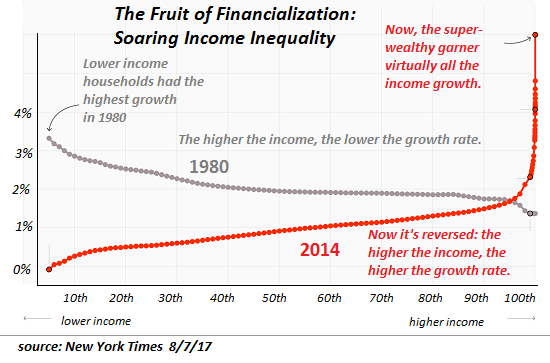
If you don’t understand why a war on wealth and the wealthy is inevitable, please study this chart: the way of the Tao is reversal.
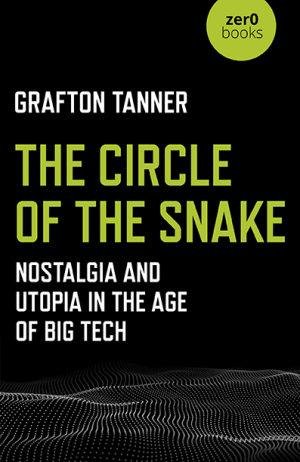
The Circle of the Snake: Nostalgia and Utopia in the Age of Big Tech
By Grafton Tanner
Zero Books, 2020
I’m sure many members of Generation X have taken a moment to look around the pop culture landscape over the past decade and a half and had a sudden moment of realization: there are certainly a whole lot of people trying to sell me things using the media of my youth. Ultimately, this is nothing new. I remember when every pop culture moment, from sitcoms to TV commercials, seemed to be using the Baby Boomers’ favorite songs to sell them cars and sneakers. But in 2020, the dominance of these re-treaded properties is even more nakedly cynical, whether its the endless sequels of the Star Wars and Marvel cinematic universes, or the easy-to-consume, signifier-filled pastiches of the worlds of Stranger Things and Ready Player One. The cultural marketplace, as dominated by bloated media and tech empires, no longer sees any need to admit the novel, the fresh, the unusual.
Both the “why” and the “how” of this cultural and technological tendency are explored by author Grafton Tanner in his new book, The Circle of the Snake: Nostalgia and Utopia in the Age of Big Tech. (Disclosure: Tanner is an occasional contributor to We Are The Mutants.) Tanner explores not only the pop culture properties that utilize nostalgia in an effort to assuage the anxieties of contemporary life in the aftermath of the 2008 financial rupture; he also explains how tech companies use the feedback from algorithmic analysis to keep consumers locked into a never-ending cycle—an ouroboros—of digital satisfaction of their subconscious desires for an older, more secure time. This nostalgic digital utopia, in turn, keeps consumers constantly “on,” working through endless “quests” that approximate proactivity but in the end keep people locked into pointless and unproductive cycles of feedback, emotional satisfaction, and control. “Recommender systems and predictive analytics—the very tools that allow our contemporary media to function—zero in on quick reactions, such as a flash of anger or a swell of nostalgia,” says Tanner in his Introduction. “These reactions are noted by algorithms, which then make recommendations based on them… The result is a nostalgic feedback loop wherein old ideas travel round.”
Tanner examines how the Big Tech tendency towards technolibertarianism and monopoly over the past 20 years has created the material conditions for this self-reinforcing system of psychic feedback. With an increasing belief in culture as disposable and “just for fun,” the material and political implications of this system of control are obfuscated. The way that these cultural narratives award Big Tech further and deeper power over all of us is merely part of the game. And we are enlisted as active players, not merely passive viewers, as in the era of television’s height. The online world, Tanner notes, demands a keen eye for analysis and a deep capacity for paying attention. The technolibertarian and neoliberal alike view our tech-suffused world—everyone is plugged in, 24/7—as a kind of utopia-in-waiting, or indeed a permanent utopia, where the idealized past can be endlessly revisited and basked in, while the present never changes from its current state of cultural and political stasis. This virtual plaza of commerce, emotional satisfaction, the illusion of proactivity, and control and surveillance describe the boundaries of Big Tech’s dominance of both our material and psychic space at the beginning of the 2020s.
The interview below was conducted in November and December 2020 via email and has been lightly edited for clarity.
***
GRASSO: Given the topic of your first book for Zero, Babbling Corpse: Vaporwave and the Commodification of Ghosts, the topic for The Circle of the Snake seems like a natural outgrowth. But from reading the book it also seems like there were a lot of specific events and observations about the world of Online and Big Tech over the past few years that led to the book’s development. What are the origins of The Circle of the Snake, and what kinds of specific cultural developments led you to propose and write the book?
TANNER: I can pinpoint the exact moment I knew I was going to write a book on Big Tech. I was living in a kind of exile in 2016, in this small town in Georgia, trying to piece my life back together after a series of false starts after college. I was sitting in a Barnes & Noble reading the 2016 Tech Issue of The Atlantic, and there was a story by Bianca Bosker about former Google employee Tristan Harris, who left the Valley and started an advocacy group called Time Well Spent because he thought Big Tech was eroding mental health. He was on a mission to fix Big Tech by making it work for us, not against us. But the piece didn’t make me feel better about tech. In fact, it was terrifying: here is an ex-Valley technocrat, mournful that he had invented habit-forming technology with severe public side effects, asking us to not only forgive him, but believe in him to create newer, better tech. I was incensed.
Shortly thereafter, we learned that Cambridge Analytica sharpened their psychographic modeling techniques by harvesting Facebook data from millions of users without their permission, all to aid in the election of Donald Trump. There was suddenly this huge backlash against Big Tech. I was supportive of it, but I also understood it came a little too late. Tech critics had been sounding the alarm for years and years. It took the election of a fascist for the left to wake up to the tech nightmare, only to realize the ones promising to end the nightmare were former technocrats themselves.
And yet, as many were loudly critiquing Big Tech for its role in throwing elections, spreading fascism, and worsening mental health, the culture industry was churning out politically retrograde nostalgia-bait. Was it really that the techlash had made everyone even more nostalgic for the pre-digital past? Or was there some kind of connection between nostalgia and Big Tech? These were the questions I had in mind when I started writing.
GRASSO: I think one of the things I like best about the book is your fusion of theory, philosophy, and epistemology with the material and economic realities of 21st century Big Tech and Big Media. Throughout the book you explore concepts such as surveillance, sublimity, nostalgia (of course), and virtuality with concrete examples from the online plaza. Essentially, if I’m not mistaken, you’re saying that the people who created the feedback loops that keep us hooked on technology and the internet and mine our data for still more ways to sell to us have themselves studied their philosophy, economic history, and techniques of mass psychology and persuasion with great attention?
TANNER: Persuasion techniques, yes, but I wouldn’t go so far as to say the technocrats have studied much else beyond their limited worldview, which is scientistic. Yes, technocrats like James Williams and Tristan Harris like to cite philosophers, but they usually do it to support their self-help solutions to the attention economy. Wake up with a little philosophy, they say, because reading Socrates is better for the mind than scrolling through Twitter. It’s a very neckbeard way of thinking about cultural consumption.
Make no mistake: these technocrats are uninterested in anything other than making a lot of money. If that means learning psychological techniques of persuasion with Stanford psychologist B.J. Fogg, then so be it. They weren’t and aren’t trying to make the world a better place or something. Like the banks before the Great Recession, the technocrats are out to make a quick buck by any means necessary, and they would have kept on doing what they were doing if the bubble hadn’t burst. People were disgruntled with Facebook for years before Cambridge Analytica, and tech critique was already a robust genre by 2016. But it took a kind of implosion, a Great Recession-style reckoning with Big Tech, to change the public opinion. Honestly, the technocrats would probably benefit from studying a little history and philosophy, instead of cloistering themselves in the ideological fortress of STEM.
GRASSO: I think one of the “oh shit” moments in the text for me was finding out that the Black Mirror special choose-your-own-adventure episode “Bandersnatch,” which I quite liked mostly for its material and inspirational signifiers (early ’80s computing, references to Philip K. Dick) was also used to mine viewers’ data in a delightfully dark real-life Dickean stroke. It’s not merely that nostalgia offers us a safe place from the dangerous present, but that those who create these nostalgic visions are working hand-in-hand with the very media empires that make us crave the past: another ouroboros.
TANNER: “Bandersnatch” not only exploits viewers’ nostalgia for its own gain, but it further normalizes the feeling of being controlled. Everyone today knows we’re being controlled from afar: by Twitter, Instagram, Amazon, insurance companies, think tanks, banks, and so forth. We are part of this giant social experiment called consumer capitalism. The purpose is to find out what we’ll buy. But we aren’t being controlled by future gamers or, as much as Elon Musk would like to believe, programmers in this computer simulation we call life. “Bandersnatch” is a work of fiction masquerading a horrible fact—that Netflix is the one controlling us, that we are not as in control as we think. The irony, of course, is that we relinquish our control via the technology we use every day, but we ultimately have very little choice in the matter. Students use devices at school, and jobs often require employees to have smartphones. We aren’t puppets, but we’re by no means totally free either.
GRASSO: So that leads me to asking you about your critique of specific media franchises: Stranger Things and the endless array of sequels and especially reboots we’ve seen since the end of the aughts. You very cannily explore Stranger Things‘ reliance on physical signifiers of commodities and objects that are no longer extant but remind us of the shackles of our technology-laden present (the old landline telephone, the shopping mall) as a key to its appeal to both Gen-Xers who were there and Zoomers who weren’t. Likewise the cinematic reboot is a way to cheaply create product and content that will connect with multiple generations. This element of “spot the Easter egg, aren’t you smart?” for older generations melds with the offer of a trip to a now-alien time for younger generations. These franchises seem to simultaneously reward passive immersion in nostalgia with an illusion of proactivity.
TANNER: Well, the spot-the-Easter-egg activities are very often nostalgic exercises themselves. Viewers are invited to find the nostalgic signifiers, even if they don’t know what they are. That’s the brilliance of Easter egg marketing for advertisers: you might not know what the hidden clue means, but you know it’s a clue and so you make note of it. Of course, the “real” fans will be able to cite all the references, but regular viewers can sometimes recognize a clue, like a corded phone or a VCR or a reference to an older movie, when they see it.
Easter egg marketing is the advertising tactic of choice in the prosumer age. It turns watching into a game. And it’s very heuristic. The films with the most Easter eggs inspire the most “count them all” YouTube videos or Buzzfeed listicles. The problem here isn’t that movies and series reference a bunch of older media; the problem is that Easter eggs reference certain things and leave others out, thus establishing these unnecessary pop culture canons. I don’t care that the Halloween franchise makes reference to itself. It’s an extended universe at this point—of course it’s going to do that. What I find questionable is its constant updating in an attempt to recapture the magic of the original film. I’m always signaling my love of Halloween III: Season of the Witch, but that film is too wacky to be included in the Halloween universe, because the franchise is desperately trying to give us the original again, as if it were the first time, without all the messy parts of the sequels. The Halloween filmmakers want to keep the bloodline of the first film pure, which means anything standing in the way must be excised.
GRASSO: You mark the period between 9/11 and the financial crisis of 2008 (and its aftermath) as the final foreclosure of any alternative to our current future and one of the dividing lines between an idealized past depicted in our nostalgic media and the forever Now. Unsurprisingly, so many of the elements of online life we now recognize as irredeemably toxic (social media, ranking and rating apps, tentpole cinematic universes full of identical sequels) began around the end of the Bush years as well.
TANNER: One of these days, I’m going to write a history-critique of the 2000s. I find the decade fascinating. It was probably the nadir of contemporary culture. Mark Fisher called it “the worst period for (popular) culture since the 1950s.”
It’s true: there was no breaking point at which contemporary nostalgia ramped up. It was a gradual shift between 9/11 and the Great Recession. Directly after 9/11, the U.S. was reeling from shock. Before nostalgia set in later in the decade, there was a feeling of futurelessness, as Robert Jay Lifton wrote—a feeling that there can be no future after 9/11, that the fear of another terrorist attack foreclosed the future altogether, that if people could fly planes into buildings on a regular weekday morning, then anything horrific is possible. During these years, we saw the birth of cinematic universes with the Star Wars prequels and the first megabudget superhero films. Of course, there were Batman, Superman, and Star Wars films before the twenty-first century, but it was after 9/11 that we saw the avalanche of these movies, several of which could not have been made without post-9/11 Pentagon support, with its bloated influence and near-endless supply of capital. You cannot downplay the reach these films have. They’re seen all over the world. And they aren’t just pro-military propaganda, they are engines of nostalgia.
After the Great Recession, nostalgia calcified. People were moving back in with their parents, revisiting old memories to soothe the anxiety of joblessness. Financial recessions are progressive only for the bankers, if they’re bailed out. For workers, they’re regressive. They set people back and invite the sufferers to hide away from it all. There is nothing wrong with this reaction. We cannot blame people who were hit by the Recession for their nostalgia. But we can blame the ones who caused it. And austerity measures only increase the desire to escape into nostalgic feelings. In short, financial meltdowns are crises that affect the future because they erase the plausibility of surviving the present.
GRASSO: You state that nostalgia is not only an emotion used to track us and to trigger specific emotional responses (which themselves are often assuaged by consumption), but also, possibly most importantly, to control us. And that control is not only physical/material but also social/aesthetic, limiting our options to wander away from the digital plaza. How do nostalgia and nostalgic media help this attempt by the market to quantify, objectify, and commodify us, the consumer?
TANNER: Content creators—a sickening term that reduces art and culture to commodities—understand the value of nostalgia. Consumer scientists have known for years that nostalgia sells. If anger draws your attention to the screen, then nostalgia triggers you to buy what will soothe the anger. That’s the cycle we’re dealing with in the present century.
And the worse things get, the more that nostalgia will naturally rise to the surface for many people. It’s not that media companies force-feed nostalgia to us. Many people are already feeling the emotion. It’s inescapable because nostalgia is a modern condition. Corporations merely go the extra mile by locking nostalgia into these feedback loops. The more you feed nostalgia into the cultural industry, the more of it you will consume because entire companies depend on you to want it. We live in a world of disruption, and every modern displacement is accompanied by nostalgia. Corporate capital knows this and depends on it.
GRASSO: Two of the specific technologies you talk about, Instagram and virtual reality, have undergone mutations in their appeals to our desire to escape the modern world. Instagram started off as a fairly disposable nostalgic evocation of the Polaroid camera aesthetic and has become a playground for big-money influencers and exhibitionists; virtual reality has evolved into just another facet of the internet’s control apparatus, despite its conceptual origins in early ’80s cyberpunk and its promised potential to give people the ability to create their own worlds. Why do these technologies seem to always mutate in the direction of greater commercialization and/or control, despite their initial apparent harmlessness or revolutionary promise?
TANNER: In the case of Instagram, its nostalgia factor was mainly due to the horrible photo quality of early smartphone cameras. With some Wi-Fi, a phone, and an app, you could take photos anywhere and upload them on the spot, which was enticing enough for many people to do just that, but you couldn’t deny the photo quality was very poor. So one way to deal with this poor quality was to saturate photos in a kind of analog haze, which could be done by applying one of several different stock filters. I can’t emphasize this enough: so much of our nostalgic appetite in the early 2010s was whetted by the inability to take and post a decent looking digital photo.
Whether it’s Instagram or virtual reality, digital technology is never totally harmless. It’s like when Tristan Harris and the Center for Humane Tech guys tell us we can have our digital cake and eat it too. You can’t have “humane tech” because tech is driven by the profit motive, which itself is often powered by another force: the military. Have you seen this new recruiting ad for the Marine Corps? It’s basically telling young people that joining the military will be an escape from the overwhelming anxieties of the digital age. The scariest thing about the ad is that it conceals the long relationship between tech and the military. Which is to say, the “tech” presented in the ad couldn’t exist without the military-industrial complex. At this point, any new, possibly revolutionary digital technology will either be bought out by a Big Tech monopoly or put to use on the battlefield.
GRASSO: As far as solutions and escapes from this predicament go, you talk a little bit about the ineffectual attempts of former technocrats to try to ameliorate our enslavement to the internet and social media with apps that limit time on websites or “safety labels,” and find them all wholly wanting. Likewise, you mention attempts to make nostalgia something constructive, playful, reflective (in the schema of Svetlana Boym). And yet the very structure of the internet and Big Media as it stands now denies all alternatives to the current control stasis. What does a constructivist nostalgia look like? Where could it exist in the cracks of the current marketplace? Is there a place for nostalgia as a political instrument of the left outside of the usual avenue of Left Melancholy?
TANNER: I’m currently writing a history of nostalgia, out fall 2021 with Repeater Books, called The Hours Have Lost Their Clock: A Recent History of Nostalgia. In it, I put forth a theory of radical nostalgia, drawing on the work of Alastair Bonnett and Svetlana Boym. Radical nostalgia is the third “R” beyond reflective and restorative nostalgia, which Boym coined. She was right about nostalgia, but over the first two decades of the present century, restorative nostalgia ballooned while the reflective strains were edged to the margins. But there needs to be this third form, radical nostalgia, because the melancholic disposition of reflective nostalgia just hasn’t been working for the left and the restorative tint has proven to be destructive.
Radical nostalgia is the act of looking back to those moments when collective action stood up to capital. It yearns for the social movements of the past. It aches for them. It isn’t interested in “getting back there,” in restoring what’s been lost, but in learning from those who came before: the struggle for indigenous rights, the staunch anti-capitalism of Martin Luther King Jr., Stonewall, the Battle of Seattle. When Richard Branson signals his support for LGBTQ+ communities, that isn’t radical nostalgia. There’s nothing radical about it; it’s mere nostalgia. Radical nostalgia looks to these and other movements to continue the fight for a more egalitarian future. It is inherently anti-fascist.
Radical nostalgia takes the action step of restorative and the aching heart of reflective nostalgia and fuses them together. It knows that the past isn’t perfect, which means what we yearn for shouldn’t be either. Restorative nostalgia is too clean, too high-definition. Reflective nostalgia kicks the can around, although reflectors might recognize the problems of the past long before the restorers do. But radical nostalgia knows that everything is imbued with horror, the past especially. Many revolutionary movements of the past suffered from machismo and intolerance, even in their own collectives. Radical nostalgia knows this and endeavors to leave it in the past. Some things must remain buried.
And radical nostalgia is one perspective we can take to resist the utopian thinking of tech. At this point, Big Tech is about the only entity that circulates visions of the future, but those visions are falling out of favor thanks to the techlash. Get ready, because they will absolutely be replaced with a different utopian vision: the humane tech movement. We’re going to be dealing with the technocrats for years. It’s going to seem like we should trust Tristan Harris and the Center for Humane Tech guys. They’re going to be pushing their vision of the future for years to come. But they are the new boss, same as the old. Only collective action, informed by the decolonial and anti-fascist movements of history, can resist what’s coming in the next decade and beyond.
The latest example of hypocrisy is Dr. Deborah Birx, White House coronavirus advisor. It turns out she traveled to meet her family for Thanksgiving after telling Americans not to travel, not to gather with family outside their immediate households.
Gavin Newsom, the governor of California, told the public they should celebrate Thanksgiving outdoors. Then he was caught having dinner, indoors, at a restaurant, unmasked, with 12 people.
There are other examples.
The usual explanation: these officials are arrogant and believe they’re above the law. They want to thumb their noses at the little people.
Yes, no doubt. But a more direct reason is staring us in the face.
The hypocritical officials know the whole COVID pandemic is a fraud.
They know there is no danger.
They know the lockdowns are unnecessary.
That’s why these officials break their own rules.
Why would they expose themselves to “the virus,” unless they knew they were safe?
Some of them believe they’re trapped in a political apparatus that offers no exit. They must go along with the show. They must participate in the fraud because, for example, federal dollars flow into their states, and those dollars are contingent on “playing the COVID game.”
Other officials have been bribed, blackmailed, threatened.
Regardless, they know they can flout their own rules because there is no health risk, no danger.
The risk is on the level of betting on a boxing match, when the bout is fixed, and you know who will win.
People will say, “These officials aren’t smart enough to figure out COVID is a fraud.”
You don’t have to be smart, you don’t have to understand all the intricate details of the fake test, the fake case and death numbers based on the test. You just need to understand enough.
You just need to be clued in.
This would suggest the COVID fraud is an open secret, shared by many in power. I believe that is exactly the case.
For purposes of comparison, consider a level of “secret understanding” slightly above that of politicians. Government scientists.
These scientists are fully aware that the PCR test for COVID is a complete hoax—for reasons I’ve detailed over the past nine months. Therefore, the scientists also know the case numbers based on those tests are fraudulent. And they know the case numbers are used as the rationale for the lockdowns.
That’s a lot of knowing. That’s a lot of “open secret.”
Here’s another comparison. PCR techs in labs all over the world, who are running the test, are fully cognizant of the crimes they’re committing every day—by utilizing “too many cycles” and therefore destroying any shred of validity when diagnosing ANYTHING.
Sharing this open secret among themselves, they otherwise remain silent.
Getting the picture?
The open secret of the COVID fraud isn’t confined to a dozen people in a sealed room. It’s high and wide. It’s understood by many in positions of power and responsibility, all over the world.
You can add your own lists of “secret sharers.” Mainstream physicians, for example. Physicians who are in charge of administering the COVID vaccines they know are unnecessary and dangerous. They also remain silent. So do certain news media people.
And since there are so many people who know the real score, we can begin to see the degree and extent of complicity that is driving the whole pandemic hoax.
This isn’t only a small conspiracy of movers and shakers who planned it and launched it.
This is a very wide-ranging conspiracy of silence.
“Don’t blame me. I’m just following orders.”
“But you know COVID is a total fraud.”
“Of course I know.”
“And you know others who know.”
“Many others.”
“Case closed.”
Which is to say, case WIDE OPEN.
The COVID situation is directly analogous to the Nazi, USSR, and Chinese bureaucracies; faceless workers passing on and obeying orders.
Many of the workers know those orders, no matter how they are dressed up, are arbitrary and evil.
The orders are initiated to destroy lives and freedom, and are transferred through the human machinery of The Complicit Silent Ones.
In 1935, reflecting on the creed of productivity which prevailed in modern technological societies, Bertrand Russell, philosopher, pacifist and devout humanist wrote that:
“I think that there is far too much work done in the world, that immense harm is caused by the belief that work is virtuous, and that what needs to be preached in modern industrial countries is quite different from what always has been preached.”
‘In Praise of Idleness and other essays’ is a collection of striking power and originality. Whereas the receieved wisdom of his era held that virtue consisted in yielding to work, monotony and routine, Russell maintained it was not the sole end of life, that beyond work, people needed leisure and pleasure in order to fully live, that what was sought to truly advance society and fortify the human condition was the “organized diminution of work.”
Through the 1920s and 30s Fordism advocated the exact opposite and the cult of productivity began to exert a strong hold on economic and social organization in Europe, the USA and Soviet Union. In the story Brave New World, Aldous Huxley envisioned a society of tyrannical collectivism which raised hell on Earth. In this dehumanizing, nihilistic oblivion, Henry Ford was worshipped as a deity and the fundamentalism of mass production crept in to all spheres of life, rigidly classifying people whose whole lives were planned out on a callow basis of crude economic worth. It was a study in how powerful forces of sublimation and repression incarnate in the edifice of the modern world mutilate our most vital, human instincts and wrench us from our roots.
Huxley’s main belief was that technological ‘progress’ had empowered the worst bureaucrats to assimilate citizens in to a sophisticated machine of repression and control which blocked and frustrated their freedom. Although, as Russell observes, in truth “with modern technique it would be possible to distribute leisure justly without injury to civilization“, the owners of the means of production in the capitalist economy absorb modern technique in to their arsenal against collective liberation. It is not in their interests to free us from bonds.
Of the proprietary class, Russell says:
“their desire for comfortable idleness is historically the source of the whole gospel of work. The last thing they have ever wished is that others should follow their example. “
That is to say that freedom and unfreedom aren’t opposites. The affluence and freedom of the proprietors actively depends on the subjugation of workers who create value.
Throughout his life Bertrand Russell was keenly involved with communities of students, activists and workers who organized against imperialism and the war machine. His belief that people could work less and live more was part of his belief that the economic system could be harnessed to more altruistic ends, justified more reasonably, attuned to satisfy people’s needs and fit to unleash their inherent creative power, instead of conforming to bourgeois imperatives.
Lately Professor Stephen Hawking has weighed in on the question of modern social organization and proffered the view that people need not be scared of machines, but ought to be wary of the systems and people who wield them. Why be scared of the unknown power of machines when what we know about the people who own them is far, far scarier?
Hawking said:
“If machines produce everything we need, the outcome will depend on how things are distributed. Everyone can enjoy a life of luxurious leisure if the machine-produced wealth is shared, or most people can end up miserably poor if the machine-owners successfully lobby against wealth redistribution. So far, the trend seems to be toward the second option, with technology driving ever-increasing inequality.”
Hawking’s view is much like Russell’s and would be called post-scarcity economics. The crux of this view is that competition for resources is not a necessary feature of an economy, that material abundance may be universal instead of there being a socially imposed monopoly of access, regulated by money and work. Like trickle-down theory, scarcity economics is not necessarily based in reality. It goes without saying that obviously we need to find a way reach this economy and mode of production in accordance with environmental protection, which models after the Industrial Revolution got disastrously wrong.
The challenge of the future is to make machines our allies and not our jailers.
Like it or not, the COVID-19 pandemic with its veiled threat of forced vaccinations, contact tracing, and genetically encoded vaccines is propelling humanity at warp speed into a whole new frontier—a surveillance matrix—the likes of which we’ve only previously encountered in science fiction.
Those who eye these developments with lingering mistrust have good reason to be leery: the government has long had a tendency to unleash untold horrors upon the world in the name of global conquest, the acquisition of greater wealth, scientific experimentation, and technological advances, all packaged in the guise of the greater good.
Indeed, “we the people” have been treated like lab rats by government agencies for decades now: caged, branded, experimented upon without our knowledge or consent, and then conveniently discarded and left to suffer from the after-effects.
You don’t have to dig very deep or go very back in the nation’s history to uncover numerous cases in which the government deliberately conducted secret experiments on an unsuspecting populace, making healthy people sick by spraying them with chemicals, injecting them with infectious diseases and exposing them to airborne toxins.
Now this same government—which has taken every bit of technology sold to us as being in our best interests (GPS devices, surveillance, nonlethal weapons, etc.) and used it against us, to track, control and trap us—wants us to fall in line as it prepares to roll out COVID-19 vaccines that owe a great debt to the Pentagon’s Defense Advanced Research Projects Agency for its past work on how to weaponize and defend against infectious diseases.
This is all part of Operation Warp Speed, which President Trump has likened to the Manhattan Project, a covert government effort spearheaded by the military to engineer and build the world’s first atomic bomb.
There is every reason to tread cautiously.
There is a sinister world beyond that which we perceive, one in which power players jockey for control over the one commodity that is a necessary ingredient for total domination: you.
By you, I mean you the individual in all your singular humanness.
Remaining singularly human and retaining your individuality and dominion over yourself—mind, body and soul—in the face of corporate and government technologies that aim to invade, intrude, monitor, manipulate and control us may be one of the greatest challenges before us.
The groundwork being laid with these vaccines is a prologue to what will become the police state’s conquest of a new, relatively uncharted, frontier: inner space, specifically, the inner workings (genetic, biological, biometric, mental, emotional) of the human race.
The term “matrix” was introduced into our cultural lexicon by the 1999 film The Matrix in which Neo, a computer programmer/hacker, awakens to the reality that humans have been enslaved by artificial intelligence and are being harvested for their bio-electrical energy.
Hardwired to a neuro-interactive simulation of reality called the “Matrix,” humans are kept inactive and docile while robotic androids gather the electricity their bodies generate. In order for the machines who run the Matrix to maintain control, they impose what appears to be a perfect world for humans to keep them distracted, content, and submissive.
Here’s the thing: Neo’s Matrix is not so far removed from our own technologically-hardwired worlds in which we’re increasingly beholden to corporate giants such as Google for powering so much of our lives. As journalist Ben Thompson explains:
Google+ is about unifying all of Google’s services under a single log-in which can be tracked across the Internet on every site that serves Google ads, uses Google sign-in, or utilizes Google analytics. Every feature of Google+—or of YouTube, or Maps, or Gmail, or any other service—is a flytrap meant to ensure you are logged in and being logged by Google at all times.
Everything we do is increasingly dependent on and, ultimately, controlled by our internet-connected, electronic devices. For example, in 2007, there were an estimated 10 million sensor devices connecting human utilized electronic devices (cell phones, laptops, etc.) to the Internet. By 2013, it had increased to 3.5 billion. By 2030, it is estimated to reach 100 trillion.
Much, if not all, of our electronic devices will be connected to Google, a neural network that approximates a massive global brain.
Google’s resources, beyond anything the world has ever seen, includes the huge data sets that result from one billion people using Google every single day and the Google knowledge graph “which consists of 800 million concepts and billions of relationships between them.”
The end goal? The creation of a new “human” species, so to speak, and the NSA, the Pentagon and the “Matrix” of surveillance agencies are part of the plan. As William Binney, one of the highest-level whistleblowers to ever emerge from the NSA, said, “The ultimate goal of the NSA is total population control.”
Mind you, this isn’t population control in the classic sense. It’s more about controlling the population through singularity, a marriage of sorts between machine and human beings in which artificial intelligence and the human brain will merge to form a superhuman mind.
The term “singularity”—that is, computers simulating human life itself—was coined years ago by mathematical geniuses Stanislaw Ulam and John von Neumann. “The ever accelerating progress of technology,” warned von Neumann, “gives the appearance of approaching some essential singularity in the history of the race beyond which human affairs, as we know them, could not continue.”
Advances in neuroscience indicate that future behavior can be predicted based upon activity in certain portions of the brain, potentially creating a nightmare scenario in which government officials select certain segments of the population for more invasive surveillance or quarantine based solely upon their brain chemistry.
Case in point: researchers at the Mind Research Center scanned the brains of thousands of prison inmates in order to track their brain chemistry and their behavior after release. In one experiment, researchers determined that inmates with lower levels of activity in the area of the brain associated with error processing allegedly had a higher likelihood of committing a crime within four years of being released from prison. While researchers have cautioned against using the results of their research as a method of predicting future crime, it will undoubtedly become a focus of study for government officials.
There’s no limit to what can be accomplished—for good or ill—using brain-computer interfaces.
Researchers at Duke University Medical Center have created a brain-to-brain interface between lab rats, which allows them to transfer information directly between brains. In one particular experiment, researchers trained a rat to perform a task where it would hit a lever when lit. The trained rat then had its brain connected to an untrained rat’s brain via electrodes. The untrained rat was then able to learn the trained rat’s behavior via electrical stimulation. This even worked over great distances using the Internet, with a lab rat in North Carolina guiding the actions of a lab rat in Brazil.
Clearly, we are rapidly moving into the “posthuman era,” one in which humans will become a new type of being. “Technological devices,” writes journalist Marcelo Gleiser, “will be implanted in our heads and bodies, or used peripherally, like Google Glass, extending our senses and cognitive abilities.”
Transhumanism—the fusing of machines and people—is here to stay and will continue to grow.
In fact, as science and technology continue to advance, the ability to control humans will only increase. In 2014, for example, it was revealed that scientists have discovered how to deactivate that part of our brains that controls whether we are conscious or not. When researchers at George Washington University sent high frequency electrical signals to the claustrum—that thin sheet of neurons running between the left and right sides of the brain—their patients lost consciousness. Indeed, one patient started speaking more slowly until she became silent and still. When she regained consciousness, she had no memory of the event.
Add to this the fact that increasingly humans will be implanted with microchips for such benign purposes as tracking children or as medical devices to assist with our health. Such devices “point to an uber-surveillance society that is Big Brother on the inside looking out,” warns Dr. Katina Michael. “Governments or large corporations would have the ability to track people’s actions and movements, categorize them into different socio-economic, political, racial, or consumer groups and ultimately even control them.”
All of this indicates a new path forward for large corporations and government entities that want to achieve absolute social control. Instead of relying solely on marauding SWAT teams and full-fledged surveillance apparatuses, they will work to manipulate our emotions to keep us in lock step with the American police state.
Now add this warp speed-deployed vaccine to that mix, with all of the associated unknown and fearsome possibilities for altering or controlling human epigenetics, and you start to see the perils inherent in blindly adopting emerging technologies without any restrictions in place to guard against technological tyranny and abuse.
It’s one thing for the starship Enterprise to boldly go where no man has gone before, but even Mr. Spock recognized the dangers of a world dominated by AI. “Computers make excellent and efficient servants,” he observed in “The Ultimate Computer” episode of Star Trek, “but I have no wish to serve under them.”
When the top 10%’s bubble pops in 2021, the loss of illusions/delusions of security and wealth will be shattering to all those who believed artifice and illusory “wealth” were real.
A great many people are living in bubbles that are about to pop. The largest bubble is the one inhabited by people who complacently believe in time travel, i.e. that the world of 2019 is about to replace the nightmare of 2020 and we can all go back to our carefree debt-funded consumption frenzy and illusions of ever-greater wealth forever and ever.
The greater one’s sense of security, the more durable the bubble. Those in America’s top 10% who have reaped virtually all the gains in income and wealth of the past 20 years live in a bubble that they view as unbreakable: no matter what problems arise, their personal income and wealth is secured by the government, central bank, etc.
Put another way, the top 10% are confident their position atop the wealth-power pyramid is secure no matter what happens. Any dip in stocks, bonds, real estate, bat guano futures, etc. that causes their personal wealth to decline (horrors!) will be instantly bought because the Federal Reserve will print another couple trillion dollars and funnel it into risk assets, as it has done for the past 20 years.
Any spot of bother in the gravy trains that fund the top 10%–local and state government, universities, Big Tech, Big Pharma, Department of Defense, Wall Street, hedge funds, venture capital, etc.– will be doused with trillions of dollars borrowed or printed into existence by the Treasury or Fed. No matter what spot of bother arises, the solution–more trillions–is just a few keystrokes away.
The top 10% are supremely confident in the godlike powers of these agencies and solutions: the idea that these “solutions” become insoluble problems does not compute, just as a decline in asset valuations that doesn’t rebound within three weeks thanks to Fed intervention is firmly outside the realm of possibility.
The top 10% are also supremely confident in the rightness of their position atop the heap. That their position atop the heap is largely the result of a web of privilege and a long run of extraordinarily good fortune does not enter their bubble at all; in their bubble, their wealth, status, prestige and income are all the result of hard work and merit.
While this is certainly true for some, it is not true for all, and even those who scraped their way to the top the hard way do not recognize that their success over the past 20 years (and arguably the past 50 years) has been largely the result of a financialized rising tide raising all boats. In a Bull Market in virtually everything (except commodities), everyone is a hard-working genius who got it all via merit.
On top of this myopic belief that their success is all the result of their own endeavors rather than a tide of financialization, the top 10% are equally blind to the toxic consequences of the wealth/income inequality that has so richly benefited the few at the expense of the many. The idea that the bottom 90% might rebel against the financial / political system that has favored the already-wealthy for a generation is outside the top 10%’s realm of possibility.
But tides do not run in one direction forever, and a revolt against the unprecedented inequality that heavily favors the top 10% is not “impossible,” it’s a certainty. The top 10% are accustomed to being admired and respected for their accomplishments, expertise, wise investing and professional acumen. They are accustomed to viewing themselves as the essential technocrat class that keeps the U.S. system functioning.
The problem with this self-congratulatory perspective is the U.S. system is now in thrall to process rather than results. The technocrat class has been trained to follow needlessly complex procedures and compliance processes as the path to professional advancement while avoiding accountability for the increasingly dismal results of America’s bloated, sclerotic, insider-dominated systems.
All this needless complexity will be jettisoned once printing/borrowing trillions become the problem rather than the solution. The bottom 90% will demand not just a fairer distribution of income and wealth, they will also demand a system that actually functions for the greater social good rather than for insiders, parasites, leeches and technocrat processors who declare victory not from results but from their success in following approved processes / narratives.
Once costs must be cut and results take precedence over process, much of the technocrat class will find itself replaced by automated software. Those that remain will be valued for getting results by whatever means are available, up to and including ignoring all compliance procedures and bureaucratic box-ticking.
The top 10%–the rentier-technocrat class–will find the bottom 90% can no longer pay their rent, insurance, etc.–all the “services” that employ and enrich the top 10%. In other words, the losses as unproductive complexity unravels will finally fall on the top 10%, many of whom have been protected from exposure to market forces and risk.
Lastly, the top 10%’s ownership of assets will be crushed by asset deflation as insolvency can no longer be papered over by liquidity. Assets that are the foundation of top 10% wealth (that the bottom 90% own very little of) will go bidless as phantom wealth dissipates into the thin air from whence it came.
The top 10% reckon they’re untouchable, safe and protected in their asset lifeboats, and the sinking of the 90% won’t affect them. The top 10%’s bubble is about to burst. Not only will their lifeboats prove unstable, every level of government will come after whatever is left as taxes will soar on virtually every form of income and wealth.
Unlike the bottom 60%, who have few illusions about the rampant unfairness and predation of real-world America, the top 10%’s bubble is 90% illusion seasoned with 10% absolute delusion. The comfortable are about to experience some of the discomfort that is everyday life for the bottom 60%, and an increasing percentage of the next 30% who still aspire to fantasies of middle-class security will find social mobility is an escalator down.
We cannot print wealth, or borrow it into existence. All we can print/borrow is artifice, phantom representations of illusory “wealth” that will vanish into thin air, in a reverse of how the “money” was created–out of thin air.
When the top 10%’s bubble pops in 2021, the loss of illusions/delusions of security and wealth will be shattering to all those who believed artifice and illusory “wealth” were real. What’s real is the tide of financialization and globalization reversed over a year ago. The tide is now running out, but few loading their “wealth” into lifeboats have noticed–yet.
“The people are unaware. They’re not educated to realize that they have power. The system is so geared that everyone believes the government will fix everything. We are the government.”—John Lennon
No doubt about it: 2020—a terrible, horrible, no good, very bad year for freedom—was the culmination of a terrible, horrible, no good, very bad decade for freedom.
Government corruption, tyranny, and abuse coupled with a Big Brother-knows-best mindset and the COVID-19 pandemic propelled us at warp speed towards a full-blown police state in which nationwide lockdowns, egregious surveillance, roadside strip searches, police shootings of unarmed citizens, censorship, retaliatory arrests, the criminalization of lawful activities, warmongering, indefinite detentions, SWAT team raids, asset forfeiture, police brutality, profit-driven prisons, and pay-to-play politicians were accepted as the norm.
Here’s just a small sampling of the laundry list of abuses—cruel, brutal, immoral, unconstitutional and unacceptable—that have been heaped upon us by the government over the past two decades and in the past year, in particular.
The government failed to protect our lives, liberty and happiness. The predators of the police state wreaked havoc on our freedoms, our communities, and our lives. The government didn’t listen to the citizenry, refused to abide by the Constitution, and treated the citizenry as a source of funding and little else. Police officers shot unarmed citizens and their household pets. Government agents—including local police—were armed to the teeth and encouraged to act like soldiers on a battlefield. Bloated government agencies were allowed to fleece taxpayers. Government technicians spied on our emails and phone calls. And government contractors made a killing by waging endless wars abroad.
The American President became more imperial. Although the Constitution invests the President with very specific, limited powers, in recent years, American presidents (Trump, Obama, Bush, Clinton, etc.) claimed the power to completely and almost unilaterally alter the landscape of this country for good or for ill. The powers that have been amassed by each successive president through the negligence of Congress and the courts—powers which add up to a toolbox of terror for an imperial ruler—empower whoever occupies the Oval Office to act as a dictator, above the law and beyond any real accountability. The presidency itself has become an imperial one with permanent powers.
Militarized police became a power unto themselves, 911 calls turned deadly, and traffic stops took a turn for the worse. Lacking in transparency and accountability, protected by the courts and legislators, and rife with misconduct, America’s police forces continued to be a menace to the citizenry and the rule of law. Despite concerns about the government’s steady transformation of local police into a standing military army, local police agencies acquired even more weaponry, training and equipment suited for the battlefield. Police officers were also given free range to pull anyone over for a variety of reasons and subject them to forced cavity searches, forced colonoscopies, forced blood draws, forced breath-alcohol tests, forced DNA extractions, forced eye scans, forced inclusion in biometric databases.
The courts failed to uphold justice. With every ruling handed down, it becomes more apparent that we live in an age of hollow justice, with government courts more concerned with protecting government agents than upholding the rights of “we the people.” This is true at all levels of the judiciary, but especially so in the highest court of the land, the U.S. Supreme Court, which is seemingly more concerned with establishing order and protecting government agents than with upholding the rights enshrined in the Constitution. A review of critical court rulings over the past two decades, including some ominous ones by the U.S. Supreme Court, reveals a startling and steady trend towards pro-police state rulings by an institution concerned more with establishing order and protecting the ruling class and government agents than with upholding the rights enshrined in the Constitution.
COVID-19 allowed the Emergency State to expand its powers. What started out as an apparent effort to prevent a novel coronavirus from sickening the nation (and the world) became yet another means by which world governments (including our own) could expand their powers, abuse their authority, and further oppress their constituents. While COVID-19 took a significant toll on the nation emotionally, physically, and economically, it also allowed the government to trample our rights in the so-called name of national security, with talk of mass testing for COVID-19 antibodies, screening checkpoints, contact tracing, immunity passports, forced vaccinations, snitch tip lines and onerous lockdowns.
The Surveillance State rendered Americans vulnerable to threats from government spies, police, hackers and power failures. Thanks to the government’s ongoing efforts to build massive databases using emerging surveillance, DNA and biometrics technologies, Americans have become sitting ducks for hackers and government spies alike. Billions of people have been affected by data breaches and cyberattacks. On a daily basis, Americans have been made to relinquish the most intimate details of who we are—our biological makeup, our genetic blueprints, and our biometrics (facial characteristics and structure, fingerprints, iris scans, etc.)—in order to navigate an increasingly technologically-enabled world.
America became a red flag nation. Red flag laws, specifically, and pre-crime laws generally push us that much closer towards a suspect society where everyone is potentially guilty of some crime or another and must be preemptively rendered harmless. Where many Americans go wrong is in naively assuming that you have to be doing something illegal or harmful in order to be flagged and targeted for some form of intervention or detention. In fact, all you need to do these days to end up on a government watch list or be subjected to heightened scrutiny is use certain trigger words (like cloud, pork and pirates), surf the internet, communicate using a cell phone, limp or stutter, drive a car, stay at a hotel, attend a political rally, express yourself on social media, appear mentally ill, serve in the military, disagree with a law enforcement official, call in sick to work, purchase materials at a hardware store, take flying or boating lessons, appear suspicious, appear confused or nervous, fidget or whistle or smell bad, be seen in public waving a toy gun or anything remotely resembling a gun (such as a water nozzle or a remote control or a walking cane), stare at a police officer, question government authority, appear to be pro-gun or pro-freedom, or generally live in the United States. Be warned: once you get on such a government watch list—whether it’s a terrorist watch list, a mental health watch list, a dissident watch list, or a red flag gun watch list—there’s no clear-cut way to get off, whether or not you should actually be on there.
The cost of policing the globe drove the nation deeper into debt.America’s war spending has already bankrupted the nation to the tune of more than $20 trillion dollars. Policing the globe and waging endless wars abroad hasn’t made America—or the rest of the world—any safer, but it has made the military industrial complex rich at taxpayer expense. The U.S. military reportedly has more than 1.3 million men and women on active duty, with more than 200,000 of them stationed overseas in nearly every country in the world. Yet America’s military forces aren’t being deployed abroad to protect our freedoms here at home. Rather, they’re being used to guard oil fields, build foreign infrastructure and protect the financial interests of the corporate elite. In fact, the United States military spends about $81 billion a year just to protect oil supplies around the world. This is how a military empire occupies the globe. Meanwhile, America’s infrastructure is falling apart.
Free speech was dealt one knock-out punch after another.Protest laws, free speech zones, bubble zones, trespass zones, anti-bullying legislation, zero tolerance policies, hate crime laws, shadow banning on the Internet, and a host of other legalistic maladies dreamed up by politicians and prosecutors (and championed by those who want to suppress speech with which they might disagree) conspired to corrode our core freedoms, purportedly for our own good. On paper—at least according to the U.S. Constitution—we are technically free to speak. In reality, however, we are only as free to speak as a government official—or corporate entities such as Facebook, Google or YouTube—may allow. The reasons for such censorship varied widely from political correctness, so-called safety concerns and bullying to national security and hate crimes but the end result remained the same: the complete eradication of free speech.
The Deep State took over. The American system of representative government has been overthrown by the Deep State—a.k.a. the police state a.k.a. the military/corporate industrial complex—a profit-driven, militaristic corporate state bent on total control and global domination through the imposition of martial law here at home and by fomenting wars abroad. The “government of the people, by the people, for the people” has perished. In its place is a shadow government, a corporatized, militarized, entrenched bureaucracy that is fully operational and staffed by unelected officials who are, in essence, running the country and calling the shots in Washington DC, no matter who sits in the White House. Mind you, by “government,” I’m not referring to the highly partisan, two-party bureaucracy of the Republicans and Democrats. Rather, I’m referring to “government” with a capital “G,” the entrenched Deep State that is unaffected by elections, unaltered by populist movements, and has set itself beyond the reach of the law. This is the hidden face of a government that has no respect for the freedom of its citizenry. This shadow government, which “operates according to its own compass heading regardless of who is formally in power,” makes a mockery of elections and the entire concept of a representative government.
The takeaway: Everything the founders of this country feared has come to dominate in modern America. “We the people” have been saddled with a government that is no longer friendly to freedom and is working overtime to trample the Constitution underfoot and render the citizenry powerless in the face of the government’s power grabs, corruption and abusive tactics.
So how do you balance the scales of justice at a time when Americans are being tasered, tear-gassed, pepper-sprayed, hit with batons, shot with rubber bullets and real bullets, blasted with sound cannons, detained in cages and kennels, sicced by police dogs, arrested and jailed for challenging the government’s excesses, abuses and power-grabs, and then locked down and stripped of any semblance of personal freedom?
No matter who sits in the White House, politics won’t fix a system that is broken beyond repair.
For that matter, protests and populist movements also haven’t done much to push back against an authoritarian regime that is deaf to our cries, dumb to our troubles, blind to our needs, and accountable to no one.
So how do you not only push back against the government’s bureaucracy, corruption and cruelty but also launch a counterrevolution aimed at reclaiming control over the government using nonviolent means?
You start by changing the rules and engaging in some (nonviolent) guerilla tactics.
Take your cue from the Tenth Amendment and nullify everything the government does that flies in the face of the principles on which this nation was founded. If there is any means left to us for thwarting the government in its relentless march towards outright dictatorship, it may rest with the power of juries and local governments to invalidate governmental laws, tactics and policies that are illegitimate, egregious or blatantly unconstitutional.
In an age in which government officials accused of wrongdoing—police officers, elected officials, etc.—are treated with general leniency, while the average citizen is prosecuted to the full extent of the law, nullification is a powerful reminder that, as the Constitution tells us, “we the people” are the government.
For too long we’ve allowed our so-called “representatives” to call the shots. Now it’s time to restore the citizenry to their rightful place in the republic: as the masters, not the servants.
Nullification is one way of doing so.
America was meant to be primarily a system of local governments, which is a far cry from the colossal federal bureaucracy we have today. Yet if our freedoms are to be restored, understanding what is transpiring practically in your own backyard—in one’s home, neighborhood, school district, town council—and taking action at that local level must be the starting point.
Responding to unmet local needs and reacting to injustices is what grassroots activism is all about. Attend local city council meetings, speak up at town hall meetings, organize protests and letter-writing campaigns, employ “militant nonviolent resistance” and civil disobedience, which Martin Luther King Jr. used to great effect through the use of sit-ins, boycotts and marches.
The power to change things for the better rests with us, not the politicians.
As long as we continue to allow callousness, cruelty, meanness, immorality, ignorance, hatred, intolerance, racism, militarism, materialism, meanness and injustice—magnified by an echo chamber of nasty tweets and government-sanctioned brutality—to trump justice, fairness and equality, there can be no hope of prevailing against the police state.
We could transform this nation if only Americans would work together to harness the power of their discontent and push back against the government’s overreach, excesses and abuse.