BOSTON UPDATE: FBI War on Marathon Bombing Witnesses Continues

fbi-foils-fbi-plot

By James Henry

Source: WhoWhatWhy

The Boston Marathon bombing is much more important than has been acknowledged, principally because it is the major domestic national security event since 9-11 and has played a major role in expanding the power of the security state. For that reason, WhoWhatWhy is continuing to investigate troubling aspects of this story and the establishment media treatment of it. So even as it slips from the headlines, we will be exploring new elements of the story regularly as the trial of Dzhokhar Tsarnaev approaches. 

***

Since the Boston Marathon bombing a year and a half ago, the FBI appears to be intimidating, harassing, and silencing friends and acquaintances of the Tsarnaev brothers. Dzhokhar Tsarnaev’s lawyers have noticed it too—they’re having trouble getting anyone to talk to them, recent court papers reveal.

In what WhoWhatWhy previously described as the FBI’s “war on witnesses”, the Bureau seems to be employing a scorched earth strategy of destroying anything that might be of use to the “enemy.”

On August 29, Tsarnaev’s lawyers filed a motion requesting a continuance for more time to prepare their defense, noting the fact that they were given only half the median preparation time that federal courts have allowed over the past decade for defendants on trial for their lives. (The judge did grant a two-month delay while refusing the defense request to move the trial out of Boston.)

The lawyers cited “outpaced requirements” in building a proper defense for their client: (1) the international nature of the investigation—including language and geographic barriers, (2) the large amount of evidence that has to be scrutinized, and most tellingly, (3) the climate of intimidation and fear created by the FBI’s investigative efforts since the bombing. They write:

Domestic defense mitigation investigation has been conducted amid a growing atmosphere of anxiety and agitation generated by highly-publicized arrests, indictments, prosecutions, deportations (and, in one instance, the FBI killing) of members of Dzhokhar and Tamerlan Tsarnaev’s peer groups.

Most news reports brush over that last part. As if shooting to death an unarmed man involved in this case—as an FBI agent did to Tamerlan’s friend Ibragim Todashev—is not relevant to the difficulties the defense team has had in getting witnesses to talk to them. But even less extreme events are enough to silence potential witnesses, such as the mysterious closing of their bank accounts.

Prosecutors resisted this and an earlier attempt to have the trial delayed. The victims have a right to see justice done—swiftly, the thinking goes.

The victims and their families certainly deserve justice for this horrible atrocity. True justice should include a full accounting—something a hurried, one-sided investigation is not likely to produce. And of course Boston and the American public deserve, and need, the truth, whatever it may be.

Yet a close read of the motion document reveals FBI activities that seem more of an effort to conceal than to illuminate.

The FBI’s March to the Sea

Tsarnaev’s defense team makes reference to the most troubling—and most anxiety-producing—action by the FBI since the bombing: the shooting to death of Tamerlan’s friend, Todashev. (See our earlier story on the head-scratching circumstances surrounding that shooting, including the questionable history of the agent who pulled the trigger.)

Some of the FBI’s aggressive tactics described in the defense document look like outright intimidation. For instance, individuals “with lawful immigration status have been detained for hours and required to surrender their electronic devices upon re-entry to the United States.”

And take a look at this excerpt:

“The investigation has been further hampered by aggressive FBI follow-up tracking and questioning of potential witnesses, as well as by the unrelenting attention of the news media.”

It is one thing to be aggressively tracking and questioning individuals suspected of committing crimes, but to be doing this to presumably innocent witnesses reeks of intimidation. Witness intimidation is a tactic ordinarily associated with mafia or drug cartel defendants.

Notably, this “tracking” must have been brought to the attention of defense lawyers by witnesses themselves, indicating overt surveillance: “We’re watching you.”

Then, farther down in the document:

“These difficult circumstances are compounded by a continuing pattern of aggressive FBI re-interviewing of potential witnesses — on occasion within hours of an attempted contact by defense investigator [emphasis added].”

Within hours of an attempted contact by defense investigator? Is the defense team being watched too? (We reached out to Tsarnaev’s defense team hoping they could expand on that, but have not yet had a response.)

It wouldn’t be the first time the FBI was caught spying on defense lawyers in a high-profile terrorism case. Lawyers for accused 9/11 mastermind Khalid Shaikh Mohammed allege that the FBI has been surveilling  them.

Whether legal counsel are being watched directly or simply getting caught up in the surveillance of Tsarnaev’s acquaintances, the effect is the same: the feds know who is talking to whom, and when.

That’s a Nice Immigration Status You Got There…

Witnesses who are not U.S. citizens—which describes the majority of Tsarnaev’s friends, family, and many in the local Muslim community—are particularly vulnerable to law enforcement manipulation. The threat of deportation is a clear and present danger to these individuals, “regardless of whether criminal charges are ever brought or proven against them,” Tsarnaev’s lawyers wrote.

Indeed, a handful of people loosely connected to the Tsarnaevs have already been deported, or had deportation proceedings initiated against them, despite having nothing to do with the Boston Marathon bombing. These include:

–   Konstantin Morozov: friend of Tamerlan, arrested and jailed pending deportation reportedly after refusing to wear a wire for the FBI as the Bureau sought information on one of Tamerlan’s Chechen friends.

–   Tatiana Gruzdeva: girlfriend of Ibragim Todashev, deported after speaking with Boston Magazine about the circumstances surrounding her boyfriend’s death.

–   Ashurmamad Miraliev: friend of Ibragim Todashev, was reportedly denied a request for an attorney while interrogated by FBI for over six hours, and transferred to an immigration detention center where deportation proceedings were initiated.

–   Khusen Taramov: friend of Ibragim Todashev, denied reentry to the United States after visiting Chechnya, despite having a Green Card.

Why hasn’t Boston’s “liberal” media made more noise about this? Arguably, the most newsworthy portion of Tsarnaev’s motion for continuance—potential witness intimidation—has been glossed over or ignored in most mainstream media accounts.

The Florida chapter of the Council on American-Islamic Relations reached out to the media and the public to expose the intimidation and harassment of Todashev’s friends and associates—and got a fair amount press coverage by their local media. The same cannot be said for the Boston area press.

Have they, albeit indirectly, been intimidated, too? The Boston media has historically had a close relationship with law enforcement, and when it ever so slightly challenged the police, found its usual (and needed) sources shut down.

However, if ever there was a moment for the local press to do the right thing, this is surely it.

It’s Time for Some Anti-Science Fiction

nature-spaceships_00374723

Source: The Hipcrime Vocab

It’s Time for Some Anti-Science Fiction
Why must positive depictions of the future always be dependent upon some sort of new technology?

Neal Stephenson is a very successful and well-known science fiction writer. He’s also very upset that the pace of technological innovation has seemingly slowed down and we seem to be unable to come up with truly transformative  “big ideas” anymore. He believes this is the reason why we are so glum and pessimistic nowadays. Indeed, the science fiction genre, once identified with space exploration and utopias of post-scarcity and abundant leisure time, has come to be dominated by depictions of the future as a hellhole of extreme inequality, toxic environmental pollution, overcrowded cities, oppressive totalitarian governments, and overall political and social breakdown. Think of movies like The Hunger Games, Elysium, The Giver, and Snowpiercer.

This pessimism is destructive and corrosive, believes Stephenson. According to the BBC:

Acclaimed science-fiction writer Neal Stephenson saw this bleak trend in his own work, but didn’t give it much thought until he attended a conference on the future a couple years ago. At the time, Stephenson said that science fiction guides innovation because young readers later grow up to be scientists and engineers.

But fellow attendee Michael Crow, president of Arizona State University (ASU), “took a more sort of provocative stance, that science fiction actually needed to supply ideas that scientists and engineers could actually implement”, Stephenson says. “[He] basically told me that I needed to get off my duff and start writing science fiction in a more constructive and optimistic vein.”

“We want to create a more open, optimistic, ambitious and engaged conversation about the future,” project director Ed Finn says. According to his argument, negative visions of the future as perpetuated in pop culture are limiting people’s abilities to dream big or think outside the box. Science fiction, he says, should do more. “A good science fiction story can be very powerful,” Finn says. “It can inspire hundreds, thousands, millions of people to rally around something that they want to do.”

Basically, Stephenson wants to bring back the kind of science fiction that made us actually long for the future rather than dread it. Stephenson means to counter this techno-pessimism by inviting a number of well-known science fiction writers to come up with more positive, even utopian, visions of the future, where we once again come up with “big ideas” that inspire the scientists and engineers in their white labcoats. He apparently believes that it is the duty of science fiction authors to act as, in the words of one commentator, “the first draft of the future. ” Indeed, much of modern technology and space exploration was presaged by authors like H.G. Wells and Jules Verne. From the BBC article above, here are some of the positive future scenarios depicted in the book:

  •     Environmentalists fight to stop entrepreneurs from building the first extreme tourism destination hotel in Antarctica.
  •     People vie for citizenship on a near-zero-gravity moon of Mars, which has become a hub for innovation.
  •     Animal activists use drones to track elephant poachers.
  •     A crew crowd-funds a mission to the Moon to set up an autonomous 3D printing robot to create new building materials.
  •     A 20km tall tower spurs the US steel industry, sparks new methods of generating renewable energy and houses The First Bar in Space.

The whole idea behind Project Hieroglyph, as I understand it, is to depict more positive futures than the ones being depicted in current science fiction and media. That seems like a good idea. But my question is – why must these positive futures always involve more intensive application of technology? Why are we unable to envision a better future in any other way besides more technology, more machines, more inventions, more people, more economic growth, etc. Haven’t we already been down that road?

Or to put it another way, why must science fiction writers assume that more technological innovation will produce a better society when our modern society is the result of previous technological innovations, and is seen by many people as a dystopia (with many non-scientifically-minded people actually longing for a collapse of some sort)? Perhaps, to paraphrase former president Reagan, in the context of our current crisis, technology is not the solution to the problem, technology is the problem.

***

It’s worth pointing out that many of the increasingly dystopian elements of our present circumstances have been brought about by the application of technology.

Economists have pinpointed technology as a key driver of inequality thanks to the hollowing out of the middle class due to the automation of routine tasks that underpinned the  industrial/service economy leaving only high-end and low-end jobs remaining, as well as the “superstar effect” where a few well-paid superstars capture all the gains because technology allows them to everywhere at once. Fast supercomputers have allowed the rich to game the stock market casino where the average stock is now held for just fractions of a second, while global telecommunications has led to reassigning jobs anywhere in the world where the very cheapest workers can be found. America’s manufacturing  jobs are now done by Chinese workers and its service jobs by Indian workers half a world away even as the old Industrial heartland looks suspiciously like what is depicted in The Hunger Games. Rather than a world of abundant leisure, stressed out workers take their laptops to the beach, fearful of losing their jobs if they don’t, while millions have given up even looking for work anymore. A permanently underemployed underclass distracts itself with Netflix, smartphones and computer games, and takes expensive drugs promoted by pharmaceutical companies to deal with their depression.

Global supply chains, supertankers, the “warehouse and wheels,” and online shopping have hollowed out local main street economies and led to monopolies in every industry across the board. Small family farmers have been kicked off the land worldwide and replaced by gargantuan, fossil-fuel powered agricultural factories owned by agribusinesses churning out  bland processed food based around wheat, corn and soy causing soaring obesity rates worldwide and runaway population growth.

Banks have merged into just a handful of entities that are “too-big-to-fail” and send trillions around the world at the speed of light. Gains are privatized while loses and risk are socialized, and the public sphere is sold off to profiteers at fire sale prices. A small financial aristocracy controls the system and hamstrings the world with debt. Just eighty people control as much wealth as half of the planet’s population, and in the world’s biggest economy just three people gain as much income as half the workforce. There are now more prisoners in America than farmers.

A now global trans-national elite of owner-oligarchs criss-crosses the world in Gulfsteam jets and million-dollar yachts and  hides their money in offshore accounts beyond the reach of increasingly impotent national governments, while smaller local governments can’t keep potholes filled, streets plowed and streetlights on for ordinary citizens. Many of the world’s great cities have become “elite citadels” making it impossible for regular citizens to live there. This elite controls bond markets, funds political campaigns and owns and controls a monopolized media that normalizes this state of affairs using sophisticated propaganda tools enhanced by cutting-edge psychological research enabled by MRI scanners. The media is controlled by a small handful of corporations and panders to the lowest common demonstrator while keeping people in a constant state of fear and panic. Advertising preys on our insecurities and desire for status to make us buy more, enabled by abundant credit. The Internet, once the hope for a more democratic future, has ended up as shopping mall, entertainment delivery system and spying/tracking system rather than a force for democracy and revolution.

Security cameras peer at us from every streetcorner and store counter and shocking revelations about the power and reach of the national security state that are as fantastic as anything dreamed up by dystopian science fiction writers have become so commonplace that people hardly notice anymore. Anonymous people in gridded glass office towers read our every email, listen to our every phone call and track our every move using our cell phones. New technology promises “facial recognition” and “smart” technology promoted by corporations promises to track and permanently record literally every move you make.

Remote-control drones patrol the skies of global conflict zones and vaporize people half a world away without their pilots ever seeing their faces. High-tech fighter jets allow us to “cleanly” drop bombs without the messiness of a real war. Private mercenaries are a burgeoning industry and global arms sales continue to increase even in a stagnant global economy with arms companies often selling to both sides. By some accounts one in ten Americans is employed in some sort of “guard labor,” that is, keeping their fellow citizens in line. The number of failed states continues to increase in the Middle East and Africa and citizens in democracies are marching in the streets.

Not that there’s nothing for the national security state to fear after all – technology has enabled individual terrorists and non-state actors to produce devastating weapons capable of destroying economies and killing thousands as 9-11 demonstrated. A single “superempowered” individual can kill millions with a nuclear bomb the size of a suitcase or an engineered virus or other bioterrorism weapon. The latest concern is “cyberwarfare” which could destroy the technological infrastructure we are now utterly dependent upon and kill millions. “Non-state actors” can wreak as much havoc as armies thanks to modern technology, and there are a lot of disgruntled people out there.

And then there is the environmental devastation, of which climate change is the most overwhelming, but includes everything from burned down Amazonian rainforest, to polluted mangroves in Thailand, to collapased fish stocks, dissolving coral reefs and oceans full of jellyfish. Half the  world’s terrestrial biodiversity has been eliminated in the past fifty years and we’ve lost so much polar ice that earth’s gravity is measurably affected. In China, the world’s economic success story, the haze is so thick that people can’t see the tops of the skyscrapers they already have and there are “cancer villages.” The skies may be a bit clearer in America thanks to deindustrialization, but things like drought in the Southwest and increasinginly powerful hurricanes are reminders that no one is immune. Entire countries and major cities look to be submerged under rising oceans and the first climate refugees are already on the move from places like Africa and Southeast Asia leading to anti-immigrant backlash in developed countries.

This is not some future dystopia, by the way, this is where technology has us led right now. Today. Current headlines. Maybe the reason that dystopias are so popular is because that seems to be where technology had led us here in the first decade of the twenty-first century. I’m skeptical that Project Hieroglyph and it’s fostering of “big ideas” will do much to change that.

Thus my fundamental question is, given the above, why is it always assumed that the path to utopia goes through a widespread deployment of even more innovation and technology? Is it realistic to believe that colonies on Mars, drones, intelligent robots, skyscrapers and space elevators will solve any of this?

I’ve written before about the fact that the technology we already have in our possession today was expected to deliver a utopia by numerous writers and thinkers of the past. “The coming of the wireless era will make war impossible, because it will make war ridiculous,” declared Marconi in 1912. HG Wells, a committed socialist who lived during perhaps the greatest period of invention before or since (railroads, harnessing of electricity, radio communication, internal combustion engines, powered flight, antibiotics),  very frequently depicted utopian societies brought about through the applications of greater technology. Science fiction authors still seem to conceive utopias as being exclusively brought about by “technological progress.” But given hindsight, is that realistic anymore?

Maybe it’s time for some anti-science fiction.

***

The classic example of this is William Morris’ utopian novel News From Nowhere.

Morris was a key figure in the Arts and Crafts movement, which was a reaction to the factory-based mass production and subsequent deskilling of the workforce. People no longer collectively made the world of goods and buildings around them, rather they were now made by a small amount of people using deskilled, alienated labor in giant factories with the profits accruing to a tiny handful of capitalist owners. Morris wanted another way.

In Morris’ future London there are very little in the way of centralized institutions.  People work when they want to and do what they want to. Money is not used. Life is lived leisurely pace. Writing during the transformative changes of the Industrial Revolution, Morris’ London looks less like a World’s Fair and more like a lost bucolic pastoral London that had long since vanished under the smoke of factories. Technology plays a very small role yet people are much happier.

Morris’ work was written partially in response to a book entitled Looking Backward by Edward Bellamy, which was extraordinarily popular in the late nineteenth century, but almost forgotten today. Bellamy’s year 2000 utopia had the means of production brought under centralized control, with people serving time in an “industrial army” for twenty years and then retiring to a life of leisure and  material abundance brought about by production for use rather than capitalist profit.

Morris still felt that this subordinated workers to machines rather than depicting a society for the maximization of human well-being, including work. Here is Morris in a speech:

“Before I leave this matter of the surroundings of life, I wish to meet a possible objection. I have spoken of machinery being used freely for releasing people from the more mechanical and repulsive part of necessary labour; it is the allowing of machines to be our masters and not our servants that so injures the beauty of life nowadays. And, again, that leads me to my last claim, which is that the material surroundings of my life should be pleasant, generous, and beautiful; that I know is a large claim, but this I will say about it, that if it cannot be satisfied, if every civilised community cannot provide such surroundings for all its members, I do not want the world to go on.”

Morris’ book shows that utopias need not be high-tech. It also shows that real utopias are brought about by the underlying philosophy of a society and its corresponding social relations. It seems to me like Stephenson’s utopias are all predicated on the continuation of the philosophy and social relations of our current society – more growth, more technology, faster innovation, more debt, corporate control, trickle-down economics, private property, absentee ownership, anarchic markets, autonomous utility-maximizing consumers, etc. It is yoked to our ideas of “progress” as simply an application of more and faster technology.

By contrast, Morris’ utopia has the technological level we would  associate with a “dystopian” post collapse society, yet everyone seems a whole lot happier.

***

Now I don’t mean to suggest that any utopia should necessarily be a place where we have reverted to some sort pre-industrial level of technology. We don’t need to depict utopias as living like the Amish (although that would be an interesting avenue of exploration). I merely wish to point out that a future utopia need not be exclusively the domain of science fiction authors, and need not be predicated by some sort of new wonder technology or space exploration. For example, in an article entitled Is It Possible to Imagine Utopia Anymore? the author writes:

Recently, though, we may have finally hit Peak Dystopia…All of which suggests there might be an opening for a return to Utopian novels — if such a thing as “Utopian novels” actually existed anymore…In college, as part of a history class, I read Edward Bellamy’s Looking Backwards, a Utopian science-fiction novel published in 1888. The book — an enormous success in its time, nearly as big as Uncle Tom’s Cabin — is interesting now less as literature than as a historical document, and it’s certainly telling that, in the midst of the industrial revolution, a novel promising a future socialist landscape of increased equality and reduced labor so gripped the popular imagination. We might compare Bellamy’s book to current visions of Utopia if I could recall even a single Utopian novel or film from the past five years. Or ten years. Or 20. Wikipedia lists dozens of contemporary dystopian films and novels, yet the most recent entry in its rather sparse “List of Utopian Novels” is Island by Aldous Huxley, published in 1962*. The closest thing to a recent Utopian film I can think of is Spike Jonze’s Her, though that vision of the future — one in which human attachment to sentient computers might become something close to meaningful — hardly seems like a fate we should collectively strive for, but rather one we might all be resigned to placidly accept

Many serious contemporary authors have tackled dystopia: David Foster Wallace’s Infinite Jest, Gary Shteyngart’s Super Sad True Love Story, Cormac McCarthy’s The Road, and so on. But the closest thing we have to a contemporary Utopian novel is what we could call the retropia: books like Michael Chabon’s Telegraph Avenue (about a funky throwback Oakland record store) or Jonathan Lethem’s Fortress of Solitude (about 1970s Brooklyn) that fondly recall a bygone era, by way of illustrating what we’ve lost since —  “the lost glories of a vanished world,” as Chabon puts it. Lethem’s more recent Dissident Gardens is also concerned with utopia, but mostly in so far as it gently needles the revolutionaries of yesteryear.

Indeed, the closest things we have to utopias on TV today are shows like Mad Men which take place during the era when Star Trek was on TV rather than a utopia inspired by Star Trek itself. For many Americans, their version of utopia is not in the future but in the past – the 1950’s era of widespread prosperity, full employment, single-earner households, more leisure, guaranteed pensions, social mobility, inexpensive housing, wide open roads and spaces, and increasing living standards. As this article points out:

When I first heard about the project, my cynical heart responded skeptically. After all, much of the Golden Age science fiction Stephenson fondly remembers was written in an era when, for all its substantial problems, the U.S. enjoyed a greater degree of democratic consensus. Today, Congress can barely pass a budget, let alone agree on collective investments.

If someone asked me to depict a more positive future than the one we have, deploying more technology is just about the last thing I would do to bring it about. In fact, the future I would depict would almost certainly include less technology, or rather technology playing a smaller role in our lives. I would focus more on social relations that would make us be happy to be alive, where we eat good food, spend time doing what we want instead of what we’re forced to, and don’t have to be medicated just to make it through another day in our high-pressure classrooms and cubicles. I might even depict a future with no television inspired by Jerry Mander’s 1978 treatise Four Arguments for the Elimination of Television (hey, remember this is fiction after all!)

Rather it would depict different political, economic and social relations first, with new technology playing only a supporting, not a starring role. Organizing society around the needs of productive enterprise, growth and profits (and nothing else) is the reason, I believe, why we are feeling so depressed about the future that dystopias resonate more with a demoralized general public who rolls their collective eyes at the exhortations of science fiction writers with an agenda**. The problem of science fiction is it’s single-minded conflagration of technology with progress.

Personally my utopia would be something more like life on the Greek island of Ikaria*** according to this article from The New York Times (which reads an awful lot like News from Nowhere):

Seeking to learn more about the island’s reputation for long-lived residents, I called on Dr. Ilias Leriadis, one of Ikaria’s few physicians, in 2009. On an outdoor patio at his weekend house, he set a table with Kalamata olives, hummus, heavy Ikarian bread and wine. “People stay up late here,” Leriadis said. “We wake up late and always take naps. I don’t even open my office until 11 a.m. because no one comes before then.” He took a sip of his wine. “Have you noticed that no one wears a watch here? No clock is working correctly. When you invite someone to lunch, they might come at 10 a.m. or 6 p.m. We simply don’t care about the clock here.”

Pointing across the Aegean toward the neighboring island of Samos, he said: “Just 15 kilometers over there is a completely different world. There they are much more developed. There are high-rises and resorts and homes worth a million euros. In Samos, they care about money. Here, we don’t. For the many religious and cultural holidays, people pool their money and buy food and wine. If there is money left over, they give it to the poor. It’s not a ‘me’ place. It’s an ‘us’ place.”

Ikaria’s unusual past may explain its communal inclinations. The strong winds that buffet the island — mentioned in the “Iliad” — and the lack of natural harbors kept it outside the main shipping lanes for most of its history. This forced Ikaria to be self-sufficient. Then in the late 1940s, after the Greek Civil War, the government exiled thousands of Communists and radicals to the island. Nearly 40 percent of adults, many of them disillusioned with the high unemployment rate and the dwindling trickle of resources from Athens, still vote for the local Communist Party. About 75 percent of the population on Ikaria is under 65. The youngest adults, many of whom come home after college, often live in their parents’ home. They typically have to cobble together a living through small jobs and family support.

Leriadis also talked about local “mountain tea,” made from dried herbs endemic to the island, which is enjoyed as an end-of-the-day cocktail. He mentioned wild marjoram, sage (flaskomilia), a type of mint tea (fliskouni), rosemary and a drink made from boiling dandelion leaves and adding a little lemon. “People here think they’re drinking a comforting beverage, but they all double as medicine,” Leriadis said. Honey, too, is treated as a panacea. “They have types of honey here you won’t see anyplace else in the world,” he said. “They use it for everything from treating wounds to curing hangovers, or for treating influenza. Old people here will start their day with a spoonful of honey. They take it like medicine.”

Over the span of the next three days, I met some of Leriadis’s patients. In the area known as Raches, I met 20 people over 90 and one who claimed to be 104. I spoke to a 95-year-old man who still played the violin and a 98-year-old woman who ran a small hotel and played poker for money on the weekend.

On a trip the year before, I visited a slate-roofed house built into the slope at the top of a hill. I had come here after hearing of a couple who had been married for more than 75 years. Thanasis and Eirini Karimalis both came to the door, clapped their hands at the thrill of having a visitor and waved me in. They each stood maybe five feet tall. He wore a shapeless cotton shirt and a battered baseball cap, and she wore a housedress with her hair in a bun. Inside, there was a table, a medieval-looking fireplace heating a blackened pot, a nook of a closet that held one woolen suit coat, and fading black-and-white photographs of forebears on a soot-stained wall. The place was warm and cozy. “Sit down,” Eirini commanded. She hadn’t even asked my name or business but was already setting out teacups and a plate of cookies. Meanwhile, Thanasis scooted back and forth across the house with nervous energy, tidying up.

The couple were born in a nearby village, they told me. They married in their early 20s and raised five children on Thanasis’s pay as a lumberjack. Like that of almost all of Ikaria’s traditional folk, their daily routine unfolded much the way Leriadis had described it: Wake naturally, work in the garden, have a late lunch, take a nap. At sunset, they either visited neighbors or neighbors visited them. Their diet was also typical: a breakfast of goat’s milk, wine, sage tea or coffee, honey and bread. Lunch was almost always beans (lentils, garbanzos), potatoes, greens (fennel, dandelion or a spinachlike green called horta) and whatever seasonal vegetables their garden produced; dinner was bread and goat’s milk. At Christmas and Easter, they would slaughter the family pig and enjoy small portions of larded pork for the next several months.

During a tour of their property, Thanasis and Eirini introduced their pigs to me by name. Just after sunset, after we returned to their home to have some tea, another old couple walked in, carrying a glass amphora of homemade wine. The four nonagenarians cheek-kissed one another heartily and settled in around the table. They gossiped, drank wine and occasionally erupted into laughter.

No robot babysitters or mile-high skyscrapers required.

* No mention of Ernest Callenbach’s Ecotopia published in 1975?

** ASU is steeped in Department of Defense funding and DARPA (The Defense Research Projects Agency) was present at a conference about the book entitled “Can We Imagine Our Way to a Better Future?” held in Washington D.C. I’m guessing the event did not take place in the more run-down parts of the city. Cui Bono?

***Ironically, Icaria was used as the name of a utopian science fiction novel, Voyage to Icaria, and inspired an actual utopian community.

Dancing with The Bride of Dracula at the Ebola Debutante’s Ball

By Les Visible

Source: Reflections in a Petri Dish

Dog Poet Transmitting…….

May your noses always be cold and wet.

What Really Happened has got a s-load of Ebola news up at the beginning of the articles list today, from yesterday and that might change in a few hours but you can find them. Yes, the government invented it and the government is disseminating it and if their usual policies hold true they will soon be taxing you for the privilege of catching it. However, if you are rich you will not have to pay for hosting Ebola in your system because the rich don’t pay taxes. That’s why God made so many poor people, so that they could finance the system, which is designed to make things go real smooth for the rich. In fact, the gears that turn the mechanical assemblies that pump out financial profit for the rich are designed to run on human blood. Not only is human blood the fuel that runs the machinery but human blood is also what lubricates the gears. You would have to say it is seriously multipurpose, especially considering that people (people?) like Little Georgie Sorrows, David Rockefeller, Lloyd Blankfein, Michael Bloomfield and many others also drink it as a cordial, aperitif, general cocktail and food supplement served up in smoothies. This is as it should be because they are smoothies. They slide through existence, like a lizard on a greased, inclined mesa.

A short while ago, the government propaganda agency, also known as the Crass Media, was mentioning how Ebola was created by the Russians but… since the completely Zionist owned American government owns the patent on Ebola and since GKS and the CDC and others are blockading all natural means for treating Ebola, it is to be presumed that this is a multifaceted assault on the public. On one hand they want to kill off as many useless eaters as they can in Africa and they’ve been killing Africans for profit and sport for decades now, while also testing whatever toxic diseases they can think of on them so that they can screw them over with pharmaceutical vaccines and, of course, they tested AIDS on them and of course they test all their jungle warfare weapons on them too.

After awhile, depending on when they need access to whatever resources they intend to steal, from whatever country their professional thieves, lawyers, bean counters and Zionist overlords decide on, they jump right in and do what they do. They are joined at the hip with the IMF (Bride of Dracula Christine Lagarde country) and the most powerful Satanic family bloodline in the world, The Rothschilds. How bad are these last? The matron of the family once said if her sons didn’t want war there wouldn’t be any war. Familiar with war are you? War is when people get blown up into small pieces, women and children get gang-raped by two legged animals. Mass graves get filled with hundreds of bodies that were first tortured. All this takes place under orders from BANKERS. Bankers own the governments because they print the money. In any case, you are not dealing with human beings here. You are dealing with hollow shells inhabited by real demons. This is why and how they can do what they do and have no regrets, remorse, or twinge of conscience whatsoever. The nastier the enterprise, the more tumescent they get. The screams of the defenseless work upon their libido like Viagra.

These seemingly civilized men and women in expensive suits provide nothing of any value whatsoever. They are a plague upon existence. They don’t care who they hurt and they don’t care how many they hurt. I am incapable of finding an adjective that accurately describes them. The toxicity of a soul like Binliner WackoffYahoo, Skull Olmert, 9-11 Barack and the rest of these mass murdering crocodile swine, is as vile and poisonous as any poison or virus on the planet. There is no if and or but about these characters. For thousands of years these contemptible densities of darkness have been adding (life after life) to the black marks upon what might have once been their souls. They are so far past the boundaries of the ring pass not, of what composes anything human that it is only the costume they are wearing that conveys the impression that they are human. They ARE NOT human. Human beings do not behave as they do. These fiends just announced that their next assault on Gaza will be worse that the last one. Think about that. They intend to wipe The Palestinians from the face of the Earth because the Palestinians ARE the people that they are fraudulently pretending to be. The Palestinians are Semitic. They are not.

Take heart in the fact that everything going on these days is all part of an extended and complex demonstration of the good, the bad, the ugly and the beautiful. How are YOU carrying yourself in these times? WHAT are you up to? What do you say? What do you think? What do you do? What are you? The quality or lack of quality expressed in these actions defines you. Every moment of your life you are defining yourself. If you want to know what you are, look back the way you came and you will at least see what you thought you were. Look within and do it with the proper degree of intensity and perpetuating determination and you will see what you really are and there will be no concern about in what manner it gets expressed because it expresses itself without the need for thought or action, yet is bleeds through every single one.

I have screwed up any number of times. For a long while my judgment and level of self control were not what they should have been; in the ideal sense that is but… I have never stopped trying. I have never sugar coated my own behavior, in my own mind, so as to locate justification for anything. It is what it was but we are fluid creatures, unless we allow ourselves to become so stratified that change has become more difficult than we were capable of. That’s Curmudgeon Country. You don’t want to live there. Nothing has to be the way it is. Either we are stronger than our patterns or they are stronger than we are and that is singularly dependent on the degree to which we have surrendered to Material Nature.

The problem is that so many things passed off as spiritual behavior these days, are simply just another permutation of Material Nature. This can be determined by whether one operates according to self interest or not. Unless you have developed a sophisticated infrastructure of lies by which you have convinced yourself of what is not, in place of what is, you should be able to see through yourself. Self deprecation and humility are powerful tools. Don’t leave home without them.

If too much of your focus is outward it can’t help but impact on your inward view. Just because the mass of humanity is marching toward perdition does not mean you have to, nor does the mass create any kind of a measure for your own being. Simplicity is a killer app. It automatically engages as a continuing feature of an ‘uncluttered mind’, We’ve already discussed how you come into possession of one.

I am not here to tell you not to live in a city. I have no idea of the condition and direction of your personal Karma. There are countless tales of men in combat who moved completely unscathed through terrible circumstance, while everyone around them bought it. I will say that generally… generally, that is the location where the worst of what is coming will hit and you are remarkably dependent on the heat and other utilities; the trucks and trains that bring in the food and water. If you are resident in the pressure cooker of countless lives all compressed into a small space, the odds are… the odds are you had better be able to think on your feet.

It takes a very, very short period of time for formerly civilized, seemingly civilized people, to revert to ‘beast mode’. I submit that you will be stunned at the velocity at which this happens. For most people, the patina of civilization is very thin. It is a kind of Formica that is extremely heat sensitive. This laminated surface can burn off in no time and leave something truly terrifying. When it expresses itself in mob behavior well… good luck with that. I have been in several mob scenes and seen what happens. It ain’t pretty. You can forget reasoning with anyone. You have to go directly into toreador mode. There are things a person needs in times of great uncertainty and it is a certainty that you will experience the reality of whatever it is that you rely on so… make absolutely sure you trust whatever that is. You need both courage and restraint. These two have have a deep relationship with each other. Those who study the nature of desirable qualities, soon learn that there are all kinds of symbiotic relationships that exist between one quality and another. Raw courage is more of a liability than anything else if it isn’t tempered by other qualities.

My friends; Push and Shove are on the marquee and Howling Chaos is in the orchestra pit. Our job is and always has been to weave harmonics out of discord, to refine our Love to its most comprehensive and efficient expression and to understand that often enough, simple and sustained endurance is all you need. Before I go off on yet another tangent, let me go off altogether. Have a wonderful day!

End Transmission…….

ISIS War Is Peace: Obama Vs. Orwell

By Aaron Dykes and Melissa Melton

Source: Truthstream Media

“We must declare war on war, so the outcome will be peace upon peace.”

This is what our Nobel Peace Prize Winning President said in front of the UN General Assembly on September 24, 2014 — the same day  U.S. military weapons hit some 168 targets including a dozen oil refineries in Syria…

It’s as if Obama is trying to reconcile his peace prize with his legacy of war by arguing that the U.S. is not at a traditional war (because the U.S. is always at war) but just as we go to yet another war, we’re actually at a war against war in the name of peace.

So…war is peace.

Ever read a book called 1984 written by George Orwell?

From The Corbett Report:

Propaganda, Brainwashing, Playing Dumb to Avoid the Truth

images

By Prof. Edward Curtin

Source: Global Research

“And we are all mortal” JFK – June 10, 1963 – American University

Not long after uttering those words in his startling and prophetic commencement address, President John F. Kennedy was publicly executed by terrorists operating from deep within the shadows of the secret state. A symbolic universe was shattered that day and a sense of fear and terror was unleashed into American society. The natural human fear of death was multiplied a thousand-fold as post-traumatic denial settled over the country and the Warren Commission released its fabrications fifty years ago this September 24th. (Did it win the Pulitzer Prize for fiction that year?)

That fear is the air we breathe today. We are choking on fear; trembling.

In a previous article,, I suggested that Americans are propagandized on two levels: culturally and politically. The elite work to scare and discombobulate regular people in various ways. Call it propaganda, brain-washing, mind-control, double-speak, etc. The result is to try and reduce people to muddled, frightened messes. These manipulative machinations generally work.

But there is a crucial flip side to this. Many, many people want to be deceived. They choose to play dumb, to avoid a confrontation with truth. They want to be nice (Latin, nescire, not to know, to be ignorant) and to be liked. They want to tuck themselves into a safe social and cultural framework where they imagine they will be safe. They choose to live in what Jean Paul Sartre called bad faith (mauvaise foi): He put it as follows:

“In bad faith it is from myself that I am hiding the truth.” But with this “lie” to myself, “the one to whom the lie is told and the one who lies are one and the same person, which means that I must know in my capacity as deceiver the truth which is hidden from me in my capacity as the one deceived.”

Such bad faith allows people to fabricate a second act of bad faith: that they are not responsible for their ignorance of the truths behind governments’ and corporate media’s lies and propaganda.

But why? Why this widespread flight from seeking truth? What is at the core of this denial?

For while the mainstream media does the bidding of the power elite, there is ample alternative news and analyses available on the internet from alternative sources. It doesn’t take a genius to learn how to research important issues and to learn how to distinguish between bogus and genuine information. It takes a bit of effort, and, more importantly, the desire to compare multiple opposing viewpoints and untangle the webs the Web weaves. We are awash in information and both good and bad reporting, but it is still available to the caring inquirer. The problem is the will to know. But why, why the refusal to investigate and question; why the indifference? Stupidity? Okay, there is that. Ignorance, there is that. Willful ignorance, ditto. But there are many very intelligent people who adamantly refuse to entertain alternative possibilities to the reigning orthodoxies.

I, as do many others, know many such people who will yes me to death and then never fully research issues. They will remain in limbo or else wink to themselves that what may be true couldn’t be true. They close down. Why? To take one example of sound, rational advice usually dismissed, last year Professor James Galbraith of the University of Texas at Austin wrote, concerning the JFK assassination – and without foreclosing the issue – that one could readily arrive at a fair conclusion by a slow, careful study, including close attention to sources and footnotes. But few dare to follow such advice for an event that is paradigmatic for so much that has followed. Why this lack of will? Why the excuses?

This is a great dilemma and frustration faced by those who seek to convince people to take an active part in understanding what is really going on in the world today, especially as the United States wages war across the globe and the Obama administration expands and modernizes its nuclear weapons capabilities.

I believe there is a way to simplify the seeming complexity of this issue without being simplistic.

I think the answer was given forty years ago by Ernest Becker in his 1974 Pulitzer Prize winning (non-fiction) masterpiece, The Denial of Death. In that book Becker wanted to simplify a great deal of “needless intellectual complexity” about why people behave as they do. He felt we were “choking on truth” as a result of a plethora of brilliant writing and discoveries. He wanted to get to the heart of the matter, to cut through verbosity while “the mind is silent as the world spins on its age-old demonic career.” He wanted to simplify without being simplistic.

His book is far from simplistic. It is deep and complicated. His conclusion, however, is simple.

It is the terror of death and the consequential denial of that reality that motivates so much human behavior. People kill out of this fear, they shrink from life and truth because of it, and they live in bad faith because of it. Born dying and knowing it, humans devise a thousand and one ways to shield themselves from this truth. And in the forefront of this great fear lie so many smaller “deaths.” Becker uncovers them all. The fear of ultimate death generates many children: the fear of disease and health obsessions, of terrorists, of the powerful, of standing up for oneself without experts, of speaking out, of being an individual, of disagreeing emphatically with government propaganda about major events, etc. The person powerfully motivated by death fear refuses to seek truth; it’s too overwhelming. Excuses are always at hand. Becker writes:

He accepts the cultural programming that turns his nose where he is supposed to look; he doesn’t bite the world off in one piece as a giant would, but in small manageable pieces, as a beaver does. He uses all kinds of techniques, which we call the ‘character defenses’: he learns not to expose himself, not to stand out; he learns to embed himself in other-power, both of concrete persons and of things and cultural commands; the result is that he comes to exist in the imagined infallibility of the world around him. He doesn’t have to have fears when his feet are solidly mired and his life mapped out in a ready-made maze. All he has to do is plunge ahead in a compulsive style of drivenness in the ‘ways of the world’ that the child learns and in which he lives later as a kind of grim equanimity – the ‘strange power of living in the moment and ignoring and forgetting’ – as (William) James put it. This is the deeper reason that Montaigne’s peasant isn’t troubled until the very end, when the Angel of Death, who has always been sitting on his shoulder, extends his wing. Or at least until he is startled into dumb awareness.

In The Denial of Death Becker distills all manner of exculpatory reasoning to its essence: fear. Fear of death leads to cowardly submission to unjust authority and untruth. The modern person, he writes, “is drinking and drugging himself out of awareness, or he spends his time shopping, which is the same thing.” We need, he concludes, the creation of new heroisms that affirm life. Drawing on Soren Kierkegaard, he suggests that we need to become “knights of faith.” This is easier said than done. He doesn’t say how to do so because he doesn’t know how.

But there are people who do; who have. President John Kennedy was one of them, as James Douglass makes clear in his brilliant work, JFK and the Unspeakable.

“In his final months, the president spoke with his friends about his own death with a freedom and frequency that shocked them. Some found it abnormal. Senator George Smathers said, ‘I don’t know why it was, but death became kind of an obsession with Jack.’ Yet if one understood the pressures for war and Kennedy’s risks for peace, his awareness of his own death was realistic. He understood systemic power. He knew who his enemies were and what he was up against. He knew what he had to do, from the turn away from the Cold War in his American University address, to negotiating peace with Khrushchev and Castro and withdrawing troops from Vietnam. Conscious of the price of peace, he took the risk. Death did not surprise him.”

It is a rare person who will say with JFK, “I have no fear of death.” His favorite poem was, “Rendevous,” by Alan Seeger, whose first and last lines run as follows: “I have a rendezvous with Death….And to my pledged word am true, I shall not fail that rendezvous.” Jackie memorized it and would recite it back to him over the years. Five year old Caroline once surprised him in the Rose Garden during a meeting with the National Security Council by reciting by heart the poem to him and a stunned group of advisers. Kennedy was a rare and very courageous individual, one of Kierkegaard’s knights of faith. In his struggle against the forces of war and death, he adopted Lincoln’s prayer as his own which he kept on a slip of paper, “I know there is a God – and I see a storm coming. If he has a place for me, I believe that I am ready.”

Maybe those of us who flee from truth out of fear would do well to meditate on such a man’s courage. And on the cowards who killed him. And on the Warren Commission, accomplices after- the-fact who wrote the fictional account of his murder.

Ernest Becker told us the truth: fear of death is for cowards. But even cowards are responsible. There is no escaping that.

The Wretched Tenure of Attorney General Eric Holder

Eric Holder

Going…going…almost gone, but let’s not forget him

By Dave Lindorff

Source: This Can’t Be Happening!

Good riddance!

Eric Holder has announced that he is leaving his post of Attorney General, which he has sullied and degraded for six years.

A corporate lawyer with the A-list Washington and Wall Street law firm Covington & Burling, Holder will be remembered for his timid defense of civil rights, his overseeing. and even encouragement of the massive militarization of the nation’s police forces, his anti-First Amendment efforts to pursue not just whistleblowers but the journalists who use them, threatening both with jail and in fact jailing a number of them (particularly in the case of whistleblower extraordinaire Edward Snowden, and Wikileaks journalist Julian Assange, both of whom reportedly face US treason charges), and his weak enforcement of environmental protection laws.

But Holder, who came into his position as the nation’s top law enforcement officer in early 2009 at the start of the Obama administration and at the height of the financial crisis, will be best remembered for his overt announcement that there would be no attempt to prosecute the criminals at the top of the nation’s biggest so-called “too-big-to-fail” banks, whose brazen crimes of theft, deceit, fraud and perjury during the Bush/Cheney years and beyond sank not just the US but the global economy into a crisis which is still with us.

Holder not only did not make any effort to put Wall Street’s banking titans behind bars for their epic crimes; he did not even make them step down from their exalted and absurdly highly compensated executive positions when his office reached negotiated settlements with the banks in civil cases involving those crimes — civil cases that in almost all cases allowed the banks to settle without even having to admit their guilt. (His ludicrous excuse: punishing these criminal executive might jeopardize the banks’ stocks and hurt “innocent” shareholders!) Nor was this legal benevalence limited to purely financial crimes. Banks like Citicorp and HSBC, which were found to have knowingly laundered millions — even billions — of dollars in drug money for drug cartels, were also allowed by Holder to escape with petty fines, and no prosecution of a single bank executive.

As the US Public Interest Research Group (PIRG) notes in its response to word that Holder is leaving as AG [1], his Justice Department generally even allowed the Banks that were fined to deduct those fines from their taxes as a business expense — something that ordinary citizens are not allowed to do by the IRS, and which Holder could have barred the banks from doing.

No surprise there. Among the clients of Holder’s old law firm are both Bank of America and Morgan Stanley. The firm also has since 2010 had a lobbying services contract with Xe Services, the murderous mercenary firm formerly known as Blackwater Worldwide whose bloody abuses in Iraq were so monstrous the company had to change its name (but not its methods) in order to keep obtaining mercenary services contracts from the US government.

It is being suggested that Holder may opt to go back to his old post as a partner at Covington & Burling, which would be the final, though hardly surprising, insult to the American people, providing a particularly galling example of Washington’s revolving door between government regulators and enforcers and the industries that they were supposed to be regulating or keeping honest.

God, how far we have fallen from the days when Ramsey Clark was attorney general, and left to become a leading critic of Washington’s imperial government at home and abroad!

At this point the Obama Administration is little more than a place holder until the next presidential election in 2016. President Obama, who campaigned as a fire-breathing liberal who would restore constitutional government, end the Bush/Cheney wars, re-open the government so that transparency instead of secrecy would be the default position, and take decisive action against climate change, has abandoned all those false promises.

The illegal and unconstitutional wars continue in Iraq and Afghanistan, and are now being expanded into Africa and Syria and, at least by proxy, but most dangerously, to Ukraine. Civil liberties are under attack at least as severely as they were back in the McCarthy period, with whistleblowers being jailed, with the president asserting the unfettered right to order the killing without trial of American citizens, and with a spying system in place run by the National Security Agency that is monitoring and storing, by its own admission, virtually all electronic communications of the American people. The government is also as closed and secret in its operation as it has been since 1974, when it was broadened following the Watergate and Cointelpro scandals, and is certainly less transparent and open than it was even under Bush/Cheney. The Obama administration has also done little to nothing about tackling carbon emissions despite the president’s lies to the contrary in his address to the UN.

In all of this extraordinary list of treachery and cowardice, Holder has played his sycophantic role as a defender of corporate America, of white privilege, and of Washington power. He has been both the John Ashcroft and the Alberto Gonzalez of the Obama administration. (Actually, that comparison is unfair to John Ashcroft, who at least was a man of conviction — repellent as some of those convictions may have been. In Holder’s case, we have a man not of principle, but who is simply a corporate lawyer, ready to do his clients’ bidding, however sordid and corrupt.)

Given the depths of unpopularity to which President Obama has sunk after six years of selling out his own electoral base and catering to the interests of the rich and powerful, the military establishment and neo-con right-wing of the Washington policy elite, it is safe to say that Holder’s replacement, still unknown, will be no better, though given Holder’s tenure it’s also hard to imagine his successor being much worse either.

So good riddance to Holder. But it will be worth while, and indeed important, to watch carefully this departing Obama official’s behavior back in the private sector, from under which rock he emerged to be attorney general six years ago.

Multi Billion Dollar Bonanza: Companies which Make Money By Keeping Americans “Terrified of Terror Attacks”

images

A massive industry profits off the government-induced fear of terrorism.

By Alex Kane

Source: Alternet

Michael Hayden, the former director of the National Security Agency, has invaded America’s television sets in recent weeks to warn about Edward Snowden’s leaks and the continuing terrorist threat to America.

But what often goes unmentioned, as the Guardian’s Glenn Greenwald pointed out, is that Hayden has a financial stake in keeping Americans scared and on a permanent war footing against Islamist militants. And the private firm he works for, called the Chertoff Group, is not the only one making money by scaring Americans.

Post-9/11 America has witnessed a boom in private firms dedicated to the hyped-up threat of terrorism. The drive to privatize America’s national security apparatus accelerated in the aftermath of the terrorist attacks, and it’s gotten to the point where 70 percent of the national intelligence budget is now spent on private contractors, as author Tim Shorrock reported. The private intelligence contractors have profited to the tune of at least $6 billion a year. In 2010, the Washington Post revealed that there are 1,931 private firms across the country dedicated to fighting terrorism.

What it all adds up to is a massive industry profiting off government-induced fear of terrorism, even though Americans are more likely to be killed by a car crash or their own furniture than a terror attack.

Here are five private companies cashing in on keeping you afraid.

1. The Chertoff Group

On August 11, former NSA head Michael Hayden, the man at the center of the Bush administration’s 2005 surveillance scandal, was defending his former agency on CBS News in the wake of the latest NSA spying scandal. Commenting on President Obama’s half-hearted promises to reform some NSA practices, Hayden told host Bob Schieffer that “the President is trying to take some steps to make the American people more comfortable about what it is we’re doing. That’s going to be hard because, frankly, Bob, some steps to make Americans more comfortable will actually make Americans less safe.”

Former Homeland Security chief Michael Chertoff had a similar message when he appeared on ABC News August 4. Speaking about the purported threat from an Al Qaeda affiliate in Yemen that led to the closure of 19 U.S. embassies, Chertoff said that “the collection of this warning information [about Al Qaeda] came from the kinds of programs we’ve been discussing about, the ability to capture communications overseas.”

CBS and ABC did not see fit to inform viewers that both Hayden and Chertoff are employees of the Chertoff Group, a private firm created in 2009 that companies hire to consult on best practices for security and combatting terrorism. Some of the companies the firm advises go on to win government contracts. Chertoff is the founder and chairman of the group, while Hayden serves as a principal. So they profit off a war on terror they say is crucial to keeping Americans safe.

Though it’s unclear how much in total exactly the firm makes, there are some known numbers. After the failed attempt in 2010 to blow up an airliner on Christmas Day with a bomb hidden in underwear, Chertoff pushed for better airport security procedures. One of the suggestions Chertoff made was for the Transportation Security Agency to use full-body scanners like the ones Rapiscan, one of the Chertoff Group’s clients, made. And sure enough, after the Christmas Day plot, the TSA ordered 300 Rapiscan machines. The Huffington Post reported that Rapiscan made $118 million from the government between 2009-2010.

2. Booz Allen Hamilton

This private intelligence contractor has become a household name in the wake of the NSA scandal. Edward Snowden, the man responsible for leaking secret documents that exposed the breadth of NSA surveillance, was working for Booz Allen when he downloaded the documents he handed off to media outlets. As the New York Times reported in June, the company parlays its technology expertise for intelligence uses into massive government contracts. Thousands of employees of the company provide services to the NSA, like analyzing the massive amounts of data the government agency collects every day. The company is also the shining symbol of the government-private security complex’s revolving door: its vice president is the former director of national intelligence, while the current director of national intelligence is a former employee of Booz Allen.

Despite the Snowden security breach, Booz Allen continues to work with the government. And they’re making a lot of money from the U.S. In the last fiscal year, the company made $1.3 billion from working in U.S. intelligence. In total, Booz Allen Hamiltion made over $5 billion last fiscal year. And the cash keeps coming: in January, the company announced that it had won a contract with the Defense Department to provide intelligence services. The amount of money it could make from the deal is up to $5.6 billion.

And like Hayden and Chertoff, Booz Allen’s vice president Mike McConnell has publicly hyped up the threat of terrorism to blast Snowden’s leaks. McConnell told a government contracting conference in July 2013 that Snowden’s leaks have done “irrevocable damage” to the U.S.’s ability to stop terrorism. “It’s going to inhibit our ability to understand nuclear activity in North Korea, what’s going on in Syria, what might be happening with the Taliban in Afghanistan,” said McConnell.

3. Science Applications International Corporation

Sometimes referred to as “NSA West” because so many former NSA employees go on to work for the formerly California-based Science Applications International Corporation (SAIC), this firm makes a ton of cash off government contracts. And they do so by hawking their expertise in combatting the terrorist threat.

Browse through SAIC’s website and you’re constantly greeted with the words “terrorist threat” and information on how the SAIC can help the government and others battle it. SAIC developed a “Terrorism Protection Manual” for Florida law enforcement that was developed to fight “today’s national terrorist threat and implement recommended security best practices.” They boast of their “experience meeting the terrorism incident response training needs of a wide variety of customers, from training for a national Weapons of Mass Destruction (WMD) scenario, applicable at agency response levels, to lesser levels of incidents affecting a city, a military installation or a special facility.”

Back when John P. Jumper, the current CEO of SAIC, was an Air Force general, he said the threat of terrorism is “greater than Nazism, greater than communism. This threat that we have of terrorist zealots is the most dangerous because these are people who care nothing about life. They care nothing about our lives, for sure, and they care nothing about their own lives.” And Larry Prior, a U.S. intelligence veteran who used to run the company’s Intelligence and Security Group, said in an internal newsletter that “the future of the nation rests on their backs,” referring to employees in his group.

SAIC is an immensely lucrative and large company. It boasts 42,000 employees—20,000 of whom hold U.S. government security clearances. It is the NSA’s largest contractor, according to CorpWatch, and is deeply involved in the NSA’s collection of intelligence. Last year it reported a net income of $525 million.

4. Center for Counterintelligence and Security Studies 

U.S. intelligence agencies aren’t the only sectors of government where the private sector has cashed in on the fear of terrorism. The post-9/11 world has seen the blossoming of a cottage industry of self-styled “experts” on Islam from private companies that market their supposedly ironclad analysis of the threat from Islamists to other federal agencies and state and local law enforcement. These companies have profited from law enforcement taking part in the “war on terror.”

Through Homeland Security grant programs like the State Homeland Security Program and the Urban Areas Security Initiative, the federal government has doled out over billions of dollars to these private companies to provide Islamophobic training. One of these companies is called the Center for Counterintelligence and Security Studies.

Based in Virginia, the center “posits radical Islam as a new global ideological menace on the order of the old communist threat from the Soviet Union,” as Political Research Associates (PRA) noted in a 2011 report on private firms doing counter-terror training. Staff members include former FBI, CIA and Defense Department personnel.

Their claim to fame is providing education and training to members of the U.S. national security community—including law enforcement agencies, according to their website. They say they have trained over 67,000 people over the past decade.

It’s unclear exactly how much this firm makes per year. But according to the PRA report, a five-day course for government employees on the “Global Jihadist Threat Doctrine” costs $39,280. The firm also lists the costs of individual courses on their website. For a 30-person class titled “Dying to Kill Us: Understanding the Mindset of Suicide Operations,” the cost is $7,856. For a three-day course for 30 people on “Informant Development for Law Enforcement to FighTerrorism,” the cost is $23,568.

The training pushes anti-Muslim ideology. On the section of their website where they list feedback from participants of the courses, one wrote: “An eye-opener. Especially how many Muslim Brotherhood front organizations there are and that the government doesn’t get it.”

5. Security Solutions International

Security Solutions International is yet another private firm hawking anti-Muslim training to law enforcement. This Miami-based company founded in 2004 uses its Israeli security connections to boost its standing in the market. They use Israeli security trainers in their courses and their president, Henry Morgenstern, is a dual Israeli-U.S. citizen who says he “developed excellent high level contacts with the Security Establishment [in Israel], making SSI the premiere training company for counter-terror related subjects.”

The company has trained over 700 law enforcement agencies since 2004. Officials from law enforcement agencies like the Massachusetts Bay Transportation Authority and the Department of Homeland Security have participated in the conferences they put on for profit. While SSI claims that they don’t cast aspersions on the whole of Islam, an examination of their trainings, conferences and the speakers they use indicate otherwise.

At a 2009 conference sponsored by Police magazine, an SSI instructor who is the company’s “expert” on Islam used a video that showed a terrorist beheading a hostage. After the course was met with criticism, the company’s CEO said “their religion got linked to terrorism a long time ago.”

The conferences they hold are usually well-attended, and this year SSI is putting on a conference in Orlando, Florida for three days. The cost for each attendee is $400. The keynote speaker this year is Steve Emerson, a well-known member of what’s been termed the “Islamophobia industry.” SSI also makes money off its Counter Terrorist magazine. A yearly subscription is $35, and the company says it has 15,000 subscribers.

Editor’s note: Dishonorable mentions that should be added to the list include corporate news media, all crony contractors including Boeing, Lockheed Martin, Halliburton, Bechtel, etc., Neocon Pro-war Activists, and the SITE Intelligence Group.

Terronoia Theater Presents: Staged ISIS Attacks

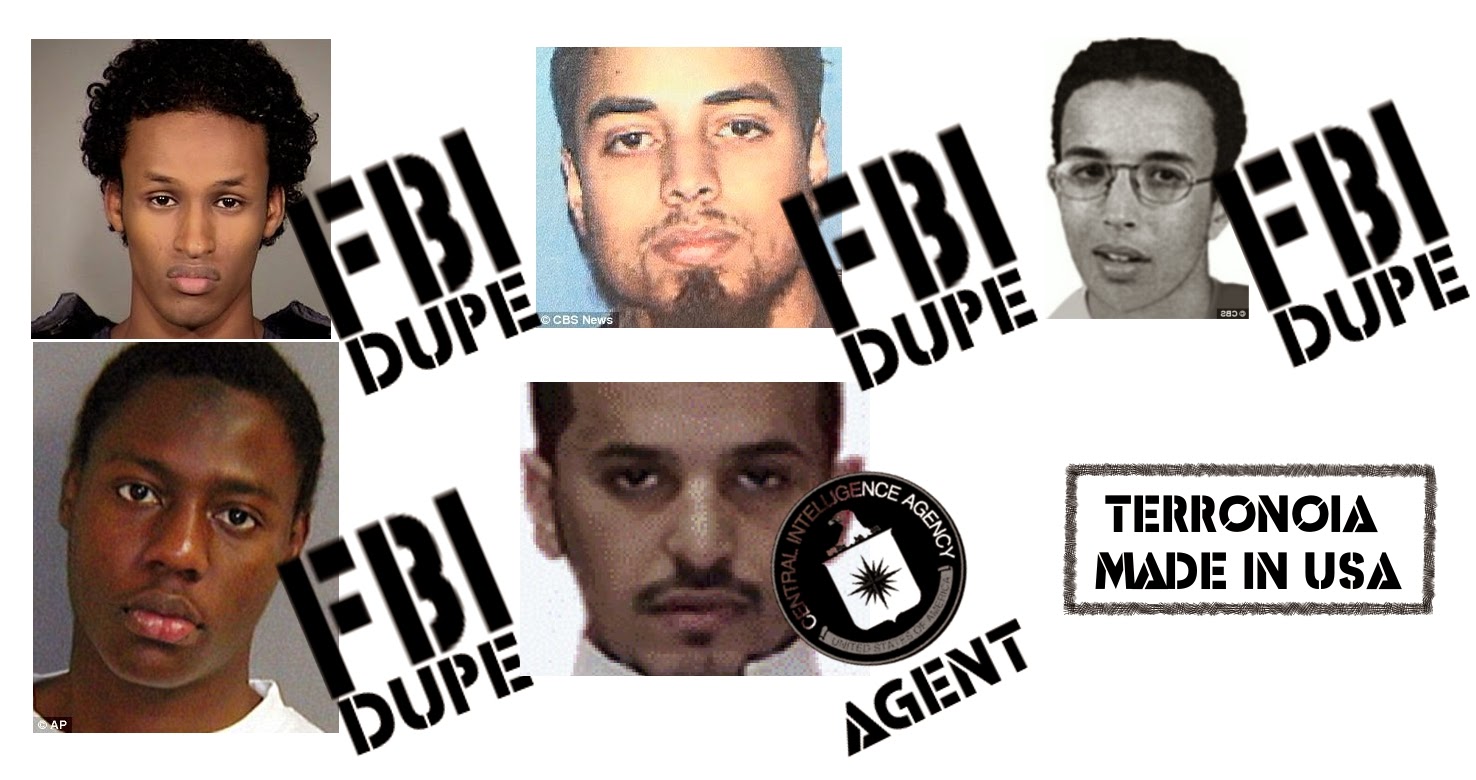
Image (from Land Destroyer Report): The FBI has an impressive portfolio of intentionally created, then foiled terror plots. Its methods include allowing suspects to handle both real and inoperable weapons and explosives. These methods allow the FBI to switch entrapment cases "live" at any moment simply by switching out duds and arrests with real explosives and successful attacks. Because the FBI uses "informants," when attacks go live, these confidential assets can be blamed, obfuscating the FBI's involvement.

Image (from Land Destroyer Report): The FBI has an impressive portfolio of intentionally created, then foiled terror plots. Its methods include allowing suspects to handle both real and inoperable weapons and explosives. These methods allow the FBI to switch entrapment cases “live” at any moment simply by switching out duds and arrests with real explosives and successful attacks. Because the FBI uses “informants,” when attacks go live, these confidential assets can be blamed, obfuscating the FBI’s involvement.

Provoking war abroad raises specter of staged attacks at home.

By Tony Cartalucci

Source: Land Destroyer Report

The FBI has foiled yet another entirely fabricated terror threat of its own creation, with missing mechanisms in two firearms provided to a potential terrorist being the only thing that prevented this latest case of entrapment from going “live.”

A Rochester man, Mufid A. Elfgeeh, is accused by the FBI of attempting to provide material support to ISIS (undercover FBI agents), attempting to kill US soldiers, and possession of firearms and silencers (provided to him by the FBI). The FBI’s own official press release stated (emphasis added):

According to court records, Elfgeeh attempted to provide material support to ISIS in the form of personnel, namely three individuals, two of whom were cooperating with the FBI. Elfgeeh attempted to assist all three individuals in traveling to Syria to join and fight on behalf of ISIS. Elfgeeh also plotted to shoot and kill members of the United States military who had returned from Iraq. As part of the plan to kill soldiers, Elfgeeh purchased two handguns equipped with firearm silencers and ammunition from a confidential source. The handguns were made inoperable by the FBI before the confidential source gave them to Elfgeeh.

What is perhaps more chilling are the details of Elfgeeh’s plans to kill US soldiers. The FBI’s press release stated (emphasis added):

Court documents also indicate that Elfgeeh first discussed the idea of shooting United States military members in December 2013 when he told CS-2 that he was thinking about getting a gun and ammunition, putting on a bulletproof vest, and “just go[ing] around and start shooting.” In February 2014, Elfgeeh told CS-2 that he needed a handgun and silencer. Elfgeeh later gave CS-2 $1,050 in cash to purchase two handguns equipped with silencers and ammunition. On May 31, 2014, CS-2 delivered the two handguns equipped with silencers and ammunition to Elfgeeh. After Elfgeeh took possession of the items, he was arrested by members of the Rochester Joint Terrorism Task Force. Elfgeeh is currently being held in custody.

Elfgeeh’s plans are also – coincidentally – verbatim, the dream scenario of Washington’s warmongers currently attempting to sell a war that will straddle both sides of the Syrian-Iraqi border, allow the US to provide terrorists operating in Syria with air support, and lead to punitive operations against the Syrian government for attacking US-backed terrorists with the final objective being long-sought after regime change in Damascus.

With serial beheadings failing to raise Western public support necessary for an expedient intervention in Syria, more insidious provocations appear to be in the works. Setting the stage, a CBS/Associated Press story titled, “Former Deputy CIA Director: ‘I Would Not Be Surprised’ If ISIS Member Shows Up To US Mall Tomorrow With AK-47,” would claim immediately after the initial James Foley execution video that:

“The short-term concern is the Americans that have gone to fight with ISIS and the west Europeans that have gone to fight with ISIS could be trained and directed by ISIS to come to the United States to conduct small-scale attacks,” Morell stated. “If an ISIS member showed up at a mall in the United States tomorrow with an AK-47 and killed a number of Americans, I would not be surprised.”

Morell warned that over the long-term the extremist group could be planning for a 9/11-style attack that killed thousands of Americans.

Elfgeeh’s entrapment is only the beginning. Staged “terror raids” in Australia are also ratcheting up hysteria ahead of an actual event of mass murder carried out on Western soil. The BBC would report in their article, “Australia raids over ‘Islamic State plot to behead’,” that:

Police have carried out anti-terror raids in Sydney sparked by intelligence reports that Islamic extremists were planning random killings in Australia.

PM Tony Abbott said a senior Australian Islamic State militant had called for “demonstration killings”, reportedly including a public beheading.

The raids, with at least 800 heavily-armed officers, led to 15 arrests.

The cartoonish nature of the plot – beheading a random member of the public before draping an ISIS flag over their body – is meant to provoke maximum fear and anger first, then maximum support for Australia’s continued involvement in Wall Street and London’s hegemonic ambitions in the Middle East. Likewise, the Rochester arrest made by the FBI amid their own terror plot, serves only to incite fear across the public and irrational support for intervention in Syria that will, in fact, lead to further support of extremists as well as the destruction of the only institution in the region truly fighting terrorism – the Syrian Arab Army.

A Functioning Firing Pin Away From a Staged Mass Shooting

The FBI has a long list of foiled terror plots of its own creation. More disturbingly are the plots they conceived but “accidentally” allowed to go “live.” One might recall the 1993 World Trade Center bombing. FBI agents, according to the New York Times, were indeed overseeing the bombers that detonated a device killing six and wounding many more at the World Trade Center.

In their article, “Tapes Depict Proposal to Thwart Bomb Used in Trade Center Blast,” NYT reported:

Law-enforcement officials were told that terrorists were building a bomb that was eventually used to blow up the World Trade Center, and they planned to thwart the plotters by secretly substituting harmless powder for the explosives, an informer said after the blast.

The informer was to have helped the plotters build the bomb and supply the fake powder, but the plan was called off by an F.B.I. supervisor who had other ideas about how the informer, Emad A. Salem, should be used, the informer said.

The account, which is given in the transcript of hundreds of hours of tape recordings Mr. Salem secretly made of his talks with law-enforcement agents, portrays the authorities as in a far better position than previously known to foil the Feb. 26 bombing of New York City’s tallest towers. The explosion left six people dead, more than 1,000 injured and damages in excess of half a billion dollars.

Considering the 1993 bombing and the fact that the FBI literally oversaw the construction and deployment of a deadly bomb that killed 6, it is clear that the FBI can at any time through design or disastrous incompetence, turn one of their contrived entrapment cases into a live terror attack. One can only guess at how many similar FBI operations are currently taking place within the United States involving ISIS sympathizers – any one of which could be turned into a live terror attack provided the weapons handed over to potential terrorists are functioning, just as the bomb was in 1993 when it was driven into the lower levels of the World Trade Center.

Everything from a mass shooting to a bombing, and even an Operation Northwoods-style false flag attack involving aircraft could be employed to provide Wall Street and London with the support it needs to accelerate its long-stalled agenda of regime change and reordering in both Syria and across the Iranian arc of influence. Readers may recall Operation Northwoods, reported on in an ABC News article titled, “U.S. Military Wanted to Provoke War With Cuba,” which bluntly stated:

In the early 1960s, America’s top military leaders reportedly drafted plans to kill innocent people and commit acts of terrorism in U.S. cities to create public support for a war against Cuba. 

Code named Operation Northwoods, the plans reportedly included the possible assassination of Cuban émigrés, sinking boats of Cuban refugees on the high seas, hijacking planes, blowing up a U.S. ship, and even orchestrating violent terrorism in U.S. cities.

That the FBI and Australian authorities are coordinating staged security operations in tandem on opposite ends of the globe to terrify their respective populations into line behind an impending war with Syria suggests a new “Operation Northwoods” of sorts is already being executed. Staged executions on cue by ISIS in the Middle East of US and British citizens at perfectly timed junctures of the West’s attempt to sell intervention both at home and abroad also reek of staged mayhem for the sole purpose of provoking war. Could grander and ultimately more tragic mayhem be in store? As ABC News’ article on Operation Northwoods suggests, there is no line Western special interests will hesitate to cross.

With the West attempting to claim ISIS now has a “global” reach, the US and its partners’ attempts to obfuscate the very obvious state-sponsorship it is receiving will become exponentially more difficult. That the FBI is admittedly stringing along easily manipulated, malevolent patsies who at any time could be handed real weapons and sent on shooting sprees and/or bombings, Americans, Europeans, and Australians would be foolish to conclude that their real enemy resides somewhere in Syria and not right beside them at home, upon the very seats of Western power.