ISIS Beheadings on Cue from US & UK?

McCain_and_Syrian_rebels-550x251-e1403308183299

By Finian Cunningham

Source: The 4th Media

The gruesome beheading of a British aid worker by the ISIS terror group in Syria over the weekend provoked a stern warning from Britain’s Prime Minister David Cameron who vowed to “hunt down the murderers” for their “act of pure evil”.

The British victim was named as David Haines, a 44-year-old aid worker, who had been held hostage in Syria for many months. A graphic video released by his killers shows Haines kneeling on the ground dressed in an orange jumpsuit as a masked executioner severs his throat with a knife. The dead man’s prone body is then filmed with a decapitated, bloody head placed on the corpse’s back.

Some analysts have disputed the veracity of the video, saying it is a fake. But Haine’s foreboding demeanor and his final words spoken to the camera tend to verify the recording as genuine. The British government has also stated that it believes the footage to be authentic.

Haines was the third Westerner to be apparently murdered by the ISIS militants in the past four weeks using the same macabre ritual.Earlier this month, on September 3, a video showed American journalist Steven Sotloff also being decapitated in the same grisly manner. Two weeks before that, another abducted American citizen, James Foley, also a journalist, met the same grim fate at the hands of his captors.

A fourth man, another British national named as Alan Hemming, is feared to be the next ISIS victim, with unconfirmed video footage of his execution also posted this weekend.

The shocking scenes of brutality have sparked public outrage in the US and around the world. President Barack Obama addressed the nation in a prime-time television broadcast last week in which he declared that American forces would track down and destroy the ISIS terrorists. The group is also known by the alternative acronyms IS or ISIL, referring ostensibly to an aspired fundamentalist Islamic caliphate that incorporates Iraq and Syria.

At the same time that Obama was addressing the nation, US secretary of state John Kerry was in the Middle East drumming up support for an American-led international coalition to launch military strikes against ISIS, whose strongholds are in northern Iraq straddling the border with eastern Syria.

ISIS has been a prominent force among a myriad of militant cohorts that have been waging war against the Syrian state since March 2011. There is substantial evidence that Western governments have been covertly supporting ISIS and other extremists under the guise of assisting the “moderate rebels” for the ultimate purpose of destabilizing the Assad government of Syria and regime change. Assad is a staunch ally of Russia and Iran, and therefore is in the Western crosshairs for regime change.

But latterly ISIS has gained notoriety for its kidnapping and murder of Western citizens.

The newly formed US-led coalition against ISIS includes 10 Arab countries comprising Egypt, Lebanon, Iraq and Jordan as well as the Persian Gulf kingdoms of Saudi Arabia, Bahrain, Kuwait, Qatar, the United Arab Emirates and Oman.

Paradoxically, it may seem, Saudi Arabia and Qatar have been accused of being leading financial sponsors of the extremist groups fighting in Syria, including ISIS. But this link is not so paradoxical when the covert Western-designated role of the terror group is understood, as we shall see.

Washington has also, not surprisingly, garnered the support of Britain, France, Germany, Canada and Australia for its supposed anti-ISIS coalition.

A meeting this week in Paris will allegedly firm up military tactics on how the US-led coalition will carry out its putative strikes. So far, Washington has said that it will not be committing ground troops as in the previous Iraq War (2003-2012) and the ongoing US-led campaign against the Taliban in Afghanistan. Obama said the modus operandi against ISIS would be like its “counter-terror operations in Yemen and Somalia”, where US air power is assisted by “partners on the ground”.

The fledgling Iraqi government of Prime Minister Haider al Abadi has welcomed the US air strikes. Since last month, American warplanes have launched nearly 150 bombing raids on suspected ISIS positions in northern Iraq. Last week saw the widening of these US air strikes to include western Iraq near Haditha. Because of Baghdad’s approval, the US-led coalition has legal cover to operate in Iraq. But this is not the case in neighboring Syria.

The Syrian government of President Bashar al Assad has not given its consent to the American plans, nor has it been consulted. Washington claims that Assad has no legitimacy or right to sovereignty because it alleges his “regime” has been repressing the civilian population – a claim that is contradicted by the re-election of Assad as president in June with a massive 88.7 per cent majority based on a voter turnout of 73.4 per cent.

Damascus has pointed out that any US military action in its territory – even if that action is against the enemy ISIS network – will amount to aggression against the Syrian state.

The objective legal position was also stipulated by the Russian government this week. Moscow said that, without Syrian government consent or a United Nations Security Council mandate, any US-led air strikes inside Syria would be “a gross violation of international law”.

Nevertheless, Obama has unequivocally stated that his proposed military coalition will conduct attacks on ISIS bases inside Syria. The legal implications of that contingency, however, appear to be unnerving the main US NATO allies – Britain, France and Germany.

In Berlin last week both the German foreign minister Frank-Walter Steinmeier and his British counterpart Philip Hammond issued categorical statements saying that their countries would not be carrying out air strikes in Syria.

Hammond, like Steinmeier, gave full backing to US strikes against ISIS in Iraq, but he told the Reuters news agency: “Let me be clear: Britain will not be taking part in any air strikes in Syria. We have already had that discussion in our parliament last year and we won’t be revisiting that position.” Britain’s top diplomat added that the “legal permissiveness” of military operations in Iraq and Syria was completely different.

Hammond was referring to the vote in the British parliament last year in which MPs voted overwhelmingly against Britain joining a proposed American military intervention in Syria, following the deadly chemical weapons attack near Damascus on August 21.

Washington was lining up air strikes on Syria to purportedly avenge the killing of hundreds of civilians from poisonous gas. That incident was blamed on the armed forces of the Assad government but it was subsequently shown to be the covert work of anti-government militants, aimed at contriving as a false flag outrage to elicit Western military intervention.

The British parliament was therefore vindicated in its vote against military intervention in Syria, and that vote put paid to Washington’s plans back then. It signaled a rare British dissent in the “special relationship” with Washington, where Britain is usually a reliable junior partner for American militarism overseas.

At the time of the Westminster vote at the end of August 2013, British leader David Cameron was visibly downcast at the rejection of the proposed intervention in Syria. Given that the British government is a major player in the US-led regime-change conspiracy in Syria, Cameron’s dismay was understandable.

This week on the day after Hammond made the announcement in Berlin of non-intervention in Syria, he appeared to be over-ruled by his boss in 10 Downing Street. David Cameron contradicted his foreign minister by telling British media that “nothing had been ruled out” for Britain’s participation in the American-led anti-ISIS coalition. Cameron was clearly indicating that British fighter jets might indeed launch air strikes inside Syria.

Such a move would over-turn the British parliament’s landmark vote outlawing military intervention in Syria. It would also negate the majority sentiment of the British public, which has been trending strong opposition to their government becoming embroiled militarily in Syria.

However, graphic videos of extremists slicing off the head of a British aid worker could be a decisive turning point. It’s hard to imagine a more repugnant act of cruel depravity to turn public opinion away from its erstwhile opposition to war toward giving consent for military action to, as Cameron put it, “hunt down this pure evil”.

Note too that in recent weeks Western governments and their mass media have been raising security concerns about Western “jihadists” returning to their home countries to carry out terror missions. Australia’s government of Tony Abbott is the latest to put its country on “high alert”. Abbott told media this weekend that his government was also sending a 600-man military force to the Middle East to join the US-led coalition, and he cited the barbaric beheading of the British national as part of the reasoning for the Australian deployment.

The macabre video executions have also overturned anti-war public feeling in the US. When Obama was planning to launch air strikes in Syria last year following the chemical weapons incident, polls showed that a big majority – 70 per cent – of Americans were opposed to any intervention. That opposition, plus the British parliament’s rejection, was a major factor in why Obama backed down then on his proposed military strikes during September 2013.

But after the latest videos showing two American journalists being brutally slain, US public opinion, according to recent polls, is now strongly in favour of Obama’s anti-ISIS bombing coalition; not just operating in Iraq, but more significantly, the American public wants the coalition to go after ISIS inside Syria too. Thus, where the chemical weapons horror last year failed to convince the American public to give its approval for US air strikes in Syria, the beheading of American hostages has succeeded.

For Washington and its close London ally, the British public is a crucial constituency to also win over. It seems more than a coincidence that ISIS has now carried out the same sickening execution of a British national as it did with the two Americans. President Obama said after the videoed slaying of Briton David Haines that the US “stands shoulder-to-shoulder” with the British people.

The question is this: are these shocking executions, with their highly stylised graphic videos, being used to manipulate public consent for Western military intervention in Syria? In that case, ISIS is not acting in some apparent rogue fashion, turning on its Western intelligence masters, but rather it is obeying orders as usual as part of a macabre charade to facilitate Western military intervention.

Once again, what we are seeing is a variation of “humanitarian pretext” to pave the way for the covert, ulterior agenda of Western-orchestrated regime change in foreign countries. That ploy was used previously by NATO forces in former Yugoslavia at the end of the 1990s and more recently in Libya during 2011.

It is well documented that ISIS, IS or ISIL, is a terror network created by US, British and Saudi military intelligence going back to the early years of the Iraq War beginning in 2003, when the group played a vital role in fomenting sectarian strife in Iraq to the advantage of the Western occupying armies.The network has antecedents in Western collusion with radical Islamist mercenaries in Afghanistan during the 1980s against the former Soviet Union, which led to the formation of Al Qaeda, and also in Chechnya in the mid-1990s.

ISIS leader Abu Bakr Baghdadi is known to be a US intelligence asset, according to a former senior Al Qaeda operative, Nabil Naim, among other sources. Former CIA personnel have also disclosed that ISIS, like Al Qaeda, was set up to further geopolitical goals for Washington and its allies in the Middle East. These goals include regime change in target countries, such as Syria, and perpetuating the money-spinning American military-industrial complex by creating an endless security threat. Officially, the network may be a proscribed terror organization and “an enemy of the state”. But in the underworld of black operations, ISIS is a covert instrument of US government and corporate interests.

Given the strategic importance of the US-led regime-change objective in Syria – and in particular the importance of obtaining public support for military intervention in that country – it is not beyond the realm of possibility that the ISIS network is carrying out beheadings of Western citizens on the orders of its handlers in the CIA and Britain’s MI6. Perhaps even, the outward political leadership in Washington and London, Obama and Cameron, are unaware of their own dark forces at work, which gives their public reactions of indignation an air of authenticity and credibility.

Indeed, the evident political consequences from the latest execution of Briton David Haines and Americans Jim Foley and Steven Sotloff are strongly indicative of a Western psychological operation. That makes Washington and London culpable of murdering their own citizens for geopolitical expediency. These victims are sacrificial lambs in the foulest sense.


Probing the SITE Intelligence Group

beheading2

By James F. Tracy

Source: The Memory Hole

Since mid-August 2014 major news organizations have conveyed videos allegedly found online by the SITE Intelligence Group. Unsurprisingly the same media have failed to closely interrogate what the private company actually is and whether the material it promotes should be accepted as genuine.

The Search for International Terrorist Entities Intelligence Group was co-founded by Rita Katz in 2001. Katz is an Iraqi-born Jew. Her father, an Israeli spy, was executed by Iraqis as a result of his intelligence activities.

In 2003 Katz authored a book, Terrorist Hunter: The Extraordinary Story of a Woman Who Went Undercover to Infiltrate the Radical Islamic Groups Operating in America, which she published using the pseudonym, “Anonymous.”

In the book Katz explains how she took on the trappings of a Muslim woman to infiltrate the meetings of radical Muslim terrorists. The plot is unlikely, especially when one considers that such secret fundamentalist gatherings are almost always segregated along gender lines and no woman, however elaborate her costume, would be granted entry without her identity being firmly established.

SITE Intelligence Group consists of Katz and two “senior advisers,” one of whom is Bruce Hoffman, the Corporate Chair in Counterterrorism and Counterinsurgency at the RAND Corporation and former director of the RAND’s Washington DC office.

The SITE Intelligence Group “constantly monitors the Internet and traditional media for material and propaganda released by jihadist groups and their supporters,” the company’s website announces. “Once obtained, SITE immediately translates the material and provides the intelligence along with a contextual analysis explaining the source of the material and its importance to our subscribers.”[1]

In 2003 and 2004, though claiming to be a 501c3 non-profit, SITE received more than $500,000 from the US government. Also in the early 2000s Katz received $150,000 from the FBI for consulting services.[2] A Guidestar search for nonprofits yields no recent records for SITE, suggesting how it has abandoned its non-profit status and now relies on corporate and individual subscriptions for revenue. In 2005 the private mercenary contractor Blackwater hailed SITE as “an invaluable resource.”[3]

The majority of “jihadist groups” operate one or more media outlets that produce and publish  “the group’s multimedia, and in some cases, communiqués and magazines,” SITE explains on its website. “These media units involve production teams and correspondents who report directly from the battlefield, and craft propaganda to indoctrinate and recruit new fighters into the group’s ranks.” SITE provides no direct links to the jihadist groups’ websites or multimedia productions from its own platform.[4]

Katz describes SITE as geared toward international Islamic jihad. In fact, it performs an international function akin to what a Southern Poverty Law Center or Anti-Defamation League do domestically–ferreting out and publicizing terrorist and “extremist” threats. “[W]e at SITE for over a decade monitor, search, and study the jihadists online,” she explains.

We have been studying and monitoring the jihadists online, which also as they get more sophisticated, we follow their techniques and study them. And based on that, we could predict where they will be uploading their video.

After all, we have to remember that much of this propaganda is being posted online. Their releases are released online [sic]. So they have to be able to use certain locations to upload their releases before they are published.[5]

Though routinely overlooked in the flurry of front-page coverage corporate media have allotted the three beheading videos–the most recent of which featured British aid worker David Cawthorne Haines–it is common knowledge that SITE uncannily secures terrorist statements and videos well before the US’s wide array of lavishly-funded intelligence services.

For example, as the Washington Post reported in 2007,

[a] small private intelligence company that monitors Islamic terrorist groups obtained a new Osama bin Laden video ahead of its official release last month, and around 10 a.m. on Sept. 7 … It gave two senior officials access on the condition that the officials not reveal they had it until the al-Qaeda release. Within 20 minutes, a range of intelligence agencies had begun downloading it from the company’s Web site. By midafternoon that day, the video and a transcript of its audio track had been leaked from within the Bush administration to cable television news and broadcast worldwide.[6]

The video later proved to be fraudulent.

With the above in mind, one may ask, If parties within a US presidential administration or the State Department sought to bypass the potential scrutiny of a wide-ranging intelligence community concerning such matters, while simultaneously providing itself with the means to effectively propagandize the American public toward a broader end, what better way than to contract the services of an entity such as SITE?

If there is some merit in the above appraisal, the arrangement is now being pushed to an extreme by the Obama administration to pave the road toward a long-sought goal: war with Syria’s Bashar Al Assad regime. Indeed, services such as SITE’s are a potent and valuable means for moving public opinion, as they have done in recent weeks concerning military action against the Islamic State. Along these lines, a decade ago both John Kerry and George W. Bush credited the latter’s re-election to a surreptitious appearance by Osama bin Laden via video tape several days before the vote.[7]

Playing a role similar to SITE, IntelCenter acts as an intermediary between Al-Qaeda’s supposed media arm, As-Sahab, and major media. In other words, “they acquire the tapes and pass them on to the press, and have occasionally even predicted when tapes would be released beforehand,” Paul Joseph Watson reports.

“IntelCenter is run by Ben Venzke, who used to be the director of intelligence at a company called IDEFENSE, which is a Verisign company. IDEFENSE is a web security company that monitors intelligence from the Middle East conflicts and focuses on cyber threats among other things. It is also heavily populated with long serving ex-military intelligence officials.[8]

As noted, news outlets seldom see fit to closely analyze SITE or Katz concerning their research and function as conduits for terrorist propaganda. A LexisNexis search for SITE Intelligence in the article content of US newspapers and major world publications over the past two years produces 317 items—an admittedly low figure given the prominence of SITE’s recent disclosures. Yet a similar search for “Steven Sotloff” alone yields over 1,000 newspaper stories and 600 broadcast transcripts, suggesting the sensationalistic usage and effect of SITE’s data and how neither SITE nor Katz are called upon to explain their specific methods and findings.

Indeed, a similar search for “SITE Intelligence” and “Rita Katz” yields only 26 entries over a two year period. Of these, 14 appear in the Washington Post, a publication with well-established links to US intelligence. Four New York Times articles feature the combined entities.

In a CNN on the heels of the Sotloff beheading, Katz explains how again SITE curiously surpassed the combined capacities of the entire US intelligence community in securing the Sotloff footage.

“The video shows the beheading of Steven Sotloff,” Katz cautiously begins after being queried on the document’s authenticity.

The location from where the video was obtained from is the location where ISIS usually uploads their original videos to [sic]. The video shows a clear message from ISIS that follows the same message that it had before. And in fact within a short time after our release, ISIS’ account on social media indicated that within a short time they would be releasing the video, only we actually had that video beforehand and were able to beat them with the release.

This unusual statement alongside SITE’s remarkable abilities, in addition to the fact that it is a past government contractor that has been caught spreading dubious information, should put news outlets on guard concerning virtually anything the organization produces.

Undoubtedly this is a great deal to ask from a news media that all too frequently participate in orienting public opinion toward war, a feat it has once again accomplished with the aid of SITE.

The interests and alliances of the transnational entities owning such media make them poised to profit from the very geopolitical designs drawn up by SITE’s corporate and government clients–the most important of which may be those seeking to broaden Middle Eastern conflict. No doubt, the widescale acceptance of such propaganda is also the result of the vastly diminished critical capacities of the broader public, now several decades in the making.

Notes

[1] “Services,” SITE Intelligence Group, , accessed September 15, 2014,

[2] Berni McCoy, “So, a ‘Charitable Organization’ Released the bin Laden Video,” Democratic Underground, September 10, 2007, http://journals.democraticunderground.com/berni_

[3] “SITE Institute,” Sourcewatch.org, Center for Media and Democracy, n.d.

[4] “Media Groups,” SITE Intelligence Group, n.d., accessed September 15, 2014.

[5] Karl Penhaul, Pamela Brown, Alisyn Camerota, Don Lemon, Paul Cruickshank, “Joan Rivers on Life Support; Chilling Words From ISIS Terrorist; How to Fight Radical Recruitment” (transcript), CNN, September 2, 2014.

[6] Joby Warrick, “Leak Severed a Link to Al Qaeda Secrets,” Washington Post, October 9, 2007.

[7] Paul Joseph Watson, “Another Dubious Osama Tape Appears When the Neo-Cons Need It Most,” Prisonplanet.com, July 16, 2007.

[8] Ibid. See also, Kurt Nimmo, “Sotloff Video Found by Group Responsible For Releasing Fake Osama Bin Laden Video,” Infowars.com, September 3, 2014.

A Libertarian Argument for Universal Basic Income

Why Has Classical Capitalism Devolved to Crony-Capitalism?

Crony-Capitalism_200x200

By Charles Hugh Smith

Source: OfTwoMinds.com

Here is the quote that perfectly captures our era: “People of privilege will always risk their complete destruction rather than surrender any material part of their advantage.” (John Kenneth Galbraith) The trick, of course, is to mask the unspoken second half of of that statement: everybody else gets destroyed along with the Elites when the system implodes.

Union pension funds: toast. Government employees’ pension funds: toast. 401Ks: toast. IRAs: toast. The echo-bubble in housing: toast. The Fed’s favorite PR cover to cloak the enrichment of their financier cronies, the wealth effect:toast.

The primary tool the Elites use to mask the risk of complete destruction is magical thinking–specifically, that “given enough time, the system will heal itself.”

That’s rich, considering that the Elites’ primary tool of avoiding destruction is crippling the market’s self-healing immune system: price discovery. Thanks to ceaseless interventions by central banks, the price discovery mechanism has been shattered: want to know the price of risk? It’s near-zero. Yield on sovereign bonds? Near-zero. And so on.

Prices have been so distorted (the ultimate goal of Central Planning everywhere, from China to the EU to Japan to the U.S.) that the illusion of stability is impossible without more intervention.

This leads to two self-liquidating dynamics: diminishing returns (every intervention yields less of the desired result) and the Darwinian selection of only those money managers who believe risk has been vanquished.

Everyone who pursues prudent risk management has either been fired or saw the writing on the wall and exited stage right. So the only people left at the gaming tables of the big institutional players are those individuals who are genetically incapable of responding appropriately to rising risk. Those who did have long been fired for “underperformance.”

So how did classical free-market capitalism become state-cartel crony-capitalism, a Ponzi scheme of epic proportions that is entirely dependent on ceaseless central bank perception management and interventions on a scale never before seen?

We can start with these six factors:

1. Those who control most of the wealth are willing to risk systemic collapse to retain their privileges and wealth. Due to humanity’s virtuosity with rationalization, those at the top always find ways to justify policies that maintain their dominance and downplay the distortions the policies generate. This as true in China as it is in the U.S.

2. Short-term thinking: if we fudge the numbers, lower interest rates, etc. today, we (politicians, policy-makers, money managers, etc.) will avoid being sacked tomorrow. The longer term consequences of these politically expedient policies are ignored.

3. Legitimate capital accumulation has become more difficult and risky than buying political favors. Global competition and the exhaustion of developed-world consumers has made it difficult to reap outsized profits from legitimate enterprise. In terms of return-on-investment (ROI), buying political favors is far lower risk and generates much higher returns than expanding production or risking investment in R&D.

4. The centralization of state/central bank power has increased the leverage of political contributions/lobbying. The greater the concentration of power, the more attractive it is to sociopaths and those seeking to buy state subsidies, sweetheart contracts, protection from competition, etc.

5. Any legitimate reform will require dismantling crony-capitalist/state-cartel arrangements. Since that would hurt those at the top of the wealth/power pyramid, reform is politically impossible.

6. Understood in this light, it’s clear that central bank monetary policy—zero-interest rates, asset purchases, cheap credit to banks and financiers, QE, etc.—is designed to paper over the structural problems that require real reform.

Japan is a case in point: the Powers That Be in Japan have put off real reforms of the Japanese economy and political system for 25 years, and they’ve enabled this avoidance by pursuing extremes of fiscal and monetary policy that have eroded the real economy and created long-term structural imbalances.

In this 24 minute video Gordon T. Long and Charles Hugh Smith discuss through the aid of 17 slides the rapid advancement of Crony Capitalism in America. The facts are undeniable, but why is it becoming so obvious and undeniable? Why is it accelerating without any apparent ‘checks and balances’? Where have the safeguards against this happening gone?

Podcast Roundup

9/7: On Expanding Minds, hosts Maja D’Aoust and Erik Davis have a conversation with Andy Sharp of English Heretic about death, Horror films, Hiroshima, psychogeography, and his latest release, The Underworld Service.

 
http://s50.podbean.com/pb/fd840a4721e38d3f25dd4ec01834d2c6/541340f7/data2/blogs18/276613/uploads/ExpandingMind_090714.mp3

9/8: R.U. Sirius joins hosts Chris Dancy and Klint Finley to discuss technology transhumanism, and the current social/political climate among other topics.

https://soundcloud.com/itsmweekly/pending-mindful-cyborgs-episode-37
 
9/9: Peter Null interviews Professor Andrew Kolin, a professor of political science at Hilbert College in Hamburg and Kevin Carson, researcher at the Center for a Stateless Society, on militarization of police, centralization of power, war and the military-industrial complex.


http://s53.podbean.com/pb/e788a26888199ef114360f06cc89f48c/541347f9/data1/blogs18/371244/uploads/ProgressiveCommentaryHour_090914.mp3

9/10: On the C-Realm, KMO and June Pulliam discuss and dissect the archetypes and cultural meaning of zombie apocalypse narratives.


http://c-realmpodcast.podOmatic.com/enclosure/2014-09-10T12_48_22-07_00.mp3

9/11: Christopher Knowles joins Aeon Byte Gnostic Radio to examine how Gnosticism connects to alternative cultures, politics and humanity’s existential crisis.


http://content.screencast.com/users/AeonByte/folders/AEON%20BYTE/media/7984ec1d-8363-4162-a034-0dabc54aef33/1.%20Gnosticism%20and%20Politics%20with%20Chris%20Knowles.mp3

9/12: On New World Next Week, James Corbett and James Evan Pilato report on 9/11 terror hysteria, Obama’s private CFR event with Sandy Berger (9/11 document thief) and the cryptocurrency/anti-surveillance potential of a new off-the-grid communications technology.

 
http://www.corbettreport.com/mp3/2014-09-11%20James%20Evan%20Pilato.mp3

Growing Social Inequality in America. Wealth Concentration and Decline in Living Standards

inequality-illo

New Federal Reserve report US median income has plunged, inequality has grown in Obama “recovery”

By Andre Damon

Source: Global Research

The yearly income of a typical US household dropped by a massive 12 percent, or $6,400, in the six years between 2007 and 2013. This is just one of the findings of the 2013 Federal Reserve Survey of Consumer Finances released Thursday, which documents a sharp decline in working class living standards and a further concentration of wealth in the hands of the rich and the super-rich.

The report makes clear that the drop in a typical household’s income was not merely the result of what is referred to as the 2008 recession, which officially lasted only 18 months, through June 2009. Much of the decline in workers’ incomes occurred during the so-called “economic recovery” presided over by the Obama administration.

In the three years between 2010 and 2013, the annual income of a typical household actually fell by 5 percent.

household_income

Reserve Survey of Consumer Finances

The Fed report exposes as a fraud the efforts of the Obama administration to present itself as a defender of the “middle class”. It has systematically pursued policies to redistribute wealth from the bottom to the very top of the income ladder. These include the multi-trillion-dollar bailout of the banks, near-zero interest rates to drive up the stock market, and austerity measures and wage cutting to lift corporate profits and CEO pay to record highs.

The Federal Reserve data, based on in-person interviews, show a far larger decline in the median income of American households than indicated by earlier figures from the Census Bureau’s Current Population Survey.

In line with the figures on household income, the report shows an ever-growing concentration of wealth among the richest households. The Fed’s summary of its data notes that “the wealth share of the top 3 percent climbed from 44.8 percent in 1989 to 51.8 percent in 2007 and 54.4 percent in 2013,” while the wealth of the “next 7 highest percent of families changed very little.”

The report states that “the rising wealth share of the top 3 percent of families is mirrored by the declining share of wealth held by the bottom 90 percent,” which fell from 33.2 percent in 1989 to 24.7 percent in 2013.

income_shares

Reserve Survey of Consumer Finances

The ongoing impoverishment of the population is an indictment of capitalism. There has been no genuine recovery from the Wall Street crash of 2008, only a further plundering of the economy by the financial aristocracy. The crisis precipitated by the rapacious, criminal practices of the bankers and hedge fund speculators has been used to restructure the economy to the benefit of the rich at the expense of everyone else.

Decent-paying jobs have been wiped out and replaced by low-wage, part-time and temporary jobs, with little or no benefits. Pensions and health benefits have come under savage attack, as seen in the bankruptcy of Detroit.

Not surprisingly, the Fed report has been buried by the American media, confined to the inside pages of the major newspapers.

Measured in 2013 dollars, a typical household received an income of $53,100 in 2007. By 2010, this had fallen to $49,000. It hit $46,700 by 2013. At the same time, the average income for the wealthiest tenth of families grew by ten percent.

While median income fell between 2010 and 2013, mean (average) income grew, from $84,100 to $87,200. The report noted that, “the decline in median income coupled with the rise in mean income is consistent with a widening income distribution during this period.”

For the poorest households, the drop in income has been even more dramatic. Among the bottom quarter of households, mean income fell a full 10 percent between 2010 and 2013.

The report reveals other aspects of the social crisis. The share of young families burdened by education debt nearly doubled, from 22.4 percent to 38.8 percent, between 2001 and 2013. The share of young families with more than $100,000 in debt has grown nearly tenfold, from 0.6 percent to 5.6 percent.

These statistics reflect both a historic and insoluble crisis of the profit system and the brutal policies of the American ruling class, which is carrying out a relentless assault on working people and preparing to go even further by dismantling bedrock social programs such as Medicare and Social Security. The data undercuts the endless talk of “partisan gridlock” in Washington and the media presentation of a political system paralyzed by irreconcilable differences between the Democratic and Republican parties.

There has, in fact, been a seamless continuity between the Bush and Obama administrations in the pursuit of reactionary policies of war abroad and class war at home. The two parties have worked hand in glove to make the working class pay for the crisis of the capitalist system.

The Federal Reserve has itself played a critical role in the growth of social inequality in the US. The bailout of the banks, estimated at $7 trillion, has been followed by six years of virtually free money for the banks.

Every facet of American life is dominated by the immense concentration of wealth at the very top of society. The grotesque levels of wealth amassed by the parasites and criminals who dominate American business, and the flaunting of their fortunes before tens of millions struggling to pay their bills and keep from falling into destitution, are fueling the growth of social anger. This anger will increasingly be directed against the entire economic and political system.

The figures released by the Fed reflect a society riven by class divisions that must inevitably trigger social upheavals. The explosive state of social relations is itself a major factor in the endless recourse by the Obama administration to military aggression and war, which serve to deflect internal tensions outward.

The growth of inequality likewise underlies the relentless attack on democratic rights in the US, including the massive domestic spying exposed by Edward Snowden and the use of militarized police to crack down on social opposition, as seen most recently in Ferguson, Missouri.

Why Independent 9/11 Research and Education Still Matters

Editor’s note: This is a revised article from last year followed by recent podcasts and videos on the topic.

One of the ways corrupt people and institutions retain power is by discouraging criticism and discussions that could lead to organized opposition. A classic tactic is to vilify targets as unpatriotic, disloyal, traitorous, heretical, dangerous, crazy, etc. Think about what happened to critics of capitalism during the peak of the cold-war hysteria. George Orwell’s 1984 depicted how governments could also manipulate language, history, media and other information in order to diminish critical thought (which leads to critical speech and organizing) and to control thought. The creation of a Big Brother-style police/surveillance state is another way to create a climate of fear and foster a culture which discourages the sharing of knowledge about certain topics and prevents people from taking action.

This should be kept in mind when discussing 9/11, because those who still have complete faith in government and corporate media (an increasingly shrinking number), have been conditioned to ignore, deny or dismiss any information that would lead them to question the official story. The most common knee-jerk reaction is to defend the official story by labeling all alternative narratives “conspiracy theory”. Though this argument is not as convincing today, when political scandals and crimes are almost a daily occurrence, the association between “conspiracy theories” and negative terms such as “crazy” and “wacko” are deeply ingrained in the culture, and not by accident.

The term “conspiracy theory” was not used as an ad hominem attack until shortly after the assassination of John F. Kennedy. Documented evidence shows the CIA needed to develop new and more effective ways to attack and discredit those who dared to question the Warren Commission Report. So when one counters questions about the official narrative with “That’s just a crazy conspiracy theory” they’re actually using a psy-op attack developed by and for a conspiracy. Because of experience and greater proliferation of information through the internet, fewer people are naive enough to deny extremely wealthy and powerful people would conspire to protect their position and interests. History and hard evidence shows it would be crazier to suppose that they don’t.

Another common argument is “The government is too incompetent to pull off something of that scale and keep it a secret”. It’s true that aspects of the government are incompetent, but the incompetence is generally limited to things they care little about such as medical and educational systems, the food system, domestic infrastructure, safety, financial regulation, disaster relief, fair elections, etc. When it comes to things they prioritize such as wars, bailouts, black budgets, black ops, cronyism, crowd control, surveillance, propaganda, etc., the US government is extremely effective. And the higher up the hierarchy, the easier it is to keep secrets. All it takes is a relatively small number of people in key positions, and through division of labor, compartmentalization, formation of policies conducive to conspiring, and covert actions and communications protected under the cloak of “national security” (with help from a mass culture of conformity, credulity and fear). One should also keep in mind that governments are not monolithic and are comprised of factions with conflicting interests which can be used, manipulated and/or compromised by players involved in the conspiracy (not just within U.S. government but in foreign governments and the private sector as well).

Some simply can’t accept that individuals and factions within U.S. government could intentionally cause an attack such as 9/11 or let it happen. This speaks to the power of corporate media and establishment propaganda on different levels. It shows how a significant majority of Americans can be kept completely ignorant of decades of violent imperialist policy around the world and how false flags have been used to start wars through history. There’s also a long history of state violence against its own people and on American soil going back to the genocide of Native Americans, murders of countless slaves and people of color, multiple massacres of labor activists, assassination of leaders such as JFK, RFK, MLK, Black Panthers, and MOVE, the 93 WTC bombing, WACO, OK City bombing, etc. There’s also ample documentation proving the US government has at least considered actions not dissimilar to 9/11 such as Operation Northwoods and Project for a New American Century. What this argument presupposes is that powerful and wealthy (mostly) white men are inherently more trustworthy, empathetic, and righteous than “Muslim fanatics” or any other “enemy” most Americans have been conditioned to fear and hate.

Other attacks against independent 9/11 researchers include dismissals like “9/11 is no longer relevant” and/or “there’s more important problems to deal with so we need to move on”. I would argue that when such crimes occur that have harmed and killed vast numbers of people and is responsible for countless casualties and elimination of civil liberties more than a decade after due to policies supposedly justified by the event, we have a moral obligation to uncover who did it and why. There’s no peace without justice and no justice as long as the truth behind such nation-changing crimes remains suppressed. Of course there’s always plenty of immediate and equally important issues to address, but those who don’t know history are condemned to repeat it. More specifically, those who benefit most from historical events such as 9/11 are motivated to repeat it while those who only know a distorted version of history while remaining ignorant of the truth are more likely to let it happen again.

Because of the work of “conspiracy theorists” we are now more aware of the scope of government/corporate criminality and connections between government, wall street, war-profiteers, and the criminal underworld. For example, without the work of independent JFK researchers we wouldn’t be aware of Operation Northwoods which many now view as a false flag template used for 9/11. Gaining a better understanding of how and why 9/11 happened helps us put current geopolitical events in context while providing insight into how such operations work and how they can be counteracted.

There’s also the “straw man” argument which creates the illusion of having refuted a proposition by replacing an argument with a superficially similar yet non-equivalent proposition and refuting it without ever having refuted the original position. This is particularly easy to do with complex high profile incidents such as 9/11 and the JFK assassination, where there can be a wide array of theories and speculation due to the complexity of the narrative, widespread interest, deep secrecy and disinformation or misinformation from “useful idiots” and/or those who would benefit from keeping crucial information hidden.

Discussing controversial subjects is never easy but it’s always rewarding when people turn out to be more receptive and thoughtful than one might suspect. Though corporate media does its best to defend the official stories, more people than ever are waking up. On this 9/11 anniversary with the potential for another war on the horizon, it’s as good a day as any to talk about it, share this information and help others wake up.

9/11/14 Update:

On the 9/3/14 episode of “Guns and Butter” Tod Fletcher uses a contextual approach to analyzing events at the Pentagon, explores origins and elements of the hijacker story (ie. telephone calls from the planes, analysis of eyewitness reports, physical debris, photo/video evidence, black boxes and FBI involvement) and investigates means, motive and opportunity.


audio http://archives.kpfa.org/data/20140903-Wed1300.mp3

This episode was followed by the 9/10/14 Guns and Butter: “9/11 and the Politics of Deception” with Christopher Bollyn.


http://archives.kpfa.org/data/20140910-Wed1300.mp3

Project Censored 9/8/14: With the anniversary of the September 11 attacks at hand, Peter and Mickey speak with Ken Jenkins, organizers of the annual 911 Film Festival in Oakland, California, about questions that still linger 13 years after the attacks. Then Shahid Buttar of the Bill of Rights Defense Committee talks about the scope and implications of the ongoing federal surveillance activities against Americans, and how to resist them. The program concludes with Robbie Martin of Media Roots, speaking about his new documentary “American Anthrax.”

https://s3.amazonaws.com/Pcradiodos/Project+Censored+090514.mp3

9/11: The Mother of All Big Lies by Stephen Lendman

9/11 Truth, Inner Consciousness, and the Public Mind by James Tracy

Thirteen Years After the September 11 Attacks, Blindness Persists by Thierry Meyssan

DATAcide: The Total Annihilation of Life as We Know It

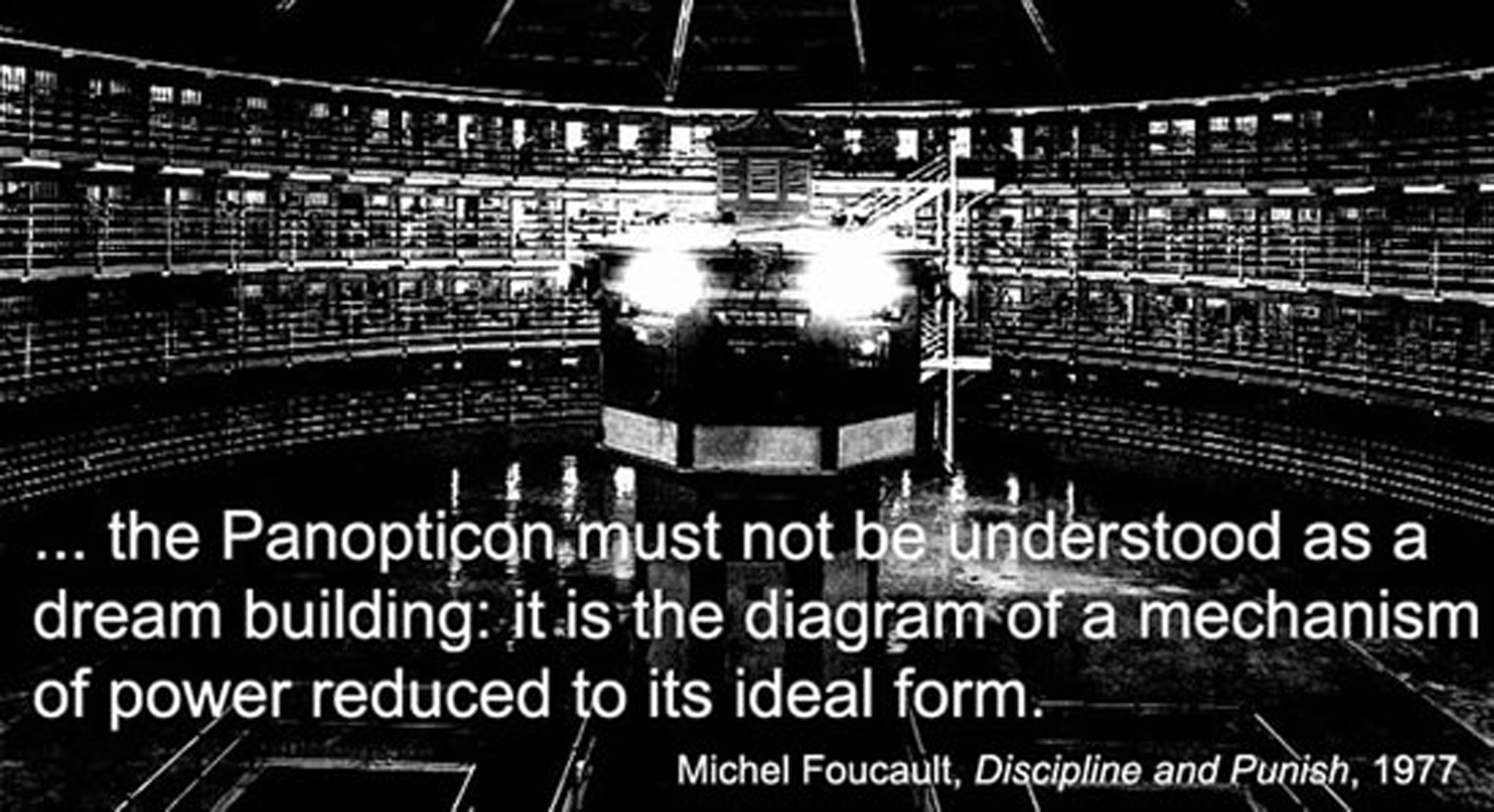
panopticon-image

By Douglas Haddow

Source: Adbusters

“So tell me, why did you leave your last job?” he asks.

The first thing I remember about the internet was the noise. That screeching howl of static blips signifying that you were, at last, online. I first heard it in the summer of ’93. We were huddled around my friend’s brand new Macintosh, palms sweaty, one of us on lookout for his mom, the others transfixed as our Webcrawler search bore fruit. An image came chugging down, inch by inch. You could hear the modem wince as it loaded, and like a hammer banging out raw pixels from the darkness beyond the screen, a grainy, low-res jpeg came into view. It was a woman and a horse.

Since then, I’ve had a complicated relationship with the internet. We all have. The noise is gone now, and its reach has grown from a network of isolated weirdos into a silent and invisible membrane that connects everything we do and say.

“I needed a bigger challenge,” I say. This is a lie.

The brewpub we’re in has freshly painted white walls and a polished concrete floor, 20 ft ceilings and dangling lightbulbs. It could double as a minimalist porn set, or perhaps a rendition chamber. Concrete is easy to clean. The table we’re at is long and communal. Whenever someone’s smartphone vibrates we all feel it through the wood, and we’re feeling it every second minute — a look of misery slicing across my face when I realize it’s not mine.

“Tell me about your ideal process,” the guy sitting down the table from us says. My eyes strain sideways. He looks to be about thirty; we all do. Like a young Jeff Bezos, his skin is the color of fresh milk. He’s dressed like a Stasi agent trying to blend in at a disco. Textbook Zuckercore: a collared blue-green plaid shirt unbuttoned with a subdued grey-on-grey graphic tee, blue jeans and sneakers. Functional sneakers. Tech sneakers. This is a tech bar. Frequented by tech people who do tech things. The park down the street is now a tech park. That’s where the tech types gather to broadcast their whimsy and play inclusive non-sports like Quidditch, which, I’m told, is something actual people actually do. It’s a nerd paradise where the only problems that exist are the ones that you’re inspired to solve. And I want in on it, because I want to believe.

“I’m a big fan of social,” I blurt out as an aside. He replies with a calm and ministerial nod. Nobody says “social media” anymore, it’s just “social” now.

My atoms are sitting here drinking a beer, being interviewed for a position at a firm that specializes in online brand management systems. Which is a euphemism for a human centipede of marketers selling marketing to marketers for marketing. The firm is worth a billion dollars. You’ve never heard of it. It’s the type of place where they force you to play ping-pong if you come in looking depressed. Meet the new boss, same as the old boss, except this one is very concerned that you see him as a positive force in the universe.

I’m here, bringing the cold beer to my dry lips and bobbing my head in my best impersonation of someone who doesn’t feel ill when he hears the words “key metrics,” “familiarity,” “control groups” and “variant groups.” It’s the dawn of the new creative economy, and I can dig it. I’m here, but I’m also spread across the internet in a series of containers. I’m in Facebook, I’m in Instagram, I’m in Google, I’m in Twitter and a thousand other places I never knew existed. Depending how my body is disposed of, it will either become dirt or atmosphere. But the digital atoms will live forever, or at least until civilization is incinerated by whatever means we choose to off ourselves.

“What about this position interests you?” he asks.

When the TechCrunchers preach the gospel of disruption, it’s from an industrial perspective that sees life on Earth as a series of business models to be upended. Disrupt or die is the motto, but they never mention the disruptees — the travel agents, the cab drivers, the bellhops. The journalists. The meat in the box before the box is crushed by the anvil of innovation.

“People have ideas about things but it’s a bunch of things. Sign up flow for example, high level things, but sometimes I think — let’s table this for now and put together some idea maps. I feel so empowered because we’re aligned,” someone else says. I look around but can’t trace the source.

It’s hard to focus on his questions when all the conversations occurring parallel to ours combine in a cacophony of sameness, as if we’re all Tedtalking a mantra of ancient buzzwords: Engagement. Intuitive. Connection. User base. Revolutionary. It’s like coke talk gone sour, not words that are meant to say things, but stale semiotics that signify you belong. This is the the new language of business. This is where Wall Street goes to find itself.

“I traded in my suit for khakis and sunglasses,” one of them says. But he’s wearing neither. “That’s the best decision you’ve ever made bro,” his colleague replies.

These are the most boring people on the planet. And it’s their world now, we’re just supplying the data for it. The game is simple: dump venture capital into a concept, get the eyeballs, take the data and profit. But the implications of this crude scheme are profound. Beyond all the hype, something weird is happening.

I can’t eat without instagramming my food. I can’t shit without playing Candy Crush. I can’t even remember who half the people are on my Facebook feed, but I’ll still mindlessly scroll through their tedious status updates and wince at their tacky wedding photos. Out of these aimless swipes, clicks and likes, a new world is being born. A world where everything we do, no matter how inane, is tracked, recorded, sorted and analyzed. Yahoo CEO Marissa Mayer has said the whole process is “like watching the planet develop a nervous system.” And through this system, every human action has become a potential source of profit for our data lords, a signal for them to identify and exploit.

“We are about to enter a world that is half digital and half physical, and without properly noticing, we’ve become half bits and half atoms. These bits are now an integral part of our identity, and we don’t own them,” says Hannes Grassegger.

Grassegger is a German economics journalist who was raised in front of his mom’s Macintosh, and later, on a Commodore 64 he got for his sixth birthday. He recently wrote “Das Kapital bin ich” (I am Capital), a book that has been criticized by the European left for being too capitalist, and by the right for being the communist manifesto of the digital era. In it he tries to answer a deceptively simple question: if our data is the oil of the 21st century, then why aren’t we all sheikhs?

“We’ve all been sharing. But the smart ones have been collecting — and they’ve packed us into their clouds,” he says. “Privacy. Transparency. Surveillance. Security gap. I don’t want to hear about it. These are sloppy downplayings of a radical new condition: We don’t own ourselves any more. We are digital serfs.”

Like Grassegger, and like everybody else, I was lured into this radical new condition with the feel-good promises of connection, friendship and self-expression. Apps, sites and services that allowed us to share what we loved, and do what we wanted. For Grassegger, these platforms were merely fresh lots ready to be ploughed, and in turn they kept the harvest: our feelings, thoughts, experiences and emotions, encoded in letters and numbers. Now they’re putting it all to work, exploiting these assets with algorithms and sentiment analysis, and our virtual souls are toiling even while we sleep.

His solution to this dilemma is practical and pragmatic, siding with a lesser evil of establishing a personalized free data market, which would allow us to exploit our information before others do it for us, arguing that “We must carry into the new space those rights and freedoms we eked out in the physical world centuries ago. The ownership over ourselves and the freedom to employ this property for our own benefit. Only this will help us leave behind our self-imposed digital immaturity.”

“KRRAAAAASHH!”

A waitress lets a pint glass slip from her hand and shatter on the floor, but no one bothers to look over; they’re too engaged. Then I notice something eerie about the vibe in this place. There’s no sneering, no sarcasm, and no self-deprecation. Everyone is just sort of floating along in an earnest tranquility. As if each anecdote about “that cool loft I found on Airbnb” contained some deep spiritual significance beyond my grasp.

My interrogator goes for a piss and I load up Facebook in the interim, hoping to find a shard of inspiration in my feed that will provide a topical talking point. Instead I find a listicle. A curiosity gap headline. An ad. A solicitation. Another ad. Another listicle. Oh dear, someone has lost their phone. And finally, an ad in the form of a listicle. Or is it a listicle in the form of an ad?

We were told to surf the web, but in the end, the web serf’d us. Yet there’s a worse fate than digital serfdom, as Snowden’s ongoing NSA revelations suggest. This isn’t simply about the commodification of all human kinesis, it’s the psychological colonialism that makes the commodification possible.

The nature of this bad trip was hinted at in June when we learned that Facebook manipulated the emotional states of nearly 700,000 of its users. Half of those chosen for the study were fed positivity, the others, despair. “The results show emotional contagion,” the Facebook scientists told us, meaning that they had discovered that alternating between positive and negative stimulus does indeed affect our behaviour. Or perhaps rediscovered. There’s a precedent for this. We’ve been here before.

Burrhus Frederic Skinner, known simply as B.F. to his BFFs, is best known as the psychologist with the painfully large forehead who tried to convince the world that free will was an illusion. But he wasn’t always so dire. He was once a young man with hopes and dreams who wrote poems and sonnets and wanted to become a stream-of-consciousness novelist like his idol, Marcel Proust. He failed miserably and it led him to conclude that he wasn’t capable of writing anything of interest because he had nothing to say. Frustrated and bitter, he resolved that literature was irrelevant and it should be destroyed, and that psychology was the true art form of the 20th century. So he went to Harvard and developed the concept of operant conditioning by putting a rat in a cage and manipulating its behaviour by alternating positive and negative stimulus. Now we’re the rats in the cage, only we don’t know where the cage ends and where it begins.

“What’s your five year vision for social?” he asks.

There’s a right way and a wrong way to answer this question. The wrong way is to be critical and cast scepticism on the internet’s role in our lives. For instance, you could draw a parallel between Facebook’s probing of emotional contagion and the Pentagon’s ongoing research into how to quash dissent and manage social unrest. Or you could mention how the Internet of Things will inevitably consolidate corporate power over our personal liberty unless we implement strict regulations on what part of ourselves can and cannot be quantified. But if you did that, you’d upset the prevailing good vibes and come off like a sickly paranoiac in desperate need of some likes.

The right way is to turn off, buy in and cash out. Reinforce the grand narrative and talk about how social is going to bring people together, not just online, but in the real world. How it will augment our interactions and make us more open. How in five years you’ll be able to meet your true love through an algorithm that correlates your iTunes activity to your medical history and how that algorithm will be worth a billion fucking dollars. And it’s through that magical cloud of squandered human potential that Skinner emerges once again and starts poking his finger into your brain.

After establishing himself as a household name, Skinner was finally able to live out his dream of writing a novel. That novel was Walden Two, a story about a utopian commune where people live a creative and harmonious life in accordance to the principles of radical behaviourism. In contrast to 1984 and Brave New World, it was meant to be a positive portrayal of a technologically-enabled utopian ideal. In it he writes, “The majority of people don’t want to plan. They want to be free of the responsibility of planning. What they ask for is merely some assurance that they will be decently provided for. The rest is a day-to-day enjoyment of life.”

In the late 60s, Walden Two directly inspired a series of attempts to create real world versions of the fictional community it described. These were just a few of the thousands of communes that were being established across America at that time. Some thrived, but the majority fell apart within a couple short years. They failed for a number of reasons: latrines overflowed, the tofu supply ran out, the livestock starved to death and so forth. But what many of them had in common was a cascading systems failure of their foundational hypothesis — that social change could be achieved through self-transformation and the problems of power could be solved simply by ignoring them. There was always a Machiavellian in the transformational mist, though, and a refusal to acknowledge outright how power creates invisible structures that undermine the potential for cooperative action ultimately led to their implosion. It’s in this stale pub, with its complimentary WiFi and overpriced organic popcorn, that those invisible power structures continue to thrive.

“There has to be incentive. There has to be. You can’t force people to use it,” a woman in the corner mutters. She’s among a cluster of people who for some reason are all carrying the same cheap, ugly backpack. Her hand gestures become more aggressive as the conversation progresses and she looks to be caught in a moment midway between panic and ecstasy. Her expression would make the perfect emoji for the inertia of our time. It looks sort of like this: (&’Z)

“Our notions of digital utopianism are deeply rooted in a communal wing of American counter-culture from the 1960s. That group of people have had an enormous impact on how we do technology. Many of the leading figures in technology come from that wing, Steve Jobs would be one,” says Fred Turner, a communications professor at Stanford University who researches and writes about how counterculture and technology interact.

“Their ideas of what a person is and what a community should be has suffused our idealized understanding of what a virtual community can be and what a digital citizen should be. That group believed that what you had to do to save the world was to build communities of consciousness — places where you would step outside mainstream America and turn away from politics and democracy, turn away from the state, and turn instead to people like yourself and to sharing your feelings, your ideas and your information, as a way of making a new world.”

There’s a fault line that runs underneath the recycling bins of America’s abandoned hippy communes all the way to my cracked iPhone 5 screen. And if there is one man who epitomizes the breadth of this fault, it’s Stewart Brand.

In 1968, Brand published the Whole Earth Catalog, an internet before the internet that provided a directory of products for sustainable, alternative and creative lifestyles, and helped connect those who pursued them. When the Whole Earth Catalog went out of business in 1971, Brand threw a “demise party” wherein the audience got to choose who would receive the magazine’s remaining twenty grand. They chose to give it to Fred Moore, an activist moonlighting as a dishwasher, who would go on to found the Homebrew Computer Club — the birthplace of Apple and the PC. In the 80s Brand launched The Whole Earth ’Lectronic Link, one of the world’s first virtual communities. Following its success, he started the Global Business Network — a think tank to shape the future of the world. They’ve worked on “navigating social uncertainty” with corporations like Shell Oil & AT&T, among others. In 2000, GBN was bought by Monitor Group, a consultancy firm that made headlines in 2011 by earning millions of dollars from the Libyan Government to manage and enhance the global profile of Muammar Gaddafi.

Brand’s most enduring legacy will likely come from coining the phrase “information wants to be free,” which serves as the business model for the Actually Existing Internet and the Big Data dream.

Looking around the brewpub, listening to the chatter, and staring into the bright blue eyes of my would-be employer, you can almost hear the words of Google CEO Eric Schmidt echo against the minimalist decor: “We know where you are. We know where you’ve been. We can more or less guess what you’re thinking about.”

In San Francisco, my fellow disruptees have taken to the streets and kicked off a proper bricks & bottle backlash against this sort of dictator-grade hubris that has come to define the Internet of Kings. Crude graffiti reading “DIE TECHIE SCUM” is scrawled on the sidewalk next to Googlebus blockades. TECH = DEATH signs are held up at protests. Tires are slashed, windows are smashed and #techhatecrimes is a hashtag that is being passed around Silicon Valley without a hint of irony.

Just down the street from where I’m sitting, a more passive form of protest has manifested in the form of a new café that promises an escape from the incessant blips and bleeps of the internet and its accoutrements.The tables there are also long and communal, but they’re wrapped inside an aluminum metal mesh designed to interrupt and restrain wireless signals and WiFi.

We are not going to escape this crisis by putting ourselves in a cage. There is no opt-out anymore. You can draw the blinds, deadlock your door, smash your smartphone, and only carry cash, but you’ll still get caught up in their all-seeing algorithmic gaze. They’ve datafied your car, your city and even your snail mail. This is not a conspiracy, it’s the status quo, and we’ve been too busy displacing our anxiety into their tidy little containers to realize what’s going on.

“Do you have any questions for me?” he finally asks, abruptly. My beer is empty, I’m thirsty for another, and the interview hasn’t gone well. I’ve failed to put on a brave face and the only questions that I have concern how much money I’m going to make. Will it be enough to pay for my escalating rent now that the datarazzi have moved into the neighborhood? Or will I have to drive an Über in my spare time to make ends meet?

The internet is a failed utopia. And we’re all trapped inside of it. But I’m not willing to give up on it yet. It’s where I first discovered punk rock and anarchism. Where I learned about the I Ching and Albert Camus while downloading “Holiday in Cambodia” at 15kbps. It’s where I first perved out on the photos of a girl I would eventually fall in love with. It’s home to me, you and everybody we know.

No, the appropriate question to ask is: “What is the purpose of my life?”

I’ve seen the best minds of my generation sucked dry by the economics of the infinite scroll. Amidst the innovation fatigue inherent to a world with more phones than people, we’ve experienced a spectacular failure of the imagination and turned the internet, likely the only thing between us and a very dark future, into little more than a glorified counting machine.

Am I data, or am I human? The truth is somewhere in between. Next time you click I AGREE on some purposefully confusing terms and conditions form, pause for a moment to interrogate the power that lies behind the code. The dream of the internet may have proven difficult to maintain, but the solution is not to dream less, but to dream harder.